The Netherlands is supporting Ukraine in the war against Russia with weapon shipments and military defence. Here’s what you need to know.
On Saturday, the Dutch Ministry of Defence has announced in an open letter to the parliament that they have decided to ship military weapons and defence equipment to Ukraine “as quickly as possible.”
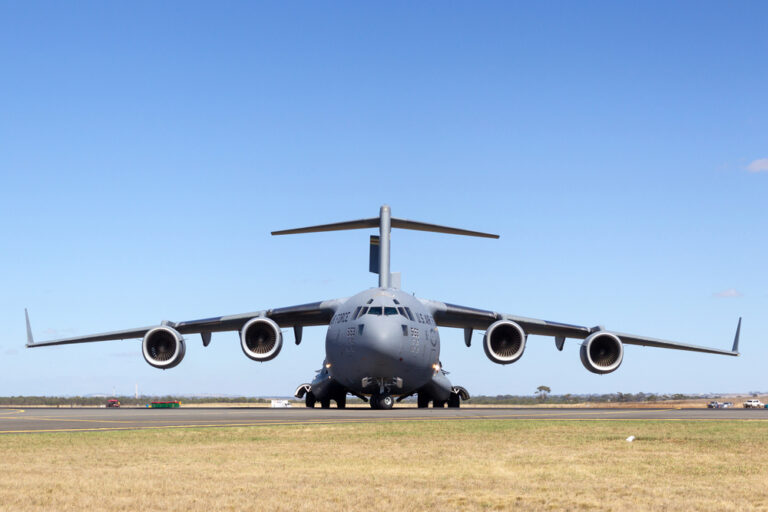
At the moment, 50 Panzerfaust 3 anti-tank weapons, 400 rockets, and 200 FIM-92 Stinger missiles are being transported to an unknown Eastern European country on board a C-17 cargo aircraft.
The plane departed from Eindhoven airport yesterday. Already before that, 100 sniper rifles together with 30,000 pieces of ammunition and two diving crafts had been supplied.
What kind of weapons is the Netherlands sending?
The Panzerfaust 3 is a portable weapon that is meant to fend off tanks, low-flying helicopters, and on-the-ground military defences. The weapon is suitable to fire at a distance of about 600 metres.
The FIM-92 Stinger missile is also a portable weapon that is designed to aim at aircraft from the ground level. These missiles are meant to protect ground troops from air-born attacks and can fire from a distance of up to five kilometres.
The two diving crafts are underwater robots designed to detect and protect naval forces from underwater mines.
De 50 Panzerfaust 3-antitankwapens (+400 raketten), 100 scherpschuttersgeweren (+30.000 stuks munitie) en de 200 Stinger luchtdoelraketten zijn op weg naar Oekraïne. Aan boord zijn ook twee detectierobots voor (zee)mijnopsporing. #StandWithUkrainehttps://t.co/c7VrNtJdU4pic.twitter.com/2DgfJyKCJi
Translation of an official Tweet from the Dutch Ministery of Defence: “The 50 Panzerfaust 3 anti-tank weapons (+400 rockets), 100 sniper rifles (+30,000 pieces of ammunition), and 200 Stinger air-target missiles are on their way to Ukraine. Two detector robots for (underwater)mines are also on board.”
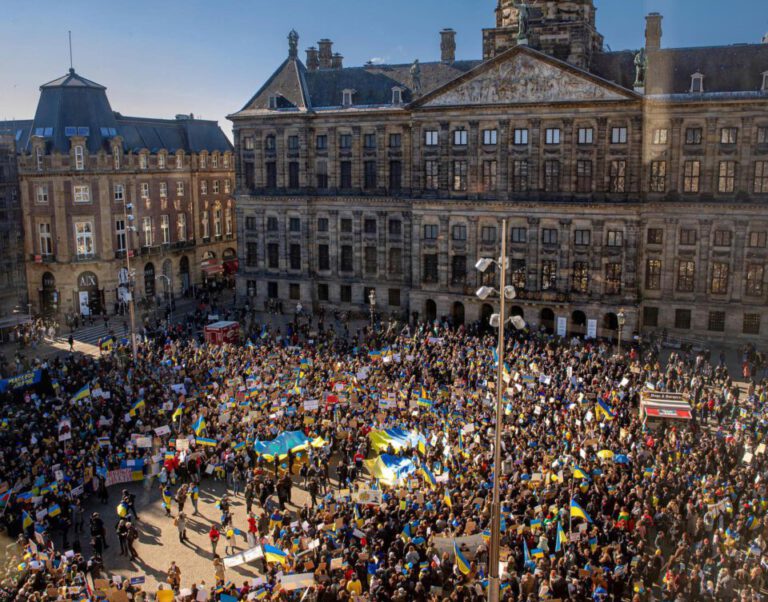
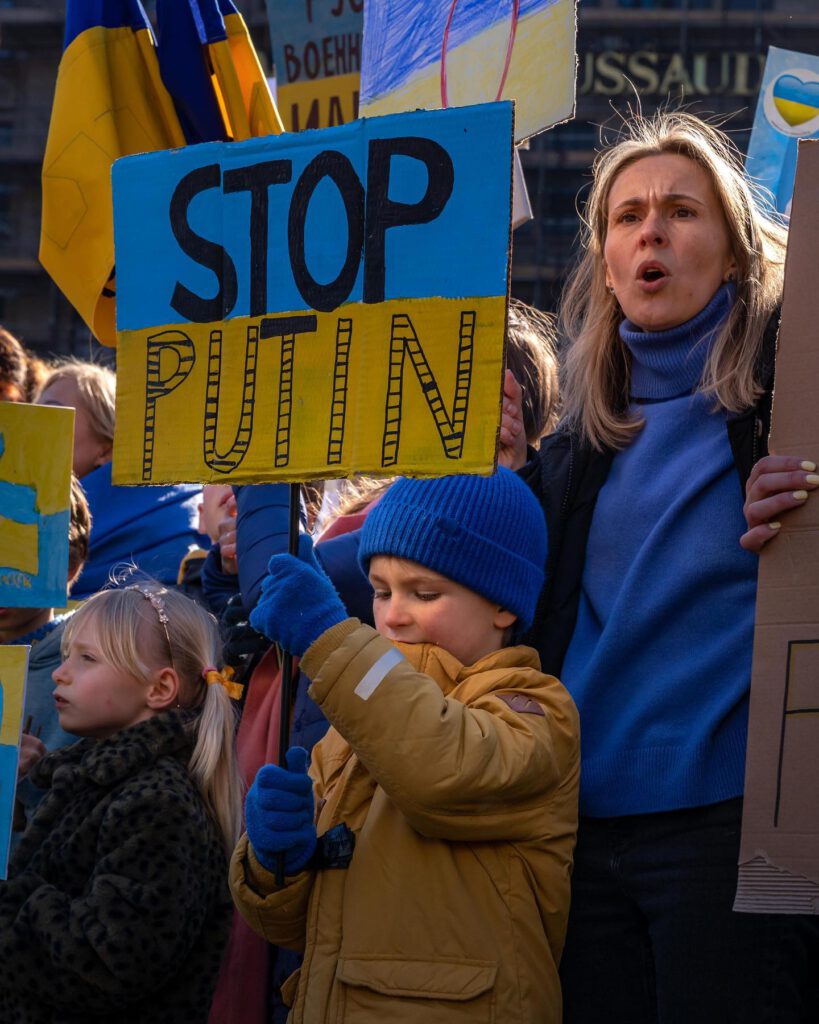
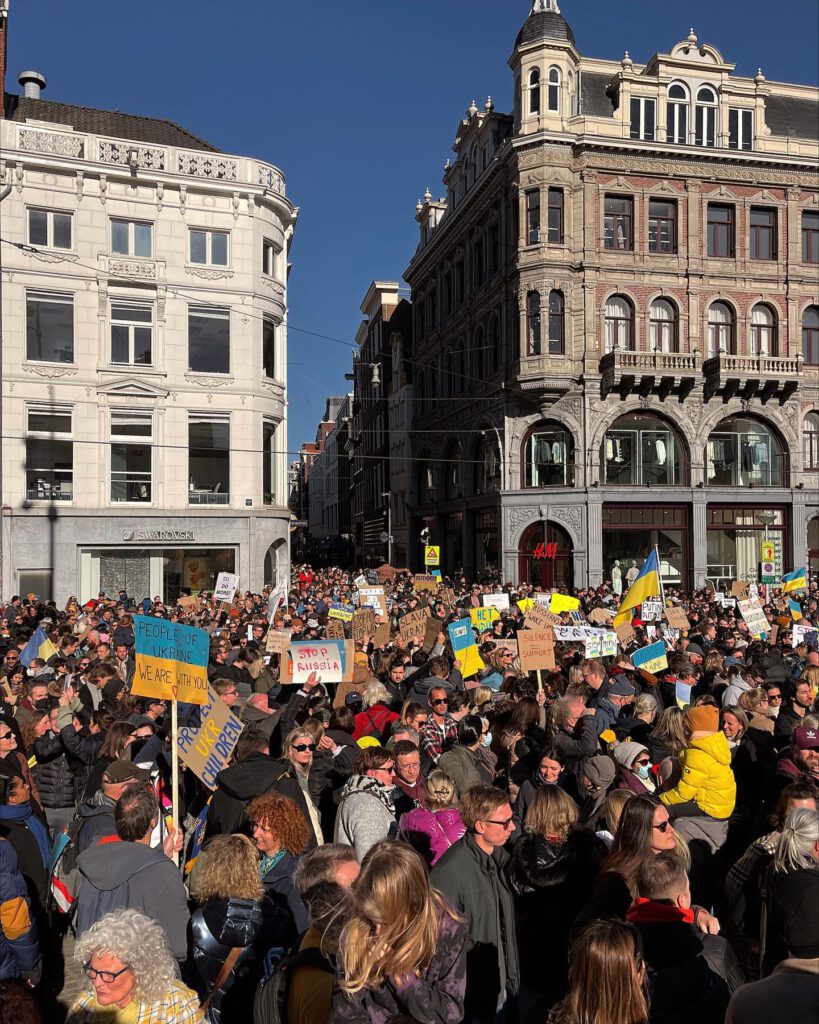
Activists kicked off with a speech: “A war against Ukraine is a war against Europe.” More speeches were held in Dutch, English, Ukrainian, and Russian.
The protesters’ main demands were to close the airspace over Ukraine and stop SWIFT payments to Russia.
The Facebook page of the Peace for Ukraine campaign asked people to stand in solidarity with Ukraine, support refugees, and call for peace and freedom in Ukraine.
Organisations including Peace SOS, Migreat, and Free Russia NL collaborated to form the huge protest on Dam Square.
Organisers are planning more protests in the upcoming days and continue to demand closure of the Ukrainian airpsace and SWIFT payments to Russia.
Dutch Prime Minister Mark Rutte says NATO asked the Netherlands for combat aircraft. Dutch Defense Minister Kajsa Ollongren confirmed fighter jets already took off from Leeuwarden earlier today.
Ter versterking van de verdediging van de NAVO-Oostflank staan we 24/7 klaar. Twee F-16’s van @VlbVolkel zijn zojuist opgestegen om bij te dragen aan de NAVO-airpolicing missie boven Polen. #WeAreNATOhttps://t.co/W6mW7gGEz0
“We are available 24/7 to strengthen the defence of NATO’s eastern flank. Two F-16s of @VlbVolkel have just taken off to contribute to the NATO air policing mission over Poland. #WeAreNATO.”
NATO also requested Dutch military movement in the coming weeks. Minister Ollongren clarified that NATO is a “defensive organisation” and the movement of the military is about “being ready” to take action in a NATO context.
Increasing preparation
A spokesperson for the Dutch army said troops and equipment will be moved for training exercises. Dutch units of the NATO response force are also ready to decrease response times.
The Netherlands is also a very important transit point for other NATO members such as the US, the UK, and Canada. If such members decided to deploy equipment and troops into mainland Europe, they would go through the Netherlands.
Mayor Aboutaleb of Rotterdam also announced this morning that the Port of Rotterdam could play an even greater role in the transports, including the shipment of tanks.
In that case, the Minister of Defense and Minister of Justice would take authority of that area of the port.
According to the Dutch Food and Consumer Product Safety Authority (NVWA), four people in the Netherlands are ill after drinking the molly-champagne mix.
Specifically, NVWA warns that the drug has been found in three-litre champagne bottles from the brand Moët & Chandon Ice Impérial, reports the NOS.
So, before popping open some bubbly, you might want to read the following. 👀
What to look out for
Thankfully, you should be able to spot pretty quickly whether your champagne bottle contains MDMA or not.
Firstly, a tell-tale sign is that the champagne won’t fizz when you pour it. Additionally, MDMA contaminated champagne is a reddish-brown colour and smells like anise — yuck! 🤢
Although you were probably looking forward to celebrating a special occasion, do yourself a favour and pour that nasty drink down the drain. 🙅♀️
According to the NVWA, molly and champagne do not mix well: touching or drinking it can be life-threatening. Across the border, seven people in Germany are seriously ill and one person passed away.
More bottles might be contaminated
The bottles containing MDMA were bought through an unknown website. However, it’s not known just how the molly ended up in them.
According to the Dutch Food and Consumer Product Safety Authority, “The NVWA is, therefore, unable to estimate whether there are even more of these bottles with the hazardous substance in circulation. It cannot be ruled out that other bottles of the same brand that also contain MDMA are in circulation.”
So, until more is known you might want to skip the Moët, or at least have a good look at your drink before you say cheers. 🥂
What are your thoughts on drug contaminated champagne? Tell us in the comments below!
The 1.5-metre social distancing rule will be removed from all public areas — for the first time since spring 2020! (Except for that one blissful period in autumn 2021).
The face mask rule is also on its way out except for travel (public transport, airplanes, and in the airport).
Plus, after being hard-pressed for months, the catering and cultural industry can finally keep their regular opening hours from before the pandemic — hoera for nightclubs! 🎉
Pre-test rules
Most places also do not need to use a coronapass anymore. Rules still apply for large indoor events with more than 500 people without fixed seating. Participants at those will have to show a negative test beforehand (1G measures).
However, a negative test isn’t necessary for trade fairs, conferences, and transfer locations while travelling.
The coronapass may be required to travel abroad, but that depends from country to country. The quarantine rules upon travel to the Netherlands expires. Time to get those suitcases ready! ✈️
What’s happening next?
The cabinet will reassess the remaining coronavirus measures on March 15, such as whether to keep the face mask rule in public transport, 1G policies, and the advice to work from home.
On the flip side, removing the coronavirus restrictions is not all happy, jolly for everyone — vulnerable members of society, such as those with chronic illness have to be extra careful without these restrictions.
What are your thoughts on the relaxed measures? Tell us in the comments below!
So, politicians aside, how is the Netherlands showing its support for the people of Ukraine?
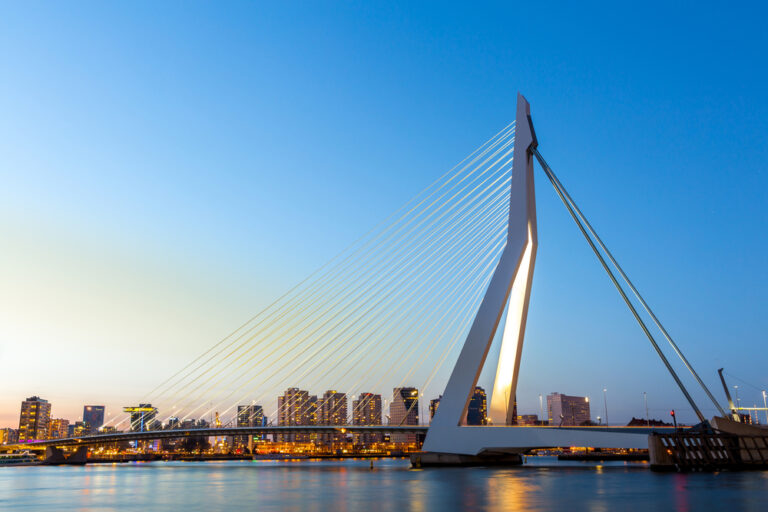
Erasmus Bridge to be illuminated in blue and yellow
The city hall of Rotterdam made sure to address the growing conflict this morning. The mayor, Ahmed Aboutaleb, announced that the city’s iconic Erasmus Bridge will be lit up later today in the colours of the Ukrainian flag. 💙💛
Om onze steun uit te spreken voor het Oekraïense volk dat geconfronteerd wordt met Russische militaire agressie en een aanval op hun grondgebied, zal de Erasmusbrug vanavond blauw-geel kleuren 🇺🇦.
“To express our support for the Ukrainian people facing Russian military aggression and an attack on their territory, the Erasmus Bridge will turn blue-yellow tonight 🇺🇦.”
Following the suggestion of Councillor Pascal Lansink-Bastemeijer of the VVD, it was also decided that the city hall will hoist the Ukrainian flag “to encourage the Ukrainians,” AD reports.
Singing in support
Support for Ukraine was also seen in Amsterdam’s Dam Square today. In spite of the horrible weather, many people headed to the world-famous square to sing the Ukrainian national anthem.
“Getting teary-eyed, just walked into Dam Square and the Ukrainian national anthem is being sung.”
More support from the cabinet
Wholesome news aside, the Dutch cabinet is also preparing to potentially supply more soldiers in an effort to curb the Russian attack.
Dutch Minister of Defense, Kasje Ollongren has said that Dutch troops will not be sent to Ukraine — as it is not a member of NATO — however, they must prepare to be mobilised.
No troops will be sent yet, they will be on standby should they need to mobilise to other NATO regions such as the Baltic States or Poland, the NOS reports.
So you’re thinking of going back to school to level up your business career and uncover your leadership potential. Good on you!
But with so many MBAs out there, how do you choose the right one? Sure, you can just browse hundreds of university websites and brochures and end up with a 20-pages long list of pros and cons for each school to base your decision on.
The smarter thing to do, though, is to join Access MBA’s free one-to-one event in Amsterdam and talk to representatives of the world’s top MBA schools in person.
That’s right — no more awkward moments on Zoom because you forgot to put yourself on mute or turn on your camera. 🎉
Access MBA educates, matches, and connects prospective MBA applicants with accredited and top-ranking business schools from around the globe.
Ready to take your career to the next level? Image: Access MBA/Supplied
At this in-person event, you will have the ideal opportunity to learn more about the world’s most recognised business degrees and speak face-to-face with admissions directors of leading international institutions from the Netherlands, the UK, Germany, France, Spain, and more, such as:
Amsterdam Business School,
Maastricht School of Management,
ESCP Business School,
HEC Paris,
IE Business School.
How can Access MBA help me on my professional journey?
There are three things that make the Access MBA event one of a kind:
1. One-to-one meetings, workshops, and more
Personal chats with representatives of some of the world’s top business schools, panel discussions with alumni, interactive workshops on test preparation. This one-to-one event will ensure that you’re really getting to know your options.
TIP: Prepare questions in advance so you can make the most of your time. 🤓
2. Personalised experience
With so many university applicants, who has time these days to take you by the hand and actually guide you through the programs that best fit your background and expectations? At this event, you’ll be able to personally chat with representatives of schools that fit your preferences.
3. You can win some cool prizes
Now, who doesn’t like to win things? At the end of each session, Access MBA awards one student with a free trip to a university campus of their choice. This could be you!
Pssssst! We hear that participants who actively engage in the discussions during the event have a higher chance of winning. 😉
If you’re not the lucky one, don’t worry. Access MBA has a multitude of other prizes and incentives for participants, such as a free GMAT online course by Manhattan Review.
I’m in! How do I sign up?
To join the event, all you need to do is head over to the Access MBA website and click the signup button. Here’s a quick overview of all the details:
👨🎓 What: One-to-one MBA event for the residents of the Netherlands 🏨 Where: Hilton Hotel Amsterdam, Apollolaan 138, Amsterdam 🕙 When: Saturday, March 5, 2022, from 10 AM to 2:30 PM ✍️ Where do I sign up: At the Access MBA website
Will you be joining this MBA event? Let us know in the comments below!
Has the popular Maza hummus been a staple on your grocery list? Perhaps it’s time to rethink that choice for the time being. 😬
The spread producer has warned that listeria might be present in two types of its products — the Esfenaj spinach dip and the less salt Hummus, RTL Nieuws reports.
The Dutch Food and Consumer Product Safety Authority has issued a safety warning.
What’s the deal with listeria?
The bacteria can be particularly harmful to elderly people, children, people with a weakened immune system, and pregnant women.
While the chances of getting infected with listeria are actually small, the consequences can be pretty severe if you do end up getting listeriosis. In extreme cases, it can lead to miscarriage and premature birth.
❗ What to look out for?
These are the specific Maza products said to contain listeria:
Maza Esfenaj 200g (spinach dip) Best before: March 19, 2022 Barcode: 8714779003897
After all that wind and rain, the Netherlands is expected to enjoy drier and sunnier weather over the next 30 days. However, Dutch weather isn’t one to play by the rules — we may also see some anomalies. 😳
February 2022 will go down as one of the strangest months for the weather. From three storms in one week (and a code red storm, at that) and too much rainwater, even for the Netherlands, the weather is only getting weirder.
Why? The Netherlands can expect what meteorologists are calling a “meteorological spring.” It is expected to start in late February and continue into March. 🏃🏻
February and March forecasts
According to Weerplaza, February 2022 will end “quite nicely”, maybe even spring-like! The weather will be especially nice this coming weekend (February 26 and 27), with plenty of sunshine!
However, not everyone is safe. The end of February will also be unusually rainy. ☔️ Some parts of the Netherlands can expect up to 200 millimetres of rain, while most of the west and southwest will be drier with 70 millimetres of rain.
Unusually cold weather in March
Meanwhile, March will also have some sunny weather and little rain — but if we turn to temperature, this is where things get weird. 🥶
Weerplaza expects significant temperature fluctuations, with extremely low temperatures around -5 to -6 degrees Celsius and extremely high temperatures from 10 to 13 degrees Celsius!
Of course, there are always chances of rain in the Netherlands but we shouldn’t be expecting anything too dramatic.
What kind of weather are you hoping for in March? Tell us in the comments!
Earlier this week, the Netherlands was shaken by a hostage situation at an Apple Store in Amsterdam. The hostage-taker was eventually stopped when he was hit by a car — he has now died from his injuries.
This was announced last night by his lawyer, the NOS reports.
What happened?
The dramatic episode came to a close when the 27-year-old hostage-taker requested water from the police. When he stepped outside with his hostage to receive the water, the hostage broke free and began to run.
As the hostage-taker gave chase, he was struck by a car which left him laying on his back on the ground outside of the store.
Explosives check
However, he could only be brought to hospital once police had determined whether or not he had any explosives attached to him. Reports at the time claimed that he could still speak to police whilst being brought in.
It would later be revealed that he sustained serious injuries. He passed away in the hospital last night.
The Public Prosecution Service has announced that the prosecution of the 27-year-old man has been dropped in light of his death, however, the investigation into the dramatic events of Tuesday night will continue.