Flat-hunting in the Netherlands? You’d better brace yourself for housing websites sneakily charging you a small fortune through auto-renewing subscriptions.
The Dutch Consumer’s Association (Consumentenbond) has just done some digging on housing websites in the Netherlands, and the results aren’t pretty. 👇
Wait, I have to pay to LOOK for housing?
If you’ve flat-hunted in the Netherlands before, you probably know the drill. If you haven’t had the (dis)pleasure, it goes something like this: you find a room you like on a housing website and think, hoera, housing at last!
Except… before you’re allowed to respond to the listing or contact a landlord, you’re directed to a payment portal, where you’re required to pay the website’s subscription fee.
These subscription fees range from €19.95 to €39 per month, and are often undisclosed (or buried deep in a FAQ list! 👀) when you’re viewing these websites.
Given the rising cost of… well, everything in the Netherlands, this isn’t money you’d want to lose! Image: Dreamstime
In addition to this severe lack of information about subcription costs, the Consumentenbond notes that these sites also fail to inform flat-seekers what these fees entail.
The result? Over 40% of the participants surveyed were unsure what they were even paying for.
And, adding insult to injury, a whopping 87% of the panellists in the study couldn’t even secure housing through these sites. Talk about a waste of money! 😬
Here’s what you should do instead
The Consumentenbond ended their report on a high note, with some handy tips for flat-hunters who don’t want to feel scammed out of their hard-earned euros. ⤵️
Compare platforms: given the Netherlands’ rampant housing shortage, rooms and apartments may be listed simultaneously on multiple websites
Look for free alternatives: real estate agents often put up listings on free-to-use websites like Funda as well
Keep track of your auto-renewing subscriptions: dodgy housing websites love it when you forget about your subscription, so remember to stay on top of it
Plus, from one international to another, don’t forget about good ol’ social media! Most of the major cities in the Netherlands have dedicated Facebook housing groups, and these listings are often vetted by eagle-eyed scam-hunters.
What housing scams have you come across in the Netherlands? Share them in the comments below!
What lies in the Caribbean Sea is a Dutch tropical island that’s booming with sandy beaches, soul cuisine, and blossoming flora. It’s truly a paradise for any vacation lover: Sint Maarten.
Where the sun meets blue skies, this island sits as a tiny speck on the world map, but despite its size, it has heaps in store for any avid holidaymaker who seeks a trip to the warmth.
Ready to jet off? Jump to the info you need below!
Ah, a question that I, as a native-born, am all too familiar with, as every time I exchange first-time pleasantries with an international, this question pops up.
Understandably so, considering that it’s not exactly a place you often see in the news, on social media, or anywhere really — unless something super funny or super devastating happens.
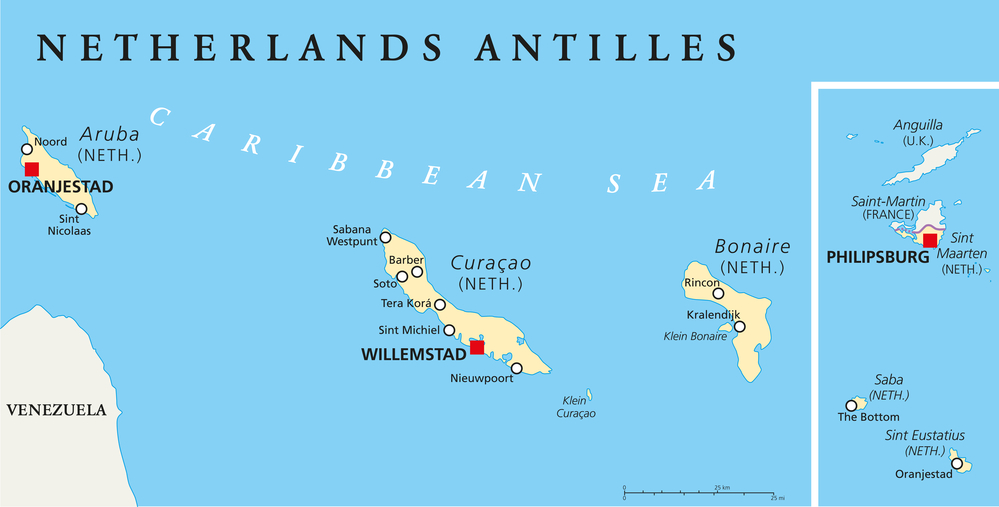
Sint Maarten is one of the four countries of the Kingdom of the Netherlands, perched next to and between a group of islands in the Lesser Antilles.
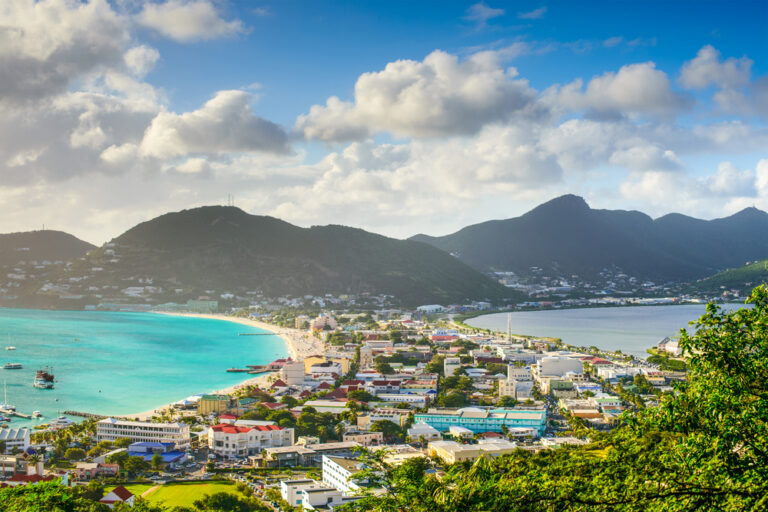
Can you find Sint Maarten on the map? Image: Depositphotos
It holds a mere population of around 40,000 people with a total area of 34 km². In other words, it’s smaller than a grain of sand on a beach.
✅ What to do in Sint Maarten
Whether you’re planning to spend your next summer out of the lowlands, or desperately want to escape the cold front this Dutch winter (if your wallet allows you, of course), Sint Maarten promises a special time.
As soon as you step foot on the island, you’ll be marked by colourful wildlife, calm waters, and all-around 30-degree weather for that natural sun-kissed (or sun-drenched) look.
If you’re looking to get the most out of your vacation in Sint Maarten, then we have (more than) a few suggestions. 👇
Catch planes taking off at Sunset Beach Bar
A wee bit too touristy for a local’s tastes, but a must-do if you’re a first-timer in Sint Maarten — Sunset Beach Bar rests on a white, sandy beach at the end of the airport runway.
Enjoy an icy cold biertje while you admire a gorgeous ocean-side view, but hold on tight to that beer (and your jaw, for that matter), because once you see a plane land on the island’s very short runway, both will be dropped.
For the ultimate experience, you can stand on the beach and get blasted by the planes as they take off, but this doesn’t come without risks. (Exhibit A: the video below. 👇)
Eat fresh local food at Mullet Bay Beach
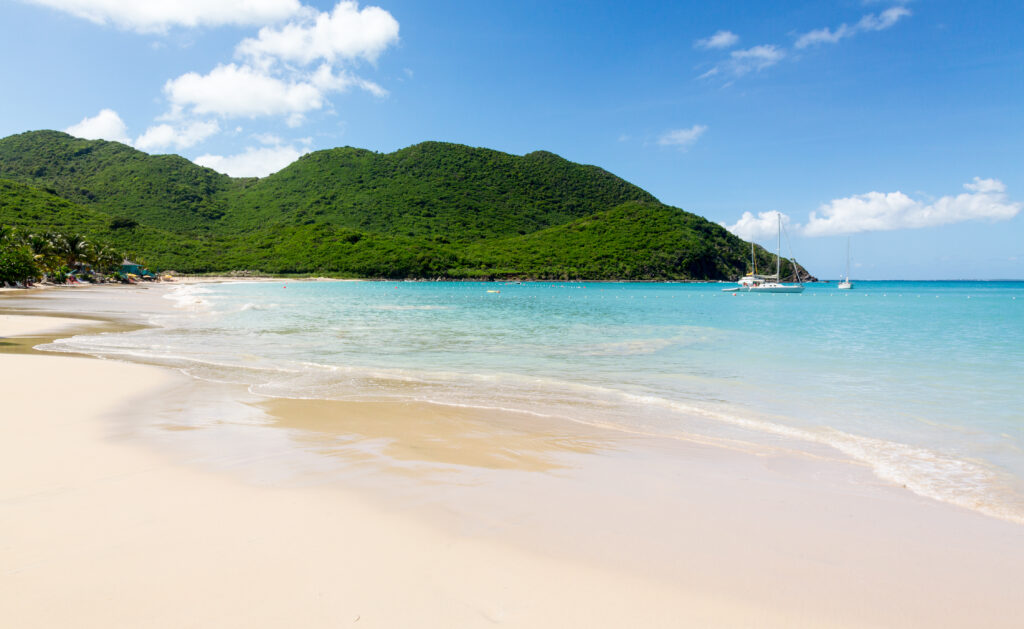
If you’re on the hunt for that perfect beach bliss, then Mullet Bay Beach is a sure thing. You’ve never seen water as clear, or sand as soft, as on this beach. Trust me.
On a calm day, you can swim amid still waves, focus on getting an even tan, or grab a buddy for a friendly game of volleyball over at the net.
For lunch? Make your way to Rosie’s Shack at the beach’s starting point for a plate of fresh-off-the-grill ribs, complete with a side of Caribbean-style coleslaw and rice and beans.
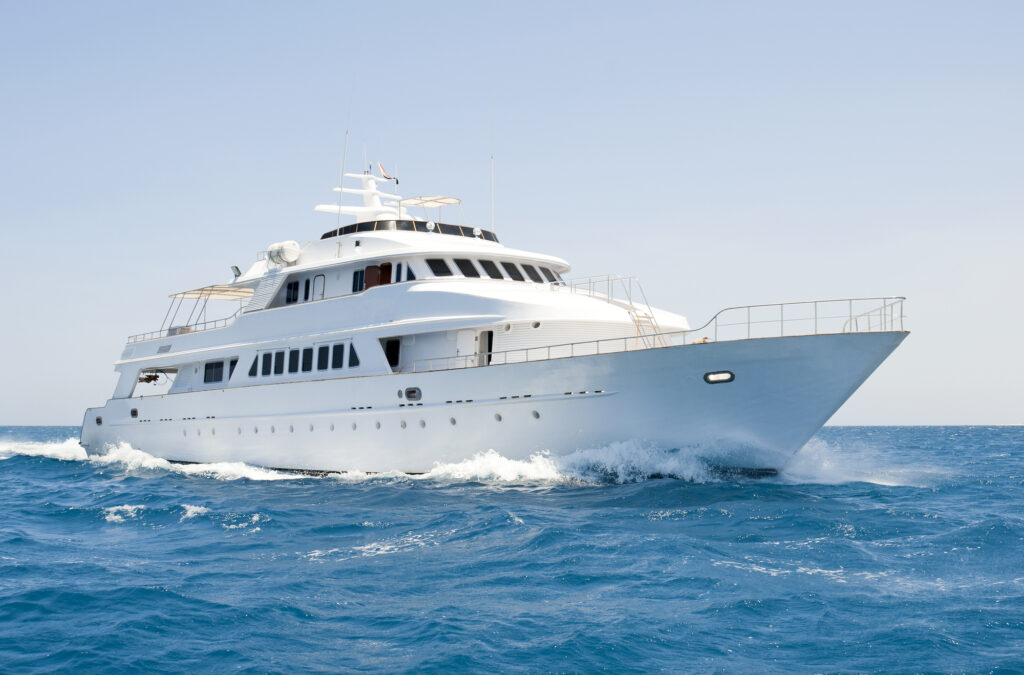
Book a cruise around the island on a charter boat
The best way to discover the island’s charms, from its beautiful landscapes to its underwater treasures, is by letting the sea take you for a ride.
Sint Maarten offers a variety of charter boats that you can reserve or book a spot on, and each brings you to the island’s many beaches. All in all, it’s an action-packed day filled with fun (and beer)!
Take a ride on a dune buggy and tour the island
Too prone to sea sickness to enjoy a good boat ride? Geen probleem. You can still explore Sint Maarten’s gems and stick to land. How? By hitching a ride on a dune buggy.
Rent one of these bad boys, and go on a thrilling tour across the island brimming with sand, sun, and adventure.
Eat sushi with an amazing view at Bamboo House
While sushi restaurants can be found anywhere in the world, not all successfully deliver the real Japanese sensation.
With fresh fish stuffed in a unique and delectable combination of fruits, vegetables, and seaweed, the sushi that Bamboo House offers makes their restaurant the exception.
Situated on top of a hill in Cole Bay, you can eat your meal with a stunning backdrop of the island’s terrain. (P.S., try the Kuta Roll. I command you.)
Have a unique experience at Parotte Ville Bird Sanctuary
Ok, so this one’s technically on the French side, and it takes a while to get there by car — but this bird park is one of the island’s main highlights, and it’s a hot topic amongst the tourists.
Step into a magical room chock-full of bird species, and become entranced by their beauty.
The best part? You’ll be given a cup of food to feed the little fellas, and they’ll come flying down to snack off your cup while you walk around. Gezellig! 🤩 (Or terrifying. Whatever you’re into. 👀)
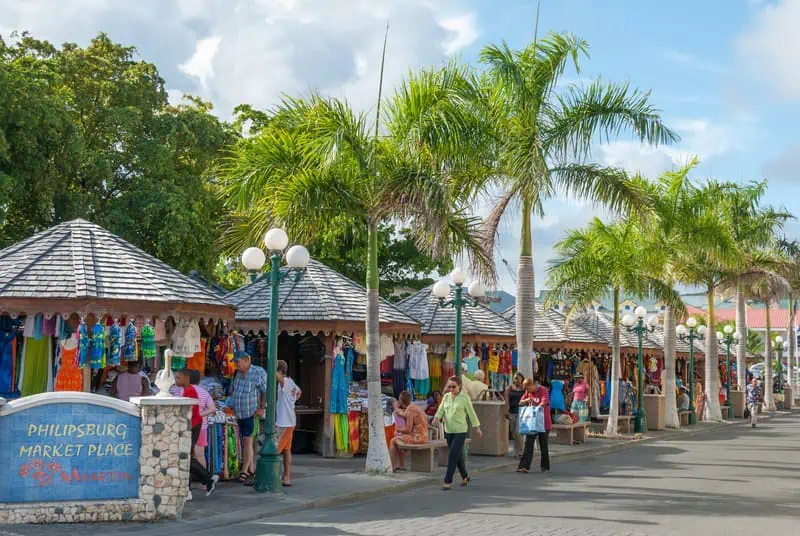
You could also stroll down and check out the Philipsburg marketplace! Image: Dreamstime
Snack on bitterballen at Karakter Beach Bar
Despite wanting to escape their country regularly, Dutchies can’t leave without taking their whole life with them, a.k.a Dutch food, Dutch drinks, and a box set to watch Dutch television.
Well, they can find joy in knowing that Sint Maarten has a beach bar that brings many of their essentials to the table. Ever had bitterballen under a palm tree with a view of clear blue water? No? Now’s your chance.
Go on a zipline down Sentry Hill
A rather new addition to Sint Maarten’s hidden gems, any visitor eager for an exhilarating experience must add this to their vacation itinerary.
Get carried by a lift to the top of Sentry Hill, and take in a breathtaking view of Sint Maarten that, on a clear day, also features its neighbouring islands, like Anguilla and St. Eustatius.
Once you’re done (and have captured enough selfies to fill up your iCloud storage), grab the zipline and fly down as fast as a pelican catching its prey.
See fancy boats cross the bridge at the Yacht Club
An underrated gem, the Yacht Club is essentially the designated hang-out spot for Dutchies who live on or frequently visit the island.
On many evenings, flatlanders assemble here to enjoy idle chit-chat and sip on a Heineken. Well, that’s my definition, anyway.
Located next to a drawbridge that connects the Simpson Bay lagoon to the open sea, it’s the go-to place if you want a spectacular view of sailboats, yachts, and speedboats passing through the bridge. Also, don’t forget to wave. 👋
🛌 Where to stay in Sint Maarten
The island is home to some undoubtedly cosy and high-quality hotels, but with so many choices, how can you tell which one to book a room at?
We’ve laid out all the best resorts on the Dutch side, and each comes with its own unique, tropical vibe, relaxing atmosphere, and set of top-notch facilities.
Sonesta Maho Beach Resort: An all-inclusive family resort complete with giant pools and lush spas. It’s situated next to Sunset Beach Bar and in one of the island’s most exciting nightlife hotspots, Maho.
Mary’s Boon: Just a stone’s throw from Karakter Beach Bar, this rustic resort sits on a beach, which means you can wake up to the sound of waves crashing against the shore, and watch the sun go down every evening.
The Cliff: Got some heavy cash to splurge? Consider staying at this modern, towering hotel complete with fancy sweets and a gorgeous seaside view.
Pelican Hill Resort: A beautiful, secluded hotel, perfect for those seeking an intimate vacation filled with solitude and relaxation.
Divi Little Bay Beach Resort: If you’re more or less looking to stay in one place on your vacation in Sint Maarten, this resort exudes the ambience of a laid-back small town. It comes fully equipped with a luxurious spa, a convenience store, a private beach, a pool area, and more.
Atrium Beach Resort: A quiet, beachfront resort equipped with snug rooms, a gym, and a tour desk that arranges snorkelling and island boat trips. Around the corner, you’ll find Buccaneer Beach Bar, which is one of the island’s lively social hubs.
Belair Beach Hotel: An all-suite beautiful resort, where you can enjoy a comfortable room with a view overlooking a vast, blue ocean and a cruise ship dock.
☀️ The best time of year to go to Sint Maarten
While the island’s close proximity to the equator makes for sunny, high-temperature weather all year round, you should aim to visit Sint Maarten during the summer or spring.
Of course, as this Dutch winter promises freezing temperatures with rain as a permanent resident, many in the Netherlands would prefer to spend the cold season in the tropics.
This will make you book your ticket! Image: Freepik
However, prices typically tend to skyrocket around Christmas time, so unless you’ve got pennies to lose, we recommend planning your holiday for the months following the new year.
Next to that, hurricane season lasts from the beginning of June until the end of November, but if we’re down on our luck, storms generally hit Sint Maarten in August and September. So, retreating to the island might not be ideal during those two months.
From a local’s perspective, the absolute best (and cheapest) time to take a vacation in Sint Maarten is spring, when school is in session, and the island is relatively quiet.
💶 How much to budget when going to Sint Maarten
Sint Maarten isn’t the cheapest holiday destination around (after all, paradise does come at a price).
In general, you can expect to spend anywhere from $100 to $400 USD per night on accommodation, and around $100 a day if you’re eating out and going on excursions.
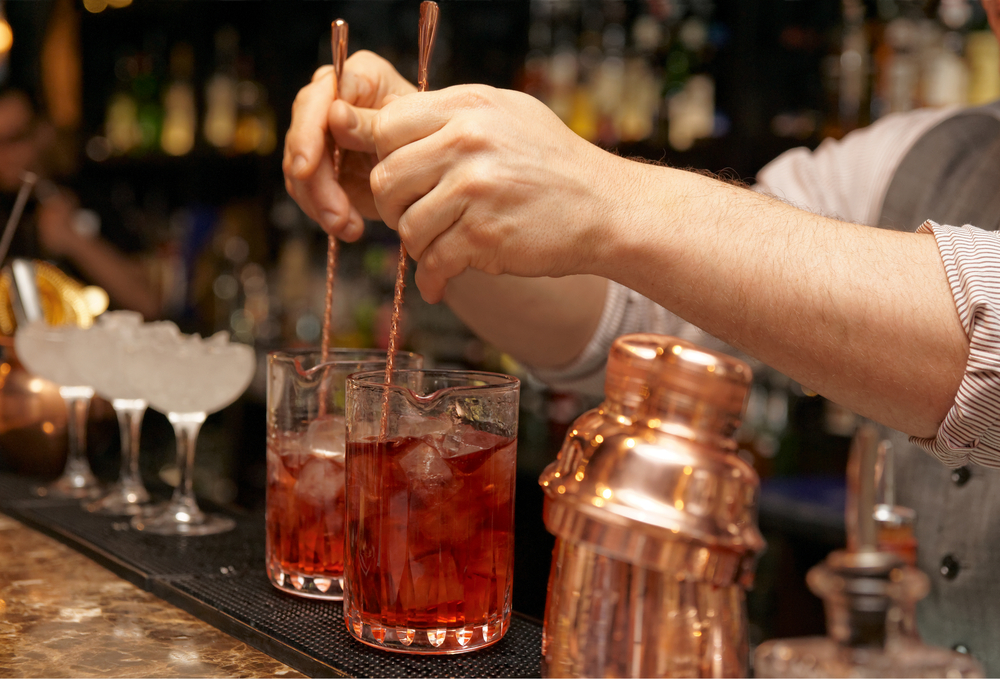
Spend your savings on lekker cocktails! Image: Depositphotos
Of course, you can cut those costs by staying in cheaper hotels and spending your day enjoying Sint Maarten’s beautiful nature instead of drinking fancy cocktails. 🍸
Also, despite being half-French, half-Dutch, the Dutch side uses USD primarily, while the French side’s official currency is the euro. Yes, it’s strange. No, we aren’t apologising.
🥸 A history that spans centuries
Dutchies might’ve heard about the island because of the starring role it played in the kidnapping of Freddy Heineken, where his captors chose Sint Maarten as their hideaway.
Or, perhaps you were introduced to the island by Auntie Hurricane Irma, who graced us with her presence back in 2017.
Nearly wiped out by the strongest storm in the Atlantic Ocean to date, Sint Maarten appeared on several Dutch and international news channels. Hey, thanks for the few minutes of fame! 👋
Regardless, the island’s long and rich history is one worth knowing about — and it all started when Christopher Columbus began his voyage across the Atlantic Ocean.
Dutch or French?
In the days of yore, Sint Maarten was inhabited by the American Indian people before Christopher Columbus gazed his eyes upon it, claiming the land for Spain. (yay for colonialism. 🙄)
However, it eventually escaped his plans. Instead, several European powers sought out the island for its profitable value and great natural resources, but two, in particular, won — the Dutch and the French.
To avoid a war, both countries mutually decided to divide the island (because sharing is caring) and signed the famous Treaty of Concordia in 1648.
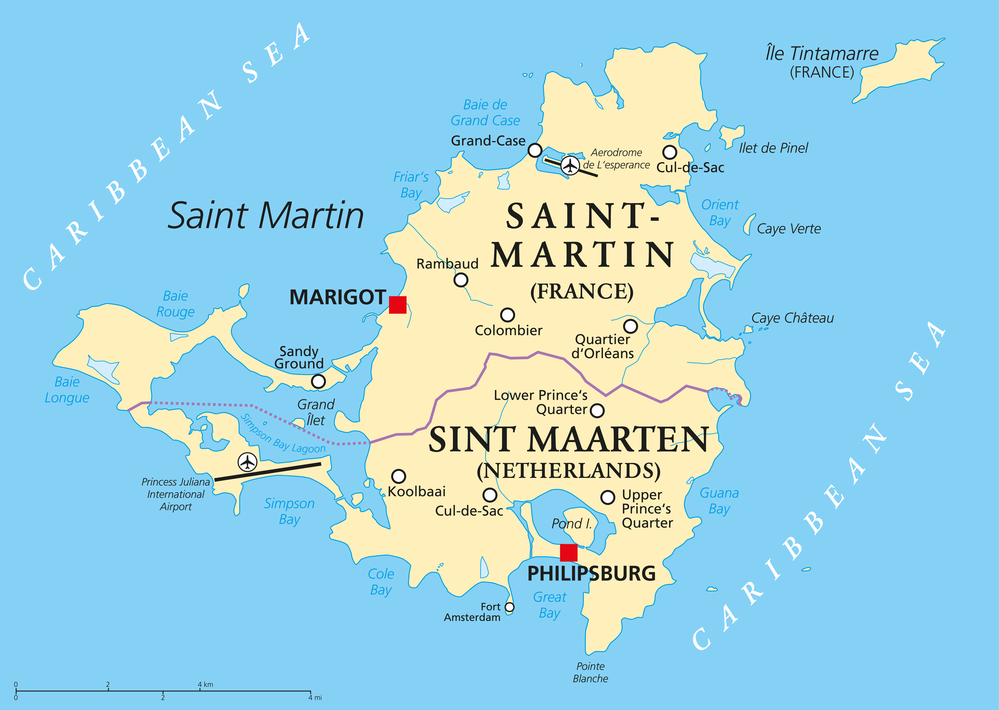
Since then, this beautiful paradise has been split between a Dutch side (Sint Maarten), belonging to the Kingdom of the Netherlands, and a French side (Saint Martin), owned by France.
The island of Sint Maarten on a political map. Image: Depositphotos
While we might boast two different governments and capitals, we’ve always been thought of as one united nation, each holding the same level of natural beauty for that perfect tropical destination.
Will you be heading to Sint Maarten? Tell us in the comments below!
🏝 A vacation in Sint Maarten: Frequently asked questions
How long does it take to travel to Sint Maarten by plane from the Netherlands?
A direct flight with KLM lasts for about nine hours. However, if you take the route that includes an overnight stay in Paris, France, the total travel time is almost a day.
Do you need a COVID-19 test to get to Sint Maarten from the Netherlands?
At the moment, the Sint Maarten government has relaxed all measures relating to the pandemic, so no test is needed. However, keep an eye on their website for the latest information.
How much does it cost to travel to Sint Maarten?
During Christmas time, flight tickets can range anywhere from €800 to €2,000, depending on which week you book and if you’ve managed to score a deal.
During summer time, you can expect to pay around €1,000 to €1,500, depending on the airline and month.
Can you cross to the French side easily?
Absolutely! There’s generally no border control between the two sides. Nonetheless, once you enter the French side, remember that the currency changes from dollars to euros and people will initially address you in French.
Will my time there be hindered by Hurricane Irma’s damage?
Parts of the island still need to be repaired due to the hurricane’s destruction, such as the airport, but this won’t deprive you of having a fabulously tropical time there.
Should I rent a car in Sint Maarten?
Unlike the Netherlands, Sint Maarten has a severe lack of public transportation. They’ve got a few local buses that can take you to places, but we recommend renting a car from one of the many rental places. In fact, one is conveniently located close to the airport: Empress Rent-A-Car.
With summer heatwaves getting more intense, Amsterdam isn’t sweating it — it’s getting smart.
The city has launched Schaduwmakers, a project that uses fake trees and movable greenery to stop people from melting into the pavement.
Sounds cool? That’s because it is. 😎
Shade, but smarter
Not all trees need roots. Some just need wheels and a splash of Dutch ingenuity.
Schaduwmakers brings smart, flexible shade to spots where planting trees isn’t possible (looking at you, tangle of underground cables and parking garages 👀).
Think giant sun sails, leafy pergolas, and steel frames covered in climbing plants, some even shaped like trees.
As climate expert Jeroen Kluck explains to RTL Nieuws, these trees don’t just offer shade, they actively cool the air: “A tree can lower the perceived temperature by 10 to 15 degrees.”
And no, there are no sad, plastic palms here. These are “sustainable, easy-to-move objects that contribute to the liveability of the environment.” 🌱
One standout is a real elm in a high-tech container from The Urban Jungle Project — self-watering, low-maintenance, and ready to roll into any urban overheated corner of the city.
Turning up the heat (and the urgency)
If you’ve spent a summer in the Netherlands, you know that some parts of Amsterdam are open-air ovens. 🥵
The 2019 heatwave made that painfully clear, with record-breaking temperatures hitting a blistering 38.8 degrees Celsius, showing just how hot it can get in the Netherlands. 👇
— World Meteorological Organization (@WMO) July 24, 2019
For example, the Oosterdokskade near Central Station regularly hits extreme heights in summer. With no shade, it’s known as a “heat street.”
And this heat isn’t just annoying. The Netherlands sees up to 40 daily deaths due to heat stress during heatwaves, reports the TNO (the Dutch Organisation for Applied Scientific Research).
Plus, as the KNMI (Royal Netherlands Meteorological Institute) points out, cities like Amsterdam can be up to 7 degrees hotter than nearby green areas.
“We need to cool down using shade and greening,” says Alderman Melanie van der Horst. “This innovation is badly needed.” And frankly, she’s spot on. 👏
Is this the future of cooler cities? Let us know your thoughts: Should every city roll out a shady strategy like Amsterdam’s? 🌿
While a fictionalised strain of the cordyceps fungus may have captivated audiences in The Last of Us, scientists are now raising the alarm about a rise in deadly fungal infections across Europe. 🧫
Aspergillus flavus is a type of fungus found in soil and crops that releases millions of airborne spores that people can unknowingly inhale.
A killer fungus hides in plain sight
For most healthy people, the infection poses little threat.
However, it can be life-threatening for those with weakened immune systems due to transplants, cancer, COVID-19, or particularly severe cases of the flu.
“About 800,000 to 1 million people die every year,” Norman van Rhijn, Dutch molecular genetics expert, tells RTL Nieuws.
Concerning death toll aside, what makes this infection especially dangerous is its ability to masquerade as something far less deadly, with the symptoms of flavus easily mistaken for common ailments.
These symptoms can be as mundane as coughing, fever, breathing problems, and general feelings of malaise.
Their ability to slip under the radar often leads to delayed diagnoses of fungal infections, increasing the risk of severe outcomes.
Worse, it’s drug-resistant
As deadly fungi like the flavus thrive in warm soil and crops, rising global temperatures are now creating the perfect environment for them to spread.
Researchers predict that rising temperatures will cause an explosion in the number of fungal infections over the next 15 years, with 9 million patients in Europe alone.
But surely the fungus can be beaten by modern medicine? 🤔
Helaas, van Rhijn points out that some variants are drug-resistant, which potentially pushes mortality rates up by 60-80%.
At present, around 40% of people who are infected face fatal results.
In response to the threat, experts are calling for greater awareness and readiness in public health systems and among individuals at risk.
Sitting is the new smoking. That’s not the name of a hip upcoming TV show but a legit concern pointed out by more than one health expert.
In an era where many jobs require us to spend hours crouched behind a laptop screen, we need to take matters into our own hands and incorporate some movement into our day.
So when I got the opportunity to equip my home with Flexispot’s new four-legged standing desk, the E7 Plus, to say I was thrilled would be an understatement.
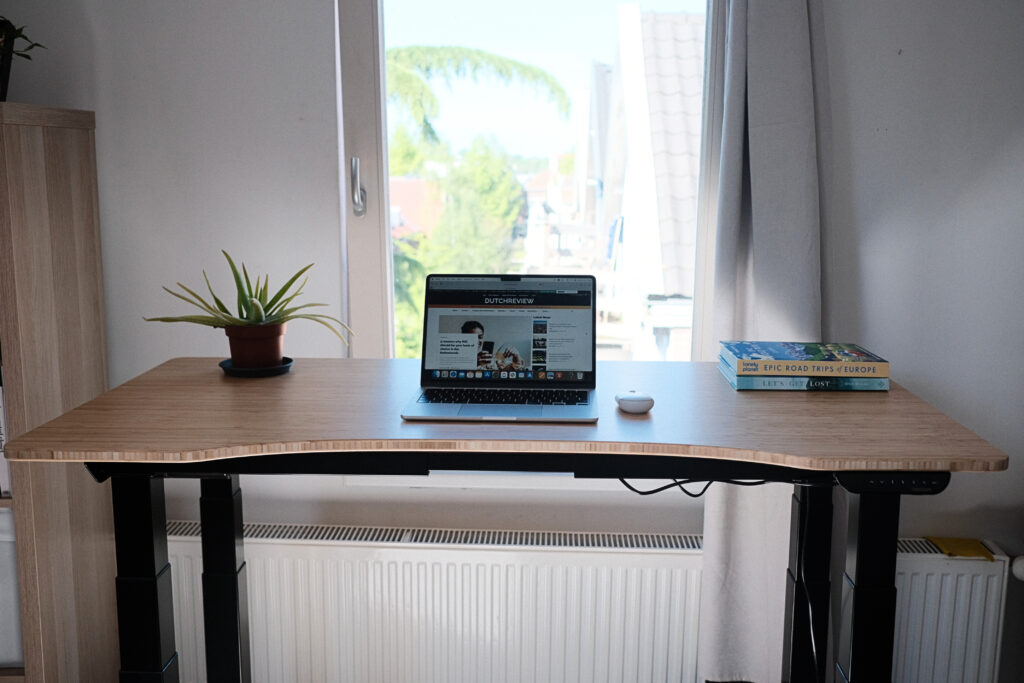
The Flexispot E7 Plus comfortably fits everything you need for your work. Image: Jana Vondrackova/Supplied
For full transparency, I was given the desk in exchange for my unbiased review. What follows below are my thoughts after receiving and testing the product.
Key features of the E7 Plus
Before we dive into the details and my experience with the desk, here’s a brief overview of the E7 Plus’ key features:
It has an innovative motor which ensures smooth lifting with no vibration or instability (I put this one to the test!)
It has a multifunctional control panel with four height preferences
It has a carrying capacity of 200 kg (hello, multiple extra monitors and plants)
It’s suitable for users between 163 cm and 200 cm (but works if you’re a bit shorter — I put this one to the test too)
So how does this beast of a table holds up when it comes to design, functionality, and ease of use?
The design: neat and aesthetic
Before the standing desk lands in your online shopping cart, there are a couple of things you need to decide: the colour of the frame, the material of the desktop, and the size.
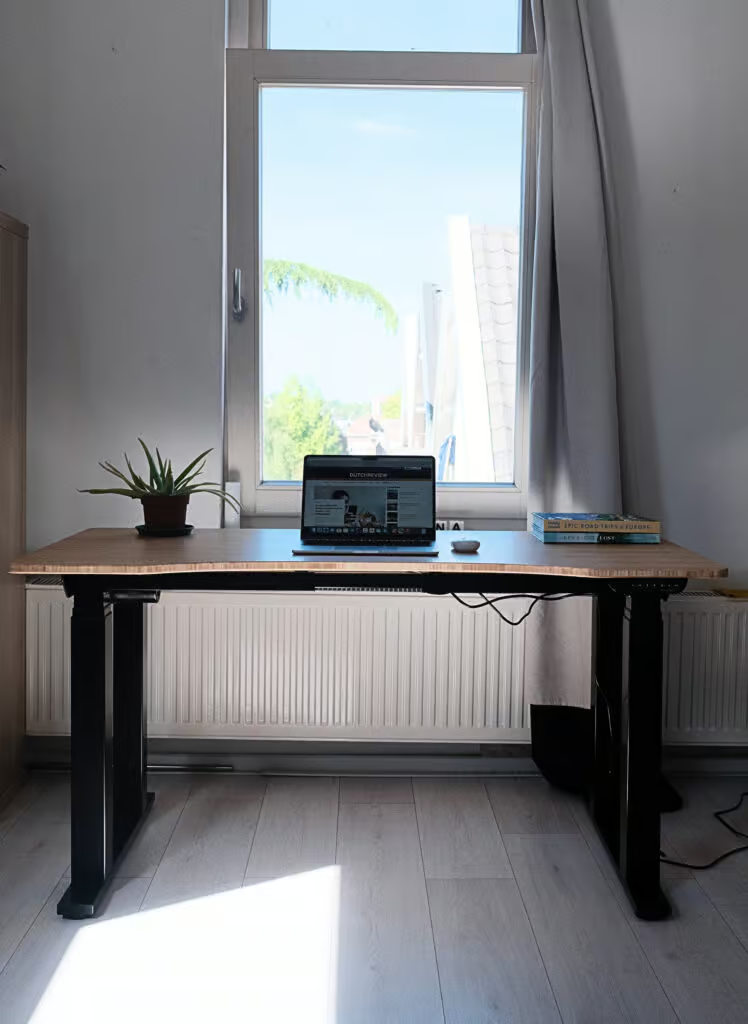
I went for a black frame with a bamboo tabletop. Because I don’t exactly have the biggest living space, I opted for the smallest possible desktop size of 140×70 cm with a slight curve on the side where you stand.
Was I happy with my choices? You betcha! The design is absolutely gorgeous. The black frame is sleek and simple and the bamboo tabletop has a very natural, minimalist feel to it.
The size is more than enough (if anything, even a little too big for my space) and can comfortably fit a laptop plus one or two monitors (and plants).
All in all, a great option — especially if you’re a fan of simple, tidy workspaces.
The functionality: strong and reliable
One of the main selling points of the E7 Plus (E7Q Lite) is that it remains steady and lifts with no shakiness and vibrations.
To see if this was marketing fluff or legit, I put a glass full of iced matcha latte on my desk and proceeded to move the desk up and down. The liquid in the glass did not move the slightest bit.
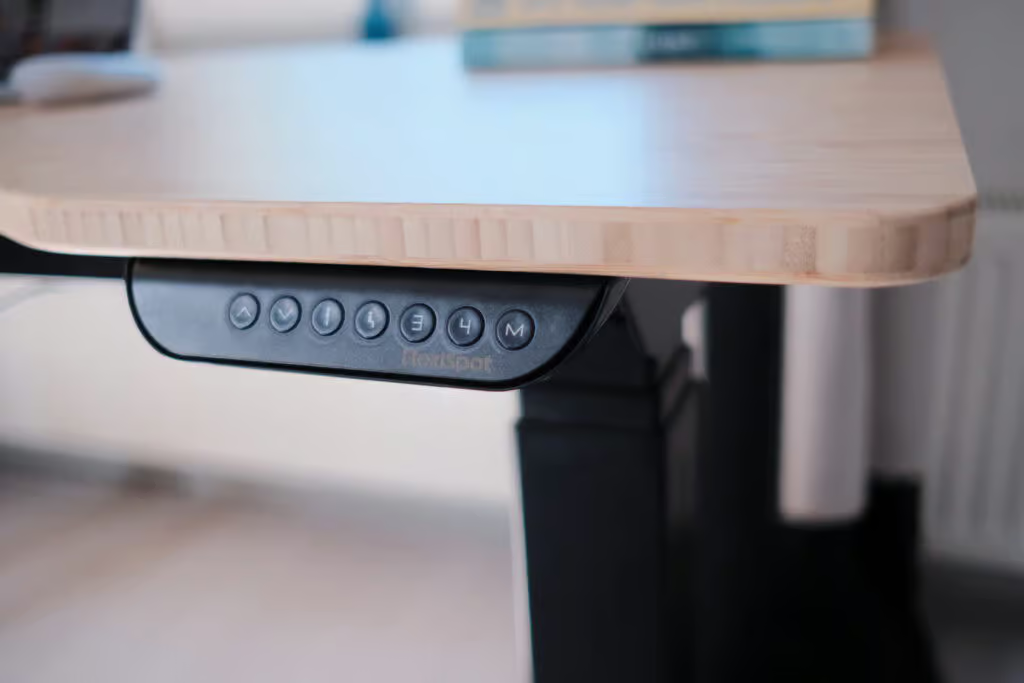
The E7 Plus is equipped with a handy control panel with a memory function through which you can set four different height preferences, so I can immediately choose my preferred sitting and standing height.
The control panel has a handy memory function. Image: Jana Vondrackova/Supplied
With a minimum height of 66 centimetres and a maximum of 131 centimetres above the ground, this desk truly is suitable for people of all shapes and sizes.
The recommended user height is between 163 centimetres and 200 centimetres, but as someone who’s only 158 centimetres, I still find the desk comfortable to use.
Delivery & installation: mostly easy
The whole setup was delivered in three separate parts — two for the table frame and one for my bamboo desktop.
Sadly (for me), the job of a Dutch courier ends the minute he gets your goods over your front doorstep. The task of transporting these large parcels up four flights of stairs was, therefore, left up to me. Luckily, I had a couple of good gym sessions behind me.
As for the installation itself, I invited a friend to help me on this mission. The process was mostly straightforward (mind you, I’m not the most handy person out there) with one small hiccup.
The bamboo desktop comes with some predrilled holes. However, we found out that these didn’t align with the holes in the table frame.
A dream workspace. Image: Jana Vondrackova/Supplied
While this might not be a massive issue for some, I’ll admit that we were taken by surprise. After some confusion, we managed to solve this pretty easily by getting crafty with a drill.
The handy little tools and screws package includes four self adhesive cable clips to ensure your cables are not dangling down. As an organisation freak, I’m a big fan.
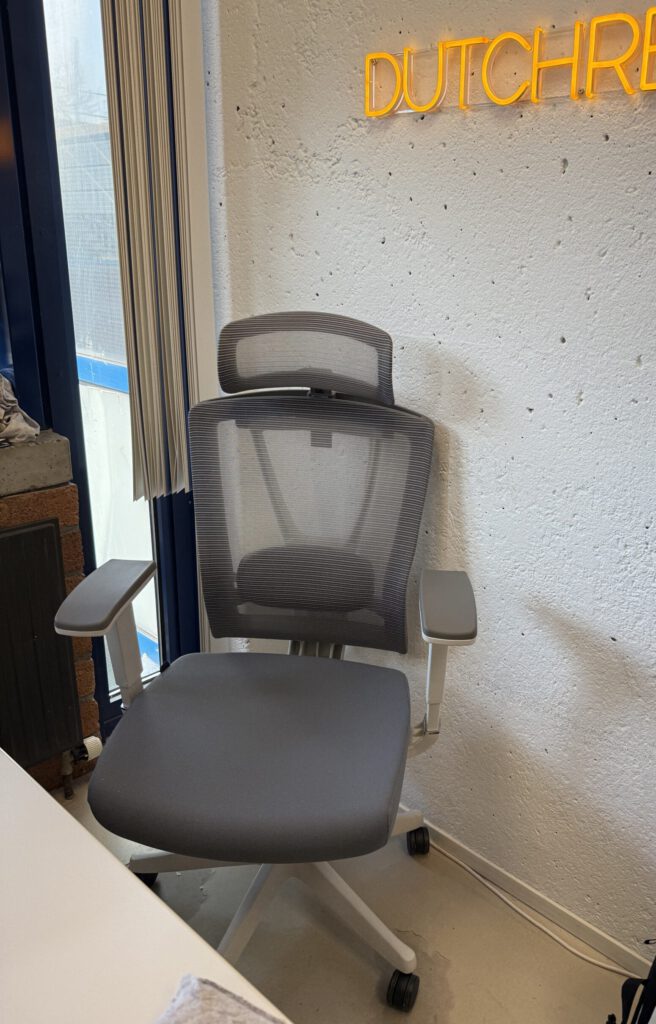
Doing your work while standing is great but it’s totally fair if you don’t want to do that for eight hours straight. The solution? The BS14 office chair.
The back and lumbar support is amazing and the headrest is comfortable enough to take a nap in it if you really wanted to.
Comfy and stylish. Image: Abuzer van Leeuwen/Supplied
Enjoy working in the lotus position? Yep, with how wide the seat is, that was totally possible! The height of the armrests can be adjusted as well, so you can easily tuck the chair under your desk.
The chair is easy to put together and the mesh fabric is breathable, so it’s comfortable to sit on all day (even when it’s 25 degrees outside).
If you want a work form home setup that’s comfortable, aesthetic, and stable, the Flexispot E7 Plus and the B14 are a great purchase. With the exception of figuring out where you need to drill your own holes, they’ll be ready for you to use in no time.
Do you have your own ergonomic set up at home? Let us know your experience!
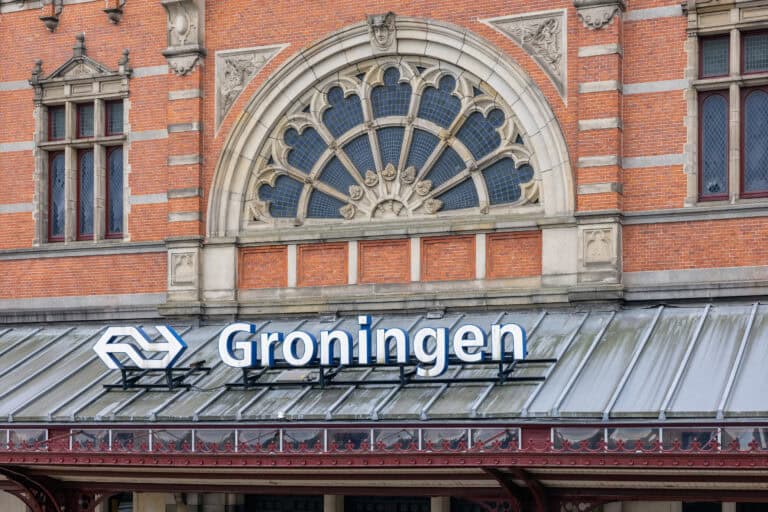
Groningen Centraal, one of the biggest hubs in the Dutch rail network, will be closed for construction over two months. The result? You guessed it: Fewer trains and major disruptions along key routes.
Why is all this happening, you ask? Because ProRail thinks it’s time that Groningen Centraal gets a fresh new look.
The upcoming construction work is linked to an extensive renovation project, which includes constructing a new pedestrian tunnel, relocating and renewing railway tracks, and moving the bus stop.
What’s happening?
Groningen Centraal will be closed until July 13, 2025, as construction is done in six phases.Here’s a breakdown of what we can expect:
Date
Lines without train service
May 10 to May 11
All trains to, from and via Groningen station
May 12 to May 16
Groningen – Groningen Europapark
May 17 to May 18
Groningen – Groningen Europapark, and Groningen Europapark – Asses
May 19 to June 13
Groningen – Groningen Europapark
June 14 to July 9
All trains to, from and via Groningen station
July 10 to July 12
Groningen – Groningen Europapark – Zuidhorn – Eemshaven – Delfzijl, and Groningen Europapark – Assen – Veendam – Bad Nieuweschans
How to get around
Worried about being stranded? Don’t be. To accommodate travellers, NS and ProRail have arranged replacement buses during each phase.
You can travel between affected areas, but be prepared for longer travel times and, most importantly, plan ahead! 🤳
By mid-July, Groningen Central Station will reopen with major improvements, offering better accessibility, quicker transport and a more organised layout. 🎉
Will these changes affect your daily travel? Let us know in the comments below!
The Dutch police have released an image of the suspect involved in a fatal shooting that occurred on May 1 in the town of Rijswijk, near The Hague.
The incident took place around 5:45 PM on the terrace of a hotel on Van Vredenburchweg, where 41-year-old Cemil Önal from Turkey was shot at close range and died at the scene.
According to Turkish media, the victim was a whistleblower who accused high-ranking Turkish politiciansof corruption and money laundering. He is also said to repeatedly have warned Dutch authorities that he feared for his life.
Looking for leads
The suspect in the fatal shooting is described as approximately 1.80 meters tall, with a normal to sturdy build, a beard, and wearing black clothing — specifically, black Adidas pants and black shoes with white soles from Nike.
Investigators have determined a possible escape route for the suspect. He is believed to have fled the scene towards Guntersteinweg and then continued north in the direction of Erasmusweg.
The police have not disclosed further details about the motive or the suspect’s identity, since the investigation is still ongoing.
They are now looking for witnesses who may have information, particularly two individuals who were reportedly sitting on a bench in the park near the crime scene around the time of the incident.
Additionally, authorities are interested in any footage from the area between 3:30 PM and 6:30 PM on May 1, including from security cameras, video doorbells, or dashcams.
Information can be shared anonymously via the online police tip form, or at 0800-6070. For international callers, the police tip-off line is available at +31 (0)79 345 98 00.
A regular Tuesday afternoon took a shocking turn in Amsterdam-Noord when gunshots rang out near Gare du Nord, leaving a 20-year-old student injured.
The same evening, a special police team swooped in and arrested two 17-year-olds, who are believed to be connected to the shooting.
According to Dutch police, all three individuals, the victim and the suspects, attend the same ROC school in Amsterdam.
Gunfire in broad daylight
The shooting happened around 2:45 PM on the afternoon of May 6.
Officers rushed to the scene and found the victim lying on the street, injured but still conscious.
Arriving a short while later, emergency crews provided first aid on the spot before rushing the victim to the hospital. Meanwhile, witnesses reported seeing two people dressed in black running toward Krijtmolenpark.
Following the incident, Amsterdam police wasted no time launching an investigation, with both suspects arrested later that evening.
One of the suspects is believed to have fired the shots, while the other is accused of being his accomplice.
Translation: [#Shooting in front of secondary school #ROC of #Amsterdam. A 20-year-old boy was shot in the right leg. 2x suspects, including the shooter, fled on a scooter. The report came in at 14.42 hrs. #PD cordoned off #trace investigation. 2x casings and scooter seized. Gare Du Nord #Amsterdam-Noord]
As reported by AT5, Amsterdam police said: “It is possible that a conflict arose in the school before the incident.’’
Both teenagers are now in custody and have only been granted access to speak with their lawyer.
As the investigation is currently ongoing, the police aren’t releasing further details for now.
Community shaken
Given that the shooting happened in broad daylight, with several people nearby at the time, it’s no surprise that the incident left a strong emotional impact on those who witnessed it.
The police recommend calling Victim Support at 0900-0101 if you were affected or need someone to talk to. You can also contact your local police officer.
The investigation is still underway, and police urge everyone who saw or heard anything to come forward. If you have any relevant camera footage, you can share it through this tip form by indicating the case number 2025109787.
We hate to be the bearer of bad news, but extensive roadworks are due across several motorways in the Randstad — and yes, they’ll affect your commute! 🚧
From today (May 9) onwards, the Rijkswaterstaat will be launching major infrastructure upgrades to improve roads and waterways.
Given the size of the job, these renewals mean serious traffic disruptions, so plan your trip wisely!
Here’s what we know
The disruptions will impact weekdays and weekends, so wherever you’re headed, it’s smart to plan accordingly. 📅
Listen up! Here’s what you need to know:
From Friday, 9 May 8 PM until Monday, 19 May 5 AM, the A12 will be closed between the Maanderbroek and Lunetten junction on the Veenendaal towards Utrecht road. Traffic will be diverted on the A30, A1, A27, A50, A15, A2 and A27 depending on your direction of travel.
From Friday, 9 May until Monday, 12 May, and from Friday, 23 May until Monday, 26 May, the A27 will be closed at the Everdingen junction towards Utrecht.
From Friday, 9 May 10 PM until Monday, 26 May 5 AM, the A1 will be closed between the Watergraafsmeer and Diemen junction. Traffic will be redirected via the A2 and A9 highways.
From Friday, 9 May 10 PM until Monday, 12 May 5 AM, the road between the Everdingen and Lunetter junction will be closed. Traffic will be rerouted via the A2 and A12.
On the weekend of Friday, 16 May, 8 PM until Monday, 19 May, 6 AM, and Friday, 23 May, 8 PMuntil Monday, 26 May, 6 AM, the A2 carriageway will be closed between the Maarssen and the Oudenrijn junction. Traffic will be diverted to the parallel carriageway.
We voeren de komende weken op verschillende #snelwegen grootschalig onderhoud uit. 🚧 Daardoor verwachten we extra drukte op de weg. Check daarom vooraf je route en pas je reis indien mogelijk aan.
Translation: We are carrying out major maintenance on several #highways in the coming weeks. 🚧 As a result, we expect extra traffic on the road. Therefore, check your route in advance and adjust your trip if possible.
Expect delays and plan ahead
With school holidays and luscious weather keeping us company, traffic is expected to spike, especially this weekend.
Delays could range from 30 to 60 minutes, so it’s best to give yourself extra travel time and check your route before departure.
If avoiding traffic sounds more appealing, consider rescheduling your plans, grabbing your sunnies and going for a picnic near your house to dodge the delays. 🧘🏻♀️
How will you spend this weekend? Will your plans be affected by the roadworks? Let us know in the comments below.
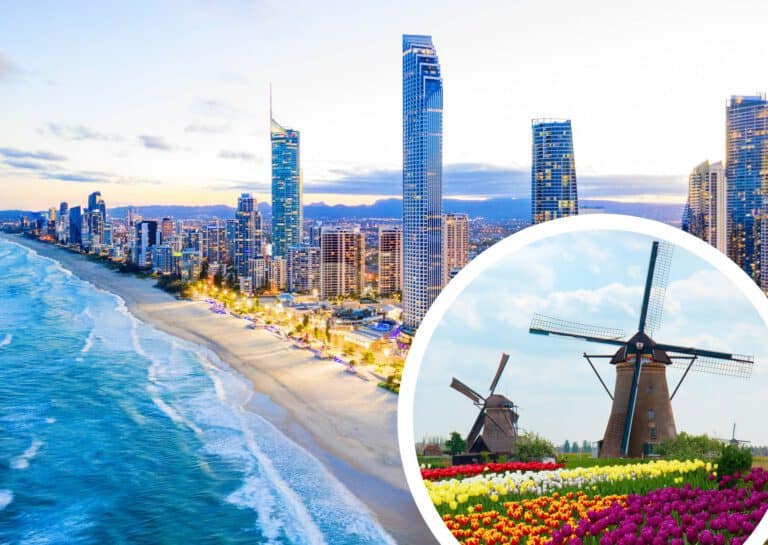
Australia and the Netherlands may not be mentioned in the same sentence all that often, but you’ll be surprised how many links there are between them.
For two very different landmasses (one tiny, one huge) on opposite sides of the globe, Australia and the Netherlands have an unlikely but close connection.
Dutch exploration of Australia
Alright, time for a crash course in history
For many Dutchies, it isn’t a big surprise to hear that the Dutch were the first Europeans to set foot on Australian soil.
The navigator Willem Janszoon made landfall in Queensland in 1606 and Western Australia in 1618. 🧭
Then, of course, Dirk Hartog was the leader of the second European group to land in Australia — and the first to leave an artefact behind to record his visit in 1616. Namely, the Hartog Plate on what is now known as Dirk Hartog Island.
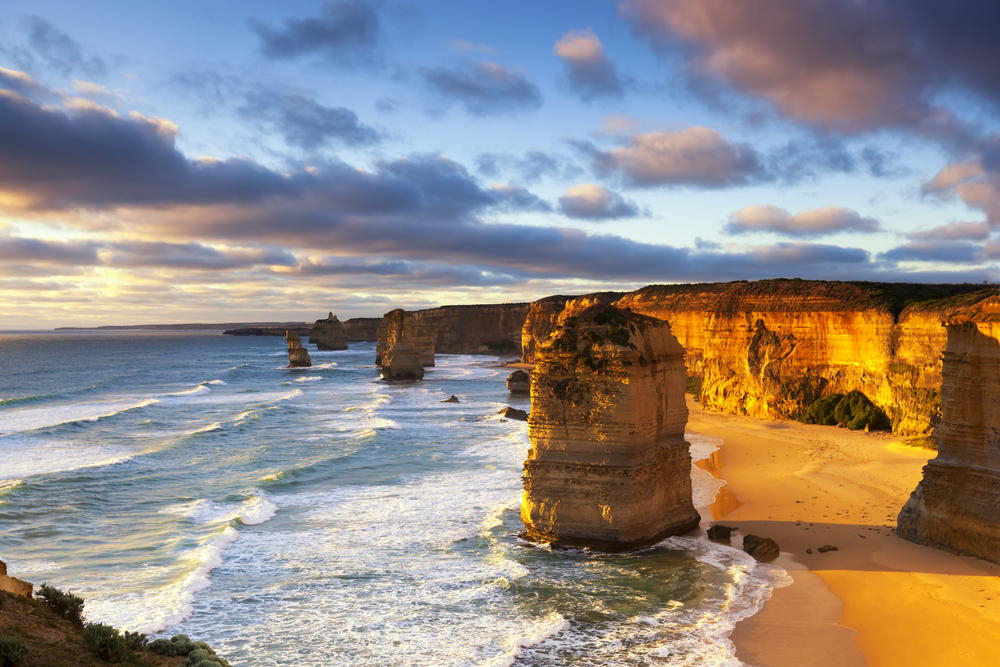
Australia and the Netherlands have vastly different landscapes, but a shared history nonetheless. Image: Depositphotos
Frederik de Houtman, Abel Tasman, and Willem de Vlamingh were the other notable Dutch explorers who first began charting the land Down Under in the 17th century.
In fact, the Dutch played such a big role in the exploration of Australia that the country was once called “New Holland.” 😱 That’s until it was colonised by the English in 1788.
Dutch shipwrecks in Australia
With so many Dutch ships exploring Australia and sailing past its West Coast on their way to Jakarta (then Batavia), there were inevitably also quite a few shipwrecks.
Why inevitably? Were the Dutch bad seafarers? Neeee. 🙅♂️
The coast of Western Australia is the resting place of more than 1,400 shipwrecks (not just Dutch ones) because of its long and difficult coastline and the common powerful storms and cyclones.
During the 16th and 17th centuries, the inability to accurately measure longitude meant many ships turned out of the “Roaring Forties” (the nickname for the strong westerly winds around Australia) too late.
The result? Ships smashed into the coast instead of heading up to Indonesia — whoops.
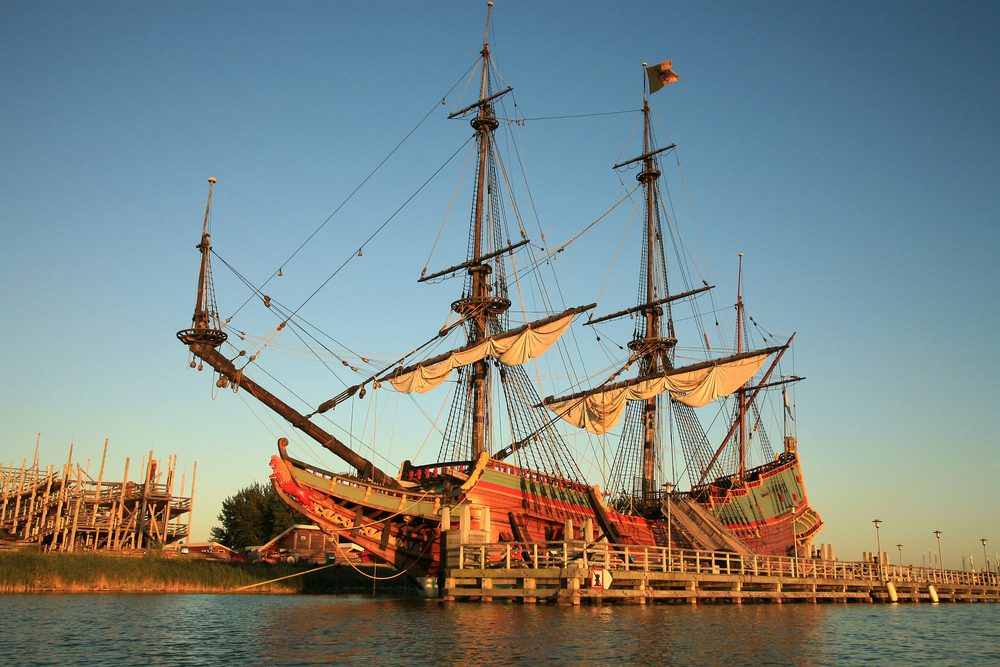
Perhaps the most well-known shipwreck on the West Australian coast is the VOC ship Batavia, which was lost in 1620.
The story of the mutiny, wreck, and consequent massacre that took place amongst the survivors of Batavia has made this shipwreck quite infamous.
The replica in Lelystad. Quite a sight! Image: Depositphotos
By now, it’s been the subject of numerous articles, books, films, and even an opera!
If you want to feel part of this intriguing Dutch-Australian history, you can visit a replica of the ship in Lelystad. Remains of the original shipwreck are displayed in the Western Australian Museum, Geraldton.
Dutch place names in Australia
The Dutch didn’t only leave shipwrecks behind in Australia but also their (beautiful?) language — or at least words and names from it.
Even today, a lot of places in Australia are named after Dutch people or places. While some of these names have changed throughout time, many still exist in an anglicised version.
What might be surprising to a lot of Aussies, and maybe even Dutchies, is just how many places were named by the Dutch.
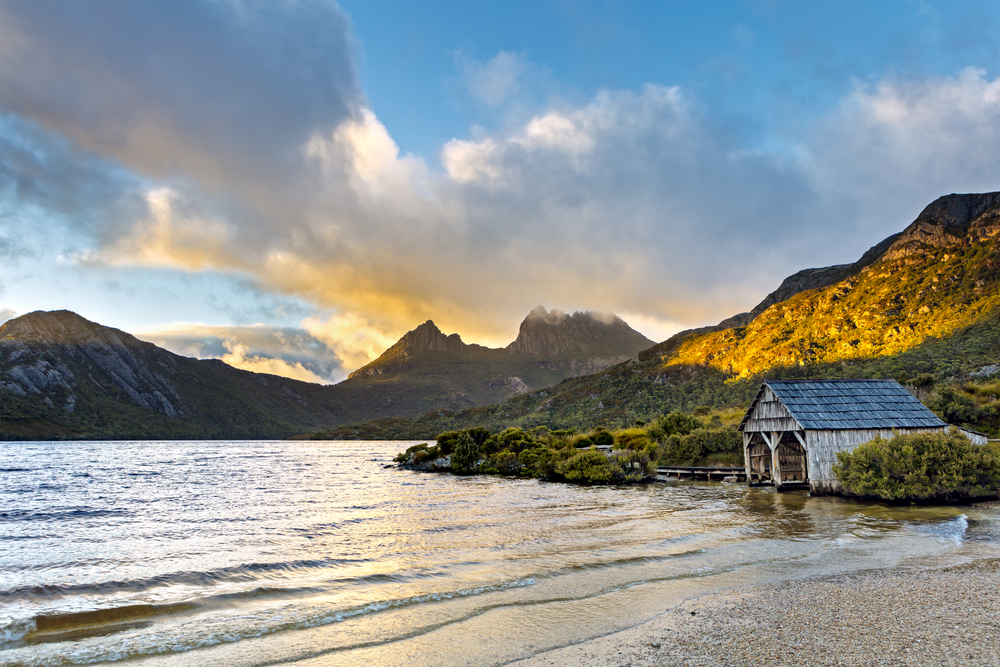
Tasmania has the Dutch to thank for its name! Image: Depositphotos
Let’s start with the usual spots named after notable Dutch people or places in the Netherlands, such as:
Dirk Hartog Island, Western Australia (named after the explorer who landed there)
Arnhem Land, Northern Territory (named for the city of Arnhem)
Gulf of Carpenteria, Queensland (named for Pieter de Carpentier, then Governor-General of the Dutch East Indies)
Wessel Islands, Northern Territory (named after the ship Klein Wesel, which was named after the city of Wesel)
Maria Island, Tasmania (named after Maria Van Aelst, the wife of Anthony Van Diemen)
And of course, the original name for Tasmania was Van Diemen’s Land, named for Anthony Van Diemen, then it was changed to Tasmania, for Dutch explorer Abel Tasman!
And here are the wildcards — names that don’t sound like they were named by the Dutch, but actually were:
Even the town where I grew up in Tasmania, called Kingston, is a sister city to Grootegast, a village in Groningen.
The Dutch immigrants who settled in the town of Kingston founded the local Calvin Christian School, which hosts an annual oliebollen festival.
In fact, so many Dutch immigrants moved to an area in Kingston now called Firthside, that it was originally called ‘Little Groningen’!
Immigration from the Netherlands to Australia
Although the Dutch began the exploration of Australia, the southern land was eventually colonised by the British. It then became a federation in 1901 and finally an independent sovereign nation after World War I. 🎉
After World War II, immigration to Australia from Europe boomed, and the Dutch were one of many nationalities who helped to populate the vast country.
Today, 240,000 Australian residents claim Dutch ancestry, and 95,000 were born in the Netherlands. Many parts of Australia have strong Dutch communities that are still active today — leuk!
Some of the most notable Dutch Australians include:
Paul Cox (Paulus Henrique Benedictus Paul Cox): a filmmaker born in Limburg who emigrated to Australia in 1956.
Edward Duyker: a historian, biographer, and author who has written numerous biographies of early explorers as well as ‘The Dutch in Australia.’
Anna Johanna Maria “Annita” van Iersel: known as Annita Keating from 1975-1998 and the former wife of Paul Keating, former Prime Minister of Australia.
Anthony LaPaglia: a well-known Australian actor whose mother was Dutch and father was Italian.
Trevor Marmalade (Jason van de Velde): an Australian comedian of Dutch descent.
Harry Vanda (Johannes Hendrikus Jacob van den Berg): a Dutch-born Australian musician who was best known as a member of the 1960s Australian rock band The Easybeats.
Johnny Young (Johnny Benjamin de Jong): a Dutch-born Australian singer hailing from Rotterdam.
Aussies in Holland
While many Dutch immigrants moved to Australia in the ’50s and onward, nowadays, there are many Australians who live in the Netherlands.
The two countries have an agreement that makes it fairly easy for Australians to work, study, and live in the Netherlands.
Naturally, this means that there are large Australian communities to be found, particularly in Amsterdam and The Hague.
Politicians from Australia have visited the Netherlands in the past (as well as King Willem and Queen Maxima visiting Australia on more than one occasion).
Where to go for Australian food in the Netherlands
There’s also an increasing number of Australian-owned and/or themed restaurants, bars and cafes opening around the country.



![This standing desk & chair will take your Dutch home office to the next level [Flexispot E7 Plus and BS14 review]](https://dutchreview.com/wp-content/uploads/flexispothorizontal-768x512.jpg "This standing desk & chair will take your Dutch home office to the next level [Flexispot E7 Plus and BS14 review]")