Home Blog Page 170

The 2025 flu season has started: Here’s what you should know

It’s time to get your tissues ready! The Netherlands has officially entered its 2025 flu season.

The National Institute for Public Health and the Environment (NIVM) has crunched the numbers: last week, 58 in 100,000 people contacted their GP with flu-like symptoms.

With the threshold for “increased activity” being 53, this only means one thing: flu season is officially here. 🤧

What can I do about it?

You probably have questions like, “Can I prevent getting the flu?” “How do I treat it?” and “Can I skip my mother-in-law’s birthday party if I’m sick?”

Well, here’s all the information you need. 👇

Should I get the flu shot to avoid getting ill?

Short answer: no, it’s too late to get a flu shot. The vaccinations are only given before the start of the flu epidemic, as the AD explains.

The truth is that preventing the flu is very hard. As the AD points out, last year’s epidemic lasted nine weeks — that’s a long time to keep dodging this annoying winter visitor.

READ NEXT | All you need to know about going to the hospital in the Netherlands

However, there are a few good habits you can implement to try and snooze the sneeze:

  • Keeping your distance (to avoid inhaling droplets sneezed or coughed by others)
  • Cleaning frequently touched objects (such as door handles)
  • Washing your hands regularly
  • Ventilating crowded rooms

How do I know I’m infected?

There are two main types of viruses circulating in the Netherlands currently: the flu (in several variants), and the Respiratory Syncytial Virus (RSV).

Both manifest as an inflammation of your respiratory system (nose, mouth and airways), but the symptoms differ slightly.

READ NEXT | How to survive the Dutch winter: weather, clothing, and more

While RSV usually causes nasal congestion, sneezing, coughing and a sore throat, the flu has comparatively more serious symptoms.

It usually starts suddenly and immediately gives you cold chills, a runny nose, a headache, muscle pains, and a fever. Within 12 hours, the fever can rise to 39°C or higher, usually lasting 3 to 5 days.

What to do when you have the flu

If you’ve caught the flu, you have two important jobs: getting better and avoiding infecting others. There are good measures for both.

To recover from the flu, you should:

  • Wait and rest, as it usually goes away by itself
  • In case of acute pain or high fever, take paracetamol
  • Drink lots of water (1.5 to 2 litres per day)
  • Move moderately but don’t exert yourself too much
  • Avoid doing sports, even for a few days after the fever has subsided

READ NEXT | How to register with a doctor in the Netherlands

To avoid infecting others, you should implement the same advice that was given to avoid spreading COVID-19:

  • Stay home if you’re ill
  • Avoid contact with others, especially if they are more vulnerable
  • If you must meet people, wear a mask and sneeze/cough in your elbow

When do I need to see a GP?

In general, the NIVM advises against visiting your GP or the hospital with flu-like symptoms, as this is often unnecessary and might spread the infection further.

READ MORE | The ultimate guide to going to the doctor in the Netherlands in 2025

If you are concerned by your symptoms, for instance, if the fever comes back after going away, you faint, or have trouble breathing, you should call your doctor.

Dig what you’re reading? Get more of it! Join our WhatsApp channel or Instagram broadcast to get the latest news straight to your pocket.

How one Dutch woman created the most unusual modern art museum in the Netherlands

3

If you associate big museums with big cities and Van Gogh paintings with the Van Gogh Museum, you might want to reexamine those assumptions. 

Why? Well, about a hundred years ago, a woman built a unique modernist building in the middle of De Veluwe National Park and this is home to one of the most impressive modern art collections in the Netherlands. 

Yes, we’re talking about the Kröller-Müller Museum — but do you know the story behind the woman who founded it? 

Who was Helene Kröller-Müller?

The Kröller-Müller Museum didn’t come about in a very conventional way — probably because it wasn’t started by a very conventional person. 

The woman who founded the iconic museum was Helene Kröller-Müller. Originally from Germany, Helene was an international in the Netherlands, relocating to the lowlands in 1888 — how relatable! 

She moved for love… well, her father’s love since he was the one who picked her husband, a wealthy merchant who worked for her father’s company and later took it over. 

The couple settled in Rotterdam, their business boomed, and Helene ended up becoming one of the richest women in the Netherlands. Okay, maybe not so relatable…

She lived in a time when most European women couldn’t study art and came from a family where her dad was much keener on picking husbands than supporting his daughter in getting a university degree.

helene-and-anton-kröller-müller-at-the-time-of-their-engagement
The happy couple at the time of their engagement. Image: Unknown author/Wikimedia Commons/CC01.0

Given this, the cards were stacked against Helene becoming an art connoisseur. Still, she developed an interest in philosophy early on and found that some of her fundamental spiritual questions could be connected to art. 

READ MORE | Forgotten women painters of the Dutch Renaissance and Golden Age

In 1905, she met Henk Bremmer, who became her advisor and helped her amass a truly spectacular personal art collection. 

Helene’s vision — build a museum that everyone can enjoy

When we say spectacular, we mean spectacular. Her collection included works by the likes of Mondriaan, Signac, Redon, and Jan Toorop, to name a few. 

READ MORE | The BKR: a short history of when the Dutch government added artists to their payroll

She was also one of the first collectors to recognise the then relatively unknown Van Gogh, labelling him as “one of the great spirits of modern art.”

For some time, she was perfectly happy collecting art for her private enjoyment. But after a while, that interest in philosophy started coming in handy, and she began to wonder about her place in the world as an art collector. 

Helene-Kröller-Müller-looking-into-the-distance
She’s probably thinking about her place in the world when looking into the distance here. Image: Kröller-Müller Museum/Beeldbank

The wondering turned concrete in 1911 when she underwent a dangerous operation. She decided that if she survived, she would build a museum for the Dutch people. 

This article exists, so you can guess that her operation was successful, and Helene proved herself to be a woman of her word. 

The (first) Kröller-Müller Museum was born

Her husband bought a building in The Hague and Helene started exhibiting her collection with the main purpose being “the benefit and enjoyment of the community.”

READ MORE | How Dutch design became a pinnacle (and what to expect in the future)

It was a time before Museum Cards, but you could still visit the collection for free — you just had to write to Helene and ask for a ticket. 

But a small building in The Hague wouldn’t cut it for this collector. In 1921, she made plans to build a bigger museum on her country estate, which would later become De Veluwe National Park. 

Jachthuis-St-Hubertus-former-country-residence-of-helene-kröller-müller
This isn’t a Disney villain’s headquarters, it’s the Kröller-Müller’s former country residence. Image: Dreamstime

Gave it her all after losing it all

Unfortunately, Helene’s dreams of a bigger museum were rudely interrupted when the Kröller-Müllers lost a significant portion of their money in the 1920s. 

But if Helene could beat early 20th-century gender norms, she could beat a little financial crisis. 

READ MORE | 11 kick-ass Dutch women you should know about this International Women’s Day

She managed to convince the Dutch Minister of Education, Arts, and Science that the state should take over the museum’s construction in exchange for her donating her entire art collection. 

The Kröller-Müllers were slightly less generous when it came to their estate, though. 

The Dutch state bought the land for a large sum of money and turned it into a national park — a great contribution to the country and to the Kröller-Müller’s finances. 

The Kröller-Müller Museum as we know it today finally opened in 1938, becoming one of the first modern art museums in Europe. A year after her big dream came true, Helene passed away. 

The Kröller-Müller Museum today: a unique wonder

So, if you find yourself in De Veluwe today, you can turn your nature getaway into a cultural outing as well. 

The museum building, an odd mixture of De Stijl and modernist architecture, is tucked away among the national park’s trees, far from any of the other great Dutch museums in the Randstad. 

entrance-to-the-kröller-müller-museum
The entrance to the museum, tucked away between the trees. Image: Kröller-Müller Museum/Beeldbank

It still houses one of the most interesting modern art collections in the Netherlands, the second-largest Van Gogh collection in the world. 

READ MORE | The 8 greatest forests in the Netherlands for a nature escape

If it wasn’t for Helene’s recognition of the then-unknown painter, Van Gogh’s art might have never reached the status it has today. 

Unfortunately, the museum doesn’t stick to Helene’s lovely tradition of giving out tickets for free — you now have to pay an entry fee for the park and the museum if you want to marvel at the collection. 

But still, Helene had many odds stacked against her and yet, she made her museum come to life. If we adopt her mentality, we too can beat inflation and buy those museum tickets!

Have you visited the Kröller-Müller Museum before? Let us know how it was in the comments!

Dutch Quirk #22: Give everyone three kisses to say hello

So, here’s a quirk that gets awkward really quickly if you get it wrong: the Dutch custom to greet you with three kisses on the cheek. 💏

The French do it, the Brazilians do it, and the Polish do it…greeting one another with kisses is not unique to the Dutch.

But there are definitely some unspoken rules you should know about.

What is it?

As someone who is not used to this sort of greeting, there are immediately some questions bubbling up as soon as a Dutchie gets closer and closer and… 😳

First of all, where do you turn your head? Is it left, right, or left? Or right, left, right?

Apparently, It’s the first one (I had to learn the hard way.)

You lean in with your head tilted towards the left. We recommend learning this one by heart so you don’t end up with an awkward smooch.

Now, are we talking lips-to-cheek sort of kissing? The answer is, no! You just sort of put your heads next to each other, cheeks touching lightly, and kiss the air next to their head.

And, do I just kiss anyone? Also, no. Usually, this kissing custom is reserved for close family and friends. Men don’t usually kiss one another.

Why do they do it?

It’s custom, just as much as a handshake or a polite nod of the head.

Interestingly, it’s more popular in the south than in the north of the Netherlands. Probably, because it’s closer to Belgium and France and the kissy greeting is said to originate there.

READ MORE | Meeting your Dutch partner’s parents: all you need to know

Sometimes, it depends on the occasion.

Three kisses are oftentimes exchanged for official or representative purposes. For instance, sometimes guests on TV are welcomed with the left-right-left smooch. 💋

It’s also part of wishing someone a happy birthday! 🎂

If you’re invited to a Dutch birthday party, you’ll impress the birthday person by splitting up the Dutch word for “Happy Birthday’ with three cheek kisses.

Gekissfelikissceteerdkiss.” 😗

Why is it quirky? 

Well, it’s just one of those things they don’t really tell you before moving to the Netherlands (luckily, we just did).

All of those unspoken rules can be a real cultural puzzle. 🧩

READ MORE | 11 movies about Dutch culture to watch

A lot of other nationalities are just not used to getting real up-close-and-personal when greeting someone.

Even if you’re used to the kisses, most countries just do two instead of three.

Watch expats tell their tale of encountering the Dutch cheek kiss:


Canada: “But like, it’s just putting your cheek on their cheek. It’s not even like it’s a kiss.”

Australian: “I just…you just go for the hand first. So then it’s fine.”

Polish: “I do it [cheek kiss] with my manager in the Netherlands. […] But I don’t know, is it common in the Netherlands to kiss in the office?”

Production: “NO!”

Should you join in? 

Absolutely! What a nice way to get to know the Dutch on a real intimate level.

The perfect way to kick off your inburgering (integration) and get a step closer to that Dutch citizenship.

What do you think of this Dutch quirk? Have you experienced it? Tell us in the comments below!

This Dutch restaurant is serving croissants stuffed with bitterballen (and we don’t know how to feel about it)

0

The Netherlands isn’t exactly known as a bastion of good cuisine, but it is known as a country of innovation

One Dutch restaurant in particular has decided to live up to that reputation, creating a snack that is certainly… new. 

Don’t go to Delft hungry

Omroep West recently found themselves in the beautiful town of Delft, eating a snack that can be described as anything but beautiful. 

READ MORE | 7 Dutch foods you need to try before you die

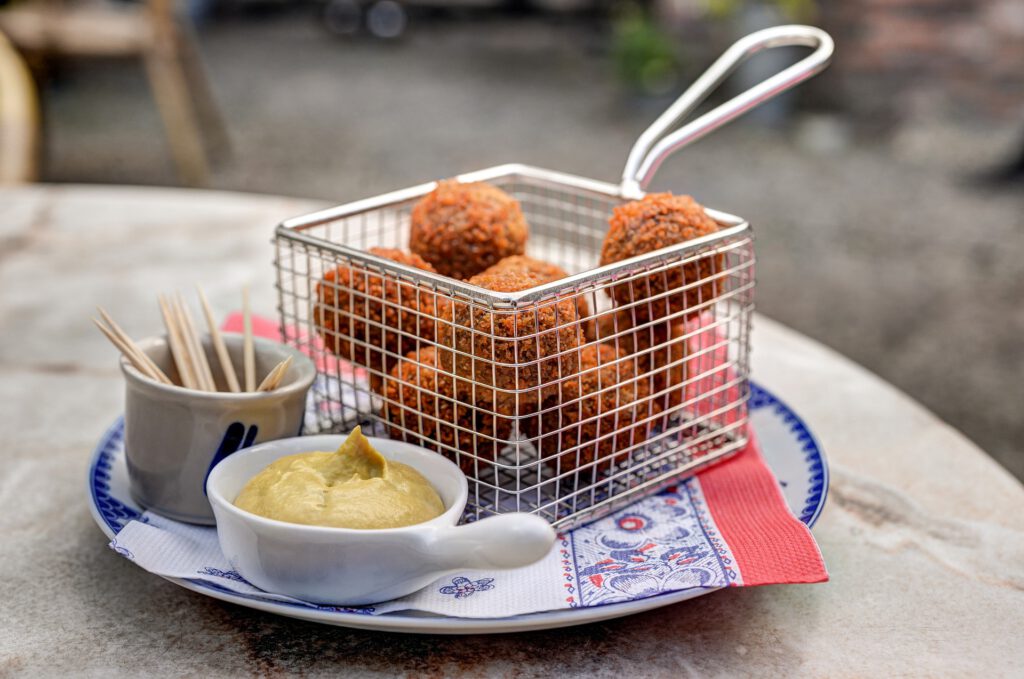
The restaurant Bij Best has decided to put a Dutch twist on a beloved French classic — they now serve croissants with bitterballen and, of course, a big dollop of mustard. 

@snackspert Delft is sowieso het bezoeken waard omdat het gewoon een prachtige stad is, maar het is ook het bezoeken waard vanwege de bitterbal croissant die je bij Bij Best (een hele sympathieke ontbijt en brunch zaak) kan halen en eerlijk gezegd ken ik geen andere zaak die dit nog doet, nice, complimenten. Mijn eerste gedachte was echter: getver, moet je niet willen combineren, weg ermee. Maar we leven in een land van etensuiting en dus moet ik dit ook een kans geven – dus dit ook. En maar goed ook, want het was prima te doen. Het is alleen jammer dat er echt veel te weinig mosterdmayo, want het werd al gauw een droge bedoening en dat is niet de bedoeling. Minpuntje, potentie heeft dit gerecht zeker. Ik daag mensen uit om dit verder uit te bouwen. ⭐️⭐️⭐️ ——————————— 📍: Bij Best, Delft 📱: nvt 💰: 5,95 euro #snackspert #delft #bitterbal #bitterballen #croissantje #tussendoortje #ontbijtje #frituur #gefrituurd ♬ origineel geluid – snackspert

The birth of… something

How did this combination come about? No, they didn’t lose a bet. One of the restaurant’s employees decided to give in to a very strange craving and made himself a bitterballen croissant for lunch.  

The restaurant then put the newly invented food onto the menu — as a bit of a joke more than anything. 

We just hope any French tourists passing through Delft have a sense of humour as well. Otherwise, France might soon become Nexit’s biggest supporter. 

READ MORE | The 19 biggest differences between France and the Netherlands

But maybe the restaurant is onto something. When Omroep West gave the snack to passersby on the street, it got some high praise — rating it eight or nine out of 10 across the board!

Who knows, sometimes something that looks so very wrong can be so right. 😌

What do you think of the bitterballen croissant? Lekker or a crime against cuisine? 

Deadly ‘choking game’ kills Dutch high school student

A high school student from Anna van Rijn College in Nieuwegein has lost his life after participating in a dangerous ‘choking game’.

The NOS reports that no further investigation will occur since no other individuals were involved in the incident. 

Raising awareness of the risks

The ‘choking game’ involves deliberately restricting oxygen to reach a temporary euphoric state. 

The boy’s parents have requested that the school publicly disclose the cause of his death to “warn other parents and draw attention to the life-threatening risks of this or similar challenges.”

Unfortunately, this is not the first time this deadly game has taken a young person’s life.

A teenage boy (16) from Arkel and another boy (15) from The Hague are among the many victims of this deadly challenge.

Over in Amsterdam, a male student (15) was even arrested for holding four other students in a chokehold.

A growing concern

The Dutch Public Prosecution Service warns that the game can lead to severe physical harm or permanent consequences “due to a lack of oxygen in the brain”.

As such, they emphasise that the “consequences of this ‘choking game’ can haunt you for the rest of your life”. 

Support for the community

Anna van Rijn College intends to provide additional support to students and parents during this difficult time.

“We will keep a close eye on how the students are doing in the coming period and provide extra help if necessary,” says the school. 

Want the latest Dutch news to come zooming through the internet to your inbox? Dat kan! Subscribe to DutchReview’s weekly roundup 📮

Brace yourselves: Storm Éowyn’s winds will hit the Netherlands today

0

After a period of fog, the Netherlands is sticking to what it knows best — strong winds all over the country!

This time around, the wind comes as a present from the west since we’re experiencing the effects of Storm Éowyn battering Ireland and the UK. ⛈️

The wind is back

As the fog is clearing up, we’re able to see again — but what we’re seeing is, unfortunately, a strong southwesterly wind all over the Netherlands today (January 24). 😬

Though we can expect a relatively calm start to the day, winds will likely peak early in the afternoon, reports NU.nl

This means coastal areas may experience wind gusts of up to 75 kilometres per hour, with possibly even stronger winds forecast for the northwestern coast and the Wadden islands. 

This isn’t our first rodeo

Wind gusts with a force of 75 km/h? That’s child’s play for the Netherlands — which is why no code yellow weather warning has been issued yet. 

Nevertheless, according to Weeronline, there is still a small chance this will be declared an official storm. 

In addition to the wind, we can expect some morning showers countrywide. Throughout the afternoon, however, it will dry up everywhere except the very southeastern part of the country. 

We’re also in for a quieter night, with the wind calming down inland but remaining stronger on the coast. 

Dig what you’re reading? Get more of it! Join our WhatsApp channel or Instagram broadcast to get the latest news straight to your pocket.

Dutch nitrogen crisis: Greenpeace wins court case against the Netherlands

0

The Dutch court has ruled in favour of Greenpeace in their case against the Dutch state, meaning the Netherlands must take more concrete action to reduce nitrogen emissions.  

The judge says the government has not been proactive enough in achieving its nitrogen goals for 2025 — and if it doesn’t act now, the 2030 goals might not be met either. 

That is why a €10 million penalty must be paid to Greenpeace if the government doesn’t significantly reduce the nitrogen balance by 2030. 

One step forward, 20 billion steps back

According to the NOS, the judge indirectly condemned the current government for not only being too slow in achieving its nitrogen emission goals but also for reversing previous measures. 

READ MORE | The easy guide to the Dutch nitrogen crisis, farmers’ protests, and more

Prime Minister Schoof’s cabinet has taken the previous government’s €24.3 billion budget to reduce the country’s nitrogen balance and cut it by almost €20 billion, leaving only €5 billion.  

Since a large part of nitrogen emissions come from livestock farming, and the Netherlands has a big agricultural sector, the Dutch nitrogen balances are some of the highest in Europe. Other big nitrogen contributors are transportation and industry. 

The court also emphasised that protecting Natura 2000 areas is a top priority.

By 2030, 50% of these protected areas must no longer suffer from nitrogen overload. Currently, only 28% meet this standard, but the court believes the goal is achievable with the right policies.

A bittersweet celebration 

The government can appeal to the ruling, but they must already get to work in the meantime.

Meanwhile, Greenpeace welcomes the verdict, labelling it as a “celebration for nature” that brings clarity.  

“The celebration is bittersweet, however,” they remark, “as it should not have taken a court intervention to achieve.”

A bumpy road ahead 

The government will have to work hard to comply with the court’s ruling. 

Since the agriculture sector needs to be significantly reduced, the government has allocated some budget to buying out farmers. These buyouts were planned to be voluntary, but some forced buyouts may also be necessary. 

A major issue in all this can be posed by the BBB (Farmer’s Party), which controls the Ministry of Agriculture. 

The party has been a vocal opponent of tough measures against the agriculture sector in the past and does not support forced farm buyouts.

What do you think of this ruling? Step in the right direction or completely unrealistic? Share your thoughts in the comments.

Car drives into group of people in Eindhoven, two people arrested

0

On Wednesday afternoon, a driver struck several people following a conflict that erupted at a coffeeshop in Eindhoven.

Two people were injured, and two people have been arrested for threatening and obstructing police offers.

What happened?

According to Omroep Brabant, the incident occurred after a fight broke out in front of Coffeeshop Pink in Eindhoven. 

According to eyewitnesses, one of the men involved in the conflict got into his car and deliberately drove into the group of people standing outside — not once, but twice. After that, he fled the scene. 

As the NOS writes, two people were injured in the collision, and one of them had to be taken to the hospital.

The exact cause of the conflict remains unclear, and it is unknown whether the individuals involved knew one another.

Authorities have arrested two individuals — one who allegedly threatened a police officer, and another for attempting to interfere with the arrest. 

However, the driver of the car remains free for now. He was driving a white Volkswagen T-Roc with a Belgian licence plate. 

Police are still searching for the driver and are urging anyone who sees the car to call 112 immediately

Want the latest Dutch news to come zooming through the internet to your inbox? Dat kan! Subscribe to DutchReview’s weekly roundup 📮

This Dutch city is the first in Europe to use public transport to power the city

Rotterdam is leading the way in sustainable energy solutions, with its public transport company (RET) being the first in Europe to use its surplus electricity to alleviate the city’s overloaded power grid.

According to AD, RET’s public transport network generates an impressive 90,000 megawatt hours (MWh) of electricity annually.

To put this into perspective, that’s enough energy to supply approximately 36,000 households in Rotterdam

Power to the people (and cars)

As RET director Linda Boot says, “There is much more power available than our trams and metros need.”

READ MORE | Renewable energy in the Netherlands: everything you need to know

Initial plans involve Rotterdam purchasing 2,000 megawatt hours from RET. This energy will be used for two new charging plazas, capable of supporting an estimated 30,000 charging sessions per year.

The concept was developed five years ago by RET technician Leo Vliegenthart during the construction of Feyenoord City. 

old-fashioned-tram-driving-through-rotterdam-city-centre-netherlands
Using your daily commute to power your house? It’s swiftly becoming a reality, thanks to RET’s new initiative. Image: Dreamstime

Boot observed that the public transport network’s power system is only fully utilised when vehicles are running, leaving much of the potential energy untapped during slower periods. 

Expanding the project

Alderman Chantal Zeegers highlighted the pressing need to relieve the region’s overloaded power grid.

Encouraged by the success in Rotterdam, Boot hopes to expand the project to other Dutch cities like the Hague, Amsterdam, and Arnhem. 

“The implementation is simple,” she says. “All that is needed is a dedicated power grid and a permit to supply electricity.” 

Dig what you’re reading? Get more of it! Join our WhatsApp channel or Instagram broadcast to get the latest news straight to your pocket.

Calling Dutch stargazers: A rare celestial event is taking place this week

0

Heads up, Netherlands (literally) — the universe is putting on a rare show this week, with six planets sharing the night sky. 🌌

If (and this is a big if in the lowlands 👀) the weather allows for it, that is. 

It’s a planet parade

Astronomers are calling it the alignment of planets, but don’t make the silly mistake of assuming the planets will actually align — the term just means that six of them will be visible in the sky at the same time. 

Saturn, Venus, and Neptune can be seen in the west until around 10 PM each evening.

Jupiter and Uranus will reign high in the sky in the south all night, and Mars will emerge in the southeast and not set until morning. 

According to the NOS, most of them (Venus, Mars, Jupiter, and Saturn) will be visible to the naked eye. As for Neptune and Uranus, however, you’ll need the help of some good binoculars to see them. 

Clear skies, please

Spotting this rare planetary alignment depends on how good the weather is — but for good weather to occur in January in the Netherlands, the planets really have to align. 

Unsurprisingly, the forecast for this week doesn’t seem like it’s on our side.

We’re not losing all hope, though, since the same celestial phenomenon will happen at the end of February, with a seventh planet (Mercury) added on February 28. 

If we miss this one, we’ll have to wait for another chance until 2040. Fingers crossed for a very clear February! 🤞

Are you excited about the possibility of seeing this rare celestial phenomenon? Let us know in the comments!