In view of the European energy crisis, the Dutch were quick to react: households and large industrial companies significantly reduced their gas consumption — leading to a 25% overall decrease in gas consumption in 2022.
That same year, a total of 31 billion cubic metres of gas were consumed in the Netherlands.
Sounds like a lot, right? Well, it’s actually the lowest number reported by Statistics Netherlands (CBS) since 1972.
Not only large companies
Large industrial companies that normally consume a lot of natural gas consumed more than a quarter less of it in 2022 than the year before.
Companies in the petroleum and chemical industries saw an especially sharp decline in their gas consumption.
But besides large companies, Dutch households were also part of the movement: they consumed a quarter less gas in 2022 than they did in 2021.
Peter Hein van Mulligen, chief economist at CBS, tells the NOS that households kept their gas usage down by “turning off the knobs, for example, by taking shorter showers.” 🚿
Why the decline?
Unless you’ve been hibernating for all of 2022, you would have heard of the skyrocketing energy prices throughout the year. How to avoid these costs? Natuurlijk, by lowering your consumption.
But high gas prices aren’t the only explanation behind this steep decrease. About 10% of gas savings can be traced back to the warm weather of last year.
Greenhouse horticulture companies also played a vital part in reducing gas consumption. How? By generating their own electricity with a gas engine that cuts 30% off natural gas consumption. How handy! 👏
What do you think about CBS’ findings on Dutch gas consumption? Tell us in the comments!
On today’s episode of weird politie encounters in the Netherlands: the police had to break into a man’s house to stop him from… vacuum cleaning.
Yup, you read that right. A 40-year-old Zwolle resident holds night-vacuuming sessions that last for hours twice every week. As you can imagine, this drives his neighbours well and truly gek (crazy).
Operation vacuum
In October of 2022, the police forced his door after receiving multiple complaints of vacuum cleaner nuisance. Why? Well, he simply wouldn’t answer (perhaps it was all the noise.)
As AD reports, the matter has now been taken to court, and the housing corporation SWZ sees no other solution than to simply evict the vacuum-man. 🤷
“Electricity is cheaper at night”
In the run-up to the late-night episode fit for a parody show, multiple neighbours complained about the man’s nighttime routine — both to the police and the housing association.
His excuse? “I have a few rooms and some chairs, and I want to clean everything well. Electricity is cheaper at night,” he explains in court.
Seems like the Netherlands shot itself in the foot with some of its ways to save on energy costs. 👀
But with today’s energy prices, can we really blame the man for wanting to save some money by vacuuming during off-peak hours? According to the prosecutor of the SWZ, we most definitely can.
“Local residents hardly sleep at night,” they say, “this is not a question of normal living sounds, but of structural nuisance.” The accused, who came to the Netherlands as a refugee nine years ago, believes that he is being discriminated against.
Pretty petty
As it turns out, the neighbourly rivalry in the building on Oldermannenlaan in Zwolle has a long history, so grab the popcorn and settle down, kids.
The vacuuming man, who now risks eviction, had previously complained about one of his neighbours’ loud music and washing machine.
In the court in Zwolle, the accused also played a tape of a neighbour singing karaoke in the evening — to demonstrate the noise pollution he had to suffer through.
“I sing very out of tune,” says the neighbour. (We don’t know about you, but to us, this sounds like a sitcom we would most definitely watch.)
The judge will decide on this case within two weeks, when the man will find out whether or not he will be evicted from his house.
What do you think about the neighbours’ vacuum feud? Tell us in the comments!
One of the busiest intersections of Amsterdam now has an “I-stopped-for-red” counter, which displays the number of good cyclists that stop at the red light.
This is Amsterdam’s way of gently nudging naughty Amsterdammers toward stopping at a red traffic light (because their life being at risk is not enough of an incentive). 🤷♀️
Good thing nothing works better than peer pressure.
You get a sticker!
In many ways, Amsterdam’s new counter is just like giving a child a sticker. It’s meant to encourage positive behaviour by making people’s efforts visible.
Amsterdam telt wachtende fietsers om door rood rijden te ontmoedigen.https://t.co/RP3zopiLxp
Op een van de drukste kruispunten van Amsterdam is een ‘gestopt-voor-rood-teller’ geplaatst. De teller toont precies hoeveel fietsers op het knopje drukken bij een rood verkeer… pic.twitter.com/5G64zXA3YM
Cyclists patiently waiting at the red light are encouraged to press a button to increase the number on the counter, which gently nudges (and guilts) others to do the same.
Tested and approved, now it’s time to launch
After a three-month-long experiment, where the device was placed on the Kamerlingh Onneslaan in Amsterdam-Oost, the government saw that 20% more cyclists stopped and waited for the green light, writes the NOS. ✋🚦
As of yesterday, the good-citizen-counter is placed at the intersection between Parnassusweg and De Boelelaan in Amsterdam Zuid — also known as one of the busiest intersections in Amsterdam.
Crazy cyclists in the big city
According to the Amsterdam municipality, around one in four Amsterdammers regularly ignores a red light. Naughty! 🚴♀️
And indeed, it’s true that many cycling Dutchies see red lights as more of a well-intentioned suggestion, rather than a life-saving necessity.
Not stopping at red lights and other reckless biking behaviour is why Amsterdam is pushing for more measures to help (or force) cyclists to do the right thing. Let’s see if they’ll work! 👀
What do you think about Amsterdam’s new good cyclist counter? Tell us in the comments!
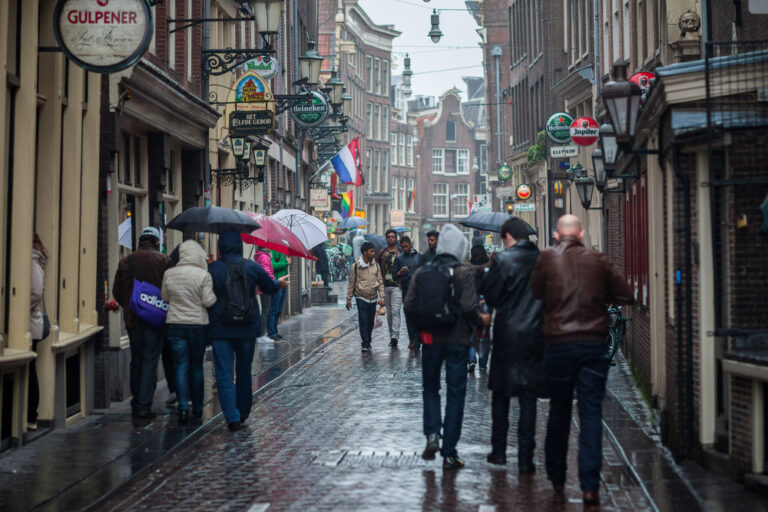
Planning a little trip to smoke some weed in Amsterdam’s hip and lively city centre? Not in 2023, says the municipality. 🚭
Smoking weed in the Red Light District and other parts of Amsterdam’s Old Town is set to be banned from mid-May this year, reports the NOS.
Residents are sick of unruly tourists
According to Amsterdam’s council, this blowverbod (smoking ban) is being rolled out to curb overcrowding, nuisance tourism, and public substance abuse.
Local residents have reported feeling unsafe at night thanks to tourists staying under the influence for long periods of time and attracting street dealers, says NU.nl.
This has a detrimental effect on residents’ quality of sleep, and the encouragement of buying from underhand street dealers increases the presence of crime in the city.
The council also plans to investigate whether a collection ban on soft drugs (cannabis products, sleeping pills, and sedatives like Valium) would be possible. If implemented, this ban would run from 4 PM to 1 AM from Thursday to Sunday each week.
Part of a larger push to combat nuisance tourism
This proposed smoking ban is just part of a larger list of measures that Amsterdam’s mayor and alderman cooked up last year. Other measures include:
A ban on selling weed after 4 PM
A ban on smoking weed in some parts of the city centre
A curtain call at 3 AM for Red Light District sex workers
What do you think of the ‘blow ban’? Tell us your thoughts in the comments below!

Ever wanted a challenge when it comes to biking? No? Well, this soon-to-be 70-metre-high bicycle mountain will surely get your legs on fire. 🔥
Stichting Fietslim (Bicycle Climb Foundation) has presented a thigh-breaking design for a bicycle climb in Zoetermeer, next to the SnowWorld ski slope.
Can this project be turned into a reality due to technical and financial feasibility? AD reports yes!
Behind the idea
The Stichting Fietskilm was founded in 2020 by three cycling enthusiasts who were looking for more challenging cycle paths.
Cyclists in the Randstad were climbing considerable slopes like the Cauberg, Posbank, or VAM mountain, but these weren’t exactly in the neighbourhood. That’s where the Stichting Fietsklim came in. 🚵
The mountain will consist of spiralling cycle paths, similar to this. Image: Zones Urbaines Sensibles/Supplied.
After some brainstorming, they proposed a spiralling cycle path, towering over SnowWorld’s high construction.
Board member of the Fietsklim foundation, Steven Hauwerts, stated to AD that “there is a lot of passion in this project. Besides the fact that we would like to offer a sporting challenge for cyclists and hikers, we also see this project as a larger whole. We are going to build this climb on a flat part in the Netherlands.”
The design
The design is inspired by the tower of roller coasters by the architectural firm Zones Urbanise Sensibles (ZUS).
It’s certainly giving roller coaster. Image: Zones Urbaines Sensibles/Supplied.
While the foundation first wanted to use the high construction of SnowWorld, the new design for Bicycle Climb is now separate from it to “keep our distance on the safe side,” reports Hauwaerts.
The infrastructure will be located in the middle of the Randstad, with the goal to design the Bicycle Climb with the Buytenpark in mind, meaning lots of trees, wood, and bird boxes for all nature lovers. 🐦 🌳
Next step? Construction will cost about €9 million. “Our next assignment is to look for one or a few investors. We want the club to be as accessible as possible,” tells Hauwaerts to AD.
What do you think about this bicycle climb, would you try it? Tell us in the comments below!
The recent earthquakes in Turkey and Syria have destroyed the lives of many people. This is hard to watch from the safety of the Netherlands, but thankfully there are things we can do to help.
According to the World Health Organisation (WHO), 23 million people in Syria and Turkey were affected by the two earthquakes (measured at 7.8 and 7.5 in magnitude) that hit on February 6, leaving tens of thousands of people homeless and devastated.
Two weeks later, on February 20, another devastating 6.4-level earthquake hit the region, followed by an aftershock with a 5.8 magnitude.
While the death toll has surpassed 46,000, many more people are homeless or still missing. Aid is being sent from all parts of the world.
“It is now a race against time. Every minute, every hour that passes, the chance of finding survivors decreases,” says General Tedros, director of WHO.
So, how can you help from the Netherlands?
We try to keep this article updated, but please tell us in the comments if you have new inputs, NGOs or campaigns you think we should include and support.
Donate to Giro555
Giro555 is an initiative of The Cooperating Aid Organisations. Together, the 11 cooperating aid organisations (Care, Cordaid, Kerk in Actie, Netherlands Red Cross, Oxfam Novib, Plan Netherlands, Save the Children, Refugee Foundation, Terre des Hommes, Unicef Netherlands and World Vision ) have opened an account where people can donate money to help the earthquake victims, reports NOS.
Giro555 was last opened in February last year, after the outbreak of war in Ukraine, raising more than €178 million.
Following the devastating earthquakes, Giro555 has now launched a campaign to provide aid for victims in Turkey and Syria.
Speaking to the NOS, Michiel Servaes, the spokesperson for the organisation, has stated:
“It is a terrible disaster, the gigantic size of which we cannot yet oversee. Immediate emergency aid is needed, such as medical care, blankets, food, and clean drinking water. Giro555 is now open and calls on the Netherlands to donate for all women, men, and children affected.”
#Giro555 is open voor #Turkije en #Syrië! Er is dringend hulp nodig voor de duizenden slachtoffers van de aardbeving, zowel op korte als op lange termijn. De samenwerkende hulporganisaties slaan de handen ineen en roepen heel Nederland op om samen in actie te komen. pic.twitter.com/wbTNHmZsA2
Translation: #Giro555 is open for #Turkey and #Syria! Urgent help is needed for the thousands of victims of the earthquake, both in the short and long term. The cooperating aid organisations are joining forces and calling on the whole of the Netherlands to take action together.
Account number: IBAN: NL08 INGB 0000 0005 55
Donate: €35, €70, €120, or choose another amount
Mission: Provide immediate emergency assistance such as medical care, food and shelter
Next Wednesday, Giro555 is organising a national action day on behalf of the victims from Sound & Vision in Hilversum, during which radio and TV channels will discuss a fundraising campaign.
Where to watch: A joint television program from the NPO, RTL, and Talpa Network will broadcast on NPO1 from 8:30 PM.
To listen: Radio station NPO FunX will be the national action channel throughout the day and will start at 5:55 AM, with DPG Media also joining. Radio stations Qmusic, Radio 538, Radio 10, Radio Veronica, and Sky Radio will also support the action day.
Donations open: Giro555 will remain open for donations for the following days after this. During the action day, there will be a call panel on Sound & Vision where people can call for donations.
The Dutch Red Cross opened an account number on Monday to collect donations for the affected areas.
At the time of writing, more than €2 million has been donated within 24 hours.
Nederland gaf al ruim €2 miljoen op #Giro7244 voor hulp aan slachtoffers van de #aardbeving🙏
Zo helpen we in #Turkije en #Syrië: 📢Zoek- en reddingsacties 🚑Eerste hulp, medische zorg, en ambulancediensten 🩸 Bloeddonaties- en vervoer ⛺️Dekens, tenten, voedsel en maaltijden pic.twitter.com/tTKnY33tZM
Translation: The Netherlands has already donated more than €2 million #Giro744 for aid to victims of the #earthquake. Thus we help in #Turkey and #Syra: search and rescue, first aid, medical care, and ambulance services, blood donations and transport, blankets, tents, food and meals
Account number: NL19 INGB 0000 0072 44
Donate: €35, €60, €120: For €60, you can give an emergency shelter package which includes tarpaulins, building materials and tools
Mission: Remove as many people as possible from under the rubble, provide first aid, and transport people to the hospital. Red Cross volunteers distribute blankets and tents to people.
The White Helmets, also known as the Syria Civil Defence, are humanitarian volunteers (former bakers, tailors, pharmacists, carpenters, and even students) that risk their lives for people in need.
Thousands of civilians are still stuck under the rubble after the earthquake, and while 3000 White Helmet volunteers are on the ground searching for survivors, they need our help to support their life-saving work.
Volunteers Muhammad and Safwat embrace in joy after successfully rescuing 2 children, Bayan and Ahmed, from under the rubble after more than 60 hours of continuous work in the town of Meles, west of #Idlib, yesterday, February 8.#Syria#earthquakepic.twitter.com/2VpLfFThBt
Molham Volunteering Team is a non-funded, charitable organisation founded in 2012 by a group of university students in Jordan with one mission: providing aid to internally placed and refugee Syrians in northern Syria and neighbouring countries.
Now, they’ve launched an “Earthquake Response” Campaign that aims to lessen the suffering of thousands of victims in Turkey and Syria.
Friends are asking about organizations with credibility helping #earthquakeinturkeyandsyria victims. Supporting them now is critical for any rescues in the next few hours. In Syria, Molham Volunteering Team – An Emergency Campaign – Earthquake Response https://t.co/2lsGAaWwpm
However, Minister de Jonge wrote a letter to the Dutch House of Representatives and there are a few assumptions about who’ll be entitled to the government subsidy.
The letter
De Jonge explained that the subsidy would be intended for households with one and a half or twice the average annual income, which would be between €60,000 and €80,000.
About a week ago, the NS rolled out contactless payments (OVpay) for checking in and out of its stations, and a total of 70,000 people have already given it a go. 🚆
In fact, its first day of release saw 7,000 people use Dutch public transport with their debit cards, credit cards, and mobile phones, according to RTL Nieuws.
Contactless payments were more popular over the weekend
That initial number of OVpay users saw a peak over the weekend, an NS Spokesperson tells RTL Nieuws.
The reason? The NS sees more infrequent travellers over the weekend, who go on an occasional day trip, and don’t necessarily own an OV-chipkaart.
It’s too soon to say if the NS’ new initiative is set to be a success. The rail company was uncertain if the ease of payment would be enough to lure car-goers to take the train more often. 🚊
However, one of their analysts tweeted that the company was still in the process of accessing customer feedback, in order to improve the final product. 👇
Vandaag is de livegang van OVPay – betalen met je bankpas en mobiel bij @NS_online! De komende tijd mag ik me weer bezig houden met analyses over hoe klanten het ervaren. Waar lopen ze tegenaan en hoe kunnen we het als NS beter doen?
Translation: OVpay went live today — pay with your bank card and mobile at @NS_online! In the coming period I will be able to concentrate on analysing how customers experience it. What problems do they encounter and how can NS do better?
No discounts, first class, or student travel
Whilst OVpay is definitely heel handig (very handy) for infrequent travellers, it definitely has its share of drawbacks.
Most Dutchies and internationals alike love their kortingen (discounts), but the new OVpay system charges you the full price of your ticket.
In addition to this, travellers that are accustomed to the fineries of sitting first class are set to be disappointed, as OVpay will only purchase a ticket for second class.
Hopefully, as improvements to OVpay are made, we may see some of these features made available for travellers.
Have you already given OVpay a go? Tell us all about your experience in the comments below!
An unprecedented event is about to take place at the Rijksmuseum in Amsterdam — almost all of Vermeer’s paintings will be on display in what is the largest collection of his work yet. 🎨🖌️
From February 10 until June 4, the Rijksmuseum is displaying works from the beloved 17th-century Dutch painter, Johannes Vermeer, in a never-seen-before exhibition, reports RTL Nieuws.
Why is this exhibition so special?
The exhibition contains 28 out of the 36 paintings Vermeer is said to have painted, which is the most Vermeer works that have been together in one establishment, ever.
The last time so many of Vermeers’ works were in one place was 20 years ago at the Maurtishuis in The Hague. Even so, there were six fewer Vermeers on display than there are now in Amsterdam.
How much is this once-in-a-lifetime experience going to set you back? Tickets for the exhibition are €30 per adult, if you hold a Museumkaartyou’ll pay €10 for a ticket.
But hey, it’s worth it if you’d like to witness the near-complete collection of the Dutch masters’ work with your own two eyes. 👀
Will you be one of the many going to the exhibition? Tell us in the comments below!
Do you know what VOC stands for? Neither do many Dutch people, concludes a committee commissioned by the government — even though it’s an integral part of Dutch colonial history.
The committee’s advice to the government? History lessons in schools must absolutely pay more attention to the history of Dutch colonialism, especially the former Dutch East Indies.
As RTL Nieuws reports, Dutch schools today are not technically required to teach about their country’s colonial past in Indonesia. As a result, how much is taught about this part of history greatly varies from school to school.
Especially given the fact that they like the minimize their role in colonialism. The Netherlands is considered one of the most “progressive” countries in the EU yet kids are taught nothing about role of the Dutch West India company and then there’s Zwarte Piet…
Shockingly, some schools pay (almost) no attention to it at all, the committee found. Why? Simply because “it’s not final exam material,” says history teacher Tim Koetsier, who consciously chooses to dedicate extra class time to the subject.
Tim Koetsier’s students appreciate the extra attention given to the history of Dutch colonialism: “I find it very interesting because it’s about something that many people in our country have had to deal with,” a student tells RTL Nieuws.
A classmate adds: “We have to learn a lot about French history and China before our exam; but the Dutch East Indies is not mandatory material. Crazy, right?” Right.
So, government?
The special committee that investigated this cause, led by former Minister Jet Bussemaker, was commissioned by the Ministry of Health, to find out how knowledge about the Dutch colonial past can be increased.
Their conclusion: lessons about Dutch colonisation should be mandatory in all schools.
The government will discuss the committee’s findings and respond later today.
What do you think about these findings? Tell us in the comments.