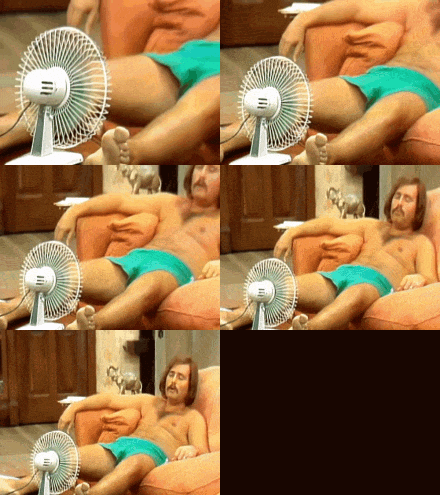
This is it guys. This is the big one. We’ve been warned by meteorologists about today for over a week. They’ve been expecting we will crack the 40°C mark. Yesterday the Netherlands broke the 1944 record for hottest day. Could we be heading for another record-breaking day?
The temperature this morning has been rapidly rising and by 10:00 the first areas had already broken 30°C. Meteorologists have described this afternoon’s temperature as “smothering.”
What can we expect for the rest of the day?
The meteorology bureau has currently issued a Code Orange, but (thankfully) are not expecting it to reach a Code Red. Guys, if this is a Code Orange, I really don’t want to be around for Red.
Will we be relinquished from the heat by the good-graces of a gentle breeze? Nah.
Only a weak to moderate wind is expected from the east to southeast. However, there is a small chance that the south or southwest could experience a local thunderstorm, so if you’re in these areas some rain-dancing should be on your agenda. Hallelujah!
Will tomorrow be any cooler?
We’re not seeing much change tomorrow either. While the temperature will drop by a few degrees that still leaves it in the high 30’s. Wadden will see 31°C, the center of the country will experience 37°C, and the southeast will be nudging 40°C with 39°C forecast.
The Netherlands is not alone in setting new records in this heatwave. Germany and Belgium sweltered through temperatures of 40.5°C and 39.9°C respectively yesterday. If only these were records we wanted to break, right?
Did you sweat through yesterday, or glow? Got any tips for beating the heat? Trust us, we would LOVE to know in the comments. ?
Actor and icon Rutger Hauer died at the age of 75 after a short period illness, as is told by his family. He died last Friday in Beetsterzwaag in Friesland, where he led a reclusive life. The funeral took place in a closed circle.
Rutger Hauer was known in the Netherlands for iconic roles in movies such as Turks Fruit and Soldaat van Oranje (Soldier of Orange). Two movies we can highly recommend to anyone:
You might know him from Bladerunner if you’re not Dutch:
If it feels like the hottest day ever in the Netherlands, well, we can confirm that it truly is as we’ve just got this push-notification that 39,1 degrees was measured in the town of ‘Gilze en Reijen’. Making July 24 2019 the warmest day ever in the Netherlands since they actually started keeping count.
It took a whole lot of complaining about the Dutch summer, climate-change and a bucketload of articles about this heatwave in the Netherlands from this website. But here we are, a new temperature record for the Netherlands! And historical fame for the town of Gilze en Reijen, of which we know nothing else besides now holding the national record for the highest temperature ever measured in the Netherlands.
The old record dated back to 1944 and was 38,6 degrees and measured in Warnsveld (Gelderland).
More temperature records tomorrow in the Netherlands
It’s going to be a short lifespan for this new record though, as temperatures are about to get more extreme tomorrow. We might see the thermometer go beyond the magical ‘40 degrees‘ on Thursday July 25.
Bijzonder moment zojuist in de weerkamer van Weerplaza. Voor het eerst hebben we 40 graden daadwerkelijk in de verwachting staan voor een locatie in Nederland. ?https://t.co/STDTBnxccnpic.twitter.com/gugkMRQfNg
What to do now with this heatwave in the Netherlands?
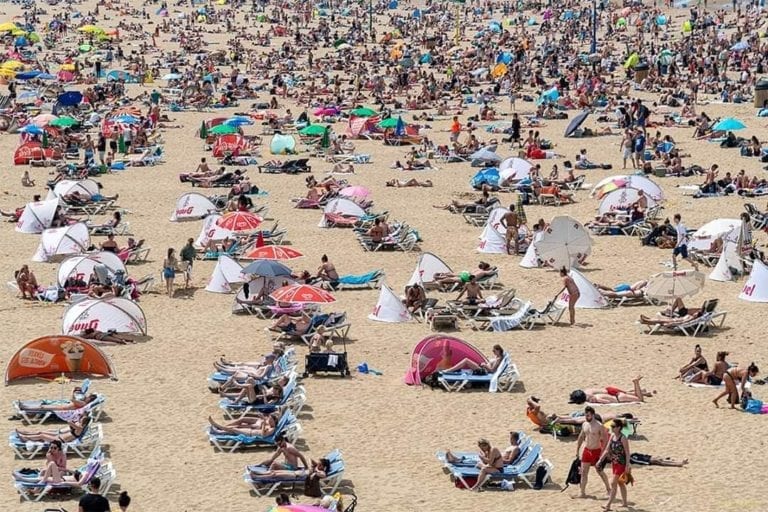
Obviously, it’s okay to ditch work now and go to a beach in the Netherlands. Surely your boss will understand. If not, try to work from home – and at least make sure that you’re drinking water, don’t get stuck in the train or get stressed out.
Looking forward to tomorrow, when it’s my day off and other people are online for DutchReview (sorry!) and can write about new record temperatures in the Netherlands.
At 6pm the average temperature for the day was 31.7 degrees in De Bilt which surpassed the old heat record (set in 2013) by 0.1 degrees, Weerplaza reports. (Don’t know what De Bilt is? Neither did I. It is a municipality in the province of Utrecht where the headquarters of the Royal Dutch Meterological Institute (KNMI) is located.)
The peak temperature recorded yesterday was 34.6 degrees in Eindhoven. The previous heat record for a July 23 was measured in 1911 in Maastricht hit 35 degrees.
Weerplaza predicts the temperatures to soar to a whopping 39 degrees tomorrow. The previous record of 38.6 was set in 1944 in the Gilders Warnsveld area. But if that happens, you’ll be sure to read about it from us.
Would you rather crop all those grey 1960’s condos out of your favourite pics of Dutch beaches? Try something different from Zandvoort, Scheveningen or Noordwijk, but not drive all the way to Zeeland? Then make your way to the Kop van Noord-Holland (the northernmost part of Noord-Holland) for one of the finest stretches of Dutch coastline.
Chill beaches, unobstructed views, the finest sand, and easy-going sunbathers. You can even get in some German practice while you’re there, because these Dutch beaches are wildly popular with Duitsland beachgoers.
Not up for the drive and don’t mind a few more Dutchies in speedos? Never fear, find a full guide to the top Dutch beaches here. Tempted to wriggle your toes in the sand and not be disturbed? Read on for our four top Noord-Holland beaches off the beaten path!
#1 Paal 29
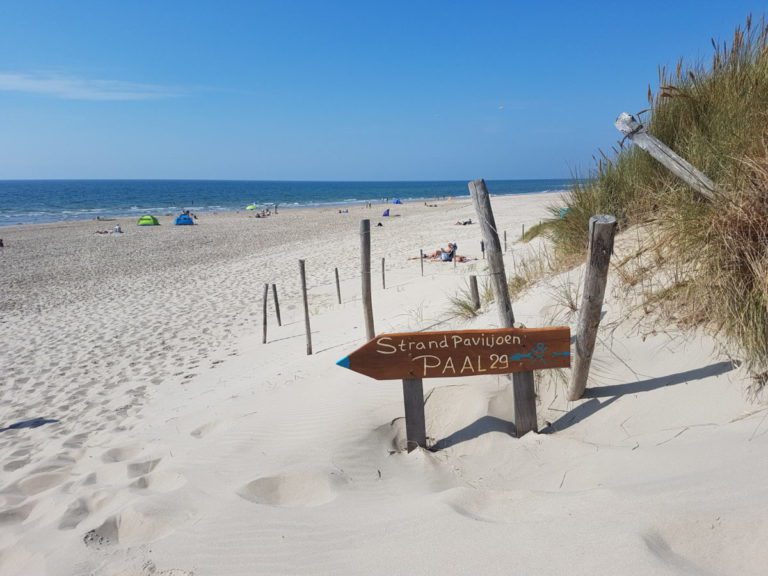
It’s only fair that I start with this one. A hidden gem, one of my favourite spots in the Netherlands and one that I make sure almost all of my visiting friends get to experience. Whether they love me or hate me for it is debatable, because Paal 29, a truly secluded Dutch beach, is not accessible by car.
Heading towards Paal 29. Source: Iulia Romaniuc
It takes either a longish hike (1.5h) or a bike ride over the Schoorlse Duinen (Schoorl Dunes) to reach it. And a bit of going uphill while you’re at it, because this is the highest dune domain in the Netherlands.
With more than 60 kilometers of hiking paths, many of them across amazing pine forests, with viewpoint platforms and the most challenging mountain bike trail in the country, the Schoorl Dunes National Park is as close as you can get to a mountain in the Netherlands.
Why you should go to Paal 29
There’s no such thing as a Dutch beach without a strandpaviljoen and Paal 29 is no exception, despite its isolated location. If you’d rather not bring your own picnic stuff, just head to the restaurant for a laid-back, barefoot dinner. The place tends to close earlier (around 20h30) than other seaside restaurants in the area, so lingering in front of that sunset with a final cocktail in hand might not be an option.
Perfect for families! Source: Iulia Romaniuc
Paal 29 is a Blue Flag beach. Expect clean sand, excellent water quality, lifeguards and a first aid post. Sunbeds, windscreens and umbrellas are available for rent at the strandpaviljoen.
To me, the best part of the day is, by far, the hike back to the parking lot in Schoorl. With heat and blinding sunshine out of the way, this is the perfect time to marvel at the dune roses, to spot the rabbits, to inhale the intense scents, to relish that comforting early evening tranquility.
How to Get There
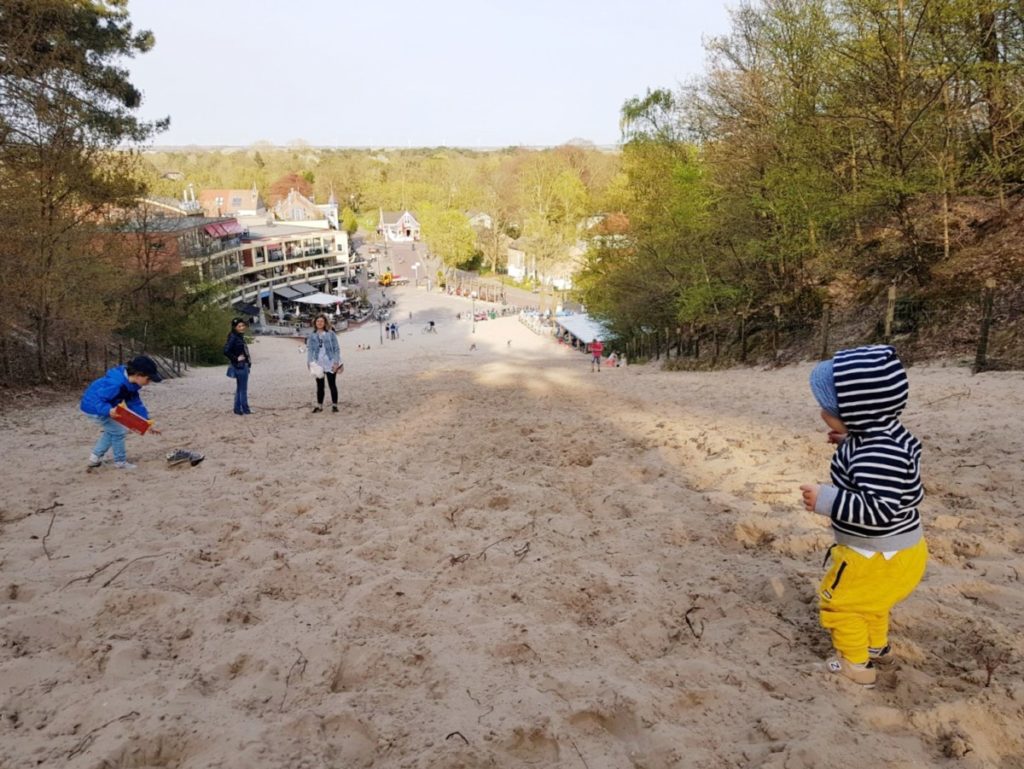
The hiking route we usually take starts in the small town of Schoorl, at the bottom of the famous Klimduin (The Climb Dune). An impressive mountain of sand, 51m high, the Klimduin is a magnet for both adults and children. Few can resist the urge to roll down the dune, gliding over the silky sand. I remember staring back at it when we drove past for the first time. It looked surreal, unlike anything I had ever seen before. Almost like a ski slope popping out in the most unexpected place, at the most unexpected time.
Rolling down the sand-dune is just one of the highlights of Paal 29. Source: Iulia Romaniuc
On your way to the beach, you can either climb the dune or take the gentle uphill path on the right, which will also get you to the top of the dune, but at a more leisurely pace.
Once you’ve reached the top, you have the option of a small detour to a viewpoint platform to the left of the main trail. Which is not a bad idea at all, except for the fact that you’ll barely distinguish the sea from that platform. Realising how far away it actually is might be a little discouraging at this point. Alternatively, you can follow the main trail, which winds through the pine forest for the first 40 minutes or so.
Hike your way to Paal 29, one of the best beaches in the Netherlands. Source: Iulia Romaniuc
Beware, though, you will have to handle several crossroads. There are plenty of trail signs around, so don’t fret, but if you wish to take the shortest route to the beach, you could probably use the extra help of a navigation app such as Google Maps.
Half way through, you will leave the forest behind and carry on, across the dunes, for the remaining 45 minutes. If it’s one of those rare hot summer days, you will need sun hats, sunglasses and lots of sunscreen to make it to the beach in one piece. About 10 minutes into this second part of the hike is when my kids usually start complaining. Approximately 30 minutes later, they will have asked the same question (“how much more?”) over and over again, 30 times and counting. Only to forget all their troubles at the sight of the sea and engage in a final, euphoric sprint to the water.
#2 Camperduin
About 5km north of Paal 29 is another gorgeous Blue Flag beach, which made national news last week, after a group of 10 to 20 dolphins was spotted swimming off the coast on Friday morning.
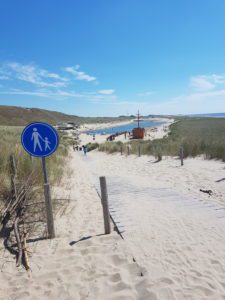
The trail to Camperduin’s artificial lagoon. Source: Iulia Romaniuc
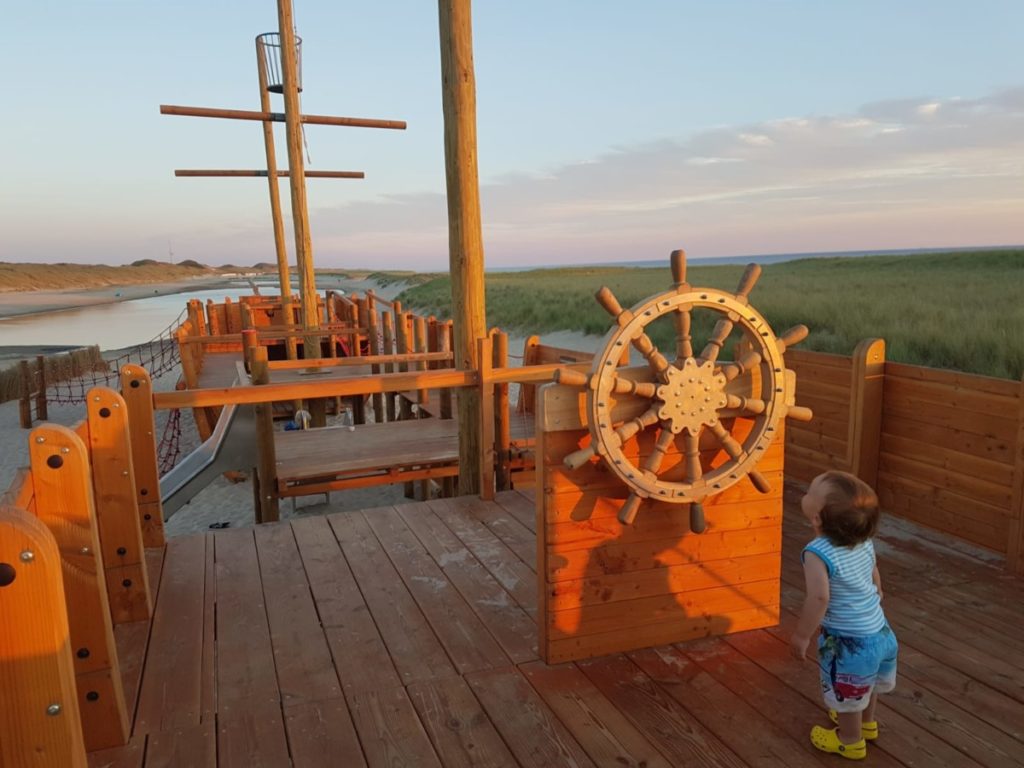
Just like other Dutch beaches nearby, Camperduin boasts rolling dunes and very fine sand. What sets it apart, though, is an artificial lagoon in a sheltered area amid the dunes. The small lake was created as part of a coastal development project (2014-2016) for strengthening the Hondsbossche and Pettemer Sea Defense between the villages of Petten and Camperduin. The huge wooden play ship (Speelschip De Slag), on the way down to the lagoon, is yet another distinctive feature of the beach. One that makes it very popular with kids.
Why you should go to Camperduin
Does the name of the beach (and village) sound familiar, but you just can’t put your finger on it? The village of Camperduin rose to worldwide fame after a major naval battle off its coast in 1797. Usually referred to as the battle of Camperdown, it ended with an unequivocal victory for the British North Sea Fleet. The Brits captured no less than eleven Batavian Navy ships without losing any of their own.
Speelschip De Slag, a play ship at Camperduin. Source: Iulia Romaniuc
There are two strandpaviljoens at Camperduin. Luctor et Emergo, right there on the beach, and Struin, higher up on the dunes, above the lagoon. Beach gear is available for rent at Luctor et Emergo.
How to get to Camperduin
Parking costs €6 per day in high season, but public transport is also an option. Just hop on bus 151 from Alkmaar Centraal.
#3 Petten
Yet another 5km north and we reach another gorgeous Dutch beach, the beautiful Blue Flag seaside of Petten. Similar to Camperduin in terms of width and sand characteristics, it does come with its own unique peculiarity.
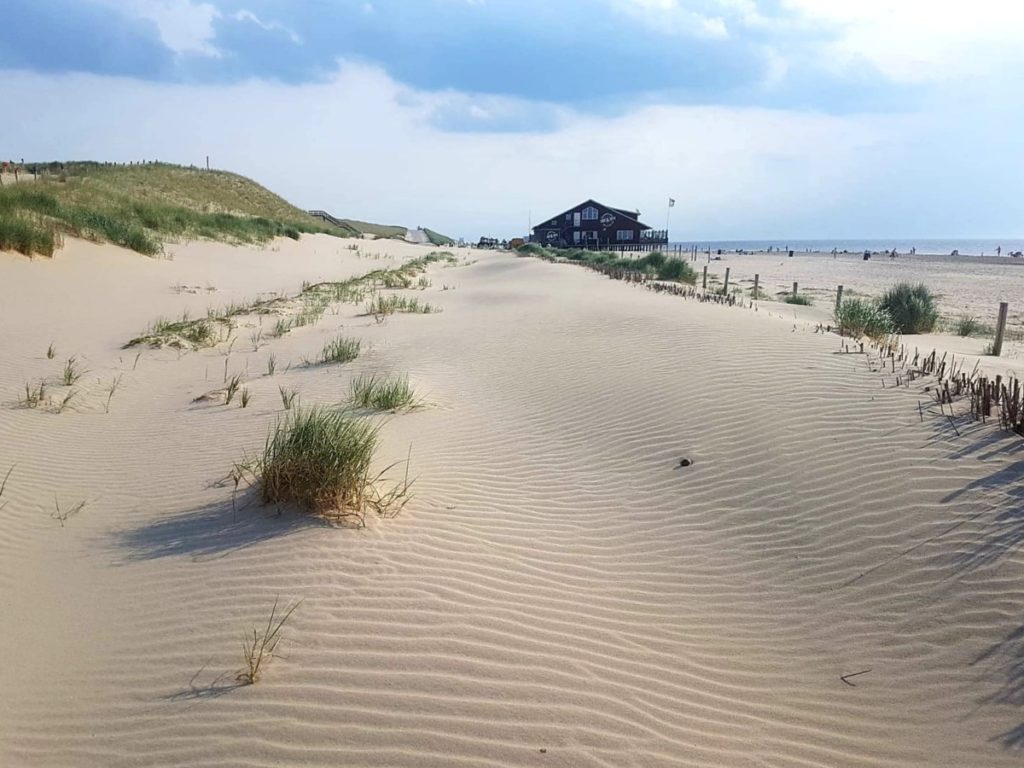
Petten sand dunes. Source: Iulia Romaniuc
Why you should go to Petten
A panoramic dune created during the same coastal development project as the lagoon at Camperduin. The wide viewpoint platform on top of the dune, complete with wooden benches, is a good spot to watch the sun sink into the sea.
A crab at Petten. Source: Iulia Romaniuc
How to get to Petten:
Parking is free, but if you don’t have a car or would rather sip a drink at the end of the day, geen probleem, just go for public transport. Bus 851 from Den Helder (a.k.a. the Kustbus – Coast Bus) stops at Petten.
#4 Sintmaartenszee
Last but not least, a further 5km north of Petten and we come to Sintmaartenszee. This stunning Dutch beach is one of the best kept secrets of the Netherlands, with a rustic atmosphere and heaps of room for children to play.
Why you should go to Sintmaartenszee
There are two strandpaviljoens, NewZuid and Noord, at somewhat of a distance from each other. The electric shuttle goes to NewZuid only. Noord can be reached on foot, following either the shore or a path across the dunes, which forks off the road to NewZuidun. Fancy a sunbed or a windscreen? You should be able to rent them out at the strandpaviljoens, provided you get to the beach early enough.
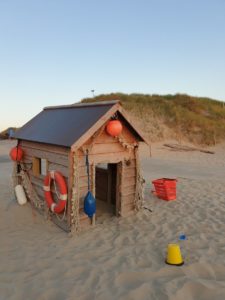
A cubby house on the beach at Sintmaartenszee. Source: Iulia Romaniuc
How to get to Sinmaartenszee
Its Blue Flag beach is not accessible by car, but not too far away from the parking lot either. Just a leisurely 15 minutes asphalt walk, or alternatively, a very short ride with the tiny electric shuttle. The shuttle is only available during summer months and costs €1 per ride per person.
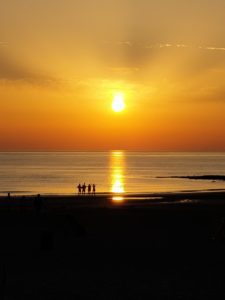
Stunning sunset over the Noord-Holland beach Sintmaartenszee. Source: Iulia Romaniuc
Free parking is possible right next to De Goudvis, a typical Dutch speelpark that will keep your kids busy for at least one afternoon if you decide to spend the whole week-end in the area. As for public transport, Sintmaartenszee, just like Petten, is covered by the Kustbus – line 851 from Den Helder, that is.
A cyclist crashing into a parked car while using her smartphone has been captured on video and shared almost 800 times since Friday. The incident occurred less than a month after the smartphone/cycling ban was implemented.
Smartphones can do a lot of things nowadays: take pictures, provide navigation in cities all over the world, connect you to that random hot guy from your English class twenty years ago, and even listen in on your secret conversations (what, what?).
But, one thing these amazing pieces of technology can’t do is tell you when your bike is about to crash into a parked car, as one Utrecht cyclist discovered this week. (Paging @Apple @Huawei and @Samsung, #featurerequest)
How did this happen?
A video captured on a reverse dash-cam shows the cyclist riding down a typical Dutch street, and slamming full speed into the parked, unattended car.
A Facebook post by the owner of the car Binnert Mihajlović explained that the cyclist damaged the car, but failed to leave any details. He’s now on the lookout for the offender.
“I think insurance-wise this does not have to be very difficult,” said Mihajlović in the Facebook post. “Additionally, I also hope that you were not injured, but it looked like you were okay.”
What was the fallout?
Mihajlović warns that while he has blurred the face in the shared video, if the cyclist fails to come forward he will release an un-censored version.
If someone asked me to rate how happy the Dutch are after being screamed at by a Dutchie for riding my bike on the wrong side of the bike path, I would answer “not at all. They’re so angry!” But, I would be wrong. A study by the Central Bureau of Statistics (CBS) has found that 86% of Dutchies are satisfied with their lives. Perhaps the very reason I think they are not happy is, in fact, the reason they are – setting boundaries and expectations that lead a good life.
The CBS study revealed that non-Western people are happier today than they were in 1997, but that people with little education are unhappier. The conclusion being that people with a higher education have more opportunities which generally lead to a more fulfilling life.
Most of the factors that contribute to happiness are fairly obvious – time spent with family and friends, education, work-fulfilment, social support and low crime rates. Interestingly, however, those who do not partake in smoking or drinking are significantly less likely to be happy than a person who does smoke or drinks alcohol. Excuse me science, are you saying what I think you’re saying?
Expectations are resentments in the making
Prof Ruut Veenhoven, the director of the World Database of Happiness, believes the Dutch are so happy because young people in the Netherlands aren’t burdened by expectations to achieve highly.
“If you look across Europe, the Dutch and the Danes are the most lenient and focus more on developing autonomy than giving priority to obedience – and that fits the society,” he told The Guardian. “Children are more free to do what they want, and in doing what they want, develop an idea of what they really like and social skills.”
Is 86% still not good enough? Move to Scandinavia!
The happiest countries only ever seem to rotate between Denmark, Iceland, Norway, Sweden or Finland (side note: do we count Iceland and Finland as “Scandinavia”?) . The most recent report by the United Nations revealed Finland is the happiest nation and the Netherlands came in fifth. The Greeks are rated as the most unhappy nation in Europe. (What a Greek tragedy.)
Are you from Greece? Then travel to the happiest countries!
According to Travelzoo’s senior editor, Gabe Saglie, even travelling to the countries with high happiness levels allows us to absorb good habits and “the pervasive factors that seem to make everyday life there a happy proposition: a sense of community that comes from social support, the joys that come from increased generosity among citizens, and the overall happiness of people who lead a healthy lifestyle.”
CBS says, the satisfaction levels in the Netherlands are so high, that any increase to the happiness levels is barely possible. “Many people in our country already have a high well-being and already give (almost) the maximum score. This creates a ‘ceiling effect’.
Why do you think the Dutch are so happy? Share any insights you might have with us!
It’s getting hot in here (so hot!) so [take all of the necessary precautions to remain at a comfortable body temperature] because I am getting so hot, I wanna [ensure you remain responsible in the heat].
Roll up, roll up, Netherlanders and beyond to temperatures that are EXTREMELY out of the ordinary and will take you by surprise! Over the next few days the mercury is expected to continue to rise.
How hot will it get?
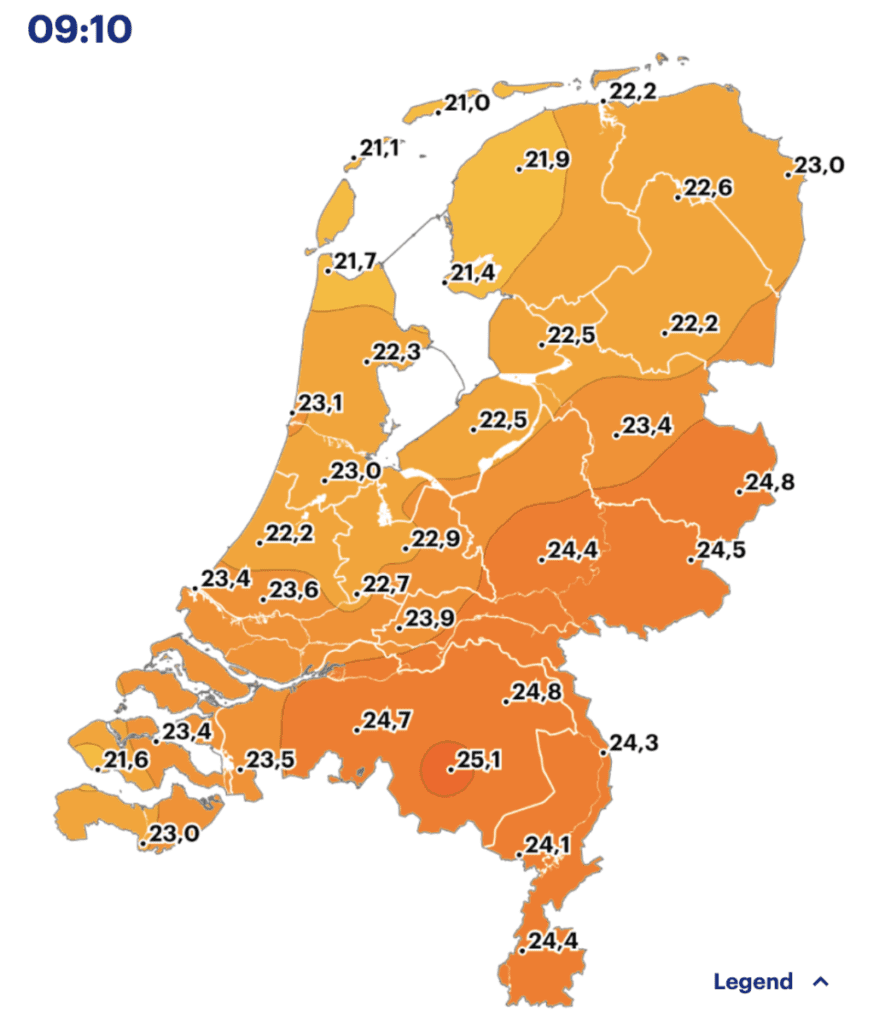
By 09:10 some regions in the southern lowlands had already broken the 25°C mark, with numbers continuing to increase by the minute. Today temperatures will reach around 28°C in the far north, 31°C in the center, and 34°C in Limburg.
The high temperatures have started early. Image: Buienradar
The Ministry for Infrastructure and Water Management (Rijkswaterstraat) and ProRail are taking measures to ensure people remain safe.
They’re advising travellers to bring bottled water and an umbrella with them, so that in case of a breakdown they can be shielded from the sun and hydrated.
Those travelling by car will be transported to a safe place with facilities in the case of a breakdown, instead of just a place to park the car.
How are trains affected?
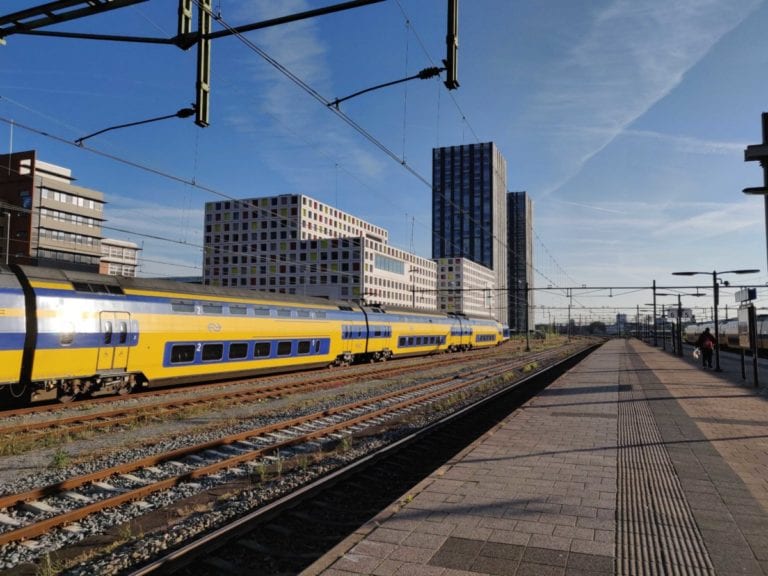
ProRail have implemented more trains with air-conditioning to be used over the coming days. While 95% of trains are modern enough to have air-conditioning, some of the older double-decker style still go without and will only be used if absolutely necessary.
ProRail also fear that tracks could be disrupted by the weather, as heat will make the steel tracks susceptible to twists. They’ve organised for additional disruption teams to be available in the event that something happens.
What should you do?
Remember DutchReviewers to stay cool as the temperature rises, find a place to cool off like a local swimming pool or safe canal or river, and eat ice-cream – LOTS of ice-cream. That’s our “expert” advice.
What are you doing to beat the summer heat? Any tips or tricks? Let us know in the comments below!
Prepare for rail disruptions caused by high heat this week
The Netherlands is going to be experiencing high temperatures of nearly 40 degrees this week. Extreme heat could result in possible disruptions on the railway lines. Therefore, ProRail has declared a ‘code red’ and will have hundreds of more employees standing by than usual to resolve issues caused by the heat.
If you want to get to your destination on time, be sure to take into account the disruptions that are predicted to happen. The rails will expand as a consequence of the heat, and may not always be able to withstand the heat, said a spokesperson to NU.nl.
Taking the train in the Netherlands when temperatures are high
The worst day is expected to be on Thursday. However, NS does not yet know whether there will be an adjusted timetable because of the high temperatures. ProRail employees will have blue flashing lights with them in case an emergency situation arises.
Het belooft een hete week te worden ☀️? Omdat deze hitte de kans op verstoringen op het spoor vergroot, neemt ProRail extra hittemaatregelen ??
To avoid be sure to take water and dress in your lightest clothes. If the air conditioning in a train stops working, the temperature inside it can rise quickly and become unbearable, especially in the new trains where you can’t crack open a window to allow for ventilation.
They don’t want you to get dehydrated, so there will be ProRail employees at different locations ready to offer water and support on Thursday when needed. But take your own water too! For yourself, and for anybody else who might need it.
What are you going to be doing to cope with high temperatures this week? Let us know in the comments below!
Our favourite rainy country is facing skyrocketing temperatures this week when a heatwave passes through Europe. It comes less than one month after a similar heatwave saw temperatures in neighbouring France reach as high as 46°C.
“Don’t come to the Netherlands,” they said. “It will rain the whole time you’re there!” they said. “Just kidding!” they said. “You’ll actually sweat your clogs off during summer!” they said.
Truth be told, temperatures are going to rise this week. Not in the nice summer way, either, but in the “oh my god, why don’t Dutch people have pools” way.
How hot is it going to be?
Weather service Buienradar are predicting temperatures will steadily increase, adding a few degrees each day. Limburg, in the southeast, is thought to be the worst affected with predictions of 39 or 40 degrees on Thursday.
Goedemorgen. Vandaag is het (vrij) zonnig met eerst nog sluierbewolking. De meeste bewolking bevindt zich eerst in het noorden. Het wordt vanmiddag 23 tot 29 graden. De komende dagen wordt het LOEIHEET en staan records onder druk! https://t.co/gADRmAQLUApic.twitter.com/hKJ7r0ocD0
Sidenote: what is loeiheet? Loei is the sound that cow makes (a Dutch version of ‘moo’) but in this context it really just means ‘very,’ ‘extremely,’ or ‘super’ combined with heet (hot). Crazy hot! Why is it moo-hot? Yeah, no Dutchies really know. Do you? Let us know below!
Today we will see comfortable temperatures in the high 20’s throughout most of the country, but the Tuesday through Thursday things will really heat up.
Are we heading for a record-breaking attempt?
Guys, I’ve gotta be honest: you know we’re in for a bad time when Buinradar meteorologists start using double exclamation marks:
If you think you can enjoy a reprieve in the evening, don’t. Tropical nights are expected with the evenings still hanging around the 20°C mark.
The ice-cream melting temperatures have a high chance of breaking the 74-year-old Dutch record for the hottest day in history. We, for one, are happy to let that record grow even older – dankjewel!
How are you preparing to face the summer heat? Any tips or tricks for keeping cool in the lowlands? Let us know in the comments below!