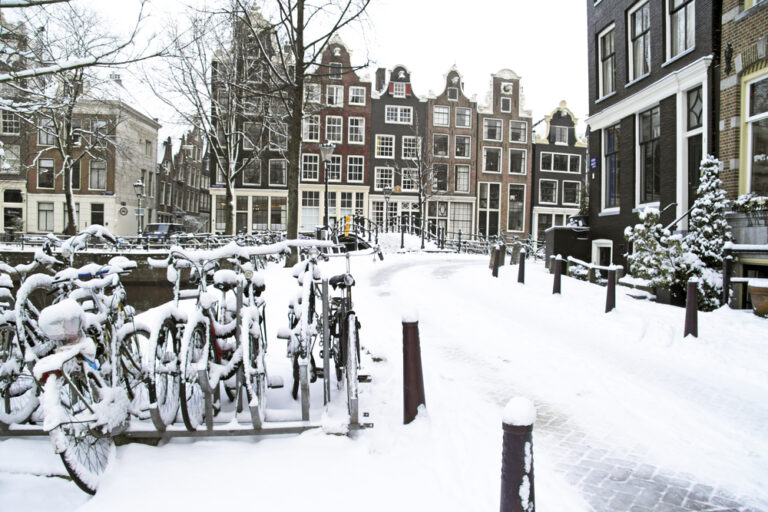
Snow, ice, and frosty winter mornings are all their way to the Netherlands.
Think you’ve put enough layers on to cope with the cold? It’s time for an extra-extra layer, as the Netherlands might get heavy snow from next Wednesday, reports RTL Nieuws. 🌨
Good nieuws for winter enthusiasts, but hold on to your hats
Although weather predictions show that the Netherlands might get some heavy snow from Wednesday next week, Buienradar meteorologist William Huizinga says that it is “impossible to say for sure.”
This is because the weather can’t always be predicted so far ahead, because all the factors that could lead to snow in the next week could change.
The prediction of snow is based on the fact that a rain area is due to enter Europe from the Atlantic Ocean. The combination of freezing temperatures in the Netherlands (how is that fourth layer treating you?), and the incoming rain could only mean one thing; Sir Jack Frost’s arrival. ❄
Just a little bit of snow in Amsterdam, the Netherlands 🇳🇱 📸 IG shadesfromthesoul pic.twitter.com/EMN78L1xT2
— Wonderful Destinations by heart ❤️ (@WonderfulDest) December 5, 2022
Snow or no snow?
Although it can’t be said for certain that we will get this predicted snow next week, we do know that it is due to be cold.
It will remain only a few degrees above zero in the coming days, and at night, temperatures will drop to 0 degrees or below. 🥶
There is also a chance for rain showers over the next day, with chances of ice overnight. This means that tomorrow it could be quite slippery, so make sure you take it a little slower on your bike. 🚲
But despite the cold weather, the weekend will dry, and temperatures will be between 2 and 3 degrees Celsius. It will be cloudy and grey inland, but along the coast, there will be a little more sunshine. ☀
And as for the snow? Well, we’ll just have to wait until next week to find out for sure, but we’ll have our sleds and winter boots ready, just in case.
What are your plans if it snows in the Netherlands? Tell us in a comment below! 👇
Your head is probably full of Christmas to-do lists and ambitious New Year’s resolutions, but there is one more important thing to consider before ringing out 2022: your Dutch health insurance.
Can’t you just add “finding (or changing) health insurance” to your 2023 resolutions, you may ask? No. Definitely not. In the Netherlands, you can change health insurance only once a year, and the deadline for doing so is December 31.
However, there’s no need to stress out just yet. It’s common practice in the Netherlands to change your insurance policy last minute. Some Dutchies even wait until New Year’s Eve! Nevertheless, it’s probably a good idea to look at it before the champagne kicks in.
So, here are eight crucial things you should know about Dutch health insurance as an international.
1. Taking out health insurance is mandatory in the Netherlands
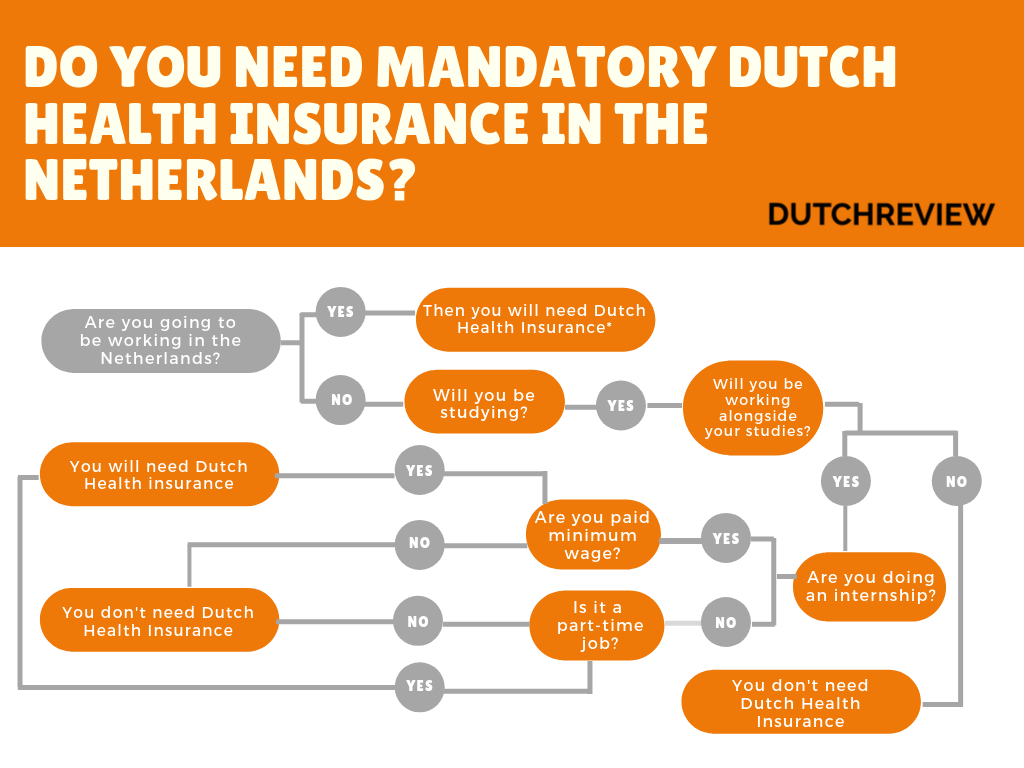
Well, at least it’s as good as mandatory. If you’re wondering whether you need to take out health insurance in the Netherlands, you should ask yourself two things: Are you working? And are you getting paid minimum wage?
If the answers are yes, you should take out Dutch health insurance.
Follow the lines, and you’ve got your answer! Image: DutchReview
Every person who lives and works in the Netherlands — including internationals — is legally obliged to take out at least a standard health insurance policy.
If you don’t, you’ll receive a letter from the CAK — a public service provider implementing regulations on behalf of government bodies (in this case, the Ministry of Health, Welfare, and Sport). This letter will kindly inform you that if you don’t take out Dutch basic insurance, you’ll be fined €437,25. 🙃
Good to know: If you’re an Erasmus student or an international student and aren’t working in the Netherlands or if you’re staying less than four months, then you won’t have to take out Dutch health insurance.
2. There are four different types of health insurance in the Netherlands
With that lovely little fine in mind, let’s look at some typical health insurance policies, shall we?
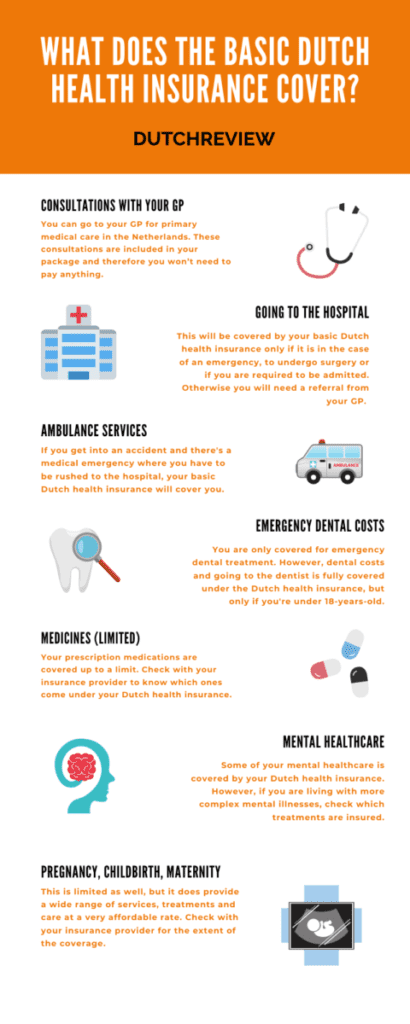
Simple, it’s just a policy that covers, well, the basics: emergency care, ambulance rides, GP visits, and some mental health care. This is not an exhaustive list, but you get the idea — if you’re an overall healthy individual, then a basic package is all you need.
For the visual learners. Image: DutchReview
However, each possible Dutch health insurance package, including the basic one, comes in multiple shapes and sizes (four, to be precise). So, when searching for health insurance in the Netherlands, pay attention to whether it’s labelled as:
a restitution (restitutie),
combination (combinatie),
in-kind (natura),
or budget policy (budget).
Let’s look at an example of why this is important: a restitution policy will give you a lot of flexibility by offering you the choice to see any care provider you fancy. With an in-kind policy, on the other hand, you’ll pay extra if you choose a care provider who doesn’t have a price agreement with your insurer.
That doesn’t necessarily mean that a restitution policy is better than an in-kind policy — merely that you should think about your needs and priorities before selecting your Dutch insurance type. After all, the extra flexibility will also be reflected in your premium.
3. Comparing Dutch health insurance will save you money
Okay, there are four different types of Dutch health insurance. Got it. On top of that, there are about 60 different health insurance providers in the Netherlands — giving you a grand total of about 900 different policies to choose from. 😨
So, to avoid being too overwhelmed by choices, we highly recommend using an online comparison tool to find the perfect health insurance for you.
Find the insurance policy that suits your needs by comparing Dutch insurances online. Image: Depositphotos
Normally all you need to do is type in your birthday, your biological sex, the city you live in, whether you’re a student, and if you want to co-insure any family members. A proper comparative website will then offer a good overview of everything you need to know about Dutch health insurance as an international.
There’ll be a few more questions to establish whether you need supplemental insurance, but in a few clicks, you’ll have the top three insurance policies for you. Easy! Then, all you need to do is check out the terms of each, and you’ll be ready to take out your preferred policy directly online.
4. The price of insurance premiums is going up (again)
The money you pay for your health insurance is called a premium (zorgpremie or premie zorgverzekering in Dutch). In the Netherlands, you can pay it either on a monthly basis, or in one lump sum at the beginning of the year (which is cheaper in the long run).
On Budget day (September 20), the Dutch government estimated that each person in the Netherlands would spend about €12 per month more on health insurance in 2023 compared to this year — jammer!
But why do premiums rise every year? There are three reasons for this:
The aged population is growing, and more care is therefore needed.
Newer and better treatments and drugs are becoming available, but they are also more expensive.
Increases in health care sector wages.
5. The Netherlands offers a healthcare allowance
Although Dutch health insurance premiums are becoming more expensive, you don’t have to watch your monthly budget crumble just yet.
The Dutch government offers something called healthcare allowance (zorgtoeslag) which is a financial contribution meant to ensure that you can take out health insurance without breaking the bank. 🙌
Good to know: The Dutch healthcare allowance has been adjusted in accordance with the increase in health insurance premiums.
To be eligible for healthcare allowance, you must:
Be 18 years of age or older, and have compulsory Dutch healthcare insurance.
Have a yearly income of less than €38,520 in 2023.
Have a nationality from an EU country, Liechtenstein, Norway, Iceland or Switzerland.
6. Things are changing in Dutch basic health insurance
Last year, it was established that people who are recovering from coronavirus (or have persistent complaints) would be eligible for additional treatments via their basic health insurance. This year, a whole lot of other things are changing in Dutch health insurance coverage as well.
Let’s start with the good news: the general increase in premium prices means your healthcare allowance (if you’re eligible) will also increase (phew!).
Also, the deductible amount on your health insurance will, thankfully, stay the same. Finally, if you’re expecting a new addition to the family in 2023, you might be interested in hearing that non-invasive prenatal tests (NIPT) will be completely free from April onwards.
On a less positive note, discounts on collective health insurance will be abolished, meaning some of us are in for an even more expensive 2023 than we might have thought.
Consultations with a dietitian will be included in your basic Dutch health insurance from August 2022! Image: photographee.eu/Depositphotos
While some conditions apply, it’s a major bump up for basic health insurance in the Netherlands. 🎉
7. Dental care is not included in your Dutch health insurance
The basispakket (basic Dutch health insurance) only covers dental care up to 18 years of age.
However, chances are you’ve blown out those candles a long time ago (and eaten a lot more cake since), so when looking at your Dutch health insurance for 2023, consider whether you want to add dental care as supplementary insurance (aanvullende verzekering).
This isn’t always necessary but really depends on your personal situation.
8. Dutch health insurance can also cover you abroad
As an international, an important aspect of finding or changing Dutch health insurance is whether you’re covered outside the borders of the Netherlands.
In general, you can rest assured that the basic health insurance includes emergency care abroad. For travelling in Europe, you can count on the trusty European Health Insurance Card (EHIC) to access medical facilities in the EU, without having to cough up money in a pinch. However, the extent of coverage beyond that will depend on your specific insurance policy.
If you’re planning on travelling outside of Europe, you can take out additional health insurance that’ll cover your medical needs no matter where you are in the world.
There you have it, eight must-knows about Dutch health insurance to take you into 2023, safe, secured, and healthcare savvy. 🍾
Do you have any tips for finding or changing Dutch health insurance? Tell us in the comments below!
As part of an ongoing collaboration, Alzheimer Netherlands and the Nederlandse Spoorwegen (NS) have come up with a new initiative to raise awareness for Dementia in the Netherlands — and it’s extremely wholesome.
As part of the “GOED omgaan met dementie in het openbaar vervoer” (dealing well with dementia in public transport) campaign, the NS is setting up realistic train compartments in nursing homes throughout the Netherlands.💺
A trip down memory lane with the NS train
“Everyone loves travelling,” says the NS — but what if travelling becomes impossible due to dementia?
Well, with the creation of a realistic looking train compartment, Alzheimer Nederland and NS are trying to imitate that Dutch train-feeling in nursing homes throughout the country. 🚅
This initiative will allow the elderly to re-experience what it was like to travel by train – without the stress of cancelled rides and overcrowded carriages.
Stimulating the senses
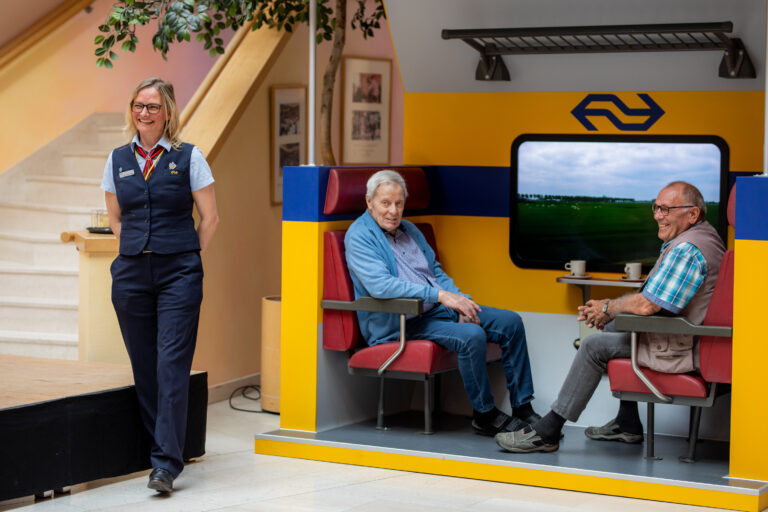
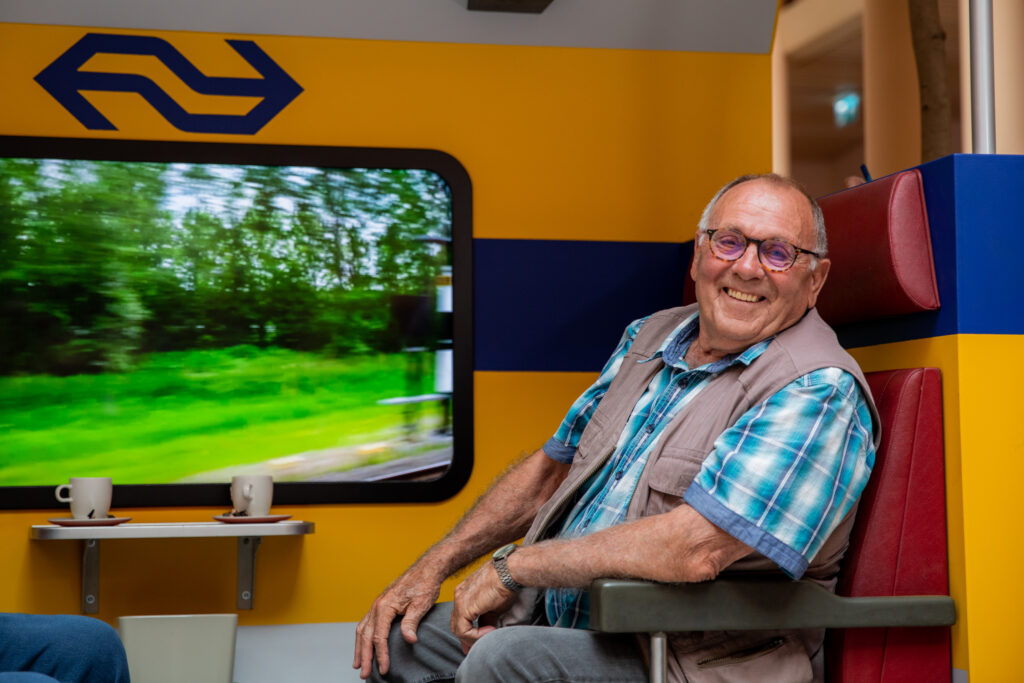
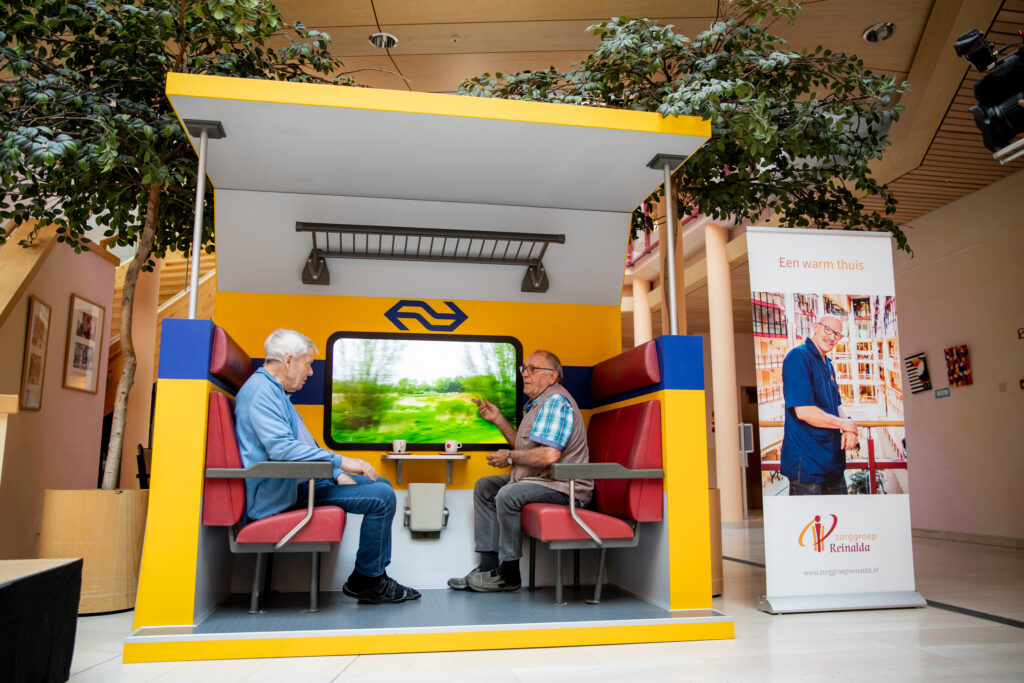
In the typical NS-style compartment — featuring real train seats, tables, and even the little NS garbage cans — residents of 12 nursing homes in all 12 provinces of the Netherlands will be given the opportunity to relive happy memories of travelling.
All from the comfort and safety of their home.
The mini-carriage will be placed in the common areas of the nursing homes, so that residents with dementia and their families can sit down in them.
Over a cup of coffee and a nice conversation, they can look out the ‘window’ — in which images will show the landscape of NS’s Amsterdam to Alkmaar route. Super leuk! ☕️
Though people generally have no shame openly expressing dissatisfaction with the NS, we think it’s safe to say that this is a great initiative!
Dementia in the Netherlands
Dementia is the general term used for the loss of abilities such as memory, language and problem-solving.
At the moment, there are approximately 290,000 people living with dementia in the Netherlands, but these numbers are expected to rise drastically.
By 2030, the number of dementia patients is expected to reach around 420,000, and 520,000 by 2050. With these high numbers, dementia is set to become one of the leading causes of death in the Netherlands.
Meaning thoughtful initiatives such as this are exactly what we need. 🧡
What are your thoughts on NS’s travelling train compartment? Let us know what you think!
Red alert! The Dutch House of Representatives has just announced that menstrual products should become free for people with low incomes. Let’s hope they put this plan into action soon. 💪
The government believes that while this is a step in the right direction, it’s only a “start”, Nu.nl reports.
The plan is said to cost €2 million a year and should be implemented in 2023 — another reason to happily wave doei to 2022.
Great! how will this work?
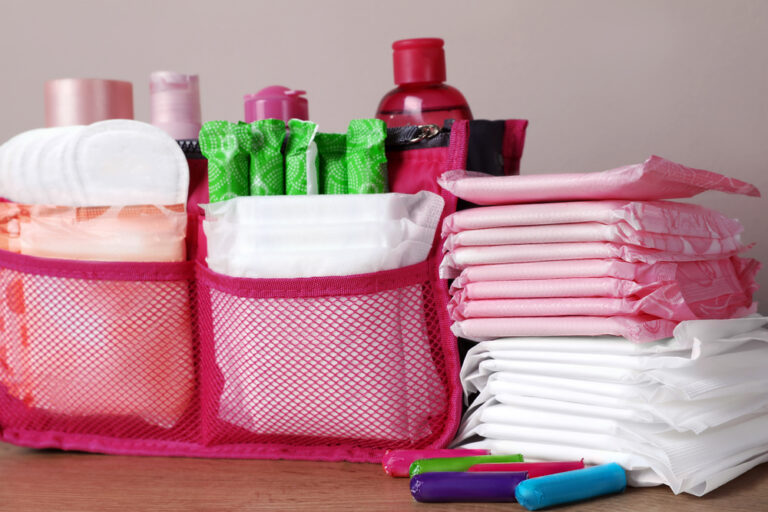
So, what counts as low income? For now, the House of Representatives believes that free period products should be made available to those on “at least” minimum income.
An ideal structural solution to the problem would be that menstrual products become free for everyone, votes MP Marieke Koekkoek — say it louder for the people in the back!
And where can we get these products? While it’s not certain where we will be able to pick up free period products, the current plan is to make them accessible through food banks.
Tackling a very real issue
Period poverty has long since been an ongoing topic of conversation in the Netherlands.
A shocking one in ten girls and women are unable to afford period products — and this hasn’t been helped by inflation which has seen the price of sanitary products rise by upwards of €2 per item.
Some women must choose between buying menstrual products or putting food on the table. This may be an extra challenging time for families with daughters.
Go with the flow
It’s not just the government who are acknowledging this struggle.
This year Tilburg University made free menstrual products available on their campus. A remarkable achievement which the rest of the Netherlands should use as a blueprint (or blood print. 😉)
Let’s hope that this isn’t just another one of those once-a-month discussions.
What do you think of this plan? Let us know in the comments below.
More freedom, more choice! 🎉 You’ll no longer have to look up abortion clinics near you while dealing with an unwanted pregnancy. That’s right, GPs in the Netherlands will soon be able to grant women access to abortion pills.
On Tuesday, the Dutch senate approved a bill that will make this possible, Nu.nl reports. Until now, women had to request an abortion pill through an abortion clinic.
How will it work?
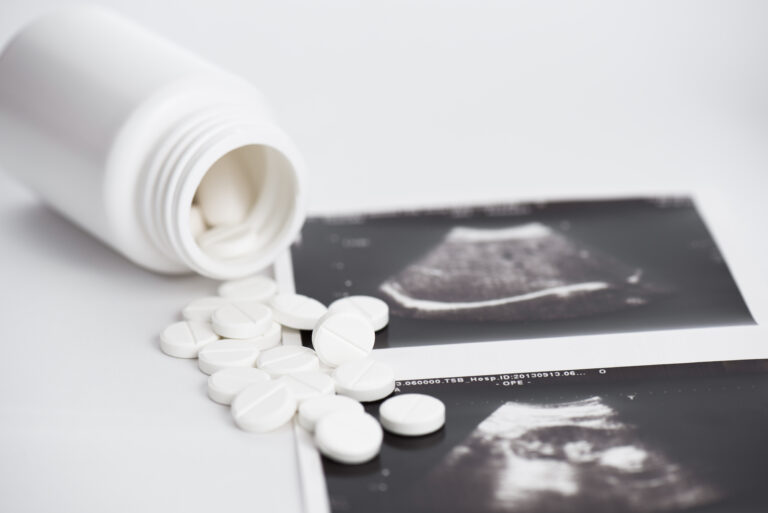
The idea is that general practitioners across the Netherlands will be able to prescribe the abortion pill to women struggling with an unwanted pregnancy.
However, the details of how this will work are not yet clear. It’s also uncertain when the abortion pill will be available from the GP. For now, it’s up to the Ministry of Health to make this happen.
A woman’s right
The bill’s initiators understand the importance of women having more freedom of choice when it comes to their reproductive health.
To date, women who want access to abortion have to travel to one of the sixteen abortion clinics in the Netherlands to have their pregnancy terminated.
However, in some parts of the Netherlands, there are no easily accessible abortion clinics.
This bill should make help to reduce this struggle.
In the future, women who are up to nine weeks pregnant will be able to get an abortion pill provided by their GP, making abortion care further accessible. This new decision will lead to abortion clinics performing fewer procedures.
To all women out there, is this new bill reassuring to you? Let us know in the comments below!
Good news for everyone who has been struggling with their Nederlands: The Dutch level requirement for inburgering (civic integration) will stay at A2! 🇳🇱
An increase of the language requirement to B1 has been in the talks for a while now. However, the Immigratie- en Naturalisatiedienst (Immigration and Naturalisation Service, IND for short), has announced that this increase will likely not occur in 2023. Hoera!
This is dependent on your visa type, whether you’re obliged to integrate (or doing it voluntarily) and the dates of your integration, so if you’re in doubt, it’s best to check with your local municipality.
Relief for hopeful Dutch residents
Some of us currently living in the Netherlands may need to be awarded a civic integration diploma in order to naturalise or secure permanent residency in the beautiful kingdom of low countries.
As part of this civic integration exam, participants must demonstrate their Dutch skills by taking a language test. The minimum requirement? That they can speak at least A2 Dutch.
So, what does this mean?
The IND’s announcement simply means that for those required to jump through the hoops of the Dutch integration process, the language requirement for the exam will not change (at least for now)!
After Morocco won against Spain (3-1 in penalties) in yesterday’s World Cup match, the supporters went a bit too far with their celebration — and fireworks. 🎆
Hundreds of fans were celebrating in the bigger cities of the Netherlands like Amsterdam, The Hague and Rotterdam, but things turned grim when the riot police intervened, the NOS reports.
What? Where?
In The Hague, fans celebrating in the streets were asked to go home, to which they didn’t listen. At some point, a motorist also tried to drive into a group of officers, but luckily there was no injury, and they kept driving.
In Rotterdam, the epicentre was at Kruisplein, near the Central Station, where more than 30 people were arrested. The square had to be evacuated, and the police asked others to avoid the city centre.
The usually peaceful and friendly Utrecht and Amersfoort also experienced some chaos last night. The football supporters started throwing fireworks at the police, among other things — such as bicycles. 🙈
Not only in the Netherlands
In several Belgian cities, such as Brussels, Antwerp, Ghent and Kortrijk, the police also had to intervene.
In Brussels, tear gas and water cannons were used at the South Station.
Follow DutchReview on Facebook for more information about coronavirus in the Netherlands.
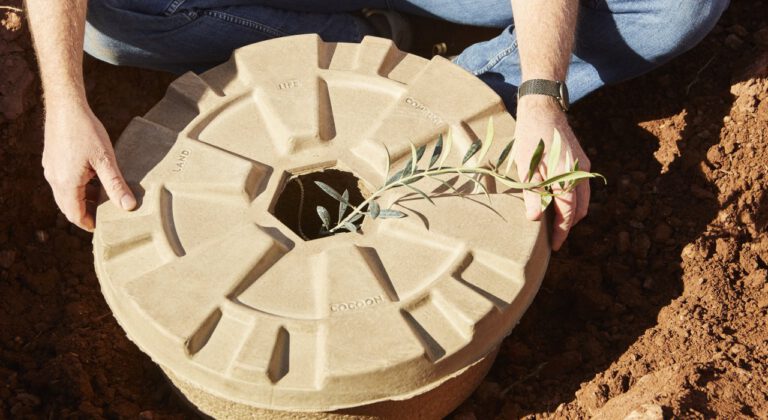
The Dutch have done it again! Amsterdam-based Land Life Company has invented a “Tree Cocoon” in its newest scheme to plant more trees and we are just as pro-plant as you are.
The “Tree Cocoon” is a doughnut-shaped carton made up of recycled cardboard and packed with nutrients, fungi and a three-month water supply in a design that helps trees to grow in even the harshest climates.
The survival rate of these seedlings has risen from 10% with a normal tree to a flourishing 80-95% in the case of a Tree Cocoon-planted seedling.
How does it work?
Essentially, the “Tree Cocoon” is an irrigation system made up of cardboard.
The seedlings soak up about 10 gallons of water in three months compared with the usual 400 gallons. Due to its intricate design, the drip system allows the sapling to absorb water and nutrients as needed, avoiding water-loss.
However, not just water is saved, but money too: one Tree Cocoon is approximately €10 instead of around €70 for a traditionally-grown drip-irrigated tree.
Wood you be mine?
The Land Life Company has one mission: to restore.
By helping to reforest the world’s two-billion hectares of degraded land through a unique innovative technique, tree-growing and tech have wed. Let’s all wish them a long and fruitful marriage. Gefeliciteered!
Using this Tree Cocoon seedlings have an 80% higher chance of surviving. Image: Land Life Company
OK, Bloomer
For those who are still adjusting to the technological revolution by peering over your glasses to look at a screen and only tapping your phone with your pointy finger — you won’t believe that satellites, drones, and GPS drilling are all used to increase the survival of these sensitive saplings.
And I know what you may be thinking. But won’t the cardboard ruin the soil? No worries! The Tree Cocoon container biodegrades over time. Greta won’t be raising her eyebrow at this one.
You grow, girl
Who’s in favour of a greener planet? Say ‘aye’!
The Dutch have shown time and time again that no mountain is too high to climb when it comes to sustainability!
What do you think of this new Dutch innovation? Let us know in the comments below.
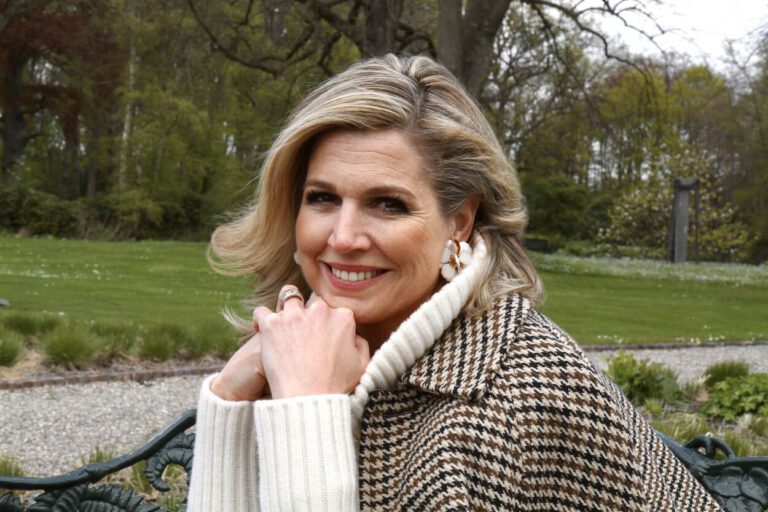
Dutch Queen Máxima will be cheering for the Netherlands this Friday when the Netherlands takes on Argentina in the quarter-finals of the World Cup in Qatar, despite the queen’s Argentinian upbringing.
A spokesperson for the Dutch Government Information Service (RVD) has confirmed the queen will ditch her home country in favour of the Netherlands. Let’s go Oranje! 🧡
The Argentinian-born wife of King Willem-Alexander was congratulated last Thursday at the Meet the World event when Argentina beat Poland. After a thank you, she encouraged everyone to “cheer on” the Netherlands. Talk about royal loyalties!
It is not the first time since Máxima became queen that the two countries have faced each other. In Brazil in 2014, both teams drew 0-0 in the semi-finals before Argentina triumphed 4-2 in penalties.
At that event, the queen was seen at the stadium with her husband, wearing an orange scarf around her neck. RVD gave NOS a similar statement at that time when asked who the queen was rooting for, “Queen Máxima is Dutch and is therefore cheering for the Netherlands.”
It is unclear whether Queen Máxima and her husband will be supporting the Netherlands in person in Qatar this year, given the controversy surrounding Qatar’s hosting of the 2022 World Cup.
How are we feeling about the game Friday? Could Máxima’s support be the lucky charm we need? Tell us your thoughts in the comments below!
Despite being among the healthiest countries in the world, even the Dutch are battling obesity! In an attempt to fight the ever-growing epidemic, the Dutch cabinet is ready to take action.
How? By giving fast food restaurants the finger. More specifically, sources from The Hague tell AD that a large plan to tackle the spread of fast food restaurants is expected to be approved by the Council of Ministers later this week.
By refusing to allow more fast food restaurants to set up shop in their cities, the hope is that municipalities will combat an unhealthy lifestyle.
What will this plan look like?
It’s easy enough to say that the cabinet has a plan — but what would this actually mean in practice? If approved, the cabinet plans to tackle the problem in three steps:
The cabinet will provide a legal basis to ban the establishment of new fast food restaurants.
Municipalities will be given the choice to decide how many fast food restaurants they tolerate.
In the future, steps may be taken to reduce the number of existing fast food restaurants.
Guess it’s time to say doei to our dreams of a Chick-fil-A in the Netherlands … 🍔
But hey, health is wealth, right?
Biking is not enough
While you may shed a tear for your beloved Dominos, this plan could be exactly what we need.
Yes, the dutch are healthy, but they also love an occasional stop at the snackbar! The spread of fast food chains, especially burger, pizza, and döner restaurants, has long been a growing issue in the Netherlands.
With many fast food joints close to schools and universities, the government is especially concerned about all us young people, who remain most susceptible to a greasy bite on the go.
someone on the news said ppl in Netherlands r getting too fat bc the government or smth said that and now they can choose to not make more fast food restaurants lol
And it’s not just us teens and twenty-somethings that the Dutch government is trying to protect.
To ensure that our future generations are set up for success, the Dutch cabinet also wants to ban marketing strategies specifically targeted towards children.
In practice, this would mean that all the lekker sweets that are named after famous cartoon characters may disappear from the shelves of Dutch supermarkets soon.
What do you think of the Dutch cabinet’s plans? Let us know in the comments below!