Home Blog Page 474

This week’s weather: summer for one day

While today’s clouds are forecasted to make room for a bit of sunshine this afternoon, expect a full summer sun tomorrow as Tuesday will mark the hottest day of this week. 🌞

Later tonight, temperatures are expected to drop as low as nine degrees in the northeast and 13 degrees in coastal areas — brr! 🧊

Tomorrow’s morning hours will bring plenty of warmth for everyone as the temperature rises to 21 degrees in the Wadden sea area and 25 degrees in the East and southeast portions of the Netherlands.

Enjoy the good weather while you can though, as tomorrow afternoon will show a different face: rain showers and possible thunderstorms in the south 🌂meanwhile, the north will remain dry, for the most part.

Wednesday onward

While it’s too soon to predict the weather for the rest of the week, we are promised OK weather, with temperatures fluctuating between 20 or 21 degrees. After all, we’re transitioning from summer to autumn ☀🍂

Follow DutchReview on Facebook and Instagram for the latest on Dutch weather!

Feature Image: Aswathy N/Unsplash

Enough is enough: thousands of protestors in Amsterdam march against the housing crisis

The housing crisis in the Netherlands is only getting worse as time goes on. Thousands of protestors have had enough and took to Amsterdam’s Dam Square and Westerpark to protest the current Dutch housing policy.

The protest first took place in Dam Square but then moved to Westerpark due to capacity.

The protestors were speaking out against exploding house prices, rising rents in the private sector and the shortage of social housing” — reports the NOS.

According to the municipality of Amsterdam, more than 15,000 people attended the protest. ✊

After the demonstration, dozens of people tried to break into a building in Gravenstraat, a street in the Amsterdam city centre. Further violence broke out between officers and protestors.

More protests to come

This housing protest won’t be the last that we will see in the Netherlands. The woonopstand (residential revolt) in Rotterdam is set to take place on October 17.

people-protesting
Thousands of people marched in Amsterdam. Image: Jelle Jaspar/Supplied

With many students currently struggling to find accommodation, the outlook for the future of the Dutch housing crisis is not looking any better. In fact, it is so severe that it is expected over 50,000 students might not be able to find housing from 2024. 😔

What are your thoughts on the Dutch housing crisis? Tell us in the comments below!

Feature Image: Jelle Jaspar/Supplied

Packed football stadiums? Relaxation of coronavirus rules to allow for full capacity

The latest round of coronavirus relaxations are set to be released this Tuesday — and they are expected to be a game-changer for football fans across the Netherlands.

Sources have confirmed to the NOS that we will soon be seeing full football stadiums as the 1.5-meter rule comes to an end on September 25 — have your vaccination certificate and cheering gear ready! 📣

However, it won’t be a free-for-all, anyone hoping to watch a football game live from the field must submit a vaccination certificate or a negative coronavirus test result before doing so.

Past football events

After a year of protests and experimental football trials, the majority of past football events were played in empty stadiums, with only some spectators allowed during the first weeks and the last week of the season.

The current coronavirus measures allow for ⅔ of the stadium’s capacity to be used for spectators — which according to the Royal Dutch football association (KNVB), already breaks the 1.5-metre distancing rule. 

Are you looking forward to attending football games in stadiums again? Tell us in the comments below!

Feature Image:gyuszko/Depositphotos

BREAKING: social distancing to end on September 25, Dutch cabinet decides

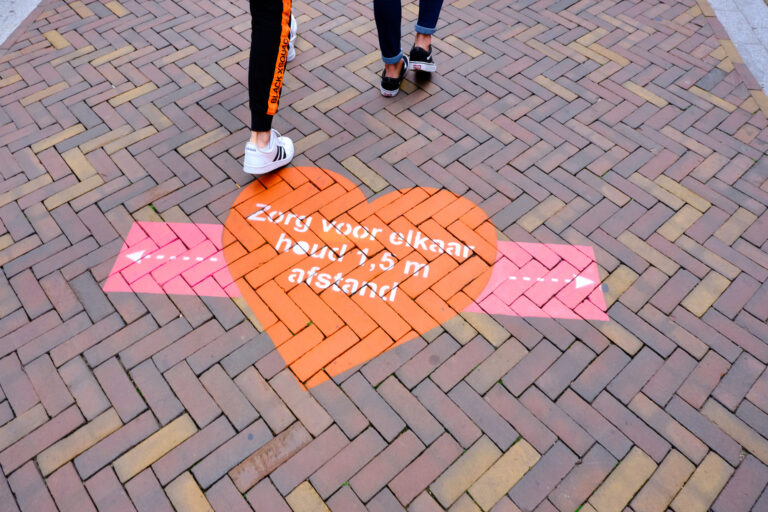
It looks like we will be bidding doei to the 1.5-metre rule in the Netherlands. However, it’s not all easing. It will soon be required that you show either proof of vaccination or a negative test result in many sectors.

Following a meeting of government officials in the Catshuis today, sources tell the NOS that from September 25th, it will no longer be necessary to practice social distancing.

Corona admission tickets

According to the sources, a “corona admission ticket” will be required before entry to cafés, restaurants, cinemas and theatres. This usually means that proof of vaccination or a negative test result must be shown.

Not quite ready for a complete easing

The Dutch cabinet does not yet feel ready to drop restrictions completely, the NOS reports. This is due to a large number of people (1.8 million) remaining unvaccinated in the Netherlands.

The government fears that if the Netherlands was to follow in the footsteps of countries such as Denmark — which has dropped all restrictions — the healthcare system may become overwhelmed once again.

As a result, other restrictions will remain in place, the sources claim. Masks will still be necessary on public transport and opening hours for the catering industry will remain unchanged.

Prime Minister Mark Rutte and Minister for Health Hugo De Jonge, will officially announce these changes and further developments this Tuesday.

What are your thoughts on the Dutch cabinet’s approach? Let us know in the comments below!

Feature Image: ELEVATE/Pexels

Eindhoven researchers receive Ig Nobel Prize for studying pedestrians

Researchers at the Eindhoven University of Technology have been awarded the Ig Nobel prize for their study of…people bumping into each other?

Yep, you read that right. The researchers, Alessandro Corbetta and Federico Toschi, were presented with the prize for their research into pedestrians’ behaviour in crowds. 🚶‍♂️🚶‍♂️

The Ig Nobel Prizes are awarded for unusual scientific research or achievements, and they take place before the prestigious Nobel Prizes in Stockholm.

The study

The 2018 study analysed the movements of five million pedestrians in the Eindhoven train station, using sensors under the station platforms.

Their study found that people keep an average of 75 centimetres away from one another to avoid bumping into them. 💥

“People are constantly avoiding collisions with oncoming traffic by pre-changing their walking path if a collision is imminent,” says Corbetta.

If people didn’t change their walking path, 18,000 people would have crashed into each other! 😲

In the end, only 80 pedestrians ran into each other.

Making places safer

Researchers hope that the study will make places where lots of people gather, like museums and festivals, safer and more organised.

Did you know? Japanese researchers also won an Ig Nobel Prize for studying why pedestrians sometimes collide.

What do you think about the research? Let us know in the comments below!

Feature Image: Madrabothair/Depositphotos

Dutch ministry omits advice to eat less meat from its sustainability campaign

In a government campaign to raise climate awareness among citizens, it has been found that the Ministry of Economic Affairs and Climate (EZK) deliberately omitted a call to eat less meat — considering the advice to be too controversial and “politically sensitive.”

The “Everyone does what” campaign started in 2019 as an effort by the government to make citizens more aware of their own contribution to climate change.

The campaign provides tips on small personal changes that individuals can make to prevent global warming, such as properly insulating homes and not travelling by car as often — we know you can do it, Dutchies. 🚲

The campaign also promotes eating more sustainably — choosing seasonal foods more often and wasting less. 🥕 However, the advice to eat less meat was intentionally removed because it was considered too controversial, The Volkskrant reports.

A politically polarizing issue?

Documents requested by the animal welfare organisation, Wakker Dier, show that in April 2019, the subject of eating less meat was removed from the campaign.

“We don’t want to explicitly communicate ‘less meat’” the EZK wrote in internal communication because it is a “politically very sensitive subject”. For a country that prides itself on being super climate-conscious, this seems odd. 🤔

Proven to reduce emissions

Eating less meat is proven to reduce emissions of CO2 which cause climate change. According to the Dutch Government’s Nutrition Center, “by eating 100 grams less meat per week, you reduce your environmental impact by 7-10%.”

Government response

The ministry responded to this revelation by saying that “Everyone does what” was designed to “enthuse citizens to take small steps towards sustainability.” They added, “We noticed that eating ‘less meat’ was a measure that provoked controversy.”

Basically, the Dutch government thinks that advising people to eat less meat will make them reject a more sustainable lifestyle altogether.

What are your thoughts on the Ministry of Economic and Climate omitting the advice to eat less meat from its sustainability campaign?

Feature Image: Arturverkhovetsky/Depositphotos

The Ministry of Defence got new trucks… that can’t drive on Dutch roads

You know that frustrating feeling when, after having meticulously measured your apartment, that super cute, newly purchased, side table just will not fit into the nook you’d intended it for?

As with your (granted imaginary) trendy side table, the Dutch Ministry of Defence’s brand new trucks are just a couple of centimetres too big for Dutch roads reports the NOS. 😅

With a height a few centimetres taller than the legal four metres, turns out they aren’t allowed to drive on Dutch roads — making the 1600 trucks pretty redundant.

Translation: “One of the Scania Gryphus variants of the Ministry of Defense appears, in combination with the ISO standard, to be an 8-foot container higher than the legally permitted 4 metres. Together with the Ministry of Defense, the supplier will carry out measurements for confirmation and, if necessary, solve the problem.”

Exemption request

The outgoing Minister of Defense, Ank Bijleveld, has written to the House of Representatives to ask that the military vehicles be exempted from the Road Traffic Act.

Bijleveld is hoping they’ll consent to the trucks being used for “a specific period of time and specific routes in the Netherlands.” Meanwhile, she must be dealing with some pretty heavy buyers remorse, as the trucks must remain parked for the time being. 🤦‍♀️

The Ministry had previously been assured that the Scania Gryphus type trucks with special containers were less than four metres high and perfectly suitable for Dutch roads.

As that turns out not to be the case (whoops!), the Ministry announced that the supplier has agreed to solve the problem.

If everything works out, the trucks are meant to replace the current vehicles which are more than 30 years old.

Do you think the military trucks should be cleared for Dutch roads? Tell us in the comments below!

Featured Image: Ministerie van Defensie/Press Release

Colour the Netherlands red but hopeful! The updated travel advice is…ambiguous?

Today, the European Centre for Disease Prevention and Control (ECDC) forecasted that the Netherlands will remain red on the EU’s coronavirus map for the coming week  — yet news of Dutch travel relaxations are reported. 😵

The ECDC’s decision to keep the Netherlands within the red status comes in light of recent coronavirus testing which reported more than 5% of tests performed in the Netherlands are positive — not sounding so good. 👎

Additionally, last week, all 12 Dutch provinces were red on the ECDC’s map, which is updated every Thursday.

Plans of optimism

Despite the ECDC’s grim outlook on coronavirus in the Netherlands, a separate report brought news of optimistic plans from the Dutch ministry of foreign affairs regarding travel relaxations for trips heading outside Europe.

“The virus is not going anywhere. You can’t keep the world locked up and we recognize the importance of travel.” A spokesman from the ministry of foreign affairs told the Telegraaf.

The discussed relaxations could be of great impact to the current travel insurance policy coverage which is limited for travellers heading to code orange areas. And what if you got any Coronavirus-related expenses while stranded on a holiday in an orange cursed destination? No reimbursement for you — says the current travel insurance policy. 💔

What do you think of relaxing current Dutch travel restrictions with the latest ECDC report? Tell us in the comments below!

Feature Image: Lukas Souza/Unsplash

Dutch farmer facing jail time for trying to sell a fake Van Gogh

A man named Kerst W. is facing a prison sentence of 11 months for (accidentally?) attempting to sell a fake Van Gogh. 👨‍🎨🎨

The farmer from Wanneperveen — a small village near Giethoorn — had in his possession a falsified preliminary study of Van Gogh’s The Harvest, worth €250.

The Van Gogh Museum informed him by letter that, “it was not an authentic work by Van Gogh.” 🙅

However, in said letter from the museum, the word “not” had been left out of the sentence. Instead, the letter appeared to say that the work was authentic.

As a result, the farmer showed the museum’s letter along with the painting and asked for €15 million for the work. 😱

Unfair sentence?

According to RTV Oost, Kerst claims that he believed the work was authentic and denies committing fraud.

He said that he isn’t good with computers and processing systems and also stated, “Someone else manages my mail and stuff.”

Meanwhile, the Public Prosecution Service wants Kerst to serve a sentence of almost a year for the fraud.

Kerst’s counsel, Cees Korvinus, thinks the sentence is too harsh for his client. “No one was harmed because it soon became clear that it was about false papers. My client acted naive at most,” he says.

In two weeks, Kerst will find out what his sentence will be and whether he will go to prison.

What do you think? Was it an innocent mistake? Tell us in the comments below!

Feature Image: Dutchlight/Depositphotos

It’s not our job: Dutch hospitality sector against asking for QR codes or negative tests

The association for Dutch hospitality (KHN) is strongly against the government’s plan for staff to request QR codes or proof of vaccination from patrons who want to wine and dine indoors — why?

It’s simple, because it’s not their job.

This is the opinion of the KHN. “[It] is not an assignment that you can leave to the catering industry”, Director of KHN, Dirk Belijaarts tells Nieuwsuur. “You really have to do that as a cabinet yourself.”

The cabinet’s plan

But what exactly is this all referring to? Recently, the Dutch cabinet introduced their plan to implement stricter measures for those who want to have a meal or a drink inside restaurants and cafés.

If these plans go ahead, patrons would be asked to show either proof of vaccination or a negative test result before they can drink or dine indoors.

In this way, the government is leaving it to workers in Horeca to put pressure on society to get vaccinated — and this burden shouldn’t fall to them, the KHN claims. “The catering industry has played policeman long enough,” Belijaarts says.

Workers in Horeca will not be alone in facing this challenge, those working in the cultural industry such as in cinemas and theatres may also have to ask patrons for proof of vaccination.

When will we know more?

The cabinet will announce at Tuesday’s press conference whether or not they will go ahead with this plan. If so, from September 25, it will be compulsory to show proof of vaccination or a test certificate before wining, dining, and hitting the cinema in the Netherlands.

What do you think? Should we show proof of vaccination or a negative test result before we sit indoors? Tell us your thoughts in the comments below!

Feature Image: FamVeldman/Depositphotos