From tonight at 12 AM, the ban on flights and ferries coming in from the UK to the Netherlands will be lifted by the Dutch Ministry of Foreign Affairs.
Last night, the ministry announced the ban would be lifted at midnight on Tuesday, March 9. The reasoning for lifting the ban was that the British variant of coronavirus has already spread widely in the Netherlands, meaning that there are no further benefits from maintaining the ban.
This was announced separately from last night’s press conference with Mark Rutte and Hugo de Jonge.
Negative tests
Travellers coming from the UK will have to provide a negative coronavirus test to be admitted into the country. They will also still have to quarantine for ten days, according to NU.nl.
The ban was originally brought in on January 23 to reduce the spread of the British variant — a highly contagious form of coronavirus.
Other travel bans still apply
Currently, flights from South Africa and some South American countries are still banned. This is due to the severity and contagious nature of the variants found in these countries.
The Dutch government still advises people in the Netherlands not to travel until April 15. There are expectations if you must travel for work or in unavoidable circumstances.
Has this affected your travel plans? Let us know in the comments!
We know the last year has not been much of a party, so is it surprising that there has been a drop in usage of party drugs in the Netherlands? Not really. However, there has been an increase in the use of weed during the Dutch lockdown.
According to the annual report produced by the Trimbos Institute, fewer people have been using hard drugs in lockdown. The report found that there were fewer uses of the favourite party drug, ecstasy, but more people tried ketamine and a bit of the old Mary Jane (yes the Netherland’s famous cannabis).
The study was conducted by interviewing people between the age of 16 and 35 on their average drug usage during the lockdown. Trimbos compared these figures to that of the same period in 2019.
The report also revealed that there has been a drop in the use of alcohol, amphetamines, and cocaine — also known as breakfast in Amsterdam.
Fewer parties
Surprise surprise, there haven’t been many parties. Participants said that their change in drug use was because they are not going out with friends as much. Not many people take ecstasy while binging Netflix.
“This is of course due to the lack of parties and festivals” Margriet van Laar, head of drug monitoring of Trimbos, tells the NOS. She also predicts that there will be a rebound of hard drug use once people finally return to their normal life — whatever that may be.
Despite there being fewer parties, 83% of participants said they had still met friends indoors, and 40% admitted to attending house parties during the lockdown. This percentage rose when restrictions relaxed in June, but only 15% admitted to attending an illegal event.
More cannabis use
While participants said that they smoked less cannabis than usual, they were smoking on more days during the lockdown in the Netherlands. Some participants suggested increased their drug use due to stress, loneliness, and other mental health issues. Cannabis and hash are commonly turned to in order to relieve stress.
Trimbos also highlights the link between those with increased drug intake and mental health. In the survey, nearly a third of participants who went to parties during lockdown were classified as “psychologically unhealthy”. Van Laar warns that the increase in drug use in combination with psychological issues can lead to bad experiences and addiction.
Trying out ketamine
As well as studying the recent trends in drug use, Trimbos has been researching the long term trends in drug use in the Netherlands. It’s research not only shows that there has been an increase in incidents of hospitalisation in relation to cannabis, but that more people have been experimenting with ketamine.
The drug commonly used as a horse tranquilliser has become more popular in the Dutch party scene. Due to the increased use of it in recent years, there have been more incidents of young people needing first aid for its effects.
“A significant proportion of ketamine users experience physical and psychological complaints,” Van Laar tells the NOS. “And a quarter of them report bladder complaints.” Not much of a party vibe.
Are you surprised by the latest Dutch drug habits? Let us know in the comments below!
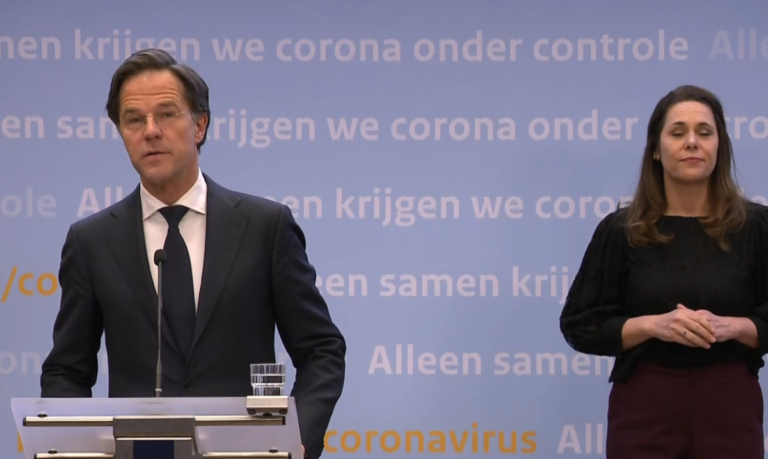
Prime Minister Rutte and Minister for Health Hugo De Jonge have fronted the press once again (yes, on a Monday, we’re also confused) to address the slight relaxation of coronavirus measures in the Netherlands.
The OMT (Outbreak Management Team) have advised against any drastic relaxation of measures in the Netherlands due to the slight rise in coronavirus figures, however, the cabinet will implement some slight “corrections” and small changes. What exactly does this entail?
Measures extended, including curfew
The main coronavirus measures —including the “avondklok” — have been extended until March 30. However, there will be an exception to “break” curfew on election night as workers will need to count votes. Election day is on March 17, but in some cases and areas voting is already possible on the 15th and 16th, so there will be an exception on these days too.
Changes to current measures
However, there will be small changes to current measures:
Sport for over 27s: Those over the age of 27 will now be allowed to exercise outdoors at sport centres in groups of no more than four. Swimming lessons for children can be resumed.
More customers allowed in shops: There will also be a slight increase in the number of customers allowed in shops. On March 16, shops are still allowed to have 1 person in their store per 25m2 of space.
This means that multiple people may be allowed on one floor at any given time as long as they can have 25m2 of space each. There is a maximum of 50 people though, in case you’re hoping to invade the IKEA with 100s.
For small shops of up to 50m2 there will be a maximum of only two people in the shop at any given time, meaning that nothing will change in these cases. Shoppers will also still have to book their time slot to shop up to four hours in advance, 1,5 meter distance and all the other measures.
Travel ban extended: The current ban on flights travelling between the Netherlands and South Africa, the UK and certain South American countries has also been extended until April 15.
Swimming lessons for children up to 12 years old. All indoor sports facilities remain closed to the general public. However, an exception will be made for children up to and including the age of 12 who need swimming lessons.
New advice on March 23: The cabinet will revisit these restrictions on March 23 and see if any changes can be made for the May vacation.
De Jonge: all going well everyone will receive a jab by early July
He said that the government are now looking into potentially only giving one dose of the vaccine to those who have previously had coronavirus. More research is needed into this however.
Still in the third wave
De Jonge also pointed out that the Netherlands is still in the midst of the third wave of coronavirus with numbers continuing to rise due to the British variant. “The prospects for the third wave are not good,” he said.
This could lead to yet another crisis in Dutch hospitals. “If the bad prospects come true, hospitals will be as full next month as they were last year”, the minister warned.
Relaxation possible if R rate drops: terraces might open!
However, if the numbers do stay down and the R rate (the rate of infection per person) stabilises to around 1, further relaxations may be possible around Easter, De Jonge said. He believes that if this happens, there may be room to reopen terraces again on March 31.
If relaxations are possible, he said that secondary education needs to be prioritised so that students can return to campus at least once per week. This would be done in conjunction with rapid testing.
Why hasn’t curfew been relaxed
One of the first questions asked to decommissioned Prime Minister Mark Rutte is why the curfew has not been relaxed along with other measures. He argues that whilst the slight relaxation of the retail industry and sports sectors do not affect the R rate, the lifting of curfew would.
This is the advice that the cabinet has been given by the Outbreak Management Team, Rutte explained, “it remains a measure that you really want to get rid of but what you see is that the curfew, in combination with the visitor regulation, really has an effect. The OMT has clear advice not to relax the curfew.”
What do you think of tonight’s press conference? Tell us your thoughts in the comments below!
Let’s be honest, bridges in the Netherlands are quite impressive! And as dorky as it may sound, seeing them for the first time can be a mind-blowing experience. Here is why bridges in Holland are so amazing.
The Netherlands already has some pretty cool buildings (and is building even more), but bridges are in a league of their own. As weird as it may sound to Dutchies, bridges in Holland are absolutely mind-blowing to most foreigners. Especially when you see them being lifted for the first time, it can be quite a memorable experience for non-Dutch people.
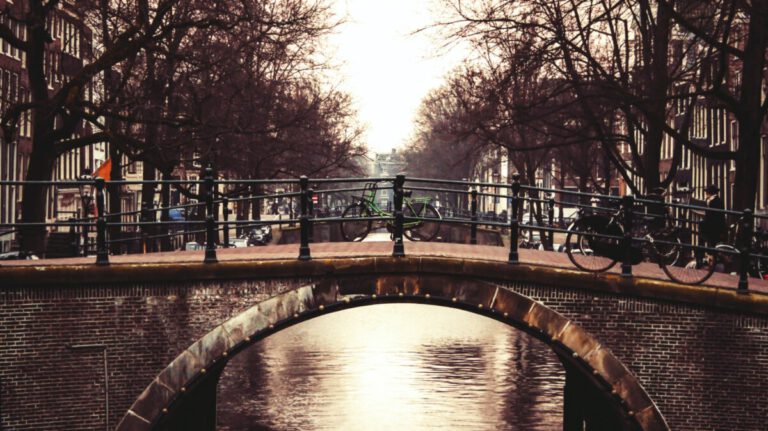
Considering how many canals there is in the Netherlands, there are almost as many beautiful bridges to cross them. Large, small, colourful, fancy, – it is bridge heaven over here!
Let’s not forget about eco-ducts, the Dutch and Belgian passages carved into nature — they are good for the environment and pretty damn beautiful.
Awesome bridges in the Netherlands
Since there are so many bridges in this small country – Amsterdam being one of the cities with the most bridges in the world – it’s hard to cover them all. So we decided to give you a brief guide to some of the most impressive bridges in the Netherlands.
Erasmusbrug
This impressive bridge in Rotterdam has pretty much become a totem for the city. It connects the north and the south parts of Rotterdam. Being 802 meters long and 139 meters tall, it’s really hard to miss. It’s truly a remarkable sight, especially during the night when it is illuminated.
The award-winning cycle and footbridge was Holland’s first suspension. Its total length is 780 meters making it one of the longest non-traffic bridges in the Netherlands.
A different way of going for a walk along the canals. Image: Michal Klajban/Wikimedia/CC3.0
Hovenring
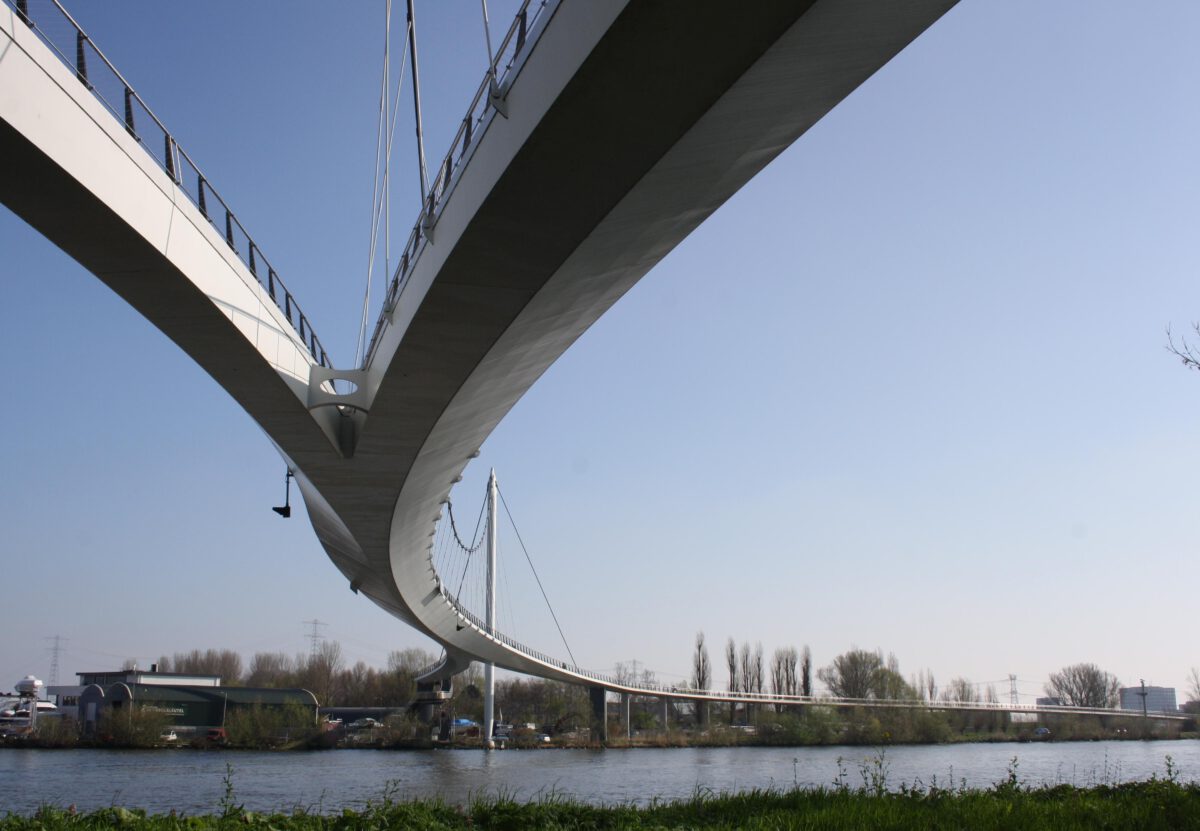
This Eindhoven based bridge acts as a suspended cycle path, the first of its kind in the world. Opening in 2012, it has become a favourite amongst photographers, being especially impressive at night.
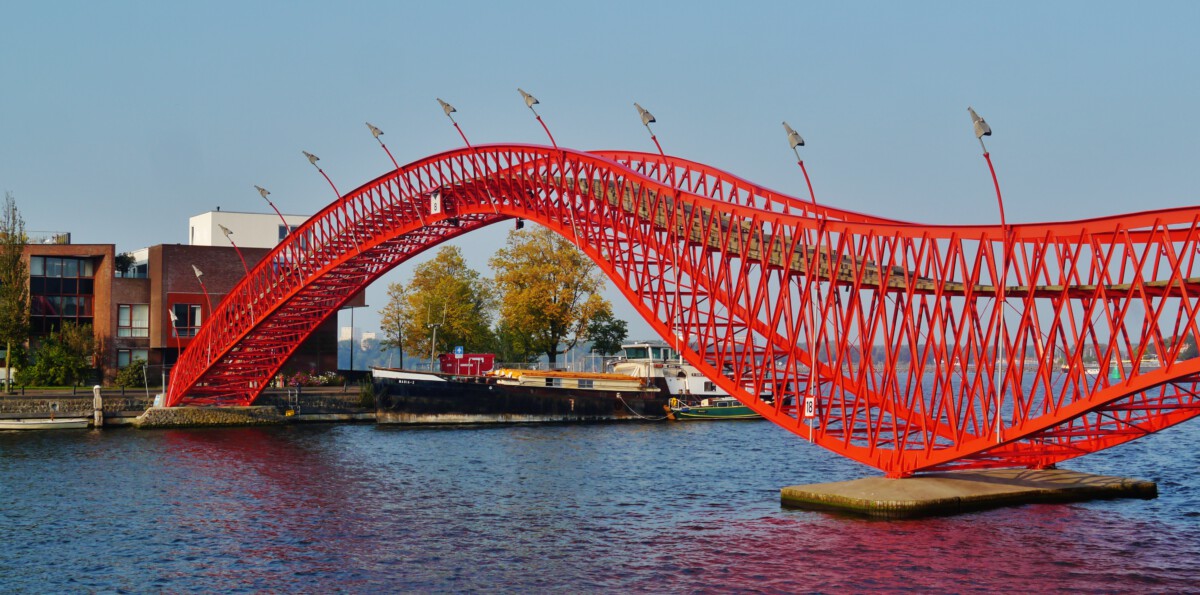
You’ll know how the bridge got its name just by looking at it. The Python Bridge in Amsterdam was built in 2001 and won the International Footbridge Award in 2002. Its official name is actually High Bridge — but no one calls it that. It is 93 meters long and is one of the most eye-catching bridges in the Netherlands.
Try crossing that when you’re late for work. Image: Zairon/Wikimedia Commons/CC4.0
Blauwbrug
Bluawbrug is a historic bridge located in Amsterdam. This 19th-century bridge has a Parisian style architecture, make it a perfect stop for a romantic walk. It connects the Rembrandtplein area with the Waterlooplein area, crossing the river Amstel. Since its opening in 1883, it has been considered one of the most beautiful bridges in the Netherlands. Definitely one for the ‘gram. 📸
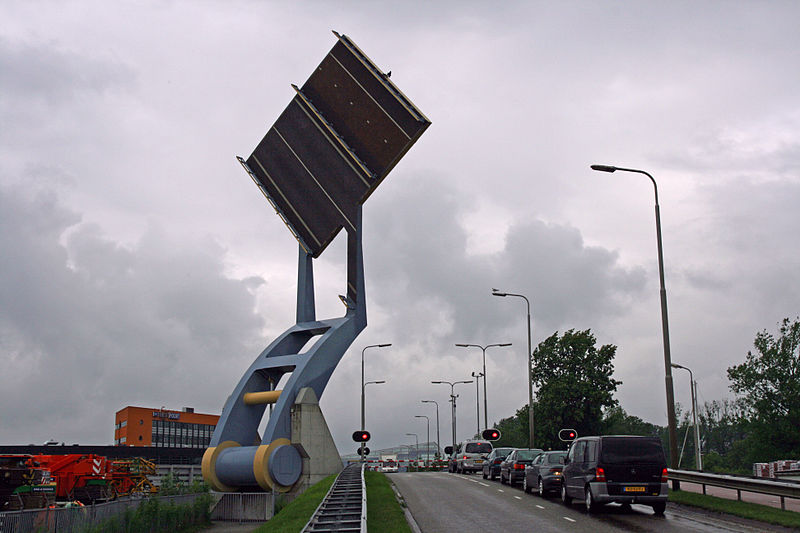
located in Leeuwarden, Slauerhoffbru is a fully automatic bascule bridge — that’s a bridge that moves. The structure uses two arms to swing a section of road in and out of the bridge itself. It is 15 meters long and honestly looks like a robotic arm with a hammer. 😅
Reminds you not to hammer your breaks. Image: Bert Kaufmann/Wikimedia Commons/CC3.0
Still hungry for more bridge facts? Here is a short educational video about the types of bridges in the Netherlands.
Are you impressed with the bridges in the Netherlands? Are there any epic bridges we missed out on? Let us know in the comments below!
Editor’s Note: This article was originally published in September 2018, and was fully updated in March 2021 for your reading pleasure.
Feature Image: Miltidadis Fragkids/Unsplash
As part of a series of trial events, Amsterdam’s Ziggo Dome opened its doors to 1,300 party-goers on Saturday. The party was used as an experiment to measure any potential spread of coronavirus amongst attendees.
Much like the previous experiments seen earlier this year, when between 500 and 1,500 people attended trial events such as business conferences, football matches and concerts, all attendees at the Ziggo Dome were tested for coronavirus before taking part in the experiment.
The attendees were also temperature checked at the door and are expected to get themselves tested five days after the party.
At the venue, each participant were given a tag that would monitor their movement.
The bubbles
The 1,300 attendees were then split into six different “bubbles.”The bubbles consisted of 5 groups of 250 people and one group of 50. As part of the experiment, each bubble had its own set of measures.
Bubble 1: People could stand where they liked. Everyone was asked to wear a mouth mask and ensure that there were no more than three people standing in one square meter. One in 10 people were rapid tested.
Bubble 2: People had to maintain a distance of 1.5 meters from other attendees and wear a mouth mask.
Bubble 3: Participants stood on predesignated spots and only had to wear a mouth mask when in motion.
Bubble 4: Attendees could sit wherever they liked but had to wear a mouth mask at all times. One in 10 were rapid tested.
Bubble 5: Standing and seating areas were available however, people were placed in specific areas by the organisation with seats being two chair-lengths apart. Attendees only had to wear mouth masks when moving.
Bubble 6: People could and stand or sit where they liked and didn’t have to wear a mask. One in 10 were rapid tested.
Could this be possible with a test certificate?
The Corona-Crisis Think Tank believes that large-scale events such as these may soon be possible if test certificates were brought in. At the request of the cabinet, the Think Tank investigated how events like this may be plausible again in the Netherlands.
They found that preliminary testing in the days before an event, along with a test certificate, could be the key to safely re-opening large-scale events.
According to Mariëtte Hamer, the chairman of the Social and Economic Council (SER) and initiator of the Think Tank Corona Crisis, “you can see that quick tests in terms of logistics are not very suitable for very large events such as in the Ziggo Dome but pre-testing works well. Anyone with a test certificate can then go through like this,” she tells Nieuwsuur.
Advice to the cabinet
The Corona Crisis Think Tank will offer four pieces of advice to the cabinet today:
A traffic light model: The think tank will suggest that the government set up a traffic light model to indicate the safety risk of specific facilities and situations. This may help to determine whether or not people need to get tested before attending an event.
A test certificate must be easily available: People should be able to receive their certificate easily and their data should not be put at risk.
Testing should be free and easy: Likewise, people should have free and easy access to testing if they want to attend an event. Testing certificates should be available on paper.
Clear communication: if an event is accessible with a test certificate this must be clearly communicated and take into account those who are not native Dutch speaker and the visually impaired.
Would you attend a large-scale event if it was possible with these measures? Tell us your thoughts in the comments below!
Noooooo… don’t leave us behind! Where else could possibly be better than this? The windmills, the tulips, the beer, the canals, the bike life, the stroopwafels… oh dear.
Don’t worry, we won’t hold it against you too much, we are here to help! Here is all you need to know when moving away from the Netherlands. (Don’t forget to come back to visit, or move back altogether.)
TIP: If you are moving away due to your employer relocating you, they may be able to help you with your move. This includes things such as arranging your removal company, ask them beforehand or you’ll have to foot the bill yourself!
Before you start
Plan, plan, plan! This is key when you’re planning on moving away from the Netherlands. Don’t assume that something won’t take very long, always assume the opposite so then you don’t get caught out.
As soon as you know that you are going to leave the Netherlands, you need to make a list — or refer to this one — and get straight to it. I know it seems like a chore, but the faster you do it, the better. Don’t leave anything to the last minute, this is very important (playing the mother role here)!
Take some time off work if you can, make a plan, utilise it and don’t forget to organise your removal van, gather lots of boxes, and start packing stuff. This is the perfect opportunity to de-clutter your things too!
You can also organise for the post office to forward all of your post to your new address!
Phone calls you need to make
I hope you like speaking on the phone because a lot of phone calls need to be made! This is the boring bit of moving away from the Netherlands, but it has to be done.
TIP: some of these services request that you let them know in writing, no less than a month before, so get straight to it and call up right away!
You’ll need to call your:
Gemeente to organise an appointment to de-register (legal requirement!). You’ll need to bring legal documents such as passport, old and new address and date of departure. Some municipalities do also let you de-register via internet nowadays.
Internet provider to have your internet disconnected the day you leave.
Telephone provider to have your phone disconnected the day you leave.
Insurance companies: such as healthcare, house and car insurance and inform them so they stop billing you.
Subscriptionservices you have in the Netherlands if you won’t need them any more, such as a gym membership.
Dentist or doctor if you are leaving and need medical records or new medication
Bank and tell them that you are leaving. Close the account if it is no longer needed (remember to do this after you have paid everything and you have been paid your wages etc.)
Don’t forget to call a removalistcompany too, to organise the actual move of your goods from your house.
People to write to
Time to get pen to paper, or fingers to keyboard. You also have to do a bit of writing when moving away from the Netherlands.
If you’d prefer, you can de-register via mail. The date it is received is the date they will assume that you have de-registered
Email your landlord and let them know that you are leaving. Ideally, this should be done a minimum of one month in advance, as set out in your contract
Email your mortgage provider, if you own a house and are leaving the Netherlands (this needs to be done ASAP)
If you have children you need to write to the school/nursery and let them know that your child will be leaving
Important things to remember
Your bills will follow you to your new country, do not leave anything outstanding! This includes if you forget to cancel a subscription, you owe the government money or you need to pay a bill from an energy provider
You need to let your landlord know in advance that you are leaving (a month’s notice is usually written into your contract)
You need to let anyone who works for you know that you are leaving well in advance (babysitter, cleaner, etc.)
Cancel your Dutch car registration (take it off your name) if you are taking it with you or selling it on
Make sure to sort any issues out with pets if you want to take them back with you
Leave the Netherlands on time! Once you’ve de-registered, you are down as having left the country
There’s your checklist to ensure that your move goes smoothly. Don’t forget to do what we said on the list, or you could be in trouble! Not only is the move itself hard, but what about the cultural differences? (Doei doei stroopwafels).
Know anyone who has moved from the Netherlands and is missing it like hell? Let us know in the comments below!
Editor’s Note: This article was originally published in April 2018, and was fully updated in March 2021 for your reading pleasure.
Feature Image: cottonbro/Pexels
The Dutch lockdown often feels like a balancing act in a circus. The latest routine: an extension of the lockdown, but some greater freedoms around sport and shopping.
The Netherlands could see some major easings of current coronavirus regulations, according to insiders close to government ministers and reports by RTL Nieuws. This could see terraces reopen just in time for a biertje in the sun.
But (and there’s always a but), the government will extend the lockdown for a further two weeks beyond March 15 before the main measures can be relaxed — and still only if infection numbers fall further.
Some minor relaxations from next week
There is another bright side: if you’re looking for a little taste of greater freedoms, some small changes may be implemented from Monday next week
To start, stores may be allowed to reopen to more people. Currently, only one person is allowed per floor of the shop. Under the changes, the number of people allowed in a store will depend on the number of square metres the store has. However, the exact specifications of this are yet to be decided.
Anyone feeling jealous of the people who, due to being 27 years old or younger, are allowed to play team sports can take a chill pill. Those older than 27 may be able to take part in outdoor sports under the new measures.
Finally, children may be allowed to attend swimming lessons again — a vital activity considering the amount of sloten and canals in the Netherlands (seriously, the Dutch are big on swimming lessons for this very reason!)
What measures would you like to see relaxed? Tell us in the comments below!
Moving to the Netherlands as an American can be a whirlwind of learning, adjusting, and wonder.
But past the language, there are some other things American expats may have trouble translating here. Here’s a handy guide to prepare yourself — and advice on how to to deal with it 😉.
Height
🇺🇸 = feet
🇳🇱 = metres
I often want to talk to someone about how tall people are and constantly struggle with converting feet into metres.
Advice: “She is the height of that lamp,” etc.
Distances – in kilometers.
🇺🇸 = miles
🇳🇱 = kilometres
How far away is that? Someone gives you a distance, and instead of admitting you’re not really sure what that means, you simply reply “oh.”
Also, Dutch people’s sense of distance is a little skewed. “Oh, that’s extremely far, an hour and a half away.” We now live in a country small enough to drive from Amsterdam to Paris in four hours. In the American Midwest, you could drive that long and still not be anywhere — just in more cornfields.
Advice: Overexaggerate when talking about distances. “That is a trillion kilometers away.” No matter where you are, a trillion is a lot. That means it’s really far. (You could also try to multiple by 1.5 to get a vague sense of the milage.)
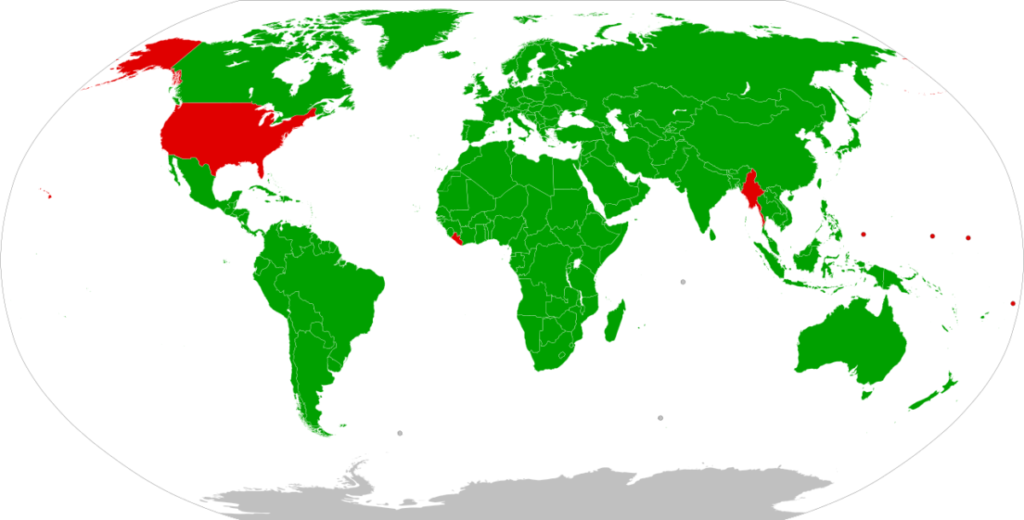
Green = officially uses the metric system — America may be a little behind. Image: Wikimedia Commons/Public Domain
Temperature
🇺🇸 = Fahrenheit
🇳🇱 = Celsius
This is particularly hard with washing machines because the temperature is in Celsius and the nobs are all in Dutch.
Advice: Talk about temperature as it relates to weather here. Mostly: coldish and wet, or sunny and warm.
Money
🇺🇸 = dollars
🇳🇱 = euros
This is okay. Although for awhile I was doing that thing where you yell, “THIS IS ONLY 5 DOLLARS,” outing myself as an obnoxious and cheap American.
Advice: Try to be silent while shopping.
Time and dates
🇺🇸 = just kinda makes sense
🇳🇱 = very confusing, dates are reversed
Dutch time, as told in the Dutch language, is like calculus to me. Quarter til the hour minus 25. It makes absolutely no sense.
Also, if we’re honest with each other, I still haven’t fully adjusted to placing the day before the month. July 11 = 11/7. It does not = 7/11, so I’m stuck thinking that the summer barbeque is happening in November.
Advice: This gets easier. Re-read. Think about it. Double check if you’re unsure.
Behaviour
🇺🇸 = very open, friendly
🇳🇱 = direct and pragmatic
When I meet you, I want to tell you everything about my life. My latest fight with my mother, the last time I cried, how much weight I gained since I think things here are measured in UK stones.
But Dutch people are stoic. Feelings and explosions of emotion are more private. “Why are you telling me about this,” they think.
Advice: To start, stick to weather for conversation to gain the Dutch person’s trust. These more serious talks will come later. If you’re looking for a quicker emotional connection, reach out to fellow expats. Cry on their shoulder. Maybe they’ll understand a little easier. There is nothing wrong with hanging out with people like you until you can get your bearings, and feel more secure.
Final words of advice
Not everyone loves where you come from or thinks it’s as great as you do, so try to go with the flow. Try to learn, even if it’s slowly. There’s no reason to be ashamed of who you are, but try to be respectful of where you are now, and adapt accordingly.
Stay confident. Stay dedicated. Soon these measurements will translate more easily 😉
What was the hardest thing for you to adjust to as an American expat? Tell us in the comments below!
Editor’s Note: This article was originally published in July 2015, but was fully updated in March 2021 for your reading pleasure.
Feature Image: Gabby K/Pexels
We’ve all met that one person who doesn’t know their difference between the Netherlands and Holland. Maybe at some point, you were that person yourself!
The Netherlands, Holland, Lowlands, and Low Countries… all of them sound somewhat similar, yet they all stand for something different. To add to the confusion, there’s also the Randstad.
If you can’t wrap your head around all these names and want to know whether the Dutch national anthem or the Dutch flag represents one or the other, we’ve got you covered.
This History with Hilbert video will clear up the difference between the Netherlands and Holland once and for all and will tell you many more fun facts about the different provinces in the Netherlands.
Do you feel ready to impress your friends with your knowledge of Dutch geography? Let us know in the comments below!
Feature Image: Ian/Unsplash
Editor’s Note: This article was originally published in January 2018, and was fully updated in March 2021 for your reading pleasure.
Been mourning the sunny days we had at the beginning of the week? Well, you’re in luck! The weather report is set for a sunny Friday across the Netherlands.
In what’s already been a record-breaking winter in the Netherlands, we are set to have a fresh and sunny day. Don’t let the early cloud fool you into putting those deck chairs away yet.
A chill in the air
Remember: just because it’s sunny, that doesn’t mean it’s warm. Despite the sun shining strong today, the temperature will not exceed six degrees. A fresh northern wind is forecast for today, so wrap up warm but keep those sunglasses handy. 😎
Veel zon #vandaag, maar op de Noordzee zjin ook wolkenvelden aanwezig. Af en toe trekken deze onze kustprovincies in, maar de zon heeft daar over het algemeen weinig last van. https://t.co/jFzu08AzRahttps://t.co/9SUjd8Kq3x
Meteorologists have also advised that people take care in the early hours of the morning. You may be tempted to rush to the beach, but do look out for icy roads and cycle paths.
One day of winter sun
Despite starting the day overcast in the south of Limburg, there will be plenty of sun to soak up today, according to NU.nl. But don’t get too excited, as the sun is only peeking its head out today. Next week we are back to a typically rainy Dutch winter. 😩
How will you be soaking up the sun? Let us know in the comments!