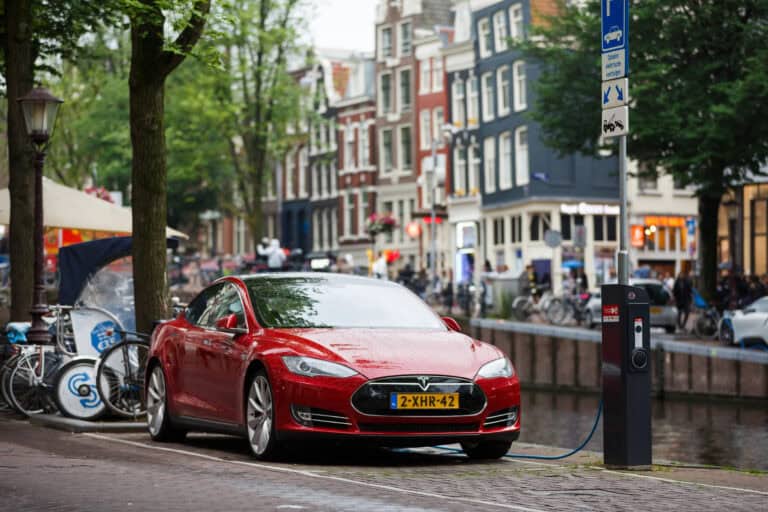
Dutch Tesla owners are suddenly realising that their sleek cars come with an unexpected feature: second-hand embarrassment.
Many discussions have unfolded in the Netherlands about owning a Tesla — and feeling shame about it. 😬
Where is this coming from?
Elon Musk, once hailed as an environmentally conscious tech visionary, now appears to swim in a pool of controversies.
The latest spectacle includes a Nazi salute to Trump supporters — an incident that would be shocking if he hadn’t already shown outward support for extreme right-wing parties.
Are Tesla owners jumping ship (or car)?
Now, some social media users are threatening to get rid of their Teslas — but just how serious are they?
To confirm these claims, Fortune shares the results from a Dutch polling group, Een Vandaag, which surveyed 432 Tesla owners in the Netherlands.
The results were clear: 31% of respondents have already sold or plan to sell their cars. The remaining 69% might face denial, hoping that Musk might log off one day. 🤞
Of course, this sample size isn’t large enough to be conclusive. However, it does highlight an ongoing shift in attitude — one that suggests that Dutchies might disapprove of Musk’s right-wing antics.
The issue of homelessness can be a very serious one, and even a wealthy country like the Netherlands has its fair share of homeless folks.
Unfortunately, this is something that can happen to anyone, internationals included. People who become homeless are often ordinary people, many of whom actually had it all at one point in their lives.
While being homeless is something that can happen to anyone, not everyone has the means to solve the problem as quickly as possible.
So if you find yourself homeless in the Netherlands, what do you do? Where should you go for assistance? And what agencies are there to help?
Homeless in the Netherlands
In the Netherlands, a person is considered homeless if they do not have a roof over their heads and an address where they are officially registered.
There are certain people who, despite having a place to live, are not registered in the system and therefore don’t have an official address. People like that aren’t classified as homeless. A homeless person has neither a roof over their head nor an official address.
There are many reasons why people become homeless in the Netherlands. The most common reasons are financial problems, addiction and (domestic) relationship problems.
It very unfortunate to lose your house — a roof over your head and a safe place to call your own. Some common causes of homelessness in the Netherlands include:
Huge debts due to excessive housing costs.
Bad financial management skills.
Addiction: drugs, alcohol, gambling, shopping etc.
A fire with no insurance covering the house and properties damaged in the fire.
Psychiatric problems that prevent people from being able to take care of themselves.
Being evicted from home after a fight with a partner or even parent (s).
Running away from home due to abuse.
On the run for something or from someone.
Divorce or broken relationships.
Entrepreneurs going bankrupt and homeless with no financial support due to a recession or bad business decisions.
While there are many reasons why people become homeless, each differing by country, huge debts remain the number one reason here in the Netherlands.
Due to an economic crisis, for example, many people lose their jobs and then their homes because they can no longer pay their rent and debts or make their mortgage payments.
While this might be very common in America, it also occurs in the Netherlands and even more frequently when there’s a recession.
In poor or war-torn countries, there are millions of homeless people, adults and children, who are forced to flee their homes or live on the streets due to war, domestic problems, natural disasters or the outbreak of diseases.
While there may be no wars or catastrophic natural disasters in the Netherlands, people still become homeless because they find themselves in unfavourable financial situations due to the loss of a job, recession, mental problems or domestic abuse.
So what do you do when you find yourself in that same situation here in the Netherlands?
Look for help in your social network
If you become homeless in the Netherlands, first seek shelter with family or friends. If you’re an expat and have no family (or friends) here, there are some organisations that can help you.
Realise that it is important to have an address where you are officially registered. Otherwise, you can’t receive posts or benefits. If you have no one to turn to or don’t know what to do, ask for help from these organisations and see how they can assist you.
In most cases, they can help you with an official address so you can receive benefits. If you have children with you, make sure to ask them about the costs associated with childcare because childcare for homeless people is usually not free.
Homeless in the Netherlands? Here’s some advice!
Find a safe place to stay
The first thing you need to do is try to ensure that you find a safe roof over your head. If you have no friends and family, go to the Salvation Army (Leger des Heils) or any other agency and ask for assistance.
If you don’t know where how to find the nearest agency that can help you, use the Opvangatlas. It’s a free service that helps you find the nearest agency in your neighbourhood.
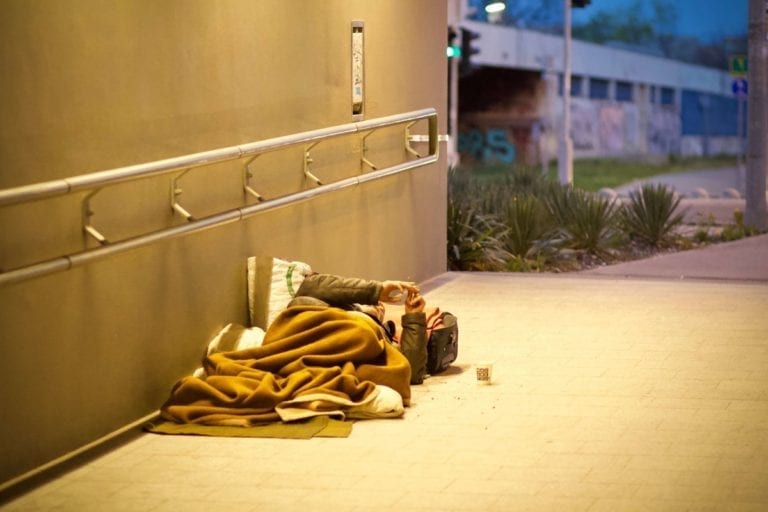
Whatever you do, please avoid sleeping on the streets. You run the risk of diseases and other problems. Sleeping on the streets can be very dangerous, especially for women.
In the winter, it is also dangerous to sleep outside, due to cold temperature. People without a social network (no friends or no contact with family) are usually the first to end up on the street. It is important that they find their way to the Salvation Army.
If you still have a source of income and can pay rent, look for a room, even if for the night. The next day, you can go to the nearest Salvation Army office, and they will help you find a solution as quickly as possible.
Take steps to sort out your financial situation
If after the Salvation Army or any other agency have helped you find temporary accommodation and you have a lot of debts, contact Schuldsanering and let them assist you in paying off those debts.
This is often the only way to get out of debt and work towards finding permanent housing in the future.
It might not be easy and huge debts may make it difficult to get a mortgage, but either way, a temporary roof over your head might be the first step in rebuilding your life.
Try to maintain or find a source of income
If you have a job, make sure you do all you can to keep it. Having a source of income offers hope and a way out of homelessness.
If you don’t have a job, ask for benefits from the government. And make sure you’re constantly searching for work.
Well-known agencies that help the homeless in the Netherlands
The Salvation Army
The Salvation Army (or Leger des Heils in Dutch) is one of the Netherlands’ most popular agencies that (among other things) offers help to homeless folks. If you’re homeless, they can offer you a bed, the possibility to shower and something to eat.
They also help with advice on problems that homeless people may have and know the right people to call in case they can’t help directly.
The Youth Information Point (Jongeren Informatie Punt)
The Youth Information Point (Jongeren Informatie Punt) provides information and advice about work, school, drugs, money, homelessness and housing, addiction, family problems, sex, etc., to young people (up to 25 years).
If you find yourself on the streets in the evening, you can reach the local police or emergency assistance at 070-3795160.
If you have no idea where the Salvation Army in your neighbourhood is or who to turn to when you’re homeless, please quickly check the Opvangatlas. Opvangatlas helps people in socially vulnerable or unsafe situations to find suitable care, help and support.
It is totally free, and you can find suitable assistance for yourself or others. This includes help with homelessness, domestic abuse — physical and/or sexual, etc.
Note: For those in a crisis situation and who need urgent help, Opvagatlas can help you find the help you need. But if you’re a victim of abuse and you feel lost, depressed, helpless and/or scared to leave your abuser, De Luisterlijn is where you can anonymously speak to volunteer workers who can offer you a listening ear.
They offer support and also put heads together on how to solve your problem(s). They are available day and night and can be reached via their helpline on 088 0767 000. Their online chat support is open from 10:00-22:00, or you can email them via the website.
Homeless shelters
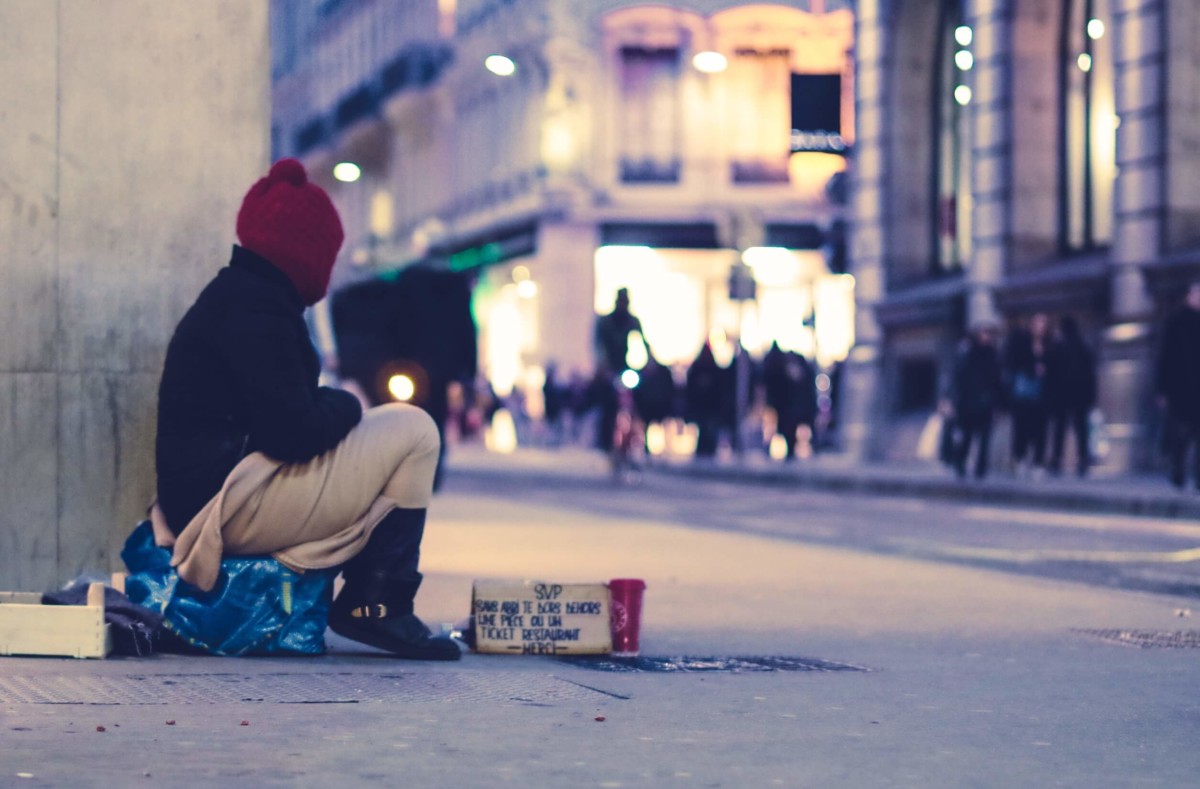
Even the most unlikely people can end up homeless in the Netherlands. Image: Ev/Unsplash
If you are a victim of physical, sexual or psychological abuse and do not want to or cannot continue to live at home, then you can go to a shelter.
Luckily, in the Netherlands, there are homeless shelters for men and women. For women who are victims of abuse by their male partners, the shelters offer them support while also keeping their location a secret from those abusive partners.
The same thing goes for men who are victims of abuse from female partners.
What help can you get at a homeless shelter?
If you’re homeless in the Netherlands and at a shelter, care providers or social workers help you with:
Getting (medical) care if you’re injured. This could be physical or psychological care.
Finding a secret address, if necessary.
Arranging a divorce, if necessary.
Finding a job.
Finding a new place to live when you leave the shelter.
Assistance in solving the problem with your family or (former) partner, if you want it.
Note: You can find the nearest shelter via the Opvangatlas.
What help does the Salvation Army offer the homeless?
The Salvation Army and other agencies can help you in various ways:
Resolving debts or problems with the law.
Getting an official address for receiving mail.
Getting a job, ID card and health insurance.
Tackling an addiction.
Note: You can find the nearest shelter via the Opvangatlas.
How long are the homeless allowed to stay in a shelter?
The homeless are allowed to stay in a shelter for up to three months. After leaving the shelter and getting settled in an apartment or any other type of temporary or permanent accommodation, they often receive a guidance counsellor or social worker who checks on them from time to time.
At shelters, professional caregivers help them solve their problems and work on getting back on their feet.
Homeless and in dire need of an official address?
Without having an official address in the Netherlands, it is impossible to apply for or receive benefits. And when you’re homeless, benefits and whatever assistance you can get really goes a long way in alleviating your predicament.
Anyone who does not have an official home address can request a temporary post address from the GBA (Municipal Personal Records Database). When you’re registered in the GBA, you can receive mail and apply for or receive benefits.
You must understand that registering with the Municipal Personal Records Database is only temporary and is, of course, not a home address. You can make enquiries at your town hall or ask the Salvation Army for more information.
Making payments for food and other essentials
Homeless people are entitled to benefits and can easily apply for them, mostly through the assistance of the Salvation Army. In most cases, if they have children with them, they receive extra money for childcare.
If you are homeless with children and can find your way to the Salvation Army, please ask them about the possibilities of getting benefits for you and your children. They can help you apply for the benefits you need, all you have to do is ask.
Homeless winter shelters in the Netherlands
In the Netherlands, winter can be very harsh and homeless people sleeping on the streets tend to suffer the most. Each city in the Netherlands has its own (winter) shelter program for the homeless.
If you’re homeless in Amsterdam, the winter shelter opens in December and closes in April. The Amsterdam winter shelter is only for homeless people in the city who are unable to find alternatives to shelter themselves. Asylum seekers can always report to the Public Transport Safety Team at Amsterdam Central Station.
There are lots of homeless people who are undocumented in the Netherlands. Most of them are scared of asking for help for fear of being sent back to the countries where they came from. While some are in the process of seeking asylum, others have had multiple asylum requests denied.
In Amsterdam, the ASKV Refugee Support organization provides legal assistance and social support to rejected asylum-seekers. They offer medical shelter and legal, medical and social assistance if you are very sick.
They are open every Monday to Fridayfrom10 AM to 5 PM.
Address: Chris Lebeaustraat 4, 1062 DC Amsterdam.
The Homeless Winter Shelter in Amsterdam
The Stoelenproject is free and has no requirements for entry except for an admission ticket. Free admission tickets are handed out on Monday afternoons between 4 PM and 5 PM for the coming week.
The homeless can come every day from September 15 to April 30 from 6 PM to 8 AM.
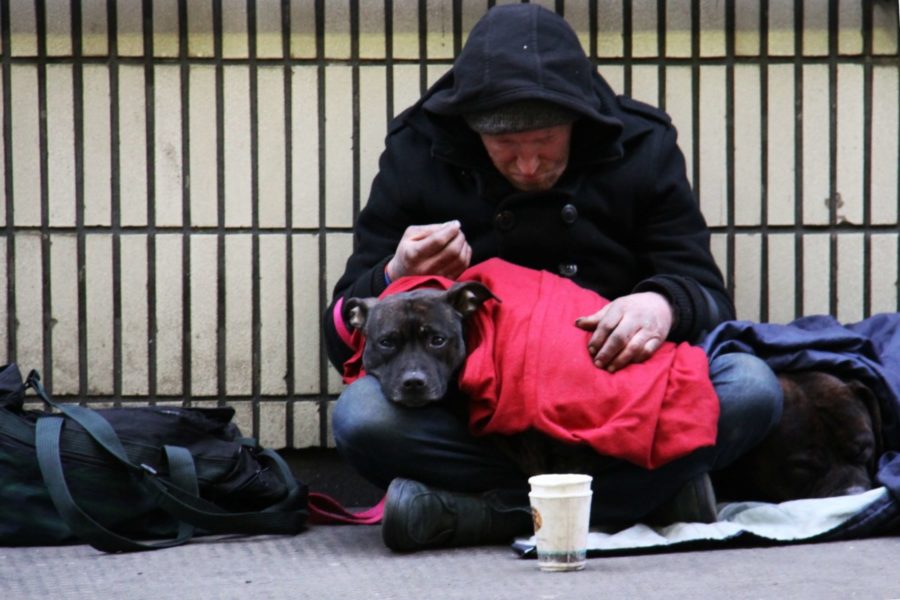
Due to the freezing conditions and how harsh it can be for dogs, Amsterdam and three other Dutch cities have a scheme where they take care of the dogs of homeless people free of charge.
HVO Querido and the Salvation Army have an agreement with Dierenopvangcentrum Amsterdam (DOA) to pick up the dogs of homeless folks at the Contactweg winter shelter in Westpoort.
The owner of the dog can stay for the night at the winter shelter while his/her dog stays in the shelter on the Meermeerweg.
Finally
Homelessness isn’t easy and, for some, can be a prolonged ordeal — a nightmare they can’t wait to put behind them and move on.
And while some people succeed, others need more time and assistance to solve all the underlying issues surrounding their homelessness.
Some may have to kick an addiction first, while others may have to be kept away from an abusive family member or partner. It’s never easy.
In some countries, homeless folks are treated like the scum of the earth, but luckily in the Netherlands, that is not the case.
There are lots of organisations in this wonderful country where homeless people can find the assistance they seek. Personally, this is one of the reasons why I love the Netherlands with all of my heart.
You never realise that it could also happen to you.
Well, life can be unpredictable. In most cases, all it takes is a bad investment, the loss of a job, mental illness, an abusive partner, etc., for one to become homeless.
If you ever find yourself in a situation where it is nighttime and you have neither a bed nor a place to call home, don’t panic! And please, don’t sleep on the streets. There is hope. There is help — you just have to find it.
Please realise that you can always do something about your situation, and no condition is permanent or hopeless. No problem is unsolvable, even homelessness.
Note: A lot of these organisations that help the homeless rely heavily on donations.
If you would like to donate to the cause, please click on any of the links below:
And don’t forget to visit any of the Salvation Army offices in the Netherlands to also donate clothes, winter jackets, food, drinks, snacks, etc.
If you have old clothes you were thinking of throwing away, please take them to the Salvation Army office near you. I’m sure they have some homeless folks who could use them!
Have you ever been homeless or do you know anyone who is currently homeless in the Netherlands? Got any tips on what can be done? Leave your thoughts in the comments below!
We all notice when the total on our shopping bill increases, but unfortunately, there’s another sneakier phenomenon that’s making our lives more expensive.
Manufacturers in the Netherlands continue to make packaging smaller but sell it for the same price, causing so-called shrinkflation.
An unpleasant trend
The Consumer’s Association in the Netherlands received 250 reports of shrinkflation last year.
Though this is less than in previous years, Consumer’s Association director Sandra Molenaar tells the AD that this isn’t exactly an encouraging trend.
Many brands have already reduced the size of their packaging before last year. Moreover, shrinkflation can be difficult to notice since manufacturers reduce the size in small steps.
Bullshit arguments
Manufacturers tend to put the blame on retailers, stating they are the ones who determine the price. Alternatively, they claim the reduced packaging has to do with improved quality.
Molenaar calls both arguments bullshit. “Just be honest and clear. Put on the packaging that there will be less in it from now on or keep the content the same and increase the price. Not nice, but fair.”
Have you noticed shrinkflation in your supermarket? Let us know your experience!
Have you ever biked the streets of Amsterdam and watched as a cyclist stuck their left arm out into oncoming bicycle traffic? Or heard frantic bell chimes from out of nowhere?
Dutchies are practically born on top of their fiets, and there are lots of factors that make cycling easy as pie — like having an entirely different way of communicating while cycling.
What is it?
Just like driving a car, Dutch people came up with their own set of rules and regulations to follow when riding a bike.
Part of those rules is an effective way to communicate with others while biking. For example:
If you want to pass someone, ring your bell before you overtake them.
Use your hands as signals when turning, i.e. if you’re turning right, extend your right arm for a few seconds before you turn.
You don’t signal if you’re going to stop — most people will have no idea what you’re trying to signal (and definitely don’t suddenly stop on a busy bike path).
While it might seem like a top-secret language to newcomers to the Netherlands, it’s actually pretty intuitive.
Why do they do it?
It’s no secret that Dutch people are some of the best cyclists in the world, and it’s for good reason too.
Their whole infrastructure is suited to accommodate bicycles and their education even includes cycling safety and etiquette.
People have also come up with a few ways to follow the rules without really following them. One time, I was sitting on the back of my friend’s bike and they asked me to do the turn signals so they wouldn’t have to let go of the handles.
Even if they’re ‘breaking the rules’, they’re not really breaking them.
Should you join in?
Definitely! Using this not-so-secret language will definitely make your cycling experience safer and easier.
Not to mention, cyclists (Dutch or not) will certainly appreciate you communicating clearly on the roads. Stay safe!
In 2024, the number of attacks carried out with explosives in the Netherlands soared. There were no less than 1,130 in just one year, leading to over 500 arrests, reports the NOS.
This is a fivefold increase from 2021, when these attacks occurred 212 times. With numbers like these, the government decided to set up a national task force, the “Strategic Offensive Against Explosions.”
“A social trend”
Explosions in the Netherlands are not just increasing in number — they’re changing in nature, too.
According to Jos van der Stap, manager of the national police’s “High Impact Crime” program, more than half of the incidents have no connection with criminal circles.
Rather, many attacks are carried out by regular citizens, often to handle personal feuds related to relationships or work, with the goal of revenge or intimidation.
The Tarwekamp explosion
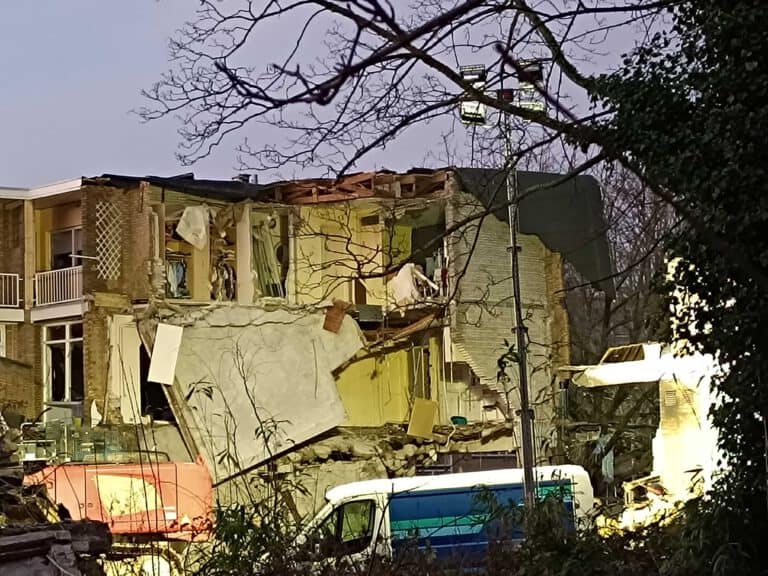
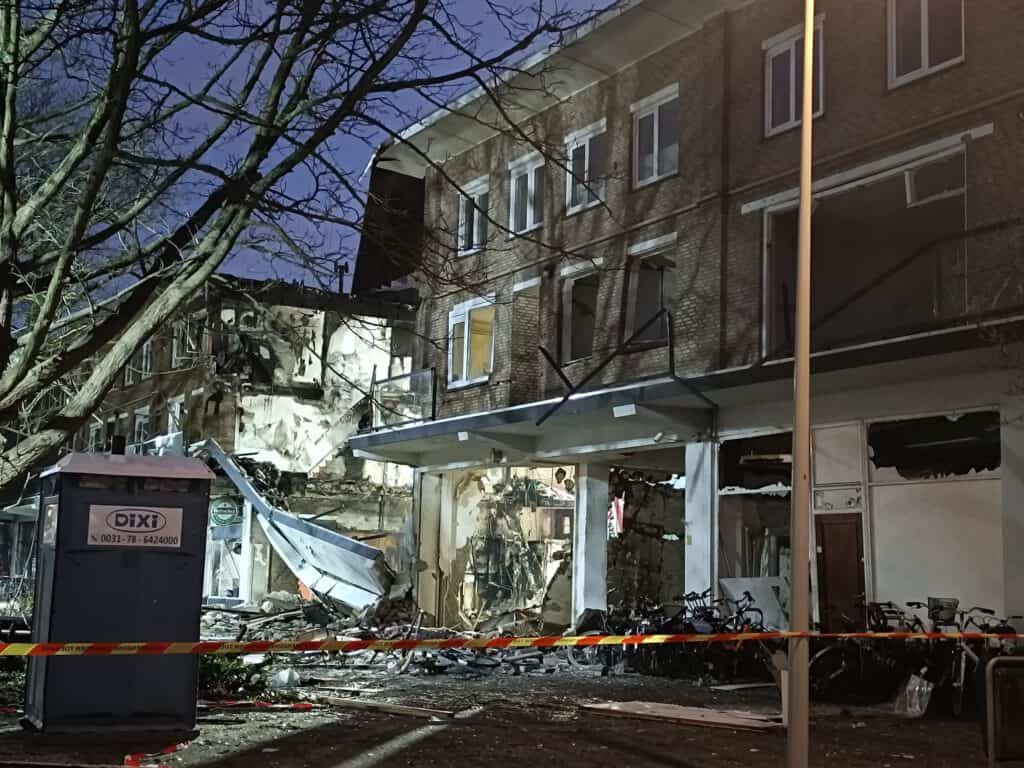
That was the case for the infamous Tarwekamp incident, the explosion that last December caused a building in the Hague to collapse, killing six people.
The December 2024 explosion at Tarwekamp left the city of the Hague deeply shaken. Image: Beatrice Scali/Dutchreview
The investigation revealed that the explosion was not related to crime or terrorism, but about a relationship.
“It seems to be a social trend to settle disputes with an attack”, van der Stap tells the NOS.
The case of Vlaardingen’s plumber
Another extreme example of this streak of explosions in the Netherlands was recorded in Vlaardingen, where one man, a plumber called Ron van Uffelen (45), was targeted 27 times in 14 months.
The last incident in the series of attacks on the man’s home, business premises, and cars happened last August 14, two days after the man’s passing.
According to van Uffelen’s wife, his death was indirectly caused by the attacks, as the stress worsened his heart problems, writes the NOS.
So far, investigations into the Vlaardingen explosions have led to over 30 arrests, but the motive behind the plumber’s persecution is still a mystery.
Why are there so many explosions?
Several Dutch politicians have blamed the problem on the accessibility of the explosives used for these attacks, including heavy fireworks such as cobras, which are often bought online for a few euros despite being illegal.
As such, they have periodically called for fireworks bans, or for re-classifying the heavier fireworks under the Weapons Act or the Firearms Act.
However, experts are looking at it from a sociological angle, too. While explosives are also accessible in other parts of Europe, “the large number of explosions is a problem mainly in the Netherlands,” criminologist Katharina Krüsselmann tells the NOS.
Experts blame this on the Dutch “fireworks culture,” as van der Stap called it: illegal fireworks are too socially accepted in the Netherlands.
Wondering why that is? Well, we might get an answer soon. Researchers at Erasmus University in Rotterdam as currently studying this worrisome Dutch trend, the Rotterdam mayor tells the NOS.
“The power of a hand grenade”
The explosions are usually carried out by setting off heavy illegal fireworks like Cobras, which have “the power of a hand grenade” and can be “life-threatening”, van der Stap tells the NOS.
Even worse, the explosive powder contained in these heavy fireworks is sometimes extracted to fabricate homemade explosives.
The main ingredient is usually flash powder, a material so explosive and inflammable that even modest amounts can cause enormous bangs.
“We as professionals are terrified of flash powder,” an explosives expert tells Het Parool.
Who is behind the explosions?
The explosions usually involve three people: an executor, an intermediary, and a client, explains the NOS.
Since the executors are often caught, we know quite a bit about them: they tend to be young men, aged around 23, living in vulnerable neighbourhoods, and they’ve had previous contact with the police.
Often, they don’t know who the final client is or how to procure or use the explosion’s materials — all they do is carry out orders from their intermediaries for a few hundred euros.
This, unfortunately, adds tragedy to the tragedy, as for the case of the Amsterdam 17-year-old who, according to Het Parool, was found “bloodied and only half conscious in the bushes” after mishandling the explosives he was given.
Why can’t the police stop the explosions?
So, if it’s so easy to catch the executors of these explosions, why can’t the police stop them altogether?
Well, it’s not that simple. For starters, the non-crime nature of many of the attacks makes it hard to predict the next strikes, and the intermediary system makes measures like adding cameras or closing buildings useless.
Deterring potential executors is also difficult. According to criminologist Katharina Krüsselmann, heavier punishments will not do the trick.
“The young people who are now hired through an intermediary to place an explosive will not refuse an assignment if it carries a heavier punishment,” Krüsselmann tells the NOS.
How will the Netherlands solve its explosions problem? Tell us your opinions in the comments below.
After surveying 84,000 commuters in the annual NS and ProRail survey, Metronieuws has revealed the verdict on the worst and best train stations in the Netherlands.
All aboard for the results… 🥁
The worst train stations in the Netherlands
According to public opinion, Lage Zwaluwe is the worst train station in the Netherlands, with a score of only 4.8 out of 10.
Rolling in for second and third place are Den Helder Zuid (5.1) and Nieuwekerk aan den IJssel (5.3).
The NS explains that the stations’ disappointing ranking can be attributed to a lack of maintenance, remote locations and atmosphere. What a train wreck. 😣
The good news? Many of the low-ranking stations are set for major renovations in the coming years, so there’s light at the end of the tunnel.
On the bright side, the best Dutch train station is once again Klimmen-Ransdaal, located between the villages of Klimmen and Ransdaal in the municipality of Voerendaal. This year, it earned a score of 8.3.
Following closely behind is Overveen Station, also with a score of 8.3.
Curious what the top 10 looks like? Take a look. 👇
Place
Station
Province
Score
1
Klimmen-Ransdaal
Limburg
8.3
2
Overveen
North Holland
8.3
3
Schin on Geul
Limburg
8.2
4
Mantgum
Friesland
8.1
5
Dalfsen
Overijssel
8.1
6
Valkenburg
Limburg
8.0
7
Daarlerveen
Overijssel
8.0
8
Houthem-St.Gerlach
Limburg
8.0
9
Santpoort Zuid
North Holland
8.0
10
Barneveld Zuid
Gelderland
8.0
Among the bigger stations, Delft is the most popular, landing a 7.9, with Ede-Wageningen trailing behind with a 7.1.
What are the best and worst train stations in the Netherlands? Let us know in the comments.
Shortly after his inauguration, the new-old president of the United States might be coming to the Netherlands.
He’s not here to see the tulips and windmills, though — he’ll be trying to convince NATO states to increase their military spending.
Pulling out all the stops
The NATO summit, which will be held on June 24 and 25 in The Hague, will be the largest summit ever held in the Netherlands.
Though his arrival has yet to be confirmed, the government is counting on Donald Trump’s presence. Minister of Foreign Affairs Veldkamp is optimistic about the possibility.
“The fact that Trump has nominated a new American ambassador to the Netherlands so quickly, I consider a sign that he will indeed come,” Veldkamp said when talking to the AD.
Where would someone who’s used to his bedroom being decked out in more gold than a 17th-century cathedral sleep when coming to the lowlands? The prestigious Huis ter Duin in Noordwijk.
This is the same hotel where former president Obama stayed during his 2014 visit to the Netherlands, and rooms for Trump and his delegation have already been booked.
The hotel isn’t just appropriately luxurious; it’s also easy to secure, making it a popular choice for world leaders. At the time of Trump’s (potential) stay, it’s already fully booked.
A huge NATO budget
It would be important for Trump to attend the NATO summit, but his arrival is uncertain due to a familiar culprit: disagreements about the budget.
Trump is advocating for member states to increase their NATO budget from the current 2% of their GDP to 5%.
This is somewhat in line with the former Dutch Prime Minister, and current NATO Secretary General, Rutte’s wishes — he wants the new budget to exceed 3% of member states’ GDPs.
Apparently, Trump and Rutte’s motto is to aim high since they are pushing for NATO budgetary increases at a time when almost a third of the member states don’t reach the current standard of 2%.
The Dutch government is worried that Trump wouldn’t come if a deal about allocating more money to NATO isn’t reached before the June summit.
Whether Trump decides to fill that room in Huis ter Duin or not, The Hague is going to be busy in June.
About 6,000 delegates and 2,000 journalists will be present at the summit, including 44 heads of state or government leaders.
Perhaps you’re moving to the Netherlands and want to know at what speeds you can expect to whiz through your newsfeed every morning, or maybe your current Dutch internet speed is less than ideal and you’re wondering how to improve it.
In any case, you’ve come to the right place.
From how internet speeds in the Netherlands compare to those in other countries, to how to test and improve your Dutch internet speed, we’re sharing all the info you need to optimise your experience of the Dutch web. 💁
This post might have affiliate links that help us write the articles you love, at no extra cost to you. Read our statement.
Internet in the Netherlands: the basics
We could be modest, but why should we when the OECD once crowned the Netherlands as “one of the historic leaders in terms of broadband penetration.”
As of 2025, the Dutch have access to an average network bandwidth of at least 200 Mbit/s (megabits per second).
In other words, chances are that you’ll have a (slightly) above-average internet speed almost no matter where you settle in the Netherlands.
The Dutch took digitalisation seriously in the early 2000s and their ambitions have only increased in the past couple of years.
In 2023 alone, 98.3% of Dutch households were covered by a Very High-Capacity Network (VHCN) — in contrast to the European average stood of 78.8%, reports the European Commission.
Home is where there’s good internet. Image: Depositphotos
The most common ways to hook up to the internet in the Netherlands are via broadband connections such as DSL, cable, or fibre-optic. Your maximum internet speed will depend on which of these connections are available at your address. 🔌
“Above-average internet speed.” It’s like music to our work-from-home ears! 👩💻 But do you know what’s even better?
The Dutch government undertook a plan to connect all households in the Netherlands with broadband networks of at least 100 Mbps by 2023 — adding that a vast majority should be running on one full Gbit/s (gigabit per second).
With Dutch internet speeds increasing rapidly, working from home is an absolute breeze. 🍃 Image: Freepik
With some top providers hitting speeds of four to eight Gbit/s, we daresay they’ve succeeded! 😉
Meanwhile, the Connectivity Action Plan aims for the Netherlands to provide “high-quality connectivity that can serve a wide range of demands and is available at competitive prices anytime and everywhere.”
The Dutch government might want “competitive prices” but, nevertheless, internet-only subscriptions in the Netherlands are still some of the most expensive in Europe. 💸 🫠
The maximum internet speed depends on your address in the Netherlands
So far, we’ve mostly talked about Dutch internet speeds in general. But what about your internet speed?
As we’ve said above, the first thing to know is that the maximum internet speed depends on the connection available at your residential address. You can easily check what your options are online by searching “internet postcode check.”
Not sure how speedy your internet is? Both Ziggo and Ookla have excellent speed tests to assess your connection. Image: Freepik
Secondly, you should keep in mind that “maximum” internet speed does not necessarily equal actual internet speed. The difference between the two depends on which connection you opt for:
DSL is available to almost all Dutch households but is less stable than other internet options. The speed mainly depends on how far away you are from the local IXP (internet exchange point).
Cable is the preferred way to connect to the internet in the Netherlands and provides stable (and affordable!) internet. There is usually no more than a 10% difference between the maximum and actual internet speed with cable.
Fibre optic internet is becoming increasingly available to Dutch households and provides stellar download and upload speeds. Plus, you’re guaranteed to always receive the maximum internet speed. However, it’s also the most expensive option.
Did you know? When it first came on the market, fibre optics was much faster than cable. However, new developments have made cable download speeds in the Netherlands just as fast as fibre optics.
These are the fastest Dutch internet providers
When it comes to super-speedy and ultra-reliable internet, these are the best providers on the Dutch market. 👇
With upload and download speeds that hit a blazing 8 Gbit/s, Odido is one of the fastest providers in the Netherlands.
In addition to their stable network and widespread coverage, Odido offers excellent bundles — combining your internet subscription with a mobile data plan or TV package.
How to check your internet speed in the Netherlands
If you want to test your maximum internet speed, you can do a speed test online with the click of a button while connected to WiFi. 👀
To find your full potential, hook up your computer or laptop to your modem via a cable. The test will quickly show you the download and upload speed that are at your property.
Need a better modem? You can easily order one online or simply go to your local electronics store. Image: Depositphotos
Let op: Make sure that you aren’t using a VPN when doing the test.
Tips for improving your internet speed in the Netherlands
Not happy with the test results? Here are some tips for improving your Dutch internet. 👇
Use high-quality internet cables that are suitable for Gigabit networks. CAT5e cables are a good bet!
If you have a laptop that’s still running strong but has more than five years of use on its back, then buy an up-to-date network card.
If you’re using WiFi then:
Make sure the modem is placed effectively, without too many obstructions blocking its signals. That means it should be visible, high, and free — oh and not too far away.
It sounds basic but restart your device. Sometimes the fault lies with your smartphone or laptop rather than the internet!
Restart your modem. Usually, it takes 10 minutes for a modem to fully reboot and your internet should be up to speed after about an hour.
Use a WiFi amplifier.
Whether you want the speed of a fibre optic connection or prefer the budget-conscious options afforded by DSL, internet in the Netherlands is guaranteed to be fast enough to keep up. 💪
Got any tips that we didn’t touch on? Tell us in the comments!
Internet speed in the Netherlands: Frequently asked questions
What is the average internet speed in the Netherlands?
As of 2025, the average Dutch internet speed is around 200 Mbit/s. However, many fibre optic connections can hit speeds of 1 Gbit/s or higher.
Is fibre optic internet widely available in the Netherlands?
Yes, fibre optic internet connections are available for most Dutch cities — with the Dutch government planning to expand coverage even further in the future.
What are the fastest Dutch internet providers?
Currently, the three fastest internet providers in the Netherlands are: Odido (8 Gbit/s), Delta (8Gbit/s), and KPN (4 Gbit/s).
The saying goes like “doe maar gewoon, dan doe je al gek genoeg” in Dutch, or ‘just act normal, it’s already crazy enough’ — a phrase that not only turns out to be an invitation to act normal but a source behind Dutch thought.
Maybe it’s the Dutch language that doesn’t do its culture justice sometimes, at least when translated into English.
From bizarre idioms to untranslatable Dutch words, we bring you yet another complex concept wrapped in a phrase, a true element of the Dutch culture: doe normaal.
What is doe normaal?
The general concept basically translates to ‘act normal’. However, tone matters here: the phrase can be seen as a gentle “try to fit in” but also a still-faced “be normal” with a warning shake of an index finger. 👆
Generally, doe normaal carries a negative tone. It could mean ‘you’re embarrassing yourself (and me)’, but it could also be considered general advice from one person to another. There, there, don’t stress.
Another Dutch phrase that can back this concept up is “steek je kop niet boven het maaiveld uit”, which translates to “don’t stick your head above the cornfield” — Dutchies don’t exactly like to stand out from the crowd.
Why doe normal?
A good question, indeed.
The answer may lie in the time or situation you’re being told to doe normaal in. For instance, don’t expect anyone to yell doe normal at you when you’re swimming or even skating in a canal — it is the Netherlands, after all. 🤷♀️
It can also relate to the pillarisation in Dutch society, where different “pillars” had different ideas of what is considered ‘normal’ based on their religious beliefs and political opinions.
Take some of the People’s Party for Freedom and Democracy (VVD) ads, for example, where heel (very) normaal and niet (not) normaal are used as part of Dutch political messaging. 📢
Doe normaal can also relate to the Dutch tendency of social policing within the society, being as direct as the Dutch are, in combination with their respect for rules and regulations.
This is like the countless times I’ve encountered a Dutch person asking a random stranger to keep it down in a silent train carriage.🤫
The Dutch doe normaal can also run below the surface. Discussions about certain finances and boastful conversations altogether are examples of what the Dutch consider a conversational taboo.
Dutchie’s take
What do Dutchies think doe normaal is? We asked a number of Dutch people what they associate doe normaal with.
For Jelle (26), doe normaal is a simplistic social conduct that’s often used in conservative, political offtimes, slogans and messages. For example, doe normaal seems to be connected to political messaging by former Prime Minister Mark Rutte and the VVD. 🗣
Other Dutchies maintain that doe normaal is a phrase a grandparent would keep repeating to their grandchildren during different social occasions to avoid rule-breaking related embarrassments.
Grandparents will often impart their wisdom about social rules and norms to follow. Image: Depositphotos
As for Fieke (31) doe normaal is an expression that can be heard in different social situations, like when you’re on a bike and someone blasts past you in their car yelling: “doe normaal joh!” or when you hear a crazy, hard to believe story so your reaction is: “neeeee joh, doe normaal!”
It can also be used in human-to-pet communication, like when your dog growls at your friendly neighbour passing by, so you go: “nou, doe eens normaal!”
According to Fieke, doe normaal can be used in different ways, but in the previous examples, it all comes down to “are you crazy?!” “no way!” and “Come on, behave yourself!” More of a typical Dutch way of expressing disbelief and excitement at the same time.
Did you experience the Dutch doe normaal or used it before? Tell us in the comments below!
Dutch cat owners are creative, unique and hiss-terical when it comes to naming their furry friends (some more than others 👀).
From classic names to obscure ones, this list of 2024’s most popular cat names might inspire you to adopt a new four-legged dictator.
What are the most popular names?
According to AD, pet insurer Figo surveyed 35,000 cat servants — I mean, owners — and found that Simba won the crown for most popular cat name in 2024. 🦁
Luna was a close second, prowling right behind Simba. 🐾
Here are the rest of the fabulous feline frontrunners:
Nala
Coco
Milo
Bella
Turns out, Dutch pet parents really enjoy The Lion King. 🥹
The most paw-culiar cat names
Some cat owners were a little more… out of the box when naming their kitties.
Here are the most tail-raising names from the study: