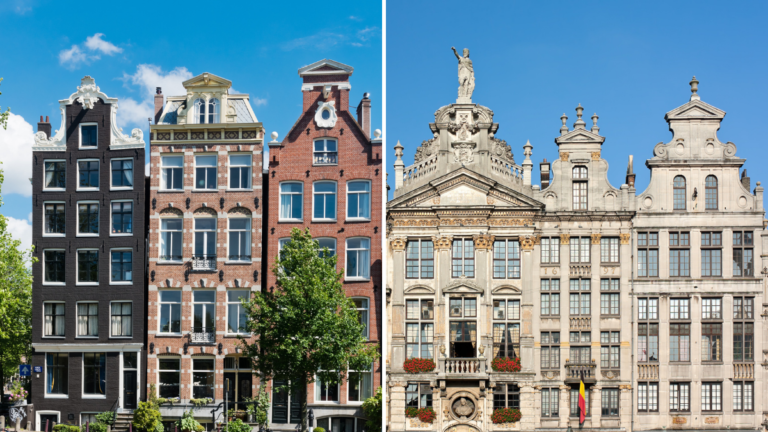
Have you ever wondered why the Dutch are called “Dutch”? You might be surprised by the word’s origin.
The Dutch are famous for being very direct and straightforward people. Do you want a genuine opinion about your outfit? You got it! Want to split the bill? No problem! Do you want to have unlimited types of cheese to choose from? You got that tenfold!
Everything seems pretty simple here until you start asking yourself specific questions. Why does this country have two names? Is it the Netherlands or Holland? And why are people here called the Dutch? And why do these words have nothing in common with one another?
Well, we have the answers for you!
The Netherlands vs Holland: What even is the difference?
If you know the difference between the Netherlands and Holland, have heard the Dutch national anthem at least once, and know a thing or two about Dutch history, then you’re pretty much a half-Dutchie.
But for those who don’t know those things, let’s get it out of the way before we get to the main question.
In short, the Netherlands is divided into 12 provinces. However, the two provinces of North and South Holland contain all the good (read: touristy) stuff.
Think tulips, windmills, canals, Amsterdam, and The Hague. Because the two Holland provinces are so popular, the whole country eventually became known as Holland, even though its real name is the Netherlands.
But why are the people here called Dutch? Well…
The British are to blame
England? English! America? American! The Netherlands? Netherlander? Hollander? No, Dutch! Why? Because logic.
As if Brexit wasn’t enough to screw up half of Europe, the Brits messed things up for the Netherlands quite some time ago.
Now, we need your full attention for the reason why we call the Dutch, well, “the Dutch.” As we all know, the German word for Germany is “Deutschland.”
Now, for the British, everyone who spoke a Germanic language was one and the same. This resulted in the British calling people from Germany and the Netherlands both Dutch.
Then, as time passed, the Germans became known as, well, Germans. However, like a nickname you got in high school, “Dutch” still sticks with the Netherlands.
What do you think about the word’s origin? Did we surprise you with the reasoning behind it? Tell us in the comments below!
No matter how many times I tell my friends I live in Haarlem, every time we chat, they ask — “So how is life in Amsterdam?” Haarlem, people, Haarlem! Trust me, there is so much more to the Netherlands than Amsterdam.
We stumbled upon the Spaarnestad (city on the river Spaarne) one sunny, summery Saturday morning. With its bustling market and happy, chatty people wandering and cycling all across its cobbled streets, Haarlem cast a bit of her magic on us.
So, in mid-2018, we made Haarlem our home, and we have no regrets.
It’s well-connected for travel
Haarlem is the capital of Noord-Holland and it will take you about 20 minutes to reach by train from Amsterdam. With something like 148 trains per day, though, it is an easy commute. 🚆
From Haarlem, you can wiggle your toes on the beach in less than 30 minutes, depending on your mode of transport and preferred coastal stretch. Oh yes, you actually have a choice.
If you wish to work outside of Haarlem, the commute to Leiden, Den Haag, Rotterdam, and Utrecht takes at most an hour, with excellent public transport links.
For any international journeys, you can be checked into your flight at Schiphol in under 30 minutes — if you go to the airport by car, that is.
It boasts idyllic and colourful nature
This charming city is, of course, the gateway for visiting the tulip fields and Keukenhof during the flower season in spring.
Keen to see the Dutch tulip fields? Haarlem has that too. Image: Magdalena Laas Photography/Supplied
There’s also the river Spaarne running languidly through Haarlem, a top spot for an evening picnic on the banks during summer. Oh, and borrel cruises on the water. 😍
The city of Haarlem dates back to 1245, so the charming aesthetic, narrow cobbled streets, hofjes, and green spaces are no surprise.
Its infamous ‘little city’ status and vibe
I often hear Haarlem described as a little city. As it is one of the most densely inhabited metropolitan areas in Europe, this reference is more of an interpretation of its village-like vibe than its populace.
This city’s pièce de résistance? St. Bavo Kerk (Church St. Bavo) on Grote Markt (Central Square).The former is not to be confused with the St. Bavo Cathedral, though, an equally imposing grand lady with her ornate copper dome. 😉
Imagine seeing scenes like this every single day. Image: Magdalena Laas Photography/Supplied
Grote Markt’s weekly markets are the city’s beating heart. There are exciting events yearly, such as the Bloemencorso (flower parade), Haarlem Jazz & More, Haarlem Cullinaire, and Haarlemse Stripdage.
It has a diverse demographic and language
Around 67% of Haarlem’s residents are Dutch, although the international community is steadily growing. Compared to Amsterdam, Haarlem may come across as a sleepy hollow since it is not as diverse, colourful, quirky, and edgy as the Dutch capital.
However, Haarlem is often called little Amsterdam, which I feel undermines the unique and pleasant character of my hometown.
Like most of the Netherlands, it is easy to get by in English, but if you want to integrate and speak Dutch, this is the perfect place to learn.
Dutch, spoken in Haarlem, is called Algemeen Beschaafd Nederlands (general decent Dutch) or ABN for short. ABN simply means it is one of the easiest Dutch accents to understand — leuk!
It’s bursting with culture and activities
After living here for a while, I’ve come to appreciate the various cultural and entertainment activities on offer.
On the other hand, De Pletterij offers more fringe music and serious debates. And their neighbour,De Werelkeuken, has new Haarlemmer chefs that offer a unique experience of global cuisine with little tastes of the homes they left behind.
Music and comedy
Quite a few pubs and cafés in Haarlem have a live music line-up. Both the Haarlem Comedy Club and the Haarlem Comedy Factory will tickle your funny bone with a varied bill of Dutch and international comedians.
This little city also hosts many significant events, such as De Houtfestival (which I love due to its family-friendly and green vibe) and the massive Bevrijdingspop.
One of my favourite food festivals in Haarlem is Proefpark in August — a delicious, family-friendly foodie’s delight.
It’s family-friendly
Haarlem is spectacular. But Haarlem in the autumn? Yes please. Image: Magdalena Laas Photography/Supplied
Haarlem is a family-friendly city. There is certainly no scarcity of clubs and events for children, both weekly and ongoing — Kidsproof Haarlem is a brilliant resource.
One of my favourite autumn events is the Lichtjestocht, which takes place in October in the national park Zuid-Kennemerland. You amble through the dunes after sunset, with only lanterns (battery-operated ones for safety, of course) to guide the way.
Speaking of independent shops, there are a few shop owners known for their eccentric natures, making it quite the experience to enter their world. Every Thursday, there is a koopavond (shopping evening) when many shops are open till 9 PM.
Haarlem is a top-notch shopping destination. Image: Magdalena Laas Photography/Supplied
Just a 10 minute walk from the station, you are in one of the longest retail streets in the Netherlands. Generaal Cronjé Straat, or the Cronjé, as it is affectionately known by the locals, offers a retro shopping experience.
It has the best coffee and dining scene
Haarlem is proud of its gastronomical flair and diverse cuisine choices — from cosy cafés to hip coffee bars to romantic and family-friendly restaurants or even fine dining.
It’s fair to say, as a self-proclaimed coffee snob, I am spoiled for choice. 😇
Haarlem’s beachy neighbours are a big drawing card. Whether you cycle or take the train, numerous beaches are easily accessible. As a local, my favourite is Parnassia aan Zee, which can be easily reached by bike or car.
To get to the wonderful Zandvoort aan Zee, jump on bus 80 or take the train, which goes every 30 minutes. Bloemendaal aan Zee is another great option and can be reached within 20 minutes with bus 81.
Beaches? Yep, Haarlem has those as well. Image: Magdalena Laas Photography/Supplied
Alternatively, one 12-minute cycle south of Zandvoort aan Zee, and one big dune climb, there’s Zuidstrand 7 — a nudist beach. But you don’t have to partake in the nudism to enjoy this Zuidstrand 7’s tranquillity and serenity.
It also boasts the wonderfully unconventional and cosy strandpaviljoen, Fosfor. Here, we’ve spent many happy hours swinging in the hanging chair, sipping on cocktails, and nibbling delicious bites. 🌊
It offers an array of nature hotspots
Haarlem’s national park Zuid-Kennemerland offers superb choices for the nature lover, the runner, the hiker, and the cyclist alike.
Spending time at the small inland lakes and recreational areas such as ‘t Wed, Westbroekplas, Meerwijkplas, Veerplas, and Molenplas is a must, especially with children.
On the banks of Veerplas is the cheerful Het Veerkwartier, a delightful café with a variety of events on offer.
Not a fan of the beach? Just head to the national park instead. Image: Magdalena Laas Photography/Supplied
Additionally, Haarlem boasts two luscious urban forests, De Haarlemmerhout and Elswout. De Hout is where we spend hours exploring the Netherlands’ oldest urban forest, while Elswout is a great place to check out a wonderful children’s theatre.
A short bike ride south of Haarlem and you reach the magical Wandelbos Groenendaal with a kinderboerderij (petting farm) and a large speeltuin (playground).
Speaking of speeltuinen, parents are spoiled for choice, with lovely playgrounds dotted all over Haarlem.
Have you visited Haarlem? Tell us what you love about it in the comments below!
We like to admire the Dutch for being smart, innovative, and even cute. But let’s be real, nobody’s perfect, and even the Dutchies can, in fact, be quite annoying.
As an international in the Netherlands, there are probably at least a dozen things that come to your mind already.
We put our heads together and asked for your help to compile the ultimate list of the most vervelende (annoying) things Dutch people do.
Disclaimer: Yes, we know — not EVERY Dutch person does these things. But we’ve seen them done more often than we would like, which is how they’ve all earned a well-deserved spot on this list. 😉
1. Always switch to English
As amazing as the Dutch’s ability to speak English is, it can sometimes make learning the local language an impossible endeavour. Why? As soon as a Dutchie hears a hint of a foreign accent, they will automatically switch to English.
Sometimes, you don’t even have to open your mouth — they just see your face (or height, in my case) and resort to English straight away.
Think learning Dutch is easy? Try having a conversation with native speakers, who switch to English almost immediately. Image: Magnific
There’s one thing we’ve gotta give them, though: if you explain to a Dutchie that you’d really like to master the guttural “g” and everything else that comes with speaking Dutch and ask them to practice with you, they will be more than happy to help out.
2. Split bills to the cent & send Tikkies for everything
The Dutch stinginess, ehm… thriftiness is probably not a new concept to most, and we could ramble on forever about the downright stingy things Dutch people do.
However, this list of annoying things wouldn’t be complete if we didn’t mention the infamous Tikkie. And what’s more Dutch than Tikkie itself? Being Tikkied for literally every cent, no joke.
If you think we’re exaggerating, the stats don’t lie: 10,000 Tikkie payments for under €2 are made in the Netherlands every day!
3. Argue for discounts
If there’s one thing the Dutch love more than bicycles and bread for lunch, it’s discounts.
Nothing will separate a Dutchie from their discount. Image: Depositphotos
We’ve even heard stories of Dutchies asking for discounts because they didn’t use the mini sachet of mayo that came with their meals. 🤔 Now, THAT is frugality at its finest.
4. Use diseases for swearing
Has anyone ever called you “cancer”? You would think that it would be considered weird (not to mention extremely inappropriate) to swear with deadly diseases.
If you do find this odd, you probably haven’t been familiarised with Dutch swear words yet. A large percentage of these are, weirdly, made up of illnesses… cholera, typhus, plague, you name it.
Come on, folks, at least use a trigger warning (or use less emotionally charged bad language 😉).
5. Plan everything in advance
If you love going on spontaneous adventures or showing up at your friends’ place unannounced just to say hi, we suggest you move to a different country.
An empty agenda is unheard of in the Netherlands. Image: Depositphotos
See, the thing is, Dutch people don’t like surprises — and they love to plan stuff.
Life in the lowlands is dictated by the omnipresent Dutch agenda.
Want to grab a cup of coffee with a Dutch friend? Make sure you send a written inquiry a couple of weeks in advance so they can fit you into their tight schedule…just kidding — kind of.
(Warning: this habit is highly contagious.)
6. Invade other countries with their caravans in the summer
Have you ever arrived at a beautiful campsite (in or outside the Netherlands) just to see all the spots occupied by massive white caravan trailers that ruin all the views? That’s Dutch people on vacation.
We suspect that the reason they love them so much is the fact that camping holidays are extra goedkoop (cheap). 🤔
7. Put condiments on chips — not next to them
Whether you order your friet with mayo, pindasaus, or something else, the sauce will inevitably be placed on your chips. The result?
One-third of your chips are squishy and soaked in a sauce before you even start eating, and the rest of your cone is drier than a piece of a forgotten hunk of brood.
Dutchies will squish a blob of sauce on top of your chips even when they serve them in a little tray that has a separate compartment specifically designated for the sauce.
8. Say leuk, lekker, and gezellig all the time
Got a new pair of shoes? Leuk! They’re your favourite colour? Also leuk! And you got them at a discount? Superleuk!
You probably got the point — Dutchies are not very creative when it comes to adjectives.
It could almost be an awesome drinking game — down a shot of tequila every time you hear leuk and a shot of vodka every time you hear gezellig at a Dutch party…or maybe not.
However, Dutch is a difficult language to master, so perhaps this lack of diversity is not at all that bad.
9. Talk loudly, especially on trains
As if the guttural “g”, harsh “sch”, and impossible-to-pronounce “ui” weren’t distressing enough about life in the Netherlands, the Dutch also love to make these sounds very loudly for some reason, especially when they’re on a train.
While some say that this is a way for the Dutch to show that they’re not keeping secrets, others simply maintain that they love to talk — and more importantly, they love to hear themselves talk.
And the sanctity of the designated silent carriage? Well, it might as well not exist.
10. Turn streets into dumpsters on King’s Day, Carnival, or any other day, really
The Dutch sure know how to celebrate events such as King’s Day or Carnival.
What they apparently don’t know, though, is how to pick up the trash that they scatter around the streets during said events, and on the other 361 days of the year.
A familiar sight after King’s Day. Image: Depositphotos
One particularly appalling habit that many of our readers hold in contempt is dropping cigarette butts.
Put that together with spitting in the streets and picking the nose in public, and you have the ultimate trifecta of some of the grossest things Dutch people do.
11. Forget to pick up their dogs’ poo
Let’s start this one with a leaderboard, shall we?
The Hague: 1,373
Rotterdam: 1,234
Utrecht: 638
Tilburg: 520
Noordwijk: 473
This is the number of “dog fines” given out in each city from 2016 to 2020, according to research published on Beslist.nl.
Sure, not picking up dog poo is just one of the possible fines included in these dog fines stats — but it’s definitely an issue. Sixty percent of Dutch people still think dog poop is a problem in their neighbourhood.
Dog poo is quite an issue in the Netherlands. Image: Depositphotos
Imagine you’re out for a picturesque picnic wearing a cute little dress and nice open summer sandals, when suddenly you feel something warm and watery squish under your foot. Heel vervelend! 🤮
12. Go crazy with fireworks on New Year’s Eve
One of our readers called this phenomenon a “firework civil war”, and honestly, there’s probably no more appropriate name than this one.
The Dutch like to start the New Year with a bang — literally.
So it doesn’t really come as a surprise that fireworks (and their alternatives) are a hotly debated topic in the Netherlands.
However, from this year, the government has launched a ban on public fireworks. Instead, Dutchies will have to go to a show in order to start the year with a bang.
13. Be terrible at queuing
The messy bundle of human beings you can observe when you’re trying to get on public transport, pay for your groceries at Albert Heijn, or just get on an escalator can’t even be described as a queue — it’s more of a hot mess.
Eager Amsterdammers trying to get on a ferry. Image: Depositphotos
A vivid scene from literally any Dutch train station perfectly captures the essence of this phenomenon.
Just watch as the desperate travellers form several clusters in places where they expect the train door to appear and then let a group of even more desperate travellers exit the train through an ever-narrowing gap.
14. Give unsolicited comments and then hide behind “Dutch directness”
Are the Dutch direct, rude, or just emotionless? The answer probably depends on your personal cultural background.
However, the Dutch can definitely take their directness a step too far. As one of our readers sensibly stated, “What’s the benefit of calling someone fat?”
The line between directness and being passive-aggressive or giving unsolicited advice is a fine one to walk.
To a soul uninitiated into the intricacies of the local culture, we understand that it can sometimes feel like the Dutch are overstepping some serious boundaries — and being more than a little annoying.
15. Insist on bread for lunch (and breakfast, and sometimes dinner)
The Dutch are just as creative with their lunch as they are with their adjectives.
This is exactly why you won’t find much more than boterhammen (sandwiches) — most likely with kaas (cheese) or hagelslag—in Dutch canteens.
A beloved Dutch classic. Image: Amin/Wikimedia Commons/CC4.0
Sandwiches are simply an integral part of Dutch society.
16. Have horrible cycling habits…
To be fair, there are two sides to this debate.
I mean, how would you react if you were a seasoned almost-Nederlander cycling full speed on a path that is exclusively dedicated to fietsers having to manoeuvre around a group of five tourists with two big-ass suitcases each?
But then again, Fast & Furious-style cycling isn’t the only annoying thing about Dutchies and their bikes.
There’s also drunk cycling, cycling without lights, not indicating direction, or accidentally derailing other cyclists who are trying to overtake you because you’re looking at your phone instead of on the road. (No, this one is unfortunately not a made-up example, just to be dramatic…)
And then you also have those people who cycle in the worst possible weather — rain, hail, snow, or all three — and then shove it in everyone’s face, making them feel bad about not wanting to sit on a wet bicycle when it feels like the world outside is ending.
We can also understand this one, though, because cycling is just so much cheaper than using public transport!
17. …and even worse habits when it comes to parking bicycles
Bike parked where you need to walk on the street? Annoying. Is your bike parked in front of your front door? Annoying.
Bike crammed in next to your bike in an official bike parking spot, but making it a huge tangle of handlebars and pedals, so it’s practically impossible to unlock and use your beloved two-wheeler? Super annoying!
This sight is not for the faint-hearted. Image: Depositphotos
The unwritten and unspoken rule about parking bicycles in the Netherlands is this: if the gemeente doesn’t remove it, you can leave it pretty much anywhere.
There’s no such thing as “there’s no space to leave my bike here” — believe me, this mentality has really grown on us over the years.
The real badass people will even park their bikes right in front of a ‘Geen fietsen plaatsen’ (no bike parking) sign.
18. Complain about things, but then do nothing about them
Exhibit A: politics. Despite being one of the most politically stable countries in the world, we haven’t met a Dutchie yet who doesn’t love to complain about their politicians.
Yet somehow, the Dutch have managed to re-elect the very same prime minister that they like to complain about not once, not twice, not thrice — but FOUR times.
But maybe this Dutch habit is also changing. After all, they did eventually vote Rutte out of office. Not sure if they have less reason to complain now, though.
19. Don’t take criticism very well
While the Dutch will happily criticise other people (or countries) under the pretence of directness, they aren’t always necessarily so open to receiving criticism themselves.
Step one to pissing a Dutchies off: offer them the mildest form of criticism. Image: Depositphotos
Just think of how adamantly some Dutch people still defend Zwarte Piet as a harmless, jovial “tradition.”
Or how defensive they get when somebody else than a Dutchie (especially an American) dares criticise the Netherlands.
They also get offended when people point out some of the not-so-nice things they do. Disagree? Just scroll down to the bottom of this page (or this page) and look at the comments section a few weeks from now.
We’ve all been annoyed by Dutchies, and they have certainly been annoyed by us.
So next time you find yourself in one of these situations, just laugh it off andfind comfort in the knowledge that other internationals have probably been there too.
Or, if that doesn’t work, you’re welcome to vent in our comments section. After all, we always love to hear a good story from the lowlands.
What’s the most annoying thing YOU have experienced in the Netherlands? Let us know in the comments below! 👇
There are some things the Dutch don’t talk about that they really, really should. What on earth is in bitterballen? And why is the Netherlands a tax haven?
From the absence of curtains to the unspoken presence of colonialism, the Dutch really have some things to address.
That said, we won’t talk about Sinterklaas and his problematic helper, as that’s a whole other conversation.
1. Curtains: Why don’t they close them?
Listen. In most countries, people close their curtains when night falls, because the darkness outside means that everything you do inside your house can be seen from outside.
Completely wide open? Just like that? For all to see? Image: Depositphotos
For better or worse, Dutch people tend to keep their curtains open in the evening, especially in their living and dining rooms.
You can see families chatting, eating together, or watching TV as you stroll through the city, which is lovely. But also… unique. Why don’t we talk about this more?
2. Bureaucracy: Never a topic at the Dutch dinner table
There’s no doubt that a little bit of bureaucracy is great. Even a lot of bureaucracy is great. But the Netherlands goes way too far on this front, and many internationals, especially, struggle with it.
It seems like a bad joke at first when you realise, OK, I need a fixed address to get a BSN, which I need for my job, which I need to afford… the fixed address.
Dutch people might not talk about bureaucracy, but we internationals sure do. Image: DutchReview/Supplied
Alas, it is true, and it is a struggle. Dutch people, though, don’t ever talk about this! Presumably, those of us from somewhat disorganised countries just aren’t used to this level of organisation.
Or maybe it’s because the Dutchies have been indoctrinated since birth to tell the government everything about themselves…
3. Feminism: The Netherlands is not top-ranking
The Netherlands prides itself on its gender equality and, more generally, on its progressive values. However, discussions on feminist issues in the Netherlands regarding gender equality do not happen very often.
There is a real danger in being too complacent and self-satisfied with past progress on these issues. The Netherlands still has room for improvement, and talking about feminism is just the beginning.
4. We’re sinking! Does anyone want to address this? No?
Look, we understand why you’d want to ignore this one. No one wants to think about being accidentally underwater, but science has shown that the Netherlands is slowly sinking. Will we survive? Maybe.
With sea levels set to rise due to climate change, it’s weird that most Dutchies don’t talk about the distinct possibility of, well, being underwater soon.
We’re confident that the Netherlands, famed for its innovation and sustainability, will come up with a great solution when they eventually start talking about this.
5. Dutch colonialism: The historical elephant in the room
As is the case with most former colonial powers, the Dutch don’t talk about colonisation nearly enough.
That’s one way to look at it, sure…But what about the negatives?
Standing in the shadow of the VOC Image: Depositphotos
Of course, on closer inspection, these eras were as full of exploitation and racism as art, trade, and nationalism.
But this makes the Dutch go rather quiet, even in museums like the Rijksmuseum, which won’t stop using the term “Golden Age”. 🔎
6. The Netherlands is a tax haven: Shhhh!
Another awkward one: the Netherlands is an internationally renowned tax haven, which is not something that we ought to shout about proudly.
But talk about it? Sure, if it’s ever going to change.
The Netherlands has developed an effective strategy to attract foreign investment: offering multinational companies an enticing package of subsidies and tax breaks if they choose to locate here.
Is this out of grief? Perhaps. But it may also be because there is a dark secret behind the ingredients of the nation’s favourite snack — bitterballen.
We wouldn’t study their content too closely, but we also can’t stop eating them! Image: Depositphotos
Usually eaten alongside a few drinks (so you forget to wonder what you’re eating), Dutch people point-blank refuse to tell you what is in these salty, fried, vaguely meaty snacks. 👀
OK, we admit it. This might be one thing we’re kind of glad that Dutch people don’t talk about. No one REALLY wants to find out and have to say goodbye to these (potentially snail-filled) snacks.
What other things do the Dutch not talk about that you think they should? Tell us your thoughts in the comments below.
As one of the most important cities in the Netherlands (Amsterdammers, fight me), it’s no wonder The Hague has a culture full of old traditions and history.
One of the lesser known aspects of life in stork town, however, is that its inhabitants have been called by two different names for as long as anyone can remember.
The city has been starkly divided in more ways than one throughout centuries. As a foreigner, there is one sticking point that is particularly confusing: what should you call a person from The Hague?
Today, The Hague is characterised by its interesting mix of old and new. Image: Depositphotos
This is a short tale about class, geography, and stereotypes, and (as with any good story) nobody is ever 100% sure about what’s fact, what’s fiction, and what’s a convenient coincidence.
In short, it goes like this: rich people are called Hagenaars, and poor people are called Hageneezen. Well, that’s one version at least, and it’s the one we’re going to focus on here.
Hagenaars: the Dutch elite
Have you ever heard the saying “a wise man builds his house on the rocks, a foolish man builds his house on sand’’? That’s usually true. Well, except if you live in The Hague.
As a Dutch coastal town, there’s no shortage of sandy ground in The Hague, but also squishy, moist peat soil. In other words, when building a house, sand ground is the lesser of two evils.
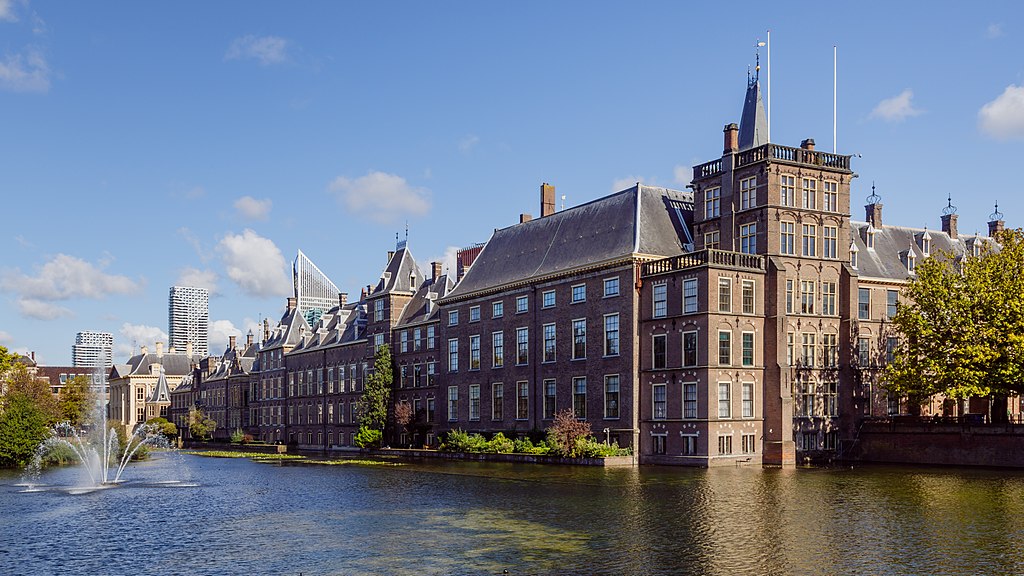
Fancy folks have been strolling around Hofvijver for centuries. Image: Nationaal Archief
Traditionally, the fancy folks living here wanted to build their houses on the best possible land they could find, which in this case meant dune soil.
That’s how the rich, snobbish elite of The Hague came to live mostly (if not only) on the sand ground. That is also how the city’s social divisions became strengthened and entrenched in its culture and geography.
So, if you find yourself living on sandy ground, chances are you’re a real Hagenaar.
TIP: If you walk through one of the fanciest parts of town, Lange Voorhout, you can see a statue of a typical Hagenaar (Dutch columnist Eduard Elias) just outside the Swiss embassy. Read the sign, and you’ll see it says: “I look around, and smile”, like the gentleman that he is.
Hagenezen: the real ones
You can probably foresee where we’re going next: to the Hagenezen, of course! And just like all other underdogs ever, the Hagenezen tend(ed) to view themselves as the “real” face of The Hague.
Markt, you can find the very image of the Haagenes: Haagse Harry. Image: Pixabay
With their houses built on the unstable peat soil, the less fortunate of The Hague’s inhabitants had to settle for the second best.
Typically portrayed as poor-ish, working class, down-to-earth folks, the Hagenezen are just as big of a part of The Hague as the rich and political upper class.
Imagine white tennis socks in sandals, biertje in hand, chilling in a rusty camping chair, and naturally, rocking the infamous The Hague Mullet.
TIP: If you walk through one of the historically less fancy parts of town, to the Grote Markt, you can see a statue of a typical Hagenees: Haagse Harry. Take a peek around to the back of the sculpture for a vulgar surprise … 👀
The Hague today
Today, the explanation of how people from The Hague got their names can (according to some) mostly be reflected in the city’s flag.
You’ll spot many flags in The Hague. Image: Dreamstime
Some say the yellow colour represents the sand of the dunes, and the green represents the peat soil — binding together both parts of the divided city.
When it comes to the actual names, it might be a relief to hear that most people don’t care very much about the labels anymore (just in case you were about to go into an existential crisis over which name you should take on).
A slightly newer interpretation of the two names is characterised by the international nature of The Hague: Hagenezen are the people born and raised in the city, and the Hagenaars are the ones who only moved there later on.
In the end, The Hague still has a distinct divide between the internationally oriented, well-off, highbrow political elite in the fancy areas of town (you know where we’re talking about) and the slightly less fancy-schmancy folks.
Revolut is now running a limited-time promotion, offering new customers a whopping 3.10% annual interest on its Instant Access Savings.
If your savings are sitting like a chunk of lead in a Dutch savings account, barely earning you any interest, you’re not alone. Most of us mean to “sort out” our savings with a better rate eventually, but life gets in the way, and that never happens.
And that’s the beauty of Revolut’s Instant Access Savings: there’s very little to sort out. You just open an account, add some money, and your high interest applies.
Right now, new customers are eligible for an even higher rate than Revolut’s 2.5% max. Here’s what to know about the bank’s 3.10% promo rate, eligibility requirements, and the sign-up process.
First things first: what’s Revolut actually offering me?
Between June 12 and August 9, 2026, new Revolut customers who open a personal Instant Access Savings account get a promo rate of 3.10% per year, with interest paid out daily.
Should you take up the offer, your boosted rate will run all the way to October 9, 2026. After this, your rate will revert to the basic rate for your plan.
Just open an account, add some money, and let Revolut do the rest. Image: Magnific
Rates and dates aside, what’s quite welcome about the offer is that you needn’t plonk down a huge sum upfront. Revolut’s Instant Access Savings have no minimum savings limit — whether you’re planning to add €10 or €10,000, your money earns interest from the day it’s deposited.
Plus, topping up is flexible, too. You can add money manually, schedule recurring transfers for payday, or switch on round-ups, which round each purchase up to the nearest euro and save the difference.
However, let op: the 3.10% rate only applies to new customers. If you opened an account before June 12, 2026, you unfortunately won’t be eligible for this limited-time promo rate.
In addition to this, the promo rate only applies to balances up to €25,000. If you’re depositing any amount over that, Revolut notes that you’ll be paid a “blended rate”, somewhere between 3.10% and the standard rate applicable to your plan.
What does “Instant Access Savings” mean?
In the Netherlands, accessing high-interest savings accounts often involves giving up a great deal of flexibility.
For example, fixed-term deposits (or termijndeposito’s) lock your cash away for a set term — usually a minimum of a few months, to a maximum of several years. Withdrawing those funds early means you’ll forfeit the interest you would have earned for the full term.
Refreshingly, Revolut doesn’t work that way. You can add funds to your savings (or withdraw) whenever you please, with no penalty for dipping into your stash.
That makes it a solid, no-fuss option for growing your savings, with rates you’d typically only access from a fixed-term deposit. And, with the cost of living on the rise in the Netherlands, it’s always a smart idea to set some funds aside for a rainy day.
What happens to my rate when Revolut’s promo ends?
If, like us, you hate having to transfer funds to and from different accounts… good news! You don’t have to move a muscle.
You’ll keep earning interest once the promo wraps up, just at a lower, standard rate.
On the Standard, Plus, and Premium plans, that’s 2% per year on your first €2,500 (and 1.5% on any balance above this). Across all plans, standard rates run between 1% and 2.5% a year, depending on which one you’re on.
You’ll keep earning money after the promotion ends as well. Image: Magnific
Needless to say, this isn’t going to be a life-changing amount of money. However, with skyrocketing Dutch energy bills, it’s money most of us would prefer not to leave on the table.
Here’s how to get your 3.10%
Keen as a bean to get some extra cash in your savings? The boosted rate is open to all new Revolut customers who open a personal Instant Access Savings account during the promo window.
The process is simple and can be done entirely on your mobile phone.
First, you’ll need to open a Revolut bank account. To do so, you’ll need to be 18 or over, with valid residency in the Netherlands. During the sign-up, you’ll be asked for certain details, including:
your mobile number,
email address,
and government-issued ID (such as a passport, driving licence, or residence permit).
Once you’re verified, it’s smooth sailing. Just open an Instant Access Savings account inside the Revolut app before August 9, 2026, and add your funds.
The promo rate applies as soon as cash lands in your savings account, and you can top up or withdraw at any time.
The United States wants to dismantle the International Criminal Court in The Hague, and this time it says it is willing to go further than ever before.
That is the message from US Secretary of State Marco Rubio, who used a Wall Street Journal opinion piece and a video on X to announce a campaign against the court, known as the ICC.
The Dutch government has responded with concern, but some experts say concern alone is not enough.
So what exactly does the US want?
The ICC, based in The Hague, can prosecute people anywhere in the world for war crimes, crimes against humanity, and genocide.
In his opinion piece, Rubio wrote that the US would take the court apart brick by brick if necessary, according to NOS.
He framed the court as an attack on the US, saying America is being targeted not with bullets, but with so called international law.
According to Reuters, the options being weighed include travel bans and visa suspensions for ICC staff, plus pressure on other countries to abandon the court altogether.
Rubio struck the same tone in a video message posted to X:
The International Criminal Court seeks to become the unaccountable arbiter of a new global law — empowered to prosecute and arrest our citizens at will and existentially threaten American sovereignty.
Why is the US so bothered by a court it never joined?
The US has never been a member of the ICC. Even so, Americans can still be prosecuted for crimes committed in the 125 countries that are members.
That is exactly the sticking point, according to Alette Smeulers, professor of international crimes at the University of Groningen. She says the US essentially wants a free pass to break international law in countries that have signed up.
The criticism itself is nothing new, she notes, but the country is now going further with a certain shamelessness.
Where did this fight come from?
The bad blood goes back years. The Trump administration was furious when the ICC issued an arrest warrant against Israeli prime minister Netanyahu over the Israeli warcrimes in Gaza.
Not long after returning to the White House last year, Trump lashed out at what he called the court’s baseless actions against America and its ally Israel. He then imposed a range of sanctions on ICC judges.
Smeulers calls that an upsidedown situation. Sanctions like these are normally aimed at terrorists, she says, and are now being used against judges instead.
What is the Netherlands saying?
The Netherlands is both the ICC host country and a treaty member, and its foreign ministry says it stands behind the court and its staff. Independent international courts, it says, must be able to do their work without obstruction.
As host nation and State Party, the Netherlands stands behind the International Criminal Court and its staff. International courts must be able to carry out their mandate without interference.
The European Commission also condemned the American attacks, calling threats against court officials unacceptable and describing the ICC as a cornerstone of the international justice system.
Is the Netherlands actually doing enough?
Warm words are one thing, but concrete action is another, and critics say the Netherlands is doing very little to actually protect the court on its own soil.
International criminal lawyer Tamara Buruma says the Netherlands, as host country, has a duty to defend the ICC. She argues the Dutch government could push within the EU for a so-called blocking law, as reported by BNR.
Such a law would mean US sanctions do not apply inside Europe. Right now, American companies operating in Europe have to follow two legal systems at once.
A blocking law would stop a firm like Mastercard from being forced to freeze someone’s bank account because of US rules, since European law would protect the company instead.
What happens if it works?
The stakes reach beyond any single arrest warrant. ICC rulings help national judges in countries like the Netherlands, Germany, and Sweden approach cases from a shared starting point, Buruma explains.
The worry is that if the US peels enough countries away, the court loses its authority. Last week, three African countries announced they would formally withdraw from the ICC.
Buruma thinks the American anger is telling. If the US is not even a member, why worry so much about the court? Her reading is that they are afraid of an institution they still quietly respect.
Do you think the Netherlands should do more to defend the ICC, or is quiet diplomacy the smarter play? Let us know in the comments.
Driving lessons can be pricey, but apparently the Netherlands has an alternate payment plan available: a ride for a ride.
In a country where prostitution is legal, it shouldn’t come as a shock that driving instructors are allowed to accept sex as payment for driving lessons.
Now, don’t go offering yourself up on a silver platter to any old driving instructor, because it’s only legal if it’s the instructor’s idea.
Like, really the Netherlands? That’s taking progressiveness to a whole new level.
A legal ride for a ride
In 2015, the Dutch government confirmed that this type of transaction was legal, when Gert-Jan Segers of the Christian Union (CU) party, tabled a question in parliament, reports CNN.
While prostitution in the Netherlands is legal, certain qualifiers need to be met to keep it legal.
One of them is having an escort license. Segers argued that any driving student would not have such a license making a situation like this “illegal prostitution”.
However, then Dutch Minister of Infrastructure and Environment, Melanie Schultz van Haegen, and then Dutch Minister of Security and Justice Ard van der Steur, said that “a ride for a ride” is not against the law.
Netherlands is a good country. I can smoke weed and offer driving lessons for sex. WOW.
Basically, if the driving student proposes sexual acts in return for lessons, then the transaction is illegal.
However, if both parties are over 18 and the instructor suggests it, then it’s completely legal. Uhmmm… are we the only ones who would find that beyond bizarre? 😳
It certainly makes a good point to ask your driving instructor how they would like to be paid before lessons start.
So does it really happen?
Alright, you might be reading this thinking, “Hey, it’s legal, but it doesn’t really happen, right?”
Wrong.
On an online Dutch sex marketplace (that we had to access for research, please tell our company’s WiFi administrators! 👀), there are ads from driving instructors offering a ‘service’.
On the website, tens of driving instructors are offering their knowledge in exchange for… well, you know. 😉
Entirely problematic
Needless to say, this has created problems. In 2020, a 23-year-old driving instructor was arrested after having sex with a minor, reports Hart van Nederland.
To stop this, the trade association has spent years pushing driving instructors to have to provide a Statement of Good Conduct (VOG) before being admitted to the protected profession.
“Today, you can take driving lessons from the age of 16.5. You want to know who you entrust your child to,” said Paul de Waal of the trade association BOVAG at the time.
“You also have to deal with an unbalanced power ratio and you sit one on one in a car with the instructor. That makes it vulnerable and a dependency relationship.”
What do you think of driving instructors accepting sexual acts as payment? Tell us in the comments!

A single Microsoft data centre in Noord-Holland gobbled up roughly 1% of all the electricity used in the Netherlands last year, newly published government figures reveal.
That figure comes from the RVO (Netherlands Enterprise Agency), the government body that hands out permits and subsidies to businesses.
The agency now keeps tabs on power-hungry warehouses full of servers too. And for the first time, we can see in black and white how much juice one of these giants draws.
So how much power are we talking about?
Picture a cluster of connected sheds along the A7 motorway, near the village of Middenmeer. Last year that one site burned through 1.17 terawatt hours of electricity.
The whole of the Netherlands got through a little over 112 TWh in 2025, based on preliminary CBS (Statistics Netherlands) figures reported by NOS. Meaning, this one data centre accounts for roughly 1% of the national total.
However, Microsoft isn’t the only giant with data centres in the Netherlands. In fact, it’s not even the largest.
Why can we see Microsoft’s number but not Google’s?
Google runs two enormous data centres here, one near Middenmeer and one in the Eemshaven up in Groningen. However, it refuses to publish what they use.
A Google spokesperson tells the NRC that the company treats the power draw of individual sites as competitively sensitive information it would rather keep to itself.
For years, the Netherlands had no idea how much these places consumed, because operators simply kept the numbers quiet.
But a European rule has cracked that open. Since 2024, the EED (Energy Efficiency Directive) requires data centre operators to be upfront about their energy and water use.
Microsoft is the first big American player to actually disclose meaningful details, which is why we know its number and not Google’s.
Guzzling more and more power
What we do know, however, is that data centres already made up 4.6% of national electricity use in 2024, according to CBS. Grid operators expect that to climb towards 15% by 2030.
The Netherlands is already running out of room on its electricity network, a problem known as netcongestie (grid congestion).
Every megawatt handed to a server hall is one that can’t go to a new home or business.
Do you reckon the Netherlands should cap how much power these data centres can guzzle, or is this just the price of the internet age? Tell us in the comments.
So, you just moved to the Netherlands. Congratulations! Be prepared to be confused.
Navigating the, erm, labyrinth, that is, the world of the Dutch can be difficult. So many new words, new places, and new people offer ample opportunity for moments where you just have to say, “Wait, what??”
Here are just a few surprising things you might notice during your first week in the Netherlands — and the explanations behind them!
1. Public transport is a maze — so get your maps (and wallets!) out
One thing anyone new to a country might notice is the public transport. Whether it’s the bus, tram, train, or metro, you’re going to need two very essential things: tickets and cards.
In the Netherlands, the public transport system can seem very confusing to newcomers.
There are multiple carriers for the different modes of transport, and sometimes it feels like the number of different tickets, cards, and prices would make your head explode. 🤯
With so many options, it can be hard to choose the best way to get around! Image: Depositphotos
The cost of public transport can also seem extortionate to many internationals.
For most, a return day train ticket can cost up to €20, while a 90-minute fare ticket for bus and tram services can cost €6.50. Money better spent in places such as coffeeshops and vintage stores, we think. 👀
Also, it’ll take a while to figure out which exit to take
Another really fun (!) aspect of Dutch transport, and Dutch trains specifically, is how large the train stations are. As a newcomer, you might find it impossible to navigate them.
Most of the larger stations have multiple exits, one leading in towards the city and the other leading out of the city.
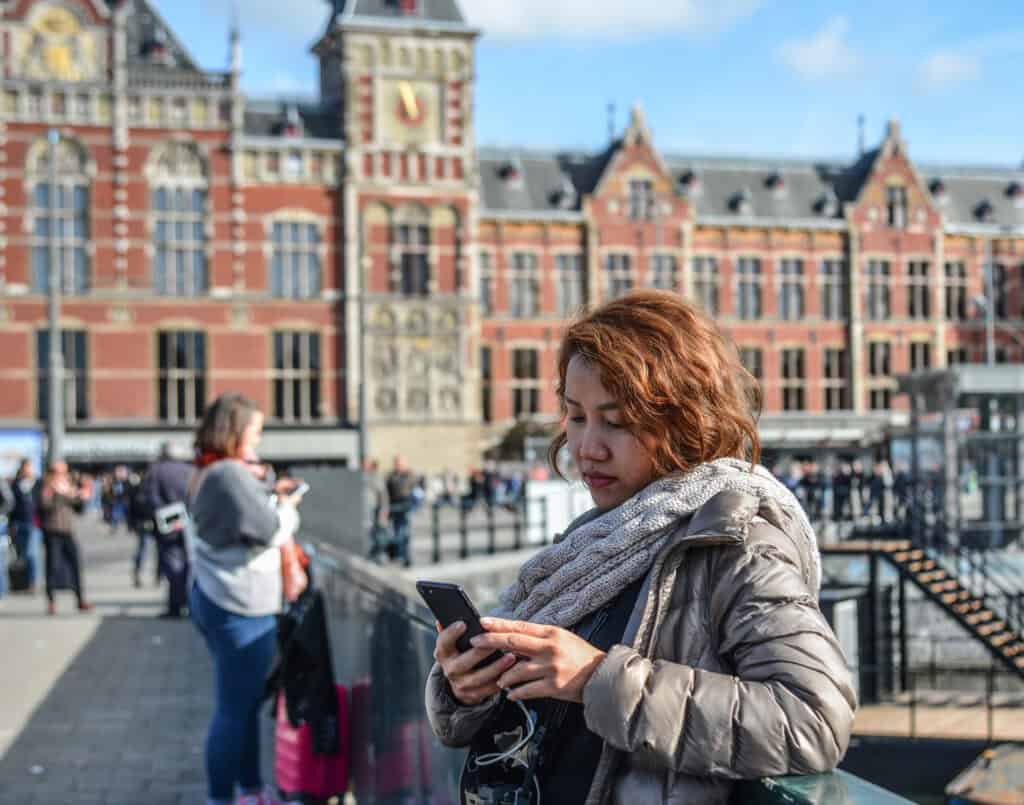
In such a big station, it’s understandable to get lost in Amsterdam Centraal. Image: Despositphotos
So, if you find yourself spinning in circles trying to get your Google Maps to align, maybe check to see if you’ve taken the correct exit!
2. Bathroom out on display? Yep. That’s a public urinal
Picture this: it’s your first week in the wonderful city of Amsterdam. Fresh out of the chaos that is Schiphol airport, you’re enjoying the sights, the wonderful canals, and the hordes of tourists until you smell something a bit… off.
Don’t be shocked because what you’re looking at (and smelling) is a public urinal. Gross! 🤢
Due to the high charges for using public bathrooms in the Netherlands, where most are charged a fee of €1 per use, a solution to the rogue-peeing issues has been to install public urinals.
And, if you’re a tourist who happens to be under the influence in Amsterdam, maybe you might misidentify public urinals as water fountains (thankfully, we’ve never actually heard of that happening). 😅
A common public urinal in Amsterdam. Image: Depositphotos
Previously, Amsterdam has attempted to prevent tourists and locals alike from publically urinating by installing hemp urinals.
You might notice that lots of buildings and alleyways in Amsterdam have odd curves to them — these oddly curved buildings are built to pee back, so watch out! 💦
Public urinals are a saving grace for the people who can use them, but for those of us who need to crouch, the challenge is finding somewhere to go. 😬
Perhaps you could try asking a friendly Amsterdammer? Otherwise, prepare a purse of euro coins to keep yourself in the clear.
3. You came to get high, but you’re leaving low
It’s your first week in the Netherlands, and the prospect of getting high is seeming more and more appealing.
But, you’re out and about, and you’re noticing something; there are not very many Dutch people in the coffeeshops.
On top of that, you’re getting odd looks for the suspicious lollipop you’ve been sucking on while walking down the street. 🙄
It might be a shock, but Dutch attitudes towards drug use might not be what you expect. In fact, it’s very much a tourist activity to even partake in it at all.
Don’t expect to get many happy looks for smoking on the streets of Amsterdam. Image: Magnific
Less than 25% of Dutch people smoke. So, don’t expect to make many Dutch friends when high.
Do, however, expect to find yourself clinging to the ground in Amsterdam for fear of falling into the canals because you made the rookie mistake of splitting the high-strength stuff with your bestie.
Note: Beware of edibles outside of Amsterdam; they’re a lot stronger and might leave you in a bit of a state for a while afterwards. (No, we haven’t learned from experience. Thank you.)
4. Cities in the Netherlands are so close!
If you’re new to the Netherlands, you might not have realised just how compact (and flat!) the country is.
You can easily get from one major city to another, usually in just under an hour — and sometimes less. (Especially if you’re living within the Randstad.)
The Randstad has some of the Netherlands’ most iconic cities, such as Amsterdam, The Hague, and Haarlem. Image: Depositphotos
For example, if you were looking to make a quick trip from Amsterdam to Rotterdam for the day, you can get there in a speedy 39 minutes.
Or, you could go to Eindhoven and almost cover the distance of the entire country in less than an hour and a half!
Though to us newcomers, the distance seems negligible, for most Dutchies, a trip from Amsterdam to Utrecht might seem like a long journey.
That being said, it’s not unusual for Dutch people to work in cities other than where they live due to the frequency of transport between cities. It’s just a hop, skip, and a jump from home to office, if you think about it! 🦘
5. What’s a BSN, and why do I need it for everything!?!
One thing you’ll soon realise about life in the Netherlands — you’re going to need some very important numbers. They’re attached to three letters: BSN.
What is a BSN? A Citizen Service Number (BSN) is a unique personal number used to register every citizen in the Netherlands in the Personal Records Database (BRP).
For you to do most things in the Netherlands, such as being paid or signing up for a job, you’re going to need a BSN.
/image
The good thing is you’ll automatically get a BSN once you register at your local municipality. But, if you’re staying for less than four months, you can also register for a temporary BSN and still be able to get a job. Hip-hip-hooray! 🥂
6. Help! My card won’t work
Ah, yes, the quite universal experience of heading to your local Dirk, doing your weekly bout of shopping, only to realise, verdorie! (gosh darn it!), My card’s been declined!
There’s nothing more humiliating than your card being declined. Image: Depositphotos
The unfortunate thing for lots of us internationals is that many Dutch stores don’t accept Visa or Mastercard, only Maestro. Which means many of us are left surprisingly stranded and ashamed at the till.
However, it’s fairly easy to get a Dutch bank account and, therefore, a usable card if you are moving over. 🎉
But, if you’re stuck in the danger zone (AKA that in-between moment when you haven’t quite gotten around to getting a bank account just yet), some places still accept cash.
7. You’re getting stared at in the queue — why?
You’re wearing your favourite bright red puffer jacket, holding a litany of post-work snacks and a cheap mug you found on a discount, and you notice you’re getting odd looks.
Roughly translated, the phrase means ‘act normal’ and perfectly encapsulates the Dutch attitude of staying part of the crowd and not sticking out.
Try not to stick out like a sore thumb in Dutch society. Being average and humble is the respected thing, rather than being a show-off with your red puffa. 💁♀️
8. And now you’re being looked at weirdly for strolling into a restaurant
Another aspect of Dutch culture and attitudes is strict adherence to their agendas — basically, everything is planned!
It’s very common for Dutch people to call ahead and book a restaurant for a meal out rather than just walking in because they feel a bit peckish.
Lots of Dutchie’s will have an agenda they stick to and will have made advance plans to hang with friends and eat.
This can be unusual for many internationals, who might have come from cultures where the norm is to stroll in, no previous plan needed! And if you do, you can expect some confused frowning at you and the restaurant’s agenda.
9. Wall food? Food from a wall?
So, you’re walking down the streets of Amsterdam. You’re a little peckish, and you’re on the lookout for food places.
Well, that, our dear friends, is a food wall! And trust us, it will become your best friend eventually.
Our friends at FEBO are a great example of food walls in the Netherlands. Image: Depositphotos
A very Dutch conception, the food wall is a brilliant invention for nights out. You can simply buy your meal from one of the little windows in the wall, usually paid for by card (but, again, be careful if you don’t have a Dutch bank account!).
But if the wall makes you a little shy, you can always go up to the counter inside and order directly there.
Otherwise, it’s a great idea for us introverts who’d like to avoid as much social interaction as possible. 😍
10. Cycling isn’t all you think it is
Now, there you are in the Netherlands, your brand-new bike in hand. You’re ready to hop on, have a lovely cycle around the major Dutch cities, and generally have a good time.
Haha. No. Not-a-happening, boys, girls, and thems. 🙅♂️
When cycling your bike around the Netherlands, the first few tries will most likely start full of excitement but quickly descend into chaos, panic, and overwhelming frustration.
Cycling in Amsterdam may not be the relaxing activity you expect. Image: Pixabay
Firstly, you made the mistake of bringing a bike helmet, but you don’t have a bell on your bike — rookie mistake.
Secondly, there are so many rules when riding a bike. There are many things you can be fined for doing while cycling, such as using your phone or not indicating the direction you’re going to turn.
Plus, cycling in the Netherlands can be a dangerous game. In 2021, 207 people were involved in fatal crashes on their bikes, and the bike was the most dangerous form of transport for that year. Unfortunately, it’s not all relaxing cycles!
That being said, your first week in the Netherlands won’t be all doom and gloom. With endless things to offer, you’ll soon be familiar with all things Dutch, such as having weird birthday traditions or carrying emergency snacks.
What are some things you noticed during your first week living in the Netherlands? Tell us below!