Home Blog Page 379

7 innovative Dutch projects for a sustainable future

0

When you think of innovation, do the Dutch come to your mind? With inventions like mobile apps that can detect skin cancer, to bicycles that purify the air around them, we wouldn’t be surprised if you answered yes to that question.

But what if we ask you about innovative sustainable development? Do the Dutch come to your mind, then? If not, let us change your outlook with these handpicked seven Dutch projects you may or may not have heard of!

The Dutch are innovative — but are they sustainable?

Right now, everyone would agree that combating climate change needs to be prioritised high. Every year, people turn up for climate strikes in The Hague and Amsterdam and a lot more people are becoming aware of climate change and its effects.

Of course, we can all take steps individually but to truly slow it down (reversing it is out of the question for now), we need large-scale change that has to come from the top.

READ MORE | How do the Dutch feel about climate change?

So, where do the Dutch rank on the sustainability front? As the fifth richest country in Europe, and a continual front-runner on happiness indexes, you would expect the Netherlands would also rank highly on the sustainability index. However, that’s not always the case.

In 2014, CBS, the national statistics office, showed that only 5.5% of all the energy used comes from renewable sources. A report from the Netherlands Environmental Assessment Agency in 2017 also showed us that the country’s then climate policies were not adequate to reach its targets according to the Paris Accord.

However, since then, climate policies and lobbying have frequently come up on the political agenda. And thus, the Dutch Climate Agreement was born. It has set out (ambitious) goals to reduce “the Netherlands’ greenhouse gas emissions by 49% by 2030, compared to 1990 levels”.

READ MORE | 13 forward-thinking things Dutch people do

Needless to say, thinking of ways to combat the climate crisis is high on the Dutch agenda. So will their ambitious goals be met? That is certainly up for debate. Environmental agencies like Greenpeace and Milieudefensie are very sceptical of the Dutch government’s plans and describe them as too vague. However, they’re still making valiant efforts.

Alright, there’s room for improvement — so what’s next?

Let’s look at a few of the innovative projects for sustainable development that are picking up the slack!

From creating hemp houses which could possibly be a solution to the housing crisis to manufacturing fake meat which looks and tastes like the real thing, here are our picks for seven incredible projects the Dutchies have been working on!

How high can you go? The first prefab hemp house was built in the Netherlands!

The Dutch and innovative use of cannabis — they might not be the first or the only ones, but they are doing it well! The Dun Agro Hemp Group has come up with a way to use hemp to make a prefab for a hemp house. They claim this to be sturdier than traditional building materials (being able to withstand earthquakes), and more affordable!

They make the houses using hemp to make “hempcrete”. It’s a strain of cannabis that is a whole lot tougher than we thought. It’s already used to make other things like clothes and biofuel, so why not a whole house?

It is also a “carbon-negative” material: it absorbs 13,500 kilograms of CO2 while it grows, and does not emit even close to that number back into the atmosphere! This CO2 that is built up in the plant is then used to make the hempcrete. This would be sustainable development at its finest if these houses are made on a large scale.

But sorry to disappoint anyone who thought they could get a lifetime supply of weed — there’s no tetrahydrocannabinol (THC) in hemp, the element in cannabis that gets you high. So how high can you actually go? Not that high, I’m afraid.

Food Valley in the Netherlands is trying to find ways to feed 11 billion people

If you haven’t heard about Food Valley, then get reading! It is a collective that is established in the university town of Wageningen that is working towards the ambitious goal of providing “food-related solutions” to end the food crisis and help combat climate change.

Over 8000 scientists and 1800 agrifood companies have come together to work on multiple projects like creating fake meat which looks and tastes like the real thing, bringing insect-based diets into the mainstream, genome mapping, and more. We’ve got the scoop on how Food Valley is innovating food-growing, or you can check out their website!

The Netherlands is home to the largest and most powerful offshore wind turbine in the world

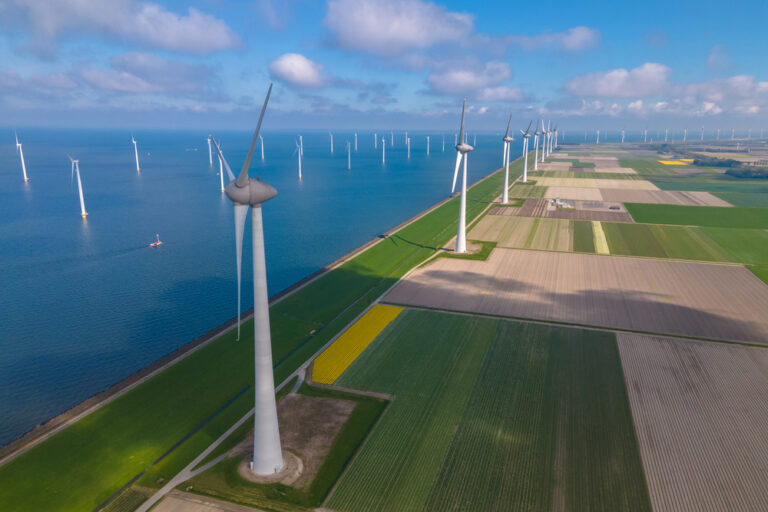
The world’s largest and most powerful offshore wind turbine has been installed in Rotterdam and is being tested out until 2024, after which it’ll go into 15 years of regular service. The Haliade-X 12 MW is designed to be set up at sea, where the winds are stronger and blows more often.

In general, larger wind turbines create higher energy at lower costs as compared to the ones that are extensively used right now. This testing period will also help TNO research on how to build more of these large turbines.

Innovative Dutch projects: Is that a bus stop? Nope, that’s a bee stop!

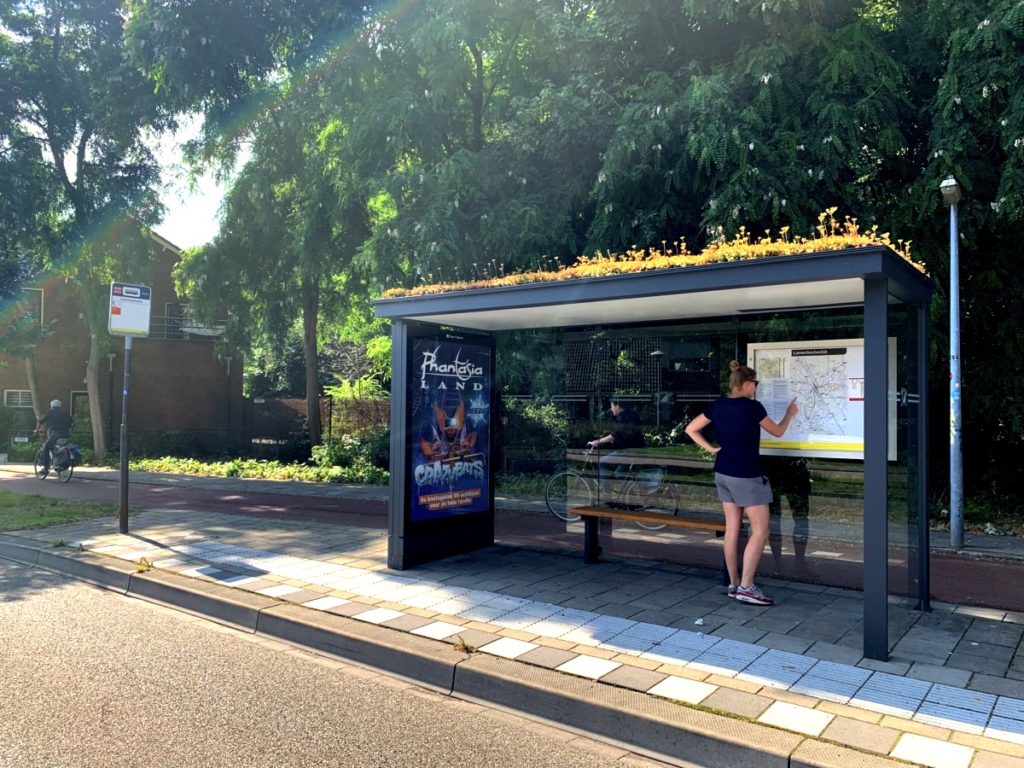
Utrecht city turned 316 bus stops into something a whole lot more special — they made the roofs of the bus stops green so that bees can find a cosy temporary home while they’re busy making their pollination rounds. The roofs have been planted with wildflowers and grass so that different kinds of bees will be attracted.

READ MORE | Bee-ing happy: how the Netherlands keeps its buzz

They might sting, but they’re an integral part of the ecosystem so feign your fear here, folks! Because these roofs are not just for them, but for you too — they store rainwater, catch some fine dust, and helps in cooling down the bus shelter.
green-bus-stops-for-bees-dutch-sustainable-innovations
Bus stops in Utrecht are saving the bees! Image: Samantha Dixon/Supplied

The world’s most sustainable building: the Rhenus warehouse

Could a warehouse distribution centre ever be newsworthy? This one sure can!

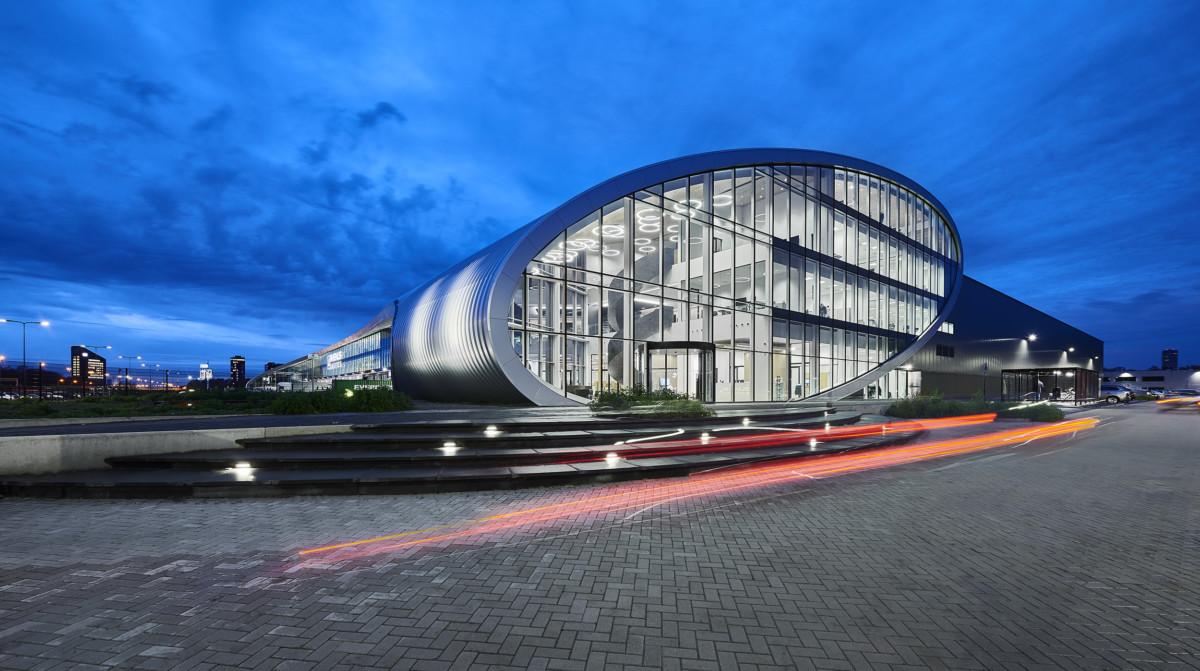
The Rhenus warehouse building in Tilburg opened in 2019 and could be the most sustainable building in the world. It has 13,000 solar panels on the roof to power the centre, and large triple-glazed windows, they use rainwater to flush the toilets and are attempting to re-establish the local flora through landscape design.

This warehouse will act as a distribution centre for Rhenus logistics and is located at ‘Het Laar’, the industrial area in Tilburg.
rhenus-warehouse-in-tilburg-sustainable-dutch-innovations
Who knew a warehouse could look so cool! Image: Rhenus B.V./Supplied

Solar-powered bus station? Yep, that’s an innovative Dutch project too!

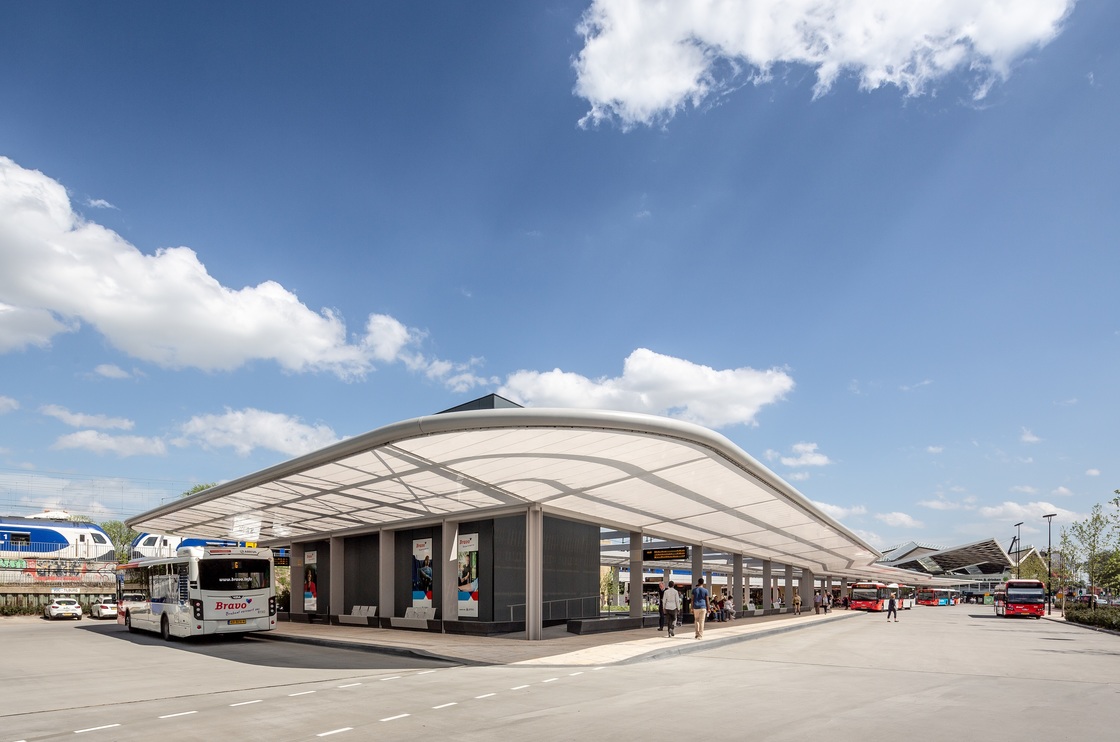
Apparently, transforming bus stations is where it’s at in the Netherlands! This one is a completely solar-powered bus station in the city of Tilburg. It’s an architectural marvel to behold as well.

Built by Cepezed Architects, they went for a more minimalistic design with a triangular shape and open space in the middle. It also has an awning covering it to protect you from the harmful UV rays emitted by the sun. The solar panels, which span 250 m2, are placed on top of this awning.
solar-powered-bus-station-Tilburg-dustainable-dutch-innovations
Innovative Dutch projects: a completely solar-powered bus station in Tilburg. Image: Lucas van der Wee/cepezed/Supplied

They have solar-powered train stations too!

There’s something about the Dutch, solar energy (even though it’s cloudy and raining all the time), and public transport stations. Their very first solar-powered train station is in Delft.

They started constructing this in January 2019, and is scheduled to be finished by next year. They will be transforming Delft Zuid into Delft Campus.

It will cost a total of 2.4 million euros, of which 1.8 million euros will be funded by the municipality of Delft. The national government will be investing the rest of the money.
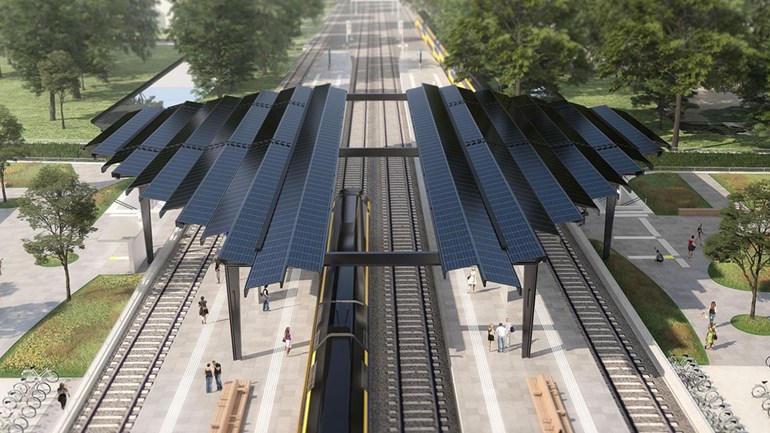
solar-powered train station at delft zuid
First fully solar-powered train station at Delft Zuid. Image: ProRail

Lots of exciting innovative Dutch projects happening in the Netherlands! As you can see, they are not yet implemented on a larger scale.

What do you think the Dutch government can do? Are there any projects you’d like to see added to this list? Tell us in the comments below!

Editor’s Note: This article was originally published in September 2019, but was fully updated in October 2022 for your reading pleasure.
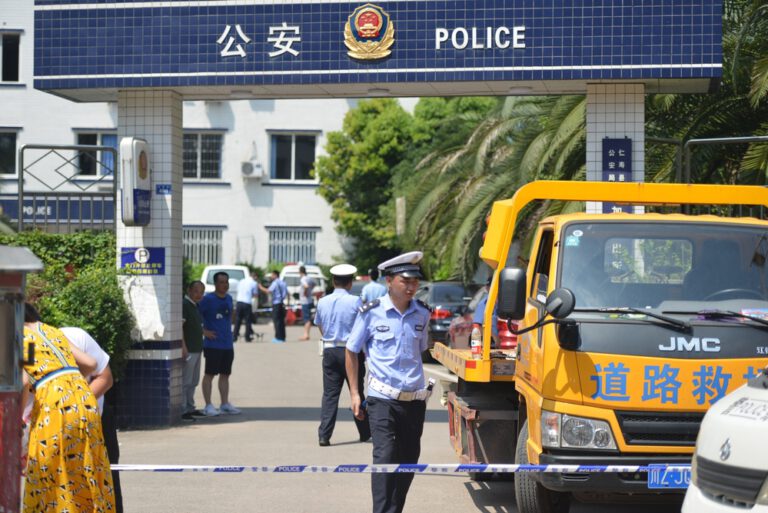

Turns out China has illegal police stations in the Netherlands

At least two Chinese police forces have been illegally active in both Rotterdam and Amsterdam since 2018.

As China failed to inform the Dutch government about the existence of the police stations, they acted against the law. As a result, they were ordered to shut both precincts down effective immediately.

Why do these exist? The cabinet doesn’t know

“The cabinet must get to the bottom of this, call the Chinese ambassador to account and close these outposts. This is yet another example of how China is infiltrating the Netherlands”, Dutch politician, Ruben Brekelmans, tells RTL Nieuws.

Recent investigation revealed…

Those with Dutch-Chinese nationality are allowed to go to the police stations for administrative matters, such as renewing their driver’s licenses.

However, a recent investigation uncovered that the two police forces are collecting information and putting pressure on Chinese folks who currently reside in the Netherlands.

READ MORE | Burglar tries to steal from Dutch-Chinese restaurant; gets stuck in elevator overnight

“Now that it is clear that these two secret police stations operate illegally here, we can hardly wait a day. These activities must be stopped as soon as possible, and the stations must be closed,” Dutch politician of the D66 party, Sjoerd Sjoerdsma, tells RTL Nieuws.

China’s attempt to seep into Dutch soil

Currently, there are about 36 Chinese police stations across Europe. Two of them have been active in the Netherlands, and most of the employees are ex-servicemen and former staff members of intelligence services, writes NU.nl.

For some time now, there have been indications of illegal activity taking place behind the stations’ closed doors — the main one being that they’re used to threaten Chinese refugees in the Netherlands.  

READ MORE | Lost in translation: a hilarious history of Chinese porcelain in the Netherlands

“It is really completely unacceptable that the Chinese government thinks that they can secretly intimidate dissidents here and also get away with it. This shows that Beijing’s long arm is much longer than we feared,” Sjoerdsma tells RTL Nieuws.

“China is trying to let Chinese laws speak here on Dutch soil. That is really an extremely undesirable form of interference. We must not give them an inch.”

What do you think about this situation? Tell us in the comments below! 👇

Climate activist glues himself to the table during popular Dutch TV show

What’s the newest trend, you ask? Well, climate activists have the answers; glueing oneself to walls (and now tables!) 

Following the footsteps of two activists who recently threw a can of soup a Vincent Van Gogh painting, and then proceeded to glue themselves to the wall of the museum, climate activist Jelle de Graaf glued himself to the table of the popular Dutch program, Jinek, reports RTL Nieuws.  

People are dying, Beau

During the show, the environmental activist, who is from Extinction Rebellion, climbed onto the table and glued the palms of his hands to the wood. 

READ MORE | 175 arrests made during Extinction Rebellion protest in Rotterdam

Once safely and securely glued to the table, he began to speak about his cause. “I’m stuck here on a live program, and I’m going to talk about the climate and the ecological crisis,” De Graaf said. 

Translation: Activist Jelle de Graaf sticks to #jinek.

Extinction Rebellion is a cause that hopes to prevent further climate change, or at least, garner the attention of those important enough to do something about it.

De Graaf accuses the RTL show of not fulfilling its duty of reporting honestly about the climate crisis. 

READ MORE | The easy guide to the Dutch nitrogen crisis, farmers’ protests, and more

His planned course of action? To glue himself to the table, of course! 

And, much like in the words of our beloved Kim Kardashian when she lost her diamond earring, de Graaf said; “People are dying, and you’re talking about Donald Duck.” 

Glue slid right off

The good news for the Jinek program is that once De Graaf was escorted off the set (while still stuck to the table), his glue quickly dislodged, and he was able to jump right off the prop. 

Once off the set, Beau asked audience members what they thought of his stunt, one viewer saying, “this is necessary to keep the conversation going. Having a conversation at the table is possible, but I think people will remember the content less.” 

But why bother?

In the same way that it feels ridiculous to throw soup at a painting in the hopes of spreading the word about fossil fuel issues, it feels doubly ridiculous to glue oneself to a table on a tv show and then talk about climate change. 

Translation: How it ended with glued Jelle at #Jinek #Beau (during the commercial).
The glue wasn’t that strong… 😬

But, the major thing that actions such as these do is get a conversation going. 

We’ll be loling about de Graaf’s Donald the Duck comment for the next few days — but it’s also true. Real people are being affected by the climate change crisis. 

By making a bit of a fool of himself on national television, now Dutch (and international) people across the country will be talking about his stunt, debating whether it was a good decision or not, and finally, thinking about the cause that he was protesting for. 

At the end of the day, all media is good media, as they say! 😉

What do you think of de Graaf’s activism? Tell us your thoughts in a comment below! 👇

People are now throwing stones at NS trains (and it’s not exactly helpful)

0

A new hobby is on the horizon! People in the Netherlands are apparently passing the time by throwing stones at NS trains. 

On Tuesday, for the second time in a row, people were adding some light entertainment to their day by throwing stones at trains in Amsterdam. 

No injuries — but certainly some damage

There is no information about any physical injuries, but that can’t be said for the poor trains, several of which were damaged, NU.nl reports.

Yesterday at Lelylaan station, stones were thrown towards the track, damaging several trains that innocently journeyed through the station. 

READ MORE: Surprise, surprise! NS will operate fewer trains from November 7

On Monday, trains at Amsterdam Sloterdijk were the victims, with several trains being pelted with bricks (yes, bricks.)  

The reason? Who knows

The police have been notified about the total of eight damaged trains, and ProRail has promised to conduct extra surveillance in order to track down the perpetrator(s).

While the NS can’t pinpoint whether this is simply a new hobby for some very bored people, or an angry protest from some very angry commuters, one thing is for certain: 

The act is “perilously dangerous, frightening for the train driver, and it also confuses the train service,” ProRail director John Voppen tells NU.nl.

Whatever the reason, it must be important for the stone-throwers. If caught, the perpetrator(s) will have to cover the costs for the eight damaged trains.

Want the latest Dutch news to come zooming through the internet to your inbox? Dat kan! Subscribe to DutchReview’s weekly roundup 📮

Sorry Amsterdammers, public transport will be even more expensive in 2023

Public transport is already expensive in Amsterdam, but there will be almost an 8.5% increase in prices starting in 2023. 

If you don’t want to spend a fortune on metroing around Amsterdam, it’s time to develop an even more profound connection with your fiets. 

As fuel becomes more and more expensive, it is impossible to keep ticket prices at the current level, according to Het Parool. 

Why only in Amsterdam?

The basic rate for public transport in the Netherlands is determined nationally, so that’s only possible to change in the whole country all at once.

READ MORE: Living in Amsterdam: the ultimate guide to Amsterdam life

But in the capital (and in the surrounding areas), The Amsterdam Transport Region is the one who determines the price per kilometre — and they want to make some changes. 

On average, the rates in and around Amsterdam will become 8.5% more expensive. It might not sound a lot, but if your daily (let’s say €10) travel expenses are a euro more expensive (€10.85), at some point, you will recognize it. 

Problem solved? 

Remote workplaces are on the rise; fewer people are commuting to their workplaces daily. Most of Amsterdam is famous for being easily reachable by bike if you can manage without public transport. 

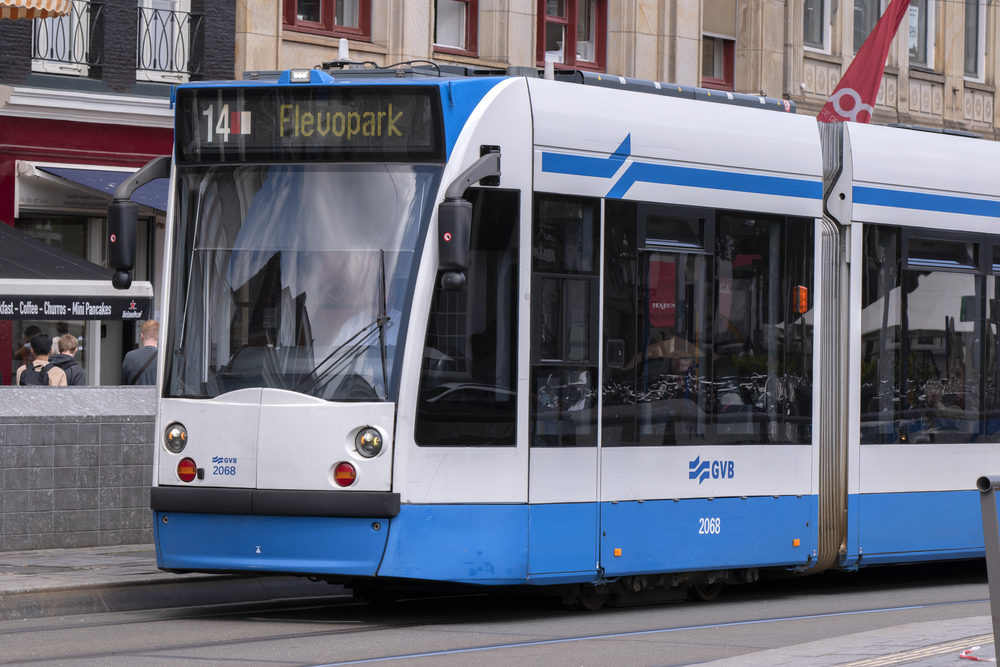
GVB-public-transport-tram
Voila! The (white?) carriage! Image: Depositphotos

What if, because of the high prices, fewer people will choose public transport in their daily travels? Is it possible to sustain the current system?

READ MORE: Public transport in the Netherlands: the complete guide

They hope the current measures will help the staff shortage issue, and Amsterdammers will still choose public transport over cars. 

‘Travellers will be somewhat compensated for the ever-increasing costs and will be positive about public transport. With this, we want to keep public transport attractive for the traveller as an alternative to the car‘, writes Transport Region in their new report.

Are you planning to use public transport in Amsterdam, or is it time to switch to your bike completely?

Where to live in Rotterdam: the ultimate guide to Rotterdam’s neighbourhoods

So you’ve made the decision to move to Rotterdam — the city with the biggest port in Europe, mind-blowing architecture, and overall the coolest place in the Netherlands (no, we’re not trying to sell it to you). 

A pioneer in sustainability, Rotterdam is unique in many ways. Having completely transformed its character after the German bombing of WWII, the city is typically described as modern and innovative, rather than typically Dutch.

However, don’t let yourself be misled by the glam of Rotterdam’s impressive high-rise skyline. 

The neighbourhoods of this multifaceted city have something for everyone  — whether you’re looking for a lively hip area or a quiet place with charming canals. So, where is the best place to snag yourself a home in Rotterdam?

Is living in the West the best?

The “west” refers to one of the most diverse areas of Rotterdam. Consisting of multiple smaller districts of diverse characters, the west is a popular place for young internationals to live.

Photo-of-Rotterdam-cityscape-from-above-showing-neighbourhoods-of-Rotterdam
Which Rotterdam neighbourhoods should you consider? Let’s talk about it. Image: Depositphotos

The Erasmus Medical Centre and the Rotterdam University of Applied Sciences are both located here, and the lively neighbourhood is well-connected with public transport. 

READ MORE | Moving to Rotterdam: what to know before making this futuristic Dutch city your home

Nieuwe Binnenweg —  the neighbourhood’s main street, which runs from the centrally located Westersingel all the way to Delfshaven — offers countless restaurants, cafés, bakeries, concept stores, barber shops, and more. 

Museumpark, on the other hand, is where you’ll find many of Rotterdam’s popular museums, such as Boijmans Van Beuningen, Kunsthal, or Het Nieuwe Instituut. Housing prices range from very cheap to very expensive, and sometimes the expensive one can be just a block away from the cheap option.

Delfshaven: the historic neighbourhood

If your heart desires typical Dutch architecture, charming canals, and quaint little streets, then Delfshaven is the neighbourhood for you.

photo-of-the-neighbourhood-of-delfshaven-Rotterdam
Want to live close to the charming canals of Delfshaven? Image: Unsplash

The area used to be a separate municipality until 1886, serving as the harbour for the nearby city of Delft. This is also where the name Delfshaven (“Port of Delft”) comes from. Spared in the German bombing of 1940, the neighbourhood has managed to retain the charm of traditional Dutch architecture. 

Delfshaven residents get to enjoy their own food market, which takes place every Thursday and Saturday at Markt Visserijplein. Housing in the area varies quite a bit, but you may be able to snatch an apartment with access to a rooftop terrace and enjoy the views of the nearby Euromast. 

Centrum: living in the city centre

Rotterdam is sometimes called the city without a heart. Why? Almost the entire historic city centre was destroyed in the German bombing on May 14, 1940. While the event definitely left its scar, it also gave Rotterdam’s city centre the opportunity to be reborn as a thriving hotspot with incredible architecture. 

photo-of-city-centre-rotterdam
The hustle and bustle of Rotterdam’s city centre. Image: Unsplash

Whether you’re looking for cafés, bars, restaurants, clubs, or fashion stores, you’ll find it here. The city centre is also home to most of Rotterdam’s famous landmarks, such as the Markthal, Cube Houses, the Grote of Sint-Laurenskerk, and Witte Huis.

If you wish to live close to Rotterdam’s nightlife and arts and culture, you can base yourself near the famous Witte de Withstraat.

READ MORE | Rotterdam Rooftop Walk is open! Here’s how to experience the city’s roofscape

The housing options range from modern residential complexes to incredible high-rise buildings with luxurious apartments, to apartments in quieter residential areas.

The city centre is the best place to live if you want to experience what Rotterdam’s restored heart brimming with activity has to offer. However, it is also (unsurprisingly) one of the priciest neighbourhoods to live in. 

Kralingen-Crooswijk: living in the best location

If you want to live in one of Rotterdam’s best-located neighbourhoods, you should definitely consider Kralingen. It’s situated right between the city centre and the main campus of Erasmus University, which makes it the perfect location for students and young professionals working for the university. 

photo-of-kralingse-plas-neighbourhood-in-Rotterdam
Kralingse Bos is a popular nature escape for the residents of Kralingen. Image: Unsplash

The most notable feature of this neighbourhood is undoubtedly the Kralingse Bos and Kralingse Plas — a place where Rotterdammers come to soak up some sunshine, enjoy a swim or a sail, or just savour a walk around the lake with some breathtaking views of the city.

Being home to many high-class residents, the housing prices in Kralingen are in the higher range. 

READ MORE | 20 best and free things to do in Rotterdam in 2022

Crooswijk is the less posh of the two. A place where you can still hear the ‘authentic’ Rotterdam accent, the neighbourhood has many faces.

With its affordable rental prices and central location, Crooswijk is a great choice for your first home in Rotterdam. 

Going Noord?

If you want to live right beside the central station, but not really in the city centre itself, Rotterdam Noord is probably the best option for you. Starting right at the back side of the train station, this neighbourhood is great for people who work outside of the city.

Its character changed immensely in the past ten years, transformed from a predominantly working-class neighbourhood to a design paradise. Hofbogen — a former railway viaduct which now houses many small businesses — is a prime example of this transformation.

Oude Noorden: the artsy neighbourhood

Oude Noorden is known for its artistic community and vibrant shopping areas. Zwart Janstraat — the neighbourhood’s main artery — is where you’ll find all kinds of shops run by people of various nationalities and backgrounds.

photo-of-pijnackerplein-neighbourhood-in-rotterdam-noord
Oude Noorden has lively areas but also more quiet corners. Image: Jana Vondráčková/Supplied

The lively Noordplein hosts a variety of markets, festivals, and concerts. If you want to enjoy some peace and quiet, you can stroll along the canal that separates Oude Noorden from Crooswijk. 

Blijdorp

When most people hear this name, they immediately think of the Blijdorp Zoo, which is located on the west side of the neighbourhood.

Being right past the central station, Blijdorp offers quick access to almost any area of Rotterdam. It is a green and spacious neighbourhood where many families live. Popular areas to get some fresh air include the Vroesenpark and the Roel Langerakpark. 

Feijenoord: the neighbourhood in the south

Rotterdam Zuid, and the neighbourhood of Feijenoord, which makes up a large part of it, hasn’t always had the best reputation as a place to live. 

photo-of-rotterdam-south
The south of Rotterdam offers modern skyscrapers but also more laid-back areas. Image: Unsplash

However, this area has undergone a significant transformation in recent years, and is now home to a melting pot of different cultures. Only about a third of the inhabitants are Dutch natives and non-western immigrants make up more than 50%. 

The contrast between the glam of Kop van Zuid and the typically working-class and more colourful districts further down south is immense, but that also means that there’s a place for everyone.

Noordereiland: the neighbourhood on the river

Situated in the middle of the river Maas, the neighbourhood of Noordereiland is often overlooked. This is despite its unique location — Noordereiland is connected both to the city centre via Willemsbrug and to Rotterdam Zuid via De Hef. Both of these bridges are rather impressive architectural works. 

READ MORE | Jeff Bezos superyacht arrives in Rotterdam: no bridge dismantling needed

Largely unaffected by the bombing of 1940, the area also features some older architecture. No matter which direction you look, you’re in for some amazing views.

However, be aware that the public transport options to and from the island are still a bit limited and not ideal for a daily commute (at least compared to the rest of the city). Housing prices are also more on the expensive side. 

Kop van Zuid: the hip neighbourhood

Looking to live in a place where you’ll find most of Rotterdam’s epic high-rise buildings? Kop van Zuid it is. An old abandoned shipping area turned into a hip and trendy neighbourhood, Kop van Zuid houses Rotterdam’s famous skyscrapers, such as De Rotterdam and Montevideo.

Located right on the other side of the Erasmus Bridge, this place is ideal for younger residents. 

photo-of-a-floating-house-in-rotterdam
The impressive high-rise buildings of Kop van Zuid. Image: Unsplash

It offers a rich cultural life, with places like the Luxor theatre, the arthouse film theatre Lantarenvenster, and the Nederlands Fotomuseum.

The neighbourhood also had a role to play in Dutch history, as it used to be the departure point of the Holland-America line. Hotel New York — the line’s former headquarters — is Rotterdam’s most famous hotel. 

Considering all this, it probably won’t surprise you that the rental prices here are quite high — but the incredible views you can get may be worth the bucks. 😉  

Katendrecht: the neighbourhood on the rise

If you cross the Rijnhaven bridge (Rijnhavenbrug) from Kop van Zuid, you’ll find yourself in the neighbourhood of Katendrecht. Formerly a harbour, the rapidly evolving area is now a gentrified paradise. The Fenix Food Factory — a place no foodie should miss — is located here. 

photo-of-a-street-in-Rotterdam-neighbourhood-katendrecht
Katendrecht is an up-and-coming neighbourhood. Image: Joris/Wikimedia Commons/CC3.0

Charlois & IJsselmonde

Charlois and IJsselmonde are two neighbourhoods in the south of Rotterdam, located to the west (Charlois) and east (IJsselmonde) of Feijenoord. Nicknamed “green gardens of Rotterdam”, IJsselmonde offers residential neighbourhoods, as well as exciting urban nature. The area is friendly and safe, which makes it ideal for families. 

READ MORE | King Willem-Alexander will celebrate King’s Day 2023 in Rotterdam

Charlois is the more edgy neighbourhood of the two. While Oud-Charlois has a village-like centre and some historic buildings, the neighbouring Carnisse is more metropolitan, making it a popular place for singles and two-person households. When the locals need to stretch their legs, they like to head to the popular Zuiderpark. 

Prins Alexander: the family-friendly neighbourhood

Prins Alexander neighbourhood, which is spread over eight districts, stretches all the way to the Zevenhuizerplas (Zevenhuizer Lake). You’ll find villas, family houses, but also modern apartment buildings. 

READ MORE | Liberation Day in Amsterdam, Rotterdam and The Hague! (Rare video footage inside)

Prins Alexander is very family-friendly and many of the public spaces are designed with children in mind. The close proximity of the Rotterdam Alexander station to Erasmus University also makes it a great choice for students. The lively boulevard at the Nesselande beach is definitely a highlight. 

Overschie

Formerly an independent village, Overschie merged with Rotterdam during WWII. While the neighbourhood may not be the best in terms of public transport connections, it does have one of the lowest crime rates in Rotterdam.

What you’ll find here is for example, the famous Van Nelle Factory — a prime example of the architectural International Style and a UNESCO World Heritage Site.

Hilegersberg-Schiebroek: the affluent neighbourhood

If you’re looking to live in one of the wealthiest areas of Rotterdam, then you may consider basing yourself in Hillegersberg-Schiebroek.

photo-of-hillegersberg-schiebroek-neighbourhood-Rotterdam
Family houses in the Hillegersberg-Schiebroek neighbourhood. Image: Jana Vondráčková/Supplied

A place with green residential areas and a village-like charm, untouched by the bombs of WWII, the neighbourhood is located close to the Lage Bergse Bos and the Bergse Plassen — the perfect place to go to stretch your legs and get some fresh air. 

Have you lived in any of these neighbourhoods? What was your experience? Let us know in the comments below!

Dutch summer temperatures are set to break records this Friday

Just when you thought summer was out faster than Liz Truss, Dutch autumn weather pulls a 180 and promises record-breaking warm temperatures ahead! ☀️

This week is likely to have sunny and dry weather for many parts of the country, says NOS.

Based on these projections, it could potentially break previously set autumn temperature records.

The week at a glance

Although hotter autumn temperatures were already predicted, this week offers a significant increase in temperatures — to summer values!

Wednesday is likely to hit 19 degrees Celcius, with Thursday being even warmer at 21 degrees Celcius.

Friday, however, promises to be the warmest day of the week, with temperatures hovering at a very summer-like 22 degrees Celsius. Perfect for some drinks and tapas on a terras (at least while it lasts!) 🍹

Record-breaking weather on the horizon

Speaking to NOS, weather forecaster Gerrit Hiemstra dubbed the predictions “truly exceptional.”

Late October temperatures are usually never so high (something we know only too well ☔️), but there is a low-pressure area still supplying warm air from Southern Europe.

This supply of warm air could see this week’s temperatures breaking records made in 2006, where it was a whopping 22.1 degrees in De Bilt.

The culprit? Climate change

However, Hiemstra warns that this heat may not be as exceptional 10 or 20 years in the future.

READ MORE | The effect of climate change on the Netherlands: what’s going to happen?

These autumn temperatures will become more common as climate change causes all seasonal temperatures to grow warmer.

And that’s not so leuk for a country that mostly lies below sea level!

What do you think of record-breaking summer temps visiting us this week? Tell us all about it in the comments below!

The Netherlands is about to experience a partial eclipse!

0

Get out those eclipse glasses, and don’t look directly at the sun! The Netherlands is about to experience a partial eclipse later this morning. 

The eclipse is set to begin at exactly 11:08 AM this morning, so if you’re sitting in an important meeting and feel like Godzilla has just stood in front of the sun, don’t panic. 

Spooky vibes — but not too spooky

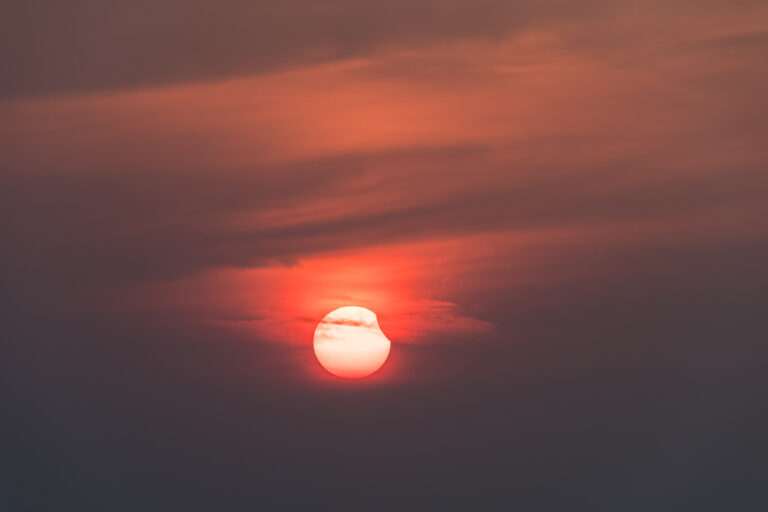
In fact, it won’t be too terrifying. From the Netherlands, about 22% of the sun will be covered, making it look more like someone just taken a bite out of the star, reports the NOS. 

Sounds like the perfect warm-up to the spooky season.  😲

Peaks at 12 PM

The peak of the eclipse will occur at 12:05 PM. If you look closely, you should see that the left upper edge of the sun will be totally covered by the moon. 🌑

The eclipse will then end at 1:03 PM. 

This is the first time there has been a partial eclipse since last summer. Usually, when there is a partial eclipse in some parts of the world, there will be a total eclipse somewhere else, though this is not the case this time around. 

READ MORE | Keep your eyes to the sky: huge meteorite shower graces the Netherlands

In fact, we’ll actually be waiting a good while before we see this phenomenon again! 

The next time there will be a partial eclipse in the Netherlands will be in March 2025 — so get yourself out into the streets today and have a look before it’s too late! 🔭

Eclipse glasses available in certain places

You’ve got a casual pair of eclipse glasses, right? Well, if not, some places, such as the Utrecht Museum and Sonnenborgh observatory, will have glasses available for visitors to watch and enjoy the eclipse. 

This is an exciting day also for children who are off school this week, as they’ll get the chance to peak at the eclipse through a special solar telescope. 

A partial eclipse also took place earlier this year! 😍

But, do be sure to use eclipse glasses or binoculars with the image projected onto a piece of paper, as even with a partial eclipse, staring directly at the sun can severely damage your eyes, physicist and observatory volunteer Rianne Plantenga tells the NOS. 

And, no, your sunglasses aren’t enough to protect you! 😎

No glasses? No problem. 

Another way to watch without damaging your ever-so-important eyes is to watch through a small hole in a piece of cardboard, and project the image of the sun onto a white sheet of paper about two feet behind it.

Will you be watching the eclipse today? Tell us in the comments below! 👇

There’s up to €380 coming your way to offset energy costs: here’s how

0

A total of €380 is promised to every energy customer in the Netherlands in November and December to compensate for soaring energy costs.

However, the system is a bit more complicated than just waiting for Sinterklaas to bring the money.

Merry Christmas?

Whereas Sinterklaas only comes once a year, this compensation is (mostly) coming twice, with one payment of €190 in November and another €190 payment in December. 

While the money is paid by the government, it is the energy providers who will distribute the funds — and this is where it gets tricky, according to RTL Nieuws.

The most significant difference is that some providers pay in cash, while others will take the savings off your energy bill.

READ MORE: All you need to know about the Dutch energy subsidy and price cap

Further differences occur when clients are behind in paying their bills or when the provider is simply behind schedule. 

Curious about when your cash will come in? Here’s the list!

Energy providers paying cash

Hoping to get some funds back in your bank account? You’re in luck if you’re with one of these energy providers. 

HEM

HEM is opting for the Christmas instead of the Sinterklaas model: it will pay out the full amount of €380 in one payment to their customers in December. 

HEM claims that the government was too late with the process so they couldn’t make the November deadline. There is no statement from HEM on whether the payout will be affected by unpaid bills.

Vattenfall

Vattenfall will pay their customers in cash, but they already announced that the payout will be deducted from any clients who are behind in their bills.

photo-of-man-with-a-stack-of-money
This is the goal! Image: Freepik

Eneco

Eneco will pay out in cash €190 in mid-November and again in mid-December. There is no word yet on how they will approach clients who are behind on their bills, but the company will send all its clients an email later this week with all details.

Companies that will give a discount instead

On the other hand, if you’re with one of the below companies, the compensation amount will be credited to your bill — same, but different, we guess. 

Essent

Essent has announced that the compensation will be distributed as a discount on all types of bills: whether it’s your regular monthly payment or older bills that are still unpaid.

Greenchoice

Greenchoice has also said it will give a discount on monthly payments; whether that also extends to previous unpaid bills is yet to be known.

Are you expecting the cash to land in your bank account? Tell us in the comments!

Top European airports revealed — but Schiphol didn’t make the cut

The people of the world have given their ratings, and it looks like Amsterdam’s Schiphol Airport is ranking lower than ever before. 

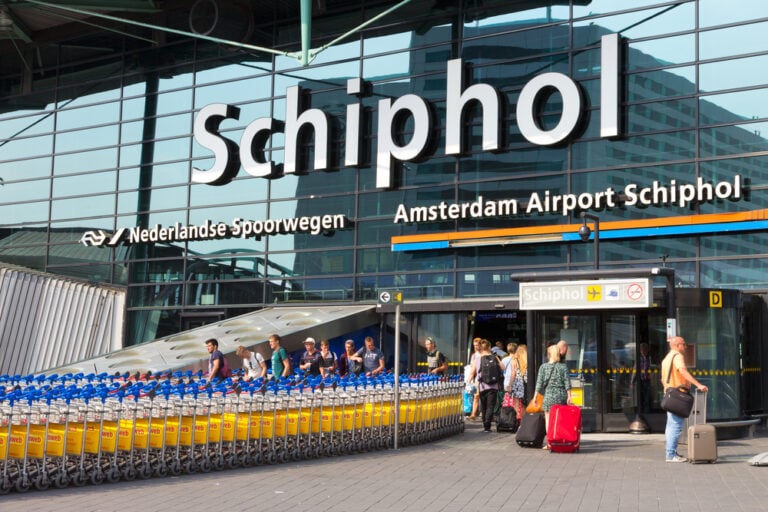
Website Vliegveldinfo.nl has compiled Google ratings about the hundred busiest airports in Europe, and Schiphol has found itself in the unsettling rank of 39th place. 

Schiphol strikes again

After a summer full of insane chaos at the airport, the largest Dutch airport seems to have only declined in the autumn months. 

Now ranked with a solid 4 stars, Schiphol is at the same level as Heathrow Airport in London, Madrid in Spain and Zaventem in Brussels.

Of course, Schiphol’s ranking could be worse. Eindhoven Airport, the second-busiest airport in the Netherlands, has ranked with 3.8 stars and is in 70th place on the rankings.

Beat out by Zurich

Zurich, Athens, and Porto scored the highest out of all the European airports, scoring a total of 4.4 stars each.

And at the bottom? Manchester in the UK with 2.9 stars, Heraklion in Greece with 2.7 stars, and Bordeaux in France, which landed a total of 2.6 stars. 

Formerly known as one of the best airports in Europe, major staffing shortages at Schiphol have led to the airport’s ratings dropping. 

READ MORE | Leave those bags; Schiphol cancels more flights due to security shortage

Recently, one-star reviews have become more and more common, with customers writing things like, “If you like real, deep-seated customer hatred, this is really the place to be.” 

Plane delays, low wages, and deserting CEOs

Schiphol Airport has become, let’s be honest, a bit of a joke in the last few months. 

Even Dick Benschop, former CEO, was able to see the chaos he’d caused, and guess what he did? Jumped ship! (or plane 😉) 

But why would he quit? 

Well, maybe because the airport ranked as the fourth-worst airport for delays this summer. No surprise to us, seeing as over the summer, a grand total of 16,000 bags were left unclaimed due to shortages of bag handling staff. 

The same staff, by the way, who reported recently just how terrible conditions are in the baggage basement at Schiphol. 

READ MORE | Chaos reignites at Schiphol as workers’ summer wage increase expires

Plus, due to staff shortages (because really, who would want to work in such chaos?), Schiphol has planned to cancel up to 18% of its departing flights through all of autumn. 

The flight slashing will continue until March 2023, with the airport capping the number of passengers passing through at 50,000 per week. 

Perhaps it’s time to consider taking the train instead? 😬

What do you think of the airport’s rankings? Tell us your thoughts in a comment below!