Yesterday, Mark Rutte and the Minister of Defense Kajsa Ollengren phoned Zelensky to coordinate the next shipment of defence equipment to Ukraine.
During the phone call, the Netherlands committed to sending heavier defence equipment to Ukraine, the NOS reports.
Initially, only lighter weapons were supplied but as the war has carried on, the Netherlands has increased their weapons shipments.
Rutte announced that the Netherlands is to begin sending heavier defence equipment in a tweet yesterday:
📞: In a call with @ZelenskyyUa the @DefensieMin and I expressed our support as Russia begins a renewed offensive. 🇳🇱 will be sending heavier materiel to 🇺🇦, including armoured vehicles. Along with allies, we are looking into supplying additional heavy materiel.
While the Netherlands has sent supplies to Ukraine since the beginning of the war, this upcoming shipment signifies an escalation in the Netherlands’ involvement.
According to Ollengren: “The war in Ukraine is entering a new phase now that Putin has launched the offensive in the Donbas. We will continue to support Ukraine.”
The Dutch House of Representatives is regularly updated on the shipment of materials to Ukraine but makes no statements about what exact supplies are being sent. This is in line with other countries’ approaches as no one wishes to give Russia this knowledge.
Dutch diplomats expelled from Russia
Coinciding with Rutte’s announcement of new shipments to Ukraine is a new report by the Russian Ministry of Foreign Affairs.
The report reveals that 14 diplomats and a staff member from the Dutch embassy in Moscow and the consulate in Saint Petersburg have to leave Russia, the NOS reports.
The twist? According to the Dutch General Intelligence and Security Service (AIVD) and Military Intelligence and Security Service (MIVD), the expelled Dutch were not diplomats, but spies.
According to the Dutch Foreign Minister, Wopke Hoekstra, the expulsion was expected. He sees it as retaliation for the Dutch decision to expel 17 Russian diplomats from the Netherlands.
“Nevertheless, I regret this step,” he says. “We are now going to see what the consequences are of the fact that so many colleagues have to leave Moscow and Petersburg.”
Dutch police are currently on the hunt for a man they consider to be very dangerous. Last Saturday, a 21-year-old woman was stabbed in the back whilst cycling.
Thankfully, the victim was not critically injured. However, police have released an appeal to the public in which they say “this man must be taken off the street as soon as possible,” RTL Nieuws reports.
When and where?
The crime took place at 11:45 PM as the woman was cycling through Vlaardingen to meet her boyfriend at a café in the city centre.
As seen in CCTV footage released by OpsporingVerzocht, the suspect first cycled past the woman. However, he then turned around and began following the victim before eventually overtaking her — stabbing her in the back whilst doing so.
At first, the victim thought that the suspect had hit her hard but then quickly realised something was wrong. As the woman dismounted her bike, bystanders spotted a knife sticking out of her back.
According to police, the woman had a lucky escape as none of her vital organs appear to be injured.
A call for witnesses
Lucky or not, the police are calling the crime a “very serious incident” and have appealed for anyone who may have seen anything to come forward. The attack took place at the Werf van Pronk intersection in Vlaardingen.
The hunt continues for the perpetrator. He is described as being approximately 1.70 metres and wearing black clothing.
As for a motive, worryingly, it appears there was none. Anyone who may have any information is encouraged to contact the police “urgently.”
This Easter weekend has had us enjoying some sunny rays here in the Netherlands. 🐰
According to Weerplaza, we can look forward to more sunny days and temperatures ranging from 15 to 20 degrees for the next couple of days. ☀️ Whoop! Terrasjes here we come.
Cold temperatures at night
But don’t put your scarves and warmer sweaters away just yet! As the week progresses, there will be some cloud coverage and cool winds.
What’s more, the nights still get seriously cold. Temperatures can easily drop below freezing, so take care of your outdoor plants and wrap ’em up nicely.
What about the next couple of weeks?
And what’s the big picture? Weerplaza predicts mild temperatures with loads of sunshine for the next 30 days. 😍 Generally, April in the Netherlands is a pretty dry month and this year is no different.
Regarding temperatures, we’re not looking at any extremes. While in the past we’ve seen temperatures around the 25-degree mark around this time of year, in 2022 the thermometer will be more level.
What about King’s Day and the May vacation?
Now to the important bit — will we be able to roam around on King’s Day covered in orange without being soaking wet by the end of the day? 🍻
If you manage not to fall into any canals or avoid the dreaded beer shower, the answer is yes! It looks like King’s Day and the first week of May, where there’s the spring vacation in the Netherlands, are relatively dry and sunny.
Glasses for the blind? A team of students at the TU Delft has proven once again that the Dutch are kings and queens of spearheading innovative technology.
This time around, we’re not talking water management strategies or nifty agricultural techniques.
Instead, we’re paying tribute to a pair of futuristic glasses that help the blind to see. And the best part? They’re 100% Stevie Wonder approved.
The glasses work by translating images taken by an in-built camera into words, explains RTL Nieuws.
Say, the wearer of the glasses turns their head to look at any given object such as a euro bill. While the blind individual might be able to realise they are holding paper money, there is no way of telling whether it’s a €100, €10 or €5 bill.
Envision Glasses to the rescue! Aimed at the unknown object, the camera snaps a picture of the euro bill, processes the image and a voice will then let the blind wearer know what is in front of them — for example, a €10 bill.
There are also other features. For example, the wearer can tell the glasses what they’re looking for and the gadget will then recognise whether or not the desired object is close by.
How did Stevie Wonder find out about them?
American singer and soul-legend Stevie Wonder came across the glasses during a fair for technologies relating to disabilities of all kinds in Los Angeles.
NPO Radio 2 explains that Stevie Wonder has been frequenting the fair for years. The musician that has been blind from birth was immediately struck by the wondrous invention.
The team of Envision Glasses did not hesitate and send him home with a pair to practice. How lovely! 😍
At the moment, one pair of Envision Glasses still costs about €3,200. Hopefully, in the future, this marvellous piece of Dutch innovative technology will be supported by health insurance and made available for all!!
What do you think of these glasses for the blind? Tell us in the comments.
What do you get when you ask a Dutch person for advice on respecting their own country? A direct answer that is not quite what you expected. 😆
There’s absolutely nothing wrong with wanting to be respectful to another country’s flag. If anything, many people would probably tell you that it’s a good thing. Heel goed!
But, if you’re going to ask a Dutch person for a thorough explanation of how to fold the Dutch flag, don’t expect any serious answers. 🤦🏻♀️
So how does one fold the Dutch flag in a respectful manner?
The tweet below shows a screenshot of a Reddit post by the user “Skeezysteev” in the r/Netherlands subreddit.
He explains that he’s American with a Dutch wife and asks how to respectfully store a recently gifted Dutch flag until they have the space to display it. 🇳🇱
The user “Rednitro” responds to him in utter seriousness and says: “You put it in the Albert Heijn tasje en then you pleur it in the kast”. 🧐
In case that sounds cryptic to you, he’s telling him to just stuff the flag into any old Albert Heijn shopping bag and keep it in the closet. 😅
And that was only one of the many comments that flooded this American man’s notification inbox:
Another user responded with: “The Dutch way is to not care about being Dutch.” There’s that patriotic spirit we’ve been searching for! 😆
Someone else commented: “I just shove mine in the closet till next year. Nothing some wind or an iron can’t fix.” What a helpful tip!
One more user commented: “Hug it and kiss it everyday before slapen“, what a lovely bedtime routine. 🌙
Joost van Abeelen — the man who tweeted the screenshot — captioned it with: “Al 5 minuten in een scheur om deze“. This literally translates to: “I’ve been stuck in a crack for five minutes because of this”. 🤔
This is of course one of the many Dutch ways to say that they’re laughing really hard at something.
Okay, what’s the actual respectful way of folding a Dutch flag?
When it comes to flag etiquette in the Netherlands, there are no legal rules about folding the Dutch flag. Unless you’re part of the military. ✨
According to the Rijksoverheid website, there are certain customs and habits when displaying a Dutch flag. For instance, they mustn’t touch the ground or stop traffic.
Whether the Dutch really care for these rules, however, is another question. 👀
There are also no laws that dictate when people can hang their Dutch flags. For instance, it’s always allowed to hang them at a wedding, a school celebration or even a funeral — however, according to this subreddit another pride of place is the back of the closet.
Do you have a Dutch flag in your home? How do you display it? Tell us in the comments below!
A new representative survey by I&O Research — commissioned by the NOS — shows the impact of price increases for 1,996 Dutch residents. Unsurprisingly, the most affected comprise the low-income groups. 📈
According to the NOS, the inflation rate in the Netherlands hasn’t been this high since the 1970s. But, only 3 out of 10 people say they suffer because of it. 🤔
It’s safe to say that the majority of Dutch people aren’t so bothered by the rising prices. 🤷🏻♀️
However, those who are most affected belong to the least-advantaged income class.
For instance, single mothers or people who receive social benefits — who are already economically challenged — must face even more obstacles with the current rising prices.
What has inflation changed for the lower-income groups?
Almost half (47%) of Dutch people with a minimum income are suffering from increased prices. And, one in five (20%) say it creates issues for them.
The representative survey wrote that a fifth to a quarter of Dutch people with minimum incomes fear an income decrease. This includes pensioners (31%), self-employed people (27%) and unemployed groups (25%).
In comparison, 62% of the Dutch respondents expect no change at all and 19% even saw a potential increase in their income levels.
What about the rising gas prices?
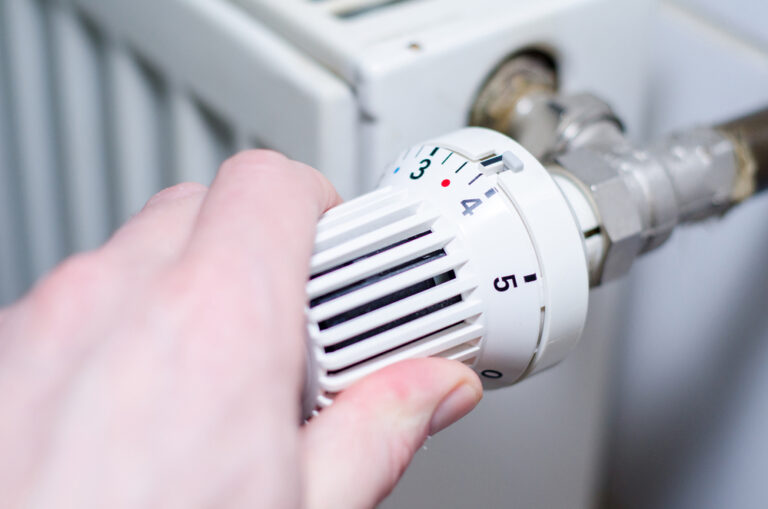
As many know, the rise in gas and energy prices has been fueled by Russia’s war in Ukraine. ⛽ As a result of this, more than half (55%) of the Dutch respondents claimed that they turn down their heaters while 3 in 10 have started to drive less or take shorter showers.
Surprisingly, the study found that respondents from lower-income groups haven’t adjusted their behaviour as much as those with middle incomes when it comes to energy costs.
This is because people with lower incomes are accustomed to being sparing with their money already but they’re also less likely to own cars in general, says one of the survey researchers.
Have you been personally affected by the rising inflation rate? What’s your experience? Tell us in the comments below!
Most of us were sure that any news about diseases and viruses was out of the way. Instead, we’re going right back into our days of sniffles and handwashing.
Twice as many people in the Netherlands reported illness in 2022 than in both 2021 and 2020, according to RTL Nieuws. But the culprit this time is no coronavirus — the RIVM suspects the notorious flu. 🙁
The reported number of cases is even higher than in both 2018 and 2019, before the coronavirus pandemic. Isn’t this awfully familiar? 😖
Flourishing flu
A spokesperson for Arbo Unie, one of the health and safety services in the Netherlands, says that short-term absences (less than a week) and mid-term absences (one to six weeks) for employees is quite high. 😓
And for good reason. GPs noticed that a whopping 59% of flu patients had severe respiratory infections. Flu epidemics in the Netherlands usually start in December or January, but this year it started in March.
Research institute Nivel believes the former coronavirus measures also helped prevent the spread of the flu.
But now that the measures were scrapped and people are back in contact, the risk of respiratory infections is back on our radars.
On the prowl
Records from the RIVM, hospitals, and laboratories across the Netherlands confirm the flu wave. “The number of people with influenza has increased considerably over the past four weeks,” says the RIVM. 🦠
According to the RIVM, you usually get the real flu once every 10 years: “People often confuse the flu with the cold virus. Many may forget how sick you can get from the flu.” 😷
On average, the flu epidemic lasts nine weeks. Arbo Unie noticed that fewer people are reporting flu-like symptoms since the epidemic began.
The number of flu cases might also be falling faster now that the weather is getting better — after all, viruses spread less easily in better weather.
Have you caught the flu or cold virus this season? What was it like? Tell us in the comments!
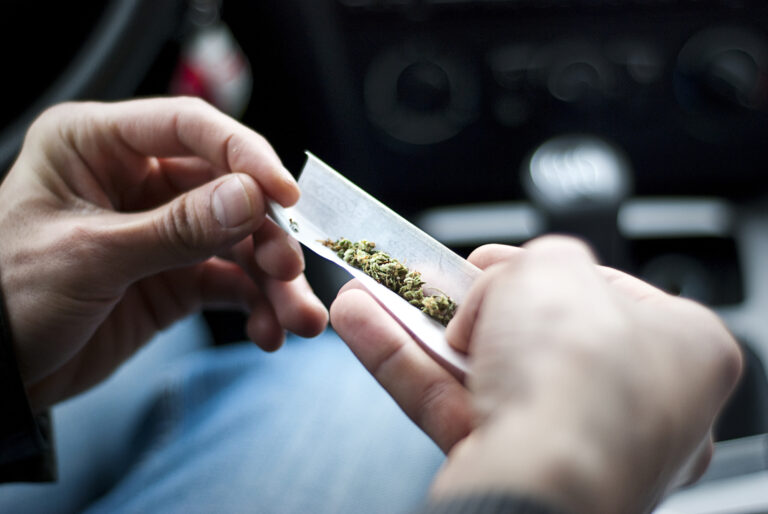
She hopes to combat “drug nuisance” in Amsterdam with support from the chief of police and Public Prosecution Service, says RTL Nieuws.
A letter to the city council
The administrative “trifecta” says a lot of major problems in the city come from the cannabis market, including minor nuisances to crime and violence. 🚨
They want to introduce a “resident criterion” — which means foreign tourists will not be allowed to enter coffeeshops. ❌
Mayor Halsema initially launched this plan in January 2021 but following some investigations and discussions with the cannabis industry, she wants to follow through with this plan. 🍃
Resident criterion causes a stir
The resident criterion in particular led to some discussion. Some opponents say this restriction could lead to more illegal trade on the street.
The trifecta disagrees, saying a ban on selling weed to tourists is a necessary step towards slowing down and regulating the market.
The problems with the street trade are already noticeable in the city centre. Dealers hang out on the streets, harass visitors, and sometimes act aggressively, particularly in the Red Light District.
Quality marks and street dealing
Mayor Halsema wants to reduce and regulate the cannabis market by introducing quality marks that coffee shops must meet. Shops that follow extra rules with business operations, information, and transparency can receive such a quality mark. ✅
She also wants to handle street dealers more severely by taking their “day proceeds away” and giving restraining orders. Dealers will also be brought in front of judges much faster.
In the works
Although this might seem extreme for Amsterdam, the trifecta won’t go through this without some resistance.
The mayor will likely clash with the progressive parties including D66, GroenLinks, Bij1, and DENK, which oppose the introduction of this criterion, Het Parool reports.
The PvdA (Labour Party) offers some room for the mayor — the party is only in favour if the municipality guarantees the enforcement against street trade. Other parties including the VVD, CDA, and JA21 support the criteria.
In the meantime, the new city council must discuss the trifecta’s proposal before making a final decision.
What do you think of the implementation of this new tourist ban in coffee shops? Tell us in the comments!
The Dutch supermarket Albert Heijn — also known as “Appie” by many Dutchies — will start delivering groceries about 30 minutes after placing an order, according to RTL Nieuws. 📦
A new ‘quick delivery’ trial will begin at two supermarkets in Amsterdam. That means that it will soon be possible to choose from 1200 products when ordering a quick delivery from Albert Heijn. ✨
The Dutch supermarket will also work with food delivery services such as Thuisbezorgd and Deliveroo to facilitate those speedy deliveries at your doorstep. 🛵
The battle for the fastest delivery services
Albert Heijn branches are finding themselves in tight competition with flash delivery companies, like Zapp and Gorillas. Having quicker deliveries is definitely one way to fight the struggle for increasing consumer demand!
According to RTL Nieuws, e-commerce has risen 35% since last year which is significantly higher than Albert Heijn’s market growth.
It’s no secret though that Jumbo has the upper hand when it comes to quick grocery deliveries — how do you even beat a 10 minute delivery time!? 🤯
Grocery shopping after the pandemic
Dutch grocery delivery services became much more popular after COVID-19 hit the Netherlands. With everyone being told to stay at home, can you blame them? 🤷🏻♀️
Instead of physically running errands, residents would much rather just go the easy way and buy their groceries online.
What’s your preferred method for buying your groceries in the Netherlands? Tell us in the comments below!
The use of VPNs is becoming increasingly popular in the Netherlands — and not just with tech wizards. But what is a VPN exactly? What does it do? And why should you use one?
VPN stands for “Virtual Private Network” and, nowadays, is usually downloaded as an app to your desktop, phone, or tablet.
You can think of it as your own little bubble that protects you and your device when you’re connected to the internet while out and about.
How? By rerouting your data and encrypting your traffic, consequently hiding your IP address.
So, why should you use a VPN in the Netherlands? Here are our top seven reasons:
1. It provides safety on public wifi
The Netherlands has an amazingly vibrant café life with Dutchies sitting on terraces year-round. As an international living here, you’ve probably also developed a propensity to bring your laptop to your favourite café and smash out some emails or study while sipping a koffie verkeerd (latte). 👩💻
Now, that’s all great (except maybe for your caffeine intake 😵💫) — but have you ever thought about what happens after you ask the barista for the public wifi password?
When you log onto that oh-so-convenient public wifi, the internet provider can potentially access your browsing history — yes, yikes. Even if you have “nothing to hide,” 👀 access to your browsing history means that hackers could extract a large amount of valuable data from your device.
Think of a VPN as your own personal bubble when surfing on public wifi. Image: Depositphotos
This includes your email credentials, bank details, personal photos and videos, and even your home address.
Using a VPN hides all this information from potential hackers.
You might be thinking “but I use public wifi all the time and this never happened to me.” First of all, good for you! Second, not all public wifi providers can see your browsing history — it depends on the router they use.
However, something that all modern wifi routers do is keep logs. Meaning they can see what domains you visited and for how long. This definitely isn’t as big of a threat as hackers accessing your browsing history — but it is, nevertheless, data you might want to keep private by using a VPN.
Data safety? Yes, please! If you’re interested in getting a VPN, we recommend checking out NordVPN whose expert team has helped us understand the ins and outs of using a VPN.
2. With a VPN, your data is safe
Do you ever feel like you’re being watched? 😅 Well, likely you are.
Even at home, advertisers, internet providers, and government agencies love to peek in on your browsing history, messages, and other private data.
So, in addition to offering safety on public wifi, a VPN also hides your data from curious companies and organisations. As soon as you activate your private network, your traffic will be encrypted and your IP address hidden — bye-bye Big Brother!
3. It offers a world of streaming options
Don’t get us wrong, Dutch Netflix has some solid movie picks. But sometimes, you just need a little more variety. 🍿
That’s where a VPN comes in handy. It reroutes your IP address so it looks like you’re accessing the streaming service of choice from another country — and BAM, a whole new library of content has opened up to you.
Think Rain Man, What’s Eating Gilbert Grape, and Legally Blonde (all available on US Netflix). Or opt for a night on UK Netflix to do a Bourne movie marathon followed by a revisit to classics like Pulp Fiction and Silence of the Lambs on Canadian Netflix.
By using a VPN, you can start a new show when visiting your home country without having to worry about whether it’ll be available in the Netherlands as well. (Trust us, there’s nothing worse than being halfway through a season only to discover you have to wait for your next visit home to finish it).
4. It scores you the best deals online
We know a VPN costs money but did you know that it can also save you money? (Yup, the Dutchie in you is paying attention now 👀).
When you shop online — whether for new clothes, furniture, vacation stays, or flights — the website accesses your location. And no, it’s not only to estimate your shipping costs. Instead, companies offer different prices depending on where they think you are in the world.
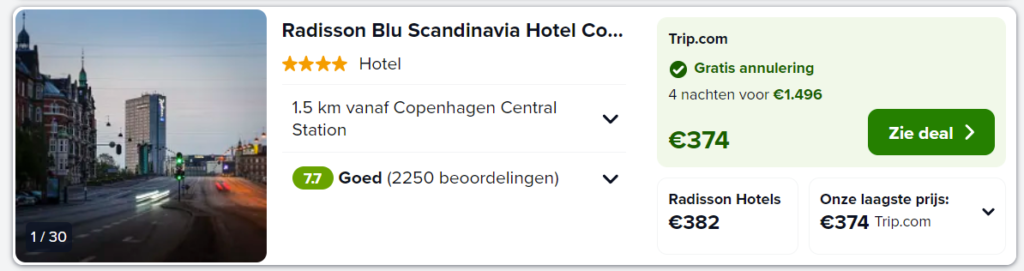
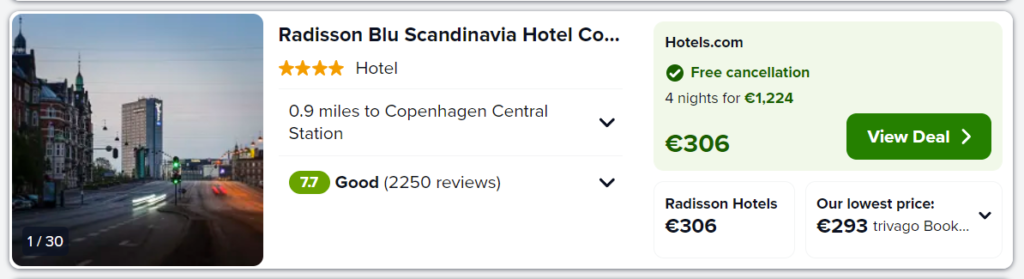
This is especially relevant when you book flights and hotels, as the price differences can be staggering. For example, when looking to book four nights at a hotel in Copenhagen, there’s almost €100 difference between booking from the Netherlands and the US.
When booking from a Dutch IP address you’d pay €374. Image: Trivago/Screenshot
With a US IP address, however, you can get the same hotel for only €293. Image: Trivago/Screenshot
We know which option we’d choose, that’s for sure. 🤷♀️🇺🇸
5. A VPN circumvents blocks — and lets you see all the content that’s actually on the site
Another thing a VPN can help you with is avoiding geo-blocking. As an international, having a VPN is extra handy because some of the content from your home country might not be available in the Netherlands. This can include services such as banking or investment accounts.
Moreover, public institutions sometimes enact content blocks on public networks.
If your home country enforces government censorship, there might be Dutch websites you can’t visit while you’re in your home country. Thankfully, not all content blocks are as serious as this. They can also be schools trying to ensure student efficiency by blocking social media sites. 📵
Not today we say!
6. A VPN improves online gaming speeds
If you’re serious about gaming, a VPN can be your new best friend. It’ll protect you from throttling and DDoS attacks so you can enjoy the best internet speeds while playing.
Bandwidth throttling is when an internet service provider (ISP) intentionally slows your connection based on your online traffic type. If they detect that you’re gaming online, your ISP can cause your game to lag — which is about the most frustrating thing in the world.
A VPN hides your data traffic through encryption so that you can enjoy lightning speeds without your ISP interfering. 💪
DDoS attacks (or distributed denial of service attacks) are a sneaky strategy for lousy gamers fishing for a competitive advantage. If you become a victim, multiple computers flood your IP address with data to overwhelm your network.
With a VPN, the effect of DDoS attacks becomes less severe and, if it persists, you can simply change servers by choosing a different VPN.
7. It’s easy to use
We may work at an online magazine but, believe it or not, we’re no tech wizards. Thankfully, a VPN is super easy to use.
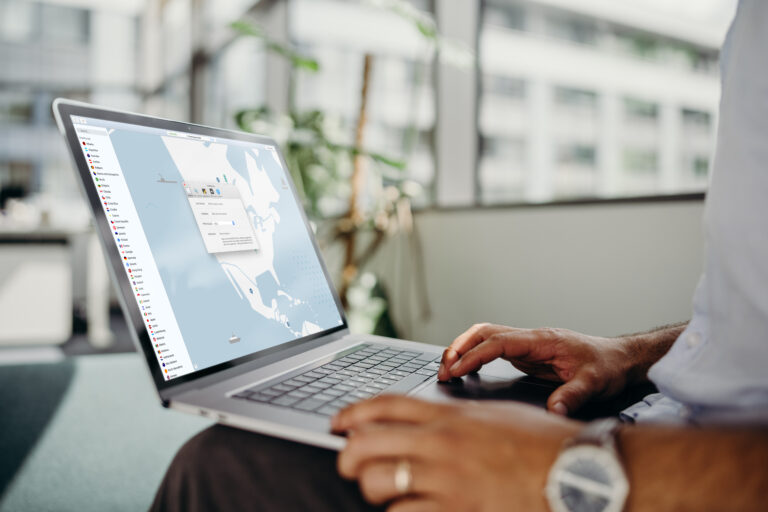
You just download the app, log in, and pick the server you’d like to use. Plus, you can easily jump between different country servers (for example when looking for the best hotel prices!) and pause or end your session.
Sign me up! As one of the most popular VPN services on the market, NordVPN checks all the boxes: It’s safe, fast, and easy to use. To download it, just head over to their website.
What’s your experience with using a VPN in the Netherlands? Tell us in the comments!