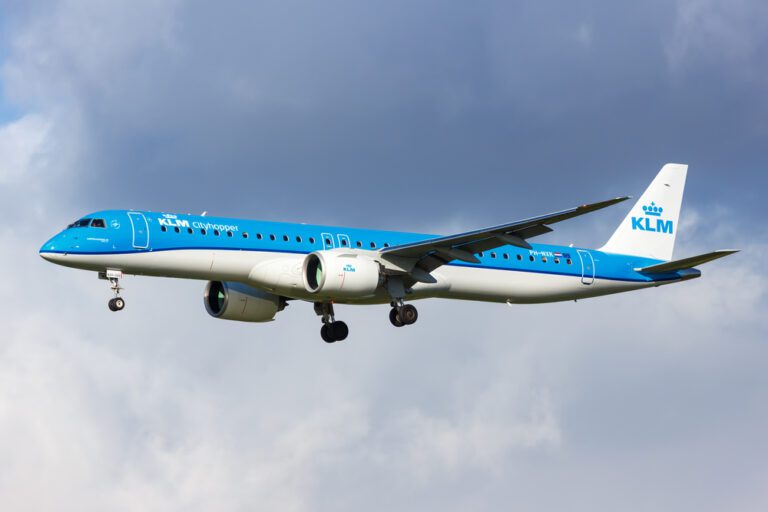
The investigation into Wednesday’s heartbreaking incident — in which a person was sucked into the engine of a KLM Cityhopper — has now been concluded. Here’s what we know.
According to the Marechaussee(the Dutch military police), the victim was a man who worked for a company at the airport.
The investigation revealed that he climbed into the engine of his own accord, which the Marechaussee confirmed was an act of suicide.
Which company the man worked for will not be disclosed. A spokesperson for the Marechaussee stated that “out of respect for the victim and the next of kin, [they] will not make any further announcements.”
Multiple witnesses
The engine in question belonged to one of KLM’s Embraer 190 Cityhoppers, which was bound for the Danish city of Billund and was about to taxi down the runway when the incident occurred.
Multiple passengers on the plane, as well as crew members on the ground, were reported to have witnessed the incident.
Are you (or is someone you know) struggling with mental health issues?
Your GP can refer you to a primary mental health provider (for counselling and online support) or suggest secondary care (for more complex issues, such as severe depression, ADHD, and anxiety disorders).
At a pinch, however, the website of the Dutch Suicide Prevention Foundation offers 24/7 anonymous chat options — yes, even in English. You can also call them at 0800-0113.
Nicki Minaj has cancelled her show at the Ziggo Dome in Amsterdam this Sunday. Concert organiser Mojo cites “last week’s events” as the reason for the sudden cancellation.
In case you missed it, the American rapper was arrested by Dutch authorities last weekend for carrying a stash of soft drugs in her luggage.
The outcome? A €350 fine and a spot on her Dutch criminal record.
As Het Parool reports, Nicki has now come forward about the incident — and she’s accused Schiphol’s military police of racism.
“Disgusting” treatment
During a livestream, Nicki expressed her frustration with Dutch authorities, whose behaviour she claims to have been racist and “disgusting” towards her.
She believes they decided to search her bags because of her skin colour and claimed the male officers seemed to enjoy the situation a little too much.
“I don’t know when I’ve ever felt this unhappy,” she shared with fans, “knowing that something is being done to you on purpose because you are a confident other race.”
“There was one lady there — all the rest were men — and I could tell she had a heart.”
“The [men’s] treatment was just disgusting, and I wouldn’t wish that on anyone. And yes, I’ve been to jail before. It has nothing to do with if you’ve been to jail before.”
“Due to the events of last week, the June 2 Nicki Minaj show in Ziggo Dome Amsterdam has been cancelled. Buyers will automatically receive a refund for their purchase,” Mojo writes on their website.
Dutch authorities deny the allegations
So, what does the Koninklijke Marechaussee (Dutch Military Police) say about all this?
Well, a spokesperson told Sky News that Minaj’s arrest was “normal procedure when somebody is trying to pass border control with drugs in their luggage.”
“No matter what your background is, who you are, where you come from or where you are going,” a spokesperson also told ANP.
What are your thoughts on Nicki Minaj’s arrest? Share your thoughts in the comments.
Dutch doctors’ reluctance towards prescribing antibiotics might be a tale as old as time, but new research shows that some also refuse to take migrant patients seriously —all because of a harmful myth about their pain tolerance.
The harmful story goes that ‘migrants have a higher pain threshold’, and it’s just that — a story. But it’s not stopping some Dutch healthcare providers from treating them differently.
Research by the scientific journal BMJ Open proves that this isn’t just conjecture.
Investigating discrimination in Dutch healthcare, their study reveals shocking findings for migrants, as summarised by NU.nl.
Dutch denial
Investigating the prejudice of healthcare providers in the Netherlands is a challenge.
Associate professor of medicine at Amsterdam UMC, Jeanine Suurmond, discovered this when her attempts were repeatedly denied.
Speaking to NU.nl, she explains that when it came to migrant discrimination, “I have sometimes been told that this would not be an issue in Dutch healthcare”.
Then why does the new research show that over 25% of Dutch patients with a migrant background felt their health problems were dismissed because of their origin?
Risking patients’ health
So, this is bigger than just a few pain complaints being ignored, but a dangerous attitude problem.
“When healthcare providers do not take the complaints and pain of patients of colour seriously or have misconceptions about this, the patient does not receive fair care,” Charifa Zemouri, lead author of the BMJ Open article, tells NU.nl.
Working with expats has opened my eyes to Dutch healthcare being a dystopian bureaucracy.
scene: group of migrant engineers chatting
"I got my Dutch GP to prescribe me medication!" "How did you manage to do that!" *sounds of amazement, admiration, shock, laughter*
And it’s a common European bias, as studies across the continent show that “medical students are less likely to choose strong anaesthesia for people with a migration background”, Movisie researcher Hanneke Felten explains.
So the evidence is already pretty damning — and then you hear the stories some migrants shared about their healthcare experiences.
The study puts forward a number of concerning case studies.
For example, one man tells of how his wife was initially accused of pretending to be in pain because, culturally, Caribbeans are considered more “dramatic.”
She was diagnosed with cancer after finally being taken seriously.
How did it get to this?
Receiving less pain relief because of your skin colour certainly sounds like something from the dark ages.
And sadly, that’s exactly where this prejudice comes from — the ‘higher pain threshold’ myth has its origins in the history of slavery, according to Zemouri and other experts.
The horrifying reality is that claiming non-white enslaved people could endure pain better than white people was a way for Dutch slave owners to justify brutal mistreatment.
Another contributing problem is medical consultancy centres spreading misinformation to healthcare providers, which informs the care they give.
NU.nl reached out to one such expertise provider, Pharos, about a false statement on their website claiming Moluccan and Indian elderly people “often have a high pain threshold”.
Pharos removed the passage shortly after their questions, but a lot of their information remains outdated. 👀
So, where do we go from here? Well, to enjoy a healthcare system without such prejudices, Zemouri encourages providers to “stop blaming health disparities on the patient and take action.”
Have you had similar problems with Dutch healthcare? Let us know in the comments below.
Passengers and crew members have been left shaken after a person was reportedly sucked into a KLM Cityhopper engine on Wednesday afternoon at Schiphol Airport.
The incident is reported to have happened as a plane bound for the Danish city of Bilund was backing up for take off.
For now, who the victim was and what exactly happened is still being investigated.
Multiple witnesses
Multiple passengers on the plane as well as crew members on the ground are reported to have witnessed the horrific incident.
Once all the passengers were removed from the plane, they were interviewed by the military police, a spokesperson tells AD.
KLM CityHopper Embraer E-190 (PH-EZL, built 2010) experienced a fatal incident during pushback at Amsterdam-Schiphol Airport (EHAM), Netherlands when a person was somehow dragged into the running engine. Flight #KL1341 was about to depart to Billund when the accident occurred.… pic.twitter.com/GrFxQoljqj
They could then receive assistance from special airport staff and the airport chaplaincy.
An alternative flight for the intended passengers took off at 8:30 PM yesterday evening. Once passengers landed, they could receive further help from KLM staff.
A staff member or a passenger?
However, at the moment, there are conflicting stories coming out about who exactly the person was.
On social media, it’s circulating that the victim was a “pushbacker” in training who saw something under the plane and was accidentally sucked into the engine when he went to retrieve it.
Good morning! *Wrings out soaking wet hair* It’s going to rain even more! *Cries, but the tears blend with an already rain-bashed face.*
With June right around the corner, you’d hope our rain jackets would have some time to actually dry, but this won’t be the case for the coming days in the Netherlands.
In fact, you should keep them handy and avoid tall trees, because not only are rain and hail forecast, but thunder and lightning too.
Don’t even bother styling your hair today
Many people will be left with the classic “wet dog” hairstyle today, as rain is forecast from the morning onwards, according to NU.nl.
Really adding to the look will be strong winds, especially for those of us living in coastal areas.
If you didn’t get soaked on your morning commute, don’t worry. You can simply nip outside during lunch to enjoy even heavier showers and a chance of thunder and hail.
Thankfully, this afternoon our rain coats will be given the occasional chance to remember what it was like to feel dry, with showers set to decrease in the afternoon and evening.
Thursday and Friday look much the same
If you start to miss the sensation of rain smacking your face, you can rest easy, there’s plenty more of it to come! (Summer? Don’t know her.)
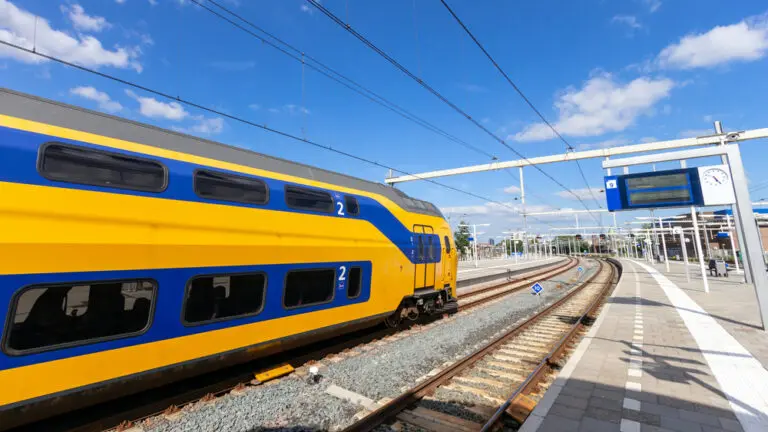
Could this be a game-changer for Dutch train travel? The ‘Lelylijn,’ a proposed high-speed train route, promises to slash the travel time between Amsterdam and Groningen in half.
With the inauguration of this route, the journey that currently takes at least two hours and nine minutes could be cut down to just 68 minutes. But how?
It’s all about choo-choosing the optimal route
The Lelylijn is not yet a reality, but it’s looking more and more likely to become one soon, according to the AD.
The railway line has been incorporated into the European railway network, and the parties forming the new government have included its construction in their main agreement.
According to the latest research results from the Lelylijn project organisation, the optimal, quickest route will include key stops in Lelystad, Emmeloord, Heerenveen, and Drachten.
If this route were chosen, it would be a historic moment for the town of Drachten, which would get its first-ever train connection. 🤩
For Drachten residents, this means reducing their travel time to Groningen from about 45 minutes to just 15, and the trip to Amsterdam to just an hour!
Why should we care?
Well, the VNO-NCW MKB Noord, an employers’ organisation from the North, sees great opportunities for employees to live in the North and work in the West.
Particularly, one of their advisors told the AD that he “envision[s] the Lelylijn packed with young professionals coming to work in World Potato City Emmeloord.”
Yes, that’s also my first time learning about the World Potato City — but now I can’t wait to hop on a high-speed train and visit it. Hopefully it looks a little something like this. 🥔
Would you make use of the Lelylijn? Share your thoughts in the comments!
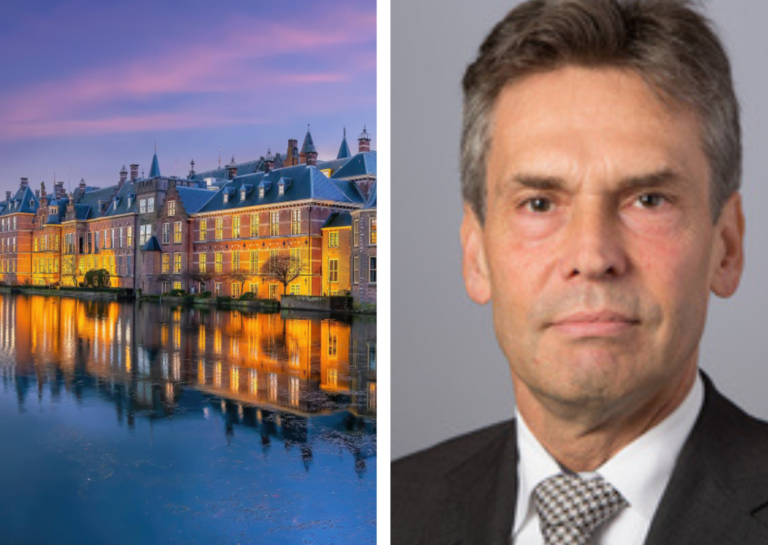
Before scoring this role, Schoof was head of the Dutch AIVD intelligence service, the National Coordinator for Counterterrorism and Security (NCTV) and director of the Immigration and Naturalization Service (IND).
Well, we must admit that’s quite the CV. 👀
Just a candidate for now
While Schoof may soon be announced as a candidate for the role of prime minister, this doesn’t mean he will actually become one.
Any cat owner knows that your furry friend will cost you a lot: hours of sleep, hundreds in vet bills, and maybe even thousands in damage to your brand-new couch— but one Dutch cat has really taken the cake.
The town of Dokkum in Friesland has fallen victim to perhaps the most expensive furball the Netherlands has ever seen.
How? Well, the sneaky feline did what all cats do: smacked at something it shouldn’t have.
However, this time, it wasn’t your boyfriend’s face, it was a tap.
A casual €325,000 in damage
The story began when the municipality of Noardeast-Fryslân decided it was time to renovate the town hall in Dukkum.
One construction worker spotted a cat slinking around the construction site, and a hunt began to try to catch it.
As a result of what can only be described as the real-life puss in boots, it was decided to close the construction site.
A turned-on tap
However, it seems that before the cat decided to call it a night, it wanted to enjoy a drink — or just watch the world burn.
A tap was turned on, and as a result, furniture was destroyed, moisture got into the walls, and water leaked through the floor into the building’s basement.
With walls and floors needing to be replaced, the cost of the damage totalled a whopping €325,000. Now that’s one expensive kitty.
Criminal kitty remains at large
And did anyone even manage to give the cat a punishing pet between the ears? No.
The cat and its unknown owner have not been identified.
Speaking with Omrop Fryslân, Councilor Bert Koonstra explains that “the damage is reimbursed by the insurance. With this, we can also close this cat file.”
Are you the owner of an orange cat who looks like it committed some crimes in the town of Dokkum? Give them a belly rub, and don’t tell the police. 🤫
How much do you spend on your Dutch rent or mortgage each month? Wait, wait, I know; a poep ton. 😭
How do I know? Because a recent study by the Dutch Central Bureau of Statistics (CBS) shows that people in the Netherlands have some of the highest housing costs compared to their income in all of Europe.
How bad is it?
Good question. The answer is that Dutch residents spend an average of 23% of their income on rent or mortgages.
That’s three per cent more than the EU average of 20%. 📈
But of course, that’s just an average. And many people (yours truly included) spend a lot more of their income on housing — some even more than half. 👇
How bad is it, really? Well, let’s put it this way: with these numbers, residents of the Netherlands spend the 6th highest amount of their income on rent or mortgages.
Only in Greece, Denmark, Germany, Luxembourg and Bulgaria do people spend a greater part of their income on housing costs.
And… rents are going up
The CBS also analysed rental prices more generally and noted that rental prices in the Netherlands have skyrocketed by a whopping 18.5% in the past nine years.
Sounds bad? It is! But it could be much worse.
As the CBS’s research suggests, a number of Eastern European countries have seen rents go up by over 50% in the past decade, including in Slovenia, Hungary, and Poland. Lithuania is taking the crown with an increase of 68%.
The EU average for rent increases since 2015 sits at 13.3%.
How much of your income do you spend on housing costs? Share your thoughts in the comments.
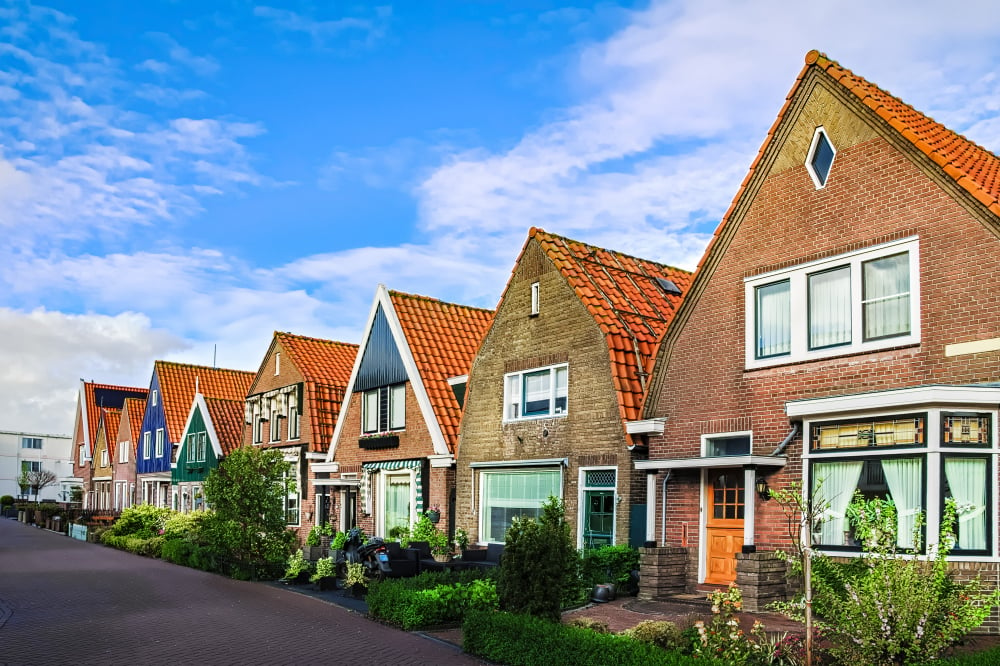
If you’re planning to buy a house in the Netherlands in 2024, then it might be good to know whether it’s actually possible at all. And often, it is — regardless of your nationality.
In the past, banks were hesitant to give out mortgages to internationals.
However, we now see that more and more mortgage suppliers are adjusting their criteria for obtaining a Dutch mortgage to suit anyone who wants to buy a house, be they Dutch or international.
Getting a mortgage in the Netherlands: criteria and factors
There are several factors that will affect your chances of obtaining a mortgage in the Netherlands.
Where you live: The one condition that applies to every bank and everyone applying for a Dutch mortgage is that you must live in the Netherlands.
If you want to buy a house and need a mortgage, then this house must be located in the Netherlands, and you must be registered at a Dutch address.
Obviously, for a Dutch person, meeting this requirement is easy-peasy. For internationals, there are a few hurdles to jump:
If you come from the EU or EEA, then you need to be registered at a Dutch address and have a BSN, but otherwise, there are no additional requirements.
If you’re not from the EU, don’t fret, it’s still possible to get a mortgage in the Netherlands! The key is that you are registered here (i.e, you have a residence permit.) 🔑
A dreamy Dutch house — it’s a dream that can come true! Image: Freepik
Employment history: This is a factor that is considered to a lesser extent. Mortgage lenders will mostly focus on whether you’re a regular employee or an entrepreneur, how long you have been working here, and whether you have a permanent contract or not.
While employment history is a factor to consider when applying for a mortgage, it usually won’t have too big an impact on your eligibility for a mortgage.
What it will have a potential effect on, however, is your potential borrowing power.
Ah! The million-dollar (or €450,000) question: How much money can you borrow for a mortgage in the Netherlands?
The most important factor that determines how much you can borrow is your income — no surprises there.
Your borrowing power when buying a house in the Netherlands is dependent on a number of personal factors. Image: Freepik
But there are also plenty of other things that will be taken into consideration when determining just how much you are eligible to borrow for a Dutch mortgage. What are they?
Your work contract
Are you a regular employee or an entrepreneur? How long have you been an entrepreneur? Do you have a permanent contract, a fixed contract, or a letter of intent from your employer?
The second income isn’t taken into account for 100% of the value, however. Instead, 90% of the second income will be taken into account when calculating your borrowing power.
The house value
In 2024, you cannot finance more than 100% of the house value (or 106% if you plan on making sustainable renovations).
This means that any additional costs must be covered by you, the buyer (kosten koper).
Make sure to take this into account when you bid on a home (and especially if you decide to offer above the asking price!)
The mortgage interest rates
What are the current mortgage interest rates like? This will, of course, have an effect on how much you can borrow.
Mortgage interest rates also differ depending on which type of interest rate period you opt for — for example, do you want to go for a fixed-rate period? A variable period?
We’ll take a deep dive into current mortgage interest rates below!
How much can your Dutch mortgage be?
Your mortgage is determined by a number of factors. Image: Depositphotos
The Dutch Institute NIBUD determines the amount one can borrow with a specific income. All lenders use these figures, so these rules apply to everyone.
However, there are a number of personal factors that will also influence how high your Dutch mortgage can be. These include:
Your work contract
Whether you are a freelancer or an employee
Whether or not you have a partner
Any debts you may have
Do you have student debt? Don’t worry. Student debts are seen as less serious debts than others.
As of 2024, only your current student debt will be considered when calculating your borrowing power, as opposed to the initial debt. Your monthly repayments will be taken into account when determining how much you can borrow.
Making sustainable changes?
As of January 2024, home buyers in the Netherlands can borrow more money to purchase a home and improve its energy label.
These amounts are determined by where the house’s energy label falls:
The lower the energy rating, the more money you can borrow to implement energy-saving measures in the home.
The higher the energy rating, the more you can borrow to purchase the home.
Singles can borrow extra
If you are single and not looking to mingle, you don’t have to give up on your dream of owning a home. In fact, this year, your borrowing power just increased.
As of January 2024, single people in the Netherlands with an income of at least €28,000 will be eligible to borrow an extra €16,000 towards buying a home.
In the Netherlands, you can finance up to 100% of the market value of your house (or 106% if you make sustainable changes.) The market value is determined by the local municipalities, which perform a valuation each year.
So, if the value is €385,000, you can get a mortgage for as much as €385,000. Sounds pretty good, right?
However, keep in mind that you will still have to bring some of your own money to the table.
Getting a mortgage in the Netherlands? There are a number of extra costs that you need to know about! Image: Freepik
There are several costs involved in buying a property that can’t be financed by a Dutch mortgage (although a mortgage intermediary can sometimes help with this).
As a rule of thumb, the costs of buying a house in the Netherlands will be roughly 4% to 6% of the buying price.
These are some of the costs you should expect to pay out of pocket:
Cost
Amount
Transfer tax
In 2024, this is 2% of the sale price of the house. ‘Starters’ up to the age of 35 are exempt from the transfer tax if the house price is less than €510,000.
Fee for the valuation report (taxatierapport) (required)
Anywhere between €500 and €1,000.
Arrangement fee for the mortgage
Depends on the mortgage provider
Fee for the notary
Approximately €2,500, including VAT and a translator
Structural survey (bouwkundig rapport) (optional)
Approximately €500
Real estate agent (optional)
Between €4,000 and €5,000
What mortgage costs are tax deductible?
Another plus for the Netherlands is that many of the costs of obtaining a mortgage are also tax-deductible.
In my personal situation, we paid around €6,000, and €3,000 was returned to us after a few months through a voorlopige teruggaaf (provisional refund) — the first time I was ever happy with the taxman!
This is something definitely worth considering before you get a mortgage in the Netherlands.
Over the past few years, the Netherlands has enjoyed historically low mortgage interest rates. This gave hopeful buyers a boost when taking out a mortgage.
In 2024, mortgage interest rates in the Netherlands are much higher than last year. Image: Freepik
However, in 2022, these interest rates increased for the first time in years.
As a result, in the past year few years, mortgage interest rates have jumped to as high as 5.45%, depending on the interest period and mortgage type you opt for.
Don’t be discouraged, however. In the grand scheme of things, these interest rates are still very manageable. ABN AMRO also predicts that these figures will drop slightly and stabilise in 2024.
While they may come as a shock to the Dutch after enjoying such low rates for a while, for many internationals, these interest rates are nothing new.
There are quite a few types of mortgages in the Netherlands, but the two most common ones are the annuity mortgage (annuïteitenhypotheek) and the linear mortgage (lineare hypotheek).
Note: These two types of mortgages are the only mortgages that are eligible for the interest tax deduction, which is usually what you’re aiming for.
Linear mortgage (lineaire hypotheek)
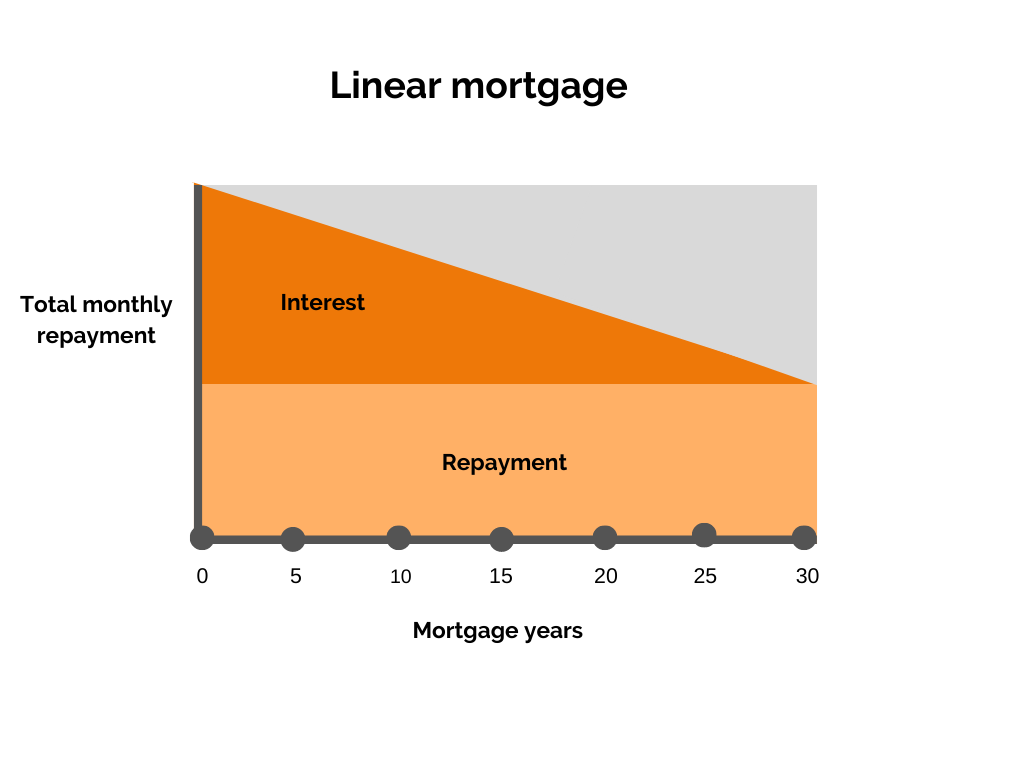
With a linear mortgage (lineaire hypotheek), the amount of debt that you pay remains fixed every month.
On top of the debt, you will also pay interest, which will be the highest at the beginning of the mortgage since you haven’t paid anything back yet.
At the beginning of a linear mortgage, the costs are high, but they will gradually decrease.
This means paying off your mortgage in the Netherlands will probably go fastest if you opt for this kind of mortgage.
A linear mortgage is a very popular mortgage option in the Netherlands. Image: DutchReview
✅ Pros: The total amount paid overall is lower because you pay less interest as you start to pay off the actual sum immediately.
❌ Cons: You pay a higher amount at the beginning of the mortgage (and most of the time, this is the period in your life when you’re making less money because your salary typically increases with age).
Annuity mortgage (annuiteiten hypotheek)
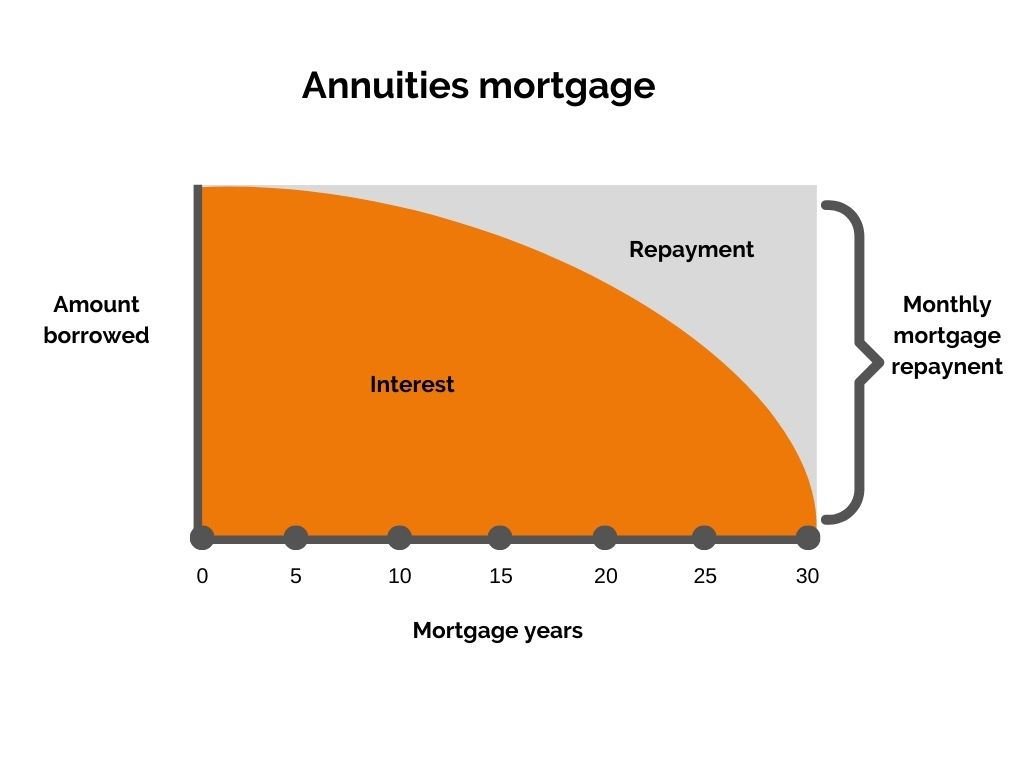
With an annuity mortgage (annuiteiten hypotheek), you will pay the same amount over the whole period of the mortgage.
In the beginning, this amount is mainly interest and only a small part of the loan. Gradually, this changes so that your loan will mainly be repaid at the end of the mortgage.
Another common type of mortgage option in the Netherlands is the annuities mortgage. Image: DutchReview
✅ Pros: You usually have lower monthly payments in the early years of the mortgage period than with a linear mortgage. The high amount of interest can be deducted from taxes, which makes your net monthly cost low at the beginning of the mortgage.
❌ Cons: You will pay more interest, which means you’ll pay more for your whole mortgage compared to a linear mortgage.
If you’ve been planning to buy a house for a while now, you’ve probably come across this complex term called National Mortgage Guarantee a few times. Here in the Netherlands, we like to call it the Nationale Hypotheek Garantie (NHG).
The NHG is a protection against any debt that still stands if you can’t pay your mortgage due to involuntary unemployment, divorce, or the inability to work.
Should anything like this happen, the people at the NHG and your bank will try to find solutions so that you are able to stay in your house (instead of selling it).
A mortgage with the NHG is a great option to consider if you want to get a mortgage in the Netherlands. Image: Freepik
Alternatively, if you do need to sell, the NHG will cover the debt that’s left — this is when the selling price is lower than the mortgage amount due.
The NHG will cost you 0.6% of the mortgage amount in 2024. However, you’ll earn your money back quickly because lenders offer much lower interest rates if you opt for the NHG when sealing the deal on your Dutch mortgage.
It’s not an option for everyone, though. In 2024, the NHG is only available for mortgages in the Netherlands that are a maximum of €435,000.
However, if you want to use your mortgage to make energy-efficient changes to the home, then the NHG maximum is increased to €461,100 in 2024.
Good to know: The 0.6% is tax-deductible!
In short, with the NHG, you’ll pay less per month since the mortgage rate is lower, you’ve got a guarantee for the worst-case scenario, and you can deduct the cost from the taxman.
Want to buy a house in the Netherlands? Here’s where you should start. Image: Freepik
Ok, you’ve read this article, and now you’re thinking: “Hey, maybe I can get a mortgage in the Netherlands, it’s not the distant utopia I first thought!”
So how do you get started? There are two steps that you can take:
Step 1: Get a rough idea of how much you can borrow for a Dutch mortgage.
You can’t be buying a house without knowing your budget! There are plenty of deciding factors that determine your mortgage amount, and often, there’s more possible than you would think.
Step 2: Reach out to a mortgage advisor
Next up, speak with a mortgage advisor to get an idea of your personal situation. A mortgage advisor works with you to find your ideal mortgage, is an intermediary between you and the bank, and helps you with all the steps involved.
When it comes to choosing a mortgage advisor, it’s best to opt for someone who understands the complexities of being an international trying to get a Dutch mortgage.
Have you been through the process of getting a Dutch mortgage? Tell us about your experience in the comments below!