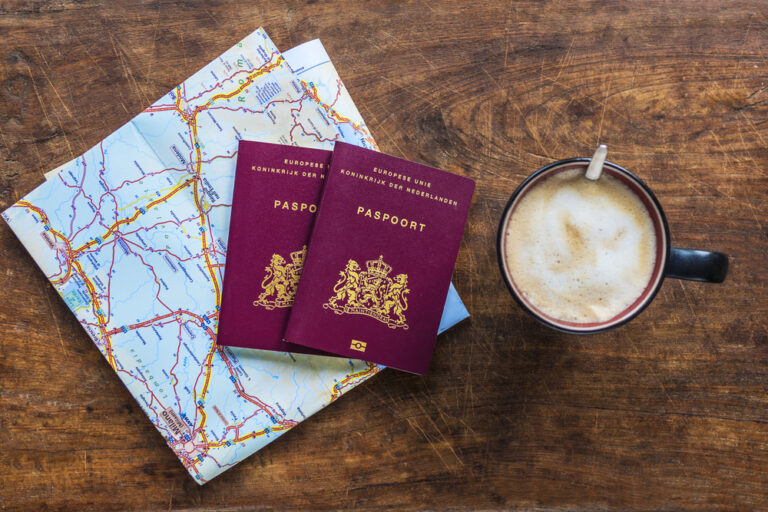
It’s a great day to consider becoming a citizen of the Netherlands. The Dutch passport has been ranked as the fifth most powerful in the world. Jippie! 🥳
The global citizenship and residence advisory firm, Henley & Partners, released its annual passport index — which compares 199 different passports to 227 travel destinations. 🗺️
The Netherlands can enjoy the luxury of having one of the best passports since the Dutchies can travel freely to 188 countries in the world! 🤯
Surprised? Not really
It’s safe to say that the Dutch truly are a spoiled bunch when it comes to travelling with freedom.
In recent years, East Asian countries have snatched more top spots on the list, which used to be dominated quite largely by European countries, reports RTL Nieuws.
At the very bottom, Afghanistan dangles at 112th on the list, giving its citizens access to only 27 countries across the world.
Of course, with European airports (we’re looking at you, Schiphol 😑) being extra dramatic these days, having a powerful passport doesn’t entirely mean folks can travel hassle-free.
Even so, it’s still something to celebrate for those that made the top of the list. 😉
Want to know where your passport stands? Take a look for yourself! 👇
Best passports to hold in 2022
Rank
Country
# Countries
1
Japan
193
2
Singapore, South Korea
192
3
Germany, Spain
190
4
Finland, Italy, Luxembourg
189
5
Austria, Denmark, the Netherlands, Sweden
188
6
France, Ireland, Portugal, United Kingdom
187
7
Belgium, New Zealand, Norway, Switzerland, the U.S.
186
8
Australia, Canada, Czech Republic, Greece, Malta
185
9
Hungary
183
10
Lithuania, Poland, Slovakia
182
Worst passports to hold in 2022
Rank
Country
# Countries
1
Congo, Lebanon, Sri Lanka, Sudan
42
2
Bangladesh, Kosovo, Libya
41
3
North Korea
40
4
Nepal, Palestinian territories
38
5
Somalia
35
6
Yemen
34
7
Pakistan
32
8
Syria
30
9
Iraq
29
10
Afghanistan
27
Did your country make the cut? Tell us in the comments below! 👇
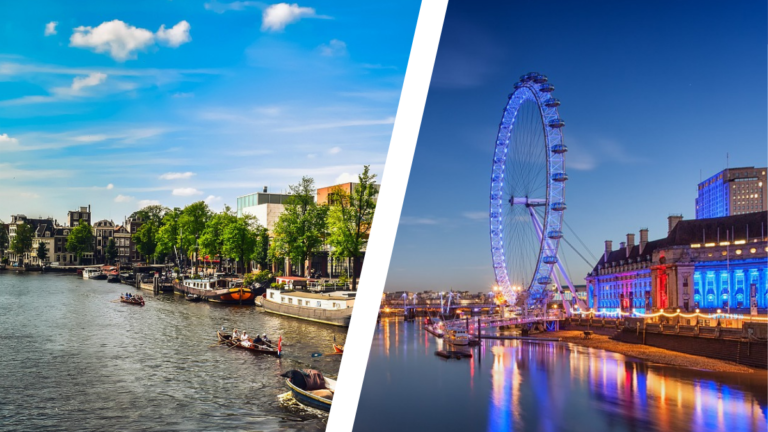
Two renowned yet completely different cities separated by the North Sea. With rave reviews about both, it can be difficult to choose between them. Are you unsure which one you prefer? We got you.
Are you considering a university exchange and are tempted by both metropolises? Or perhaps you are taking a sabbatical and want to make the right choice for this once-in-a-lifetime opportunity.
We are multicultural here at DutchReview, and many of our previous staff have lived in both cities. We’ve covered all bases to present to you the ultimate comparison between Amsterdam and London.
Disclaimer: Please bear in mind that we are comparing averages. There will, of course, be discrepancies based on personal preferences.
Entertainment
→ Winner: London
It’s a little unfair to compare the culture in these two cities given the drastic size difference. London has almost nine times more people and is seven times bigger than Amsterdam, so it’s only natural it has more entertainment. So for this question, we have to assess it relatively.
Museums
English writer Samuel Johnson famously said: “if you’re tired of London, you’re tired of life”. There is so much happening in London that it is hard to believe people ever get bored.
The British Museum gets roughly 5 million visitors a year. By comparison, the Rijksmuseum gets 2.5 million visitors a year. Both are amazing museums and worth a visit.
But where does it differ? Well, in the price 🎟. All the major museums in London are free. Yes, completely FREE. Hear that, Dutchies? By comparison, the Rijksmuseum costs 25 euros per adult.
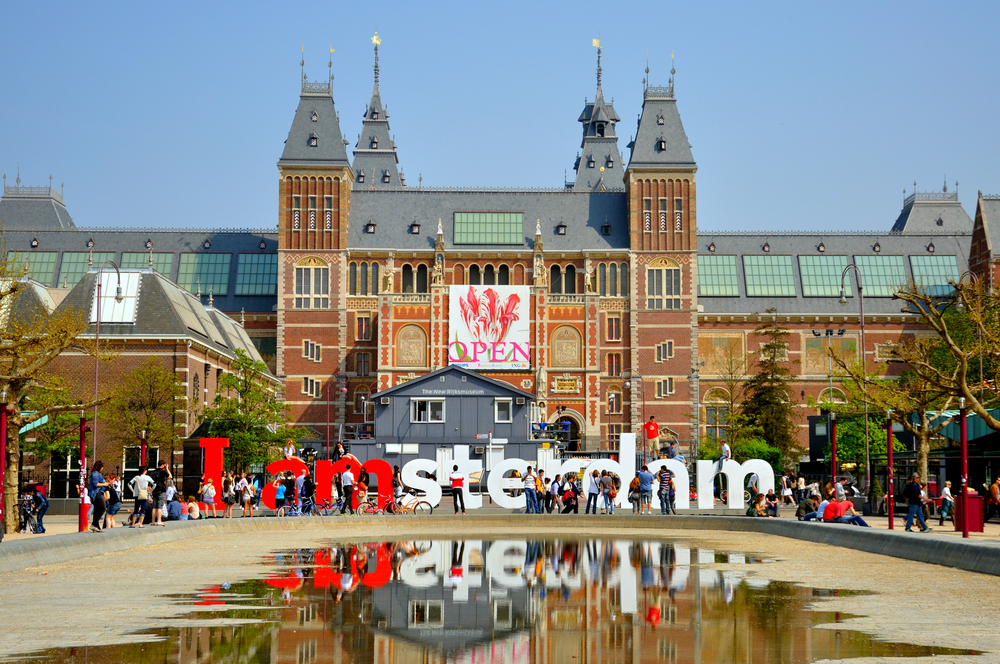
The beautiful Rijksmuseum front. Image: Depositphotos
Cinema and theatre
On average, visiting the cinema in Amsterdam is cheaper. You can get a ticket for around 11 euros in comparison to the 16 pounds you would pay in London. 📽
There is far more variety in London, and all major shows will always visit London. Additionally, both cities have systems to get massive discounts.
In London, head to the TKTS booth in Leicester Square, where discount tickets for a huge selection of London shows are put up for sale every morning.
In Amsterdam, there are some shows but nowhere near the amount in London, and you have to check in advance what shows are performed in English and not Dutch.
Nightlife
London has far more variety, probably due to its sheer size. But what’s certain is that you’re bound to find something that suits everyone’s tastes: electronic music, 80’s themed nights, techno, and blues parties.
There are plentiful clubs in Amsterdam, and thousands of people travel to Amsterdam just for the nightlife alone, a city that’s renowned for its intense clubbing experience in electronic music.
The vibrant clubbing scene of Amsterdam. Image: Unsplash
Amsterdam’s small size works in its favour here as it is relatively easy to visit a few different clubs in one night. Most of the time you could even walk between a few decent clubs with ease — an ideal bar-hopping environment.
London, on the other hand, requires a taxi which makes going out more expensive unless you hit the jackpot and visit a great club the first time around. 🚕
The club scene is awash with cocaine and ecstasy users in both cities. If you are going to try drugs in the Netherlands, make sure you are aware of the different types and the varying effects they have.
Keeping fit
Like to keep fit? Gym memberships are, on average, about 50% cheaper in Amsterdam than in London.
→ Winner: Undecided (depends on personal preference)
Amsterdam is only an eighth of the size of London, with a population of a little over one million squeezing into 219.4 square kilometres.
By comparison, London has 1,572 square kilometres and 8.9 million inhabitants.
That is such a stark difference it deserves an article in and of itself, and it really comes down to personal preference. Do you prefer more anonymity? Or do you love having little areas within a big city?
Both cities are well located geographically with easy access to Europe. You can get from London to Paris in a mere two hours and from London to Amsterdam in four hours. 🚇
Amsterdam is about the same distance from Paris as London, but it is on the European continent, so there is the possibility to drive to other destinations such as Belgium, Germany, and Denmark as opposed to flying or driving much longer distances like you’d need to do from London.
Cost of living
→ Winner: Amsterdam
Food is expensive, eating out is expensive, and rent and housing bills are expensive. Expatisan, a living costs calculator that allows for a comparison between cities, revealed that London is 27% more expensive than Amsterdam.
The prices were updated in October 2021 on the latest exchange rate.
Housing
The cost of living in both cities is very high. I doubt anyone would say either are affordable. Rent is about the same in both cities. For one room in a flatshare, you will pay around 500-1000 euros/pounds in both Amsterdam and London.
This is what we feel like when we have to pay rent in both cities. Image: Pixabay
Food and drink
Amsterdam
London
Beer in a pub
€4.50
£6.50
Sausage roll (Albert Heijn v Greggs)
€1.95
£1.30
Latte
€4
£3
London is the most multicultural city in the world, and it shows in the variety of cuisine. You can access anything your heart desires: Japanese, Mexican, Indian, Moroccan, and the list continues.
Amsterdam is a lot smaller, so it does not have the same selection as London, but nonetheless, it is still a capital city with lots of variety. 🤤
Service is more intense and “Americanised” in London, with fast, friendly staff. Servers in Amsterdam are far more relaxed, and you’ll likely be waiting a lot longer to have your order taken.
Transport
→ Winner: Amsterdam
In London, you can travel with either an Oyster card or your bank card through contactless. In the Netherlands, you can only travel with a designated travel card which is either an OV-chipcard or an NS discount card.
Travelling with contactless on your bank card in London and NS discount card in Amsterdam are both much simpler as you don’t have the faff of topping up a travel card each time the money on your card runs out.
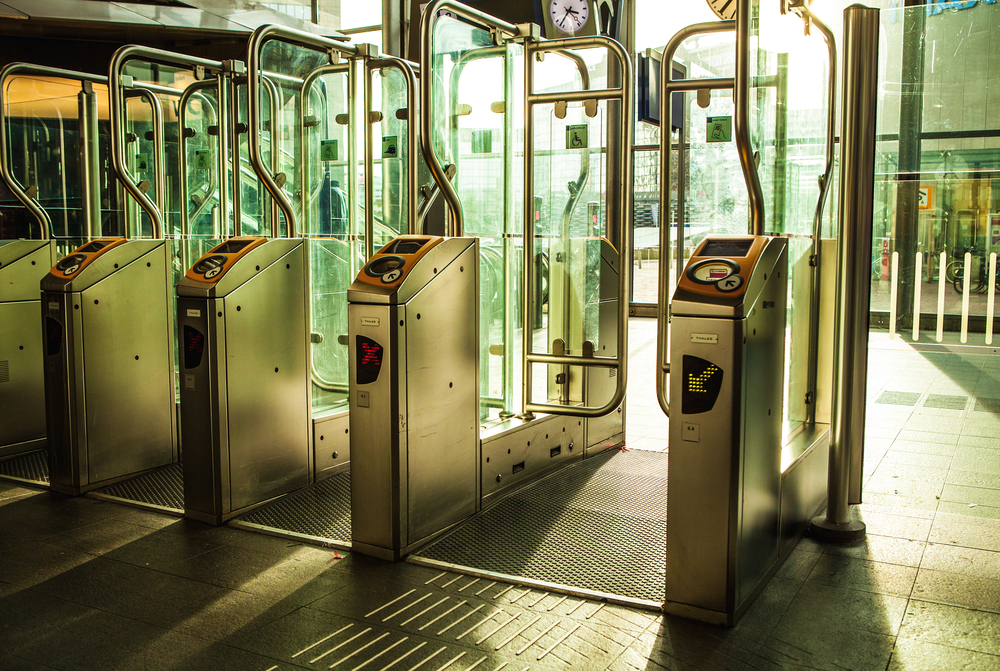
Amsterdam train station entrance, have your card ready! Image: Depositphotos
Amsterdam’s transport network is less extensive than London’s, and a large reason for this is the fact Amsterdam is built on water which limits the underground transport system.
In 2002, construction started on the Amsterdam Zuid-Noord metro line. It was completed 15 years later, but it quickly became evident that Amsterdam’s precarious historical underground was a less stable foundation for the new metro line.
The result? Houses built above it literally began to fall into the earth. Residents were forced from their homes, and even after the line opened ten years later, most of the buildings were still empty.
Cycling
The biggest difference in transport between the two cities is that most people cycle in the Netherlands. Roads have designated cycling paths and Dutch people say they teach their kids how to bike before walking.
Amsterdam is home to more bikes than people and everyone is a prolific cyclist. Need to go to work? Cycle. Need to meet a friend for coffee? Cycle. Bought a sofa and need to transport it to your house? Carry it on your bike.
Need to travel to Spain? Cycle. Well, maybe not this last one, but you get my point. 😆
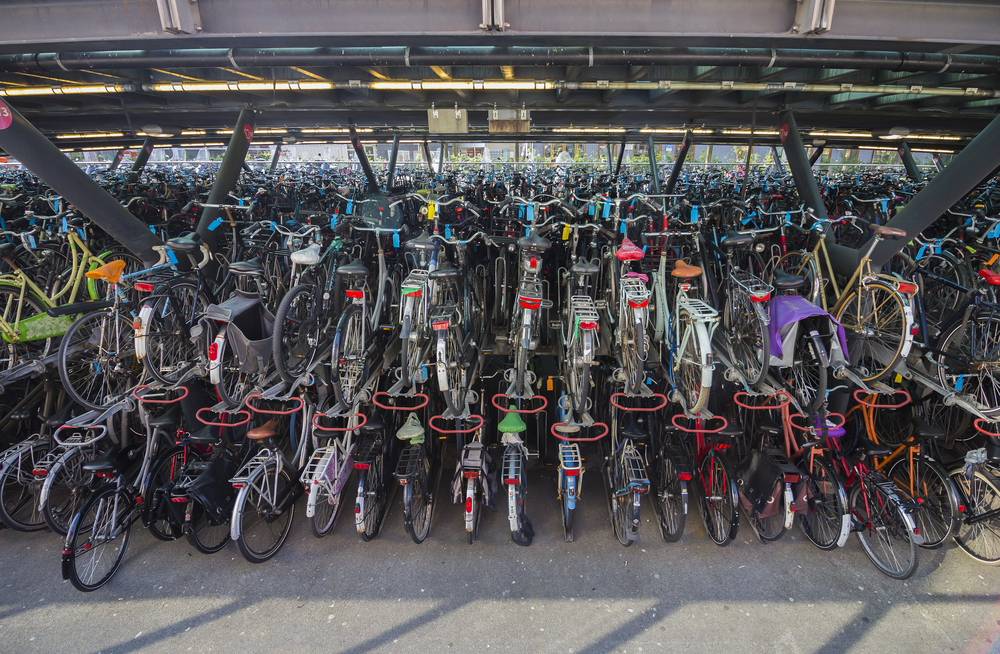
Expect a battle for bike parking in Amsterdam. Image by Depositphotos
It is, of course, possible to cycle in London but far more dangerous as there are not many designated cycling paths and people are not as aware of cyclists.
Weather
→ Winner: London
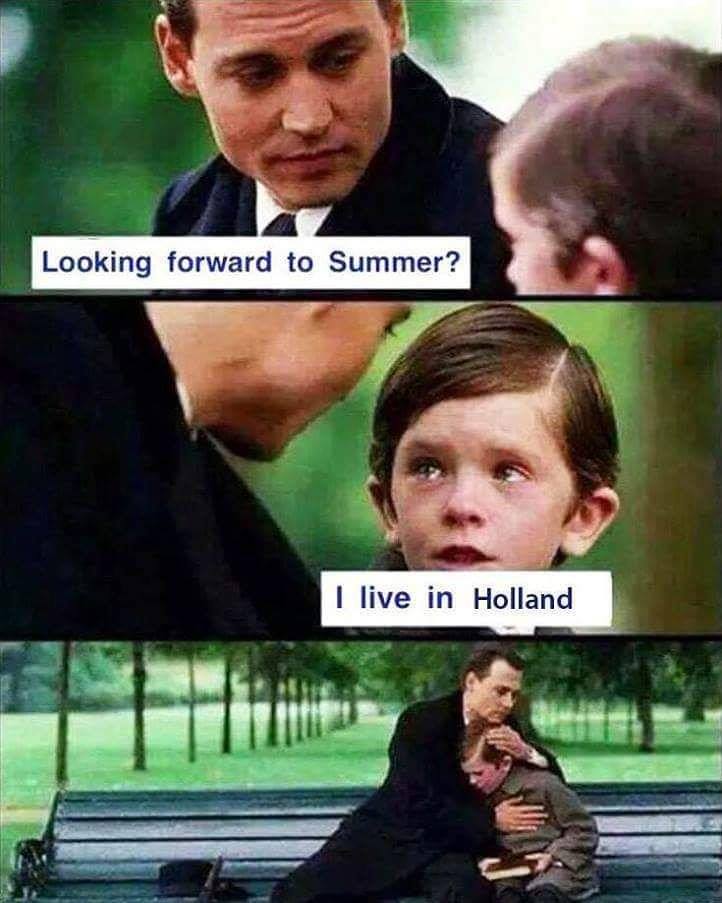
We could summarise Amsterdam’s weather with the following meme:
There, there…
Since Amsterdam is situated very near to the North Sea, cool winds often blow across the Netherlands, generating a ‘moderate maritime climate’ with warm(ish) summers and cold winters.
The weather in Amsterdam is defined by the high precipitation (roughly 840mm/year), meaning there is no real dry season.
The weather in London is somewhat mild in comparison. Summer temperatures usually sit in the mid-twenties, but it is common for London to experience temperatures well above 30°C. London. London gets about 156.2 rainy days a year (557.4mm).
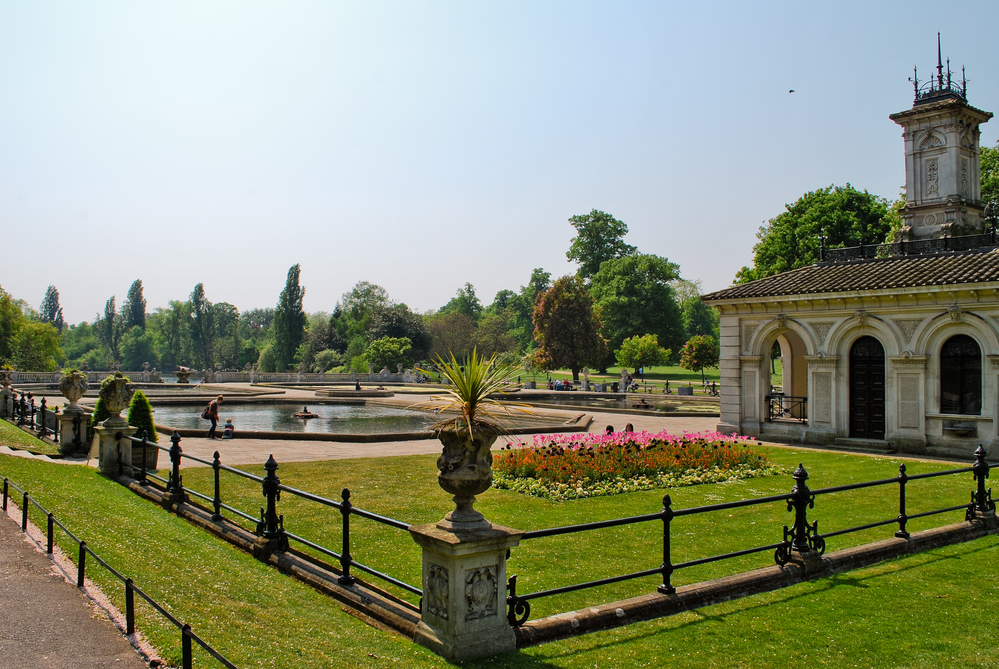
A scene from Hyde Park, London. Image: Depositphotos
Salary
→ Winner: London
People who work in London usually earn more than their Amsterdam counterparts. The average net salary in London is £1,982 (2,804 euro), and the average monthly salary in Amsterdam is about £2,620 (€3083,3). That’s a difference of around 14%. 💰
Expat culture
→ Winner: Undecided
Language
In most cities, talking about the fact that English isn’t a country’s native language would need to be addressed, but there’s almost no point when it comes to the Netherlands (or London, for that matter).
For the last few years, the Netherlands has competed with Sweden for the number one ranking on the EF English Proficiency Index. As it currently stands, the Netherlands is ranked first. 🏆
However, to truly assimilate, it is important to learn Dutch. It will help with integration and work opportunities. It is not the easiest language to learn, but many people have successfully done it.
Healthcare
Both cities have a public healthcare system, called the ‘NHS’ (National Health Service) in Britain and just ‘healthcare’ in the Netherlands.
But anyone who works in the Netherlands needs to pay a compulsory €100+ per month for health insurance. Without that, you will need to pay the full whack of everything from GP visits to surgeries. 💊
Some people from Europe living in the Netherlands try and avoid paying for Dutch health insurance by relying on their European Health Insurance Card instead.
This works if you are travelling but if you are working and earning in the Netherlands, paying a monthly health insurance policy is mandatory.
EU, EEA, or Swiss nationals who are working in the Netherlands must get Dutch health insurance within four months of registering at the city hall.
Integration into society
A Reddit thread asking people to compare experiences of living in both Amsterdam and London gleaned insight into the exclusivity of Amsterdam.
One user commented that “Amsterdam feels provincial, and the mindset of the people reflects it. It’s not multicultural at all, and there’s a huge gap between Dutch people and expats because of the language. There are things I miss (Albert Heijn! 🛒), and I can objectively say that quality of life is better in Amsterdam, and I think, in general, things work better in the NL. But the city lacks the energy and opportunities that London has to offer, and I wouldn’t move back for anyone.”
Another user commented, “Amsterdam is certainly more relaxed and laid-back than London; the pace of life is slower, and people are less rushed and busy and take more time to enjoy the little pleasures of life.”
Which city is safer?
→ Winner: Amsterdam
According to the latest report by Economist Intelligence Unit (EIU), Amsterdam is one of the safest cities in Europe. By comparison, London didn’t make it to the top five in the same report.
The report included 60 cities around the world and analysed 76 indicators contained within four types of safety. These four main categories were digital, infrastructure, health, and personal security.
Like anything, at the end of the day, it comes down to personal preference. Both Amsterdam and London are bustling capital cities with incredibly appealing aspects and huge variety. London has more to offer and more going on, just by the sheer size of it but Amsterdam, for such a small capital, does pretty darn well.
What do you think of the Amsterdam vs London debate? Tell us in the comments below!
A group of students in Eindhoven have developed a car that captures more C02 than it produces — and can even turn the captured C02 back into energy.
You’ve heard of cars that are “not that bad”, but a car that’s actually good for the environment, no way, right? Until now.
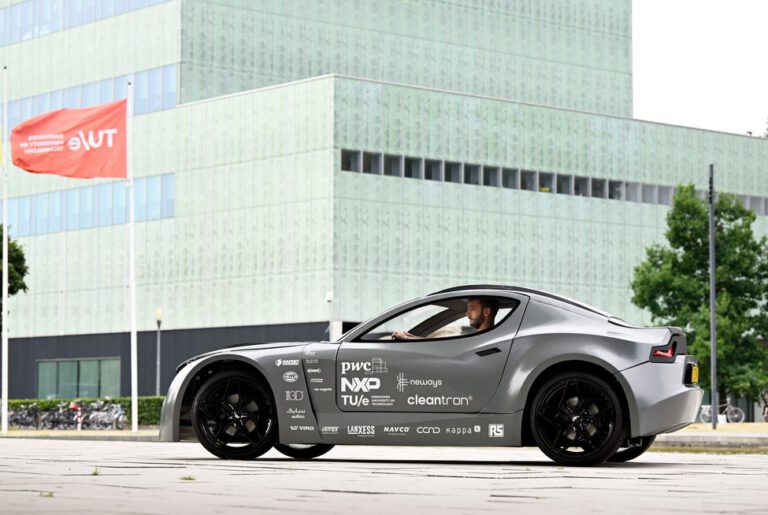
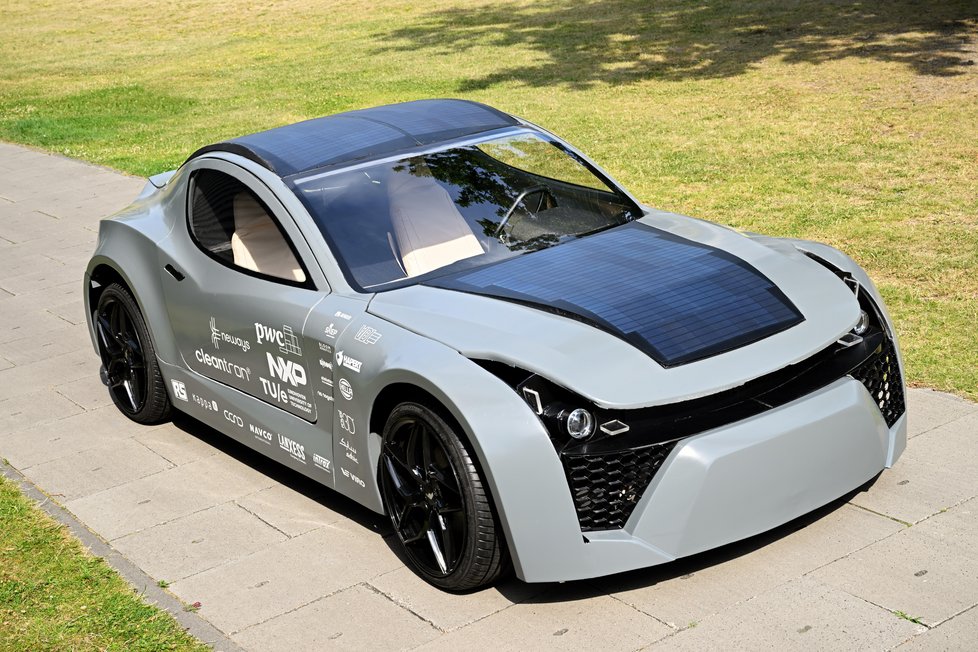
The car was designed by the student team TU/Eco-motive from the Eindhoven University of Technology. Called “Zem”, it features a filter in front, which collects C02 as you drive around (much like this Dutch bike invention).
Now, the students are in the process of applying for a patent for their invention — understandably enough!
Unique filter
The special C02 filter makes the car unique in the world, although the students claim to have been greatly inspired by the Dutch Lightyear One car, which also has its roots at the Eindhoven University of Technology.
After driving 20,000 kilometres, the car will have captured about two kilograms of C02. It might not sound too baffling, but it’s still a major step in the direction of sustainable transport.
It took the group of 35 students only 10 months to develop the C02-capturing car, and they now plan on extending the project to improve the current prototype next year.
Emission-free goals
The group has many goals for the next year. First, they want to make the entire production process of the car entirely emissions-free, “including construction, manufacturing, and demolition,” says team manager Louise de Laat.
Then, once the C02 filter is full (after about 320 kilometres), the aim is for the driver to remove it and clean it at a special charging station. Ideally, the captured C02 will then be turned into electricity.
Who would mind cruising around in this? Image: TU Eindhoven
The team is currently in the process of developing and pitching their prototype of the C02 filter charging station to manufacturers.
No need for the whole car
It all sounds good on paper, but what if you can’t afford a whole new car but want to be more environmentally friendly? That’s the cool part: the car itself isn’t that important.
The most important part is, of course, the filter.
That’s why the students are currently looking into how they can produce the filter alone and place them in already existing/old cars.
Their goal is to have C02-capture filters installed in every car as a basic part of everyday transportation. Sounds great!
Will you try out this car if it hits the market? Tell us in the comments below!
Sure, the Netherlands is known for its popular cycling culture, but sustainable transport doesn’t stop there — it’s also got the most electric-car charging points in all of Europe! ⚡️
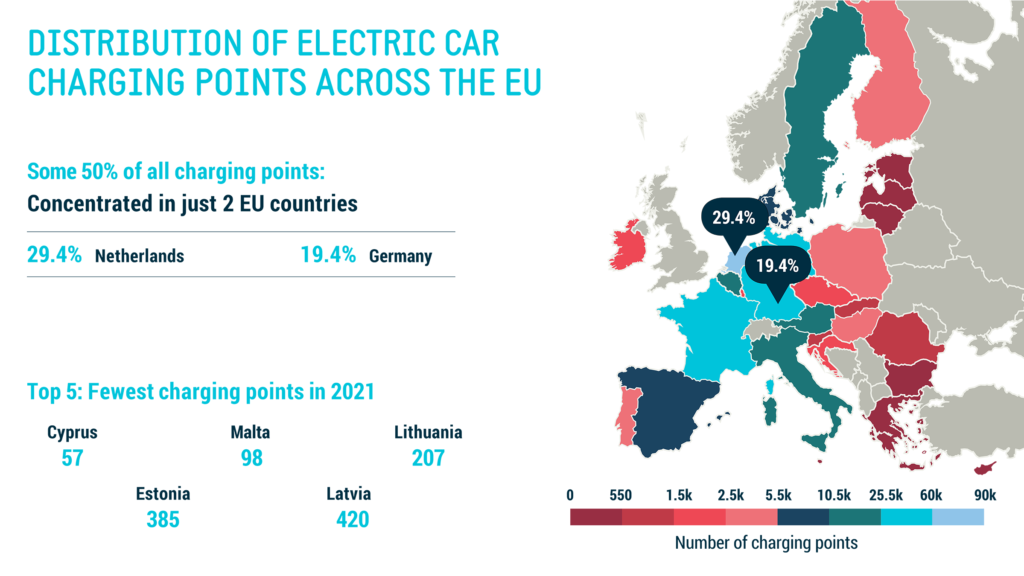
According to recent data by the European Automobile Manufacturers’ Association (ACEA), the Netherlands and Germany boast half of all charging points for electric cars in the European Union.
With 90,000 chargers for the Dutch and 60,000 for the Germans, perhaps the two countries will learn to appreciate each other more over their shared sustainable developments!
The Netherlands is a small country compared to most of its EU counterparts. But, it still holds the most electric-car charging infrastructure, with 29% of all charging points in Europe. 🤯
Though, there’s a large gap between the countries that have the most charging points and those which have the least.
The Netherlands and Germany have almost 50% of all charging points in Europe. Image: ACEA
Cyprus, the country with the least infrastructure with just 57 charging points, has 1,600 times fewer charging points than the Netherlands. 🤔
The gap is especially apparent between western and eastern EU countries, which have a clear divide when it comes to electric-car charging infrastructure.
For example, Romania (which is about six times larger than the Netherlands) only possesses 0.4% of all the EU’s charging points.
How do other countries rank?
Countries with the most chargers
Netherlands (90,284)
Germany (59,410)
France (37,128)
Sweden (25,197)
Italy (23,543)
Countries with the least amount of chargers
Cyprus (57)
Malta (98)
Lithuania (207)
Estonia (385)
Latvia (420)
Did your country make it to the list? Is it in the top or bottom half? Tell us in the comments below!
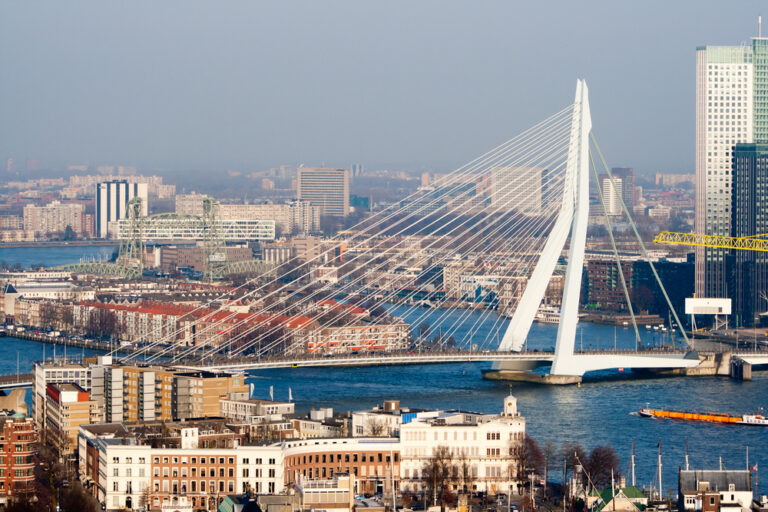
A water taxi and a huge riverboat have collided under the Erasmus Bridge in Rotterdam causing the water taxi to become completely submerged under the huge tour boat.
After the incident, six people have been rescued from the water by emergency services which were deployed en masse, reports the NOS.
Dramatic footage shows the water taxi cruising diagonally into the path of the tour boat and then being pushed underneath the water’s surface:
Those who were rescued were all aboard the water taxi, including the boat’s skipper. However, the condition of all the victims is still yet to be disclosed to the public.
Imagine this scenario: a lost dolphin finds its way to a beach you’re swimming in. Do you help it find its course? Well, this lady had other plans. 🤦♀️
After the long-beaked dolphin suddenly started swimming between people at the beach in Zandvoort, many tried to help it by leading it back into the sea. 🐬
Yet, once it started heading back into deeper waters, a woman grabbed the animal and tried climbing on its back. 🙄
Gestoorde vrouw klimt in Zandvoort op spitsneusdolfijn, terwijl de dolfijn eerder door anderen teruggeduwd werd in de zee. Het dier had daar door kunnen overlijden. pic.twitter.com/fX6M6vda1g
In the video, Dutch bystanders criticised the woman and told her to “doe normaal” (act normal!), so she could stop whatever she was trying to do.
Reported to the police
Since then, the woman has reported herself to the police, who will determine whether or not she’s committed a criminal offence.
The police have opened an investigation and explained that they will talk with her about what happened, reports RTL Nieuws.
Dolphins shouldn’t be in the North Sea
SOS Dolfijn — a rescue organisation — called the dolphin’s presence very disturbing. They don’t survive well in these environments and can easily strand themselves in the shallows.
Annemarie van den Berg at SOS Dolfijn told RTL Nieuws, “If they end up in the North Sea, they get into trouble. These animals do not survive well in these types of waters. They look for food at a depth of two to three kilometres.”
How do you feel about the woman’s behaviour? A simple joke or a dumb mistake? Tell us in the comments below!
Three cruise ships will soon become the temporary home of asylum seekers in the Netherlands, says State Secretary Eric van der Burg.
But the plan is not exactly problem free. 🙄
As you’ve probably heard a few times already, the Netherlands has struggled to deal with the number of asylum seekers arriving for a while now, and the Dutch government has labelled the current situation as an asylum crisis.
The situation has made them pretty desperate to find alternative ways to host those seeking a better life.
Unsure about the specifics
The state secretary could not tell RTL Nieuws where the vacation vehicles will be stationed, but he seemed very sure about the fact that (at least) one out of three ships will arrive in August.
That’s some information, at least, but the creative plan does give off a slightly chaotic vibe. 🤔
It’s still unclear (or at least unknown to the public) where the ships will be located, so we’ll be holding our collective breath in anticipation of more definitive information.
However, the plan to receive three cruise ships to help with managing asylum seekers may not have Dutch people’s support.
The municipality of Vlissingen was initially in favour of the solution but withdrew its decision upon stark resistance from local residents. 🤐
Ukrainian refugees most popular
Due to the overpopulation of many asylum centres, the government is trying many new tactics for distributing people across the country.
One new development this year has been that certain municipalities are open to hosting Ukrainian refugees, but not other nationalities (how charming). 👌🏽
Therefore, the government is considering options for placing Ukrainian refugees in municipalities where they are particularly welcome and thereby freeing up space in other parts of the country (where they don’t care as much about the nationality of those in need).
If you think this attitude sounds a bit iffy, you might be relieved to hear that municipalities soon will be obliged to cooperate with the national government’s asylum policies, whether they like it or not. A new law is in the making, which hopefully will make the whole thing a bit more streamlined. 😎
What do you think of the Dutch solution to host asylum seekers on cruise ships? Tell us in the comments below!
Famous TV presenter Frank Masmeijer has been granted a royal pardon by the Dutch king, cutting short his 2014 prison sentence for cocaine trafficking, by 1.5 years.
One of the perks of being king of the Netherlands is that (in addition to the fancy clothes and good food) you’re allowed to pardon people you don’t think should be locked up.
And, well, our very own Willy-boy has made use of his royal privilege in a rather strange way this time. 😅
Confessed involvement
A whopping 467 kilos of cocaine sounds like quite the lucrative deal, and Masmeijer clearly agreed. He allegedly took part in a smuggling attempt from Colombia to Antwerp in 2014.
After denying everything for about four years, the former TV host finally admitted that he’d been involved to a “limited” extent — whatever that means. 🤷🏽♀️
Royal pardon — but why?
Eight long years later, the 60-year-old Dutchman received some lovely news: our dear Willem-Alexander has ordered to have him pardoned.
Meaning Masmeijer will be a free man a baffling 1.5 years before he was supposed to be! 🙄💅🏽
Does Willy have some special information that’s been hidden from the public? Does he hate law and order? Or does he simply have an (until now) unknown admiration for failed drug smugglers?
Whatever the reason might be, nobody seems to be sure what the Dutch king based his pardon on.
Mesmeijer himself even stated that he was unaware of the possibility of a pardon because his lawyers viewed the chance of him getting one as being close to zero.
Although Mesmeijer and his team are probably jumping with excitement right now, not everyone’s happy with the decision.
The Dutch Police Association have made their dissatisfaction clear and would very much like to get an explanation for the king’s choice.
Sooo, Willem-Alexander either has to conjure up a really good excuse or accept the fact that this episode will be added to his long list of embarrassing blunders. 🤴🏽
It’s not the King, but the minister who actually decides
But the Netherlands isn’t an old-school Disney monarchy, so ultimately the King decides very little himself.
With this pardon, a request is first put before the court and the prosecutor, who can give their advice about it, and the advice of the court is then leading (in this case, the prosecutor actually advised negatively about granting the pardon).
The minister of legal protection (Franc Weerwind) then decides upon it, before the King ultimately needs to sign off on it, which he will theoretically do every time.
What do you think about the Dutch king’s use of the royal pardon? Tell us in the comments below!
We all know the feeling of being handed a task and thinking “yikes, I don’t know if I can do this.” Now imagine that you’re a seven-year-old who has just been handed the steering wheel of a Ferrari.
A Dutch man has been sentenced to four weeks in prison and given a three-year driving ban after letting his seven-year-old child take the wheel of his Ferrari.
While being investigated for other crimes, footage on the father’s phone was retrieved which showed his son sitting behind the wheel of the expensive sports car, Quote reports.
A need for speed
And no, the car was not stationary. In fact, it was far from it since the footage which showed the speedometer read 225 kilometres per hour (!).
There’s no doubt of the reading’s accuracy either, as the footage shows cars being overtaken at a great speed outside the window.
Picture this: an obnoxious Ferrari overtakes you on the motorway, you turn to give them a death glare (and perhaps a middle finger), and — oop — it’s a child.
Not his first rodeo
Other footage revealed that the young driver was more than a little familiar with automobiles.
In fact, he also had experience driving tractors and trucks — driving through red lights in some cases.
While the father was being investigated in relation to a drug case, the Public Prosecution Service decided that he also needed to face consequences for creating a baby driver. 👦
Are four weeks enough of punishment? Tell us your thoughts in the comments below!
What did you do on the hottest day of the year? A dip in the pool? A trip to the beach? Well, this Dutch man decided to cook some kroketten in his car — we guess you could call that a Dutch oven. 😉
Mark van der Molen, a Dutch television presenter, took his culinary adventures to Twitter yesterday as he documented himself cooking the Dutch delicacy on his car dashboard. 🧆
“Why would he do that?” you may ask. Well, it was simply to show others how powerful the sun can be, especially if you’re sitting in a scorching hot car all day.
Om iedereen te waarschuwen voor de gevaren van de zon en vooral wat gebeurt met een hond in je auto, ga ik timen hoe lang het duurt om een dikke ovenkroket te bakken op het dashboard van m’n auto. Stay tuned 🥲 pic.twitter.com/yRVtREf7nk
His tweet reads: “To warn everyone about the dangers of the sun and especially what happens to a dog in your car, I’m going to time how long it takes to bake a thick oven kroketten on the dashboard of my car. stay tuned 🥲”
Update na 42 minuten. De kernthermometer (het computertje zeg maar) is oververhit en uit 😂 de kroket nog zacht, wel warm aan het worden pic.twitter.com/jFNRrNEtDq
After letting the kroketten sit on his dashboard for 42 minutes, Mark van der Molen tweeted that the core thermometer he used to measure the temperature started to overheat. 🥵
Though, things are starting to look up for Mark as his kroketten’s core temperatures eventually started to warm up a bit. It’s ventures like these that give the Dutch their innovative name. 😆
Mark’s kroketten were finally ready to eat after cooking for two hours and 12 minutes! While we haven’t had a taste, it sure seems like Mark enjoyed eating them, regardless of the long wait! 😋
Would you cook a dashboard-cooked croquette? Tell us in the comments below!