At the EU summit on Thursday, outgoing Prime Minister Mark Rutte condemned Hungary’s new anti-gay law and challenged the country to start the process of leaving the EU.
In response to Hungary’s new anti-gay law which prohibits those under 18 from being exposed to content relating to homosexuality, Mark Rutte has criticized the country, saying, “they have no business in the EU for me”, reports Nu.nl.
According to insiders, during a heated discussion about the rights of the LGBTQIA+ community, Rutte asked Hungarian Prime Minister Viktor Orbán why he does not use Article 50 of the EU treaty to terminate his country’s membership, if he does not want to meet the standards and values of the union.
This is the article that the United Kingdom used to begin the the Brexit procedure in March 2017.
Support from other EU leaders
Rutte found support amongst many other EU leaders who also condemned Hungary’s new law. Before the leaders met in Brussels, seventeen of them had already announced where they stand — declaring themselves in favour of LGBTQIA+ rights and promising to fight against discrimination.
Many of the leaders were moved by Luxembourg Prime Minister, Xavier Bettel’s personal story — he himself is married to a man. According to Rutte,”Everyone had tears in their eyes.” Nevertheless, Orbán received support from allies Poland and Slovenia.
What does the law entail?
Hungary’s parliament has just passed a new anti-gay law, which, among other things, prohibits exposure of content relating to homosexuality to be shown to people under the age of 18. As a result, series and films in which gay people appear will no longer be broadcast on TV before 11 PM — goodbye Modern Family!
Even more concerning, schools will be prohibited from providing information about homosexuality and transgenderism.
A war of words
Responding to the firestorm directed at Hungary, the country’s Justice Minister, Judit Varga tweeted that this is “nothing more than a new episode in the blackmail series”. She added that “Hungary does not want to leave the EU. On the contrary, we want to save her from hypocrites.”
What are your thoughts on this row? Tell us in the comments below!
Taking a holiday from the Netherlands just became a whole lot easier, after the European Centre for Disease Prevention and Control (ECDP) reclassified the Netherlands travel advisory to orange.
Every week, the ECDP publishes a map of Europe indicating the coronavirus situation in each country. It works as a sort of policy recommendation for EU countries so that Europe can have a common approach to travel restrictions.
Since yesterday, the Netherlands is no longer one of the few red spots on the map — hoera! 🥳
Fewer travel restrictions
Going from red to orange (and in Friesland and Groningen even green) means that there’ll most likely be fewer travel restrictions for people embarking on holiday from the Netherlands (yay!).
The colour change is great news if you’ve been itching to travel but have held off on your trip — perhaps restrictions wouldn’t allow travelling or maybe the prospect of quarantining for half the vacay was enough to make you think twice about the costs of those plane tickets. 😬
Nederland gaat van rood 🔴 naar oranje 🟠. Doordat besmettingen flink zijn gedaald, staan Friesland en Groningen zelfs op groen 🟢. De kaart van @ECDC_EU wordt sowieso steeds groener. Dat betekent dus minder verplichtingen als we reizen binnen Europa. 👉 https://t.co/XJ8O26nKtepic.twitter.com/CfdJRsFDPi
Outgoing Minister of Health, Hugo de Jonge, is also happy about the Dutch colour change. He says a greener map means less restrictions when traveling within Europe.
Orientate yourself before traveling
The ECDC map is not binding advice, so just because the Netherlands is now orange doesn’t mean that other countries have to welcome tourists without any restrictions. While EU countries have agreed to follow the ECDC guidelines as much as possible, it’s still up to each country’s government to decide which restrictions, if any, they want in place.
So, before you pack your sunhat and rush to the airport, make sure to check which travel restrictions apply to your destination.
Will you be traveling this summer? Tell us in the comments below!
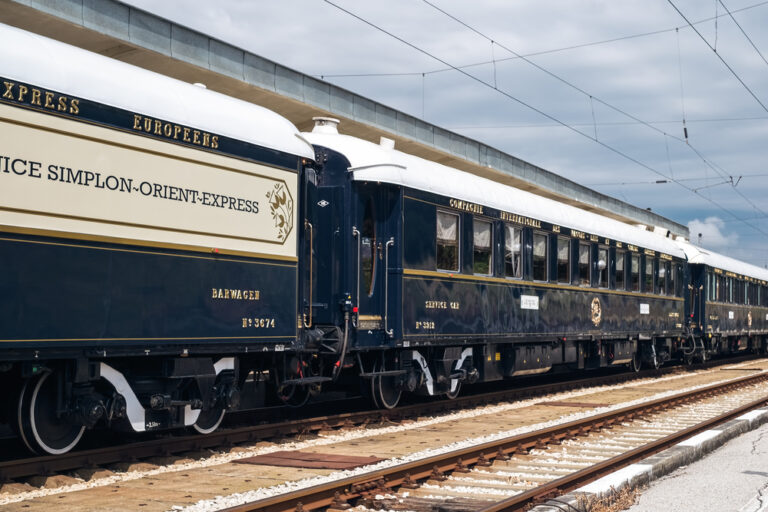
Late on Tuesday night, the Orient Express arrived in the Netherlands for the first time. As one of the world’s most luxurious trains, hitching a ride on this beauty is quite a costly feat — this shows in the number of passengers that were on board.
The Venice Simplon Orient Express is one of the most luxurious trains in the world. According to Treinreiziger.nl, this posh beauty will be passing through the Netherlands once a year from 2021 onwards.
Not something for normal people
The Orient Express is all about the experience. With cabins costing anywhere from €3,000 per person, to €25,000 for a cabin, one thing’s for sure — this is way too expensive for normal people like us. Unless of course you win the lottery or mortgage your house.
The train has a rich and vivid history
If you do have €25,000 to drop, there’s a strong chance that you end up in the almost one hundred-year-old sleeper car 3309. Built in 1926, over the years this carriage has set the scene for many dramatic events.
In February 1929, the train got stuck in an avalanche 60 miles from Istanbul for 10 days. This incident was the inspiration for Agatha Christie’s most famous novel, “Murder on the Orient Express.”
Meanwhile, in 1940, King Carol of Romania used the train to flee the country with his mistress — saucy!
All about luxury
As we know already, the train is very exclusive. Its 17 carriages usually only accommodate 156 passengers. However, due to coronavirus that number is currently limited to 92 passengers, explains Pascal Deyrolle the General Manager.
The train also has 45 permanent employees. According to Deyrolle, this “is no different during COVID-19.” He says, “We all need them” as each carriage has its own steward, and the trains needs technicians and cooks.
The Venice Simplon also has three dining carriages and a bar car — that really puts the frikandelbroodje we bought for our train ride to shame.
It’s all about being the biggest and best
Thanks to its 17 carriages, the Venice Simplon Orient Express is also one of the longest trains in Europe. At more than 400 metres long, it’s longer than the Eurostar! The train is the longest length that can possibly be allowed according to European regulations.
All this hype and only ten passengers
There were only ten passengers aboard when the train arrived in the Netherlands late on Tuesday night.
Initially there had been more passengers on board but many got off in Brussels as the train was delayed by five and a half hours due to bad weather conditions in the Alps — the horror of an extra few hours in such a luxurious setting!
The train departed the Netherlands this morning at 9:27 AM. Currently the luxury train’s main route is London-Paris-Venice, but the train also visits Budapest, Prague, and Istanbul from time to time. The operators also say that they are open to expanding the number of destinations “if there is demand for it” explains Deyrolle.
We’ll be drooling as we read this news from our second class NS carriage — oh to be rich and famous.
Would you save up for a trip on the Orient Express? Tell us in the comments below!
Thinking of buying a house in Rotterdam? We’re glad to hear that. This unique Dutch city is still nicely affordable when it comes to your house hunt. Of course, there are important decisions you need to make before you bite the bullet and make that bid.
There’s a lot to think about when you make the decision to settle down and find a home for you — but most important is the future. After all, you’ll likely be sticking around for a while.
Luckily, Rotterdam is exactly the place to be when it comes to this. With its upcoming neighbourhoods, new developments, and forward thinking architecture, your future will be well catered to. Here are four things for you to consider before you buy in Rotterdam.
There are dozens of snazzy new developments on the way
Following the bombing of 1940, Rotterdam had to focus on rebuilding itself — a mindset that never left. The city is constantly coming up with new developments.
Rotterdam is a city in constant flux. Image: Unsplash
Rijnhaven
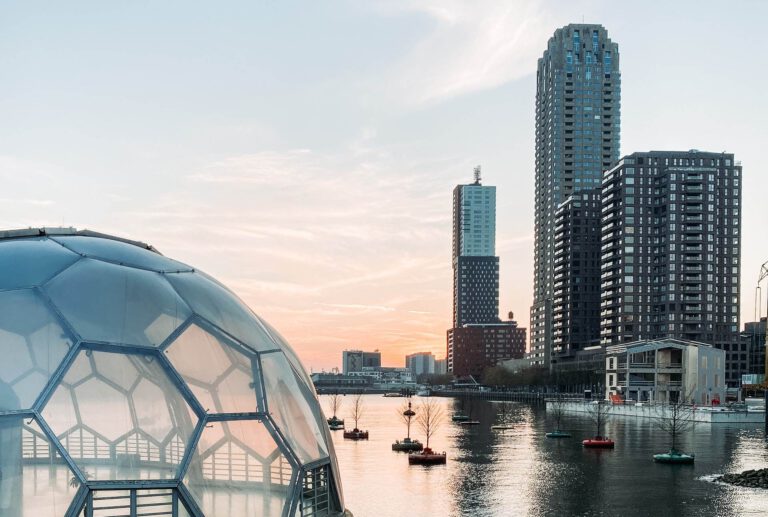
The masterminds of Dutch engineering are transforming one-third of the water in Rijnhaven into a space with greenery and new housing, creating a new hub on the south bank of the river. Fancy a home in a floating park? This is the place to be!
Codrico factory site
Neighbouring Rijnhaven, the area of Katendrecht has already undergone significant changes in recent years. However, the transformation is not nearly done yet — the former Codrico factory site is currently being remodelled to become the heart of Rotterdam South.
Future residents can look forward to a bustling area with offices, shops, plenty of culture, and a 220 metres high building with 1,500 new homes.
Coolhaven Little C
Little C is a brand new complex with 330 loft homes and business spaces inspired by New York City (Rotterdammers like that city as you can understand). It’s located right next to the Erasmus MC and close to the Euromast.
With rooftop gardens, green waterfront, and numerous small shops, living in Little C is basically like living in your own small village within the big city.
Tree House
Ever dreamt of living in a tree house? Your dream may come true in 2025 when Rotterdam’s own version of a tree house opens its doors. Inspired by the ecosystem of a tree, this unique building is conveniently located right next to the central station, making it the perfect home for commuters.
The New North
Over 5,000 new affordable apartments and vast stretches of greenery instead of an ugly grey highway? That is exactly what the project Het Nieuwe Noorden is about. For now, this ambitious plan is just that — a plan. However, the Rotterdam city council is expected to vote on it before summer 2021. Fingers crossed that this initiative goes ahead! 🤞
And plenty of high rises to choose from
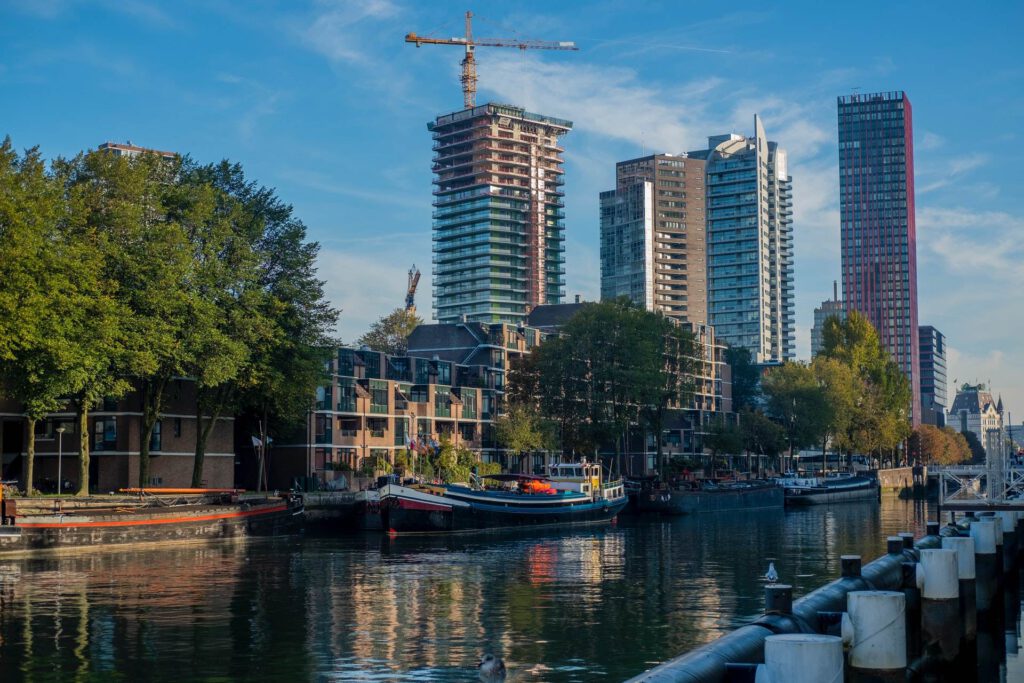
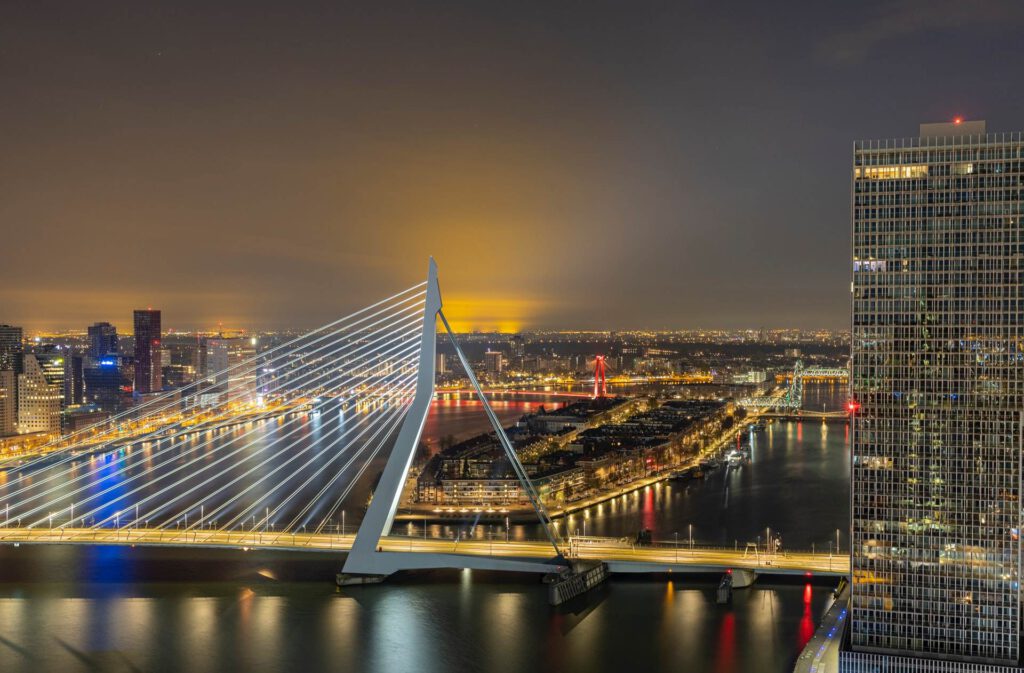
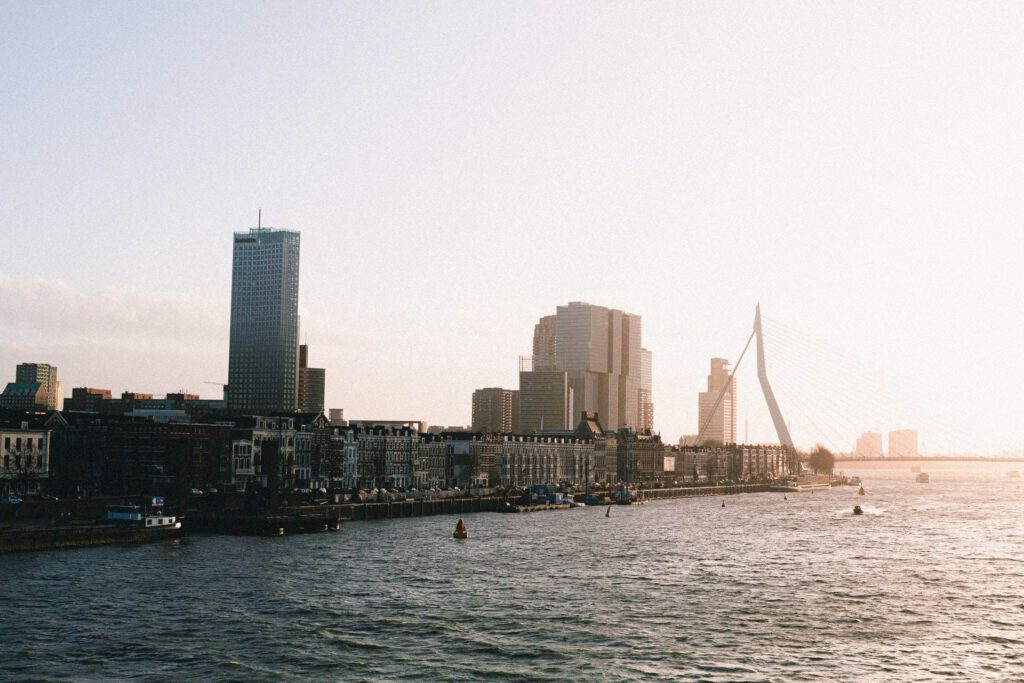
What makes Rotterdam really stand out (quite literally) from its Randstad counterparts is the city’s un-Dutch skyline — the city has many high rises to choose from!
Rotterdam’s skyline is very different from other Dutch cities. Image: Gerard Lakerveld/Unsplash
De Zalmhaven
If you’re keen to live in a high rise, why not just go for the (soon-to-be) tallest building in the Netherlands? It’s located right at the bank of the river Maas, offering its future residents gorgeous views of the city — especially if you end up living on the top floor which is more than 200 metres above the ground.
Montevideo & New Orleans
Right in the glamorous neighbourhood of Kop van Zuid — standing 43 and 44 storeys high — are the second and third tallest buildings in the Netherlands.
The area is also a cultural hotspot with the Nederlands Fotomuseum, LantarenVenster, and Nieuwe Luxor Theater.
These are the best upcoming neighbourhoods in Rotterdam
Rotterdam is a city that’s growing in popularity, and its rapidly transforming neighbourhoods are a testament to that. While urban redevelopment goes hand in hand with sky-rocketing property prices, there are a few neighbourhoods in the city where the prices have not yet caught up with their popularity — meaning you’ll likely get more bang for your buck.
Feijenoord
The neighbourhood of Feijenoord lies north of the actual Feyenoord football stadium. A rapidly gentrifying area with numerous new housing developments on the way, it offers one of the top locations in the city.
It’s surrounded by other vibrant neighbourhoods such as Katendrecht and the city centre is just a stone’s throw away — all of this for prices that don’t leave your bank account completely plundered.
Feijenoord may not have 3D-printed homes like Eindhoven does but it has something even better — an entire floating street. So if you’re looking to invest your money into something really unique, this is it.
Oh and in case you’re wondering, things around this neighborhood might change in the future with the possible building of a new Feyenoord stadium and the so-called Feyenoord City neighborhood — which would be a massive new development for Rotterdam South.
Charlois
Charlois hasn’t always had the best reputation. Shunned as the “wild west” of Rotterdam in the past, the neighbourhood is now experiencing an ultimate revival — and so are its housing prices. However, if you’re after something more spacious, maybe even with a garden, this is the neighbourhood to look into.
The neighbourhood offers everything from charming village-like corners of Oud Charlois to the more modern streets of Carnisse, conveniently located close to Zuidplein. However, the best thing about Charlois is its close proximity to the Zuiderpark — one of the biggest city parks in the Netherlands.
Rotterdam West
If you’re looking for a diverse multicultural neighbourhood with buildings that survived the bombing of 1940, then Rotterdam West is for you. One of the most varied areas in the city, it offers bustling streets with bars and cafés such as the Nieuwe Binnenweg, as well as greenery for a laid back afternoon such as the popular Het Park.
Luckily for you, the neighbourhood’s close proximity to the city centre doesn’t necessarily always correlate with higher real estate prices. While this is not the area to look for a large family house with a big garden, you may be able to find some nice affordable apartments.
North Rotterdam
This up-and-coming neighbourhood of Rotterdam Noord is definitely something to look into for the creative souls among you. One of the area’s main highlights is the Hofbogen — a former railway viaduct transformed into a two kilometre long hub for creative entrepreneurs and a place for Rotterdammers to enjoy the sun.There are even plans to transform this railway into a New York style highline park!
You need to think about the water levels before you buy in Rotterdam
Housing in Rotterdam offers unique and diverse opportunities. However, the city still suffers the same problems as other areas — namely, water levels are dropping, and this leads to structural issues.
Rising water levels are an issue across the globe — but Rotterdam has solutions. Image: Unsplash
In the Netherlands, the foundation of many houses is based on wooden pillars that are usually submerged underwater. However, groundwater levels in the Netherlands are dropping.
Pillars that should be underwater become exposed to the air and begin to rot, affecting the structural integrity of many houses’ foundations. This is something you need to consider when buying a house in Rotterdam.
Luckily, the city is undertaking initiatives to tackle this problem. For example, in the Kleiwegkwartier, a resident’s initiative called Grondwater op Peil came up with the solution to pump water from the canals under the affected houses.
Ready to buy? Ask the experts
Eager to make Rotterdam your new home? We don’t blame you! Now, before you drop that cash, there are also a few things you need to consider when it comes to getting a mortgage.
Firstly, you need to consider how much you can actually borrow. This depends on you/and your partner’s work contract. In the Netherlands, how much you can borrow is determined largely by how steady your job is — do you have a permanent contract, for example?
Based on this, and a number of other personal factors, how much you can borrow (and thus, your buying power) will be determined.
The process of taking out a mortgage will slightly also differ depending on your position in the housing market. For example, are you a first-time buyer? Or are you selling your old house to buy a new one?
Are you considering buying a house in Rotterdam? Tell us your thoughts in the comments below!
Feature Image: Nick vernij/Unsplash Editor’s Note: This article was a team effort between Jana Vondráčková and Sarah O’Leary.
As one of the greatest artists not only in Dutch history but throughout the world, Rembrandt van Rijn is still making headlines 352 years after his death. A new artwork by the Dutch master has been discovered.
Yep, you read that right. Known famously for the iconic large scale of De Nachtwacht (The Night Watch) (1642), which truly is awe-inspiring to stand in front of, Rembrandt’s ground-breaking work is still being discovered and celebrated three centuries after its creation.
A cracked frame reveals a treasure
In a stroke of luck, a new Rembrandt painting was revealed to the world after (ironically and unluckily) falling off a wall in Italy. The artwork, which fell to the ground, damaged its frame in the fall and a repair was needed: Antonella di Francesco was tasked with the mending.
About the artwork
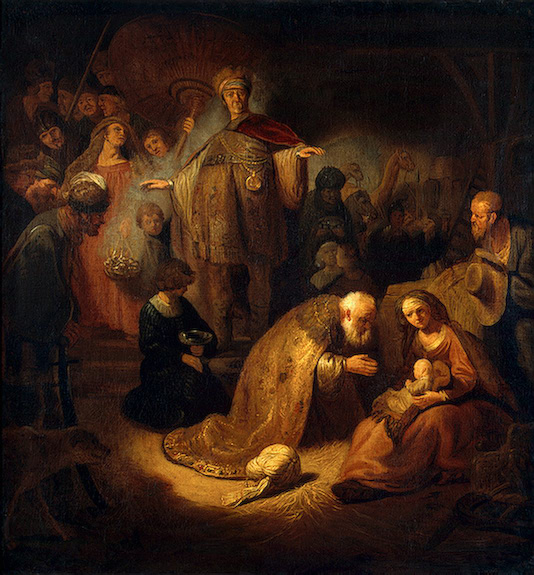
The work, an Adoration of the Magi, was presented at the French Academy in Rome by an Italian Cultural Foundation head and belonged to a noble family. Works such as this were seen as household ornaments during the 19th century, meaning their value and origin were often lost. This is a possible reason why the owners of the undiscovered work had no idea who the genius was behind their possession.
The professional eye
Luckily for the world, the restorer Antonella di Francesco became aware of the artwork’s potential upon beginning the restoration. Rembrandt revealed himself to di Francesco, who says it was like she was under the Dutch master’s spell riding a “thrill that has no equal.”
The work is oil on paper applied to canvas. It is thought to have been prepared around 1633 as a series of engravings centred on the Life and Passion of Christ.
A truly astonishing find
This find is so astounding not only because of the location in which it was discovered but also because it is such a challenge for critics to identify works of the Dutch Baroque master.
Rembrandt held critics in very low regard — and was buried as a poor man in an unknown grave in the Westerkerk as a result. He would often engrave his name on the pieces by his students to increase the painting’s value. Sometimes, he would even finish their work before signing it as his own, making this positive identification all the more astounding.
Are you a fan of this much-loved Dutch master? Tell us your thoughts in the comments below!
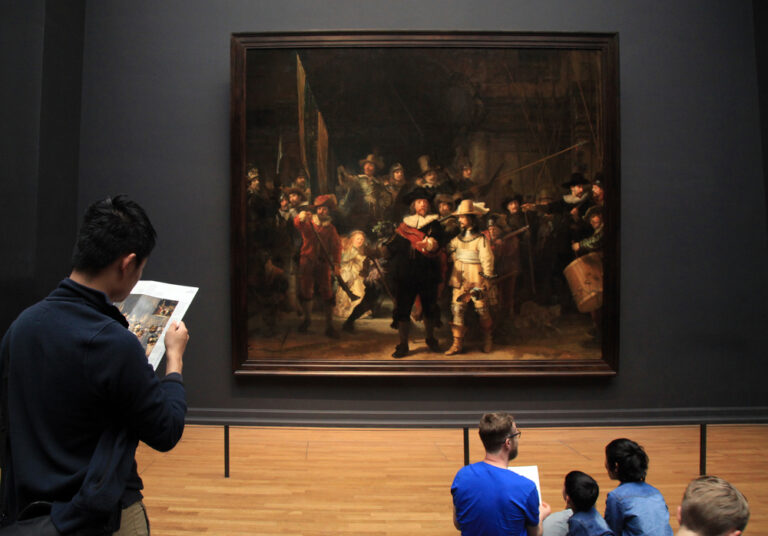
For the past two years, the Rijksmuseum in Amsterdam has worked on reconstructing Rembrandt’s famous piece the Night Watch, reports NOS.
Now, the first phase of the museum’s “Operation Night Watch” is concluded and, for a limited time period, you can see the painting as Rembrandt had “intended it.”
Original format
When Rembrandt completed the Night Watch in 1642, it was hung in a banquet hall in the Kloveniersdoelen in Amsterdam. However, the painting was moved in around 1715 for it to be admired in the new town hall — what is now the Royal Palace of Amsterdam.
But, when moving the painting, the Amsterdam municipality encountered a problem: The Night Watch was too large for its new location.
So what did they do to Rembrandt’s masterpiece? They simply cut off a strip of the painting on all sides! Now it fit the intended wall, squeezed between two doors. Problem solved, right? 🙃
The pieces that were cut off around 1715 have never been recovered. Fortunately, another Dutch painter, Gerrit Lundends, made a replica of the famous Rembrandt piece before it was cut (goed gedaan!).
Thanks to this replica, the Rijksmuseum was able to assess what the original painting must have looked like. Nevertheless, Lundeds was no Rembrandt — and so the past two years of “Operation Night Watch” have been spent studying Rembrandt’s techniques and use of colours.
And then comes the magic — or, well, science. The team who studied Rembrandt’s techniques essentially taught this knowledge to a computer, which then reconstructed the missing parts of the Night Watch using AI!
De volledige Nachtwacht is voor het eerst in 300 jaar te zien! Het team van #OperatieNachtwacht heeft met behulp van kunstmatige intelligentie een reconstructie weten te maken van de missende stukken.
“The complete Night Watch can be seen for the first time in 300 years! The team from #OperationNightwatch have made a reconstruction of the missing pieces with help from artificial intelligence. See the behind the scenes video here”
Experience the Night Watch
The Night Watch is now on temporary display in the Rijksmuseum. The reconstructions of the missing pieces have been hung as panels around the painting. With the extra panels, it’s now possible to see the masterpiece as Rembrandt has originally intended it.
According to the museum, this changes the experience of the painting and makes it much more dynamic! In fact, the reconstruction shows that the composition of the painting is different from how we’ve known the Night Watch until now.
This autumn, the panels will be removed again and the actual reconstruction will begin. Want to see the Night Watch in its full format but can’t make it to the Rijksmuseum before the autumn? Don’t worry! You can do an online experience of the painting on the museum’s website.
What do you think of “Operation Night Watch”? Will you be going to the Rijksmuseum this to view the painting this summer? Tell us in the comments below!
Let op, internationals! Thousands of landlords in the Netherlands do not return deposits to their tenants — even when nothing has been damaged in the rental property.
This is often seen in cases where the tenant is an expat, with hundreds of incidents occurring in, you guessed it, Amsterdam.
The alarm has been sounded by various Dutch rental organisations who assist tenants.
“What is striking is that many expats have to deal with it. They often have to pay two to three times the rent as a deposit. And an apartment in Amsterdam easily costs €2000 per month. Then you are talking about €4000 to €6000,” Gert Jan Bakker of the rental organisation, !Woon, tells the NOS.
Expats are the ideal target
Bakker explains that expats are the ideal victim when a landlord wants to get greedy and try to keep the deposit. This is because they often don’t stay in one place for too long, meaning that the landlord can receive multiple deposits in the span of a few years.
On top of this, expats are more likely to move abroad, making it more difficult for them to reach the landlord should they fail to return the deposit.
“Such a landlord knows this and then thinks: why should I repay the deposit?” Bakker tells the NOS, “But even if a tenant is now in Tokyo, we try to get that deposit back, with letters, collections and subpoenas.”
Hope to deter the tenant
Hit the gym folks, because coming after these landlords often requires an almighty effort — and they know it. Landlords hope that the tenant will be deterred by the many hoops involved in taking legal action against them. This is especially difficult if you are trying to do so from abroad.
Fleur van Leeuwen of Urbannerdam — an organisation that helps tenants in the municipalities of Leiden, Utrecht, Rotterdam and many others — explains to the NOS that tenants “have to consider whether the costs outweigh the possible profit. It often takes a €500 deposit to hire a lawyer.”
How to prevent this from happening
Bakker offers some tips for tenants in order to avoid getting swindled by their landlord. The first thing to do is to carry out an inspection of the room with your landlord when you first move in and out of the property.
Document everything. Take note of any initial damage by taking pictures, this way you have proof should your landlord try to claim the cost from your own deposit.
It’s also important to establish whether the property has suffered damage, or simply normal wear and tear, Bakker explains. “A new scratch on the floor does not mean that the landlord can withhold a deposit. It must be real damage, for example, if you kicked a door.”
Stay safe out there folks, and don’t get swindled!
Have you has similar experiences with your landlord? Tell us in the comments below!
As news came in yesterday that it’s spreading through Rotterdam, the formerly named “Indian variant” is now making its way through the capital.
The variant appears to be spreading quickly. A sample of the GGD found an increase from 7% of the infection cases in Amsterdam to over 40% in just two weeks. This new strain of coronavirus is mostly found in young people. “They come back from vacation and take the virus with them,” a GGD spokesperson tells the NOS.
The overall number of cases of coronavirus are still falling in the capital, but slower than before. In the past week, there were an average of 55 cases registered per day in Amsterdam.
Delta variant across the Netherlands
The RIVM estimated that almost 10% of all coronavirus infections in major Dutch cities are caused by the delta variant, according to the outgoing health minister, Hugo de Jonge.
The increase of cases in Amsterdam is an indicator of how other cities may fair. A spokesperson for the Amsterdam Municipal Health Services said “Amsterdam and other large cities were also a kind of precursor for the rest of the country in other variants.”
Follow DutchReview on Facebook for the latest news and updates.
For more than a year, the usually buzzing streets of Amsterdam have been weirdly empty. But the calm might be over because, from tomorrow, eight non-EU regions are added to the Dutch government’s list of “safe countries/regions.” Meaning — more tourism!
Have you always dreamt of visiting the Netherlands? Or maybe you’ve been sitting on your travel plans for a year, patiently (or not so patiently) waiting for the world to open up again. Well, perhaps now is your chance!
From where can I travel to the Netherlands?
Currently, there are 10 countries on the government’s list of safe non-EU or Schengen areas. From tomorrow, the following will be added:
Albania
China’s Special Administrative Region of Hong Kong
China’s Special Administrative Regions of Macau
Lebanon
North Macedonia
Serbia
Taiwan
United States
So-called safe countries/regions are places where the chance of contracting the coronavirus is deemed to be sufficiently low. So, if you’re currently in one of those that means you can visit the Netherlands! The EU travel ban doesn’t apply and you can travel no matter your nationality — also for leisure.
Return of tourism
Previously, travel to the Netherlands was only accepted for so-called essential purposes. However, the tourism industry and tourists alike can finally (yet cautiously) rejoice!
Now, travellers coming from safe countries or regions can enter the Netherlands no matter the purpose of the trip. When coming from one of these areas you also no longer need to show a negative test result. And there’s no required self-quarantine upon entry in the Netherlands. After a year of tests, isolation, and the weekly supermarket run being the only trip we’ve gone on, these are big steps!
Follows European Commission recommendation
The Dutch government’s decision to lift travel restrictions for these countries follows the recommendation from the European Commission to gradually open borders to non-EU countries. Every other week, the Commission releases an updated list of countries that EU member countries should welcome travel from. The latest update, which included the U.S. and more, was released on June 16.
What do you shift of the lifted travel restrictions? Will you be visiting the Netherlands soon? Tell us in the comments below!
Pull out your piggy banks and say ✋ to avocado on toast, Amsterdammers — your city is considered significantly more expensive today than it was two years ago.
Amsterdam is now considered the 44th most expensive city in the world, according to a new survey by consultancy firm Mercer.
The firm’s Cost of Living 2021 ranking found that Amsterdam climbed 20 places in the past twelve months, putting it in the top 50 most expensive cities for the first time in five years.
So when did your daily stroopwafel or kaasbroodje become so expensive?
That’s the good news. You’re probably not feeling it so much because currency had a big role to play in the rise, according to Ellen van Arenthals, Senior Consultant Global Mobility at Mercer Nederland.
“Amsterdam’s jump in the rankings is mainly caused by the appreciation of the euro against the US dollar,” Van Arenthals explains. “Between March 2020 and March 2021, the euro gained 10.79% against the dollar.”
That’s less stress for internationals in the Netherlands — as long as you’re not paid in USD of course. 😬 😉
Other European cities also make a leap
If the thought of Amsterdam becoming more expensive scares you, we suggest not making a rash move to another European city. Paris, France climbed 17 positions to 33rd place, while Milan, Italy jumped to 36th most expensive.
Munich (Germany), Brussels (Belgium), Frankfurt (Germany), Oslo (Norway), and Helsinki (Finland) all rose at least 18 places.
Want to know how Amsterdam compares?
Comparison is the thief of joy — but in this case, could actually make you feel better about making the move to the Netherlands. Here’s the top 20 most expensive cities in the world — check it at your own risk:
Rank 2021
City
Location
Rank change from 2020
1
Ashgabat
Turkmenistan
1
2
Hong Kong
Hong Kong (SAR)
-1
3
Beirut
Lebanon
42
4
Tokyo
Japan
-1
5
Zurich
Switzerland
-1
6
Shanghai
China
1
7
Singapore
Singapore
-2
8
Geneva
Switzerland
1
9
Beijing
China
1
10
Bern
Switzerland
-2
11
Seoul
South Korea
0
12
Shenzhen
China
1
13
N-Djamena
Chad
2
14
New York City
United States
-8
15
Tel Aviv
Israel
-3
16
Copenhagen
Denmark
9
17
Guangzhou
China
3
18
London
United Kingdom
1
19
Lagos
Nigeria
-1
20
Libreville
Gabon
13
Do you find Amsterdam is expensive to live in? Tell us your thoughts in the comments below!