The Dutch vaccination program is rapidly gaining momentum. More than 15 million shots have already been administered. This rapid rise is partially thanks to an overwhelming willingness to be vaccinated.
It’s no secret, the Netherlands was slow off the ground with the vaccination program. However, RTL Nieuws reports that vaccine willingness is now much higher in the Netherlands than it is in the rest of the world — say whaaattt?
Yep, it’s true. Currently, 287 people are being administered a coronavirus jab every minute and the country is enjoying the results. Everyday life in the Netherlands has turned around in the past few weeks — think going shopping without a face mask to dancing in clubs.
People’s reasons for being vaccinated vary, but the most common are personal health concerns as well as being able to travel and go out with friends again. According to virologist Ger Rijkers, the most important thing is that people are vaccinated, this brings the Netherlands closer to herd immunity.
However, don’t grab the party poppers just yet — virologists warn that reluctance in other countries could lead to even more new variants.
What will it take to get the virus under control?
Rijkers says that “to really get the virus under control, we need to reach a vaccination rate of around 80 percent worldwide.” This is essential in order to provide a barrier against the emergence of highly contagious new variants.
While countries such as the United States and Israel started their vaccination campaigns very energetically, the graph below illustrates that they have now noticeably tapered off. The reason for this is not a shortage of vaccines but a reluctance to be vaccinated.
According to Rijkers, this unwillingness to be vaccinated is worrying, given the emergence of new variants “which turn out to be increasingly contagious.”
Meanwhile, the graph shows that vaccination rates in the Netherlands are shooting quite sharply — needle sharp you could say.
Reluctance in other countries
This enthusiasm for the vaccine is unfortunately not matched in other influential countries, such as the United States, France and Australia. The graph below shows that in these countries, up to 30% of the population are opposed to being vaccinated against coronavirus.
Meanwhile, in the United States and France an additional 11% of the population still have their doubts. In Australia, 30% of the population are outright opposed to getting the vaccine while 20% still have their doubts — meaning that only half of the population are convinced by the importance of immunity against the virus.
We are all connected
Rijkers tells us that even though we currently have lots to celebrate in the Netherlands, we still “depend on the situation in the rest of the world.” If not enough vaccines are administered globally, we risk the emergence of new mutations which are “not only more contagious, but also a lot stronger.”
What is your stance on coronavirus vaccinations? Tell us in the comments below!
Someone once asked me why Dutch folks never wear helmets when they’re on a bicycle, and after much deliberation and a long conversation about that, we came to the conclusion that when Odin created the Dutch, he created each and every one of them with a bicycle.
The Dutch are so obsessed with bicycles that they can ride them drunk, high, and even in a high-speed chase. Most Dutch folks even have more than one bike — one old and rusty one for running everyday errands, and another new and expensive one for outings, work, etc.
With 22 million bicycles for 17 million inhabitants, 32,000 kilometers of bicycle lanes, and the largest bicycle parking facilities in the world, the Netherlands could absolutely claim to be the world’s number one cycling country.
How did we get here?
The two-wheeler has become an indispensable means of transport in our country, and while the flat Dutch landscape may have something to do with it, one still has to ask how we came to be a cycling country in the first place.
The truth is that the Netherlands has not always been a cycling country. In the 19th century, Great Britain, Belgium, and Germany had more citizens with bicycles than we did. So how did the Netherlands become the country of bikes that it is today? Let’s take a historic trip down the Dutch bicycle lane.
Cycling in the 19th and 20th century
The first (velocipede) bicycles came to the Netherlands around 1820. Unfortunately, they weren’t a huge success, surviving mainly as an eccentric hobby for rich people.
Throughout most of the 19th century, cycling was mostly popular among the young and wealthy and was seen as a leisure time activity — mostly for daredevils. At the time, it wasn’t a means of transportation just yet.
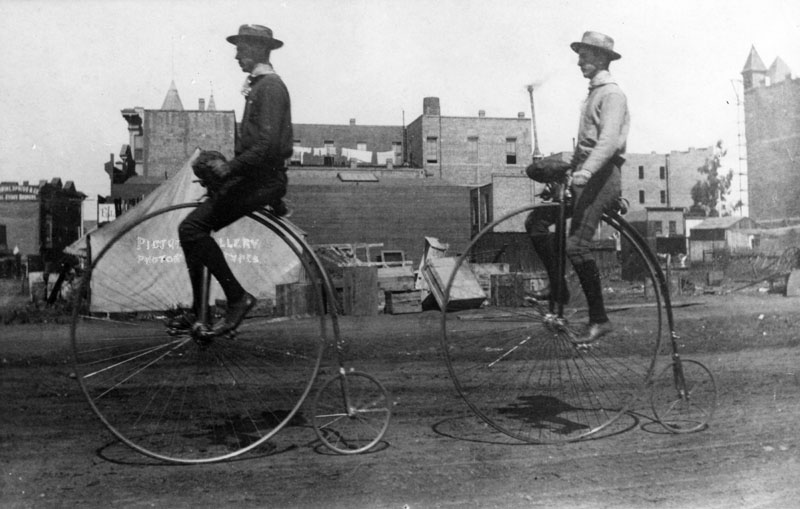
It was only when the penny-farthing (also known as high-wheel) bicycle came to the Netherlands in the 1870s that bicycles became more visible on the streets. However, compared to countries such as Great Britain, Belgium, and Germany, the bicycle was still relatively unpopular in the Netherlands at the end of the 19th century.
Bicycles for everyday transportation
It wasn’t until the Royal Dutch Touring Club (ANWB) — which was founded in 1883 by members of the velocipede clubs in The Hague and Haarlem — presented the bicycle in its advertisements as a means of transportation for everyday folks at the beginning of the 20th century, that its popularity really increased in the Netherlands.
Penny-farthing came to the Netherlands in the 1870s. Image: Unknown author/Wikimedia Commons/Public domain
That, in combination with its convenience and lower maintenance costs, gradually made cycling extremely popular in the country. Through years of multiple designs and development, bicycles started to look more like the ones we know today. No more velocipedes and penny-farthings, just the same size wheels and a lower saddle for comfortability.
What we know today in the Netherlands as the omafiets, or the “grandma bicycle,” came into being in 1901, but was called the Fongers Damesrijwiel at that time. This bicycle made it possible for cycling to become equally popular among Dutch women.
Who was Fongers?
Fongers was a company founded in Groningen in 1897. It pioneered the development of the classic Dutch touring bicycle and from 1884 manufactured a lot of high-quality bicycles, which, in the years leading to 1910, were only reserved for the wealthy.
As the years went by, their bicycles became more affordable. The company would go on to play a major role in making bicycles and cycling quite popular in the Netherlands.
In the 1920s and 1930s, the Netherlands began to make a name for itself as a cycling country and by the 1920s, there were already two million bicycles.
Cycling royals
In 1936, when the Dutch Princess Juliana and the German Prince Bernhard got engaged, they cycled on a tandem through the garden of Noordeinde Palace in a photoshoot which was their first appearance to the press as engaged royals.
Engaged royals cycling on a tandem — what could be more Dutch than that? To the outside world, the tandem which was used for the photo shoot would later give Princess Juliana the nickname “The Biking Queen” and just like that, the bicycle had made its entry into Dutch culture.
Blitzkrieg against bicycles: Nazi bike theft
Most people don’t realise how big of a role bicycles played during WWII. The Dutch Army (especially the Regiment Wielrijders), as well as German troops, made use of bicycles on a daily basis.
And here’s the interesting part: people desperately needed their bikes during the war. The bicycle remained one of the few possible means of transportation, as extreme scarcity of fuel made travelling by cars and buses virtually impossible for a long time. So Adolf Hitler ordered the confiscation of as many bicycles as possible because the Wehrmacht urgently needed vehicles to bring troops to the front.
This was pretty hard on the civilian population because the bicycle was the only means of transportation that most of them had. In some parts of the country, the populace was urged through pamphlets to hand in their bicycles, and those who didn’t obey had their bicycles taken from them by force.
After the war
Even shortly after the liberation, German soldiers stole bicycles en masse as they had to report to the Allies to be disarmed — and many chose to steal bicycles to get there. German soldiers in front of the Rijksmuseum in Amsterdam were stopping protesting cyclists, pulling them from their bicycles and hastily riding off. About 100,000 Dutch bicycles were confiscated from the Dutch by the Germans with the help of Dutch collaborators, especially the NSB (the Dutch Nazi Party).
This confiscation of bicycles by the Germans was one of the reasons why there was a lot of bad blood between the Dutch and Germans for a very long time after WWII. The worst thing you could ever do to a Dutch person is to confiscate their bicycle.
In the first twenty years after the war, there were lots of references in Dutch media to the confiscation of bicycles by the Germans and all of them were an expression of anti-German sentiment. In subsequent years, things started to calm down and people from both countries could joke about it. However, the Germans truly came to realise just how much the Dutch love their bikes.
The bicycle or the car?
If you had to ask a Dutch person this question, there’s a very high chance that they would choose the bicycle every time. Despite the bicycle thefts by the Germans during WWII, the Dutch cycling culture of the 1920s and 1930s didn’t disappear. Most people didn’t own cars, and with fuel shortages continuing well after the war, cycling experienced a major revival.
In the 1950s, the popularity of cycling grew even further. So much so that in 1954, Amsterdam was allowed to host the first stage of the Tour de France, making it the first time that the race would be hosted outside of France.
Influx of cars to Europe
At the same time, the Marshall Plan was kicking off in the 1950s. With it, Europe saw an influx of countless American goods and services, one of them being American (made) cars. As European cities, industries, and infrastructure were rebuilt, more and more Dutch people could afford a car, and owning one was seen as a sign of wealth and prosperity. It was in this period that the bike faced serious competition.
The Marshall Plan
Also known as the European Recovery Program, the Marshall Plan was a US program in the 1950s aimed at providing aid to Western Europe following the devastation of WWII. It was a period where the US would provide more than $15 billion to help finance the rebuilding of Europe. The Marshall Plan was also meant to remove trade barriers between European countries and the US, as well as foster commerce.
With the car rising in popularity in the 1950s and 1960s, plans were developed by policymakers to radically change Dutch cities. The car was put in first place, new roads were constructed, and even the old Dutch city centers were redesigned to allow for the easy movement of cars. For the first time, the Dutch cycling culture faced a real threat.
Give us back our cycling country
Too much of anything isn’t good (unless said thing is a bicycle, then the Dutch are totally cool with it), so when it came to cars taking over their neighbourhoods, the Dutch didn’t like it. In the 1960s, in rapidly developing cities like Amsterdam, where so much focus was placed on giving cars free rein and the cities’ infrastructures were being redesigned to accommodate them, thousands took to the streets to protest.
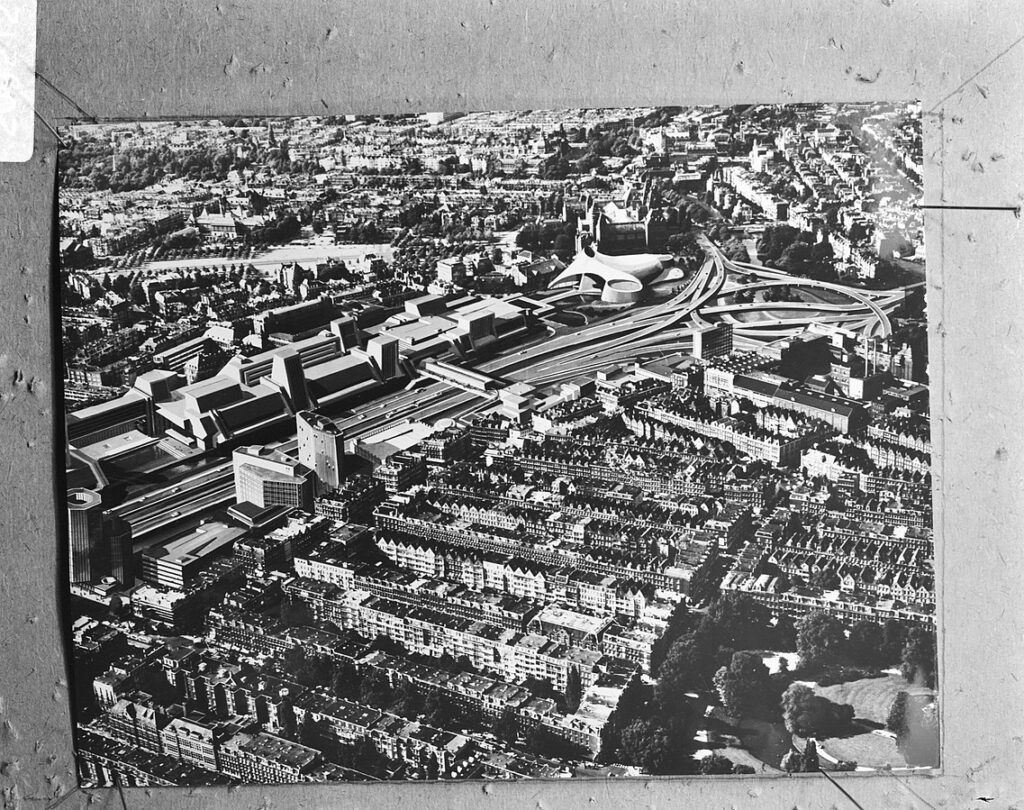
The Jokinen Plan in Amsterdam saw thousands of Amsterdammers come out to protest against the city’s urbanisation plans, in which the general idea was to completely demolish overcrowded working-class neighborhoods such as De Pijp and the Kinkerbuurt, in order to make way for highways and high-rise buildings. These plans were ultimately halted.
The Jokinen Plan wanted to see some of Amsterdam’s neighbourhoods transformed into a highway. Image: Jack de Nijs / Anefo/Wikimedia Commons/CC1.0
The Singelgracht was also expected to be filled in and turned into a six-lane road. To this day, the plan is referred to as “the highway plan that almost destroyed Amsterdam,” and the locals are very proud that it was never implemented.
Furthermore, to protest against and stop the construction of a dual carriageway over Nieuwmarkt, 30 demonstrators bought a building that was on the route of the planned road, so that the municipality could not demolish the building, and as a result, could not construct the dual carriageway.
There were many more plans like the Jokinen Plan and all of them triggered so many protests at the time that even involved celebrities. The protests were all successful and large-scale motorways were banned from Amsterdam.
Protecting cyclists
At the same time, the hazards of owning a car became increasingly clear. In 1971 alone, 3,200 people died in Dutch traffic, 400 of whom were children under the age of 14. The Stop de Kindermoord foundation was established with the aim of guaranteeing the safety of young road users.
The foundation was very active in many ways, some of which were advising locals who wanted to tackle traffic problems in their neighbourhood and organising the Nationale Straatspeeldag with local groups — a special day where streets were closed to cars so that children could play safely. Politicians were also regularly approached by the foundation and asked to push through better policies in parliament. Through their protests and initiatives, change gradually started to come. It had finally dawned on the Dutch that the cyclist had to be put in first place and protected.
Environmentally friendly alternative
In 1975, the ENWB (Eerste Enige Echte Nederlandse Wielrijdersbond) was founded. The ENWB — nowadays called the Fietsersbond — was founded out of criticism of the ANWB, which according to the founders of the ENWB had become a lobby for car owners and car traffic.
The ENWB also proclaimed the bicycle as the environmentally friendly alternative to the car, and since the ANWB seemed not to care about the environment, the ENWB positioned itself as the environmentally friendly organisation with a lot of its members being conscious of the impact of driving on the climate. This was shortly after the oil crisis of 1973, with car-free Sundays being the first time the Dutch started to learn about the impact of cars on the environment.
Rethinking city design
In the early 1970s, policymakers began to concern themselves with citizens’ wishes to cycle more. Cycling had become a way of life, and since they couldn’t change that, they had to find ways to make cities bicycle friendly.
This led to policymakers rethinking the design of Dutch cities. For example, grocery stores, shopping malls, cinemas, and schools all had to be within cycling distance of residential areas.
As a result, people didn’t have to take the car to do groceries or meet with friends in shopping malls outside the city. The easy accessibility of public transport (bus, tram, and metro) stops by bicycle also made it easier to move around without a car.
The Dutch could quickly cycle from their houses to bus, tram, or metro stops (or train stations) and then take the train, tram, metro, or bus from there. Most things needed by everyday folks remained nearby, making it accessible by bicycle, and gradually, the country slid into its role as one of Europe’s most cycling nations.
More bicycle lanes
While the Dutch had done a lot over the years to show how much they loved their bicycles, one important ingredient of a cycling country that was still missing was an extensive network of bicycle lanes. In September 1885, the first bicycle lane in the Netherlands was opened on the Maliebaan in Utrecht.
The second bicycle lane would not be built until 1896. However gradually, more and more bicycle lanes came to be built even though the main reason they were constructed was to free the highways of the “annoying” cyclist.
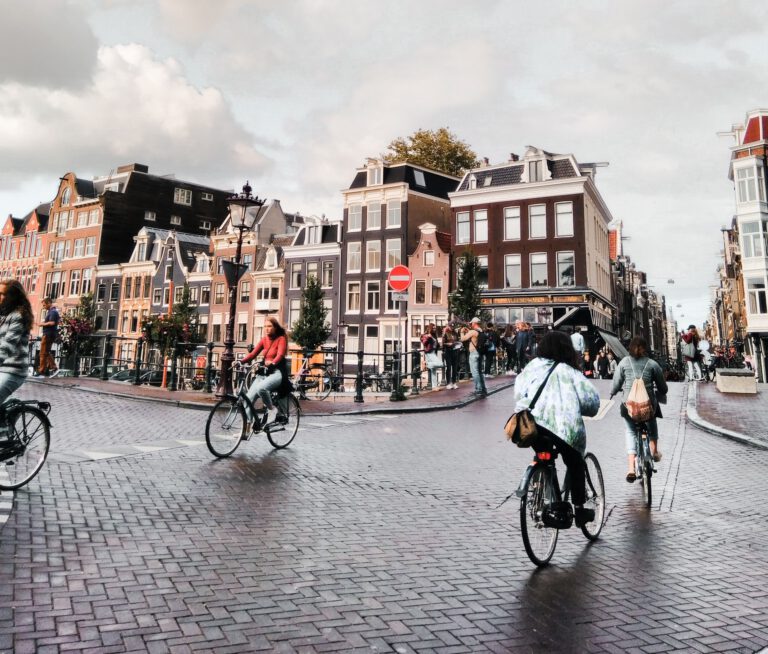
Today, the Netherlands has about 32,000 km of bicycle lanes. Image: Guus Baggermans/Unsplash
In 1965, just under 7,000 kilometers of bicycle lanes had been constructed in the Netherlands, mostly on private initiative. In the 1970s, a number of bicycle-safe intersections and traffic lights had already been built in Leiden, The Hague, and Tilburg. Due to the increasing popularity of the bicycle in the 1980s, the government started to realise that more bicycle lanes needed to be built.
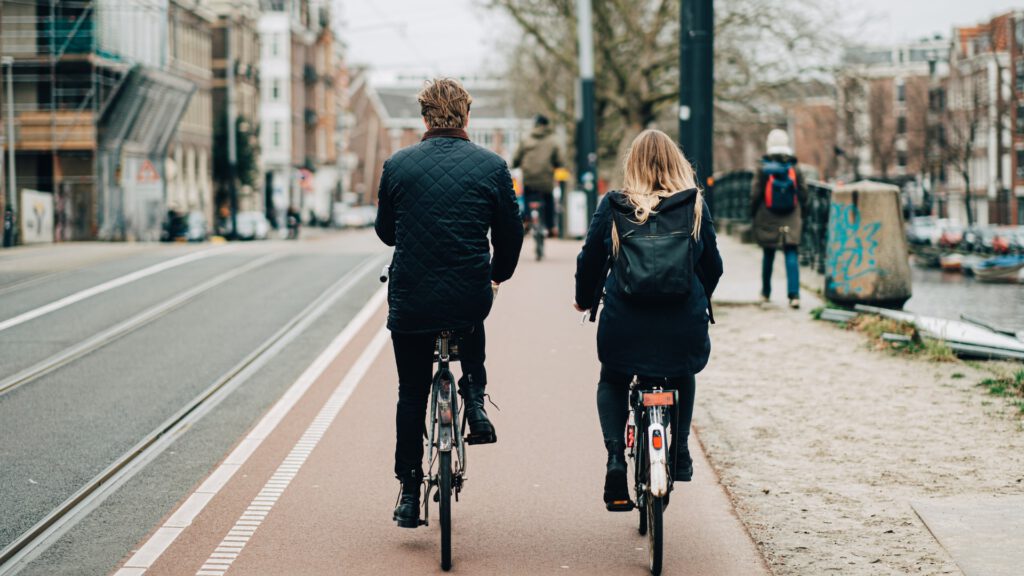
From 1978 to 1988, the Dutch bicycle network grew by 73% — from 9,300 kilometers to 16,100 kilometers — compared to an 11% growth of the motorway network. And since then, the bicycle lane network in the Netherlands has doubled, with about 32,000 kilometers of bicycle lanes today.
Emergence of the car-free city
While the 1960s saw plans to make way for highways, such as in the case of the Singelgracht in Amsterdam, the 1990s saw Dutch city centers increasingly being designed for bicycle and pedestrian traffic.
Fortunately, this development has continued to this day. With low-traffic and car-free zones, more and more cars are being banned from (large) city centers in order to improve air quality and make cities more environmentally friendly and attractive.
Furthermore, locals prefer seeing the medieval alleys around their old churches and canal buildings completely car-free. At the same time, the popularity of the e-bike, which makes cycling attractive for seniors, has significantly increased. E-bikes can also travel long distances, and most people who have them see no reason to own cars.
Cycling today
In a battle between cars and bicycles, bicycles will always win in the Netherlands. According to a 2018 study, bicycles in the Netherlands cover 13.3 billion kilometers annually. There are people who believe that maybe, one of the reasons why the Netherlands never succeeded in having established car brands like the French, Germans, and Swedish is because they’ve come to love their two-wheelers so much.
Today, the Netherlands has tons of different types of bicycles. There’s the cargo bike, recumbent bike, children’s bike, foldable bike… Children use them as a means of transportation to school, parents use them to take their kids to football and hockey practice, and others use them for various kinds of errands. Some (old) people even cycle all around the country (or Europe) during the summer vacation. To the Dutch, cycling isn’t just a necessity, it is also a leisure time activity.
A ‘bakfiets’ is just one type of a Dutch bike. Image: Alenmax/Depositphotos
As the Netherlands aims to be climate-neutral by 2050 — achieving an economy with net-zero greenhouse gas emissions — the government will need the populace to cycle much more than ever before.
The bicycle has cemented its place in the Dutch transport culture and I’m afraid it’s not possible to be Dutch without being a badass on a bicycle. Who would have thought that something that once started as a leisure time activity for the rich would go on to become a mode of transportation that is both cheap and environmentally friendly?
How do you feel about cycling in the Netherlands? Are you as crazy about bikes as the Dutch are? Let us know in the comments below!
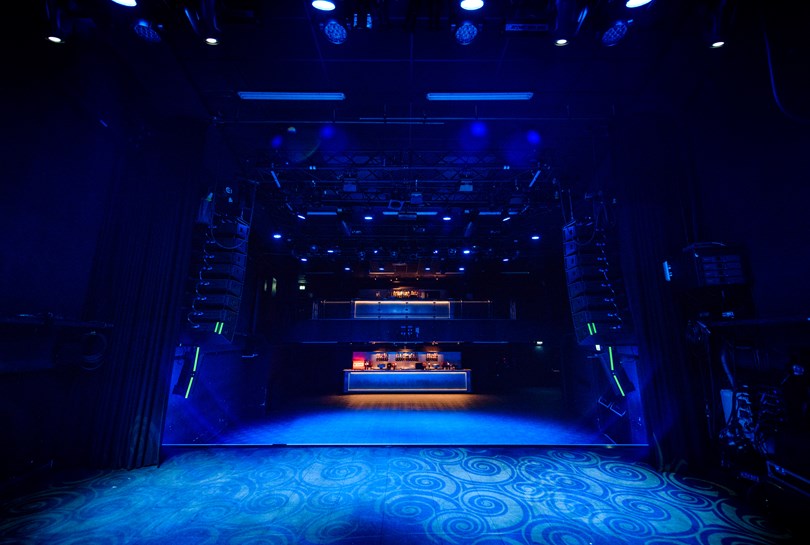
In the Netherlands, new restrictions came into place last Saturday with almost everything opening, including events and nightclubs.To make the most of it, many clubs already opened their doors at 12:01 AM Saturday.
Before being able to bust some moves on the dancefloor, clubgoers had to show a negative PCR test, a vaccine certificate, or proof that they’d had the coronavirus within the last six months. However, not everything went smoothly, reports the NOS.
Delayed test results due to hack
Entering the clubs should have been easy with the new CoronaCheck App and in many cases, it went well. But the organisation behind the “testing for access” system, the Open Netherland Foundation, suffered a hacking attempt that delayed test results.
After 14 months without clubbing, people were getting ready for a party weekend only comparable to King’s Night, and 227,000 people were tested through “testing for access”. However, thousands of expectant party-goers who’d been tested Saturday didn’t get their results in time. Many received it late into the night, Sunday morning, or not at all.
No test result, no clubbing — right?
To ensure a fun and safe night for all, it shouldn’t have been possible to go clubbing without a negative test result (or one of the other proofs). But where there’s a will there’s a way. 😅
The confusion and frustration from delayed test results made an already busy night even more chaotic. So, to make a hectic night easier, some clubs started being lax with the rules: “At a certain point we accepted every proof, including vaccination booklets or rapid self-tests,” a catering entrepreneur told the NOS.
Er is weer meer ruimte voor horeca, cultuur en evenementen. Velen keken daarnaar uit: ruim 200.000 mensen lieten zich dit weekend testen via Testen voor Toegang en meer dan 2 miljoen mensen maakten een vaccinatiebewijs aan. Veel ging goed, maar nog niet alles. #workingonitpic.twitter.com/rynxCT5fB8
Tweet translation: Now there is more room for catering, culture, and events. Many were looking forward to this: more than 200,000 people were tested this weekend via Testing for Access and more than 2 million people created a vaccination certificate. A lot went well, but not everything.
Fake test results
To prove that they’d been tested or vaccinated club-goers needed to show a QR code generated by the CoronaCheck App. To avoid fraud, the app is developed in such a way that most phones can’t take a screenshot of the QR code — except iPhones. The code is also linked to your ID and there’s an animated bike moving around on the screen to prove that you’re not showing a screenshot.
But last weekend bars were overwhelmed.
Because of the long lines, IDs weren’t always compared to the QR code and screenshots managed to slip in. Meaning that some party-goers didn’t have to prove that they didn’t have coronavirus. 😷
Next weekend will be better, hopefully
To RTL Niews, de Jonge said that “we will meet with the Open Netherlands foundation, which organises Testing for Access to see what can be done differently and better for the next weekend. Because next weekend it will be busy again.”
Did you go clubbing last weekend? What was your experience going in? Tell us in the comments below!
Forget “New year, new me,” the Netherlands is coming up with an entirely new concept — new month, new laws.
From next Thursday, laws concerning wages, housing, and shopping will see some important changes, reports the NOS. In the true Dutch spirit, we looked at which ones will save you money and which ones will cost you more:
Regulations that will save you money
First things first, the minimum wage will go up by up to €16 per month to a total of €1,701 for four full working weeks. This will affect salaries in, for example, supermarkets and those employed in horeca.
A rent freeze will apply to social housing until June 30, 2022. This will save tenants about €6 per month. For homes that are rented out through the private sector, the rent can increase but only by a maximum of 2.4%.
Saving on electricity
If you’re still in doubt about whether you should get a smartenergy metre, this new regulation might help you make your choice.
As of July 1, anyone with an old energy metre will pay the same rates during the day and at night — meaning no more discounted night rates.
A smart metre, on the other hand, automatically switches between day and night rates, so if you want to keep saving money, this is your best bet.
Free coronavirus tests before travel
In July and August 2021, travellers can get tested for coronavirus before their trip completely free of charge. The Dutch government has set up a new website where the test can be booked from June 30.
It will also officially be possible to travel with the European travel certificate. Travellers can use this to prove that they’ve been vaccinated against coronavirus, tested negative before their trip, or have had the virus in the past.
Regulations that will cost you money
If your dating life has mostly consisted of weekly speed dates with the delivery man over the past year (no, you’re not the only one who got into the habit of excessive online shopping during the pandemic…), we have some bad news for you.
Orders from outside the EU will now become more expensive. Previously, packages under €22 were exempt from VAT. However, now a VAT of 21% applies.
If the webshop you’re ordering from doesn’t include this in the price, you’ll end up paying more when your package arrives in the Netherlands — yikes.
No more alcohol discounts
If you want to get your last discounted beers, now is the time. The Netherlands is introducing the new Alcohol Act, which forbids supermarkets and liquor stores from offering discounts on alcohol that are higher than 25%.
While there’s already a 25 cent deposit on large plastic bottles, the Netherlands is now introducing a deposit of 15 cents on small plastic bottles. This is supposed to help increase plastic recycling.
What else is changing?
It’s not just about the money. If you still have some statutory holidays left over from 2020, better use it now, because they’re about to expire.
Employers have to inform their employees about this in time. This ‘leftover holiday expiry date’ doesn’t apply to extra holidays above the statutory minimum.
No more unsolicited phone calls
The last change will surely brighten up the day of those who hate annoying telemarketers (sorry guys, we know you’re just doing your job).
The Netherlands is cancelling its “do not call” registry from Thursday. Residents of the Netherlands will have to indicate that they want to be called, as opposed to explicitly having to say they don’t want to be called.
This means that companies can no longer just hit you up with an offer. In addition, they have to keep track of how and where they got the numbers and call from a recognisable phone number themselves.
What do you think of these new regulations? Let us know in the comments below!
You’ve scored the job, filled out the paperwork, put in the working hours, and your hard-earned euros have landed in your Dutch bank account. Now it’s time to check your payslip for all those other nice benefits like vacation time, your pension, and perhaps your secondary benefits.
But wait! Sorry to roet in het eten gooien (throw soot in the food), but there’s a hurdle you’ll have to overcome first: Dutch payslips can be a pain in the butt to read.
Why? Your Dutch pay stub is full of confusing phrases, numbers, and long Nederlandse words that throw fear in the heart of even natives. But never fear: here’s what to know about your Dutch payslip — and how to read it like a pro.
We turn to the experts when it comes to all things about employment and recruitment in the Netherlands: Undutchables! We teamed up to write the ultimate explainer on those tricky Dutch payslips.
When and how do I receive a Dutch payslip?
If you’re employed in the Netherlands, your employer must give you a payslip (loonstrook) with your first salary or whenever something changes in wages or payroll taxes. Most employers typically give you a payslip at the end of each month.
Your pay stub may be delivered via email, through an internal system, or perhaps even on paper — although that’s less common in the age of technology. 👩🏼💻
Why should I read my Dutch payslip?
Money makes the world go round, pays for your brood, and lets you take nice vacations (hopefully). That’s why it’s important to check your Dutch payslip so you know:
Your gross and net salary (before and after tax)
Allowances and reimbursements that you’re entitled to
How much holiday pay you have accrued
How much leave you are entitled to
Your payslips are also an important part of Dutch life: you’ll need to provide them if you rent or buy a house, apply for any kind of financing, or sometimes even if you sign a phone contract. These, and your employment contract, are proof that you earn your moolah.
Dutch payslip terminology breakdown
The time has come! Got your Dutch payslip in front of you? We’ll break this down into three easy sections: the top, middle, and bottom of your payslip.
A quick note first: we’ve dug and dug to find the most terms, but it’s possible your payslip uses a different structure or terminology. In that case, head on over to your HR department and they’ll be able to clear it all up for you!
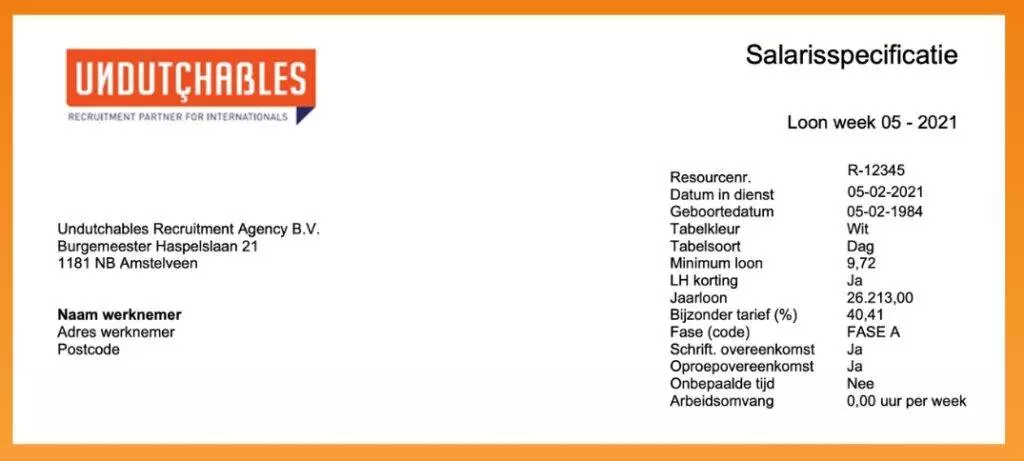
Top of a Dutch payslip: personal, date, and employment details
The majority of information at the top of of your Dutch payslip will stay the same each week. Image: Undutchables/DutchReview
All of your basic information belongs at the very top of your payslip — this typically doesn’t change month-to-month. Your and your company’s names and addresses will sit somewhere near the top.
Move your gaze and you’ll find more personal and factual information. Here’s a quick rundown:
Datum in dienst (Start date)
The start date of your contract with the company.
Geboortedatum (Date of birth)
Your date of birth (as shown on your ID)
Tabelkleur (Tax table colour)
This is determined by the tax office. White is for current employment, green is for past employment (for example, if you’re receiving a pension or unemployment benefit).
Minimumloon (Minimum wage)
The legal minimum wage which must be paid to the employee as determined by the government.
Personeelsnummer/Resourcenummer (Employee number)
The employee identification number your company or recruiter has assigned to you.
Jaarloon (Annual salary)
Your annual salary for the previous year. If you’ve just begun your job, this will be your starting salary calculated as an annual figure.
Bijzonder tarief % (Special tax percentage)
The tax rate on special wages like holiday pay, overtime, or bonuses.
Dagen tijdvak (Time period)
The period of time that the payslip represents.
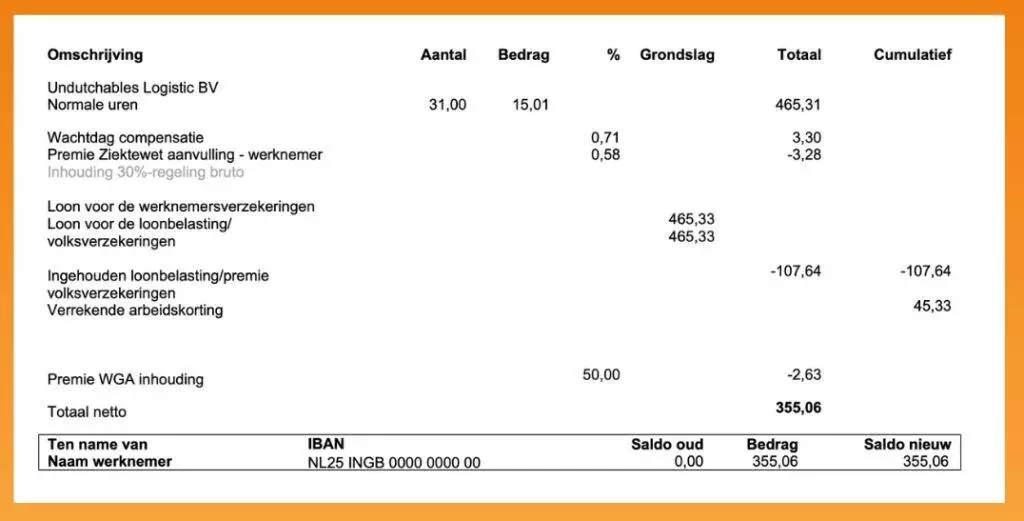
Middle of a Dutch payslip: salary calculations
All of the important details about your recent work and payment is in the middle section. Image: Undutchables/DutchReview
The middle of your Dutch payslip holds information more specific to the current period and how your payment has been divided.
Dagen gewerkt (Days worked)
The number of days the employee worked in the time period above.
Verloonde uren (Paid hours)
The number of hours the employee is paid for the time period.
Normale uren (Normal hours)
The total number of hours worked and your gross hourly rate.
Overuren (Overtime)
The number of overtime hours worked and the hourly overtime rate if applicable.
Bruto (Gross wage)
Now we’re into the good stuff. Bruto is your gross salary from the payslip’s period added to your pension amount or other tax extras, like a company car allowance.
Werknemer verzekering (Wages for employees insurance)
This is the premium employers pay in case their employees suffer loss of income if they become unemployed, incapacitated for work or ill. These insurances are:
Unemployment Insurance Act (WW)
Disability Insurance Act (WAO)
Work and Income according to Capacity for Work Act (WIA)
Sickness Benefits Act (ZW)
Your employer may pass a portion of the insurance costs on to you, which will be reflected on your payslip (likely under WHK premie).
The amount of payroll tax and social security deducted from your gross salary.
Netto loon tijdvak (Net wages)
Net salary after tax deductions, but before additional reimbursements and deductions.
Declaratie onkosten (Declared expenses)
Any costs you have claimed back from your employer, such as fuel, kilometres driven to visit clients, dinners while away, or the cost of using your phone for work purposes.
Reiskosten (Travel costs)
Your net travel expenses, such as taking the train to work (if your employer covers this cost).
Totaal Netto/Totalen (Total)
The total salary paid to you for the period (net).
Betalen (Paid)
The bank account details where your salary was or will be deposited.
IBAN (Account number)
Saldo oud (Old balance: any outstanding amount your employer already owed)
Bedrag (Amount)
Saldo nieuw (To be paid)
Cumulatief (Cumulative)
Your accumulated salary over the months of the year so far.
Bottom of a Dutch payslip: long-term calculations
Want to take a vacation? You’ll need to look toward the end of your payslip. Image: Undutchables/DutchReview
At the bottom of your Dutch payslip, you’ll typically find all your long-term calculations. These can be:
Reservering (Balances reserved for later)
This section will cover different types of leave and allowances. You’ll likely see calculations for:
Opbouw (the amount earned in the payslip period)
Opname (any amounts you used in the payslip period)
Saldo (the balance of the hours you have left)
Kort verzuim in geld (Short term leave)
Total hours built for short-term leave, such as going to the dentist or the doctor.
Vakantiebijslag (Holiday allowance)
Paid to take a holiday? In the Netherlands, hell yeah! This section will show how much you have built towards your holiday pay which is paid out in May.
Vakantieuren wettelijk (Statutory holiday hours)
The total amount of hours built up for your holiday allowance. The minimum number you are entitled to each year is four times the number of working days per week. If you work full-time your minimum will be 20 days per year.
Hours built up toward non-statutory holiday days. These days are normally defined in your employee handbook or collective labour agreement. It differs per industry, so check with your HR department to find which ones apply to you.
SV/ZVW/WW/WAO Loon (Insurances salary)
The wages on which you must pay taxes and social security contributions.
Pensioengevend loon (Pension fund salary)
Your salary for pension purposes.
You did it! After receiving a payslip from your Dutch employer that looks like it was written by an over-enthusiastic three-year-old, you’ve cracked the code and deciphered the goods. Now the only thing that’s left to do is spend your hard-earned cash!
Not happy with your payslip — or your employer? Head on over to Undutchables and check out their current vacancies!
That’s right, no more additional travel costs to pay for testing before your vacation abroad. The Dutch government has decided that in July and August 2021, travellers can get tested for coronavirus completely gratis!
So pack your bags because you can already make your appointment on June 30. The test you’ll need depends on your travel destination. However, both PCR and antigen (rapid) tests will be offered for free.
For antigen tests, you can make an appointment for an affiliated commercial test location and you’ll have your result within three hours.
For PCR tests, you can book a test for either an affiliated commercial test location or some GGD test locations. It’ll take 24 to 26 hours before you have your result.
Let op! You need a DigiD to contact the GGD.
The Dutch government has a list of travel advice per country — so you can easily check which test you’ll need and what preparations you should make before holidaying.
Sounds great! How do I make a free appointment?
To differentiate between the free travel tests and regular tests, the government has decided to make a new website for booking travel test appointments. (Don’t we just love a bit of Dutch bureaucracy?)
Warning! You can’t book an appointment for a free travel test via coronatest.nl! To make sure the cost of your test is covered by the government you need to book it through the official website.
If it’s just looking like an info page now, don’t worry. The page will be updated on June 30 and you’ll be able to book your free coronavirus test directly or via a phone number that’ll be available on the website.
Proof of negative test with CoronaCheck
Once you have your (hopefully negative) test result, you can put it into the CoronaCheck App or CoronaCheck.nl by simply entering the so-called pick-up code of your result. Then you’re ready to board!
CoronaCheck can be thought of as your new coronavirus vaccination booklet. It’s part of the Digital Corona Certificate (DCC) that’s being introduced throughout Europe from July 1 and serves as proof that you’re healthy to travel.
Will you make an appointment for a free test? Tell us in the comments below!
Canals and windmills might be one of the reasons why you came to the Netherlands, but it probably won’t be the reason you’re spending a day in Tilburg.
And while we love Tilburg because it has the best library in the Netherlands, lush natural scenery, and an excellent shopping and foodie scene, this time around we’re taking you on a step-by-step (literally) tour through the urban culture hotspots of Tilburg.
Let us take you through Tilburg step by step. Image: DutchReview/Supplied
Let’s be honest, Tilburg isn’t exactly what you’ve got in mind when it comes to a buzzing urban scene. Brooklyn and Berlin sure! Rotterdam and Eindhoven, we can get that.
So when we were asked to hop on an e-step and cruise through urban Tilburg, we were actually a bit surprised. After spending a beautiful day in the city, we were still surprised, but this time just pleasantly. So settle in, pop in some lo-fi-hip-hop tunes and get stepping with us through Tilburg.
A day on an electric step
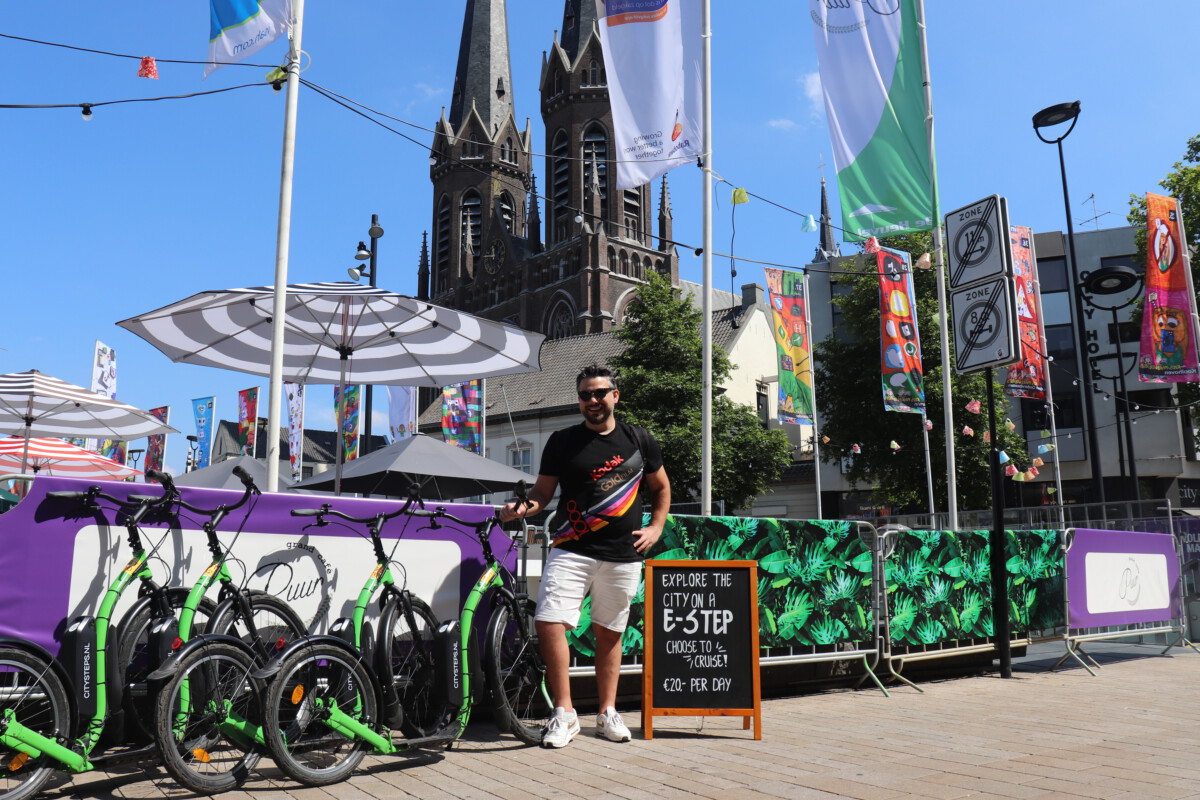
We feel kind of rebellious, because e-scooters are mostly illegal throughout the Netherlands. However, Tilburg is a pioneering town and they took it upon themselves to develop an e-step that actually got approved by Dutch road authorities.
It hits speeds of up to 25 kilometres per hour, which is speedy but not frightening, and brakes and steers extremely responsively. What a treat — especially with the many comfy bicycle paths around!
You can also grab an e-step at the Mercure Hotel in the city centre. All the stuff in this article can, of course, be done by bike or on foot (wouldn’t recommend that), but it’s the e-step that made our day unforgettable.
Before we fully get into our urban tour of Tilburg, we’d like to give a quick shout-out to our friends at Ticket to Tilburg who helped us show you all the different aspects of city life Tilburg has to offer!
Step one: the Spoorzone — Tilburg’s urban heart
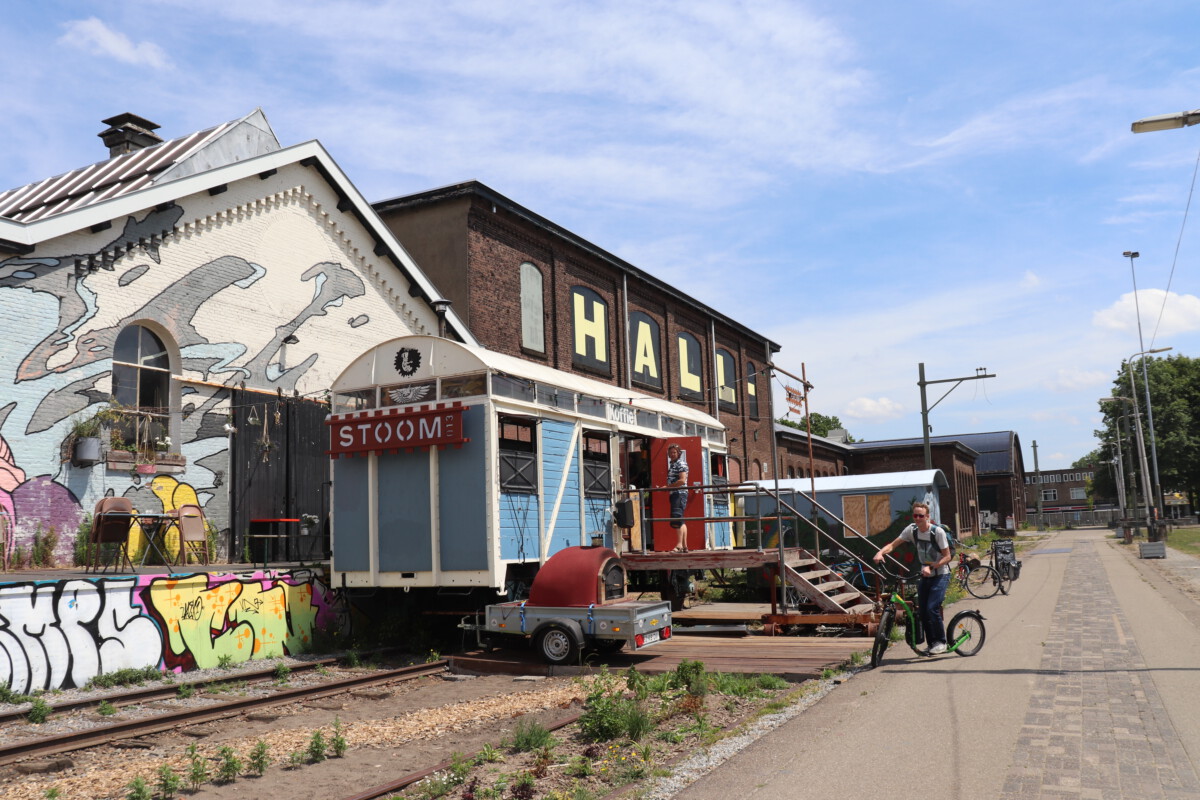
Tilburg has its square with nice cafés and an old church, but it also has the Spoorzone: the city centre for the young and cool, which was redeveloped from what used to be the old train yard.
The tracks are still there. Image: DutchReview/Supplied
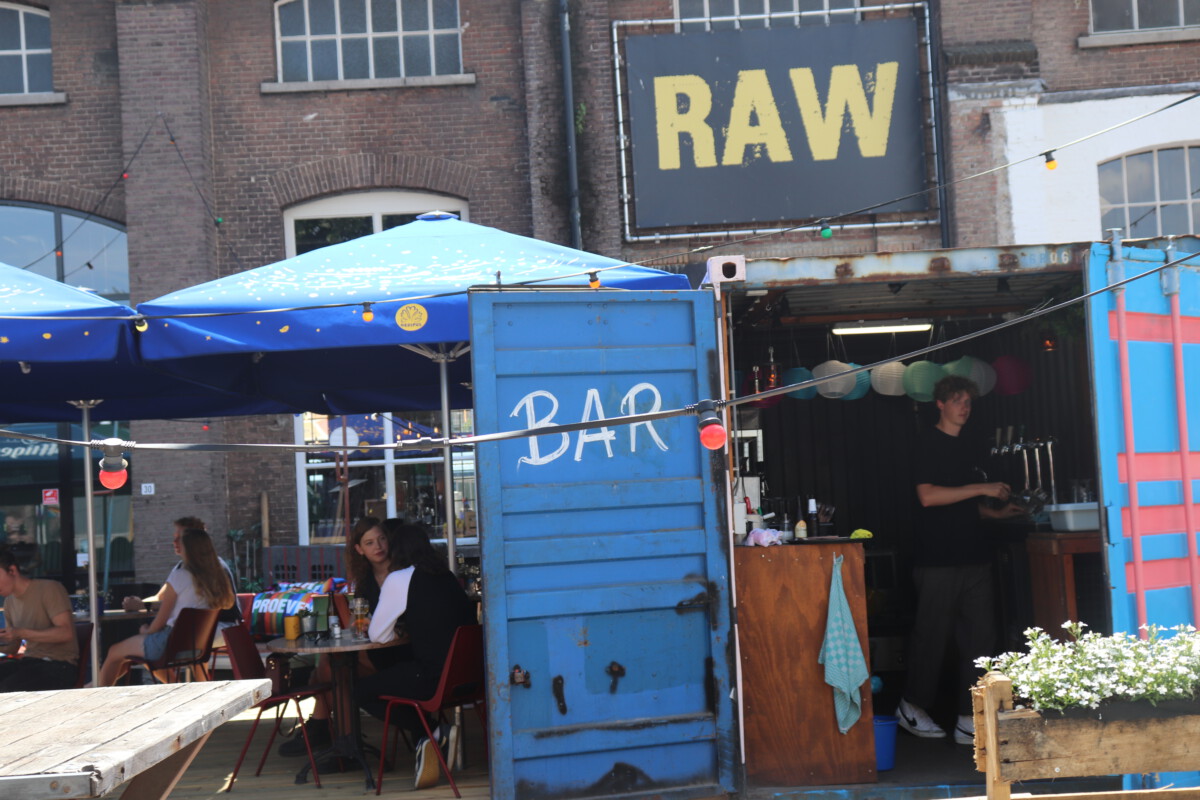
Everything an urbanite could wish for is present in the Spoorzone. Grab some grub at the artistic RAW bar or enjoy a beer at the funky square.
We’re sure that if you return here in the evening, there’s a party or two going on. Image: DutchReview/Supplied
The Spoorzone is also home to the LocHal, which, although it isn’t something quintessentially urban, is definitely a spot one cannot miss.
Step two: Ladybird Skatepark at the old wagon workshop
The epic Ladybird Skatepark is located in an old wagon workshop. It consists of two parts: a wooden competition park and a junior street park. Skateboarders and inline skaters are welcome here every Monday, Wednesday, Thursday, and Saturday.
Various ramps and obstacles that are organically designed create a unique skateable landscape — it’s all pretty edgy and big, and one of the nicest skateparks of the Netherlands.
Right beside it is the Hall of Fame, a culture factory where you can experience more or less everything when it comes to urban sports and culture.
Let’s get stepping and enjoy the great outdoors at…
Step three: Spoorpark — Tilburg’s Central Park
The Spoorpark in Tilburg just opened in 2019, so it’s all brand new. Creating it was a massive undertaking that took more than a couple of years, and it’s safe to say that it’s more than just your regular run-the-mill park.
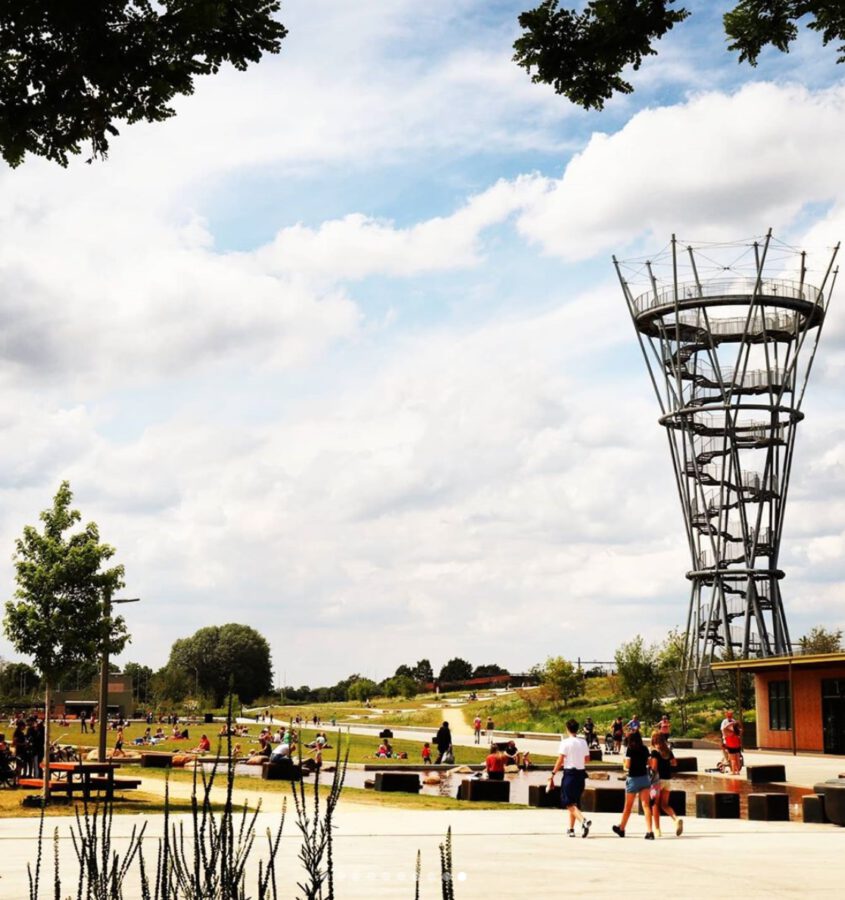
Climb up the Kempentoren to enjoy Spoorpark from above. Image: DutchReview/Supplied
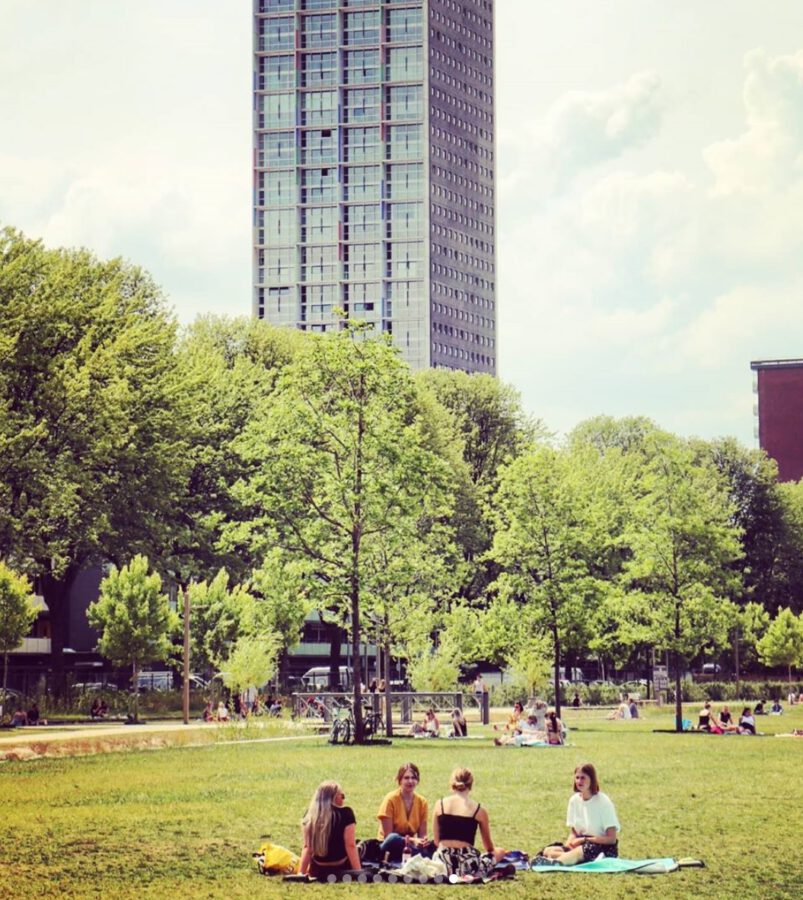
Spoorpark is practically Tilburg’s Central Park. Image: DutchReview/Supplied
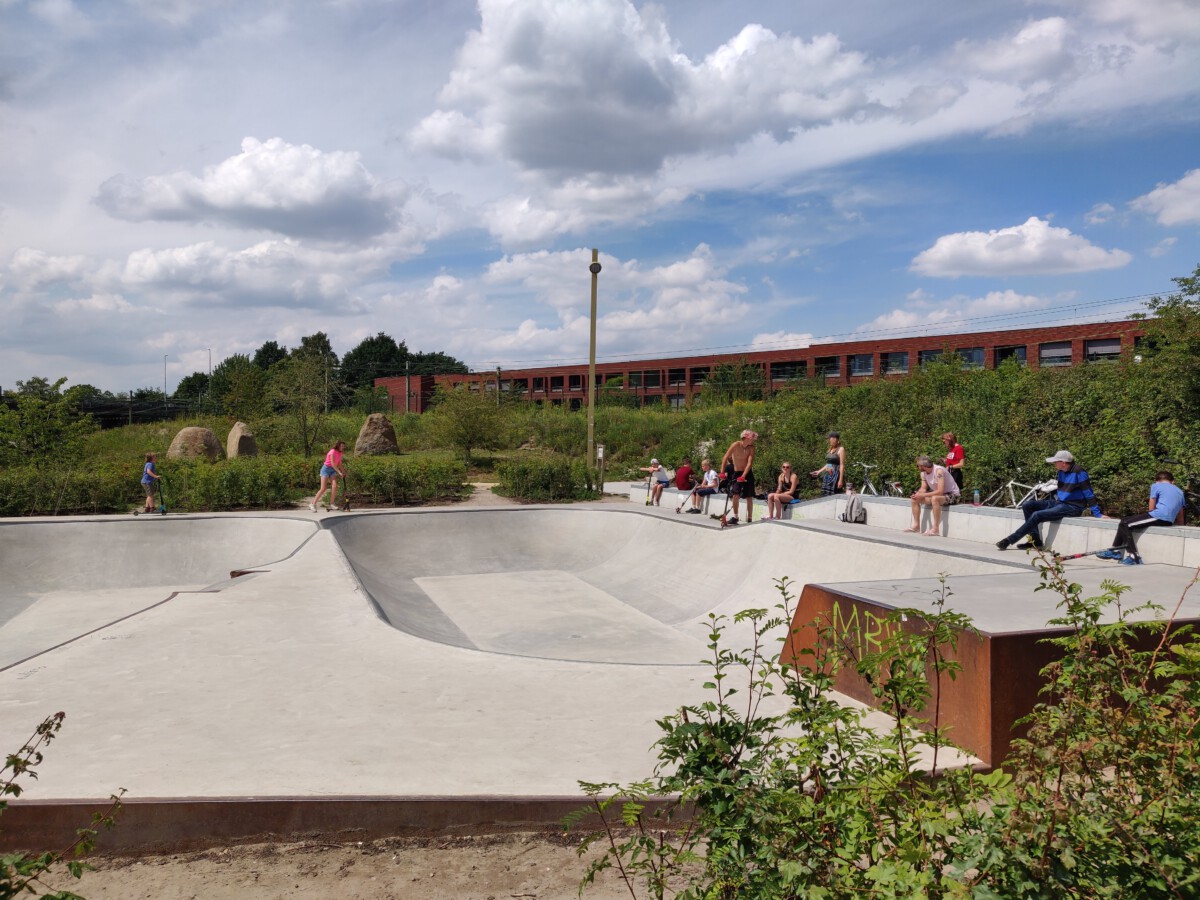
The park provides tons of opportunities for sports of all kinds (there’s even an urban sports park present). Especially the skate bowl and mountain bike range at the end are not to be missed! You can enjoy drinks and fancy food at the T-huis and even do some city camping.
Enjoy the skate park at Spoorpark. Image: DutchReview/Supplied
Step four: the many marvelous murals of Tilburg
We got our hands on a map with the best graffiti spots of Tilburg, which conveniently takes you through the entire city as well — not just the hotspots. One of the first areas we got to explore was the Piushaven, a spot one wouldn’t reach as quickly if they were to just venture into town on foot.
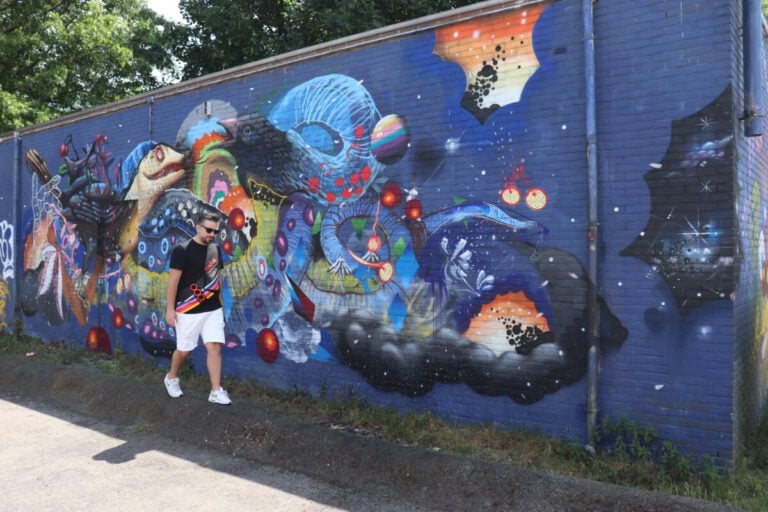
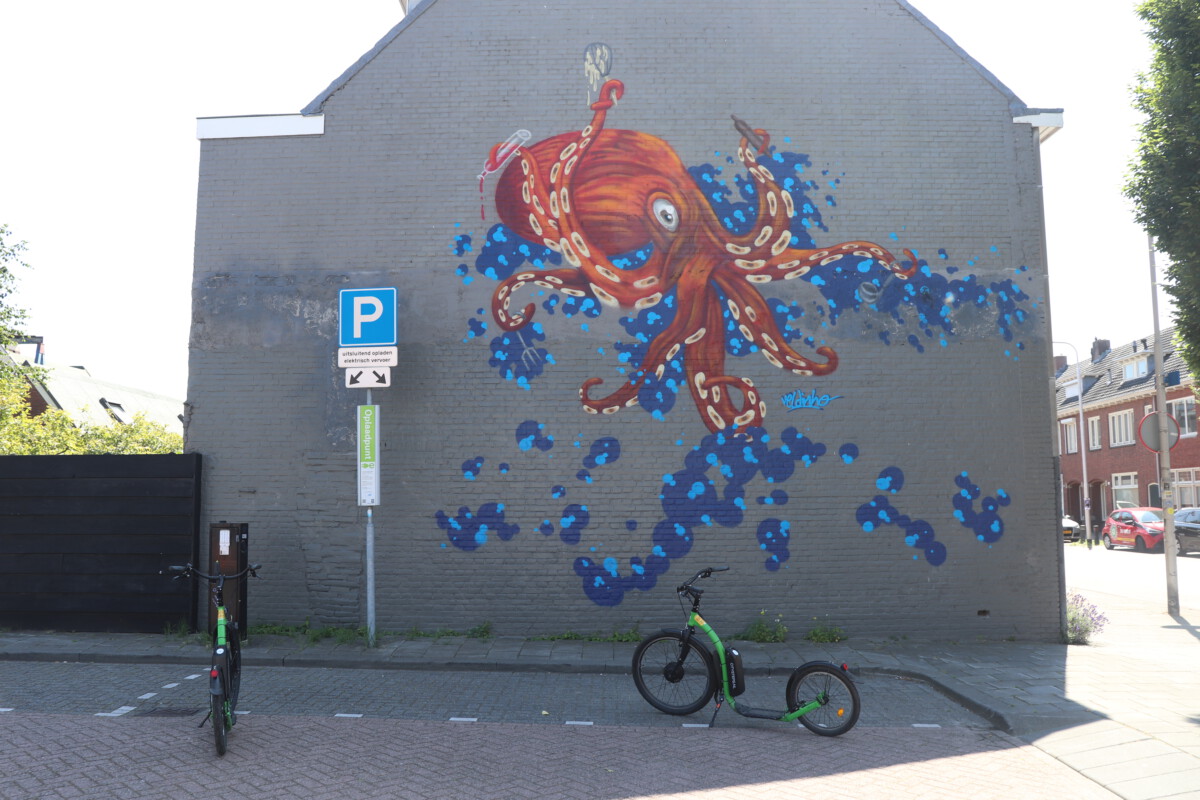
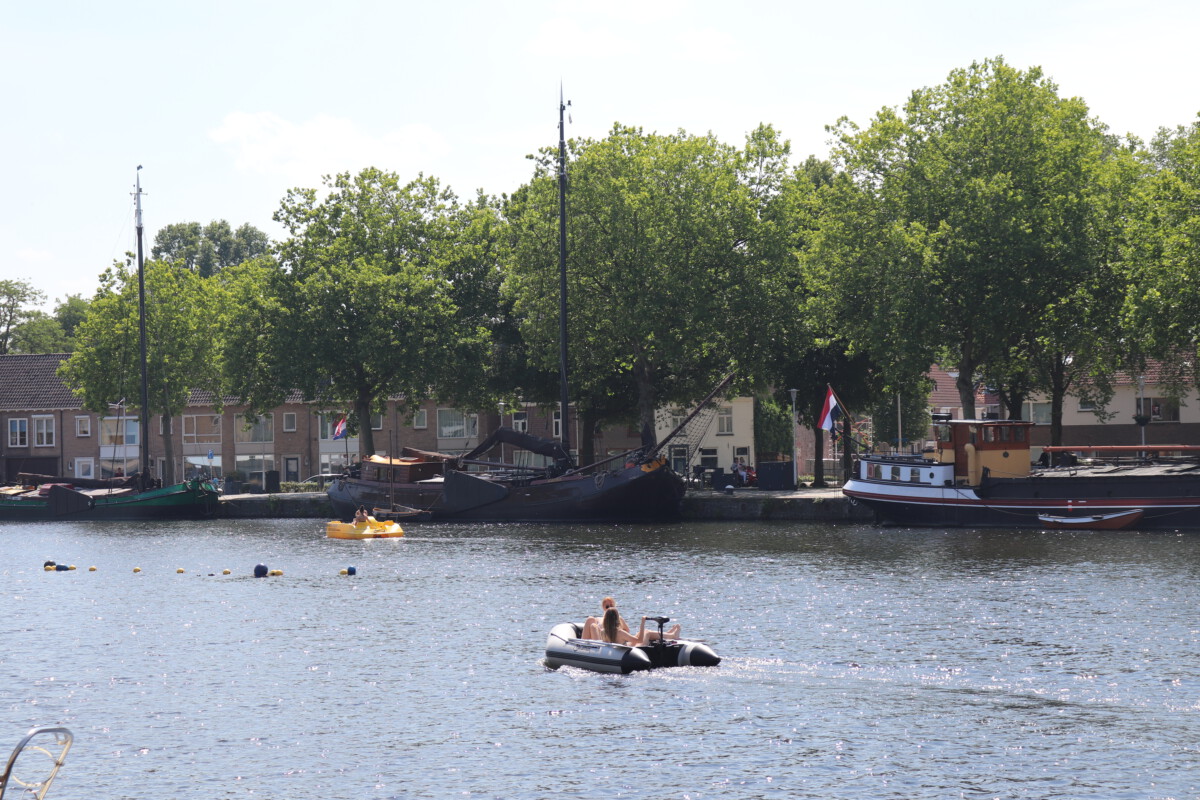
Just one of the many murals of Tilburg. Image: DutchReviewSummertime and the livin’ is easy…at least in Puishaven. Image: DutchReview/Supplied
These beautiful murals are sprinkled all around the town, sometimes nicely in the spotlights, sometimes in clever unexpected places. Here are two more, the rest you can discover yourself.
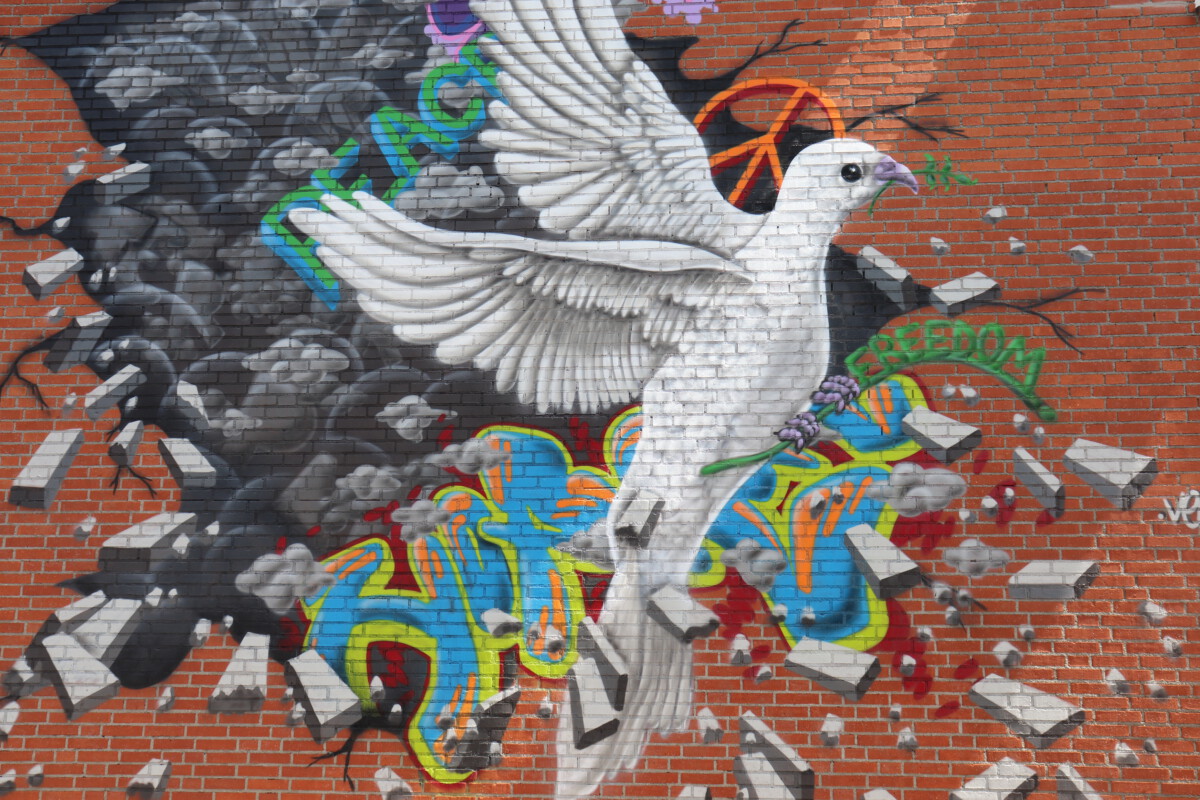
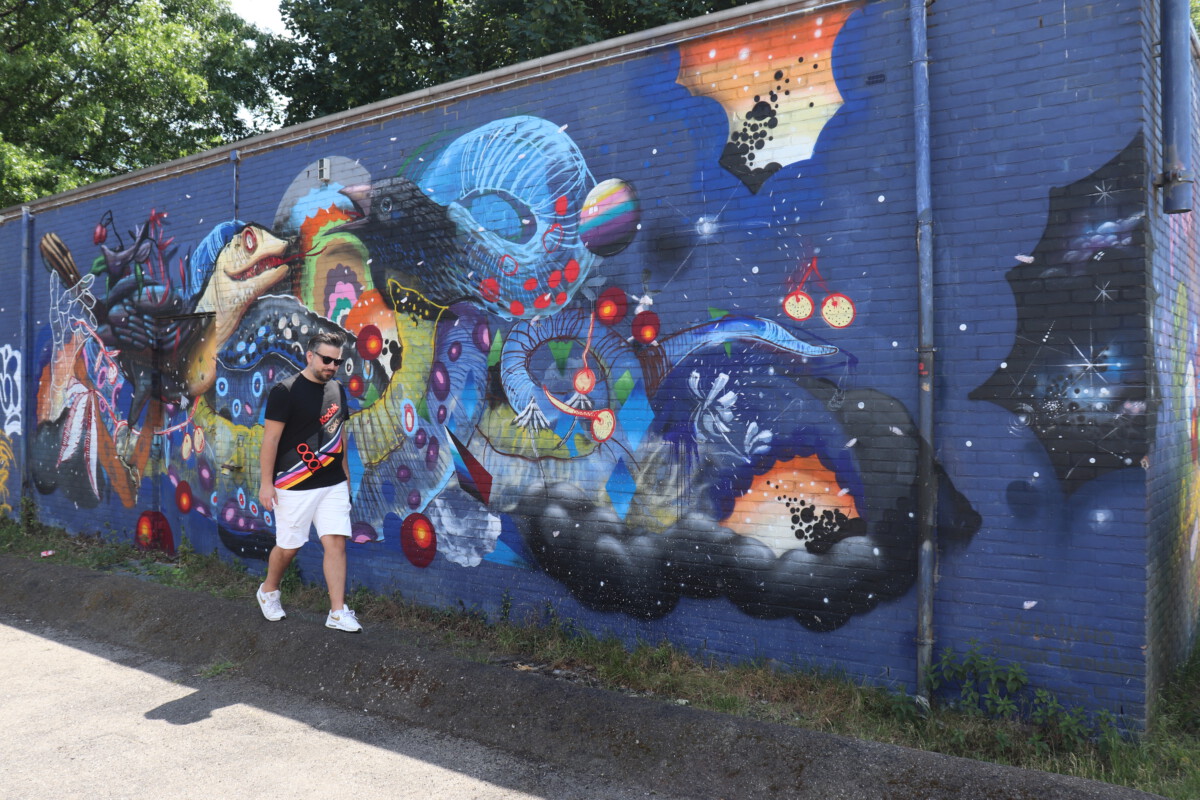
Another pretty mural. Image: DutchReview/SuppliedThis last one can be found at the Spoorzone. Image: DutchReview/Supplied
Step five: cool shops and bars
Time to step back into town and discover some of the unique shops that Tilburg has to offer (not talking about coffeeshops, but those are there too, not gonna deny that in an article about the urban scene). We’ve stepped past all kinds of interesting stores, too many to mention actually.
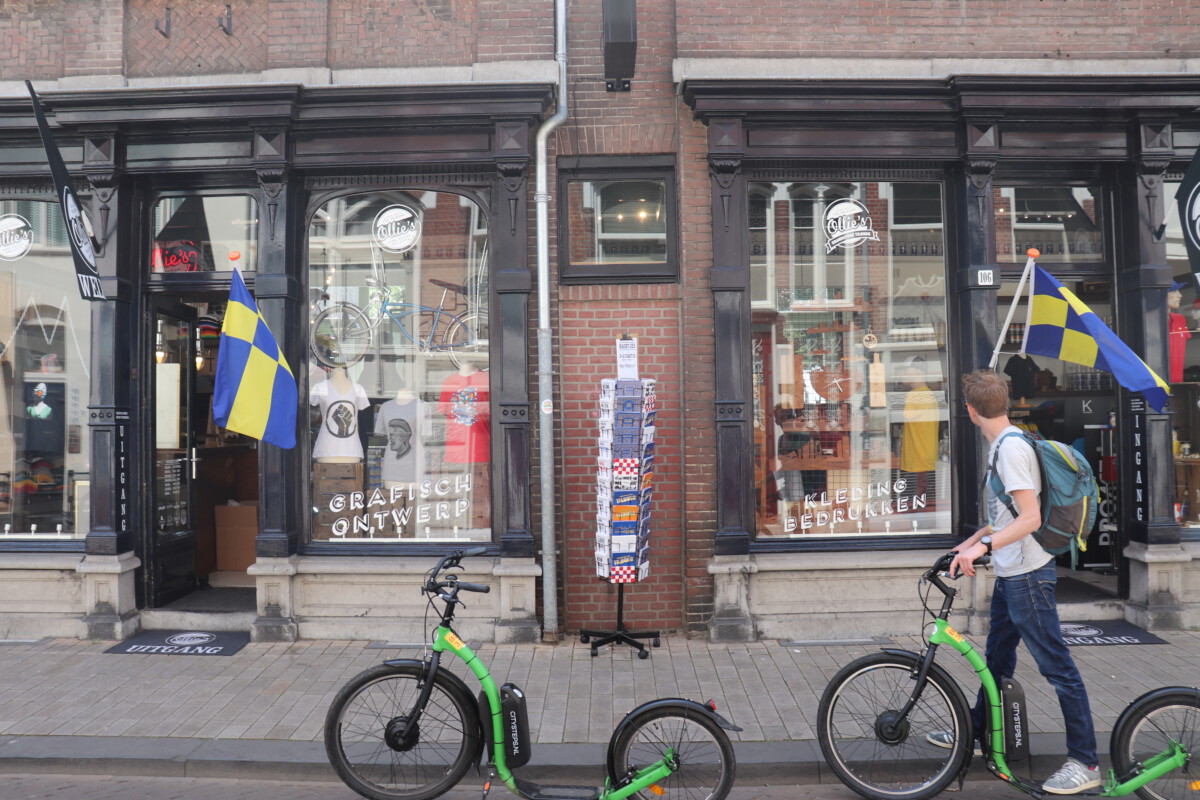
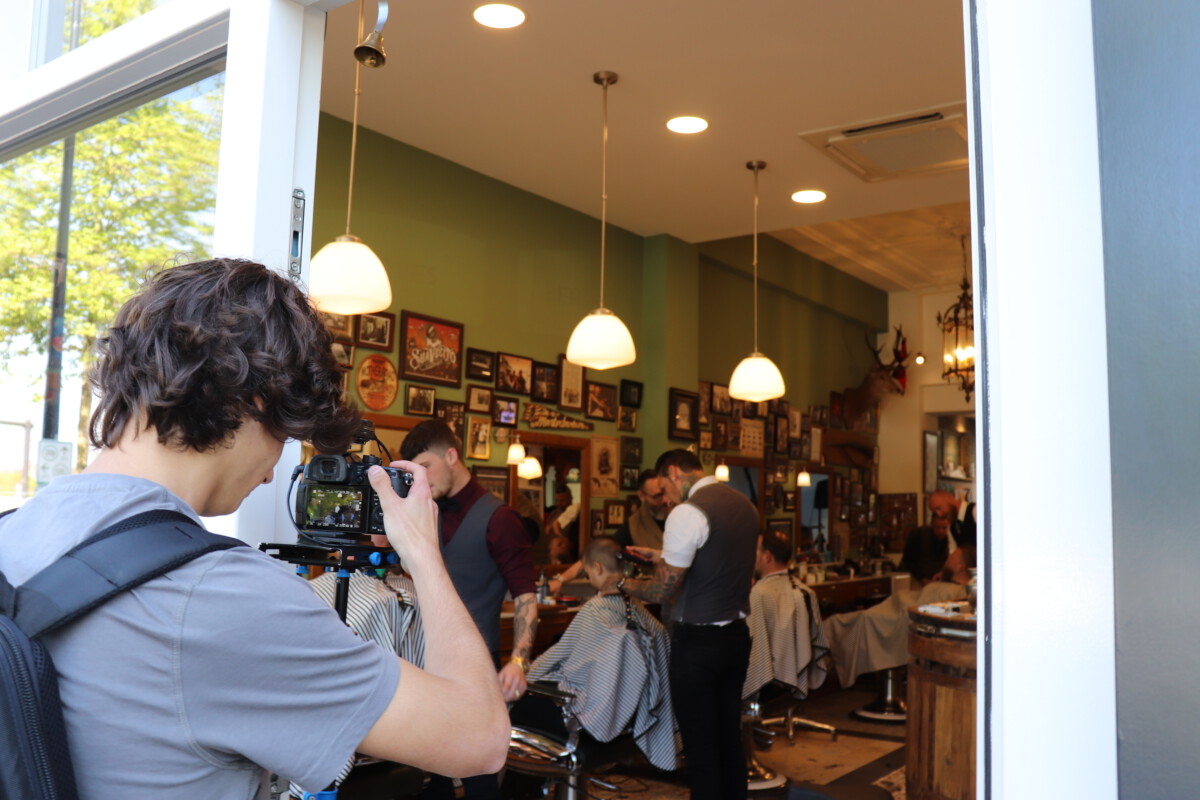
Ollie’s: this one was awesome. Image: DutchReview/SuppliedOne of the finest barbershops to come across. Image: DutchReview/Supplied
Speaking of eating in Tilburg, there are plenty of places with a funky character to eat out at in ‘013’. Our personal favourites include RAW in the Spoorzone, the Wagon — an awesome former train wagon where you can eat, and EVE, where you can enjoy a drink or two.
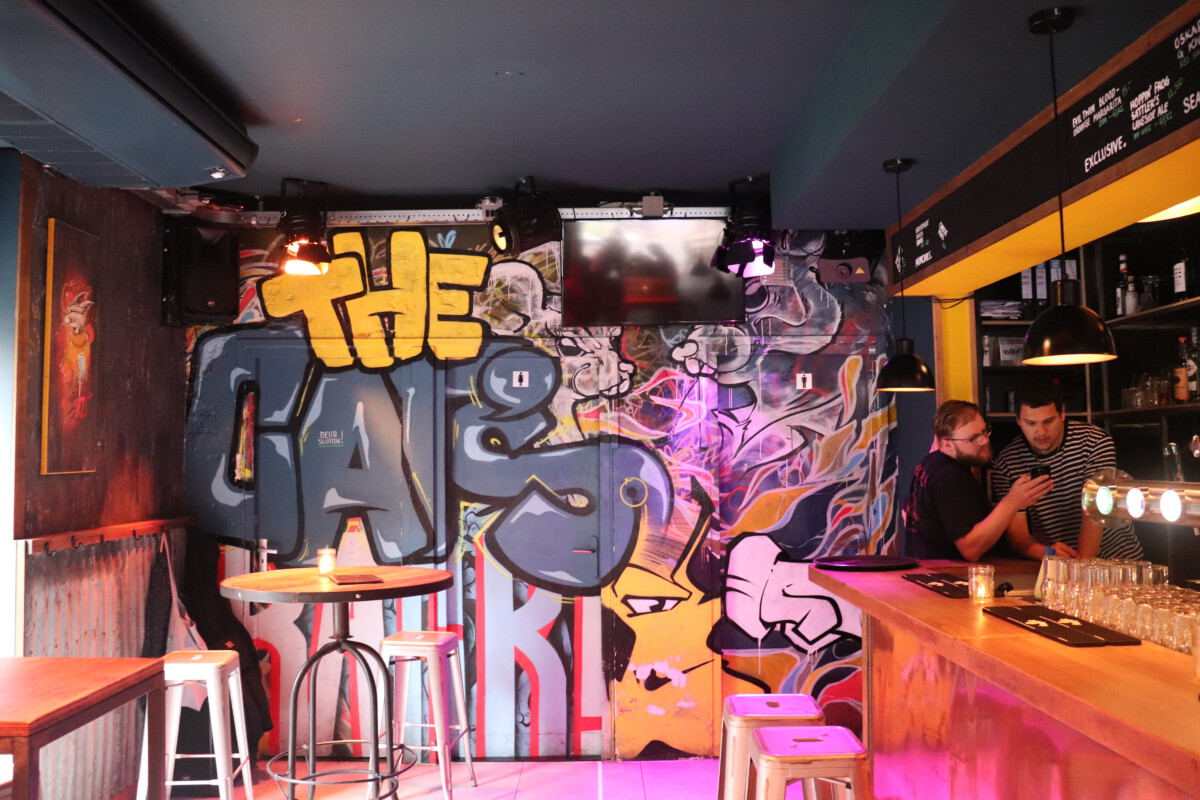
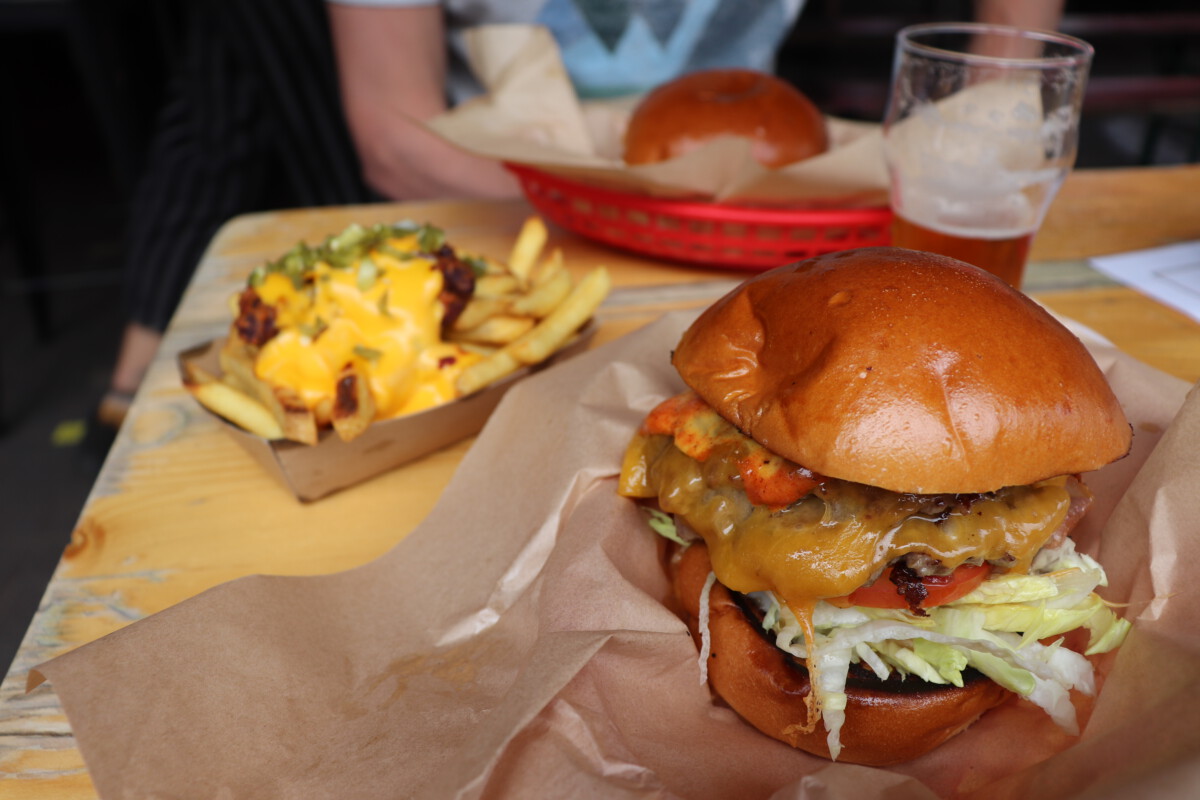
This time around we had burgers and beers at The Cat’s Back, and it’s not just the beers and burgers that we’re raving about. The Cat’s Back features some great hip-hop tunes, classic games, and some of the best indoor graffiti we saw that day.
The Cat’s Back has some of the best indoors grafitti. Image: DutchReview/Supplied
But of course, the reason why we were there was the burgers and beers. This place has a reputation of megalomanic burgers to uphold and they did just that. Throw in that they offer more than 35 imported beers and you’ve got one happy DutchReviewer.
Like we said, plenty of delicious options in Tilburg to check out. Head on over to our friends of Tickets to Tilburg for more info on all that good stuff.
You just have to try burgers at this place. Image: Ticket to Tilburg/Supplied
Step six: Doloris — the metamaze you just have to experience
The best way to describe Doloris would be to say that it’s, well, an experience. What they offer is something truly special. They have 2200 square meters of art and 40 ‘experience’ rooms which are designed to be a maze for you to find your way through. It was originally inspired by Peristal SingumBerlin, which is now permanently closed. Here’s an impression of it:
So this is really not something you want to, in good conscience, miss, given that the original version of it is no longer in existence. Plus, given how often it rains in the Netherlands (and it did at the end of our urban trip day — big surprise), having an indoor activity on your list of must-visit hidden gems in Tilburg is always a good thing.
With headliners like Kendrick Lamar and A$AP, the biggest hip-hop festival in the Netherlands, Woo Hah!, is one not to be missed. It started off as pretty small, but quickly grew to 30,000 visitors (completely sold out — ticket wise that is) within two years and as someone who attended two years ago, I am not surprised.
Watching five seconds of the aftermovie and I guarantee you’ll be scrambling to buy a ticket for next year’s edition.
Besides hip-hop, why not enjoy an evening at a concert hall in Tilburg? One of the most notable music venues is Poppodium 013. If you’re interested in exploring the vibrant and burgeoning music scene in Tilburg, you’ll definitely not be a stranger to this place.
The famous 013 hall. Image: Ticket to Tilburg/Supplied
Big thanks to Ticket to Tilburg for setting us up for a wonderful day exploring the street art and urban vibes of Tilburg! We loved getting to see yet another side of this awesome city — plus getting to sample even more of its delicious food.
What’s your favourite place in Tilburg? Let us know in the comments below!
Feature Image: DutchReview/Supplied Editor’s Note: This article was originally published in June 2020, and was fully updated in June 2021 for your reading pleasure.
This week, the Netherlands is taking ginormous steps in the reopening of society after more than a year of coronavirus lockdowns.
So what exactly is happening?
Almost all restrictions are gone
Yes, it’s really happening! From Saturday, the Netherlands enter phase four of the government’s reopening plan. That means only basic measures will be in place, such as keeping 1.5 metres distance, wearing masks in especially crowded places (like public transport), and washing your hands regularly.
No cap on the number of visitors you can have at home
Gone are the days of face masks, except where social distancing can’t be maintained
We’re working from the office, baby! (up to 50% of the time)
All locations and events will re-open with 1.5 metres distance and certain conditions
Amateur sports competitions are back on
Locations and events can re-open without social distancing if all guests can provide a “corona ticket”
Sing your heart out! No more restrictions on singing, screaming, or wind instruments
Late-night alcohol runs: the ban on buying alcohol after 10 PM expires
You can get a free corona test for travelling
Clubs are opening FRIDAY night
Alright, technically Saturday morning, but they’re keen! The first nightclubs in the Netherlands are already opening their doors at 12:01 AM Saturday 26 — so if you’re out Friday evening you may just have a party night ahead.
People who can show a vaccination certificate, negative test, or prove that they’ve had coronavirus within the past six months are allowed to go clubbing — without worrying about social distancing.
What do you think about the new (lack of restrictions)? Will you be busting some moves this weekend? Tell us in the comments below!
The Dutch language is notorious for being difficult to understand. From all those guttural dips to the stretching oouu noises, you’re really challenged from the get-go. However, if that wasn’t enough, there are idioms. So. Many. Bizarre. Idioms.
The key to understanding Dutch idioms is to remember that Google Translate is certainly not your friend. Let’s start off light, shall we?
1. Muggenziften en mierenneuken
Ah yes, this one is a real charmer. “Muggenziften en mierenneuken” directly translates to sifting mosquitos and — ahem — “canoodling with” ants. What on earth does this imply you may be wondering?
Easy. If you’re sifting mosquitos and BLEEP-ing ants, you’re not only looking at the minute things in life, you’re going to the trouble of fiddling with them. Essentially, it means you’re sweating the small stuff and it’s time to chill — stay away from the ants you gekkie.
2. Het zit wel snor
In fact, if someone is looking to comfort you and remind you to swallow that chill pill, they may say “het zit wel snor” meaning — y’know, you probably guessed — “it sits like a moustache.” Capiche?
No? WHY NOT? Ok no we get it, there is nothing to be inferred from a well-placed moustache. This idiom has a simple meaning — “it’s ok.” Don’t you worry about a thing hun, forget the ants and mosquitos, alles is goed.
3. Wie zijn billen brandt, moet op de blaren zitten
That being said, sometimes the metaphorical moustache just isn’t sitting well, you look homeless and — ok enough of trying to make our own idioms. Sometimes, poep happens. You mess up, and you have to deal with the consequences.
People will tell you that “wie zijn billen brandt, moet op de blaren zitten” meaning “if you burn your ass, you need to sit on the blisters” — owie. Graphic imagery aside, the blisters are your consequences, and sometimes you need to pick up that mirror, drop your pants, and face them.
4. Weten waar Abraham de mosterd haalt
Now this one is echt bizar. If you’re a real smart cookie, or just a bit of a bragger, you may say that you “weten waar Abraham de mosterd haalt” or in English, that you “know where Abraham keeps the mustard.”
Ummm, translation service please? Listen, we don’t know who Abraham is, or why someone would ever care where the mustard is (don’t come for us but Abraham can keep it.) Ultimately, this is somehow meant to infer that you know what you’re talking about.
5. Het regent pijpenstelen
“It’s raining tobacco pipe stems”?! More like it’s raining completely gek Dutch phrases.
Imagine the soothing sound of laying in bed at night, being gently lulled off to sleep by the relaxing sound of…tobacco pipes crashing down on the roof above your head? Dames en heren introducing “it’s raining tobacco pipe stems”. Of course, this saying really does make sense — it’s used when it’s raining really, truly ridiculously hard (which in the Netherlands is, um, always).
But we have one question Dutchies — why tobacco pipes? Who sat listening to the rain one night in 17th century Netherlands and thought “Yep, that looks exactly as if thousands of tobacco pipes fell out of the sky!” It’s probably not what we would have compared it to, but Dutchies do what Dutchies do, we guess.
Enough idioms is enough, otherwise, we’ll need to get ourselves a certified translation to make our way through these super-strange but super-Dutch idioms!
Which of these bizarre Dutch idioms tickled your fancy? (👈 Hey, an English idiom!) Tell us your favourites in the comments below!
A petition and private Dutch companies are leading the charge to make July 1 a Dutch national holiday to commemorate the day slavery was abolished in Suriname and the Dutch Antilles in 1863.
Many people across Suriname, the Antilles and the Netherlands celebrate Keti Koti (also written KetiKoti or Keti-Koti.) The festival is not a national holiday in the Netherlands — but that could be about to change.
This year, some Dutch companies will be giving their employees a day off on July 1. This decision has been made following the creation of a petition to recognise Keti Koti as a national holiday by The Black Archives, the Netherlands Becomes Better Foundation and radio station, FunX.
FunX and other companies such as Tony’s Chocolonely are amongst the first of those to declare July 1 a day off for their employees, regardless of whether or not Keti Koti is recognised.
What is Keti Koti?
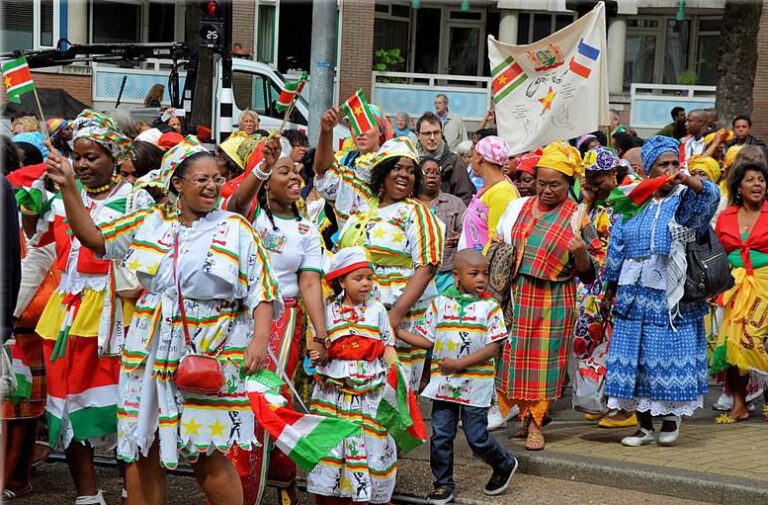
Keti Koti, meaning “broken chains” in the Surinamese language of Sranantongo, is marked in the Netherlands by festivals and parades (called Bigi Spikri parades, meaning “big mirror.”)
Many enjoy wearing traditional costumes, perusing stalls and enjoying music in parks across the Netherlands. The most widely known celebration can be found in Amsterdam’s Oosterpark, where the National Slavery Monument is located.
However, for many, the day is not only a day of festivity but also of reflection and commemoration.
40,000 signatures needed
At least 40,000 signatures will be needed in order for the petition to be discussed in the House of Representatives, Mitchell Esajas of The Black Archives tells RTL Nieuws. Since the petition’s creation yesterday, the number of signatures has grown to nearly 15,000.
An important day of remembrance
Esajas points out that the liberation of thousands from slavery marks an important chapter in Dutch history, and it should be treated as such, saying “it’s also an important aspect of history, lest we forget.”
He likens the liberation from slavery under Dutch rule to the liberation of the Netherlands from Germany. Just as the Netherlands marks May 4 and 5 as national holidays, it should also acknowledge July 1 as an important date.
When a national day off is facilitated by employers and the government, you send a signal that society and the government think this is important enough.
Eva Hol, program director at FunX points to the importance of commemoration in Dutch society. “On days off like Easter, children ask: why do we celebrate that? That creates a conversation. That’s good,” she says.
Currently, the Netherlands falls behind when it comes to recognising and remembering its dark history and the large role the country played in the slave trade.
However, the Netherlands slowly heading in the right direction. Last year, Amsterdam’s city council supported the request to mark July 1 as a national holiday. This week, further action has been taken with the cities of Amsterdam, Rotterdam, The Hague and Utrecht sending a joint letter to the Dutch cabinet requesting that the government mark Keti Koti as a national holiday.
Do you think Keti Koti should be a national holiday in the Netherlands? Tell us your thoughts in the comments below!