You may not think it with the national love for bitterballen, but it turns out the Dutch are going veggie. A recent study puts the Netherlands ahead of every other European country when it comes to the consumption of meat replacements.
According to research by not-for-profit ProVeg, Dutchies buy the most meat replacement products compared with their European neighbours. It looks like many have also dabbled in veganism, as the sale of vegetable-based “cheeses” is also on the rise — these are up by 400% over the last two years, reports the NOS.
A small market on the rise
Despite the Dutch love for non-meat, the market share of these products is only 2.5%. This is surprising when the national average amount of fake meat products eaten per person in the Netherlands is 870 grams per year.
The cliché that every millennial is veggie might be true. Remko Vogelenzang, director of Bobeldijk Food Group, said that it’s mainly young people driving the meat-free market.
He also suggests that coronavirus might have affected people’s meat-eating habits. He told the NOS that “some people have become concerned about factory farming and come to the conclusion that a pandemic is caused by humans, in the way we interact with animals.”
Low on “real” meat consumption
It looks like aardappelen, vlees, groente is going out of fashion, the Dutch aren’t eating as much meat as we think. In fact, surprisingly, the Netherlands is only 70th in the world for its meat consumption, according to World Population Review. That’s miles better (or we should say kilometres better) than our neighbours in Germany. Across the border they are chomping in at 19th place.
What do you think about Dutch meat consumption? Have you dipped into the meat replacement market? Let us know in the comments!
Car sharing is becoming more popular in the Netherlands. The number of shared cars is increasing mainly due to growing attention for the environment and the fight against congestion on the roads.
If there’s one thing the pandemic and lockdown has shown us, it’s that the roads are so much better with fewer cars on them. Additionally, on average, cars are stationary about 90 percent of the time. So wouldn’t it make sense to share them?
As more and more people make use of car-sharing possibilities in the Netherlands, even more people start to understand the benefits. In 2020, the Netherlands had 730,000 people making use of shared cars, according to CROW. That is a 42% increase compared to 2019 — when there were still 515,000 users.
This is good news because the sharing of cars is sustainable and the more we do it, the fewer (second) cars people will buy. Moreover, car sharing is perfect for people who travel less often by car and drive shorter distances.
Let’s talk numbers
According to De Verkeersonderneming, there are currently 369 shared cars per 100,000 inhabitants in the Netherlands. Business car sharing, in particular, is growing rapidly in big cities like Amsterdam and Utrecht.
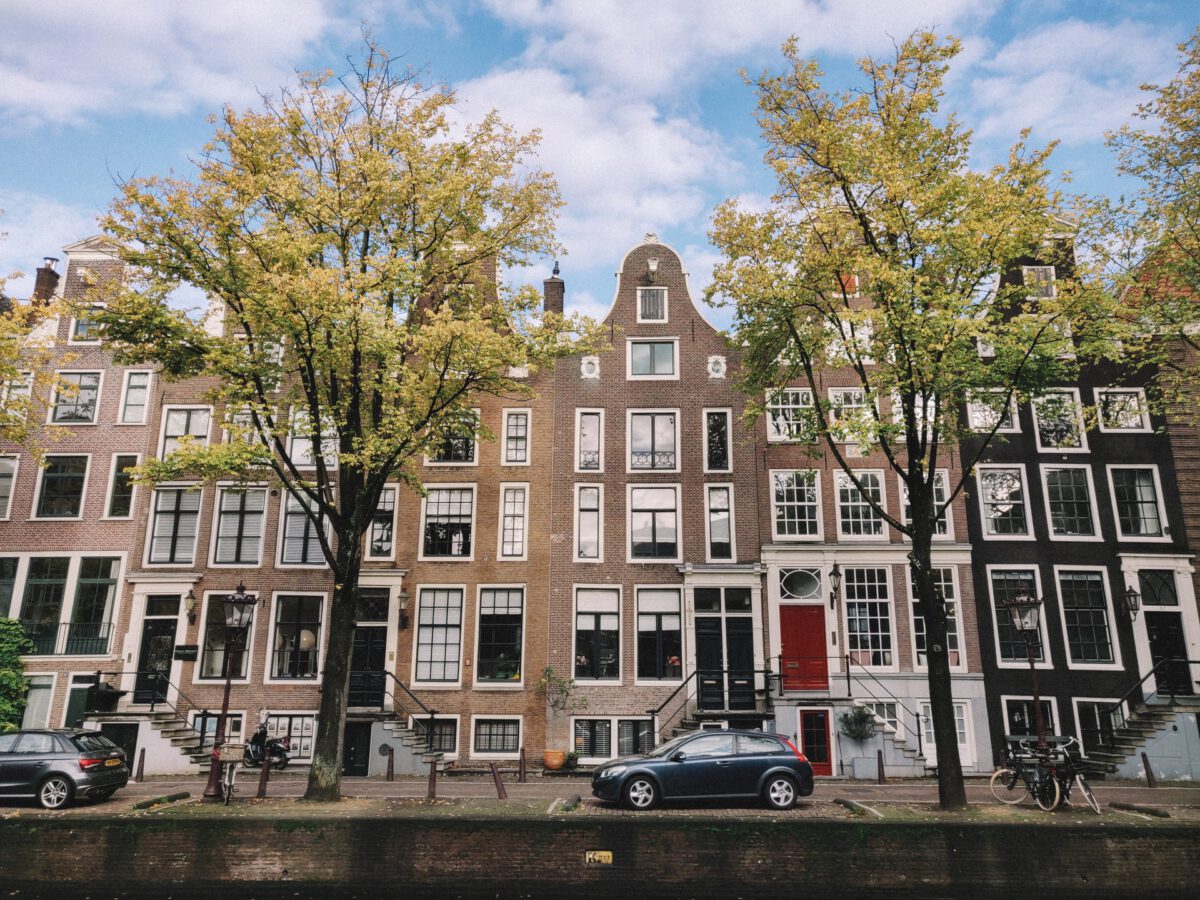
Amsterdam is leading with the highest number of car shares. Image: Benjamin Hollway/Unsplash
The idea behind employees of a particular company sharing cars saves companies money and is also good for the environment. Community-based car sharing is equally on the rise. It means that you share a car with a group of residents of a flat, district, or neighborhood.
Large municipalities are the top sharers
In large municipalities, the chance that you will see a shared car is increasing. Cities such as Utrecht and Amsterdam have more car-sharing users and the shared cars are often electric.
In terms of the total number of cars, the municipality of Amsterdam leads with more than 11 thousand shared cars. The number of shared cars also continues to grow the fastest.
Utrecht and The Hague each have more than 5,000 shared cars. Nevertheless, Utrecht leads the way in terms of the number of shared cars per 100,000 inhabitants, which is almost 1,500 in Utrecht, thus putting the city in the first place.
The number of shared cars also grew rapidly in Rotterdam in 2020, putting the city in the top 10 for the first time. Shared cars are slowly gaining popularity in Haarlem, Amersfoort, and Groningen.
In order for car-sharing to be a real success in the Netherlands, more cars need to be made available for sharing. And this should also be actively promoted so that people are made aware of the possibilities and encouraged to use them.
Coronavirus leads to more car sharing
The corona crisis has had a positive impact on the use of car-sharing possibilities. At the beginning of the “intelligent” lockdown in 2020, while car-sharing wasn’t as badly affected as public transportation because more people chose to walk, cycle, and enjoy the fresh air, a huge number of car owners looked for platforms to share their cars that had been stationary throughout the lockdown.
Many platform providers showed a strong increase in the demand for car-sharing after the lockdown. This can probably be explained by the recommendation to use public transport only for essential journeys.
Carpool/ridesharing
The sharing of cars isn’t the only phenomenon that is becoming more popular in the Netherlands. Carpooling and ride-sharing are terms that are used interchangeably, where carpool usually refers to colleagues riding with each other, while ride-sharing is basically people in the same community giving rides to each other for cash. This is usually done via a ride-sharing app.
Difference between car sharing and car rental
The difference between opting for a shared car and renting from a car rental company is that you do not have to go to the rental company itself, but that there is (almost) always a car near you.
Additionally, an app shows you the available shared cars in your vicinity, and you can also make a reservation via the app at any time. You are therefore not bound by the opening hours of a rental company.
Benefits of car sharing
Car sharing offers significant environmental, social, and economic benefits. It reduces the number of cars on the roads, the number of traffic jams, CO2 emissions, parking pressure, and the individual cost of using a car.
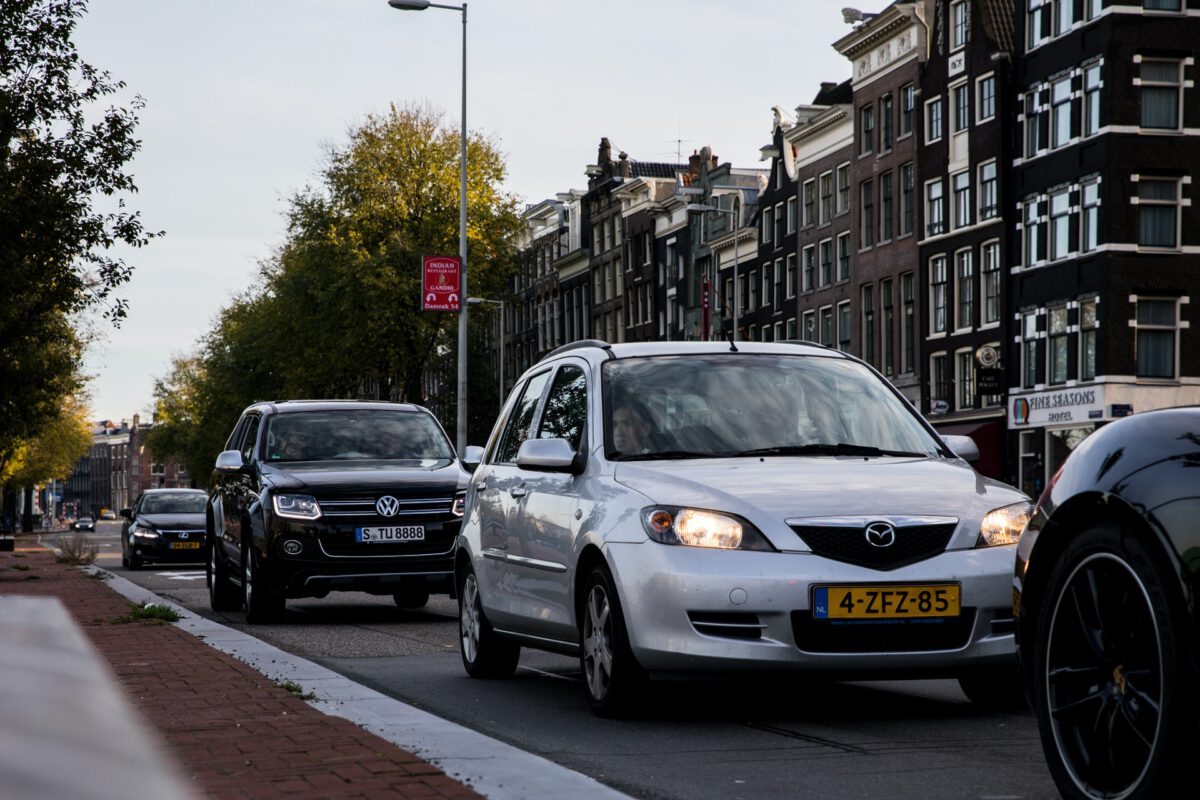
The Netherlands could see many benefits to car sharing. Image: Ihor N/Unsplash
Car sharing is a sustainable and flexible alternative to owning a car. Let’s run through some of the main advantages:
Car sharing is cost-efficient
Owning your own car is expensive. An average Dutch family pays between €3,500 and €7,500 annually (depending on size) for a car (inspection, maintenance, fuel, etc.). With car sharing, you save a lot of money every year.
With car sharing, you reserve a car that is tailored to your situation. Are you a single parent about to drop off the kids at football practice and then run some errands? Do you want to go shopping with some friends? Do you want to visit family with your partner and kids? Different options for different kinds of people.
Car sharing is time-saving
You are never burdened with time-wasting practical or administrative matters, such as buying insurance, maintenance, cleaning, or inspection. With most car-sharing systems you have to do little or nothing yourself. So you can spend the rest of the time getting to where you have to be.
Car sharing is good for the environment
When you don’t own a car, you are forced to think more consciously about other options for getting around (on foot, by bicycle, shared scooters, public transport, etc.) Car sharers drive fewer kilometers, which means they limit their CO2 emissions.
A shared car quickly replaces 5 to 10 private cars. This means more space in your street for kids to play or do something fun.
Car sharing is a way of making friends and is inclusive
You can share a car with your neighbors, which gives you a lot of new social contacts. A private car is not affordable for everyone. Car sharing offers people who can’t afford cars the opportunity to use them from time to time.
The future of the shared car in the Netherlands
The question is whether the phenomenon of car sharing is here to stay. Its growth in popularity in the Netherlands shows that car sharing certainly has potential. Market researchers expect that a maximum of one million potential users will enter the car-sharing market in the next five years.
Car sharing can become much more popular if governments make it less attractive to own a car. The pandemic and lockdown have shown that the fewer cars we have on our roads, the better. Car sharing is the future and if we truly care about the environment we need to make it a way of life. Quickly.
Have you ever used car sharing and what do you think about it? Let us know in the comments.
The Dutch cabinet thinks so too, as they have been discussing potential relaxations of current coronavirus restrictions. From May 19, we may be able to play sports indoors, visit zoos and amusement parks, and attend lessons in music schools again, according to RTL Nieuws.
The cabinet is also considering the possibility of allowing terraces to stay open longer. This would mean extending current opening times of 12 PM to 6 PM. Insider sources in The Hague claim we could see terraces opening earlier in the morning until 8 PM.
Cabinet still unsure
This decision has not yet been formally made. However, the Dutch government has agreed that if the number of coronavirus infections and hospital admissions keeps going down, they will continue to relax the current restrictions.
Based on its new five-step plan for a restriction-free summer, the government was initially hoping to introduce more relaxations on May 11. These, however, were postponed.
Summer vacay abroad?
Whether we’ll really be able to spend our summer holiday basking in the Spanish or Italian sun is now up to the European Parliament and the European Council.
Negative travel advice applies in the Netherlands until May 15. After that, the country will probably go back to the colour coding system whereby travellers can go to countries where the number of infections is low.
A couple of destinations are already relatively safe to visit. For example, travellers returning to the Netherlands from Portugal, as well as some Spanish and Greek islands, no longer have to quarantine.
Measures announced tomorrow
The cabinet will announce the exact measures and relaxations that we can expect from May 18 in a press conference tomorrow.
Do you think we’ll see further relaxations in the Netherlands? Let us know in the comments below!
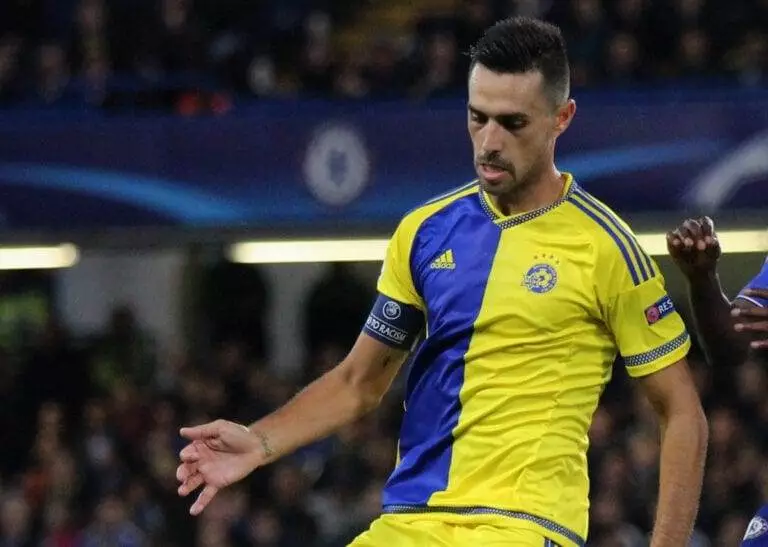
The Dutch home of an Israeli football player, Eran Zahavi, was broken into on Sunday. The robbers allegedly tied up his wife, assaulted her, and cut her hair in front of their children.
The robbers reportedly pretended to be delivery men to enter the household in Buitenveldert in Amsterdam. They entered the home to find Zahavi’s wife and children. One of his children was also harmed in the assault. According to locals, the robbers threatened to use a firearm.
At the time, Zahavi was on his way to meet his team (PSV Eindhoven) for a game against Willem II.
Horrible news for PSV striker Eran Zahavi as a robbery took place at his house today. According to @parool his wife was tied up and heavily assaulted in the presence of her 3 children. The robbers acted as package deliverers.
Zahavi’s neighbours have confirmed the details, reports Het Parool. The Dutch police have confirmed very few details of the incident. The police were alerted to the robbery at around 4 AM. A spokesperson told Het Parool that they can confirm that a robbery took place at Arenborg in Buitenveldert, but that cannot confirm who the victim was.
The Dutch police were conducting a neighbourhood investigation in the early hours of this morning. A helicopter has been deployed to scope the local area.
Despite being some of the most secular of nations in the world, Dutch culture is still very much shaped by religion — especially Christianity.
Are Dutchies actually still religious? What are the most popular religions in the Netherlands? Let’s dive into the topic.
How many Dutch people identify as religious?
A study conducted by Statistics Netherlands reveals the following numbers when it comes to religious identification in the Netherlands in 2019.
Only about 46% of Dutchies identify as religious. The majority of these is made up of Roman Catholics who represent 20.1% of the population. This is followed by Protestants, representing 14.8% — this number includes different branches of Protestantism, such as Dutch Reformed, the Protestant Church of the Netherlands, and Calvinism.
With regards to other religions, Muslims make up 5% of the Dutch population, and 5.9% represent other religions, such as Hinduism, Buddhism, and Judaism.
Christianity
After the conversion of the Roman emperor Constantine, Christianity quickly became the dominant religion in Europe and would be so for many centuries. However, under the influence of the Renaissance, Reformation, Enlightenment, the quickly growing understanding of natural and social sciences, and increased literacy and wealth, religion lost more and more of its influence over time.
Today, the Netherlands embodies the liberal middle road of having both freedom of religion as well as freedom from religion. This is to say that while people are free to express and practice their religion (with a footnote banning hate speech and criminal acts), it is equally true that no one can force religion on another person. People are as free to worship as they are to ridicule.
Judaism
Today, Jews (be it ethnic or religious) are a very small minority in the Netherlands. Due to its liberal culture, the Netherlands has always been a popular place of refuge for those who were persecuted for their beliefs — be it Jews, Protestants, or otherwise. The sizeable minority of Jews, mostly living in Amsterdam, was decimated in the Holocaust. Living in the most densely populated country in Europe with an advanced social administration (left intact after the swift and decisive Nazi invasion of 1940), only 35,000 of the initial 140,000 Jews living in the Netherlands survived the war.
Ietsisme and non-religion
There a list of Dutch words that have made it into the English dictionary. Among such proud concept such as apartheid and Yankee, there is also ietsism — a word that is the result of making an -ism out of the word iets (something). Best described as “faith without religion”, ietsism is a broad term that encompasses everyone who basically says: “I don’t believe in God, but I do believe that there is something out there.” To be an ietsist means to believe in a supernatural being, but without following any kind of established dogma or set of beliefs.
Not being religious is also on the rise, praise be Richard Dawkins (unholy is his name)! All jokes aside though, not believing in gods has slowly become the new norm, with only every other Dutchie being religious as of 2019. Whereas some worry about moral decay and nihilism (when Nietzsche said that “God is dead!”, he wasn’t exactly celebrating this), others see it as a new wave of liberation from dogma.
Islam
With circa 900,000 Dutch people professing this faith, Islam is a sizeable minority in the country. It quickly rose after the immigration of Turkish and Moroccan people in the 1970s.
Islam is also a somewhat controversial religion in this country. Though Muslims are as free to practice their religion as anyone else, there is increasing tension between Muslims and non-Muslims. Needless to say, the recent wave of terrorist attacks, such as in Ankara, Ivory Coast, and Brussels, have only added to the suspicion. The Netherlands has both a tradition of liberal tolerance as well as fierce resistance against the multi-cultural society, with the murdered Pim Fortuyn (1948-2002) and Theo van Gogh (1957-2004) as some of the most outspoken critics of Islam.
This critique of both Islam and non-Western cultures can be a nasty and out-right racist affair, but there are also more rational and intellectual responses. I think Frits Bolkestein made a very accurate judgment in his book The Intellectual Temptation when he claimed that if we ever want to see a moderate Islam, it has to open up to relentless criticism and scrutiny. Just as Christianity has been shaped (for the better) by philosophers such as Voltaire, Nietzsche, Marx, and Bertrand Russell, as well as ridicule as the above-mentioned Life of Brian, so must Islam open itself to criticism.
Only time will tell if the religious/ethnic divide in the Netherlands will become greater or smaller. In the meantime, I think it is best if we keep walking the middle road of freedom of religion and freedom from religion.
What’s your experience with religion in the Netherlands? Let us know in the comments!
Feature Image: Wendy van Zyl/Pexels Editor’s Note: This article was originally published in May 2020, and was fully updated in May 2021 for your reading pleasure.
Few are more passionate and devoted to animal rights activism than the Vegan Streaker.
Peter Janssen strongly believes in ending the intensive livestock industry by any means necessary, including through violent activism, anti-animal cruelty demonstrations, and even displays of nudity … all in the name of protest, of course.
Who is the Vegan Streaker?
The 35-year-old man born in Culemborg, Netherlands, is well-known for appearing at busy locations scantily dressed. The vegan streaker protests naked all over the world in the middle of events involving animals.
He became famous when he appeared on a live television show dressed in only black underpants and covered in painted slogans like “Meat is murder”. The trend of appearing half-naked in public places landed him the nickname “the Vegan Streaker”.
As the face and most famous member of the Vegan Strike Group, Janssen is wanted in various countries for his, often violent, animal welfare protests.
Janssen takes responsibility
He confesses to having jumped into bullfighting arenas approximately 21 times in Spain, four times in Mexico and once in Portugal. He maintains that he will only stop targeting Spanish bullfighting organisations when they stop killing the animals.
Although he appears shirtless in most of these protests, Janssen made headlines again when he jumped naked into the water at a dolphin show event in Japan.
The Streaker’s many offences
Janssen’s list of prison stints and convictions began in 2009 after he confessed to his involvement in a Mink Liberation campaign, during which he released up to 3,000 mink from the fur farm in Zeeland.
However, after being released from custody, he became the lead suspect of a 2006 arson case in which a butcher’s van was set alight in Vught. This was his first self-proclaimed violent act.
In 2008, Janssen disturbed a live broadcasted hocket match between the Netherlands and Spain for the Champions Trophy. In this specific protest, Janssen wanted to draw attention to apartments and protest the 22.5 million pigs who got castrated every year. On the front of his body, the Vegan Streaker painted lyrics to the song ‘Balls for pigs” and on his back “Géén Varkensflats” (No Pig-apartments). Besides also writing the link to his website on his legs, Janssen could be seen harassing the Spanish players by yelling: “BULLFIGHT IS BULLSHIT”!
However, his most daring protest was one that never came to fruition. In 2009, Janssen was arrested for suspicion of planning an attack on Queen Beatrix because she wears animal furs.
His recent convictions
More recently, Janssen’s antics included arson at a duck slaughterhouse in Ermelo in May 2020. Five trucks were set aflame outside the meat supplier Tomassen Duck-To’s duck slaughterhouse on the Fokko Kortlanglaan. On top of paying damages of over €5000, he was also sentenced to 25 months in prison.
His car keys, which were found in his pants at the duck slaughterhouse, lead police to arrest him. Why were his pants found sans body, you may ask? Because, true to his nickname, he took them off after accidentally setting himself on fire, too. Such is the hazard of the job, right?
Better vegan food in prison
The Vegan’s Streaker’s antics do not stop there, however. In April 2021, Janssen again made headlines after starting a hunger strike from his prison cell in Arnhem. He does this to show solidarity with suffering animals in the intensive livestock industry and animal testing industry.
Janssen draws attention to the fact that the government is supposedly providing billions of euros in subsidies to people who exploit animals. The dry rice and tofu, which is apparently the staple vegan meal option in prison, is possibly another, less noble, reason for Janssen’s hunger strike.
Through a crowdfunding campaign started in a message on his Facebook page, the Vegan Streaker hopes to raise money to buy better vegan food in prison. In a post on the crowdfunding page, Janssen states that “I now experience how animals should feel in a cage, stable or dolphinarium. If I want to be able to stand up for the animals again quickly after my release, I really need your support.”
What do you think of the Vegan Streaker’s protests? Tell us your thoughts in the comments below!
I have never paid a lot of attention to sleeping arrangements until I got a Dutch boyfriend. I’m from Austria and the first time he came to visit me in my homeland, I prepared an extra blanket for him on the bed (I mean, that’s what a good girlfriend does, right?).
What I didn’t prepare for, is that a few hours later this would lead to a conflict. Apparently, it’s not normal to sleep under two different blankets as a couple in the Netherlands. To my horror, I learnt that the norm here is to share a two-by-two metre blanket with your significant other. This clashing of cultures led to an ongoing discussion and encouraged me to write this article. Let’s call it: the blanket battle!
The blanket battle: cultural differences
In the Netherlands, where the weather is grey and rainy most of the time, sometimes you can’t help but spend your day cuddled up in a blanket. It just feels like the right thing to do. Now, are you going to be cuddled up in one giant blanket or two separate blankets?
The way it works in Austria is this: two same-sized duvets are folded in half and placed side-by-side on the bed. We don’t use top sheets. Sometimes people drape the third blanket across the duvets to prettify the bed. This system is also used in Germany and parts of Scandinavia.
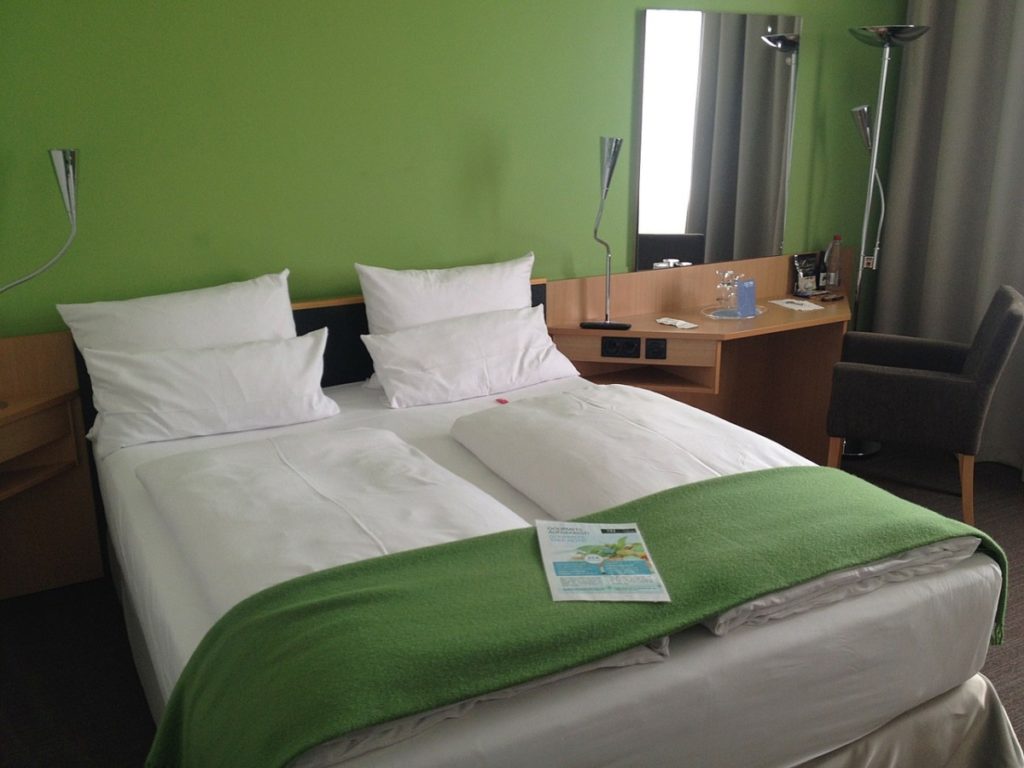
The blanket battle: Two blankets for two people. It just makes sense, right? Image: markusthomasde/Pixabay
The blanket battle: why the Dutch should do as the Austrians do and get two blankets
People think sharing one big blanket is romantic, warm, cuddly, and comprises all other lovey-dovey adjectives you can think of. However, if you’re going to share a blanket with your significant other, you need to make sure the one blanket is enormous and stretches comfortably across the two of you.
In my opinion, the one-blanket system is massively flawed. One blanket always leaves the chance that your covers will be ripped from you in the middle of the night or that your partner will purposely steal them from you to feel extra cosy.
That’s just too much of a risk and all these problems can be easily solved with the Austrian system — having two smaller separate blankets ensures everybody can sleep peacefully and all your worries can dissipate.
The Austrian system also lets you sleep at your desired temperature. Too hot? No worries. Too cold? Also not a problem. I’m usually too cold and my boyfriend is usually too warm. Is this an issue for sleeping? Not with the two-blanket system. He can put push his blanket away from his torso while I have the freedom to tuck mine up around my neck.
Collision of cultures: one blanket in the Netherlands but always two blankets in Austria
When I was moving to the Netherlands, this issue had to be addressed. In the spirit of truly immersing myself in the Dutch culture, I brought with me my new, two-meter big, amazing, fluffy, romantic blanket for the two of us!
One could argue that I could have just bought another blanket in the Netherlands and kept the original one in Austria. But to be honest, a proper blanket is quite expensive, and being under the influence of Dutch frugality, I didn’t want to spend some extra money on something that wasn’t necessary.
Funnily enough, when my Austrian friends visit me in the Netherlands and I give them one big blanket to sleep under, they consider it quite odd. They think it is impractical and don’t understand how we could sleep under just one blanket, because it’s just “komisch” (weird).
Have we convinced you that the two-blanket system is better? What is the norm in your culture? Let us know in the comments below!
Feature Image: Pixabay/Pexels Editor’s Note: This article was originally published in October 2019, and was fully updated in May 2021 for your reading pleasure.
Back in March, the outgoing Dutch Minister for Health, Hugo de Jonge, claimed that anyone in the Netherlands who wants to get vaccinated against coronavirus should be able to get their first jab by July.
To live up to these claims, the Dutch Ministry of Health, Welfare and Sport is now ramping up the country’s vaccination strategy.
The GGDs — which currently have the capacity to administer 1.5 million injections every week — are preparing to bring this number up to two million doses per week from the end of May.
In April, De Jonge claimed that 2.5 million injections need to be given every week from May. At the moment, the Netherlands is at about 800,000 per week.
Hospitals will also administer vaccines
From the end of May, GGDs will aim to vaccinate two million per week with Dutch hospitals administering the surplus. In line with the ministry’s aim, this would give hospitals the responsibility to administer half a million vaccines weekly. However, the actual number will vary depending on the deliveries.
Jabs for the young and healthy
The idea is that hospitals would vaccinate predominantly young and healthy people, according to the NOS. While hospitals are still busy with coronavirus patients, they claim to have sufficient staff to administer vaccines.
“Nurses or students in particular will inject, under medical supervision of a doctor. It’s not a complicated operation,” claims the Dutch National Network of Acute Care (LNAZ).
Invitations via RIVM
The hospitals will not be inviting patients. Everyone will receive a letter from the RIVM and can then make an appointment online. If everything goes as planned, predictions are that about eight million people will get a jab in June.
Up until now, around 5.9 million vaccines have been administered in the Netherlands. About one million of these were a second dose.
Have you been vaccinated yet? What do you think of this new strategy? Let us know in the comments below!
A Rotterdam police officer has apologised after footage was recorded of him punching a 17-year-old boy on Liberation Day. The boy had been part of a group of people who were standing next to a car playing loud music.
The police were responding to a noise complaint when the incident occurred. Five people were arrested after the group refused to move on and began to insult the police officers.
According to reports by RTL Nieuws, the boy was interfering with an arrest and as a result, was arrested himself. However, an officer approaches him before he is brought away, pushes him roughly to the ground, and then punches him in the face when he stands up. The incident was captured on video by a bystander.
— Lidwien Jansen #freerider (@lidwienj) May 6, 2021
At this point, bystanders can be heard protesting and another police officer runs to intervene.
An apology
The charges against the boy have since been dropped and the officer involved has apologised to the boy. The boy received a call from the police man and his supervisor, with the officer describing his actions as “disproportionate.”
What are your thoughts on the officer’s actions? Tell us in the comments below.
Feature Image: Screenshot from viral video/@h__aras
Dutch communication, eh? Now, I know what you are thinking. As the infamous stereotype goes, just go into every conversation like a bull in a china shop and say whatever you want, asbluntly and direct as possible. If people are offended – helaas pindakaas, that is their problem. Well, yes. But ask yourself this: why is it so often deemed an acceptable approach here?
Intrigued? You should be.
By the end of this article, you will not just have a clearer idea of effective communication with Nederlanders, but also all cross-cultural communication. We’ll be delving into communication styles across cultures. Also, why some countries have entirely different approaches to communication — and how that can create problems.
Culture, culture, culture
Firstly, let’s look at you (yes, you). You have, largely, been nurtured in harmony with the culture and behaviours of the country that you grew up in, or have had the most exposure to. The way that we think, approach tasks, and what we find logical and acceptable, are all biases from our most familiar culture.
Yes, personalised events also shape us. Then there is Nature vs. Nurture, but there are characteristics shared through similar ethnicities, languages, histories, and religions. A decent first step before trying to understand and work with Dutch culture is to acknowledge and explore your own, as often we are not even aware of the depth of these influences. But how can that be done?
Low-context vs. high-context cultures
Cultures are incredibly complex so it’s not so black and white. There is certainly more than simply exploring low-context and high-context cultural theory. However, it’s a good place to start.
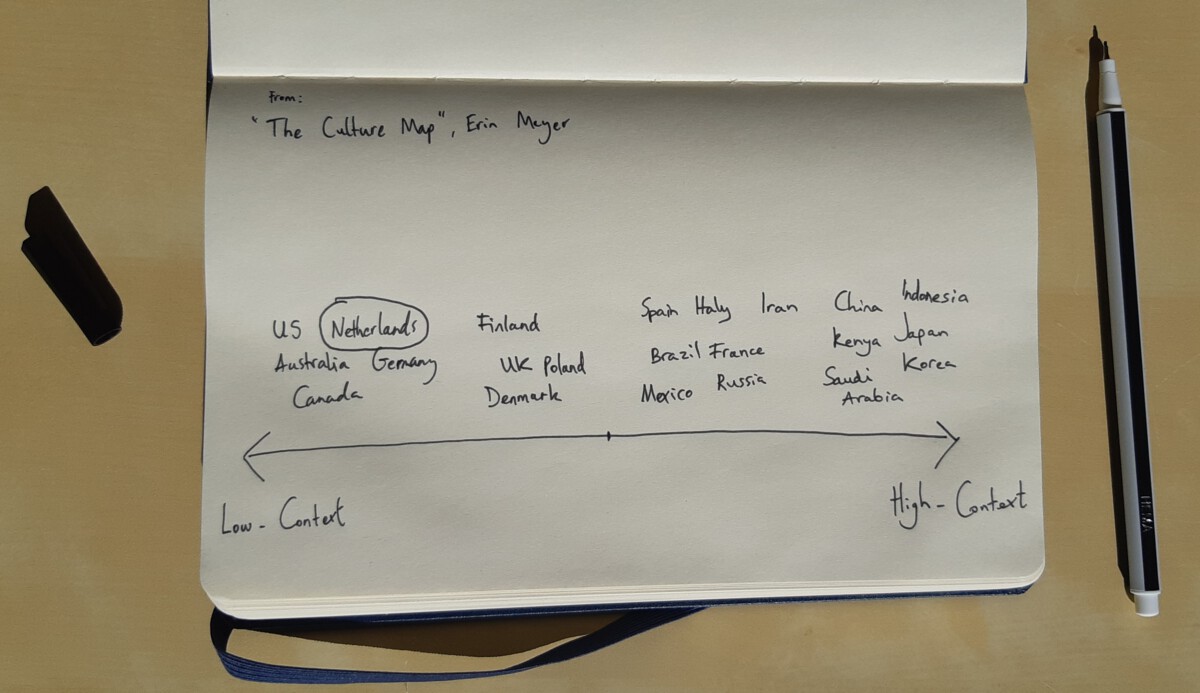
General patterns and characteristics are present in cultures which help us put them on a scale, such as this one (an example borrowed from Erin Meyer):
Where does your home country sit on this scale? Image: James Bogue/Supplied
However, Meyer cautions not to get too obsessed with it. “What matters is not so much the absolute positioning of a person’s culture on a particular scale, but rather their relative positioning in comparison to you.”
So with that in mind, what are the basic differences between the two groups in terms of communication?
High-context communication traits
Information is shared implicitly, where context is king. It’s often indirect (read between the lines), extensive, and communication is considered an art. Non-verbal cues are key, such as voice tone, gestures, facial expressions, and eye movement. Disagreement and conflict are often seen as personal.
Low-context communication traits
Information is shared explicitly, with much less importance placed upon non-verbal elements. Communication is seen as a way of exchanging ideas, information, and opinions. So, the choice of words, conciseness, and clarity is of utmost importance to do that effectively. Additionally, repetition for the sake of good communication is acceptable. Disagreement is often depersonalised, with a focus on a “rational” solution to solve a conflict.
Ok, but what does this mean in practice?
Again, Meyer nails it. “If you’re from a low-context culture, you may perceive a high-context communicator as secretive, lacking transparency, or unable to communicate effectively,” she writes.
“If you’re from a high-context culture, you might perceive a low-context communicator as inappropriately stating the obvious…or even as condescending and patronising.’’
Interestingly, and probably to the amusement of low-context cultures, the two groups most likely to suffer from miscommunication are two high-context cultures. Their implicit interaction is based upon their own cultural nuances and behaviours.
The Netherlands, obviously, has as a (very) low-context culture. So next time you are at work with Dutch colleagues or with Dutch friends and neighbours, ask yourself this:
Am I communicating implicitly or explicitly?
If the answer is the former then good luck. You can be fluent in Dutch, a die-hard Ajax fan, and somehow convince yourself that stamppot is enjoyable and not bland, but that may not. be enough. If you’re still communicating with high-context culture mannerisms you will forever fall short of Dutch expectations.
Differences in communication is honestly just the start, and it’s a fascinating topic which is immensely helpful in a multi-cultural environment.
For example, attitudes to personal space and privacy; relationships; hierarchy and company structures; the approach and execution of tasks; the perception and importance of time; and learning are all aspects that can vary. These all depend on where your culture sits on the low-context to high-context culture scale.
So if you not only want to survive but thrive in the Netherlands, put some time aside to learn about low-context cultures. This isn’t to say that there is a golden standard for communication and behaviour, or that your own culture is incorrect so you need to change, just that it’s important to acknowledge and be aware of these differences to increase adaptability and efficacy.
It may just save you from a lot of future miscommunication.
Have you found it difficult to communicate in the Netherlands? Tell us your story in the comments below!
Editor’s Note: This article was originally published in April 2020, and was fully updated in May 2021 for your reading pleasure. Feature Image: Moose Photos/Pexels