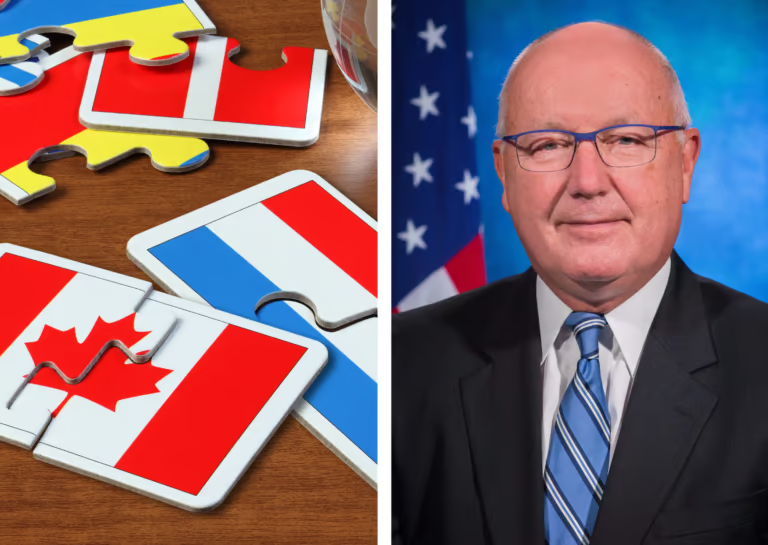
After a highly publicised dinner and sleepover at the White House, the royal couple reflected positively on their visit and discussions with President Trump.
According to NOS, the King stated in a press briefing that they were able to “clearly state their opinions” throughout their stay.
While there was some hint that the Caribbean Netherlands came up, he refrained from providing specific details about their discussions with the president.
“A beautiful evening”
“They did their best to give us a very beautiful evening. We are very grateful for that,” Willem-Alexander revealed.
A dinner of North Sea sole, spinach soup, and more, combined with the tulip-themed decorations, drew kind words from the royal couple, according to NOS.
The couple then spent the night at the White House; however, PM Rob Jetten was not invited to sleep over.
After their visit, the couple continued on their trip to Florida. All in all, the king referred to the US journey as “very fascinating days”.
Enduring partnership
Despite the controversy and discussion in the Netherlands surrounding the royal visit to the Trumps, words from Jetten and the royal couple suggested they were pleased with the opportunity.
Amid the initiation of a cooperation program to open doors for Dutch companies in the US, the King declared that the two countries must “always remain on good terms,” reports NOS.
Navigating the healthcare system when you’re new to a country can be challenging, and if you’re wondering how to go to the doctor in the Netherlands, you’re not alone.
From registering with a huisarts (general practitioner) to understanding when you’ll need a referral, there are some things to keep in mind when planning a first visit to the doctor in the Netherlands.
Wait, is this an emergency?
Regardless of your situation, if you’ve had an accident or see someone who needs urgent help, you should call the emergency number 112 as quickly as possible.
Going to the doctor in the Netherlands: What is a huisarts?
Dutch can be a complicated language. Even though the word huisarts might sound like some artwork you have back at your house, that’s hardly the case.
Huisarts translates to “house doctor,” and refers to General Practitioners (GPs) in the Netherlands.
Your Dutch GP is your first stop for all health-related business. Image: Dreamstime
It is always better to register with a GP in the Netherlands right away because it might be hard to do so when you need actual help.
And who wants to deal with Dutch bureaucracy while feeling under the weather? Exactly.
How to find a doctor in the Netherlands
Now that you know what a huisarts is and that you need one to make a doctor’s appointment, let’s get things going: How do you find a general practitioner in the Netherlands?
The Dutch have made it fairly easy to find a local doctor. Simply go to the ZorgkaartNederland website and pick your municipality. God bless the internet. 🙌
The website is only available in Dutch, so, unfortunately, you’ll have to rely on your Google Translate extension for it!
If you prefer things to be simpler, a Google search with the city you live in and the word ‘huisarts‘ may also work.
Alternatively, you can contact your gemeente (municipality). They’ll be happy to help you find a GP in your area or to provide you with a list of local huisartsen.
Registering with a general practitioner in the Netherlands
It’s important to know that, in the Netherlands, you can’t just rock up to any doctor’s office if you’re feeling under the weather.
Instead, you must be registered with your GP before paying them a visit (unless you’re considered an ‘urgent case’).
To register with a general practitioner in the Netherlands, you can visit a physician’s website or give them a call.
Register with the doctor from the comfort of your own bed. Image: Pexels
You’ll need to provide personal information such as your name, address and Burgerservicenummer (BSN), as well as your health insurance details.
Sometimes you’ll find that the GP of your choice is not accepting new patients at the moment. That’s because they have reached the maximum capacity of patients they can treat.
If this is the case, your best bet is to simply opt for a different doctor.
Making an appointment with a doctor in the Netherlands
So the time has come: you’re feeling unwell, and you need to see a doctor in the Netherlands. 🤒
If this happens, you have three options:
You can make an appointment by calling your huisarts office directly,
You can make an appointment using your GP’s website (if available), or
You can check if your doctor has a consultation hour (spreekuur), where you can drop by without an appointment.
When in doubt, give your doctor’s office a quick call. Image: Freepik
What do you do if you just have a few simple questions? Then you might be able to simply give your GP a call and get a consultation over the phone. Nice!
How to see a medical specialist in the Netherlands
Okay, now let’s get to the real deal: What happens if you need to see a specialist in the Netherlands?
Whether it’s a dermatologist, an ENT, or a gynaecologist, you will need a referral from your huisarts to see any specialist in the Netherlands.
Your GP is the one who decides whether to send you to see a specialist or not, so it’s important to clearly state your wish to do so.
After you get a referral from your huisarts, you can go ahead and make an appointment with the specialist.
Your GP will help you get to a specialist. Image: Depositphotos
If you have a specific specialist in mind already, you can also ask for your referral to be made directly to that person.
Once you have the referral papers, it’s always good to ask your insurance company if they wish to see the referral to make sure you’ll get your money back.
Good to know: It is possible to see a specialist without a referral if you would like to — but this varies between healthcare providers. However, in this case, you may have to cover the costs of your visit yourself.
What happens if you go to a doctor in the Netherlands and don’t have health insurance (yet)?
If you have just recently applied for health insurance and you haven’t got an insurance number yet, you can always visit your huisarts (happy news!).
In the Netherlands, a GP cannot refuse to give you the care you need.
Do keep in mind that being without insurance means you would have to pay the costs yourself.
But it’s not all doom and gloom, and as soon as you receive your insurance number, you can send the bill to your insurance company to get the money back.
What’s up with Dutch doctors and antibiotics?
One of the things to keep in mind is that Dutch doctors might react differently to your health problems than the way you are used to.
Dutch doctors will only prescribe you antibiotics if you really need them. Image: Freepik
Antibiotic resistance is taken very seriously in the Netherlands and is seen as one of the biggest threats to our modern-day life.
Dutch doctors, therefore, only prescribe antibiotics if they diagnose you with a bacterial infection and not a viral one (such as the flu).
So, if you are coming from a country where antibiotics are seen as a magic pill that solves your every problem, don’t be surprised when your huisarts just shrugs and tells you to get some rest.
How has your experience with doctors in the Netherlands been? Tell us in the comments below!
Love or hate them, the Dutch are fiercely unique (even though they may not dress like it).
One of the best examples is what you’ll find in their houses.
In fact, there’s a stack of things that you’ll find in a typical Dutch home that may confuse internationals in the Netherlands. Here are 14 of them! 👇
Let op: Like the birthday calendar (which is also used by the writer’s German family), these items aren’t strictly Dutch. However, they came as a surprise to our international readers — making them well worth a spot on our list!
1. A toilet calendar, for when you’ve got things to do and are stuck in the loo
Deep thoughts, deeper toilet calendars. Image: Gpointstudio/Depositphotos & michaklootwijk/Depositphotos
The Dutch are brilliant at multitasking — I mean, just watch them bike while simultaneously holding a potted plant and a wheel of cheese.
That brilliance also extends to their bathroom routines in the form of the verjaardagskalender (birthday calendar) or WC kalender (toilet calendar).
You’ll find this nifty little thing hanging under a sink or on the wall of a Dutchie’s loo. Scrawled on it will be things like: “Nienke’s birthday”, “Wedding anniversary”, or even “Remind Jeroen to pay his Tikkie for €0.85”.
Ok, we may have exaggerated the last part there. 😉
2. Fabulous window displays that’ll have you pausing in your step
When it comes to window decor, Dutchies sure aren’t thrifty! Image: Depositphotos
Whether it’s to announce the birth of a new child, to wish Sarah or Abraham a happy birthday, or just to show off fancy decor, the Dutch excel at cool window displays.
The decor is usually facing outwards, putting on a show for passers-by to have a peep, say “Wat mooi!” (how beautiful), and go along on their way.
At the very least, you’ll see some cute shells and the odd cactus or two on the windowpane; however, among creative urbanites, the sky’s the limit!
3. Invisible curtains and an attitude of never being nosy
And, speaking of windows, windows in the Netherlands feature the latest Dutch technology: invisible curtains!
Jokes aside, curtains and the Dutch are two things that absolutely do not mix.
Houses in the Netherlands usually don’t come with them, as the Dutch prefer having an uninterrupted view outside.
This likely stems from the Calvinistic mindset of open/no curtains equating to having nothing to hide and living a good life.
So what we’re trying to say is that you aren’t likely to see many curtains blocking your view of families eating dinner — or the odd flash of bum crack! 🍑
4. Inspection-shelf toilets so you can hold a funeral before you flush
Trust us, you’ll soon become rather…err, closely acquainted with the sight (and smell!) of your poop. Image: DutchReview
Originally nicked from the Germans, the Dutch toilet features an inspection shelf for a closer examination of any logs you may drop. 💩
There’s a method to this madness, however, as this design is perfect for examining your poo to check if your internal plumbing is in tip-top shape!
Pros: you get no wet bum, can have a better look at your poop, and…errr, yeah. You get no wet bum.
Cons: you get a full whiff of the aroma, will use your toilet brush to death, and get to say a final “doei!” to your poop.
Internationals beware — Dutch toilets are a very different beast from the ones you’re used to!
5. Steep stairs that’ll almost scare off a mountain goat
Definitely not a fun experience if you’re afraid of heights. 🥴 Image: DutchReview/Supplied
If you need practice for a trip to the Tibetan mountainside, please visit a Dutch house. The steepness is mostly born out of necessity.
Dutch houses are packed more closely than stroopwafels in AH packaging because Dutch authorities used to tax people based on the width of their homes.
So, if you’re visiting a Dutch house and cry out in amazement at the steepness of their stairs, be warned that your shins may also be in danger.
6. A gourmetten bakplaat (griddle) that’s whipped out every December
Trust us, it’s more fun than it sounds! Image: Christiano Betta/Wikimedia Commons/CC 2.0
It makes sense that the inventors of borrelen appreciate time in the company of good food and drinks.
Gourmetten involves sitting at a table and grilling meat and veggies in tiny pans on a bakplaat (a small device to cook food), with accompanying bread and sauces.
It’s a popular Dutch Christmas tradition and a great way for families to have a gezellig etentje (cosy dinner) together!
As such, gourmetten bakplaten are likely to be stashed somewhere in a Dutch kitchen, waiting for the perfect time to grill.
7. Bathroom sinks in bedrooms because we don’t even know
We sink we’ll give this one a pass. Image: Depositphotos
You can occasionally find bathroom sinks lurking in Dutch bedrooms like uninvited guests.
Dating back to a time when proper bathrooms weren’t as common, “bedroom sinks” are currently more often found in older houses, though newer student houses are also seeing an uptick in these fixtures.
That being said, students beware: some landlords use this “privilege” as an excuse to increase rent on bedrooms with sinks. 😉
8. Ceramic figures giving each other a perpetual smooch
We can definitely see why they’re so popular! Image: Depositphotos
Plenty of Dutch houses feature ceramic figurines of a boy and girl in traditional Dutch clothes having a snog.
They’re a combination of adorableness, Dutch traditionality, and Delft blauw (traditional blue and white Dutch pottery which depicts scenes from the Netherlands).
I mean… what’s not to like?! In fact, this kissing couple is so popular that three-storey-tall statues of them were erected in Zaandam.
9. Random Buddha statues, for that extra bit of zen
One theory is that Western countries have an appreciation for elements of Asian culture that they find easy to digest.
Here’s our theory: Buddhas, with their aura of exoticism, add an element of “yes, it’s from Thailand — I like to travel, you know 😌” (even if it’s bought with a korting at a gift shop in Amsterdam).
10. A flessenlikker to get every drop of what’s lekker
The Dutch love many things, including various spreads for their boterhammen (sandwiches) and being thrifty.
What’s the best way to combine the two? A flessenlikker, of course!
Dutch doors? But wait… how can so-called “Dutch doors” be that weird? 🤔
Well, these doors — also known as stable doors or boerendeuren (farm doors) — are exterior doors with a weird quirk. They contain an upper and lower half, which can both be opened independently of each other.
These halves function similarly to windows. The top half allows the house to be aired, while the lower half keeps dirt and animals out.
This is pretty nifty as they’re most commonly found on farms. After all, you don’t want a goat to pop in and nick your boterham (sandwich)!
12. The efficient kaasschaaf for all your sandwich needs
Making the perfect boterham (sandwich) has never been easier! Image: Depositphotos
I’m sure most of us are familiar with the humble cheese-grater — but the Dutch kaasschaaf (cheese slicer) is the cheese-grater’s bigger (and dare we say better? 😉) brother.
Dutchies who want something fancier than plakjes (slices) of cheese from their Albert Heijn grab one of these bad boys and slice their cheese wedges at home.
Coming across one of these in a drawer signals that you’re either in a Dutch house or there’s a wild Dutchie lurking around yours (hopefully, they brought cheese!).
13. Mysterious draaikiepramen that befuddle most internationals
What is this sorcery?! 🤯 Image: DutchReview/Supplied
The draaikiepraam or tilt-and-turn window is relatively common in parts of Europe, but particularly in the Netherlands.
However, its two methods of opening have internationals scratching their heads in confusion. A draaikiepraam can be tilted inward on its axis to let in a light breeze or opened outwards like a door.
These are perfect for houses in the Netherlands that often lack space. However, they feature a finicky mechanism that can be a nightmare. And thank your lucky stars if you’ve never had to pay to have one of them fixed!
Having to do battle with one of these is a sure sign you’ve landed in a Dutch (or Western European) house.
14. Two different kitchen towels that you’d better not mix up
We repeat, don’t mix them up! Image: Freepik
Almost every Dutch house has two kitchen towels — one for your hands, and the other to dry washing up. Wipe your hands on the wrong towel, and you risk a stern frown.
Which one is which? Well, the Dutch people we’ve spoken to for this article say the one for their hands is fluffier. To be perfectly honest, though, we just take a random guess each time.
As you can see, the Dutch abound with creativity and quirkiness (though we will have to give those stairs a pass)!
What other strange things have you come across in Dutch houses? Tell us all about it in the comments below!
Understanding the average salary in the Netherlands is important for professionals considering a move to this European country.
The Netherlands is known for its high quality of life, strong economy, and excellent work-life balance, as well as being one of the highest-paying countries in the world.
Workers in the Netherlands earn one of the highest salaries in Europe! Image: Markus Spiske/Unsplash
But what will your salary be? Well, the average salary in the Netherlands depends on a few factors, such as industry, work experience, and education level.
According to the Centraal Planbureau (Central Planning Bureau, or CPB), the median annual salary in the Netherlands for 2026 is calculated to be about €48,000 gross per year (including holiday allowance). While the monthly average amounts to €3,800 gross per month.
Some sources estimate a slightly lower average salary in the Netherlands, starting at €41,000 gross per year (€3,417 per month).
Just like the average Dutchie may cycle to work, the average person earns around €41,000 a year. Image: Depositphotos
Of course, a range of factors impact the average salary, including age, education level, and industry. So what’s the average for you?
Average salary in the Netherlands by age
One way to look at average salaries is by age, where 45 to 65-year-olds usually earn the highest median salary per annum.
Age
Median yearly salary in 2026
25 and younger
€37,500
25-45 years old
€37,900
45-65 years old
€42,700
65 and older
€32,700
Children between the ages of 13 and 16 are allowed to work under certain conditions. They can also work for the minimum wage starting at age 15, earning €4.41 per hour.
Supermarkets are a common “bijbaan” (side job) for people under 18. Image: Jumbo
On the flip side, the average retirement age in 2022 was 65.5 years, which was slightly less than the Dutch state pension age.
The statutory retirement age in the Netherlands has gradually increased in the last few years, reaching 67 in 2024. It will increase further to 67 years and 3 months starting in 2028.
Average salary in the Netherlands by education
The Dutch education system is considered one of the best in the world, with 38% of adults in the Netherlands holding some form of tertiary education.
Getting a university degree increases your chances of a higher average salary in the Netherlands. Image: Depositphotos
As expected, the average salary in the Netherlands increases with education level.
Tech hub and home of Philips, Eindhoven nabs the second place. The Hague takes third place, as it is home to many intergovernmental organisations, embassies, and NGOs.
The Hague takes third place for the highest average salary by a Dutch city. Image: Depositphotos
Average salary in the Netherlands by industry and work experience
The most in-demand job sectors are finance, information technology (IT), (mechanical) engineering, and (public) healthcare.
People working in finance at the manager level make an average of €73,745 a year, while engineers make an average of €43,945 a year.
Gross salary vs. net salary
Once you’ve signed on to a new baan (job), your employer will offer you a salary. You’ll be given two figures, your bruto salaris (gross salary) and your nettosalaris (net salary). So, what’s the difference?
It’s important to keep track of how much money is actually going into your bank account each month. Image: Freepik
Well, your brutosalaris refers to the amount of money you make before taxes and other deductions — which means you won’t be keeping the full amount.
Instead, the netto salaris is what winds up in your bank account once all the deductions have been made.
Income taxes in the Netherlands
In 2026, the Netherlands has three tax brackets for Box 1 income (meaning the money you earn from your work and home ownership).
Gross Yearly Salary
Income Tax
Below €38,883
35.75%
Between €38,883 and €79,137
37.56%
Above €79,137
49.50%
As the incomes and tax rates change every year, you can use an online calculator to determine your exact income tax.
While you’re at it, stay on top of your taxes, too! Image: Depositphotos
When you receive your monthly payslip, your employer has usually already deducted the income tax from your salary (under payroll taxes), as well as any other contributions you may have to pay.
Understanding your Dutch payslip
Employees in the Netherlands receive their payslips (loonstrook) from their employer on a monthly basis.
Dutch term
English translation
Meaning
Periode
Period
The relevant time period of work (weekly or monthly)
Personeelsnummer
Employee number
Your employee ID number
Salaris
Salary based on hours worked
Your gross monthly salary
Brutoloon
Gross salary/wage
Gross salary before taxes and deductions
Nettoloon
Net salary/wage
Net salary after tax and deductions; the final amount that goes into your bank
Uurloon
Wage
Your gross wage (usually by hour)
Burgerservicenummer (BSN)
Citizen service number
Your Dutch social security number
Gewerkte uren
Worked hours
(Normal) hours worked that period
Loonheffing
Income tax
The amount of money deducted for prepaid taxes and contributions
Socialeverzekering
Social insurance
The social security contributions you pay for (and are covered by)
Social premiums and contributions
Your payslip may also include which social security programmes you contribute to and which ones you are covered by.
Your employer often deducts social premiums and insurance from your salary before you get the money at the end of the month. Image: Depositphotos
Examples of contributions are your pension fund (Algemene Ouderdomswet or AOW), disability pension (arbeidsongeschiktheidspensioen or AP), unemployment benefit (werkloosheidswet or WW), and paid sick leave (zorgverzekeringswet or ZVW).
Whether you’re a fresh graduate or a seasoned professional, understanding the average salary in the Netherlands is important for anyone who plans to or is currently working here.
Have you worked in the Netherlands? Tell us about your experience in the comments below. 👇
Average salary in the Netherlands: Frequently asked questions
What is the average salary in the Netherlands?
According to the CPB, the median annual salary in the Netherlands is €48,000, or about €4,000 gross per month.
The average salary depends on many factors, including your age, industry, experience, education level, and even the city you live in.
What is the minimum wage in the Netherlands?
The minimum wage in the Netherlands is fixed per hour and depends on your age. Your weekly or monthly earnings depend on your official number of working hours. Here are the wages by age:
The 30% ruling in the Netherlands — if you’re an expat here or planning to become one, you’ve probably heard of it. But what does it actually entail?
The 30% ruling, also known as the 30% facility, is a tax advantage specifically designed for highly skilled migrants in the Netherlands.
This ruling can significantly impact your take-home pay, making it a crucial aspect to understand if you’re planning to work in the Netherlands. ⚡️
But how does it work? How do you qualify for it? And how much money does it save you?
Let’s break down everything you need to know about the 30% ruling in the Netherlands in 2025.
Moving to the Netherlands for work? How exciting! ING, the bank of the Dutch (and the expats!), is your go-to for all things finances — whether you’re a self-employed ZZP’er or working your way up the Dutch career ladder. Open your account now.
Let’s start with the most basic question first: What the frikandel actually is the 30% ruling?
The 30% ruling in the Netherlands is a tax break designed to entice highly skilled migrants to bring their brilliance to the land of windmills and stroopwafels.
If you meet certain conditions (more on that later), your employer can pay you up to 30% of your salary tax-free for five years.
It’s simple: less taxes = more money! Image: Depositphotos
The program’s goal is to bring international talent to the Netherlands and help them out with the extra costs of living and working abroad, like higher rent, language lessons, and the hassle of moving.
It’s a win-win: talented people get the support they need to settle in, and the Netherlands gets to benefit from their skills and experience!
How does the 30% ruling work?
Highly skilled migrants who land a job under the 30% ruling can enjoy a sweet tax break.
However, it’s worth noting that new applicants will not benefit from a 30% tax cut for the whole five years (well, not anymore).
Instead, the 30% ruling will be reduced to 27% as of January 1, 2027.
Until then, the following transitional rules apply:
Employees who had the 30% ruling before January 1, 2024, will keep the 30% tax-free benefit for the full duration of their ruling.
Those who received the 30% ruling in 2024 will receive the 30% tax cut until 2027, but will only get up to 27% tax-free from 2027 onwards.
Employees who receive the 30% ruling from 2025 must meet a new, stricter salary criterion to remain eligible beyond 2027.
Image: DutchReview
Here’s how it works. Your employer deducts the respective percentage (30% or 27%) from your gross income (i.e. the total amount you earn before deductions and taxes). Taxes are then calculated on the remaining amount, which is your taxable income.
This taxable income must be above the 2025 minimum salary requirement of €46,660 if you’re over 30, and €35,468 if you’re both under 30 and hold a Master’s degree.
These salary minimums apply to everyone except scientific researchers, PhD holders, and doctors training to be specialists.
But there’s not just an income minimum to be eligible for the 30% ruling; there’s also a maximum. More specifically, in 2025, the maximum salary eligible is capped at €246,000 per year.
Once the taxes are sorted, the deducted percentage is added back to your net pay as a reimbursement of expenses, which isn’t subject to income tax.
Image: DutchReview
If your taxable income doesn’t hit the required threshold, you can still benefit from a tax break, just not to its full extent. So, it’s a win either way!
To make this clearer, let’s look at two examples.
Example 1: Mara is 45 years old and earns €100,000 gross per year. Under the 30% ruling, €30,000 of her salary is tax-free, which means her taxable income is €70,000.
Since €70,000 meets the minimum salary requirement for the full 30% ruling, Mara gets the full tax-free allowance of €30,000.
Example 2: Jim is 35 years old and earns €50,000. With the 30% ruling, his taxable income would drop to €35,000, which is below the minimum salary requirement of €46,660. As a result, Jim can only receive a partial tax-free allowance.
To meet the minimum taxable salary requirement, his maximum tax-free amount is limited to €3,340 (€50,000 − €46,660). This means his tax-free allowance equates to 6.68% of his salary (instead of the full 30%).
Eligibility for the 30% ruling in the Netherlands
Okay, we’ve established that the 30% ruling is a tax benefit for highly skilled migrants. But… who is a skilled migrant?
Earn a salary that corresponds to the market rate in your field.
Have been hired outside the Netherlands. Specifically, you must have lived more than 150 kilometres in a straight line from the Dutch border for more than 16 months in the 24 months before your first working day in the Netherlands.
What counts as “expertise that is scarcely available” in the Netherlands?
Great question. Unfortunately, there are no set guidelines for this requirement. Instead, this scarcity is determined by factors such as salary, employment history, education, and level of employment. The skills are assumed to be present if the minimum salary requirement is met.
Special requirements for recent PhD graduates, researchers and medical specialist trainees
Are you a PhD graduate, researcher, or medical specialist trainee? You’re in luck because the 30% ruling in the Netherlands includes special arrangements for people like you!
The 30% ruling is designed to encourage highly-skilled migrants to come to the Netherlands by offering tax incentives. Image: Depositphotos
These exemptions make qualifying for the tax benefit easier for these professionals.
Recent PhD graduates don’t need to prove that their expertise is scarce in the Dutch labour market and their minimum salary threshold is lower.
Researchers working at a research institution also don’t need to demonstrate a scarcity of expertise as long as the institution is recognised by the Dutch government.
Medical specialist trainees are eligible for the 30% ruling even if their training period extends beyond the usual duration. They also benefit from a lower minimum salary requirement.
Financial rules and regulations for expats in the Netherlands can be complex, so go for a bank that understands. As the biggest bank in the Netherlands, ING knows what expats want and need. Open an account now.
How long does the 30% ruling in the Netherlands last?
Sadly, the 30% ruling is not a forever deal and only applies to your first five years of employment.
Whereas international employees used to be able to get the 30% tax cut for the entirety of the five years, this will be reduced to 27% as of 2027.
After that, it’s time to submit a joint application with your employer. Along with this, you’ll need to provide several documents, including:
A valid passport or photo ID
Your Dutch employment contract or a confirmation letter of your position
A valid work permit, if applicable
Your Dutch social security number (Burgerservicenummer)
Proof of your address in the Netherlands
Proof of residence in another country before the hiring process started
Make a list of documents you need, and start gathering them. Image: Depositphotos
Once you’ve completed and signed the form, you can send it to the Dutch Tax Office at the following address:
Belastingdienst/Kennis- en Expertisecentrum Buitenland PO Box 2865 6401 DJ Heerlen The Netherlands
They will get back to you with their decision within eight weeks.
Benefits of the 30% ruling in the Netherlands
Extra money is pretty sweet, huh? But the 30% ruling in the Netherlands offers more perks than just fatter paychecks. Let’s talk about the other benefits.
First off, the 30% ruling simplifies your tax return process, and some expats may also be exempt from certain Dutch taxes.
Another bonus is that if you’re eligible for the 30% ruling, you can easily swap your foreign driver’s licence for a Dutch one.
Many non-EU drivers would normally need to retake the driving test, but not with the 30% ruling. Just exchange your licence, and you’re all set to cruise! 🚗
Changes to the 30% ruling in the Netherlands
The Dutch 30% ruling was first introduced in 1964 under the Dutch Wage Tax Act. Since then, the Netherlands has attracted international talent from around the globe. Of course, the scheme has undergone many changes over the years.
Until the end of 2018, the 30% ruling in the Netherlands lasted for eight years rather than five, but the Dutch government decided to reduce it to five years starting from January 1, 2019. (😡)
Then, the government decided that the amount of the benefit should also decrease to 27% from 2027.
What happens to the 30% ruling if you change jobs?
Are you thinking about changing jobs? Don’t worry — you don’t necessarily have to kiss the 30% ruling goodbye.
New job? Congrats! Now make sure you can keep getting that sweet 30% ruling. Image: Depositphotos
If you switch employers within the Netherlands, you can still keep the ruling, but there might be a few bureaucratic hoops you’ll have to jump through.
If you are changing employers within the same corporate group and still meet the conditions for the 30% ruling with your new job, your 30% ruling will remain valid without submitting a new application. All you have to do is verify with your employer that your new and previous employers are part of the same corporate group.
Switching to a new corporation? Then, you’ll need to check with your new employer to see if your 30% ruling can stay valid. Naturally, your new employer must be a registered sponsor with the IND, and your salary must still meet the requirements.
Besides that, you must begin your new job within three months of leaving your previous one.
Most importantly, your new employer needs to file with you for a (renewal) application. The application should be submitted within four months of starting with your new employer.
It’s a bit of paperwork, but totally worth it to keep those tax-free benefits rolling in.
Lekker poffertjes, charming windmills, picturesque canals, and tax breaks… It’s no wonder so many internationals (us included!) want to make the Netherlands their home.
Understanding the 30% ruling can significantly ease the financial transition into expat life and make your adventure in the Netherlands even more exciting.
So, whether you’ve already packed your bags or are just toying with the idea of moving, this tax advantage is just one of the many perks that make the Netherlands such a fantastic place to live!
What do you think about the 30% ruling in the Netherlands? Share your thoughts in the comments.
The 30% ruling in the Netherlands: Frequently asked questions
What’s the maximum duration for the 30% ruling?
As of now, the maximum duration for the 30% ruling is five years, or 60 months.
What are the requirements to apply for the 30% ruling?
To apply for the 30% ruling in the Netherlands, you must fulfil the following criteria:
You earn a salary that corresponds to the market rate in your field.
You have been hired outside the Netherlands.
How do I apply for the 30% ruling in the Netherlands?
You and your employer must jointly apply to the Dutch Tax and Customs Administration. Along with your application, you will need to send personal documents like a valid passport or photo ID, your employment contract or a confirmation letter of your position, and proof of your address in the Netherlands.
Detailed instructions for the application process can be found on the Dutch government’s website.
What is the minimum salary in the Netherlands for the 30% ruling?
The minimum salary requirement is adjusted on the first day of each year. For the most current figures, check out the official guidelines online.
To qualify for the 30% ruling in 2026, your salary (excluding the tax-free allowance) must be over €46,660 if you’re over 30. If you’re under 30 and have a Dutch academic master’s degree or an equivalent from another country, your salary must be at least €35,468.
If you are a scientific researcher at a designated research facility or are a doctor in specialist training, you can benefit from the 30% ruling regardless of your salary.
Does the tax benefit still apply if I get a salary increase?
Yes, as long as your salary meets the minimum salary threshold, the tax benefit applies, even after a salary increase in the future, including any bonuses or allowances granted.
While I always try to look for the positive in life, I will admit that a part of me has a hard time turning not-so-great things around — an aspect that didn’t serve me well when I first came to live in the lowlands.
Honestly, I did not expect how many surprises awaited me. These are some of the things that, well, truly haven’t grown on me over time despite my best efforts.
Perhaps you won’t agree — and that’s okay! But remember, it takes courage to be honest, even about matters of opinion — and you can share your opinion in the comments below. 👇
1. Terrible Dutch driving skills
Watching someone park a car in the Netherlands is terrifying. Image: Dreamstime
This was quite a shocker to me. My preconceived idea about the Dutch was that they’re law-abiding citizens, with everyone following the rules, and no one dared to stand out for ‘thinking outside the box.’
And,oh boy, was I wrong. 😱
Take parking, for example. I know parking doesn’t come easy for everyone, but the first 10 times I saw a car go directly over the sidewalk just so they could sneak into a parking spot without too many manoeuvres, I knew things weren’t quite like I had imagined.
The story continues because once the driver manages to park, it’s clear that they do not care much about tires (no matter how expensive they might be!) because they leave them perched precariously on the sidewalk gutter.
Everybody knows that it is an excellent way to preserve them. 👀
2. The smell of weed hovering in the air
Get ready to plug up your nose if the smell of weed is off-putting to you. Image: Depositphotos
The fact that the possession of marijuana is decriminalised in the Netherlands is forward-thinking.
It means everyone is free to do as they please, and this all sounds very nice — until you find your nostrils invaded with sickly-sweet fumes when you turn a corner on your way to the supermarket. 🤢
When I go to the park with my son and he is happily playing on the swings or going down the slide, the last thing I want for him to smell is weed.
As far as I know, smoking it in public spaces is forbidden, but that does not seem to stop many people (just another example of the rules being bent).
3. The Dutch approach to healthcare
This is one of the most contentious points for internationals in the Netherlands, but like everything in life, it depends on what you compare it to.
In my case, I enjoyed universal healthcare in Spain for free (which you pay for with your taxes, obviously), but there was no extra health insurance necessary.
In addition, if you need to go to a specialist, you can just book an appointment without a referral: think routine gynaecologist checkup, paediatrician, etc. 🩺
When I arrived in the Netherlands, it was not easy to wrap my head around having to go to a GP for everything and only getting paracetamol prescriptions (Which I can buy from the supermarket, thank you very much).
The bottom line, I will never get used to the Dutch healthcare system, period.
What is up with the cost of daycare in this country? 💰 Sure, when your child turns four, education is free and awesome, but what do you do for the first four years?
Applying for childcare allowance (kinderopvangtoeslag) might help, but only if you qualify.
Also, what if you have more than one kid? I see families with two or three children running around, and the only possible explanation I can think of is that they are all millionaires.
It is easy to see why almost no one uses daycare five days a week.
Much like a game of Tetris, you desperately need to find childcare for your 32-hour workweek, padding it with a day when the grootouders (grandparents) can help out and, of course, make use of papadam (a day when the dad should take care of the kids).
Without these extras, having children is not sustainable for the common middle-class family.
5. That darn Dutch weather
Obvious? Maybe. Still important? For sure! While people have different standards for measuring a country’s quality of life, for me, the weather plays a huge part in that assessment.
Although I don’t mind the cold, the extreme humidity (my hair has gone from straight to what’s happening?), the savage wind, and constant, out-of-nowhere rain make it very hard to adjust to the Dutch way of life.
Needless to say, throwing in a bike amid that madness is complete insanity — I have seen some pretty nasty falls, ouch! The weather is a hard pass for me.
As a result, I spend much more time indoors than I would like. 🏠
Workers, van owners, businesses, and households struggling with high energy costs are set to receive targeted relief under a government package worth €1 billion.
According to NOS, ministers will sign off on the proposal on Friday. Thereafter, the minority cabinet plans to consult opposition parties on whether their measures need tweaking.
As the Strait of Hormuz remains blocked, motorists in the Netherlands are victims of soaring petrol prices: up to €2.50 a litre.
However, the cabinet’s proposal has no impact whatsoever on prices at the pump.
No cut at the pump
In Western Europe, things are never nearly as expensive as their taxes make them. To many, an easy solution to rising fuel prices would be to reduce the duty.
However, while Germany has moved to cut its excise duty by 17 cents per litre, the Dutch government has explicitly eliminated this solution. As expected, the reasoning is practical.
A reduction of 10 cents per litre would cost the government around €1 billion, and for that high a price, the motorist wouldn’t benefit too much.
Moreover, the situation on Hormuz remains uncertain, so ministers are choosing caution over crowd-pleasing.
The cabinet also believes that a lower excise duty on petrol could drive up consumption, which runs counter to the cabinet’s sustainability goals.
What the money actually covers
So where does the money go? The support package is split across low-income households and small business owners.
The energy emergency fund (energienoodfonds) receives €50 million to help the lowest-income households who can no longer keep up with their bills.
The proposal sets aside extra funding for better insulation, which would ensure lower energy bills for both homes and businesses. In the future, the cabinet also plans to reserve money to subsidise green energy for businesses.
Tax talk
Workers who commute by car will see their tax-free travel reimbursement (onbelaste kilometervergoeding) rise from 23 to 25 cents per kilometre.
For example, a commuter covering 400 kilometres a week could now cut €8 back per week. This is, of course, only ifyour employer is nice enough to give you a travel allowance.
Meanwhile, small entrepreneurs with delivery vans or light commercial vehicles dubbed “grey license plates” will see their road tax halved for the rest of the year.
What do you think of the proposal? Tell us in the comments.
Hospitalisation figures for Dutch cycling injuries have hit a new high, with nearly 81,000 people ending up at the emergency room in the past year.
This is a 9% jump compared to the previous year and almost a quarter more than a decade ago.
Dutch safety organisation VeiligheidNL published the figures on Wednesday to coincide with Bicycle Helmet Day. The data points clearly indicate that the e-bike is the cause of the increase and that older cyclists are vulnerable.
E-bikes are the culprit
The numbers showed 14,400 cases of head or brain injuries, reports AD. Of the total 81,000 emergency visits, around 55,000 involved serious injuries, ranging from broken bones and concussions to skull fractures.
Accident rates involving regular bicycles have barely changed in recent years; instead, VeiligheidNL points squarely at the growth in e-bike use as the cause.
As they’re faster than regular bikes, e-bikes create larger speed gaps between riders on busy fietspaden (cycle paths).
However, what’s particularly perplexing about the data is that two-thirds of all accidents involved no other road user. No collision, no car, no teenager on a fatbike — just a rider, a moment of misjudgement, and the ground.
Older riders, bigger consequences
In 2025, Dutch roads saw 281 cyclist fatalities — the highest toll since 2007. Even more sobering is the fact that 118 of those victims were in their seventies or older.
And it’s not just about the fatalities, either.
Over 40% of those hospitalised were aged 55 or above, and the over-75s account for a disproportionate share of the most serious outcomes.
The injuries among older e-bike riders tend to be severe: fractures, concussions, and, in the worst cases, serious trauma to the skull.
SWOV, the road safety research institute, is direct about the stakes. At e-bike speed, a helmetless fall can be the difference between a bad day and a fatal one.
The helmet question
Currently, just 5% of Dutch cyclists wear a helmet. The Zet ‘m Op (“put it on”) campaign, launched Wednesday by Minister Vincent Karremans, aims to push that to 25% voluntarily by 2035, AD reports.
The Fietsersbond (Cyclists’ Union) also recently began recommending that cyclists over 70 wear helmets, a move campaigners called a breakthrough.
It’s an ambitious goal, but the shift is already starting to happen voluntarily, with a quarter of cyclists over 75 now wearing a helmet.
The group Doctors for Safe Cycling (Artsen voor Veilig Verkeer) says the evidence is clear. A helmet reduces the risk of serious head and brain injury by 60% and the chance of a fatal outcome by 71%.
Their immediate focus, though, is on younger e-bikers. The organisation is pushing for mandatory helmets for under-18 e-bike riders.
Do you wear a helmet when you cycle in the Netherlands? Has the e-bike changed how you think about cycling safety? Let us know in the comments.
Here’s our guide to the best lakes in the Netherlands!Whatever lake-loving adventure you’re after, we’re here to give you all the juicy details to make it happen.
Fancy a freshwater swim or maybe a relaxing barbecue on the beach? Perhaps a sunset sail or a bit of leisurely island hopping?
Hundreds of lakes are splashed across the shallow landscape in this fascinatingly soggy little country, covering 2500 square kilometres. It’s no surprise that the country that was once underwater is still covered in it.
But let’s get right to the good stuff. Below you’ll find our 18 favourite lakes in the Netherlands, and the reasons we love them.
With fantastic beaches, fishing, and water sports, as well as kid-friendly play areas and adults-only cruising, there’s something for everyone — and we’ll show you just where to find it.
In Amsterdam, a hot day can sometimes feel torturous — it’s a crowded urban heat island where air conditioning is scarce.
In a heatwave, the rain and wind that pummel us the rest of the year mysteriously disappear. We’re left just as damp, only in more awkward places.
But suffer no more! The city can also be a paradise when you know where to go to cool off. And fortunately, there are plenty of gorgeous lakes nearby and a beach to meet your every desire.
1. Nieuwe Meer
Nieuwe Meer in the Netherlands at sunset is the place to be. Image: Brin Andrews/Supplied
This popular lake among locals sits just alongside the Amsterdamse Bos. There’s a long beach with two official swimming areas.
Around here, you can find private coves, a nudist beach, and Amsterdam’s only officially condoned gay cruising area (where men go to meet). It’s an excellent lake for recreational fishing, full of perch, pike, whitefish, and everyone’s favourite: eels.
If you fancy a bit more adventure, you can always pop over to the Bos, where you can wander through the massive forest and even visit a goat farm, or see the Highland cattle. Canoes, kayaks, and bicycles are available for hire at several locations.
📍 Where to find it: Nieuwe Meer, southwestern Amsterdam 🧭 How to get there: There are several routes from Amsterdam Centraal by bus, tram, or metro.
2. Sloterplas
Sloterplas Lake is perfect for an afternoon cool-off on a hot Amsterdam afternoon. Image: Mark Ahsmann/Wikimedia Commons/CC3.0
This Amsterdam city lake has undergone renovations in recent years and is now in top shape for a leisurely day at the water’s edge. The Rondje Sloterplas is a smooth 5.8-kilometre path for pedestrians and cyclists — perfect for a jog before your dip.
There’s a recreational beach on the northwest bank where you can head for volleyball, picnics, and lounging, and just over in Sloterpark is also a disc golf course and a petting zoo.
On the southeast side is a launchpad for water sports, popular for canoeing, fishing, and sailing. Sloterplas also features a unique treat for the diving community — the oldest underwater house in the Netherlands, the ‘Cockelbockel’.
📍 Where to find it: Sloterplas, Amsterdam West 🧭 How to get there: Cycle or take one of several different tram options.
3. Gaasperplas
Nobody has left but the ducks during sunset at Gaasperplas. Image: Oda de Wit/Wikimedia Commons/CC3.0
Gaasperplas is a diverse recreational area, with sprawling lawns and beaches. It even has a nature reserve where you can spot a variety of wildflowers and medicinal plants.
Bring the kids and head to the sandy recreational beaches on the southern side of the lake: they’ll go wild for the water playground!
Or, venture to the northern end for a different kind of adventure at the nudist beach, which is conveniently grassy. You can sail, surf, or swim your way into the sunset.
And finally, in case you don’t get your fill of nature in the daytime, there’s even a campground where you can pitch a tent.
The cherry on top: metro access! 🤩
📍 Where to find it: Gaasperplas, southeast Amsterdam 🧭 How to get there: Take Metro 53 to Gaasperplas.
4. Ouderkerkerplas
Take a dip (and don’t be afraid to get your hair wet!) at the Ouderkerkerplas lake near Amsterdam. Image: Janericloebe/Wikimedia Commons/Public Domain
Swimming, diving, sailing, and surfing are just a few of the ways you can spend the day at the Ouderkerkerplas.
A beach with favourably shallow water for swimming is located on the north side of the lake (do check for algal blooms before swimming, particularly on hot days).
At the beach, you’ll find play facilities and a snack cart in the summer months. You can even saddle up for an afternoon of horseback riding, trotting along the 30 or so kilometres of bridleways around the circumference.
A small nature reserve was created along the lake’s banks, serving as an important wintering place for many birds. For this reason, the lake is closed for nesting from October 15 to April 15 each year.
📍 Where to find it: Ouderkerkplas, southeast of Ouderkerk on the Amstel 🧭 How to get there: Take the metro to Bijlmer Arena, then bus to Ouderkerk.
Lovely lakes just beyond Amsterdam
If you’re willing to venture a bit further from the city, you’ll be rewarded with many more wonderful lakes where you can have fun and relax to your heart’s content.
The next seven lakes are all reachable from Amsterdam in under two hours by public transport, or just a quick zip away by car. And in true Dutch fashion, a few are still within cycling distance.
5. Loosdrechtese Plassen
This sailboat posse is keeping it cool on the Loosdrechtse Plassen. Image: quatre mains/Wikimedia Commons/CC2.0
Loosdrechtese Plassen is conveniently located between Amsterdam and Utrecht. Come here for boating, canoeing, diving, bicycle boating, or any family-friendly water activity you can dream up.
You’ll be surrounded by green with plenty of nature to behold — shady trees, water lilies, reeds, and many bird species call Loosdrechtese Plassen home.
In the recreation area of De Strook, you’ll find a wide, sandy beach with picnic benches, barbeques, a volleyball court, pavilion, and toilets.
If you prefer to do your relaxing on a terrace, there are several in the area to choose from, with views overlooking the water.
📍 Where to find it: Loosdrechtse Plassen, southwest of Hilversum 🧭 How to get there: Take the train to Hilversum, then the bus to Oud-Lousdrecht (a little over an hour).
6. Strijkviertelplas
Discover the beautiful Strijkviertelplas Lake, with plenty of places to sunbathe. Image: Freepik
Located in Utrecht, Strijkviertelplas has a recreational beach with abundant space for sunbathing and a gently sloping beach perfect for swimming.
In an easily accessible location, the lake sits next to sports fields and an industrial area, yet still maintains a peaceful atmosphere. It’s popular for picnics, surfing, and fishing.
Get your daily steps in with a leisurely jaunt along the cycling and pedestrian path that weaves around the lake. With the conveniences of toilets and a snack cart, you can comfortably spend a day here.
📍 Where to find it: Strijkviertelplas, southeast Utrecht 🧭 How to get there: Cycle or take the train from Utrecht Centraal in about 20 minutes.
7. Westeinderplassen
Visit the charming harbour at Westeinderplassen, close to Amsterdam. Image: Miss of Me/Wikimedia Commons/CC3.0
This big beauty is actually one large and several smaller connected lakes combined.
With over 50 marinas and plenty of boat rental companies and restaurants, you’ll find all the resources you need for a full day of fun in the sun!
Be your own captain and hire a boat — you can meander through the narrow channels and tiny islands (mostly privately owned). A little hungry? Relax with a picnic or barbecue, or pop into one of the area’s many cafes or terraces.
Prefer more physical activities? On a warm day, locals love to swim, surf, and paddle in the clear blue waters.
The other 350 days of the year, you might want to opt for a stroll or cycle along the Roendje Poel, a 23-kilometre trail that winds around the polder landscape. 😉
📍 Where to find it: Westeinderplassen, Aalsmeer 🧭 How to get there: A short cycle or walk from Aalsmeer.
8. Veluwemeer
Veluwemeer is a prime spot for windsurfing. Image: Pediant/Wikimedia Commons/Public Domain
Veluwemeer is about an hour’s drive southeast of Amsterdam. It’s a large lake (30 square kilometres), great for leisure boating and other water sports.
Long and narrow, with wide vistas, a sandy beach, and shallow swimming, it’s an idyllic place to lounge or play the day away.You can hire a boat and cruise around to the many tiny islands that speckle the lake — perfect for a picnic!
If you’d like to settle in for the night, there are several campsites around the lake where you can set up your tent.
There’s a small nudist recreation section on the north end of one of the beaches, Ellerstrand. A snack truck parks nearby when the weather is nice, and you’ll be expected to cover up your personal bits before visiting the counter.
📍 Where to find it: Veluwemeer, Flevoland/Gelderland 🧭 How to get there: Drive an hour from Amsterdam or take a train for about an hour and a half.
9. IJsselmeer
Join in the fun with these sailboats at play on the IJsselmeer. Image: Gouwenaar/Wikimedia Commons/CC4.0
IJsselmeer is massive. It’s the Netherlands’ largest lake (1100 square kilometres), linked to the Wadden Sea, though made up almost completely of freshwater.
Enkhuizen is the closest beach to Amsterdam, though there are many other popular beaches on the east side of the lake as well. These sandy beaches lead gently into shallow water, making it a wonderful place for swimming.
Perfect for leisure boating (how the Dutch refer to motorboating) or any other water sport you can dream up, you’ll have all the open water you need and more.
Fun fact: the IJsselmeer is the parent lake to Gooimeer and Markermeer, which were formed from it after the creation of the Flevoland polder. 💡
📍 Where to find it: IJsselmeer, central Netherlands 🧭 How to get there: The nearest beach is about an hour by train from Amsterdam
10. Markermeer
Catch this and other lovely views of the peaceful villages around the Markermeer lake. Image: Gouwenaar/Wikimedia Commons/CC1.0
Markermeer certainly takes after its parent lake, IJsselmeer, as the second-largest lake in the Netherlands.
Another prime location for leisure boating and other water sports, you can test your skills in windsurfing, waterskiing, and sailing against the best of them.
Toss your anchor down on the Marker mudflats, the only island on the lake open to the public. From here, you can enjoy the scenery and explore this expansive beach and birder’s paradise on foot, visit the small port, a watchtower, and a visitor’s centre.
You’ll find historic and picturesque harbours, with plenty of places to stop and wet your whistle. On the eastern side of the lake, you can check out the lighthouse, Het Paard van Marken, which has been a national monument since 1960.
📍 Where to find it: Markermeer, northeast of Amsterdam 🧭 How to get there: Cycle, bus, or drive from Amsterdam, all in 40 minutes or less!
11. Gooimeer
A hot day is no match for Gooimeer. Image: Maarten Sepp/Wikimedia Commons/CC3.0
Last up in this aqueous little family is Gooimeer.
It’s the smallest of the trio (30 square kilometres), but nothing to scoff at. A lovely lake for fishing, sailing, and paddleboarding, there’s plenty to keep you and your family or friends entertained.
The shallow water is optimal for swimming, particularly with small children. You won’t want to miss a stop at one of the few gezelligterraces offering sweeping views of the beach and water.
📍 Where to find it: Gooimeer, southeast of Amsterdam 🧭 How to get there: An hour and a half by train or a half-hour drive from Amsterdam.
12. Kagerplassen
A warm day brings everyone out to play at Kagerplassen. Image: Vincent van Zeijst/Wikimedia Commons/CC3.0
Situated just northeast of Leiden, the Kagerplassen (plural) are a favourite among university students and water sports enthusiasts.
This unique network of canals, islands, and polders is located in the area with the most windmills in the Netherlands. These, paired with the picturesque old buildings, farmland, and vast skies, form a charming backdrop reminiscent of times past.
It’s a prime destination for paddleboarding, water skiing, and boating, or just lounging the day away. If you feel like picking up a new hobby, there are sailing and windsurfing schools to guide you.
Head to the easily accessible recreational beach, Koudehoorn, on the island ‘t Joppe, for swimming and beach play. Refresh at the pavilion with drinks and bites.
📍 Where to find it: Kagerplassen, Leiden 🧭 How to get there: Cycle or bus from central Leiden in about 20 minutes.
Best Dutch lakes beyond Amsterdam
It’s easy for us city dwellers to forget, but Amsterdam is, in fact, not the centre of the universe. But since we’re using it as a reference point, these next several lakes are a bit more distant.
Fortunately, though, nothing is really so far away in this little country! Of course, if you happen to live in or around South Holland, Friesland, Drenthe, Gelderland, Flevoland, or Noord Brabant, you’ll be lucky enough to find one of these in your own neck of the woods.
13. Kralingse Plas
You can visit the historic spice mills at Kralingse Plas. Image: Michiel1972/Wikimedia Commons/CC4.0
A Rotterdam favourite, this popular recreational area is centrally located and offers fun for the whole family. A large playground, children’s farm, and water slide are just a few of the highlights for the little ones.
If it’s a dry land adventure you’re after, lace up your rollerblades for a tour around the five kilometres of cycling and running paths. You can even go horseback riding or visit the climbing forest with zip lines.
On Wednesday, Thursday, and Saturday afternoons, two historic windmills, De Ster and De Lelie (the only active spice mills in the Netherlands), are open to the public.
You’ll also find plenty of restaurant terraces and breathtaking views of the city skyline.
📍 Where to find it: Kralingse Plas, eastern Rotterdam 🧭 How to get there: A short drive or 25 minutes by tram from Rotterdam Centraal.
A popular South Holland recreational area, just on the edge of Rotterdam, Zevenhuizerplas is the place to go for water sports and nature.
It’s a particularly hot spot for diving, with several dive sites and a variety of fish and peat formations to feast your goggled eyes upon.
Back on land, you’ll find a diverse population of water birds and plants, tall trees and lovely walking paths. Take your pick from sandy beaches or grassy banks, and bake in the sun or settle into the shade of the tall trees.
A designated swimming area is cordoned off, separating it from boats and other hazards, and a lifeguard is present in the high season. A nude beach is designated in a small signposted area.
📍 Where to find it: Zevenhuizerplas, northeast of Rotterdam 🧭 How to get there: From Rotterdam Centraal, a 40-minute train ride or a 20-minute drive.
15. Henschotermeer
It doesn’t get much prettier than this view of Henschotermeer from above. Beautiful drone shot by @rbouwman74. Image: Remco Bouwman/Supplied
Henschotermeer is a unique area for nature lovers, tucked away in the woods with towering pines, a white sandy beach, and crystal clear water. It’s the perfect destination for a day of recreation.
Hike, lounge, float, or paddle; the vast, shallow lake offers plenty of space to spread out and enjoy a day away from the city. You can swim or walk across either of the two footbridges to explore the forested island.
Cool off with a freshly tapped beer or a scoop of artisanal Italian ice cream from one of the food stalls on site.
The lake is open to the public from 8:30 AM until sunset. Tickets must be booked online in advance via the official website for an entrance fee of €3.70 for visitors over the age of three. Open from April 1 – September 30.
📍 Where to find it: Henschotermeer, east of Utrecht 🧭 How to get there: An hour by train or a 25-minute drive from Utrecht. Paid parking is available.
16. Berkendonk
Go windsurfing or paddleboarding on the gorgeous water of Berkendonk Lake. Image: Unknown/Wikimedia Commons/CC3.0
Beloved by locals, Berkendonk is located just outside Eindhoven, on the east side of Helmond. It will meet all your aquatic recreational needs: sunbathing, swimming, sailing, windsurfing, paddleboarding, you name it.
A windsurfing school and rental shop are located right alongside the water.
The lake is divided into two sections for visitors: the water sports recreation area and the general area, where you’ll find a nudist beach on the north end. The beach gets crowded on warm days, so get there early to choose your favourite spot on the grassy lawn or sandy beach.
In case you don’t feel like packing a lunch, a snack bar is available on-site, as are toilets and shower facilities. Occasionally, the lake is closed due to blue-green algae, so be sure to check ahead.
📍 Where to find it: Berkendonk, Helmond 🧭 How to get there: From Helmond, cycle 20 minutes or drive for 10.
17. ‘T Nije Hemerlijk
What a contrast of colours at the New Heavenly Kingdom! Incredible shot by @marionstoffels. Image: Marion Stoffels/Supplied
The name says it all, translating to ‘The New Heavenly Kingdom.’ Reminiscent of a tropical paradise, white sands contrast with blue-green water, surrounded by lush greenery.
The water is shallow, and the northside beach is perfect for a sunbath. Rent a canoe or paddleboard and glide effortlessly over the clear waters.
You’ll find play equipment, toilets, a kiosk, and a restaurant, and close by is DX Adventure Park, where you can fly down mega water slides. A 29-kilometre ‘mountain’ bike route is also accessible from here — these nature trails have true hills with beautiful views.
📍 Where to find it: ‘T Nije Hemerlriek, Gasselte 🧭 How to get there: From Gasselte (south of Groningen), cycle for 10 minutes or take a 25-minute bus ride. Parking is very limited, and driving is discouraged.
18. Tjeukemeer
Hay dances in the sunset on a peaceful evening at Tjeukemeer. Image: bps72/Wikimedia Commons/CC3.0
This big blue darling is the largest inland lake in the Netherlands (22 km2), offering ample space for boating, fishing, and other water sports.
Sailing is one of the more popular recreational activities at Tjeukemeer, with wide-open waters and lovely views of the uniquely Frisian surroundings.
The area is a paradise for people and birds alike, with vast meadow landscapes, rare flora and fauna, and many species of water and meadow birds.
Along the shores, you’ll find abundant beaches, marinas, campsites, and hotels. After a tranquil day on the lake, the lively old fishing village of Lemmer makes a lovely stop for a drink or bite to eat.
📍 Where to find it: Tjeukemeer, North Friesland 🧭 How to get there: A quick drive or cycle from Lemmer.
From urban oasis to woodsy retreat, boater’s paradise to swimmer’s delight, the Netherlands offers a plethora of lakes for you to enjoy. Hopefully, you found something you can dip your toes into.
There are many more wonderful lakes in the Netherlands — did your favourite make the list? We’re always on the lookout for the best, so comment below to let us know!
If you’re coming from the American health-insurance system, the Dutch one can feel like stepping through a portal into a parallel universe.
Here’s everything you should know as an American getting health insurance in the Netherlands.
Let’s start with the basics: the Netherlands runs on mandatory, universal health insurance.
Every legal resident buys a basisverzekering (basic insurance package) from a private insurer, and the government dictates what that package must cover. Insurers have to accept everyone, regardless of health history — nobody gets turned away.
For Americans used to a system built on employer luck, fine print, and anxiety-inducing deductibles, this is a welcome, but big adjustment.
What makes Dutch health insurance different for Americans
First things first: your US health insurance almost certainly won’t cover you in the Netherlands in any meaningful way, and Medicare doesn’t cover international care at all. You’ll need Dutch insurance.
The two systems are structurally opposite. In the US, coverage is determined by your employer. In the Netherlands, insurance is mandatory; you choose your own insurer, pay each month directly, and the government sets the rules.
The other big adjustment is the huisarts — your GP. In the Netherlands, the GP is a gatekeeper: you can’t see a specialist without a referral. It sounds restrictive, but it keeps costs down and prevents the kind of fragmented, specialist-hopping care that’s common in the US.
Do US expats need Dutch health insurance?
Yes. If you’re legally living or working in the Netherlands, Dutch health insurance is mandatory. You have four months after registering with your gemeente to sign up — but your premiums run from your registration date, not the date you actually sign up for health insurance.
Sign up in month three, and you’ll owe two months of back premiums on the spot. Most insurers allow instalments, but it’s still a bill you weren’t expecting. So while the four-month window exists, it isn’t a free pass.
There are some exceptions. Workers still covered by their home-country social security system, or those covered under a social security treaty, may be exempt.
But the vast majority of Americans arriving via DAFT visas or any other route fall squarely under the mandatory rule.
What if I’m only in the Netherlands temporarily?
There are two situations here:
If you’re in the Netherlands for fewer than four months and have no plans to register as a resident, Dutch basic insurance doesn’t apply to you. Make sure your existing US health insurance covers you abroad, or take out a travel insurance policy that does. For context, Schengen guidelines recommend at least €30,000 in medical coverage for visitors.
If you’re planning to stay long-term but your residence permit isn’t confirmed yet, that’s a different situation. During that gap — which can last several weeks — it’s best to sign up with an international health insurance provider, such as GeoBlue, Cigna Global, or IMG Global, for a bridging policy that you can cancel later when you get your registration.
The threshold that matters is four months. Stay under it as a visitor, and your home country or travel insurance is sufficient. Cross it as a resident, and Dutch basic insurance becomes mandatory.
Special cases: students, freelancers, and the self-employed
International students who don’t earn income in the Netherlands aren’t usually required to take out Dutch basic insurance. They can use their home-country coverage or a private international policy (often student-specific) instead.
Students aren’t quite subject to the same rules: unless you want to work, of course! Image: Dreamstime
Freelancers and ZZP’ers (zelfstandigen zonder personeel, or self-employed sole traders), however, face the same mandatory rules as everyone else.
How Dutch health insurance works: the basics
The Dutch system is a hybrid. The government sets the rules; private insurers compete on price, customer service, and supplementary packages.
However, no one can be denied basic coverage, and the basic package is identical across all providers.
Crucially, healthcare insurers must accept all applicants for the basic package. Pre-existing conditions are not grounds for refusal. That alone is a significant departure from what many Americans are used to.
Basic insurance (basisverzekering)
The basisverzekering is the minimum coverage option. It covers GP visits, hospital care, prescription medication, maternity care, and mental health treatment via referral.
However, it doesn’t cover dental care for adults, glasses, physiotherapy beyond a limited number of sessions, and most alternative therapies.
Supplementary insurance (aanvullende verzekering)
Supplementary insurance covers gaps such as dental care, extra physiotherapy, overseas coverage, and glasses.
Keep in mind, providers can refuse supplementary applications (unlike the basic insurance), so if you have a condition that requires a lot of physiotherapy, for example, it’s worth shopping around early.
Most Dutch residents take out some form of supplementary cover — and it’s easy to see why. Whether you need it depends on your situation, but if you have a family, teeth, or a tendency to injure yourself, it’s worth considering.
How much does Dutch health insurance typically cost?
Dutch health insurance is considerably cheaper than what most Americans are used to — but there are a few different costs to understand before you pick a plan.
Monthly premiums (maandelijkse premies)
The cheapest basic premiums for 2026 start at around €145 per month, while more comprehensive options run higher. The average sits at around €159 per month.
That’s what some Americans pay for a week of employer-sponsored insurance, for perspective.
As an American, Dutch health insurance prices can be a mind-blowing change. Image: Dreamstime
Your employer also deducts a separate income-based ZVW (Healthcare Insurance Act) contribution directly from your salary.
This isn’t your monthly premium but an additional contribution to the national insurance fund. You don’t pay it separately; it’s deducted before you see your payslip.
The own-risk deductible (eigen risico)
Before accessing certain types of medical care in the Netherlands, sometimes you have to pay a personal deductible: the eigen risico (own risk)
Eigen risico is the amount you pay out of pocket each year before your insurer starts covering non-GP costs. Think of it as an annual threshold, not a per-visit fee.
In 2026, the compulsory deductible is €385. You can choose a higher deductible of up to €885 per year to lower your monthly premiums.
GP visits are exempt from the eigen risico. So are maternity care and care for children under 18. In fact, for most routine medical needs, you won’t hit the deductible at all.
Growing up in the US, the idea of a predictable, capped annual deductible feels almost radical, especially since a friend of mine back home hit $8,000 out-of-pocket in a single year. Here, the worst it can get — by design — is €885.
The healthcare allowance (zorgtoeslag)
Good news: if your income is below a certain threshold, the Dutch government chips in to help cover your premiums. In 2026, the income threshold is €40,857 for individuals and €51,142 for couples.
The allowance can be up to approximately €132 per month for single households and up to approximately €250 per month for couples.
You apply via your DigiD through the Mijn Toeslagen portal. The forms are in Dutch, but running them through a browser translation tool gets you most of the way there.
If you’re eligible, apply as soon as you’re set up. It’s paid directly into your bank account each month and genuinely takes the edge off the premium cost.
Can you deduct medical costs from taxes?
In certain circumstances (like for people with chronic illness or unusually high medical costs), it’s possible to deduct some healthcare expenses from your Dutch income tax.
This is worth investigating with a Dutch tax accountant if you have significant ongoing medical needs.
Choosing a Dutch health insurance provider
All providers must offer the same basisverzekering coverage. What varies is price, network, customer service, and supplementary options.
There are two main policy types available in 2026.
A naturapolis (contracted network policy) restricts you to providers with which your insurer has agreements. It’s cheaper, but with fewer choices.
A combinatiepolis (combination policy) offers broader access to hospitals and specialists, including some coverage for non-contracted providers, depending on the policy terms.
An important note: the restitutiepolis — the most flexible policy type, which offered full reimbursement at any provider — was discontinued at the start of 2025 and is no longer available. Most former restitutie holders have been automatically moved to a combinatiepolis.
Dutch health insurers worth knowing
Glider (formerly Loonzorg) is the go-to recommendation for most expats. Everything from customer service to policy documents is in English, and Glider waives the mandatory eigen risico, meaning you don’t have to pay any out-of-pocket costs upfront. It’s an intermediary of HollandZorg and covers all public hospitals and GPs.
ONVZ is another strong option for English-speaking expats, known for excellent customer service and clear communications.
Zilveren Kruis is the largest insurer in the Netherlands by market share and offers a wide range of plans, though it’s not specifically geared toward internationals.
FBTO is popular for its competitive pricing and straightforward use.
To compare providers side by side, Zorgwijzer has an English-language comparison tool and is the most expat-friendly place to start.
To break it down even further, here’s a table of the main providers:
Provider
English support
Eigen risico waived
Good for
Glider
✅ Full
✅ Yes
Expats, newcomers
ONVZ
✅ Partial
❌ No
High-service seekers
Zilveren Kruis
❌ Limited
❌ No
Wide network coverage
FBTO
❌ Limited
❌ No
Budget-conscious
VGZ
❌ Limited
❌ No
Broad family coverage
International health insurance for US expats in the Netherlands
If you’re moving as a contractor invoicing US clients and planning to spend part of the year travelling, an international plan might be a better fit than Dutch basic insurance — at least initially. GeoBlue, IMG Global, and SafetyWing all offer US-citizen-friendly international plans. Allianz Care, Cigna Global, and APRIL International are also worth comparing.
Just note: international insurance doesn’t satisfy the Dutch legal requirement. Once you’re a registered resident in the Netherlands, you need Dutch basic insurance.
Switching or cancelling your Dutch health insurance
Every year, there’s a switching window that opens in mid-November and runs until December 31. Whatever you choose takes effect on January 1.
Switching is straightforward as your new insurer handles the transfer. If you leave the Netherlands permanently, you can cancel outside this time window by providing proof of deregistration from your gemeente.
How to register for Dutch health insurance
Step 1: Register with your gemeente and get your BSN. You can’t get Dutch basic insurance without it.
Step 2: Choose a provider and apply. You’ll need your passport or ID, BSN, proof of Dutch address, and a Dutch bank account.
Step 3:Register with a local GP (huisarts). This is separate from your insurance and essential since your GP is your entry point to the whole system.
Your GP is your main point of contact with the rest of the Dutch healthcare system. Image: Dreamstime
Step 4: Register with a local pharmacy (apotheek). Your insurer will send you a zorgpas (insurance card), but in practice, most pharmacies and GP practices identify you by your BSN, name, or date of birth.
If you arrive before your permit is finalised, use bridging international insurance in the interim. It’s best not to go uninsured, even for a few weeks.
What happens if you don’t get Dutch health insurance?
The process escalates in steps.
The CAK (Central Administration Office) sends a letter once it detects you’re uninsured.
If you don’t take out Dutch basic insurance within 3 months of that letter, you will be fined €529.74.
Failure to act within a further three months results in a second fine of the same amount.
After that, the CAK enrols you in a plan, and the premium is withheld directly from your salary or income for 12 months.
One important note on timing: if you do take out insurance within the four-month window after arriving, your coverage is backdated to your registration date. That means any care you received during that window is covered.
What you cannot do is avoid paying for care you received during a period where you were genuinely uninsured — those costs fall on you. So don’t chance it!
To find one accepting new patients, try ZorgkaartNederland, which lets you filter by language. Many Amsterdam-based practices operate in English.
The main difference from the US is that you cannot see a specialist without a GP referral. Full stop. It feels restrictive, but in practice, it means less unnecessary treatment and fewer conflicting diagnoses.
Dutch healthcare is, in short, much more hands-off than US healthcare. Don’t expect to be referred for every issue: they may just prescribe paracetamol instead.
Hospitals
The Netherlands has three types of hospitals: academic hospitals (research and complex care), general hospitals, and teaching hospitals.
Amsterdam University Medical Centre, for instance, is a teaching hospital. Image: Dreamstime
All basic insurance covers inpatient hospital care, though waiting lists exist for non-urgent procedures.
Mental health care
Mental health treatment is covered under the basic package via GP referral to GGZ (Geestelijke Gezondheidszorg, mental healthcare).
Though wait times can be long for specialised services, expat-specific mental health providers — many English-speaking — are increasingly available in the major cities.
Dental care
Here’s a big one: dental care is free for children under 18. Adults need supplementary insurance for anything beyond emergency treatment.
This catches many newcomers off guard, so factor it in when choosing your plan.
Pharmacies (apotheek)
Register with a local pharmacy when you first arrive. Your GP sends prescriptions directly; you pick them up.
Keep in mind, the Dutch are much more cautious about prescribing medication — especially for antibiotics. Overall, they’re considerably more cautious than US practices.
Have you made the switch from the US healthcare system? Drop your experiences in the comments below.
Frequently Asked Questions (FAQ)
Can I keep my US health insurance when I move to the Netherlands?
You can keep your US health insurance when you move to the Netherlands, but it won’t do much for you day-to-day. Most American plans provide minimal or no meaningful coverage abroad. If you’re planning to return to the US eventually, it may be worth keeping your premiums up — but for healthcare in the Netherlands, you’ll need Dutch insurance.
Does Medicare cover me in the Netherlands?
Medicare does not cover you in the Netherlands. It doesn’t cover care outside the US except in very limited circumstances, and it won’t satisfy the Dutch insurance requirement either.
Do I need travel insurance on top of Dutch health insurance?
You may need travel insurance in addition to your Dutch health insurance, depending on how much you travel. Standard basic insurance covers emergency care within Europe up to Dutch tariff rates, which may not cover the full cost of treatment in more expensive countries.
Can my family members use my Dutch health insurance?
Your family members cannot use your Dutch health insurance — each person needs their own policy. The exception is children under 18, who are covered at no extra premium under a parent’s insurer; the government pays the premium.
What’s the difference between a naturapolis and a combinatiepolis?
A naturapolis limits you to contracted providers and is the cheaper option. A combinatiepolis gives you broader access, including partial or full reimbursement for some non-contracted providers, depending on policy terms — it’s the more flexible choice. The old restitutiepolis, which offered full reimbursement at any provider regardless of contract, was discontinued in 2025 and is no longer available.
What happens to my Dutch health insurance if I lose my job?
Your Dutch health insurance continues if you lose your job — it’s tied to you as an individual, not your employer. You’ll need to keep paying premiums yourself until you find new work or leave the country.
Do I need a BSN before I can get health insurance?
Yes, you need a BSN before you can get Dutch health insurance. You can’t apply for basic insurance without one, so registering with your gemeente and getting your BSN should be your first priority after arriving.
Can I get health insurance in the Netherlands if I have a pre-existing condition?
Yes, you can get health insurance in the Netherlands with a pre-existing condition. Insurers are legally required to accept all applicants for the basic package, regardless of health history. Supplementary insurance is a different story — providers can refuse those applications — but the basisverzekering is open to everyone.
How do I claim reimbursement if I visit a non-contracted provider?
How you claim reimbursement for a non-contracted provider depends on your policy type. With a combinatiepolis, reimbursement varies by insurer and care type — typically somewhere between 70% and 100% of the standard rate. With a naturapolis, out-of-network reimbursement is lower. Always check your policy terms before choosing a provider outside the contracted network.
Is mental health care covered by basic Dutch health insurance?
Yes, mental health care is covered by basic Dutch health insurance through a GP referral to a GGZ (Geestelijke Gezondheidszorg) provider. Some sessions require a co-payment once you’ve used your eigen risico.