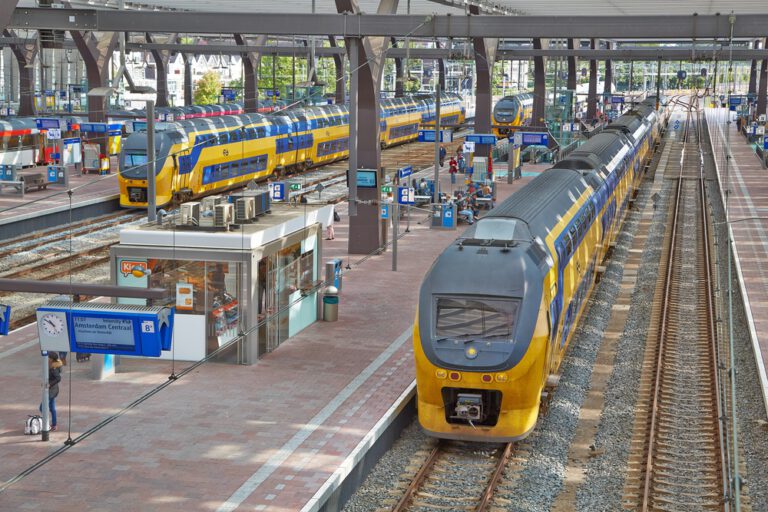
Last night, two 18-year-old men were arguing on the train at Rotterdam Centraal Station when a gun was accidentally fired.
Thankfully, no one was injured, but police have launched an investigation to get more answers as to who was responsible.
Authorities solemnly said, “This could have ended very differently”, RTL Nieuws reports.
Gun supposedly fell on the ground
For now, the story is as follows: the two men were onboard a train on track 6 of Rotterdam Centraal Station when a heated argument they were having escalated into a full-blown fight.
Then, in the midst of their brawl, a firearm supposedly slipped out of someone’s bag or pocket, fell on the ground, and went off.
In response, the two teenagers immediately fled from the train. They didn’t get far, however, as they were swiftly arrested by police.
Witnesses asked to come forward
Meanwhile, authorities are urging witnesses to come forward and explain what actually happened.
De politie stelt sporen veilig, spreekt met getuigen en bekijkt camerabeelden. Mocht u getuige zijn geweest van dit incident, maar heeft u nog niet met de politie gesproken? Bel 0900-8844. (3/3)
— Politie Eenheid Rotterdam eo (@POL_Rotterdam) October 5, 2023
Translation: “The police secure traces, speak to witnesses and view camera images. Have you witnessed this incident but have not yet spoken to the police? Call 0900-8844. (3/3)”
They are still searching to find more potential perpetrators involved in this shooting incident.
Do you want to advance your career at record speed? Or completely change directions? Either way, an MBA degree is the way to do it.
In the ever-changing Dutch job market, companies are always on the lookout for specialists who can bridge the gap between industry knowledge and strategic thinking.
Could you be the missing puzzle piece a Dutch company is looking for? Jazeker, with a specialised MBA in an in-demand field! 🧩
First things first: What’s an MBA degree?
Good question. MBA stands for Master of Business Administration, and, as the name gives away, it’s a postgraduate degree in all things business.
You can think of an MBA as strapping a rocket ship to your career — it’s a degree that teaches you the secret arts of management, strategy, and finance. 🚀
Completing an MBA degree generally takes anywhere from 18 months (full-time) to four years (part-time), and often requires you to have some work experience before starting.
Is it worth it? Well, let’s put it this way: Employers love MBAs! In the Netherlands’ competitive job market, having an MBA can make you stand out in the big pool (or should we say canal?) of job-seekers.
But what direction should you focus on to have the best chances of landing your Dutch dream job? What are the most in-demand MBAs Dutch companies looking for? Let’s see. 👇
1. Engineering management
How about an MBA in engineering? International University offers this. Image: Freepik
The engineering industry is booming across the Netherlands, making it one of the most in-demand fields in the Dutch job market. Naturally, an MBA in engineering management is as safe a bet as Dutch tulips blooming in spring. 🌷
In a country that was quite literally built below sea level, the workforce is always in need of engineering managers — not just to keep the country from sinking but also to help develop sustainable practices and cutting-edge solutions.
Besides offshore engineering, the Netherlands is also big on all things innovative and sustainable. With an MBA in engineering management, you’ll have the right ability to bridge the gap between technical expertise and strategic business thinking.
With just a bit of time and effort, you’ll become a highly competitive professional in various industries — from real estate to telecommunications and healthcare.
2. Healthcare management
A career that’s always in demand: As a healthcare manager, you can help increase the quality of healthcare services around the Netherlands! Image: Depositphotos
Speaking of healthcare: another degree that is in high demand among Dutch companies is an MBA in healthcare management. 🩺
Like any other country, the Netherlands is no stranger to public health challenges like healthcare disparities and mental health issues. If you’re passionate about making a true difference in people’s lives, then this is the degree for you!
The pandemic showed the complexities of the healthcare sector worldwide and the importance of healthcare leaders who take charge.
As a result, there’s a growing demand in the Netherlands for managers who can navigate the challenges of healthcare administration, policy, and innovation. Could that be you?
3. Finance and accounting
Amsterdam Zuid is the hotspot for all things finance in the Netherlands. Image: Freepik
From neobanks to well-established traditional ones to insurance companies — the Netherlands is home to countless thriving financial institutions. And guess what? They’re always looking for people with adequate know-how and skills to join their teams.
With an MBA in finance and accounting, you’ll gain those skills and more — and you’ll soon be a well-rounded specialist leader.
This degree is in high demand among companies, sought after for holders’ ability to fuel a company’s growth with their financial magic. Trust us, with these highly valuable qualifications, you’ll soon be in higher demand than pepernoten at Christmas time.
4. IT management
Is technology your thing? Then an MBA in IT management might be right for you! Image: Freepik
In our modern day and age, technology rules how we communicate, work, travel (and binge-watch our favourite shows). 🌍
The Netherlands is no exception to this rule, and many multinational tech giants have made the land of clogs and stroopwafels their home, including Philips and Booking.com. What do these companies need? Talent! And that’s where you come in.
With an MBA in IT management, you’ll know exactly how to efficiently use data, technological familiarity and business information to put a company’s strategic goals into action.
5. International marketing
Could YOU be the key to your company’s international success? Image: Depositphotos
Science, finance, and technology — these three are always top of the class when it comes to in-demand fields on the job market. But what if you want to do something a little more creative? Then an MBA in International marketing might be the one for you!
As a key player in the global economic market, the Netherlands prioritises international trade and multicultural business environments. No matter the sector, companies must understand things such as consumer behaviour, branding, and international marketing strategies.
It’s only natural that people with expertise in these areas can contribute significantly to a company’s growth. The result? People with MBAs in International marketing are much in demand!
6. Artificial Intelligence
Entering an emerging field is always an exciting challenge. Image: Depositphotos
The recent popularisation of ChatGPT has made it clear that AI tools are rising in popularity in all industries. And by the looks of it, they’re here to stay!
What’s the best way to not lose your job to the power of artificial intelligence? By taking ownership of it! Especially in a time of uncertainty and scepticism around AI, many companies are looking for capable leaders and advisors — and you could be one of them.
With an MBA in Artificial Intelligence, you can get ahead of the trend. This degree is guaranteed to be not just in high demand but also highly versatile, as the trend of AI tools is expanding to all fields.
7. Innovation and entrepreneurship
Which will you choose: a young start-up, or an innovative multinational? Image: Depositphotos
The Dutch are known for being innovators — and it comes as no surprise that the Netherlands continuously ranks among the world’s most innovative countries.
Naturally, the Dutch job market reflects that, and the Dutch economy is the perfect cocktail of innovation-oriented multinationals and promising start-ups.
An MBA in innovation and entrepreneurship equips graduates not only with all the knowledge to succeed in the hands of big companies, but even to start their own innovative venture.
Dutch companies are looking for professionals with specialised skills that align with the country’s economic priorities and global competitiveness.
These MBAs address industry needs and equip graduates with all the know-how to excel in the Dutch job market. Ready to find out for yourself?
Which of these seven in-demand MBAs would you go for? Tell us in the comments!
Although most of us are partial to some friendly woofers, Outgoing Minister Adema is sick of vicious canines and wants to ban “biting dogs” once and for all. 🐕❌
Apparently, the idea came to him after hearing the accounts of plastic surgeons who had to perform corrective procedures on dog attack victims.
These stories of mutilation shocked Adema and motivated him to launch an investigation into banning these dogs. A more “concrete plan” is currently in the works, NOS reports.
VVD releases ban plan on Animal Day
Yesterday — which was Animal Day — the political party Volkspartij voor Vrijheid en Democratie (VVD) released a plan outlining what the ban would look like.
According to VVD MP Erik Haverkort, 150,000 people fall victim to the bite of a hound on an annual basis, AD.nl reports.
This is especially problematic when you take into account the presence of dangerous dogs in the lives of children.
So, on what grounds would they decide to place a “breeding and keeping” ban on a particular breed of pooch?
The VVD thinks they should start by examining the dog’s physical characteristics. For instance, does the mouth have “clamp” like jaws when it bites down? In that case, a ban should be put in place to protect the community.
As Haverkort puts it, the bite of “a sweet Labrador” might leave you with a cut “at most”, whereas an “aggressive fighting dog” has the potential to effortlessly “tear away part of your cheek”.
Will we lose friendly pups in the process?
Plastic surgeon Nick Brinkman refers to the tragedies that happen to mutilated victims as an “avoidable problem”.
He notes that the ban is vital to ensure that fewer people are both physically and mentally scarred each year.
Meanwhile, although the Christian Union (CU) branded the VVD proposal as “brave”, CU MP Pieter Grinwis also chimed in with a word of caution.
According to Grinwis, care must be taken when determining which dogs are aggressive enough to ban, so we don’t also lose our mild-mannered pups in the process.
Where do you stand on this aggressive dog ban? Share your thoughts in the comments below.
As of yesterday, October 4, women can now swim topless in Amsterdam’s pools. This plan has been in the works since May of this year when Berlin got rid of the obligation to wear a bikini top in the pool.
That’s right, no more strategically shifting your bikini to try and tan without tan lines — just take the whole top off! 👙
Washing away an outdated law
Up until now, the legalities of swimming in pools without a top were in rather muddy water. Understandably, councillor Ilana Rooderkerk wanted to make sense of the situation.
So, she gave a speech in May that shared the sentiment of many other women and said, “Free the nipple!” (Literally, that’s how she ended her speech in May, according to Het Parool.)
Councillor Rooderkerk worked alongside sports councillor Sofyan Mbarki, who also wasn’t very sure of the rules at the time. After some months and a few phone calls, it’s now official: let the nipple be free, ladies, and enjoy a topless dip!
A trip back in time
Despite how old-fashioned this news feels, it was actually very normal for women to swim and tan topless in the 80s.
Then, we became a bit more prudish over time, and now we’ve gone full circle back to the 80s.
Lately, though, there’s been much more discussion among Europeans about women’s rights to kick back topless by a swimming pool. It’s not a very heavy discussion at all — just, you know, about the inescapable sexualisation of the female body. Light stuff. 🙃
Either way, the nipple has been freed. Hoera!
How do you feel about this new policy? Tell us in the comments!
Unearthed social media posts from the Rotterdam shooting suspect reveal hate and a racial slur after one victim previously reported him to the police, providing more insight into his motives.
A 39-year-old woman named Marlous, her 14-year-old daughter Romy, and 43-year-old teacher and general practitioner Jurgen Damen were killed in a shooting spree last Thursday.
The suspect, a 32-year-old student and Rotterdam resident called Fouad L., had a history of “psychotic behaviour” and previous convictions of animal abuse, reports the NOS.
Online complaints
So what was his relationship with the neighbours he allegedly shot and killed?
Apparently, Fouad L. was a source of many neighbourhood complaints and had a reputation for being a nuisance.
Marlous had reported Fouad L.’s behaviour to the police on several occasions, which L. wasn’t happy about — hence why he took to online forums, including 4Chan, to complain.
In addition to that, L.’s posts about his neighbour allegedly referred to her by a racist term to criticise her interracial relationship.
Arson, as well as murder
As for the crime committed last Thursday, The Public Prosecution Service suspects L. of not only all three murders, but also two counts of arson and the illegal possession of firearms.
Why arson? Well, after shooting the 39-year-old Marlous and 14-year-old Romy in their home on Heiman Dullaertplein, L. apparently set fire to his own house on the same street.
On the same day, the suspect also shot and killed 43-year-old teacher and general practitioner Jurgen Damen, before setting fire to the Erasmus Medical Center as well.
Suspect in custody for two more weeks
It has not yet been determined which of these suspected crimes L. will actually go on trial for.
Today, the examining magistrate decided that L. won’t leave police custody for at least another two weeks.
De man die wordt verdacht van het doden van 3 mensen in Rotterdam is net voorgeleid bij de RC. Hij blijft 14 dagen langer vastzitten.
Translation: “The man suspected of killing 3 people in Rotterdam has just been brought before the RC. He will remain in custody for an additional 14 days.”
The suspect is also in complete isolation and may only be in communication with his lawyer.
On top of all this, Fouad L. has been evicted from his residence — which he had €3,000 in outstanding rent for.
Surprise, surprise: even one of the most egalitarian countries in the world discriminates against women in the workplace! The Dutch pay gap has increased, with women earning less than men in most sectors. 🤨
Recruitment specialists Intermediair and Nyenrode Business University conducted a joint study into the Dutch gender pay gap and the results were shocking. Over the past two years, men’s salaries have increased disproportionately to women’s.
Men earn more than women… still
In particular, the average male salary has increased by 7.4%, while the average female salary has increased by 5%.
The fields with the highest gender pay gap, you ask? In the ICT and judiciary sectors, men earn a whopping 22% more than women. Market research, meanwhile, has men earning a whole 27% more than women!
If that wasn’t infuriating enough, Dutch men may even earn more than €10,000 per year more than women in the same field.
Oké, oké — it’s not all bad. There was one sector in which women did earn more than men. In the media sector, women earn a whole 50 euros more! Pop the champagne; inequality is over!
Is it because of education?
Unfortunately, this inequality exists across the board. At every level of education, men earned more than women on average. The difference is even starker among workers with a higher education.
According to RTL Nieuws, women with a higher education earn even less than men of a similar education level.
But it gets even crazier! Get this: men with a lower level of education received a larger pay raise than women in higher education. Let’s say that again: women with higher education still earn less than men with lower education.
@novaramedia The media’s ingrained misogyny was exposed when Moya Lothian McLean appeared on Sky News…to talk about misogyny. Moya appeared on Sky News on Wednesday evening to discuss comments made by Laurence Fox on GB News where he asked what “self-respecting man” would “climb into bed” with Politics Joe reporter Ava Evans. Fox has been suspended by the channel alongside Dan Wootton, who was interviewing him. On Novara Live on Thursday, Moya explained how the debate in the media highlighted structural misogyny. #politics#ukpolitics#media#sexism#uk♬ original sound – Novara Media
This doesn’t make us want to drop everything and live in the woods with just plants and wild animals at all… 🙄
Why does this happen?
The study didn’t make it very clear why men are earning more than women. But let’s be honest, we all know why: sexism (there, we said it).
“Our labour market has been shaped by men with wives working at home full-time, but the reality has changed,” Julia Wouters tells RTL Nieuws.
So what can we do about it? One solution is for employees to be chosen based on their results rather than attendance, which is how it’s mostly done now.
As Julia Wouters tells RTL Nieuws, another solution is to show how much men earn and how much women earn. This will at least make the statistics undeniable, and a real conversation can start.
Are you surprised by these statistics? Tell us in the comments!
The restaurant in question? Restaurant Bougainville — a Michelin-starred restaurant located on Amsterdam’s Dam Square.
The restaurant is located on the third floor of the luxurious Hotel TwentySeven, and opened its doors to the public in 2017.
“It is a unique achievement, of which we can be terribly proud and grateful. From the kitchen and bar team to the cleaners and reception, we’ve all done this”, owner Eric Toren tells AD.
European cuisine with an international touch
Now we know what you’re thinking: how can a restaurant win such a title if it serves… Dutch food? 🤢
Well, it doesn’t.
The menu of the world’s best restaurant “covers a wide range of European influences [which are] complemented by a more international touch”, according to its website. Lekker!
But the delicious food isn’t the only thing that earned Restaurant Bougainville its title — the TripAdvisor ranking also focuses strongly on the customer’s overall experience. 🏆
If you want to try Chef Tim Golsteijn’s art for yourself, make that reservation ASAP because you know this place is about to be booked out for weeks at a time. A 5-course tasting menu can be enjoyed for €130.
Who else topped the rankings?
Wanna know what other places you should put on your to-try list? Let’s see.👇
Rank
Name
Location
1
Restaurant Bougainville
Amsterdam, the Netherlands
2
Ise Sueyoshi
Nishiazabu, Japan
3
The Old Stamp House Restaurant
Ambleside, United Kingdom
4
Maison Medard
Boulleret, France
5
Ristorante Villa Crespi
Orta San Giulio, Italy
6
Avartana
Chennai (Madras), India
7
Akira Back
Bangkok, Thailand
8
Paul Ainsworth at No. 6
Padstow, United Kingdom
9
PIC
Valence, France
10
Sachi Heliopolis
Cairo, Egypt
Would you want to visit Restaurant Bougainville? Tell us your thoughts in the comments!
Three twenty-something women have all been stabbed within the same week and around the same bridge in Utrecht. Police are now wondering if all three crimes could be connected.
Last night at around midnight, a 20-year-old woman was walking over the bridge called the Balijebrug in the Rivierenwijk, Utrecht, when she was stabbed.
The victim has since been hospitalised with minor injuries, RTV Utrecht reports.
In the meantime, the police are using a sniffer dog, as well as other tactics, around the bridge to find out more about the crime.
Two other attacks
Sadly, this stabbing is not a stand-alone case; last Wednesday, another young woman, aged 23, was stabbed with a “sharp object”.
This happened right before her handbag was snatched up by the perpetrator. Again, the woman suffered minor injuries from the attack.
Horrifyingly enough, a third incident took place along the same bridge at around 2 AM on Saturday morning when another 23-year-old woman was stabbed with an unspecified sharp object.
We zoeken getuigen of personen met meer informatie over een steekincident #Balijelaan#Utrecht die vannacht – 30 september om 02.25 – plaatsvond. Voor meer info, klik op de link:https://t.co/BTZLQtokY6
Translation: “We are looking for witnesses or people with more information about a stabbing incident #Balijelaan#Utrecht that took place last night – September 30 at 2:25 AM. For more information, click on the link.”
The Dutch-speaking man responsible for this incident is reportedly around 25 years old, with dark hair, and about 1.70-1.75 meters tall, RTV Utrecht reports.
Separate incidents or connected crimes?
The similarity across all three attacks feels too uncanny to ignore — especially given the proximity and timing — so police are considering the possibility of a connection between them.
Even so, they are also investigating the events as separate crimes and want to “keep all other scenarios open”, according to their spokesperson, NOS reports.
What are your thoughts on these three stabbings? Let us know in the comments below.
Driving in Amsterdam should be considered an extreme sport — but not for much longer. By the end of this year, the speed limit in the city will be significantly reduced — from 50 km/h to 30 km/h.
You might already be able to spot signs around the city indicating the new speed limit. If you look closely, you’ll see that these have stickers stating that the new measure only applies from 8 December onwards.
Until then, speed away! (Just kidding, please drive safely and follow traffic rules). 🚗
New infrastructural measures
According to NU.nl, five thousand new speed signs will soon be installed around Amsterdam, and 170 traffic lights will be adjusted.
But the developments don’t stop there. Starting in January, LED signs will be placed along roads to remind drivers to drive at the correct speed. If you see a smiley, you’re doing great; if you see a frowning face, slow down.
New measures will apply to 80 per cent of the roads in the city. In some areas, public transport will also have to stick to new rules, with trams and buses in separate lanes being set a speed limit of 50 km/h.
Putting an end to the chaos
Why all of these new measures? Well, they’re coming for several reasons. First, serious accidents are expected to be reduced by 20 or 30 per cent.
Second, noise pollution is expected to decrease. This will comfort Amsterdammers who know the struggle of not being able to sleep because of loud tram lines and honking cars zooming past your window.
Transport companies and emergency services will monitor the changes closely to determine the effectiveness of the new measures. ⚡️
How do you feel about these speed restrictions? Let us know in the comments!
While being chased by the police all the way from Belgium, a man stole three cars and hit several others. He’s now on the run in Amsterdam.
The man drove from Belgium into the Netherlands, where he was spotted by Dutch politie driving the first stolen car, according to NU.nl.
Three cars stolen, many damaged
When the man decided that the first car wasn’t good enough anymore, he dropped it in Geldermalsen. In the same place, he stole his second car by ordering a driver out of their own car.
Once he made it to Amsterdam, the suspect did the same thing again. In a high-speed chase, the thief made his way through Amsterdam West and Nieuw-West, hitting several parked cars along the way.
Suspect on the run (literally)
The suspect’s streak stopped when he encountered a flat tire in Sloterdijk in Amsterdam. The twist now is that he’s fleeing on foot. 🏃♂️
Police have looked for the suspect with two helicopters, but he could not be found anywhere. Hopefully, for his sake, he can run faster than a car. 😬
Have you seen this car thief around the Netherlands? Tell us in the comments!