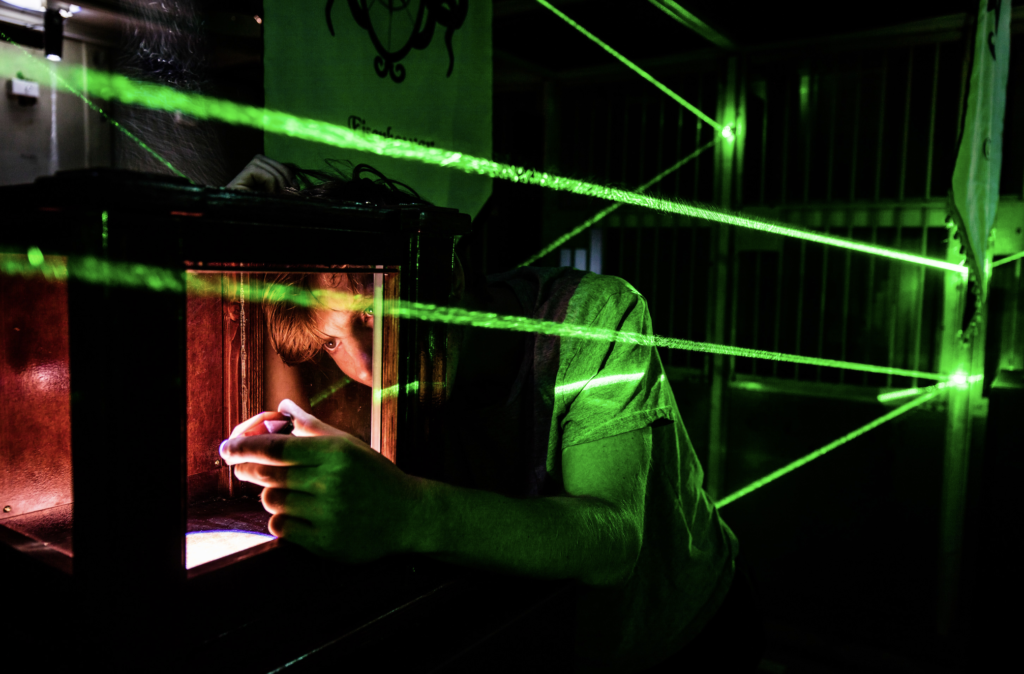
Looking to experience Amsterdam in a new and exciting way? The unsolved disappearance of a visionary woman will lead you deep inside the ancient mystery of this wondrous Amsterdam escape room. ✨
On a cloudy Monday afternoon, two of our DutchReview writers (or, may we say, heroes) followed a call for help from our friends at Logic Locks.
The deserted study chamber of explorer Elizabeth Lionheart is rumoured to hold the secret behind her mysterious disappearance — and we set out to find it.
Little did we know that this escape room experience would, figuratively and (almost) literally, steal our hearts away! ❤️🔥 We laughed (a lot), despaired (temporarily), and had an absolutely unforgettable time.
Behind rows of dusty leather-bound books, strange objects from places far away, and the glassy eyes of long-dead animals, we’ve eventually discovered the Secrets of Eliza’s Heart — and you can too!
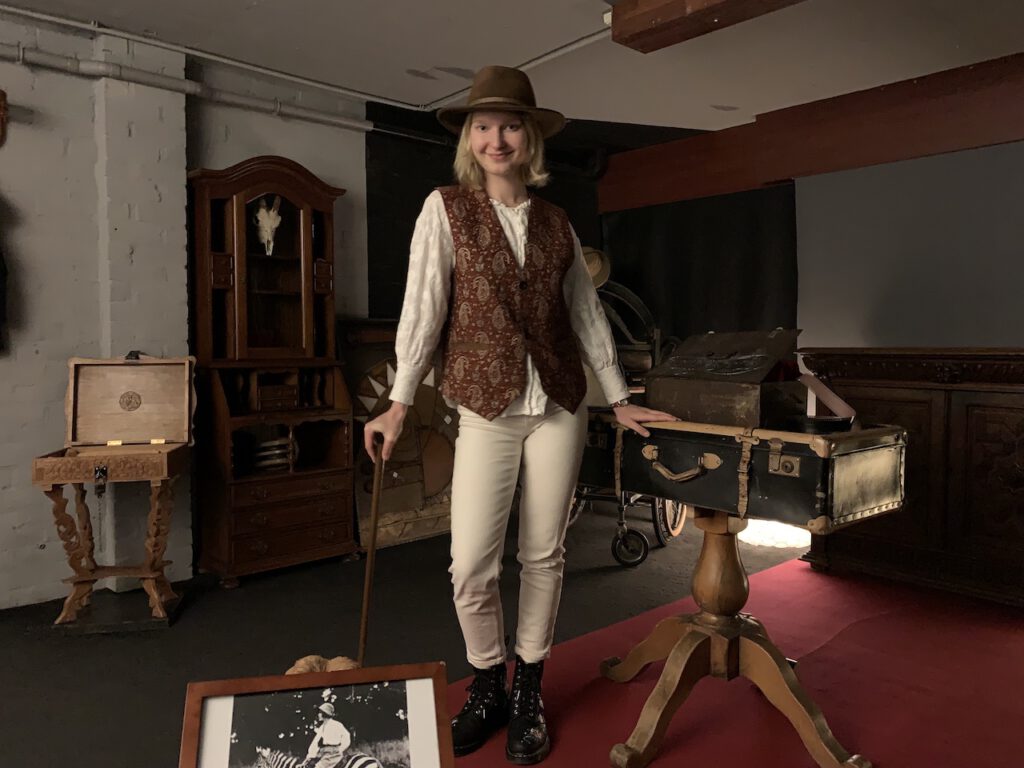
Our DutchReview Team in Eliza’s study chamber. Image: LogicLocks/Supplied
The protagonist: Elizabeth Lionheart
But first, who is this mysterious Elizabeth Lionheart?
Whilst other women were constrained to the rigid gender roles of the early twentieth century, Eliza was clearly ahead of her time. Bravely, she set out to travel the world by herself and sought to discover the most hidden and unexplored places she could find.
Reputed for her beauty and forward-thinking sense of fashion, Eliza made it onto the pages of various fashion magazines — and, it is rumoured, into the minds of many, many men.
Then, all of a sudden, she vanished without a trace in 1922. Well, almost without a trace…
The mystery: what happened to Eliza?
This is where you’re desperately needed, dear adventurer! Three questions will lead you to unravel the mystery of Eliza’s disappearance:
What was Eliza’s last destination?
Where has she gone?
And…what happened to her heart?
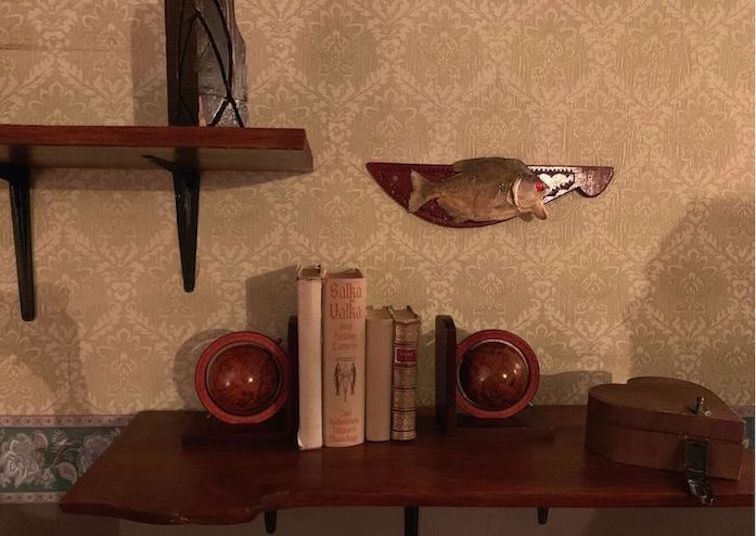
Can you spot the heart? Image: DutchReview
The crime scene: Eliza’s study chamber
The answers to these questions are hidden somewhere within her office, which has been left untouched for almost 100 years.
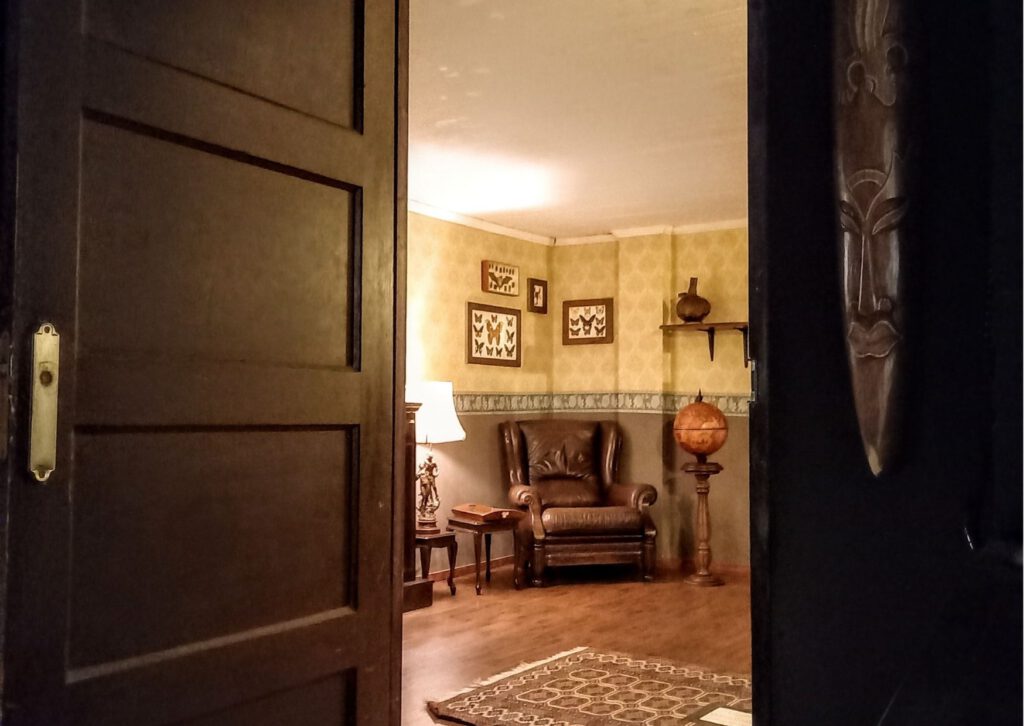
At first glance, you’re greeted by the charm of a 1920s study: a noble mahogany desk, stuffed animals decorating the walls as trophies, a plush armchair, and a cosy hearth that has long gone out.
But beware! Don’t make the mistake and fall victim to distractions. Look at everything once, twice, or even three times — from all possible angles.
Has the fireplace really ceased to light up the room? Have the books stopped to tell you their stories? Are the paintings on the walls showing you more than their intricate brush strokes?
Nothing is quite what it seems. 🙉🙈🙊
What did Eliza leave behind in her study chamber? Image: DutchReview
The enemy: dark forces at play
So you’re ready to take on the challenge. You’ve straightened your explorer’s hat, cracked your knuckles, and focussed your mind. But wait!
There’s one crucial thing you have to know. You’ve got no more than 63 minutes to solve the mystery. Why? Because Eliza’s study chamber seems to drive all those who enter it slowly into the arms of insanity.
Rumour has it that Eliza has brought back ancient knowledge of dark magic spells from her travels to the depths of the Amazonian rainforest.
How far did she go to protect her most guarded secret? Well, let’s just go with what Logic Locks tells us, you have to “unravel the mystery…until it unravels you.”
Is your game host a friend or foe? Image: DutchReview
Secrets of Eliza’s heart: what you need to know
Drawing from our experience and learning from our mistakes, we’ve collected all you need to know before you discover the Secrets of Eliza’s Heart.
👨👩👧👦 Players: You can play with 2 to 7 people. Ideally, you’ll be more than 3!
⏳ Duration: Plan about 90 minutes for the whole experience. But you’ll have no more than 63 minutes to get to the bottom of Eliza’s Secret.
🏋️♂️ Difficulty: This isn’t the easiest escape room, but you’ll get some help from your host if you get stuck! The more people you bring, the easier it’ll get.
👻 Spookiness: There are some suspenseful moments during the game, but you won’t ever drift into the realm of horror. Are you looking for something a bit more spooky? Try out Logic Lock’s renowned (and feared) Amsterdam Catacombs.
Fun fact: the DutchReview Team actually didn’t manage to solve the Secret of Eliza’s Heart! We had to escape the study chamber before the 63 minutes elapsed and we would forever lose our minds.
Any good tips for escape room beginners? Share them in the comments below!
While the Netherlands is often considered a greatplace to be a university student, a recent survey says otherwise.
A joint study by the Interstedelijk Studenten Overleg (ISO), Erasmus Student Network (ESN), and the National Student Union (LSVb) found that 59% of university students in the Netherlands experience mental health problems.
According to AD, less than three in 10 students are completely satisfied with student life.
Feeling the pressure
International students often feel depressed due to performance pressure, being far from home, and missing social contact. Not to mention a grim housing situation and perpetually bad weather in the country.
On top of that, 35.4% of students also face financial problems while living in the Netherlands.
Many international students indicated that the cost of public transport was too high while access to healthcare can be difficult.
The coronavirus crisis also played a role in the survey results. The survey collected data in February and March when the government gradually phased out coronavirus measures.
A worrying development
According to the survey, more than half of students have mental health problems, whilst a quarter of respondents don’t feel at home here.
“This does cause us great concern. Our research is not representative, but it sends out a signal because the group of students who experience these problems is still very large,” ISO chairman Terri van der Velden tells the NOS.
Van der Velden suggests limiting and controlling the flow of international students. “Then you can better guide and inform them [about university life in the Netherlands].”
Looking ahead
The student organisations recommend investments in accessible preventive mental healthcare, through student psychologists, the municipality, the GGZ (Dutch Mental Help Services), and other platforms.
They also suggest creating specific housing policies for incoming international students, while providing better access to practical information about living, studying, and working in the Netherlands.
Overall, it seems like the Dutch educational system has its work cut out — but at least someone has ideas to improve it.
Are you surprised by these findings? Tell us your thoughts in the comments below!
A three-month-old infant has passed away in the sports hall of Ter Apel asylum centre. The baby’s family were forced to sleep in the sports hall due to a lack of available beds.
At the time of writing, the cause of the baby’s death remains unknown. However, the House of Representatives has called for an investigation.
Investigation launched
An inspection will “investigate all possible aspects that may have played a role in the death of the baby,” the government said in a press release.
“For example, the inspectorates look at the medical cause, whether care has been provided before, the available care and the living conditions around the application centre and in the sports hall.”
Record number of people sleeping outside
Part of the answer may be found in the fact that Ter Apel is facing a huge accommodation crisis for asylum seekers. Last night a record-breaking 700 people were forced to sleep outside, the NOS reports.
Included in this number were pregnant women, children, and people with chronic illnesses.
Doctors Without Borders called in
The situation has become so dire at Ter Apel that Médecins Sans Frontières (Doctors Without Borders) has dispatched employees to help out.
According to these employees, the situation at Ter Apel is comparable to the standards at the Moira Refugee camp that was established on the Greek Island of Lesbos.
In de kantine bij Artsen Zonder Grenzen:
“Welcome back from Yemen. What’s your next assignment?”
“They’re sending me to….”
*checks letter*
“…it says ‘Ter Apel’. Wherever that is. I hope the tents are good quality at least.”
Translation: In the canteen of Doctors Without Borders:
Speaking on the NOS Radio 1 Journaal, the Mayor of Groningen Koen Schuiling has summed up what we’re all thinking: “It is a sad, low point for our country that we have come this far.”
Thanks to its flat terrain, mild-ish climate, short distances, and really expensive car parking — the Dutch city of Utrecht has been awarded the top place in the world to cycle! 🤩
This year’s Global Bicycle Index has officially been published, ranking 90 cities across the world to see which are the most bike-friendly.
The index scored the cities based on the number of bicycle users, crime and safety, infrastructure, weather conditions, bike-sharing opportunities, and cycle-related events.
With more than half of its population being cyclists, Utrecht has dominated the index with the highest scores and conquered the winning title! What can we say? It’s just in their DNA! 😉
Utrecht: The true bike capital of the world
Utrechters are true cycling lovers — and can we blame them? They just know that liberating feeling of zipping along a bike path and taking in the charm of the city all too well.
A growing number of folks are looking to commute to and across the city by bike more and more these days — and with some of that world-class cycling infrastructure, it’s a truly tempting pastime. 🚲
But what makes the Dutch city the ultimate paradise for cyclists?
A quick Google search will reveal that Utrecht was practically built around the bike life. It was the first city in the Netherlands to make a cycle path.
Not just that, the city also has the largest bike parking in the world, with more than 30,000 places to store your bike!
There are 33,000 bicycle parking places in the Utrecht Central Station area. Storing the same number of cars would require 890,000 square meters of floor area.
That’s more retail, more office, more housing and more public space; all as a result of an integrated transport policy. pic.twitter.com/GYNmCznjIo
It’s clear that European cities took charge of the index, and while the Dutch have snatched the top spot this year, the Germans aren’t too far behind! 🎉
With a low rate of cycling fatalities and over 39% of its people using bikes every day, the German city of Munster is the second most bike-friendly place in the world.
It might surprise you to know that Amsterdam actually ranked fifth on the list. Helaas, the chronic traffic jams and tourist swarms are essentially what holds the Dutch capital back.
Curious to know if your country made the top 10? Take a look! 👇
City
Rank
Utrecht, Netherlands
1
Munster, Germany
2
Antwerp, Belgium
3
Copenhagen, Denmark
4
Amsterdam, Netherlands
5
Malmo, Sweden
6
Hangzhou, China
7
Bern, Switzerland
8
Bremen, Germany
9
Hannover, Germany
10
What do you think about Utrecht being the top bicycle city? Tell us in the comments below! 👇
Many internationals want to study in the land of cheese and tulips; from affordability to a big international community, there’s a lot to enjoy!
But before anything, here are a few things everyone should know before they start their university hunt in the Netherlands.
1. There are different levels of Dutch higher education
Dutch higher education is divided into two main types: wetenschappelijk onderwijs or WO (research-oriented higher education) and hoger beroepsonderwijs or HBO (higher professional education). Try saying those three times fast!
University studies are rigorous all around the Netherlands. Image: Depositphotos
WO is focused on applying scientific knowledge to solve scientific problems. Students do a lot of research and writing at a universiteit (research university), they take exams, and occasionally do internships and traineeships depending on their programme.
HBO, on the other hand, educates students for a specific profession at a hogeschool (university of applied sciences). The programmes are oriented towards practical experience rather than research. Students usually do a year of work placement to get experience in their field.
Depending on what suits your interests, learning style, and career goals, the options are open! If you are interested in doing a PhD, you’ll need a master’s degree at WO level (in the Netherlands, or something equivalent from elsewhere!)
2. It’s incredibly difficult to score perfect marks
Dreaming of straight A’s? No such luck. All assessments at Dutch universities are graded from a 1-10 scale — but a 10 is almost impossible.
A passing grade is typically 5.5 or 6, and the average grades fall in between a 6 and an 8. If you’re seeking those elusive 9s and 10s, you’ll need to readjust your expectations: such high scores are seldom given by teachers because there’s a focus on finding things to improve on.
3. You need to start your housing search as soon as you can
Settling into a new country can take a lot of time and it’s not the easiest process. You may not have heard about it but there is a huge housing shortage in the Netherlands. Many international students are left with a permanent address, easily becoming one of the biggest problems for students when they first move here.
Housing can be a really tough process — the sooner you start, the better! Image: Depositphotos
We recommend starting your housing search at least three months in advance, speaking with your university’s international office, and constantly checking up on student housing websites like Kamernet and Studentenwoningweb to get a head start.
4. Getting your visa can be bureaucratic — but your university should help
Of course, non-EU students must be equipped with a student visa and residence permit to study in the Netherlands as part of any international travel and education. Whether you’re an expert or it’s your first time moving abroad, organising visas and immigration documents can be really draining.
But great news: universities will usually process these documents for you (or at least help)!
Along with the IND, or Immigratie- en Naturalisatiedienst (Immigration and Naturalisation Services) your school should handle your documents, and give you a hand where you need it.
5. The average study programme length is shorter than most
An average bachelor’s degree at WO level is only three years long, while an HBO bachelor’s degree is four years.
A double bachelor degree can be anywhere between three to five years long depending on the specialisations and combinations. Master’s degrees are often one to two years long, save for medicine, dentistry, veterinary sciences, and pharmacy (which are almost exclusively offered in Dutch).
The average student in the Netherlands graduates sooner than most undergraduates. Image: Depositphotos
This could be a huge advantage if you’re coming from somewhere that has higher tuition fees — a shorter study term may mean less money to spend on your degree overall!
6. Transferring to another study in the Netherlands is really difficult
Dutch universities don’t have a “general education” year with standardised subjects like many universities in other countries. Without this general education year, there isn’t a lot of wiggle room to shift to a new study programme and academic credits are usually not transferable across universities.
To join a new programme, you have to drop out of your current course and wait until the next application period for your new course.
7. Study in English, maar de rest in Nederlands
The Dutch pride themselves in being the best non-native English speakers in the world but that doesn’t mean you can get by with English alone.
Learning Dutch as a student is a big advantage. Image: Depositphotos
A lot of people do speak English (in supermarkets, in cafés and restaurants, etc.) but a lot of formal communication from healthcare to the Belastingdienst (Tax and Customs Administration) will come in Dutch. If you’re living in another country, it’s a great opportunity to learn the local language — even if just enough to order some coffee!
Let’s face it. Dating as an international in the Netherlands isn’t easy. Sometimes, Tinder, Bumble and the borrelen can prove to be huge letdowns — but with this dating app, your love life is actually about to get interesting.
Flexible, convenient, and fun: it’s no secret why dating apps have become the norm — and if you’re single, you’ve probably got at least one downloaded on your phone right now.
However, in a world filled with Tinder bros, ghosting, hookup culture, and bread-crumbing, online dating has quickly gotten a bad rep with anyone who’s looking to find a serious partner.
It’s time to wave goodbye to hookup culture and start meeting people who prioritise romantic commitments.
Inner Circle is the go-to platform for finding love in the 21st century, one swipe at a time. Why? Because its members are people that you’d actually want to date. 🤩
There’s no better feeling than knowing you and your date are on the same page! Image: Inner Circle/Supplied
From teachers to entrepreneurs to creatives, you’ll meet people from all walks of life — but the one thing they all have in common: they take dating seriously and want to meet up in the real world.
You can join the app for free (just as the Dutch like it), and it’s also available in Barcelona, London, Milan, Paris, Stockholm, and Berlin.
Single and ready to mingle? Here are three reasons why you should join Inner Circle:
1. Your safety is guaranteed
The internet can be both a blessing and a curse. With Tinder swindlers and catfishers running wild, it can be difficult to navigate the sometimes-treacherous waters of online dating. 😬
Inner Circle offers a solution to this problem. They prioritise authenticity by giving you a screened community to weed out the baddies and which has a zero-tolerance approach.
That way, you can shoot your shot confidently and safely, knowing everyone you match with is really who they say they are.
2. Your time is valued
Ever been ghosted so many times to the point your friends start calling you Casper? Well, Inner Circle says, “no more!”.
On the app, you get matched with people who have put real effort into their dating profiles, and who have a genuine interest in meeting and getting to know you.
Your match actually wants to meet up in real life! Image: Inner Circle/ Supplied
Plus, the super smart algorithm only shows you profiles from people you have most in common with, so from the start, you’ll have to swipe less — and can date more. 😊
3. Your best date spot, already picked out
Finding a place to meet up with your budding love has never been easier.
With Inner Circle, you can choose from a member-curated list of the best spots in town, or match with other members based on the places you both love to go. You can also grab a ticket to one of their iconic parties and events.
No need to fret about where you should go, that’s already sorted! Image: Inner Circle/ Supplied
Ready to level up your online dating game now? We sure are! You can register free with the app to gain access to all of Inner Circle’s flirtatious fiestas! 💃
Are you interested in joining Inner Circle? Tell us your thoughts in the comments below! 👇
Dreaming of hitting the slopes this winter? The Dutch travel group, TUI, just improved your chances. Between December and April, there will be a weekly train that can carry you to Austria’s top ski resorts overnight! 🚂
If so, it’s a divine time to think about snatching a ticket for this new night train that’ll whisk you away from the flat Dutch terrain to the stunning Austrian peaks. ⛰️
JUST IN: To coincide with the forthcoming ski season, @TUIGroup will expand its partnership with GreenCityTrip by introducing a night train to Austria. pic.twitter.com/jgRtNawUg1
Folks can board the ski express from Amsterdam Central and continue directly to Austria via Utrecht.
From there, the train’s path splits in two, giving you the option to either journey through the Austrian state of Tyrol or the region of Salzburg. Travelling with a mooi view of the Alps? Who wouldn’t want that?
On your way to Austria, TUI takes you to multiple ski resorts across Europe. So, in other words, you truly get your money’s worth. 😉
Europeans are known to be quite the ski bums. The incredible sense of freedom, the thrill of gliding effortlessly through some freshly-powdered snow — it’s not hard to guess why. 🤔
You’d think that hailing from an entirely mountain-less country would stop the Dutch from shredding some pow, but zeker niet.
However paradoxical this seems, the flatlanders have an immense love for the slopes — so when given the chance to visit some winter sports resorts, you better believe they’re going to take it! ⛷️
Sorry TUI, you’ve got competition
TUI already strives to give eager travellers train journeys to many European cities — but did you know that the NS also came up with its very own night train?
Expect less train traffic and fuller trains from September onwards in the Netherlands. NS, like (seemingly) everyone else nowadays, is experiencing staff shortages.
About 10% fewer trains will roam the rails from 2023, reports NOS. That is compared to the last non-Covid year, 2019.
What does “fewer trains” mean?
In short: if you’re a regular train traveller in the Netherlands, you can expect fewer departures, fuller trains, and more transfers needed to get from point A to B. Yay! 😒
But they can’t place all blame on the lack of NS staff. A reduced amount of travellers after the pandemic has also impacted the decision to cut down on trains.
According to NOS, 2022 has only seen 82% of the regular (non-pandemic) amount of travellers on the rails — seems like people are still enjoying the work-from-home routine Ms. Corona put in place.
A blessing in disguise?
We get it, it seems like there’s only bad train news nowadays. This update comes on top of a series of other less-than-ideal train situations lately, with strikes in the industry dominating the transport landscape for the next few weeks.
The thing is, it’s not all bad news. NS has promised that fewer trains will make for more predictability because the chance of last-minute cancellations (caused by the current staff shortage) is lower.
It sounds too good to be true, but hey, we’ll take some positivity when it’s offered to us.
Will the new train schedules impact your daily routine? Tell us about it in the comments below!
On Wednesday, August 24, there will be little to no trains running in the northern region of the Netherlands due to a 24-hour strike by the NS staff. None aboard! 🚂
The first day of the strike began at 4 AM and impacts areas the areas of Friesland, Groningen, Drenthe and parts of Flevoland and Overijssel until 4 AM tomorrow, reports the NOS.
Unfortunately, while this strike “ends” within 24 hours, four more 24-hour long strikes will follow, impacting other areas of the Netherlands throughout the upcoming weeks.
Today, Arriva trains will continue to run between Leeuwarden and Groningen. Though, Freek Bos, the same expert who told passengers to stay home during the NS strikes, says we can expect extra crowds on those trains due to other cancelled intercity trains.
To get an up-to-date look at what’s happening in all the different stations, you can check the situation on the tracks, provided by the NS website.
If, unfortunately, your train gets cancelled due to the organised strike, it’s possible to get a refund of up to €25 per person.
Why is the NS staff on strike?
In short, money. 💰
The trade unions and the NS disagree about a new collective labour agreement which sees to increase the staff’s wages by €100 gross and offer them a one-off payment of €600.
The railway company explains that the demands of the trade unions are going too far as it’s still recovering from a difficult financial situation, as a result of the pandemic.
NS strikes: a location overview
Wednesday, August 24: Northern Netherlands, including staff from Groningen, Leeuwarden, Lelystad and Zwolle
Friday, August 26: Western Netherlands, locations The Hague, Dordrecht, Leiden and Rotterdam
Monday, August29: Northwest Netherlands, including Amsterdam, Den Helder, Haarlem and Schiphol airports
Tuesday, August30: Central Netherlands, including the locations of Utrecht, Gouda and Amersfoort
Wednesday, August31: Eastern and Southern Netherlands, including the Arnhem, Breda, Ede-Wageningen, Enschede, Maastricht, Nijmegen and Vlissingen stations
We don’t mean to derail your feelings, but getting on a train is basically going to get a lot harder in the following next week. 🚆
If you like detective novels, puzzle-solving, and adventure stories, you’ll love a good Amsterdam escape room.
Finding clues, reading between the lines, and thinking outside of the box, that’s what escape rooms are all about.
Escape rooms are the ideal experience if you’re visiting Amsterdam during the rainy season, or if you just want to put your detective hat on and get those brain cells churning. Elementary, my dear Watson! 🔎
We tested and chose these escape rooms based on reputability, user ranking, real reviews, and awards they’ve won. 🏆 Let’s unlock some secrets, shall we?
1. Locked Amsterdam: the Soviet mystery a journalist must solve
What clues did this journalist leave behind in his office? Image: Depositphotos
Locked has two Amsterdam escape rooms on offer and gets extra points for being connected through a masterfully crafted storyline — and a Soviet submarine might just be the key to it all. 🗝 Here’s what they’re about!
🗝 The Submarine
Journalist Hugo Laanen is following a hot lead on a Russian submarine that went missing 20 years ago during the Cold War while carrying a dangerous nuclear load — and which is yet to be found.
But then, Hugo disappears! It’s up to you to find him. You start your investigation in his office in Amsterdam Houthavens, but you’ll end it in the depths of the Pacific Ocean. Thrilling!
🗝 The Liebermann Conspiracy
Hugo is back. However, whatever he revealed about the Russian submarine got him into deep trouble.
The brave journalist is in exile (potentially hiding from the Russian secret services) but he’s onto a new story and will need your help!
The powerful Liebermann group is up to some dark and twisted trickery. Hugo needs you to break into their headquarters and find out what they’re up to!
2. Sherlocked: the award-winning experience that’ll blow your mind
An ancient secret is well secured down in The Vault. Image: Sherlocked/Supplied
Sherlocked is on a mission to make the world just a tiny bit more magical. ✨ These guys and their escape rooms have a number of prizes under their belt — and for good reason!
Located in the historical Beurs van Berlage, a historical Amsterdam building, their two escape rooms offer more than a simple lock-and-key puzzle. The keyword is ‘immersive’: you’re not just playing an adventure, you’re living it.
🗝 The Architect
You’ve been called upon to investigate what appears to be the office of Dutch architect H.P. Berlage — but who was truly a member of the Society of the Crossed Keys, a cryptic group of leaders and intellectuals believed to be in the possession of some of the world’s best-kept secrets.
To add to the mystery, since Berlage’s death in 1934 the Society suddenly vanished without a trace — until now. Are you prepared to peel back the layers of this secret and uncover the clues in the architect’s office?
🗝 The Vault
You’re planning a heist. Yes, you. Get your team together, because you’ve got a job to do.
A mysterious object is waiting for you in the Vault. This is not a classic escape room experience, but a thrilling mission that’ll have you sweet-talk guards, crawl through tight spaces and think quick.
Curious? We were too! Our team turned from content writers into highly-skilled thieves for a day and tried it out!
3. Questomatica: the tech-savvy riddles that gamers will love
Ever thought of entering the world of 90s arcade games? Image: Depositphotos
If it’s your ultimate dream to enter a video game in real life, then Questomatica and their escape rooms open up portals that’ll transport you straight into pixel land. 👾
Through the clever use of light and technology, Questomatica fuses non-digital and virtual reality into real-life gaming experiences. This company has collected over 1,000 reviews on Tripadvisor — and more than 900 indicate a five-star ranking!
🗝 Arcade Invasion
Loved playing Pac-Man and Snake in the 90s? Well, then this experience is a dream come true.
Fight two-dimensional pixelated enemies with laser guns, open brick question boxes (Mario says, hi), and puzzle yourself out of this computerised reality!
Especially for the more seasoned escape room cracks amongst you, this is definitely an experience worth checking out.
🗝 Wake Up!
Are you living the dream? Well, at least for this experience you are. Questomatica allows you to dive straight into the dreamworld of Matilda.
Matilda is usually a happy and cheerful girl, but her dreams of this particular night are filled with illusions, puzzles, and warped realities. Can you help her wake up?
4. Logic Locks: the time capsule for daring explorers and brave adventurers
Solving the “Amsterdam Catacombs” escape room requires a lot of skulls…ehm, skills. / Image: Freepik
Logic Locks has quite the name amongst Amsterdam escape rooms. Their award-winning experiences immerse you entirely into their respective worlds because of their stunning attention to detail, lifelike props, and intricate storylines.
🗝 The Amsterdam Catacombs
This escape room is not for the faint-hearted. But if you’re a true-and-tested horror fan or fearless adventurer, then you’ve met your match.
Logic Locks specifically has a disclaimer for this room, warning players that you must be “mentally stable and physically fit” to enjoy this experience!
This adventure will lead you deep into the catacombs of the historic Posthoornkerk, a church located in the city centre. In order to escape the claws of the Amsterdam underground, you’ll have to face some of your biggest fears… ☠️ Are you ready?
6. Xitrooms: the mad scientist that left you his secrets
Watch out, it’ss explode any second! Image: Depositphotos
Xitrooms claim to have the first-ever escape room in the Netherlands. While we can’t tell you if it’s true or not, we can confirm their offering is top-notch.
Xitrooms offer a classic lock-and-key puzzle for both of their escape rooms. Great for beginners!
🗝 Professor X
You’re trapped in the science lab of a mad professor and you gotta get out! His twisted, genius mind has left many riddles and clues for you behind to solve.
One question remains: what is the result of his madness and what will actually help you escape?
🗝 Madam X
You’re on a mission: cracking a safe that holds a 69-carat diamond.
But here’s the catch: the diamond belongs to the oldest sister of Professor X and she’s asked her brilliant brother to build the safe.
Will you be able to outsmart the professor and crack the code?
If you like art, sophisticated puzzles and a good challenge, then Escapist has an Amsterdam escape room in store for you that’ll have you guessing until the very end!
🗝 The Gallery is a state-of-the-art escape room that builds upon a totally unique storyline: an unknown art dealer, a never-seen-before collection, and an art gallery that isn’t quite what it seems…
8. My Escape Club: the ultimate place for Sci-Fi lovers
Welcome to the world of Steampunk, dear traveller. Image: Depositphotos
Dystopian worlds, secret societies, and rusty time machines. My Escape Club has built three unique Amsterdam escape rooms that’ll tickle the fancy of every fantasy and sci-fi lover.
🗝 Judgement Day: in a dystopian future, humanity is about to lose the war against deadly machines, but a bunker might hold the weapon that’ll save us all.
🗝 The Curse: a mansion in Amsterdam is supposedly haunted by the remnants of dark magic and the ghosts of its past — are you brave enough to find out if this is true?
🗝 Steampunk Adventure: a time machine transports you back to the Steampunk World but will you be able to leave this parallel universe?
My Escape Club also offers VR experiences and real-life action games that reach far beyond the traditional escape room adventure. An added plus: all experiences come with some of the cheapest prices on the list!
9. Game Over: the dream-come-true of every movie fanatic
What’s hiding deep inside the Aztec temple? Image: Depositphotos
Last, but very much not least, Game Over is coming at you with six fantastical escape rooms that are heavily inspired by popular TV shows and movies.
Ever wanted to explore a cursed temple-like Indiana Jones? Plot a heist like the crew of Netflix classic La Casa De Papel? Or test your survival skills in a setting inspired by the Walking Dead? Game Over is where it’s at.
🗝 The House Next Door: enter a haunted house from which no one has ever returned and summon its demons.
🗝 La Misión del Profesor: you thought your planned heist was bulletproof — but then the safe doors close and you’re put to a brutal test.
🗝 Maniac: I want to play a game: you’ve fallen into the hands of the maniac Jigsaw and you can only survive if you escape his twisted game.
🗝 Forbidden Temple of Montezuma: the mystery disappearance of an Archeology professor leads you deep inside an Aztec temple.
🗝 Top Secret: you’ve been smuggled into the parliament’s building to complete a top secret service mission in under 60 minutes.
🗝 Walking Death: as one of the last remaining survivors, you’re trying to establish a safe settlement in a post-apocalyptic and zombie-invested world.