The Netherlands is on the verge of becoming the first European country to approve Tesla’s self-driving technology for use on public roads.
The Full Self-Driving Supervised (FSD) technology handles navigation, steering, lane changes, and the most herculean driving act: parallel parking.
The software is already available across the US, Canada, Mexico, Australia, New Zealand, China, and South Korea.
While the Rijksdienst voor het Wegverkeer (RDW) has confirmed its final assessment is underway, Elon Musk expects an answer by April 10.
Now, Europe is watching RDW’s decision closely. A green light for these magical cars would allow Tesla to add the EU to its roster.
Yet, one question remains: In case of an accident…
Who is liable?
Despite the self-driving technology, a driver must keep her hands on the wheel at all times. At least for legal reasons, this ensures that the driver is liable.
Rembrandt Groenewegen, a traffic and personal injury lawyer, tells Een Vandaag, “Whoever is behind the wheel must intervene if anything goes wrong.”
If the driver was reckless (drunk, watching a film, texting, snapping, or reclining their seat) behind the wheel, insurers can still pursue damages. “But it was my robotic car’s fault,” will not be a suitable excuse.
However, if an accident is caused by the car’s software, things are a bit tricky. Vehicle data is often inaccessible to the owner, and extracting it from Tesla may require going to court.
Emeritus Professor of Transport Policy, Bert van Wee, is a wee bit sceptical. “In built-up areas or narrow streets, things can go wrong much more easily due to children crossing unexpectedly or a frozen bridge,” he tells EenVandaag.
🇺🇸 A @Tesla pulled off a split-second crash avoidance move that looked straight-up impossible.
It’s the kind of moment AI and robotics fans live for: proof FSD tech could actually make roads safer.
Accidents in the early stages are, in his view, inevitable, as seen in the US and China. If they happen too often, public trust could collapse even if the technology is statistically safer.
Yet, Gijs Dubbelman, researcher of ‘Mobile Perception Systems’ at Eindhoven University of Technology, says that without keeping up with technology, European carmakers risk losing ground.
Nonetheless, Dutch people, and Europeans, are weary of Tesla for completely different reasons. Primarily because its CEO has certain fascist tendencies, or perhaps because of the Grok fiasco. The time that Musk allegedly did the “Hitler salute” also comes to mind.
Would you trust a self-driving Tesla on Dutch roads? Let us know in the comments.
A Dutch man has allegedly victimised dozens of women from six countries, forcing them to perform humiliating sexual acts.
The Spijkenisse man, who went by “Turpien” on his online accounts, used the popular messaging app Snapchat to find his victims.
The police investigation, which began in 2025, discovered that the sheer volume of material on the man’s computer indicates he had many more than the confirmed 52 victims.
Some of the girls were as young as 13. Known victims span across the Netherlands, the US, Germany, Canada, Montenegro, and England.
Threats and coercion
The sextortion of these women involved coercing them to send nude or compromising images of themselves.
Threatening to forward the images to friends and family if the girls and women did not comply immediately, Turpein would then escalate his demands.
For example, he asked the girls to write messages on their bodies, such as “owned by Turpein,” reports RTL Nieuws.
Once the nude images and videos had been received, the man is suspected of having sold and circulated them through closed online groups.
He has also allegedly created and disseminated child pornography.
The case goes to court
The substantive hearing for this case begins today, April 9, more than a year after his arrest in January 2025.
A police campaign to help victims of sextortion and seek out more of Turpein’s victims has been launched. According to the police, resources are also being made available to parents.
This campaign has one central message for victims: “You are not alone.”
Do you know any additional victims, or have you been affected? Contact Het Centrum Seksueel Geweld on Whatsapp at +31614644309.
Taking the plunge into that Dutch lesson life is no easy feat — especially when you’re not sure if the time, effort, and cost will be worth it.
But take it from seasoned internationals in the Netherlands: if you really want to feel comfortable in your ability to speak Dutch, you need to rip off the band-aid and book yourself in for a Nederlandse cursus.
So before you start coming up with a thousand reasons not to take the plunge, we’re here to bust 11 myths about taking Dutch lessons, so you can get on with the learning. 😉
1. It’s expensive
Will Dutch lessons cost you some of your hard-earned geld? Zeker! Will it cost you thousands and thousands of euros? Not necessarily. An average 13-week, one-class-per-week course will run you around €500.
Now we chose a writing career, so believe us, we know that’s not a tiny amount of cash to cough up. But the amazing rush of walking into Albert Heijn and conducting the entire trip in Dutch? Being able to give directions to the little lost old lady on the street? That’s a priceless feeling.
Food just tastes better when you order it in Dutch. Image: Depositphotos
Plus, at the start, you’ll increase one whole level (e.g., from A1 to A2) as a beginner, or half a level when you’re intermediate or advanced. That means every 13 weeks you’ll have a whole new set of skills to show off. Lekker bezig! (Good job!)
2. The teachers are all old and mean
If the thought of learning a language gives you flashbacks to sitting in primary school and having your knuckles rapped for not remembering your French conjugations, it’s time to let that mental image go. Shh, go on, it’s time.
Dutch teachers come in all shapes and sizes, and that’s awesome because it means you have a choice.
You can find a teacher who is 20 years old, fresh, and enthusiastic, or you can find a teacher who’s been around long enough to have seen every Dutch learning problem there is. Now, it’s just a matter of finding your perfect match!
3. The lessons are entirely in Dutch
We all know how quickly Dutchies switch to English. Image: Dreamstime
Alright, this isn’t an entire untruth. As you progress, you will be hearing and speaking a lot of Dutch in lessons — but that’s the point!
However, we all know how great Dutchies are at speaking English, so if there’s ever a tricky grammatical concept that you really need to be explained in simple English, you can bet that will be done quick smart. You will not be left lost and alone, we promise.
4. There will be a lot of homework
Another great thing about learning a language as an adult is that you’ve got s***to do, and the teachers get that. You’re not a child with empty evenings, you’re a person with a job. And a cat. And laundry. And grocery shopping that really needs to be done.
Will there be homework? Yes. But it’s usually manageable. Got plenty of time? Great! You can spend between four and six hours on your huiswerk. Got a more hectic week ahead of you? Carve out an hour or two for yourself one evening in the week, and you’re good to go.
Didn’t have time to do it all? Geen probleem. Again, this isn’t primary school. You won’t be scolded in front of your classmates. Life happens; the teachers get it. The more you put in, the more you’ll get out, but every journey starts with that first step.
5. It’ll be boring
Boring? Dutch lessons? Never. Look, some of the grammar can feel tedious, and some of the words may make you want to tear your hair out, but boring? Nee.
There will never be a boring moment at a Dutch course! Image: Depositphotos
We can’t promise every lesson will be as scintillating as the latest season of the Dutch Hunted (which, by the way, you’ll be able to watch in Dutch now), but with the right Dutch language school you’ll have lessons with variety where you’ll get that sweet, sweet adrenaline rush after creating the perfect bijzin.
Who needs skydiving when you have Dutch lessons?! 😂
6. You’ll learn useless Dutch
Listen, when you’re living in the Netherlands, there’s no such thing as useless Dutch. Sure, people can argue that you’ll get along fine with a script for certain scenarios and do the rest in English.
But then again, you’re neither integrating into the society nor improving your chances of passing the inburgering exam in that case.
Dutch lessons cover everything from how to format a sentence to how to tell a particularly loud person in the silent carriage of the train to “hou je mond” (Shut your mouth). And you’re going to need it all if you plan on staying in this country for longer than a few months, trust us.
7. You’ll need to take a lot of tests
It’ll take a while before you find yourself in this situation. Image: Dreamstime
Myth, myth, myth. Of course, this is all dependent on your Dutch language school, but typically, you’ll do a full or a half language level block before needing to take a test.
So yes, sometimes you’ll need to crack open the books and study hard, but you won’t be drowning under a mountain of exams, we promise.
Then, when you do pass a test, you’ll know it was hard-earned and true proof of your Dutch-speaking ability (which is by then great, by the way). 🙌
8. It’s time-consuming
Will you learn Dutch overnight?Nee! Will you need to put in some time and effort? Ja! But learning Dutch doesn’t need to be time-consuming. For a once-per-week class, you’ll typically need to do between four and six hours of homework each week, plus your class time.
It’s not for the faint-hearted, but it’s certainly doable around a full-time job, seeing friends, and having hobbies — and yes, we are speaking from experience!
9. It’ll move too fast (or too slow)
Listen, this can be true. But only if you’ve signed up for the wrong level of Dutch lessons. Maybe you overestimated your ability and enrolled straight into a B1 course, only to find that everything is one big blur of sounds.
But the fix is simple: Switch yourself to a lower level, and you’ll find a pace that suits your abilities! The school where we learn Dutch makes it possible to switch to another level during the course as well.
Believe us, it’s easier to learn Dutch when you’re in an environment where everyone is making mistakes. Image: Depositphotos
However, most of the time, you’ll find that everything moves at just the right pace. You’re usually asked to complete a short test or have a quick phone call with your teacher before you begin. This way, you can be advised of whether your level of Dutch is too high, too low, or juuuust right for the course. 👌
10. You can just learn Dutch with an app instead
Apps like Duolingo are fantastic at strengthening your Dutch vocabulary. However, the greatest criticism around these apps is that you will learn words, but you won’t learn grammar, and that’s a problem when it comes to, you know, creating sentences.
More importantly… You don’t learn how to speak the language.
Dutch grammar and sentence structure are entirely different from English, so taking the time and effort to learn how to conjugate and construct a sentence (and having a chance to put them into practice) is really necessary, and that’s something an app won’t teach you.
11. You’re too old, or you can’t do it
You’re never too old to start learning!. Image: Depositphotos
Let’s go ahead and call ourselves Barack Obama because “Yes, We Can”. It is possible to learn Dutch, and we’re speaking entirely from experience when we say that the process goes hella faster when you’ve been gently guided by a great teacher.
Plus, Dutch lessons consist of people of all backgrounds and ages. You’ll find fresh-faced 20-year-olds, well-seasoned internationals who have been living here for 10-plus years, and anyone and everyone in between.
We also spent far too long in the Netherlands struggling to pick up the language, but it was only when we signed up for language lessons that we saw our Dutch progress go through the roof.
Today, we’re by no means fluent, but we can get around, have hour-long conversations, and sometimes even understand whatever the hell the NS loudspeaker is crackling out.
And let us tell you — if we did it, you can too. 😂
What myths have you heard about taking Dutch lessons? Tell us in the comments below!
This article was co-written by Sarah O’Leary & Samantha Dixon
Following the announcement of a two-week ceasefire in the war in Iran, several nations have joined together to help reopen the Strait of Hormuz.
AD reports that the Netherlands joins Denmark, the United Kingdom, Germany, Canada, Spain, France, and Italy in this mission. However, according to NOS, up to 15 countries are cooperating on reopening the Strait.
A joint statement was released this morning by PM Jetten and the other leaders involved: “Our Governments will contribute to ensuring freedom of navigation in the Strait of Hormuz.”
What’s next?
Protecting navigation and naval passage through the Strait will be assisted by the 15 countries, including the Netherlands.
In earlier statements, Jetten declared this assistance could only be implemented in the case of a ceasefire and the end of any reciprocal attacks.
Once the safety of any naval missions can be assured, more specific plans and details can be sorted regarding the Dutch involvement in the Strait.
According to the NOS, Foreign Minister Tom Berendsen states that no request for assistance has yet been received by the Netherlands.
Berendsen reacts to the ceasefire
Berendsen commented on the ceasefire this morning.
Speaking with NOS, he stated that “we must be aware that if the Strait opens, the global economy will still suffer from it in the coming months — even if it remains open — and so will the Netherlands.”
Energy prices in the Netherlands have soared since the start of the war. While the opening of the Strait will offer temporary relief, Berendsen seems convinced that the impacts will linger.
In the joint statement, the need for diplomacy was made clear: “The goal must now be to negotiate a swift and lasting end to the war within the coming days. This can only be achieved through diplomatic means.”
What do you think of the latest developments? Let us know in the comments!
Let’s say you’ve lived in the Netherlands for a couple of years now, and you’re fairly local.But are you on a nickname basis with your Dutch city? This is your chance to find out!
For such a direct society, Dutch people really don’t like to call things by their names.
Not only do they often give themselves official nicknames that they use instead of their real names, but they also do it to their cities.
While some of these city nicknames are just affectionate short versions of the original, others are quite obscure, if not downright ridiculous. Let’s talk about the best ones. 👇
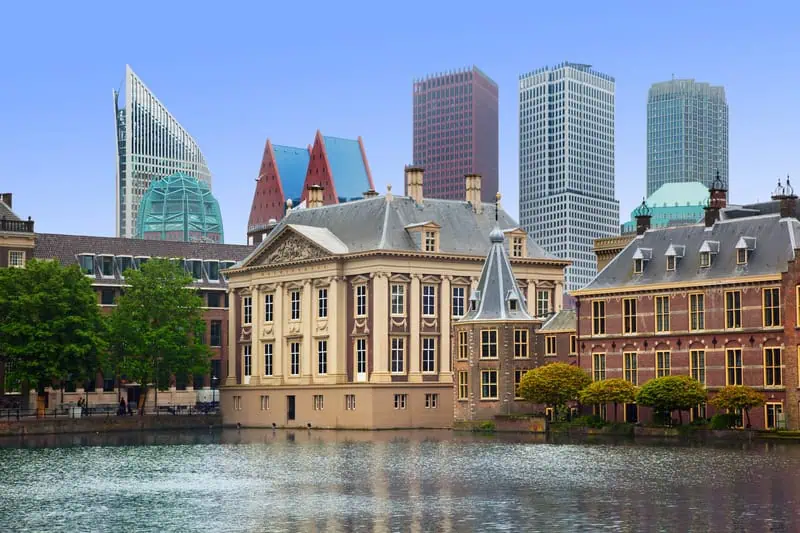
1. The Hague: Agga
Building all those fancy skyscrapers probably took less time than learning how to say “‘S-Gravenhage” 🫣. Image: Dreamstime
Sorry, we just started, and we’re already cheating: technically, Den Haag is also a nickname.
Officially, the city is called ‘S-Gravenhage, “the count’s lodge,” a fancy name given to the city in the 17th century to make it sound more prestigious.
The name refers to the city’s history: back in the 1200s, when it was called Die Haghe (the enclosed), it used to be an actual count’s lodge — Count Floris IV of Holland’s, to be precise.
Nowadays, the city is known as Den Haag, or, more affectionately, Agga.
Agga
The nickname Agga is an example of straattaal (street language), a Dutch urban slang heavily influenced by other languages, such as Turkish, Moroccan, and Surinamese languages.
Specifically, the word Agga comes from modifying “Den Haag” according to a grammar pattern typical of Sranatongo, a Surinamese language.
Through the same process, Scheveningen becomes Skiffa, and Rotterdam becomes… wait, we’re not telling you yet!
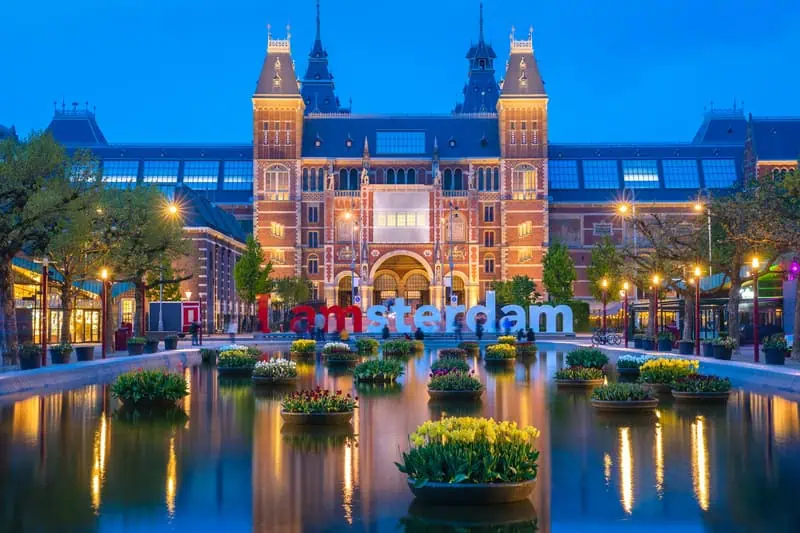
2. Amsterdam: Damsko, Mokum, Venice of the North
Amsterdam gets all of three nicknames 😎. Image: Dreamstime
Everybody knows that capitals are obnoxious, but three completely unrelated nicknames? Come on, doe normaal, Amsterdam.
Damsko
Yep, you’ve guessed it — this nickname is just another example of a straattaal word derived from mixing Dutch vocabulary and Surinamese grammar. We’re experts by now.
Mokum
This nickname is older: it comes from Amsterdam’s history as the home of one of the biggest Jewish communities in Europe.
In Hebrew, “maqom” means “place” and was often used in combination with a single letter to indicate a city. Amsterdam, for instance, was “mokum Alef,” “city A.”
Now, the A has dropped, but the nickname has stuck, as have several other Dutch words derived from Hebrew.
Venice of the North
Amsterdam has canals, Venice has canals, and Amsterdam is geographically north of Venice — ja hoor, it’s that straightforward.
What’s funny about this nickname, though, is that Amsterdam shares it with Groningen, Giethoorn, and also dozens more cities worldwide: there’s Chinese Venice, Portuguese Venice, Russian Venice… you get it.
Basically, every time two large puddles merge into each other, residents start claiming an uncanny resemblance between their city and Venice.
3. Rotterdam: Roffa, Rotown, Potterdam
De mooiste rotstad die er is 🥰 . Image: Depositphotos
Rotterdam’s nicknames perfectly capture the humble, genuine, and humorous charm of the city.
Roffa
This one, once again, finds its origins in Surinamese-infused straattaal.
Rotown
Ah, yes, Rotown! Or, in its less flattering Dutch version, Rotstad (literally, shitty city).
Potterdam
This nickname, much like the humorous nickname “Rotstad,” refers to the city’s reputation for having comparatively high crime rates.
However, both Rotstad and Potterdam are often used by residents themselves quite affectionately — as heard in the popular song referring to Rotterdam as “de mooiste rotstad die er is,” the most beautiful shitty city that there is. 🥰
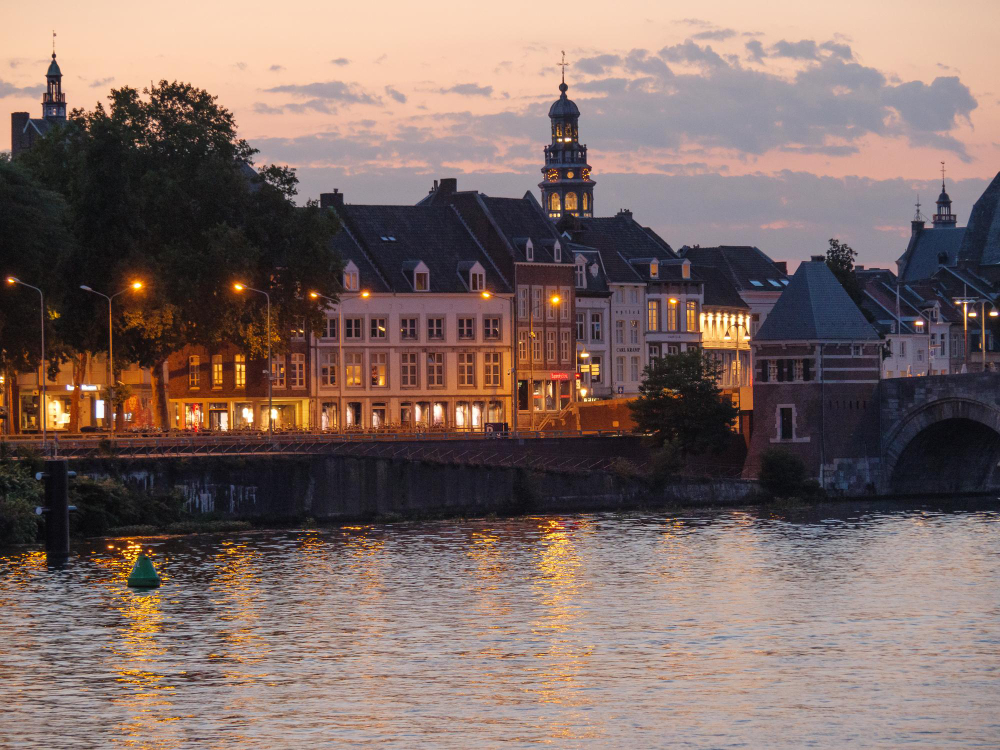
4. Maastricht: Paris of the Netherlands
Maastricht’s humble Eiffel Toren. Image: Freepik
Whoops, they did it again: another city, another bold international comparison.
Maastricht, with its Burgundian style and cute terraces, has a reputation as a popular destination for couples’ getaways.
The Hague, being associated both with the government and the House of Orange, carries somewhat of an aura of sophistication — and who would expect any less from the city of Haagse Harry?
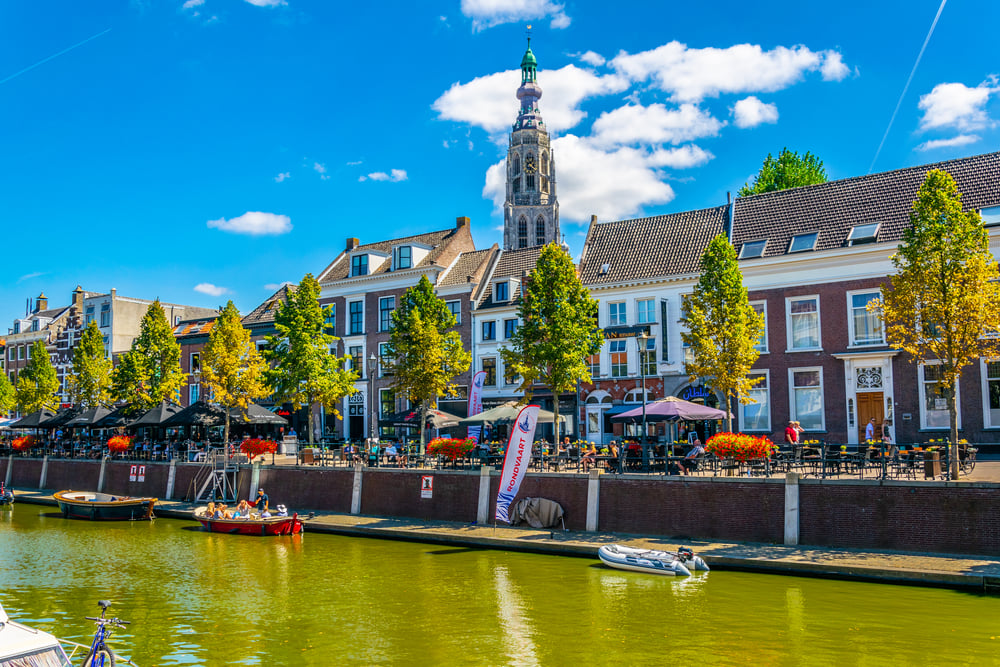
Breda, however, shouldn’t feel too special: it shares the title with “the Hague of Limburg” (Roermond), “Frisian Haagje” (Heerenveen), and “the Hague of the East” (Arnhem).
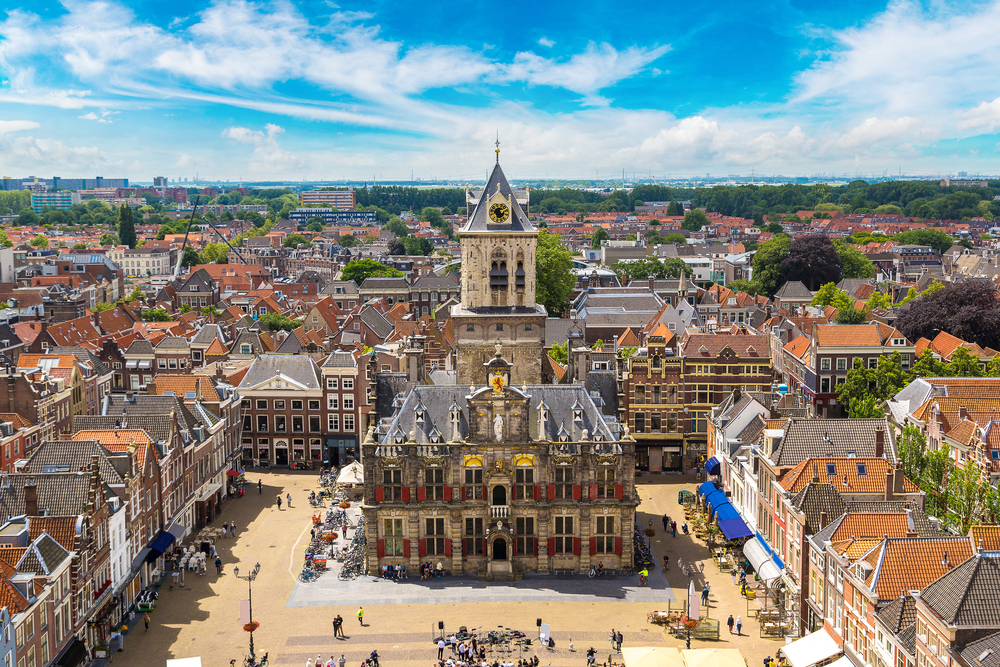
6. Delft: The Prince City (Prinsenstad)
Well-suited for a prince, indeed. Image: Depositphotos
Speaking of the House of Orange, any guesses on why Delft is called “The Prince City?”
Yep, Willem van Oranje has graced us with one more piece of Dutch trivia: Delft takes its nickname after him.
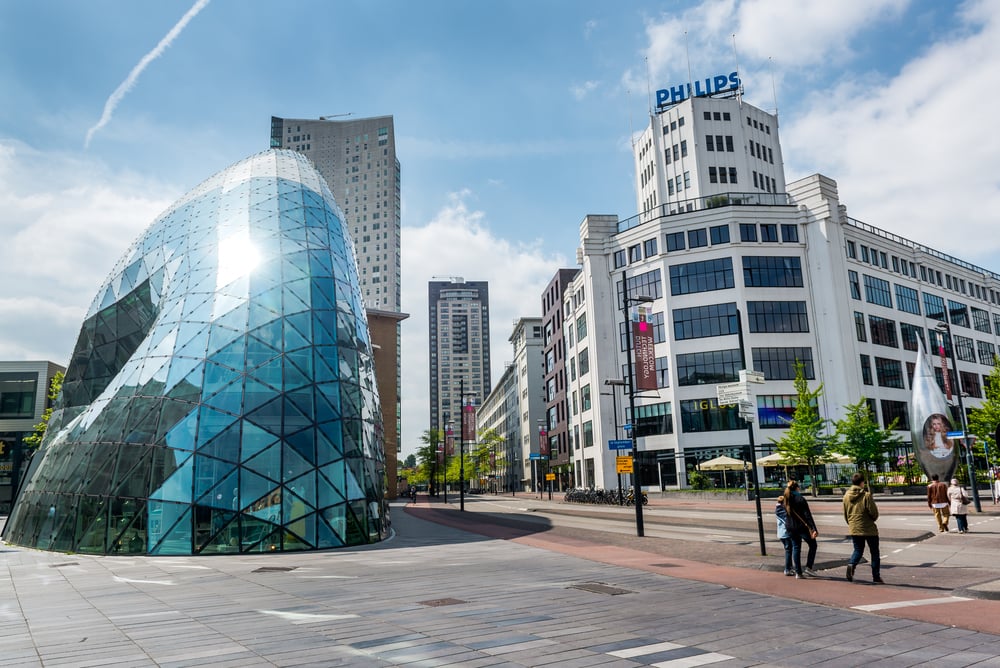
Come the 20th century, both industries dwindled out, but Eindhoven continued to light up the country: it gave birth to NV Philips and became the Dutch hub of light bulb manufacturing.
The city remains a fundamental electronics hub to this day, hosting an international light art festival, GLOW, each year.
Los Eindjeles
In light of all these prestigious achievements (hehe), locals often affectionately use another nickname to refer to the city, which also conveys self-made grandeur: Los Eindjeles.
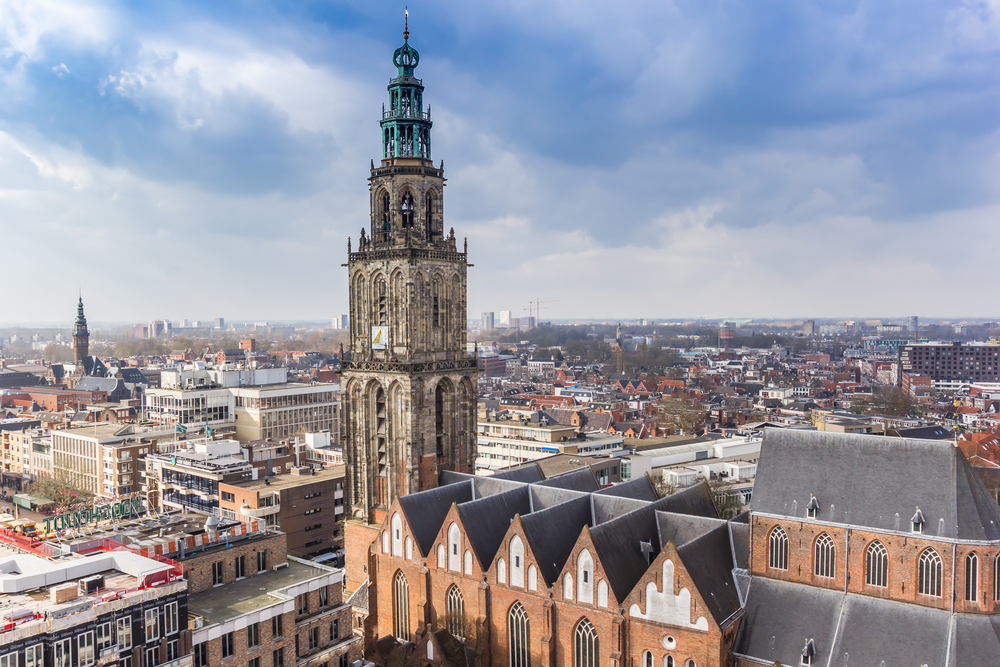
8. Groningen: The gem of the North, City (Stad)
Nothing says “Groningen” like the Martinitoren 😍. Image: Depositphotos
Another double-nickname alert! These two, however, carry very different attitudes.
The Gem of the North
Here’s another Dutch city bragging about its beauty and comparing itself to some sort of precious stone. B-boring!
This is because Groningen is the only urban sprawl big enough to deserve that title in its region. The surrounding areas of Friesland and Noord Drenthe don’t really offer a comparably large city.
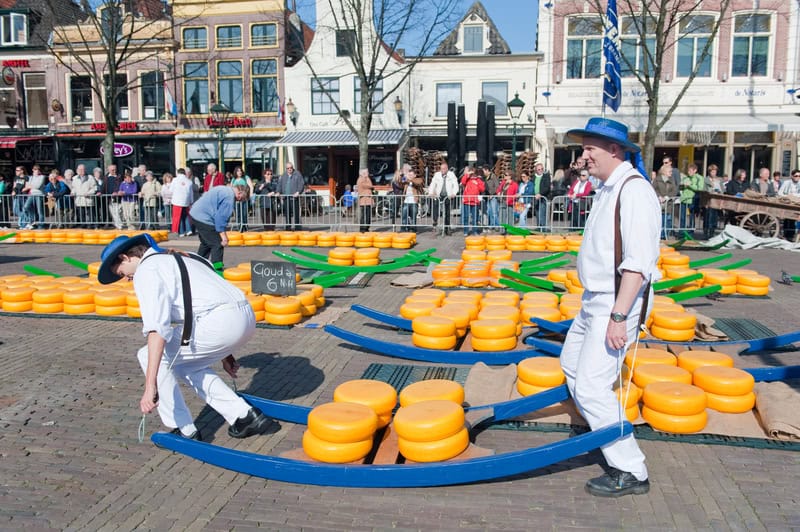
9. Alkmaar: Cheese City (Kaasstad)
Gouda isn’t Kaasstad, but Alkmaar is. Right. 🧀 Image: Dreamstime
In this cheese-obsessed nation, the nickname of Kaasstad would have fit any city — but if we really have to choose, Gouda makes the most sense, right?
Wrong. Alkmaar proudly holds the title of the city with the oldest and largest cheese market in the Netherlands. 🧀
In fact, cheese is so important to the city that its inhabitants are called kaaskoppen, cheese-heads — proudly, we’re guessing?
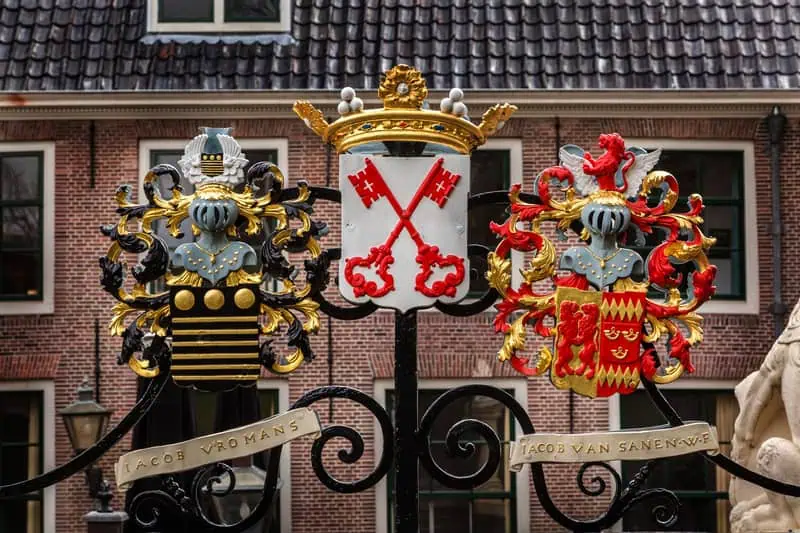
10. Leiden: The Key City (Sleutelstad)
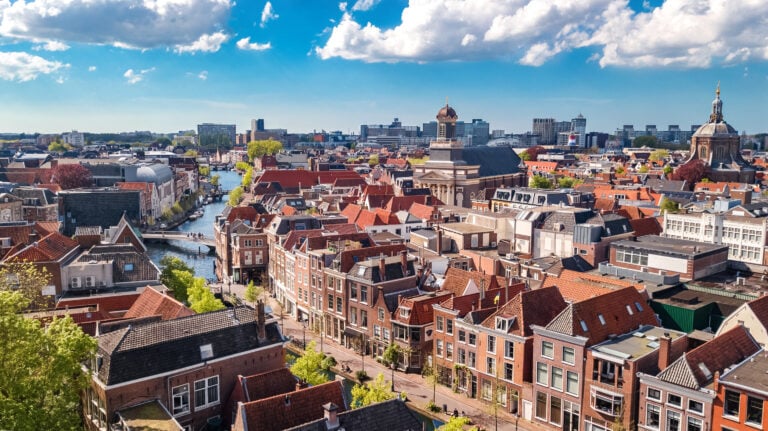
Now you know why you can spot keys everywhere in Leiden! Image: Dreamstime
Leiden is known as “The Key City” because it holds the keys to… our hearts? The huge warehouse where Dutch men store their collective hair gel stash? Nope, it’s the keys to heaven.
According to an old Christian bestseller, God gave heaven’s keys to Saint Peter, who happens to be the patron saint of Leiden.
As a result, keys can be spotted on everything Leiden-themed, from the city’s flags to fridge magnets and university logos.
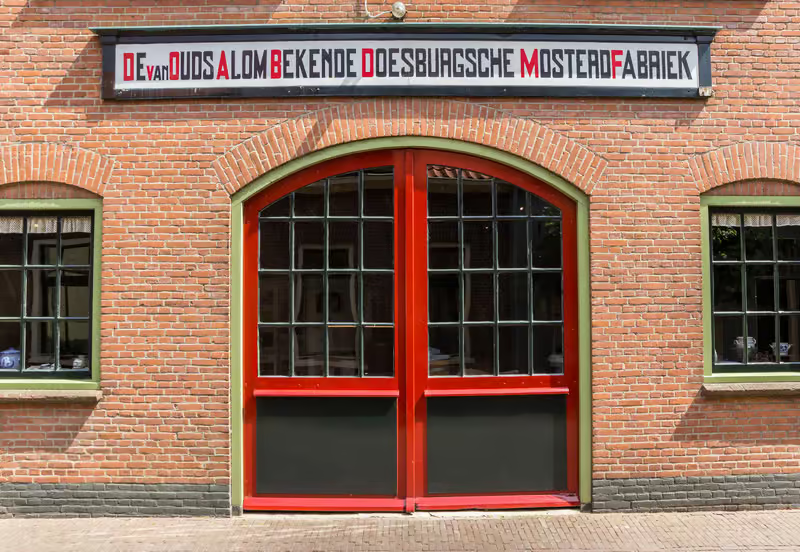
11. Doesburg: Mustard City (Mosterdstad)
Imagine how many mustard jars must have crossed these doors 🤯 . Image: Dreamstime
Back in 1457, a Dutchman called Gosen Momme created a mustard recipe so divine that it managed to win over the palates of a mayo-obsessed people and is still being produced 500 years later.
Momme’s factory, now also a museum, achieved more than just longevity: it also gave Doesburg its nickname, making the Gelderland town a national treasure.
That’s the end of our journey into Dutch city nicknames, for now.
Should the Dutch come up with more ridiculously self-confident international comparisons, or should a local industry suddenly shoot another obscure town into national fame, we’ll alert you promptly.
Do you know any other Dutch city nicknames that should make the list? Help us enrich our knowledge — write them in the comments below!
There are many ways to learn Dutch, and while attending a language schoolis effective, it’s not for everyone (or their wallets). So, why not turn something you already do into a study tool? Like watching YouTube!
Whether you’re a total beginner, a determined intermediate, or an advanced learner, there’s a Dutch YouTuber out there for you (and your language goals 😉).
Want to start watching right away? Jump straight to your interest!
Forget boring grammar lessons, because Kim’s channel teaches Dutch through funny skits and real-life scenarios, showing the topic first, then breaking down the grammar.
Her videos are sweet and funny, covering everything from essential grammar, daily conversations and common mistakes non-native speakers make. She also has a complimentary website and offers online courses.
👌 Good for: Beginners and intermediates who want all-around learning. ⏱️ Video lengths: 10-15 minutes
Bart’s fun videos aim to bridge the language gap between internationals and Dutch people, featuring a cute animated soap opera, student interviews about Dutch culture, and entertaining language challenges.
His channel is less structured than Kim’s, with most lessons and exercises on his website. But for fun, insightful interviews on Dutch culture and language, it’s a great pick!
Plus, he has a free online video course called “1000 most common words in Dutch” that you can subscribe to for an extra challenge!
👌 Good for: Beginners and intermediates, plus anyone interested in Dutch culture. ⏱️ Video lengths: 5-10 minutes
We stumbled across this channel via an extensive playlist by Easy Languages.
Their ‘Easy Dutch — Learn Dutch from the Streets!’ playlist is updated by the channel Easy Dutch and is a must-follow for any aspiring Dutch speakers!
It’s full of interviews with people from the Netherlands about all sorts of topics, from the life of Turks in the Netherlands to what makes people happy. They even have a video where they corner Rutte to ask him what he’s wearing! 😆
All videos are entirely in Dutch, but their Dutch and English subtitles make it easy to pick up new words.
👌 Good for: Anyone who wants to learn vocabulary and practice listening skills. ⏱️ Video length: 10 minutes
Offering one of the most extensive video libraries for learning Dutch on YouTube, DutchPod 101’s channel has 20 playlists for you to peruse — with videos on everything from vocabulary and grammar to writing, reading, and listening skills.
If you ask us, a playlist with conversational phrases is perfect for putting on in the background while cleaning or taking a shower!
Their videos may look like they were made with 2010s graphics, but the content is worth staying for.
👌 Good for: People at any level who want targeted videos. ⏱️ Video lengths: 3 minutes to 4 hours
Dutch lifestyle and health channels
Want to take a break from studying but still practice your Dutch skills? Good news! Whatever your viewing taste is like, there’s probably a Dutch version.
If you’re a person with a uterus who wants to grow a mini human in there sometime, VerlosMoeder is for you!
‘Verlosmoeder’ combines verloskundige (midwife) and moeder (mother), reflecting Djanifa’s content about her work and motherhood. A sweet, aesthetic channel radiating femininity and strength. 🤰
👌 Good for: Intermediate to advanced speakers who want to learn about midwifery, female health, pregnancy, and raising children. ⏱️ Video lengths: 10-20 minutes
6. faenomenal
Your typical lifestyle and food YouTuber… but with a sustainable and vegan twist. Now, where was that subscribe button?
Fae’s channel has many features shared with other popular YouTubers in this category: aesthetic shots, humour, and a bit of a vintage vibe (which seems very Dutch, to be honest).
Her videos are great for practicing Dutch: she speaks clearly, at a good pace, occasionally uses English, and repeats vocab in similar videos (think: vegan what I eat in a day). 🙌
👌 Good for: Intermediates who want a chill way to practice their listening skills and enjoy varied content. ⏱️ Video lengths: 10-20 minutes
First of all, this guy uploads every Monday, Wednesday, and Saturday. 😱 That means his content may not be as carefully curated or edited as some other YouTubers, but there’s plenty of it.
Most of his videos also feature his girlfriend, friends, or family, so it’s great for hearing conversational Dutch (albeit spoken relatively fast). If you’re into old-school, slightly chaotic vlogs, this is it!
👌 Good for: Intermediate to advanced speakers who want to be thrown into daily Dutch. ⏱️ Video lengths: 30 minutes to one hour
As a YouTuber, blogger, and singer, Teske’s content can help you learn Dutch whether you’re in the mood for watching, reading, or listening to some poppy rap. 🎶
Her channel focuses on daily life, (mostly vegan) food reviews, and life advice. Like Fae, she speaks clearly and at an easy-to-follow pace, making her vlogs enjoyable even for Dutch learners.
👌 Good for: Intermediates who want a chill way to practice their listening skills and enjoy varied content. ⏱️ Video lengths: 10-20 minutes
Another guy who uploads videos every single day — a big hoera for Dutch efficiency. Whatever it is, it means there’s a lot of content for you to peruse!
Giovanni’s channel mainly posts day-in-the-life vlogs — though unless your 20-something friends drive Lamborghinis and vacation in castles, it might not feel too relatable. 🙃
Nevertheless, he has lots of energy and enthusiasm, and his level of eccentricity is pretty entertaining.
👌 Good for: Intermediate to advanced speakers who want to be thrown into daily Dutch. ⏱️ Video lengths: 15-30 minutes
Dutch gaming channels
An article about YouTubers wouldn’t be complete without the gamers appearing. And luckily, there are more than a few Dutch ones. 🎮
Even though his channel is called SerpentGameplay, Rick also uploads about internet culture and random life events — all with a love for bad jokes, weird facts, and gaming!
He’s critical, down-to-earth, and charming with excessive hand gestures and copious self-irony. Oh, and since he speaks directly to the camera and into a microphone, his Dutch is relatively easy to understand!
👌 Good for: Intermediate to advanced speakers who enjoy gaming, internet culture, and self-irony. ⏱️ Video lengths: 10 minutes to five hours
With over 6,000 videos, this YouTuber offers plenty of content for you to enjoy.
DusDavid Games features Minecraft, other games, vlogs, and comedy — and, though he speaks quickly, his clear audio helps you understand his Dutch.
👌 Good for: Intermediate to advanced speakers who want to watch their usual gameplay videos in Dutch. ⏱️ Video lengths: 5-30 minutes
Dutch comedy and experiment channels
Looking to laugh away the struggles of learning Dutch? You’ll step up your casual Dutch with these comedy channels and be introduced to some Dutch slang. Lijkt me leuk! (Sounds like fun!)
Airing on NPO3 (a Dutch public broadcasting channel for children, youth, and innovative television) as well as YouTube, BOOS follows the host as he tries “to make angry people not angry.”
What does that entail exactly? 🤔
Viewers email in complaints — about bosses, landlords, webshops, or politicians — and the team investigates, offering entertaining insights into Dutch society.
Also, Boos has decent-quality auto-translated subtitles if the dialogue ever goes a bit too fast for your Dutch.
In Drugslab, three young people use, test, and talk about drugs, all in the name of science.
Run by a Dutch public broadcaster and vetted by medical and addiction experts, Drugslab ended after covering all planned substances. However, its 193 fun, informative episodes are still on YouTube.
What’s more, they’ve moved to a new channel! In a video posted a year ago, DrugsLab announced a new channel called Spuiten en Slikken. This new channel covers sex, drugs, and more in the Netherlands. If you’re looking for some wild videos to practice your Dutch, this is the one!
👌 Good for: Intermediate to advanced speakers who want to hear how young Dutchies speak. ⏱️ Video lengths: 5-20 minutes
The three friends have more than 2.5 million subscribers and are regularly picked up by Dutch television, and in 2018, they sold Stuk to the Dutch media conglomerate Talpa. This has also meant a shift towards Videoland as a platform for StukTV. 📺
However, Giel, Thomas, and Stefan still upload new episodes of their TV-show-like productions to YouTube.
Their videos range from crazy dares to the show “Het Jachtseizoen”. Each action-packed episode features a well-known Dutchie who enacts a prison escape and has four hours to flee from the presenters who act as guards. 👮
👌 Good for: Intermediate to advanced speakers who reality-tv-like entertainment. ⏱ Video lengths: 10-30 minutes
Dutch news and educational channels
Are you planning on taking the inburgeringsexamen? Or to keep on top of the most important developments in the Netherlands?
Similarly to learning Dutch with podcasts, watching news(y) channels in Dutch is a great way to kill two birds with one stone — improving your Dutch and your knowledge about the Netherlands simultaneously!
The NOS Jeugdjournaal uploads daily news segments to its YouTube channel — keeping your information and your Dutch up to date.
The NOS Jeudjournaal is the youth version of the Dutch public broadcaster and newspaper, the NOS. Although it’s aimed at nine to 12-year-olds, it’s a gem for listening to the news in simple Dutch.
👌 Good for: Beginners and intermediates who want to keep on top of the latest news in easy-to-understand Dutch. ⏱️ Video lengths: 1-5 minutes
Another kids’ program that’s great for hearing simple Dutch in an educational context. Developed by Schooltv.nl, Clipphanger is part of the public broadcaster NTR, focusing on educational content for Dutch youth.
These simple animations are great for building Dutch vocabulary on topics like politics, mental health, or Keti Koti, with accurate Dutch subtitles to catch any words you miss.
👌 Good for: Beginners and intermediates who are looking to increase their vocabulary. ⏱️ Video lengths: 1-2 minutes
Dutchies have something for age-targeted news channels. But well, if it means everyone has a chance to understand and follow current affairs, that’s pretty good. 👏
NOS op 3 targets 18–50-year-olds, using clear language and informative graphics — great for Dutch learners! Like Clipphanger, it offers non-autogenerated Dutch subtitles for better accessibility.
👌 Good for: Beginners and intermediates who want in-depth knowledge about specific current topics in the Netherlands. ⏱️ Video lengths: 5-30 minutes
The Dutch TED! Swap your TED binge for similar Dutch content — because procrastination should be productive.
Also, a podcast, De Universiteit van Nederland, is exactly what it sounds like: a university for all of the Netherlands.
These mini-lectures, presented by top Dutch academics in collaboration with 14 universities, make complex topics accessible through clear, engaging explanations in layperson’s terms.
👌 Good for: Anyone who wants to learn about interesting topics while practising their Dutch listening skills. ⏱️ Video lengths: 4-20 minutes
Several Dutch political parties are calling for the Netherlands to ban Kanye West from entering the country, after the British government rejected the rapper’s travel authorisation to visit the UK.
Kanye West, a controversial rapper and commentator also known as ‘Ye,’ was scheduled to perform at the UK-based Wireless Festival in 2026.
However, when he applied to visit the UK, his application was rejected by the Home Office. The UK festival has since been cancelled.
Now, Dutch political parties CDA and ChristenUnie are calling for the Netherlands to do the same, reports AD. A festival in Arnhem at the GelreDome has booked the rapper for June 6 and 8.
Why has he been rejected?
Kanye has been a controversial figure for quite some time now, and his rampant antisemitism has cost him significant brand deals and connections, according to the Washington Post.
As AD reports, he has called himself a Nazi, denied the holocaust, and even released a song in 2025 titled ‘Heil Hitler.’
When the UK festival first booked him, there were criticisms from government officials, politicians like Keir Starmer, sponsors, and the general public.
The Home Office concluded that allowing Ye into the country would be contrary to the public good, the BBC reports.
Ye in Nederland?
Cancelling Ye’s performance at GelreDome is no easy task.
As there is no indication that Kanye will use hate speech during his upcoming shows, it would be exceedingly difficult to call off any of them in advance, reports AD.
However, one of the performances could theoretically be cancelled.
According to music law attorney Radboud Ribbert, speaking with AD, if Ye makes punishable statements during his first show, it could be grounds for cancelling the second one.
Arnhem’s Mayor, Ahmed Marcouch, was quoted by AD as saying he would not be able to ban the performance unless there was a “serious risk of disrupting public order.”
As that is not currently the case, the Mayor indicated, cancelling the event is not an option.
The Mayor made clear that he finds Ye’s past remarks “disgusting,” but that there are no legal grounds to cancel the act (yet).
Additionally, banning the artist from setting foot on Dutch soil is not within the Mayor’s power: that lies with the cabinet.
Some political parties are clear that they are in favour of a ban: representatives of two Christian parties in the Netherlands, the CDA and ChristenUnie, told AD that they would support a ban if the cabinet were to impose one.
What happens now?
While the London festival is cancelled, it seems Ye’s shows at the GelreDome stadium in Arnhem are going full steam ahead.
The controversy has not stopped ticket sales, either: Dutch concertgoers are more than happy to shell out over 300 euros to see Ye perform.
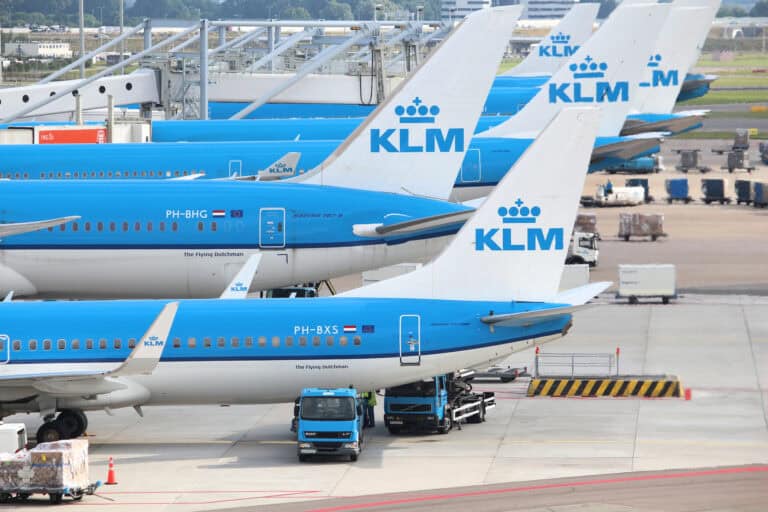
The Dutch government, a shareholder in the Air France-KLM Group, is scrutinising an exorbitant pay rise for KLM’s top boss — with Finance Minister Heinen calling the increase “truly inappropriate.”
The airline’s annual report disclosed that CEO Marjan Rintel received nearly €1.6 million in 2025, which is roughly 30% more than what she earned the previous year. (The Finance Minister of the Netherlands, for comparison, earned roughly €206,000 in 2025.)
While Rintel’s base salary stands at €600,000, the mystery income comes from variable bonuses and rather profitable company shares, reports NOS.
Bad management
Heinen didn’t hold back when speaking to RTL Nieuws: “I find this truly inappropriate.”
In his words, “If you ask a sacrifice of your staff, you have to bear it together. The top management is sending the wrong signal with this.”
To make matters worse, while the CEO’s paycheck was gathering bonuses, KLM ground staff spent much of 2025 fighting a wage freeze. The staff had no scope for bonuses, increments, or cost-of-living adjustments to their salary.
A spokesperson pointed out that Rintel’s pay is “variable,” meaning it depends on how well she meets set goals for both KLM and Air France-KLM.
They also added that, since the parent company had a “very good” 2025, the rise in its share price increased the stock-based part of her earnings.
Needless to say, that’s a bold claim for an airline that was recently ranked among the worst in Europe. Turns out, they not only cheap out on in-flight snacks but also on employee salaries.
Now, a seven-figure executive paycheck awkwardly hangs in the balance until the shareholders’ meeting on April 23, giving the Dutch state a formal voice in Rintel’s earnings.
Do you think a 30% pay rise for a CEO is justified when staff have been fighting for better wages? Tell us what you think in the comments below.
Ah, who doesn’t like kissing? It’s romantic, it’s intimate, it’s passionate, it’s… awkward?!
Yes, it can be weird, especially when you’re introduced to someone you don’t know, and they come towards you at full force.
It’s too late to stretch out your hand — as their upper body already awkwardly touches yours, they plant their lips first on one cheek, then on the other one… and then on the first one again. 😱
If you think those cheeky air kisses trickled down from the British Royals, you are wrong.
The Royals only hand out two kisses, as do the chic Parisians or other upper-class members in Belgium or France, for example.
Surprisingly, this affectionate custom hasn’t even been around for that long. It is said to have come from the Belgian and French countryside and arrived in the north of the Netherlands in the 1980s.
Before that, only one kiss on the cheek or a firm handshake was the norm in terms of greeting etiquette.
Follow the rules to avoid disaster
But is this three-kiss policy a way to show genuine affection or just a mechanical sequence of head movements that everyone follows because that’s the way it is?
While it isn’t clear, you might as well embrace it and transform this interpersonal awkwardness into a genuine gesture coming from the heart.
However, before you throw yourself into this cheeky world of (air) kisses, take note.
The social kissing rules exist to avoid bad coordination ending up in an accidental kiss on the mouth or neck or the painful smacking of cheekbones.
If you follow this set of rules, nothing will go wrong (hopefully) when performing your cheek-kissing act:
In general, you kiss three times when greeting friends and family (also when saying goodbye)
You start on the right side, then move to the left cheek, and finish with a kiss on the right cheek again
Women kiss both women and men, while men greet other men with a handshake
Go for air kisses instead of fully planting your wet lips on your greetee’s cheek 👄
What if, even after studying these rules meticulously, you end up in a precarious kissing situation?
I’d say just laugh it off and hug it out. After all, the ice is definitely broken, and you can skip all initial formalities before starting a conversation.
Where do you stand when it comes to this Dutch custom of three kisses? Tell us in the comments below!
Gouda, Edam, Leidse Kaas, Beemster… the list goes on. The Dutch know their cheeses pretty well — and it’s no wonder that they eat it all the time! 😋🧀
The Dutch have many traditional dinner dishes, but when it comes to lunchtime, the meal of choice is almost always a cheese sandwich! 🥪
What is it?
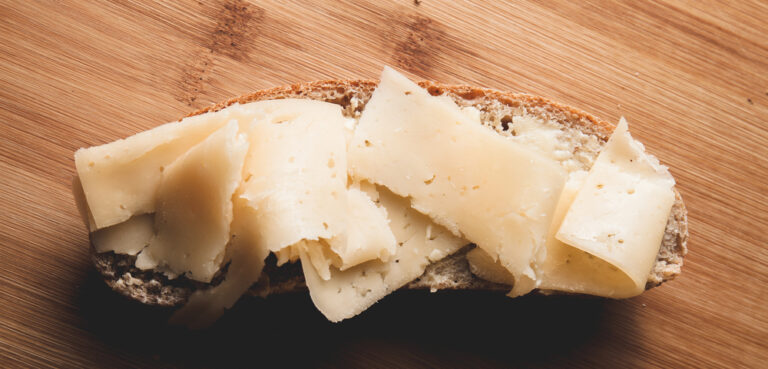
The Dutch incorporate cheesy ingredients on their sandwiches — otherwise known as boterhammen — with toppings like smeerkaas (cheese spread) or plakjes kaas (cheese slices).
If they’re really feeling crazy, they might even add some slices of ham in there. But, cheese is always the usual topping!
The type of cheese used in these sandwiches depends largely on its age.
For example, when making a tosti, a Dutch person would pick a young cheese over an aged one to get that melting effect. ✨
Why do they do it?
Since the 17th century, bread and cheese have always been staple ingredients in Dutch lunches.
According to the OEC, in 2020, the Netherlands was the second country in the world to export the most cheese, with a revenue of €3.748 billion!
I guess that’s how the Netherlands gets a lot of its cheddar. 😉
Why is it quirky?
The Netherlands have a long shared history with their cheeses.
From using it to fight against the French (seriously) to producing so many types of Dutch cheeses, it’s safe to say that the Dutch are really, really into cheese! 🧀
The Dutch also prefer a cold and light lunch compared to other European countries. Warm lunches aren’t very common in the Netherlands, so a slice of cheese and a piece of bread usually get the job done!
Even though Dutch lunches tend to be very short and simple, eating all this cheese every day is probably why the Dutch are so tall!
Should you join in?
Absolutely, we believe that Dutch cheese is really “grate”! 🫕
Since there are so many types of cheeses to choose from in the Netherlands, you may enjoy some cheese types over others — so try them all!
If you’re lactose intolerant or if cheese simply isn’t your thing, the Dutch have plenty of other delicious foods that you have to taste! 🧆
Have you ever tasted Dutch cheese? Got any favourites? Tell us in the comments below!