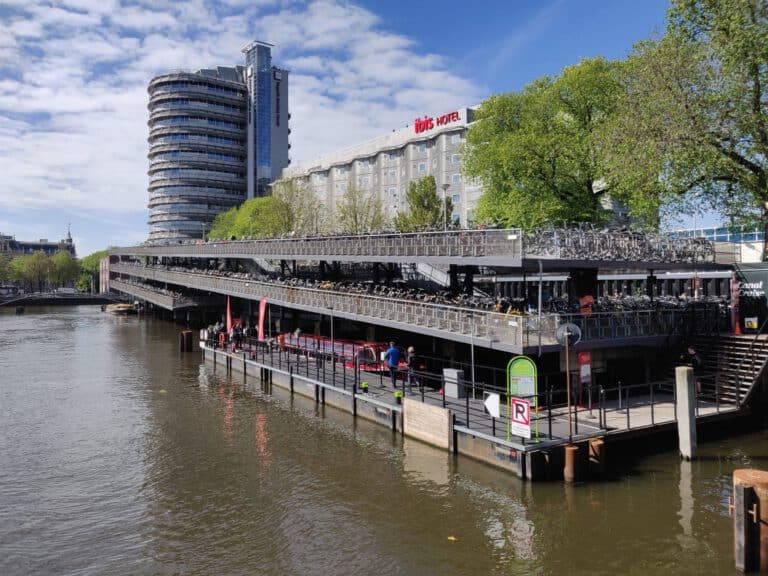
Amsterdam residents can finally say doei to Centraal’s unsightly bike tower, with efforts to remove the structure starting next Monday.
Constructed in 2001, the bike tower has long been an infamous blemish on the historic face of the city. And, let’s face it — the grandeur of the iconic central station makes the fietsflat look pitiful.
A long time coming
Soon after the successful opening of Amsterdam’s underwater bike garage in 2023, plans were made for the fietsflat’s removal. (In other words, this demolition is long overdue.)
As Amsterdam’s traffic alderman pointed out in 2023, the tower’s storage capacity of 2,500 is nothing compared to the now 14,000 underground bike slots available to cyclists.
The NOS also notes that the unseemly tower has continued to deteriorate, despite the municipality’s best efforts to renovate it.
Even worse, plans to sell the tower to Schiphol Airport proved too costly and technically difficult. The lack of alternatives left the municipality with no other choice: the fietsflat needs to go.
What can we expect?
The tower will be removed in phases, starting next Monday.
First, the structural elements of the tower will be removed. After two weeks, the demolition of metal and concrete superstructural components will begin. The last thing to be removed will be the foundation.
You can expect some noise pollution for up to seven days, but a full demolition will only be completed by early February.
As far as we’re concerned, though, a little noise is well worth the result.
Are you excited to see Amsterdam’s famous eyesore finally removed? Share your thoughts in the comments.
The Dutch parliament is sounding the alarm: their plan to slap a €70 surcharge on long-haul flights could backfire spectacularly, with travellers simply driving to Brussels or Düsseldorf for cheaper departures instead.
While the government wants to make flying from the Netherlands less attractive to help the climate, MPs now think people won’t stop flying altogether — they’ll just start their journeys abroad.
From 2027, if you’re planning to fly somewhere far away (think the United States or Australia), you’ll be paying around €70 extra on top of the current €29.40 flight tax. 💰
Yep, that’s €100 in tax alone before you’ve even chosen your seat.
The grass (and flight prices) are greener across the border
As AD writes, MPs are getting more and more concerned that the Netherlands is pricing itself out of the aviation market.
And this worry isn’t just theoretical, either.
According to VakantiePiraten, the number of Dutch passengers departing from Düsseldorf has jumped 41% since 2021, whilst Brussels has seen a 20% increase.
The result? The Belastingdienst (tax office) could miss out on millions whilst neighbouring countries rake in the cash.
Who pays and who doesn’t?
The current system charges a flat rate regardless of destination, but the new differentiated system will hit long-haul travellers hardest.
Some destinations, like the Caribbean Netherlands, Aruba, Curaçao, and Sint Maarten, are already exempt from the flight tax hikes.
ChristenUnie MP Pieter Grinwis is also pushing for exemptions for Suriname, given the strong family ties many Dutch-Surinamese residents maintain. He’s less convinced about extending this courtesy to Indonesia, pointing out that the route is mostly holiday traffic.
The environmental irony
And here’s where it gets properly contradictory: a policy designed to reduce emissions by making flying more expensive is instead encouraging people to drive two hours to a foreign airport.
That’s extra car journeys, extra fuel, and extra carbon emissions before anyone’s even boarded a plane.
The debate continues this week as State Secretary Eugène Heijnen defends the government’s choice for higher flight taxes. Whether this policy sticks around remains to be seen.
Will you pay the premium to fly from Dutch airports, or hop over to Belgium and Germany? Share your thoughts in the comments.
Are you thinking of renting out your house in the Netherlands? There’s a lot to consider, but geen probleem! We have a comprehensive list of what to keep in mind.
There are many different things to be aware of when you do this, and it’s important to be keyed up (pun intended) before you make the decision.
1. Should you rent out your property, or should you sell it?
Firstly, you need to determine whether you want to rent it out and work out the pros and cons. If you plan on returning to the property at some point or another, then selling it is out of the question.
However, the longer you stick with your house, the more it could increase in value, so it’s all about picking the right time.
Meanwhile, renting out your property can be expensive if it has a lot of issues (and you have to keep fixing them). But renting is also a great way to earn passive income. Decisions, decisions!
2. Tax when renting your property
The whole tax thing can get pretty complicated when renting your property out. In short, when you rent your property out in the Netherlands, the property’s value is taxed (generally around 30%).
Taxes are a world in itself when renting out your home. Image: Pixabay
However, this varies so much from property to property, and it all depends if you are still living in the Netherlands, so it’s impossible to give exact figures.
3. Should you use a Dutch rental agency?
To make your life 10 times easier, renting it out through a Dutch rental agency may be worth it.
One of the bad points of this is, of course, that it will cost more. However, Dutch rental agencies know what they’re doing.
Talking to an agency can make renting out your home a lot easier. Image: Freepik
If this is the first time you have rented out a property, then there are some important things that you might miss — especially when it comes to knowing the law (very important)!
A rental agency can also help you set the price of your property. They know the market well and will likely know what your property is worth better than you can.
They’ll also have good contacts to find you tenants, which you likely won’t have alone.
This is especially handy if you are renting because you are moving abroad. After all, a rental agency can handle most of the admin work, repairs, and other issues during the tenancy.
4. Finding the perfect tenant
The best way to go about this is, again, to consider using a Dutch rental agency, as they will be able to do background checks on the tenant to see if they have a track record of not paying their rent and also to see if they can afford to pay for the rent.
Consider what is the perfect tenant. Image: Depositphotos
It’s hard for Dutch people and internationals to find housing, but it all depends on the landlord, who ultimately decides who they are willing to rent to.
You’ll ideally want to find someone who:
Will take good care of your house
Can pay the rent on time
Is reliable and won’t skip out on the contract
5. The contract length you might like
In the Netherlands, indefinite rental contracts are now the standard. Temporary (fixed-term) contracts still exist, but only in specific legally defined situations, such as for students, diplomatic return clauses, or certain temporary housing permits.
If an indefinite contract needs to be ended, this can only be done with proper notice and a legally valid reason, and Dutch law allows only a limited number of reasons for terminating a tenant’s contract.
The contract you give your renters will depend on the legal situation. Image: Freepik
Tenants, on the other hand, may end their contract by giving notice without needing to provide a reason. In other words: they can leave more freely, but as a landlord you cannot kick them out unless the law explicitly allows it.
Laws around rental contracts are always changing in the Netherlands, so it’s important to verify that your contract type fits the latest requirements.
6. Future maintenance costs
Property maintenance will mainly lay on your shoulders when you rent out your home. This needs to be made clear to both yourself and the tenant.
You also need to be aware that some maintenance costs will not be cheap, and this is something you’re going to have to sort out if something big happens.
Always know your responsibilities as a landlord. Image: Depositphotos
Generally, the tenant is responsible for painting the inside of the property, etc.; however, if they make serious amendments without your permission, then you have the power to say that it needs to be restored to how it was when they first moved in.
Be aware of your responsibilities and the potential costs, always.
7. Inspecting your property as a landlord
When you rent out your property, chances are that you’ll want to inspect it at least once during the tenancy.
You must not turn up uninvited, as this is against the law, so make sure you let the tenant know in advance. This is even true if you suspect that illegal activity is happening on the property (for which you will be responsible).
Of course, your tenants deserve to live in a decent home. Image: Depositphotos
The best time to inspect is at the start of the tenancy, so that you know how the property is at the start and then when the tenant leaves, to ensure that everything is in good working order. Take photos.
This way, it is easier to sort deposit issues if you have proof that the tenant has damaged the property.
Regarding the quality of the home, the Dutch Minister of Housing Hugo de Jonge developed a points system where the amount of rent charged is in line with the quality of the home. This ensures that landlords can’t overcharge for a subpar home.
Note: This does not include normal wear and tear! (Don’t be one of those landlords.)
Have you ever considered renting out your house in the Netherlands? Let us know in the comments!
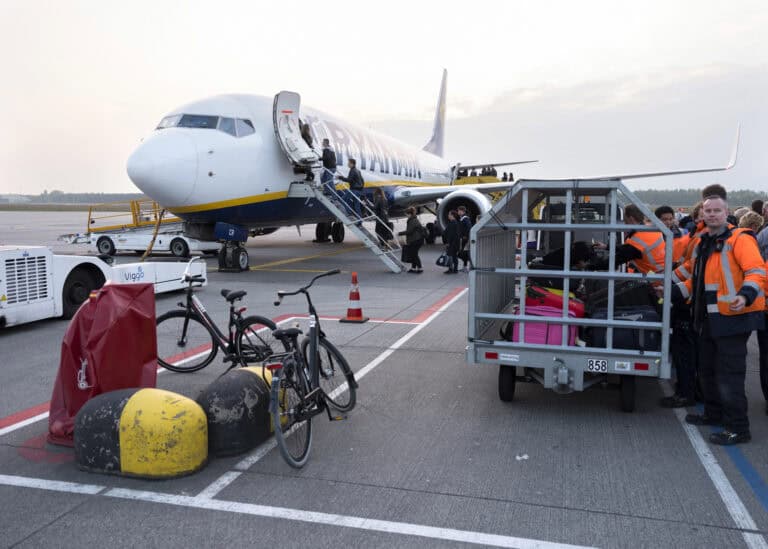
The Airport Coordination Netherlands (ACNL) has punished Ryanair by revoking two fixed departure and landing slots at Eindhoven Airport. Why? They’re always late.
According to the ED, the Irish budget airline constantly ran an hour behind schedule on Monday evening flights from Sofia, Bulgaria, and Thursday evening flights from Pisa, Italy, over the summer season, causing delays (and headaches) for Eindhoven.
The regularity of the delays has led ACNL to conclude that Ryanair broke the rules on purpose.
In a statement, Ryanair called the action “unprecedented, irrational and disproportionate.”
All without a fight?
Hoping to buy some time, Ryanair appealed the ACNL’s rarely given penalty at a district court in Haarlem.
The court sided with the slot coordinator, ruling that Eindhoven Airport already had a scarce number of spots that needed to be allocated fairly.
Meanwhile, ACNL had followed all procedures in good order. Ryanair was issued a warning in the middle of June for potential sanctions, and those sanctions were imposed in August.
This is not the first time there’s trouble in Ryanair’s bargain flight fare paradise.
The airline racked up almost thirty violations over three months in 2025. Can the self-proclaimed “Europe’s favourite airline” have its cake and eat it too?
What does this mean for travellers?
Ryanair now has two options: it can reschedule its flights to Sofia and Pisa or temporarily remove the routes from its schedule.
The confiscated slots will instead be open to competing budget airlines such as Transavia and Wizzair.
The bad news? Passengers will still be expected to defy the laws of physics to squeeze their belongings into a small personal bag… A rite of passage when flying out of Eindhoven.
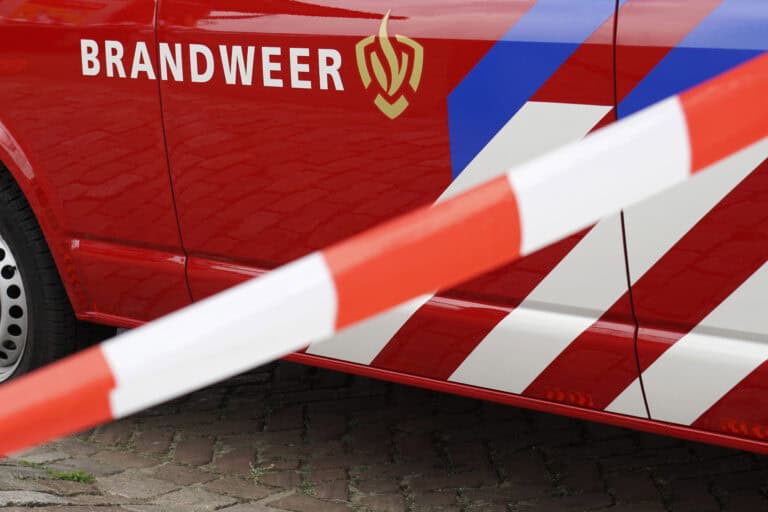
Police have started an investigation into the discovery of a human body during a fire brigade training exercise.
The Spaarndam fire department made a gruesome finding yesterday morning when a standard training went awry.
As part of their training routine, a dummy was released into the Zijkanaal C at around 9 AM to be retrieved by firefighters in a diving exercise.
Instead, divers discovered an actual human body. The Kennemerland Safety Region confirmed the find to the NOS.
The discovery was quickly reported to local police and the area was designated a crime scene. A Special Intervention Unit retrieved the body at around 10:30 AM.
Identity of the body unknown
A spokesperson for the Kennemerland Safety Region tells RTL Nieuws that at the time of the discovery, police had not been aware of any missing persons in the area.
The identity of the body has not been released by authorities.
The case has now been handed to the police, who hope to find answers.
If you have any information regarding the case, contact Dutch police at 0900-8844.
In a nail-biting World Cup qualifying match, Curaçao has become the smallest nation ever to reach football’s biggest stage. Meanwhile, Suriname kept their dream alive with a last-gasp own goal that secured their playoff spot.
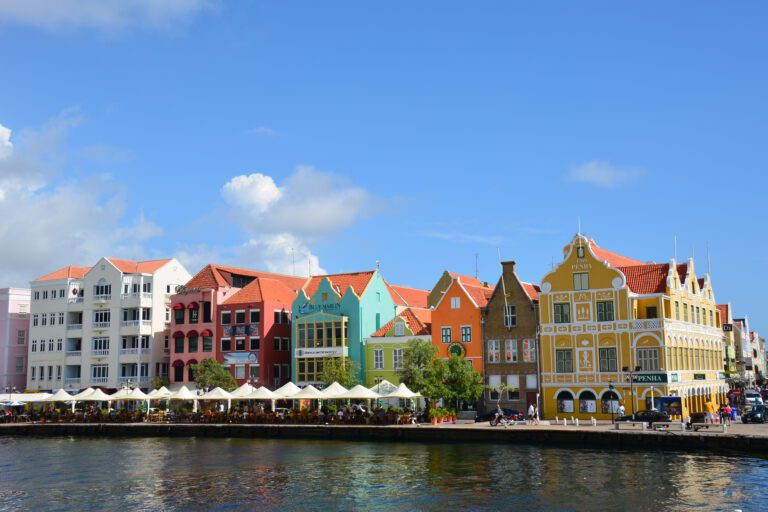
The Caribbean island of Curaçao, home to just 155,000 people, achieved the impossible on Tuesday night.
As the NOS reports: a nerve-shredding 0-0 draw against Jamaica in Kingston was enough to send the tiny island through to the 2026 World Cup in the United States, Mexico, and Canada.
This special constitutional status means that whilst Curaçao is autonomous, it shares the Dutch monarch and maintains close ties with the European Netherlands.
Many Curaçaoans hold Dutch nationality, and the island’s official language is Dutch alongside Papiamento.
The squad itself reflects these ties, consisting mostly of players with backgrounds in Dutch professional football.
Dick Advocaat, the 78-year-old Dutch football legend, missed the historic match after flying back to the Netherlands on Saturday due to family circumstances. His close friend Cor Pot and Dean Gorré took charge in his absence.
When Curaçao takes the field next summer, Advocaat will become the oldest coach ever at a World Cup.
Suriname’s dramatic escape
Whilst Curaçao was celebrating, Suriname experienced their own drama. Coach Stanley Menzo’s team needed a win against Guatemala to qualify automatically, with talk in Suriname of a national holiday if they pulled it off.
Instead, Suriname collapsed in Guatemala City, conceding three goals and facing elimination from even the playoffs.
Then, in the 93rd minute, a Guatemala defender scored an own goal. That single moment kept Suriname’s World Cup dream alive, securing their playoff spot on goal difference.
Summer 2026: Dutch cities ready to party
Next summer is going to be massive in the Netherlands, particularly in cities like Rotterdam with their diverse, football-mad communities.
With Curaçao, Cape Verde, Morocco, potentially Suriname and the Netherlands itself all qualifying for the World Cup, expect Dutch cities to transform into one giant, multicultural football festival.
Rotterdam, with its significant communities from all these qualified nations, is set to become party central.
It will be June, long nights, and a lot of games are played in the late evening and night (Dutch time), it will be a buzzing affair.
The 2026 World Cup’s expanded 48-team format has opened doors for smaller nations, but Curaçao’s achievement stands as something truly special.
The Dutch team, good old ‘Oranje’, already qualified this Monday after winning against Lituania (as was expected).
Which country are you supporting with the next World Cup? Let us know in the comments below!
Dutch household investments have hit a historic high, with chip giant ASML now overtaking Shell as the country’s most-held stock.
According to statistical research by De Nederlandsche Bank (DNB), Dutch households are investing more than ever, with home-grown favourite ASML being the most popular investment in the third quarter of 2025.
This post might have affiliate links that help us write the articles you love, at no extra cost to you. Read our statement.
Tech giant ASML takes the multi-billion-euro crown
Dutch shares in ASML have now skyrocketed to a whopping €4.42 billion in value, largely driven by a 22% increase in share prices.
For the first time, the chip manufacturer is the hottest investment in the Netherlands, dethroning the previous favourite Shell PLC.
Step aside, Shell! Dutch investment portfolios have a new favourite this quarter. Image: Freepik
But it isn’t just ASML seeing big figures — Dutch household investments have now risen to €204.7 billion in value, which is up by around €9 billion since the previous quarter.
Are you keen to start investing, but don’t quite know how (or where!) to begin?
Opting for an investment app is one of the most accessible choices, as you won’t need massive stacks of cash or a degree in finance to grow your portfolio.
Some of our favourite investment apps include Trade Republic and Scalable, for their sheer affordability, English-language support, and wide range of stocks, ETFs, and crypto.
Prefer investing through your banking app, instead? Many neobanks, like bunq and Revolut, also offer a wealth of investment opportunities in addition to regular banking services.
What are the most popular investments in 2025?
While stock in ASML may have taken the crown, DNB’s report also highlights some other popular choices, including:
multinational oil and gas company Shell,
popular Dutch financial service Cooperative Rabobank,
multinational banking corporation ING Group,
American tech giant NVIDIA,
multinational tech conglomerate Microsoft,
Dutch equipment manufacturer ASM International,
British consumer goods company Unilever,
Dutch-Belgian multinational Royal Ahold Delhaize, and
Dutch semiconductor equipment manufacturer BE Semiconductor Industries.
Placed alongside Halloween candies, they vie for our attention in the supermarket aisles for a month. 👀 However, once the spooky holiday is over, and we’re one step closer to Sinterklaas… it’s officially pepernoten season!
While Sinterklaas is a somewhat (read: very) controversial holiday due to the controversy around Sint’s helper, Zwarte Piet, one thing appreciated by Dutchies and internationals alike are the treats that Sint and Piet bring with them: pepernoten.
Okay, okay — before you come at us — technically, we’re talking about kruidnoten here, but pepernoten is a more frequently used term to describe these delicious Dutch treats.
We’ll explain the difference below. 😚
What is it?
Pepernoten are soft, irregularly shaped biscuits. They’re made from rye flour but have a sweet honey flavour, spiced up with anise.
If this sounds unfamiliar, it’s probably because many people (including Dutchies!) say that they’re eating pepernoten though they’re technically stuffing their face with kruidnoten.
So what are kruidnoten then? Kruidnoten are crunchy, dome-shaped biscuits that’ll instantly bring Christmas to your tongue. 😍
They’re made from wheat flour and spiced with ginger, cinnamon, cloves, nutmeg, cardamom, and white pepper.
When most people say ‘pepernoten’, they mean these. However, ‘pepernoten’ are the larger, lighter, irregularly shaped ones (shown in the feature image). Image: Depositphotos
Kruidnoten also come in many different flavour variants; just visit a Van Delft store and you’ll be amazed! You can even find them coated in chocolate — lekker!
Why do they do it?
Kruidnoten are a typical treat related to the Dutch celebration of Sinterklaas, so eating them simply goes hand-in-hand with the holiday season in the Netherlands.
In fact, pepernoten have been part of the Sinterklaas tradition since the 16th century. Then, when the Netherlands started importing more spices in the 19th century, the kruidnoot saw the light of day.
From then on, it was also kruidnoten that were thrown during Sinterklaas parades.
So, why? Well, tradition. Plus, they’re outright delicious!
Why is it quirky?
If they’d only eat them around Sinterklaas (December 5), it wouldn’t be so quirky.
However, pepernoten and especially kruidnoten make their appearance in Albert Heijn as early as September — echt!
The Dutch tradition of pepernoten comes hand in hand with the arrival of Sinterklaas. Source: Erik Bro/Wikimedia Commons/CC 3.0
It’s every Dutchie’s dilemma: do they buy the first bag of kruidnoten once the urge kicks in? Or do they hold off until at least November?
From our experience, the former usually wins, and you’ll find everyone stuffing their faces with kruidnoten months before the holidays.
Should you join in?
Absolutely!
Whatever your feelings are about Sinterklaas and Zwarte Piet, everyone can get on board with pepernoten and kruidnoten.
After living some time in the Netherlands, you’ll likely even be facing the same dilemma as the Dutch: to buy or not to buy kruidnoten in October.
What do you think of this Dutch quirk? Have you experienced it? Tell us in the comments below!
Want to get started with investing in the Netherlands but don’t know where to start? I’ve been there.
Investing is one of the most effective ways to grow your wealth over time, and with the Netherlands’ stable economy, you have plenty of opportunities to get started.
In fact, investing is getting more and more popular in the land of clogs, with recent studies suggesting that nearly 2 million households (a.k.a. one-fourth of the population) now invest in one form or another.
But whether you’re thinking about putting your money into stocks, ETFs, or cryptocurrencies, it’s important to know the basics before you jump into it. 👇
💡 Disclaimer: Investing always involves risks.
1. Choose an investment platform that fits your goals
Before you invest a single one of your hard-earned euros, you’ll need to find an investment platform to do it with. In doing so, it’s important to pick one that matches your financial goals, experience level, and personal preferences.
There are heaps of investment platforms out there, some better suited for those just getting started and others that cater to experienced traders looking for more advanced tools.
Do your research — it’ll pay off. Image: Freepik
When choosing the right one for you, there are certain factors to keep in mind:
Fees: Does the platform have trading commissions, account maintenance fees, or significant currency conversion costs?
Language: Is it available in English (or another language that you speak)?
Available products: Does it offer the types of investments you’re interested in (for example, Dutch stocks, global ETFs, cryptocurrencies, sustainable funds)?
Ease of use: Does it have an intuitive interface that makes investing easy and seamless?
Extra features: Are there extras like automatic investing, educational content, a credit or debit card?
While people may suggest different platforms and apps to you, it’s important that you take time to explore your options and pick one that suits your needs (trust me, you’ll thank yourself later).
Not sure what investment platform to go with? Scalable Capital is one of the most affordable online financial brokers out there. With its easy interface, smart tools and a wide variety of investment options, it’s a great option for anyone, from complete newbies to experienced investors.
2. Assess your risk appetite and investment goals
There’s always some risk involved in investing, but how much you take on depends on what you’re comfortable with — a.k.a. your risk tolerance.
Risk tolerance refers to how comfortable you are with the ups and downs of the market: Are you okay with seeing your investments dip temporarily if it means higher potential returns? Or do you prefer a more stable, lower-risk approach, even if the growth is slower?
To avoid panic later on, it’s important to be honest when you ask yourself these questions.
It’s also important to think about your investment goals and timeline, that is, whether you’re in it for the long term or the short term.
Lastly, make sure your investment strategy aligns with your financial goals and life situation. Are you saving for a house? Starting a business? Planning for retirement? All of these factors have an impact on your financial situation and, with that, should shape your investment strategy.
Looking to become a homeowner? This will have an impact on your investment strategy. Image: Freepik
3. Diversify your portfolio to spread the risk
Ever heard the saying “Don’t put all your eggs in one basket”? Well, that’s also (or especially) true when it comes to investing.
No matter how confident you feel about a single company or sector, investing all your money in one place is very risky. Sure, if that stock takes off, you’re good — but if it plummets, your entire portfolio suffers.
And that’s why diversification, or spreading your money across different types of assets, industries, or markets, is so important.
While investing in certain stocks in the Netherlands is a great start, adding global investments to your portfolio gives you exposure to different economies and industries, so you’re less affected if one market underperforms (or if Trump decides to crash one 😉).
Whether you’re interested in ETFs, individual stocks, or crypto, Scalable Capital has you covered. You can get started with as little as €1 and invest in over 2000 ETFs, 7000 stocks or 17 cryptocurrencies.
Speaking of diversification: If you’re new to investing, index funds and ETFs (Exchange-Traded Funds) are a great place to start. These offer a simple way to grow your money without having to pick individual stocks or constantly check the market.
They’re also great because they allow for diversification. With just one investment, you can own a small slice of dozens (or hundreds!) of companies, which helps spread out risk.
Some popular ETFs for Dutch and European investors include:
iShares AEX UCITS ETF, which tracks the Dutch AEX index (the top 25 companies listed in the Netherlands).
Vanguard FTSE All-World UCITS ETF, which lets you invest in developed and emerging markets from all over the world.
iShares MSCI World ETF, ideal for broad, long-term international diversification.
Scalable Xtrackers MSCI All Country World UCITS ETF, covering about 90% of global markets with a mix of direct investments and financial tools to track the market efficiently.
VanEck Sustainable World ETF, for those interested in socially responsible investing.
5. Know your Dutch tax rules
We hate to break it to you, but: Ja, the Belastingdienst will want its share of your investment profits, so it’s important to understand how the Netherlands taxes them.
In the Dutch tax system, your investments fall under Box 3, which covers your “wealth tax” (i.e. not income tax from work, which is Box 1).
Here’s how it works:
You pay tax on your net assets (your total assets minus debts) as of January 1 each year. This includes things like cash, stocks, ETFs, crypto, and second properties.
There’s a tax-free allowance (heffingsvrij vermogen) of around €57,000 per person (or €114,000 for tax partners) in 2025.
Anything above that amount is taxed based on a provisional return the government assumes you make, not on your actual investment gains (yes, it’s complicated, but there is help*).
The percentage of tax you pay depends on how much wealth you have, with higher wealth brackets assumed to earn a higher return.
*Sounds confusing? It is, but luckily, some investment platforms (such as Scalable and DEGIRO) provide you with a tax report that makes declaring your assets much easier.
6. Start small and be patient
One of the biggest myths about investing is that it’s only for people with a lot of money. In reality, you can start small, even with just a few euros, and build your portfolio over time.
The key is consistency and patience. Markets go up and down, and dips can feel discouraging. But historically, markets grow over time, so staying invested (even through the ups and downs) gives you the best chance to benefit from that growth.
There will be ups and downs, but patience will pay off. Image: Depositphotos
Since trying to guess the perfect moment to buy or sell is pretty much impossible, a great way of investing is the so-called DCA (Dollar-cost-averaging) strategy, where you invest a fixed amount of money at regular intervals, regardless of the market conditions.
This averages your buy price over time and keeps your emotions out of investing, letting consistency and time do the work for you.
💪 TIP: Many investment apps, such as Scalable, offer a DCA automation tool (Savings Plan). With this tool, money is automatically deducted from your account and invested at regular intervals.
7. Stay informed and keep learning
One thing about the stock market is that it is always changing and evolving, so staying informed is key to making smart investment decisions.
Luckily, there are plenty of (free!) resources out there to help you stay up-to-date and improve your financial knowledge, such as books, YouTube channels, and podcasts.
The more you know, the better equipped you are to handle market ups and downs, seize opportunities, and adjust your strategy when needed. So, keep educating yourself! 💪
What questions do you have about investing in the Netherlands? Or what tips would you give to beginners? Share them in the comments.
From next week onwards, the Dutch government will start distributing a new emergency information booklet to over 8.5 million households across the Netherlands.
Titled “Bereid je voor op een noodsituatie” (or “Prepare for an emergency”), the crisis guide is designed to help residents stay self-sufficient during the first 72 hours after a major disaster.
Why now?
Earlier this year, Euronews reported that the Iberian Peninsula suffered a massive blackout, leaving over 60 million people without power in Spain and Portugal.
To outgoing Dutch Justice and Security Minister van Oosten, the situation showed “how vulnerable we can be and how important good preparation is.”
In a bid to “ensure that all Dutch people can be well-prepared for an emergency”, all households across the Netherlands are expected to receive the booklet by January 10, 2026.
What’s inside the new emergency booklet?
Stressing the importance of thinking ahead in an emergency, van Oosten states that the booklet will help people prepare for a crisis.
In particular, the booklet focuses on the following steps:
Step 1: Assemble an emergency kit
While most households will have the essentials, such as non-perishable food, blankets, and a power bank, the booklet urges people to consider if they have enough supplies for 72 hours.
Further, you’ll need to consider your own situation and what extras you might need, like baby food, pet food, and medication.
Not sure how to compile a disaster kit? The booklet will also offer a handy checklist for packing your essentials and staying prepared.
Step 2: Create an emergency plan
The second step will encourage people to come up with a practical emergency plan.
This involves clear agreements with family, friends, or flatmates, and covers questions like:
how you’ll reach each other,
where you’ll meet,
who’ll pick up the children from school, and
who might need extra help.
Step 3: Talk to each other and help each other
Last but not least, communication is key.
The booklet emphasises the importance of supporting each other through a crisis and helping each other prepare. In addition to advice, the booklet will cover some important conversation-starters, such as:
What have you prepared for?
Do you need help?
What are you worried about?
In addition to Dutch, the booklet will be available in various other languages from November 25, including English, German, Polish, French, Arabic, Turkish, Chinese, and Spanish.
What do you think of the government’s new initiative? Tell us your thoughts in the comments below!