The Netherlands could get its first real taste of winter weather, with frost and hail on the horizon after weeks of unseasonably mild temperatures.
Though the Netherlands may have set a new record for the most number of mild days in a year, it looks like winter’s finally here. (And yes, it means business!)
But we’re not freezing just yet
Mild Dutch weather is giving us a final hurrah this Friday, with highs of 17 degrees Celsius in the south.
Helaas, if you live in the north, prolonged rain is likely to drag temperatures down to a more chilly 10 degrees.
Things will start getting colder on Saturday, with Weeronline forecasting highs between 11 and 14 degrees Celsius in the south. The north, meanwhile, will hover around a frosty 7 degrees.
Temperatures will continue to drop on Sunday, with a cloudy start to the day in most regions and some brief sunshine in the north.
Next week gets properly wintry
However, next week is when winter really kicks things up a notch.
A 3.4 magnitude earthquake hit the Dutch town of Zeerijp in the early hours of the morning, one of the most powerful tremors ever recorded in Groningen.
The earthquake struck Zeerijp at around 1 AM on Friday and is the strongest quake in the region since the 2022 tremor in Wirdum, which measured 3.1 on the Richter scale.
No damage has been reported.
The province is no stranger to earthquakes
Groningen has experienced countless tremors over the past decade, with the province rocked by four quakes over magnitude 1.5 in 2025 alone.
The region’s seismic activity is directly linked to prior natural gas extraction in the region. While the Dutch Senate permanently closed the gas field in April 2024, the Dutch Meteorological Society says that it is unclear when the earthquakes will stop.
Many in the Netherlands view Zwarte Piet (Black Pete) as an innocent addition to the Dutch holiday season. But for others, the figure is deeply offensive and represents a system of inherent racism that parades under “tradition.”
Every year, debates circle around the contentious topic, regarding whether the blackface Zwarte Piet should be allowed in public festivities.
These emotionally charged arguments have led to protests, riots, threats, and even violence — but they’ve also led to some gradual change.
Expats and tourists in the Netherlands are often mystified by the ordeal. If you’ve just walked into the conversation, you may be wondering why everyone is shouting.
So here’s some background on the Zwarte Piet tradition, what both sides have to say about it, and how public opinion is changing over time.
Got an opinion on Zwarte Piet? Make sure to vote in our poll at the end!
No time? Jump quickly to the section that takes your fancy:
Zwarte Piet plays an integral part in a beloved Dutch celebration. Every November, the Sinterklaas holiday marks the arrival of the Sint (Saint) in the Netherlands.
He comes by boat, supposedly from Spain, accompanied by his helpers, the Zwarte Pieten.
Parades and festivities celebrate Sinterklaas’s entrance all over the country. In these celebrations, Sinterklaas is the stoic hero, and Zwarte Piet is his (controversial) helper.
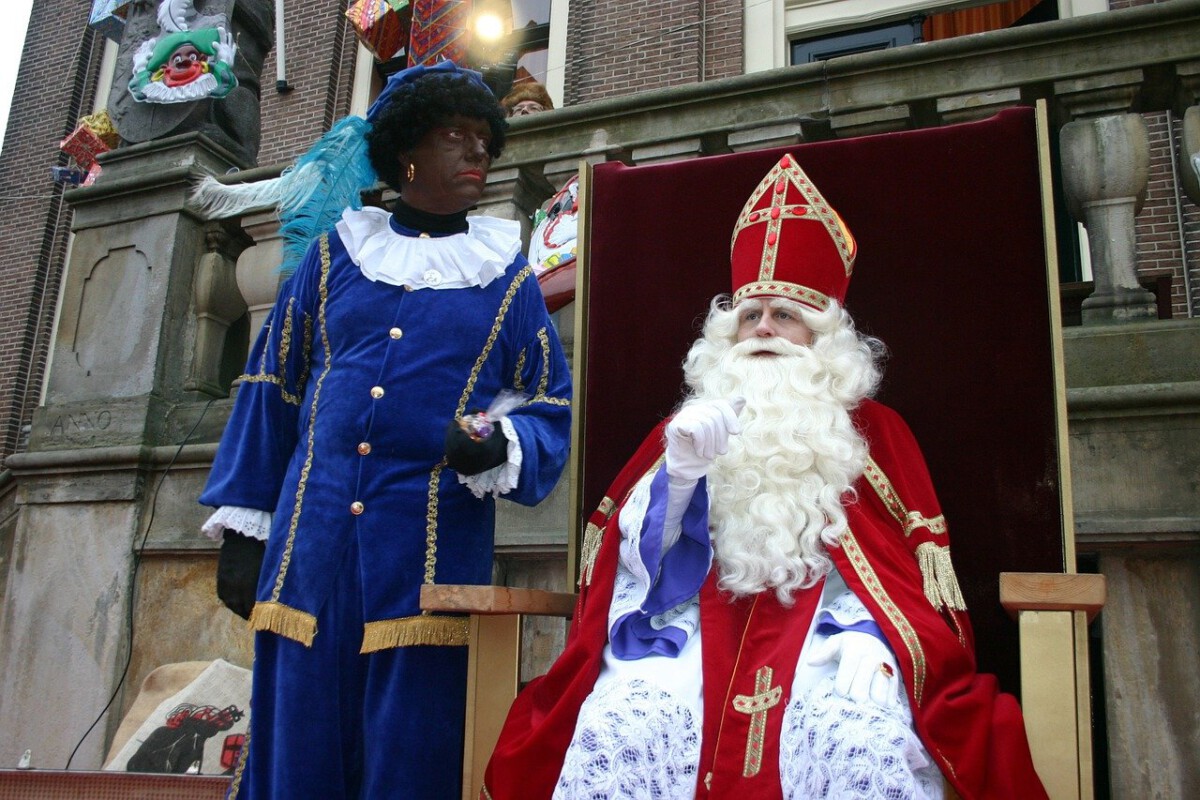
A traditional Zwarte Piet and Sinterklaas. Image: Pixabay
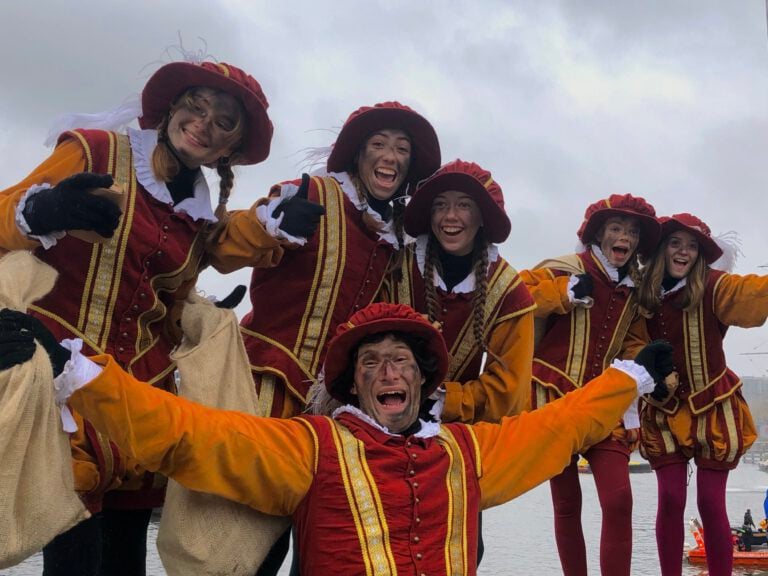
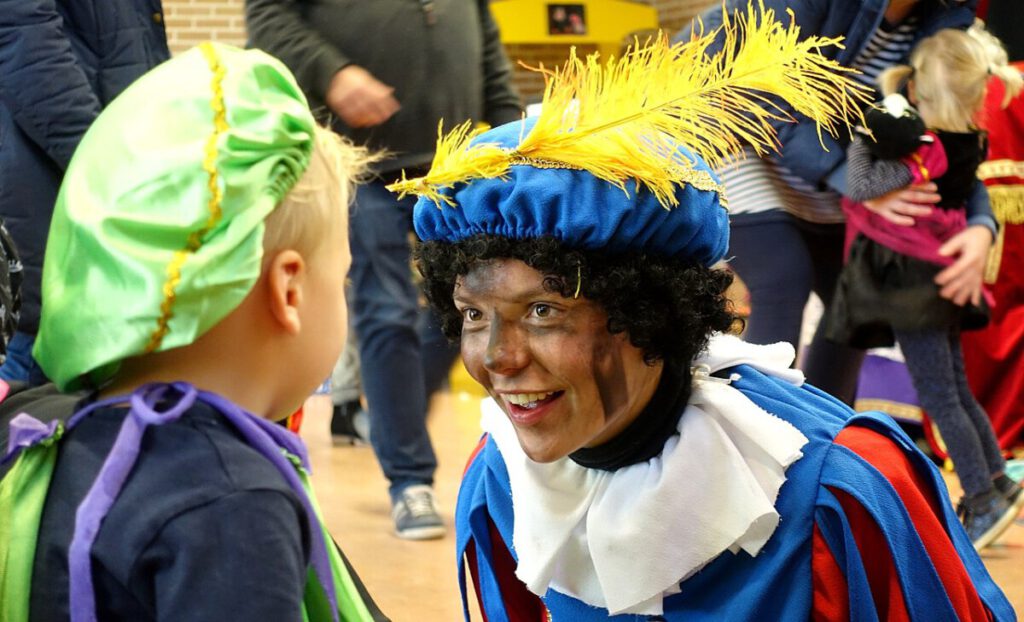
Traditionally, Dutch people portray the character in full blackface makeup, tossing candy and gifts to children.
The character’s original costume comes complete with an afro wig, red lips, and hoop earrings. However, in modern portrayals of the character, some accessories and makeup may be toned down.
History of Zwarte Piet and the blackface tradition
Zwarte Piet’s history is cloudy. People often disagree about when and how the character originated, disputing even historically sound evidence. Sinterklaas, or Saint Nicholas, has clearer roots that can be traced back as far as the Middle Ages.
Throughout the years, tales of Sinterklaas have always included a helper of some kind — be it a chained demon of yesteryear, or Zwarte Piet, the prancing page of modern-day.
The earliest written evidence of Zwarte Piet is found in a 1850s children’s book written by Amsterdam schoolteacher Jan Schenkman. In the book, Zwarte Piet is Sinterklaas’s dark-skinned helper, referred to only as “the servant”.
In the illustrations, he appears in colourful clothing reminiscent of a page. Historians tend to agree that the character is linked to slavery, as the page boys of this era did not work by choice or receive wages.
Changes to Zwarte Piet over time
The character has changed quite a bit since 1850. Originally seen as an assistant to the stern and punishing Sinterklaas, around 1890, the roles reversed.
Sinterklaas softened, and Zwarte Piet became the scary character who would rattle his chains and threaten children with his roe (a switch made of bundled sticks).
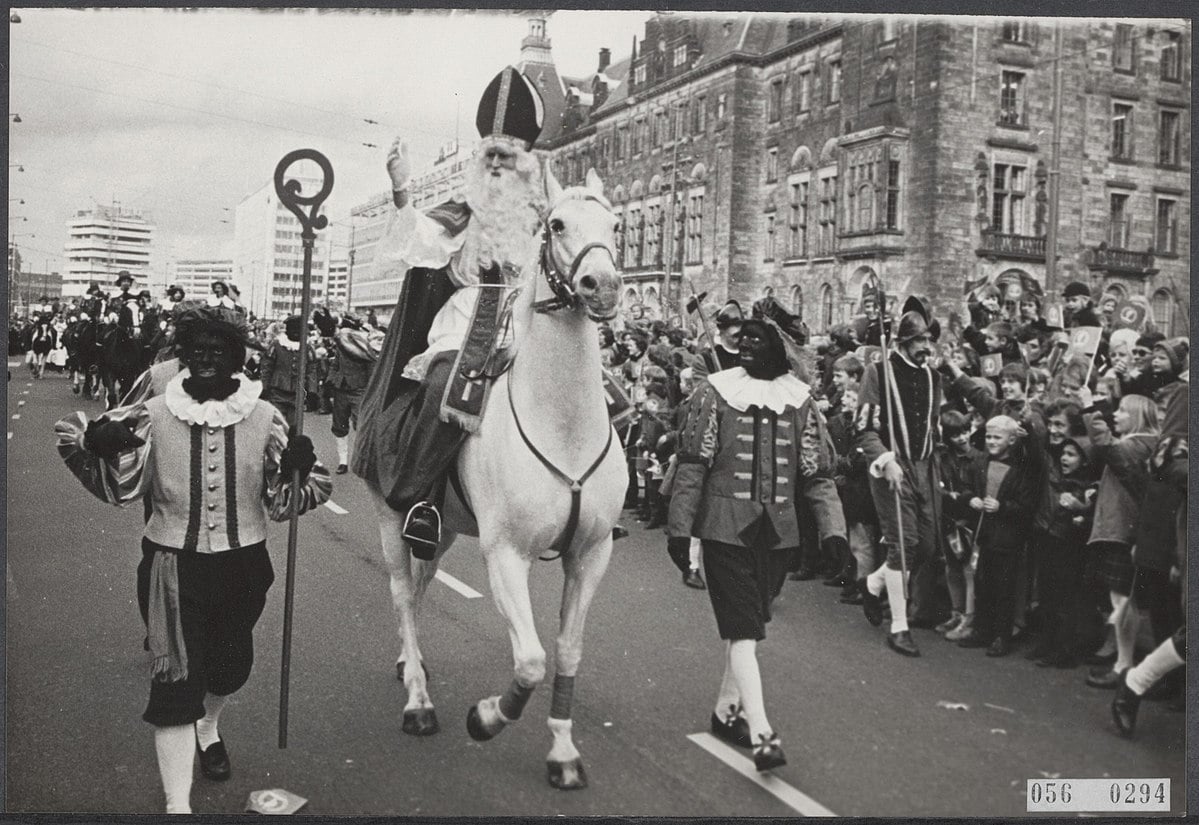
Zwarte Piet’s role in the Sinterklaas celebrations has evolved over time as well. Once the sole punisher, by the late 1960s, the character had become more of a friend to children, and the number of Pieten at holiday events had multiplied.
Sinterklaas with his Zwarte Pieten at a 1967 entry parade. Image: Anefo/Wikimedia Commons/CC1.0
Since then, and up until the last decade or so (when public disapproval was amplified), the Zwarte Pieten have been the highlight of the annual parades.
They bring gifts and treats for good children, while naughty kids are only playfully warned they’ll be whipped and taken away to Spain in one of Zwarte Piet’s burlap sacks.
The Zwarte Piet debate
If this description of Zwarte Piet has you raising an eyebrow or two, you’re not alone. Zwarte Piet has attracted criticism nationally and internationally for years now.
Blackface, even as a form of theatrical makeup, is insulting and dehumanising toward people of colour. Forget the questionable history and dimwitted portrayal of the character; the mere appearance of Zwarte Piet raises alarm bells for many onlookers.
Pro-Zwarte Piet: the traditionalists’ argument
Many traditionalists argue that the character’s appearance is part of a harmless tradition and is not tied to racism in any way. They believe in a different version of history wherein Zwarte Piet was more of a noble servant, and they view the black makeup as simply an old Dutch tradition.
Other Zwarte Piet supporters are convinced the character gets a black face from coming down the chimney. (An idea that leaves out an explanation for the exaggerated lips, afro, and other accessories, however.)
Die-hard Zwarte Piet proponents fight for their right to uphold the character’s full costume as an important part of Dutch culture. They fear that outsiders will strip them of their cultural identity because they don’t understand it.
White people portraying themselves as black people isn’t really a sight for sore eyes. Image: Depositphotos
Some Dutch disagree with allegations of racism because, for generations, they’ve viewed the festivities as something entirely wholesome to bring joy to children. How can others accuse them of racism when they’ve never knowingly had racist intentions?
The Sint en Pietengilde, an organisation fighting to preserve the traditional Zwarte Piet, says that supporters are “generally surprised” when they notice that people see Zwarte Piet as a racist figure.
From the guild’s perspective, “This is still often not recognised. As a result, acceptable ways of depicting Zwarte Piet from history are incorrectly interpreted as racist.”
The majority of these blackface supporters are in disbelief that Zwarte Piet is discriminatory, and they feel misunderstood.
The main arguments that the Zwarte Piet traditionalists make are that the character has been misinterpreted and others have overreacted, while they simply want to continue with their traditions in peace.
Anti-Zwarte Piet: the no-blackface argument
People opposed to Zwarte Piet emphasise that the character’s cartoonish, historically unsavoury portrayal reinforces negative stereotypes, contributing to an inherent bias against people of colour. They see some issues that need resolving before the holiday can be a peaceful one.
For Zwarte Piet’s opponents, historical evidence proves the character arose out of colonial times when slavery was the accepted norm.
They say that this bias against black people has been carried with Zwarte Piet over the years, whether consciously or not. They see the blackface character as a racist and harmful relic from the past.
The anti-Zwarte Piet camp also doesn’t generally buy into the idea that black paint was separate from the popular and embarrassing blackface makeup of the time.
Blackface was used by white people as a device to mock and dehumanise Black people in their portrayal, not only in the US but also throughout Europe.
But aside from addressing Zwarte Piet’s problematic history, opponents want to shift the focus toward a future of equality. They argue that continuing to reinforce negative racial stereotypes creates an unconscious bias in society, keeping people of colour at a disadvantage.
Even beyond the aim for broad societal change, Zwarte Piet’s opponents want an end to the everyday racism that the character encourages.
Many black people in the Netherlands have had experiences where they’ve been referred to as Zwarte Piet in a derogatory way, often as children. Some have also encountered more aggression and other racial slurs, particularly around Sinterklaas.
As Jerry Afriye, leader of the action group Kick Out Zwarte Pietsays, “By the same adults who now shout from the rooftops that Zwarte Piet is not racist, you can be called Zwarte Piet.“
“For example, in the workplace, ‘There you have our Zwarte Piet’. Or on social media, as a caption to a photo of Mandela: ‘[The Head Piet] is dead’.”
Lost in translation?
Where the conversation often gets stuck is on the very words “racist” and “racism”. Racism is thought to be exclusive to more overt racial aggressions.
Everyday bias and systemic racism are still relatively foreign ideas in the Netherlands. Getting on the same page about what is and isn’t racism is a hurdle in itself.
What’smore, racism has not been largely discussed in the Netherlands until recently and is a bit of a taboo topic. It doesn’t fit with the Dutch cultural identity, so the jarring word “racism” stirs immediate discomfort and defensiveness.
There’s a big disconnect in the discussion when it comes to behaviour that many do not recognize as discriminatory because it’s based on tradition, while others experience that behaviour as hurtful or insulting.
Momentous reactions to Zwarte Piet
Zwarte Piet has had many big moments in the media over the past century or so. This timeline covers some of the most influential:
In recent years
Over the last several years, Zwarte Piet has had too many spotlight moments for this humble timeline. In 2018, the action group Kick Out Zwarte Piet organised protests that made big waves in 17 Dutch cities.
Because of all of the commotion in recent years, several cities have banned the Sinterklaas entry altogether, while others will allow it only with modified Pieten. In 2020, the coronavirus took care of cancelling them all.
An ever-growing number of stores in the Netherlands have stopped selling merchandise with the Zwarte Piet image. The popular HEMA, Jumbo, and Bol.com have all said goodbye to blackface.
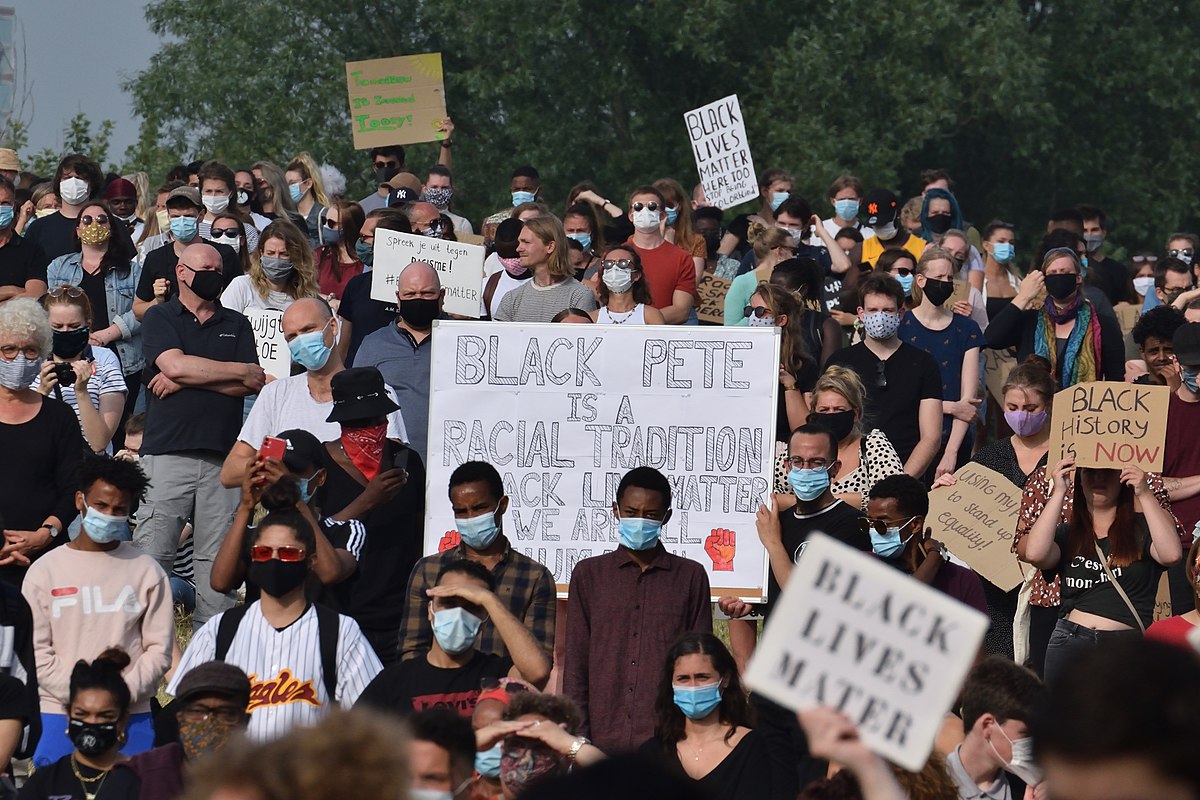
In 2020, the Black Lives Matter protests and international antiracism movement sparked by the murder of George Floyd, called attention to systemic racism in the Netherlands.
As a result, the voices standing up to racism are louder than before, and conversations about it are becoming more normalised.
June 13, 2020: Black Lives Matter demonstrations in Leeuwarden. Image: Arnold Bartels/Wikimedia Commons/CC4.0
But the voices of white supremacy are also increasing. Some anti-Piet activists have been the targets of hate crimes, threats, and violence. Jerry Afriye of Kick Out Zwarte Piet received a letter earlier this year that read, “…we will have fun slaughtering you, your family, and extended family…and won’t wait for Sinterklaas.”
He also said that he had changed his opinion of Zwarte Piet after realising that children were feeling discriminated against during the holiday festivities. “That’s the last thing we want during Sinterklaas,” he said during a press conference.
Rutte didn’t feel the government should step in. He predicted that in a few years, “you will hardly see any more Zwarte Pieten.”
This was particularly big news because, in the past, even Mark Rutte has worn blackface in Sinterklaas celebrations. So have many of the lovely, good-hearted Dutch people you may know.
This is perhaps why the shift toward seeing the character as a racist symbol has been met with such resistance — how could this whole culture that is widely thought to stand for tolerance and inclusion be racist?
Well, it’s a bit more nuanced than that, and people are starting to recognise it.
A shifting paradigm
Over the years, we can mark a clear shift in the Netherlands’ perception of the holiday character. It was slow and steady at first and then exponential over the past year.
More and more, the Dutch are opening up to the idea of eliminating or modifying the character to be more sensitive to racial stereotyping.
Sooty Piet & Chimney Piet
To find some middle ground, some municipalities have suggested different colours of Pieten as an alternative to the blackface character. Red, blue, rainbow, and even the contentious grey, but none as promising as the Sooty Piet (Roetveegpiet) or Chimney Piet (Schoorsteen Piet).
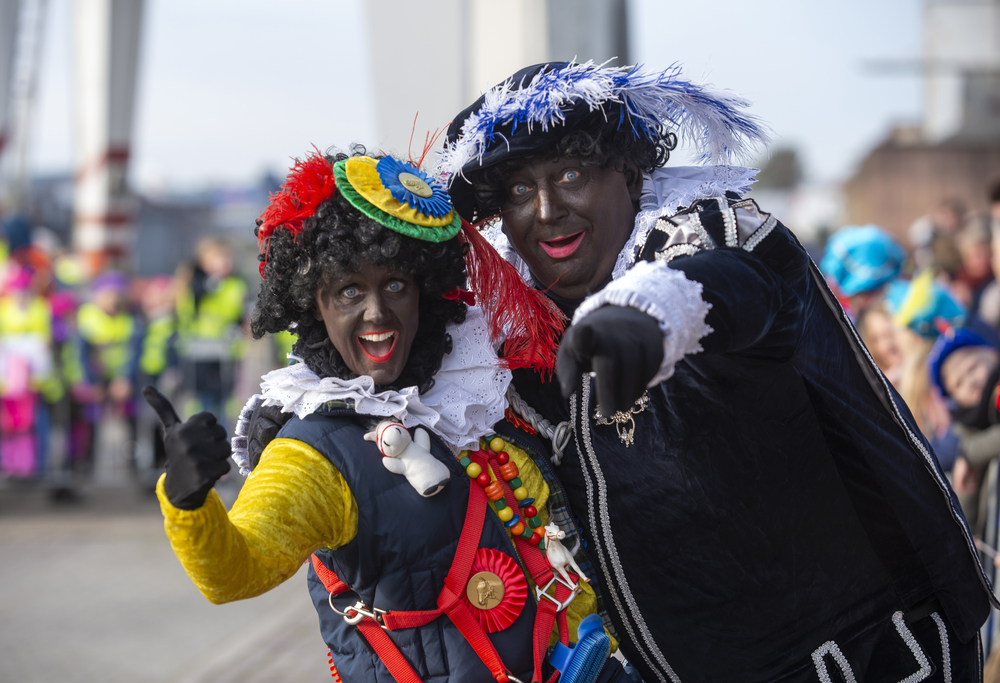
This rendition of the character has soot smudged on his cheeks to support the newer adaptation of the story, which claims that Piet’s face is only blackened from the chimney.
Soot Piet is often viewed as an acceptable alternative to Zwarte Piet. Image: Ziko van Dijk/Wikimedia Commons/CC4.0
This new narrative is, of course, a modern workaround to the blackface issue. While many still do not approve, others, including the Zwarte Piet action groups, are more comfortable with it than the original.
Public opinion about Zwarte Piet
Since 2013, Dutch news outlet EenVandaag has been hosting an annual “Opinion Panel” regarding Zwarte Piet. The survey shows whether people view the character as discriminatory and whether or not his traditional appearance should change.
It’s clear that a growing number of Dutch people are coming to the conclusion that traditional Zwarte Piet is problematic.
They wanted to see if the movement had influenced opinions of racism in the Netherlands — it had.
In 2020, far more Dutch people say that Zwarte Piet should change, and fewer people say the character should stay the same.
The November 2020 survey shows many of the opinions from June have been upheld, while a smaller percentage was likely a temporary product of the social movement.
It should be noted, however, that most people who changed their minds in 2020 indicated on the survey that they are in favour of adjusting Zwarte Piet “to keep the peace” rather than because of a changed perception of the character. They want to “get rid of the social unrest and demonstrations.”
In 2021, survey results were similar to those of 2020, with 56% saying they did not want to change the appearance of the character and 32% saying it should change. However, 46% of people saw Sooty Piets as a reasonable alternative.
Talking about racism
While the data shows signs of change in Zwarte Piet’s future, the debate will likely be around for years to come — there is still much to be discussed. EenVandaag’s survey in 2020 also asked, “Do you have the feeling that you can say in public in the Netherlands what you think of the appearance of Zwarte Piet?” Only 45% of the Dutch (known for their directness) replied yes.
Whether or not people are willing to talk about their views openly, the whispers behind closed doors show there is still convincing to be done.
Action group Nederland Wordt Beter says a future that is more inclusive and without racism “can only be achieved by recognizing the influence that the colonial and slavery past has on today’s society and on all Dutch people.”
That’s why one of the guidelines Nederland Wordt Beter is pushing for, along with the changing of Zwarte Piet’s appearance, is education about why it needs to change — “to turn anger into understanding and solidarity.” Because, of course, to keep the peace, you first have to find it.
Have your say
Is Zwarte Piet racist?
How do you find the Zwarte Piet debate? Do you think the character’s appearance should change? Tell us your thoughts in the comments below.
The small Brabant village of Moerdijk and its 1,130 residents may soon face an unthinkable reality, having to relocate entirely to make way for the Netherlands’ energy transition.
The shocking announcement came during an information meeting held by the municipality of Moerdijk on Tuesday evening.
According to Omroep Brabant, Mayor Aart-Jan Moerkerke admits that “We are asking a huge sacrifice from our residents.”
Why is this village being asked to disappear?
According to RTL Nieuws, “the national government wants to develop a significant amount of new energy infrastructure in this region in an area already struggling with limited space, quality of life issues, and high environmental pressure.”
In other words, the nearby port and industrial estate, already considered too small twenty years ago, has long placed pressure on the surrounding area.
And earlier this year, the national government and the province of North Brabant decided that the Moerdijk region would play a central role in the Netherlands’ energy transition.
Major infrastructure projects are now planned for the area, including:
A new 380 kV high-voltage substation
Expansion of the existing Geertruidenberg substation
Construction of hydrogen plants
Installation of Delta Rhine Corridor pipelines carrying ammonia and hydrogen from Rotterdam to Limburg
And all this isn’t as simple as slapping some pipes through someone’s back garden.
What happens next?
A final decision on Moerdijk’s fate will be made on December 1, just over two weeks away.
The municipality insists that any move forward must come with “solid guarantees,” including compensation for residents.
If the relocation does go ahead, Moerdijk won’t vanish overnight. The first major energy projects aren’t scheduled to begin until 2028, and one local alderman tells RTL that he hopes the village can continue to exist for at least another ten years.
In the meantime, officials say they’ll do everything possible to keep Moerdijk livable and ensure residents’ and business owners’ lives don’t “come to a standstill.”
Whether the village will ultimately disappear remains uncertain, but one thing is clear: the people of Moerdijk are now on the frontlines of the Netherlands’ ambitious energy transition.
Do you think this makes sense, or is it completely absurd? Share your thoughts in the comments below!
A prestigious American university is eyeing The Hague for a potential European campus, and Donald Trump’s presidency might be the push they need to make it happen.
The city announced this week that it’s in discussions with a renowned US university about opening a branch in The Hague.
However, officials are keeping tight-lipped about which institution is involved.
Is it one of the Ivy Leagues? The suspense is killing us.
Could we have a reason to thank Trump?
According to AD, the timing is no coincidence. Trump’s return to the White House has rattled American academia, particularly his plans to slash scientific research funding.
The president has clashed with several top universities, including Harvard, over their research priorities and budgets.
The EU has already extended an open invitation to American researchers: pack your microscopes and come to Europe. Now, The Hague wants to be their landing pad.
Why The Hague makes sense for an American university
The city isn’t exactly lacking in international credentials. The Hague is already home to 160 international organisations, from the International Criminal Court to the Organisation for the Prohibition of Chemical Weapons.
Add in Leiden University’s Campus The Hague and you’ve got a city that’s practically built for global academic collaboration.
While this would be the first major American university presence in the Netherlands, it wouldn’t be entirely unprecedented.
UCLA already operates a small human rights and justice institute called Promise Europe in the city, which opened in 2023.
The Hague also revealed it has “leads” for attracting other international organisations and NGOs, suggesting this could be part of a broader expansion of The Hague’s already considerable international footprint.
The Hague’s international reputation is paying off
This isn’t just wishful thinking on the city’s part.
In September, The Hague reported that an “unparalleled number” of institutions are interested in setting up shop there, while three major European organisations already based in the city are planning significant expansions.
The successful NATO summit in June also boosted the city’s profile as a global meeting place. Now, there’s talk of The Hague playing a larger role in the World Bank’s rule-of-law programme.
The city hasn’t revealed a timeline for when we might learn which university is considering the move, or whether it’ll actually happen.
Which American university do you think is eyeing The Hague? Drop your predictions in the comments.
Wanna learn Dutch, but you’re not sure where to start? Then you’re in luck! Whether you’re looking to move to the Netherlands or you arrived here recently, it’s never too late to learn Dutch fast and easy.
It’s good that you want to learn Nederlands the fast and easy way, so we’ve put together seven tips to get the ball rolling for you (bonus: most of them are free ways to learn Dutch too).
1. Watch Dutch TV with subtitles
It may drive you absolutely crazy listening to Dutch television (there’s nothing worse than listening to a language on TV at first and not understanding a word), but trust me: it works.
If you end up enjoying it, you might just find yourself switching to the Dutch TV industry altogether! Image: Depositphotos
It’s the perfect way to hear a conversation and internalise it as you’re reading the subtitles. In fact, that’s how a lot of children learn other languages (especially English). If they can do it, so can you.
Next time you want to Netflix and chill (or Netflix en chillen), leave out the chill and pop on that Dutch film. Your language skills will thank you for it, even if your partner won’t. 😉
2. Read children’s books
When you’re learning Dutch, you’ll be starting from square one — in the exact same way that a child learns how to read and pronounce words properly through a basic children’s book.
We all did that one day with our own native language, so this is one of the best ways to do the same for Dutch.
One of the most popular Dutch children’s books is Jip en Janneke, known for its simplicity but also cleverly written.
Don’t fret; this is one of the easiest and most effective ways to practise Dutch. It’s also the perfect way to get a bit of bedtime reading in, though it may be a bit awkward at work when someone asks you what books you’ve been reading lately…😬
3. Give it your all, but remember: less is more.
Less really is more when it comes to learning a language. “Binge” learning Dutch fast and in a panic is not necessarily the most effective way of doing it.
Do you remember staying up late trying to absorb every little thing for an exam the next day in a last-minute cram sesh? Was it stressful? Well, the same goes for learning Dutch fast that way.
If you want to learn it properly, it’s going to take time and patience.
A little bit of studying goes a long way. Image: Depositphotos
You’ll need to be passionate enough to learn the language because if you’re not going to give it your all and put in 100% effort when practising, then you aren’t going to learn it quickly, and you aren’t going to learn it properly.
4. Talk to people and pretend you don’t speak English (no, seriously)
We’re all guilty of panicking halfway through a poorly strung-together Dutch sentence and finishing it with “Spreekt u Engels?” or “Sorry, ik spreek Engels“.
Even worse is when you’re speaking okay, but the person you’re talking to switches to English anyway. But now — no more! Let’s take a stand.
Forget that you speak English for a second and persevere. Even say (in Dutch) that you don’t speak English when they switch.
Keep calm and keep speaking in Dutch. Image: Depositphotos
Unless you’re having incredible difficulty or the person is starting to look p**sed off, then do not switch back; you’ll find that your confidence will grow, and your language skills will flourish. Go for it — act natural and pretend you’re Dutch!
5. Find a study buddy and exchange your language knowledge
I’ve often seen this on international Facebook groups, where people are looking for someone to buddy up with in order to practise their Dutch.
For example, if you have a friend who wants to practise their English (or another language you can help with) and they can speak fluent Dutch, then you can ‘exchange’ languages.
Who knows? You might even make a life-long friend using the language buddy system. Image: Depositphotos
It’s simple: You practice on them, and they practice on you (think about cursing in Dutch as well). You can even go on study-buddy dates where one of you will speak one language, and then you’d respond in Dutch, and the conversation will flow that way.
It’s quite funny to watch those who overhear your conversation. Speaking from personal experience, when I was on the train with my friend who sat next to a guy speaking English to another guy, he would just reply in Dutch over and over.
My friend was very confused. It may sound crazy, but it works.
6. Listen to the Dutch radio
If you have a lot of international friends, it can be hard to practise your Dutch because no one is speaking it around you. Our last tip is that you can listen to some good old Dutch music on the radio or streaming service.
You don’t have to sit there, staring blankly at the walls, trying to listen out for every single word, but it might be a nice way to get used to hearing the different pronunciations.
Ask a Dutch person what you should get jamming to, or try having it in the background whilst you do work.
Remember to have fun with it; it’s great that you are broadening your horizons by learning another language. You’ll find way more opportunities in the Netherlands and make a tonne of friends.
Eventually, you might even start to understand the Dutch humour — but that’s a whole other language entirely.
Good luck! Or, as the Dutch say, succes!🤩
What are your top tips for learning Dutch easily? Drop them in the comments below!
A 21-year-old IT employee in the Netherlands just learned the hard way that first impressions really do matter.
The man had only just started his new job on June 1 this year, working for a company that seconded him to the Central Agency for the Reception of Asylum Seekers (COA).
His role was as an IT service employee working remotely.
An awkward introduction
On June 3, only his third day on the job, an awkward moment unfolded during an introduction at the COA. The man refused to shake hands with a female team leader, citing his religious beliefs.
According to RTL Nieuws, the COA later filed a report of gender discrimination against the employee.
Hoping to clear the air, the man responded with an email explaining that he had “acted out of religious conviction” and hadn’t intended to offend or humiliate anyone.
Despite his explanation, his employer terminated his contract that same day, claiming his “performance” didn’t align with company expectations.
Quite a verdict for someone who’d barely logged a full week.
Court steps in
The man took the case to court, and the District Court of The Hague wasn’t impressed by the company’s reasoning. The judge ruled that the dismissal was discriminatory and that it was far too early to assess his performance.
Since the employee was set to work remotely, the court also noted that shaking hands wasn’t exactly in the job description.
In the end, the court awarded the man €34,000 in “fair compensation”, stating that the employer was “particularly responsible” for the discriminatory termination.
Three days on the job, no handshake, and a €34,000 payout. Sometimes, staying true to your beliefs really does pay off.
Do you agree with the court’s ruling, or should the employer have had the final say? Tell us what you think in the comments below!
Whether for bureaucratic reasons or to call your best friend back home, sometimes you have to make international calls from the Netherlands. So, what’s the best provider to do this with?
Let’s check out our options and determine which provider offers the best solution for calls beyond Dutch borders.
Good to know: Making calls internationally is not the same as roaming. EU roaming only covers calls made while you’re abroad, like calling home from France during a trip. These are usually included in your regular Dutch mobile plan.
Calling from the Netherlands to another EU country (e.g. from NL to Italy) doesn’t count as roaming — it’s an international call, and your provider will likely charge extra unless you have an international bundle.
What are my options?
Despite the fact that thousands of internationals come to the lowlands each year, finding an affordable option for international calling from the Netherlands can be challenging.
Can you make international calls without breaking the bank? Image: Freepik
Although all the main Dutch providers, such as Vodafone, KPN, and Odido, allow you to make international calls, they often come with high costs or limited coverage.
In fact, many traditional providers may charge up to a whopping €4.50 per minute for an international phone call from the Netherlands.
But there are alternative options. 👇
LEBARA stands out with its international calling bundles
By offering international calling as an add-on to your regular plan, LEBARA caters specifically to those who need to stay connected with loved ones or business contacts abroad — and makes international phone calls possible without breaking the bank.
LEBARA is one of the only providers offering international calls as part of a prepaid or SIM-only bundle — and at the cheapest price available!
Pick your plan duration: Choose the plan duration that works for you, whether it’s a short-term deal or a longer-term commitment.
Select your data bundle: Choose the data allowance that suits your usage, from 1 GB to 45 GB.
Select international calling as an extra: Add international calling to your plan, allowing you to make unlimited calls to 44 countries for just €5 per month.
What’s included?
LEBARA’s international calling bundle covers a whopping 44 countries, 18 of which are outside the European Union.
This extensive coverage ensures that you can reach out to friends and family across the globe. Some of the key countries included in LEBARA’s international bundle are:
The United States,
Canada,
The United Kingdom,
South Africa,
Turkey,
India,
All of the EU.
LEBARA is the clear winner if you’re looking for the best SIM card for international calling from the Netherlands.
With its affordable plans, extensive coverage, and flexible options, LEBARA makes staying connected with loved ones abroad easy and cost-effective. ✨
How often do you make international calls from the Netherlands? Share your experience in the comments!
Okay, so we’re all aware of how Dutchies use the word lekker for everything, but there’s another candidate for most used, untranslatable word: gezellig.
Gezelligheidis an essential part of Dutch culture, and you’ll find that Dutchies love using this word to describe everything under the sun.
What is it?
The word gezellig has no direct translation. It can mean anything from cosy to friendly, comfortable, or even relaxing. How abstract!
You’ll hear it everywhere. Weather can be gezellig (though not likely in NL 😉), someone’s room can be gezellig, and taking a walk can also be gezellig.
There is no limit to what can be considered gezellig in Dutch.
Why do they do it?
The word is derived from the word gezel, which means “companion” or “friend.” Back in the Middle Ages, a gezel was also the Dutch word for a “journeyman.”
From there, the word could have developed from a noun into an adjective or adverb to describe something friendly and cosy, like a good friend. Aww! 💖
Why is it quirky?
It’s used EXCESSIVELY in the Dutch language, and it sounds pretty crazy to someone who isn’t familiar with the tongue.
GEE-ZEL-LEG. You have to say the difficult Dutch “g” twice. 😱
Should you join in?
Ja, zeker! (Yes, of course!) It’s quite an important and frequent word in Dutch, so it will only help you to better integrate if you know what this means.
Plus, the Dutchies can’t get away with switching to English with this word so you might as well know it yourself. 😊
What do you think of this Dutch quirk? Have you experienced it? Tell us in the comments below!
Two information panels commemorating black American soldiers who helped liberate the Netherlands have been removed from the visitor centre at the American Cemetery in Margraten, Limburg.
The panels highlighted the contributions of “Black Liberators” and their fight against racism within the US military.
NRC reports that these panels may have been removed months ago.
Could this have something to do with Trump?
The American Battle Monuments Commission (ABMC), which oversees the cemetery, tells the NRC that the exhibition material is rotated regularly “so that as many individual stories as possible are featured.”
However, NIOD researcher Kees Ribbens suggests to the NRC that this decision could be linked to policies introduced during the Trump administration.
According to him, the ABMC has been encouraged to step back from promoting diversity and inclusion in its public presentations. “The diversity officer has been sidelined,” he notes.
Community voices concern
The decision to remove the panels has provoked strong criticism within the province.
Eleven parties in the Provincial Council have called the removal “indecent and unacceptable.” Noting that the visitor centre now pays little or no attention to the role of Black American soldiers in the liberation of the country.
Apart from four parties, the Council is urging that the panel be reinstalled. They are also calling for a new, permanent memorial dedicated to Black American liberators.
Limburg’s King Commissioner, Emile Roemer, will soon meet with the US ambassador to request that the panels return to the visitor centre as soon as possible.
The weight of remembrance
A spokesperson for Roemer stresses the significance of the soldiers being recognised.
“Those Black liberators played a crucial role in the liberation of Limburg. There was deep segregation in the army. They fought for a freedom they themselves didn’t have,” says the spokesperson.
Around 12.5% of the American troops were African-American during the Second World War, and 172 are buried at Margraten.
Was the removal of these panels an unfortunate coincidence, or does it reflect a deliberate choice to sideline these stories? Let us know your thoughts in the comments below.