If there’s something Dutchies enjoy, it’s celebrating their (usually) beloved King on King’s Day. And part of the festivities includes a series of weird and wacky street games.
They already have weird sports and questionable habits regarding fire safety, so what’s another quirk on the list? 🤷🏻
What is it?
Most people know about King’s Day in the Netherlands, but may not know how many street games people love to play. 🎯
If you’re planning on celebrating King’s Day in Amsterdam or another Dutch city, you might spot a few of these games, including:
Koekhappen: Someone hangs cookies on a string in a line, and everyone participating has to bite off pieces and finish their cookie to win. With their hands tied to their back, too, of course.
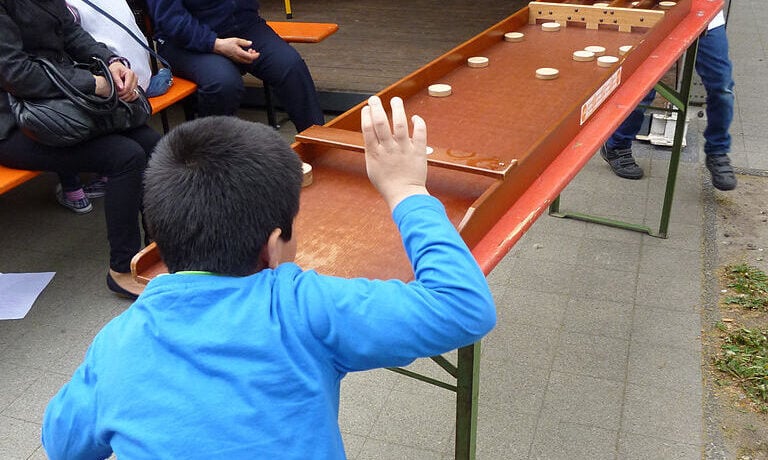
Sjoelen: Think shuffleboard, but shrink it and put it on a table! Players push plastic or metal pucks into the scoring zone using their hands instead of shuffleboard sticks.
Spijkerpoepen: Perhaps the most bizarre one — you tie a piece of string around your waist, and a nail is at the end of the string. Now, you’re supposed to get the nail inside a beer bottle or another small opening.
Reminds me of spijkerpoepen (nail pooping). A game I used to play in the Netherlands as a kid. pic.twitter.com/o5jSEBT3yC
Sounds like a lot of fun, right? Well, there are even more street games to play! You have to keep an eye out when you’re making your way around the city. 👀
Why do they do it?
Plenty of Dutch kids are trying to make a little extra cash. Many kids like participating in flea markets and selling their old clothes and toys. 🧸
However, some Dutchies like to set up these games for others to play for a small fee.
And even without kids, it’s hilarious to see (drunk) adults play these games and have the time of their lives.
While no official sources say where these games came from, it’s likely they were passed down through Dutchie generations. 🧓🏻
Why is it quirky?
These games are uniquely Dutch. Such activities go hand-in-hand with King’s Day, even if they aren’t just for the royal celebrations. 👑
And almost every Dutchie has played them at some point. Whether as a kid at a friend’s birthday party or a King’s Day celebration with your friends and family, most natives have tried a game or two.
Should you join in?
Absolutely! You may find them chaotic and maybe a bit embarrassing if you’re a street game newbie (unless you’re on the sauce), but it’s all in good spirit. 🤗
These street games certainly made the childhoods of Dutch children, and we’re sure they’d make adulthood a blast too.
Have you ever tried playing one of these games? Tell us in the comments below!
As most of the country will be partying on the streets of the Netherlands, biertje in hand and wearing flashy orange clothing, we here at DutchReview would like to say a big gefeliciteerd!Happy birthday, King Willem!
The King, who will no doubt celebrate his big day with grace and style has, like all of us mere citizens, managed to have some hilarious moments during his life.
Read on for our King Willy highlights! 👑
That time he was King of the swingers (toilet swingers that is!)
Yes, that is the King of the Netherlands swinging/throwing/hurling a bright orange toilet!
Back in 2012, when King’s Day was Queen’s Day in celebration of the late Queen Juliana’s birthday, King Willem sportingly took part in a toilet throwing contest, in which he flushed the competition away and walked away with a little toilet trophy.🚽
That time the Prins of Pils enjoyed a cold one with Putin
Willem-Alexander en Maxima met Poetin aan het bier. De wereld is gek. pic.twitter.com/TZoc3pvIzY (via @JeroenPauw1)
Yes, that is Putin. King Willem is not renowned for his startling intelligence but instead for his playful personality.
The Dutch king often trumps his other royal family members in popularity polls — until 2021, when his popularity began to plummet.
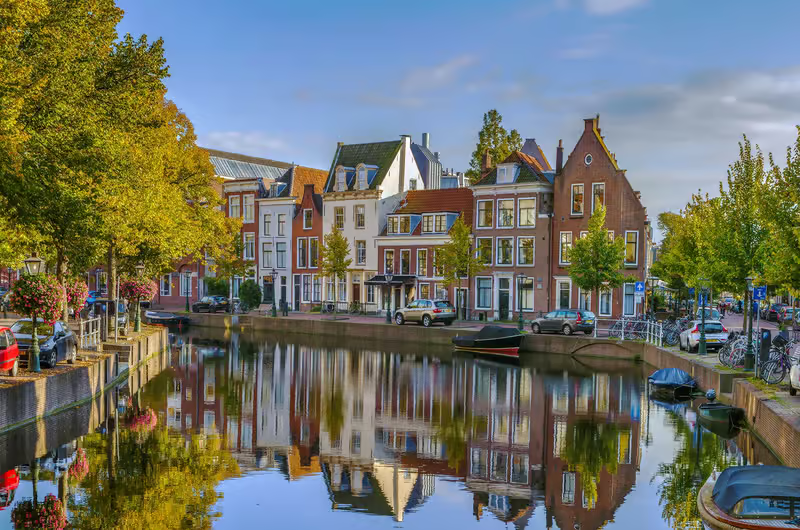
Back in his student years in Leiden, the King was nicknamed the ‘Prins of Pils’ a.k.a ‘Prince of Beer,’ as he was, on more than one occasion, seen showing his love for the alcoholic beverage. 🍻
Some reports claim that the young Prins of Pils even managed to drive a car into one of the canals of the student city of Leiden. I mean, who hasn’t drunkenly messed up on this scale?!
That time the Dutch King found his Queen
King Willem married the lovely (now) Queen Maxima on February 2, 2002. What King Willem lacks in quick wit, intelligence, and beauty, Queen Maxima delivers! 👸🏼
Queen Maxima hails from Argentina, and as flawless as she is now, she wasn’t when she married this Dutchman.
Her father was a Minister of Agriculture during Argentina’s brutal dictatorship. Many in the government opposed this particular connection, and the marriage wasn’t welcomed by all.
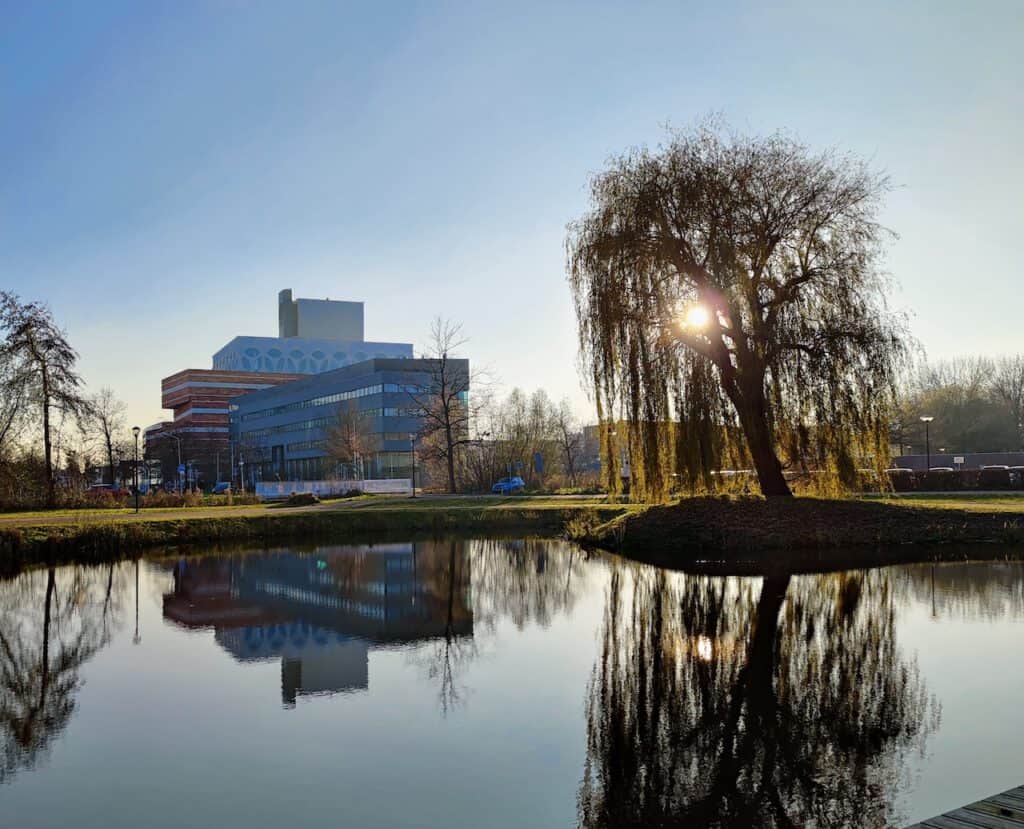
Leiden has always had a habit of being ahead of its time. The city where the Pilgrim Fathers found refuge, where Albert Einstein kept a professorship, and where the modern ECG was born is now applying artificial intelligence to hunt for tomorrow’s medicines.
Leiden University’s motto is Praesidium Libertatis, “Bastion of Freedom.” Since its founding in 1575, it’s been the kind of place where unconventional thinking is actively encouraged.
Bold thinkers have been gravitating here for centuries, and the results have been extraordinary.
A city that collects world-changers
The Pilgrim Fathers spent over a decade in Leiden before sailing to America on the Mayflower in 1620, drawn by the city’s reputation for tolerance and free thought.
As we’ve written before, Leiden shaped them in ways that would go on to define a nation.
Einstein was next in line. In 1920, Albert Einstein became a bijzonder hoogleraar (special professor) at Leiden University. As a result, he came to the city regularly for a few weeks a year, enjoying the idea of such a “comet-like existence in Leiden.”
In the 17th century, Leiden was already known for tolerance and freedom. Image: Dreamstime
His close friendship with physicist Paul Ehrenfest made it feel like a second scientific home, and he visited regularly to meet fellow physicists, discuss his theories, and play music together.
He wasn’t the last Nobel laureate with ties to Leiden, however. Willem Einthoven, professor at Leiden University from 1886 to 1927, developed the first practical electrocardiograph and pioneered the ECG as a clinical tool, work that earned him the Nobel Prize in Physiology or Medicine in 1924.
In total, sixteen Nobel laureates have studied, taught, or conducted research at Leiden University over the centuries, and the city of knowledge continues to change the world of medicine.
From the lab to the medicine cabinet
Leiden University’s approach to drug discovery has always been unusually practical for an academic institution.
That work spans chemists, biologists, medical researchers, and computer scientists. Researchers in Leiden have contributed to developments in areas including cancer immunotherapy, muscle disease research, and malaria vaccines, often working in close collaboration with the Leiden University Medical Centre (LUMC).
Researchers often work closely with LUMC. Image: Magnific
On the research side, recent work from Leiden includes a “super antibiotic” developed to control a dangerous gut bacterium at a low dose, and mini organs-on-chips being explored as an alternative to animal drug testing.
However, the LUMC has also proven its capacity for frontline emergency care, most recently in 2026 when it received patients evacuated from the hantavirus outbreak aboard the cruise ship MV Hondius.
The machine learning medicine cabinet
Leiden has always found new tools to push medicine forward, and now it’s applying that same spirit to AI drug discovery software.
The Leiden Early Drug Discovery & Development network (LED3) brings together more than 250 researchers and staff with expertise spanning artificial intelligence, medicinal chemistry, molecular biology, pharmacology, metabolomics, structural biology, and toxicology.
One researcher worth knowing about is Gerard van Westen, an AI and medicinal chemistry expert at Leiden University.
Van Westen uses decades of bioactivity and medicinal chemistry data to train models that predict how candidate drugs interact with proteins in the human body, with a vision of rethinking how drug discovery works in the 21st century.
Traditionally, finding a viable drug candidate takes years of costly trial and error. AI models can help researchers identify promising compounds more quickly than traditional screening methods, which matters enormously when you’re working against diseases that have resisted treatment for decades.
The park where it all comes together
The physical home of much of this work is Leiden Bio Science Park, right next to Leiden central station.
It’s the Netherlands’ largest life sciences cluster, with researchers, startups, and multinationals working across vaccines, regenerative medicine, and medical technology.
The park is anchored by Leiden University and LUMC, and is home to global players like Janssen and Astellas alongside Dutch biotech firms.
The Leiden Bio Science Park is where it all comes together. Image: Abuzer van Leeuwen/Supplied
Eli Lilly recently announced a €2.6 billion investment in a new manufacturing facility connected to the park. Meanwhile, startup Idris Oncology is building cancer diagnostics on site, with the long-term goal of detecting tumours before symptoms appear.
Across the city, PLNT is where students and early-stage founders turn ideas into companies.
Rapidemic, one of the park’s younger diagnostics startups, splits its time between the Bio Science Park lab and PLNT, and recently received a $2.7 million grant from the Bill and Melinda Gates Foundation to develop rapid STI tests. Not bad for a small team out of Leiden.
From the Pilgrims seeking a city that valued free thought, to Einstein debating relativity at his friend’s house, to researchers training AI on decades of medicinal data to find the next antibiotic, something about Leiden keeps attracting people who want to figure things out.
Did you know about Leiden’s scientific legacy before reading this? Or do you work in or around the Bio Science Park? Tell us in the comments!
With Simyo’s snazzy new international data bundles, you can wave doei to scary roaming charges and hoi to affordable, stress-free connectivity while abroad.
Sure, the EU has its handy “roam like at home” policy, but travelling outside of the EU can get very expensive very quickly. Before you know it, your mobile bill could get even scarier than the thought of taking a red-eye flight next to a screaming baby.
Luckily, Simyo has a little something up their sleeve to keep those costs manageable. Let’s dive in! 👇
Simyo: Why this provider is SIMply the best
Not only was Simyo voted the best mobile provider in 2025 by the Dutch Consumer’s Association, but they’ve also racked up a truly impressive 35 awards in their trophy cabinet.
While they’re marketed as a “budget” provider, they consistently outcompete the Netherlands’ biggest providers in terms of quality, reliability, and customer service.
Plus, their plans run on the highly awarded KPN network, giving you access to one of the strongest and most reliable signals in the country — for a fraction of the cost of a standard KPN plan.
Premium network access for a discounted price? Sign us right up! Image: Freepik
As internationals ourselves, we’re also big fans of the fact that Simyo offers their SIM-only plans in eSIM format.
This gives us the freedom to purchase a plan (including an international bundle) within minutes. There’s no need to set foot in a brick-and-mortar store or stress about needing a SIM card thirty minutes before your flight.
From the US to Egypt, Simyo now covers these countries
Reflecting their diverse customer base, Simyo has expanded their coverage to include data bundles for several non-EU countries.
While these bundles vary in terms of data and price, most offer you around 10-20GB for €20-35, with coverage for up to 31 days. They may not offer unlimited data, but they’re significantly cheaper than activating data roaming on your Dutch SIM card.
So, whether you’re heading to visit family in Turkey, going on a business trip to the US, or exploring the wilds of South Africa, Simyo has a plan for you.
Here’s the current list of destinations where you can activate an international data bundle:
Canada,
the Caribbean Netherlands,
Egypt,
Indonesia,
Morocco,
Serbia,
Singapore,
Thailand,
Turkey,
the United States,
and South Africa.
The only catch is that you’ll need to be a Simyo SIM-only user to apply for these bundles. (Sorry, prepaid users!)
Are the bundles worth it? Let’s talk price and value
If you’re travelling home from the Netherlands and don’t want to swap out your Dutch SIM card for a local one, Simyo offers you a great alternative in their international data bundles.
These bundles can be purchased as add-ons to your SIM-only plan.
As they’re factored into your bill at the end of the month, you needn’t worry about paying the costs upfront or while you’re on the road.
Whether you’re touring the wilds of South Africa or the beaches of Indonesia, these eSIMs are a handy travel companion. Image: Freepik
And, even better? Simyo’s data bundles might even be cheaper than certain travel eSIMs.
Take Simyo’s Canadian data bundle, for example.
A 31-day bundle offers you 10-20 GB of data for around €25 to €35, which is a far cry from the €85 to €90 that some travel eSIMs cost for a similar number of days.
However, if you’re a heavy data user, you might find Simyo’s data limits a little underwhelming. There’s no unlimited data option, and the number of GBs in each package tends to vary depending on which location you choose.
Here’s how to activate your foreign data bundle
We aren’t tech wizards over here at DutchReview, so we really appreciated the sheer simplicity of it. There were no fussy email downloads, no QR codes, and no multi-page list of instructions to read through.
All you really need to do to activate one of Simyo’s data bundles is:
Check Simyo’s website to see if there’s an international bundle available for your destination,
Choose the amount of GBs you want for your trip,
Send an SMS with an activation code to 1330, and
Enjoy your data, stress-free!
And, if the data in your bundle is running out, it’s simply a question of texting a short activation code to 1330 and… boom, more data.
So, should I try Simyo’s bundles on my next trip?
As a workplace full of internationals, we found these bundles a great alternative to travel eSIMs.
While they’re especially handy for existing Simyo users with family outside the EU, the ease of sign-up and activation means they’re also a solid option for internationals who want to switch to an expat-friendly provider.
Combining excellent service with wallet-friendly prices and features tailor-made for internationals, these bundles are a stellar alternative to regular travel eSIMs. Image: Freepik
In our opinion, if you’re only away for a week and can live off your family’s WiFi connection, getting one of these bundles may be a waste of money.
However, if you’re travelling the world for a few weeks and want to avoid the hassle of juggling multiple SIM cards, Simyo’s bundles are an excellent choice.
Would you try one of Simyo’s international data bundles on your next trip home? Share your thoughts in the comments below!
We all thought arcade culture saw the last of its heyday 20 years ago. However, it’s managed to make a strong comeback in the past decade, and we can partly thank the Netherlands for its roaring return. 🇳🇱🕹️
Arcades in the Netherlands were bustling hubs in the ‘80s and ‘90s. Children and teenagers alike could leave school stress behind and spend hours trying to beat their high score.
As mobile apps became an indispensable part of people’s lives, Pac-Mac and pinball machines quickly became a thing of the past.
Nevertheless, in recent years, the Netherlands has established a multitude of new arcades, enabling the world of coin-slotted machines to flourish once more. 🎉
From old-school classics to modern-day VR, here are 17 arcades in the Netherlands that’ll make you fall in love with gaming all over again!
1. TonTon Club
One way arcades could bounce back in the 21st century was by combining two popular, worldly pastimes: drinking booze and playing games. From this, arcade bars were born. 🍻
Beer drinkers and gamers are welcome at arcade bars in the Netherlands! Image: Pexels
One of the first arcade bars to reach the Netherlands is the TonTon Club in Amsterdam! Renowned for its welcoming atmosphere, fine beer selection, and variety of old, nostalgia-inducing games, this place knows how to game in style.
Die-hard gamers and newcomers can take a trip to the past with Mortal Kombat and the pinball machine, or if reimagined classics are your thing, they also have Dance Dance Revolution and Mario Kart!
Of course, all that gaming requires some sustenance, and TonTon Club happens to come with an exciting fusion of Japanese and American-style cuisine. You know what that means… milkshakes and ramen burgers! 🍔
📍 Location:Polonceaukade 27, 1014 DA Amsterdam 💰 Cost: Tokens cost €1 each or €5 for 6 tokens. ⏰ Opening hours: Wednesday, Thursday, and Sunday: 4 PM to 1 AM; Friday: 2 PM until late; Saturday: 1:00 PM until late.
2. Blast Galaxy
A blast from the past. Image: Blast Galaxy
Okay, gamers, sentimentality is real with this one. We can all tip our hats to the creators of Blast Galaxy for replicating arcade centres from the ‘80s or ‘90s almost to the tee.
This is the go-to arcade in Amsterdam if you’re looking to kill an afternoon (or more) binge-playing old-fangled masterpieces, like Donkey Kong, Pac-Man, Millipede, Street Fighter, Galaga… need we go on? 😉
Blast Galaxy is filled to the brim with vintage arcade cabinets, and you won’t have to worry about blowing all your coins at once.
Instead, the arcade offers a ticket upon entrance that can be used to play any game for as long as you want.
📍 Location:Magneetstraat 5, 1014 CC Amsterdam (Sloterdijk) 💰 Cost: Entry ticket for €15 ⏰ Opening hours: Wednesday: 12 PM to 6 PM; Thursday: 4 PM to 11 PM; Friday: 4 PM to 12:30 AM; Saturday: 12 PM to 12:30 AM, Sunday: 12 PM to 8 PM.
3. Gamestate
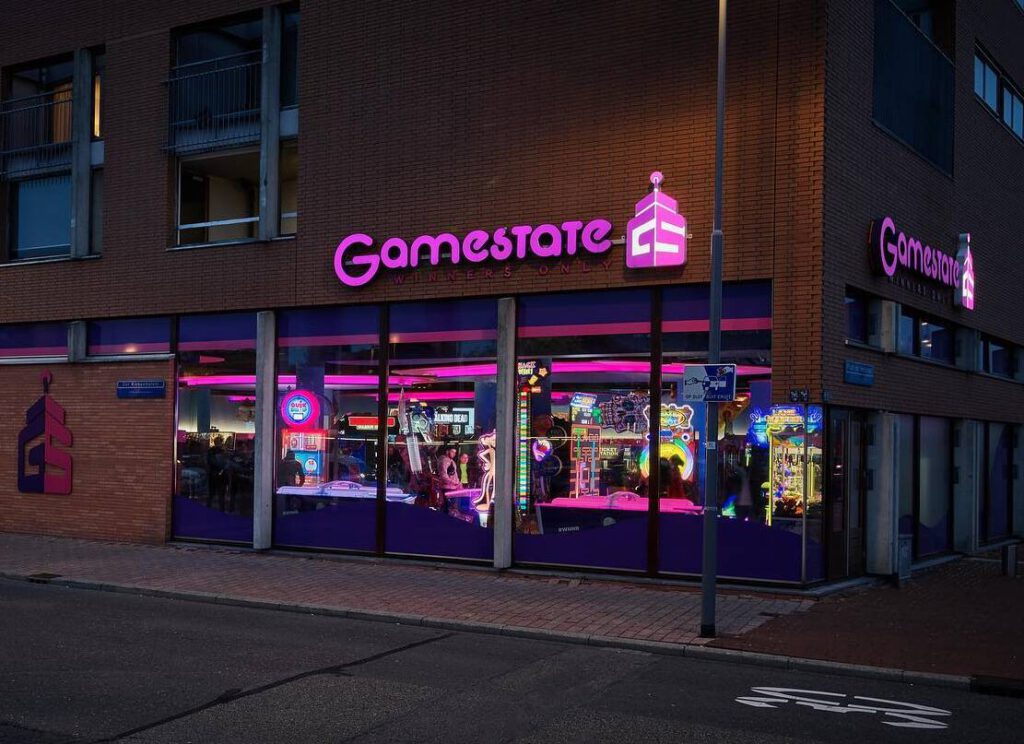
Gamestate opened in 2013 and later became the biggest arcade chain in the Netherlands. It also operates in Belgium, Germany, Poland, and Slovakia.
Now, their neon storefront sign can be seen across a handful of Dutch cities in the Randstad.
One of the largest arcades in the Netherlands is right up your alley. Image: Gamestate
Their shtick revolves around being a family-friendly gaming centre, where winners can exchange cash for prizes. So basically a Dutchified version of Chuck E. Cheese, only without the rat mascot and recycled pizza slices. 🍕
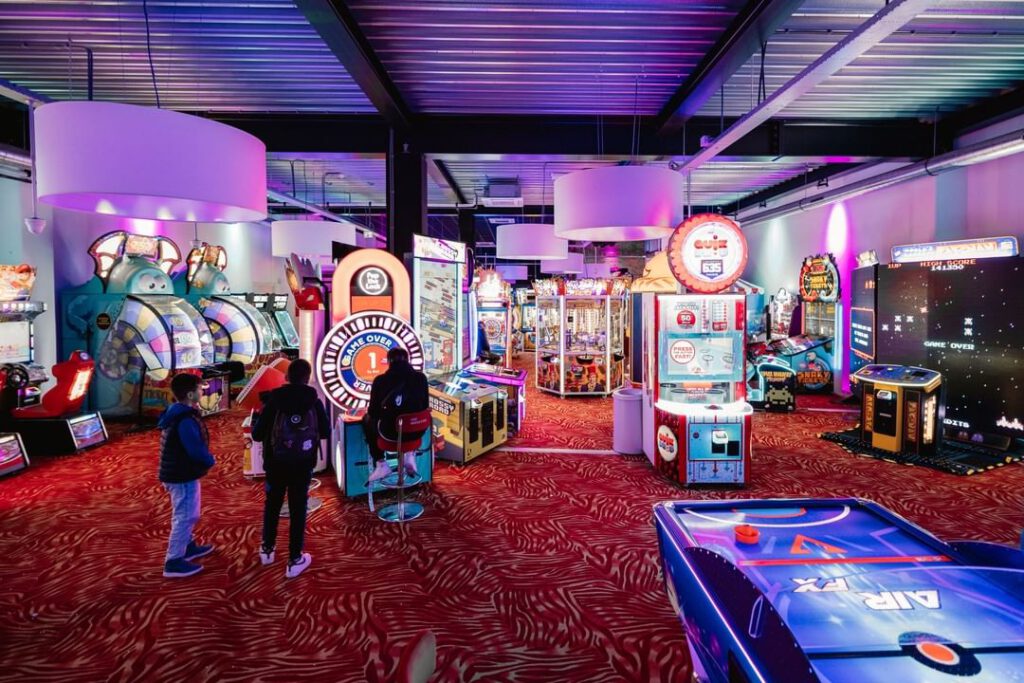
However, if you’re looking for old-school retro vibes, you won’t find them at Gamestate. This place takes a more contemporary angle on arcades, offering a selection of carnival-type games to gamble your time away with.
Virtual reality has revolutionised the gaming world in ways we never thought possible a few years ago.
In the Netherlands, VR technology has experienced a huge increase in demand to the point that now, it can be seen in almost every arcade centre.
Playing VR for the first time is an experience you’ll never forget! Image: VR Game Park
One such arcade that caters to a new generation of video games is VR Game Park in Amsterdam. With over 600 square metres of space, everything this underground arcade offers comes in sensational 4D simulations. You can also find them in Eindhoven and Den Haag.
Each virtual simulation allows you to envision yourself in exhilarating situations: riding on a steep roller coaster, stealing dough in a heist, or hunting zombies in an apocalypse. 🧟
📍 Location:Overhoeksplein 15, 1031 KS Amsterdam 💰 Cost: The pricing depends on the chosen package, group size, location and time of booking. ⏰ Opening hours: Every day 10 AM to 8 PM
5. National Video Game Museum
A strong contender fighting for the title of “best arcade in the Netherlands” is the National Video Game Museum in Zoetermeer.
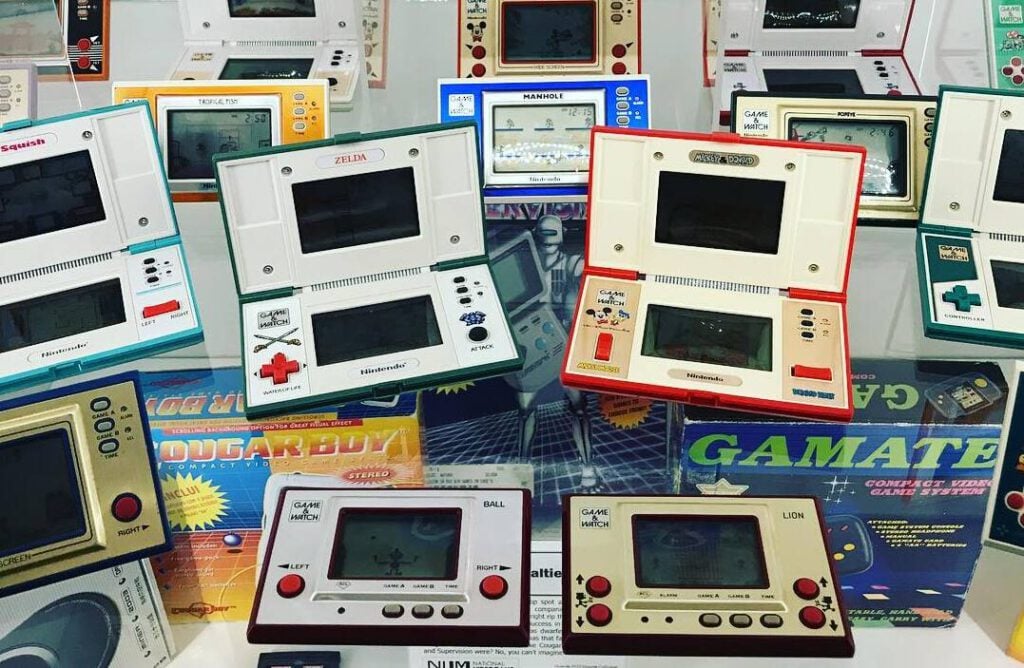
With more than 50 vintage arcade cabinets on display, this spacious arcade lets you relive the glory days of old-time gaming.
Just take a look at this vintage collection of Nintendos! Image: National Video Game Museum
It all began as a community project led by a few passionate Dutchies. And now? The arcade has grown so they’ve gained recognition from big brands such as Nintendo and Microsoft.
One aspect that makes this arcade extraordinary is that it consists of little areas designed as antique living rooms.
These were specially built to give patrons the true experience of playing video games as an ‘80s kid at home rather than on a generic metal bar stool.
📍 Location:Theaterplein 11, 2711 EK Zoetermeer 💰 Cost:Ticket prices vary depending on how many hours you wish to play ⏰ Opening hours: Wednesday and Friday: 12 PM to 6 PM; Saturday and Sunday: 10 AM to 6 PM
6. The Dutch Pinball Museum
In the days before video games, arcades in the Netherlands were chock-full of pinball machines.
People might not realise, though, that an incredibly broad array of pinball machines were produced over the years.
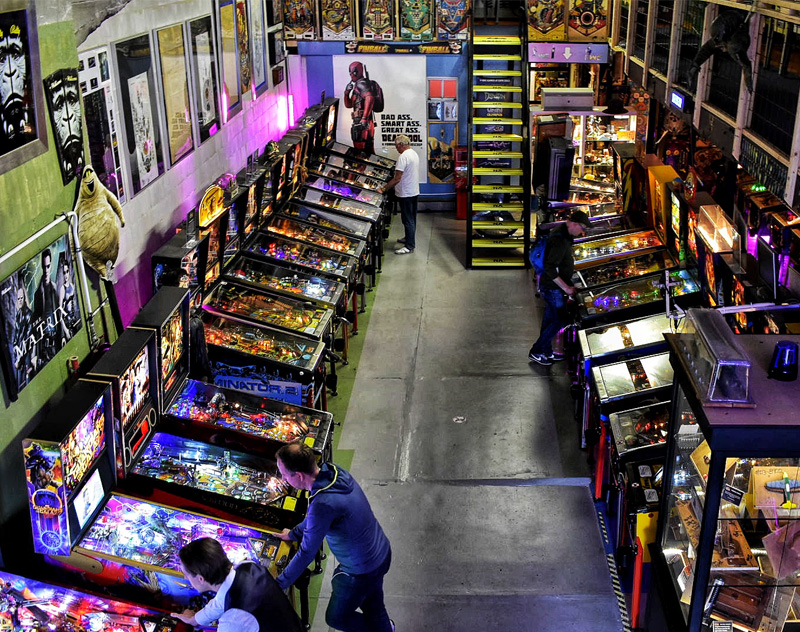
Have you ever seen an arcade with this many pinball machines in the Netherlands? Image: DutchReview
However, only a few stood out as all-time classics, and the Dutch Pinball Museum in Rotterdam honours them.
If you consider yourself an old-timey pinhead (no, not that kind of pinhead), then a visit to this museum is a must. It has about 100 pinball machines to play on, and some even date as far back as the ‘30s and ‘40s. 👾
📍Location:Voorhaven 12, 3024 RM Rotterdam 💰 Cost:Depends on the day and kind of ticket ⏰ Opening hours: Wednesday: 12 PM to 5 PM; Saturday and Sunday: 11:50 AM to 6:10 PM
7. Enversed VR
A virtual reality centre that’s gained quite a popular rep in Europe, Enversed VR allows you to immerse yourself in video games as the main character you always knew you were.
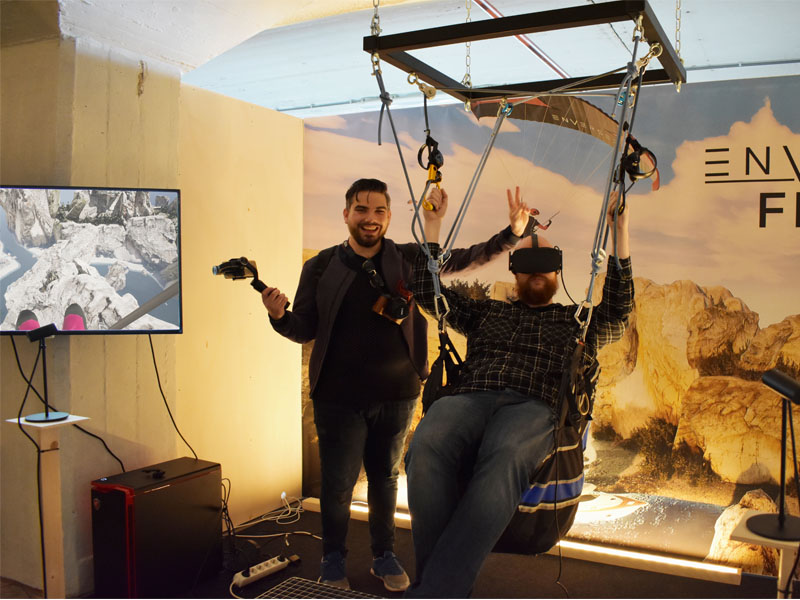
Who needs to do real paragliding when you’ve got VR? Image: DutchReview
Located in Eindhoven, this place allows you to play out all your child-like fantasies and experience things you otherwise couldn’t in the real world.
Step into the virtual world by solving challenging puzzles in an escape room, shooting huge paintballs from the sky with a bow and arrow, or becoming a resistance fighter in a dystopian society.
📍 Location:Torenallee 100-02, 5617 BE Eindhoven 💰 Cost:Varies by the kind of VR escape room and the number of people ⏰ Opening hours: Wednesday and Thursday: 2 PM to 7 PM; Friday: 1 PM to 7 PM; Saturday: 11 AM to 7 PM; Sunday: 11 AM to 6 PM
8. Amaze VR
Woners (residents) in the Netherlands can consider themselves lucky to experience the cutting-edge technology that is virtual reality, and in almost any city. If you’re casting around for a good VR centre in The Hague specifically, Amaze VR is your best bet.
Located centrally, Amaze endeavours to provide a compelling experience: once you put the headset on, you will magically spend hours in a different world.
Their arcade supplies over 50 highly-rated VR games to play, where you can join a group of spies on a mission, become a detective to decipher clues, and so much more. Rest assured that you can let your imagination run wild here.
📍 Location:Torenstraat 140, 2513 BW Den Haag 💰 Cost: VR arcade: €35; VR escape room: €35; VR zombie shooter: €79 (for two people) ⏰ Opening hours: Monday to Thursday: 12 PM to 8 PM; Friday: 12 PM to 10 PM, Saturday: 10 AM to 10 PM, Sunday: 10 AM to 8 PM
9. Bonami Games and Computer Museum
A nostalgic kick and any nerd’s paradise, Bonami Games and Computer Museum in Zwolle is the hidden gem you didn’t know you were missing. It’s by far the coolest place to be for gaming aficionados.
— RetroWizzard@oldbytes.space (@RetroWizzard) August 10, 2021
Everyone can turn back the clock and re-live their childhood with the largest collection of old PC games, computers dating back to the 1950s, and vintage arcade cabinets.
With up to 250 square metres of space, you can easily lose all sense of time drooling over the copious amounts of collector’s items and retro technology — and the best part? These old machines can actually be played. So, prepare for gamer’s thumb!
It also gives those who were born after the decline of arcades to get a true, educational experience of playing on authentic consoles — just as their parents once did.
📍Location:Ossenkamp 4, 8024 AE Zwolle 💰 Cost: Children up to 4 years: free; 5 years and above: €18.50 per person ⏰ Opening hours:Varies per day
10. Molly’s Arena
Inspired by the bustling shopping district of Akihabara in Japan, Molly’s Arena in Amsterdam is a mecca for any Otaku or casual watcher of anime.
The arcade centre opened its doors to appreciate Japanese pop culture by offering a wide range of manga-themed video games to play. Needless to say, it’s heaven on earth for any weeaboo gamer.
Since it’s on par with the goods served in Japan, you can expect their food selection to include traditional Asian cuisine, from fluffy pancakes to delectable ramen with the right level of spiciness. 🍜
📍 Location:Osdorpplein 771, 1068 TC Amsterdam 💰 Cost: Choose between three starter bundles that include a smart card and game credits ⏰ Opening hours: Wednesday to Thursday: 12 PM to 10 PM; Friday to Sunday: 11 AM to 10 PM
11. Zero Latency VR
We all know VR centres score big in the Netherlands, but perhaps you haven’t yet found one that offers a completely wireless setup.
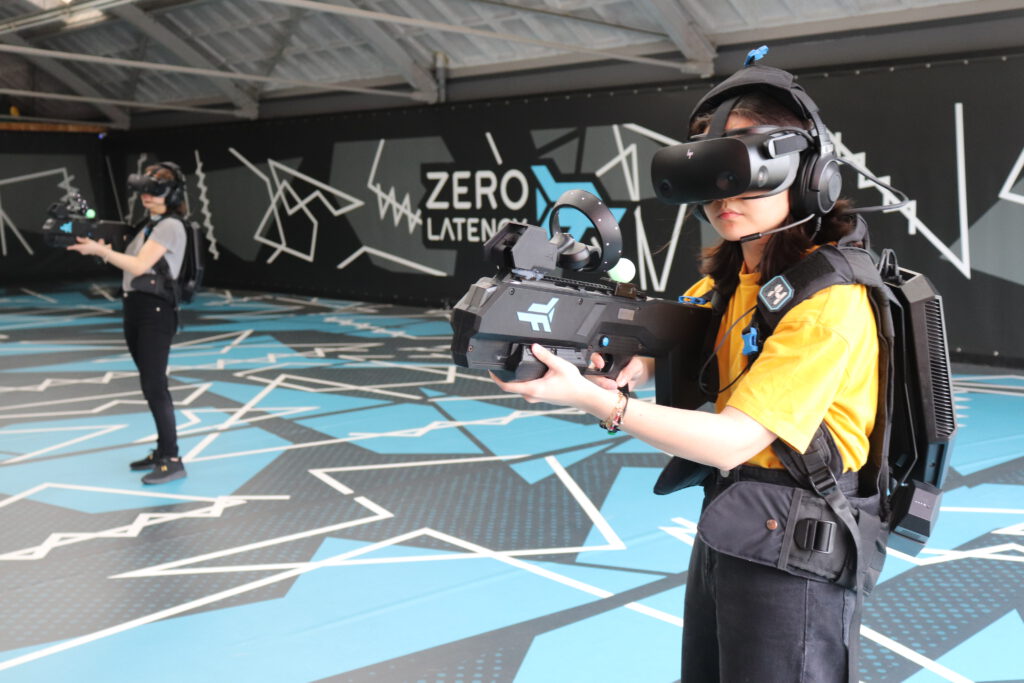
All suited up and ready for action! Image: Maarten Peelen
To expedite your hunt for free-roam VR gaming, Rotterdam boasts Zero Latency VR, a centre which gives players the ability to traipse in the virtual world without worrying about tripping on tangled wires.
Once you choose one of the eight video games to play, you’re then suited up with a high-powered computer, a super cool vest, and a top-notch headset. The arcade also comes with a huge space for players to walk around and explore the virtual world with ease.
📍 Location:Amsterdam, Rotterdam, Utrecht 💰 Cost: €39 per person for each video game package ⏰ Opening hours: Tuesday to Friday: 3 PM to 10 PM; Saturday: 11 AM to 10 PM; Sunday: 11 AM to 7 PM
12. Sir Winston Fun & Games
Centred around being a family-friendly hub, Sir Winston Fun & Games is a great choice if you’re looking to kill a rainy afternoon playing funfair-style gambling games and arcade cabinets.
The perfect mixture of fun-fair and retro arcade games. Image: Sir Winston Fun & Games
Similar to Dave & Buster’s over in the US, this arcade uses the age-old system where you can win prizes by collecting tickets from the various games on display. It also offers a small menu consisting of finger-bite foods like chicken wings, frietjes, and burgers.
The only drawback? Arcades like this largely cater to big families, so on a regular weekend, expect it to be home to adults and (screaming) children alike.
Anyone who’s ever been to the famous Scheveningen Pier in The Hague has no doubt heard about the arcade hall around the corner!
A familiar name amongst Dutchies since 1985, Hommerson Funland guarantees a good time for hardcore gamers and newbies alike.
Whether you’re 12 or 70 years old, folks of all ages can find fun at this arcade in the Netherlands. Image: Pexels
Go wild with old-timey classics like Pong and Pac-Man, as well as newly developed mainstreams like Flappy Bird and Dancing Stage, all set up for you in the arcade.
Though we can argue that the best part of the arcade, which truly sets it apart from the rest, is that folks can play a wide range of games while enjoying a gorgeous view of the beach. 🌅
📍 Location:Gevers Deynootweg 990-8, 2586 BZ Den Haag 💰 Cost: Entrance is free. Individual games are paid for with “Funland coins” or regular euro coins. ⏰ Opening hours: Sunday to Thursday: 10 AM to 10 PM; Friday and Saturday: 10 AM to 1 AM
14. The Games Guild
One of the most highly-rated places in the Dutch city of Alphen aan de Rijn, The Games Guild is a small, yet vibrant arcade that’s garnered plenty of attention from a close-knit community of gamers.
This arcade in the Netherlands is any D&D player’s best friend. Image: The Games Guild
Its founders strived to bring digital communities together by offering like-minded gaming enthusiasts a space to connect and play with each other.
The arcade has several rooms serving different purposes, each stuffed wall-to-wall with retro technology. So, trust that you can satisfy all your gaming needs here with ubiquitous classics like Dungeons and Dragons and Super Smash Bros.
If you’re looking to play from a sweeping collection of funfair-style games and traditional arcade machines in a single day, then The Game Box is sure to give you maximum bang for your buck.
Eat, play, and win at this arcade in the Netherlands! Image: The Game Box
Open all year round, this arcade offers the latest hip games, from air hockey to basketball, as well as racing simulators and pinball machines. They’ve also managed to raise the stakes by giving folks something that no other arcade in the Netherlands has: bumper cars!
In addition, you can win tickets through some of the games, which you can then exchange for great prizes. The arcade nailed the Dutch crowd; because of this, it became available in multiple cities across the lowlands!
Preserving arcades, as we once knew them, grows more difficult in the Netherlands as the gaming industry becomes overwhelmingly online.
However, there is hope in boundary-pushing companies that aim to evoke nostalgia and celebrate the classic machines by creating a place for them in today’s world. 🕹️
Have you visited any of these arcades in the Netherlands? If so, which was your favourite? Tell us in the comments below!
Three couples said “I do” at Amsterdam City Hall on April 1, exactly 25 years to the day since the Netherlands made history as the first country in the world to legalise same-sex marriage.
Amsterdam Mayor Femke Halsema officiated the weddings herself, calling it “one of the most special moments as mayor.”
According to RTL Nieuws, the ceremony was attended by Prime Minister Rob Jetten, who became the Netherlands’ first openly gay prime minister after D66’s election win last year (and who has his own wedding plans in the pipeline).
A quarter century of history
On April 1, 2001, then-Mayor Job Cohen married four same-sex couples at the same city hall, in what became global news overnight.
Cohen was present again last night, and Halsema quoted his words from that day on social media: “Soon you will be able to say ‘we are married,’ and that sounds a lot better than saying ‘we are partnershiped.'”
Since that first ceremony, more than 36,000 same-sex couples have married in the Netherlands. The country’s lead has since been followed by more than 30 others, though the majority of the world still hasn’t caught up.
‘I belong, just like everyone else’
Jetten addressed the three couples personally, wishing them a happy marriage.
In a social media post afterwards, he reflected on what the original 2001 weddings had meant to him at just 14: “Thanks to the couples who led the way back then, as a 14-year-old teenager, I saw confirmed what I still doubted inwardly: I belong, just like everyone else.”
He was quick to add, however, that nothing should be taken for granted.
“This acquired right is not a self-evident right,” he said, adding that the best response is to do what the couples did, giving each other “the most important place in your life in front of everyone.”
Where were you when same-sex marriage became legal, and what does this 25th anniversary mean to you? Let us know in the comments.
Dutch pantry staples Calvé, Knorr, and Hellmann’s are about to get a new American owner, as Unilever has agreed to merge its entire foods division with US spice company McCormick.
On March 31, the Anglo-Dutch brand Unilever announced it would fold its food division into McCormick & Company. Based in Maryland, the group is best known for its spices, seasonings, and hot sauces.
The merged group will keep the McCormick name, its US headquarters, and its New York Stock Exchange listing.
But the Netherlands isn’t entirely out of the picture.
What stays in the Netherlands
While the deal makes financial headlines — especially after Unilever’s food division was valued at around $45 billion — many Dutch consumers are more concerned with what the change means for their everyday favourites.
But rest assured, pindakaas fanatics, Unilever promised the Dutch cabinet in 2020 that it would retain its food division in the Netherlands in the event of a sale.
Honouring Unilever’s word, McCormick plans to set up an international headquarters in the Netherlands. Meanwhile, Unilever’s food innovation centre in Wageningen and headquarters in Rotterdam will also remain.
Today, we announced an agreement to combine Unilever’s Foods business with @McCormickCorp, creating a scaled, global flavour powerhouse and positioning Unilever as a pureplay HPC business.
Despite being (legally) considered a British company, Unilever chose to list its newest venture, the Magnum Ice Cream Company, on the Amsterdam Stock Exchange in 2025.
And, although the NOS reports that McCormick is planning a secondary European listing, whether the ball goes to the London or Amsterdam exchange is unclear.
The cabinet has already had a tête-à-tête with Unilever. Now, Minister of Economic Affairs Heleen Herbert plans to enter talks with McCormick.
Money talks
Once the deal is closed, Unilever will gain a whopping $15.7 billion in cash.
Together, Unilever and its shareholders (including BlackRock and Vanguard Group) will hold 65% equity of the merged entity. McCormick’s existing shareholders will own the remaining 35%.
Unilever’s portfolio has been dwindling since 2017, when it sold its origin story: the margarine brands Blue Band and Becel, to a US investment group. The renowned brands Conimex, Unox, and De Vegetarische Slager met the same fate.
The silver lining? Unilever itself retains a 9.9% stake in the new company.
This means that, while the new company will be officially American, the Netherlands will continue to influence its products. (A small but meaningful win for national pride in the country’s pantry staples!)
While the merger is expected to save around $600 million per year, its completion is targeted for the middle of 2027, pending regulatory approval and a vote by McCormick shareholders.
Update: Hold your horses and look at the publishing date. Hope you had a good laugh, and we’ll catch you next April Fool’s — and remember, always check your sources. 🤭
Dutch rail company NS has announced that, due to increased public transport usage and crowded trains, new “standing compartments” will be introduced across all major NS-run train networks.
As gas and energy prices continue to rise, NS expects a significant increase in train usage in the coming months.
To address the upcoming crowding, NS CEO Wouter Koolmees announced this week that new trains will be introduced ahead of King’s Day 2026. That’s just a month away!
What to expect
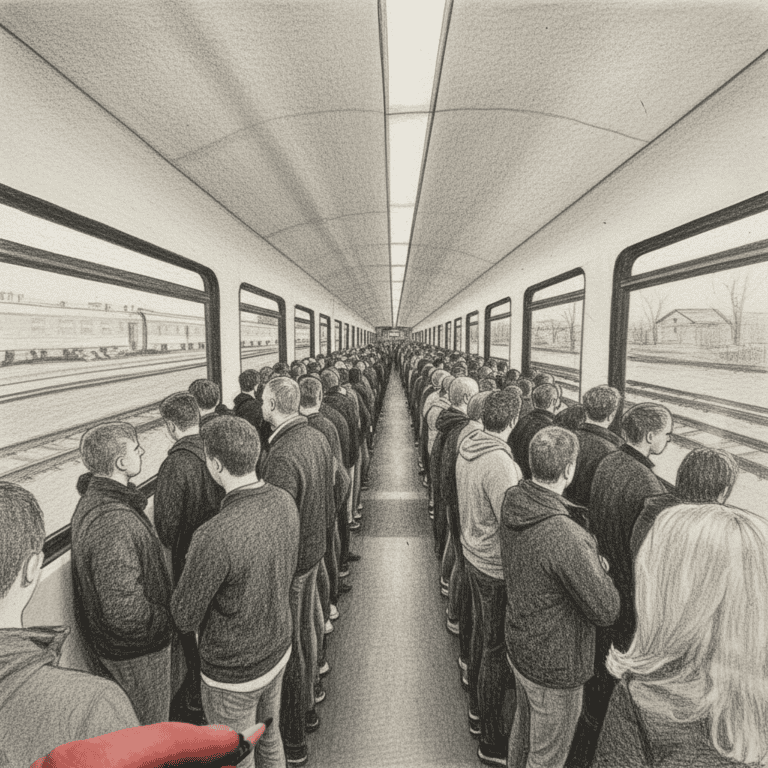
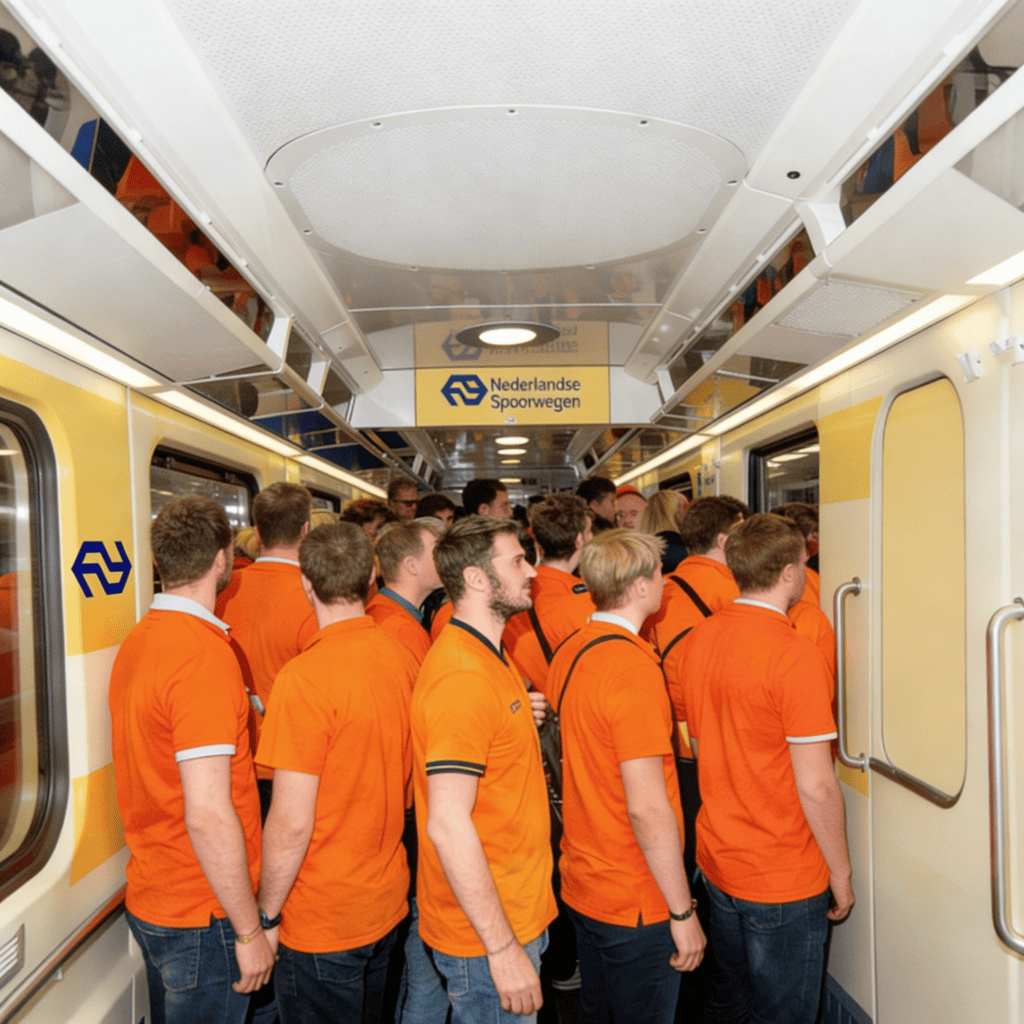
While the old trains have two main sections (first and second class), second class will be cancelled, and the new trains will include carriages for standing passengers.
The hope is to offset crowded rides during rush hour and accommodate new passengers switching from driving to public transport.
Here’s what things will be looking like come King’s Day 2026! Image: Freepik
Koolmees is optimistic about the plans: “We’ve had a long-standing desire to try this out,” he said earlier this week. “It’s time to get on our feet and make it happen!”
The new trains are already on their way to the major stations: according to reports, they’ll be fully functional by 27 April in order to properly flood Amsterdam for King’s Day.
Bicycle carriage
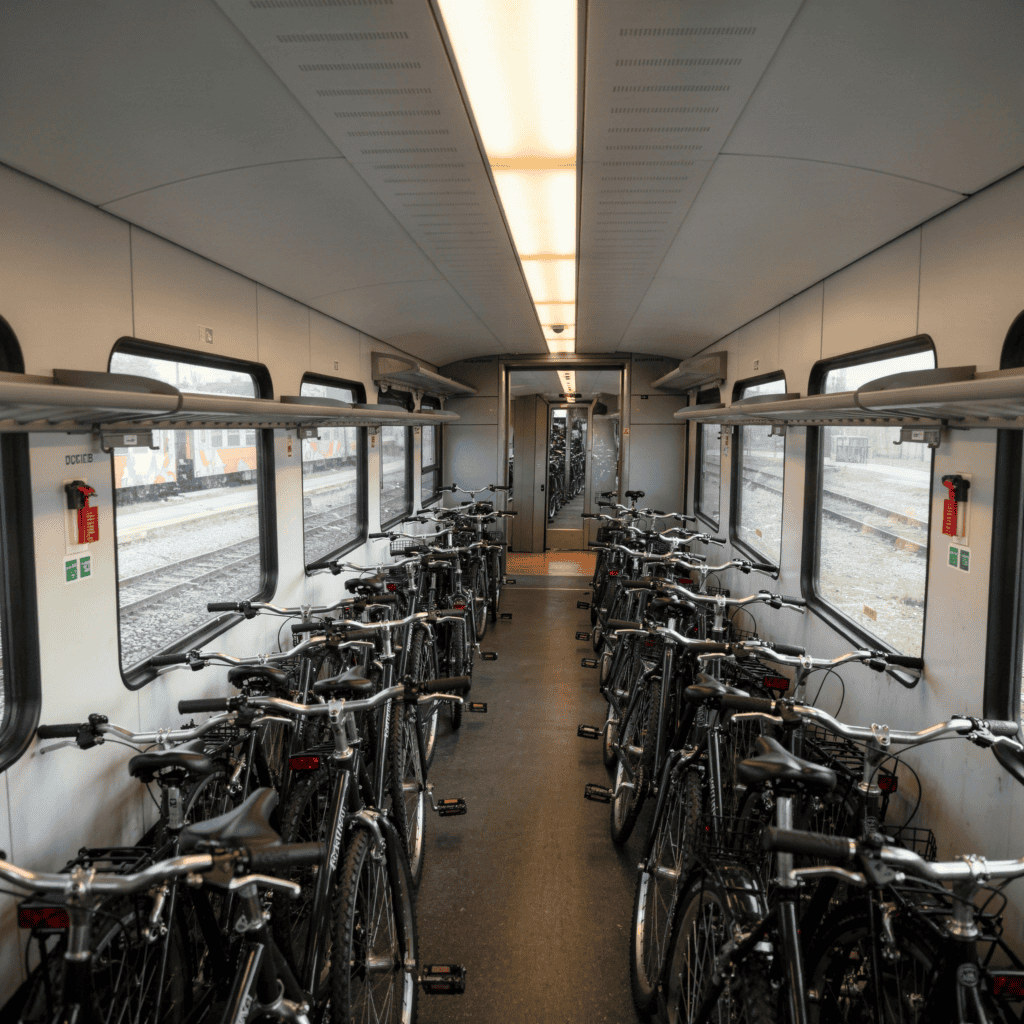
The new trains will also include a separate carriage for those with bikes, to keep them from getting in the way in other train cars.
Here’s what those bike carriages will look like, according to NS. Image: Freepik
These additional carriages will reportedly be able to hold up to 30 bicycles and their owners. It is still being discussed whether fatbikes will be allowed.
Jetten cabinet approves
The new cabinet is also on board. It’s been widely publicised that the new cabinet places public transport concerns high on its list of priorities.
In an effort to promote greater use of public transport, the cabinet is standing up for the NS and offering €265 million in funding to support the fast-paced initiative.
“I know where I stand on this issue,” Jetten said yesterday: “We need our trains to be fully optimised and ready to rail us into an upstanding future.”
What do you think of the new trains? Let us know in the comments!
The internet is full of financial advice, but one of the main mantras? Money kept in your bank account is dead money. You need to be investing.
Why? The argument behind this is pretty straightforward: money sitting in a bank loses value over time because inflation grows faster than interest rates on a traditional savings account.
But when it comes to putting your money somewhere where it’ll actually grow, many newbies feel overwhelmed by the options, the apps, and the possibility of losing their hard-earned cash.
So how do you start without risking it all? Here are five types of investments you could try (or at least investigate) as a beginner.
Everyone starts somewhere. Platforms like Lightyear make those first investing steps a little easier. With one simple app, they allow you to explore different tools, learn as you go, and see how your money grows over time.
Sign up with the code DUTCHREVIEW and get up to €100 to your account. T&C apply. Investing involves risk.
💡Disclaimer: Investing involves risk of losing some or all of your money. Speak to a qualified financial adviser if you have doubts.
1. Look into opening a high-yield savings account
You know that epic trip around the world you really want to take next year? Or that wedding you’re planning in two years and need to save up for? Those are both examples of short-term goals.
And to save up for short-term goals, you want to put your money in a place where you have guaranteed returns and where its value won’t fluctuate too much. Enter: high-yield savings accounts.
High-yield savings accounts are great for short-temr financial goals. Image: Freepik
They act as a solid parking lot for your cash while you figure out your long-term investments, and because you can typically access the money quite quickly, they are also a great place to keep your emergency fund.
However, high yield doesn’t mean a high return, so don’t expect to make a killing. The best options currently available offer interest rates of no more than 3% APY (as of November 2025).
Overall, if you want to keep your cash extra safe and still make at least a little bit on it, a high-yield savings account is a good bet.
2. Give Exchange Traded Funds (ETFs) a try
With your shorter-term wishes and dreams covered, it’s time to think about medium to long-term financial goals. So, where can you look if you want higher yields than the previously mentioned option?
The best place to start as a beginner is with Exchange Traded Funds.
An Exchange Traded Fund, aka ETF, is a type of investment fund that’s made up of various assets like stocks, bonds, or commodities.
The fund typically tracks the performance of a specific sector, such as tech or healthcare, or a specific market index, such as the S&P 500 (which looks at how the leading 500 companies on US stock exchanges are doing).
When the index goes up, the money you invested in the fund goes up as well and vice versa.
The handy thing about ETFs is that they can be bought and sold like stocks, meaning their prices fluctuate throughout the day, and you can trade them at any point when the stock exchange is open.
This makes them different from mutual index funds, which only trade at the end of the day and typically aren’t available to retail investors like yourself.
ETFs are a great option if you don’t want to research individual stocks. Image: Freepik
Why are ETFs a great pick for beginners? Firstly, they’re simple.
Since an ETF is made up of a portfolio of stocks and bonds, you don’t need to spend precious time digging into the performance of every single company to figure out whether its stocks are a good investment.
This comes hand in hand with another benefit: diversification. By investing in an index fund, you’re making sure that you haven’t put all your eggs in one basket.
ETFs have broad market access. This means you can invest in practically anything from emerging markets to specific industries like tech or pharma, or even commodities like oil and gold.
Because they are managed passively, the associated fees are typically lower as well. On top of that, you can access information about what they’re made up of, so you know exactly what you own.
💡 Pro-tip: Buying ETFs with Lightyear won’t cost you an execution fee (though the usual suspects like fund charges or currency costs may still sneak in).
3. Start a personal pension account
The great thing about investing is that you really can start small and simple. And by simple, we mean with a pension fund.
Pensions in the Netherlands are typically made up of two main pillars:
The first is the AOW (Algemene Ouderdomswet or National Old Age Pension Act), which is a basic pension provided by the government to anyone who lives in the Netherlands and pays income tax.
The second is an employee pension. Many companies offer this as a perk, but it’s not actually mandatory for an employer to pay your pension unless this is stated in your CAO (Collective Labour Agreement).
That is why many people in the Netherlands actually opt for a third pillar: a personal pension account. You can set one up through your bank, insurer, or other financial institution.
What are the advantages? Large pension funds invest money into things you might not access on your own, such as large infrastructure or alternative assets. And because you’re looking at a long-term investment, you don’t have to worry about short-term fluctuations in price.
There’s also a sweet perk that you can benefit from: Investments into a private pension account can be deducted from your taxes.
4. Move on to individual stocks
Stocks represent the more “classic” form of investing. What do we mean by that? Basically, you buy shares of an individual company, for example, Apple or Philips.
It’s a high-risk, high-reward type of thing where if your selected company does really well, you can make big bucks. However, if it does poorly, you can lose it all just as easily.
If, with time, you want to get serious about investing and aren’t deterred by doing a bit of research and checking out earnings reports, stock investing can be a great teacher.
Lightyear offers various options for investing. From earning higher interest by investing in savings to putting your money in funds and stocks, you can choose how you want to grow your money depending on your risk appetite.
Sign up with the code DUTCHREVIEW and get up to €100 to your account. T&C apply. Investing involves risk.
On top of that, investing in stocks gives you full control: you decide what business you support with your money and which ones you avoid.
However, as a beginner investor, you shouldn’t bet all your money on stocks. Start with just a portion and put the rest in diversified funds. As you become more advanced, you can adjust your strategy.
5. Try investing in a Real Estate Investment Trust
Let’s be real: buying a house in the Netherlands in the current housing market might not be a possibility for everyone. But what if you still want to have some of your money in real estate?
One thing you can consider is investing in Real Estate Investment Trusts. A REIT is a company that owns or produces real estate that generates income (think offices, shopping malls, apartments).
Can’t afford to buy real estate? You can always invest in a REIT instead. Image: Freepik
While you cannot invest in just any REIT, some are publicly traded, and you can buy shares like you would with a company. Similar to owning company shares, investing in REITs typically comes with investor voting rights.
REITs are obligated to distribute most of their taxable income, which means you can get regular dividends as an investor.
However, keep in mind that they are subject to other tax rules in the Netherlands than regular shares.
That being said, they are a great way to diversify your portfolio and have something that behaves differently from stocks and bonds.
Last but not least, it is a highly liquid product, meaning you can quickly convert your shares into cash (which is not always the case with a physical house).
While investing might seem scary for a newbie investor, there are relatively easy ways to start building up your portfolio.
Start small with lower-risk options, keep it simple, and remember, don’t put all your eggs in one basket. As your confidence grows, you can start looking into more complex and higher-risk options.
What is your experience with investing? Share your thoughts in the comments!
I am the furthest from handy. Though I’ve never touched a drill machine, moving to a whole new country requires you to whip out some handyman skills.
Luckily, I didn’t need to, because I chanced upon Fix That Now.
This Dutch platform is basically Tinder for people who need a professional handyman, contractor, cleaner, painter, electrician, plumber, and more.
It allows you to compare rates, find your match, and let someone else worry about how to install those bathroom shelves while you tackle life in the Netherlands.
Whether it’s the shock of learning that a lot of homes come without flooring or trying to unclog a tiny toilet, the struggle is real.
It can be a challenge to find a professional electrician, plumber, or general handyman when you’ve only just moved to the Netherlands. Image: Freepik
Add a language barrier to the mix, and you’re screwed.
Many online platforms take advantage of internationals by charging exorbitant rates for home services.
As a newbie in the Netherlands, I found myself in a dilemma. I refused to pay through my nose for odd jobs around the house, but I couldn’t do them myself either.
I posted my job (assemble a closet) on their website for free, included my budget, and within 24 hours, I had a freelancing handyman reach out to me through the website.
Here’s where it gets good: professionals willing to take on your job can send up to five quotes per listing.
These will all appear on your dashboard. No phone spam, just a clean overview where you can compare prices side by side.
Even better? Every professional is verified through the Chamber of Commerce, and you can see their badges and reviews.
Not sure if a handyman’s up to the task? You can review their badges and reviews. Image: Freepik
Although I was a bit suspicious of giving my phone number to Fix That Now, the platform only shared my digits once I accepted a professional’s quote.
After the job is done, you pay the professional directly. Just as agreed, no hidden fees.
A range of services
Fix That Now offers every service under the sun, from roofing, tiling, bathroom renovations, electrical work, plumbing, painting, deep cleaning, plastering, insulating, and more.
It’s especially handy for new internationals, as you can post multiple jobs at once.
Whether you need a freelancer for a quick job or a full company for a bigger project, this platform is for you.
Have you ever tried this service? Tell us your experience in the comments.