After years of an “unprecedented” (ugh, not that word again) coronavirus pandemic, the unthinkable has happened: the Dutch government has actually been told to respect conspiracy theorists? 🤯
Or at least, to approach them with what the Social and Cultural Planning Office (SCP) calls a more “curious attitude”, reports NOS.
You can’t sit with us
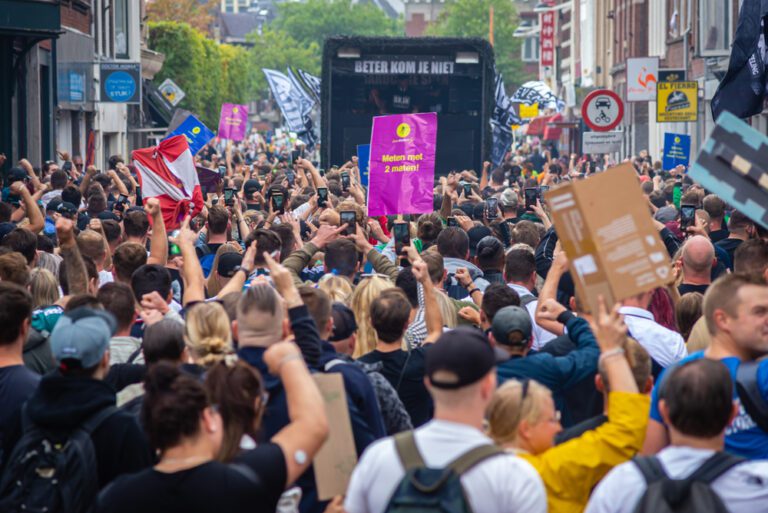
Why? Because the 20% of Dutch citizens who are anti-corona policy (ranging from full-blown “anti-vaxxers” to those feeling mildly sceptical) felt “excluded” and not “heard” during the COVID era.
After all, their disbelieving posts were flagged, demonstrations were banned, and they must have been told they were clinically insane at every family function on Zoom.
With their self-expression stifled, anti-establishment voices felt completely alienated from society, even during an already lonely lockdown, according to SCP findings.
Adding fuel to the fire
Researcher Joep Schaper believes social and political alienation experienced by sceptics in the past few years has only “fueled distrust” in the government even further.
Interviews from the SCP study (which surveyed over 2800 people) reveal that sceptics are convinced corona policies had more to do with some kind of totalitarian, sadistic “control” rather than “health”.
COVID-related skepticism also bleeds into other issues, apparently causing some to doubt whether the Ukraine war or “nitrogen debate”, or virtually anything the government tells them, is even real. Eek! 😬
Who are the sceptics? (And why do we all know one?)
Conspiracy theorists are said to be a “diverse” group of people with a range of backgrounds, “mental health” and social media usage. It turns out that distrust towards the government doesn’t discriminate.
However, according to corona sceptics, vaccinations do? That’s right, one interviewee believes those with COVID vaccinations were treated as superior and “pure” by management, while the unvaxxed were perceived as… dirty?
Worst riots in decades explode across Netherlands over Covid restrictions as PM calls rioters “scum of the earth.” @washingtonpost
It was almost likened to being in a minority — despite the fact that being vaccinated is actually a choice. 👀
Where did we go wrong?
Still, the Dutch government has been instructed to take a long, hard look in the mirror. They want to reevaluate how they managed to become the subject of so much suspicion in the last few years, which SCP points out, doesn’t happen “overnight”.
Regardless of differing views, the SCP notes that the “government is there for everyone” and no group of people should be dismissed as “lost” — especially if that group comprises one-fifth of the Dutch population.
Do you agree with this shift in governmental attitude? Sound off in the comments below!
The rain may have given us a short break from the sweltering heat, but now the summer weather we love has finally returned. (Just in time for a weekend full of fun in the sun! 😉)
After the rainstorms on Tuesday and the inconsistent weather on Thursday, we can say, without a doubt, that we are ready to ditch the raincoats for sunhats and swimsuits.
Luckily the Dutch weather is obliging us with a summery Friday and weekend weather that’ll make us think we’re on a tropical island instead of in the Netherlands. 🏝
Here comes the sun
Friday starts off nice and sunny in most parts of the country, reports Weeronline. Any lingering morning clouds in the west will then dissipate and give way to bright sunshine.
Meanwhile, temperatures will reach a balmy 21 degrees Celsius near the sea and a little over a sweltering 26 degrees Celsius inland.
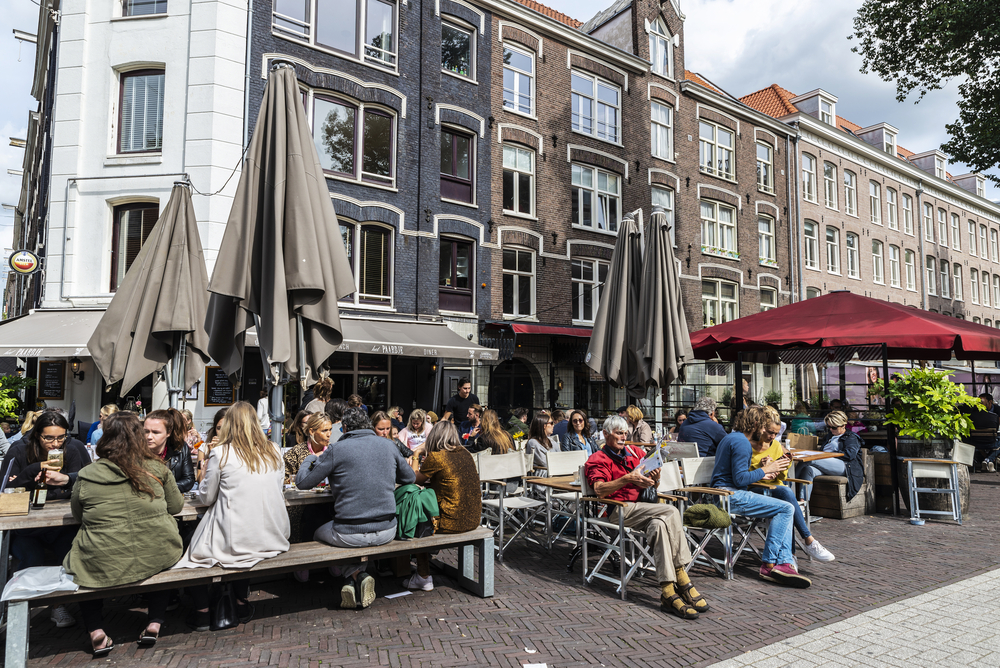
In the afternoon, a few cumulus clouds will pop up across the country with a small chance of rain. However, you needn’t worry about a storm wrecking your plans because the evening will be gorgeously sunny and warm. Terrasje time! 🍹
A summery Saturday
A good amount of sun is expected in most parts of the country, but there could be some clouds, especially in the northeast.
There’s a chance that these clouds could bring some rain, but most parts of the country are expected to stay dry and sunny. The temperature will mostly range from 24 and 27 degrees Celsius, but lucky Brabant and Limburg will feel highs of 28 degrees Celsius.
Putting the ‘sun’ in Sunday
Put on those summer dresses and shorts, because this Sunday is going to be ‘tropically warm’!
The coastal provinces will receive temperatures of 27 to 29 degrees Celsius while the southeast, however, will experience scorching temperatures of up to 32 degrees.
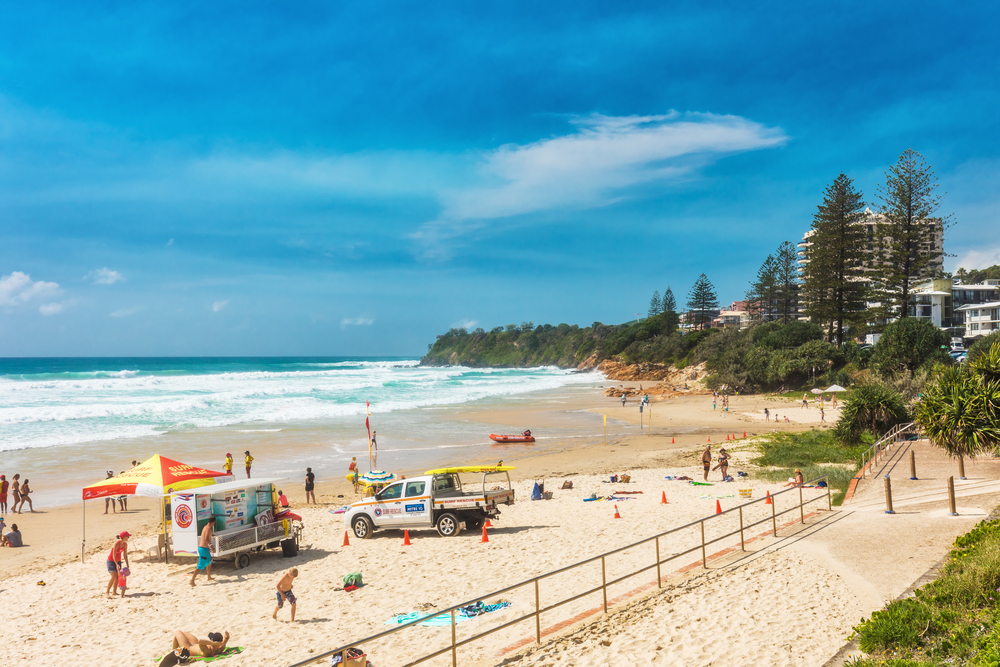
While this glorious weather will let you have a great beach day, don’t have so much fun that you forget your sunscreen! The UV index will reach a 7 or 8, which means you can turn into a tomato in a mere 10 to 15 minutes.
What fun-in-the-sun activities are you planning for this weekend? Tell us in the comments!
Forget bottomless brunch mimosas — instead, ditch your weekend plans for this unlimited booze cruise through Amsterdam’s canals 😂.
For a ridiculously affordable €29, you now can sip endless alcoholic beverages to your heart’s content on a boat tour — and not wake up feeling broke 🙊.
That’s, like, the equivalent of two shots of tequila at a normal Amsterdam bar *ahem*.
This post might have affiliate links that help us write the articles you love, at no extra cost to you. Read our statement.
Bar hopping is easier when the bar moves with you
As you bask on the sunny deck of the ship, a live tour guide and captain (who comes with the boat) will cruise along different parts of Amsterdam’s canals, talking you through stories behind the city’s nooks and crannies.
There you can reenact Titanic scenes with a first date, celebrate graduations and anniversaries with family, or simply pre-drink in style instead of tossing back cheap beers around a cramped apartment for a change (which often amounts to a similar price).
Party for one? Knock yourself out. You’ll just coast past traffic and pedestrians (mere land mortals) feeling unequivocally cooler than everyone else.
Drinking made educational
The tour lasts between 60 and 75 minutes — that sweet spot where you’re primed to sashay into clubs, pubs, or any other nightlife Amsterdam famously has to offer directly afterwards, and no sea sickness has kicked in yet.
This booze cruise includes a complimentary, unlimited selection of beer, wine, and soda for any responsible “moms of the group” or those who are (admirably) just trying to cut back.
You’ll emerge from the experience not only sufficiently socially lubricated, feeling fine wined and dined, but also basically with the knowledge of an esteemed Amsterdam historian. 🧐
Remember, it’s not alcoholism if it’s “educational”. Maybe we’re just really interested in finding out more about Amsterdam’s history, okay?
Try smoothly inserting some one-liners about Amsterdam’s historical facts in conversation at a bar afterwards to impress people — fine, maybe not.
Booked a spot but want to back out? No problem. Not sure how many friends or family will join you in your (deplorable) drinking habit 🤪? Well, you can always make a reservation here without even paying up front.
Oh and do bring a passport or ID card if you’re a member of the baby-faced gang (last we checked, the drinking age is still 18 here).
👋 Goodbye and good riddance! While COVID-19 still exists, cases in the Netherlands have dropped significantly. On June 16, 2023, the Dutch government downgraded COVID-19 from A-Status. This removed the obligation to report infections and stops the possibility of introducing legal restrictions to control the spread. As a result, as of June 22, 2023, this article is no longer updated daily, weekly, or monthly — and we couldn’t be happier. Stay vaccinated, kids!
Coronavirus, while milder than before, continues its presence in the Netherlands.
The Dutch government has taken huge steps toward returning society in the Netherlands to its pre-pandemic state.
However, the restrictions and measures in the Netherlands are constantly changing. Stay up to date with the latest information on coronavirus in the Netherlands below.
Booster shots are available to everyone who is aged 12 and older who had their last vaccination or tested positive for coronavirus at least three months ago.
You can make a booster appointment online using your DigiD. Alternatively, you can call 0800 7070 or see if there is a walk-in clinic near you.
🧪 How to get a coronavirus test in the Netherlands
Testing is an important aspect of the Dutch approach to coronavirus.
Testing if you have symptoms
In March of 2023, the Dutch government decided to close down all GGD testing facilities.
From March 17, people who need a test or proof of recovery (to travel to countries that require one, for example) will have to go to private testing facilities in order to do so.
All costs will have to be covered by yourself.
TIP: If you’re on holiday in the Netherlands and develop symptoms, you can also receive a test. You can find a commercial test centre online.
It typically takes up to 48 hours to receive your test results.
Testing if you have been a close-contact of someone with coronavirus
In March 2023, the Cabinet decided that self-tests are no longer required and you no longer need to stay at home if you have any symptoms.
If you still wish to take a PCR test after having been in contact with someone with coronavirus, you can visit a private testing facility.
Though self-tests are no longer required, they remain available from Dutch pharmacies and supermarkets. They’re affordable, at less than €5 each.
If you’re a student at a Dutch university, you may also be able to order free self-tests.
In most testing kits, there are printed English instructions available.
🛫 Travelling to the Netherlands during the coronavirus
Travelling to the Netherlands is open for most people, with few restrictions in place.
For full information on travelling to the Netherlands during the coronavirus, refer to the Dutch government website.
🧼 What can I do to reduce the spread of coronavirus in the Netherlands?
It’s not just up to the government: we all need to do our share to slow the spread of coronavirus in the Netherlands. Here are some tips for how you can help out:
This new rule aims to encourage people to use reusable containers but helaas. According to NU.nl, this might not go as planned, as many establishments tell them they find it difficult to implement.
Supermarkets feel the struggle
Supermarket chains, Jumbo and PLUS, have announced that they are still looking for ways to implement the new rules. “We encourage customers to reuse where possible,” a spokesperson for Albert Heijn tells NU.nl. “But it must be practically feasible for the customer.”
Ja ja, we’re sure they also want to ensure that customers don’t put that croissant in their lunchbox and act as if they got it elsewhere.
So, instead, we’ll have to pay more instead. You can expect a surcharge of between €0.05 and €0.50 on products in plastic packaging. For penny pinchers, every cent counts, so we don’t imagine that going down well.
The milkshake brings all the reusable cups to the yard?
Anyone who gets their milkshakes or soft drinks poured into a disposable cup at McDonald’s will have to pay an extra 25 cents or €1 for a deposit cup. Well, that’s okay, right? You could just bring your own cup — wrong!
“We will not accept that from a hygiene point of view, and given the large numbers of visitors we have, that is not possible,” a spokesman for McDonald’s fast food chain tells NU.nl.
Europe in a nutshell:
Plastic straws banned because bad for environment. Forced to use paper-made ones which dissolve and u get to drink half the straw.
It won’t only be costing the customers more, however. Fast food chains like McDonald’s will experience extra costs with the use of deposit cups. “…which requires much more plastic than what is left in the regular cup. Moreover, they have to be washed, which costs water and energy.”
Who wants to carry their Tupperware collection around with them?
If you’re getting food and drinks to go, you’re probably doing it for the speed and convenience. Maybe even because you already forgot your lunch sitting on your kitchen counter.
Through industry club BETA, petrol stations say the new rules were “conceived with the best intentions but are not very practical”. They also think that people would probably rather pay extra for disposable packaging than deal with the inconvenience of bringing their own cups and containers.
Snack bar owners agree with this. “Fries are an impulse purchase. People don’t walk around with their own trays in their bags,” director Frans van Rooij of the trade association ProFri, tells NU.nl. And if you’re someone who happened to have a plate for some frietjes, what do you do with your dirty plate when you’re done? 👀
“We support every measure to prevent environmental damage, but this defeats the purpose,” says van Rooij. Guess, this means most snackers are going to pay extra for disposable containers.
Will you be carrying your own containers or paying extra for disposable containers? Tell us your preference in the comments!
Do you like sneaking off to Eindhoven for your nicotine or fast food fix? Well, don’t get used to it. Both of those industries could be brought to a halt by the city council.
At a council meeting on Tuesday evening, The Party for the Animals (PvdD) insisted on “a ban on new fast-food restaurants” in Eindhoven, reports NU.nl.
But before you start loading up on frietjes and milkshakes to hoard away in your cellar, let’s examine the fine print:
“We do not want a ban on existing fast food chains”, explains PvdD councillor Jonas Roothans. Instead, they want to prevent the establishment of new fast-food places.
Don’t take up smoking to cope with fast food withdrawals…
Alderman Monique Esselbrugge not only respected their plea but added that there is also going to be firmer control over establishments selling tobacco (whatever that means).
At the same time, PvdD assures us it’s not their intention to control people’s food choices, only to give them healthier options.
Is it even conceivable? 😮
However, the city council isn’t even sure if any of these bans are even possible from a legal standpoint.
The alderman — along with nine other cities that have banded together in their mutual hatred for fast food, forming “Dynamic Inner Cities City” — is going to investigate the possibilities further before jumping to conclusions.
In the meantime, we’ll all just have to get used to stomaching our greens more often.
Can Eindhoven survive without the additional junk food? After all, the city already has five McDonald’s restaurants, seven Subway stores, and two Burger King’s.
Would this be a welcomed improvement for your diet or a catastrophe? Share your thoughts in the comments below!
Yeah yeah, Stonehenge, we’ve heard of it. There’s a new, extremely old and mysterious archaeological structure in town. And it’s right here in the Netherlands.
A 4,000-year-old sanctuary was found on the outskirts of the municipality of Tiel. Before Jesus Christ came and stole everyone’s thunder, people worshipped the sun — and this whole shrine was dedicated to it.
Maybe these farmers weren’t so different from us. We worship the sun when winter starts to end. No one else? Just us?
A very old-fashioned clock
This structure functioned as a way to tell time. Now, this was before our attention spans lasted eight seconds, so the farmers’ way of telling time was less “It’s been 15 minutes since my last glass of water”, and more along the lines of “We are probably somewhere in December”.
“This solar calendar helped determine the seasons and plan the year. When will the migratory birds arrive, when will the lambs be born, and when is the first frost?”, Cristian van der Linde tells De Volkskrant.
How exactly did it work? The structure is about 20 metres in diameter, surrounded by a ditch with gaps corresponding to important positions of the sun.
On the important days of the year, such as the shortest, longest days, and “cross-quarter days”, the rising sun shone through the gaps to tell us which days they were.
A sanctuary drenched in mystery
On top of its time-telling purpose, this solar calendar was potentially used for all kinds of old-fashioned ceremonies.
The archaeologists found a woman’s head, cattle skulls, animal skeletons, and a spearhead, among other things.
Archaeologists also found a graveyard with only women, one of whom was buried with a glass bead that came all the way from present-day Iraq, 5,000 kilometres away.
But it doesn’t stop there. Archaeologists also found an older grave, built in the exact place where all solar lines converge. This was probably someone important, but it’s unclear exactly who it was yet.
Given that it's the Solstice, this article regarding the discovery of a 4000 yr old "stonehenge" complex near the town of Tiel in the Netherlands is quite timely. Surprised no one mentioned both it and Stonehenge were built at 51 degrees N. Odd that.😉😁https://t.co/JdpUFcIxzy
Of course, there are still many questions. Who is the woman with the bead? Where did the animal bones and bodies come from? Who was buried in the super special grave? What was the exact use of this structure?
And most importantly: don’t archaeologists find it uncomfortable to be surrounded by so many dead bodies?
Which find is most intriguing to you and why? Tell us in the comments!
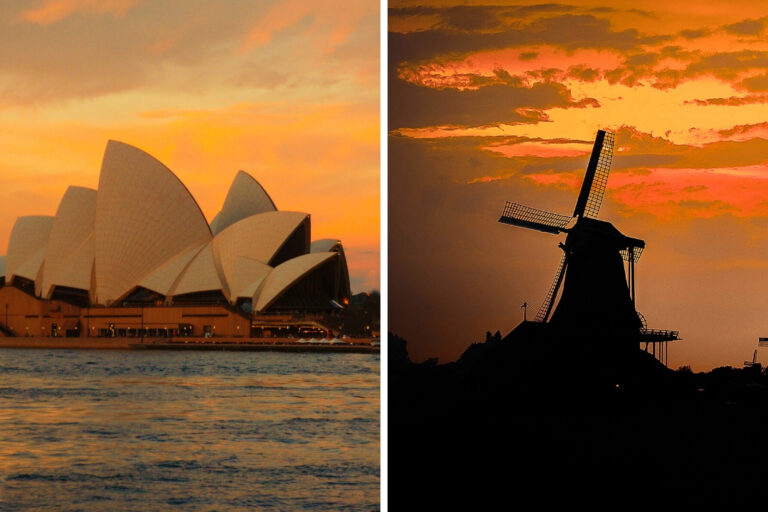
If you’ve grown up spending summer in the Netherlands and always yearned for a warmer year-round climate (I know you have), then perhaps the idea of visiting Australia has crossed your mind once or twice.
Most Dutchies or internationals I speak to are envious of the fact that the land Down Under is blessed with warm weather.
I never divulge all the other things that come with living in a country that, for the most part, is intolerably bloody hot all year round — wouldn’t want to burst their bubble.
But it made me think, for the first time ever, is summer really that different from country to country when you don’t count the climate?
If you’ve experienced even one summer in the Netherlands, you’d know they’re something to be cherished.
The grass is green, the trees have sprung fresh leaves, and the water in the canals has an almost magical glint around midday. The sun seems to linger in the air, and the daily pressures of life don’t have a seat at the table.
The last time I was in 40 degree heat was in Australia back in 2011… in Perth… in their Summer… and they had to slow the trains down because the tracks were warping.
The temperature itself is like a warm embrace from an old friend with a fondness for woolly cardigans.
It’s as if the entire Dutch population has enthusiastically shaken off the weight of winter and spilled into the streets to celebrate the beginning of the festival season, long boozy afternoons, barbeques in the park, and gin fuelled cruises through the canals.
In Amsterdam and the rest of the country, we begin to gluttonously soak up the sun’s rays and shed our jeans and jackets in exchange for bikinis and board shorts.
The temperature: skin-tickling warmth versus soul-sizzling heat
The heat during summer in the Netherlands is pleasant enough, albeit fleeting and a little on the mild side — although less so in recent years.
There are hot days, but not to the severity of Australia. After a few months of cloud cover, it doesn’t take long to colour your skin and adapt to the warmth.
What’s the Dutchs’ favourite summer pleasure? Sitting on terrasjes! Image: Depositphotos
Living in Australia, on the other hand, will require you to slip on a few UV-resistant layers of clothing, slop on SPF 60+ sunscreen and an Akubra because the land Down Under in summer feels like Satan’s sphincter after a bowl of Surinamese sambal.
In places such as Oodnadatta in South Australia, the temperature once hit 50 degrees Celsius. I kid you not, the roads started to melt, and the local water tank actually started boiling.
You could turn on the tap and get scolding hot water straight into the teacup, no kettle necessary. I’m sure there would have been a lot of complaining that day in the little town of Oodnadatta.
How we approach summer: pleasant appreciation vs. borderline disgust
How do the Dutch approach the sun-drenched months? I’ve found that they embrace summer in the Netherlands as if it were the last summer of their life.
This eagerness to spend every waking moment basking in the sun’s intoxicating presence is nothing short of admirable and a testament to just how much they truly appreciate it when that time of the year rolls around.
While in Australia, “bugger me it’s hot” or “Jesus Christ how’s this bloody heat” are acceptable ways to address your elders, old primary school teachers or the town chaplain. Or pretty much just start a sentence from December to March.
We love to have a whine about how much we miss summer, but let me tell you, there are not enough curse words in the English or Dutch dictionary to convey the unpleasantness of your eleventh straight 33-degree day.
Getting from A to B: a leisurely cruise versus a one-way ticket to hell
During summer in the Netherlands, getting from A to B or visiting your friends on a soothing Dutch summer’s day is much more pleasant than in Australia.
Just jump on your bike and enjoy the cool breeze as it gently caresses your face and cycle around one of the many tree-lined streets that make up the main arteries in most towns and cities.
Sure, you’ll perspire a little in the early afternoon as you head off to your local bar, but it will be an innocent little bead of sweat that tickles your newly tanned skin ever so gently. Your bicycle or car seat also poses no danger.
Unlike Australia, where you should prepare to receive 3rd-degree burns from the metal buckle as you sluggishly chuck your seatbelt on and climb into the car after seven-and-a-half minutes on the beach, that incidentally felt like six days in the Sahara.
Australians take to the beach on a hot summer day. Image: Depositphotos
A towel on the seat to prevent your skin from melting upon contact and oven mitts to help you touch the steering wheel also don’t go astray when it’s a scorcher.
And for those thinking about taking public transport, that’s laughable. Just try to enjoy yourself as the bus or train morphs before your very eyes into a fiery death carriage on wheels with a one-way ticket to the sweltering depths of hell.
The similarities between Australian and Dutch summers
But, if you’re able to look past the nocturnal cicadas, the flies, the sunburns, the bushfires, the flies, and the traditional “good afternoon” thunderstorm, plus the flies, it’s not all bad.
And if you dig a little deeper, summer in the Netherlands and in Australia is relatively similar.
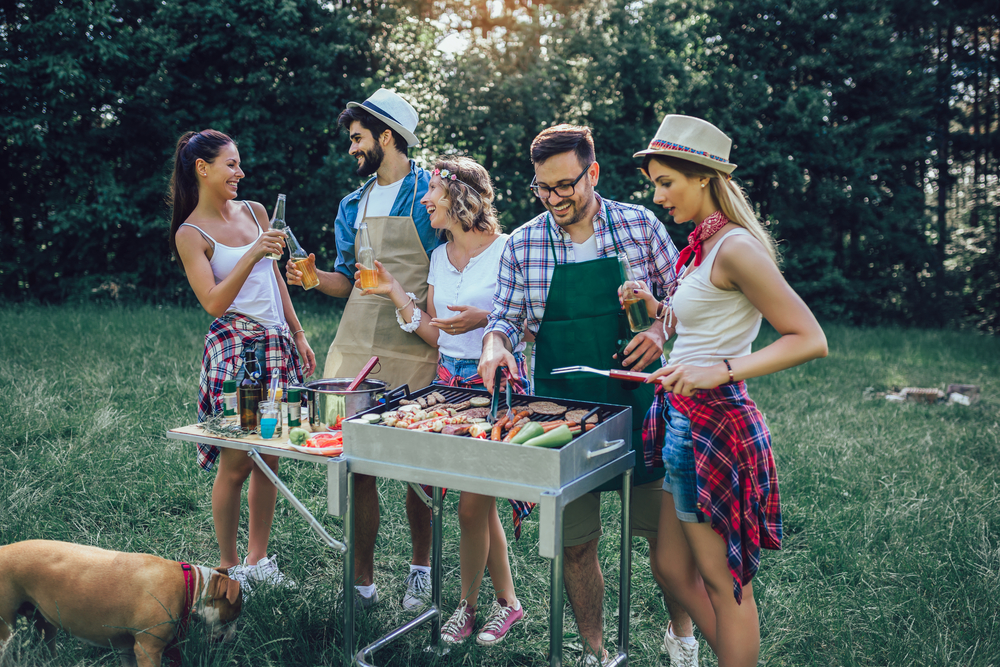
What about the fact that we can all agree that there’s nearly nothing better than taking a stroll through the park and smelling that smoky scent of a BBQ on full blast.
Who’s up for a barbecue party at the park? Dutchies and Australians sure are! Image: Depositphotos
It’s one of the things that I think makes these Australian and Dutch summer vibes so akin.
Or what about that seemingly widespread truth that this season also represents something more than just hot days and a chance to have a bit of a perve on the opposite sex in minimal clothing.
It’s that blissful feeling as memories of summers past wash over your worries and the anticipation of adventures to come with friends, both old and new.
You’ve seen it in movies, and now you can finally be the main character: Amsterdam’s Roller Dreams is the place to go for roller skating with a classic 80s twist.
We all know the feeling: you’re biking or walking in the park, and you see someone on roller skates gliding through the air. So graceful, so light, not a care in the world. You want to be just like them.
Well, your time has come. Finally. ✨
This post might have affiliate links that help us write the articles you love, at no extra cost to you. Read our statement.
Totally tubular
Roller Dreams is located in Amsterdam Noord, just 10 minutes from Amsterdam Centraal. Gliding into the rink, you’ll find the perfect 80s rollerskating experience, with bright colours and the decade’s music. And, of course, drinks. 🍻
Can’t rollerskate to save your life? Luckily, all ages are welcome at every skill level. Are you lacing up your skates for the first time? Geen probleem! Sign up for roller skating lessons and enjoy your trip back in time.
The rink itself is designed to transport you back to the 80s, with retro-themed decorations and an ambience reminiscent of the roller discos of the era.
Wave goodbye to TikTok and step into the world of neon, big hair, and being able to afford a house.
Where can we sign up?
You’ll roll in and find a super fun, baby-pink room. For 90 minutes, you can skate, glide, cruise (or, if you’re like us, fall) in a skating rink that looks like it stepped out of a Barbie movie.
The best part? Every ticket purchase (just €19.50!) includes the rent of new baby-pink roller skates to match the decor.
The rink is open from Wednesday to Sunday, so you can glide across the smooth surface while grooving to iconic hits from the 80s five days per week.
Whether you’re a local Amsterdam resident or a tourist visiting the city, Roller Dreams offers a unique and entertaining activity that combines fitness, fun, and a dash of nostalgia!
Special events
Every Wednesday. Thursday, and Friday, Roller Dreams hosts a disco — and fling open their wardrobe doors so we can all play dress-ups. Leotards and flared pants, here we come!
We don’t know about you, but we are definitely interested. Now if you’ll excuse us, we have to grab our leg warmers and lycra outfits and get going. We’ll see you there. 🛼
Leave it to the Netherlands to film reality TV so unhinged it makes you cringe but also binge…all of it overnight.
We may have ogled at MTV’s Ex on the Beach, recoiled at the Dutch edition of Married at First Sight, and choked on our microwaved meals watching Naked and Afraid, but have we seen the latest epic: Stranded on Honeymoon Island?
Getting married to a complete stranger is kids’ stuff by reality TV standards. The same goes for being abandoned on a survival program — we get it, you’re hungry, who cares?
That’s why producers of Stranded on Honeymoon Island decided to take it up a notch, by combining the premises of all our favourite shows into one big hot mess. 🫠
Hellish honeymoons
The series follows newly wedded couples while they “wash up on the beach” of a “deserted island” as though they’ve been in a shipwreck, reports RTL Nieuws.
After only a couple of seconds of clumsy introductions, the matches are married on a boat and soon told to jump into tropical waters.
They then swim towards what they believe is a luxury beach resort for their heavenly honeymoon, and boy, are they in for a shock.
Translation: “Ai ai. There is a serious hair in the butter with Sarah and ‘hangry’ Joeri in ‘Stranded on Honeymoon Island’.”
Instead of a resort, they’re met with what RTL Nieuws calls a “true nightmare”: an uninhabited island that’s as barren as their sex lives.
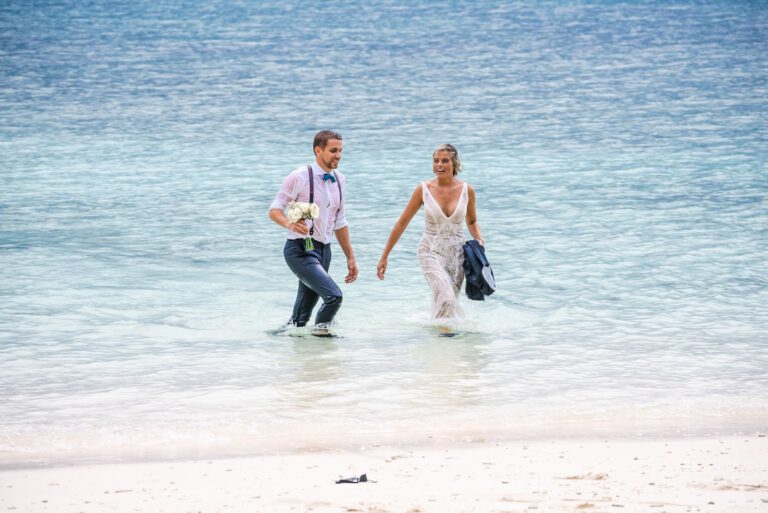
Decked out in damp wedding dresses and suits, the unsuspecting reality TV contestants are then forced to try and literally “survive” in the wilderness, while also bonding with the (usually poorly matched) random stranger they just married.
A glimpse into the Flemish version of the show broadcasted by VTM features a husband ripping off his new wife’s bridal gown on their wedding night — but not for the reasons you might think.
…It’s because his wife was exhausted from dragging along the heavy, wet material behind her while they trudged around aimlessly through the sand.
How will the Dutch react? 😬
This program is already a huge hit in Belgium and was recently also sold to a Dutch channel, which is rumoured to be RTL — the same platform responsible for providing us with our beloved Married At First Sight.
Anyone who is partial to some reality TV drama (um, so everyone deep down) should keep their eyes peeled for these honeymoons from hell that will soon be airing in the Netherlands.
Besides, the Dutch version is bound to make the Belgian one look like a Disney fairytale in comparison. 🥴
Now please: give us some English subtitles, reality-TV gods. 🙏
Are you excited/scared to witness this reality TV show unfold? Let us know in the comments below!