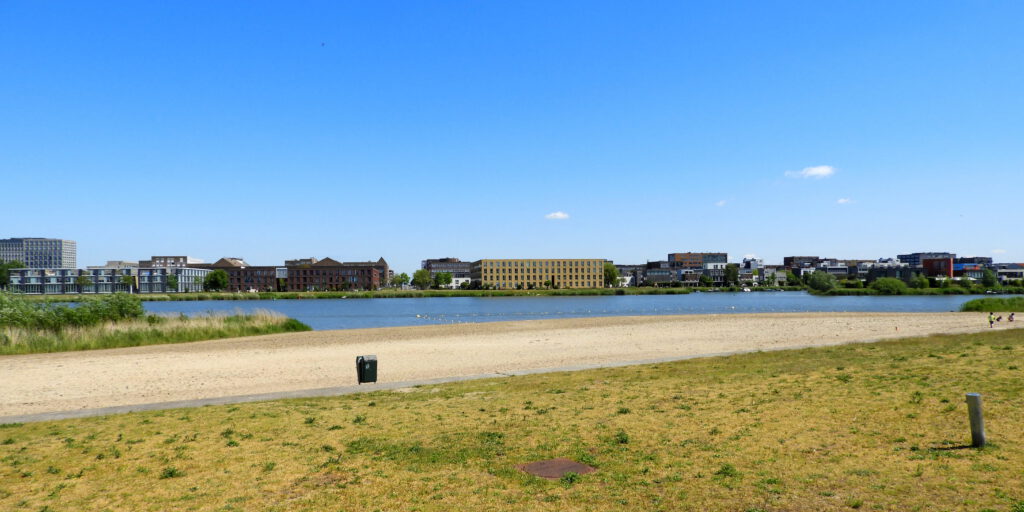
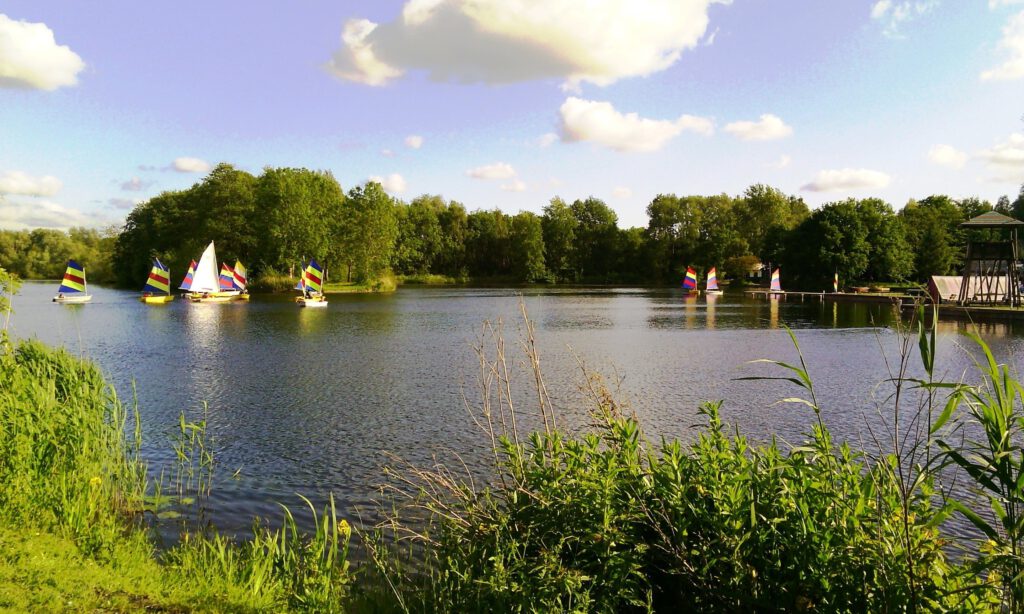
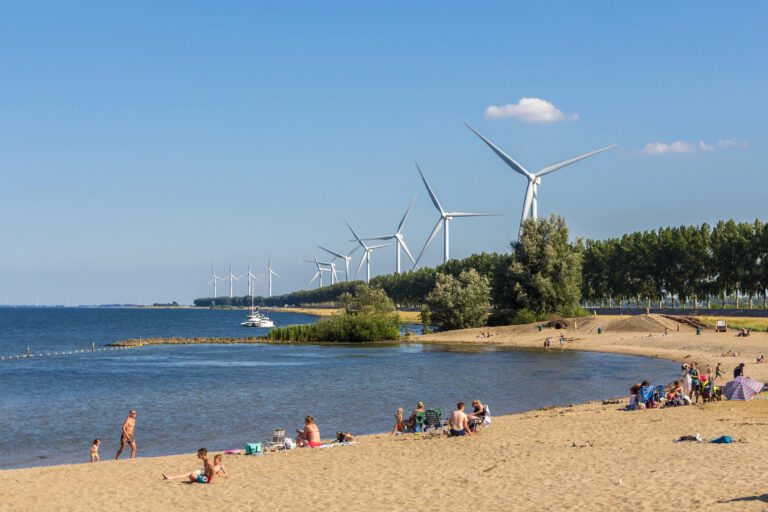
Thanks to skyrocketing temperatures across the Netherlands, a growing number of natural swimming spots are currently facing health warnings due to deteriorating water quality.
Official data from Zwemwater.nl reveals that the number of active safety warnings has ticked up from 40 to 46 locations within the past few days.
Algal blooms are affecting Dutch swimming spots
According to Zwemwater, the Netherlands has 947 official swimming locations, ranging from lakes and ponds to coastal areas.
While the vast majority remain perfectly safe, recent warm weather has caused water conditions to deteriorate.
In addition to this, a stricter “negative swimming advisory” now blankets 35 different sites, up from 33 last week.
Environmental agencies regularly test these spots for hazardous accumulations of blue-green algae (blauwalgen), as well as harmful bacteria like E. coli and enterococci.
At present, several locations are off-limits due to algal blooms, which carry a risk of skin irritation and gastrointestinal problems.
What swimming spots are currently off-limits?
Popular spots on the “No Swimming” list include:
Spaarnwoude,
Haarlemmermeerse Bos Plas,
Haarlemmermeerse Bos pond,
Zwaansmeer,
Loosdrechtse plassen peuterbad strook,
Plas Vrijenburgbos,
Noord Aa Naaktstrand,
Kralingse Plas,
Zevenhuizerplas Strand Noordwestzijde,
Noord Aa Zwemstrand,
and Hof van Capelle (among many others).
For the full list, please view the current warnings (actuele waarschuwingen) on the Zwemwater website.
Here’s how to stay safe
Fortunately, you don’t have to cancel your outdoor plans entirely.
To protect yourself and your family from skin irritation, stomach flu, or worse, keep these practical steps in mind before heading out:
Always check if warnings apply: Before you pack your towel, check the real-time status of your chosen spot. Does Zwemwater indicate a warning? Sites like Zwemindex can help you find alternatives.
Decode the warning flags: On-site signs will tell you the current safety level. A yellow warning sign means there is an elevated risk of illness, an orange sign indicates a negative swimming advisory (swimming is strongly discouraged), and a red sign means an absolute swimming ban.
Stick to monitored swim zones: Avoid random canals, rivers, or ponds. Official locations are strictly monitored until October 1, which marks the formal end of the Dutch outdoor swimming season.
Want to make sure DutchReview pops up on your news feed more often? Just add us as a preferred news provider, and we’ll handle the rest.
Dutch summer is so… damp. If you’re not shaking rain from your umbrella, you’re mopping sweat from your brow. Luckily, the latter can be cured with a nice, refreshingoutdoor dip.
Get familiar with the best places to swim in Amsterdam, so that when that thermometer hits 30 degrees, you and your towel will have already claimed your spot. 💪
These prime places see plenty of paddlers year-round, but we’ve also included whether or not they are official swimming locations (for water quality-conscious folk out there)!
🤔 What’s an “official” swimming spot?
In the Netherlands, each province publishes a list of approved swimming spots where, from May to October, water quality is checked weekly. Official sites are well-maintained, often with facilities like toilets and snack bars, and have signs with the most up-to-date water quality.
Dive straight in for our top swimming suggestions 🏊
The park is home to De Groote Speelweide, a great swim spot located on the Grote Vijd, an area surrounded by towering trees.
Who wouldn’t take a dip in such tranquil water? Image: Antoine J/Unsplash
You might choose to cycle or drive (there’s plenty of parking) to the Bos, but transport gets a whole lot cooler once you’re there — you can rent a canoe or pedal boat on the west side.
De Hoge Dijk is one of those places to swim in Amsterdam that has something for everyone, and not only because it’s a serene golf course and urban beach all in one.
There’s a sandy beach for you, your towel and a good book to enjoy. Then, check out the shallow play pond for all the splashing about a kid can muster. And finally, experienced swimmers can strut their stuff in their own designated zone.
Everyone should be more like this guy on a 30-degree summer day in the Netherlands. Image: Dreamstime
Tourists might arrive at Centraal Station and head straight for the impressive Nemo museum or National Maritime Museum with its big ship anchored outside, but what about seeing it all from the water?
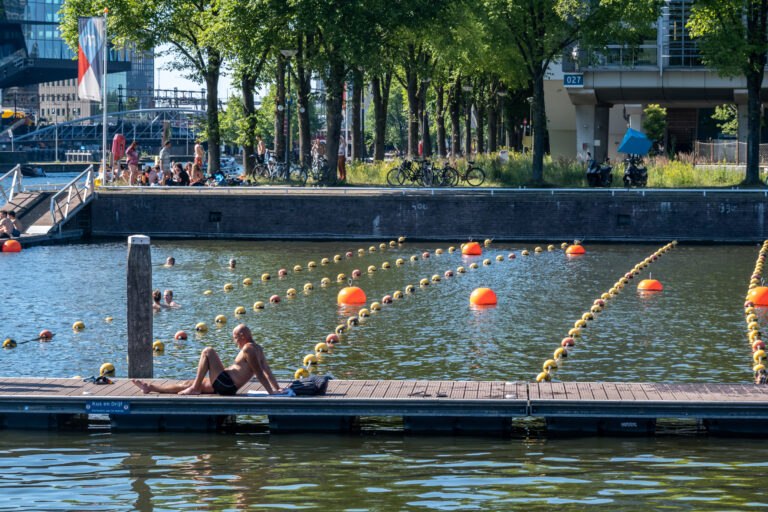
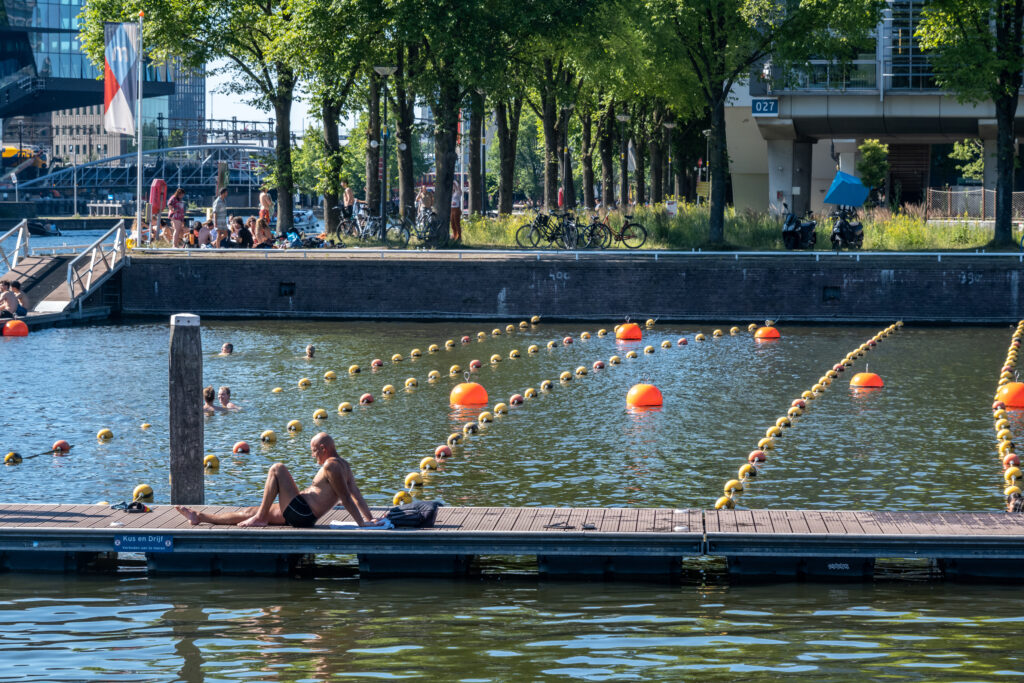
Marineterrein is a great spot for sightseeing on a hot day. You can keep your cool by jumping into the water from the multiple boardwalks or relaxing in the shaded grassy areas.
Next up in the top places to swim in Amsterdam has to be an all-time favourite (for us and everyone else it seems).
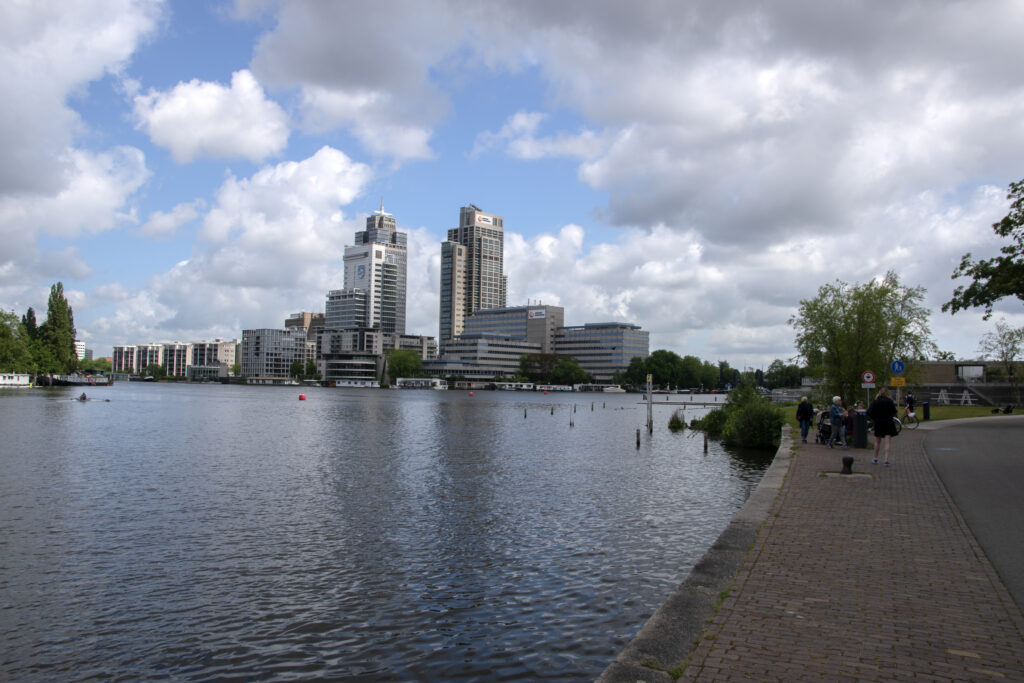
Park Somerlust is located on the southern bank of the River Amstel, and it’s another opportunity to swim with a view as the high-rise buildings of Amstel line the water.
Mix business with pleasure (and plenty of paddling) at Park Somerlust. Image: Dreamstime
Leaping from the jetty, you’ll find yourself plunged into deep water. Perfect for those scorching summer days, complete with a large lawn to lie back on your towel and nearby temporary toilets (no, we don’t mean the river itself 👀).
If you’re looking to avoid the hottest part of the day, but don’t want to be swimming in Amsterdam in the dark, then head to this stretch of the Errasmusgracht in the corner of Erasmuspark in the West.
You can soak up the sun into the late afternoon from the small boardwalk or grassy bank, best enjoyed with a refreshingly cold drink from one of the park’s many bars or restaurants. 😎
A city beach is the answer to finding the water quickly on a hot day. Image: Dreamstime
Urban beaches are a great way to experience the coast without actually having to travel there, and the sandy shore of Diemerpark on the east side of the city is no exception.
Funnily enough, this super-chilled park used to be a rubbish dump. But don’t worry, those days are long behind the now sparkling clean, tranquil “sea” side area.
Take a gasp at Gaasperplas, a beautiful nature reserve with a wide sandy beach lined with lawns and trees, providing a peaceful place to swim in Amsterdam.
A beautiful scene of bright blue and luscious green! Image: Dreamstime
This is urban swimming at its best: the paddle point is only a 15-minute walk from Gein metro station, the final station of line 54. You can practically feel the waves calling your name as you rush out of the office after a long, hot day.
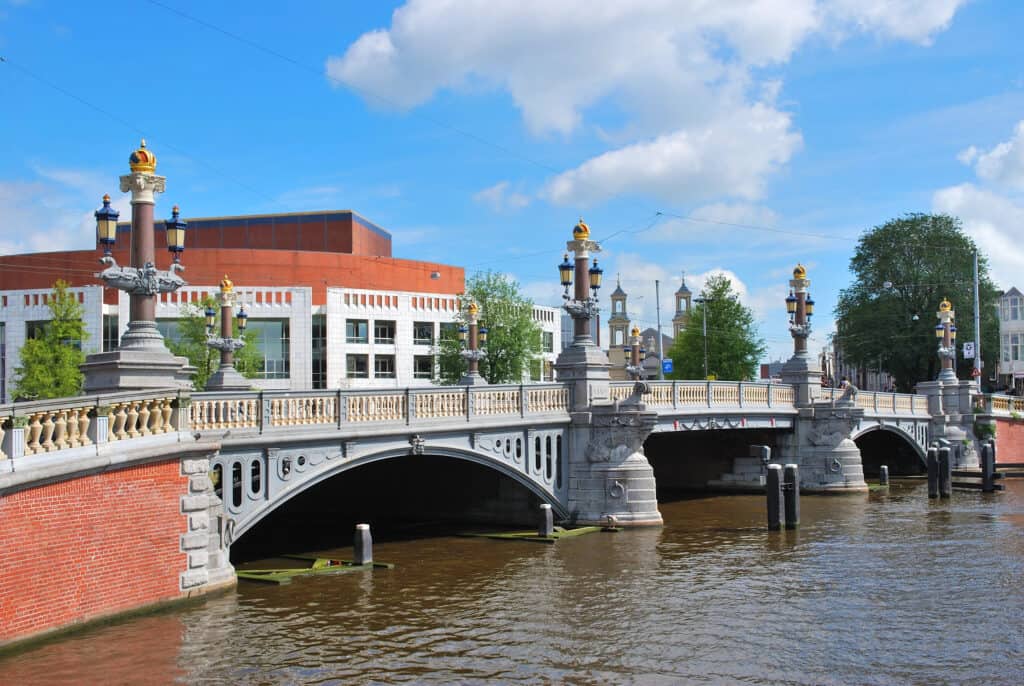
While you can’t swim right here (by the opera house), the Amstel River is still accessible to those who need to cool down in Amsterdam. Image: Depositphotos
When the thermometer pops off (as VERY occasionally happens in the Netherlands), the local crowds know where to go.
Groups of friends flock to the Amstel River. The river flows through the whole city, but the best swimming spot is accessible near the terrace of the lively Café Hesp. So go on, enjoy a dip and a sip as the boats go by. 😍
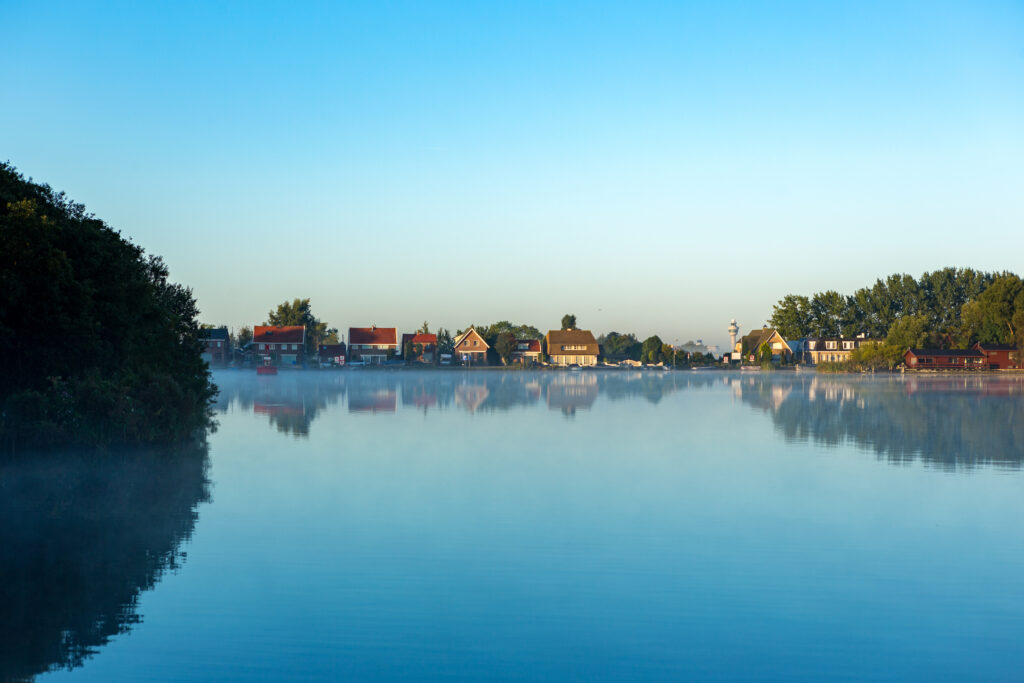
OK, anyone can reach Nieuwe Meer, but we admit these houses have it easiest. Image: Dreamstime
Near Amsterdamse Bos, there is a large lake with three official swimming areas (Westzijde, Noordoever, and Nieuwe Meer). Nieuwe Meer offers a chance to relax on a beach or in private coves and float the day away in the water.
It’s also a hotspot for watersport lovers, so watch out for paddleboards and canoers enjoying the lake too!
While the sizzling heat might make you want to tear off all your clothes and jump in the nearest canal, the murky waters should be enough to make you stop mid-leap.
Don’t worry, that doesn’t mean you have to sweat and suffer. Just do yourself a favour and head to IJburg Beach, where the water quality is regularly checked by the municipality to maintain its excellent reputation. 🔍
There’s a restaurant and surf centre here too, so you can easily spend a whole day pretending you’re on holiday and not a stone’s throw from central Amsterdam.
You can’t beat the crisp water of pristine outdoor pools like Oosterbad in Aalsmeer for a swim in the open air. You can dive in using the jumping boards available or take your time with some peaceful laps.
Oosterbad is almost 100 years old, but don’t worry, that doesn’t mean the water is too. The pool is actually filled with natural water, which you can enjoy until 8:30 PM most weekdays.
The night from Thursday, June 25, to Friday, June 26, is expected to be the warmest ever measured in the Netherlands, as a code orange weather warning grips the nation.
If accurate, the forecasted nighttime temperatures of 24 degrees Celsius would beat the current national record of 22.4 degrees Celsius, set on July 27, 2018. Worse? Temperatures could get even hotter locally.
The KNMI expects Beek in South Limburg to stay above 25 degrees overnight, topping the local record of 24.4 degrees, also set on that same date in 2018.
Here’s what the code orange covers
From midday today (June 24) until at least Friday, a code orange weather warning for extreme heat applies to the centre and south, with daytime highs of 33 to 36 degrees.
If you haven’t seen a code orange for heat before, there’s a good reason why. Since the criteria were tightened in 2021, they apply when one of three things happens:
three consecutive days at 34 degrees or higher,
two consecutive days at 36 degrees or higher,
or a single day at 38 degrees or higher.
The far north has it easier, with Groningen, Friesland, and Drenthe under code geel (yellow) weather warning and afternoon highs of 28 to 33 degrees.
The RIVM also warns that air quality will be poor in the centre and south of the country today and on Thursday due to ozone smog. You can expect the worst in the late afternoon and early evening.
Children, older adults, and people with existing respiratory conditions will need to be extra careful, as they’re most sensitive to the smog.
Expect fewer trains (so plan your commute wisely!)
From Wednesday, the NS is running fewer trains on some routes. Overheated components, especially on double-decker trains that can’t cool down overnight, raise the risk of breakdowns.
The rail operator is asking passengers to carry water and points to the free refill taps now at more than 250 stations. Pack a bottle before you head out, and expect longer commutes if you’re travelling by rail over the next few days.
How are you surviving the absolute inferno currently raging in the Netherlands? Share your tips for staying cool in the comments below.
The Netherlands officially has two languages, but in practice, it sometimes seems as if you hear many more. In addition to Dutch and Frisian, there are countless dialects and accents. For such a small country, the diversity is remarkable. If you listen carefully, you can often tell where someone is from.
However, dialects and accents are more than just differences in pronunciation or vocabulary: they reflect a region’s history, culture, and sometimes even its character.
For example, a gentle Limburg accent may be associated with the region’s laidback and less stressy attitude.
Meanwhile, a Rotterdam accent may be associated with directness, and an Amsterdam accent with confidence and a bit of joi de vivre.
Of course, these are generalisations — not everyone fits into a stereotype — but they do show how closely language and identity are connected.
For internationals learning Dutch, this variation in accents and dialects can be, in certain places, bewildering. This is completely normal and only temporary. Much like riding a bike, you’ll find that your Dutch will quickly pick up the specific motions of a certain dialect.
And don’t worry, most of the time you just hear a light accent giving away where someone is from.
Whether you’re in Amsterdam, Rotterdam, Eindhoven, or even Wassenaar, Taalthuis offers Dutch language courses in multiple locations across the country and online. Find a course that fits your schedule and location.
The various Dutch accents
Let’s begin with a breakdown of the various accents you may encounter while living here and learning Dutch.
Standard Dutch: the version you learned
So, what have you been learning in class? This is most likely: Algemeen Nederlands (AN), or Standard Dutch. However, many Dutchies will still refer to the old-timey Algemeen Beschaafd Nederlands.
This is the neutral, official version of Dutch you hear on the national news, in government communications, and on language exams. It is spoken in the broader area around Haarlem, known as Kennemerland.
It’s polite, clear, and carefully pronounced. However, not all Dutch people speak Standard Dutch. You often hear a light accent, sometimes strong.
Geen paniek, let’s explain what accents are from what region, and you will understand the Dutch better!
Don’t worry if you encounter a Dutch accent that sounds a bit different from what you’ve learned, you will adjust to it quite quickly. Image: Freepik
Brabants and the famous soft G
Here’s the accent many internationals encounter first, especially if they live in Eindhoven or the surrounding area. Brabants is known for its zachte G: the soft G.
Instead of the throat-clearing rasp of Standard Dutch, the Brabants G sounds gentler, closer to an English H. It’s warmer, friendlier, and much easier on the ears if you’re not used to Dutch pronunciation.
Thanks to the large expat community in Brabant, this is often the Dutch that internationals hear outside the Randstad.
That being said, the soft G sounds of Brabant also tends to survive a move to the Randstad. And honestly, it’s not a bad introduction.
Amsterdam Dutch: fast and expressive
However, if you move straight to Amsterdam, your introduction to the Dutch language will be slightly different.
The Amsterdam accent is fast, nasaly, expressive, and unapologetically confident (much like the people who speak it, some would say).
With this accent, sounds get dropped, vowels get stretched, and everything comes out at about 1.5x speed.
But don’t panic. This is actually the accent you hear in Dutch films and TV shows when they want to inject some of those big city capital vibes, meaning you will have plenty of exposure to it.
And what does exposure lead to? Comfort and understanding.
Amsterdammers are known for being direct and opinionated, and their accent reflects that. It’s loud, clear, and impossible to ignore.
There are also quite a few specific words used in Amsterdams, many of them derived from Jiddisch (such as Mokum!). Often, Amsterdammers will drop an “ouwe” or “gebbetje” in their sentences.
Want to get a feel for the accent and practice your Dutch at the same time? Check out the below video.
Rotterdam Dutch: a direct accent
Speaking of direct accents, Rotterdam’s accent matches the city’s reputation: direct, blunt, and practical. The pronunciation is clipped and efficient. There’s no fluff, no softening, and definitely no apologies.
And sometimes, that’s exactly what you need when learning a language.
You know what you also need? A bit of fun. The Rotterdam accent certainly makes way for this, with its rolling r’s and interesting vocabulary.
What do we mean by “interesting vocabulary”? Well, there’s quite a bit of cursing in there as well. But you know that they say: you can’t speak a language until you can successfully curse in it.
The Hague Dutch and its stretched vowels
The Hague has its own recognisable accent, characterised by stretched vowels and a distinctive rhythm.
That being said, it’s nothing too confusing for your delicate new-to-Dutch ears. I found that I only started to pick up on people’s specific The Hague accent after a few years of learning Dutch.
There’s also a difference between the accent of Hagenaars (the posh folks at the Binnenhof) and the famous Hagenees (the mullet folks).
Again, there can be a bit of cursing present, especially in Hagenees, where people have been using “kankah” in their sentences like it’s “gezellig.”
Dunglish and foreign accents
Here’s the most important thing to know: having an accent when you speak Dutch is completely normal. Nearly every international who learns the language will have one, and that’s absolutely fine.
Dutch people are generally patient and appreciative when you make the effort to speak their language. Accents are rarely judged harshly. What matters is that you try.
This truth cuts both ways. Dutchies also often have an accent when they speak English. I’m talking about the renowned Dunglish — English spoken with Dutch pronunciation patterns and weird translations thrown in.
It’s not hard to find amusing examples of Dunglish, and you’ve got to love the confidence of the Dutch in just throwing it out there.
Let’s turn to the unofficial king of Dunglish (and confidence, for that matter).
Then there are the dialects
Accents are one thing. Dialects are another.
In the north and east of the Netherlands, you’ll encounter speech that sounds flatter, more direct, and sometimes quite different to Standard Dutch. Twents, spoken in Twente, and Gronings, from Groningen, are prime examples.
Further south and west, you’ll find dialects like Zeeuws (from Zeeland) and Drents (from Drenthe). Each region has its own flavour, shaped by geography, history, and local pride.
These dialects have their own vocabulary, grammar, and rhythm. If you’ve only learned Standard Dutch, don’t be surprised if you struggle a bit more than usual at first.
However, once you’re fully immersed in the dialects, you’ll be surprised by how quickly you start to become comfortable with them.
With new schools opening up in Eindhoven and Wassenaar, Taalthuis now offers Dutch language courses in no less than 10 locations (as well as online, of course). No matter the region (or accent), with Taalthuis, you can learn Dutch in a way that fits your life and location.
Limburgs: soft, melodic, and confusing
Is it an accent or a dialect? Linguists lean towards calling Limburgs a dialect group rather than just an accent.
Limburgs has a musical rhythm, with soft, rolling sounds that make it sound almost like a gentler version of Dutch. For people who expect Dutch to be harsh and guttural, Limburgs often comes as a pleasant surprise.
Another way to spot the dialect? All their sentences tend to go up at the end, as if someone is asking a question.
A special mention for Frisian
Frisian isn’t a dialect — it’s an entirely separate language. It’s officially recognised alongside Dutch and spoken in, you’ve guessed it, Friesland.
If you think Dutch sounds interesting, wait until you hear Frisian. It’s closer to English than to Dutch in some ways, but feels a bit like a fever dream if you haven’t studied it.
Frisians are fiercely proud of their language, and rightly so. It’s a unique part of the Netherlands’ linguistic landscape.
Dutch variation is part of life here. Accents and dialects are an important part of Dutch identity and culture, and while they can sometimes pose a challenge to Dutch learners, mastering them demonstrates just how far you can go in your Dutch learning journey.
What matters is effort, patience, and the willingness to laugh at yourself when you inevitably mishear something.
Which Dutch accent or dialect have you encountered? Let us know in the comments.
Starting a business in the Netherlands often comes with a classic chicken-and-egg conundrum; you need a bank account to operate, but the bank wants your KVK number first.
As a team of internationals, we’ve all been there. Here’s what you need to know about KVK requirements for business bank accounts.
Your KVK registration comes first
In general, you’ll need to have a KVK number to open a business bank account, so the standard advice is to register your business before applying.
This is largely because Dutch banks operate under strict anti-money laundering legislation, and a KVK registration is the main way a bank can verify that your business legally exists.
Without one, banks in the Netherlands won’t be able to perform the KYC (Know Your Customer) and AML (Anti-Money Laundering) checks they’re legally required to complete before opening an account.
This requirement applies whether you’re setting up as a ZZP’er (freelancer) or incorporating a BV (a private limited company).
Banks need to know that your business exists and that you’re in the Netherlands legally. Image: Magnific
In addition to this, banks may also ask for certain documents. It pays to have those details ready even before you set up your account.
Already registered with the KVK? Revolut Business lets you open a multi-currency business account online, with no branch visits and no lengthy paperwork.
With access to powerful expense tracking and budget management tools, plus integrations for accounting tools like Xero and QuickBooks, it’s like a mini accountant in an app. Until June 30, 2026, you can also earn a €80 welcome bonus and get a local Dutch IBAN to make running your business even smoother. 💸 (Terms & conditions apply.)
a valid form of ID (either a passport or national ID),
proof of address in the Netherlands,
proof of registration with the KVK,
a description or plan of your business activities,
your UBO (Ultimate Beneficial Owner) registration details, if applicable,
and a copy of the partnership contract and proof of identification for all partners, if you’ve formed a general partnership (VOF)
Have your paperwork in front of you, so the setup is as seamless and stress-free as possible. Image: Magnific
Are you setting up a business bank account for a private limited company (BV) or public limited company (NV)? Dutch banks may require even more information from you.
Typically, required documents for BVs and NVs also include:
articles of association,
a copy of the register of shareholders,
and a detailed list of the countries where you do business, if you plan to use your account for foreign transactions.
Do you actually need a Dutch business bank account?
This depends on your legal structure and your current IBAN.
If you’re setting up an eenmanszaak (sole proprietorship) or VOF (general partnership) and already have a private bank account, you’re not legally required to open a separate business account.
Meanwhile, if you’re setting up a BV or NV, you’re legally obligated to open a business bank account for your company’s transactions.
Location also plays a huge role: if you already have a business bank account in the SEPA zone, you do not need to open a new one in the Netherlands. This is because the Dutch Tax Administration accepts any SEPA-zone IBAN.
Unfortunately, if you’re based entirely outside the SEPA zone, you’ll likely need to apply for a business account with a bank in the Netherlands.
Have you opened a business bank account in the Netherlands? Share your thoughts in the comments below.
Let’s be honest: when you lose your job in the Netherlands, calling a lawyer probably isn’t the first thing on your mind. Here’s the thing, though: Dutch employment law is actually pretty protective of workers, but only if you know your rights.
And unless you’ve memorised the entire labour code (Burgerlijk Wetboek), that’s where a dismissal lawyer comes in handy.
So when should you actually consider hiring one? Here are six situations where getting legal help isn’t just smart, it could save you thousands of euros.
What does a dismissal lawyer actually do?
Before we dive in, let’s clear something up: a dismissal lawyer (ontslagadvocaat) isn’t just someone who shows up to intimidate your employer (though that’s a nice bonus).
They specialise in employment terminations and know Dutch labour law inside out. Their job is to make sure you’re treated fairly — whether that means negotiating a better severance package, challenging an unfair dismissal, or ensuring your employer actually follows the rules they’re supposed to follow.
You can also think of them as your legal translator for all the confusing Dutch employment jargon you’re about to encounter.
Need expert help navigating a dismissal?Ontslagspecialist specialises in supporting employees through terminations. With over 25 years of dismissal cases under their belt, they have plenty of experience helping internationals navigate these tough times, ensuring you understand your rights and get what you’re entitled to.
1. You’re being made redundant or facing a reorganisation
This is probably the most common reason expats end up calling a dismissal lawyer — and for good reason.
When your employer needs to cut costs or restructure, they might make you redundant through what’s called bedrijfseconomisch ontslag (economic dismissal). Sounds straightforward, right? Not quite.
While being made redundant is hardly uncommon, a dismissal lawyer can check if your case was handled correctly. Image: Freepik
In the Netherlands, your employer has to follow strict rules: proper consultation, fair selection criteria, transition plans, the whole nine yards. A lawyer makes sure they’re actually doing all that (and not just picking you because you’re the easiest to let go).
Here’s what a lawyer ensures:
You’re not unfairly selected for redundancy (there’s a whole system for this called the “reflection principle”)
You receive a fair severance package (ontslagvergoeding)
Your employer follows proper legal procedures — or pays up if they don’t
Without legal help, you might accept the first offer that comes your way or miss out on thousands in compensation. Don’t be that person.
2. You’ve been fired “on the spot” (ontslag op staande voet)
Getting fired on the spot is serious business in the Netherlands. You’d have to mess up quite badly to achieve this. We’re talking theft, violence, major fraud, the kind of stuff that makes HR sweat.
The problem? Employers can get this wrong. For example, they may fire someone in anger without proper grounds or procedure, and suddenly what felt like righteous fury turns into an expensive legal mistake.
A dismissal lawyer will review whether your employer actually had legal grounds for your immediate dismissal. Did they follow the rules? Did they give you a chance to respond? If not, you might be entitled to serious compensation, or even reinstatement (if you want it).
And here’s the kicker: even if you did mess up, the dismissal might still be invalid if your employer didn’t follow proper procedure. Dutch law is fickle like that.
3. Your employer claims you’re “underperforming” (disfunctioneren)
Ah, yes, the classic “you’re not performing well enough” dismissal. It’s common, it’s awkward, and it’s often done incorrectly.
In the Netherlands, you can’t just be fired for poor performance overnight. Your employer must provide clear warnings, create an improvement plan (verbetertraject), give you a fair chance to actually improve, and document everything properly.
A dismissal lawyer will make sure that you’ve been given a fair shake. Image: Freepik
A dismissal lawyer ensures that the performance issues are legitimate and properly documented, you’ve been given a fair improvement period, and the dismissal process is legally sound.
Without legal help, you might be pressured into resigning or accepting a weak settlement. And trust us, “voluntary resignation” is not your friend when it comes to unemployment benefits.
4. You want to make sure you’ll get your WW (unemployment benefits)
Believe it or not, losing your job in the Netherlands doesn’t automatically mean you’ll qualify for WW (werkloosheidsuitkering or unemployment benefits). And if you’re an expat who doesn’t fully understand the Dutch benefits system, this can get messy fast.
Common pitfalls include resigning voluntarily (usually no WW for you), getting dismissed because it was “your fault” (serious misconduct can disqualify you), and signing agreements that accidentally make you ineligible.
A dismissal lawyer helps ensure the dismissal is structured so you qualify for WW, helps you avoid agreements that disqualify you, and secures a proper reference letter for future employers.
This is especially important if you’re on a visa that depends on your employment. Three months to find a new job sounds reasonable until you realise you can’t get benefits because of a technicality.
5. You’re negotiating a settlement agreement (vaststellingsovereenkomst)
A vaststellingsovereenkomst (or VSO for short) is a formal agreement where you and your employer agree to end the employment contract, usually with a severance payout.
Sounds simple, but here’s the catch: once you sign, you can’t go back and ask for more. It’s legally binding, and you’ve officially waved goodbye to any future claims.
Make sure you don’t sign any settlement agreements unless you’ve fully explored all your options. Image: Freepik
A lawyer ensures the severance amount is fair (often calculated using the kantonrechtersformule, a formula judges use), the agreement doesn’t contain sneaky clauses (non-compete, confidentiality, waiving future claims), and you’re not leaving money on the table.
Facing a settlement agreement?Settlement Agreement NL can help you understand what’s being offered and whether it’s actually fair. Think of it this way: your employer has lawyers drafting this agreement. Shouldn’t you have one reviewing it?
6. You suspect discrimination or unfair treatment
If you believe you’ve been dismissed due to discrimination, for example, due to your age, nationality, pregnancy, or disability, then you need legal help. Full stop.
Dutch law protects against discrimination, but proving it requires expertise, evidence, and knowing exactly which legal buttons to push. A dismissal lawyer can assess whether you have a case, gather evidence and build a legal argument, and push for compensation or reinstatement.
Discrimination cases are time-sensitive, too, so don’t wait around hoping things will magically resolve themselves. They won’t.
Have you ever hired a dismissal lawyer in the Netherlands? Was it worth it? Let us know in the comments below!
Hold onto your ijsjes — the Netherlands is on track for its first-ever national super heatwave. A sweltering stretch of five days above 30 degrees (three above 35) that’s never once been recorded nationally.
De Bilt, the municipality home to the Dutch Meteorological Institute (KNMI), and the official gatekeeper for national heatwave status, could tip things over as early as Wednesday or Thursday, reports AD.
The key difference between a regional and a national heatwave is where the temperature is recorded. A regional heatwave applies when thresholds are met at a local KNMI weather station, whereas a national heatwave is only declared once they’re achieved at the central KNMI station in De Bilt.
If De Bilt is hit by the heat, it’ll be the longest heatwave ever recorded in a Dutch June: eight days straight.
The plot (and our sweat) thickens
Last weekend, we saw regional heatwaves recorded in Maastricht and Ell, checking off the requirement of temperatures over 25 degrees for five days straight, with three days topping 30 degrees — why this is marked as an achievement this is beyond us.
(Anyone interested in sponsoring the DutchReview office with aircon is very much welcome to slide into our DMs.)
But the real prize is the super heatwave. He doesn’t wear a cape or have Clark Kent’s six-pack, but if he brings us five days of 30+ degree weather in De Bilt, three of them hitting 35, we’ll happily go on a second date.
For now, we’re only on day two of this week’s tropical heatwave bonanza, and the state of our supplies is already dwindling. Only two ijsjes left (lemon — niet lekker) and a six-pack of Heineken to quench our thirst.
If your fridge is looking anything like ours, you better send your kinderen to the Appie to regroup; it’s not like they’re busy being at school anyway.
There’s a lot more sweating to go
Temperatures in the Dutch south are predicted to reach 35 degrees or more from Wednesday through to Saturday. The rest of the country can get ready for equally sticky 30-degree heat sessions.
And there’s no cool saviour of the night, because the humid nights and 20-degree evenings will stick around too.
Regional super heatwaves have happened before — but never a national one. So buckets of sweat, shoving down ijsjes, and everyone on edge it is!
But, hey it’s a shot at the history books. 👀
What favourite ijsje of yours will be helping you survive this heat? Let us know in the comments.
However, Rotterdam-based Nearfield Instruments — a spin-off from research institute TNO — just announced a massive €330 million Series D funding round on Monday, and it may be knocking on ASML’s door.
This marks the largest deep-tech funding round in Dutch history, catapulting Nearfield to unicorn status, with a fresh valuation of €1.4 billion, reports NRC.
Where does Nearfield fit in the supply chain?
The chip machine manufacturer specialises in metrology and inspection systems — in other words, machines that chipmakers like TSMC, Intel, or Samsung rely on to measure, analyse, and verify the structures they build on wafers.
ASML creates the lithography machines that write patterns (designed in the US) onto silicon wafers.
ASML builds the $400 million machines powering the world’s most advanced chips — and no one has been able to replicate them. Here’s why this company has become one of the most critical chokepoints in the global semiconductor race. Watch Primer with @Caroline Hyde 📺 for more. #tech#AI#business#chips
Nearfield creates the machines that measure and inspect what was actually built, using atomic force microscopy to catch errors only a few atoms tall.
Put simply: without ASML, you can’t produce the most advanced chips at all. Without Nearfield, you can make them, but you can’t verify they were made correctly. This verification step has become a serious bottleneck in its own right.
The demand for improving quality, yield, and efficiency in chip production has grown alongside demand for more advanced semiconductors, thanks to the AI boom and the data centres powering it, explains TNO.
IPO around the corner?
With investment coming in from the US, Europe, Qatar, and Singapore, Nearfield founder Hamed Sadeghian has hinted at an IPO, possibly as early as 2027.
Whether this will happen in New York or Amsterdam isn’t yet known, but Nearfield would be making its debut alongside fellow Dutch-listed chip machine manufacturers ASML, Besi, and ASM International — further cementing the Netherlands’ role at the heart of the AI boom.
Speaking with NRC, Sadeghian didn’t rule out an acquisition by one of those very same Dutch peers, either.
What’s next?
Should I stay or should I go is a question as old as time, or at least as old as The Clash. With 450 employees, most of them stationed in the Netherlands, Nearfield is looking to expand — but not without growing pains.
Sadeghian tells NRC that while the Netherlands remains an ideal environment to develop new technology, expansion is hindered by “too much talk, too little decisiveness, and a severe housing shortage.” Don’t we know it!
Meanwhile, geopolitical tensions continue to hang over the semiconductor industry. ASML and ASM International have already faced export restrictions from the Trump administration on advanced chipmaking equipment destined for China.
Whether Nearfield will soon find itself caught in the same crossfire remains unclear, but its growing strategic importance means it’s increasingly playing in the same tense geopolitical arena as its bigger Dutch siblings.
Nearfield may not be “the next ASML” just yet. But it’s well on its way to becoming one of the Netherlands’ most important semiconductor companies.
What do you think about the Netherlands’ positioning in the AI boom? Let us know in the comments.
Utrecht police are urgently searching for a man they believe attacked two women cycling alone within half an hour of each other, dragging both from their bikes and putting them in chokeholds on the night of June 18–19.
The appeal was made through Opsporing Verzocht, the long-running Dutch crime programme that asks the public to help solve open cases.
Police suspect the same man is behind both attacks.
What happened
Both incidents took place west of Utrecht city centre in the early hours. The first woman was cycling along the Potgieterstraat when she was attacked at around 2 AM.
The second was riding near the Leidseveer, roughly half an hour later.
In both cases, the man pulled the women from their bikes and beat them severely. During the attacks, he placed both victims in a chokehold.
According to police, he appears to have chosen his targets at random.
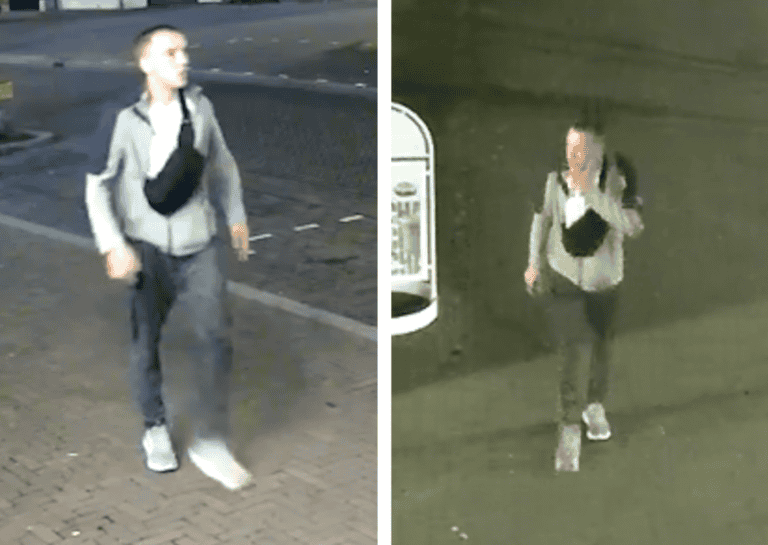
Between the two attacks, cameras captured the suspect, including on the Kanaalstraat.
@opsporingverzocht DELEN, SPOED! De politie wil dringend tips over deze man. Hij heeft afgelopen vrijdagochtend binnen een half uur twee vrouwen in Utrecht van hun fiets getrokken en grof mishandeld door onder andere een nekklem aan te leggen. Ze lijken willekeurig gekozen. Het gebeurde in de nacht van 18 op 19 juni tussen 02.00 en 02.30 uur in de Potgieterstraat en Leidseveer. Hij is gefilmd tussen de aanvallen. Signalement verdachte: ● leeftijd ± 20 – 40 jaar ● slank ● 1.70 – 1.80 ● breed hoofd ● scheve tanden ● rookt Tip over deze zaak? Bel gratis 24/7: 0800-6070 of anoniem naar Meld Misdaad Anoniem: 0800- 7000. Je kunt ook online een tipformulier invullen via opsporingverzocht.nl of meldmisdaadanoniem.nl | Zaaknummer: PL0900-2026211701 #opsporingverzocht#politie#Utrecht♬ origineel geluid – Opsporing Verzocht
What the police know about the suspect
Both victims describe their attacker as having a broad head and crooked teeth. He’s slim, between 1.70 and 1.80 metres tall, and estimated to be 20 to 40 years old.
On the night in question, he carried a small bag, which he sometimes held visibly and at other times tucked under his jacket. Footage released by investigators also shows him smoking.
How you can help if you recognise him
If you were in the area of the Potgieterstraat, Kanaalstraat, or Leidseveer that night, officers want to hear from you, even if it seems minor.
They’re also asking anyone with a private camera nearby to check their own footage for the suspect.
You can pass on information to the tip line on 0800-6070, report anonymously via Meld Misdaad Anoniem on 0800-7000, or file a tip online using this form. The case number is PL0900-2026211701.
Were you near West Utrecht that night, or do you recognise the description? Let us know in the comments, and please pass on anything useful to the police.
A doctor in the Netherlands has ended the life of a terminally ill young child, in a first for the country. Health Minister Sophie Hermans confirmed the news in a letter to the House of Representatives.
The case is the first under a regulation for children aged one to 12 that came into force in 2024.
Before that regulation, life termination was only possible for two age groups; newborns up to one year old, or children aged 12 and over.
Children in the one to 12 bracket fell into a legal gap. They were considered too young to make the decision themselves, so the option simply wasn’t available to them.
What the 2024 regulation actually allows
The 2024 regulation lets a doctor end a child’s life in consultation with the parents. This applies only to children aged one to twelve.
The conditions are tightly drawn. The child must be suffering unbearably with no prospect of relief, and be expected to have only a short time left to live.
As NOS reports, the children covered by the rules often have congenital conditions affecting the brain, lungs or heart, or metabolic diseases.
Before the regulation existed, doctors had two options. They could offer palliative sedation, or stop giving the child food and drink so the child would gradually die. That second process can sometimes take weeks.
Why this case is so sensitive
The rules were politically fraught from the start. They concern children too young to make their own decisions, which sets this group apart from older children and adults, who must request euthanasia themselves.
Some medical experts also voiced doubts. One concern is that doctors might fear prosecution, since the final verdict on whether they acted lawfully rests with the Public Prosecution Service (OM), not the review committee.
In this case, the committee has examined what happened and spoken with the doctor involved. Its judgement has now been passed to the OM. The OM must decide whether the proper procedures were met.
According to NU.nl, the cabinet expected the rules to apply to five to ten children a year when the policy came in.
What happens next
The review committee’s binding advice is set to be made public soon, though Hermans has not given a date.
For now, the details stay private. Her letter does not reveal the child’s age or illness.
The Netherlands legalised euthanasia for adults in 2002. Paediatricians then pushed for clear rules covering younger children for years before the 2024 change arrived.
How do you feel about where the Netherlands has drawn the line? Share your thoughts in the comments.