Man, we love it when we get to tell a highway to hit the road. It’s even sweeter when that ugly grey highway is being covered over by some flippin’ amazing forest and affordable housing.And when it could all happen in Rotterdam? Hell yeah!
The Rotterdam PvdA (Labour Party) dropped a brand-spankin’ new proposal for a stunning residential area called Het Nieuwe Noorden — translating to “The New North” — this January. And if this is what the future of the Netherlands could look like, we are totally on board.
(Go ahead and slide it, you know you want to 😉)
Green space and killer housing
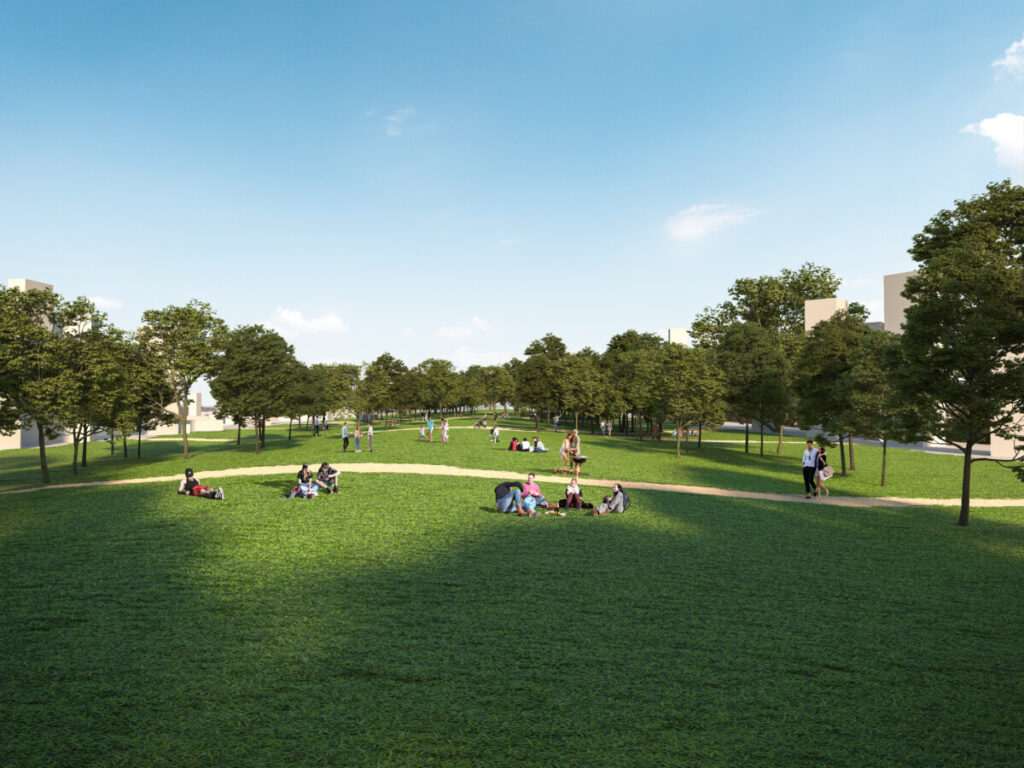
Architectural firm MVRDV developed the plan, which would completely cover the A20 between Hillegersberg and Rotterdam Noord and replace it with greenery instead. We. Are. In!
If you’re salivating over the images already you’re probably wondering “well, how can I live there?” And that’s the even better news: the green zone includes space for 5000 affordable homes.
Correct, 5000! Houses, not apartments! In a major Dutch city! In a green zone!
Okay, we’ll chill now.
From A20 to A-OK
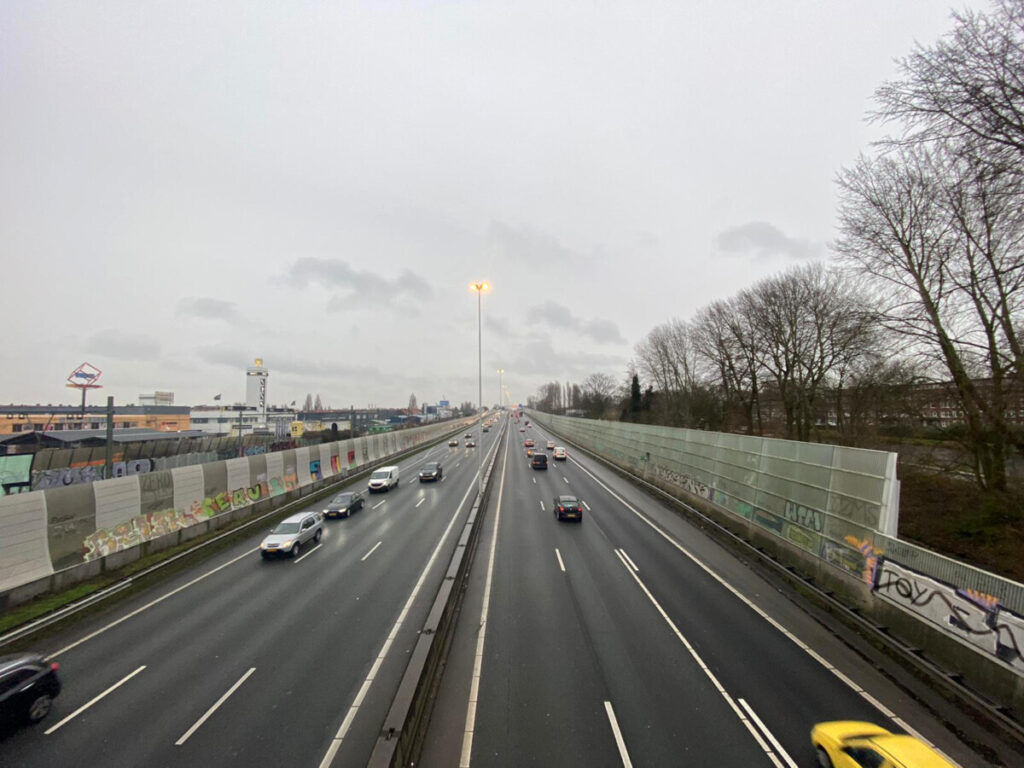
The A20 runs along the north side of the city, and most of it is just a view of businesses and noise barriers. Yuck. In the new proposal, a fresh, green approach will be taken to the area — and the highway will disappear.
Initiator Dennis Tak, councillor of Rotterdam’s PvdA, is proud of the plan. “A large polluting highway will disappear from the cityscape and Rotterdam will get a huge and affordable residential area in return.”
What the A20 could look like. Image: Het Nieuwe Noorden/MVRDV
And while this proposal is new, the idea is not. Het Nieuwe Noorden elaborates on a plan from 2009 called the Kralingse Berg. “The A20 has been a thorn in the side of Rotte-loving Rotterdam for years,” says Tak. “With the extension of the A16, the motorway has become less necessary.”
“This approach not only solves the problem of the motorway, but it also creates space for sustainable construction — not luxury residential towers, but affordable family homes for Rotterdammers.”
What the A20 currently looks like. Image: Het Nieuwe Noorden/MVRDV
Give it to us — what comes next?
Alright, it’s (sadly) not going to appear overnight. The plan was submitted on January 4 and has since gone through a feasibility study.
Now it has to go to the city council for a vote which will hopefully happen before the summer. The national government will also need to be lobbied to make changes to the A20, so there’s a bit of work to be done.
But if the proposal is realised, up to 160,000 Rotterdammers are expected to benefit. Hey, that could be you!
What do you think of this plan to greenify Rotterdam? Tell us in the comments below!
Feature Image: Het Nieuwe Noorden/MVRDV Editor’s Note: This article was originally published in January 2021, and was fully updated in June 2021 for your reading pleasure.
We hope you have your fans and water bottles at the ready — temperatures are expected to soar above 30 degrees today and tomorrow across much of the Netherlands.
30 degrees (or higher!)
According to everyone’s favourite weather service, Buienradar, we’re in for temperatures between 25 and 33 degrees this afternoon — perfect for an ice cold drink on the beach or a swim in a polder.
Over the next two days, temperatures are expected to exceed 30 degrees in all of the provinces except Groningen, Friesland and Drenthe (lucky ducks.)
Thursday
Tomorrow the heat will peak at 35 degrees in some parts of the country, reports RTL Nieuws. Meteorologists at Buienradar have reported that the air will be very humid — so prepare for a sticky day. We’ll be huddled over our fans and taking lots of cold showers.
Special protocols in place for road users
Today and tomorrow will be so hot that the Rijkswaterstaat has issued a heat protocol for road users. This means that if you break down on the side of the road, a recovery company will immediately be dispatched to bring you to a safe location.
According to the Rijkswaterstaat this is because “With high outside temperatures, the temperature of the road surface can rise to above 50 degrees.” The protocol will be in place from 10 AM to 8 PM over the next few days in all of the provinces where temperatures are likely to exceed 30 degrees.
Remember to drink lots of water people! And keep on re-applying that sunscreen. But also — enjoy yourselves, you deserve it. 😉
Will you be sunbathing on the beach or sheltering from the heat indoors? Tell us in the comments below!
Young travellers returning from a holiday in Portugal or Spain are strongly advised to get tested after returning to the Netherlands, even if they have no complaints.
“In the past week, we have seen an increase in young people who test positive for coronavirus after a holiday abroad,” reports the RIVM. The public health institute is therefore appealing to those between the ages of 17 and 24 to get tested after returning to the Netherlands.
Six percent of the 8,981 people who tested positive had recently been abroad, most of them returning from countries such as Spain, Portugal, Germany, and Belgium.
Infections in Spain and Portugal increasing
The number of infections in Spain and Portugal has increased slightly over the past couple of days, especially among young people. At the same time, both countries recently relaxed most of their coronavirus restrictions.
Spain ditched curfew last month, with the Basque Country no longer implementing restrictions on how many people can be together in a group. Nightlife in Madrid is also slowly going back to normal, with dancing allowed outside, albeit with a face mask and at a 1.5 metres distance.
However, many young people don’t adhere to the rules that are still in place. “On one hand, you see that the government is trying to open things up to attract tourists but on the other hand, the rules are poorly understood — especially by young people. The youth culture is together on the beach, partying and drinking,” correspondent Rop Zoutberg tells the NOS.
Dutch infections keep going down
Coronavirus infections coming from abroad are of particular concern especially as the numbers in the Netherlands keep dropping. The number of positive coronavirus tests decreased in 288 of the 352 Dutch municipalities last week, reports RTL Nieuws.
For most municipalities (208), the risk level “concern” applies, meaning there are between 35 and 100 positive tests per 100,000 inhabitants. Serious risk level now only applies to 15 municipalities, compared to 86 municipalities last week.
What’s your opinion? Should young travellers returning to the Netherlands from abroad get tested? Tell us in the comments below!
Here ye here ye! From Wednesday, all born in the year 1997 AND 1998 can book their coronavirus vaccine in the Netherlands. Minister for Health, Hugo de Jonge, has given the green light on his Twitter.
That’s right, drop the coffee, library books, or take your work break (what is it that 23/24 year-olds should be doing again??) It’s time to book that jab.
Those born in 1997 have been able to book since 10 AM this morning, and 1998-babies can book from 1:00 PM.
“1998, stop what you’re doing. ✋ Because at 13:00 it’s your turn! Bring on that vaccination appointment. #PlanDePrik online and spread the word!”
Fair warning: the webside and phone lines are overloaded today, so be patient!
How do I book my vaccine appointment?
There are two ways that you can book your appointment. You can either book online by heading to the government’s CoronaTest website or you can call 0800 7070.
Once you have contacted the GGD you will receive two dates, one for your first jab and one for your second (if needed.) Your appointment may be within the coming days or the coming weeks, this depends on the municipality that you are registered in.
Happy jabbing people! Tell us about your experience in the comments below!
Whether you are trying to make a living or just earn some extra cash on the side as a student, working in customer service in the Netherlands can be quite different. They even have their own name for it (Horeca).
As someone who has spent three years helping Dutch customers in cities such as Amsterdam, The Hague, and Utrecht I’ve definitely seen the good, the bad, and the just plain weird. So settle down and prepare for some (somewhat) expert advice on what to expect from Dutch customers.
Authentic Dutch customer service: attitude
When I first started working in customer service in the Netherlands it came as a great shock that employees are allowed to give attitude to rude customers. For many years it was drilled into me to give “American style” customer service. This means you’re taught to always be bubbly and cheerful, it was a big surprise to see how this is not as much a priority in Dutch customer service.
While of course, my Dutch colleagues would always treat the customer very kindly. However, they wouldn’t get in trouble if they talked back to people that were especially rude. Even though at first it was very hard to let go of the idea that “the customer is always right”, once I embraced the Dutch way of working I felt quite liberated. Long gone are the days of internal breakdowns! So if you tend to be a mean customer (please don’t) be prepared for some sassy Dutch attitude. 💁
Biggest customer service trend in the Netherlands: promotions
If there is one Dutch word you need to remember while working in customer service, it’s korting. Dutch customers are big fans of discounts and special offers. Therefore, it’s often the first thing they ask for as soon as they walk in.
But it doesn’t stop there. Once you appoint them to the promised land, Dutchies won’t start shoving products into their basket like children at a candy shop. Oh no! The Dutch are very intelligent and practical buyers (and rightfully so). They will ask you about certain products, their benefits compared to the other items, and start calculating which option is more favourable.
I have to admit, Dutch people are the niftiest and most sensible customers I have ever worked with. And while it is quite refreshing to see a customer who knows how to get a good deal, it’s also a pain in the derrière when your boss requires you to upsell the newest and most expensive products to them. The struggle is real!
Small change: the Dutch will count the coins
I can’t emphasize this enough! Make sure you always have change. Dutch people are eagle-eyed when it comes to counting the pennies. If you don’t have even five cents to give back, chances are most customers will be grumpy.
Storytime! I once had a man make a comment that if I don’t give five cents change all day to every single customer, then I’ll end up with quite a generous tip. I wish that was the way it worked, but Uncle Scrooge wasn’t going to help my offshore funds! The man stayed until I found some way to give him back his five cents, even though the process took half an hour and involved five different people. So the bottom line is, always have change. Otherwise, you’ll get a lot of unhappy customers.
Have that calculator handy, you’re going to need it. Image: photography33/Despositphots
No tips: The sad reality of Dutch customer service
This kind of connects with my previous point on change, but unfortunately, Dutch customers don’t typically leave tips. If you really want to make a good tip, then I recommend working in Amsterdam. You can spot a tourist a mile away because aren’t aware of the non-existent tipping culture in The Netherlands (please don’t tell them about it). And while the lack of tipping might be frustrating, it’s not impossible to coax out the can. You’ll occasionally get a few regular Dutch customers that would give you a tip just because they like you, or if they are particularly charmed with your excellent service.
So the moral of the story is: create genuine connections with loyal customers and they might give you tips, especially during holidays! However, be aware that your manager will probably use the tip money for your team night out. Bummer! 😬
English or Dutch? The constant dilemma
Spreek je Nederlands? If not, no need to worry! At least most of the time. While working in Amsterdam with only English can be no problem at all, unfortunately, this isn’t the case in all of the Netherlands.
As a person who has worked with customers in The Hague and Utrecht, I can say that my job has been quite challenging on some days. Whereas most of the time I would do my best to help customers in Dutch, sometimes the conversation would get so complicated for me that I would start staring at them like a stoner after his second joint. And while most Dutch people have been nice enough to switch to English and even have a laugh about how butchered my Dutch sounds, unfortunately, that’s not always been the case.
I’ve had customers walk out on me, ask to speak to the manager, and a colleague of mine was once told to go back where she came from. Although situations like these are always hard to handle, it’s important to remember that this doesn’t happen so often. So if you’re working in customer service somewhere other than Amsterdam, here are the steps you need to follow if your Dutch is not so Dutchy yet.
Survival tips for English speakers working in Horeca:
First, write down the most commonly used phrases at work. Even though it may seem embarrassing, it really helps with remembering complicated phrases, and Dutch people tend to have a laugh about it. Soon, you’ll be a pro at getting them the afrekening (the bill). As long as they see you’re trying, it’s all good!
2. Second, kindly explain to your customers that you are working on your Dutch. At this point, they’ll most likely just switch over to English or say that you are really sweet for trying (it’s a win-win situation).
3. Third, if the customer is still being mean to you just shake it off! Understand that this is their country, therefore it’s normal for them to want you to speak their language. Plus, most Dutch people are very nice to foreigners! So just let it go and onto the next customer to practice your Dutch.
How are your experiences when it comes to customer service in the Netherlands? Let us know in the comments below!
Editor’s Note: This article was originally published in April 2018, and was fully updated in June 2021 for your reading pleasure. Feature Image: Serreitor/Depositphotos
Haarlem, for its size, has a fair amount of museums to browse, and after months of museums being forced to close, we’re sure that you’re dancing in your seat to soak up some culture yet again.
If you haven’t explored the stunning city of Haarlem yet, it may be just the place for you to scratch that museum itch — after all, there are stacks of great museums that are filled with collections for you to visit!
Here are 16 (yes, that’s what we could narrow it down to!) that are some of the best.
Let op! Each museum in the Netherlands has specific safety measures to follow. These include:
A maximum amount of people (one person per 10 square meters, including children and excluding staff).
Reservations, registration and health check are required.
Groups of up to four visitors are allowed, not including children up to the age of 12 and persons who live at the same address.
Visitors must wear a mask inside. This can be taken off when someone is sitting.
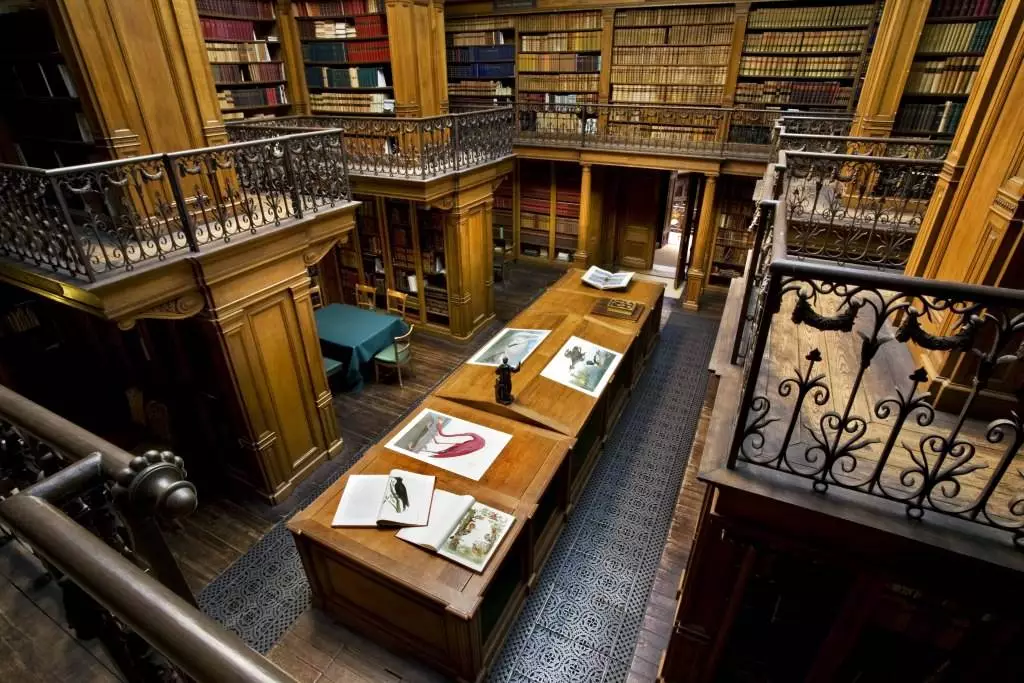
The library was built in 1995 and is a must-visit. Image: Teylers Museum/Wikimedia Commons/CC3.0
Even if you visit the Teylers Museum only to admire its architecture, it will be well worth it.
This museum is the oldest in the Netherlands, built for purpose, and has been open continuously since 1784 to the public, (bar of course during the COVID-19 lockdown). The oldest part, The Oval Room, was built adjoining the Foundation House; home to the wealthy silk merchant, Pieter Teyler, the original benefactor of the museum. He believed in the 18th-century enlightenment ideal that “knowledge is power” and this ‘museum of wonder,’ as its logline proclaims, certainly lives up to it. It offers diverse collections of art and science. It’s almost as if one walks through a real-life encyclopaedia.
My favourite exhibition displays drawings of Michelangelo and Rembrandt. Of course, for preservation reasons, the actual pictures are not always on display but represented with replicas.
The museum expanded over the years to include an instrument room, fossil rooms, entrance hall, picture gallery, exhibition gallery, print room, and library. The beautifully atmospheric library, built in 1885, can only be visited by appointment or during a guided tour. It is unique in that it has the most extensive collection of 18th and 19th-century botany, zoology, and earth sciences literature.
A bright and airy café offers delicious refreshments for the parched reveller.
Its unassuming exterior, blending perfectly into the historic street, reveals nothing about the treasures to be found inside. The Museum of Haarlem creatively tells the story of the city’s history through photography, art, films, and interactive exhibitions.
We were transported back in time as my son tried on the uniforms of orphans, lay on a small, hard bed, and played guess-the-content in the drawers, using our five senses.
Besides the permanent exhibition, the museum regularly highlights the work of local artists and city marvels in temporary exhibitions. The building dates back to 1697 when it housed the St. Elisabeth Gasthuis or hospital.
Adjoining the Museum of Haarlem is a fascinating place to learn about all things architecture related, especially in Haarlem and its surrounds.
I have to be honest, though, with a five-year-old in tow, we usually visit with the sole purpose of building LEGO structures. Across two rooms, and two large tables, boxes filled with something like 60.000 LEGO blocks are available for your creations; your imagination is the only limit.
Across from Museum Haarlem and ABC, you step into an art world where old meets new. This art gallery museum has two locations, Hof and Hal, seven minutes walk apart.
It mixes contemporary and historical works, in a way, which make you appreciate art with a refreshed perspective. Tickets allow you entry to both locations.
There is a lively café, serving delicious lunches, tea, coffee, and even alcoholic tipples at the Hof location, which is open to museum visitor and non-visitor alike.
📍 Hof: Groot Heiligland 62, 2011 EP, Haarlem 📍 Hal: Grote Markt 16, 2011 RD, Haarlem
If you want to delve even deeper into the history of Haarlem, 6000 years to be exact, then pop next door (to the Frans Hals Hal) and climb underground into the Archeological Museum.
It is a little gem with a big heart, playfully teaching children history with mock excavations, ‘artefact’ puzzles, and castle construction activities. Artefacts from various archaeological excavations are displayed with fascinating, historical facts.
Cornelius, the medieval Haarlemmer, is brought back to life with a reconstruction. His skeleton, which is the centrepiece of the museum, was excavated at the Botermarkt.
Still on the Grote Markt, is De Vishal (fish market). It was rebuilt in 1769 as a fish market to replace the one from 1603. It functioned as a covered market selling fish till just after World War II, after which it was transformed into an art exhibition space.
Today, it is a freely accessible exhibition space for contemporary visual art and design. There are about ten exhibits a year, showcasing the work of local and other Dutch artists as well as international artists.
Next to the visitors’ centre, on the Grote Markt, you can explore the 14th-century cellars of the city hall and delve further into the history of Haarlem.
What a sight to see. Image: DmitryRukhlenko/Depositphotos
The centuries-old Grote or St. Bavo Kerk, overlooking the Grote Markt, is not a museum in the strictest sense, as it is still an active church with Sunday services, but its beautiful architecture is steeped in history.
Artists often exhibit in its magnificent hall, and organ concerts are mesmerising. The magnificent Müller organ dates back to 1738 with pipes almost 11 metres in length.
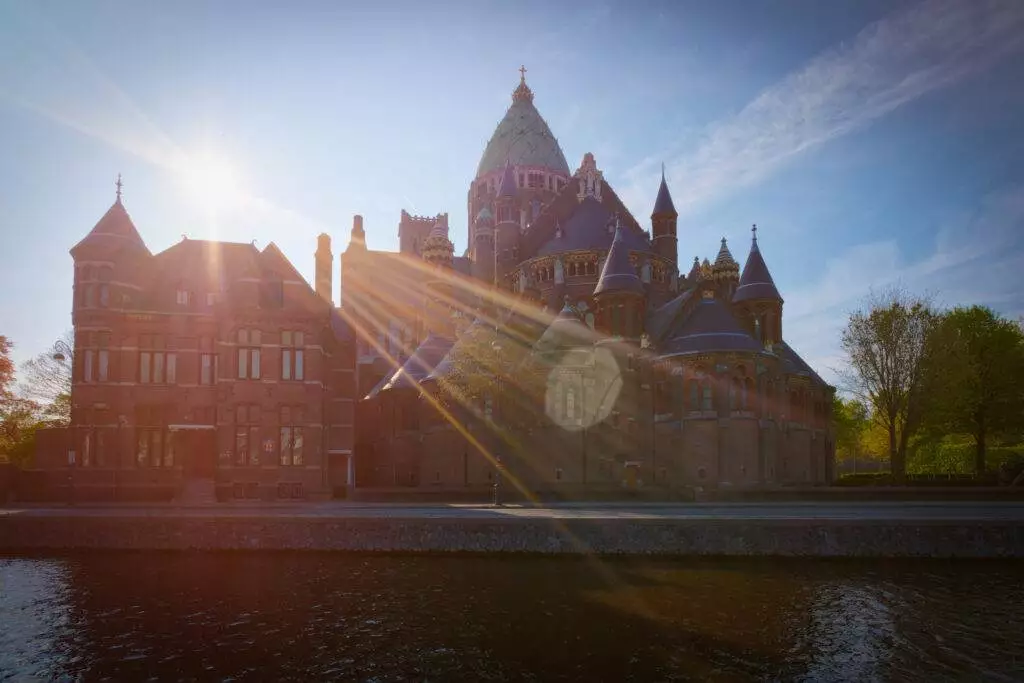
One cannot chat about the previous beauty without mentioning the other grand old dame of Haarlem, the dome cathedral. It is unique and considered as one of five of the most important churches in the world, built between 1850 and 1950; the others being the Sagrada Familia, the Sacré-Coeur, the Westminster Cathedral, and the Basiliek van Koekelberg.
It has 12 towers, with its dome reaching an impressive 65m high. Apart from admiring the art, the architecture and the organs, one can also climb the spiral steps up the towers for a magnificent view across the whole city.
Leaving Grote Markt, walking towards Haarlem Station, you will pass the Corrie Ten Boom House.
There is often a queue around the time a tour starts, and with good reason. Built around 1600, it is a living memorial to the bravery and altruistic behaviour of Corrie, her sister, Betsie, and their father Casper Ten Boom.
Their home was a refuge; they saved countless Jewish people and refugees hunted by the Nazis, during the Second World War. During the tour, knowledgeable guides enlighten you with the Ten Boom family history: walking through their home and seeing their photographs and possessions.
The traumatic reality of their history becomes painfully real when you climb into the cramped hiding place in Corrie’s bedroom.
About five minutes walk from the Haarlem Station is Museum van de Geest, Dolhuys in Haarlem, a museum dedicated to mental health.
I have yet to visit this museum of the mind but have been told, “het is de leukste museum van Haarlem“, which translates as “the best museum of Haarlem.” Between major renovations and coronavirus measures, it was closed for more than a year. Given that the building is 700 years old, a major renovation was well overdue.
This medieval building used to be referred to, incorrectly and insensitively, as the “lepers-, plague-, and madhouse,” keeping people considered to be the outliers of ‘normal’ society outside the city walls.
Visitors can see one of only a few isolation chambers still existing in Europe, to reflect what it must have been like to be locked in such a cold and dark place. Exhibitions allow you to peek inside the minds of brilliant and celebrated artists, writers, and scientists, some of whom lived with a disability or mental illness.
The current museum values people’s uniqueness and the beauty of our minds. It encourages the visitor to question the concept of ‘normality.’
It doesn’t just look pretty from the outside! Image: Nilaya/Depositphotos
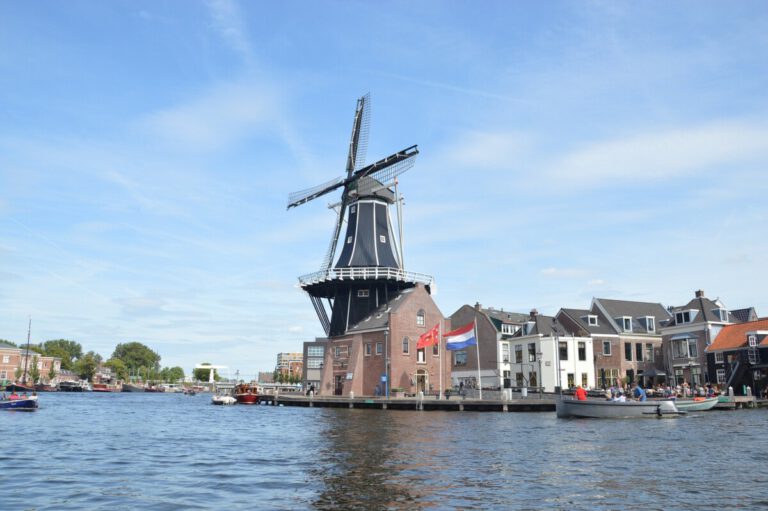
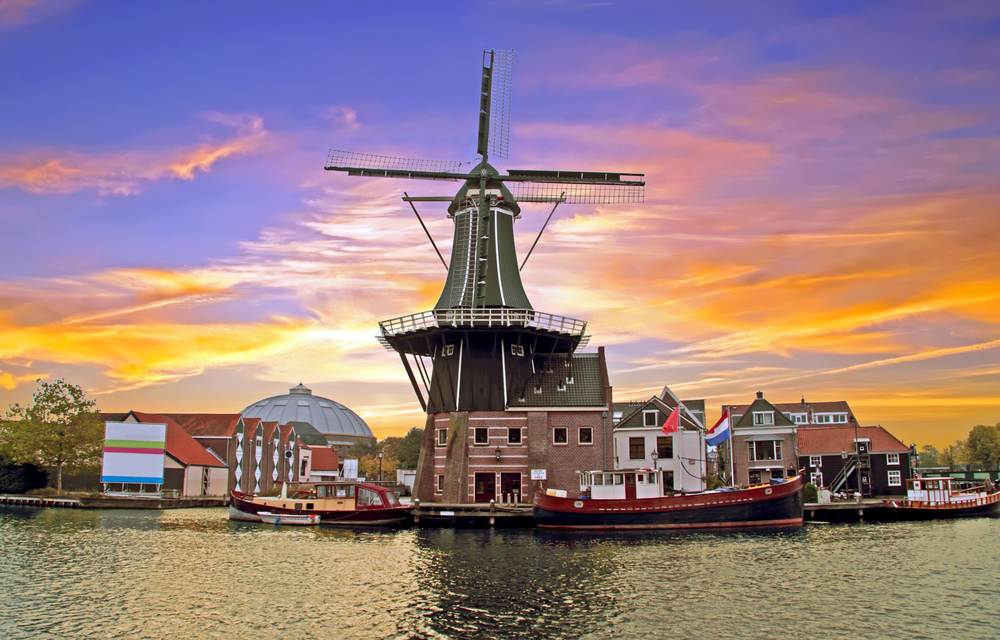
Windmill Adriaan is a loved icon on the Haarlem skyline with a colourful history.
It was originally built in 1778, by businessman Adriaan De Boois, on the ancient defence tower (i.e., Goë Vrouwtoren) on the banks of the Spaarne. It changed hands frequently. In its lifetime it crushed stone, milled grain and tobacco, and was both a wind and a steam mill.
Sadly, on April 23, 1932, it burned to the ground; the cause a mystery forever. Although the city pledged to rebuild it, it was 70 years before the newly-built Windmill Adriaan opened its doors as a demonstrative mill museum on the 23rd of April 2002. Adriaan is quintessential Dutch, as you can only visit him by appointment (a.k.a reserving a ticket online).
The barrel organ museum is only open on Sundays from midday. If you find this 140-year musical Dutch tradition charming, it is well worth a visit. The barrel organ is part of a street music culture unique to the Netherlands, and the oldest instrument in the museum dates back to 1900.
Another museum only open on Saturdays is the transport museum. Its primary collection of four trams (oldest dates back to 1896) and 11 buses will intrigue young and old.
The observatory opens its doors to the public every Friday night (except during summer) from 20:00 to 23:00. It also opens on the first Saturday of each month between 13:00 and 16:00. During your visit, you can observe various celestial bodies, such as planets, nebulae, and globular clusters.
Entry is free, and you need to reserve a space online. Be warned, these observatory nights are so popular that spaces are booked out months in advance.
Here, you will find a collection of documents, which could cover the distance of more than 45 kilometres archiving the history of Noord-Holland, Kennemerland, and Amstel-and-Meerlanden. It is fitting that the archives are housed inside the Janskerk, which is the oldest church of its kind preserved in its original form. It was built in 1318!
In the next few weeks, the Ministry of Health will organise a nationwide campaign where vans will be sent into neighbourhoods to vaccinate people against coronavirus. The aim of this campaign is to vaccinate 85% of the population of the Netherlands.
The mobile vaccination sites are mainly being sent to areas where the vaccination uptake has been low. These include deprived neighbourhoods and Christian municipalities, reports Nu.nl. In addition to a high rate of vaccination, it’s equally important that the vaccines are spread widely and equally across the country.
The GGD will soon be visiting these areas to provide information to residents about the coronavirus vaccine. People who are interested will be able to get their shot immediately and won’t need to make an appointment.
Why is this campaign so crucial?
These measures have been designed to prevent local outbreaks. In the worst-case scenario, these outbreaks can lead to mutations. There’s concern amongst scientists that such mutations could even be harmful to people who have already been vaccinated. Nevertheless, the vaccines seem to be working well against the variants that are currently known.
In addition, RTL Nieuws reports that experts are warning about another peak in the virus. While the peak may be lower than the previous ones as many people have had their shots, it’s still possible for people to contract the virus even after being vaccinated.
Where have they been used so far?
The pop-up vaccination site was first used in the Frisian city of Harlingen last month. The busses are now also running in other places in the province. In addition, they have been used in Amsterdam, Rotterdam, and Utrecht. In these cities, they were used to vaccinate homeless people, among others.
How many mobile vaccine boxes will there be?
It’s still to be determined how many vaccination boxes there will be and where exactly they will go. The Dutch Ministry of Health is still discussing with various GGDs and municipalities about this.
The Ministry also has to decide which vaccine will be used at these mobile sites. According to a spokesperson from the Ministry of Health, the Janssen vaccine could be a logical choice as it only requires one shot.
Tried and tested method
The GGD has had success with local campaigns like this before. In the past, the health service has run effective anti-smoking campaigns in neighbourhoods and recently ran mobile coronavirus testing locations.
Dutch vaccination effort is pushing forward
Outgoing Minister of Health, Hugo de Jonge, has just announced on Twitter that from today, anyone born in 1995 can make an appointment to get their jab.
Did someone say summer? Because it’s here, baby! After what seemed like an endlessly rainy spring, the hot weather is here to stay. Some parts of the Netherlands may reach 36 degrees on Thursday.
It’s going to be a slow roast with temperatures reaching a moderate 27 degrees today. There will be some cloud over the country, according to meteorologist Marc de Jong of Buienradar.
Warm Wednesday
Tomorrow, the temperature starts to climb. De Jong tells RTL Nieuws that today “it will be a very sunny day, with about 30 degrees in the south.” This is thanks to a high-pressure area drifting its way over the Netherlands. 💁
Searing hot Thursday
Sorry if you’re not a sun worshipper because later this week it’s getting steamy. De Bilt is likely to reach a high of 32 degrees, whereas the east of the country may reach that scorching 36 degrees! 😎
On Thursday evening, the humidity will be cleared by a bout of thunderstorms. But watch out because there is a flood risk! Maybe it’s a good evening to stay in and watch the football.
The weather should stay warm for the end of the week, but those tropical showers may be here to stay. So enjoy the blue sky while you can!
What will you be doing in this balmy weather? Let us know in the comments!
The Dutch government wants to relax another set of coronavirus measures one month earlier than originally planned — a (semi)normal summer might really be in sight!
Step four in the government’s plan to reopening Dutch society was initially scheduled for July 21. Then, it was moved ahead to June 30.
Now, with the number of infections and hospital admissions steadily falling, we may see another set of measures gone as early as next week, insider sources from The Hague report to the NOS.
What changes
From Saturday June 26, sports competitions may begin once again and cultural institutions such as museums, theatres, and cinemas can welcome more visitors.
Cafés and restaurants can extend their opening times until midnight and serve up to 100 customers at a time. In addition, the maximum number of people recommended at home will increase to eight. Hoera!
Basic rules such as keeping a 1.5 m distance and wearing a face mask in public spaces will stay in place. However, the Dutch parliament is already discussing what the future of mask requirements should look like.
The final decision regarding further relaxations will be taken by the Council of Ministers and announced at a possible press conference on Friday.
What do you think of this next set of relaxations? Will we be able to experience an almost normal Dutch summer? Tell us in the comments below!
It’s a common situation among expats: you arrive in a new country, get acquainted, embrace the culture, the people, the food. Then, before you know it, it’s time to move again!
Perhaps you have been through this, or you are about to go. If that were the case, what would you miss the most about the Netherlands? Here are some of the things that immediately sprung to mind 🇳🇱 :
1. Friendly hellos
If you’re new to the lowlands, chances are that you have crossed a stranger in the street and he or she has greeted you with a warm smile. You might’ve even got a wave or a full-on hallo/morgen. While it may seem strange at first for some people (depending on the culture you come from), it undoubtedly grows on you. I personally find it uplifting. Who wouldn’t miss such a friendly trait?
2. Strangers being helpful
Similar to how you’re likely to be greeted by a random person in the street, they can point also you in the right direction if you need it. Maybe you run into your neighbour and they will ask you about your life, where you’re from, the weather, your childhood traumas. In my experience, Dutch people like to talk! I wasn’t expecting that but it’s actually pretty nice. Taking that step from small talk to a real conversation makes you feel truly welcome.
3. No curtains
You are walking down a charming Dutch street full of the cutest houses, and you can’t help but have a peek inside. Who can blame you with those big inviting windows? If you didn’t grow up in this culture, it’s inevitable your eyes will wander.
That is the thing about not having curtains and owning a beautiful home in this country. The long and narrow living room that leads into the kitchen, which leads into a lovely back garden — it’s just too tempting to look! P.S. I am sorry if you have seen me spying through your window. 👀
A few curtains spotted here, but the only few in the lowlands. Image: Victor He/Unsplash
4. Letters for everything
When I first moved to the land of bitterballen, I didn’t pay much attention to PostNL. I mean, I didn’t really know anybody, who would send me a letter? The answer is everyone apparently.
From receiving your BSN (Burgerservicenummer) to having a pediatric nurse at your doorstep (wait, what?). There is something special about waiting for the mailman in this hyper digitalised world we live in. Although, all that snail mail could have been easily been covered in an email — not so great for the environment. 😅
5. Beautiful summers
While the weather is obviously not the best asset of the land of windmills and tulips, it’s fair to say that the Dutch summer is very enjoyable. This is coming from someone who has spent the last few summers in Madrid, where temperatures can rocket to 40 degrees. I can safely say that a nice fresh, balmy summer in the Netherlands is exactly what I was craving. Even if you have to wear a sweater in the middle of July sometimes. 💁♂️






.jpg)