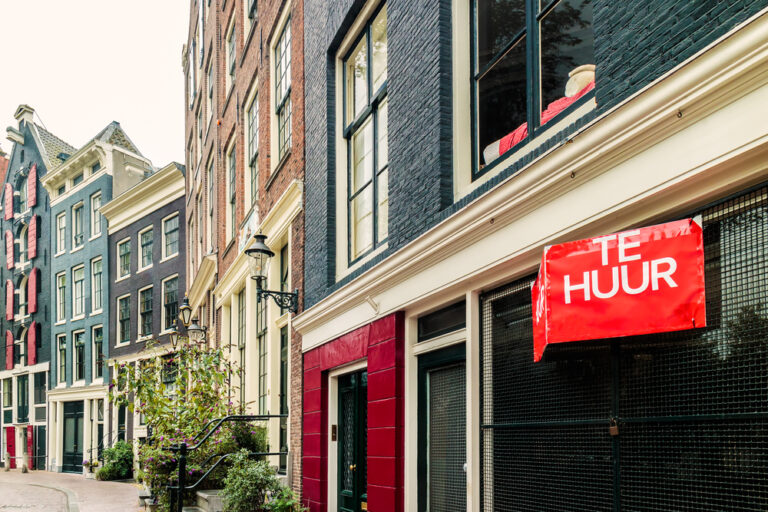
Amsterdam students are now paying an average of €945 per month for a room in 2025, up from €900 last year. New data from Kamernet shows the national average student room costs €601 monthly, rising just 0.5% from 2024.
The numbers are enough to make anyone’s eyes water, especially when you consider that, according to AD, most of these “rooms” are between 12 and 18 square metres.
That’s roughly the size of a decent garden shed — but with presumably better Wi-Fi.
We’re talking about nearly €1,000 for a space the size of a large walk-in wardrobe. At 14 square metres (the typical room size), that works out to about €67.50 per square metre.
Amsterdam is, of course, the most expensive
Amsterdam remains the undisputed champion of wallet-crushing student accommodation costs. The €945 monthly average represents a €45 increase from last year’s already painful €900.
To put that in perspective, you’re essentially paying luxury hotel prices for what’s often a glorified cupboard with a window.
But this national average of €601 masks some seriously dramatic regional variations that’ll make your head spin.
The winners, losers, and “what on earth happened here?” category
Some cities have gone a bit mental with their price increases. Nijmegen takes the crown for the most shocking jump, with the average rent for a room rocketing up by 24.3% to €635 per month.
Students in Tilburg aren’t faring much better, facing a 23% increase to €535 per month. Leiden rounds out the top three with a 16.4% spike, bringing average rents to €610.
But it’s not all doom and gloom. Some cities are actually becoming more affordable — shocking, we know.
Eindhoven won this trend with rents dropping 7.4% to €440 for a room, while Breda saw a 2.7% decrease to €535.
Where your money goes furthest (and where it disappears fastest)
If you’re looking for a bargain, head to Enschede, where the average student room costs just €351 per month.
It’s practically a steal by Dutch standards — though “bargain” is relative when you’re still paying €351 for a space smaller than some people’s bathrooms.
Other relatively affordable options include Wageningen at €395, and both Leeuwarden and Ede at €425 each.
And what about apartments?
If you thought student rooms were pricey, wait until you see apartment prices. Amsterdam apartments now average €2,000 per month — that’s roughly €32 per square metre.
For comparison, Maastricht apartments cost €888 monthly at €20.80 per square metre, making them look positively reasonable.
Rotterdam and Tilburg apartment prices have surged by 14.3% (€1,600) and 10.6% (€1,225) respectively.
However, some cities like Eindhoven (-11.1%) and Groningen (-4.6%) are seeing decreases, bringing the average rent to €1,200 and €1,050.
Have you been hit by these shocking rent increases, or have you found a miracle affordable room somewhere? Share your housing horror stories (or success stories) in the comments below.
There are many weird and wacky sports in the Netherlands that will make you raise your eyebrows and question Dutch sanity.
We all know that Dutchies are obsessed with football,hockey, and ice skating, but many other countries enjoy these sports too. However, if you are bold enough to venture out into the Dutch provinces, you’ll run into a bunch of weird sports that are unique to the Netherlands.
Brace yourselves, because we’re about to count down the 11 weirdest sports in the Netherlands.
1. ‘Paalzitten’: the sport of sitting
Are you a fan of sitting? Well, the Dutch actually have a sport for that! This sport involves Dutchies sitting on a pole for as long as they possibly can (sometimes for over 90 hours!).
The poles do come with a board to sit on and short toilet breaks are allowed — but my word, this can’t be much of a spectator’s sport. 😅
2. ‘Fierljeppen’: canal jumping in the Netherlands
With the number of canals in the Netherlands, making a sport out of them was bound to happen. Fierljeppen is a traditional sport originating from Friesland in the north of the Netherlands.
In fierljeppen(Frisian for far jumping), there is a pole of around eight to thirteen metres in the canal.
The technique is to run towards the pole, jump onto it, and climb it as high and as quickly as possible while trying to control the direction of the fall. Then, if they do it right, they land on a sand bed on the other side of the canal.
3. ‘Korfbal’: a Dutch blend of basketball, netball, and handball
In korfbal, two teams play against each other, each team with four women and four men.
The objective of the game is to get what looks like a football into a hoop, which sits atop a 3.5-metre pole. This fast-paced game has the same intensity and passion you’ll find in NBA basketball.
Although korfbal was invented by the Dutch, over 70 countries from around the world currently compete in this sport at the World Games. 🌏
4. ‘Sjoelen’: Dutch shuffleboard
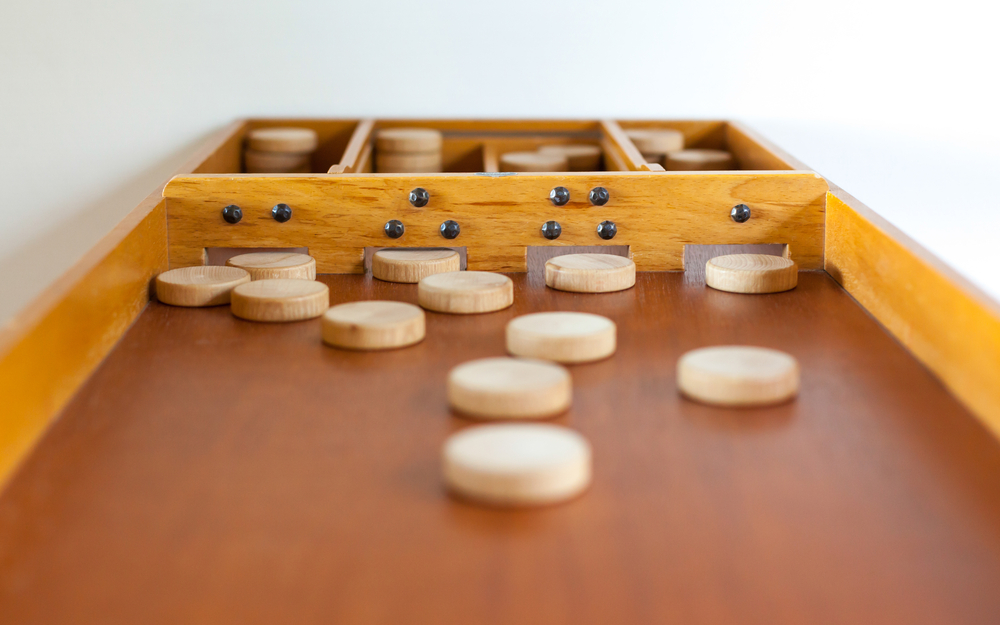
Don’t let appearances fool you, this is a competitive game. Image: Depositphotos
Sjoelen is a popular game that has similarities to shuffleboard. In fact, many Dutch families have a sjoeltafel hiding away in an attic somewhere. The aim is to slide 30 wooden pucks down the longboard and through small wooden arches to score points.
The game is surprisingly competitive, as players compete to get the top score out of a possible 148 points. 💯
5. ‘Kaatsen’: tennis with no rackets?
Kaatsen, or Frisian handball, is believed to be one of the oldest ball games in the world. As the name suggests, players hit a ball with their hands to each other across a field.
Scoring works similarly to tennis; the first team to win six games wins the match. Hitting such a tiny ball across an entire field with only your hand is truly an impressive skill to watch in action!
6. ‘Beugelen’: a stone ball and a wooden bat
Beugelen was favoured by Holland’s upper classes back in the 1400s but has since become a popular sport right across the Netherlands.
In this sport, participants push a heavy ball with a wooden shovel with the aim of getting the ball through the ring in the centre of the floor. Ultimately, it’s kind of like a cross between croquet and boules. 🤷♀️
7. ‘Skûtsjesilen’: manure boat racing
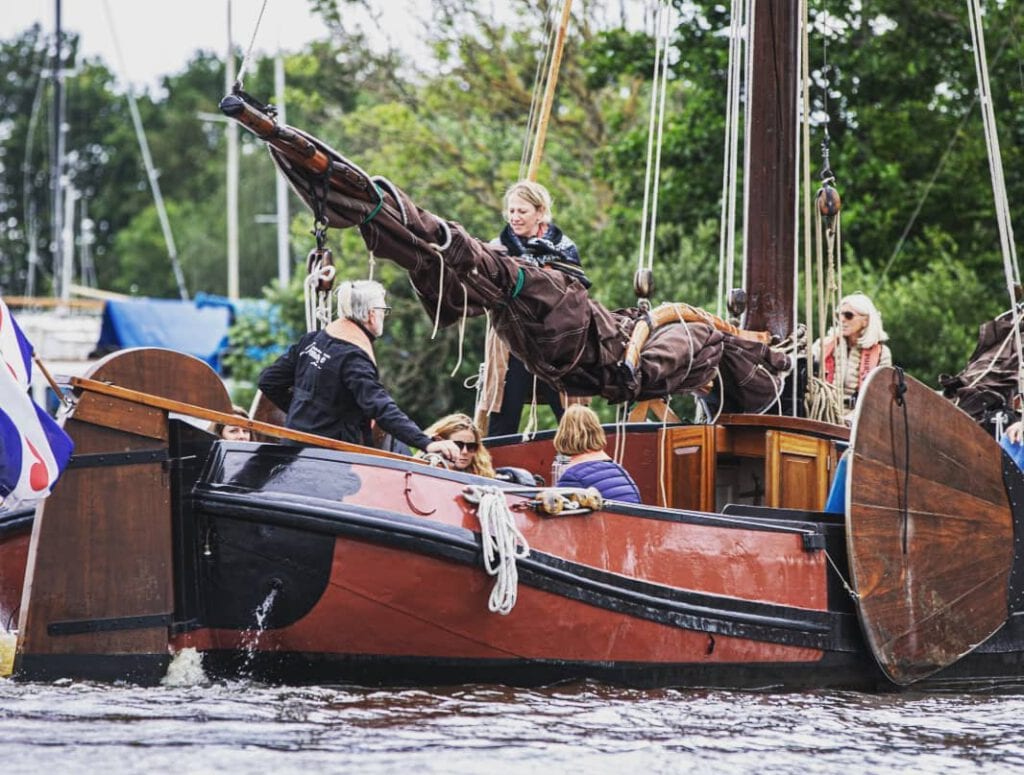
A Skûtsjesilen team preparing to sail. Image: @ebelewijbenga/Instagram
Skûtsjesilen is a sailing competition in which competitors race historic flat-bottom boats called skûtsjes. ⛵
The boats were originally used for transporting peat and manure to farms over shallow waters, but their manoeuvrability makes them ideal for a good race. Many of those who compete are direct descendants of the ancient Frisian skipper families.
The championship takes place every summer in Friesland and is a serious matter of honour for the villages and towns that enter the competition.
8. ‘Klootschieten’: chuck it as far as you can!
Humanity’s obsession with throwing balls is fully embodied in the game of klootschieten. Participants use speed, power, and technique to throw the kloot as far as they can — the world record is 106.2 metres!
A kloot is a wooden or plastic ball filled with lead that weighs anywhere from 200-800 grams. The winning team is that which can throw the kloot across the five-kilometre rural course in the fewest number of throws.
The game is said to have originated from a weapon that the Frisian people used to throw at their enemies. Yikes!🤾♂️
9. ‘Elfstedentocht’: skating on the canals
This is more of an unusual event than a weird sport in itself. Elfstedentochtis a long-distance skating tour over the frozen canals, rivers, and lakes of Frisian cities.
The route changes every year according to where there are condensed patches of frozen water but is usually around 200 kilometres in length.
10. ‘Marathonschaatsen’: the ultimate skating marathon
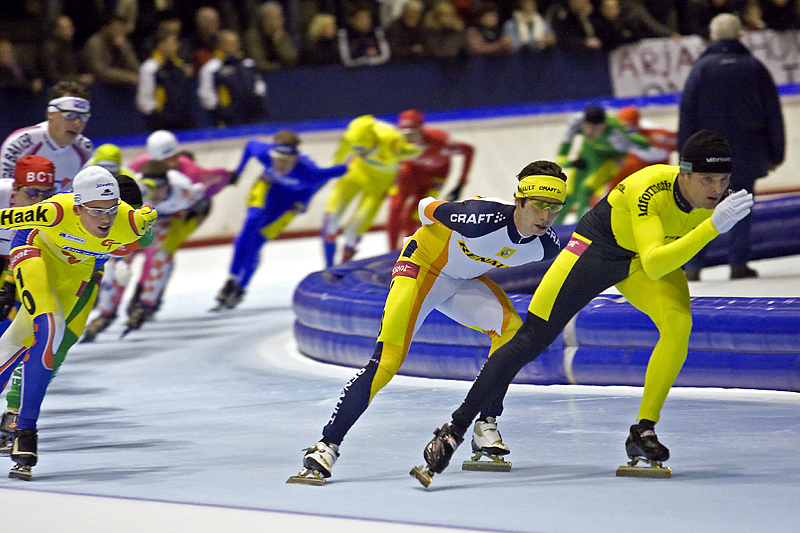
The Elfstedentocht’s indoor cousin is just as competitive! Image: Emiel Ketelaar/Wikimedia Commons/CC3.0
Since Elfstedentocht has become increasingly rare since about the 70s, the Dutch have instead organised the indoor marathonschaatsen (marathon skating), which takes place every year.
Competitors speed around the three-kilometre-long ice rink in Biddinghuizen for a whopping 125 laps in the men’s division, and 80 laps in the women’s division.
With strategics and team tactics, this sport is so much more than just a bunch of Dutchies skating in circles!
11. ‘Tegenwindfietsen’: cycling into a storm
You have to be slightly crazy to do this one. Tegenwindfietsen is essentially cycling straight into a headwind, which sounds like absolute torture (but sometimes unavoidable in the Netherlands.) Some Dutchies CHOOSE to cycle in the middle of a storm.
The Dutch Headwind Cycling Championships take place on the Oosterscheldekering storm barrier and is announced three days before a storm is due to hit, usually in autumn or winter.
The course is 8.5 kilometres long and is biked in the midst of storms which can reach as high as wind force nine! Do you see what we mean by torture?
The Dutch have been renowned for their innovative spirit for centuries, and they’re not about to change anytime soon! Why would they, when it gives them infinite amounts of (global) street cred?
Distinctive architectural styles, orange carrots, the first modern atlas of the world, and Bluetooth — Dutch history is full of cool innovations!
And their proud tradition continues in modern times, with new solutions and inventions seeming to pop up every other day. 🌱
They’ve been discovering things (*cue inappropriate colonialism joke*) since forever, and constantly look for new solutions to old as well as new problems.
The Dutch are also extremely proud of their innovative history and adventurous spirits. So don’t expect the tall people in the tiny country of great inventions to be humble about it.
Why do they do it?
Why do Dutch people innovate so much compared to other countries? We’ve got a few ideas.
Some say the favourable work conditions existing in (countries like) the Netherlands facilitate just the sort of free thinking necessary to grow as an innovative nation. 💪🏽
Being good at innovation is not in itself particularly quirky. What is, however, is the attitude Dutch people have toward their own skills.
If you’ve been in the Netherlands for more than an hour or two, you must have picked up on the fact that Dutch people are not exactly known for being shy. 👀
And it’s no wonder the Dutch are so openly proud of their skills when they’re some of the best innovators in the game.
Should you join in?
Innovation brings the world forward, so that’s definitely a Dutch characteristic worth adopting.
As if the world doesn’t talk about summer enough, we’re going to talk about it some more! Today, we’ll be answering all the questions that you are dying to ask if you’re in and around Rotterdam.
Are there outdoor pools in Rotterdam? What are the best parks to visit? Can I take a boat trip around the city? Where are the best places to drink? Is there a beach near Rotterdam?
We’ve got you covered!
So, without further ado, here are 6 things to do in Rotterdam in the summer. Your park-beach-swimmin’-drinkin’-cruisin’ prayers have all been answered:
1. Head to Hoek van Holland to go beaching
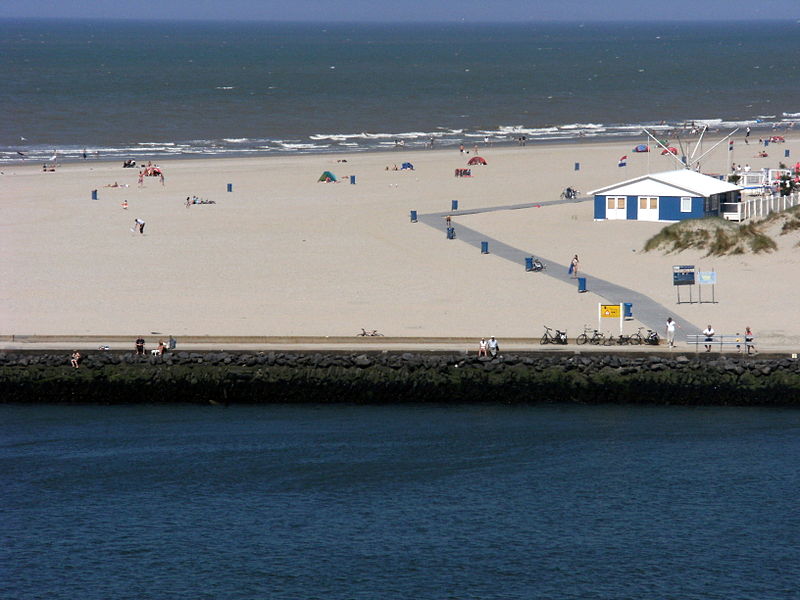
Hoek van Holland in Rotterdam during the summertime! Image: Mark Ahsmann/Wikimedia Commons/CC3.0
Ok, so technically, this isn’t INSIDE of Rotterdam. It’s considered Rotterdam-territory, and it’s pretty damn close if you’re looking to soak up some of that Dutch sun by the sea.
Hoek van Holland is only a 30-minute drive away from the centre, and you can catch a train straight to the beach from Centraal Station. Super handig! (Super convenient!) 😉
It has a beautiful sandy beach with restaurants, bars, shops, and nature — basically everything you could want from a beach. It also doesn’t get quite as busy as some of the other popular beaches in the Netherlands, such as Scheveningen, so that’s always a bonus!
2. Take a cruise around the port and go boating
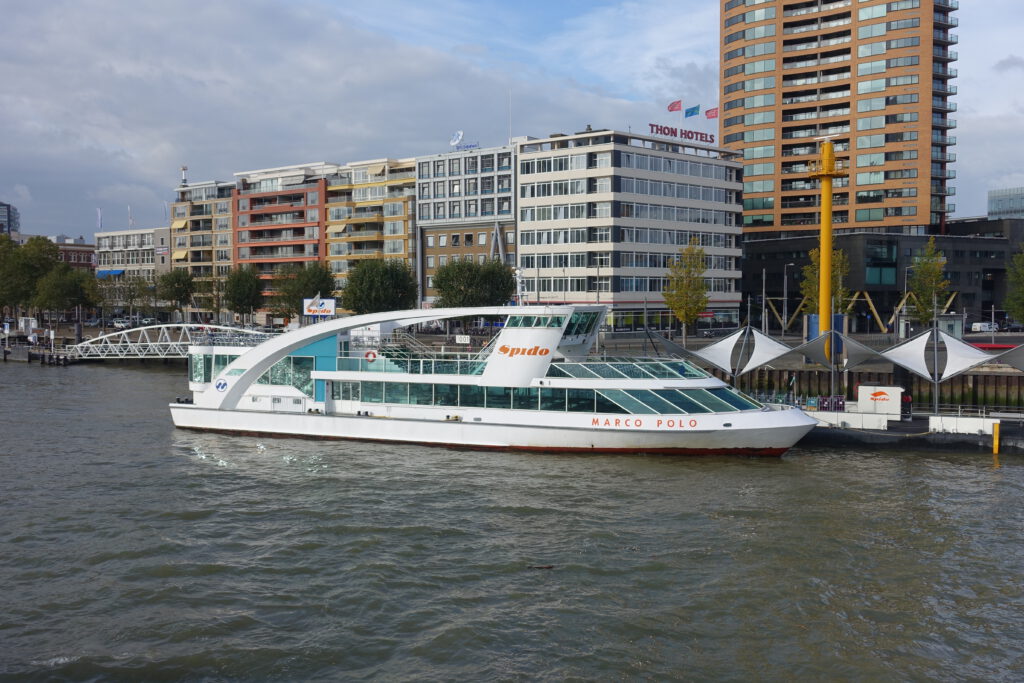
The Spido boat rocking Rotterdam waters! Image: Guilhem Vellut/Wikimedia Commons/CC2.0
Since Rotterdam is surrounded by water, there’s only one thing to do: BOAT TRIP! Not quite the same as a quiet, slow cruise along the canals, but unique in its own way.
If you’re on the lookout for a bit of a different tour in the city, there’s also a thing called the Splash Tours bus, which is literally a bus on land that can float in the water. 👇
While it’s definitely fascinating, it does look incredibly weird from the outside when you see it in the water. So, you can expect a few head-turns riding around in that thing. 😬
3. Go picnicking in the park
Het Park in Rotterdam during the summer is a sight for sore eyes! Image: Jan Geerling/Wikimedia Commons/CC4.0
Rotterdam has tons of beautiful parks with a relaxing vibe — and what’s synonymous with parks? Picnics, of course! 😊
One of the more popular parks is ‘Het Park’, which is located on the edge of the city’s centre near the Euromast.
It has lots of green space, lakes, and nature, and it’s reasonably quiet in the sense that you can grab a nice spot on the grass and enjoy a good picnic under the sun without being overcrowded by people.
After work, expect to find folks stripping down into their bikinis to grab the last bit of evening sunshine at the park.
If you’re looking to explore other great parks in the area, then these are essential to know: Zuiderpark, Kralingse Bos, Vroesenpark and Museumpark. 👌
4. Go swimming in an outside pool… on a cruise ship!
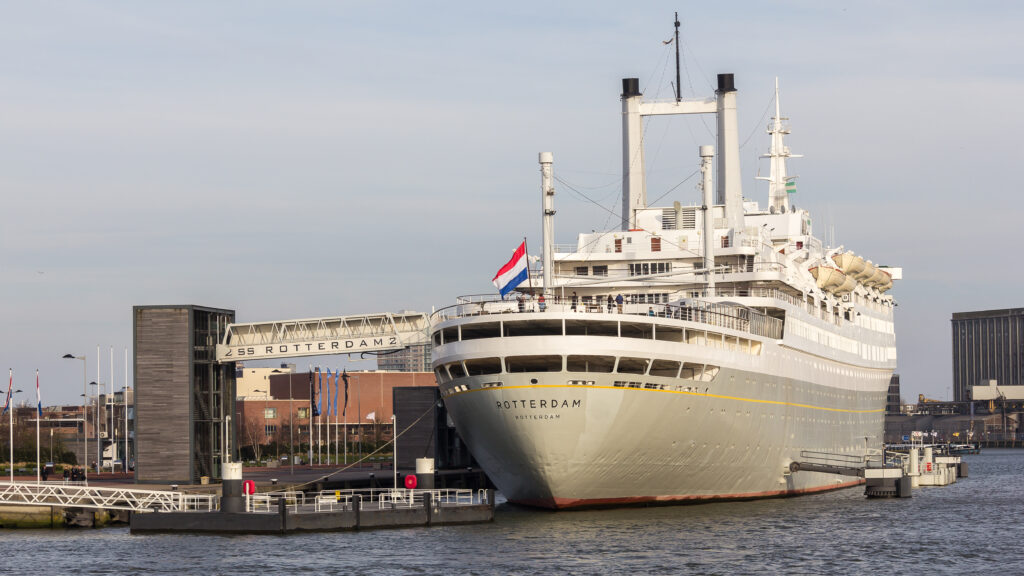
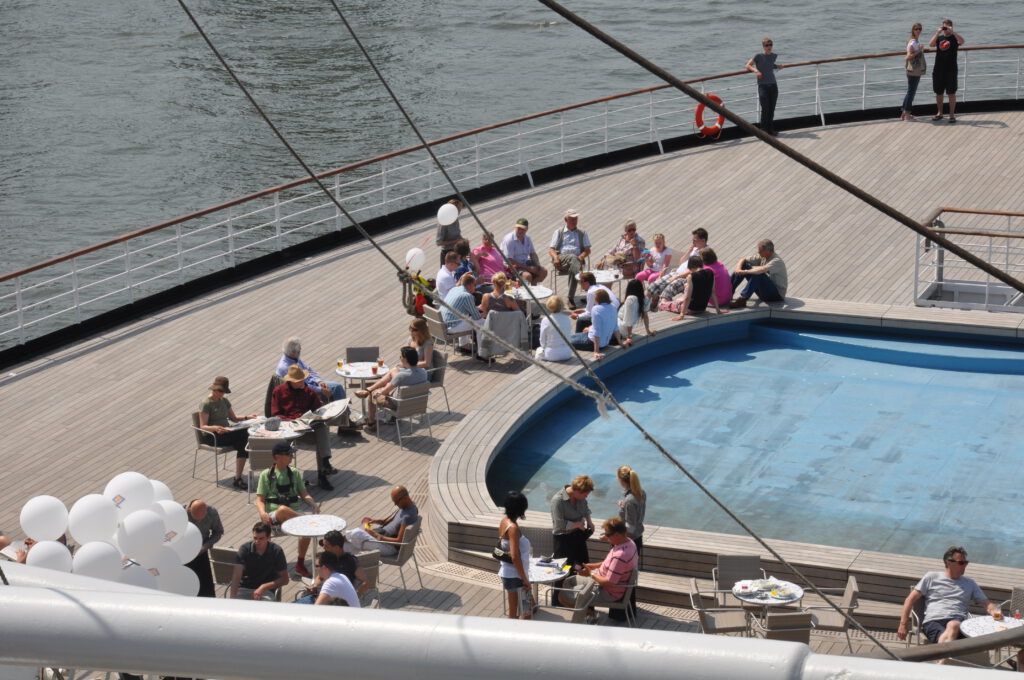
While Rotterdam isn’t exactly a city known for having outdoor swimming pools, it does possess a place where you can get your feet wet or bring your kids to have a splash about. What are we talking about here? Oh, right, the SS Rotterdam!
There’s a small pool on the outside deck at the end of the ship. Of course, this won’t be the place to practice for the Olympics, but it’s better than nothing, I suppose. (If you don’t mind sitting in your bikini with a horde of people drinking beer around you.)
5. Go drinking on a rooftop bar
Rotterdam certainly is a skyscraper city… Image: Depositphotos
Rotterdam has lots of outside space to grab some delicious food or have a couple of cocktails — but the most popular one is Witte de Withstraat (dang, talk about a tongue twister 😜). Here’s where you can sit outside and indulge in the many different bars and restaurants all along the street.
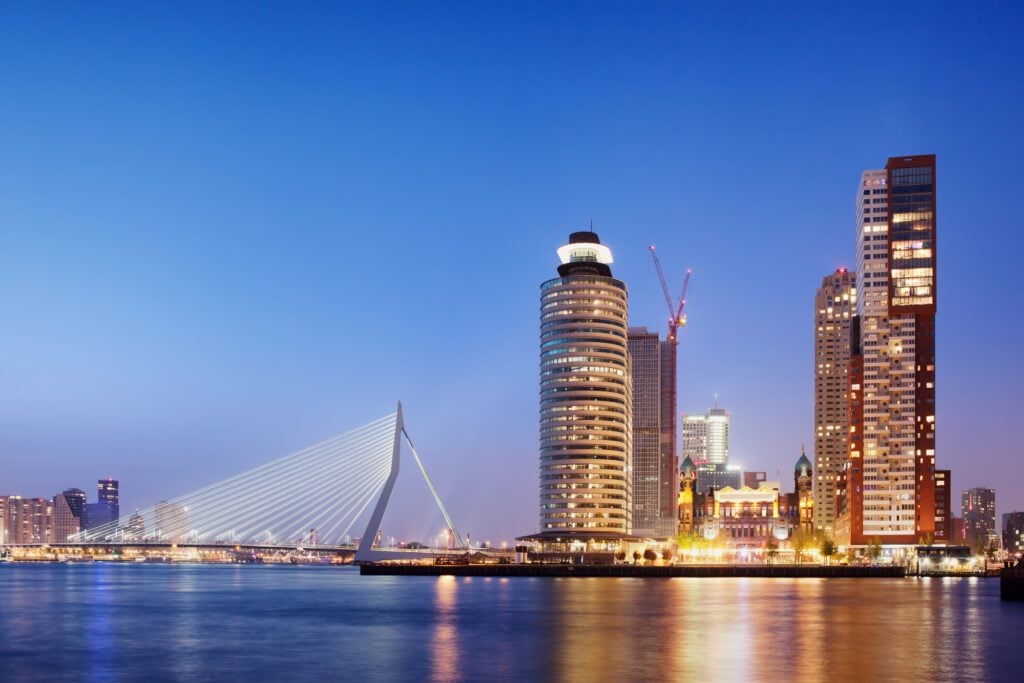
However, Rotterdam also has a variety of amazing rooftop bars. You know, with it being the skyscraper city and all that.
Rooftop bars let you enjoy your summer evenings of literally feeling on top of the world. The best part is that they are so easily accessible and usually a stone’s throw away from a station or metro.
So, if you’re looking for somewhere to wind down after a stressful day at work, or want to impress a few guests, then you know where to go!
Well, there you have it! Five very summery things to do in Rotterdam during the sunny holiday period. The perfect way to get your summer fix!
(Personally, I vote number five because I turn into a raging alcoholic the minute the sun comes out. It’s the Brit in me.)
Do you have any other suggestions onthings to do in Rotterdam in the summer? Let us know in the comments below!
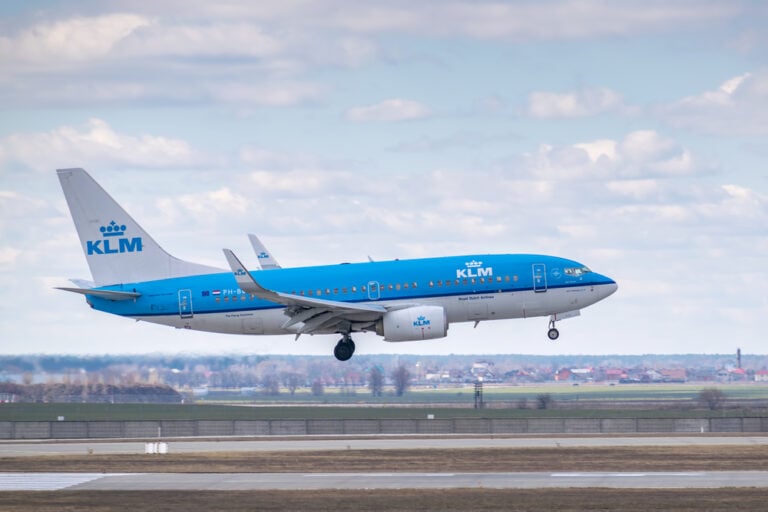
Something’s brewing in the blue skies of KLM, and it’s not just the coffee. Starting September 9, the Dutch airline is testing a brand-new type of ticket on several European routes.
And travellers aren’t going to like it.
With this new ticket, you can only bring one small bag or backpack that fits under the seat in front of you.
That’s right, no duffel bags. With this ticket, the bag can’t be bigger than 40 x 30 x 15 cm — that’s even smaller than EasyJet’s restrictive measurements. Think “laptop bag” or “tiny weekend tote.”
This doesn’t mean you’re going to save money
And no, before you hope for a silver lining, this new ticket type isn’t automatically cheap.
However, taking extra hand luggage onboard the chosen routes will now cost more.
A KLM spokesperson tells NU.nl that the surcharge for extra baggage varies, “It can be €10 or €15. People see that when they book.”
However, in a statement, spokesperson for the Consumers’ Association (Consumentenbond), Babs van der Staak, points out that “bringing hand luggage costs on average about €28 extra. And can be up to €40.”
Against European law
She also writes that KLM is crossing the line. “European law says airlines can’t charge for a reasonable amount of hand luggage,” she warns.
As a result, the association will be adding the airline to the complaint they have already filed with European regulators against seven other airlines.
In the meantime, brace yourself for some extra charges on these routes: Athens, Dublin, Florence, Helsinki, Munich, Prague, Stockholm, Turin and Vienna.
If you’re flying to one of these destinations with KLM in autumn and hoping to pack your life into one bag, it better be the Mary Poppins variety.
What do you think of this change? Tell us your thoughts in the comments below.
Police are calling for witnesses to step forward after a girl was sexually assaulted by a man while visiting Rotterdam’s Zuiderpark with her mother last Tuesday.
The NOS reports that the park was crowded due to the summer weather, and the mother lost sight of the girl, who is a minor, for a few minutes at around 4:30 PM.
According to police, once the girl returned to her mother, she told her that a man had touched her in the bushes. The child wore a sleeveless dark blue dress with white unicorns on it and white sandals.
Police looking for witnesses
Since the assault, police have increased surveillance in the park and have set up a large investigation team.
They are also calling on anyone who may have seen something to step forward.
The assault is believed to have happened near a reed bed along Zuiderparkpromenade, west of Zuiderpark.
The suspect is described as a white man, believed to be over 35 years old, with a black/grey beard and blue/green eyes.
The victim was wearing a sleeveless dark blue dress with white unicorns and white sandals.
Speaking with the NOS, a police spokesperson explained that they would not be revealing the victim’s age. They also do not want to reveal the exact nature of the assault.
Were you in Zuiderpark between 4 PM and 5 PM on August 12? If you think you may have seen something, you can report the crime via the free tip line at 0800-6070. You can also report anonymously by calling 0800-7000 or filling out the online tip form.
A 24-year-old man was arrested in Badhoevedorp, just 20 minutes from Amsterdam, on Thursday on suspicion of preparing to launch a right-wing terror attack.
The man claims to be a member of Geuzenbond, a far-right organisation. Guezenbond encourages the “normalisation of right-wing extremist thought and making the ‘white race’ resilient through physical training” writes the Public Prosecution Service (OM).
The group also tends to target young people in the Netherlands and Belgium, according to the NOS.
Firearms found at home
The Public Prosecution Service launched an investigation into the man after the Dutch General Intelligence and Security Service (AIVD) received a tip that he was preparing to commit terrorist violence.
A search of the man’s home in Erp found firearms and ammunition. The man was subsequently charged on suspicion of possessing and manufacturing these weapons.
He has been remanded in custody while police continue their investigation.
Utrecht police are searching for a man who committed a “serious sexual assault” in Zeist on Friday.
According to police, a woman was approached by a man on Prinses Mariannelaan who then committed the crime. The suspect then fled into the forest.
After police arrived, they launched a large-scale investigation, utilising the Royal Netherlands Marechaussee, a police helicopter and several sniffing dogs. Unfortunately, the perpetrator has not yet been caught.
The suspect is described as below:
Male
1.80 meters tall
Muscular
Short hair
Between 30 and 40 years old
Shorts
Black tank top
Spoke English with an Eastern European accent
Similar incident
The description closely matches a report relating to an incident earlier in the day, where a different woman was approached on the Grensweg near Hoog Kanje.
In that instance, the woman felt very uncomfortable when the man approached her and called out for help.
A person walking a dog ahead of the woman turned around, but then continued on. The woman began screaming, scaring the suspect away.
Police have now reported that the dog-walker has made contact with police and had a satisfactory reason for why he did not come to assist.
Police seek tips
Police have since received dozens of tips relating to the incidents, but continue to seek any information that could help catch the perpetrator.
Anyone with relevant information or camera footage can call 0900-8844 or report online.
If the suspect is seen, do not approach; instead, call 112.
The Netherlands has an incredibly rich student life, where everyone is encouraged and welcome to take on extracurricular activities. These are mostly in the form of student associations (studentenverenigingen), sometimes known as student societies.
For those of you fresh off the plane and settling into your new student life in the Netherlands, you may have already experienced the Dutch introduction week known as introductieweek.
It’s basically a bombardment of banners, leaflets, and free pens, during which tall local students convince you to sign up for student clubs.
This can be quite overwhelming, and you might find yourself walking away wondering what exactly you signed up for. Was that an academic club, an association, or some kind of sorority or fraternity?
What kind of student associations are in the Netherlands?
Student associations in the Netherlands exist for almost everything. From soccer, politics, rowing, LGBTQ+, history, art, street dance, debating, a religious group, vegans, international students, nationalities, and more!
Generally, Dutch student societies are divided into five different groups:
Social associations (Gezelligheidsverenigingen) — exist primarily to socialise and make the most out of student years. 🎉
Study associations (Studieverenigingen) — with a focus on your degree area. 📚
Sports associations (Sportverenigingen) — for a particular sport. 🏑
Religious associations (Religieuzestudentenverenigingen) — for members of certain religions or faiths. 🛐
Other associations (Overigestudentenverenigingen) — anything else you can think of! 💡
What are the perks of joining a Dutch student association?
This could be your new home! Image: Bert Kaufmann/Wikimedia Commons/CC3.0
If you want to integrate into Dutch life while studying in the Netherlands, joining a society is a great idea.
Of course, it’s not without challenges. But in general, you can take advantage of some sweet benefits. Here are just a few!
Networking and student life
Student associations are a quick way to meet people and make friends. You’ll have to be up for learning a new language and willing to throw yourself into all the parties and activities.
If that’s the case, then student associations will be a great way to meet some friendly people.
Of course, for international students, breaking into those tight Dutch circles can be a little more complicated. Many internationals are Master’s students and are only around for a year or so.
They have a reputation for taking their studies more seriously — I mean, none of us flew across the planet to fail — so they tend to have lower commitment levels to societies than local students.
The result is that student associations sometimes put less effort into attracting internationals. Unfortunately, this can create a bit of an anti-international vibe.
It’s also natural that many societies in the Netherlands operate in Dutch, making it difficult for internationals to feel included.
If you would like the benefits of joining a student association with a bit less pressure, opt into an international student association like ESN. Most of the students will be in the same boat as you, but there will also be some Dutchies floating around who love hanging with foreigners.
Housing
As you may know already, there’s a nationwide housing crisis in the Netherlands, especially in student cities.
Who knows, you might even meet your future housemates! Image: Depositphotos
Now we’re not here to say that joining a student association will score you an awesome place to live. However, finding a place to stay is easier when you’ve built up a network — especially if you have some Dutchies mixed into your social circles.
Meanwhile, some fraternities and sororities have student houses that will only accept members.
Job market
In the student community, joining a student society is said to seriously help your career.
I’ve heard stories of internships and other jobs being made possible because of a shared society membership with the employer (which many still boast about long after graduating).
How do I join a student association in the Netherlands?
A great way to make friends and a guaranteed party invite. Image: mild_swearwords/Wikimedia Commons/CC2.5
The easiest way to take part in a student association is by showing up to introductieweek (introduction week). Here, almost all student societies will be represented and looking for new members — like yourself!
If you happen to miss introductieweek, check in with your university to see if it has a list of student societies, or do a quick Google search.
You never know what student association will catch your eye — and you may just end up making some friends for life along the way. 😉
Are you, or were you, part of a student association while studying in the Netherlands? Tell us in the comments below!
Amsterdam may be small, but its art and culture scene is anything but. With a wealth of art museums spread across its charming streets, this city feels like an open-air museum.
After five years of living here, I can tell you: Amsterdam seriously spoils you. World-famous masterpieces and quirky hidden gems are never more than a short bike or walk away.
Whether you’re visiting or just settling in, this guide is where your art museum journey begins. 👇
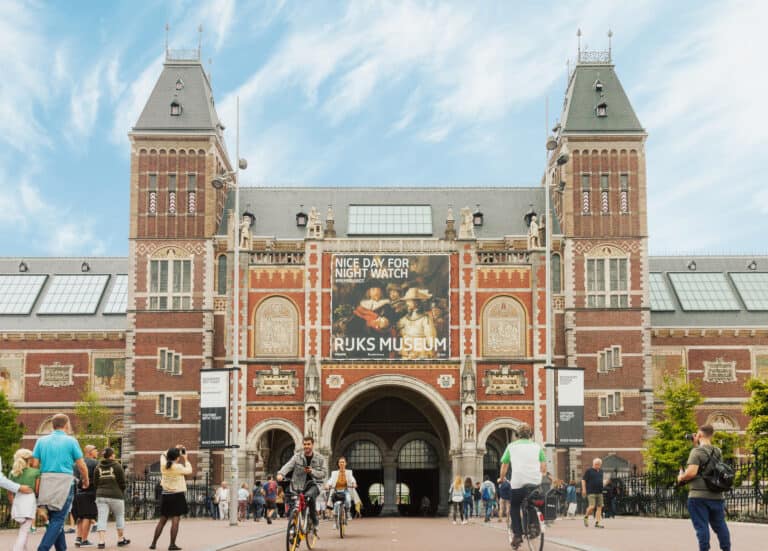
The granddaddy of all museums in Amsterdam? That would be the Rijksmuseum, and yes, it lives up to the hype. 😍
Step inside and you’re surrounded by 800 years of Dutch art and history, from Rembrandt’s “The Night Watch’’ to Vermeer’s “The Milkmaid.’’
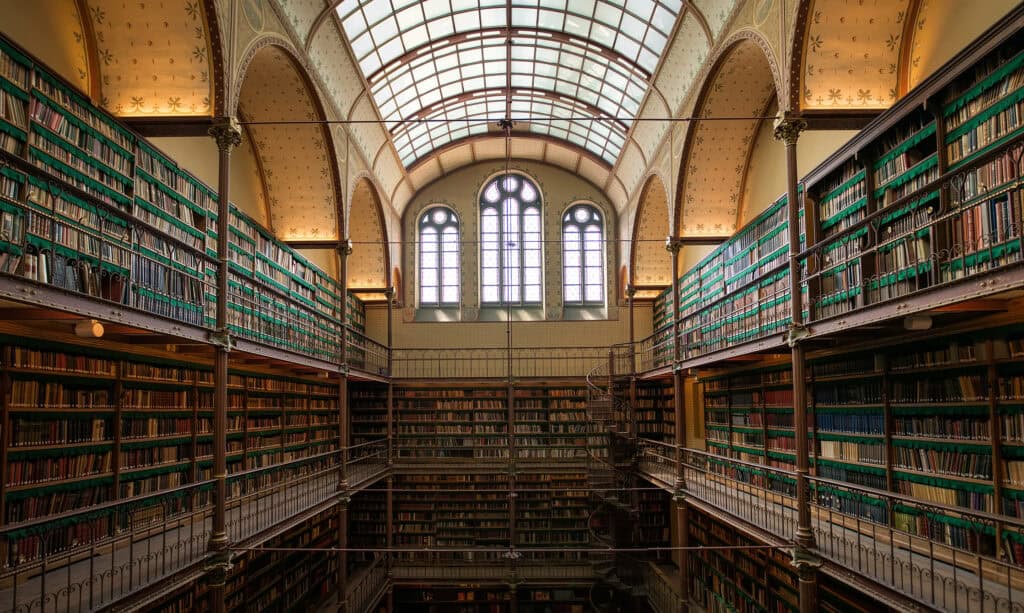
Rijksmuseum tip? Don’t miss the library. Image: Dreamstime
It’s not just paintings: think Delft blue pottery, gleaming weapons, and intricate dollhouses that once showed off the wealth of 17th-century merchant families.
The museum is massive, so give yourself a few hours. And don’t skip the gardens, they’re free to enter and change with the seasons.
Tip: Visit early in the morning or late in the afternoon to dodge the crowds, and treat yourself to a meal at RIJKS, the museum’s Michelin-starred restaurant.
📍 Location:Museumstraat 1, Amsterdam 💰 Price: €25 for adults, free under 18 ⏰ Hours: 9 AM to 5 PM daily (booking with a time slot required)
2. Van Gogh Museum
Home to the world’s largest Van Gogh collection, this museum takes you on an emotional deep dive into the artist’s life and work. 🌻
Van Gogh’s story is told chronologically, so as you move through the rooms, you follow the artist’s life, from his hopeful beginnings to his final, troubled years. Highlights include his self-portraits, “Sunflowers,’’ and The Bedroom.’’
The museum also explores his artistic influences and features personal letters to his brother Theo, offering powerful insight into his creative mind.
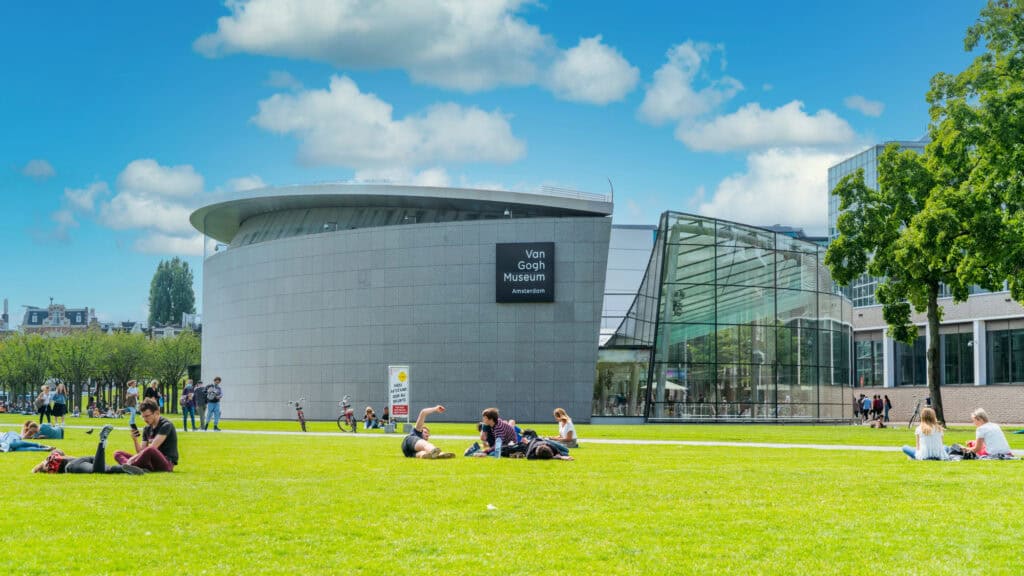
Don’t miss lounging outside the Van Gogh Museum when the sun is shining. Image: Depositphotos
To top everything off, the building, designed by Dutch architect Gerrit Rietveld, is a modernist masterpiece.
Tip: Tickets are only available online, and you must book a time slot in advance. Opening hours may vary monthly, so check before you visit.
📍 Location:Museumplein 6, Amsterdam 💰 Price: €24 for adults, free under 18, €11 for students ⏰ Hours: 9 AM to 6 PM daily (open until 9 PM on Friday)
3. Stedelijk Museum
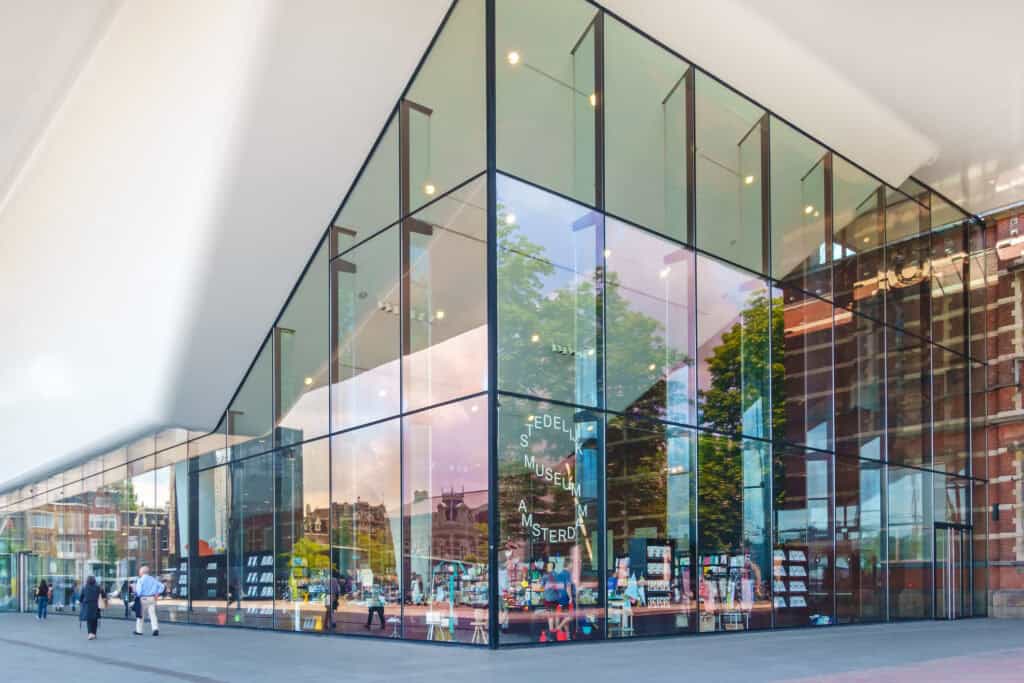
Amsterdam’s go-to museum for modern and contemporary art, the Stedelijk, stands out with its bold collection and bathtub-shaped building.
Inside de badkuip (yes, locals call it that), you’ll find works by big names like Picasso, Mondrian, and Kandinsky.
Before the art, the Stedelijk Museum building speaks. Image: Dreamstime
The temporary exhibitions? Always ready to shake things up. One might move you to tears, and another leaves you staring at a red dot, questioning everything. That’s the fun of it. 💁♀️
Tip: If you’re looking for an artsy book, a cool print or a unique souvenir, the museum shop is well worth a visit.
📍 Location:Museumplein 10, Amsterdam 💰 Price: €16.50 for adults, free under 18 ⏰ Hours: Tuesday to Sunday from 11 AM to 5 PM
4. Moco Museum
Set inside a historic villa near Museumplein, the Moco Museum brings street and contemporary art to the heart of Amsterdam.
Banksy steals the spotlight with works like “Girl with Balloon’’ and “Laugh Now,’’ but you’ll also spot pieces by Basquiat, KAWS and a rotating cast of bold, thought-provoking artists.
The best part? The setting. With rooms that feel like a very cool private home, Moco keeps things fresh, fun and accessible. 😎
Tip: This museum is hugely popular, so it’s best to book in advance — plus, booking online gives you a discount.
📍 Location:Honthorst 20, Amsterdam 💰 Price: €19.95 for adults, €17.95 for ages 7 to17, €17.50 for students ⏰ Hours: 9 AM to 8 PM, Monday to Sunday
5. Rembrandt House Museum
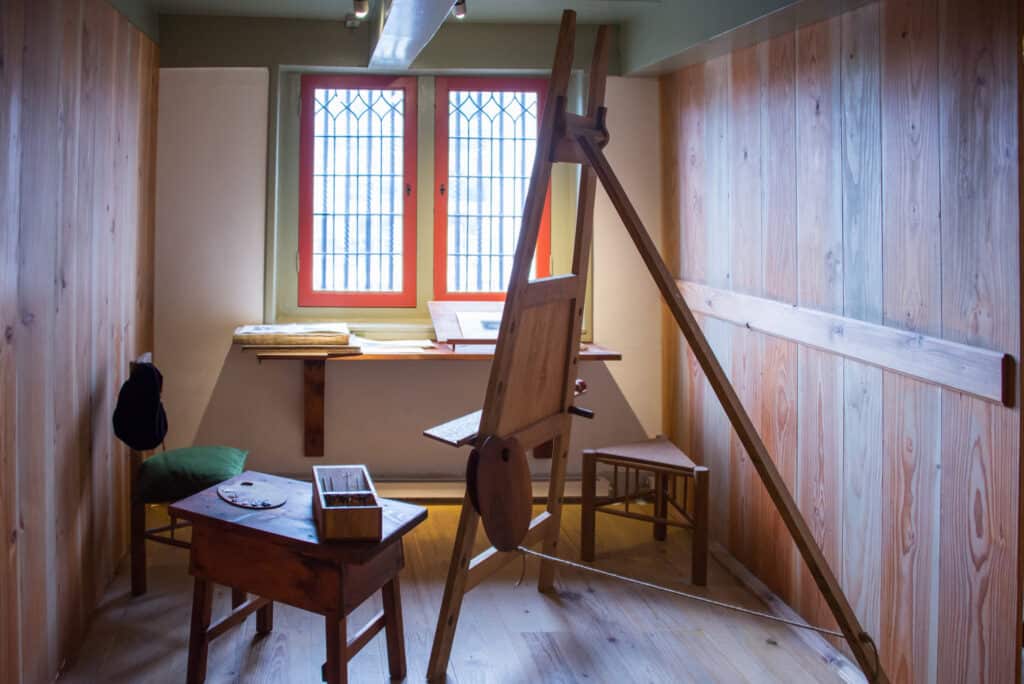
This historic house, where Rembrand lived and worked during the height of his career, has been faithfully recreated to show how it looked between 1639 and 1658.
Stand where Rembrandt mixed genius with pigment. Image: Dreamstime
You’ll see his box bed, painting tools, and a sleek set of etchings. There’s even a live demo on how he made his own paint — because, of course, he did.
It’s a surprisingly intimate and effortless museum experience: small, fascinating, and perfect if you’ve only got an hour to spare.
Tip: Check the website before you go, as opening hours may vary depending on the time of year of your visit.
H’ART Museum, once the Hermitage Amsterdam, has rebranded with a bold new focus and a more independent spirit.
Housed in a grand neo-classical building by the Amstel, it presents major exhibitions with global art and socially relevant themes, in collaboration with leading museums. 🌍
But that’s not all. The building also houses the Amsterdam Museum and Museum of the Mind | Outsider Art, making it a unique cultural hub.
Tip: The Grand Café serves up seriously good coffee, and the museum keeps things lively with painting workshops, live jazz, and other artsy happenings
📍 Location: Amstel 51, Amsterdam 💰 Price: €27.50 for adults, €17 for students, and free for visitors aged 17 and under ⏰ Hours: 10 AM to 5 PM daily
7. Royal Palace Amsterdam
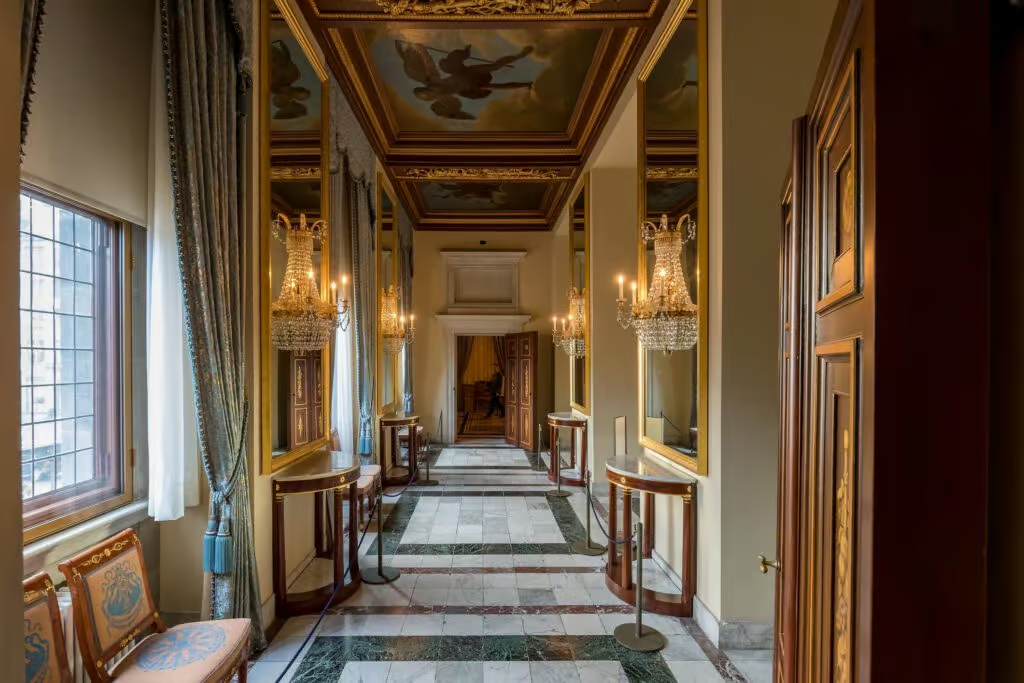
Once Amsterdam’s city hall, the Royal Palace became a palace for royalty when Napoleon’s brother decided he needed something a bit more… majestic. 👑
Imagine calling this your office. Goals. Image: Dreamstime
Today, it still hosts royal events but opens to the public when the royals are off duty. While not technically an art museum, it does feature impressive artworks, including pieces by Rembrandt’s pupils and Ferdinand Bol.
Nxt Museum in Amsterdam Noord is all about the future of art — digital, immersive, and seriously interactive.
Set inside a former warehouse, the space comes alive with video, VR, and tech that moves with you.
Some exhibitions are all about the wow factor, while others ask big questions about technology, privacy, and what it means to be human in a hyper-connected world. 👾
Tip: Prices vary by time slot, so plan ahead. Want the best deal? Wednesdays are your friend.
📍 Location:Asterweg 22, Amsterdam Noord 💰 Price: €19.50 to €24.50 for adults, €15 for students ⏰ Hours: 11 AM to 8:30 PM Sunday to Thursday, 11 AM to 10:30 PM Friday to Saturday
9. Eye Filmmuseum
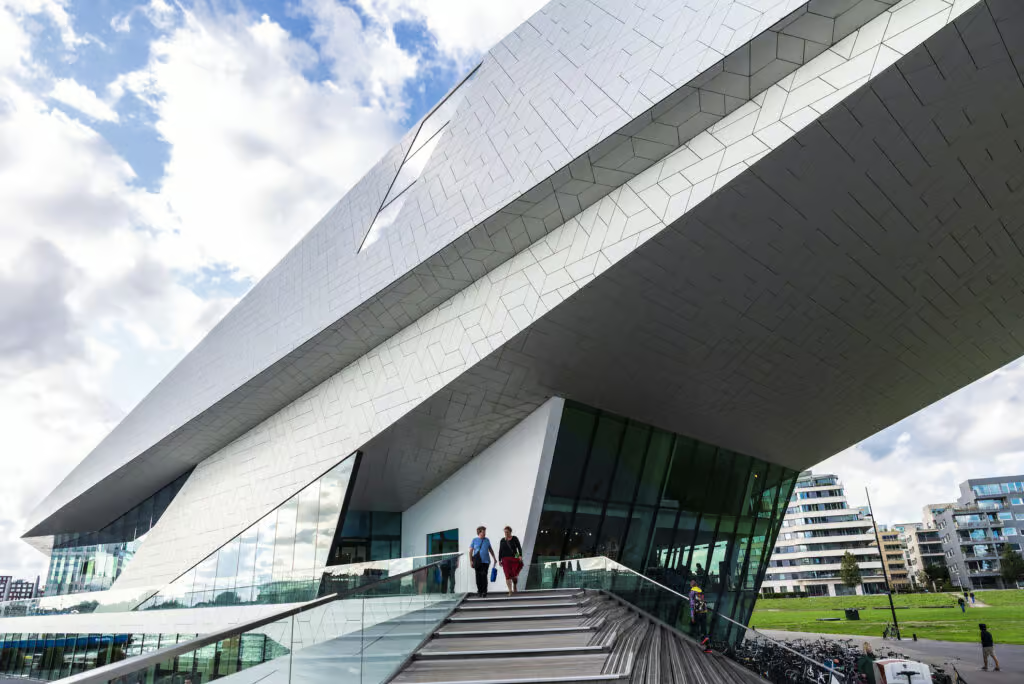
This white icon, located across from Amsterdam Centraal Station, is all about cinema.
Did you know the Eye Filmmuseum is named after its eye shape and the Dutch ‘IJ’? Image: Dreamstime
You’ll find rotating exhibitions and a permanent showcase on the history of film, along with fun activities for kids, including flipbook making, animation tables, and audio benches.
The Eye Filmmuseum features four cinemas, offering screenings for all tastes, from family favourites to arthouse highlights.
Tip: The Eye Bar & Restaurant serves up stunning panoramic views — and one of the best broodje kroketjes in the city.
📍 Location:IJpromenade 1, Amsterdam Noord 💰 Price: €13.50 for adults, €11 for children up to 11 years ⏰ Hours: Sun-Thurs 10 AM to 10 PM, Fri-Sat 10 to 11 PM
10. STRAAT Museum
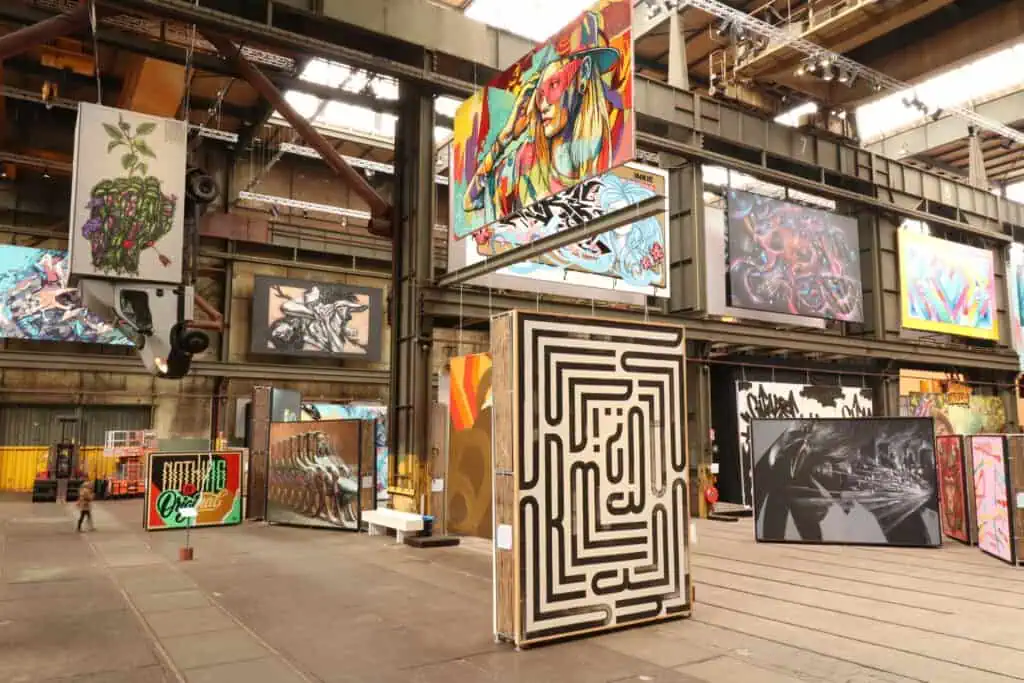
Catch the free ferry to Amsterdam Noord and find yourself surrounded by bold, unfiltered street art in a massive industrial warehouse.
The Straat Museum isn’t your average museum. It’s raw, loud, and proudly rooted in the streets, with work by legends and rising stars alike.
World’s largest graffiti museum? Yep, right here. Image: Dreamstime
We’re talking 7,000 square metres of graffiti, massive murals, and wild installations that don’t hold back.
Tip: Feeling inspired? Sign up for a workshop and leave with your masterpiece.
📍 Location:NDSM-Plein 1, Amsterdam Noord 💰 Price: €19.50 for adults, €9.50 for anyone under 18 ⏰ Hours: Mon 12 PM to 5 PM, Tue to Sun 10 AM to 5 PM
11. FOAM
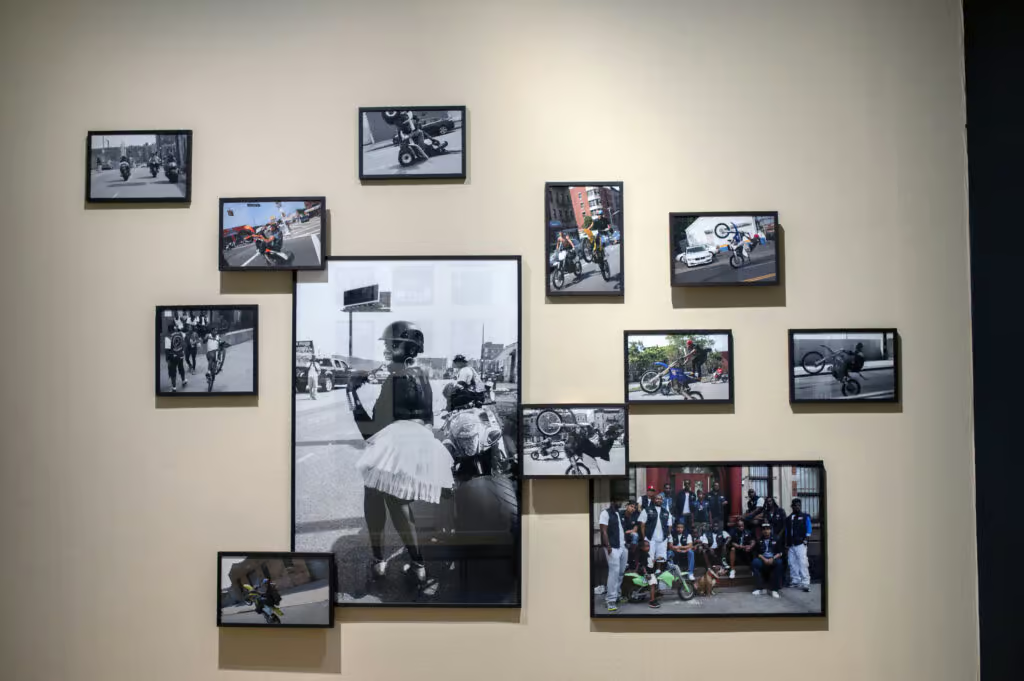
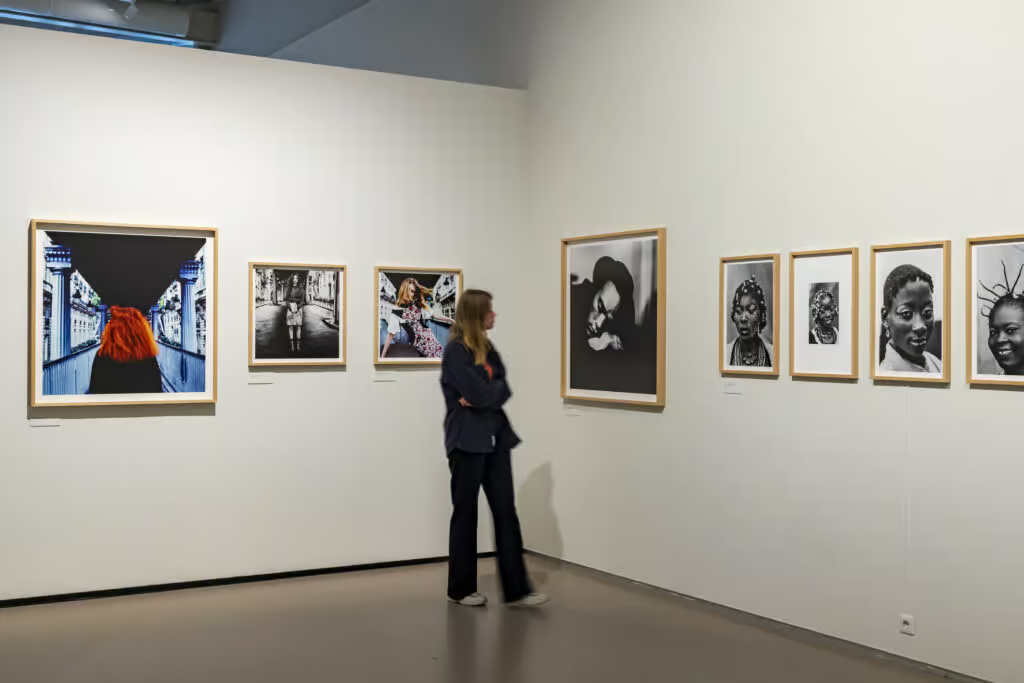
FOAM is a must for photography lovers, all inside a dreamy canal house that’s almost as photogenic as what’s inside. 📷
If you love photography, Foam hits deep. Image: Dreamstime
Expect exhibitions that range from historical icons to new voices, with a strong focus on documentary photography that isn’t afraid to get political or personal.
It’s not huge, which means exhibitions are thoughtfully curated and easy to connect with.
Tip: The lineup changes often, so check the website before you go. And don’t skip the gift shop — the photo books and prints are seriously tempting.
📍 Location:Keizersgracht 609, Amsterdam 💰 Price: €16 for adults, free for children up to 12 years old ⏰ Hours: 10 AM to 6 PM Monday to Wednesday, 10 AM to 9 PM Thursday to Friday, 10 AM to 6 PM Saturday to Sunday
12. Huis Marseille
Huis Marseille has been capturing Amsterdam’s attention since 1999, when it opened as the city’s very first photography museum.
Housed in a 17th-century canal house at Keizergracht 401, it expanded in 2013 to include its neighbour at number 399. The result? Fourteen unique exhibition spaces.
The museum hosts a rich and varied program that changes about four times a year, showcasing photography that zooms in on today’s social and political issues.
Tip: Don’t miss Huis Marseille’s garden, and its quiet little library.
📍 Location:Keizersgracht 401, Amsterdam 💰 Price: €12.50 for adults, €6.50 for 65 + ⏰ Hours: 10 AM to 6 PM daily, Thursday open until 9 PM
13. Cobra Museum
Take the number 5 tram to Amstelveen and explore a museum packed with bold colour, raw emotion, and a fearless break from tradition.
Cobra was never just an art movement — it was a radical break from convention, grounded in creativity, international solidarity, and a belief that art belongs to everyone.
Cobra is just outside the city and totally worth the detour. Image: Dreamstime
Here you’ll find works by Karel Appel, Constant, and Corneille, alongside contemporary artists who carry that rebellious spirit alive.
📍 Location:Sandbergplein 1-3, Amstelveen 💰 Price: €20 for adults, €5 for teens 13 to 18, free for kids under 12 ⏰ Hours: 10 AM to 5 PM Tuesday to Sunday
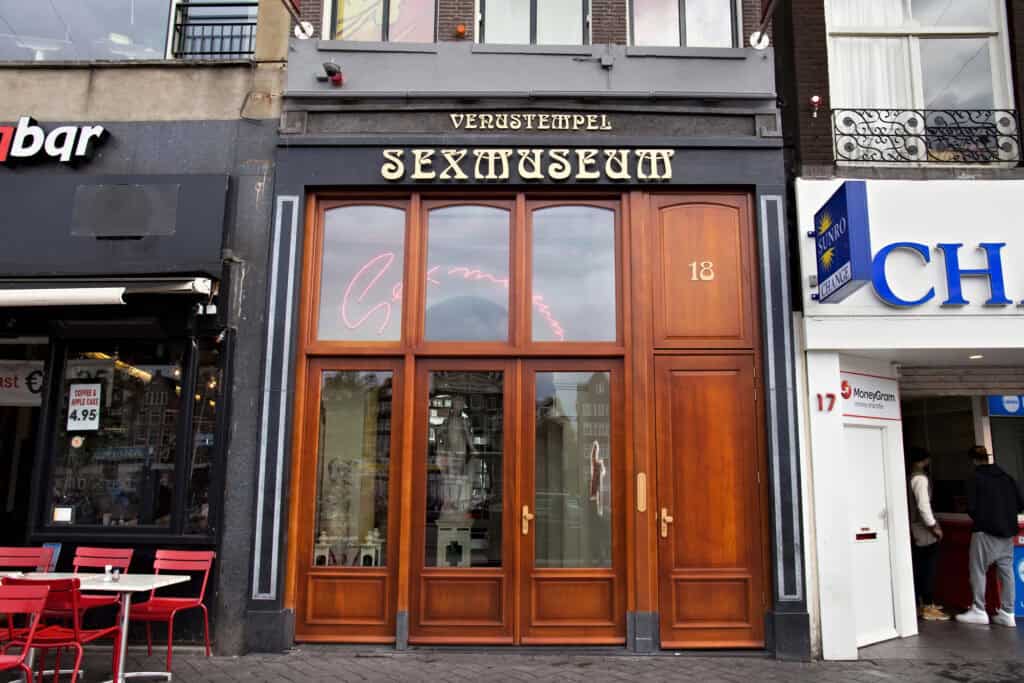
14. Sex Museum
Although this isn’t your typical art museum, this cheeky little spot on Damrak has been exploring Amsterdam’s open attitude toward sex since 1985.
Amsterdam’s Sex Museum is more than giggles; it’s a walk through centuries of erotic history. Image: Depositphotos
The collection goes global, featuring erotic art from anonymous stone carvings to big-name artists, all proving one thing: sex has always been part of the cultural conversation.
Sure, it’s touristy — but don’t roll your eyes just yet. You’ll find everything from ancient fertility symbols to vintage porn and stories of sexual liberation.
📍 Location:Damrak 18, Amsterdam 💰 Price: €10 for adults (16+) ⏰ Hours: 10 AM to 6 PM daily
15. KattenKabinet
A museum entirely dedicated to cats in art — exactly as wonderful and weird as it sounds.
The collection stretches across centuries, with paintings, drawings, sculptures, and even works by big names like Picasso and Rembrandt. Yes, even the greats couldn’t resist a good cat muse. 😻
Tucked inside a beautiful canal house, the museum comes with a bonus: real cats. These furry residents wander through the galleries like they own the place, and honestly, they do.
📍 Location:Herengracht 497, Amsterdam 💰 Price: €12.50 for adults, €7.50 for 65+ ⏰ Hours: Tuesday to Sunday from 12 AM to 5 PM
16. Het Schip
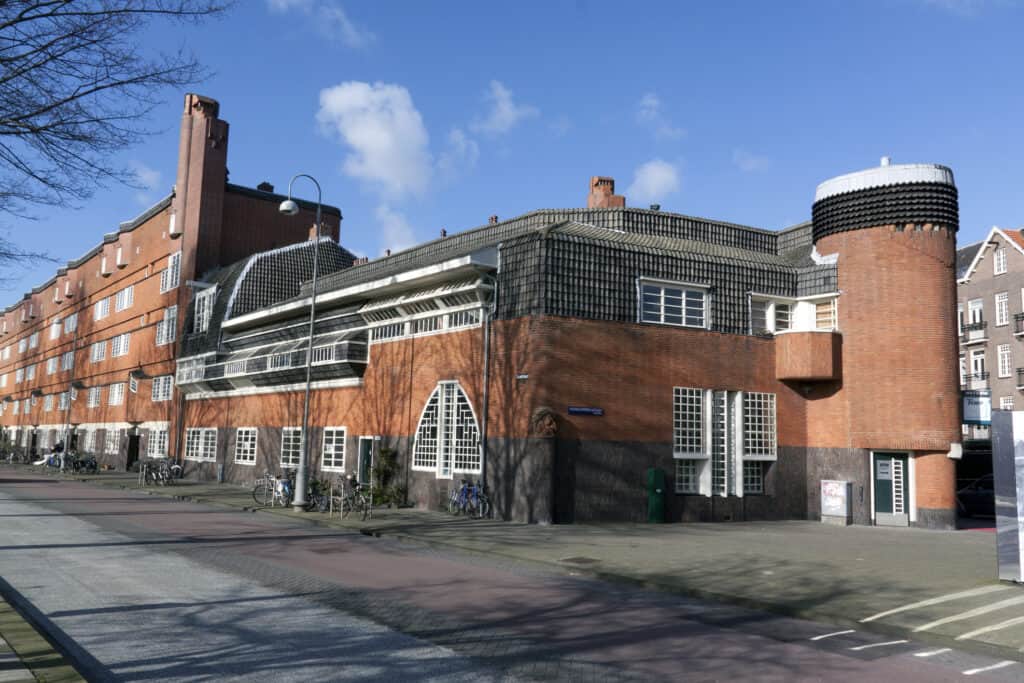
Museum Het Schip lives in a legendary Amsterdam West complex by Michel de Klerk, better known as “The Schip.”
This striking brick building, which resembles a ship, is one of the finest examples of the Amsterdam School style.
A bit hidden, wildly original. That’s Het Schip. Image: Dreamstime
An expressionist masterpiece that proves social housing can have just as much flair as any building.
Expect permanent exhibitions featuring vintage street furniture, as well as rotating art exhibitions to keep things interesting.
📍 Location:Oostzaanstraat 45, Amsterdam 💰 Price: €16.50 for adults, €5 for children 5 to12 ⏰ Hours: 11 AM to 5 PM Thursday to Sunday
FAQ: Art museums in Amsterdam
What’s the difference between the Museumkaart and the I amsterdam City Card?
The Museumkaart costs €75 and gives access to 400+ museums across the Netherlands, including all the big names in Amsterdam. Visit just four and it’s paid for. It often skips the lines, which is a lifesaver in busy seasons. You can buy it online or at participating museums. Live here or visit often? This one’s for you.
The I amsterdam City Card is built for short stays. It covers public transport, 70 museums, a canal cruise, bike rental and even some restaurants. Prices start at €65 for one day and go up to €135 for five. You can get it online or at the I amsterdam Store in Amsterdam Centraal.
Do I need to book museum tickets in advance in Amsterdam?
For top museums like the Van Gogh Museum, booking tickets online in advance isn’t just smart — it’s mandatory. Others, like the Moco Museum, don’t require it, but booking ahead is strongly recommended, especially during weekends, holidays, or the summer rush.
Many other museums allow walk-ins, but you may encounter queues and higher prices. Booking online usually means a discount or faster entry.
When is the best time to visit museums in Amsterdam to avoid crowds?
Early mornings or late afternoons are your best bet. Tour groups usually flood between 10 AM and 4 PM, so the best times to visit are between 9 AM and 10 AM and after 3 PM.
Weekdays, especially Tuesday to Thursday, are way calmer — your chance to enjoy the art without elbowing through a crowd.
How can I combine multiple museum visits in one day?
Stick to the Museumplein area. You can easily walk between the Rijksmuseum, Van Gogh Museum, Stedelijk, and Moco.
Are photos allowed in any Amsterdam museums?
Most Amsterdam museums allow photos, but flash and filming are usually restricted. It’s always best to check the website or ask the staff when you get there.
If you plan a commercial shoot or work in media, make sure to contact the museum in advance for permission.
Do Amsterdam museums offer audio guides or guided tours?
Many museums offer audio guides, though they’re not usually included in the ticket price. Some provide apps or QR codes for your phone, so it’s best to bring your headphones — just in case.
Are Amsterdam’s museums wheelchair accessible?
Many Amsterdam museums are wheelchair-accessible, featuring elevators, ramps, and accessible toilets.
That said, a few older buildings can be less straightforward. It’s a good idea to check the museum’s website or contact them in advance to make sure everything you need is available.
Still not sure where to begin? Start with one big-name museum and pair it with something smaller and a bit quirky to keep things interesting.
Mix and match based on your mood, your energy level, and whether you remembered to book ahead (we’ve all been there). 😌
Enjoyed the guide? Share it with a friend, save it for later, or use it to plan your perfect museum day. Got a favourite we missed? Drop it in the comments — we’d love to hear it. 💬