During a visit to a military base in Limburg, the King of the Netherlands expressed his concerns about the current state of international politics.
“We may have taken it a bit too much for granted that we would always have freedom and peace,” he told the NOS.
The defence industry’s time to shine
The Limburg military base is currently a site where Ukrainian soldiers are training, and it is precisely this war in Ukraine and the chance of similar conflicts that worries the king.
He believes we must better prepare ourselves to continue living in peace and security, and part of that entails the Netherlands “arming itself to the teeth”.
Strong leadership
This isn’t the first time the king has spoken about international politics. For example, he previously advocated for leadership from a strong European Union.
The entire world eats Nutella on toast for breakfast. Except for the Dutch.
They open a box of chocolate sprinkles and make it rain all over their breakfast spread.
If you think this must get messy, you’re correct. But it’s also much more fun than you’d think.
This Dutch favourite is called Hagelslag, and if you haven’t tried it, you’re missing out! 😋
What is it?
Hagelslag is just chocolate sprinkles, like the ones you would decorate cakes with or sprinkle over soft-serve.
Here in the Netherlands, Hagelslag is most commonly eaten on buttered toast. The butter or margarine ensures (more or less) that the sprinkles stay put.
That way, you can enjoy breakfast without changing your T-shirt or tablecloth. But do check whether or not a sneaky sprinkle is clinging to the corner of your mouth. 😉
Fun fact 🤓: Allegedly, it was B.E. Dieperink, the director of a ‘drop’ factory, who came up with the prototype of Hagelslag on a gloomy autumn day. It was hailing (you see, where he’s coming from?), and Dieperink thought sprinkles with anise taste might make a nice breakfast spread.
The anise-flavoured treats first hit the market in 1919, but when chocolate-flavoured varieties were introduced in the 1930s, they quickly became the more popular choice for Nederlanders with a sweet tooth.
Why do they do it?
Well, it’s just so fun. Who doesn’t want to eat chocolate sprinkles for breakfast? And they come in a lot of different variations, too! 🙌
The classic version is your average chocolate sprinkle. But you can also get pink forest fruit-flavoured sprinkles! Or white chocolate! Or orange sprinkles for no reason other than patriotism!
Ah, we love them all. But, to save you from any unnecessary embarrassments at any Dutch breakfast table, here is a quick guide on how to properly eat Hagelslag:
✅ Get a soft piece of bread.
✅ Butter your bread generously, so that as much Hagelslag as possible can stick to it.
✅ Take your box of Hagelslag and carefully shake out the sprinkles over your piece of bread.
✅ Now, most importantly, don’t fold your toast to avoid the sprinkles going everywhere. Ideally, you just cautiously balance the soft slice with both hands and take small, delicious bites.
✅ Pick up the leftover Hagelslag on your plate, table cloths (and kitchen floor) with your finger. This is the most fun part because it allows you to eat with your hands. Teehee.
Why is it quirky?
For one, it is really not a very practical way to eat chocolate sprinkles. Or chocolate on bread, for that matter.
It would honestly be easier to break off a piece of a chocolate bar and dump it on your toast.
But the Dutch love it! Go into any Dutch supermarket and find that the array of Hagelslag available rivals the amount of breakfast cereal in the neighbouring aisle.
It’s just something you have to try yourself to see what all the fuss is about. 😉
Should you join in?
Absolutely! Sugar, carbs and breakfast — what’s not to love? You can also eat a broodje Hagelslag as a snack (tussendoortje). No judgment here. 😎
What do you think of this Dutch quirk? Have you experienced it? Tell us in the comments below!👇
We love Utrecht for its quaint streets, cute cafe nooks, and bustling atmosphere — but sometimes, you really need to escape the city.
Luckily, there are stacks of scenic hikes and walks in Utrecht. We’re not talking a jaunt over the Matterhorn’s level of hiking — but beautiful stretches over fields, wanders through the forests, or ambling alongside rivers and sloten; that’s what Utrecht does best.
Of course, it’s not always easy to find the perfect hike that ticks all the boxes of distance, duration, and damn-good views.
That’s why we’ve compiled some of the best hikes and walks in Utrecht to escape the city.
1. Eendenkooienpad, IJsselstein
Breathe in the fresh air of the Dutch countryside on this gentle, 17-kilometre romp. The Eendenkooienpad (Duck Decoy Trail) is a path that stretches through farms, along the river Hollandse IJssel, and traverses ancient towns.
Good things come to those who wait — and while Doorn is a little further out of the city centre, it’s well worth the trip.
The Kaapse Bossen is home to some of the most beautiful nature in Utrecht.
Meander through the middle of Utrecht’s Heuvelrug and venture through sloping forest paths.
This nine-kilometre hike will take you through the highlights of the Kaapse Bossen, including an estate gatehouse and a watchtower with an incredible view over the Heuvelrug.
TIP: Partway along the path is a thick fir tree that blew over in the early 1990s. Side branches have kept the trunk off the ground, so this tree is perfect for climbing!
🚶♂️ Walk distance: Nine kilometres ⏰ Duration: Two hours 📍 Starting point: Parkeerplaats Groene Entree Kaapse Bossen 🗺 Marked Route: Follow the dark blue route indicators
3. De Amerongse Berg, Utrechtse Heuvelrug
Boswachterij De Amerongse Berg in Utrecht is one of the oldest forests in the Utrechtse Heuvelrug.
This municipality is home to an epic forest of great proportions; wander amongst the ancient oak and birch trees, and take in the wonder that is nature. 🌳
Utrechtse Heuvelrug was created in the last ice age and, as a result, is home to narrow valleys.
But, destroyed and left barren due to greedy cattle, the forest was replanted with birch, oak, and beech trees to create a beautiful mixed forest.
🚶♂️ Walk distance: Eight kilometres ⏰ Duration: Two hours 📍 Starting point: Veenseweg 28 3958 ET Amerongen 🗺 Marked Route: Follow the sandy path
4. Scrambling on the Heuvelrug (Scharrelen op de Heuvelrug)
Coniferous trees, pine cones, oaks, and beeches line the landscape along the Heuvelrug, an epic hiking trail in Utrecht.
You’ll find this trail set amongst the deciduous forest in the village of Lage Vuursche. Perhaps while you’re there, pay a visit to Princess Beatrix, who lives in Drakensteyn Castle nearby.
But maybe swap out those muddy hiking boots for something a bit more glam before you do. 👸
🚶♂️ Walk distance: 13 kilometres ⏰ Duration: Three-and-a-half hours 📍 Starting point: 3739 KA Hollandsche Rading 🗺 Marked Route: Follow the blue arrows
5. Monument route Amelisweerd & Rhijnauwen
The Amelisweerd and Rhijnauwen trail leads you along a mapped-out route of 17 wonderful Dutch monuments spanning across the centuries.
Wander through and wonder at an 18th-century home or check out an old Dutch fort, the largest fortification made along the Dutch Waterline.
If you want to extend the length of the trail, you can pad out your hike by visiting the various museums along the way.
The Old Amelisweerd Museum combines art and preserved household items from the 18th century and is well worth a visit.
You can download the map for the route online, however all the information about the monuments is in Dutch — so make sure you’ve got your phone if you’re an English speaker!
🚶♂️ Walk distance: Five kilometres ⏰ Duration: One hour 📍 Starting point: Koningslaan 9, 3981 HD Bunnik 🗺 Marked Route: Follow the map
6. Austerlitz forest walk
Located in the middle of the Utrechtse Heuvelrug, Austerlitz is the perfect spot for a calming forest hike.
Along the route, you’ll pass the White House (no, not the American one! 🏚), an 1820’s hunting lodge.
Or, you can climb the Pyramid of Austerlitz, a camp that once hosted over 20,000 French soldiers 200 years ago.
Along this trail, you’ll hike through the Dutch forest and observe the shifting sands.
As lots of cows live in the area, the grass is kept short, but the further you get along the trail, the more the area will emerge into woodland with tall, coniferous trees. 🌲
Dogs are welcome along the Beerschoten walking route, so grab your furry best friend and get ready to walk a hefty 11-kilometre hike! 🚶♀️
The route connects three Dutch nature reserves in Utrecht: Beerschoten, Houdringe, and Panbos.
Wander through the huge meadows and even past the sand dunes along the way, as you’ll really be getting a view of all kinds of Dutch nature.
🚶♂️ Walk distance: 11 kilometres ⏰ Duration: Two-and-a-half hours 📍 Starting point: Slotlaan 8, 3749 AA Lage Vuursche 🗺 Marked Route: Follow the yellow poles
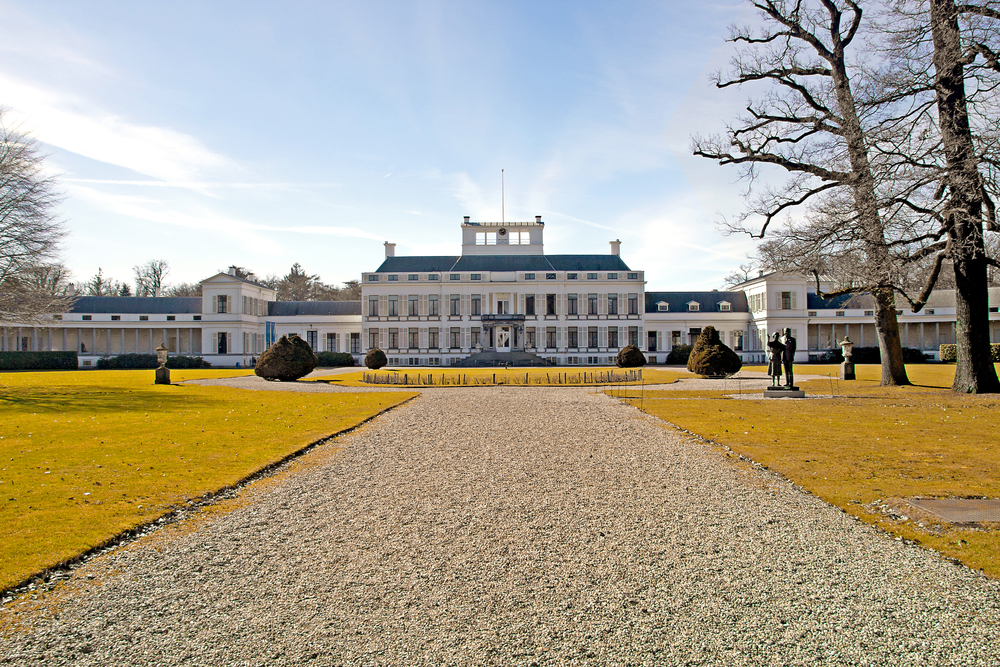
10. Around Palace Soestdijk
The impressive Palace Soestdijk in Utrecht will inspire you during your hike. Image: Depositphotos
The name of this trail sort of gives it away! This walk around Palace Soestdijk will lead you around the 17th-century palace, ideal for some historical views while you walk. 🏰
Dogs are welcome as long as they’re on a leash. Parts of the hike are paved, and it is generally quite flat (like the rest of the Netherlands if we’re honest), so it makes for a scenic, relatively easy walk.
🚶♂️ Walk distance: 16 kilometres ⏰ Duration: Three hours and 20 minutes 📍 Starting point: Amsterdamsestraatweg, Baarn 🗺 Marked Route: Follow the route
Pack those bags, and make sure you’ve got plenty of water and snacks to keep you going on these trails in Utrecht. Now that you’ve seen these beautiful parks and woodlands, why not explore some more hiking trails across the Netherlands?
Have you been on any of these trails in Utrecht? Tell us in the comments below! 👇
Yes, it’s official — the weather has cleared its schedule. King’s Day is getting the royal treatment: it will be dry, sunny, and comfortably warm, with even better days to follow.
Today, though? It still insists on some last-minute drama. Grey skies, scattered rain, and the kind of gloom that throws us back to, well, last summer.
But from tomorrow? The clouds politely excuse themselves, and the sun takes centre stage.😎
A royal forecast
As early risers set up their stalls, they’ll be greeted by a crisp 5 to 8 degrees.
By afternoon, the party is heating up. Across the country, temperatures are expected to rise to a pleasant 19 degrees. 🎉
Suppose you’re lucky enough to be in Limburg, eastern Brabant, or Doetinchem (where the royal family will be waving their way through the day). If so, you might even enjoy temperatures of around 20 degrees, according to AD.
Translation? Sunglasses: mandatory. Sunscreen: highly recommended. Burnt noses: not cute.
As the evening rolls in, a few friendly clouds join the party, and temperatures dip to a pleasant 9 –12 degrees around midnight.
Still perfect for sipping that final toast or polishing off a tompouce (or three). 🍰
Looking ahead: is that…summer?
Once the orange confetti settles, the weather will keep climbing the charts. 👀
According to RTL, the sunshine is set to continue, and temperatures may reach up to 25 degrees across the Netherlands — a welcome reminder that warmer days are finally here.
Unless you’re on the Wadden Islands, that is. There, the sea is still holding onto its seasonal moodiness, reminding everyone that, yes, technically, it’s still April.
So, what’s your plan? Scouting bargains? Strolling in orange? Soaking up the sun from a terrace? Tell us how you’re celebrating King’s Day. 🧡
Tesla is continuing its downward spiral, with the company’s sales plummeting by over 50% in the Netherlands.
This is reflective of the company’s current status as a whole – its profits fell by 71% in the first three months of the year.
Tesla is crashing
According to Reuters, only 3,443 new Teslas were registered in the Netherlands in the first quarter of 2025, compared to 6,842 in the first quarter of 2024.
RTL reports a similar trend, pointing out that in March of 2025, Dutch sales dropped by as much as 60%.
And it’s not just the Netherlands. This shift is apparent in 15 other European countries where the company’s market share dropped from 18% to 9%.
Too much politics
Tesla CEO Elon Musk has been busy implementing massive layoffs and hiring 19-year-olds for his Ministry for Government Efficiency, DOGE, leaving little time for business.
Meanwhile, demonstrations are taking place in several cities across the US and Europe, where people are expressing dissatisfaction with Musk’s involvement in politics.
It seems that Musk is dissatisfied himself, as he announced he will be working for Trump only a couple of days a week from now on — someone has to be the richest man on earth after all.
Do you think Tesla’s declining sales are the beginning of the end, or will the company bounce back? Let us know your thoughts!
That’s not just a few extra lights on — it’s money that could be used for groceries or rent. And it hits for families in homes with poor insulation or those living on tight budgets.
With Dutch energy costs a real financial threat, any government help goes a long way. 👇
How to unlock support (without losing your sanity)
The government’s Temporary Emergency Energy Fund is back, ready to help cover part of your energy bill for up to six months.
As the NOS reports, the support is either deducted directly from your energy bill by your supplier, or transferred to your bank account if you live in a student house or share a meter.
To qualify, your gross monthly income must be no more than 200% of the social minimum. That means €3,400 for singles and €4,740 for those cohabiting with a partner or flatmate.
With energy costs on the rise, government funds can give many households a much-needed boost. Image: Freepik
You’ll also need to show that you spend at least 8–10% of your income on energy bills.
Here’s what you need to apply:
📧 A valid email address and mobile number
👥 All household members aged 18+ with an income who are present in the area at the time of application
🔐 A DigiD account with SMS verification (each household member logs in with their own)
🧾 A recent energy bill(s) in the name of a household member
🔢 The customer or administration number from your energy provider
💸 The amount you paid last month for energy
Think you’re eligible or want to check if you are? Apply now via the fund’s official website.
Don’t wait too long
If you’re thinking, “I’ll apply next week”, let’s stop you right there. Last year, the fund ran out of money before the application window closed.
Over 180,000 people have already shown interest this time around, and the Emergency Fund says it’s already “incredibly busy.”
There is €56.3 million available to support about 100,000 households, so funding is limited and demand is high. 😬
Translation? Don’t wait. The sooner you apply, the better your chances.
If your energy bill puts serious pressure on your budget, now’s the time to act. Check if you’re eligible and apply while the fund is still available. 💪
The Netherlands’ Military Intelligence and Security Service (MIVD) has sounded the alarm over a sharp increase in hybrid threats from Russia, aimed at disrupting Dutch society.
In addition to the increased risk of physical threats, the Netherlands has become one of the key targets in a wave of Russian cyberattacks.
The Russians’ goal? Undermining and destabilising national security.
What are the Russians attacking?
In 2024, the MIVD detected the first Russian cyber sabotage, which targeted the digital operating system of a public facility in the Netherlands.
While this cyber assault was unsuccessful and caused no damage, the attacks did not stop there.
Since then, the Netherlands has faced more Russian cyber operations. These include failed attempts to breach infrastructure networks, as well as digital assaults on websites of Dutch political parties and public transport companies.
However, Russian threats aren’t limited to land, with the MIVD reporting suspicious Russian activity in Dutch waters.
These actions suggest that Moscow might be mapping infrastructure in the North Sea, such as data cables and energy lines, in preparation for a physical attack.
If successful, an undersea strike could lead to widespread disruptions across the Netherlands, Europe, and beyond.
While no major damage has been reported yet, the intent is very clear. 😬
A multi-pronged attack
There’s one clear motive behind Russia’s cyber attacks: disrupting the Dutch vote in the upcoming European elections.
But Russia’s sights also go far beyond the ballot box, as the Netherlands plays a crucial role in NATO’s defence due to its location and infrastructure.
The Netherlands is now scaling up its defences
In response to the growing threat, the Netherlands is shifting into defence mode, as it braces for future and more long-term challenges to its security.
Minister of Defence Ruben Brekelmans has called for action, “to prevent vulnerabilities towards Russia, a rapid scaling up of our armed forces and defence industry is necessary. This is the only way we can prevent more Russian aggression in Europe.”
What began as a property dispute in the peaceful village of Weiteveen ended in a tragic double murder. Now, the victims’ relatives are out for justice.
Murderer Richard K. had been locked in a long, bitter feud with the victims (Sam and Ineke) over the sale of his former childhood home.
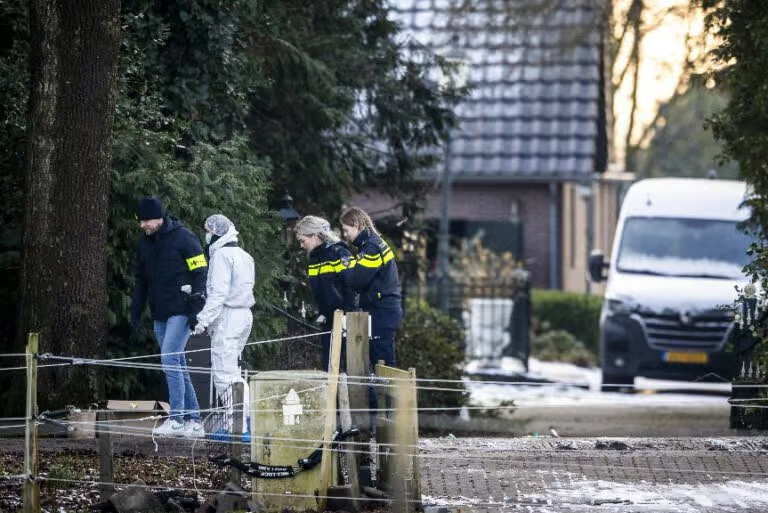
On the morning of January 16, 2024, the conflict reached its tipping point, with K. murdering the couple in cold blood.
Although K. was sentenced to life in prison last month, the victims’ relatives say that justice came a little too late, with police negligence allowing the situation to spiral into deadly violence.
It was premeditated murder
As reported by the NOS, K. first shot Ineke while she sat in her car.
Then, he entered the couple’s home and fatally stabbed Sam in front of the man’s 12-year-old son.
Although K. claimed he acted out of fear and only wanted to protect his family from Sam’s threats, police confirm that this wasn’t a spur-of-the-moment act.
Not only did the killer turn off all the hidden cameras he used to spy on Sam and Ineke’s house, but he also left written instructions for his family in case they didn’t see him again.
As a result, the judge ruled that K. was wholly accountable for the crime and not eligible for a reduced sentence.
Dutch police ignored over 80 complaints
Now, Sam and Ineke’s family says the police should have stepped in long before things reached this point.
According to RTL Nieuws, the couple had filed more than 80 complaints about Richard’s threatening and unstable behaviour. But despite all those warnings, nothing was done to protect them.
“Based on the information available, we should have revoked his hunting license and confiscated his licensed weapons,” said Martin Sitalsing, police chief of the Northern Netherlands unit, in a police news bulletin.
“We, as police, have not achieved our professional standards. I find that particularly painful, and I regret it,” he continued.
Through their lawyers, Sébas Diekstra and Maaike de Vries, the couple’s relatives are now sending an official letter to the police, holding them liable for the murders.
They argue that this inaction amounts to an “unlawful act’’ and are demanding accountability, because they believe this tragedy could have been avoided.
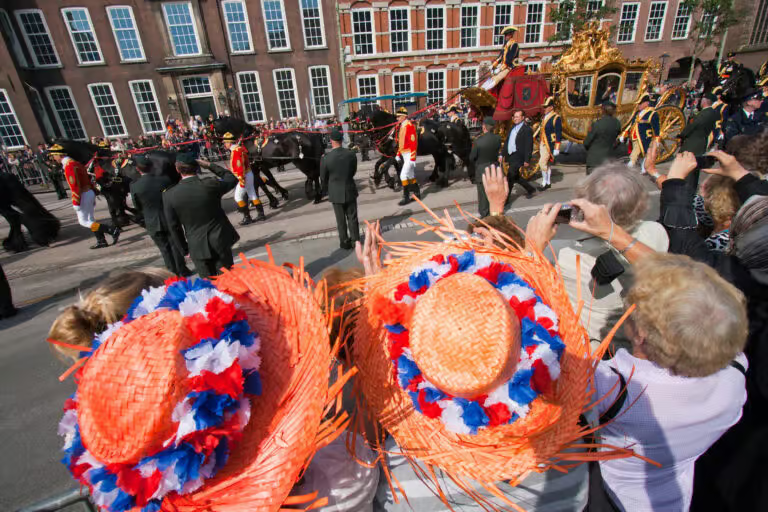
King’s Day, the Netherlands’ favourite national holiday, sees the Dutch royal family join in on the national festivities to celebrate the King’s birthday. 🎉
Each year, the House of Orange picks one lucky city to visit, where they’re welcomed with special events to mark the occasion.
They showcase their coolest outfits, blending royalty with high fashion, and wave their way into Dutch hearts.
So, where will they be this year?
In case you’re deeply invested in where Europe’s most charming monarchy will celebrate the King’s birthday: this year, they’re heading to Doetinchem. 🎉
Doetinchem is located in the province of Gelderland — a large chunk of the Netherlands you probably drive through on your way to somewhere else.
But, for one glorious day, the entire city will transform into a giant, lively party. 🕺🏻
What’s the plan?
On Saturday, April 26, the royal family will touch down in Doetinchem for a full day of celebrations with music, dance, local culture, and enthusiastic waving.
Slightly higher temperatures on Easter Sunday and Monday mean most of the country can enjoy a mild end to the holiday, with the sun regularly popping out from behind the clouds.
FYI, Maastricht steals the show, reaching a potential 20 degrees on Sunday. ☀
A chance of rain, but don’t cancel plans just yet
The weekend stays mostly dry, but a 30 percent chance of showers looms overhead.
Though the chances of rain appear more likely on Easter Monday, nothing is certain just yet.