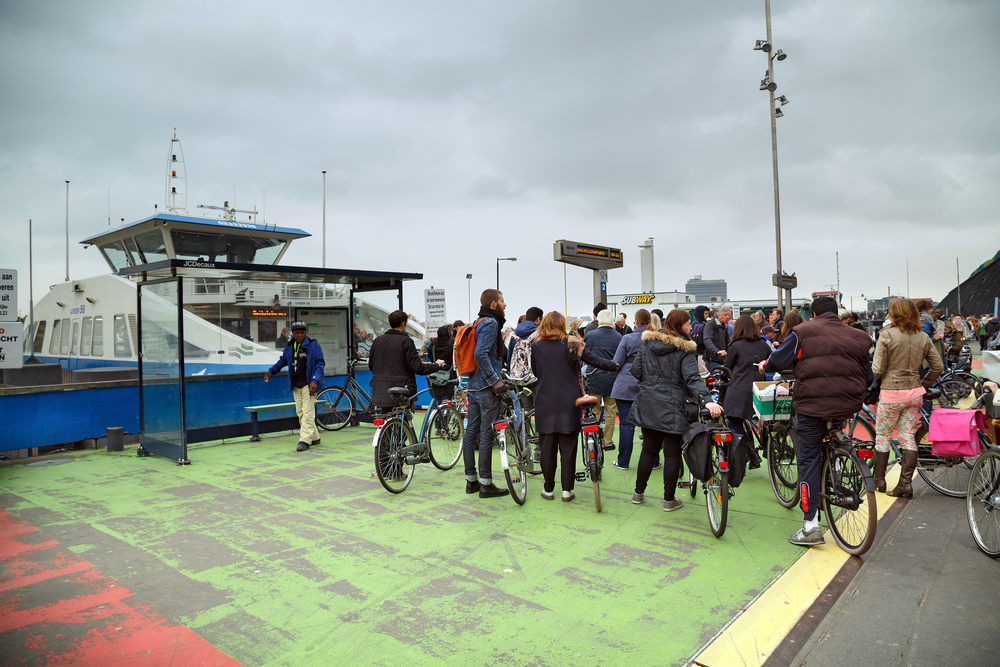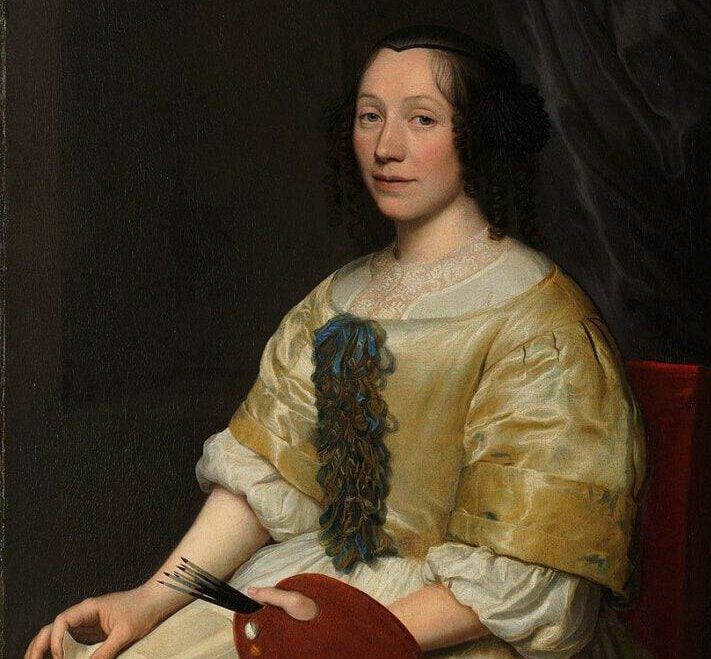
The Netherlands is a land of art and museums. From the Frans Hals and Van Gogh Museums to the Rembrandt House, visitors come each year to admire their genius.
But how many of us ever pause to ask these questions: where are the works of female painters from the Dutch Renaissance and the Golden Age?
How come Dutch museums are only named after famous male painters, and why does nobody ever talk about these women?
An erased legacy displayed in today’s museums
The very first art critics in the (Dutch) Renaissance and Dutch Golden Age eras often made fun of female painters. “Women paint with their brushes between their toes,” one infamously said.
We are all often in awe of Michelangelo’s Sistine Chapel ceiling paintings, Da Vinci’s Mona Lisa, and Vermeer’s Milkmaid, but I’m sure that there aren’t many people who know the name of a single female painter from that era.
It’s almost as if their legacy has been completely erased from the history books.
Only 13% of art pieces displayed in today’s museums were made by a woman. Only 2% of the art market’s turnover is spent on artworks by female painters. And 10% of international galleries do not represent any women at all.
Alarming figures regularly crop up about the underrepresentation of women in art, and not much has been done to change things.
For centuries, women were excluded from the art world in all kinds of ways, yet a number of them managed to become highly esteemed painters, despite the many obstacles they encountered.
Female invisibility in a patriarchal society
A comment you often hear is: “If there are no famous female painters, maybe it’s because they were just not good enough.”
But, the reason why there are so few female painters doesn’t necessarily lie with women not being good enough, but with a patriarchal society that sought to shackle them with repressive social standards.
READ MORE | 11 kick-ass Dutch women you should know about this International Women’s Day
The difference between men and women was very clear in the Renaissance and Dutch Golden Age eras: men were allowed to get an education, chase careers, and be successful, while women were forced to stay at home.
This meant that women were actually not visible in society. They were mainly expected to stay indoors to take care of the household and the children.
Although male painters liked and regularly depicted women on their canvases, it was not socially acceptable for women to practice the profession themselves.
Everything was aimed at excluding them from painting as much as possible.
They had less access to education, were not allowed to study nude models to gain knowledge of human anatomy, and were banned from art schools.
This made it extremely difficult for women to learn to paint at a high level.
Against all odds
Considering all these obstacles, it is truly a miracle that there have been women who succeeded in becoming quality painters. This often had to do with the fact that they received a lot of support from their families.
Although the purpose was not for them to make a career, especially in the eclectic world of art, there were still parents who supported their daughters in developing their artistic talent.
Many of the well-known female painters had fathers who were painters, so they were lucky to learn the tricks of the trade from childhood by observing them in their studios.
READ MORE | Hannie Schaft: the Dutch spy who was executed by the Nazis
Others came from well-to-do families and had the means to afford the costly affair of apprenticing to a painter.
As a result, women depended very much on the wealth and approval of their fathers or male guardians for their art education.
This explains why famous female painters in the Renaissance and Golden Age eras were so rare. The freedom and opportunity to develop as a painter belonged exclusively to privileged women.
Yet, their guts, talent, and perseverance must also be praised. By embarking on a career as a painter, these women went against the prevailing norms of how a woman was supposed to behave.
By taking the plunge and going for their passion, they lifted painting to a higher level.
Dutch women painters of the 17th century
In the Netherlands, female painters played an important role in the development of art. Still-life painting, a genre typical of the Low Countries, was mostly mastered by women of this era.
Three women painters stood out.
Maria van Oosterwijck
Maria van Oosterwijck (1630-1693) came from a family of painters but did not become an apprentice until she was thirty.
In 1666, Maria moved to Amsterdam, where she became an assistant to still-life painter Willem van Aelst. At his studio, Maria developed into a painter of international repute.
She was best known for her highly detailed still-life flowers and often went to the Hortus Botanicus in search of rare flowers to immortalize.
Her works were highly sought after and sold to heads of state and noblemen, from King Louis XIV and Emperor Leopold I of Austria, to Cosimo de Medici and William III of England.
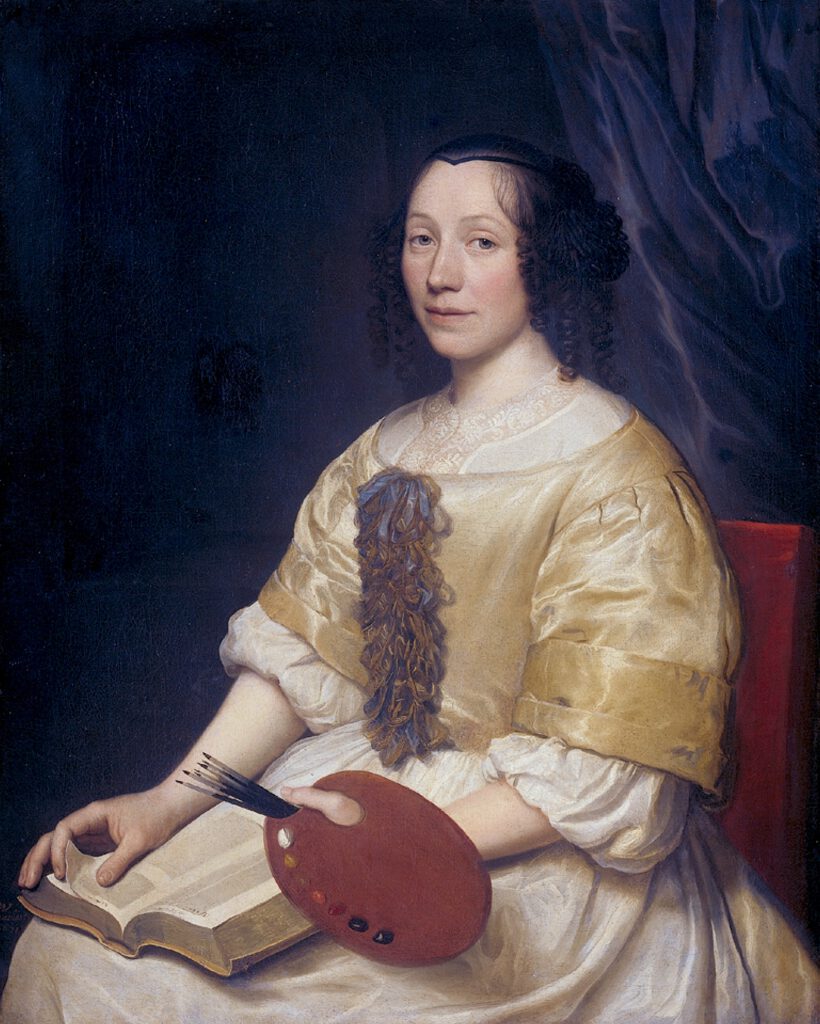
On December 28, 1667, the Florentine Prince, Cosimo III de Medici said that her still-lifes were just as good as those of the renowned Van Aelst.
When Cosimo III bought two paintings from her after his second trip to Holland in 1669, Maria became a household name in the art world.
While many painters in Amsterdam and elsewhere struggled to keep their heads above water between 1680 and 1690, Maria’s reputation and the general appreciation for her work remained high, even in the highest European circles.
In 1684, Jan III Sobieski, King of Poland, bought three paintings from her for the capital sum of 2,400 guilders.
READ MORE | The Dutch East India Company was richer than Apple, Google, and Facebook combined
When Johann Georg III, Elector of Saxony, visited The Hague on a trip in 1688 and saw three of her paintings, he was so impressed he bought them for 1,500 guilders.
Louis XIV (the Sun King) also had one of her paintings in his “art cabinet”.
Through Constantijn Huygens’ intervention, King-Stadtholder William III and his wife Maria Stuart acquired two paintings from Maria in 1689, one for the price of nine hundred guilders. Both paintings are still part of the English Royal Collection at Hampton Court in London.
Thanks to her art sales, Maria was able to buy a house on Amsterdam’s Keizersgracht, where she trained other female painters, including her former maid Geertje Pieters and another very talented pupil of Willem van Aelst, Rachel Ruysch.
Constantijn Huygens wrote a poem about Maria in 1677, saying: “Maria van Oosterwijck stands at a rare height and has no equal.”
In 1690, at sixty years of age, Maria withdrew from the painting world.
She moved to Uitdam to live with her nephew Jacobus van Assendelft, who had become a preacher in 1688. She died three years after the move.
In the past two centuries, interest in her paintings has declined somewhat, but presently, her works are attracting more attention again and are sold for high prices.
Rachel Ruysch
Rachel Ruysch (1664-1750) grew up in a rather interesting family.
Her father was a well-known anatomist who owned a large collection of rare flora and fauna. Her mother’s family consisted of many painters, as a result of which she came into contact with painting as well as with animals and plants from an early age.
She showed so much talent as a still-life painter that her parents decided to send her to become an apprentice to Willem van Aelst. It is quite possible that her training was largely carried out by Maria van Oosterwijck.
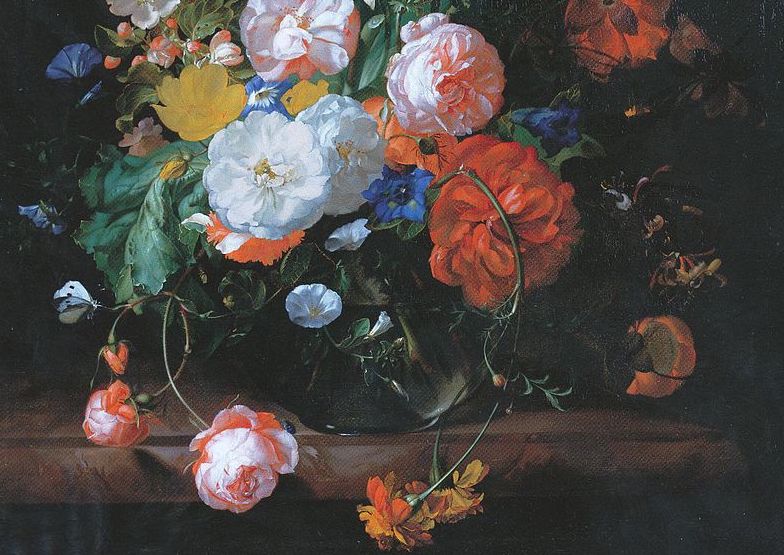
Rachel preferred to paint woodland grounds and compositions with flowers. Because flowers were an immensely popular motive in the Netherlands during the Golden Age, her lively, colourful works soon started to draw attention.
Her paintings sold for such high prices that she could live comfortably by making only a few works per year.
In the summer of 1695, Johann Wilhelm, Elector Palatinate, visited Frederik Ruysch’s museum. On that occasion, he doubtlessly also saw the paintings of Rachel, who was now married to the painter Jurriaan Pool.
She had just given birth to her first child, but motherhood did not prevent her from continuing her career as a painter.
At this point in her career, she had become very famous and successful, and in 1699, she was offered membership into the Confrerie Pictura in The Hague as recognition for her contributions to art.
She was the first woman to receive this honour. As a mother of ten children, she must have had a very busy life, but nevertheless, she continued to paint until her death at the proud age of 86.
Judith Leyster
Although women like Maria van Oosterwijck and Rachel Ruysch had a great influence in the painting world, there is one woman who managed to make an even bigger impression.
In 1633, Judith Leyster (1609-1660) was the first woman in the Western world to be recognized as a master painter.
It’s a mystery how she developed into a painter since she did not come from an artistic family.
At the age of nineteen, she was already known in her hometown of Haarlem as a highly talented young woman who could compete with the best male painters of her time.
In 1633, she was admitted to the Guild of Saint Luke of Artisans, making her the first woman to be recognised as a master painter.
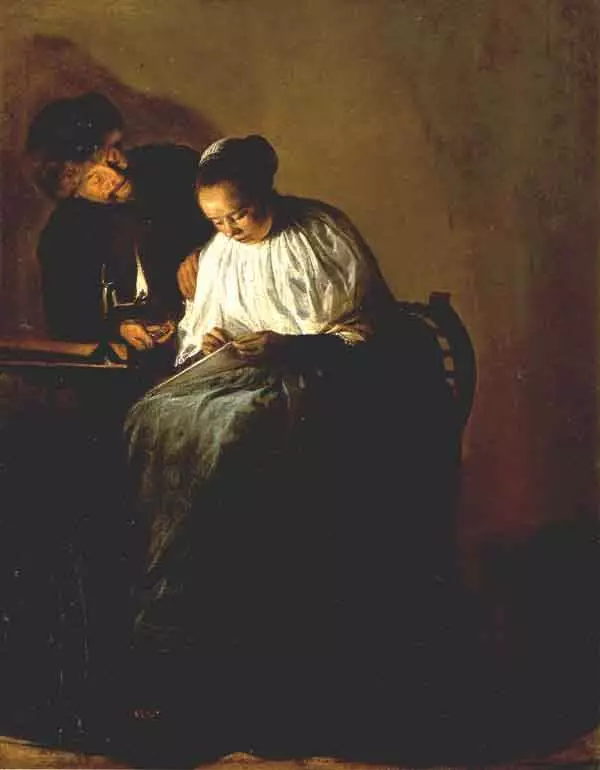
Her style is very similar to that of Frans Hals, and some of her works were once wrongly assigned to him.
Since Judith signed her works with only the letter “J”, it was also rumoured that Frans Hals might have had an unknown brother by the name of Jan.
Leyster specialised in painting cheerful genre scenes. The people in her works often have vivid facial expressions and casual poses.
As far as we know, Judith Leyster is the only woman who made paintings of modern figures, instead of mythological and Biblical scenes.
Unfortunately, very few of her paintings have survived, probably because she only worked as a painter for a relatively short period of time.
In 1635, she married the painter Jan Molenaer, after which she left the art world. Eighteen paintings are attributed to her with certainty. These works largely date from the period 1628-1635.
In 2016, one of her self-portraits surfaced, probably dating from 1653. The painting was auctioned for half a million euros.
Leyster’s works can be found in the Rijksmuseum, Mauritshuis, the National Gallery in London, the Frans Hals Museum, and Museum Boerhaave.
Passion for art and revolution
These female painters were a rarity in a world that left little room for women to develop their talents. They were not supposed to have had the careers they carved out for themselves.
Yet, some of them dared to take the revolutionary step towards an “unconventional” life as professional painters.
These women often found themselves in an environment where they were encouraged to develop themselves, such as progressive monasteries or a family that offered support.
The vast majority of these female painters have long disappeared from our history books, but thanks to feminist historical research, they are increasingly being “rediscovered” today.
READ MORE | The museum town of the Netherlands: 14 great museums to visit in Leiden
The growing attention provides for new exhibitions that demonstrate the importance of these women for painting.
More museums in the Netherlands, Europe, and the world need to have exhibitions showcasing their paintings and telling the story of how much they have contributed to the art world.
I hope we get to a point where little children can learn about these wonderful women just as much as they are taught about van Gogh or Rembrandt.
And that museums are opened and named after them, and their genius works of art are displayed with pride for all to see, enjoy, and admire. They deserve to be celebrated and not forgotten.
Which female Dutch painter is your favourite? Have you ever seen their work in a museum? Tell us about your experiences in the comments.
Feature Image: rijksmuseum.nl/Wikimedia Commons/Public Domain