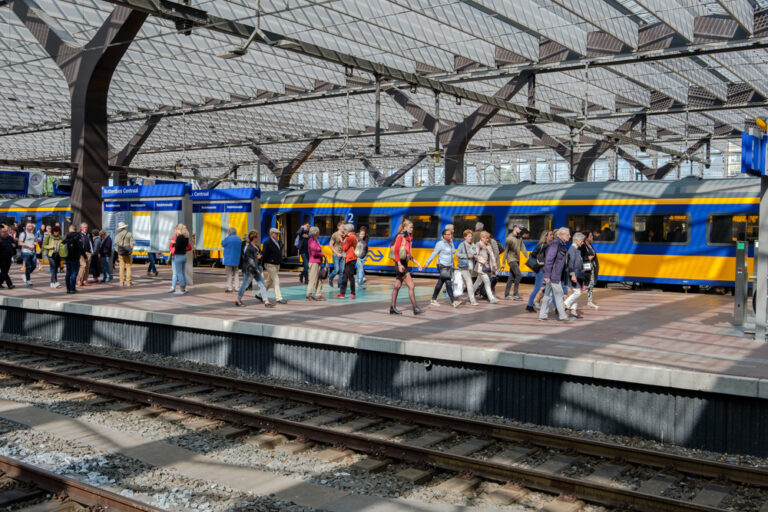
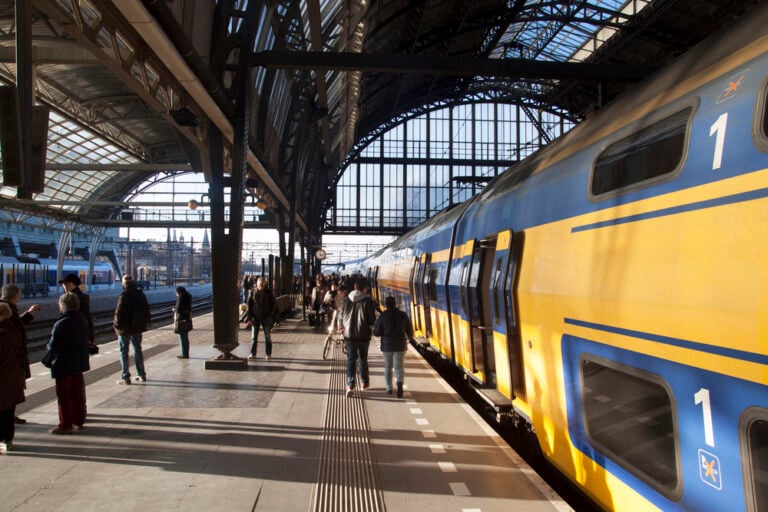
The Dutch government has allocated a casual couple billion to fund the cost of extending railway and bus services to new towns and estates across the Randstad.
The plans to extend railway lines come after the Dutch cabinet announced the building of 900,000 new homes. More than half of these houses will be built in the Randstad and North Brabant, reports de Volkskrant.
Amsterdam finally gets a win
After years of debate, a decision has finally been made, or as the Dutch say: de Kogel is door de Kerk (the bullet is through the church). ⛪️
Amsterdam will finally see the extension of the North-South metro line. And, the line will soon go all the way to Hoofddorp.
What does that mean? Well, it means there will finally be a direct metro connection between Amsterdam and SchipholAirport. 🎉
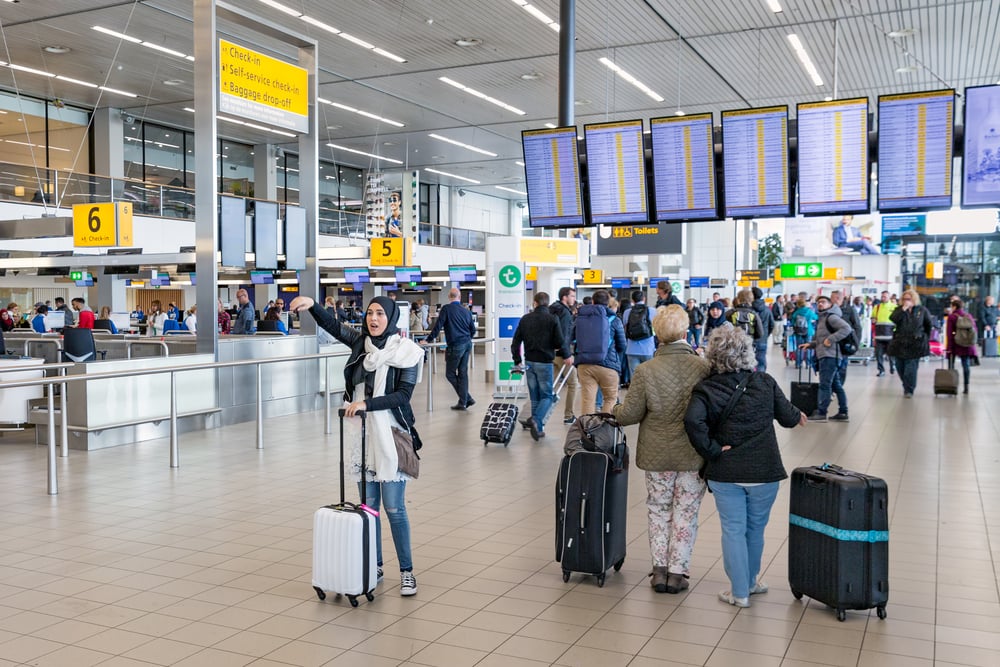
The new train lines will make it easier for travellers to get from Amsterdam to Schiphol. Image: Depositphotos
NS cancelled your train again? Don’t you worry, schat; the GVB’s got your back! 🚇
Amsterdam Zuid is also to receive extra tracks, with the total cost of all the improvements coming to a whopping €5.4 billion.
Improvements all over the country
In Suikerzijde, a new neighbourhood in the sprawling city of Groningen, there will be a new bus and train station built.
A new bus station in Eindhoven will be built below the train station, which will also get a make-o Well, the tracks are being revamped to accommodate international trains from Antwerp, Aachen and Düsseldorf.
In Overijssel, improvements will also be made to the tracks. Here, they will be electrified, creating a much more efficient train connection to Germany.
80,000 houses to be built on the ‘old line’
Along the railway lines from Leiden, The Hague, Rotterdam and Dordrecht, 80,000 houses will be constructed. By 2040, four new stations will be built to accommodate the thousands of commuters sure to move into these homes. 💼
Not only will there be new stations, but the track will also be widened to allow for more frequent trains to run along the lines. The cost of all this?
€1.56 billion. 😲
Delays? The NS has a degree in those
The new train lines have only just been announced, but there are delays to the plans already. The delays seem to be due to a nitrogen problem with storing current projects.
On my way to Amsterdam. An important event today. With some luck though hopefully, as there are many @NS_online disruptions / delays on my route. pic.twitter.com/yNODCchLmi
“We remain committed to accessibility and water safety, because this is not a luxury but a condition for a country where it is pleasant to live and live,” Dutch MPs have said about the issues in a letter to the House.
What do you think about the plans to improve the Dutch railway system? Tell us in the comments below!
After two years, the Dutch labour market is seeing more and more vacancies being filled, meaning people are taking up vacant jobs again.
There were 17,000 fewer vacancies in the Netherlands in September, compared to the second quarter of this year, writes the NOS.
In other words, the tightness of the Dutch labour market is loosening up. However, it’s not all good news, as the unemployment rate is also on the rise.
Economical trouble?
The economic instability and uncertainty brought about by both Coronavirus and the Russian war against Ukraine have made for more cautiousness in the labour market overall.
This has been exemplified by the fact that more employees than ever have been dismissed in the past year.
The number of existing jobs is still rising, but unemployment rates are also increasing. And, trade and catering, the two sectors most in need of staff, are still down 128,000 people.
Have you experienced the Dutch labour shortage first-hand? Tell us in the comments below!
It’s that time of year again: not the festive Christmas cheer we know and love. Instead, the time when our already pricey health insurance will become more expensive. Merry Christmas! 🎄
No matter who your current health insurer is, you’ll probably have to pay more for your premium, with prices increasing from the beginning of next year.
How much?
The Independer published a spreadsheet with the exact numbers, but if you’re with one of the big four insurance companies, you should prepare for an increase between €3.75 and €9.30.
The biggest increase will be at VGZ, where the monthly fee will rise by €9.30, making it €141.95 per month for the basic package.
Menzis increases their basic package premium by €8, so customers will pay €141.25 per month.
Zilveren Kruis increases by €7.50, making their basic package €138.95 every month.
And the smallest change will be at CZ, where the new premium will cost €138.25 per month after a €3.75 increase.
Why is it more expensive?
Yep, inflation sucks and we’re all feeling it. While health insurance premiums rise almost every year, this year it’s wages in the sector rising, which makes the whole healthcare system more costly. Some medicines are also becoming more expensive.
The D66 (Democrats 66) party has released a new statement advocating for abortion to become an international human right. The document argues that women from countries abroadshould be able to get an abortion in the Netherlands for free.
This new statement comes in light of new anti-abortion laws internationally, such as the rollback of Roe V. Wade in the US this summer.
In a new note sent to the government, the Dutch political party wants to implement a number of new measures to help make abortion safer and more accessible to women across the world.
Unsafe abortions are a ‘war against women’
In their new statement, the D66 party outlines the importance of abortion rights for women.
They argue the point that unsafe abortions are preventable, stating that 39,000 women die from complications after unsafe abortions every year. This is something that the WHO (World Health Organisation) defines as “a pandemic that can be prevented.”
In the eyes of the D66 party, these unsafe abortions are a “war against women.” According to the party, abortion is a human right, and the fact that access to abortion has decreased instead of increased in recent years is a cause for concern.
Freedom of every individual — in the Netherlands and beyond
Some European countries, such as Poland or Monaco, make abortion incredibly hard to access. In others, like Andorra, Malta, and San Marino, abortion is strictly banned.
To combat this, D66 wants to make the Netherlands a safe haven for women to secure this right.
Why? The Netherlands does exactly that along with other measures that ensure the wellbeing of their citizens, and their abortion rate is the lowest in the world: pic.twitter.com/NwOua6yg1r
Already, over 3,000 women travel to the Netherlands each year to have an abortion, but this comes at a cost. How much? Between €400-1,000.
D66 MP Sjoerd Sjoerdsma wants to reduce this cost entirely by making abortion free to women everywhere. Part of this would include subsiding abortion clinics and investing more money into organisations such as Abortion without Borders and Women on Waves.
Abortion should become a human right internationally
One of D66’s major pushes is for abortion to become a human right.
And, the political party believes the Netherlands can be a leading example for paving the way for internationally legalised abortion.
The Netherlands has always been seen as a very progressive country; from being the first country to legalise same-sex marriage to the protection and rights of sex workers in the Netherlands. The party believes in the same way, the country can also pave the way towards safe, worldwide, abortion.
Let op! Werkzaamheden: zondag 13 t/m zaterdag 26 november 08.00 uur, van, naar en via Amsterdam Zuid. Plan je reis voor vertrek in de reisplanner! https://t.co/Q3f0ODpahv
Translation: Attention! Construction work: Sunday 13 to Saturday 26 November 8 AM, to, from, and via Amsterdam Zuid. Plan your trip before departure in the trip planner!
The metro lines 50, 51, and 52 arriving and departing from Amsterdam Zuid are the ones to keep an eye out for (and yes, you can still use your NS train ticket on them!)
A method to the madness
Due to the growing number of travellers, more trains are needed to run the Amsterdam Central to Schiphol Airport route.
This, according to ProRail (the organisation responsible for maintaining and extending the Dutch railway network), means that work needs to be done on the existing rail network.
A stretch of railway tunnel to Schiphol, for example, is outdated and in need of renovation. This means that several “train-free” periods will be necessary to complete this work.
Are you going to be travelling to Schiphol during this time? Tell us all about it in the comments below!
Dutch political party ChristenUnie, wants to ban every youngster’s favourite app, TikTok, in the Netherlands — but… why?
The app’s Chinese ownership has made politicians around the world grow wary as it continues to steal the attention of basically every young person out there.
In fear that their citizens’ data will end up in the hands of the Chinese government — ChristenUnie wants to prohibit the Dutch from using the app for good.
“Our job is to protect civilians. TikTok in this form must be removed from the market,” parliament member of ChristenUnie, Don Ceder, tells RTL Nieuws.
Make sure to flick through DutchReview’s TikTok — before it gets banned. (We only just got the app. 🥲)
TikTok on the hit list
Currently, there are more than 3.5 million folks in the lowlands who use the app on a regular basis — making it the most popular platform for Dutch youngins to date.
“Our whole class is on TikTok. The app is cool because there are all kinds of fun dance videos on it and very funny videos,” an 11-year-old student of the Zuidwalschool in The Hague, Mballu, tells RTL Nieuws.
“We know there is criticism surrounding the app, and we also get lessons on it at school about protecting your privacy. But I’m not worried”, Mballu’s classmate, Dominik, tells RTL Nieuws.
Dutch politicians’ solution? Ban the app!
TikTok has been a cause for concern for years, as many Dutch experts and educators fear the app’s alleged ties to the Chinese government, and worry that their citizens’ data is being handled wrongly.
American politicians also have the urge to ban their citizens from using the app, and it could become stronger after the mid-term elections.
“Our job is to protect the privacy of citizens. It is undesirable for a Chinese company, which cannot be separated from the Chinese government, to receive such a large bulk of data and send it to young people”, a politician of ChristenUnie tells RTL Nieuws.
A teen-led protest against the ban
Well, the children of the Zuidwalschool disagree, stating that it would be a pity if the app were banned, and we’re sure many youngsters probably feel the same.
“Leave everyone free to choose whether you use the app or not. I would find a ban really dumb. We’re having a lot of fun with TikTok”, Dominik tells RTL Nieuws.
While we can’t deny the app’s lack of privacy laws and its ability to cause addiction is concerning — it’s hard to imagine a world without all those cute dog videos (RIP Owa Owa Pudgy). 🥺
Do you think TikTok should be banned in the Netherlands? Tell us in the comments below!
Being vegan in any city can be tricky. Trying to find the best spots for breakfast, dinner, or even where to pick up a quick wrap to eat on the go turns into quite the challenge— but not when you’re looking for vegan food in Amsterdam.
All your problems are about to be solved if you’ve come across this handy little article. We’ve compiled some great vegan restaurants to satisfy every vegan’s craving! 😜
From cheesecakes to pink (yes, pink!) burgers, there’s so much Amsterdam can offer in terms of vegan cuisine.
At the Vegan Junk Food Bar, you’ll have a litany of options for a filling vegan meal. From burgers just oozing with tasty toppings to some classic ‘dirty fries’, this vegan restaurant in Amsterdam is sure to leave you full — and raving back to your friends! 🍔
With three locations in Amsterdam, you’re sure to find a free table. We’d recommend coming in the early evening, or try to avoid peak dinner times, as these guys don’t take reservations.
Be careful; one location is alcohol-free, so if you want a glass of red with your meal, make sure you know which one you’re headed to! 🍷
🍔Location(s): Three locations in Amsterdam 📞How to book: No reservations here! It’s first come, first served! € Price Range: Mid-range
2. Check out Flower Burger for some pinktastic food
Homemade buns, burgers made from real ingredients. Flower Burger is an all vegan burger bar concept, originally from Italy. They opened this summer in the Negen Straatjes!https://t.co/d6wuX2lrDdpic.twitter.com/3FeHrqq2a6
Well, Flower Burger has so much to offer. With lots of surprisingly coloured burgers, (think pink, purple and even green!) this vegan restaurant in the centre of Amsterdam can offer not only a yummy meal but also an aesthetically pleasing dish. 😍
Set in a relaxed dining setting, you can order at the counter and get an automated tag that beeps once your food is ready — perfect for those of us who want a chill evening out in the Dutch capital.
3. Satisfy your pumpkin soup cravings at SOIL Vegan Café!
Riz, kimchi, edamame, haricots verts et de Lima, carotte, petit pois, courgette, poivron, oignon frit, radis blanc, oignons verts et furikake. + Burger végane, mayonnaise de miso, salade de chou asiatique, sauce fromage végane, mesclun et tonkatsu.
And, with more than just one vegan restaurant in Amsterdam, you’ll have better luck in nabbing a table on a Friday night.
🍔Location(s): Two locations in Amsterdam 📞How to book: Book online between the hours of 5 PM to 8.30 PM € Price Range: Mid-range
4. Tantalise your tastebuds at TerraZen Centre
Enjoy some Japanese and Caribbean food at the TerraZen centre. Image: @terrazencentre/Instagram
Specialising in a mix of Japanese and Caribbean cuisine, this vegan joint in Amsterdam is as vibey as they come.
Take a seat at their low-lying table before the window, cross your legs and dig in. For a taste of something new, and wonderfully sweet, we’d recommend you try their vegan spring rolls! Rather than the usual taste you might expect, these guys have a bit of a sweet-and-sour tang. 🤯
Just be aware that they close for two hours between 3 PM to 5 PM!
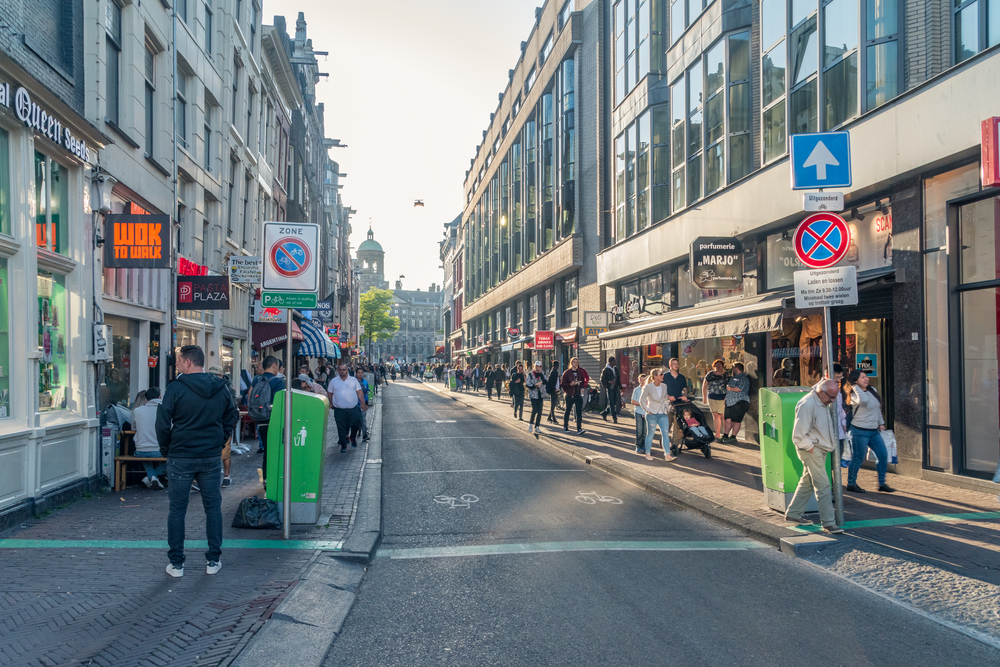
Just one example of the many Wok to Walks in Amsterdam city. Image: Depositphotos
If you’re looking for a vegan-friendly bite to eat on the go in Amsterdam, Wok to Walk is the spot for you.
Order at the counter for egg-free noodles, and enjoy your own choice between various vegetables and sauces. The teriyaki is always a win in our books! 🍜
There are usually a few free spots to sit inside, though the restaurants tend to be quite small. We’d recommend grabbing your noodles and heading to a nearby park!
🍔Location(s): Six wonderful locations in Amsterdam 📞How to book: No reservations here! € Price Range: Affordable
6. Grab a grubby dinner at Vegan Temple Bar
Vegan junkfood is not an original concept anymore, but Vegan Temple Bar is aiming mostly at tourists, as they are located at Lange Leidsedwarsstraat. They opened in June, before it was a non-vegan pizzeria by the same owners. https://t.co/i4de7Kl1iupic.twitter.com/gnRAU3pvaf
Specialising in yummy vegan burgers and finger food, this is the place to go for a meal that will leave you feeling full but wanting more. 🤤
And, no, you haven’t found your way to Dublin’s famed Temple Bar if you head here — you can be assured this vegan restaurant in Amsterdam is actually in the Dutch capital after all! 🇳🇱
7. Discover ramen in a way you’ve never seen before at Men Impossible
Grab a steaming bowl of yummy ramen at Men Impossible! Image:@menimpossible/Instagram
Are you a fan of ramen? Men Impossible brings vegan ramen to a whole new level, so if you’ve been craving some good noodles, this is the place to go! 🥢
Also, be sure to check out their set menus for an easy choice with lots of different foods to please those greedy tastebuds.
There are two things to remember when choosing to go here; book ahead, as these guys don’t do walk-ins, and if you want to bring more than two people to dinner, you’ll have to send them an email to request a larger table. 🚶♀️🚫
Little Plant Pantry is Amsterdam’s first plastic-free shop. Here you can shop for all your sustainable goods to your heart’s content — and enjoy a delicious vegan meal!
While vegan restaurants serving sushi can be a little hard to find, you’re sure to discover something you’ll love at the Vegan Sushi Bar in Amsterdam.
The first vegan sushi restaurant in the Netherlands, they are making active efforts to improve the world we live in.
From donating profits to ocean-cleaning charities and organising river and beach clean-ups, the founders of Vegan Sushi Bar really care about our little Earth. 🌎❤
A restaurant hidden inside 0T301, a cultural centre for everything arts, De Peper is an amazing vegan restaurant in Amsterdam that offers some real gourmet vegan meals.
Go raving back to your friends, and maybe even join them after dinner for drinks and a second rave inside OT301’s club.
Got a craving for cheesecake? This vegan restaurant in Amsterdam is the place to go for all those sweet cravings — while also being assured you’re eating completely vegan.
Mr and Mrs Watson also sell the world’s first vegan cheese wheel (yes, that’s a thing! 🧀) and offer an array of different vegan cheeses.
The Meets is an excellent place to enjoy a vegan dinner in Amsterdam. Image: @themeetseatery/Instagram
Having been fully plant-based since 2021, The Meets is the place to get a tasty vegan brunch and enjoy a lazy Sunday in Amsterdam.
However, brunch isn’t all they offer. Serving all-natural dishes with delicious wine pairings, The Meets is also a great option if you’re looking for a classy place to go for dinner!
If you’re all about class, then we have to mention Bonboon. Located by the water on KNSM island in Amsterdam, at Bonboon you can enjoy a luxury vegan meal from a set menu. 🥂
Near to lots of hotels, perhaps this is an idea for a great weekend treat — a night away, and a luxurious meal out!
14. Live your dreams of vegan soft-serve at Deer Mama
Had a really great time with lovely friends. Been to a vegan restaurant called Deer Mama in Amsterdam. First time trying vegan food and it was delicious. Will definitely go there again! pic.twitter.com/ISXid9m66y
Cakes, brownies, burgers, and more, can be found at Deer Mama.
Craving a bit of soft serve ice cream? They’ve got it! And, that’s something poor vegans often go without — but you’re in Amsterdam schat, and here, your dairy-free dreams come true. 🍦
With a beautiful pink and blue interior that will leave you feeling calm and content, here you can enjoy the vanilla ice cream of your dreams. Yum!
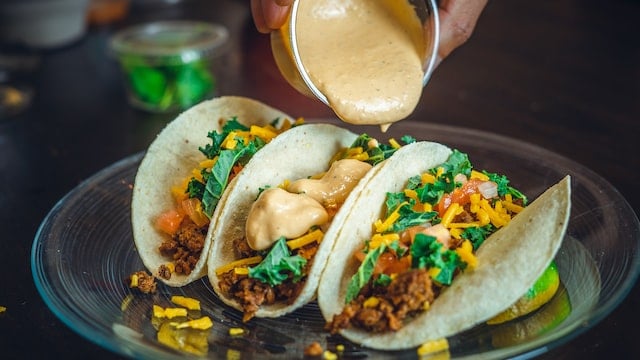
Satisfy your taco and tequila craving at Madre, Amsterdam. Image: Unsplash
Got a desire for some vegan-friendly tacos, tequila, and top cocktails? Madre has all that and more, with great vegan options on its sustainably-focused menu.
As the Netherlands’ first vegan-only Mexican restaurant, they’ve got meat-free burritos down to a tee! 🌯
Amsterdammers will not be allowed to watch live public screenings of the World Cup group phase in Qatar, says Mayor Femke Halsema.
Usually, when an important match happens, you’ll find Dutchies and internationals alike gathered on canals and terraces in front of a huge public screen, swaying, screaming, laughing, and crying together.
However, this will not be happening during this year’s World Cup, at least not in the Dutch capital. This, according to NH Nieuws, is due to Amsterdam’s strict “winter policy.”
The “winter policy” leaves football fans cold
Amsterdam municipality regulations state that TV screens are not allowed to be placed on the terraces during winter.
This is entirely different to the policy during summer, which permits TV screens to be set on terraces, provided these screens are not watchable from the road.
Of course, terraces are much larger during summer and open until much later.
Fortunately, there’s some wiggle room
Halsema did mention that if the Dutch national team were to get further than the group phase, then she’d be open to a second opinion.
This restriction may likely disappoint D66, which hoped for the World Cup to be used to make viewers aware of the human rights violations currently taking place in Qatar.
Horeca could score a goal
If Amsterdam’s winter regulations about terraces were overturned, this would draw football fans to bars, cafés, and restaurants in order to follow the matches.
In turn, this would give those businesses a big boost in income.
VVD group chairman Claire Martens pointed out that replenishing the “piggy bank” would be much deserved after how much the Horeca sector suffered during the pandemic.
While we may hope for a change of heart in Amsterdam, for now, Amsterdammers are going to have to keep the foam fingers and orange fedoras indoors for this World Cup.
What do you think of this move? Tell us all about it in the comments below!
Tourism in the Netherlands has been on the rise, bringing visitors from all over the world to the land of windmills, stroopwafels, and cheese. Which nation was most excited to pay us a visit? Well, the UK, of course!
In the third quarter of the year, which includes the entire summer period, the Netherlands saw a record 14.6 million tourists take their holidays in Dutch cities, reports CBS.
That is a lot of people, especially considering that the population of the Netherlands is 17.5 million.
British tourists make the Netherlands their playground
We’ve all experienced it on the streets of Amsterdam: a ragingly drunk collection of British women embarking on a hen party, cycling through the streets in skimpy bride and bridesmaid paraphernalia, can of gin and tonic in hand.
And, if you hadn’t seen it before this year, you most definitely did during the summer.
British tourists come in their thousands to enjoy all that Amsterdam has to offer. Image: Unsplash
The number of tourists visiting from the UK rose to 464,000. That figure is seven times the number of British tourists who visited the Netherlands during the same period in 2021.
Perhaps the Brits are trying to get as many trips in as they can before 2023, when things will get a heck of a lot more complicated for them.
Germans try out the Dutch way of life
But, not only did the Netherlands play host to thousands of Britons, it also hosted nearly 2.2 million German tourists over the course of the third quarter this year.
This was a 74% increase compared to the number of German tourists who visited in the third quarter of 2021.
Amsterdam is a popular tourist choice
Tourism in North Holland rose by a grand 57% as compared to figures from the same quarter in 2021. And, what major city resides in that part of the country?
Amsterdam, of course! The city hosted thousands of guests over the third quarter. We can just imagine all the hen parties, bachelor celebrations, family getaways, and drug-infused college trips the city was host to. 🥴
But, while North Holland saw an increase in tourism, cities such as Overijssel, Gelderland, and Zeeland saw a decrease in visitors.
Cities such as Groningen and Utrecht saw an 8% increase, and the South of Holland was host to 17% more tourists in the third quarter.
Dutch hotels under pressure
Hotels in major Dutch cities saw a massive increase in the number of foreign guests they hosted. In Amsterdam, there was an 88% increase in the number of tourists who stayed in the hotels, while in Utrecht, there was a 25% increase.
But, though tourism figures from people abroad doubled during the third quarter, the amount of Dutch citizens holidaying on Dutch soil decreased. This was especially clear in the number of domestic tourists who visited cottage sites in the Netherlands, as this number decreased by 18.4%.
Chances are, you have a lot of knowledge worth sharing about life here in the lowlands. To make sure that migrant workers are being heard in the places that matter, Share My Voice is once again launching an extensive survey across the Netherlands.
You probably hear it all the time — the Netherlands is a lovely place to live as an international. Migrant workers and expats flock to this tiny country to enjoy the many benefits of living in the land of bikes, dikes, and stroopwafels.
But, let’s face it, life is not always rosy red, even in the Netherlands. Costs of living are high, the weather is usually rather depressing — and don’t even get us started on the housing market.
Living in the Netherlands has its pros and cons. Image: Freepik
And, on an even more concerning note, only one-quarter of the migrant workers feel welcome in their local community, according to the January 2021 version of the Share My Voice survey.
What is the Share my Voice Survey?
Share My Voice is a research panel by migrant workers, for migrant workers. Their task is to map out the experiences of international people working and living in the Netherlands, for one simple reason: they want the Netherlands to become the best possible host country.
A few times a year, surveys are run questioning things like life satisfaction, living situation, and levels of integration into Dutch society for migrant workers. This makes for systematic and thorough research on what it’s really like to live and work in the Netherlands, as a non-Dutch person.
The next survey runs from November 10 until December 16 — so you’ve got just over a month to share your voice about living in the Netherlands.
There are currently many hundred thousand migrant workers in the Netherlands, a number that’s only likely to increase in the coming years. But that’s not all: migrants and migrant workers have always played a crucial part in shaping Dutch culture, society and economy — making it all the more important to hear what this group has to say.
Yet, although a lot of politicians and decision-makers talk about migrant workers in the Netherlands, there’s still some work to be done when it comes to talking with migrant workers in the Netherlands.
Share My Voice is the perfect way to let your voice be heard as an international in the Netherlands. Image: Freepik
If you want a safe, anonymous space to voice exactly how much, or how little, you like living in the Netherlands, well, then the Share My Voice surveys should be just your thing.
Best of all, you’re not just talking to the wall — the research panel will shed light on the issues you care about, for the people that can actually do something about them.
Oh, also, the survey can be conducted in a bunch of different languages, in case doing it in English (or, God forbid, Dutch!) sounds a bit stressful.
How can I share my opinion?
Now that you’ve been convinced of the importance of letting yourself be heard in Dutch society, there’s just one step left: signing up!
The next survey is all about housing and living conditions for migrant workers, and given the current housing situation, we bet there are a few people out there with something to say.