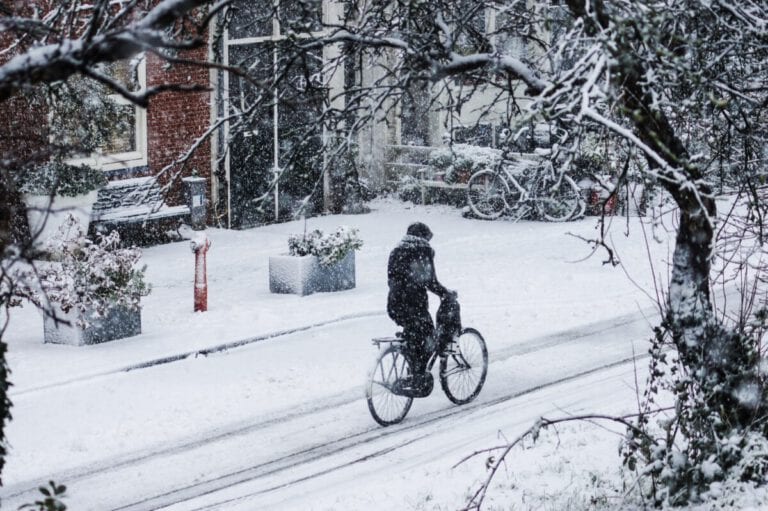
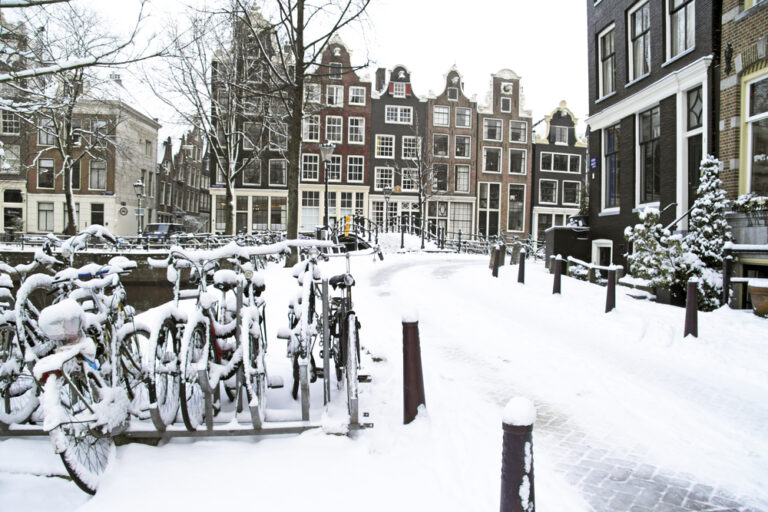
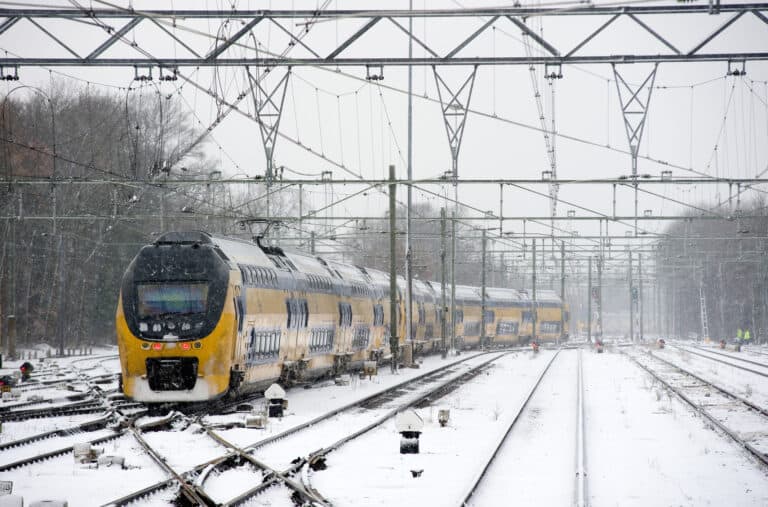
The majority of the Netherlands is under a code orange weather warning today, with up to 10 centimetres of snow expected in some areas. If you haven’t already, remind your boss that authorities are urging people to stay home.
And if you’ve been hoping the winter chaos would ease up, think again. The KNMI has issued a code orange warning for 11 provinces, covering nearly the entire country except Limburg and the Wadden Islands.
The warning came into effect this morning as snow began moving in from the west, with the heaviest snowfall expected in eastern areas. According to RTL Nieuws, between 5 and 10 centimetres of fresh snow is forecast.
But it’s not all fluffy white snowflakes and snowballs. Strong southerly winds of force 6 to 7 along the coast are making conditions pretty bad, causing snow to drift and reducing visibility.
Roads are already gridlocked
This morning’s commute has already been an absolute nightmare for many drivers.
According to NOS, over 500 kilometres of traffic had formed on Dutch roads by 8 AM, making this the worst Wednesday morning rush hour the country has seen in years.
The A4 between Amsterdam and Rotterdam is particularly bad, experiencing gridlock traffic for tens of kilometres.
Train routes are reduced, and cancellations are growing
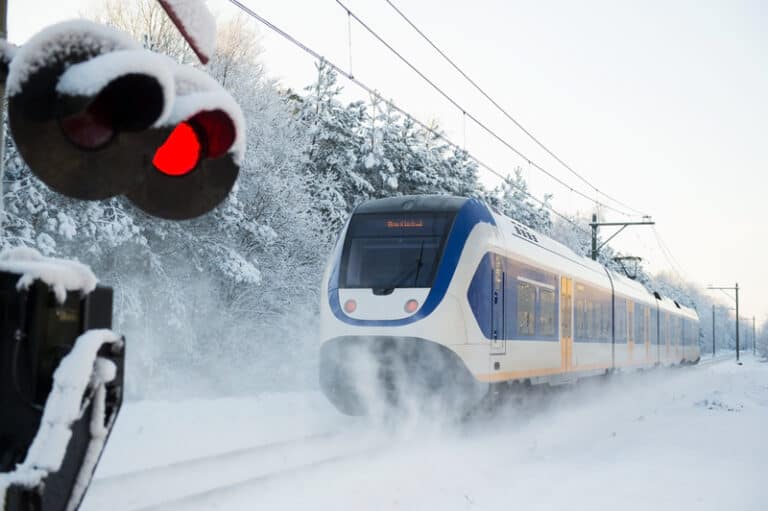
Meanwhile, the NS is running a reduced winter timetable, with no trains between Schiphol and Utrecht until 8 AM, and multiple routes in the north and east running fewer services.
For those fed up with the snow, tomorrow afternoon should bring rain to the southwest.
However, the weekend looks set for more winter weather, with forecasts warning of severe frost and wind chill factors potentially dropping to between -15 and -20 degrees Celsius, according to RTL Nieuws.
Stuck at home whilst snow piles up outside? At least you’ve got a legitimate excuse to dodge that meeting you were dreading.
Just touched ground in the Netherlands and looking for a good prepaid phone plan? Or maybe you’ve been here for a while but are looking to save some money by switching providers? Well… how does a €5 per month plan sound?
With outstanding (English!) customer service, affordable rates and handy-dandy add-ons, LEBARA has a lot to offer expats in the Netherlands.
Why get a LEBARA prepaid SIM?
Choosing a prepaid SIM card in the Netherlands can offer significant advantages depending on your needs.
For example, prepaid SIMs provide excellent cost control by allowing you to purchase a specific amount of credit or data upfront, avoiding overspending and unexpected charges.
Having a local SIM makes a big difference in the Netherlands. Image: Depositphotos
They also offer flexibility without commitments or contracts, allowing you to switch plans easily if needed. This is perfect for internationals trying to figure out what exactly they need from a Dutch phone plan. It’s a win-win!
But what exactly makes LEBARA’s prepaid SIMs stand out? Well, let me talk about some of my favourite things about them. 👇
It’s one of the cheapest options out there
If you’re anything like me (and the Dutch), you’re always on the hunt for a good deal.
In that case, you’ll be happy to hear that LEBARA stands out as one of the cheapest prepaid SIM (and SIM-only) providers in the Netherlands.
Prices for a prepaid SIM with LEBARA start as low as just €5 per month:
Product
Price
Included benefits
Data-only bundle
Starting at €5
✅ Free SIM card ✅ Up to 50 GB of data (for €50) ✅ Free calls to other LEBARA numbers ✅ Valid for 30 days
All-in-NL
Starting at €10
✅ Free SIM card ✅ Up to 15 GB of data (for €30) ✅ Unlimited calls and texts in NL and EU ✅ Low rates on international calls to 44 countries ✅ Free calls to other LEBARA numbers
All-in-International
Starting at €15
✅ Free SIM card ✅ Up to 15 GB of data (for €30) ✅ Free international calls to 44 countries ✅ 100 SMS (international or EU-wide) ✅ Free calls to other LEBARA numbers
Prepaid credit
Starting at €5
✅ Pay per SMS/min/MB ✅ Doesn’t expire ✅ Top up as you go
But it’s not just LEBARA’s bundles that are affordable; when it comes to rates for calling and mobile data, LEBARA offers some of the most competitive prices in the market.
With rates starting at just €0.09 per calling minute, €0.15 per SMS, and €0.01 per MB of data, LEBARA is considerably cheaper than its competitors, letting you get the most out of your prepaid SIM and each top-up.
So, whether you need to make local calls, international calls, or use mobile data, LEBARA’s prepaid SIMs are designed to give you the most bang for your buck.
Saving money? Sign us up! Image: Freepik
It allows you to make international calls — without breaking the bank
LEBARA understands the importance of staying connected with friends, family and authorities if you live abroad.
That’s why they’re the only Dutch phone provider offering special prepaid bundles for international calling.
With their All-in-International prepaid bundles, starting at just €15, prepaid customers can enjoy the convenience of calling 44 countries without breaking the bank.
With this bundle, all calls made within the European Union, Switzerland, and the United Kingdom are charged at the same rate as domestic calls.
However, LEBARA goes the extra mile, and their prepaid bundle also allows you to make cheap calls and send text messages to Canada, Iceland, Liechtenstein, South Korea, Turkey (landline), China, India, Malaysia, Singapore, Switzerland, the United States, Hong Kong, Israel, Morocco (landline), South Africa, and Thailand.
Enjoy the best network in the Netherlands
Last but certainly not least, LEBARA operates on the KPN network, renowned for being the best and fastest network in the Netherlands.
Super fast data, wherever you go. Image: Depositphotos
Consistently rated as the top network, KPN has excellent coverage (even in rural areas) and super speedy data traffic.
So, yes, by choosing LEBARA, you can rest assured that you’ll have excellent connectivity wherever you go within this flat country.
I’m convinced; how do I get one?
If you want to get your own LEBARA prepaid SIM, simply head to their website and get started.
Choose the bundle that suits you, put in your contact details — et voilà!
Your prepaid SIM card will be sent to your address within a few days, and you’ll be ready to start calling, texting, and surfing the web. 🏄♀️
If you’ve ever found yourself wondering how on earth the Netherlands is so flat, you’re not alone.
When I take a train from Belgium or Germany back into the Netherlands, I know I’ve crossed the border when the horizon suddenly begins to stretch out in front of me, completely undisturbed by hills or mountains.
Coming from a mountainous country, the very sight of it gets the cogs in my brain turning — how is the Netherlands so flat!?
How did the Netherlands get to be so flat?
It turns out that a combination of geography and land reclamation from the sea is the key to explaining the ruler-straight horizon. Let’s take a look at how each of these works.
Dutch geography is naturally flat land
Most of the Netherlands consists of naturally flat, low-lying plains — hence the Netherlands. This has to do with it being the drainage point of Western Europe.
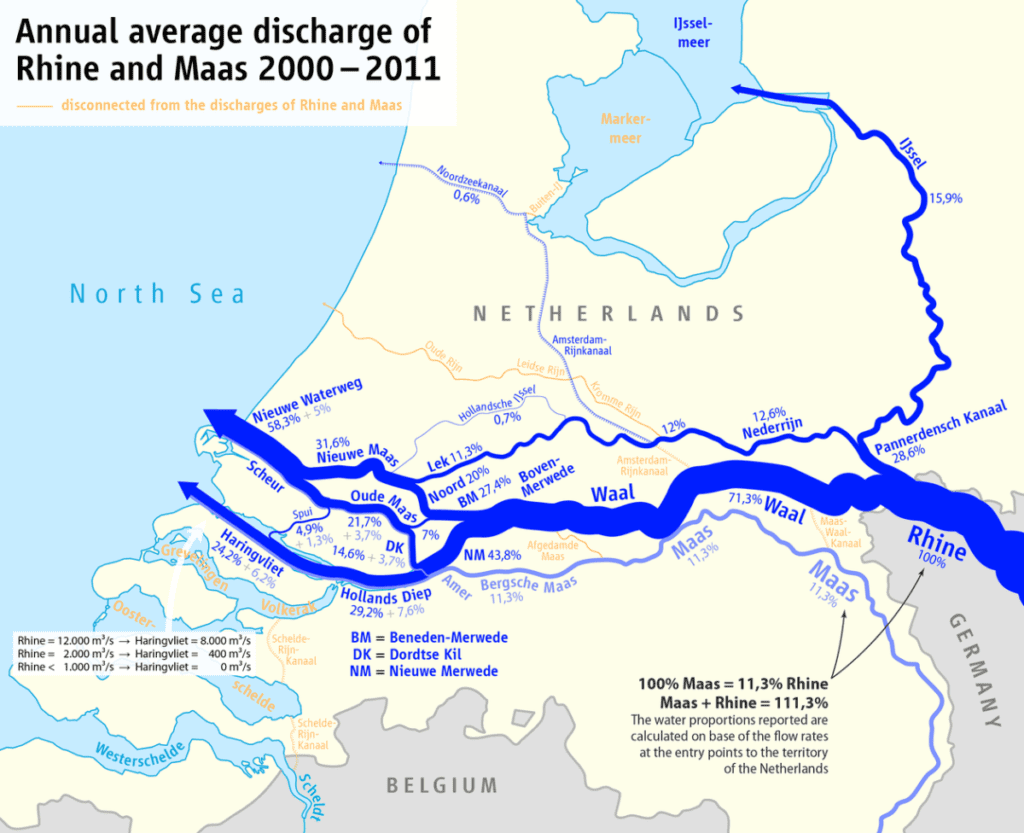
Four major rivers (the Rhine, the Meuse, the Scheldt, and the Eems) flow into the Netherlands and drain into the Wadden and North Seas via the Dutch coastline.
The Rhine and Maas are two major rivers in the Netherlands. Image: Maximilian Dörrbecker/Wikimedia Commons/CC2.5
How the Dutch reclaimed land from the sea
A whopping 17% of the land in the Netherlands used to be underwater!
Stealing this land back to build entire cities is one of the many reasons the Dutch are renowned for their engineeringand water management skills. It’s also why much of Holland is so flat.
How exactly the Dutch achieved this is truly impressive. First, dikes were built to section off strips of submerged land and to prevent more seawater from flooding in. These areas were called polders.
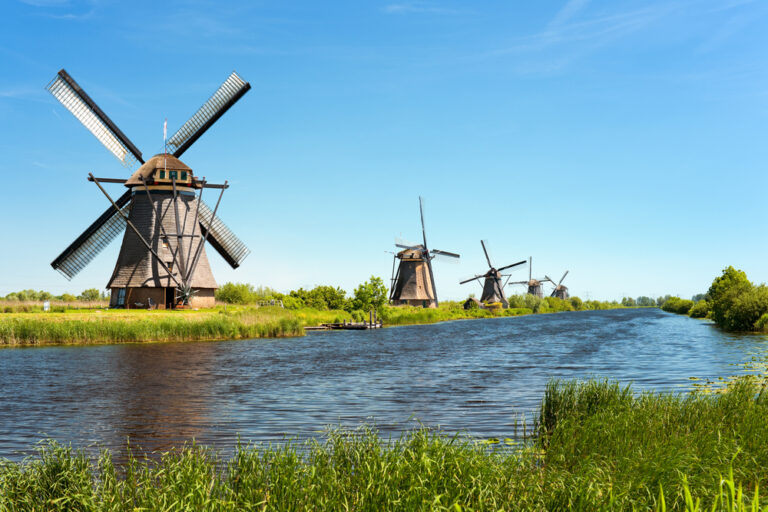
The seawater was then pumped out of the polders using windmills, and plants were used to stabilise the ground. Polder ground is rich in clay, fertile, and yes, very, very flat.
The following video has some great animations to show you this process:
Is the Netherlands below sea level?
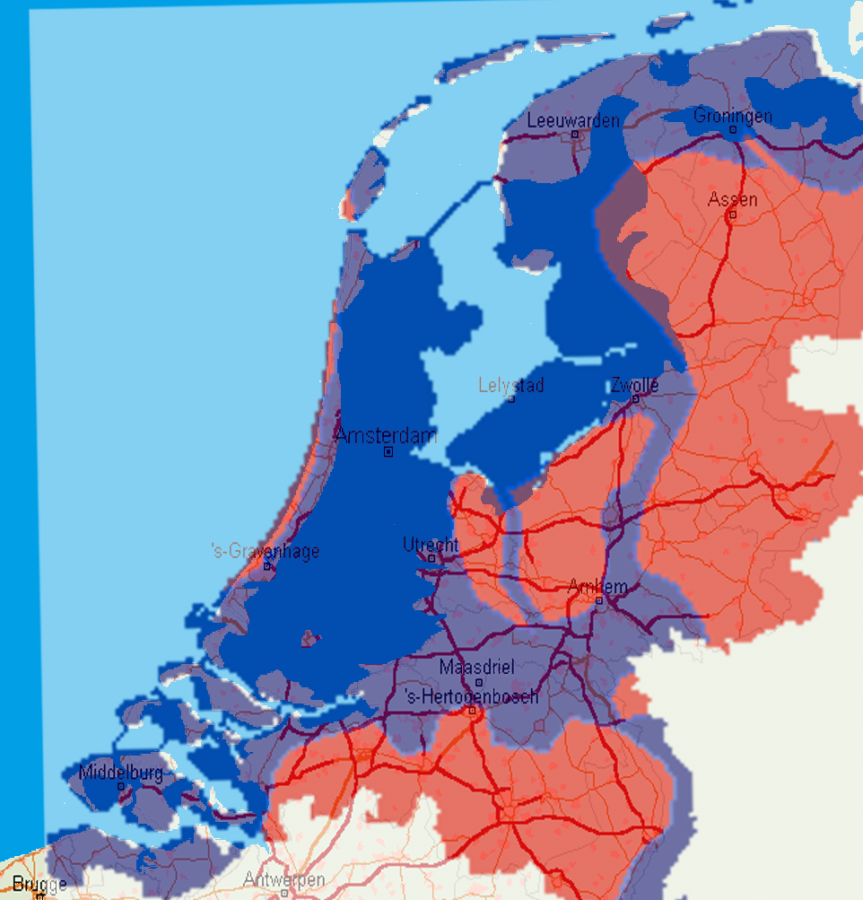
You’ll wet your pants (thi-hi) if you think about this too much, but yes, 27% of the country lies below sea level.
This means about 10% of the Netherlands was already below sea level before the land reclamation.
A baffling 21% of the 17 million Netherlanders reside quite blissfully in what used to be the seafloor.
This includes major cities like Amsterdam, Rotterdam, and Delft. The lowest point is 6.7 metres below sea level!
All that blue on the map is technically below sea level. Image: Reboelje/Wikimedia Commons/CC3.0
The Dutch dike system protects the Netherlands from flooding and other natural disasters.
The Delta Works in the southwest of the country is one of the largest systems of dikes, locks, and storm barriers built to protect the country.
When dikes fail: Watersnoodramp
The flooding of 1953 was the largest flooding disaster in the Netherlands on record and is known as the Watersnoodramp.
It was caused by a storm from the North Sea and killed over 2,100 people. Immense damage was caused to areas in the provinces of South Holland, Zeeland, and North Brabant.
The three-border region of Vaals, where the Netherlands meets Germany and Belgium, is the highest point of the country, but it’s still only 323 meters high.
That doesn’t stand up to places like the Swiss Alps, which are up to 4,634 metres above sea level! 🗻
Is the Netherlands sinking?
You may have heard that much of the Netherlands is built on sinking ground, and unfortunately, this is true.
The continuous drainage required to keep parts of the country dry — now done by massive water pumps rather than windmills — is causing the land to sink up to seven millimetres per year.
Climate change is also contributing to the nation’s downward drift. As the summers become warmer, the clay-rich land dries faster and thus sinks faster.
There’s no shortage of water in the Netherlands! Image: Depositphotos
This can cause huge problems for Dutch infrastructures, like cracking foundations, destabilised roads, sinkholes, and an increased risk of flooding.
A few old canals and quays in Amsterdam have already collapsed. Many Dutch cities are reinforced with underground poles to try to fight this. Older houses were built on wooden piling, which is now rotting, often costing millions of euros to replace.
A report by the PBL, the Dutch Environmental Assessment Agency, predicts around €5.2 billion will be needed to restore weak foundations by 2050. Ouch!
How is the Netherlands preparing for rising sea levels?
Unlike some politicians with *cough* bleached cats for toupees *cough*, the Dutch government does not ignore climate change, nor do they plan on building any walls.
“We can’t just keep building higher levees, because we will end up living behind 10-metre walls,” senior government advisor Harold van Waveren told the New York Times.
Instead, the Dutch are building inland reservoirs to catch floodwaters in a project called Room for the Water.
In this way, the Dutch hope to continue to do what they have always done best — that is, to live with water rather than fight against it.
But the Room for the Water project has received criticism, too. 👀
The area of Noordwaard, once a thriving farm region in the southwest of the Netherlands, is now only a watery marshland after it was designated as a flood-catchment zone for the project.
Homes were demolished and people displaced, and some fear that with rising sea levels, this will be the fate of many Dutch areas in the future. Concerns have arisen over how sustainable the Room for the Water strategy really is.
Now you know: the Netherlands is flat both because of natural geography and because of land reclamation. Still fighting those natural forces, the nation continues to pump a lot of money, brainpower, and water into keeping its cities dry.
Is the Netherlands doing enough to save itself from climate change? Tell us in the comments below.
Walking around the streets of Amsterdam, you might be a bit intimidated by the presence of police on the roads. But for the Dutch, these authorities are no more than lamp posts.
That’s because law enforcement agents quickly fade into the background for many Dutch people, and they have no fear of talking back to them, just as if they were inanimate objects.
What happens?
Picture this: you’re wandering along the road, past a group of Dutch schoolkids, minding your own business, and all of a sudden, you hear shouts from the group.
Wait, what? What’s wrong?
Nothing, you realise, as you see a group of police cycle past on their fietsen (bikes!). While we won’t detail the exact words of the heckling, it’s not the kind of respect you might be accustomed to as an international.
Dutch authorities aren’t greeted with the same level of respect that people around the world usually accord the police, their bosses, or world leaders. 😱
The Dutch people’s habit of talking back to authorities can be pinned down to a very egalitarian mindset and society.
For instance, in lots of Dutch workplaces, you’ll find a lack of a work hierarchy. Your boss is on the same page as you, so you can *usually* speak to your boss the same way you’d speak to a coworker.
It can be easy to become a little offended by Dutch directness, especially when you’ve ordered a seemingly normal-sized portion of lunch and your waitress exclaims, “That’s a lot!”
Why is it quirky?
In many countries, it is a big no-no to talk back to authorities, whether that be a parent, professor, or supervisor. Their word is gospel, so you take it as such.
Yetthe Dutch have no qualms about expressing their many opinions, and this translates into zero fear of letting authorities know exactly how they feel.
If you see a politieauto (police car) drive through, telling off some Dutchies for improper cycling, only for them to wave them off, now you can understand why they’re so casual!
Should you join in?
The answer to that question is a bit difficult.
If you want to be as fearless as the Dutchies are, then maybe try it out — speak up in that class you’ve been scared to share your thoughts in, or try having a casual convo with your boss during happy hour.
But as far as heckling the politie goes, we’ll leave that one up to you.
What do you think of this Dutch quirk? Have you experienced it? Tell us in the comments below!
Freezing temperatures of up to -10 degrees are unleashing a flurry of chaos across the Netherlands, as universities close, even more flights are grounded, and a code yellow warning is issued nationwide.
As temperatures dropped to -10 degrees last night, Dutchies are waking up to an icy, unforgiving Tuesday morning, reports AD.
The lowest temperature was -10.6 degrees Celsius in Gilze-Rijen, Brabant. Shockingly, regions only a few dozen kilometres away saw temperatures of only -3.
And with these freezing temperatures, the country continues to experience snow chaos.
Expect treacherous roads and traffic
While some might have rejoiced in the gorgeous snowfall over the weekend into Monday night, others are finding it less romantic.
Due to the freeze, the roads are perilously icy across the country. A code yellow has been issued, cautioning drivers to be vigilant, or, better yet, to stay off the roads if they can help it.
Accidents are likely in this kind of weather — an incident on the A12 this morning has already caused up to 2 hours of delays between Gouda and Utrecht, reports NOS.
NS trains aren’t running (but it’s got nothing to do with the snow)
Better yet, this morning, the NS announced that all domestic trains were cancelled till at least 10 AM due to IT outages and switch failures.
Several unlucky passengers were already forced to find accommodation on Monday evening or even sleep at the airport (hardly a five-star hotel), as flights were already cancelled over the weekend.
Now, according to NOS, the magic number of flights currently grounded is over 700.
Utrecht University remains closed
Due to the difficult commuting situation for students and teachers, the University of Utrecht has cancelled classes for the second day in a row.
Not sure if this qualifies as a snow day, but surely some students are pleased with the change of plans.
The current weather is far from over: tomorrow is forecast to bring more snow (but hopefully less chaos).
How have you been affected by the winter weather? Let us know in the comments below!
If you’re commuting by train today (January 6), you may want to make alternative arrangements, as all domestic NS trains are cancelled until at least 10 AM this morning.
UPDATE: As of 10 AM, the NS reports that train traffic will be “gradually restarted”, with service limited to certain regions in Amsterdam and Flevoland.
However, due to the wintry weather and “numerous switch disruptions”, commuters across the Netherlands will experience fewer trains, longer travel times, and cancellations. International trains are also affected.
Thanks to a perfect storm of technical disasters, the NS has just announced a complete halt to all domestic train services across the Netherlands.
Citing “numerous switch failures and an additional IT outage at NS”, a spokesperson for the rail operator explains that an essential part of its scheduling system isn’t working — resulting in the chaos you’re about to experience this morning.
When will the trains start running again?
The NS expects that no train services will run until at least 10 AM this morning.
The rail operator is also urging passengers to postpone their journeys if possible, rather than risk being stranded at stations.
In the meantime, you’ll want to check the NS journey planner and app for updates before even thinking about heading to the station.
Opting for alternative transport options like buses and trams? You may encounter similar delays due to the snow. If you can, it is best to remain at home.
Feeling a twinge in your back after too many Dutch cycling adventures? Whatever the issue, going to the physiotherapist in the Netherlands is surprisingly easy once you know how the system works.
This guide walks you through referrals, costs, insurance cover, and what to expect during your first visit. Let’s dive into it.
What is physiotherapy in the Netherlands?
Physiotherapy (fysiotherapie) is one of the most common types of care in the Dutch healthcare system. Its goal is to help with everything from sports injuries and muscle tension to posture problems caused by long days working behind a laptop.
You’ll also find variations such as manual therapy, sports physio, dry needling, and pelvic physiotherapy. Each works slightly differently, but they all aim to reduce pain and improve movement.
Do I need a GP referral for physiotherapy in the Netherlands?
Thanks to the Netherlands’ directe toegankelijkheid fysiotherapie (direct access to physiotherapy or DTF), you can generally book a physiotherapist directly without getting a GP referral.
This means you can make an appointment without seeing your GP first, and without having to explain how you pulled your shoulder while lifting an IKEA box.
Good news: You can skip the GP visit! Image: Depositphotos
DTF also means your physio will do a short screening during your first appointment to check whether physiotherapy is safe and appropriate for your condition.
If anything looks unusual or outside their scope, they’ll refer you to your GP or a specialist. In most cases, though, you can start treatment right away — which makes the whole process much faster than many internationals expect.
However, there are a few exceptions.
Some insurers still require a GP referral for specific treatments or long-term cases, so it’s always worth checking your policy before booking. But for everyday issues like back pain, muscle tightness, or mild sports injuries, DTF keeps things simple and accessible.
Does Dutch health insurance cover physiotherapy?
Here’s some bad news: basic Dutch health insurance doesn’t cover standard physiotherapy for adults.
You’ll usually need aanvullende verzekering (an additional insurance package) if you want cover for non-chronic conditions. Most of these top-up plans include between 6 and 18 sessions a year.
Your supplementary insurance will help you out. Image: Depositphotos
If you have a qualifying condition, your first 20 sessions are usually paid out of pocket or by your additional insurance. After that, your basic insurance takes over.
Common chronic conditions include neurological issues, serious mobility problems, and long-term post-operative recovery.
Physiotherapy coverage for children in the Netherlands
Children get more generous coverage for physiotherapy than adults. For them, many treatments fall under basic insurance, and paediatric physiotherapists specialise in movement development, posture, and injury prevention.
A GP referral is sometimes required, but many treatments can start directly.
How much does physiotherapy cost in the Netherlands?
A standard 30-minute physio session in the Netherlands costs between €30 and €60. Intake appointments tend to be a little more expensive because they involve a longer assessment.
If you don’t have additional insurance, you’ll pay the full price out of pocket.
How to book a physiotherapist in the Netherlands
Finding an English-speaking physiotherapist in the Netherlands is usually a straightforward process.
Many practices have international staff, and booking can often be done online. Reviews are also super helpful for choosing a physio who fits your needs.
You can usually call the practice to make an appointment. Image: Depositphotos
Your first session includes an intake interview, a physical assessment, and a treatment plan. Bring your ID and insurance card, and wear something comfortable that you can move in.
Find an English-speaking physio near you
Most cities have plenty of physiotherapy practices that list English as a working language. Tools like ZorgkaartNederland or your insurer’s directory can help you find someone close to you.
What happens in your first session with a Dutch physiotherapist
During your first session with a physiotherapist in the Netherlands, you can expect questions about your medical history, pain levels, and daily habits. Your physio will want to know when the pain started, what makes it worse, and whether you’ve had similar issues before.
They’ll also ask about your work setup, hobbies, and activity level — because sitting hunched over a laptop for eight hours or cycling 20km daily absolutely affects your body.
Don’t be surprised if they ask surprisingly specific questions about your posture or sleeping position.
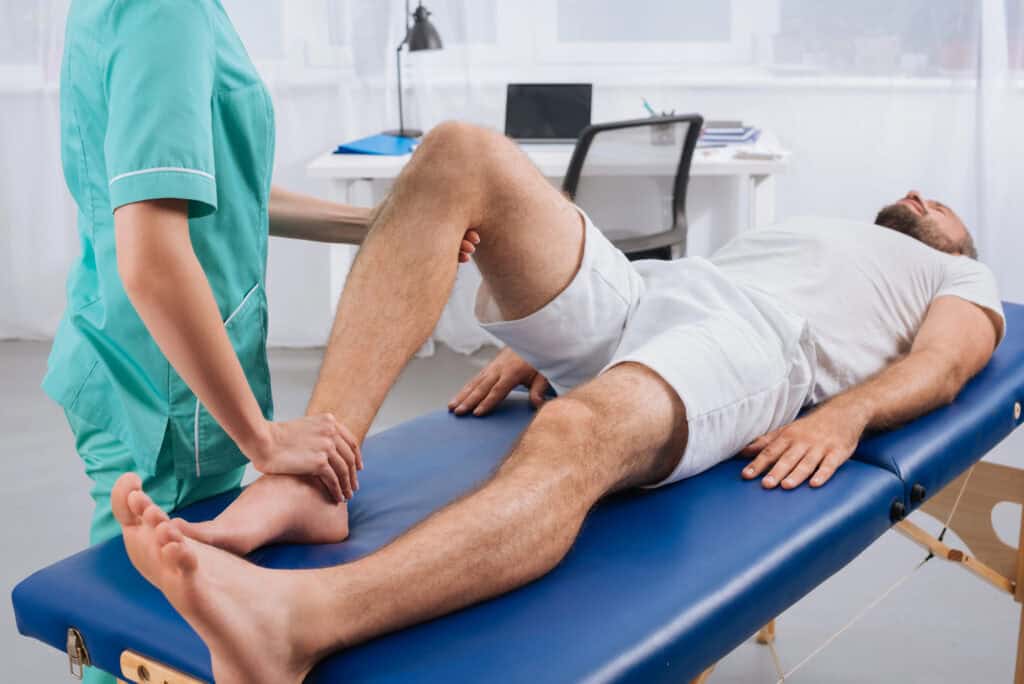
Your physio may also test your movement, flexibility, and strength. This could involve walking across the room, bending in different directions, or performing simple exercises while they observe.
Be prepared to do some exercises. Image: Depositphotos
After that, you’ll develop a treatment plan together. This might include hands-on manual therapy or exercises to do at the practice or at home. Some physios also use techniques like massage, dry needling, or taping.
Most will give you a realistic timeline for recovery and book follow-up sessions on the spot.
The whole intake usually takes 30 to 45 minutes, and you’ll often start some light treatment during that first visit.
Types of physiotherapy you can get in the Netherlands
Depending on what kind of pain you need help with in the Netherlands, there are different types of physiotherapy you can get:
Manual therapy: Focuses on joints, neck pain, and mobility issues.
Pelvic physiotherapy: Common for pregnancy, postpartum recovery, or pelvic floor issues.
Sports physiotherapy: For athletes or gym lovers who push a little too hard.
Shockwave therapy: A treatment for stubborn tendon problems.
Dry needling: Uses thin needles to release tight muscle knots.
How to submit claims and get reimbursed
If your insurance does cover your physiotherapy session, it’s important to know how to get reimbursed.
This depends on the practice, but many Dutch physiotherapists bill your insurer directly, which saves you a lot of admin.
Others will email you an invoice that you can submit through your insurer’s app or online portal.
Tips for internationals going to a physio in the Netherlands
The first thing you should always do is to check whether your physio has a contract with your insurer to avoid surprise bills. If you know you need multiple sessions a year, consider adding a top-up insurance package.
When it comes to your appointments, wear comfortable clothes, bring water, and don’t be shy about asking for English. Most physios are used to internationals and will happily translate any tricky Dutch words on your treatment plan.
When should you see a physio, GP, or specialist?
As a general rule of thumb:
A physio is great for muscle pain, movement problems, and most sports injuries.
See your GP if you have unexplained swelling, fever, or sudden severe pain.
Go straight to emergency care for fractures, dislocations, or anything that makes you suspect you’ve done something very dramatic.
Physiotherapy in the Netherlands is easy to access once you know how insurance works, and it can make a huge difference to your comfort and recovery.
Take your time to choose a good physio and keep track of your sessions. You’ve got this!
Have you been to a physio in the Netherlands? Share your experience in the comments!
Getting physiotherapy in the Netherlands: Frequently asked questions
Do I need a referral from my GP to see a physiotherapist in the Netherlands?
No, most people can book directly thanks to directe toegankelijkheid fysiotherapie (DTF). Your physio will screen you during the first session and only refer back you to a GP if needed.
How much does a physio session cost in the Netherlands?
Between €30 and €60 for a standard 30-minute session. Intake appointments are usually slightly more expensive.
Does my Dutch health insurance cover physiotherapy?
Basic insurance doesn’t cover non-chronic physiotherapy for adults. You’ll need an aanvullende verzekering (additional package) for cover. Children under 18 and people with chronic conditions get more generous cover.
How many physio sessions will my Dutch insurance cover?
This depends on your additional insurance package, but most cover between 6 and 18 sessions per year. Check your policy to be sure.
Can I find an English-speaking physiotherapist in the Netherlands?
Yes, especially in larger cities, it’s easy to find an English-speaking physio. Many practices have international staff or physios who work in English. You can check reviews or call ahead to confirm.
What should I bring to my first physiotherapy appointment in the Netherlands?
Bring your ID, insurance card, and wear comfortable clothing that you can move in. If you have previous medical reports or scans related to your issue, bring those too.
How long does a typical physio session last in the Netherlands?
Standard sessions are usually 30 minutes long. Intake appointments can take 45 minutes to an hour.
Will physiotherapy hurt?
Some techniques, like deep tissue massage or dry needling, can be uncomfortable, but your physio will always check in with you. Treatment shouldn’t be unbearable, so speak up if something feels wrong.
Can I claim my physiotherapy costs back from my insurance?
Yes, if you have additional insurance that covers physio. Some practices bill your insurer directly, while others will give you an invoice to submit through your insurer’s app.
What’s the difference between a physiotherapist and a manual therapist?
Manual therapists are physiotherapists with extra training focused on joint mobilisation and manipulation. They typically work on neck, back, and joint issues.
Let’s set the scene: you’re watching a Pewdiepie meme reaction video on YouTube and he briefly mentions the Netherlands. You scroll down and the comments are a sea of “gekoloniseerd”. 💬
Confused? Well, it looks like you’ve run face-first into a strange Dutch quirk in the wild (or, rather, on the internet).
What is it?
This quirk relates to a humorous habit of some millennial/Gen Z Dutch people: rushing to the comments section of a YouTube/TikTok/Instagram video that mentions the Netherlands and spamming the word ‘gekoloniseerd’ (colonised).
Why do they do it?
According to an old Reddit thread, the joke originated from a YouTube video by a user named Studio Massa.
The video, titled “de VOC (voor idioten)” — the VOC for idiots — is a short cartoon retelling of a Dutchman landing on an island and attempting to wrangle spices from the natives.
Another Redditor in the same thread suggested that the “gekoloniseerd” joke could’ve come from a rather unsurprising source: Thierry Baudet. A few years ago, a clip of the far-right Dutch politician went viral, and the internet found it hilarious.
In the video, Baudet gestures to his bookshelf and goes, “dit is eigenlijk niet van mij, maar ik heb dit gekoloniseerd” (this is actually not mine, but I’ve colonised it).
Wherever the meme came from, it’s now firmly embedded in the cultural psyche of young, chronically online Dutchies, who use every opportunity to wield it.
Why is it quirky?
Very few other nations have such a popular joke word or phrase that all but SCREAMS, “hi, my country was mentioned in your video/post, so now I’m spamming your comments section.”
In the words of a Redditor on the original thread, it’s a great way to figure out if any Dutch people are online.
So, if you see a “gekoloniseerd” (colonised), “zeg maker” (say, mate), or “kokosnoten zijn geen specerijen” (coconuts aren’t spices) wafting about in the comments section of a video, well… chances are it mentions the Netherlands in some way.
Should you join in?
That depends.
Most millennial/Gen Z Dutch people (and internationals) view it purely as a meme, or as a way of indicating that they’re part of a group online.
However, given the Netherlands’ history of colonising bits of land here, there, and everywhere, some Dutch people and internationals find its use distasteful.
As an international from a former Dutch colony, I think it’s a relatively harmless joke. Whether you’d like to adopt this Dutch quirk or shun it is solely up to you, as there’s no one-size-fits-all approach.
What do you think of this Dutch quirk? Have you experienced it? Tell us in the comments below!
If you were planning to catch a train in Amsterdam this morning, cancel those plans. The entire Amsterdam region has lost all rail services, with Schiphol Airport now unreachable by train.
What started as scattered disruptions has rapidly deteriorated into a full-blown transport crisis, and the NS has now suspended multiple services across the country.
No trains are running to or from Amsterdam Centraal, and Schiphol (one of Europe’s busiest hubs) is now unreachable by rail.
With snow continuing to fall, the situation is worsening by the hour, and more routes are being suspended — leaving thousands of travellers stranded and forcing many to abandon their journeys entirely.
Transport network in meltdown
Beyond Amsterdam, trains have stopped running between Utrecht and Leiden, Zwolle and Leeuwarden, Zwolle and Deventer, and Leeuwarden and Stavoren.
On routes that are still operating, services are running at half capacity or worse, meaning the trains that do show up are absolutely rammed with frustrated commuters.
The root cause? Switch malfunctions triggered by the snowfall.
But here’s the kicker: ProRail repair crews can’t even reach the broken switches because they’re stuck in the same traffic chaos as everyone else, according to NOS.
Why can’t Dutch trains handle snow?
If you’re an international from a snowier climate, you might be wondering how a few centimetres can cause such chaos.
ProRail’s explanation is simple: countries like Sweden and Switzerland cope far better because their infrastructure is specifically designed for months of snow.
“In the Netherlands, we see snow less frequently,” a ProRail spokesperson explains to the NOS. “If you have snow for several months per year, you adapt your infrastructure accordingly.”
Translation: we’re just not built for this. When snow does arrive, the entire rail system buckles under pressure.
No clear timeline for recovery
With the KNMI extending code orange warnings to eight provinces and snow continuing to fall, there’s no indication of when normal service might resume.
Buses have also stopped running in Friesland and Utrecht, leaving many commuters with no alternative.
For internationals trying to reach Schiphol for flights, the situation is particularly dire. With trains suspended and roads gridlocked, getting to the airport has become nearly impossible.
However, if yesterday’s events are anything to go by, the chances of their flights actually departing are pretty slim.
Stranded at home or stuck in a station? Check the NS app constantly for updates, though honestly, you might be better off staying put until this whole mess sorts itself out.
The American military operation to seize Venezuelan president Nicolás Maduro has put the Netherlands in an uncomfortable spot. Dutch politicians are trying to balance international law principles with the reality of having Caribbean islands sitting right next to Venezuela.
Saturday’s dramatic extraction of Maduro from Caracas sent shockwaves through Dutch political circles.
Not because anyone’s mourning the departure of an authoritarian leader, but because of what it means for international norms and regional security.
The Netherlands isn’t just an interested observer here. The Caribbean islands of Aruba, Curaçao, and Bonaire are part of the Dutch Kingdom, lying mere kilometres from Venezuela’s coastline.
Flights cancelled, cabinet stays quiet
The immediate impact was felt in the skies. KLM and other carriers scrambled to cancel flights to Curaçao, Aruba, and Bonaire as airspace closed amid security concerns, reports NOS.
As a result, thousands of travellers found themselves stranded on both sides of the Atlantic.
By Sunday, flights had cautiously resumed, though airlines continue urging passengers to stay alert to sudden changes.
Meanwhile, the caretaker government kept its response carefully neutral.
Foreign Affairs Minister David van Weel said the Netherlands doesn’t recognise Maduro’s regime but urged all parties to avoid escalation and respect international law, according to de Volkskrant.
Notably absent? Any condemnation of the American operation itself.
Politicians split on response
Rob Jetten, leader of D66 and part of coalition talks, was more direct.
By Saturday evening, he’d called Maduro “a cruel dictator” but labelled Trump’s actions as “contrary to international law” and creating “a precedent with major risks”.
PVV leader Geert Wilders, however, was characteristically blunt, writing “Bang Boom Maduro gone” on X.
Why the cautious response?
The Netherlands has been walking on eggshells for months.
The worry is straightforward: Venezuela might hit back at the US by targeting its closest neighbour, which is Dutch-controlled.
But less straightforward, the Dutch also now more or less fear their “ally”: the US.
As Defence Minister Ruben Brekelmans told parliament in December, the government has been at pains to show it’s not involved in American operations near Venezuela. The Netherlands has responsibility for defending Aruba, Curaçao, and Bonaire.
But for example; there’s also Ukrainian aid to consider. The Netherlands needs American support for Ukraine to continue, adding another layer of diplomatic complexity.
What the law says
Dutch legal experts aren’t mincing their words. Speaking with de Volkskrant, Marieke de Hoon, who lectures in international criminal law at the University of Amsterdam, calls the operation “a crime of aggression”.
Meanwhile, Frans Osinga, professor of war studies at Leiden University, agrees. “From an international law perspective, the Netherlands should obviously condemn this. It’s completely illegal, neo-imperialist behaviour,” he tells the paper.
But he sees the impossible position: “The proximity of the Antilles and the fact that American support for Ukraine is still badly needed stands in the way of harsh condemnation.”
The Netherlands positions itself as guardian of international law, hosting The Hague’s international courts. Watching a major power bypass those structures hits differently when you’ve built your reputation on upholding them.
Parliament returns from recess this week for an emergency debate on Venezuela and its implications for Dutch policy.
What do you think about the Netherlands’ cautious response? Share your thoughts in the comments below.