Have you ever thought, “Hey, why let a little expiration date dictate our food choices?” Well, hold onto your taste buds, because a bold new supermarket in the heart of the Netherlands is taking expired goods from drab to fab!
From canned tomatoes that have seen a few seasons to chocolate bars that had to show their ID to buy a drink – it’s all there!
Ok, fine, the products aren’t that old. At the Datumvoordeelshop in Neijmegen, the products are being sold at or just past their expiration date.
Will this food kill me?
We’re sure you might be thinking, “Wait… isn’t eating expired stuff a recipe for disaster?”
But fear not, foodies! According to AD, this supermarket has a stringent quality control process, and they’re not just throwing random old stuff on the shelves.
In addition to curating a selection of products that still have plenty of life left in them, they also check that the products are properly sealed and stored, so you’re safe to consume them.
And it’s not just food, as the shop also sells shampoo, cotton pads, and toilet paper.
Hoera for low prices!
Shoppers have been stoked about the pocket-friendly prices. It’s like shopping in a time machine where everything costs a fraction of what it did when it was fresh. Who knew a slightly aged gouda could bring so much joy at a fraction of the cost?
And the cherry on top? Shops like Datumvoordeelshop help reduce food waste, which is a prevalent issue in the Netherlands. It’s a win-win that even your grandma’s meatloaf leftovers would approve of.
🌎 has used up all its resources for the entire year! Many are used to produce the food we never eat.
— Food and Agriculture Organization (@FAO) August 2, 2023
So, next time you’re up for a shopping escapade, why not embrace your inner culinary explorer? Swing by this offbeat supermarket and get ready to embark on a frugal flavour journey.
Would you try shopping at the Datumvoordeelshop? Tell us all about it in the comments below!
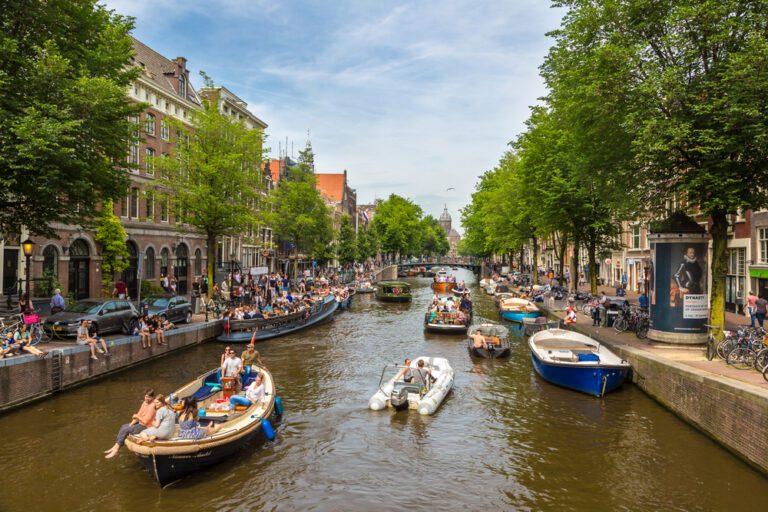
With warmer temperatures returning this week, you may be ready to take a refreshing dip in the canal. Helaas, for health reasons your canal swim will have to wait.
Health reasons? Ja hoor, you read that right! Due to heavy rainfall on Sunday, excess sewage and rainwater overflowed into Amsterdam’s canals.
This means that the water quality will remain poor until the end of Wednesday, reports Het Parool.
The municipality of Amsterdam has issued advice that you don’t go swimming during the 72-hour period between the overflow and return to normal water quality.
A crappy Sunday
The heavy rain didn’t only ruin Pride Weekend, it’s also temporarily ruined the water quality of Amsterdam’s canals. (However, rather the canals than the city, right?)
The reason for the poor water quality? Well, sewage was purposely discharged into the canals to prevent flooding in Amsterdam city. Phew! That saved us from having a rather “shitty” experience. 💩
No swimming 🏊♂️❌
While the Dutch capital’s streets are poop-free, the canals aren’t. Due to the overflows, the water quality has deteriorated in many places, including the Amstel.
“Swimming in this polluted water is not healthy and we therefore advise against it,” said the municipality in a press release.
You know all the pathogens that happily live in wastewater and that we usually don’t have to think much about? Well, now they’re in Amsterdam’s canals and other open water.
How are the rankings calculated, you may be asking? PeopleForBikes’ data-driven programme identifies, evaluates, and compares the bike network quality of 1733 cities globally.
Not only does a Dutch city take the number one spot against a whopping 1733 other cities, but two more are in the top 10. Go Nederland! 🇳🇱
Dutch fietsen for the win
Based on data about streets, speed limits, bike infrastructure, and destinations documented in OpenStreetMap, the City Ratings have given Dutchies a reason to celebrate.
Why? Dutch cities come out on top, natuurlijk. The Hague tops the ratings at number one, with Almere landing in fifth place, and Utrecht at number eight. Gefeliciteerd!
If you’re wondering what other cities have cycled to the top, check out the top 10. 🚲
Ranking
City
State/Country
Score
1
The Hague
South Holland, Netherlands
89
2
Provincetown
Massachusetts, United States
88
3
Crested Butte
Colorado, United States
87
4
Bromont
Quebec, Canada
87
5
Almere
Flevoland, Netherlands
85
6
Blue Diamond
Nevada, United States
85
7
Leuven
Flemish Brabant, Belgium
85
8
Utrecht
Utrecht, Netherlands
84
9
Brussels
Brussels Capital Region, Belgium
84
10
Murdock
Nebraska, United States
84
A sprint for bike-friendly cities
Each city receives a City Ratings score on a scale from zero to 100, where a low score indicates a weak bike network and a high score indicates a strong bike network.
What is a bike network? A bike network is a connected system of protected bike lanes, off-street paths, slow shared streets, and safe crossings that enables people to comfortably bike around a city.
So, how were the scores determined? The Bicycle Network Analysis (BNA) is software that measures the quality and connectivity of a bike network and assesses six factors of a city in the acronym SPRINT.
Safe speeds
Protected bike lanes
Reallocated space
Intersection treatments
Network connections
Trusted data
With all that in mind, we can’t help but have pride shining in our hearts for the country that makes it possible to flex our innovative cycling muscles. 💪
What do you think of the ratings of bike-friendliness? Tell us in the comments!
It has been a true challenge not to get grumpy this week with all the rain we’ve had. Wasn’t it meant to be summer? Well, this week, there’s finally a light (sunshine) at the end of the tunnel. 🌞
After the wettest week of the summer so far, some mild Dutch sun will return to grace us with some much-needed warmth.
Warmer temperatures are coming (finally!)
Whilst that might sound too good to be true, we’ll still need to weather the storm for two more days. However, this Wednesday (August 9) will see temperatures hit highs of 20 to 25 degrees Celsius.
On top of that, the weather will stay significantly drier with more sun, according to RTL Nieuws.
But the universe must always stay balanced, so we can’t have too many good things. On Saturday, August 12, there is a chance of rain again.
The rain isn’t messing around
August 7 will kick off with yet another gloomy rain shower, according to Nu.nl. You needn’t cancel your plans just yet, however, as clearer and sunnier weather is already predicted for the afternoon.
Unfortunately, for those living in the south of the Netherlands, the rain might continue for a little longer. As for the wind, it continues to be strong on the coast and on the Wadden islands.
Once one of the strongest advocates for equality, the Netherlands is now falling off the path towards creating an inclusive society and being a world leader in LGBTQ+ rights.
Even though the big crowds and celebratory atmosphere of Amsterdam Pride this weekend might’ve felt like the Netherlands is the place to be for LGBTQ+ rights, this picture just isn’t as colourful as it seems.
According to Robbert Dijkgraaf, the Dutch Minister of Education, Culture, and Science, the Netherlands struggles to stay on the path of leadership for LGBTQ rights.
In fact, opposition to LGBTQ+ rights in the Netherlands is becoming more vocal and aggressive, according to Bloomberg.
Opposition bubbles under the surface
Although the Netherlands was the first country in the world to legalise same-sex marriage, things are an entirely different story today.
In an interview, Dijkgraaf points to stronger resistance from certain societal groups, such as extreme right-wing political parties. Even among the general populace, there are more and more Dutch people that take the country’s inclusiveness for granted.
These comments by the Dutch minister come at a time when the Netherlands fell to 14th place on Rainbow Europe’s list of the best European countries for LGBTQ rights.
The advocacy group signalled that hate crimes against the LGBTQ community were becoming more and more common in the Netherlands.
Rainbow Europe also pointed out that the Dutch government wasn’t doing enough to protect the community. In particular, there was found to be inadequate state assistance for trans individuals facing domestic violence.
More hate against the LGBTQ+ community
Sadly, many incidents this year exemplify these trends. Just last month, a monument in The Hague for the LGBTQ+ community was vandalised.
Earlier this year, Dutch football fans were repeatedly heard chanting homophobic slurs. And, after Rikkie Valerie Kolle won the coveted Miss Netherlands beauty pageant, she faced an outpouring of online hate.
Even at the political level, openly gay Climate Minister Rob Jetten faced a wave of homophobia when he announced his candidacy for party leadership.
Ever thought about visiting a coffeeshop in Amsterdam but don’t quite know where to start?
Don’t fret, you’ve come to the right place! The Dutch capital has about 160 coffeeshops — and each one of them is a portal transporting you right into the world of Amsterdam’s finest weed, hash, and edibles.
Never been to an Amsterdam coffeeshop before? Well, here are some tips and tricks you should know about that’ll level you up from coffeeshop-newbie to seasoned smoker in no time!
Let’s get high in an Amsterdam coffeeshop! Image: Depositphotos
Is it even legal to visit a coffeeshop in Amsterdam?
But wait a minute, I hear you say. How legal is it to visit a coffeeshop in Amsterdam?
The confusion is well-founded. Coffeeshops in the Netherlands are tolerated by the law and the consumption of weed is decriminalised. But it’s not, technically, legal.
Don’t let this put you off, however, because the Dutch are pretty chill. No cop will bother you whilst peacefully smoking your joint in the park or at the canal side as long as you’re not in an area where smoking is banned.
Especially inside a coffeeshop, you won’t run into any problems at all.
Tip: Beware of the five-gram limit. One good thing to know is that you’re not allowed to carry more than five grams of weed with you at a time! That’s about five to six pure joints. Want more than that? Just bring a friend. 😉
Still confused? Listen to the ever-wise Vincent Vega from Pulp Fiction explaining the whole thing!
What kind of Amsterdam coffeeshop should you visit?
Okay, now that we know you won’t be spending your Amsterdam getaway in a prison cell for visiting a coffeeshop — where should you go?
Just like with restaurants, some coffeeshops are certainly better than others. What’s more, each coffeeshop comes with its very own atmosphere, specialisation and unique weed selection.
Tip: Don’t settle for the first coffeeshop you stumble across in Amsterdam Many coffeeshops are grimy and dingy and won’t set you in good stead for a high time. Your experience of smoking weed makes you much more sensitive to the mood and vibes of the environment around you. So, find a coffeeshop that resonates with you! Good vibes only. 🤗
Here is a very basic overview of the kinds of coffeeshops you can visit in Amsterdam and the perfect spots for first-timers.
Traditional Amsterdam coffeeshops
Look at the cosy interior of Coffeeshop Tweede Kamer in Amsterdam. Image: DutchReview
The first-ever coffeeshop licence was given to Mellow Yellow in 1967, but 50 years later, it closed down after a government-backed scheme declared that any coffeeshop within 250 metres of a school had to close.
Many of these long-standing coffeeshops still exist and are amazing to visit for their rich history. These shops are also most likely to be frequented by Amsterdam locals, making you feel right at home!
Here’s a list of some of Amsterdam’s oldest, most traditional coffeeshops:
The Bulldog was established in 1975 and is now, after the closure of Mellow Yellow and others, Amsterdam’s oldest standing coffeeshop! This spot is hugely popular and located right in the Red Light District. Just for the history, The Bulldog is absolutely worth a visit.
Het Ballonnetje first opened its doors in 1978, which makes it another true old-timer amongst Amsterdam coffeeshops. This is an excellent spot for coffeeshop first-timers because of the laid-back atmosphere and killer weed selection.
Coffeeshop De Tweede Kamer was established in 1985 and was the first coffeeshop to start weighing and packaging products in front of customers back in the day. Here, young and old from all cultures and backgrounds come together to enjoy some seriously high-quality ganja. What’s not to love?
Tip: Don’t buy from street dealers Yes, these exist, even in coffeeshop-filled Amsterdam. Don’t fall for these guys and their supposedly world-class prices. Coffeeshops are much more credible because they employ staff that knows their dank and the budtenders can advise you on the different strains available. Much safer and better!
New-wave Amsterdam coffeeshops
Look how classy, clean and modern new-wave Coffeeshop Sloterdijk looks! Image: Supplied
Now that we’ve covered some of the more traditional Amsterdam coffeeshops, we also want to pay tribute to the modern, young and innovative amongst the bunch!
Forget dark-and-dingy smoking dens, though you can definitely still find these in and around the city. As a first-timer, however, you might want to start with one of these new-wave establishments that will completely transform your idea of what a visit to an Amsterdam coffeeshop can be like.
Coffeeshop Sloterdijk puts an emphasis on transparency and class. We mean it. Just imagine walking into the lobby of a five-star hotel and it’s not that different from entering Coffeeshop Sloterdijk marvel countertops, shiny glass displays and golden details. The staff is expertly knowledgeable about all things marijuana — and they wear a uniform too.
Coffeeshop Boerejongens West welcomes both locals and tourists, every single day of the week. This store is fresh, modern, and open to everyone, from first-timers to experienced smokers. If you’re after some of Amsterdam’s finest weed, hash, and space cakes, Boerejongens is the place to be.
CoffeeshopAmsterdam demonstrates that knowing your stuff and smoking responsibly is the new cool when it comes to experiencing marijuana in Amsterdam. These guys put an emphasis on making you feel as comfortable as possible. The staff is friendly and knowledgeable, and the three stories ensure that you’ll always find a space. Perfect for a first-time visit. (We can also recommend the edibles, especially the cakes! 😋)
Now that you’ve chosen the right Amsterdam coffeeshop to set you up for your first visit, here comes the next step: going inside.
And there really is no secret behavioural code specific to coffeeshops. After all, how do you behave anywhere else? With respect and consideration, of course!
✅ Do buy something to drink. Not only will it help to forego that dreaded ‘cotton-mouth’ feeling (cannabis dries up your mouth), but it can also help stabilise your blood sugar levels. Just like drinking alcohol on an empty stomach isn’t the best idea, it’s always good to prep your high with some surgery sustenance.
✅ Do ask for advice from the budtenders on what strain you should buy. There really is no pressure to know whatever the difference is between Big Buddha Cheese and White Widow. Instead, ask your trusty coffeeshop employee for the desired effect. Want to feel relaxed, hyped or wish for more psychedelic effects? Your budtender will know the right pick for you.
✅ Do be considerate of others. A lot of coffeeshops in Amsterdam are located in residential areas. Sure, it’s exciting to smoke weed for the first time, but don’t be screaming beneath someone’s bedroom window. Always be mindful of the neighbours, tourists, and locals!
✅ Do clean up your mess before you leave. Coffeeshops tend to be really busy, especially in the centre. Got rolling papers, weed crumbs and filters lying around? Clean up before you go. The next person and your budtender will thank you.
At CoffeeshopAmsterdam Café, you can order alcohol AND smoke a pure joint. Image: Supplied
The Don’ts
❌ Don’t turn up trashed. Cannabis and other drugs, including alcohol, don’t mix very well! Only visit an Amsterdam coffeeshop when you’re sober. You don’t want to be high in a club anyway, trust us.
❌ Don’t confuse a coffeeshop with an actual Koffiehuis, where they do just sell coffee. (This can be especially confusing on TripAdvisor.) If you want to enjoy a good coffee or even a drink next to your joint, you’ll have to frequent an Amsterdam smoker’s bar. These establishments don’t sell cannabis, but you’re allowed to smoke up there.
❌ Don’t smoke cigarettes, or tobacco, inside the coffeeshop. An official tobacco ban for all public inside spaces forbids this for cafés, bars, restaurants and coffeeshops in the Netherlands. This means you’ll have to smoke your mixed tobacco-weed joint outside or at home. Alternatively, some cafés allow you to smoke your weed pure (without tobacco). Our favourite for that is CoffeeshopAmsterdam Café, right at the Singel!
❌ Don’t stock-pile weed. You are only allowed to purchase five grams at a time and every budtender will tell you so if you’re about to order more.
Many coffeeshops have grinders, lighters, filters, and papers available for use! Image: Depositphotos
Be prepared: know your strains
While asking your budtender about the different strains available on the menu is the best thing to do, it can’t do any harm to know the basic ins and outs of cannabis, edibles, hash and its effects.
Just so, if someone asks you whether you prefer Sativa or Indica, you know just what to say. 😉
Tip: Avoiding a bad trip
We’ve all heard of it — the dreaded bad trip. Just like with any other mind-altering substance, including alcohol, everyone reacts differently to cannabis. There are a few basic principles that can help you avoid a high-gone-wrong:
✅ Smoke in a quiet and relaxed environment with people you trust. ✅ Try CBD joints instead of THC joints, to keep your head level and your body relaxed. ✅ Consume cannabis on its own, without alcohol or other drugs. ✅ Make relaxing plans after and chose the park over the club anytime. ✅ Smoke slowly and enjoy the process. You’ve got nothing to prove.
Weed versus hash
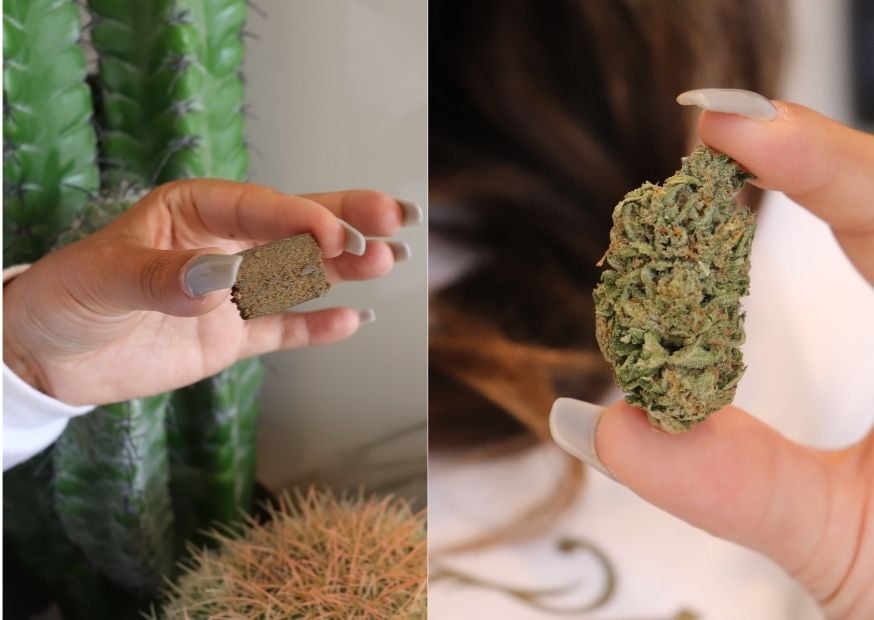
On the left, you can see a block of hash, and on the right a weed bud! Image: DutchReview
Maybe you’ve heard someone say before that they prefer smoking hash over weed because it gives them a more stable high. But what is the difference, exactly?
In essence, what is commonly referred to as weed is the dried cannabis plant, cultivated mainly from flowering buds. Weed is the green, marijuana bud that you grind up and the roll in your joint.
Hash, on the other hand, is a concentrated paste made from the resin and sap of the plant. It usually comes pressed in small bricks and can be smoked crumbled in a joint or pipe.
For both substances, the effects really depend on the strain that you chose. Generally, hash is considered to be stronger than weed. Ask your budtender!
Indica versus Sativa
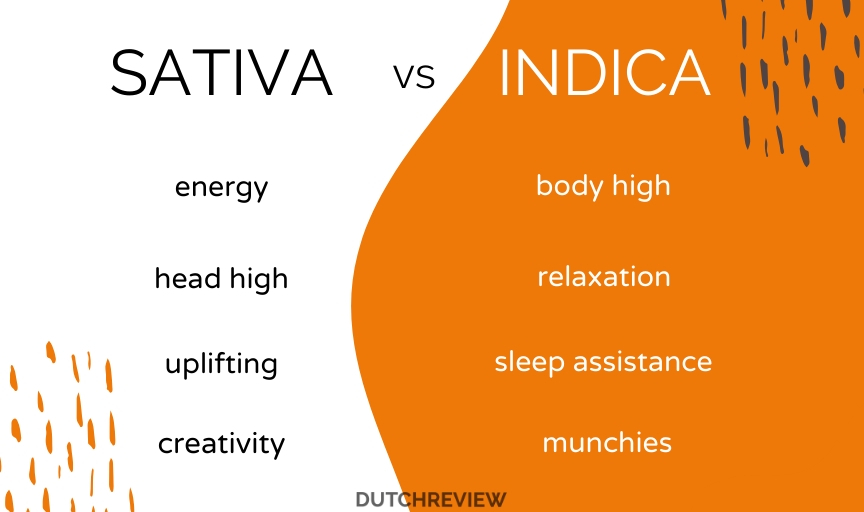
Choose Sativa if you want good chats and energy, chose Indica if you want some rest and relaxation. Graph: DutchReview
Here’s the most basic distinction between cannabis strains that you should know about: Indica and Sativa.
Both are subspecies of cannabis, just like apples and pears are both fruit but with very different tastes. Regarding Indica and Sativa, the difference lies within the varying effects both of them have.
On the most basic level, Indica will provide you with more of a body-high that is calming and level. Sativa, on the other hand, produces more of an active head-high that will have your thoughts run wild and offer you an energy boost.
THC versus CBD
Only a few drops of CBD oil before bed can potentially help with sleep or aid with stress. Image: Depositphotos
Let’s put our crazy scientist glasses on for a second and think about what actually makes us high when smoking the holy greens. In essence, it’s the thousands of chemical components found in the cannabis plant, called cannabinoids, that bind to receptors in the brain.
THC (tetrahydrocannabinol) and CBD (cannabidiol) are the most common cannabinoids found in the cannabis plant.
THC is the stuff that makes us high and produces a psychoactive effect. (Do you see the pink elephants, too??). CBD, on the other hand, does not produce a head high but is known for its positive effects on the body.
This cannabinoid is hailed as a miracle worker for pain relief, easing mental stress and assisting sleep. When visiting an Amsterdam coffeeshop, you can ask to have a joint that is high in CBD if you want to have more relaxing effects.
Tip: Discover the world of CBD If you’ve never visited an Amsterdam coffeeshop or smoked wee before, it might be a good idea to start with CBD as opposed to THC. A pure CBD joint will help you ease into the process of smoking, without stripping you of the coffeeshop experience.
Edibles — yay or nay?
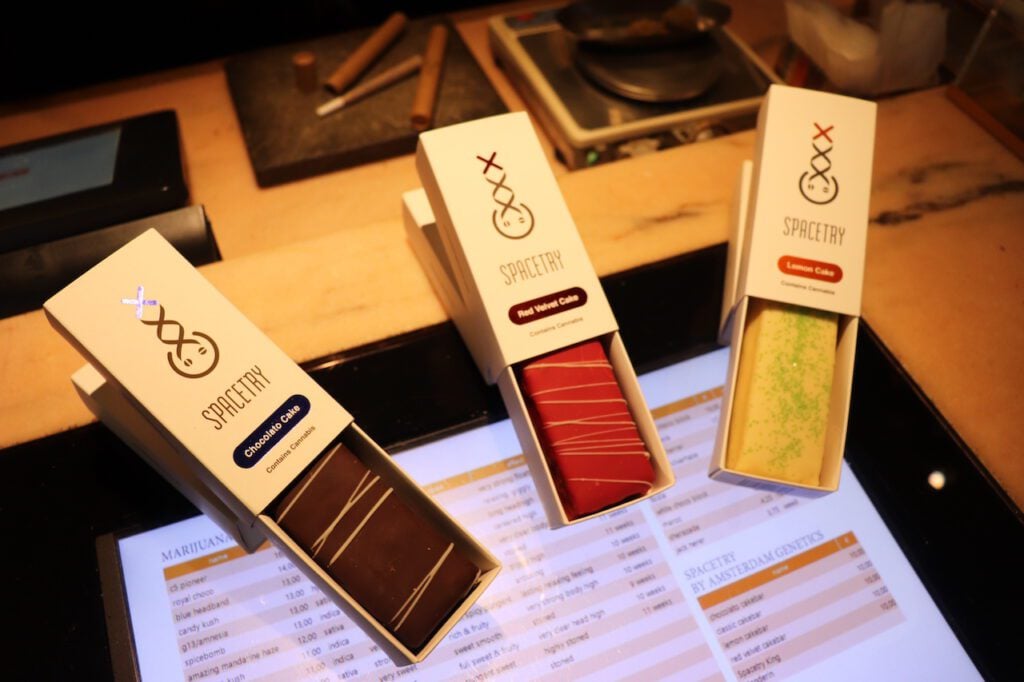
Look at the glorious space-tries (like pastries 😉) from the Tweede Kamer Coffeeshop! Image: DutchReview
If you don’t like smoking (or just have a sweet tooth) and still want to get high in Amsterdam, you might want to try an edible.
Edibles are weed-infused, mostly sweet, food items such as cakes, cookies or gummy bears that will get you high just like a joint does.
However, because you’re ingesting the THC instead of taking it in through your mouth and lungs, it will take a little longer for you to feel the high from an edible. In fact, it can take up to 20 minutes or even two hours for your body to absorb the THC contained in a weed brownie or space cake.
Because of this, it’s especially important to resist the urge to eat more. For beginners, ask your budtender how much you’re supposed to be eating at a time. Edibles tend to be quite strong, so the answer might be just a quarter of a brownie.
So there you have it, everything you need to know about visiting a coffee shop in the Netherlands. Go and enjoy the experience but just don’t make the rookie error of falling asleep. You don’t want to be the tourist that ends up slumped in the corner after one puff.
Have we missed any tips or tricks that first-time visitors of Amsterdam coffeeshops just have to know? Tell us in the comments!
Editor’s Note: This article was originally published in October 2018, and was fully updated in August 2023 for your reading pleasure.
From the best Amsterdam universities to the costs of living, to the best places to party (uh, I mean, study) — this guide to studying in Amsterdam has everything you need to know. 🧑🎓
Amsterdam might be small, but the academic offer is truly spectacular. The city hosts two world-class universities and 29 other higher education schools. Check ‘em out! 👇🏻
Looking for a shortcut? Jump to a section below! 🤓
Your first question when it comes to studying in Amsterdam is probably: where? You know the Amsterdam part, but now you need to find, apply for, and go to a school.
Here are the top picks — but first, a quick lesson on the types of higher education in Amsterdam and the Netherlands.
Types of higher education in Amsterdam
In the Netherlands, bachelor studies come in two different forms:HBO (hoger beroepsonderwijs) and WO (wetenschappelijk onderwijs).
HBO degrees are offered at so-called universities of applied sciences (hogescholen). Here, students study for four years with an emphasis on hands-on learning.
WO degrees, on the other hand, are offered by universities. Generally, a WO degree is about three years long. The intensity of education is a little higher and, in general, more ‘academic’ than professionally-oriented.
You can obtain a master’s or PhD with both HBO and WO degrees.
That’s a whole world of possibilities opening up from neuroscience to politics to law. 🧑🎓 Lekker, zeg! (Nice, right?)
Vrije Universiteit Amsterdam
One of the main buildings of the Vrije Universiteit in Amsterdam. Image: Depositphotos
Next up as one of the best universities to study in Amsterdam, is the second most popular choice: the Vrije Universiteit (VU).
VU might rank a little lower in the 2024 QS University ranking — #207 out of #1500 — but the university is known for its broad offering of English-taught programmes and diverse, international atmosphere.
The VU has a more centralised campus in the south of Amsterdam, which has the added benefit that you don’t have to push (or kick) tourists out of the way when you’re running from one university building to the next. 😅
Fun fact: The VU was founded in 1880 to create a university free from the influence of state and church! To this day, the university does not accept money from the Dutch government. Radical!
Hogeschool van Amsterdam
Want to work next to your studies and develop yourself professionally? Maybe a degree at the HvA is just right for you! Image: Depositphotos
The Hogeschool van Amsterdam (HvA) is not a university but one of the hogescholen (universities of applied sciences) in the Netherlands.
At a hogeschool, students are educated according to the skills they will need later in their professional life.
For example, some of HvA’s dual-bachelor programs mean that you alternate between studying in the classroom and working in the field.
HvA also offers additional training and diplomas for already working professionals.
Let op: The HvA was founded in 1993 (30 years ago, whoop! 🎉) and has since made efforts to expand on their international programmes. However, most of them are still exclusively in Dutch, so check their English-taught courses carefully before applying!
Amsterdam University College
Take your pick of world-class universities in Amsterdam. Image: Freepik
Good news for internationals — the Amsterdam University College (AUC) offers education entirely in English! Despite the ‘university’ in the name, AUC is also a hogeschool specialising in the liberal arts and sciences.
At AUC, you can acquire only one type of degree: a bachelor’s in the liberal arts and sciences. To tailor your programme to your academic interests, you can choose between three different majors — humanities, social sciences, and natural sciences.
The AUC is special because they only admit 300 students each academic year; that’s 100 available spots for each major. You’re also required to live on their premises until your degree is complete!
You should know: the AUC has higher tuition fees than other universities on this list. If you wish to study here, expect to pay about twice the cost of other Amsterdam universities. 😬
Other universities in Amsterdam
While the four universities and hogeschool listed above represent the most popular choices for students, studying in Amsterdam has a lot more to offer.
There are heaps of choices when studying in Amsterdam. Image: Unsplash
Are you interested in studying fashion, for example? Or art? Or film? Amsterdam is a hub for budding artists and creatives. 🎨
Or do you want to become a businessperson — all suit and tie? There’s an Amsterdam school for that, from hotel management to economics to business! 👇🏻
Gerrit Rietveld Academie, this edgy art school has everything from fine arts to fashion and architecture.
AMFI is the largest fashion institute in the Netherlands.
Amsterdamse Hogeschool for the Kunsten gives true Juilliard-vibes. Here, students can study the arts at six different academies: theatre, dance, film, music, architecture and art.
Nyenrode Business School is the only private university in the Netherlands and is very prestigious. Future CEOs, bankers, and entrepreneurs come to study here.
Student life is infamous for being a time of financial insecurity.
Pair that with living and studying in Amsterdam, one of the most expensive cities in Europe, and you’ve discovered the main downside of studying in the Dutch capital: it ain’t cheap. 👋💸
Tuition fees in Amsterdam
Let’s start with the good news: tuition fees are not all that high in the Netherlands, particularly when compared to the UK or the US.
Of course, in comparison to other Northern European countries like Germany, Denmark, or Sweden, you’ll need to be ready to pay up.
Tuition fees to study in Amsterdam can be surprisingly affordable — or expensive — depending on your home country. Image: Freepik
Keep in mind that tuition is subsidised for students from EU countries and Switzerland, which makes tuition costs cheaper. If you don’t have a passport for one of these countries, you’ll need to pay the non-EU rate.
To give you a rough idea, here is what you’re looking at for a bachelor’s degree beginning in 2023:
Generally, high-profile programmes such as medicine or dentistry come with a higher price tag. 🧑⚕️But these are often only taught in Dutch anyways.
To do a master’s in Amsterdam, expect to pay an average tuition fee of around €2,000 per year as an EU student. As a non-EU student tuition fees can range from anywhere between €10,000 to or up to €50,000 per year.
Good to know: a secondbachelor’s degree in the Netherlands as an EU student will cost you significantly more than your first one. Only your first degree is subsidised by the government. If you’re considering a second degree, you can expect to pay about four times as much — so, choose wisely!
Cost of living in Amsterdam
Look, it’s you wistfully staring at the Amsterdam houses you’d love to live in, but can’t afford. 😅 Image: Depositphotos
From groceries to housing to eating out — the Dutch capital ranks among the top 50 most expensive cities in the world, so you can expect to spend a good amount of cash on day-to-day expenses when studying in Amsterdam.
The Amsterdam housing market, in particular, is (in)famous for its impossible prices. Sky-high demand, cartelisation, and privatisation of property have escalated into an ongoing housing crisis for Amsterdammers.
Especially Amsterdam students looking to find an affordable room (don’t even think about an apartment unless daddy is paying for it) are vulnerable to the drastic price hikes.
For a single room in a shared flat, you’re looking to pay anything from €400 (very unlikely) to €1200. Most student rooms range between €600 to €800 per month and up. 📈
Student rooms in the Netherlands are pretty basic and very expensive. Image: Pexels
What about eating out? Let’s say, you want to treat yourselves to some deliciously brothy ramen with your study friends. You also want to cheers with some sake and share a starter.
If you’re generous and give your waiter a small tip, you’ll realistically end up paying anywhere between €25 to €30 for a good night of eating out.
Lastly, maybe most importantly, what about beer? Well, here’s the good news! Beer isn’t all that expensive in the Netherlands. 🍻
You shouldn’t be paying more than €3 for a good, ol’ Amsterdam brew (think: Heineken) or €6 for a craft beer. If it’s any more than that, say “doei”. You’ve stumbled into a tourist trap — get outta there! 🏃♂️
Here’s a rough estimate of the costs you can expect when studying in Amsterdam:
Expense
Price in €
Student room in Amsterdam (including gas, water, electricity)
€550-800
Dutch sim card with 10 GB of data
€15-40
Secondhand bike (basic)
€70-120
30-minute+ intercity train ride
€6-8
Week of groceries
€45-70
Cappuccino (regular)
€3.50-4.50
Cheap restaurant meal
€16-25
Crate of beer
€13-18
Loaf of bread (half to whole)
€0.70-3
Pasta (500 gr)
€0.90-1.50
Chicken fillets (300 gr, not organic)
€2.99-4.50
Cheese (10 to 14 slices)
€2.50-4.50
Forming life-long friendships over beer and bitterballen. The Dutch way! Image: Depositphotos
Financing your study in Amsterdam
We’ve hammered the point home that the cost of living in Amsterdam is high — so what are some options to pay your tuition, and still, you know, eat?
There are three main ways to finance your study at an Amsterdam university:
Self-funding
Scholarships
Governmental aid
Assuming your parents, let alone you, don’t have that extra cash to fund all of your housing and living expenses in the big city, let’s talk governmental aid and scholarships.
Governmental aid
The financial support for students in Amsterdam supplied by the Dutch government is called Studiefinanciering (student financing).
This four-component financial aid package for students includes a regular loan, a student travel product, a supplementary grant, and a tuition fee loan.
Naturally, governmental aid is a popular option. However, you can only access government study aid if you are a student with an EU, EEA, or Swiss passport.
For more of an overview, there is this useful tool that lets you see what scholarships are on offer to support you through your respective study programme.
Financial support for merit, minority groups, non-European partner countries, crisis regions, or specific disciplines is also available.
Below are a few examples of scholarships offered by Dutch institutions — but there are plenty more once you really start searching. 👇🏻
This scholarship is for international students from outside the EEA (European Economic Area). Successful applicants will receive €5,000 during the first year of study.
The OKP supports citizens of a select number of ‘third world’ countries to follow courses in the broader field of development studies in the Netherlands.
The OTS is offered by many universities in the Netherlands. It’s aimed at aspiring students from the following countries: China, India, Indonesia, South Africa, Korea, Russia and Vietnam. The offer varies depending on the university of your choice.
How to save money when studying in Amsterdam
You’ll soon notice that the minute you step foot to study in Amsterdam, money is magically and irreversibly flowing out of your bank account.
Luckily, there are some tips and tricks to save money when studying in Amsterdam:
✅ Get yourself an OV chip card. This magic public transport pass can get you anywhere and everywhere in the Netherlands. As an Amsterdam student, there are special deals you can take advantage of.
✅ Consider living in adjacent cities or towns. This is much more common than you might think. Diemen and Amstelveen are especially close by. They may not be as pretty as Amsterdam, but they are much cheaper! If you’re willing to commute, you can also have a look at Haarlem, Almere, or Hilversum.
✅ Choose your Dutch grocery store wisely. You’ll find that some chains are significantly more expensive than others. On the cheaper end of the spectrum, there is Deen, Lidl, Vormaar, and Dirk. On the more expensive end, you can find Jumbo, Albert Heijn, Ekoplaza, and Marqt.
✅ Explore some of Amsterdam’s many markets! You can find affordable local fruits, vegetables, cheeses and meats here. An added plus: it’s the perfect moment to practice your budding Nederlands. 🇳🇱😉
✅ Get to know Tikkie etiquette as fast as possible. Tikkie is a Dutch app that allows you to send payment links to your friends. In the Netherlands, it’s completely normal if you send Tikkies for the most minuscule amounts. Charming? Not so much. Good for people with tight student budgets? Absolutely!
✅ Get a museum card! With this magical card, you can visit about 45 museums all over the country for a year. If you’re over 18 you can buy a card for €64.90. This might seem expensive but if you want to visit the Van Gogh, Stedelijk, and the Rijksmuseum, you’ve already earned it all back.
🪴 How to find student housing in Amsterdam
Studying in Amsterdam often means living with a variety of housemates. Image: Pexels
Housing is a major issue for people studying in Amsterdam. Especially internationals who believe they’ll be staring dreamily out of the window of their grachtenhuis (canal house) will face a rude awakening.
The only way you’ll get that picturesque canal house is if you have a strong network built up around the city. (Or, if you have really rich parents. 💸)
But luckily, there are some tips and tricks when taking on the relentless Amsterdam housing market that might give you just the tiniest head start.
University accommodation in Amsterdam
Depending on which university in Amsterdam you’ll be attending, you’ll be provided with different types of university accommodation. 🎓
Incoming first-year international students
Good news! Most universities in Amsterdam provide international students with affordable housing for their first year of study.
And the bad news? (Come on, you knew there’d be a catch. 🎣) Spaces in these programs are super limited. If you’re too late with your application, you’re left to look for housing on your own.
Believe it or not, these containers are a way of fighting the housing issues in Amsterdam. Image: Depositphotos
For these designated first-year rooms, Dutch universities typically work together with social housing agencies. In Amsterdam, you’ve got De Key and DUWO as the two main players distributing a pre-allocated number of affordable apartments, rooms, and studios to students.
This process happens automatically. If you’ve enrolled early enough, your university in Amsterdam will provide you with a couple of options — and you can take your pick!
Student housing websites in Amsterdam
If you’re not among these lucky first-years, an international or you want to find affordable housing in Amsterdam for your second year at university, don’t fret! You can still access De Key or DUWO housing.
There are special websites where you can sign up to access their service. The most important one for Amsterdam is Studentenwoningweb.nl.
The second most popular option is ROOM.nl, which provides social and student housing in Amsterdam and other Dutch cities. We recommend signing up for both websites to double your chances.
How does it work?
To start, there is a registration fee of roughly €20, but your registration is subsequently valid for 10 years. Your place on the waiting list is determined by how long you’ve been registered on the website. So, sign up as early as possible.
Now, here comes the discouraging bit: it is very unlikely that you will score any housing through studentenwoningweb.nl unless you’ve been signed up for three to four years at the very minimum. Many Dutch parents will sign up their children as soon as they turn 16 when you can first enrol.
Private accommodation in Amsterdam
Didn’t manage to secure university accommodation? Don’t worry! Most internationals will have to fend off the Amsterdam housing market on their own sooner or later, especially after their first year of study.
There are three main ways to find private accommodation when studying in Amsterdam: Facebook groups, housing websites and student hotels. Here are the top ports of call for either category.
Finding housing through a Facebook group is probably the most common option if you’re new in Amsterdam and looking for housing on your own. These are some good (and mostly spam-free) groups to get you started:
With Facebook, you’ll notice that many posts will lead with ‘NO INTERNATIONALS’ or ‘DUTCH ONLY’, immediately singling you out as the least attractive applicant in all of the world wide web. 😭
Our advice? Don’t apply: they’re not the kind of people you want to live with anyway. Of course, what better reason to learn Dutch than to increase your chances on the Amsterdam housing market (just ever so slightly).
Got an invite for a viewing? You might just stumble into what the Dutch call a hospiteeravond. (Or ‘hospi’, for short.) This cultural phenomenon is a reflection of the high demand placed on the Amsterdam housing market.
Basically, you’ll be invited to a house/room viewing with three to 25 (yup) other successful applicants. There might be snacks, drinks and a casual introduction — but don’t be fooled! A hospiteeravond is essentially a casting in disguise for the perfect roommate.
So, be on your best behaviour and bring the most delicious snacks. You might just be meeting your future huisgenoten (roommates) that you’ll study with in Amsterdam. 👯
Housing agencies in Amsterdam
If you’re tired of applying for one room after another through Facebook, you can also try searching for a rental through these housing websites:
Kamernet.nl is a website where students in Amsterdam and the Netherlands can find or list their available rooms, apartments or studios. A small application fee is required to respond and apply to offers.
Pararius.com is the largest rental property website in the Netherlands, where you can find empty apartments and houses. Have a friend you’d like to move in with? Maybe you’ll get lucky here!
Funda.nl also lists an extensive range of long-term and short-term properties. Their multiple settings make finding something in your desired price and size range especially easy.
Student hotels in Amsterdam
These hybrid concepts combine student housing, hotels and independent rentals all in one.
The rooms and studios you can find here are on the pricier side, but they often come with fun facilities such as gyms, laundry services or office spaces.
The Student Hotel is somewhat of a mix between student and private accommodation. If you’re well off, you can book yourself into one of their luxurious apartment complexes in the centre and west of Amsterdam — gym, laundry service, and security guards included!
Hotel Janssen operates on a similar premise and offers long-term rooms for students in an industrial, up-and-coming hotel complex. Rooms are in the upper price range, between €800 to €900 a month.
Student Experience has four different buildings in Amsterdam, where you can rent independent studios on a long-term or short-term contract.
Hopefully, these options will give you a good starting point that will end with your own set of keys to a room in Amsterdam. 🔑
What to do if you can’t find a place to live in Amsterdam
Here comes the absolute worst-case scenario: you arrive in Amsterdam, but you can’t find an adequate place to live before the beginning of your studies. This can be incredibly stressful and it happens more often than you might think.
Of course, if you follow the tips above, your chances of ending up in this situation are greatly reduced! But, just in case, here are some tips on what to do if you’re about to start your studies in Amsterdam but don’t have a place to live yet:
Rent an Airbnb for a month so you can search on the ground. It’s not ideal, but long-term Airbnb’s are available in Amsterdam and they give you some space to breathe before running head-first into another housing search.
Book a hotel room. Similar to renting an Airbnb, but more costly, is the option to book yourself into a hotel room in Amsterdam for the time being.
Consider studying remotely while continuing your search. Especially after the coronavirus pandemic, universities in the Netherlands have made online teaching a routine practice. Reach out to your professors and programme coordinators to explain your situation and ask if you can study online until you find housing in Amsterdam.
Look for housesitting opportunities in Amsterdam. This might be a good opportunity if your budget is a bit tighter — and if you like pets! Often, housesitting opportunities present themselves when their owners are away for a few weeks and are looking for someone who can take care of their furry friends. We’d love it!
Ask your university for help. Universities in Amsterdam are well aware of the housing problem students face. And while they are a lot of times ill-equipped to deal with it, remember that your university in Amsterdam is responsible for you. So, don’t hesitate to contact the housing office or study advisor and ask for the help you deserve!
Best areas for students to live in Amsterdam
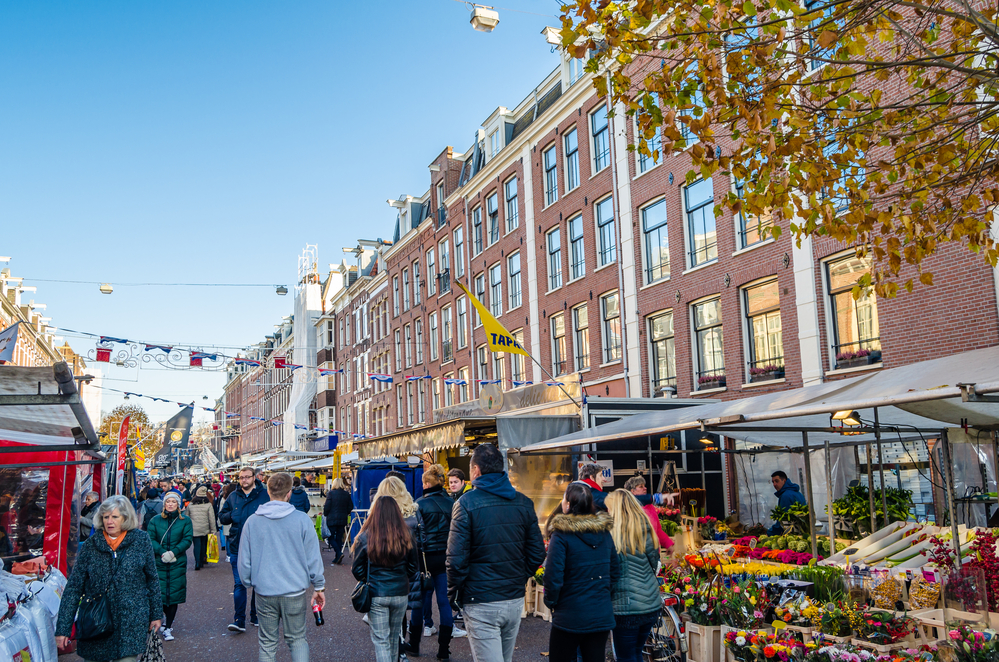
Do we see you already strolling across the Albert Cuyp market in De Pijp? Image: Depositphotos
In Amsterdam, some areas are more popular with students than others. Mostly because of affordability, you’ll find us youngsters clumping together in some Amsterdam neighbourhoods more than others.
De Pijp is certainly one of the most sought-after neighbourhoods for students in Amsterdam. The former workers’ quarter is now bustling with life, bars, cafés, and independent shops. However, gentrification is steadily creeping up the prices!
Amsterdam-Noord is definitely up-and-coming. Formerly a port and industrial area, the neighbourhood has a unique, rustic charm. To get to the city centre, you have to take the free ferry across the IJ, which is a must anyway to get a full taste of the Amsterdam experience.
Amsterdam-Noord has turned industrial zoning into some of the coolest areas in the city. Image: Depositphotos
Amsterdam-West, especially Nieuw-West, has some of the cheapest housing options in the city. The more you go westwards, the more you’ll find that brutalist, modern architecture replaces the Amsterdam canal houses. Not very pretty, but it brings down housing prices.
Some of these neighbourhoods are a little further away from the centre. For example, Diemen is technically an independent municipality.But hop on a bike, and you’re at Dam Square in no more than 30 minutes. 🚲
Tips for finding student housing in Amsterdam
To wrap it up nicely, we have compiled the ultimate list of top tips to find student housing in Amsterdam and ease your journey as much as possible:
✅ Start your housing search early. Thinking of starting your studies in Amsterdam next year or any year? Sign up for international student housing now.
✅ Be aware of registration rules in Amsterdam. Generally, only two tenants can legally register on one property. Found a room in an apartment with six others? Make sure you can legally register, otherwise your living situation isn’t valid and you might want to look for another place.
✅ Don’t fall for scammers in Facebook groups! If a room seems too good to be true (think: ridiculously spacious, less than €600, utilities included), it probably is.
✅ Move quickly. Did you get invited to a viewing and have an opportunity to move in? Dig your nails in as soon as you can! There are probably 30 people waiting in line behind you.
✅ Build a strong network. To be honest, your best shot for a nice room is getting it through someone you know. The best deals circulate secretly in the tightly-knit Amsterdam community. So, be nice to everyone you meet! You never know whose roommate is moving out next. 😉
👨🏻🍳 Student jobs in Amsterdam
Well, you’ve got a place to stay, and now you’ll somehow have to pay for it. Luckily, getting a student job in Amsterdam is far less difficult than finding a place to stay.
Even if you’ve never worked a day in your life, the hustle and bustle of the capital city ensures that people are always needed in the service, retail and tourism sectors.
Working in the hospitality sector is very common for Amsterdam students. Image: Freepik
An added plus is that most employers are absolutely fine with you speaking English. The city is so international that no one will bat an eye.
So, to start you off, we’ve compiled a list of popular employment choices for students in Amsterdam. Let’s go!
HORECA (Hospitality)
HORECA in the Netherlands stands for hotel, restaurant and café. Here, you have tons of options.
Just take a stroll through the city and peek into the next bar window. Are they looking for people? Or maybe your favourite café has posted a job opening on Instagram. 😉
Bike courier
From food to grocery delivery, the demand for bicycle couriers is huge — and it’s the perfect flexible job when studying in Amsterdam.
This student is cycling your groceries across town to finance her studies. Image: Depositphotos
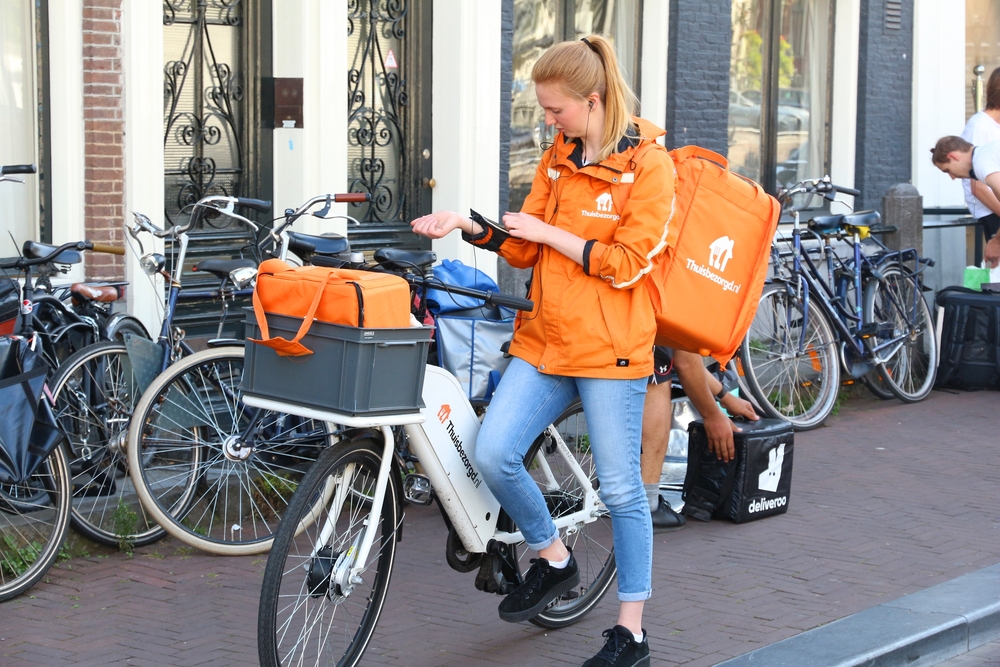
Don’t mind cycling for a couple of hours a day and delivering food you can’t eat?From Uber to Thuisbezorgd to Flink — one of these is surely looking to hook you up with a contract before you can say fiets.
Call centres
Another student-job classic: call centres. We’ve got them too here in Amsterdam, and they’re always looking for internationals that speak more than one language.Spanish, French, and German are in particularly high demand to serve customers worldwide.
Retail
There are thousands of stores in Amsterdam willing to offer flexible student jobs. From Rituals to Zara to H&M and Hunkemöller, there are so many shops you can just take your pick — even if you don’t speak Dutch!
Of course, there are many more options for student jobs. To find exactly what you’re looking for, you can browse these websites that list available job openings in Amsterdam:
Most employers will offer students zero-hour contracts. This way, you’re not required to work any amount of hours per week. On the flip side, your employer is not required to schedule any work time for you either.
These contracts ensure that you can remain flexible and plan your work around your dedicated study time or exams.
🍺 Student life in Amsterdam
Now, let’s get to the good stuff. Why does a post-study beer just taste so absolutely delicious sitting at an Amsterdam canal-side? 🍻
As a student, Amsterdam has all you could wish for. There is always something to do, see, and people to meet.
At the same time, Amsterdam is not your typical, inconceivably large capital city. They call it the ‘global village’ for a reason. 🏡
Amsterdam is highly diverse and exciting, but also small and cosy at the same time. You can feel at home without feeling lost.
This is a university building of the UvA. You could study here! Image: Depositphotos
Best study spots in Amsterdam
Let’s talk study spots in Amsterdam. Depending on the school you’ll attend, you’ll have access to university buildings and libraries.
Another option is to study in cafés or public spaces with a stable wifi connection. You’ll soon find out which sort of environment you prefer. Do you like the chatty background noise of a full café? Or the silent rustling of student-packed libraries? 📚
Cafes are a great place to soak up that Amsterdam atmosphere while #GettingStuffDone. Image: Freepik
University libraries in Amsterdam
If you’re studying in Amsterdam, these are some places you’ll spend a lot of time at:
While these are UvA and VU buildings, students of the different hogescholen in Amsterdam generally have access to these buildings too. All you need is a student card — prima (perfect)!
Not a university library but a stunning spot to catch up on some studying in Amsterdam nonetheless: The Rijksmuseum Research Library. Image: Depositphotos
Nice cafés to study at in Amsterdam
If you have a little extra money on your hands, you can also buy yourself a couple of hours in a nice café. Order a fresh mint tea or cappuccino, and you can sit undisturbed to do your readings.
These are just some (of many) cafés with good desk space, plugs and music choices when studying in Amsterdam:
The Volkshotelhas a dedicated working place (werkplaats) that is spacious, plant-filled and a hub during exam times when university libraries are full to the brim.
The Rijksmuseum Research Library has a dedicated study room and you can reserve a spot for free on their website. The place is absolutely stunning and really has that old-academia feel to it.
Espresso Yourselfis a Muslim woman-owned business in the West of Amsterdam. There are dedicated places for you to work which you can ‘rent’ for a small fee. Added plus: the coffees taste amazing!
Coffee Company, a chain cafe, is a popular choice for Amsterdam students. Yes, the coffee and beverages are expensive, but plugs are everywhere, and no one bothers you to give up your seat.
Café de Jaren is famous for having authors writing their books in the spacious salon. So, you might as well join in and brood over your paper. It’s a beautiful place with a lot of natural light.
Looking for more caffeinated study spots in Amsterdam? Don’t fret; there are quite literally hundreds of them. Just pop into any café you might fancy and ask if it’s okay for you to work there. 🧑💻
Best places to eat and drink on a student budget in Amsterdam
Want to enjoy student life in Amsterdam to the fullest and watch your budget at the same time? Don’t worry at all! There are plenty of places with student-friendly spaces where you can grab a snack and have a biertje all day round:
One of the most difficult Dutch decisions to take at 1 AM at a FEBO— kaaskroket or bitterballen? Image: Depositphotos
‘Skek is a funky, student-run place right in the centre of Amsterdam. The bar-slash-restaurant has a creative, seasonal menu with prices staying below the €10 mark. And you always meet fun people here too!
Kriterion is a cinema and eetcafé (eatery). You should definitely go for Taco Tuesdays or tune in for one of their arthouse films!
De Engelbewaarder is a popular Amsterdam student bar with a really nice terrace next to the canalside. It’s always full, especially when it’s sunny out, and is a focal point of student life.
Taste before you waste is a foundation that aims to prevent food waste in Amsterdam. Each Wednesday, there is a 100% free dinner cooked with foodstuffs that would have otherwise been wasted. Donations are very welcome, of course.
FEBO is a snackbar chain that has a special place in most Dutchies’ hearts. Chances are, you’ll end up in a FEBO at some point during your Amsterdam study career. Most likely slightly intoxicated and at an unreasonably early hour. 😉
Good to know: The Dutch go about studying in a classic “work hard, play hard” fashion. There is even an expression for that: the 6.5-culture.
Remember, the Dutch grade on a scale from 1-10 and a 6.5 is just about a pass. To the Dutch, that’s all that matters! Not only does this mindset get rid of unnecessary stress, but it also leaves a lot of room for partying and grabbing drinks with friends. 💃
🗺 Going on student exchange in Amsterdam
If you’re not quite willing to take the step and move to Amsterdam full-time, you can always study in Amsterdam for a semester or two on exchange. There are different ways to do that.
Erasmus+ exchange
If you’re a student based in the EU or EEA, you can participate in an Erasmus+ exchange. Every European citizen can spend up to 12 months abroad at another Erasmus+ university, which means you can benefit from the programme multiple times! 🇪🇺
Global Exchange Programmes
There are also global exchange programmes, whereby your home university creates individual learning agreements with other universities outside of Europe. Generally, you will continue to pay the tuition fee of your home university whilst spending your semester abroad.
A study exchange in Amsterdam means friends, beer, sightseeing, biking, and maybe a bit of studying. Image: Freepik
Check with your study advisor to see whether they have any existing agreements with an Amsterdam university. Sometimes, exchanges like this can also be organised independently, as long as you can justify why the courses you could take in Amsterdam suit your particular degree programme.
Joint-degree or double-degree programmes
Another option concerns so-called joint-degree programmes or double-degree programmes. Usually, these are master’s programmes, where you’ll spend one year each at one or several different universities.
You’ll study a single subject at two different universities with a joint-degree programme. On the other hand, a double-degree programme allows you to obtain two degrees at once in the same time of studying.
Summer school
If you just want to get a small and condensed taste of Amsterdam student life (and you like to study a lot), summer school might be a good option for you.
Universities across the city offer week-long academic programmes over the summer period. The price tag tends to be in the higher range, but usually, accommodation is provided for you (which is a huge plus, as we have learned.)
Use this tool to see which summer courses are offered this year. ☀️
Amsterdam in the summer means hanging out in the park and dangling your feet in (gross) canal waters. Image: Depositphotos
❗️ Important things to know and do before studying in Amsterdam
Okay, ready for the ultimate checklist you should tick off before coming to study in Amsterdam? Here it goes:
✅ Make sure to apply to student housing as early as possible. Otherwise, you might just miss out on university housing!
✅ If you’re from outside the EU/EEA, ensure you have the appropriate visa and resident permit. (More on this below. 👇🏻)
✅ You’ll need to register with the municipality of Amsterdam within five days of arriving in the Netherlands. To avoid missing this in the chaos of your arrival, we advise you to make an appointment in advance.
✅ If you want to work alongside your studies, you’ll have to get Dutch health insurance.
✅ Check if your university has welcoming days for international students. Usually, there are systems in place to organise your pick up from the airport, hand over the keys to your student accommodation and just generally ensure your arrival is as comfortable as possible. 🤗
⚖️ Pros and cons of studying in Amsterdam
Phew, if you’ve made it this far, your head is probably spinning with all the information we’ve thrown at you above. 😵💫
Here is a short and sweet overview of all the benefits and disadvantages of studying in Amsterdam that we’ve discussed thus far. 👇🏻
Pros of studying in Amsterdam
The Dutch capital combines the feel of a vibrant metropolis with cosy small-town vibes. What’s not to love!
From art to fashion to business to the sciences — the vast number of universities and hogescholen in Amsterdam will ensure that everybody can follow their interests.
It’s expensive! We’ve hammered this point home already, but you can expect to spend more than in other cities due to the overall high costs of living. (Although, at least the beer is cheap!)
The housing market is an absolute nightmare. Finding good, adequate and legal housing requires energy, money and quite a bit of luck.
It takes a while to get to know the Dutch. Amsterdammers are so used to having internationals come and go that they can be a hard social circle to break into.
The nightlife in Amsterdam is also amazing! This is Club Melkweg. Image: Depositphotos
📆 The Dutch academic calendar
In the Netherlands, the academic year is divided into two semesters.
Winter semester: starts on the first Monday of September.
Summer semester: starts on the first Monday of February.
Most degrees start in the winter semester, but some programmes also offer students to start in the summer.
Regarding holidays and breaks, there are slight variations between different institutions. Generally, you can expect to have a free week over the Christmas period and sometime around Easter.
There are also various Dutch national holidays scattered over the year that might get you a day off your study desk every now and then.
🛂 Student visas to study in Amsterdam
Coming in from outside the EU to study in the lovely city of Amsterdam? You’ll need a visa! 👇🏻
EU/EEA citizens
If you’re an EU, EEA, or Swiss citizen and want to study in Amsterdam, you don’t have to worry about getting a visa. The only important thing is to register at a Dutch address. Otherwise, you won’t be able to study here legally.
Non-EU citizens:
If you’re not from the EU, EEA, or Switzerland and want to stay in the Netherlands for longer than 90 days, you’ll have to get a visa.
There are two possible types of visas required: an MVV and a VVR.
Entry visa (MVV)
Only some nationalities will have to apply for the MVV to enter the Netherlands. This is the case if you areNOT from any of the following countries: EU/EEA, Australia, New Zealand, Canada, Japan, Monaco, Vatican City, USA, and South Korea.
If your country is not on this list, you’ll have to apply for the MVV at the Dutch Immigration and Naturalisation Service (IND). To do so, you’ll have to be enrolled in your study programme first.
Luckily, most Dutch higher education institutions have systems in place that will apply to the MVV (if you need it) and the resident permit on your behalf.
Yes, there will be paperwork — but it will be worth it. Image: Depositphotos
Residence permit (VVR)
The second, and more important, one is a residence permit (VVR). This will allow you to stay in the country for the entirety of your studies.
Generally, this application process takes place online through your university. Most likely, you’ll have to submit several documents such as:
A copy of your passport,
An antecedents statement (e.g. a document stating whether or not you have a criminal record),
Proof of financial means,
A tuberculosis statement.
Your university will then send over the documents to the Dutch Immigration and Naturalisation Service (IND).
Here are a couple of other important details to keep in mind when applying for a student visa:
✅ You need to be conditionally enrolled in a study programme at an Amsterdam university to start the process of applying for your visas
✅ Getting your visa approved may take months, so it’s important to apply early to your desired university. Generally, you should aim to apply about four months in advance.
✅ There is a fee ofbetween €200 to €300 for your visa application.
✅ You’ll need to obtain at least 50% of your required credits (study points) per semester to keep your visa. Your university will keep track of that. If you don’t study hard enough, you might just lose your right to live in the Netherlands. (How about that for motivation. 😉)
Are you still intimidated by the whole process? Watch this short, digestible video by the VU, and you’ll see it’s not that complicated after all. 👇🏻
Wow, you’ve made it all the way to the end! Whether you’re considering, applying, or dreaming of studying at a university in Amsterdam — you’ve already got all the info you need to pursue higher education in the Netherlands.
Do you have any other questions about studying in Amsterdam, or would you like to add any details that we’ve missed? Let us know in the comments!
Editor’s Note: This article was originally published in April 2022, and was fully updated in August 2023 for your reading pleasure.
🙋♂️ Studying in Amsterdam: frequently asked questions
👌 Is Amsterdam a good place to study?
Amsterdam is a great place for students coming from abroad. The city has over 33 different higher education institutions. The University of Amsterdam (UvA) and the Vrije Universiteit (VU) consistently rank very high in global university rankings.
💸 How much does it cost to study in Amsterdam?
You’ll likely find that studying in Amsterdam is more expensive than in other cities. The cost of living and renting is especially high. A single student room will cost you anywhere between €450 to €800.
🌎 Is Amsterdam a good place for international students?
Amsterdam is an excellent place for international students. There is an exceptionally large offer of international programmes available
💶 Is it free to study in Amsterdam?
No, in the Netherlands, all higher education schools charge a fee for bachelor’s and master’s programmes. You can expect to pay between €2,000 to €4,000 per semester for any such degree.
💯 Is it hard to get into an Amsterdam university?
This will depend on the degree programme you choose. Some programmes are more competitive than others, such as medicine, dentistry, or veterinary sciences. Overall, universities in the Netherlands don’t have a reputation for competitive admission.
🤑 Is Amsterdam expensive for students?
Yes, Amsterdam is an expensive city to study in. The cost of living in the Netherlands is high. Housing prices are especially difficult for students to afford. On the flip side, it is easy for students to find part-time employment, and there are financial support schemes in place.
People peeing in the canal when drunk is something you might have the unfortunate luck of seeing in the Netherlands, but hearing an art piece pissing throughout the night has residents calling to hold the pee.
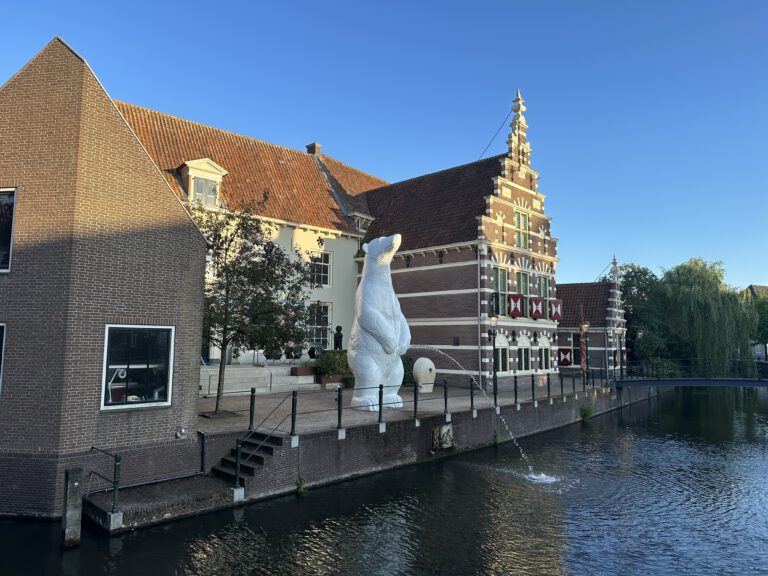
An art sculpture of a polar bear has been keeping residents in Amersfoort awake during the night with its constant… trickling into the canal, reports NOS.
Well, no more. The polar bear statue is being potty trained and will now have to hold his pee from midnight to 7 AM.
Who pissed in your cornflakes?
The artwork by Florentijn Hofman, also known for his giant rubber ducks, is called the ‘Pissing Polar Bear’.
The large statue of a polar bear, which can be seen from July 8 to November 19, urinates into the canal in Amersfoort every few minutes — even during the night.
While we all understand the pain of needing to piddle at night, these residents had enough.
“Residents woke up at night from all the peeing,” museum director Paul Baltusto explains to RTV Utrecht.
Imagine hearing water splashing into a canal throughout the night. Not only would it keep you up, but it would also make you need to pee when you’re cosy in bed.
Understandably, local residents have complained about the noise.
“It was the idea that the polar bear pees ‘uncontrolled’. In other words, we would not necessarily influence it. But now that local residents have indicated that it keeps them awake at night, we thought: let’s change it,” says Baltus.
That means that residents will get a break from the incessant peeing for seven hours while they sleep, but they’ll still have to hear it throughout the day.
What’s this polar bear all about?
The artwork is a part of the ‘Art and Zoo’ exhibit at the Museum Flehite. Hofman’s polar bear represents the current state of nature.
“[It’s] about melting ice caps, a nature that suffers, the habitat of polar bears, which is getting smaller and smaller,” says the director.
“This polar bear has chosen to show his displeasure. That’s why he pees so hard in our canal. Just as harshly as we sometimes treat nature.”
Have you seen the ‘Pissing Polar Bear’? Tell us about it in the comments!
Knocking them down and leaving them for dead — why are delivery drivers taking out their problems on poor, innocent packages?
A recent TikTok by Omroep Brabant has surfaced and left us gasping in horror while we clutch our delivery packages protectively.
That’s right — unearthed footage from people’s security cameras reveal sights such as a DHL delivery driver doing the unthinkable:
Nonchalantly sauntering up to a front door, impatiently buzzing the doorbell and, after the homeowner doesn’t answer within a millisecond, practically roundhouse kicking their package onto the doorstep.
Hey, what did that widdle package ever do to you? 😢
Slam-dunk and “hoop” for the best?
But the antics don’t end there. More footage sees yet another DHL delivery driver encountering a roadblock: a closed gate in front of the address. But fear not, our hero finds a speedy solution!
…Slam-dunking the package (with potentially fragile contents) like it’s a basketball over the gate and into a flower pot on the other side. Ouch. 😬
Other delivery drivers apparently just leave piles of packages, unsigned, unaccounted for, and just begging to be stolen, directly outside of people’s homes.
Packages worth their weight in gold
The result? A businesswoman interviewed by Omroep Brabandt says that out of the 150 packages she sends per week, around five are always mysteriously misplaced along the way.
In May, she lost 10 packages that set her back €1,000, and garnered her scathing reviews from angry clients. Yikes. 🥴
While DHL are apparently addressing the issue (giving their employees a stern talking to), places like PostNL are apparently denying accountability.
So, why, why, why are delivery personnel doing this? Is it just because they want to feel powerful? 💪
Omroep Brabandt speculates that it could be due to intense, stressful deadlines. Many delivery services demand that their drivers drop off 30 packages every hour in order to earn enough money.
Hmm. Maybe that could explain both the antics and the stressed-out rage. Do they just need a vacation? And a raise? 🤔
How do you feel about entrusting delivery drivers with possessions after seeing this? Share your thoughts in the comments below!
The cold rainy Dutch weather has no plans to stop this weekend, meaning that Amsterdam Pride might take place underwater. ☔
Unfortunately, the wettest week of the Dutch summer is wrapping up with a bang as the summer showers are expected to reach an all-time high this weekend, reports NU.nl.
Apart from a little tease of sunshine on Saturday morning in the northeast, most of the country is forecasted to enjoy grey and rainy weather — All. Day. Long.
Amsterdam Pride under the rain
Those that planned their colourful and fun Pride outfits to show off at Saturday’s Canal Parade might have to do some reshuffling.
Sadly, the miserable weather is set to be near-continuous, meaning that your colourful outfit might have to be covered up by a bleak raincoat.
Not ready to hide your wardrobe choices from the world and want to embrace your inner Dutch (“you aren’t made of sugar”)?
Go you! Just be careful not to catch a cold. Temperatures are forecast to reach a maximum of 17 degrees Celsius in the west and 19 in the east — brrr 🥶.
What about Sunday in Amsterdam?
So… not one day of Amsterdam Pride will be exempt from stormy Dutch weather.
The rain is expected to continue on Sunday, with a side of thunderstorms… At least Pride should bring us some colours that aren’t grey.
Although there might be moments when the rain will stop on Sunday, no sun is expected to make an appearance. Temperatures will still be cool, reaching a maximum of 18 degrees Celsius.
The cherry on top? There will be a strong wind coming from the northwest all day, making it feel extra cold. Do you have a Pride sweater prepared? 🙃
A little bit of good news is much needed with this week’s weather. Thankfully, we’ve got some!
After the weekend, temperatures are finally expected to climb back up a bit, so not all hope is lost, folks!
Have you been to Amsterdam Pride before? Tell us in the comments below!