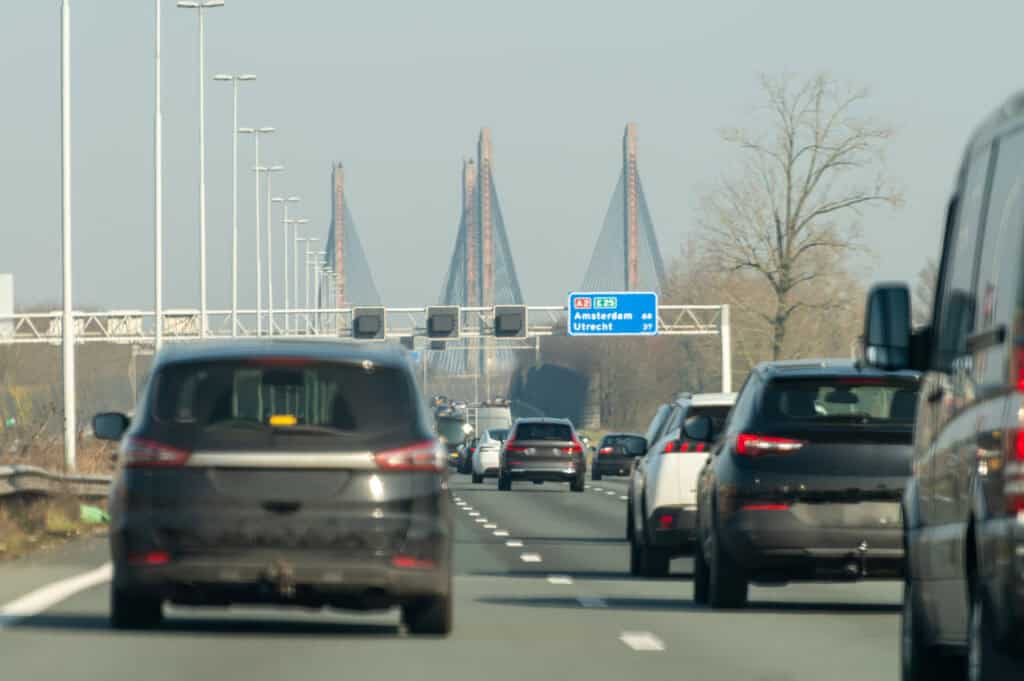
Dutch police and prosecutors are rolling out a penalty points system before the end of this year, aimed at the roughly 30,000 drivers who keep breaking traffic rules (no matter how many fines land in their letter box).
Points will land on top of whatever fine you’ve already been served with. Reach six points within a year, and you’re added to an official list of repeat offenders.
The plan was reported by RTL Nieuws based on information from the police, the Openbaar Ministerie (Public Prosecution Service), and the Ministry of Justice and Security.
Here’s what will earn you a point
Texting behind the wheel or driving without a seatbelt costs one point plus the usual fine.
Meanwhile, two or three points apply to serious offences that go before prosecutors or a judge, including drunk driving, driving without a licence, or causing a serious crash.
The exceptions to the rule are offences caught by a flitspaal (speed camera), which don’t generate any points at all. However, you may want to ease up on the accelerator, as speeding fines can run up to hundreds of euros.
What happens once you’re on the list?
At present, police, prosecutors, and the ministries of Infrastructure and Justice are still ironing out the finer details.
The ministry has indicated a CBR course could follow, referring to the driving licence authority that already runs mandatory courses for dangerous drivers and those with DUIs.
Police also want to track offenders using smart cameras that read number plates. That’s legally awkward, since officers can’t simply follow people without specific suspicion, and the police say privacy questions are part of the ongoing discussions.
“In any case, we are going to actively seek them out,” Frits Lindeman, the police’s traffic project leader, tells RTL Nieuws.
The more dangerous an offence, the more points you’ll receive. Image: Dreamstime
The point system is aimed at repeat offenders
Drawing on data from Statistics Netherlands (CBS), the national statistics agency, RTL Nieuws calculated that 29,720 people would have hit six or more points last year under the new counting method.
The group skews heavily young and male, with women comprising only 5%. Of the total group, one in eight has a previous traffic conviction, and one in three has “problematic debts”. In 2025 alone, 2,650 offenders were under the age of 18.
However, experts aren’t convinced the plan will work
Researchers at Utrecht University and the Vrije Universiteit found that warning letters sent to repeat offenders made no difference. In their words, “stronger measures, particularly license suspension or revocation, were by far the most effective.”
The Netherlands already runs two points systems. One applies to drivers who’ve held their licence for under seven years, which catches plenty of internationals working through the Dutch licence process, and another covers drink and drug driving.
It remains to be seen whether adding a third points system will affect the behaviour of repeat traffic offenders.
Do you think the new points system will be a success, or do you reckon there’ll be no change? Share your thoughts in the comments below.
From today, July 24, Dutch goods going to the United States face an extra tariff of 10% or 12.5%. The official reason? Forced labour.
Yes, you read that right: forced labour. The US says the EU isn’t doing enough to keep goods made with forced labour out of its market, so the tariff is a little nudge.
However, Brussels, which passed a law banning those goods in 2024, has a different word for it: unjustified.
New US tariffs hit up to 60 countries
US Trade Representative Jamieson Greer announced the measure on July 23. Covering 60 economies, in a bid to “correct what is both a human rights abuse and distortive trade practice to improve the welfare of workers everywhere.”
Countries with a forced labour import ban already in place pay 10%, while everyone else pays 12.5%. The EU sits awkwardly between the two, with certain products charged at both rates and a list of exemptions still being sorted out.
As the Netherlands doesn’t have its own rate, whatever the EU gets hit with, Dutch exporters do, too.
The timing is doing some heavy lifting
Trump’s previous global tariff of 10% expires this Friday, July 24. His new tariff, meanwhile, starts this very same Friday.
That gap of precisely zero days isn’t an accident. The US Supreme Court struck down much of his earlier tariff programme, so his team went looking for a different law to hang the tariffs on, and landed on Section 301 of the Trade Act of 1974.
By law, this section lets a president act against “unfair” foreign trade practices without asking Congress.
“The impression is increasingly emerging that a tariff measure is sought first, and only then is a suitable legal justification found,” Bernd Lange, chair of the European Parliament’s trade committee, states.
Clearly not one to mince words, he branded the US investigation “utterly absurd”, given the EU ban on forced labour products.
What’s actually behind the forced labour claim?
Needless to say, “forced labour” isn’t a technicality invented for this tariff. The International Labour Organisation estimates that around 28 million people worldwide were in forced labour in 2021, with a large share producing goods that end up in global supply chains.
The US has banned imports made with forced labour since the Tariff Act of 1930, and tightened it considerably in 2021 with a law targeting goods from Xinjiang in China.
The EU’s own ban, signed in 2024, applies to any product sold in the EU market regardless of origin.
However, the crux of the issue is the start date — the EU ban officially doesn’t apply until December 14, 2027, though the Commission published its enforcement guidelines and risk database last month.
Of course, this gap in the timeline is the strongest part of Washington’s case. While Brussels can point to the law on paper, enforcement has yet to take full effect.
Dutch trade with the US is declining
The US is the Netherlands’ fifth-largest export destination and its second-biggest outside the EU, after the UK. In 2024 alone, 5.7% of Dutch export value crossed the Atlantic, comprising mostly petroleum, chip machines, and medicines.
However, with measures like Trump’s latest round of tariffs on the table, the strength of the two nations’ continued trade remains uncertain. Dutch goods exports to the US dropped 4.7% in the first ten months of 2025, falling every single month from July.
As for whether any of this shows up on your receipt: tariffs are paid by American importers, not you, so the effect on Dutch shelf prices is expected to be minimal at best.
Want to make sure DutchReview pops up on your news feed more often? Just add us as a preferred news provider, and we’ll handle the rest.
You’ve arrived in Amsterdam, you’re ready to hit the coffeeshops, but wait: Is smoking weed in Amsterdam legal?
This guide was written and regularly updated by the DutchReview editorial team, based in Amsterdam, drawing on first-hand visits to each coffeeshop featured.
You’re not the first to ask this question, and you won’t be the last. Cannabis (or, weed) in Amsterdam operates under some pretty complicated legislation, so we’ve broken it down to be understood by normal, non-Dutch-speaking humans (a.k.a. you and us 🤝).
Pssttt… don’t worry: you’ll be able to smoke weed in Amsterdam while you’re visiting — but it’s not quite as easy as you think!
Quick Facts 💡
Legal status: Smoking weed in Amsterdam is not legal, but it is decriminalised under the Dutch gedoogbeleid (tolerance policy) — meaning it’s officially tolerated and won’t get you in trouble as long as you follow the rules.
Who can buy: Anyone aged 18 or over can buy weed in Amsterdam, including tourists — the city has no residents-only policy.
Purchase limit: You can buy a maximum of five grams of weed per person, per visit at any Amsterdam coffeeshop.
Where smoking is banned: Smoking weed in public is banned in parts of the city centre — specifically the Red Light District (de Wallen), the Dam, the Damrak, and the Nieuwmarkt.
Fine: Getting caught smoking in a banned area can land you a €100 fine.
Tobacco rule: Mixing weed with tobacco is not permitted indoors — pure joints or a vaporiser only.
ID required: You must bring a valid, government-issued photo ID — a passport, national identity card, or driving licence — as coffeeshops are required by law to check the age of anyone who appears to be under 25.
🚭 Smoking weed in Amsterdam is not actually legal — but it is decriminalised
Why do people come to Amsterdam to smoke, then? Well, that’s because the Netherlands has a so-called “tolerance policy” (gedoogbeleid) when it comes to weed. This makes smoking weed neither legal nor truly illegal.
Cannabis has been available for recreational use in Amsterdam since 1976. Image: Depositphotos
Huh? Confusing, we know. 😅 But essentially, this means that consuming weed in Amsterdam (and the rest of the Netherlands) is decriminalised, and tolerated, as long as:
It’s not being done in an area of Amsterdam where smoking is banned
The weed is sold by a coffeeshop with a valid licence
The person isn’t carrying more than five grams
The person is over 18 years old
The smoker doesn’t cause a nuisance to the public
💨 The ins and outs of the law: what’s allowed and what’s not?
Of course, a law wouldn’t be a law if it were easy and straightforward. 😉
So, what’s the deal with Amsterdam’s smoking ban? And what does weed-legal Amsterdam actually look like for tourists in practice? Let’s have a look.
Is smoking weed in Amsterdam legal in public places?
Technically, smoking weed in any outside public space is not allowed, but in practice, you will not get in trouble for it. Wanna blaze it up at a public park? Go for it, except…
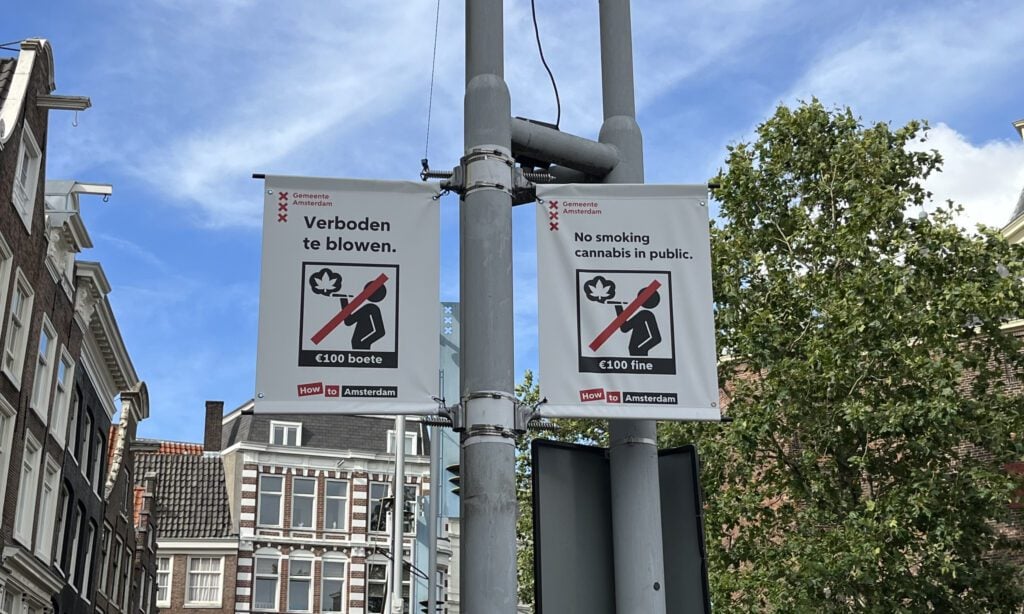
Smoking weed has been officially banned in some designated areas of Amsterdam’s city centre.
You’ll see signs like this in some parts of the city centre. 👀 Image: DutchReview
However, this widely dreaded ban is not as bad as it first may sound. Firstly, it only counts for certain areas in the old part of town, namely: de Wallen (the Red Light District), the Dam, the Damrak, and the Nieuwmarkt. 🚭
Secondly, according to various Dutch sources, the Dutch police and the handhaving (municipal law enforcement officials) often let you get away with a warning at first.
That is not a guarantee, though, so be cautious — because blazing it up in one of these areas could potentially land you a juicy €100 fine. Ouch!
Is smoking weed in Amsterdam legal in bars?
In the old days (or well, before 2008), Amsterdam coffeeshops prided themselves in providing their customers with both smokes and spirits. 🍻
In 2008, however, the Netherlands enforced a new law that forced 750 coffeeshops all over the country to choose between selling cannabis or alcohol.
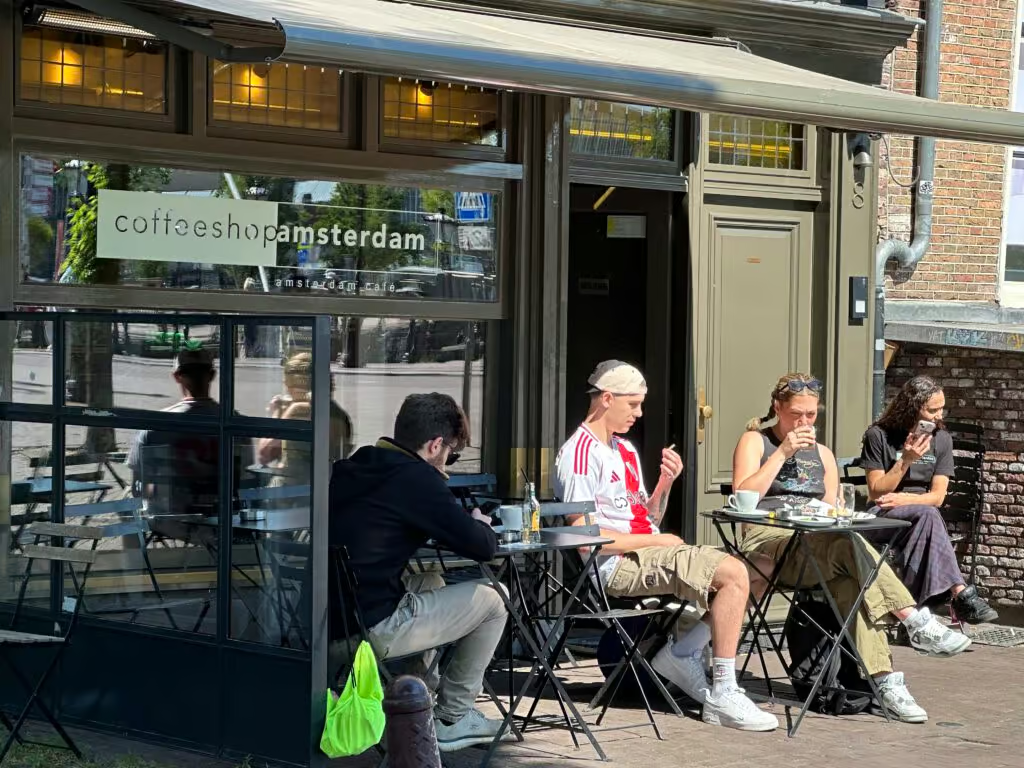
Nowadays, sharing a bud and some booze is only allowed in certain smoke-friendly bars, such as the Coffeeshop Amsterdam Café, where booze, buds, and buddies can still come together for a great time. 🙌
Ah, a refreshing beer — perfect for preventing the classic “cotton mouth”! Image: Depositphotos
Here’s the catch: you can smoke and drink in these cafes, but they do not sell weed — you have to bring it with you.
On top of that, the weed you smoke inside these bars has to be pure (meaning it can’t be mixed with tobacco), because the Netherlands has a strict ban on smoking tobacco in public indoor spaces.
Is smoking weed in Amsterdam legal in coffeeshops?
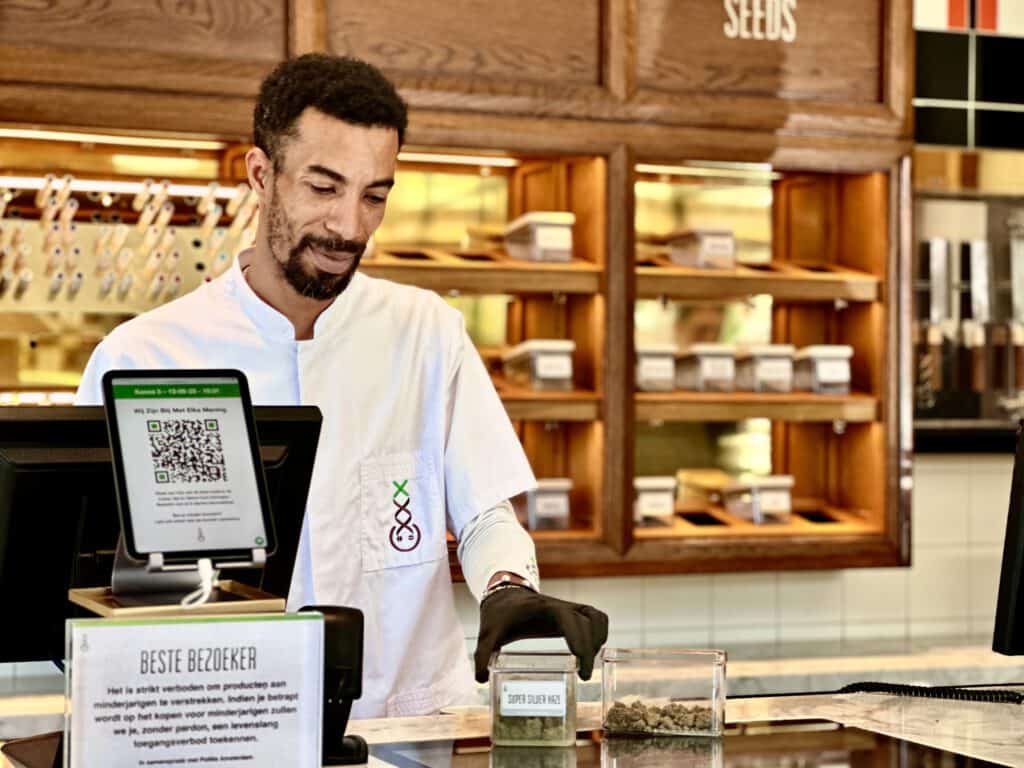
Of course, the most common place to smoke weed in Amsterdam is the place you buy it at: in coffeeshops (no, not the places that sell coffee).
With over 160 coffeeshops spread throughout the Dutch capital, you have plenty of options to choose from.
According to the municipality of Amsterdam, around 23% of tourists visit a coffeeshop during their stay. Image: DutchReview
Again, by law, coffeeshops can’t allow you to smoke tobacco inside of their establishment, so you’ll have to go for a pure joint. Besides that, you’re free to smoke away to your liking inside or on their terrace.
Amsterdam coffeeshops are great for many reasons, not only to smoke weed. Similar to bars, they are social places where people can meet and spend time with friends, all while enjoying some of that fine Dutch herb. ☘️
Is smoking weed in Amsterdam legal in my home?
Smoking weed at home (or at your accommodation) can be a great experience! Think about it: the comfy bed is right there, the fridge is stocked with food, and you don’t have to worry about how to get home.
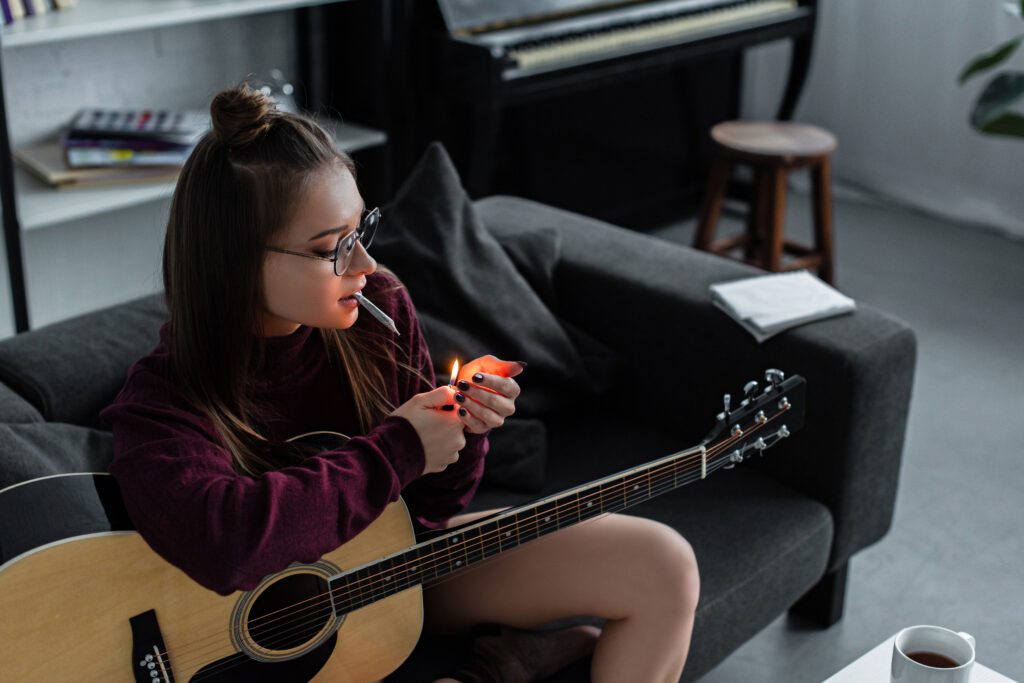
But is it okay to smoke weed in Amsterdam when you’re in your own four walls? Ja, technically it is. Although your neighbours might not like the smell, you are allowed to smoke weed in the privacy of your own home.
How about a cheeky joint to get the creative juices flowing? 😉 Image: Depositphotos
If weed causes you to be a nuisance to others, however, then that is something that can be acted upon, and your neighbours could call the police, for example. Therefore, if you do like to have an occasional smoke at home, make sure you are being considerate, especially if you live in a flat.
That being said, many Airbnbs and rental apartments will have a policy against smoking, so make sure you do not get in trouble. When in doubt, ask your landlord — or stick to the balcony just to be safe.
🇳🇱 Is weed legal in the rest of the Netherlands?
The Dutch tolerance policy applies to the entire lowlands except for 10 cities. Wait what?
Yup, 10 Dutch cities are part of an ongoing government trial — the Wietexperiment — in which local coffeeshops can only sell weed sourced from licensed, regulated growers: Arnhem, Almere, Breda, Groningen, Heerlen, Voorne aan Zee, Maastricht, Nijmegen, Tilburg, and Zaanstad.
Since April 2025, participating coffeeshops must source exclusively from seven government-approved growers — up from the original three when the trial launched in December 2023. The ultimate goal is to use the results of this experiment to inform a possible full legalisation of cannabis across the Netherlands.
The ultimate goal of this trial is to expand the Netherlands’ tolerance of marijuana to full legality.
☘️ Where to buy the best weed in Amsterdam city centre: our top 7 picks
Ready to try out smoking weed in Amsterdam? Leuk! Now that you know the Amsterdam coffeeshop rules, let us give you our insider scoop and suggest some of our favourite spots to buy weed from.
1. Boerejongens West: high-end weed with the best advice
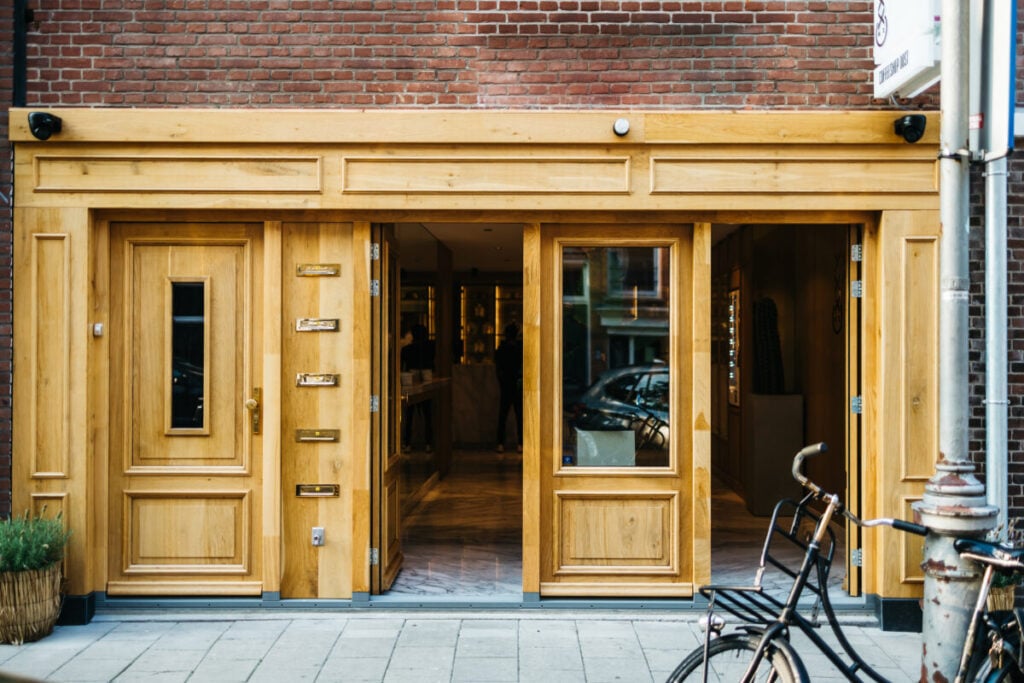
This is a classy-looking coffeeshop. Image: DutchReview
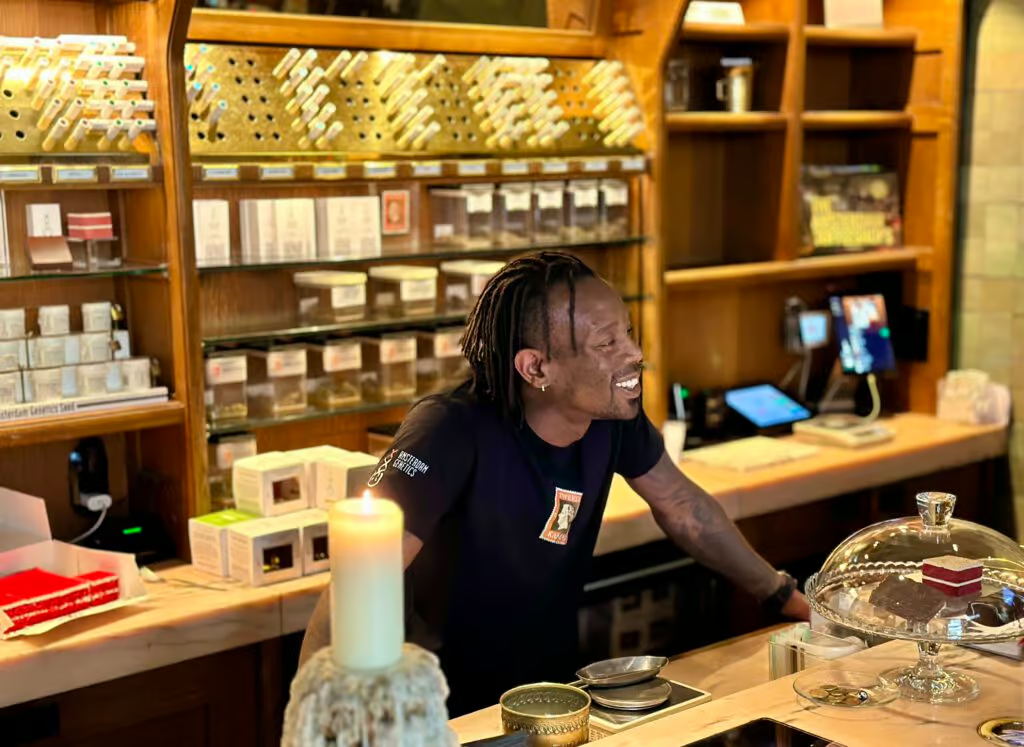
The Boerejongens Coffeeshops are among the most popular coffeeshops in Amsterdam. With four locations in the city, this is a great option that’s never far away (spots exist in West, Centrum, BIJ, and Sloterdijk).
What makes this place unique is its classy vibe and knowledgeable staff. Besides great weed, they also sell some of Amsterdam’s best hash and edibles (a heavenly Red Velvet space cake, for example) — we high-ly recommend it!
2. Coffeeshop Tweede Kamer: the authentic Amsterdam weed experience
A true classic. Image: DutchReview
If you’re looking for a piece of Dutch cannabis history, Coffeeshop Tweede Kamer is the place to be. This place, located by Amsterdam Centrum, near the Singel canal and founded all the way back in 1985, is a favourite among locals and tourists alike.
We’re not exactly sure why, but its name is a reference to the Dutch House of Representatives — perhaps pointing a finger at those responsible for the confusing laws? 😉
The staff are not politicians, however, but they are true connoisseurs of cannabis, happy to answer any and every question you may have.
When in doubt, ask your questions to the lovely staff members — they’ll be happy to help. Image: DutchReview
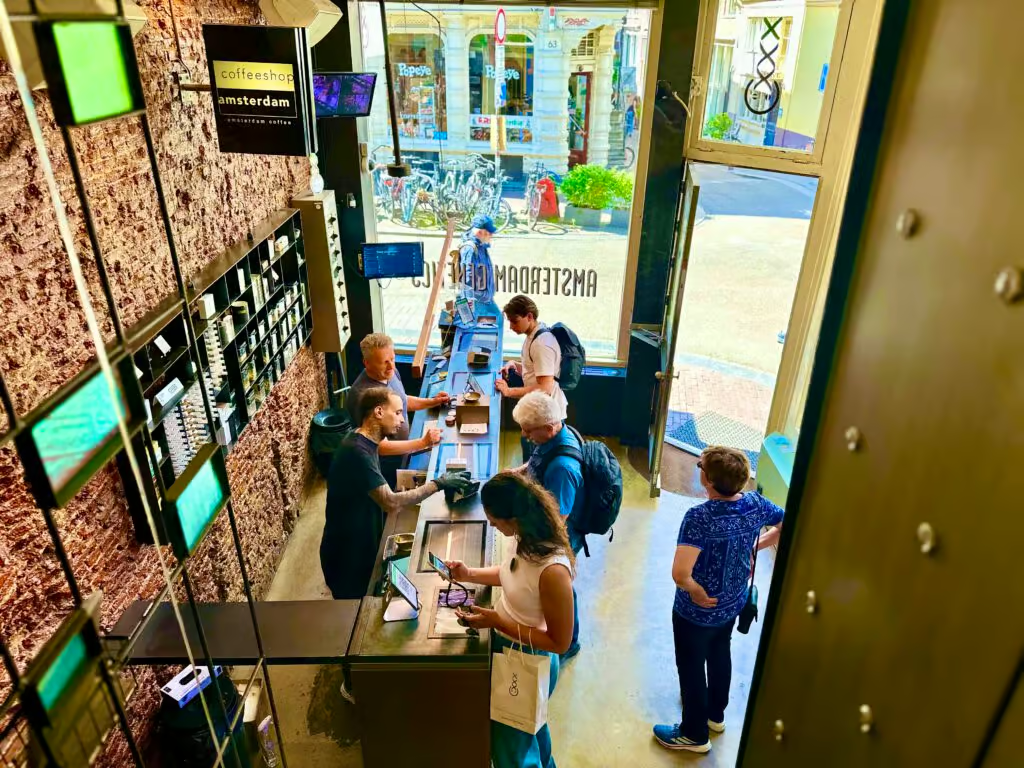
Coffeeshop Amsterdam (formerly known as Dampkring 2) is a great coffeeshop if you actually want to hang around and smoke. With more than 90 seats spread across three floors, Coffeeshop Amsterdam is guaranteed to have an open spot for you.
The relaxing atmosphere and the friendly people make this place a true gem, where you can enjoy not only a nice joint, but also delicious (non-alcoholic) drinks, and lekkere bites — perfect for the munchies.
Want even more? Stock up at Coffeeshop Amsterdam and walk two minutes over to Coffeeshop Amsterdam Cafe! It’s smoker-friendly, offers alcohol and drinks, has a great outdoor terrace, and is in the gezellig Haarlemmerstraat right near Amsterdam Central Station.
Located on the IJplein, a 12-minute walk from Amsterdam North’s ferry port, this coffeeshop is a true hidden gem, serving some of the city’s most high-quality weed products.
Whether you’re on the hunt for a delectable edible or some smooth weed, Coffeeshop Noord’s expert staff will make sure you get exactly what you’re looking for.
5. Coffeeshop Sloterdijk: Amsterdam class in a coffeeshop
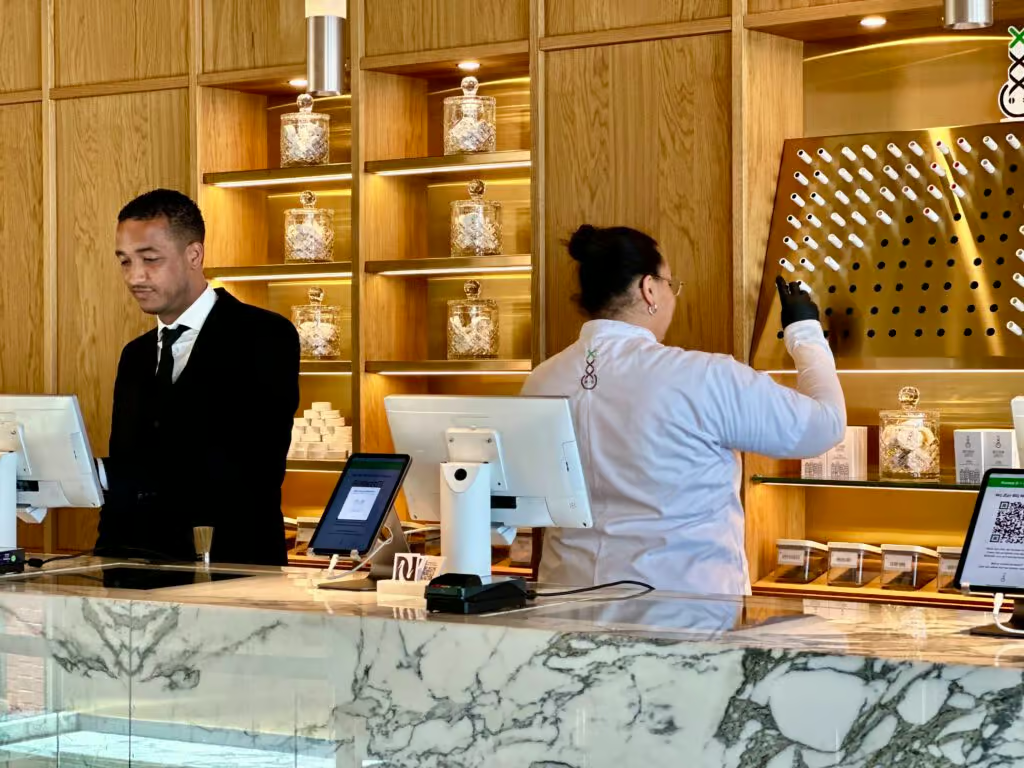
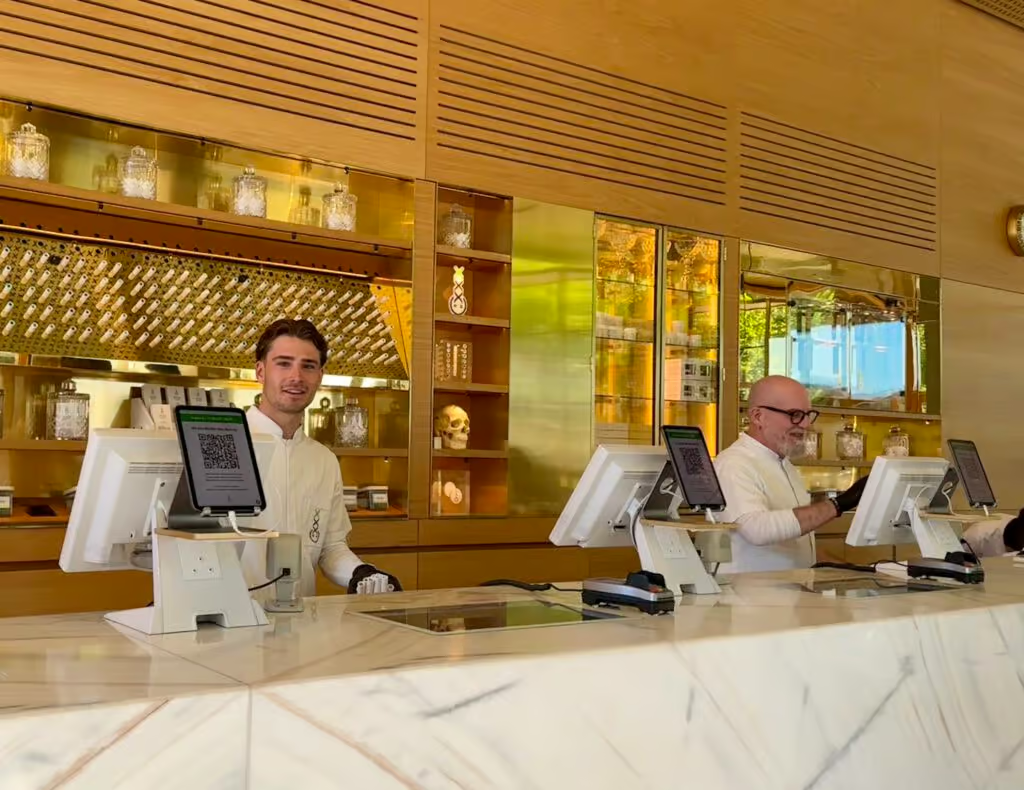
It’s all gold and marble. Image: DutchReview
Coffeeshop Sloterdijk breaks the mould of what you’d expect from an Amsterdam coffeeshop.
With its bright, modern interior, marble counters, and impeccably dressed staff, it feels more like a high-end dispensary than a smoky hangout.
Whether you’re new to hash or a seasoned smoker, the friendly cannabis sommeliers will guide you through their premium selection, all packaged in sleek, minimalist designs.
Bonus: it’s easily accessible by train, bike, or car — with free parking right out front.
6. Coffeeshop Siberië: for canal views away from the crowds
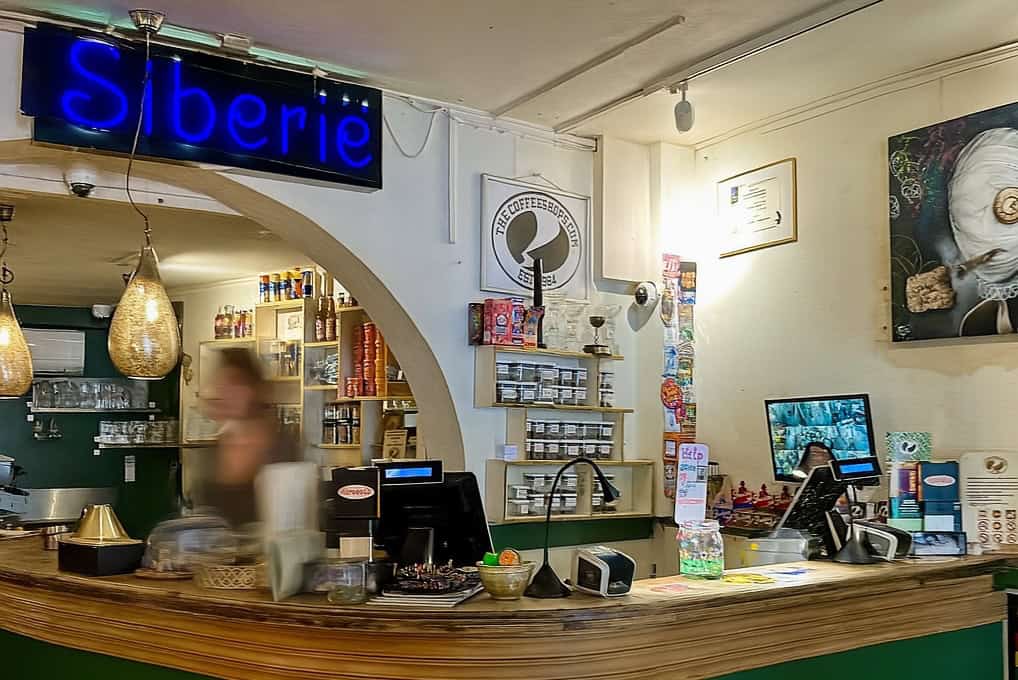
This coffeeshop has major cosy vibes. Image: DutchReview
Boasting an impressively extensive menu which advises you of the strengths and effects of each weed strain, Coffeeshop Siberië also has special items on the menu that change regularly.
But besides having amazing weed, this place has so much more to offer — most importantly, an extraordinarily good vibe.
Located in a stunning canal house off of the Brouwersgracht, the walls of this coffeeshop are decorated with local art, while all the weed is professionally tested in labs. We’re big fans!
Coffeeshop Oost represents the perfect blend of old and new. It’s a sleek new shop located in a charming old building in Amsterdam-Oost (Oosterparkbuurt), near Oosterpark, selling the authentic weed experience in a modern setting.
Though this coffeeshop will pull you in with its affordable prices and sleek look, it’ll leave you wanting more thanks to its incredible variety of quality products.
From delicious spacetries (get it? Pastries but spacey! 😋) to quality hash and weed, the knowledgeable budtenders have everything you could want and more.
To get more info on the best places for smoking weed in Amsterdam, be sure to check out the best coffeeshops in Amsterdam.
🪁 Things to do after smoking weed in Amsterdam
Getting high in Amsterdam legally is one thing, keeping yourself entertained while you’re riding the wave is another. 🏄♀️
Depending on the headspace you’re in after smoking weed in Amsterdam, some activities may be more suitable for you than others. Therefore, we advise you to decide on your trip-activity after you get high in order to avoid spending money on an experience that you will end up hating.
Whether you need time to chill, something to stimulate the brain, or just a good ol’ trippy trip, these activities should do the trick:
Relax in a park and watch the clouds go by
Feel your heightened senses at a museum
Pet some cute goats at a petting zoo
See the city from another angle on a canal cruise
Challenge your friends at a boardgame café
Play some glow-in-the-dark minigolf
Satisfy your munchies at the Foodhallen
Go listen to some live music
See a movie at the Tuchinsky theatre
Try your luck at an escape room
⛈️ What if I have a bad trip after smoking weed in Amsterdam?
Don’t worry, it can happen to the best of us (unfortunately). Image: Depositphotos
If you have a bad trip after smoking weed in Amsterdam, first of all: don’t panic. We know that’s easier said than done, but remember that your trip won’t last forever.
It’s important to remember that anyone can have a bad trip — no matter how experienced of a smoker they are. Signs of a bad trip may include increased anxiety or a sensation that time is standing still.
That being said, bad trips are generally harmless, and, as we said, they will pass. In addition, there are some things that you can do or plan ahead for in order to ease your mind if you start feeling niet zo leuk (not so good).
Go to a place where you can relax
Focus on your breathing
Make sure you have a friend with you
Do things that calm you down
Talk about nice things
Drink some water and have a snack
Take a nap
If needed, seek medical help
What did we learn? Smoking weed is neither legal nor illegal in Amsterdam. Though confusing, this means that you can enjoy Amsterdam’s best weed without worries as long as you stick to the city’s rules.
To sum up: Amsterdam coffeeshop rules
Respect other customers and follow the coffeeshop’s individual house rules
You must be 18 or over to enter and purchase cannabis
Always bring a valid, government-issued photo ID
You can buy a maximum of 5 grams per person, per visit
No smoking tobacco indoors — pure joints or a vaporiser only
No alcohol on the premises
Not in the mood to smoke your weed? Why not try some edibles? Or are you more the hash kinda person? Either way, we’re sure you’ll find what you’re looking for in Amsterdam — the city of illegal legal weed.
Did you know smoking weed in Amsterdam is not legal? Tell us in the comments!
Is smoking weed in Amsterdam legal? Frequently asked questions
How much weed can you buy at once in Amsterdam?
In Amsterdam coffeeshops, you can buy a maximum of five grams per person, per visit. This limit applies across all coffeeshops — so you can’t top it up by popping next door — and is part of the Netherlands’ tolerance policy designed to keep purchases within the bounds of personal use.
What ID do I need for an Amsterdam coffeeshop?
To enter an Amsterdam coffeeshop, you’ll need a valid, government-issued photo ID — a passport, national identity card, or driving licence will do. Dutch law requires coffeeshops to check the age of anyone who looks under 25, so don’t be offended if you’re asked; it’s standard practice and means the coffeeshop is doing things properly.
Where in Amsterdam is it legal to smoke weed?
Believe it or not, smoking weed in Amsterdam is actually not legal, just decriminalised. That means smoking weed in Amsterdam is tolerated, as long as:
It’s not being done in an area of Amsterdam where smoking is banned
The weed is sold by a coffeeshop with a valid licence
The person isn’t carrying more than five grams
The person is over 18 years old
The smoker doesn’t cause a nuisance to the public
Smoking weed in Amsterdam is banned in the inner city centre in the districts of de Wallen (the Red Light District), the Dam, the Damrak, and the Nieuwmarkt.
What happens if I get caught smoking weed in an area of Amsterdam where it is banned?
Smoking weed in an area where it is banned can land you a fine of a whopping €100 fine.
However, according to various Dutch sources, the Dutch police and the handhaving (municipal law enforcement officials) often let you get away with a warning at first — but there’s no guarantee for that.
So, break the law at your own risk. 😉
Can I smoke weed indoors in Amsterdam?
This depends on the type of indoor space. Generally speaking, smoking weed is prohibited in most public spaces such as restaurants, bars, or terraces.
However, there are some exceptions. For example, you are allowed to smoke pure cannabis (without tobacco) in coffeeshops and certain designated smoker’s bars.
You are also allowed to smoke in your own private space. But, of course, if you are renting a room or apartment, then your landlord will probably ask you not to.
What are the rules in Amsterdam coffeeshops?
When visiting a coffeeshop in Amsterdam, there are three simple rules you need to follow:
You must be over 18
You can’t smoke tobacco in an indoor smoking area
You can only purchase five grams at a time
Some coffeeshops in Amsterdam also sell basic drinks on-site, and others might also offer food. Only rare bars allow you to smoke and drink alcohol at the same time, and these are usually independent of the coffeeshops.
What is the best coffeeshop in Amsterdam?
The best coffeeshops in Amsterdam are the Boerejongens coffeeshops. It’s a coffeeshop chain with four locations throughout Amsterdam, all of them bright and modern.
These coffeeshops are popular with both locals and tourist, and the in-house budtenders are true connoisseurs who are happy to help.
Can tourists buy weed in Amsterdam coffeeshops?
Yes, tourists can buy weed in Amsterdam coffeeshops. Unlike some other Dutch cities, Amsterdam has not introduced a residents-only policy, meaning visitors from anywhere in the world are welcome to walk in, browse the menu, and buy up to five grams per visit — as long as they’re 18 or over and have valid ID.
Surf’s up in the Netherlands? You bet. If you can brave the chilly waters, there are plenty of great spots up the coast for you to hit the waves this season. 🌊
Keen to ride the waves, bask in the sun, and hang ten?
While the Netherlands may not top the list of the best countries to surf in, good offshore winds can create the perfect conditions to ride the waves. This is especially true if northwest and northern winds cause a swell.
If you’re stressing about where you can catch the perfect waves, don’t fret! I’ve surfed at some of the most popular spots in the Netherlands, and here are my top 10 favourites.
What you should know about surfing in the Netherlands
Let’s not kid ourselves, this isn’t Hawaii we’re talking about. This is the North Sea, which means frosty toes are the price of a good shred. Wet suits and cold-water wax are required year-round.
Compared to other surfing spots in the world,Dutch beaches do require more patience for catching a solid wave.
But they’ll certainly deliver the surfing fix you’re craving, and pushing through the cold will be totally worth it.
Underestimating the surfing culture in the Netherlands would be a mistake.
If you know where to go, strong waves and firing barrels could be lining up for you and your board — yewwww!
Best places to surf in the Netherlands
Okay, so we’ve clarified that you can indeed surf in the lowlands. But where should you head to first?
We’ve collected 10 of the best places to surf in the Netherlands below so you can find the top spot to catch the waves.
Tip: For live surfing conditions of the various spots throughout the Netherlands, make sure you check out Magicseaweed before you head. 😉
10. Top Dutch surf spot: Noord Scheveningen
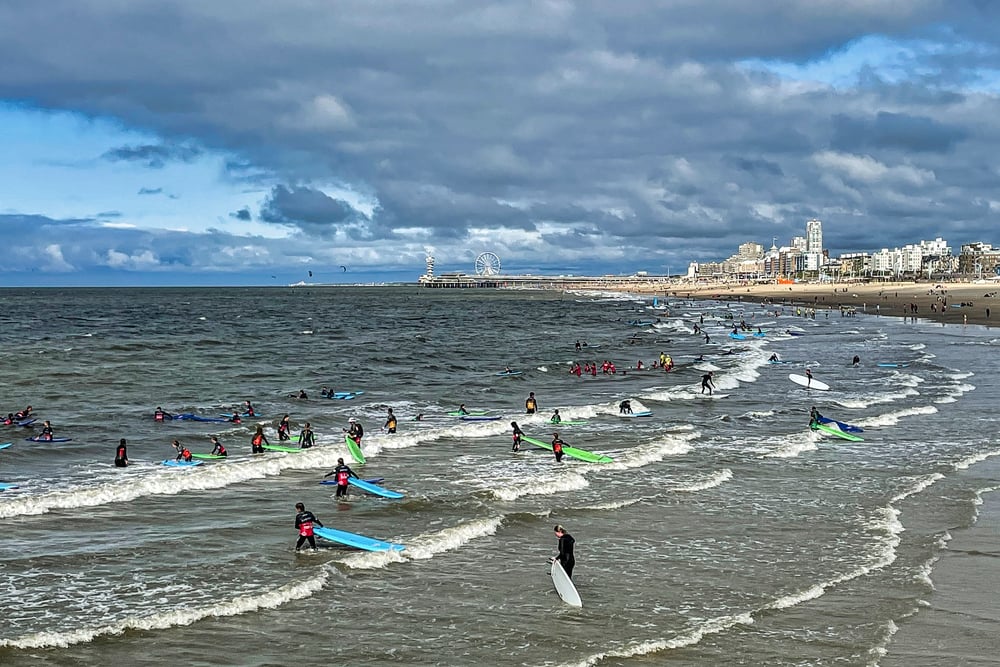
There are also several surfing schools in Scheveningen. Image: DepositPhotos.com
As one of the most popular surfing destinations in the Netherlands, Scheveningen is a must-see for anyone looking to cut some water.
About 20 minutes from the beautiful city centre of Den Haag, Scheveningen beach is easy to access and offers many restaurants and bars for that post-surf hangout.
The waves are point break, mainly from the right, which makes for a great challenge. The beach is sandy but the seafloor does tend to have rocks, so this is not a recommended spot for beginner surfers.
Although swells are not exactly world-renowned, they do create some decent waves worth paddling out for any time of the year.
Scheveningen is pretty much the hub of surfing culture in the Netherlands. But if you want to go off the beaten track, here are a few suggestions for some lesser-known surfing spots.
The island of Texel is host to a beach that runs uninterrupted for almost 15 kilometres. This makes for a less crowded surfing experience, as well as a picturesque landscape of dunes and countryside.
Here, you can expect steady winds and generally higher waves compared to other surf spots in the Netherlands.
The conditions also make for a great kitesurfing and windsurfing destination. ⛵️
8. Zeeland’s top surfing spot: Domburg
Domburg’s surf spots are a bit trickier to get to, but that makes the magnificent beaches far less crowded. Image: DepositPhotos.com
This scenic seaside town is located in the Zeeland province, which you can reach quite easily from Rotterdam. Domburg has no train station, so if you’d prefer to avoid the more touristy beaches, this is the place for you.
Its beaches are known for strong, breaking waves, which are fast and come from every direction. The most popular banks are just south of Domburg, past the golf course, but there are plenty of good spots higher up if you’d prefer to avoid the locals.
One thing to be aware of is the jetty pilings at high tide.
A unique perk of Domburg is MadNes: the surf, skate, and music festival that takes place here every July. This year, the festival was hosted on beach Nes, Ameland from July 3 to July 5.
For a more unconventional route (or if you’re simply not the biggest fan of little sea creatures), check out the Rotterdam urban surfing spot, RIF010.
This unique surfing location is perfect for more than just surfing. You can also bodyboard, paddle, canoe or cycle on their pump track.
And the best part — you don’t have to travel far, since it’s right in the middle of the city!
6. Surfing beach close to Rotterdam: Hoek van Holland
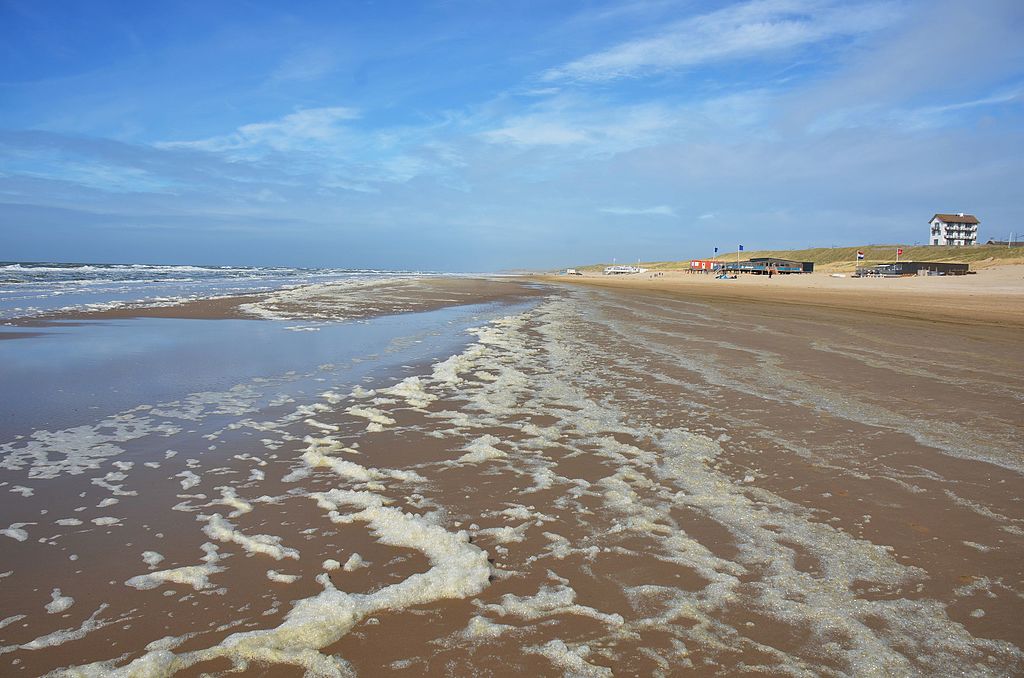
Hoek van Holland’s beach is easy to get to for surfing. Image: Kees Torn/Wikimedia Commons/CC2.0
This beach starts at the mouth of Rotterdam’s Europoort and continues northward towards Scheveningen, making it easily accessible for anyone in the south of the Randstad.
As another popular surfing destination in the Netherlands, many surf shops and schools can be found along this beach.
Surfing conditions are good, with steady winds and strong breaking waves. However, pollution from the harbour does have an effect on water quality. 😬
5. Popular surfer’s choice: Zandvoort
Zandvoort is one of the Netherlands’ most popular surf spots. Image: DepositPhotos.com
Watersport enthusiasts flock to Zandvoort in the summer for its beautiful golden beaches and clean waters. The long stretches of sand prevent overcrowding, and there are plenty of bars and restaurants to serve the summer beach buzz. 😎
The sea is calmer in spring and summer, but as Zandvoort is totally exposed to the sea, you can pick up some high winds here. Waves tend to be soft crumblers but can reform into stronger breaks.
All levels of surfers can be found here, but long boarding is more suited to the conditions.
4. A surf spot away from tourists: Camperduin
If you love surf spots that aren’t packed with tourists, you’ll love Camperduin. Image: DepositPhotos.com
The coastal village of Camperduin in North Holland has a west-facing beach that leads into a man-made lagoon.
It’s one of the quieter surfing spots and its beaches tend to have a lot of space, even in summer.If you’re looking to shred some barrels, this is one of the best places to do so.
Some of the most powerful jetty breaks in Holland can be found here, enough to snap a board every once in a while. Do be careful of strong rip tides though.
3. Surf beach close to Amsterdam: Wijk aan Zee
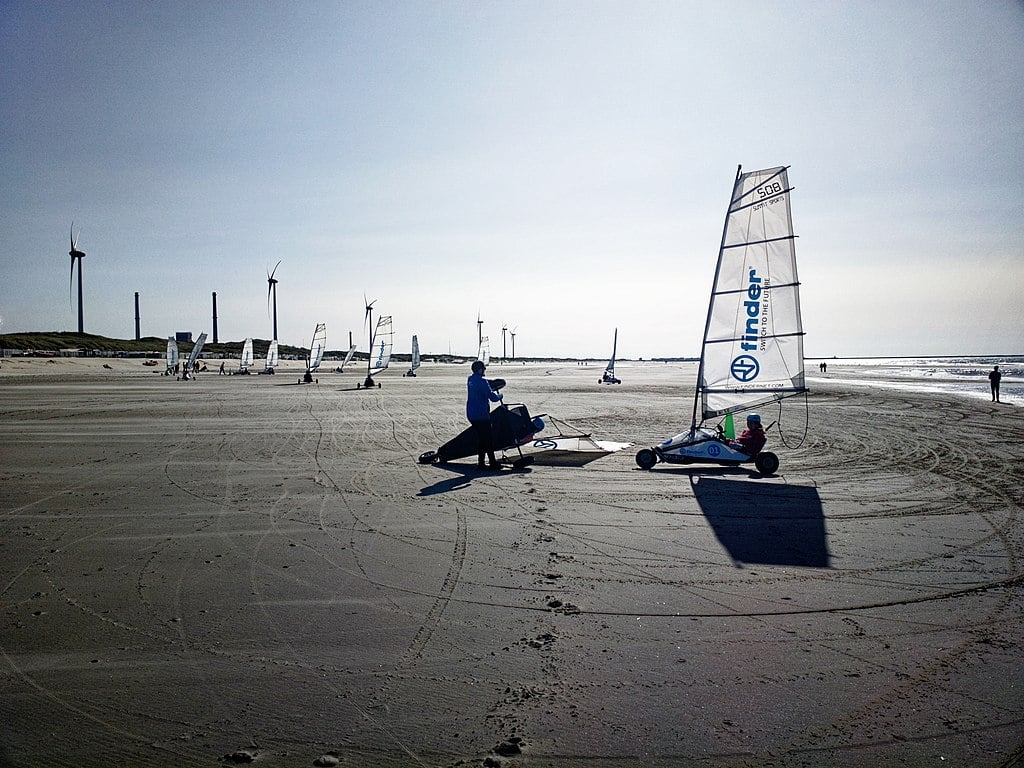
Land sailing is also a popular sport at Wijk aan Zee. Image: Txllxt TxllxT/ Wikimedia Commons/CC4.0
A short 30-minute drive from Amsterdam, Wijk aan Zee is another favourite beach of the Dutchies.
Although it can get quite crowded, there are many surfing resources at your disposal here, including shops, schools, and hiring equipment.
Waves are of the beach break type, coming from all directions. With a soft-sandy bottom, conditions are perfect for beginner surfers as well as experienced shredders.
The huge jetties provide some wind protection, but do be careful of riptides as you get closer to them. The water quality is not the best at Wijk aan Zee, but its location makes it a good option for Amsterdammers.
2. Popular Dutch tourist beach: Bergen aan Zee
Bergen aan Zee is a local hotspot for surfers in the Netherlands. Image: Henk Monster/Wikimedia Commons/CC3.0
Bergen aan Zee is a coastal town in the province of North Holland. Tourists love it here in the summer, but it’s an emptier spot as far as surfing goes. Although, local surfers are starting to catch on to this location.
Bergen aan Zee experiences fairly consistent point break waves, but in the summer it tends to flatten out.
Swells come from both directions and the ideal time for a good shred is high tide. The bottom is sandy as well, so be cautious of rips.
1. Quiet surf beach in the Netherlands: Ouddorp
If you’re in the south of the Netherlands, Ouddorp is a top spot to catch some waves. Image: DepositPhotos.com
You can find this village in South Holland surrounded by beautiful countryside and miles of white beach sand.
It’s one of the quietest surf spots on the Dutch coastline, which is great if you’re looking for emptier waters.
The waves here aren’t too intense, so it’s a perfect place for beginners. The beach break waves come from all directions, the seafloor is sandy and there are few safety hazards.
If you’re lucky, you might even see some seals in the water! 🦭
Is it safe to surf in the Netherlands?
If you stick to the designated surfing spots, surfing in the Netherlands is perfectly safe.
Riptides and strong winds are things to be aware of, so do a little research before you head out into the waves.
If it’s your first time surfing here and you’re anxious about wading out into the unknown, start with the busier beaches where you can follow the lead of experienced locals. But generally speaking, you have nothing to worry about.
Should I wear a wetsuit when surfing in Holland?
Yes! In summer, you’ll need a wetsuit when surfing in the Netherlands of either a 3mm or 2mm thickness depending on the water temperature. However, no hoods, gloves, or boots are required.
In winter, you’ll need all of the above items, with a wetsuit thickness of 5mm or 6mm.
When is the best time to surf in the Netherlands?
Usually, you’ll get stronger and more consistent waves in the winter months, with many beaches flattening out a bit during summer. But if you head to any of the hotspots mentioned above, you’ll find surfable waves year-round.
Where can I buy surfing equipment in Holland?
All the major surf spots in the Netherlands have places to rent surfboards and other surfing equipment, including all of the locations mentioned in this article.
Did we leave out your favourite surf spot? Do you know more about some of the locations we mentioned? Tell us in the comments below!
From July 23, if you’re in parts of Rotterdam’s De Esch after 11 PM without a decent reason to be there, you’re now breaking the law.
The ban applies every night between 11 PM and 5 AM, and will run for three months. According to the municipality, the measure follows years of noise and disorder caused by visitors coming into the neighbourhood from other cities.
The ban covers a designated part of De Esch, along with the Kralingse kades (Kralingen quays). Matrix signs in the neighbourhood mark where it applies.
Who does the ban apply to?
Needless to say, the ban doesn’t apply to everyone. The following people can still be in the area at night:
residents of the zone,
people visiting residents,
anyone working in the area,
patrons visiting a bar, event venue, or sports facility there, and
police and emergency services.
If you’re a non-resident and you’re visiting someone in the zone after 11 PM, you may be stopped and asked why you’re in the area.
Residents are fed up with “persistent nuisance”
According to the municipality, visitors from outside the neighbourhood have been causing noise and disorder in De Esch and along the Kralingse quays. The problems occur mainly in the evenings and at night.
As NOS reports, the nightly ban is a last-ditch effort; Rotterdam had already tried various other measures before. Concrete blocks were placed in the area, surveillance was increased, and officials spoke to the people causing the disturbances — all of which proved ineffective.
In particular, residents point to street racing, drug and lachgas (laughing gas) use, prostitution, and noise. The problems started shortly after the coronavirus crisis and have continued for nearly three years.
“The quality of life in the neighborhood is under pressure,” Rotterdam Mayor Carola Schouten stresses. “Peace must return to De Esch, and residents must feel comfortable and safe. That is why I am exercising this authority.”
The measure is highly unusual, experts say
An area ban is normally issued to a specific individual, not to everyone who doesn’t have explicit permission “to be in the designated area”.
As Michel Vols, professor of public order law at the University of Groningen, tells NOS, he knows of no other Dutch municipality doing this. He described it as a major restriction on freedom of movement, pointing out that someone walking their dog through De Esch from a neighbouring area would technically be committing a crime.
“Why, for example, doesn’t the police enforce nuisance better instead of someone’s presence in the neighborhood?” he asks.
However, police say enforcing against the noise directly hasn’t worked. Officers need to witness the behaviour themselves and this generally stops as soon as a patrol car arrives.
Do you live near De Esch, or somewhere with a similar problem? Let us know in the comments.
The south and southeast of the country could see temperatures climb past 30 degrees Celsius from Wednesday, with possible highs of 35 degrees by Thursday.
With provisional heat warnings for Tuesday, Wednesday, and Thursday next week, KNMI flags a “transition to sunny and warm summer weather.”
But before we buckle down under any heat warnings, we still need to get through the weekend, which is forecast to be a bit of a mixed bag.
Expect rain, clouds, and humidity
Saturday will be pleasant, with bright sun in the morning and varying periods of sunshine and cloud cover by afternoon. Temperature-wise, maximums run from 21 degrees Celsius on the Wadden Islands up to 28 in the southeast.
Sunday, on the other hand, will bring some real Dutch weather. Expect heavy cloud, rain, and highs of roughly 23 degrees, with an 80% chance of precipitation.
The chance of precipitation will drop to 30% by Monday, with slightly more sunshine. Temperatures will hover around a maximum of 23 degrees.
By midweek, the mercury starts rising
Tuesday marks the turning point, when the country shifts towards sunny, warm summer weather with maximums around 27 degrees.
Wednesday is forecast to get even hotter, with highs between 28 and 31 degrees, depending on where you are.
However, come Thursday, we’ll really feel the sizzle. KNMI puts the odds of passing 30 degrees in the southeastern half of the country at 60%, and the south could reach anywhere from 32 to 35 degrees.
Lekker weertje he? ☀️😎 Seriously, is someone pulling a joke? Lather up with that sunscreen because temperatures are set to rise up to 34 degrees Celsius this weekend. What are your plans for the tropical weekend? Let us know! #netherlands#weather#dutchreview
Which parts of the country get the worst of the heat?
Limburg, eastern Brabant, and the southeast will likely hit the top of the forecasted temperature range, while the coast and the Wadden Islands stay cooler thanks to sea breezes.
If you’re in Amsterdam, Rotterdam, or The Hague, you’ll likely land somewhere in the middle. You’ll still be warm, but don’t expect Maastricht-level heat.
And if you thought we’d waved “doei” to sweaty summer nights, you’re sadly mistaken. Forecasted minimums hit 14 degrees on Tuesday, rising to 17 and 18 degrees on Wednesday and Thursday, respectively.
Will there be an official heat warning?
Fortunately, KNMI currently lists no active warnings, and the markers on Tuesday, Wednesday, and Thursday are labelled as “possible heat” rather than confirmation of any upcoming heatwaves.
When temperatures push above 27 degrees for several days at a time, KNMI and the RIVM (the national public health institute) can activate the Nationaal Hitteplan (National Heat Plan). This heat plan prompts extra checks on elderly and vulnerable residents, in addition to free “cooling spots”.
Thanks to record-breaking regional temperature spikes, it’s been switched on more than once already this summer — but it’s unclear whether we can expect sustained heat this time around.
Will you be enjoying the upcoming tropical spell, or do you prefer it when the mercury’s much lower? Share your thoughts in the comments below.
Ever wondered what the Netherlands is all about? The land, the flag, the dams, the religions (or lack thereof), and all the orange? Well, here’s an 11:58-minute-long overview.
It’s a difficult task to sum up an entire country in a condensed yet precise way — we’re talking a whole nation here, folks. Still, we at DutchReview sure attempt to do so, on a daily basis, as a matter of fact, and as much as possible.
But if you’re short on time and can’t read all the wonderful articles we have on life here in the lowlands, we have just the video for you.
Here, you can easily cram hours of reading about Dutch culture and history into less than 12 minutes!
It covers anything and everything: from the 80 Years’ War with Spain, to the tall and smart gene running through Dutch veins and the Nederlanders’ love of bikes, cheese, and more.
If you’re a Dutchie, or someone who’s just as fascinated as we are with all things Dutch, we’re sure you enjoyed this quick and fun summary.
Did this video miss any key points? Tell us what should be added in the comments below!
This post might have affiliate links that help us write the articles you love, at no extra cost to you. Read our statement.
What do I need to set up my utilities in the Netherlands?
Before you can embark on your Dutch utilities journey, there are a number of important documents that you need to gather. These will be needed by your utility provider to set up your services.
You’ll need:
proof of identity (ID card or passport),
proof of address (rental contract), and
a bank statement or proof of residency from your municipality (gemeente).
It’s also almost always necessary to have a Dutch bank account to set up your utilities in the Netherlands.
Are they not included? Then you’re ready to pick your own utility providers (see the info below!).
Keep in mind that some landlords have specific conditions surrounding gas and electricity — so it’s good to double-check your rental contract.
I’m buying a property in the Netherlands
If you buy a house in the Netherlands, it’s often possible for you to transfer the utility services from the previous owner into your own name. This is a handy option if you don’t want to deal with the hassle of choosing a new provider.
Alternatively, you can do some research and pick service providers that align with your wants and needs. If you own an apartment or a studio, make sure to check if your homeowner’s association has any special requirements for utilities.
Electricity and gas in the Netherlands
Now that we got the basics out of the way, let’s move on to the first major utility you’ll need to set up in the Netherlands: electricity and gas.
Electricity and gas in the Netherlands are grouped as “energy supply sources”. Most Dutch homes use electricity as their main source of power, but gas is an option in many homes, too.
Many homes use gas as a source of central heating. Image: Freepik
While gas-powered homes use electricity as well (for all things that need electricity), they use gas for things such as heating, stoves, and hot water. 🔌
How to connect electricity and gas to your Dutch home
You’ll be happy to hear that, in most cases, electricity and/or gas will already be hooked up to your Dutch home when you move in.
All you need to do (ideally before moving in) is choose an energy provider and transfer the services to your name. From then on, all you need to take care of is paying your bills.
Good to know: If you don’t enter into a contract with a provider upon moving, you will be sent a letter by your municipality reminding you to do so. If you still fail to set up gas and electricity, your power will eventually be cut off.
After transferring the utilities to your name, your new provider will usually ask you to provide meter readings.
To make sure that you only pay for the energy that you actually use (and save money!), we recommend that you make note of these readings on your move-in day.
How to choose a Dutch electricity and gas provider
The Dutch energy market is privatised, meaning you have the freedom to select a gas and electricity provider that ticks all your boxes.
Choosing can take some effort, but it’s not as hard as you might think! Image: Depositphotos
The most popular providers of gas and electricity in the Netherlands are:
When choosing the provider that’s right for you, there are a variety of factors you may want to consider. Think of costs, customer service, sustainability, and contractual terms and commitments.
Tip: An easy way to get an overview of the best providers and their prices is by using a price comparison tool like Energievergelijk.nl, which is fully available in English.
Costs of gas and electricity in the Netherlands
It’s important to know what you can expect to pay for gas and electricity in the Netherlands so that you can stick to your monthly budget (and have some spare change for a biertje or two).
Of course, how much you actually end up paying per month can vary on factors such as your usage, the insulation of your home, the type of contract you sign and, very significantly, the energy label of your home and your appliances.
Energy labels for Dutch homes and appliances
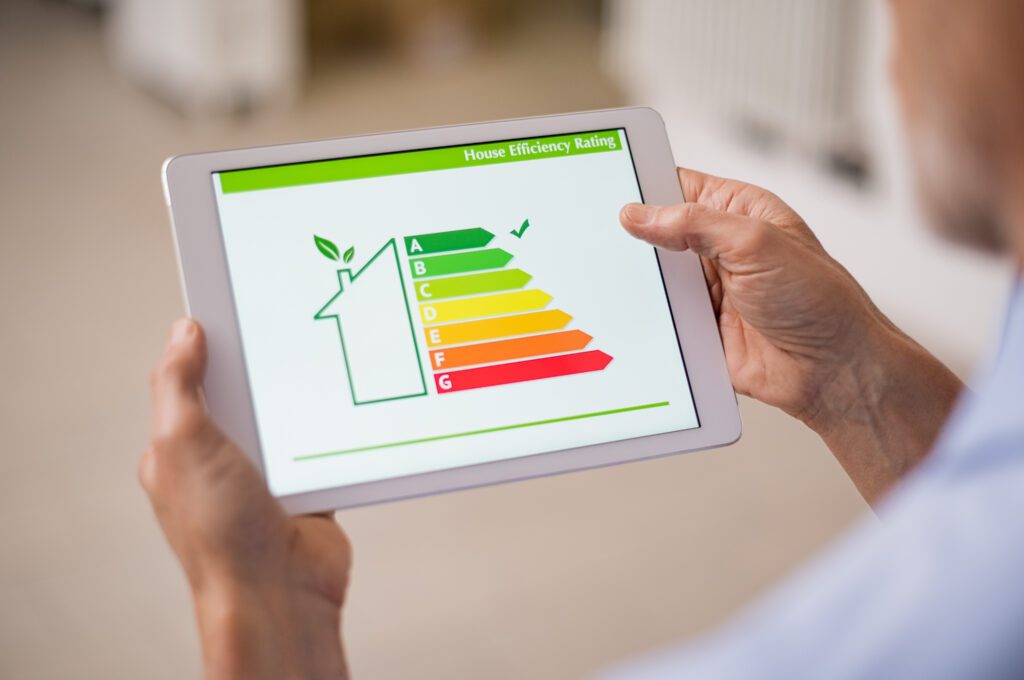
What the frikandel is an energy label? In simple terms, it’s an EU-wide categorisation of homes and devices that indicates how energy-efficient your house or appliance is.
The rating ranges from A (the most energy-efficient) to G (the least energy-efficient). For apartment buildings, the A-rating is extended to A, A+, A++, A+++ and A++++, where more pluses indicate better energy efficiency.
You can check your home’s energy label online. Image: Freepik
For houses, the energy label indicates how energy efficient a house is compared to similar houses.
For appliances, the energy label indicates the device’s energy efficiency and also provides information about the noise level, repairability, and water use, for example.
Appliances that have an energy label include fridges and freezers, washing machines and washer-dryers, dishwashers, televisions, ovens, vacuum cleaners, lighting products, central heating boilers, and air conditioners.
How major? Well, a G-labelled home uses a whopping 50% more gas than an A-rated one. As for electricity, homes with a G label use, on average, 15% to 25% more than A-rated ones.
To give you an example, these are the energy costs of a two-bedroom house of about 60 square metres, based on different energy labels. Source: DutchReview
Average gas usage and cost per month:
How much gas a household consumes mainly depends on the type of house you live in.
The Netherlands is a very sustainable country, and it’s on a mission to reach net-zero carbon (CO2) emissions by 2050.
To achieve that goal, the government supports households that switch to green energy by subsidising part of their cost.
The Netherlands has various sources of sustainable energy. Image: Depositphotos
This means that, although green energy is more costly to produce, it often ends up costing the consumer as much (or less!) as non-renewable energy would.
If having green energy is important to you, then you’ll want to pick a provider that offers green energy.
Let op!Not everything that’s “green” is actually sustainable — and some providers may be much greener than others. 🚫
It’s pretty easy for Dutch energy suppliers to call themselves green; so always make sure to double-check where your provider’s energy actually comes from.
If you want guaranteed green energy, it’s worth thinking about solar panels! ☀️
Water in the Netherlands
Getting water to your Dutch home is not nearly as complex as getting gas and electricity. Phew!
How to connect water to your Dutch home
Good news: Water is already connected to your home in the Netherlands when you move into it. There is nothing you need to do besides getting a water supply contract in your name.
Setting up utilities like water in the Netherlands doesn’t have to be so hard! Image: Unsplash
Water supply providers in the Netherlands
In the Netherlands, your water supplier is not chosen by you. Instead, providers are decided by the region you live in — and there are 10 different ones for the entire country. 💦
To find out who your provider is, you can ask your landlord or insert your postcode into this handy tool.
If you live in any of these major Dutch cities, these are your water suppliers:
If you own the house you live in, you will need to pay an additional water system charge for buildings of about €65.
How can I pay my utility bills in the Netherlands?
We’ve covered Dutch utilities, providers, and prices; now, let’s dive into the nitty-gritty of paying your bills. (Yep, turns out they’re pretty strict about that).
Usually, utility providers will offer you two standard options to pay your bills:
Automatische incasso (automatic direct debit), where your due amount gets taken straight out of your account every month, or
Manually transfer the amount you owe to your provider each month via internet banking.
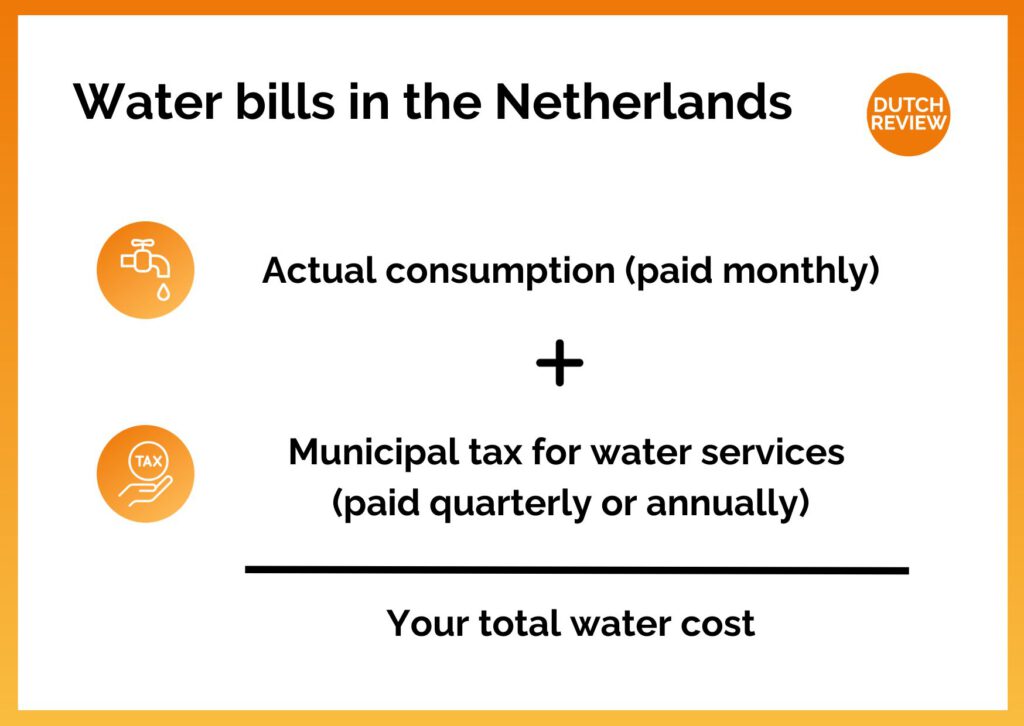
Your tax bills for water will be sent to your home address once a year or once per quarter, depending on your municipality. You can typically choose to pay the amount in one go or split it up into multiple payments. 💵
How can I switch utility providers in the Netherlands?
As you know by now, the utility market in the Netherlands is privatised.
This means that, in theory, you can switch your gas and electricity contract as much as you like (within your contract, of course). Your water provider, on the other hand, will only change if you move to a different region.
If your contract allows you to switch, you can usually do so online. Image: Freepik
But why would you choose to switch energy providers? Well, because it can actually be quite profitable! Yup, one of the most efficient ways to save money on utility expenses is to choose your provider wisely and switch regularly.
Another reason to consider a switch could be if you’re looking to make your home more sustainable or if you’re looking for a provider that’s more expat-friendly.
If you want to switch energy providers, the first thing on your to-do list should be to check whether your current contract actually allows you to switch. Since June 1, 2023, providers can fine you if you decide to switch providers before your contract ends.
However, if your plan has an indefinite term, you can switch anytime.
If you are looking to switch your utility provider, you’ll have to take these two easy steps:
De-register from your old provider.
Apply to the new provider by providing your new address and an estimate of your monthly or annual usage.
Oftentimes, you can also just contact your new chosen supplier, and they can help you make the change.
Moving and utilities in the Netherlands
Moving house in the Netherlands? Exciting! Unfortunately, that means that you have to deal with setting up your utilities again.
Fortunately, it doesn’t have to be as hard as the first time around. 😅
Transferring utilities to your new address
Moving is stressful enough — so you’ll be happy to hear that one way to make your move a little more manageable is by transferring your existing utility contracts to your new address.
You can easily transfer your services by calling your utility provider. Image: Freepik
Since your energy contract is linked to your personal account with the supplier and not the property, transferring utilities to a new address is easy-breezy!
Cancelling your utility contracts
If you’re moving abroad or want to register with a new supplier in your new home, then it’s time to say goodbye to your utility contract.
Usually, you can easily de-register from your provider using their online customer portal. Alternatively, you can shoot them a quick e-mail saying you would like to put an end to your contract.
Other services you may want to set up in the Netherlands
Phew! Well done, you’ve officially set up the most important Dutch utilities. 👏
Next up, it’s time to set up your mobile phone and internet. Luckily, we’ve got some guides to help you out:
Feeling ready to tackle your utilities in the Netherlands? Great, take a moment to pat yourself on the back — you’ve just ticked a major task off your to-do list!
Now, it’s time to enjoy all the wonders that Dutch life has to offer (and maybe some biertjes).
Do you have any more tips about utilities in the Netherlands? Tell us in the comments!
The Green Cathedral or, as the Dutch say, De Groene Kathedraal is a must-see if you’re in the Netherlands. Why? Oh, y’know, it’s just casually made entirely out of live, growing trees. Wat leuk!
A roof, walls, and stained-glass windows are all things we associate with cathedrals — but when it comes to the Green Cathedral, the Dutch decided (in classic Dutch style 😏) to switch things up.
Dutch artist Marinus Boezem developed the idea of the Green Cathedral in 1978. After Flevoland was reclaimed from the sea and became the 12th province in 1986, Boezem decided the new city of Almere would be the perfect home for his creation.
As a result, the beautiful bomen that make up the walls of the Green Cathedral were planted in 1987.
Oh, and there isn’t just one cathedral. In fact, Boezem decided that there should be two! A “counter-cathedral” was created a few years later.
The “counter-cathedral” is an empty cathedral-shaped space that has been cut out of a forest of oak and beech trees.
If jigsaw puzzles are your thing, you’ll find this gezellig. The Green Cathedral fits like that last puzzle piece into the empty space that is the “counter-cathedral”. So satisfying!
So, why does the Netherlands have a cathedral made of trees?
Boezem is a big fan of Gothic architecture, which has different elements inspired by nature.
Stone columns, cross-ribbed vaults, and adorned capitals are all constructed in the image of tree trunks, branches, and foliage.
So what did Boezem do? You might have guessed it. He took this inspiration and got a little bit literal. He created a cathedral made from the very same trees that the architecture is usually inspired by.
Concrete paths between the trees represent the ribs of cross vaults in normal cathedrals, and shells encircling the trees are meant to refer to the sea that was present in the area not so long ago.
Overall, however, the Green Cathedral is meant to symbolise the desire to ascend to the divine and leave earthly matters behind — and you’ve gotta admit, it’s quite a cool way of getting that message across.
Initially, the cathedral also has something to say about temporality. This can be seen in its specific shape (which copies that of the stylish Notre-Dame de Reims).
How was it supposed to convey this message? While the 13th-century cathedral, Notre-Dame de Reims, will last forever, the Green Cathedral was meant to only have a lifespan of 30 years.
However, it was later decided to actually maintain the cathedral.
Visiting the Netherlands’ Green Cathedral
We bet you’re just dying to visit this gem, so what now? If you’re trying to figure out what to do for the day, the cathedral is open 24/7. After all, there aren’t any doors to close. 🎉
— Erfgoedhuis Almere (@Erfgoed_Almere) June 4, 2022
With these open doors, there are many things to do when visiting the Green Cathedral. 👇
Go for a bike ride or canoe around the Green Cathedral
Firstly, there are winding bike paths and a canal running next to the Green Cathedral — natuurlijk, because this is still the Netherlands.
This green beauty provides a great spot for a nice cycle or paddle in a canoe.
Yep, we said canoe. You can rent a bicycle or canoe from Outdoorpark SEC Almere nearby, just remember to book at least three days in advance to ensure you can go on your adventure!
Tip! They do have some bike routes, but none that will actually take you to the Green Cathedral, so you get to create your own exciting cycle route.
Take a walk around the Green Cathedral
If you like to keep things simple, that is. You can also take a stroll through the cathedral and look up at the swaying trees, or even walk along the empty field that is the “counter-cathedral”.
Don’t forget to snap a photo as a memento of your outing! 📸
Once you’ve taken it all in, you can fuel up after your exploration and grab some food and drinks to go from the Boerderij Uniek Leven tea house. Why go? You can have a lekker picnic, of course!
Tie the knot at the Green Cathedral
Need a wedding venue? Don’t you think this would be a unique place to do it?
While it may not be your typical cathedral, the Green Cathedral often still functions like one and is a popular spot for weddings and funerals in the Netherlands.
How can I get to the “Green Cathedral”?
This wonderful piece of land art is accessible by bike and car. And yes, there is free parking.
Taking the bus? Klinkt goed, just note that while there are buses from Almere Stad Station Centrum, they won’t take you all the way.
That’s ok though, you’ll have the chance to take in some spectacular views while you walk.
However, there is a tea house nearby where you can stop to have something to eat and drink. So perhaps bring along some geld (money) for a sweet treat.
It’s art, a cathedral, and it’s outdoors — there really is something for everyone.
If you’re in the Netherlands, this awe-inspiring Dutch creation is a gem that can’t be left off your bucket list.
Have you visited the Green Cathedral? Tell us about it in the comments!
Diesel at Dutch pumps has risen by roughly 30 cents a litre in two weeks, while wholesale gas has more than doubled since February.
Diesel now averages €2.569 a litre and petrol €2.620, according to UnitedConsumers, which tracks recommended prices from the five biggest oil companies.
Meanwhile, wholesale gas hit just over €62 per megawatt-hour, up from under €41 a month ago and under €30 before the war began in late February, NOS reports.
Both price spikes trace back to the Strait of Hormuz, the shipping route in the Persian Gulf that carries a large share of the world’s oil and gas. Due to renewed conflict in the area this weekend, oil prices were pushed to their highest price in over a month.
Petrol and diesel costs are rising fast
Ships came under fire in the Strait of Hormuz over the weekend, and since a huge share of the world’s oil passes through it, petrol and diesel prices shot up to their highest point in over a month.
Petrol, especially, has taken that hit and run with it. At €2.620 per litre, we’re roughly three cents off the record-high price of €2.646 set in May, according to UnitedConsumers.
And that wasn’t even the first time this year that petrol costs hit a record; May’s price spike is the fifteenth smashed record since March, ANP reports.
Diesel is climbing even faster, up around 30 cents in a fortnight to €2.569. While Europe refines plenty of its own petrol, it’s unable to do the same for diesel, making diesel prices far more sensitive to volatility in the supply chain.
In addition to this, reduced Russian exports have squeezed the market further, ING sector economist Rico Luman tells NU.nl.
He expects diesel to keep rising, while analysts at Morgan Stanley go one step further, predicting that European diesel stocks could drop to their lowest level since at least 2015.
Will your energy bill go up, too?
Qatar is a major gas exporter, and the hostilities around the Strait of Hormuz have made shipping that gas to Europe much harder.
However, price hike aside, the effect on your energy bill depends on what type of energy contract you’ve signed:
Fixed contract (vast contract): your gas rate doesn’t move at all until your contract ends, irrespective of the volatility in the market. You’re unlikely to feel the squeeze until your contract ends.
Variable contract (variabel contract): your rate typically changes two or four times a year. The price hike will be factored in at your provider’s next adjustment, rather than now.
Dynamic contract (dynamisch contract): your rate is recalculated daily against the wholesale price. In other words, your wallet will definitely feel the rising gas prices.
If you’re stressing over your dynamic contract, there’s a small light on the horizon: consumer prices climb less steeply than wholesale ones, because a large chunk of the bill is accijns (excise duty). This tends to act as a fixed amount, rather than a percentage.
Have you already noticed your bills climbing higher, or has the change not affected you? Share your thoughts and experiences in the comments below.