Do you speak English? Yes, we do! The latest EF English Proficiency Index ranked the Netherlands first among 123 non-English-speaking countries in English proficiency.
Next to ranking among the tallest people in the world, the Dutch are also better at speaking English than any other non-native country. According to research, between 90% and 93% of Dutch people claim they can hold a full conversation in English.
So our only question is: how do they do it?
The Dutch don’t dub
The Dutch are surrounded by the English language from an early age through television. They don’t dub any movies or series.
Unlike in other European countries like Spain, Germany, or France, in the Netherlands, you can watch everything on TV in its original language while reading Dutch subtitles.
This means that children in the Netherlands have a much more natural approach to learning and speaking English. It propels them well ahead of their peers in other countries.
Watching shows in their original language is a great way to learn a new language. Image: Depositphotos
Although being glued to your TV for hours, binge-watching American series can sometimes result in developing a pretty ‘murican accent (ya’ll know what I’m talkin’ about).
The global mindset of the Dutch
This small country, with 17 million inhabitants living on 41,545 square kilometres, beats many larger economies and ranks 18th worldwide by GDP.
With the business-friendly culture of the Netherlands, the Dutch have had to master English to compete in the global market.
Many international companies have their headquarters in the land of windmills and bikes. Image: Depositphotos
The history of worldwide exploration from the Netherlands
The Dutchies’ high English proficiency also stems from their global exploration. This nation of former seafarers has adventure in its blood.
Abel Tasman, for example, was the first known explorer from Europe to reach today’s Tasmania and New Zealand in 1642. Sailor Dirk Hartog was the first to land on Australia’s west coast. There’s even an island named after him (Dirk Hartog Island).
Today, many adventurous Dutch students choose to study abroad. They also often enrol in a language course, complete an internship, or spend a gap year volunteering, while perfecting their English skills.
Last but not least, the Dutch can thank their ancestors for their exceptional ability to speak English. The Dutch language is part of the Germanic branch of the Indo-European language family, just like English.
This means that the two languages share the same roots and have similar characteristics, making it easier for Dutch speakers to learn English. Dat is goed nieuws! (That is good news!)
What’s your experience with English proficiency in the Netherlands? Tell us in the comments below!
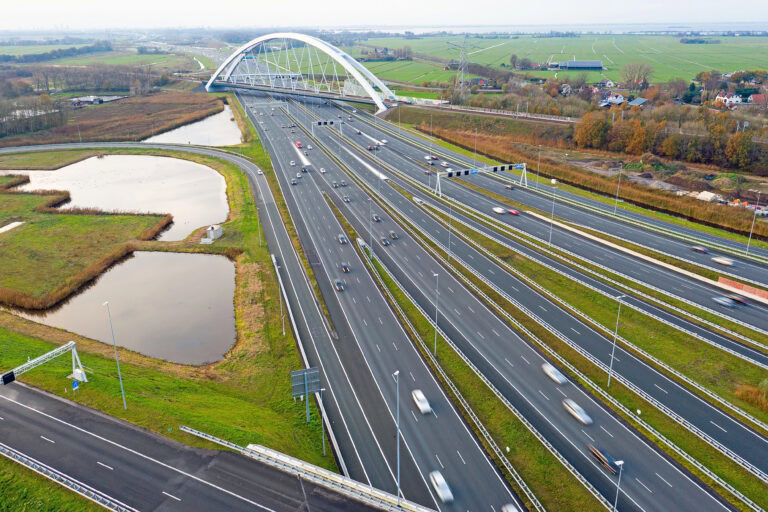
From tonight, July 3, until 17 August, Rijkswaterstaat (the national roads authority) is closing a stretch of the A1 towards Amsterdam for major maintenance.
The A1 is one of the country’s busiest motorways, running from Amsterdam all the way to the German border via Amersfoort, Apeldoorn, and Hengelo, according to Rijkswaterstaat.
The section closing now sits right at the start of that route, in the Gooi region east of the city.
What’s actually closing, and when
From 11 PM tonight (Friday, 3 July) until 5 AM on Monday, 17 August, a major stretch of the highway between junctions Eemnes and Muiderberg will be closed.
Rijkswaterstaat is using the closure to replace asphalt and expansion joints, repair the road surface, and carry out work on several bridges and viaducts, according to its project page.
However, the good news is that slip roads are shutting in phases, so the local road network doesn’t get overwhelmed all at once:
Until Monday, 27 July at 5 AM, the Naarden-West and Naarden-Vesting slip roads will stay open, while the rest will close.
Between 27 July and Wednesday, 5 August at 7 AM, every slip road in the closed section shuts.
From 5 August until maintenance is completed, only Naarden-West will reopen.
Several roads around Naarden’s historic fortress and the IJsselmeerweg will also run one-way traffic at points during the works. It’s worth checking the exact dates and times on Rijkswaterstaat’s route page before you set off.
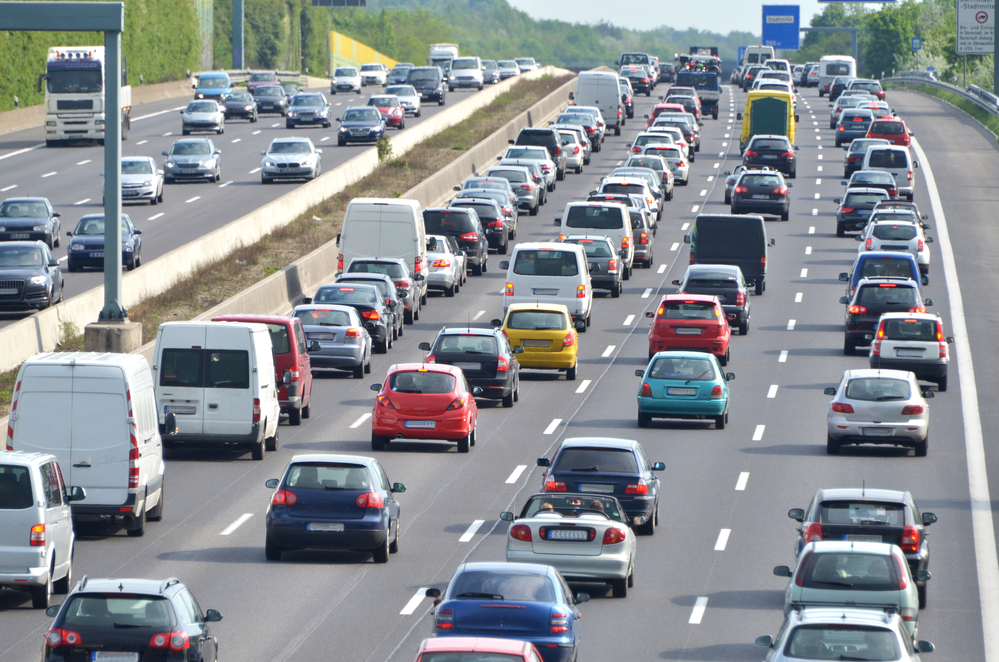
Budget extra time for your commute, given the diversions and extra traffic on the road. Image: Depositphotos
Diversion routes and alternative transport
If you’re driving, here’s how Rijkswaterstaat is rerouting traffic around the closure:
From the north and east of the Netherlands: traffic is rerouted well before the Eemnes junction to stop long queues building up ahead of the closure. Traffic from the east specifically is diverted via the A28, A27, A12, and A2.
From Amersfoort, Huizen, Laren, Blaricum, or Eemnes: the main diversion runs via the A27 and A6.
From Hilversum, Naarden, or Bussum: separate local diversions apply. Signs and roadside message boards mark the routes along the way.
Public transport will also get a much-needed boost during the closure. Regional buses in het Gooi will run on a denser timetable, meaning more buses and more room than you’d normally get.
Why is this happening?
Rijkswaterstaat is using the closure to replace the asphalt and expansion joints along this stretch of the A1.
Expansion joints are the flexible seams built into a road surface to let it shift slightly with temperature changes, and over time, they wear out and need replacing.
Are you commuting to or from Amsterdam this summer? How will you be managing the closure? Drop your tips and advice in the comments.
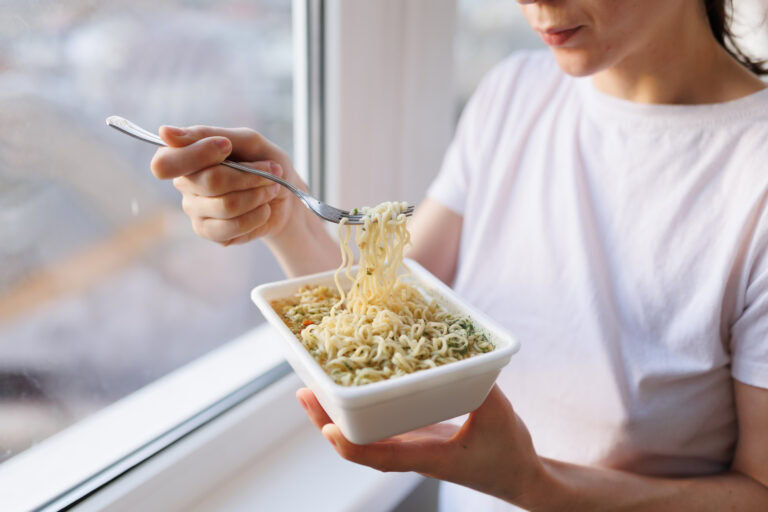
A Salmonella outbreak linked to flavoured instant noodles, affecting over 100 people across 14 European countries, has now reached the Netherlands.
Almost half of those infected by this particular strain require hospital treatment, with children and young adults seeing the most severe symptoms.
If you’ve got a bag of chicken-flavoured instant noodles in your cupboard, especially anything from an Eastern European supermarket, it’s worth a second look.
Here’s what we know about the outbreak
Between November 2025 and June 2026, the European Food Safety Authority (EFSA) logged 106 confirmed cases of Salmonella Stanley infection, with 49 of these requiring hospital intervention.
Cases were reported in Austria, Czechia, Denmark, Estonia, France, Germany, Hungary, Latvia, Lithuania, Norway, Poland, Sweden, the United Kingdom, and the Netherlands.
A joint outbreak assessment from EFSA and the European Centre for Disease Prevention and Control (ECDC) discovered that flavoured noodle products were the most likely source of the infection.
Investigators narrowed down the list of possible brands
Neither EFSA nor the ECDC named the affected brand of noodles, but investigators in Germany and Lithuania found the outbreak strain in chicken-flavoured and hot chicken-flavoured noodles.
Both were traced to the same manufacturer in Ukraine, and other Salmonella strains turned up in products from the same brand, suggesting there could be more than one source of contamination.
According to NOS, Reeva Foods is reported by news agency AP to be the brand involved.
In a quality assurance and safety update, the company said it had detected a possible contamination in a batch made for the Baltic market by its Ukrainian producer, Euro Food Service, and that it’s cooperating with the investigation.
Reeva products tend to be sold here through Eastern European supermarkets, rather than the big Dutch chains like Albert Heijn or Jumbo. Food safety authorities across the affected countries, the Netherlands included, have already started pulling the implicated batches from shelves.
If you’ve bought a packet of flavoured instant noodles from one of these supermarkets lately, it’s worth checking the batch number on your product against any recall notices before you cook it.
Want to make sure DutchReview pops up on your news feed more often? Just add us as a preferred news provider, and we’ll handle the rest.
A well-connected public transportation system, the locals’ ability to speak excellent English, and the Netherlands’ modest size all make it one of the easiest European countries to travel around, but you need to come prepared.
From clothing to electronics and handy apps, these items are must-haves for your trip around the Netherlands.
The best part? This list was compiled by expats who have lived in the Netherlands for years and experienced the highs and lows that come with every season in the lowlands.
1. Your best rain gear
Anyone who’s been living in the Netherlands for more than three months will tell you that it’s not all sunlit canals and pretty tulips.
With grey, gloomy skies and rain pouring down 24/7, the winter (and sometimes the other seasons too) in the lowlands is, in fact, the opposite of that.
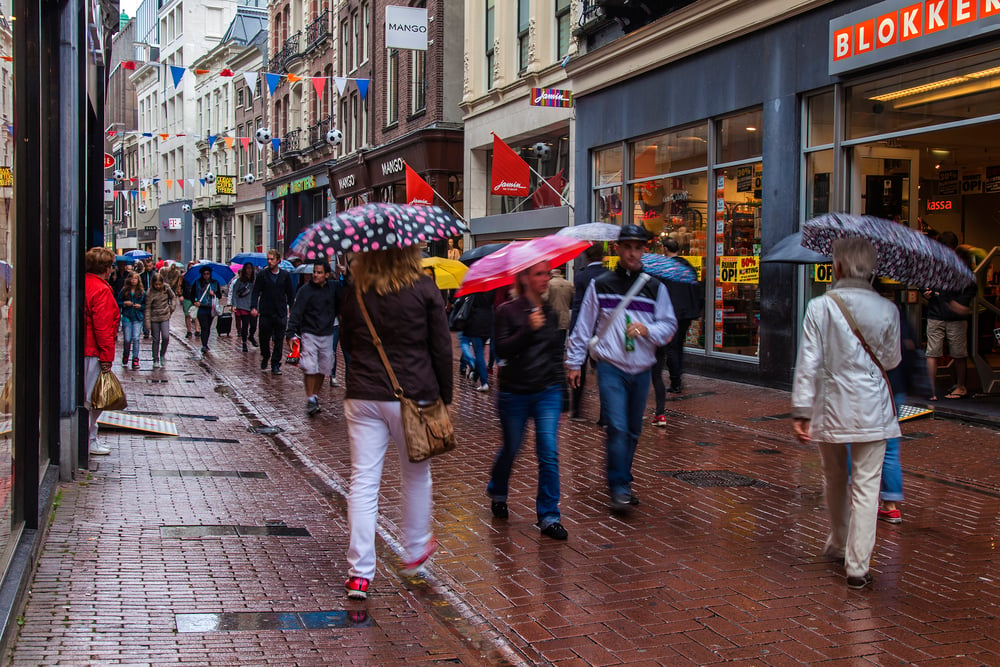
In a country as windy as the Netherlands, only the most hardcore umbrellas survive this kind of weather. This is why you’re better off packing gear that will actually protect you.
An umbrella is not enough to survive the Dutch rain. Image: Freepik
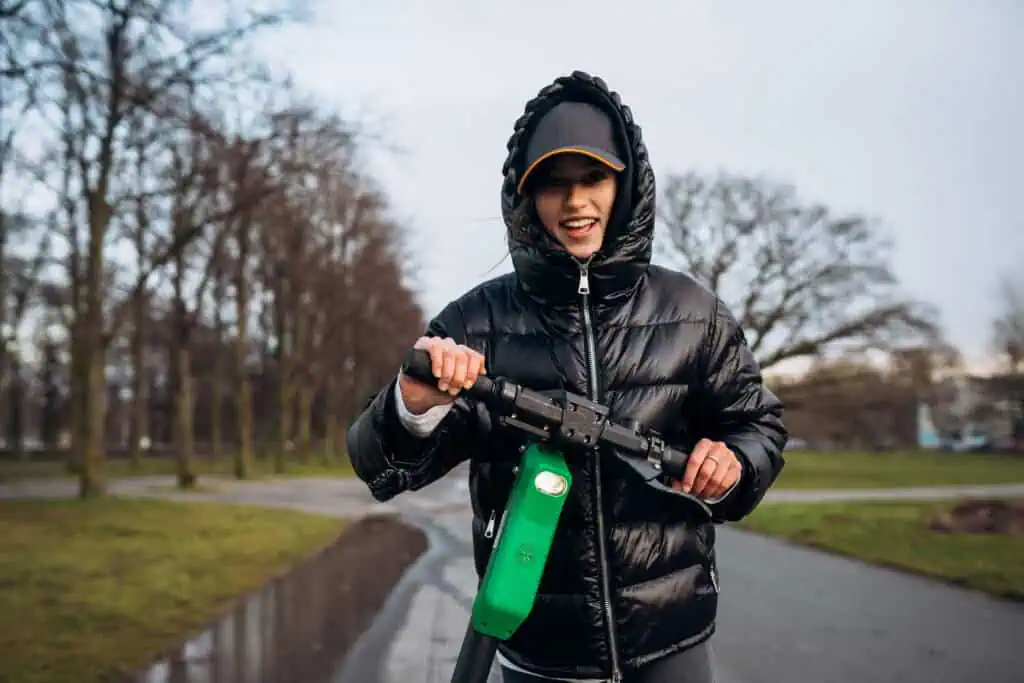
If nothing else, you’ll need at least a lightweight rain jacket to throw on during out-of-the-blue rain showers. For even more protection, an easy-to-pack-away rain poncho is a great option.
Grab a basic one for just a few euros from Hema or Blokker, or invest in a proper outdoor poncho from brands like Decathlon or Bever.
For cycling around and other outdoorsy activities, it pays off to have a pair of rain pants.
While they’re not the most fashionable piece of clothing, they do provide the much-needed protection from heavy rain. A decent pair can be purchased for around €25 from Decathlon or Hema.
Last but not least, make sure you have shoes that are waterproof and not just fashionable. Your dry feet (and socks) will thank you later.
Pro tip: There’s nothing more annoying than having to sit down on a drenched bike saddle. Wrapping it with a plastic shopping bag is an easy (and super cheap!) fix for this.
2. An eSIM to stay connected
How do you get from the airport to the heart of Amsterdam? Do the famous Van Gogh Museum and the Anne Frank House still have tickets available for the day you want to visit?
Staying connected will make your travels around the Netherlands a lot easier. Image: Freepik
Whether you need directions or information about opening times, the ability to look things up on the go is priceless, especially when you’ve just landed in a new country.
Why rely on unstable public Wi-Fi when you can just use a convenient eSIM?
Yesim offers the ultimate eSIM for tourists and travellers. You can choose between different packages for the Netherlands based on the amount of data you need, or opt for unlimited data for a set number of days. Use the code DUTCHREVIEW15 and enjoy 15% off your first purchase.
3. Bike-appropriate clothes
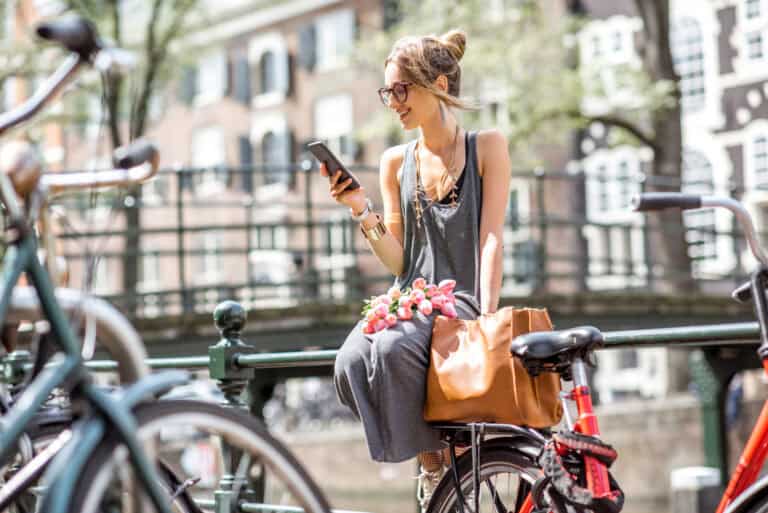
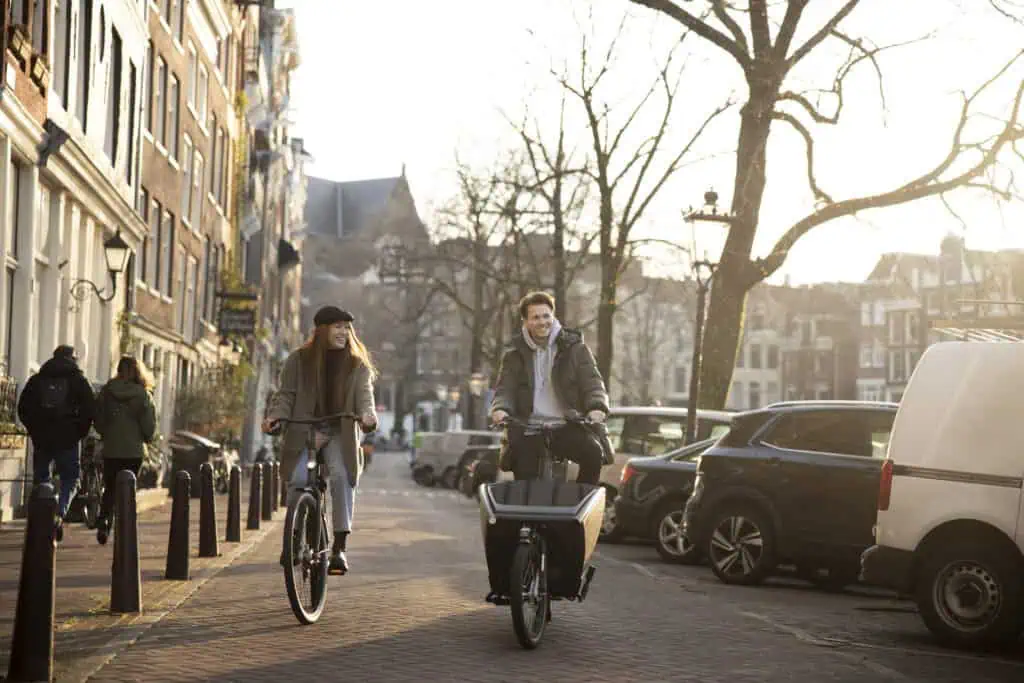
There’s no experiencing the Netherlands without hopping on a bicycle and enjoying a few kilometres of the amazing 153,000-kilometre-long network of cycling paths.
However, to make the most of this unique experience, you’ll want to be dressed for the occasion.
Flip flops and mini skirts look cute, but they might not be the best bet when you’re breezing through the windy Dutch seaside towns.
Instead, opt for comfortable pants and sneakers. If you do wish to look a bit more elegant, we recommend getting a pair of mini shorts to wear under your skirt or dress.
You’ll want to make sure that you’re comfortable when you’re exploring Dutch cities and landscapes by bike. Image: Freepik
For extra comfort in the winter, make sure you have a scarf and something to keep your ears warm. Handlebar mittens can be an effective and convenient solution for cold hands.
And always remember — it can start pouring at any moment, so don’t forget to throw a rain poncho or other rain gear in your bag before you head out.
4. A European power adapter
Unless you’re coming from another European country, you will need a power adapter. The Netherlands uses type C and type F plugs.
If you forgot yours, you can usually find them at the airport or check out one of the popular Dutch stores. Head to Action or Blokker for cheap adapters, or try Kruidvat if you want a more fancy one.
5. A debit card & some cash
Not every establishment in the Netherlands accepts credit cards, and AmEx can be especially problematic.
The most convenient way to pay? Ditch your credit card and use a debit card. You can use it not only in stores and restaurants but also on public transportation and in public toilets.
Debit card and cash are your best bets when it comes to paying in the Netherlands. Not all establishments accept credit cards. Image: Freepik
Cash is the next best thing in places where your credit card won’t work. Maar let op! (But watch out!) Some places are PIN ONLY, which means you can’t pay there with cash.
Note: Surviving with just your credit card might be possible in more touristic places like Amsterdam — but don’t count on it once you venture off the beaten track.
6. A trustworthy translation app
It’s true that the Dutch speak excellent English. However, you might still end up in situations where a translation app is the only way to understand what’s happening.
You might also want to use a translation app for street signs and other information in public spaces that might only be in Dutch — it could save you from walking into the wrong bathroom.
The one caveat of translation apps? They don’t always work without the internet. That’s why it pays off to purchase an eSIM for your Dutch travels. With Yesim, you can choose from multiple packages for the Netherlands depending on your needs. Get 15% off your first purchase with the code DUTCHREVIEW15.
7. A location-specific weather app
We’ve already established that the weather in the Netherlands is highly unpredictable and can go from gorgeous sunshine to a nasty downpour mixed with hail in a matter of minutes.
Luckily, there are handy apps local to the Netherlands that ensure you are (almost) always prepared for what’s to come.
The two most common weather apps used in the Netherlands are Buienradar (rain radar) and Buienalarm (rain alarm).
Having a weather app in the Netherlands can help you avoid some unpleasant surprises. Image: Depositphotos
They’re usually fairly accurate and show not only the forecast for a few hours ahead but also how strong the rain is at any given moment on a scale from light to heavy to way beyond heavy.
8. A decent water bottle
Most tap water is safe to drink in the Netherlands and you’ll find convenient water fountains in many public places.
Why are we telling you this? Many restaurants don’t offer free tap water (despite technically being legally required to).
That’s why it’s convenient to bring your own water bottle and refill it wherever you go. It reduces plastic pollution and is kinder to your wallet (a large bottle of water can set you back as much as €6 in Dutch restaurants nowadays). It’s a win-win!
With all the right clothing and other handy tools and items, you’ll be able to enjoy the Netherlands’ major cities and hidden gems alike in any kind of weather.
What would you recommend people bring for traveling around the Netherlands? Leave your suggestions in the comments below!
The Dutch are known for their engineering feats, especially with anything relating to water, but did they really have to build stairs that felt like climbing Everest?
What is it?
Most people learn how to climb and descend stairs by the time they’re four or five years old, but seeing these bad boys will make you rethink anything you’ve ever known about stair safety.
These stairs are steep and narrow enough to get fully grown people to cling to the bannister in fear.
Why do they do it?
These notorious stairs have their history in the 16th, 17th and 18th centuries. Most residential areas in the Netherlands are built upon softer soil and need very strong foundational structures to keep the buildings upright. 🏘
On top of that (literally) was the fact that the Dutch authorities started taxing people for the width of their home’s facade! The result? Very narrow houses.
the only thing I will not miss about The Netherlands is carrying three people’s luggage up these steep ass narrow ass beautiful ass stairs pic.twitter.com/sfM20xUBBB
This didn’t just come down to taxes either. There also wasn’t much space for residential areas, a lot of the land being reclaimed from the sea and all.
So, if Dutchies couldn’t build out, they would build up.
Combine these two things, and you have narrow and somewhat crooked houses overall and even narrower and crooked stairs inside.
Why is it quirky?
Most people don’t realise it until they move into one of these houses, but there are actually quite a few drawbacks to this Dutch architectural phenomenon.
It’s practically impossible to bring any big pieces of furniture up or down the stairs unless they’re flat-packed IKEA furniture. Otherwise, almost every Dutch house has a hoisting hook:
In a simpler version, many moving companies use machines to deliver large pieces of furniture to the upper floors.
These hooks seem equally as dangerous as trying to bring furniture up the stairs. 😬
But, speaking of dangerous, steep stairs are the enemy of a big night out — they’re likely to have you tumbling down to the first floor if you don’t watch your step.
Should you join in?
We suggest you at least get the chance to experience climbing up such a set of stairs, just to see how quickly you can get the chills. We don’t recommend attempting to climb while intoxicated if it is your first time, however.
trying to find a cheap apartment in the netherlands means every single option includes very steep stairs so once i move i’m going to either have really strong legs or broken bones and a concussion
If you’re moving to the Netherlands, you might not really have a chance to choose what kind of stairs you get, but you’ll get the hang of it eventually. 😁
What do you think of this Dutch quirk? Have you experienced it? Tell us in the comments below!
You flick on the kettle, charge your laptop, and feel a small glow of smugness because your energy contract says “100% green.”
But is it actually green? The answer is a bit more complicated than the label suggests.
The short version: yes, you can absolutely get 100% green energy in the Netherlands. The longer version involves a bit of understanding before you switch.
First, a slightly awkward truth about electricity
Once power hits the grid, it’s all mixed. Wind, solar, gas, and nuclear are all jumbled into one big pool.
Nobody can physically send pure wind energy to your sockets unless you fancy building your own private grid.
So when a provider sells you “100% green,” they’re not piping you a special clean stream. They’re matching your usage through certificates.
No energy provider can send you 100% green energy. Image: Magnific
How “100% green” actually works
When a wind farm or solar park generates electricity, it earns a certificate called a Garantie van Oorsprong (GvO) or Guarantee of Origin.
In the Netherlands, these certificates are officially issued and monitored by VertiCer (a Dutch organisation responsible for certifying renewable energy and biomass).
One certificate represents 1,000 kWh of green electricity, with details on where and how it was produced.
When you sign a green contract, your supplier redeems enough of these certificates to match what you use over the year.
It’s a tracking system, not a separate set of wires. But it does mean your money supports renewable generation — which is the point, really.
☀️ Looking for a green energy provider? Vattenfall supplies electricity backed by Guarantees of Origin and is committed to a future where we’re less dependent on the use of fossil fuels for energy. It’s a straightforward option if you want to power your home more sustainably without the admin headache.Check out Vattenfall’s energy plans.
Not all green is equally green
Here’s where the fine print matters. Some suppliers buy cheap certificates from foreign hydropower plants without investing a cent in new Dutch renewables. Others actually build local wind and solar.
To tell them apart, check the Stroomscore, an independent ranking from groups like the Consumentenbond and Natuur & Milieu that scores providers on where their energy comes from and whether they invest in new green production.
The greenest pick? Look for “100% Dutch wind or solar” rather than a vague mix.
There are ways to opt for green energy with your provider. Image: Magnific
What about gas?
If your home runs on gas — and most Dutch homes still do — “green gas” gets trickier.
Truly green gas
Genuinely green gas (groen gas) is biogas made from organic waste, but it’s still a developing market.
CO2-compensated gas
Much of what’s sold as “green” is actually natural gas, where the supplier offsets the emissions through projects like tree planting. Better than nothing, but not the same as renewable.
So, how do I actually get green energy?
Switching your supply takes less than 10 minutes online. Let’s run through it:
Check the Stroomscore for various providers: See which Dutch providers score closest to a perfect 10.
Filter for Dutch sources: Use a comparison site and check the filters for “100% Dutch wind” (Nederlandse wind) or “Dutch solar” (Nederlandse zon).
Sign up online: Once you select a green tariff, enter your address and estimated annual usage (found on your current smart meter or previous utility bill).
Let your provider handle the transition: Your new supplier will cancel your old contract automatically. All you need to do is submit your final meter readings on the day of the switch if you do not have a smart meter.
Have you switched to a green energy contract yet, or are you holding out for solar panels? Drop your experiences in the comments below.
The large-scale herring fishing in the Netherlands started during the Golden Age. Since then, Dutch herring and the ‘Hollandse Nieuwe’ have become a delicacy with culinary fans all over the world. 🐟
The herring fleets of the 15th century also gave birth to the all-powerful Dutch merchant navy.
To the Dutch, herring had become an indispensable source of proteins and nutrients, thanks to which the population could grow (really, really tall).
Herring in the Netherlands: the basics
Eating herring in the Netherlands is a Dutch tradition. Lots of tourists find it exciting to buy herring for the first time, grab the whole fish by its tail, and let it slide down their throats in typical Dutch fashion.
The Netherlands and herring are inextricably linked, and no fish is more Dutch than the popular so-called Hollandse Nieuwe!
A herring is a small, slender, silvery fish. About a quarter of its body weight can consist of fat. Herrings can become eight to ten years old.
After two to three years, the herring is mature and about twenty centimetres long. For a while, the herring was heavily overfished and almost on the brink of extinction.
Thankfully, the species is thriving again due to global quotas restricting the number of herring fishermen are allowed to harvest at a time.
Where exactly does the herring come from?
Herring comes from the eastern part of the North Sea, and most herring can be found in the waters around Norway and Denmark.
Some can also be found a little bit to the eastern part of the North Sea, near Scotland.
Hold up — does that mean my herring ain’t Dutch?? 😳 Image: Depositphotos
Almost all the herring eaten in the Netherlands is caught by Danish and Norwegian companies, while Dutch companies with factories in Skagen, Denmark, prepare them and bring them back to the Netherlands to sell.
The opening of the herring season in the Netherlands
The traditional auction of the first keg of herring takes place in Scheveningen every year, with proceeds going to charity. In 2009, a record revenue of more than €66,000 was gained from the auction.
A day after the auction, the herring season officially starts, and the following Saturday is called Flags Day.
Traditionally, the auction only involves the sale of Dutch herring called Hollandse Nieuwe. 👇
What is Hollandse Nieuwe Herring?
The name can sometimes be confusing. It raises the question: when is a herring both Dutch (Hollandse) and new (Nieuwe)?
Well, herring may only be called Hollandse Nieuwe if it has a certain percentage of fat — at least 16% — and has been cleaned the right way.
It is typically caught between May and September and can be quite scarce in the winter months.
The name maatje or maatjes herring is derived from virgin herring. This means that the herring caught does not yet contain a roe and may not be ready for the Hollandse Nieuwe name.
Vlaggetjesdag (Flags Day) in the Netherlands
Vlaggetjesdag (Flags Day) has a long and interesting history, though it has only had its name since 1947.
According to history books, there was a ban on catching too many herrings from the sea in the 18th century. Due to the ban, fishermen had to focus on other species such as the flatfish.
Only a limited number of fishermen were allowed to sail out to catch the herring — usually, only about 10 boats were allowed to leave every day.
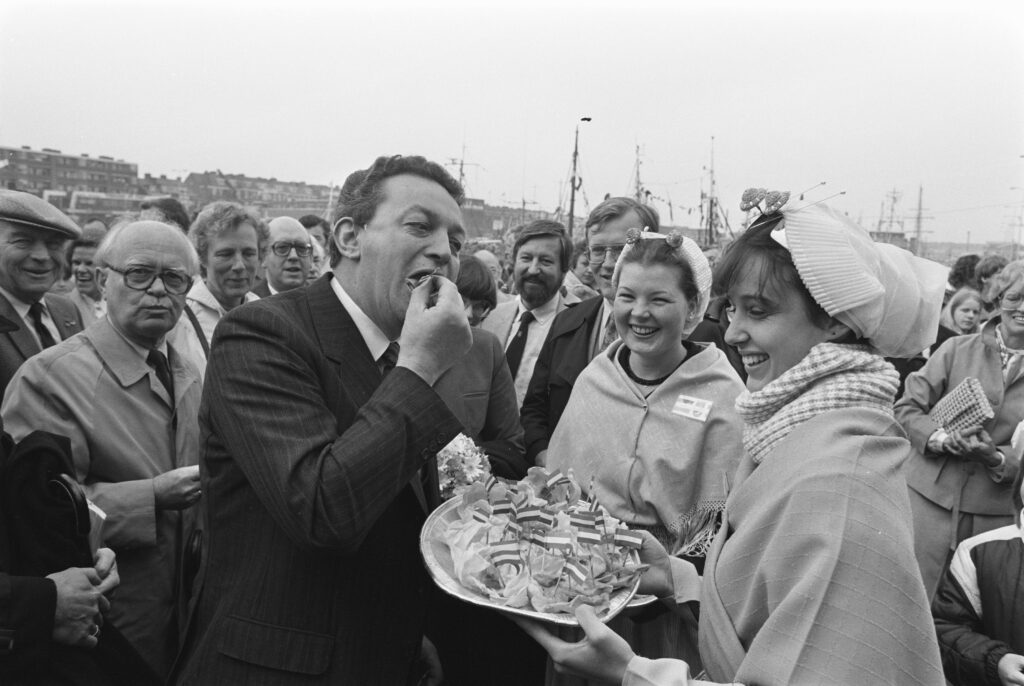
Lekker! Dutch Minister Gerrit Braks eating herring at Flags Day in 1983. Image: Rob Croes/Wikimedia Commons/CC0 1.0
The first herring caught by any of the 10 boats was traditionally awarded to a high-ranking person (like a mayor, or even stadtholder). The tradition started because Stadtholder Willem V was present on a regular basis to check the departure of the boats.
The fishermen enjoyed the statesman’s official presence and decorated their villages with flags to welcome him (hence Flags Day!).
An official Vlaggetjesdag Committee was established in 1950 and has been in charge of all the festivities surrounding Flags Day ever since.
Preparing herring or ‘gibbing’
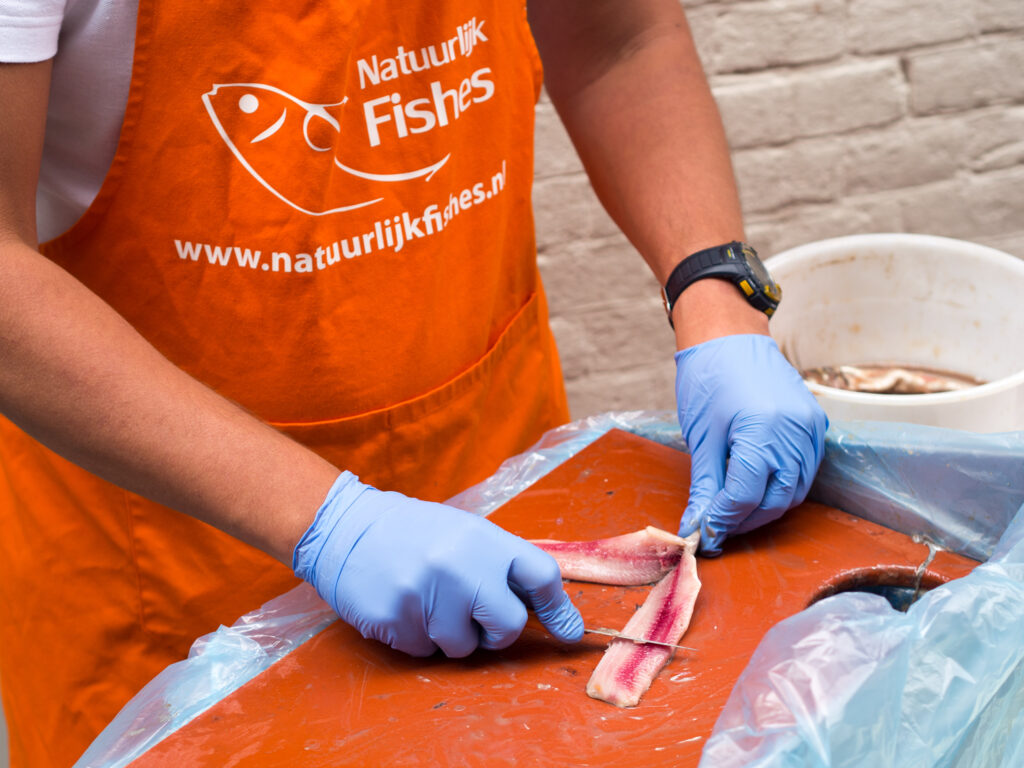
Gibbing is the process of preparing salt herring, which en-tail-s (get it 😉) the removal of the gills and part of the gullet with a specially designed knife.
However, the liver and pancreas remain untouched because they release enzymes essential for flavour.
Gibbing also involves the removal of the heart and the intestines, after which the fish is stored in a wooden barrel with salt. In this way, the herring can be stored for long periods and transported more easily.
Cleaning a herring is a fine craft. Image: Takeaway/Wikimedia Commons/CC BY-SA 3.0
Haringhappen in the Netherlands
Haringhappen is a Dutch tradition that was borrowed from the Catholic faith. During Lent, Catholics are prohibited from eating meat so Dutch Catholics ate herring to usher in the fasting period after the carnival.
The Wednesday after carnival is officially called Ash Wednesday and has traditionally been a Catholic event where Christians get an ash cross on their forehead — as a sign of penance and a moment of contemplation.
After getting their ash crosses, Dutch locals usually tuck into some herring at home. Thus began the tradition of eating herring on Ash Wednesday and also during Lent.
How to eat herring in the Netherlands
For tourists coming to the Netherlands, especially for the first time, eating herring is something that must be done the right way to avoid judgmental looks from Dutch locals.
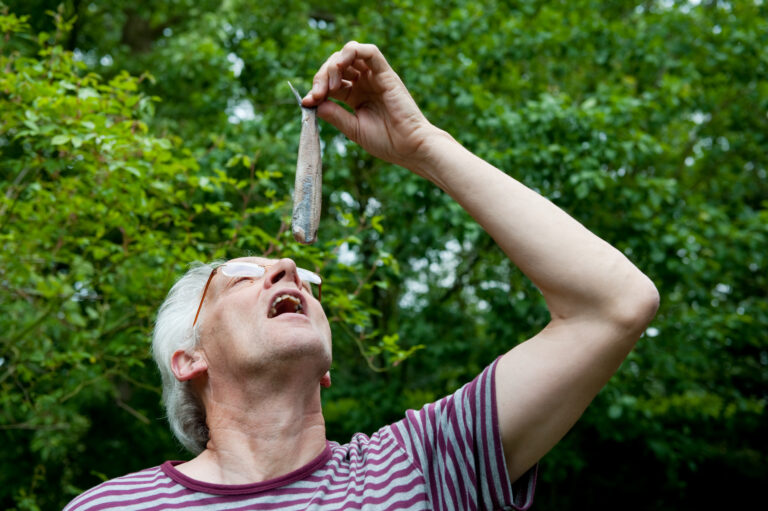
So without further ado: it’s customary to grab a salty herring by the tail and then let it slide down your throat.
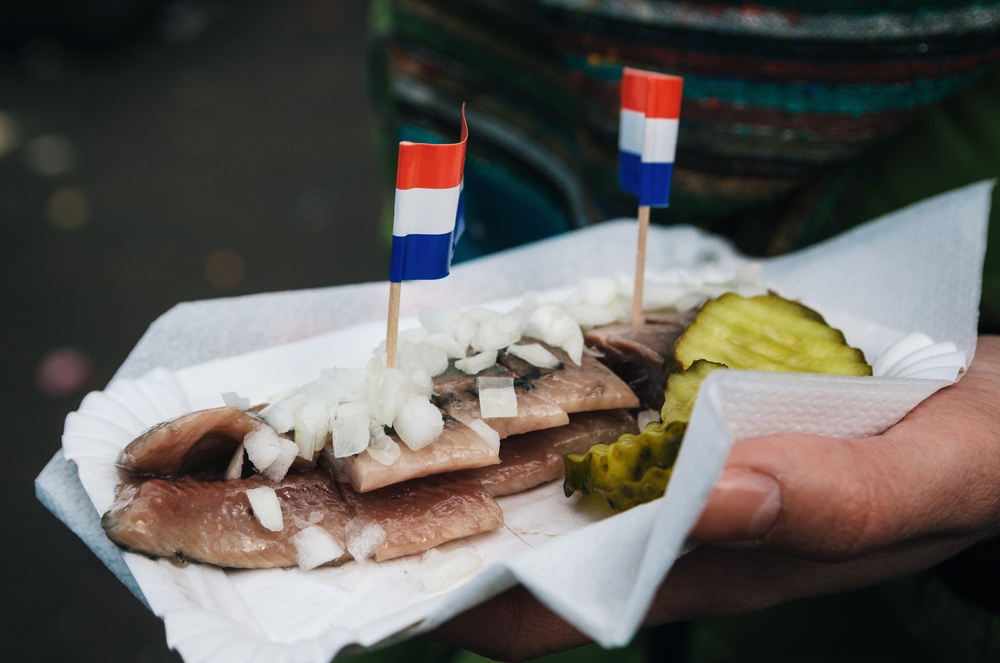
Often this is done with onions to somewhat neutralise the strong taste of the herring. Tourists usually find it a disgusting way of eating fish, and there are lots of Dutch folks who don’t like it either.
But you don’t necessarily have to eat herring raw. It can also be eaten fried or smoked.
Eating herring in the Netherlands: You either love it or hate it. Image: DutchReview
Some fun facts about the Dutch herring
About 50 billion herring swim in the North Sea every year.
At a certain point during the Dutch Golden Age, the Netherlands had 80% of the herring market and made so much money from the herring trade that they were easily among the top three richest countries in Europe.
You can use your phone to judge how fresh your herring is. The app “How fresh is your fish?” can be used to determine and judge the freshness of 15 fish species, herring included. The app is free to download for iPhone and Android phones.
The closing of the North Sea to herring fishing in 1977 forced Dutch fishermen and herring buyers to move to some Scandinavian countries permanently. Denmark turned out to be the most suitable place for them.
More than 80% of the herring eaten in the Netherlands isn’t caught here. Only two ships in the Netherlands are actively catching herring in Scheveningen.
You can only eat herring during the herring season and in the Netherlands, the season starts in the month of June. In Scandinavia, that is usually in the period from May to July.
Eating herring is healthy because it’s a fatty fish. Herring contains omega-3 fatty acids, which act as protection against heart diseases.
So whether you live in the Netherlands or you’re just visiting, don’t forget to take part in the popular Haringhappen.
But whatever you do, please don’t eat herring with cutlery. Pick it up by the tail and slide it down your throat like a true Dutchie!
Have you ever tried eating herring in the Netherlands? Did you like it? Tell us in the comments!
When you think of the Netherlands, what’s the first thing that springs to mind? Is it windmills, cheese, or tulips? Or maybe it’s the infamous Tikkie — an online payment system where you can send people requests for absurdly small amounts of money.
There’s no official rule book for using Tikkie — but there really should be one. With their reputation for being both direct and stingy, Dutch people seem to have no problems navigating the unspoken rules of the payment platform.
For internationals who come from less direct cultures, though, the art (or extreme sport, if you’re Dutch) of Tikkie-ing can be quite the minefield.
What’s an appropriate amount to request a Tikkie for?
Anyone who’s lived in the Netherlands for a while has probably realised that the idea of reciprocity, or doing rounds, doesn’t really exist here. Don’t get us wrong, this can have its advantages… But not that many. 😂
Instead of living by the rules of reciprocity, Dutchies prefer to settle the bill (no matter how big or small) as soon as possible to make sure no person is indebted to another.
Make sure to count every little cent! Image: Magnific
In other words, if you’ve ever interacted with Dutch people, you’ve probably received a Tikkie for €0.80 or an equally negligible amount.
You should not be surprised if you’ve received a Tikkie from a guy you went on a date with who wants to be reimbursed for the €0.50 contribution he made so you could use the public toilet 🚽.
Or from a friend who covered the €1.50 you needed for a morning coffee. ☕
While having an easy way to request your money is great, we’d suggest holding off on those Tikkies for less than €4 at the cost of looking heel stingy. 💸
When is it socially acceptable to send a Tikkie?
We asked the DutchReview readers for their opinions, and the general consensus is that the sooner you send that Tikkie, the better.
Maybe don’t send it while you’re still seated at the restaurant, having just put your forks down — that might come off as a little desperate. But if you send it when you get home or the next morning, you’re generally good to go.
With Tikkies, timing is everything. Image: Depositphotos
When is it appropriate to send a Tikkie follow-up request?
If a week or more has passed and your money’s still conspicuously absent from your bank account, go ahead and send a follow-up request.
But not the next day — people are busy, and sometimes international bank transfers take a bit of time.
What if you forget to send the Tikkie — how long do you have?
The amount of time permissible for a Tikkie request kind of depends on the amount of money that you’re asking for. There’s nothing less charming than bamboozling someone with a €2 Tikkie for a party you went to two months ago. Don’t do that. People won’t like you for it. 🙄
But say you’re going through your bank account, and remember that you paid €30 for a friend two months ago. Then you’re well within your rights to send a Tikkie, and everyone will respect you for it.
The jury is still out on sums between €10-€20 — but we think a safe rule of thumb is that if you haven’t sent that Tikkie within a month, you should see that round of drinks as being on you. 🍻
Where do you stand on the highly-debated subject of Tikkies? Tell us in the comments below!
Once on their fiets (bike), the Dutch own the road and it’s truly amazing to watch as you know in your heart it’s possibly the worst mistake to stand in their way.
Here are the eight most amazing superhero things the Dutch effortlessly do when it comes to biking. 🚲
1. The Dutch pedal in style
Dutchies ride their bikes everywhere — no exceptions.
Going to a wedding dressed in their finery on a bike? Of course! Why not? Especially since there’s no helmet involved.
Dresses, heels, suits, and perfect hair — because no helmets. Image: Depositphotos
After all, who said a bike can’t do what a car can.
2. One bike is never enough
Echt serieus! The Dutch own bikes like farmers own cows!
You can easily find more bikes in a house than the actual number of family members.
It’s not abnormal for a Dutchie to own three bikes: one for everyday use, one for road cycling, and one as a backup — just in case the other two fail.
3. Cycling the dog is better than walking the dog
The Dutch really like to maximize their me-time. So they have their very own version of walking the dog: cycle the dog!
The smaller dogs sit in the front basket, while the larger ones are leashed and run alongside the bike.
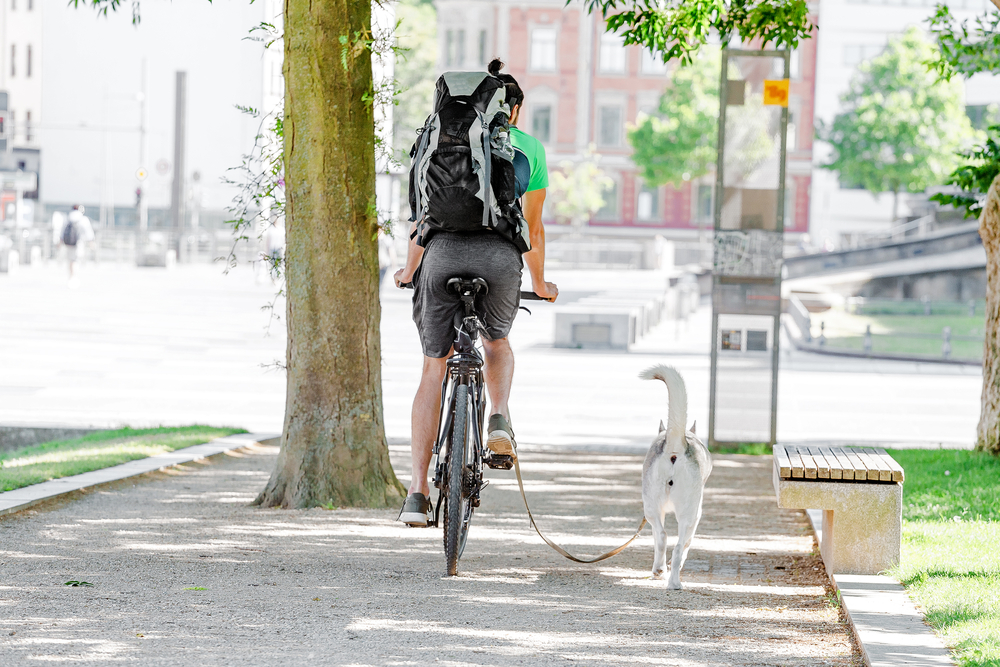
A string attached to a live animal on a moving, balanced object. What could go wrong? Image: Depositphotos
Finally, you’ve heard of putting your kids in a bakfiets, but why not put your fur-baby in a carrier of their own?
A hondentrailer attaches to the back of Dutchies’ bikes so they can bring their dogs wherever they go. 🧺
4. Childhood in the Netherlands begins on two wheels
Starting early? We think the Dutch invented it. You can often see Dutch parents in the park, encouraging their toddlers who can barely waddle to ride bikes of their own.
We honestly think Dutch kids learn how to bike before they walk!
5. Bikes should be pretty too
The amount of money that the Dutch spend on their bike accessories is jaw-dropping.
Dutch bikes are equivalent to a Batmobile, coming fully equipped with everything: storm umbrellas, baskets, grocery bags, bottle holders, extra lights, special lights, baby carriers, and a phone holder.
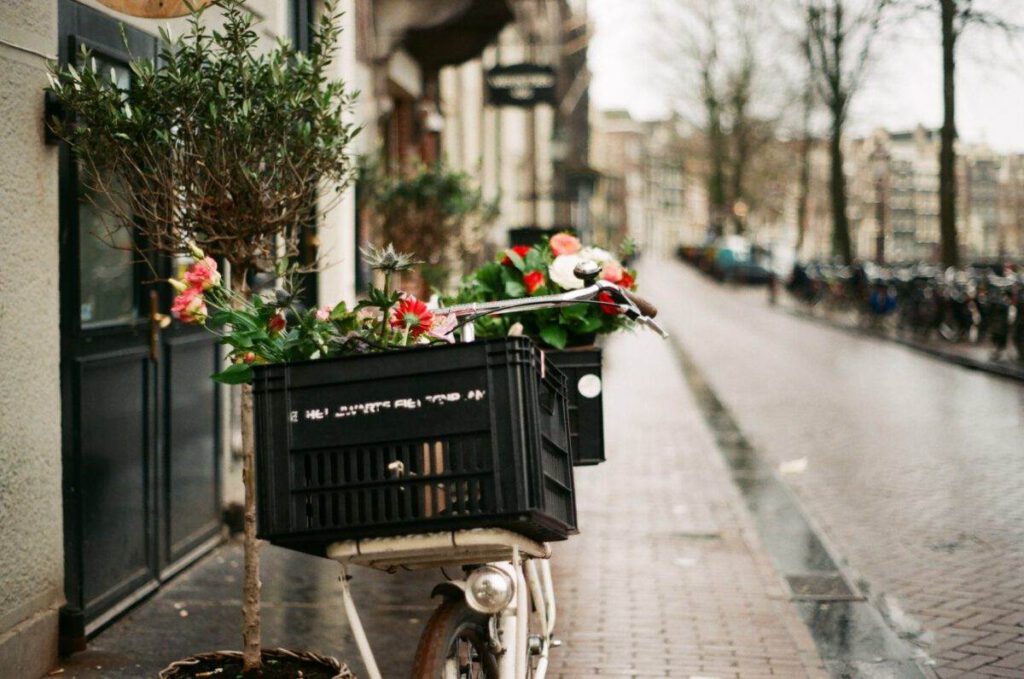
If Dutchies have plans to ride their bike everywhere for every occasion, you can bet it looks pretty! Image: Unsplash
Some even accessorise their bikes when the weather changes in the spring and summer to celebrate!
Of course, when something is so dear to your heart (and wallet), you lock it up! You’ll typically find at least two to three locks on the average Dutch bike.
Here’s another fun fact: the locks on a bike can sometimes cost half as much as the bike itself. 😅
6. The Dutchies’ love for their bikes is undying
Date a Dutchie, and you will always be their second love (after the bike, of course).
Don’t be surprised if the idea of a fun date with a Dutchie is being on a tandem bike, because forget the third wheel… not.
The Dutch should seriously coin a name for this one because they make it look like the norm as they showcase effortless balance biking while texting, even in their high heels, jackets or corporate wear!
Biking has also created a new division of secretly operating professionals called bike fishermen.
Yes, that’s an actual profession here in the Netherlands.
After all, it’s very necessary: after a hard night of partying, and especially after an Ajax game or New Year’s, a huge number of bikes end up in canals — and someone has to get them out!
What do you think is the most amazing thing about Dutchies on their bikes? Tell us in the comments below!
Rents across the Netherlands rose on July 1, and that shift could change how much housing allowance you’re entitled to.
According to AD, you might now qualify for more huurtoeslag, risk having to repay some later, or finally qualify to receive it.
Huurtoeslag works as an advance. The real amount only gets settled once 2026 ends, so any mismatch between your estimated income or rent for 2026 and reality gets corrected then.
This can result either in your getting a bit more money from the government at the end of the year, or on the other side of the spectrum, paying money back to the government.
What changed with your rent
This is why reporting any changes to your rent is super important.
As of July 1, landlords in the social housing sector could raise rent by up to 4.1%, according to the Huurcommissie. Meanwhile, rent under €350 a month could expect a flat €25 increase instead.
And higher earners faced steeper rises. A combined household income above €68,858 allowed a €50 monthly bump, and if that went above €93,531, your rent could climb by €100.
Why this trips people up
Let’s say your rent, like a certain writer’s, went up by €35 on July 1. The good news is that higher rent usually means more huurtoeslag.
Great, right? But landlords, being landlords, don’t always pass your new rent figure on to the Dienst Toeslagen (Tax Authorities’ benefits office).
This means it’s up to you to update your rent in Mijn Toeslagen. And the Belastingdienst requires any change to be reported within four weeks, so it’s worth doing now if you haven’t already.
You can do this through the Toeslagen app or via Mijn Toeslagen on toeslagen.nl.
Not receiving huurtoeslag yet? Well, your rent increase could mean that you now qualify. The same site lets you run a trial calculation to check this.
Another thing worth considering: Your AOW (state pension) also rose on July 1. That can push your reported income up, which affects your toeslagen (benefits) as well.