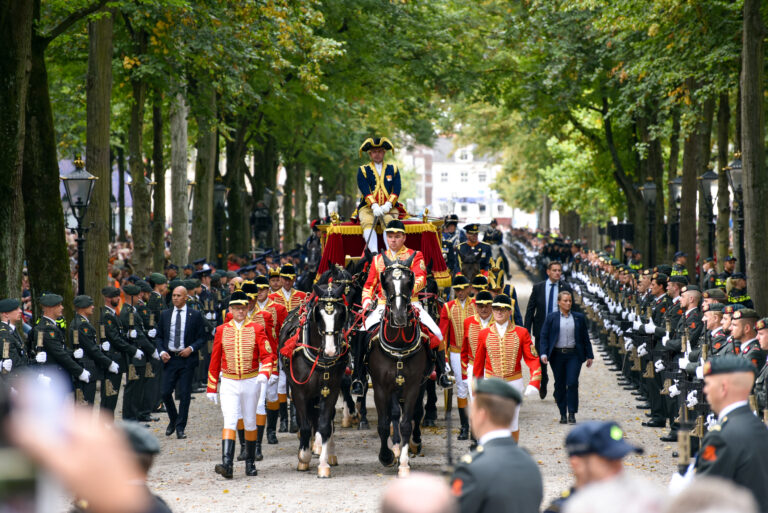
Prinsjesdag (Prince’s day, or the Dutch annual Budget Day) is usually a day of pomp, pageantry, and precariously balanced hats, but it comes with a blustery twist this year.
Today (September 16), The Hague will not only play host to the royal procession and King Willem-Alexander’s Speech from the Throne, but also winds gusts up to 70 km/h.
Hats versus hurricane
If there’s ever been a year to add bobby pins to your Prinsjesdag kit, this is it.
With Weeronline predicting numerous showers across the north and centre of the country, guests are being warned that the traditional parade of extravagant hats may turn into a battle against the breeze.
The Royal Theatre, where the king delivers his speech, even had to tape down the red carpet to stop it from flying away.
What’s Prinsjesdag?
Every third Tuesday of September, the Netherlands polishes its Glazen Koets (Glass Carriage), rolls out the red carpet, and gets ready for one of the most popular political events of the year: Prinsjesdag.
In particular, this is when the cabinet presents its Miljoenennota (Budget Memorandum), in which they announce the government’s main financial plans for the following year.
For starters, the NOS points out that the outgoing Schoof cabinet has lost half its coalition: first the PVV in June, then the NSC in August, leaving only VVD and BBB with just 32 of 150 seats.
This marks the first time that an entire party quit an already fallen cabinet.
Adding insult to injury, Prime Minister Schoof has described the Budget Memorandum as “policy-poor” with no radical measures, since every proposal must be crafted to win support from opposition parties.
Here’s what to expect from the new Budget Memorandum
The unstable political climate means that big issues such as the nitrogen crisis and the housing shortage remain unresolved, even though the economy continues to perform steadily.
From leaked documents obtained by the NOS, several policies are currently on the table:
A rise of €3 per month in health insurance premiums
An extension of the discounted excise duty for petrol, diesel, and LPG
Scrapping proposed budget cuts to public transport in the Amsterdam, Rotterdam, and Hague regions
A 1.2% rise in income, 1.3% rise in benefits, and 1.5% in pensions
However, we can expect to know more when the official decisions are released this afternoon.
So, whether you’re tuning in for the political message, the hats (or lack thereof), or the sheer spectacle of keeping tradition alive in stormy weather, Prinsjesdag 2025 promises to be an unforgettable show.
Do you plan on going, or will you enjoy it from the sofa without the wind? Tell us in the comments below!
Ah, King Willem-Alexander: a character both admired and hated throughout the Kingdom of the Netherlands. The Dutch certainly love criticising him and his many slip-ups!
In a geographically tiny country like the Netherlands, it’s no surprise that news and gossip travel fast.
So, when the King messes up, the Dutch quickly take part in one of their favourite national sports: hating on the royals. 🤴🏽
What is it?
The Dutch don’t like it when the King messes up, and they will certainly let their opinions be heard.
Especially during the pandemic, when Willem-Alexander suffered from backlash after quite a few whoopsie-doopsies in the area of “following the regulations”.
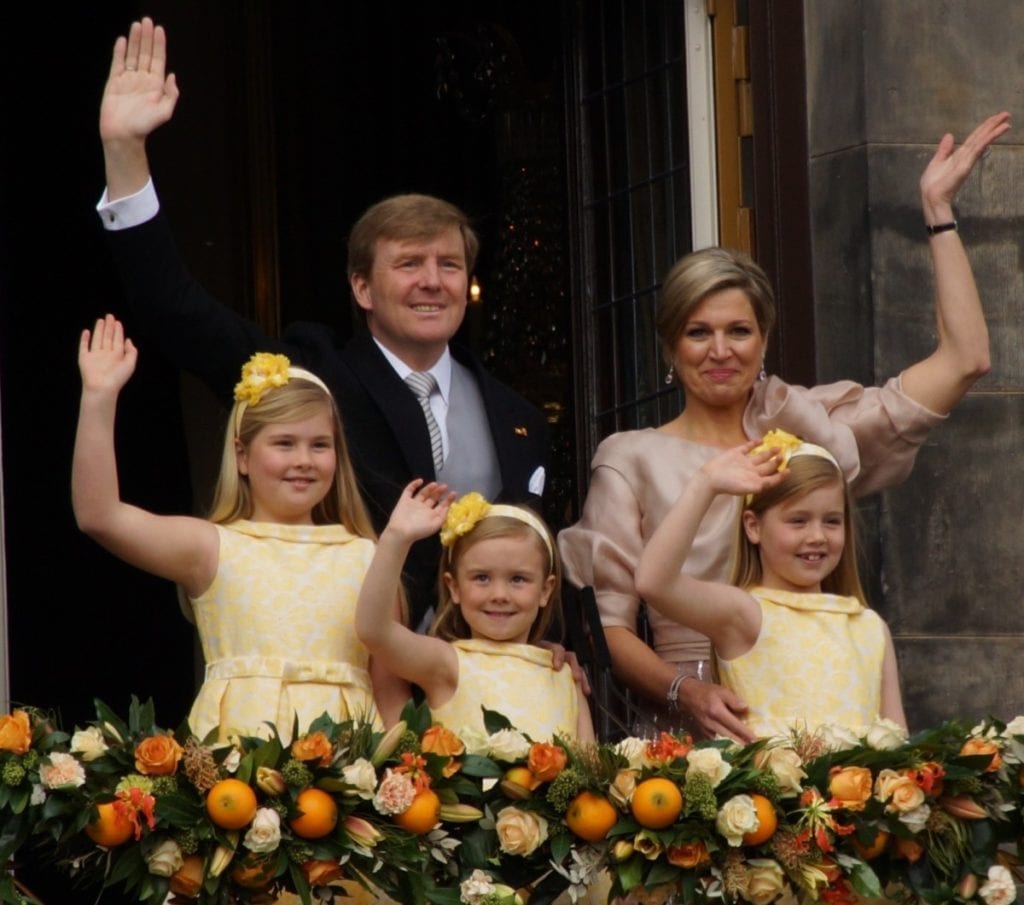
Here’s a lovely throwback picture of the often controversial Dutch royal family from 2013. Image: Floris Looijesteijn/Wikimedia Commons/CC2.0
Just one example was when the Dutch really didn’t like it when the royal family decided to take a lovely little vacation from the pandemic-ridden Dutch society in 2020 and headed off to Greece!
People also got mad when the future queen of the Netherlands, Princess Amalia, was allowed to have 21 people over for her birthday party — and we regular folks were only allowed four… 😒
Tsk tsk tsk, the King has received tons of hate over the years… But if he wants to climb on the popularity ladder in the future, it might be an idea to work on learning from his mistakes.
The Dutch love to keep criticising him, and he’s not exactly working hard to make them stop.
But hey, all PR is good PR, right? … Right? 😅
Why do they do it?
People have been hating on their kings for as long as the concept of kings has been a thing, to a more or less public extent. But why is it such a noticeable thing in Dutch society?
One explanation could be that the Dutch, being a well-developed and well-functioning democracy, value keeping their rulers in check. Some might even say it’s healthy to hate on the ruling elite a little bit.
People don’t tend to like it when politicians and other authority figures place themselves above regular people, and the Dutch are especially notorious for this attitude.
That’s why Dutchies loved it when former Prime Minister Mark Rutte showed his “just a regular guy” side and biked to work. Or when Princess Amalia turned down her royal allowance to get more in tune with the normal Dutch folks on the street. How adorable.
What the Dutch?
Window washer with ladder almost bikes into King Willem-Alexander. Nobody got hurt and both have a good story to tell!#Egalitarianism
Or perhaps the Dutch just really like to come across as cool, hip, following with the times, reading the (political) room, etc.
In times of democracy, it’s just not that hot to have a monarchy anymore, and everyone knows how much the Dutch like being seen as progressive and fresh. 😎
Why is it quirky?
If you’re from a country with less freedom of speech than the Netherlands, you might view the outspokenness of the Dutch as quirky and bold.
However, it’s not dangerous, frowned upon, or unpopular to hate on the King and all his blunders. Quite the opposite, in fact!
But the Dutch hatred for their king is even more quirky when you realise that they don’t seem to want to get rid of the royal family anytime soon… 🤷🏽♂️
For starters, the King’s birthday is celebrated like crazy every single year. There’s no holiday more intensely Dutch and monarchical at the same time.
It also seems to be a general perception that the monarchy is here to stay, for God knows what reason.
Should you join in?
If you want to blend into Dutch society, you should definitely practice some King-dissing jokes and get on with the trend of disliking Willy-boy.
That is, as long as you don’t mind the hypocrisy that comes with it, because you’ll also have to be very excited about the King’s birthday if you want to be taken for a real Dutchie.
What do you think of this Dutch quirk? Have you experienced it? Tell us in the comments below!
More than 220 employees at Amsterdam-based Booking.com have signed a new petition calling on their employer to stop profiting from accommodations in illegal Israeli settlements.
However, CEO Glenn Fogel shows no signs of budging, despite mounting internal pressure and international criticism.
Employees are clear: “Booking must choose”
The latest internal petition, distributed last Thursday and seen by NRC, demands that the company immediately stop offering accommodations in the West Bank.
It’s just the latest chapter in a years-long internal battle that’s creating what staff describe as “serious reputational damage, burn-outs and disillusionment” within the tech giant.
The petition writers didn’t mince words: “This is a matter of integrity, legality and protecting the future of our company. Booking must choose. Show dignity or be remembered as the company that profited from one of the greatest crimes of the 21st century.”
Internal battles and corporate censorship
The employee unrest at Booking.com goes back to 2018, but tensions had already escalated dramatically since Hamas’s attack on 7 October 2023.
What’s making tensions worse is that Booking opened an important office in Tel Aviv in 2021. According to sources, the Tel Aviv office is gaining influence, giving pro-Israeli employees a more prominent role within the company.
Two weeks after the war began, Booking management sent an email to all staff asking them to keep non-work-related messages “to a minimum.”
Since then, Booking has been attempting to manage internal discussions, which many employees perceive as outright censorship. The company’s compliance department now closely monitors Booking’s internal forum Blink and removes posts that violate guidelines.
When profit meets principle
Despite the internal pressure, CEO Glenn Fogel remains unmoved. During a Q&A with employees on 5 September last year, he made his position crystal clear: Booking offers services everywhere the law allows.
“Our mission is to make it easier for everyone to experience the world,” Fogel told his workforce. “We have never said we won’t do business somewhere because we disagree with something.”
The company also took note of Airbnb’s experience. In 2018, Airbnb decided to remove all listings in the West Bank but reversed its decision within six months after legal challenges.
The expat workplace dilemma
As one of the Netherlands’ largest tech employers, Booking.com’s Amsterdam office houses thousands of international workers from across the globe.
For many expats, it has been a reliable employer in a notoriously competitive Dutch job market, especially for those who don’t yet speak Dutch.
The internal protests highlight a broader question for expats working at major Dutch companies: what happens when your employer’s decisions conflict with your personal values, especially when you’re building a life in a new country?
Are you working at booking in Amsterdam and want to give us an insider-perspective? Send us a private message on one of our channels!
There’s no better way to soak up the beauty of Amsterdam than by hopping on your fiets (bike) for a day of adventure.
With flat landscapes, charming villages, and stunning waterways, cycling is not only a budget-friendly way to explore but also a quintessentially Dutch experience. But… where should you go?
There are many popular cycling routes in and around the beloved Dutch capital, so get your cycling gear on and let’s hit the road!
Ready to see the Netherlands beyond Amsterdam? We highly recommend checking out the Zaan Region! Just north of the capital, it offers a perfect blend of history, culture, and nature.
1. Follow the Amstel River for endless canal views
The most famous river in the Netherlands. Image: Depositphotos
The Amstel River route is the perfectAmsterdam adventure, weaving through peaceful canals lined with iconic windmills and historic sights.
The Amstel River is one of the most significant rivers in the Netherlands, flowing through the heart of Amsterdam and into the IJ River.
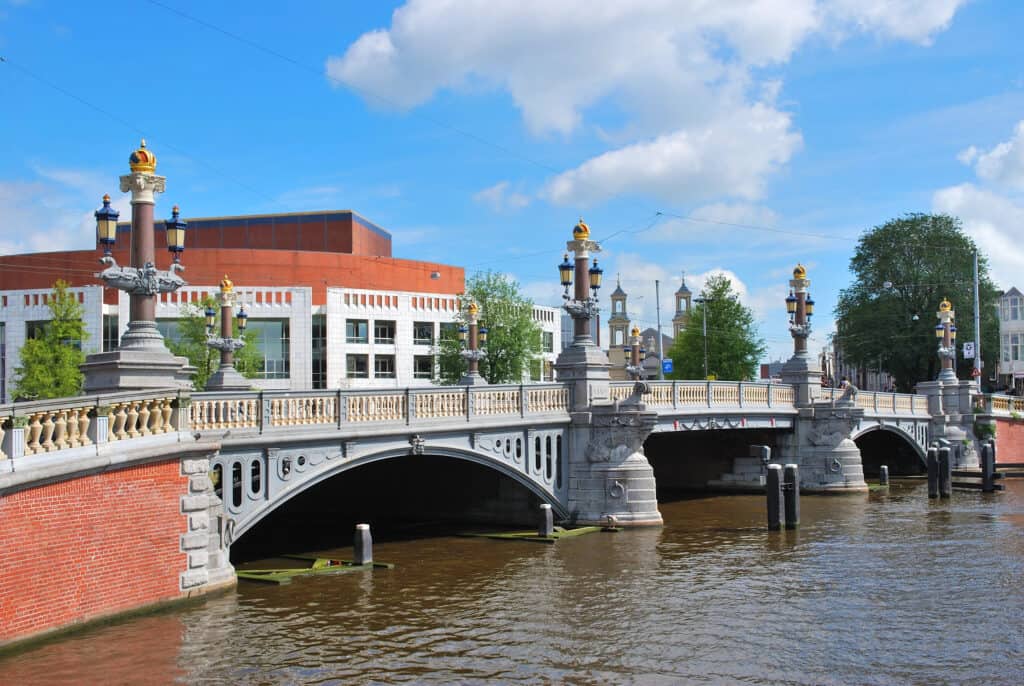
On this route, you’ll come across sights such as the historic Magere Brug, the Amstel Hotel, and the Riekermolen windmill. You’ll also cross through various charming villages, giving you that picture-perfect Dutch experience.
🚴♂️ Distance: 43.5 kilometres ⏰ Duration: 2 hours and 31 minutes 💪 Difficulty: Medium 🗺️ Get the route here.
2. Delve into history by visiting the castles surrounding the city
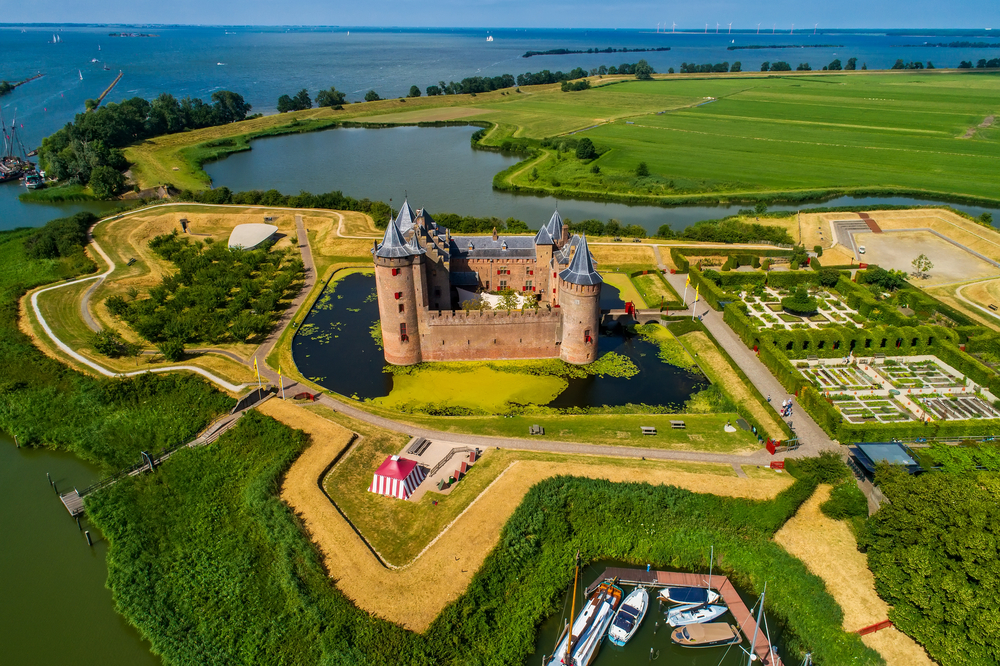
If you venture a little outside the city, you’ll discover the many majestic castles, fortresses and gardens that surround Amsterdam, such as the Muiderslot and the Slot Zuylen.
Some of them used to be part of the Defence Line of Amsterdam (a UNESCO World Heritage Site!), while others were privately owned by wealthy merchants from the Golden Age.
Each castle has its own story, and they all reflect centuries of Dutch history. We highly recommend making a day out of this route, with stops for guided tours along the way.
🚴♂️ Distance: 51.6 kilometres ⏰ Duration: 3 hours and 4 minutes 💪 Difficulty: Medium 🗺️ Get the route here.
3. Explore quintessential Dutch culture in the Zaan region
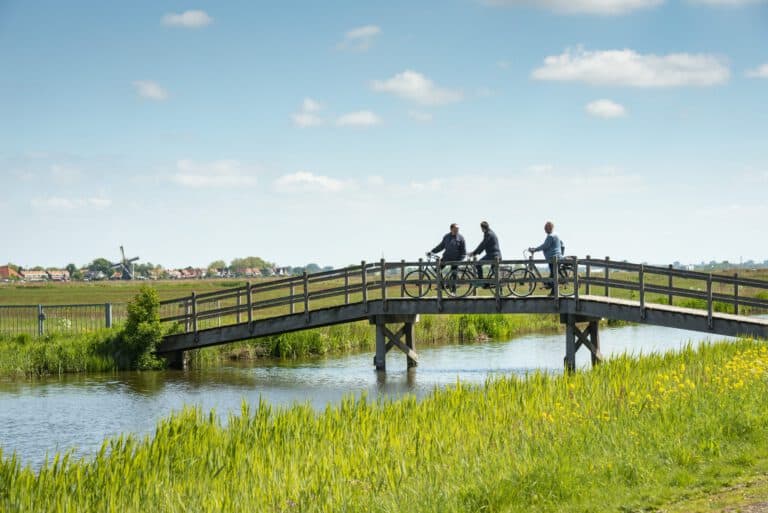
The perfect mix of nature and city. Image: Zaans.nl/Supplied
No trip to Amsterdam is complete without visiting the Zaan region(Zaanstreek) and the iconic Zaanse Schans.
This area is a living museum of Dutch culture, featuring historic windmills, traditional wooden houses, and artisanal workshops.
This route takes you past the wonderful city of Zaandam, and we highly recommend checking it out for a mid-cycle stop. There’s heaps to explore here, from local shops to great food and plenty of history.
After seeing the glorious Zaanse Schans, the way back to Amsterdam takes you through Het Twiske — a 630-hectare recreational area that offers a relaxing end to the day. (And pssst… you might even spot some wildlife!)
Want to know what’s going on in the Zaanstreek? What spots can you absolutely not miss? Or where should you grab lunch while in the area? Head to Zaans.nl for tips from the locals!
🚴♂️ Distance: 43.8 kilometres ⏰ Duration: 2 hours and 36 minutes 💪 Difficulty: Medium 🗺️ Get the route here.
Time to see a lighthouse! Start this trip on the iconic Magere Brug, a traditional wooden drawbridge over the Amstel River.
From here, you’ll slowly make your way into the wetlands that capture the tranquillity of Amsterdam’s countryside.
The route then brings you to the famous harbour towns of Marken and Volendam, where you can take a break to explore cosy shops and taste Dutch snacks along the waterfront.
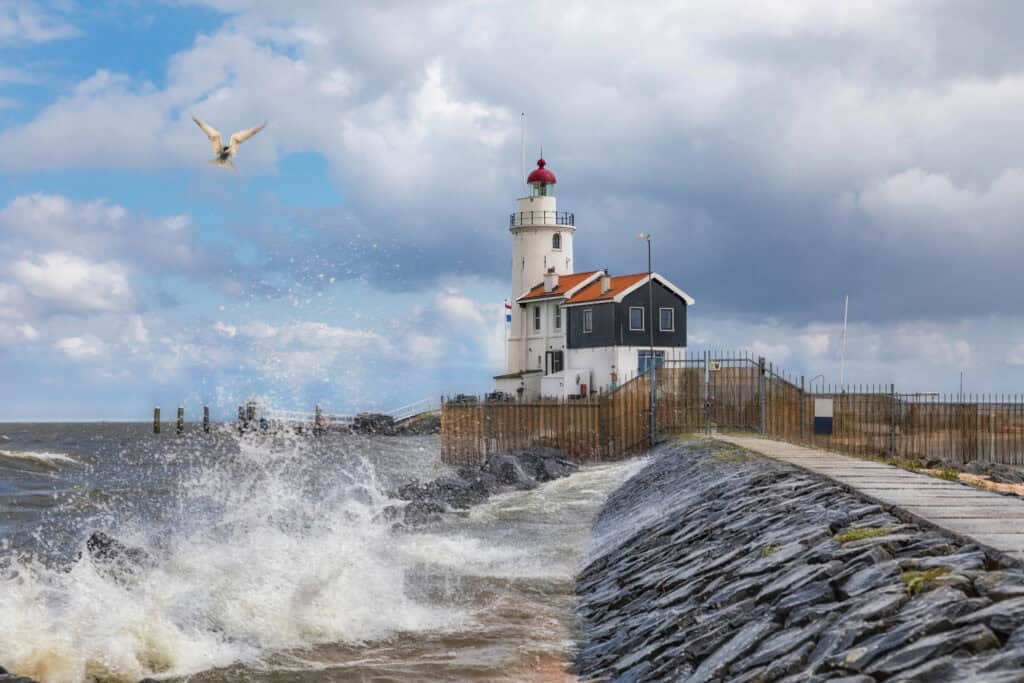
A major highlight of this loop is the Vuurtoren van Marken (Marken Lighthouse), a historical lighthouse standing proudly on the tip of Marken since 1839.
🚴♂️ Distance: 57.7 kilometres ⏰ Duration: 3 hours and 19 minutes 💪 Difficulty: Medium 🗺️ Get the route here.
5. Get your sweat on, then go for a dip in Bloemendaal aan Zee
While this route is one of the longest on our list, the good news is that your efforts will be rewarded with a refreshing dip in the sea (so don’t forget your swim trunks!).
The ride takes you through Haarlem to the scenic dunes and along the coast, where you can enjoy breathtaking views of the North Sea.
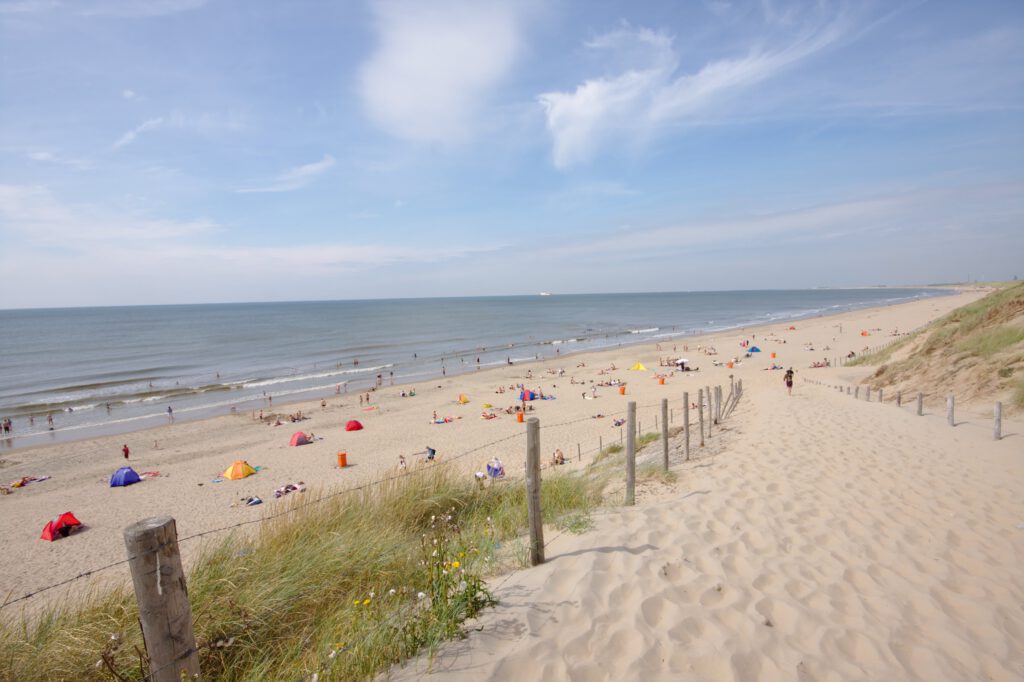
After a good workout, unwind on the beach with delicious ice cream or enjoy a beachside café. This route is perfect for those looking to combine exercise with relaxation. ⛱️
🚴♂️ Distance: 51.6 kilometres ⏰ Duration: 3 hours and 10 minutes 💪 Difficulty: Medium 🗺️ Get the route here.
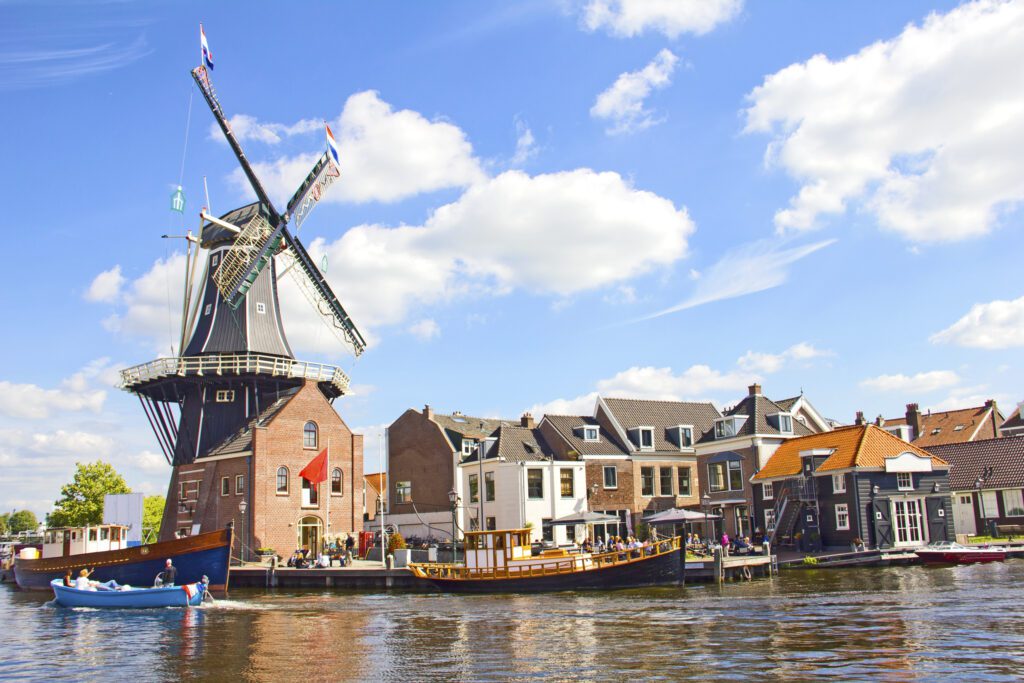
Amsterdam’s little brother, Haarlem, is a perfect spot to visit on a scenic bike route from Amsterdam. The city boasts an impressive array of art and history, so don’t be afraid to hop off your bike and explore.
You could, for example, explore the famous Grote Kerk, with its towering spire visible from miles away. If you feel like taking it easy, just stroll through the streets lined with quirky shops and charming cafés.
On the way there, you’ll come by the impressive Fort bij de Liebrug, while the way back takes you past the Polderbaan, the longest landing strip at Schiphol Airport (perfect for plane enthusiasts!).
🚴♂️ Distance: 56.1 kilometres ⏰ Duration: 3 hours and 19 minutes 💪 Difficulty: Medium 🗺️ Get the route here.
7. Go up north and fall in love with Amsterdam’s Waterland
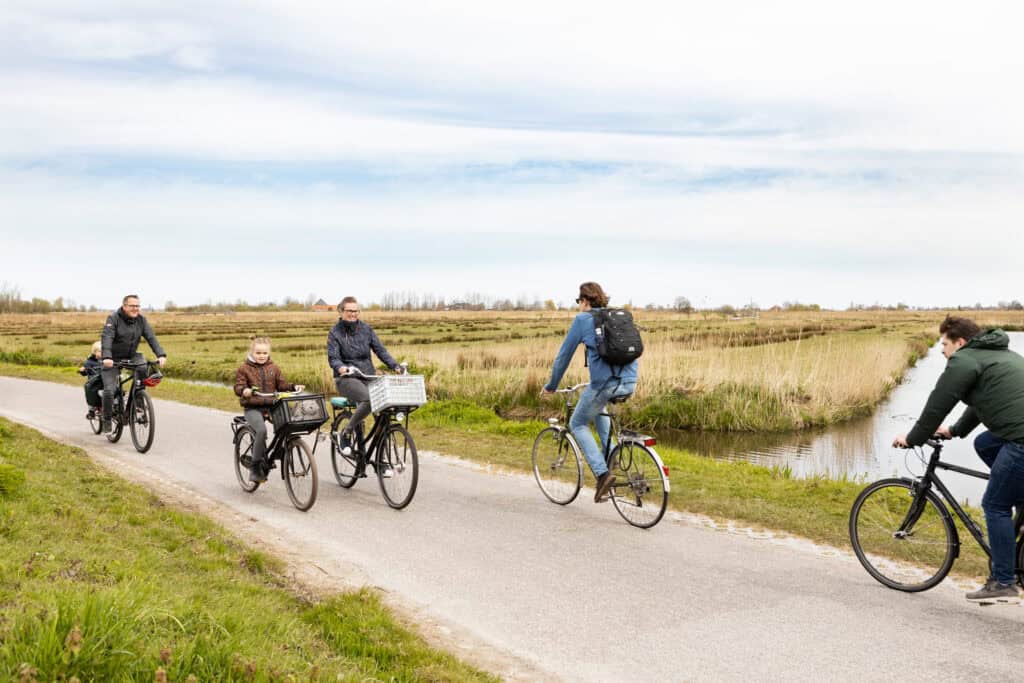
Waterland is the name of the green countryside just north of Amsterdam’s city centre. The area is a cyclist’s paradise, featuring peaceful waterways and landscapes as the backdrop for your adventure.
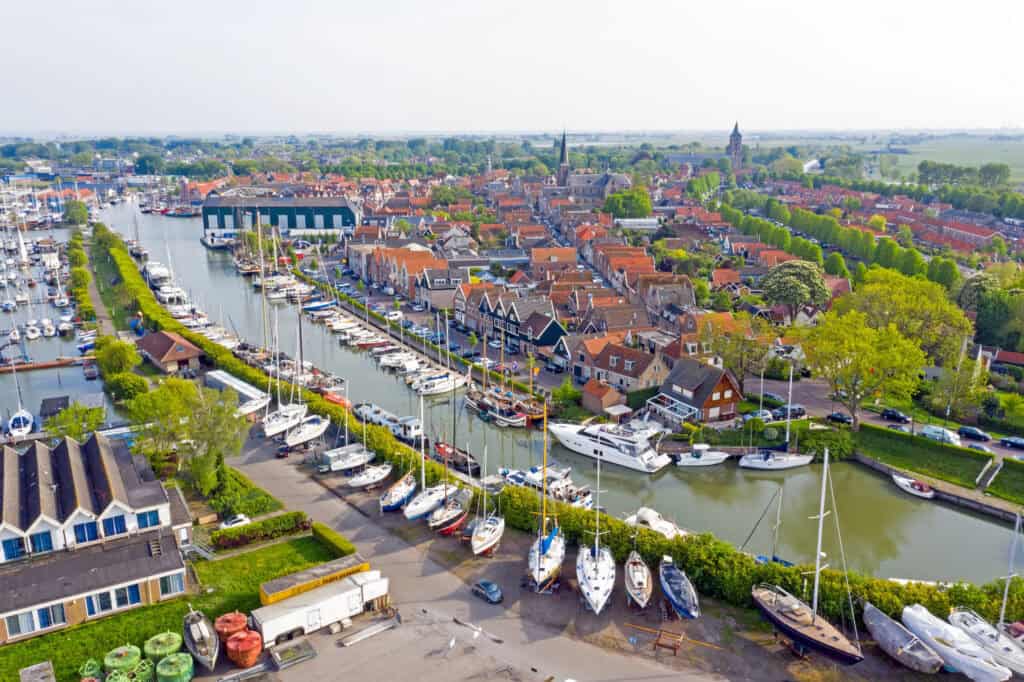
On your way, you’ll come by several waterfront villages and houseboat communities until you end up in Monnickendam. Founded by monks, this is an old fishing village and a true hidden gem. We highly recommend a visit!
🚴♂️ Distance: 44.6 kilometres ⏰ Duration: 2 hours and 34 minutes 💪 Difficulty: Medium 🗺️ Get the route here.
Ready to pedal your way through Amsterdam’s surroundings on these scenic routes? Grab your fiets and off you go!
Do you have any other recommendations for scenic bike routes for day trips from Amsterdam? Share them in the comments!
If you’re flying to or from Schiphol with KLM this Wednesday (September 17), you may want to double-check your travel plans, because some major cancellations are headed your way.
According to flight information on Schiphol’s website, dozens of KLM flights have already been cancelled, with the fate of many others as yet uncertain.
These disruptions affect both domestic and international flights, primarily between the hours of 8 AM and 12 PM (CEST).
Is your flight affected?
Check KLM’s flight information on arrivals and departures scheduled for this Wednesday.
Why are KLM flights being cancelled?
The string of cancellations is in response to an upcoming strike, organised by KLM ground staff for this Wednesday, September 17.
Protesting the “inequality at KLM”, the Federation of Dutch Trade Unions (FNV) seeks to highlight the discrepancy between KLM’s “luxury deal with pilots” and the “crumbs” offered to the ground crew.
“The people on the ground are lugging, dragging, and ensuring that KLM keeps operating 24/7,” John van Dorland, Director of FNV’s Aviation Federation, explains. “And they’re just given the crumbs, while the management and the pilots walk away with a generous deal.”
KLM has yet to offer a statement on the upcoming strike.
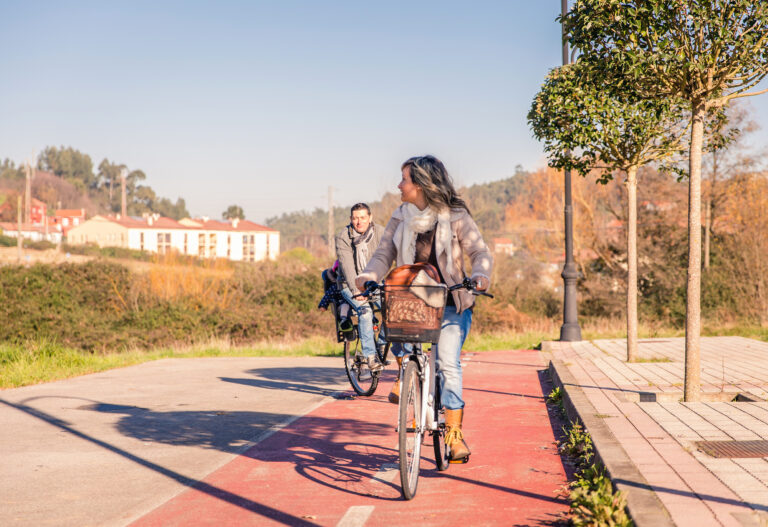
Welcome to the Netherlands, where bicycles outnumber people. The Dutch are so crazy about their fiets that they would much rather bike than walk.
And who can blame them? Cycling is ingrained in Dutch culture — you can’t walk around in the Netherlands without having at least one near-death experience with a 70-year-old on an e-bike. 🤡
What is it?
Have you ever tried to walk to a restaurant or café with a Dutch person? If you ever have, they may have just hit you with, “Where’s your bike?”
If you don’t have one or aren’t feeling like it, they will just stare at you in abject horror.
While the Netherlands has excellent public transportation, sometimes you don’t want to wait for a train or be near other people. So, the bike is (once again) the superior option.
Plus, other cyclists and automobile drivers are (usually) very cautious with cyclists taking priority on Dutch roads.
Why is it quirky?
Other countries aren’t as fanatic about cycling as the Dutch are. Even in nearby European countries like Germany and England, the dedication to cycling as a mode of transportation is less present.
They’re also bigger countries, so it’s harder to make cycling cool there. 💁🏼♀️
Should you join in?
YES. Cycling is a way of life here in the Netherlands, and it’s way faster than walking. You’ll still be getting your exercise in, but you’ll also have to deal with angry cyclists and some ferocious winds sometimes.
Cycling is also better for the environment and for your health in general — so grab a fiets and get those pedals moving. 🌱💖
What do you think of this Dutch quirk? Have you experienced it? Tell us in the comments below!
British punk-rap duo Bob Vylan sparked outrage during their Sunday performance at Paradiso in Amsterdam, where they shouted “Death to the IDF” and appeared to praise the murder of American right-wing commentator Charlie Kirk.
Politicians from every side condemned the concert, with some describing it as “an orgy of hatred against Jews and dissidents”.
Meanwhile, the Farmer-Citizen Movement (BBB) went as far as demanding the duo’s expulsion from the country.
Even D66 leader Rob Jetten strongly criticised Bob Vylan’s comments about Kirk’s death: “You don’t understand anything about freedom of speech and how you can disagree with each other if you’re here cheering on someone’s murder.
The legal debate may be in Bob Vylan’s favour
According to the NOS, despite the outrage, prosecution may prove difficult.
Attorney Willem Jebbink explained that the statement “Death to the IDF” could be interpreted as “away with the IDF,” framing it as part of the public debate on Gaza.
This view is supported by the rap duo’s well-documented criticism of atrocities happening in Gaza and how world governments are not doing enough.
Furthermore, the European Court of Human Rights protects freedom of expression, even when statements are shocking or offensive.
Still, limits do exist
In 2011, Dutch rapper Hozny was punished after releasing a video depicting the execution of a Geert Wilders lookalike, showing that courts can restrict artistic freedom when it crosses into incitement.
To make matters worse, the bulk of the controversy is centred around Bob Vylan’s decision to urge the audience to “find them and meet them on the streets” (in reference to fascists and Zionists).
Jewish advocacy group CIDI considers the remarks a call to violence, and they are filing a complaint.
Dutch authorities are now weighing possible charges. Police have confirmed that they will consult with prosecutors, while Amsterdam’s mayor stressed that although artistic freedom is a fundamental right, it cannot endanger residents or be used to incite hatred and violence.
This fallout extends to the Dutch music scene
Tilburg venue 013 cancelled Bob Vylan’s upcoming performance, accusing the duo of “trivialising political murder”.
Paradiso, however, stood by its decision to host the concert.
Do you think this is an attempt to silence opposition to the war in Gaza, or is the language itself to be condemned? Tell us your thoughts in the comments below!
Get those bucket lists ready, because the Netherlands just scored a double-feature on Forbes’ list of the 50 most beautiful villages in 2025.
While the Netherlands can’t exactly boast about its beaches or a singular “mountain“, Dutch villages look like they’ve been plucked straight out of a fairy tale.
But which of these Dutch villages managed to wow travel experts at Forbes and land in the top ten? Let’s dive in!
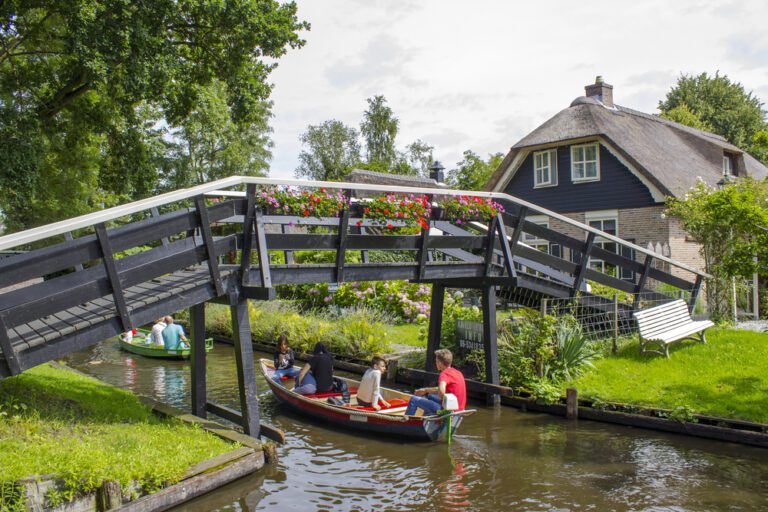
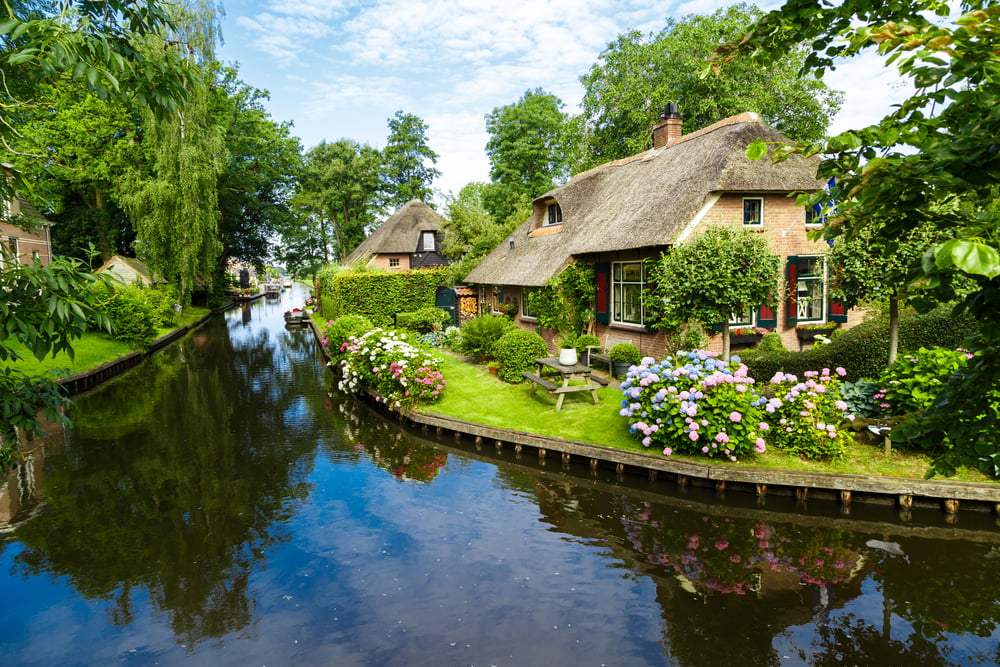
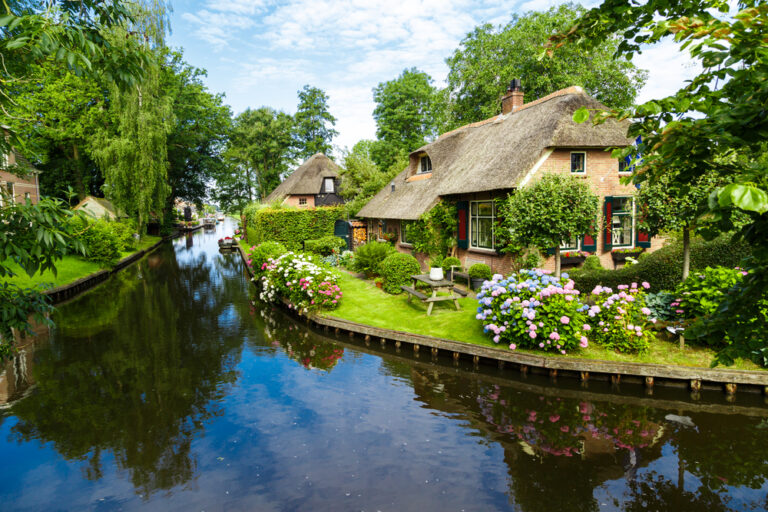
Giethoorn: The Netherlands’ very own “Venice of the North”
Coming in at fourth place is Giethoorn, the crown jewel of the Dutch province of Overijssel.
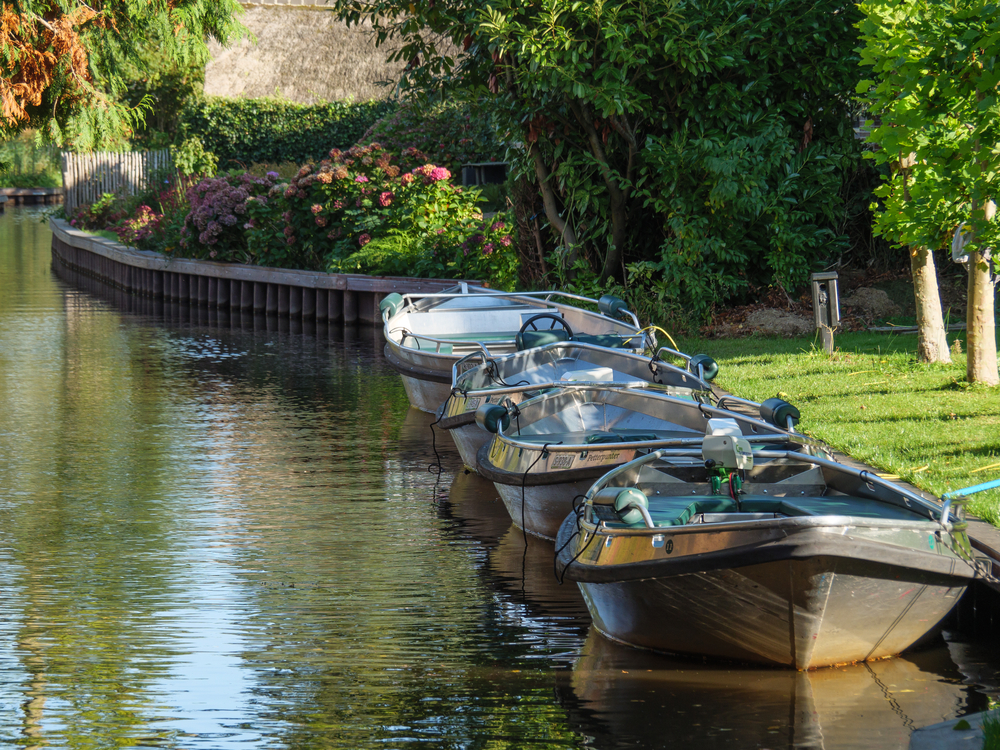
While you can walk or cycle around Giethoorn, the best way to explore the village is by boat. Image: Depositphotos
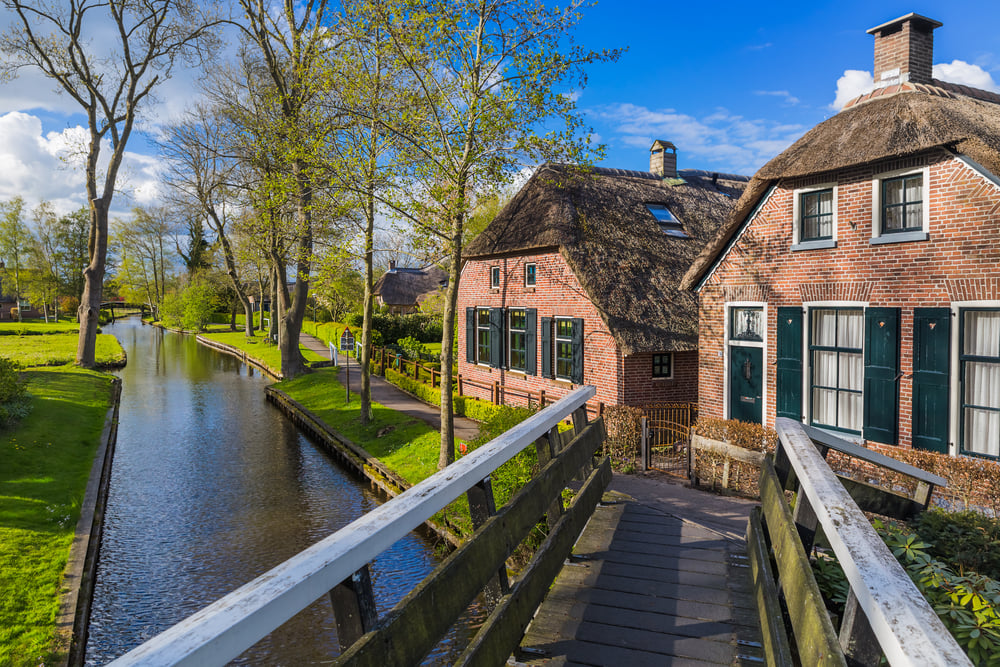
With winding canals, quaint, thatched roofs, and oodles of old-world charm, it’s no wonder that Giethoorn secured a place in the top five.
Bourtange: History nerds, this one’s for you
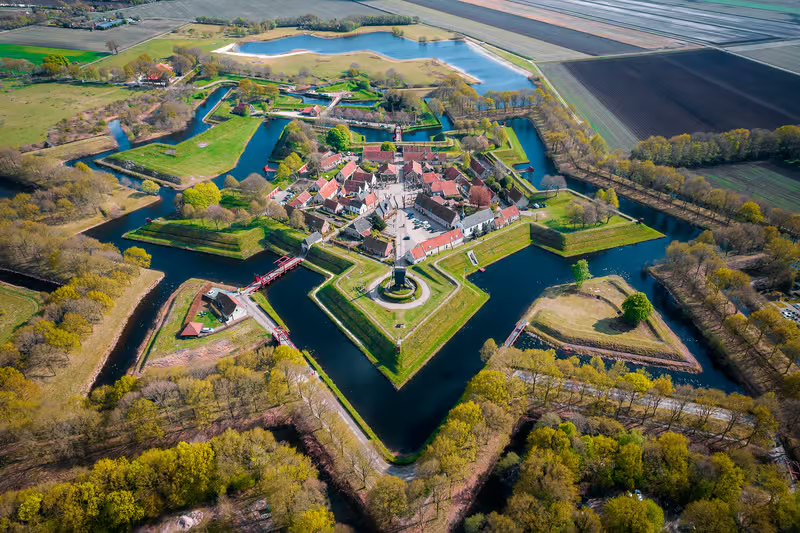
At a very respectable seventh place is Bourtange, a unique, star-shaped fortress tucked away in the northernmost province of Groningen.
Though Bourtange’s star-shaped structure is best seen from the air, the fortress is a must-see for history enthusiasts. Image: Dreamstime
The list raves about its “storybook charm”, which visitors can experience at the market in its cobbled courtyard, a visit to the Museum of Fortifications, or a walk around the historic sites at the fortress’s heart.
Which other villages made it to the top ten?
Giethoorn and Bourtange may have won two top spots, but they faced fierce competition from several other stunning villages across the globe:
Village
Rank
Bibury, England
#1
Hallstatt, Austria
#2
Reine, Norway
#3
Gásadalur, Faroe Islands
#5
Oia, Greece
#6
Kotor, Montenegro
#8
Shirakawa-go, Japan
#9
Batad, Philippines
#10
For those curious about the other 40 villages, do check out the full ranking here.
Do you agree with the global rankings? Tell us your thoughts in the comments below!
Dubbed the Venice of the North, Giethoorn is a wonderland of canals weaving and winding their way around unspoilt Dutch countryside, and it’s packed with things to do.
If you’re looking to break out of Amsterdam’s hustle and bustle, but still want those quaint Dutch canal views, you need to visit gorgeous Giethoorn!
Can’t decide? Find something to do in the list below! 👇
Bob and chug your way through Giethoorn’s green heart. Image: Depositphotos
The stunning canals of Giethoorn are beckoning, so jump in a boat and get ready to explore, plucky adventurer!
As a car-free city, there’s no better way to embrace all the sights and sounds than by water, and you’re certainly spoilt for choice when it comes to boat rental companies.
Whether you’d like to glide down the stunning waterways accompanied by a tour guide’s historical retellings or photograph the abundance of wildlife from an ultra-quiet whisper boat, your adventure is of your choice.
💰 Price: Renting an entire boat can cost anywhere from €65 to €170 ⏰ Opening hours: Vary per company 📍 Location: Along the canals of Giethoorn
2. Hop on a bike and explore Giethoorn at your own pace
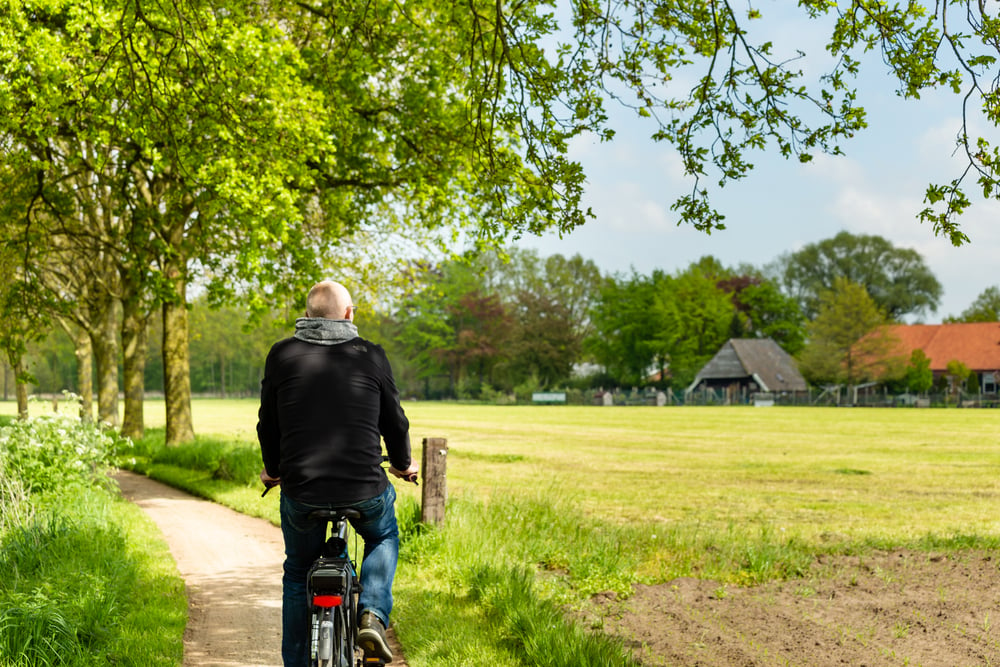
No matter where you go in the Netherlands, a bike’s probably going to be your best friend! Image: Depositphotos
If you want to feel the breeze rushing through your hair as you cycle through some of the most picturesque scenery in the Netherlands, you’ve got to hop on a bike!
No bike? No problem, because Giethoorn has a horde of bike rental companies that’ll saddle you up with a two-wheeled BFF in no time.
💰 Price: From €7.50 ⏰ Opening hours: Vary per company 📍 Location: Stroll the main streets to find a bike hire company
3. Voyage down the stunning canals with a kayak or canoe
All in favour of having a fun afternoon on the water, raise your paddle! Image: Freepik
Do you want to tour Giethoorn from the water and burn some calories while you’re at it?
Sounds like you may need to grab a kayak or canoe!
It doesn’t matter if you’ve never kayaked or canoed in your life or if you’re an absolute pro at it; as there are routes for all skill levels, so do take the plunge.
💰 Price: Prices start from €12.50 for a one-person kayak ⏰ Opening hours: Vary per company 📍 Location: Along the canals of Giethoorn
4. Stroll through any of Giethoorn’s breathtaking walking routes
Exercise AND great views? Count us in! Image: Depositphotos
Perhaps you’d like to stretch your legs a bit? You’ve certainly come to the right place, as Giethoorn has many enchanting walking routes that’ll lead you on an enjoyable ramble through the city.
Whether you’re into a casual four-kilometre stroll around various points of interest or want a more gruelling 27-kilometre walk around the entire city, you can definitely find one that’s your speed!
TIP: Be sure to bring your camera along, because we aren’t joking when we say these routes are breathtaking.
💰 Price: Free ⏰ Opening hours: Entirely up to you 📍 Location: Along the many walking routes of Giethoorn
5. Grab a board and hit the water
Who says you can’t make a big splash whilst exploring a new city? Image: Depositphotos
D’you fancy trying your hand at stand-up paddleboarding? Good on you, because Giethoorn’s the right place to bob through scenic canals on your paddleboard.
Alternatively, if you thought Scheveningen was the only place to go windsurfing in the Netherlands, think again! Giethoorn also offers both windsurfing facilities and several surf schools for visitors who’d like to dip a toe into a water sport.
💰 Price: Prices range from €15 (windsurfing) and €20 (stand-up paddle boarding) for an hour, to €60 (windsurfing) and €35 (stand-up paddle boarding) for a day ⏰ Opening hours: Vary per company 📍 Location: Giethoorn’s lakes
6. Embark on an enchanting trip back in time at Museum ‘t Olde Maat Uus
Museum ‘t Olde Maat Uus peels back the weathered pages of time to give visitors a charming look at what Giethoorn was like back in the olden days.
Perfect for history enthusiasts, it’s got a carefully curated collection of costumes, furniture, tools, and hordes of other things from a bygone era.
There’s also a museum shop for tourists to buy trinkets, a coffee shop for refreshments, and activities for children to do.
💰 Price: €7.50 for adults, €2.50 for children aged four to 12, and free for children under three ⏰ Opening hours: 11 AM until 5 PM, Monday to Sunday 📍 Location: 1 Beekstraat, 5671CS Nuenen
7. Take a walk on the wild side at the Weerribben-Wieden National Park
Between stunning views and a large population of birds and animals, this national park is a definite must-see. Image: Depositphotos
But don’t let the word bog you down, because this park offers visitors a huge selection of activities!
Whether you’d rather bike in the wilderness, hike through several trails, or rent a boat to tour the park, you’re guaranteed to find an activity you enjoy.
Oh, and did we mention that it’s also a birdwatcher’s paradise? Many rare species call it home, and there are several bird-watching huts erected for this very purpose, so be sure to check them out!
💰 Price: Free to enter ⏰ Opening hours: The park has no times listed, but opening times for individual activities will vary 📍 Location: Weerribben, 8302 KW Emmeloord
8. Explore the Netherlands’ best collection of rocks, minerals, and fossils
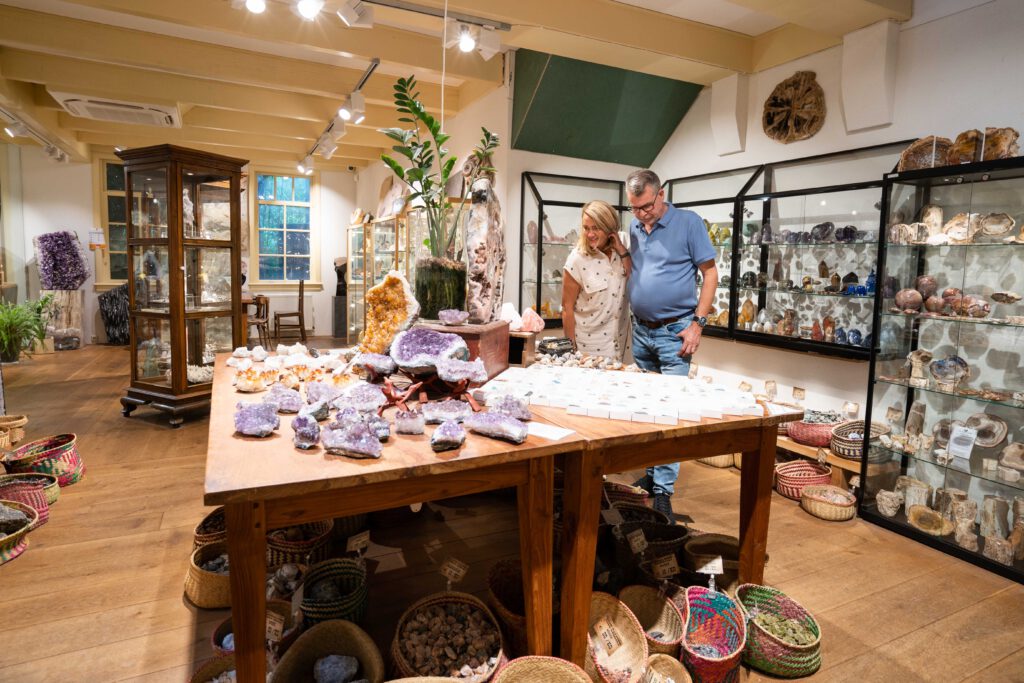
Do check out the museum shop for trinkets! Image: Supplied/Museum De Oude Aarde
Do you seriously dig rock exhibits? Well, Museum De Oude Aarde has got your back!
This museum has the largest egg in the world, a stunning geode from Brazil, and a whole host of other treasures collected over the decades.
Are you travelling with children and wondering how you’ll keep the little ones entertained? Fret not, the museum’s got an enthralling Scavenger Hunt, where kids uncover a bunch of hidden treasures based on a few clues.
💰 Price: €4.90 for adults, €3.90 for children up to the age of 12, and free for children under 12 ⏰ Opening hours: Open 10 AM to 6 PM from Monday to Sunday 📍 Location: 43 Binnenpad, 8355 BR
9. Stop and smell the (porcelain) roses at Giethoorn Floramics
Calling all art enthusiasts! Giethoorn Floramics is an atelier that features gorgeous handmade pottery with summery flower motifs.
If you’d like to pick up some unique keepsakes from your trip to Giethoorn, then this is the best place to do it.
TIP: This atelier is also situated along the famous Dorpsgracht canal in an area that is home to at least 20 historical buildings. Why not tour this historic neighbourhood whilst you’re in the area?
💰 Price: Depends on the item ⏰ Opening hours: 10 AM to 6 PM 📍 Location: Binnenpad 35, 8355 BP
10. Channel your inner royal at Museum Villa Rams Woerthe
Built in 1899, the stately Museum Villa Rams Woerthe has been dubbed the Downton Abbey of Overijssel — and for good reason!
Both the museum, in its Art Nouveau style, and the surrounding grounds are national monuments (is it just us, or is that code for “super Instagrammable?”), making them the perfect sight for architecture enthusiasts.
TIP: The basement of the Villa Rams Woerthe houses the Hildo Krop Museum, which is dedicated to artist and sculptor Hildo Krop (once City Sculptor of Amsterdam). Make the most of your visit and check out this hidden gem, too!
💰 Price: €11 for adults and free for those under 18 ⏰ Opening hours: 10:30 AM to 2 PM on Tuesday, 10:30 AM to 4 PM from Wednesday to Friday, 1 PM to 4 PM on Saturday, and 10:30 AM to 4 PM on Sunday (closed on Monday) 📍 Location: Gasthuislaan 2, 8331 MX Steenwijk, OV
11. Have a gezellige picnic by one of Giethoorn’s many canals
Perfect for delicious snacks and drinks by the cheerful, babbling canals! Image: Unsplash
Is that romance in the air? This city has so many picturesque canals and lakes to sit by that a picnic is a perfect thing to do on a sunny afternoon in Giethoorn!
There are several supermarkets spread all over the city (such as Albert Heijn, Jumbo, Lidl, ALDI, and Coop, to name a few), so it’s easy to pick up something yummy for your picnic.
💰 Price: Free (just the price of groceries for a picnic) ⏰ Opening hours: Whenever you want 📍 Location: Around Giethoorn
12. Paint the town red at Paintball Giethoorn
Aim and… fire! 💥 Image: Freepik
Are you travelling with a group of friends and are dying for something fun and energetic to do?
Then head over to Paintball Giethoorn for an absolute blast (of paint, that is!) and get ready to make some fun memories.
💰 Price: Roughly €30 per person ⏰ Opening hours: 9 AM to 5 PM every Monday to Saturday, and 9 AM to 6 PM every Sunday 📍 Location: Zuiderpad 5A, 8355 CA
13. Tickle your taste buds at one of the best restaurants in the Netherlands
If you’re exploring the wonders of Giethoorn, why don’t you take your taste buds on a culinary adventure? Image: Unsplash
Giethoorn is also home to the Michelin-starred Restaurant de Lindenhof, which serves an enticing concoction of regional, French, and international cuisine.
If you’re looking to make unique memories in Giethoorn, then embarking on a rare culinary experience might be the perfect thing to do!
TIP: If you’re not into Michelin-star prices, don’t worry — Giethoorn has plenty of top-quality restaurants with midrange prices, such as Restaurant 141, Grand Café Fanfare, and Smit Giethoorn.
💰 Price: Culinary packages range from €160 to €225, overnight stays can reach €630+ ⏰ Opening hours: Open for lunch (12 PM to 2 PM) and dinner (6 PM to 9 PM), from Wednesday to Sunday 📍 Location: Beulakerweg 77, 8355 AC
14. Venture off to Vollenhove and explore the ruins of Kasteel Toutenburg
This village is a hidden gem just a stone’s throw from Giethoorn’s scenic heart. Image: Depositphotos
Run out of things to do in Giethoorn? Just half an hour from the city centre is the historical shipping village of Vollenhove.
Granted a city status as far back as 1354, it’s also home to the ruins of the medieval Kasteel Toutenburg.
The castle was built in the 1500s by Joris Schenck van Toutenburg, the then-stadtholder (ruler) of Overijssel under Emperor Charles V, and is a must-visit for history enthusiasts!
So you’re about to take the plunge and delve into the scary world of learning Dutch? Chances are, you probably have a few questions, or you want to know what stages you’ll have to go through to get there.
Most people have the same questions in mind before learning Dutch, and we’ve done you the favour of collecting them all in this handy list.
So, without further ado, let’s get down to it! Here are seven things you need to know before learning Dutch. 👇
1. Is learning Dutch hard?
Some people say that learning Dutch is easy, and other people insist that it’s hard. The truth is, it all depends on several factors:
If you’re fluent in English, German, or both (this is a massive help, as there are many similarities)
If you’re fluent in more than one language (there’s research to suggest you pick up languages faster if you are)
If you can pronounce those terrible, guttural gghhhhhhh sounds
The good news? Your English fluency will give you a pretty good leg-up when it comes to learning Dutch! Image: Depositphotos
There are also a few reasons why learning Dutch may be hard:
The pronunciation can be tricky as hell for some people (*cough* most people *cough*)
The word order can be mind-boggling
Dutch people will always be better at speaking English than you are at Dutch, so they’ll quickly switch if they sense you’re insecure
However, some aspects of learning Dutch may also be easy.
With over 1,500 Dutch words in the English dictionary, that means you already know around 1,500 Dutch words!
Even better? Dutch words are also present in or derived from many other languages, so you may find you know even more if you’re familiar with a language like Afrikaans or French, for example.
However, it’s important to remember that learning Dutch certainly isn’t easy — so it’s not something you’re going to learn overnight.
Just try not to get too hung up on whether you think it’s going to be hard or not. And don’t worry too much about the whole de/het thing.
2. Is Dutch similar to German?
In short: yes. Dutch is very similar to German, so if you speak German, you’ll definitely spot the similarities as soon as you start learning.
Lots of words are the exact same in German as they are in Dutch, and many others only have slight differences.
Germans, unsurprisingly, have a super easy go of learning Dutch! Image: Freepik
However, do keep in mind that the Dutch tend to get offended when you tell them that their language is similar to German, so it’s best to keep that small fact to yourself.
It’s similar, but it’s still a different language — kind of like if you speak Spanish, then Italian isn’t that far from your comfort zone.
Note: Grammatically, Dutch is somewhat easier. So if you’re German learning the Dutch lingo, then you’re probably going to find this a relief… or not. 🤔
3. Do you need Dutch if you speak English?
In theory, no. Plenty of people get around just fine with speaking English in the Netherlands.
It’s also common practice to find an English-speaking job. But if you think you’ll be staying in the Netherlands for a few years, why not learn the language?
There are a couple of things you’ll be missing out on if you just stick to English, so getting those Dutch skills going might just be worth it:
Speaking Dutch for work
Sure, you might have managed to score yourself an English-speaking job, but chances are, if you want to climb the ranks, then Dutch is going to be necessary.
If you learn Dutch, it will also broaden your career prospects, as you’ll quickly qualify for so many more jobs.
If you are looking for a complete career change, speaking Dutch will also help immensely.
Before we continue, you should definitely check out these untranslatable Dutch words — they’re always worth knowing (as if the language in general wasn’t baffling enough). 😵
Socialising and speaking Dutch
To truly fit into any society, learning the language is the thing to do.
Not only is it polite (because hey, you’re living in their country and all), but it’s also paramount if you want to truly fit into the culture. You will be able to communicate with everyone, and they will be able to communicate with you.
Many people do it like this, though; admittedly, it’s probably best to do this alongside your own studies or Dutch classes.
If you do choose to incorporate TV into your Dutch journey, it’s smart to switch things up every now and then: watch TV in your own language with Dutch subtitles, and then watch Dutch programmes with your language as the subtitles.
Relax and learn a new language at the same time? Win-win if you ask us! Image: Depositphotos
A good thing about Dutch TV is that dubbing is not a popular concept, so you’ll have a good chance to practice your Dutch skills undisturbed by English.
Oh, and as a bonus: if you speak English (which you presumably do, since you’re reading this article), then you’re already in luck.
British and American television channels are widely watched in the Netherlands, so it’s the perfect time to start reading the subtitles! 👓
5. Are there any sounds that are hard to pronounce?
Oh dear, a simple “yes” would be an understatement.
If your language involves a lot of gghhhhh sounds and rolling letters, then you’ll be a natural at learning Dutch. If not (and let’s face it, that applies to most of us), then you’re really going to have to practice.
I’m a Brit with no language skills and no rolling letters, and it took me six months just to pronounce words such as “gezellig“, “Scheveningen“, and “Groningen“ properly.
Sounds gross, but the best way to practice is to try to bring some phlegm into the back of your throat and gargle as if you were going to spit it out, whilst saying the word.
It sounds awful, but you’ll soon get used to saying it naturally (without sounding all weird and phlegmy).
6. Do Dutch people speak English?
Yes!In fact, apart from native English-speaking countries, they’re frequently ranked as having the best English language skills in the world.
The thing is, this can make it hard to learn Dutch, as you’ll find that our dear Dutchies will switch to English once they hear us struggling. It saves time and makes life easier, but persevere!
Simply pretend you don’t speak English! Image: Depositphotos
Stick with the Dutch if you want to practice, even if they switch to English.
One advantage of their great English skills is that it makes learning Dutch easier (in terms of finding good English material, teachers, and whatnot).
Just make sure not to take it for granted and give up on your Dutch language journey.
7. Is there any way I can learn Dutch for free?
Aha! You’re in luck here, because there are quite a few ways to learn Dutch for free.
This is definitely one of the things to know before you learn Dutch — it can be quite expensive, but there are plenty of ways to learn Dutch completely for free.
So, there you have it. Once you’ve mastered all the weird sounds, you’ll be well on your way to spitting out Dutch words left, right, and centre. Good luck!
What tips do you have for learning Dutch? Are there any other things to know before starting? Let us know in the comments!