We’re officially three months into 2024 (we’re not sure how that happened either). Have you noticed any of these major changes since the start of the year?
From wages, pensions, and government allowances to environmental laws and energy prices, here are the five biggest changes in the Netherlands in 2024 so far, according to Meldpunt.
1. Tobacco, alcohol, and soft drink taxes increase
Tobacco became more expensive on April 1, 2024, but only by a small margin, as this increase happens yearly.
Taxes on alcohol and soft drinks (or mixers, depending on how you see it) are also on the rise — a crate of beer will be €0.50 more expensive while the so-called “sugar tax” increases by €0.26 per litre for non-alcoholic beverages.
2. Minimum wages are calculated monthly
The Netherlands is transitioning from a minimum monthly wage to a minimum hourly wage, which gives some advantage to people who were working 40 hours to be considered full-time.
The minimum wage will increase by 3.75% for those working a 36-hour week, while employees working a full 40-hour week will see an increase of 15% to their hourly wages.
3. Pension ages raised, but as are allowances
If you dream of early retirement, we hate to be party poopers, but the Dutch pension age will also increase in 2024, going up to 67 years.
That means you can only start receiving your Dutch state pension (Algemene Ouderdomswet or AOW) when you reach 67 years.
Not all hope is lost, though. Pension accrual in the Netherlands will now start at 18 years, meaning employers must pay pension contributions to younger employees, and Dutch pension funds are increasing by around 3% (this varies per fund).
4. Government allowances are growing, except for healthcare allowance
If you’re renting or have children, you’ll see a slightly bigger amount deposited into your bank account each month, as rent allowance, childcare allowance, and the child-related budget are all increasing this year.
However, the healthcare allowance was reduced at the start of this year following a temporary increase last year.
5. The energy price cap is disappearing
The government is also removing the cap on energy prices in the Netherlands, but there are a few silver linings.
Excise taxes on diesel and petrol won’t increase, and the energy surcharges on vulnerable households are also disappearing. Whew!
6. Disposable plastics are being banned
In an effort to be more sustainable, catering companies and restaurants are not allowed to offer disposable cutlery, cups, or containers to customers who are eating in the vicinity.
Update:Een april, kikker in je bil (April 1, frog in your butt)! Alright, the Dutch expression doesn’t quite work in English, but yes, April Fools!
As talks for the new Dutch cabinet continue, leaks about new anti-immigration measures are coming from the negotiation table in The Hague.
Ever since Wilders’ PVV became the biggest party in the elections, it’s been clear that harsh measures to reduce the number of internationals in the Netherlands would come our way.
Now, as insider sources from the Hague have reported, the government plans to introduce a harsh test that immigrants must pass to stay in the Netherlands.
You pass, you stay
The proposed geschiktheidstest voor verblijf (test of fitness for residency) is one of the harsher measures the cabinet is introducing — all in the name of keeping “Nederland voor Nederlanders” (The Netherlands for Dutch people).
According to the leaks, this will be a mandatory exam for internationals aged 18 and over to determine whether they are allowed to stay in the Netherlands.
Anyone who is not of Dutch nationality must take the test within one year of moving to the country.
Three categories of knowledge and culture
To satisfy Geert Wilders’ radical wishes, the proposed test will be drastically different from the traditional Dutch citizenship test.
It focuses on three categories said to determine internationals’ “fitness for residency”: language, cultural awareness, and cuisine.
Each category will be graded on a pass/fail basis. To pass the test and be allowed to stay in the Netherlands, internationals need to pass two out of three categories. Here’s what you can expect.
Language
If you want to stay in the Netherlands, you’ll need to brush up on your Dutch, ASAP. You will have to demonstrate the following abilities:
Properly saying the G sound (an exception will be made for people living in Limburg),
Pronouncing the word rijbewijsverlengingsaanvraagformulier (driver’s license renewal application form),
It’s unclear if the new cabinet will also set up a vegetarian version of the test, as the BBB heavily lobbies for more meat in everything as a hallmark of Dutch culture.
Cultural awareness
Lastly, internationals must also demonstrate knowledge about how to conduct themselves when living in the Netherlands. Potential tests include:
Predicting how long the NS train will be delayed from Amsterdam to Rotterdam on the day of the test,
Biking through Amsterdam on a bakfiets full of glasses of milk without spilling them,
Making someone cry by giving them direct, harsh criticism.
Experts suspect it could be delayed for years, as there is no workforce to implement it. It is not unlikely that the government will have to employ highly skilled migrants to make it happen by 2028.
Do you think you could pass the Dutchification test? Share your thoughts (or concerns) in the comments!
The Netherlands employs its so-called Kennismigranten (highly skilled migrants) in many sectors, from IT to academia to… nail salons, apparently.
Yup, according to research by the Dutch Labour Inspectorate, skilled migrants don’t always end up doing the work the government intends for them to do.
Instead, companies often abuse the highly skilled migrant scheme to take advantage of the accelerated immigration process for employees.
What is the highly skilled migrant scheme?
Highly skilled migrants are highly educated workers from non-EU countries who come to the Netherlands to contribute to the Dutch knowledge-based economy. They often work, for example, as university lecturers, scientific researchers, or doctors in training.
The knowledge migrant scheme also allows companies to expedite a residence permit for these workers, provided they earn at least €3,700 gross per month (if they are under 30).
It’s not all about knowledge
It turns out that the Dutch highly skilled migrant scheme is being abused by both companies and individuals to bring people from outside the EU to the Netherlands.
As the Volkskrant writes, the Dutch Labour Inspectorate has found skilled migrants cleaning kitchens, working on construction sites, and in nail salons.
How does this happen? Well, among the 10,500 companies recognised as sponsors in the Netherlands, there are also employment agencies and payroll companies which refer the “knowledge migrants” to catering establishments, cleaning companies, and nail salons.
(No, that is not to say people who work in these jobs are not skilled or knowledgable; but it is not who the scheme is intended for.)
Residence permits for sale
In some cases, companies take it even further and use the highly skilled migrant scheme to “sell” the dream of permanent Dutch residence to people from abroad.
Once a skilled migrant has stayed in the Netherlands for five years, they qualify for a permanent residence permit.
So, some companies are willing to accept money (a lot of it) from third-country residents in order to hire them, on paper, as “skilled migrants”.
If you’re an expat living in Amsterdam, you could soon be asked to take Dutch language classes, history lessons, and volunteer time.
That’s right, the PvdA (Labour Party), Amsterdam’s largest political party, calls for expats to take integration courses (inburgeringscursus) when living in the city, reports Het Parool.
One important factor to note is that businesses would be responsible for these courses, rather than the government.
Taking responsibility
The PvdA party leader in Amsterdam, Lian Heinhuis, submitted a proposal requiring expats and businesses in Amsterdam to participate in some kind of integration course.
“You can earn from the city, but you also have to do your part. [I think] it is only logical that companies feel responsible to facilitate expats as much as possible to become part of the Amsterdam society.”
The proposed course could include things such as language lessons, introductions to neighbourhood initiatives, visits to the volunteer centre, and meetings with long-time, local Amsterdammers.
A large influx of expats
Many expats in Amsterdam end up living in an international bubble and never fully integrate with the Dutch.
In principle, that’s because many only stay in the city for a short time, so they are not required to integrate like other migrants are.
But in practice, expats have been staying in the Netherlands for much longer, and the question arises as to why and when an immigrant should integrate or not.
Heinhuis hopes her initiative will close the gap between Amsterdammers and expats and see companies take action to help their employees contribute to the city.
Whether this will happen depends on whether businesses are interested in her proposal, but such a proposal can’t be forced unless it’s made national policy.
What do you think of Dutch integration courses for expats? Tell us in the comments below!
The internet makes the world go round — and naturally, you want excellent WiFi at your Dutch house.
Whether you’re moving to the Netherlands or within it, setting up your internet is one of the first steps you’ll want to take. But before you can do so, there are some questions you may have. Let’s get those out of the way!
1. What types of internet connections are available in the Netherlands?
Let’s start with the basics: the types of internet connections available in the Netherlands.
There are three main types of internet connections in the Netherlands. Image: Depositphotos
It’s important to know that the type of connection you have depends on your home. The most common connections in the Netherlands are the following:
Cable: Cable Internet uses the infrastructure of your cable TV network to provide Internet services.
DSL: DSL internet runs through standard phone lines that are wired into your home.
Fibre optics: Fibre optics transmits data using pulses of light sent through extremely thin strands of glass or plastic fibres.
To figure out which type of connection your home has, you can simply ask your landlord, or have a quick look around your home.
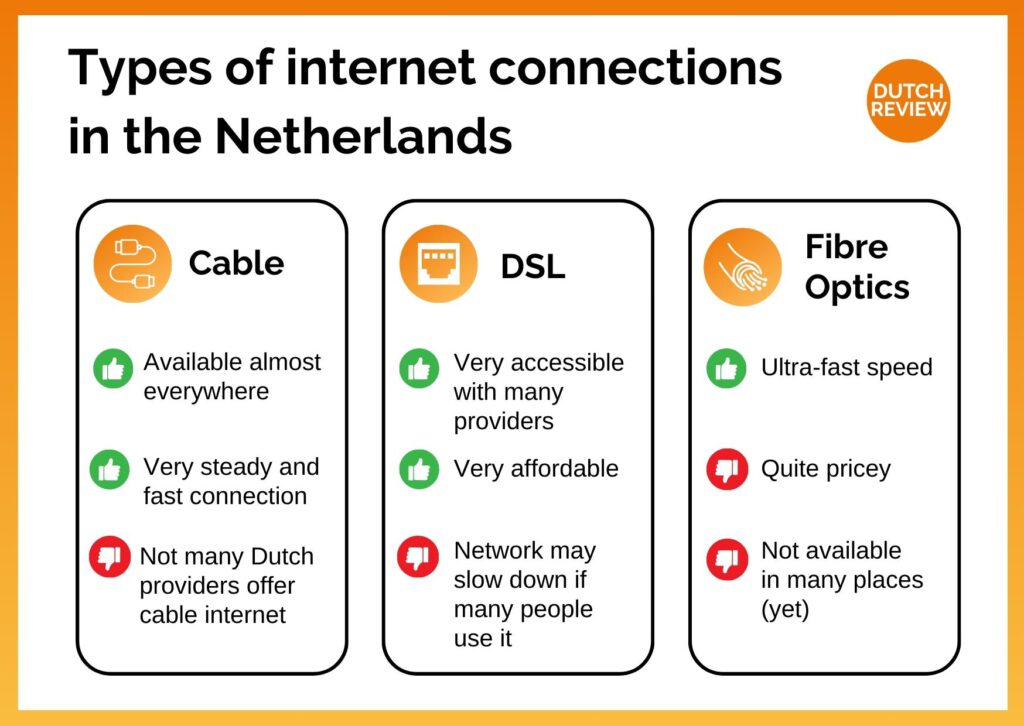
Each of these three connection types has pros and cons:
Image: DutchReview
2. What is the fastest internet network in the Netherlands?
Once you’ve determined the type of internet connection you have in your home, it’s time to choose a provider — but who offers the fastest network?
You’ll be happy to hear that your internet will be pretty speedy, no matter which Dutch internet provider you choose.
In fact, as of 2023, the Netherlands has the 21st fastest internet in the world, with an average internet speed of 209.11 Mbps (megabits per second).
If you’re someone who regularly streams movies of plays online games, then fast internet is a must. Image: Depositphotos
But in an effort for Dutch internet to become even faster, many Dutch web service providers are currently expanding their fibre optics network (most notably KPN, Vodafone and Odido) — to offer even better speeds to their customers.
In other words, no matter which provider you choose, chances are that you’ll have a (slightly) above-average internet speed, almost no matter where you settle in the Netherlands.
However, if you want the fastest possible connection, opt for a provider that offers fibre optics.
3. Which is the cheapest Dutch internet provider in the Netherlands?
As with many things, the price of your internet connection in the Netherlands depends on factors such as the provider and plan you choose.
Prices for internet-only subscriptions in the Netherlands can range anywhere from €32 per month to €70 per month.
The cheapest Dutch internet provider out there is YouFone, currently offering an internet-only subscription for €32 per month.
That said, many providers offer special deals such as bundle packages for internet and TV, or half of the first year at a reduced rate.
The best thing you can do is compare prices and policies online and pick the one that suits your needs best.
Provider
Price per month (internet only)
Internet speed
Odido
€35
100 Mb/s
Ziggo
€42.50
100 Mb/s
YouFone
€43
50 Mb/s
Online.nl
€32
50 Mb/s
KPN
€42.50
100 Mb/s
Let op: The actual internet speed can depend on your address. Also, keep in mind that these are the flat rates offered by providers, but special promotions could bring the monthly price down!
4. Bundle options: are they worth it?
In the Netherlands, we love a good ol’ actie (deal) or korting (discount) — but are they the way to go when it comes to your internet provider? The answer is: it depends.
In the Netherlands, most internet providers will want to offer you TV and internet as a bundle. If you want access to Dutch television anyway, bundling it with your internet services is the way to go, as it can save you quite a bit of your hard-earned euros.
What will it be: streaming services or traditional television? Image: Depositphotos
If you’re unsure, it’s essential to check whether the offered channels, services (some TV packages now include access to streaming services like Netflix or Hulu), and internet speed meet your needs.
You should also consider the terms of your contract, and make sure that the bundle offers enough flexibility — not only when it comes to the cancellation policy, but also in adjusting your package over time.
Provider
Price per month (internet + TV)
Internet speed
Number of TV channels
Odido
€47.50
100 Mb/s
67
Ziggo
€56
100 Mb/s
74
YouFone
€49.50
50 Mb/s
51
Online.nl
€44.50
50 Mb/s
86
KPN
€55
100 Mb/s
73
5. Can I use mobile data as my home internet in the Netherlands?
If you’re looking at different options for internet connection in the Netherlands, you may have considered using mobile data for your home internet — and that is certainly an option.
The Netherlands’ fast 4G network ensures that you can surf the web at high speed from all your devices. In fact, with some providers, such as KPN, 4G availability throughout the country is over 99%.
As a result, many Dutch phone providers offer data plans suitable for home use. How does it work? The same as the mobile hotspot on your smartphone!
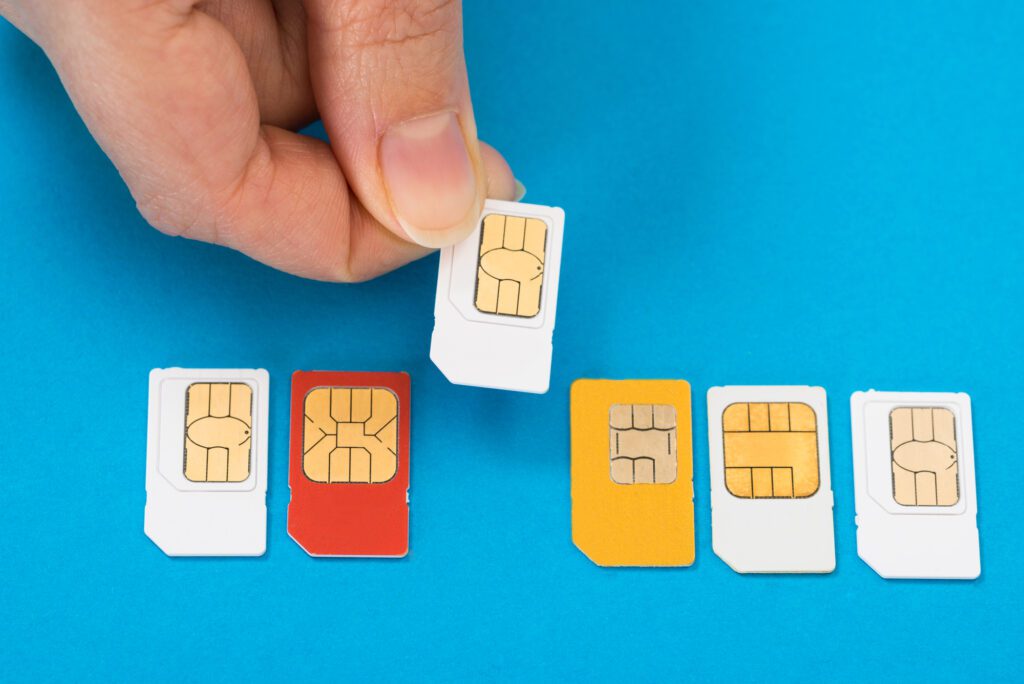
If you opt for this option, you will receive a SIM card with data access, and your provider will likely offer you a mobile hotspot device or a mobile router. These will allow you to connect your devices (laptop, PC, smartphone, smart TV) to the mobile network.
All you need to start your mobile data journey in the Netherlands is one of these little cards. Image: Depositphotos
While using mobile data as your home internet can be a handy option — especially if you’ve just arrived in the Netherlands and have many things left to figure out — there are some drawbacks to it:
Slow speeds: If you’re a gamer or like to stream videos on multiple devices, this method is not the best for you.
Data limits: If your data plan is not unlimited, you may quickly get hefty bills for exceeding your limit while surfing the web.
Higher costs: Mobile data plans, especially those with generous or unlimited data allowances, tend to be more expensive in the long run than traditional home broadband options.
6. How do you choose the right web service provider in the Netherlands?
In today’s world, we all surf the internet constantly, for things from streaming our favourite shows to working from home and everything in between — so it’s important to choose an internet provider that fits your needs.
The most popular internet providers in the Netherlands are Ziggo, KPN, and Odido (formerly T-Mobile and Tele-2), but which of them is right for you depends on multiple factors.
You may want to consider things such as:
Customer service
Availability in your area
Speed
Connection types
Contract terms and pricing
Special discounts/promotions
7. How do you set up your WiFi in the Netherlands?
Found the perfect provider? Then, it’s time to get your WiFi going in your Dutch home!
Setting up your router can seem hard, but if you know how to do it, it’s as easy as appeltaart! Let us lay it out for you.
It’s not rocket science (even though it may feel like it). 😉 Image: Depositphotos
1. Getting your equipment ready: Once you order your WiFi package, your provider of choice will ship you all the necessary equipment to your house. To set it up, you’ll need the router, an internet connection, and a device (like a computer or phone) to connect.
2. Placing your router: The router will send a WiFi signal through your home — that’s why it needs to be in the right spot to get the best coverage. Put it in a central location!
3. Getting it to work: Next up, your router must be plugged in using the provided power plug. After that, you should be able to connect your device to the internet using the provided WiFi password.
4. Testing your connection: Connected? Congrats! Now, you can test your internet speed using an online tool such as SpeedTest by Ookla or Fast.com.
5. Secure your WiFi: If you want to give your WiFi some extra protection, you can change the password to access it. To do so, enter the router’s IP address in your internet browser and log in with the default login details provided by your provider.
6. Troubleshooting: If you ever run into issues with your internet, try restarting your router. If the issue persists, check for any storingen (interferences) in your area. If there is one, you may just have to wait a bit. Can’t manage to fix your connection? Contact your provider!
Et voilà, you have successfully set up your Dutch WiFi! 👏
Ready to surf the web? In the Netherlands, it’ll be not just fast but also safe. Enjoy!
Do you have any more questions about Dutch WiFi? Ask us in the comments!
Are you an avid walker looking for somewhere in the Netherlands to enjoy the great outdoors? Here’s a list of 11 great national parks that can help you get closer to nature. 🌳
The Netherlands may not have any mountains (or any hills for that matter), but the landscape is still beautiful and peaceful.
To start, here are 11 national parks in the Netherlands to add to your visit list.
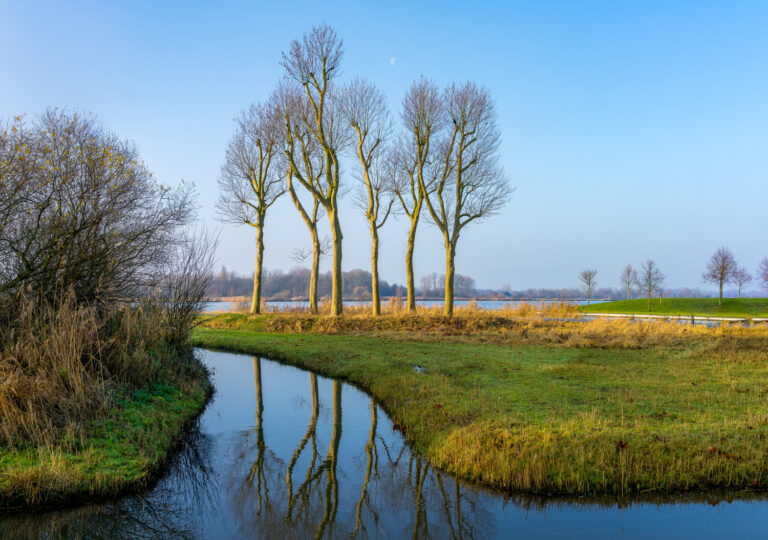
1. De Biesbosch
Even the swans love it. Image: Unsplash
De Biesbosch is a popular national park and one of the largest in the country. The main attraction is the number of activities on offer—there is no shortage of things to do.
You can go bird-spotting, walking, fishing, spend the night in a fishing hut in the park, rent canoes, cycle, and go on special walking tours with foresters. You can even dine in the national park!
De Biesbosch has a wild yet beautiful landscape, making it the perfect escape from the city. They hold informative school programs and are heavily involved with educating the public and preserving the landscape and its inhabitants. 🦢
De Maasduinen is a beautiful national park located in the province of Limburg. The park was created by, well, people, but also wind and water. It actually forms the longest river dune belt in the whole of the Netherlands. 🌊
There are also many different rare species of plants and animals in De Maasduinen, including snakes, sand lizards, cranes, buzzards, bats, beavers and butterflies. 🦋
De Maasduinen National Park is the perfect place to go for a walk, horse riding, a leisurely bike ride, or go on a mountain bike trail. Field trips are also held there, and it’s perfect for a fun little school trip. Overall, it’s a charming place to go for the day.
If you are looking for something a little further afield but with most of the familiarities of your Dutch home, then look no further than Texel.
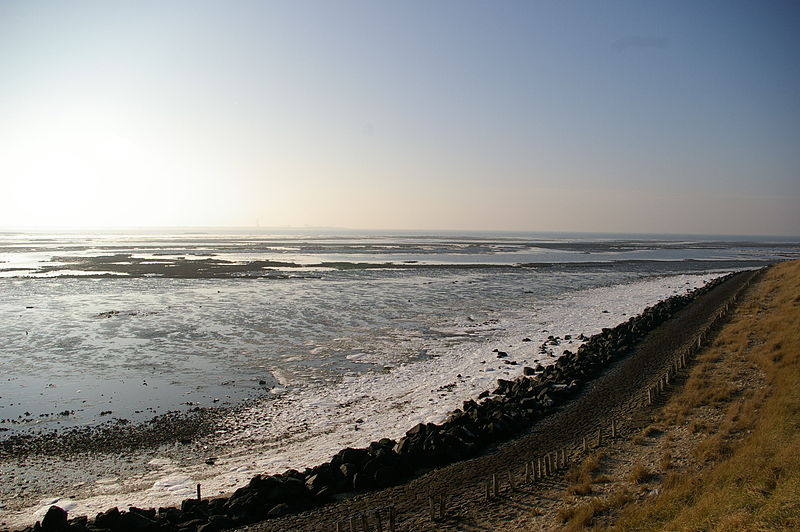
Texel is an island located just five kilometres north of Den Helder, across the Wadden Sea. 🌊
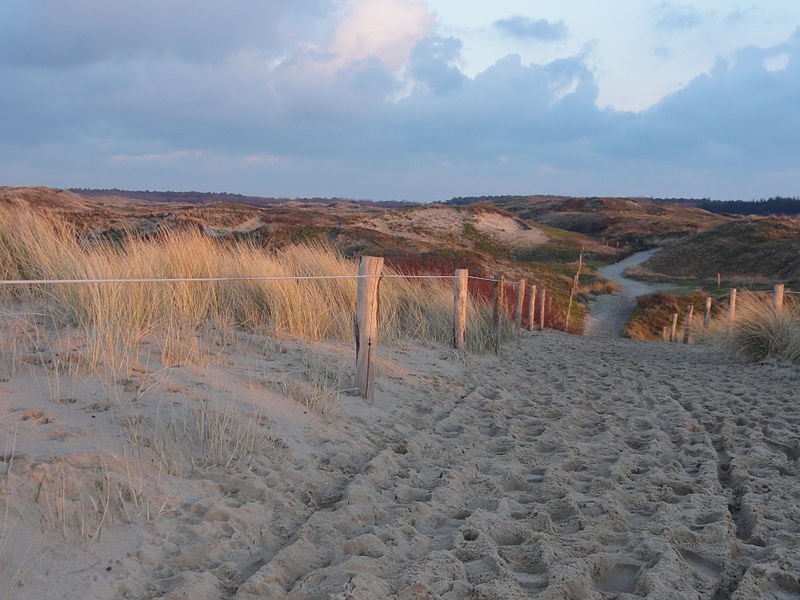
You haven’t visited Texel yet? What are you “dune”?! Image: IngevGelder/Wikimedia Commons/CC3.0
Over a quarter of the island is made up of the Dunes of Texel National Park, complete with cycle paths (of course) and the sea.
It’s basically everything you could want from a weekend walk or cycle. Or on horseback, if that’s your preferred method of travel!
Texel National Park’s landscape is made up of dunes, valleys, woodland and marshes. All are complete with a variety of animals, rare species of plants and protected birds. 🐤
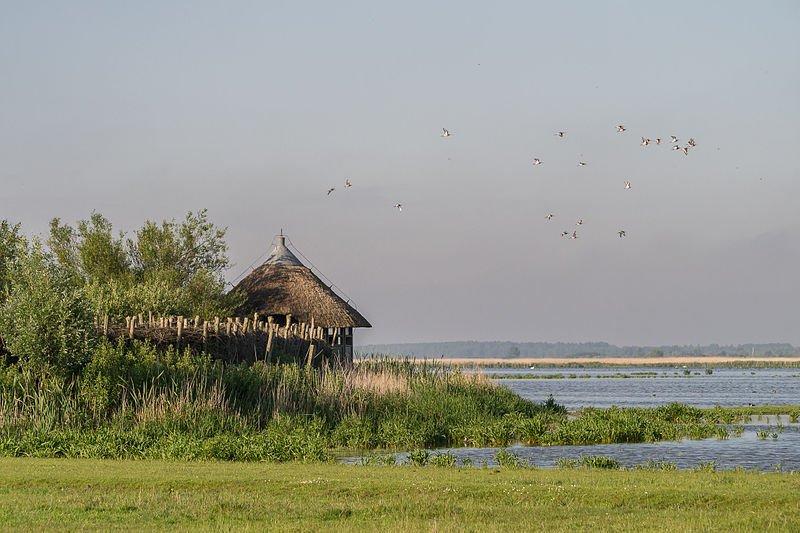
Bird-watch or stargaze it’s up to you. Image: Uberprutser/Wikimedia Commons/CC3.0
Lauwersmeer National Park is found in the providence of Groningen and Friesland. It is a product of flooding prevention when a dam was built there in 1969, so it’s now a freshwater lake.
Over 100 bird species breed there, along with thousands of geese. You can also find spoonbills, stilt-claws, sea eagles and grey fringes. It’s literally the perfect place to be at one with nature or to observe the birds. 🦅
If bird-watching isn’t really your thing, how about swapping starlings for stars? ⭐️
The National Park has been named “Dark Sky Park” for years because there is a special area preserved for visitors to see the sky without any light pollution. Echt cool!
A shifting landscape. Image: MartinD/Wikimedia Commons/CC3.0
Oosterschelde National Park lies in the province of Zeeland and is the LARGEST national park in the whole country.
Most of the park is water, and because of the tide, it changes the landscape often, making it an interesting place to keep visiting. 🌾
There is an array of different plants and animals living here mainly because the salt marshes have created different ecosystems.
It is also home to the Oosterschelde storm surge barrier, which protects the Netherlands from severe flooding. There is a museum there where you can learn about the 1953 flood, which is the reason that the storm surge barrier is here today. 🌊
The Zoom-Kalmhoutse Heide is on the border of the Netherlands and Flanders. When they became separate countries, it was divided.
What makes this place unique is that it is entirely man-made — even the bogs.
The landscape is varied with forests, dunes, heather, parks, polders and pastures. There is also a heavily wooded area originally planted to provide fuel for factories back in the 19th century.
Nature protection was not always a priority in this area, especially as it was across borders.
Now, there is a wide variety of endangered or vulnerable plant and animal species that are protected there. 🩹
Both nature and the landscape are preserved, making it a beautiful place to be for tourists and animals alike. 🦌
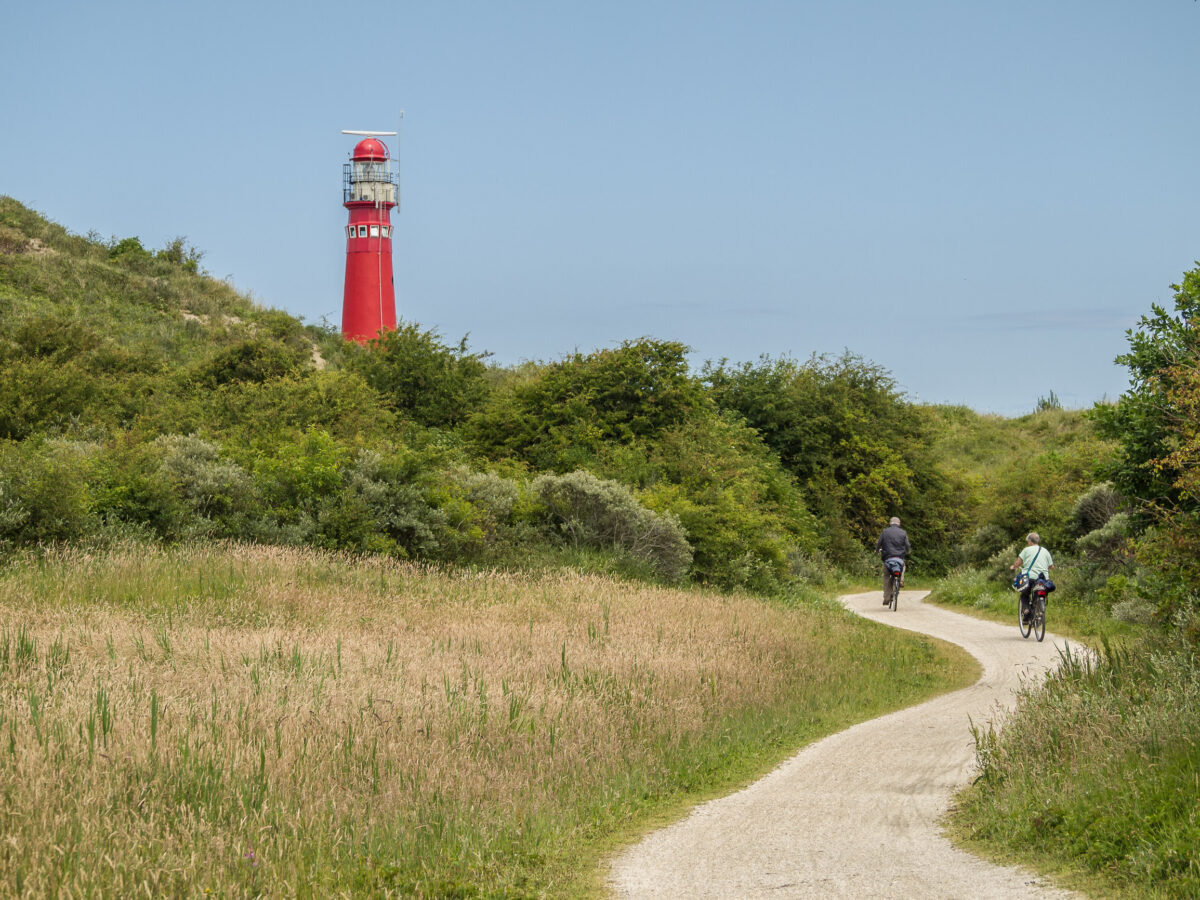
You can find over 300 different bird species in Schiermonnikoog. Image: Uberprutser/Wikimedia Commons/CC3.0
This National Park can be found on Schiermonnikoog island, one of the six Wadden Islands. This small area is packed with so many different landscapes and plenty of nature. The national park has dunes, forests, mudflats, polders and more. 🪵
Due to the huge variety of landscapes on one island, over 300 bird species visit Schiermonnikoog every year. A large variety of rare plants also grow in Schiermonnikoog.
Only local residents are allowed to have vehicles on the island, but the area has a variety of cycling paths and walking routes, so it’s easily accessible. Or if you’re not feeling too active, then taking the bus is also an option.
These lumpy bogs might be the closest the Netherlands gets to hills… Image: Jiri Komarek/Wikimedia Commons/CC4.0
This National Park is close to Amsterdam, making it the perfect escape from the busy and sometimes stressful city life. The national park is mainly made up of beaches and sand dunes.
There is plenty to do in Zuid-Kennemerduinen, such as hiking, biking, swimming, horse riding, bison spotting, and walking along the dunes.
The park’s website provides a lot of information about the park and its activities for both adults and children.
There are also beautiful country estates at Zuid-Kennemerduinen (some with formal gardens), along with a beautiful wild dune landscape and plenty of different plant and animal species. Lots to see and do!
Hoge Veluwe National Park is located in Gelderland and something for everyone. It’s known for its beautiful landscape, nature and also houses the Kröller-Müller museum.
The museum gets its name from a couple who once owned the area. There’s a lot of history to this national park, where the museum and the park closely work together, just as the couple did. 🤝
De Groote Peel National Park is a beautiful vast area, perfect for walkers and bird watchers. It has a wide range of landscapes including marshes, ponds, forests and open countryside. 🌿
This national park is the perfect place if you’re after peace and tranquillity; it’s quiet and is out of sight and the sound of any main roads or houses.
In fact, you can’t see any form of structure for miles. It’s a blissful no man’s land!
There are around 25 species of mammals that roam the grounds (such as wild boar, deer, polecat etc), and if you’re a bird lover, you’re in luck too. The crane, cormorant and reed goose can be spotted around De Groote Peel National Park, along with a range of other domestic birds.
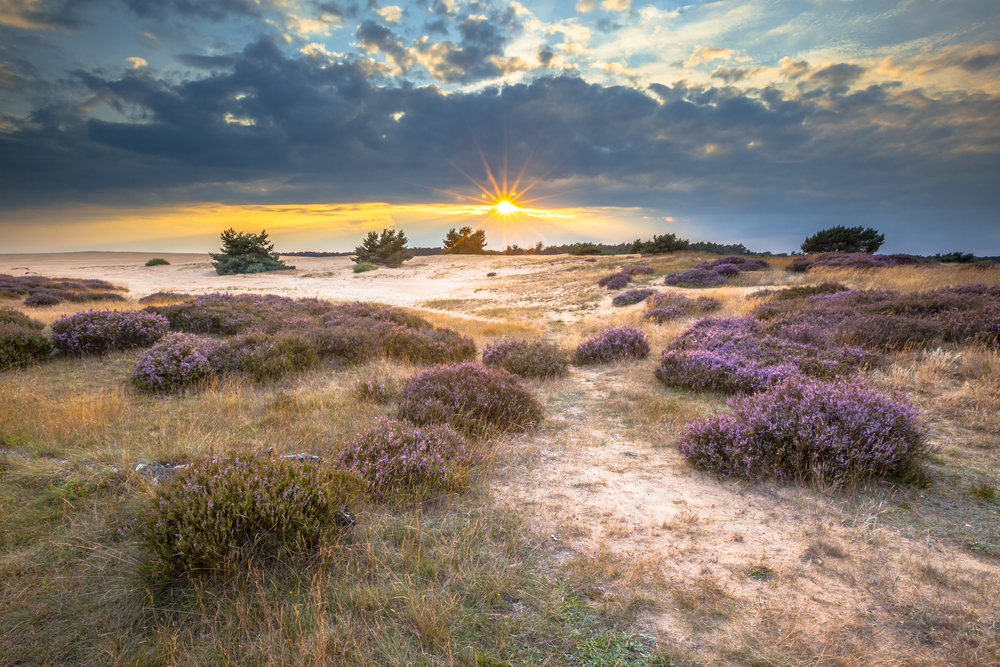
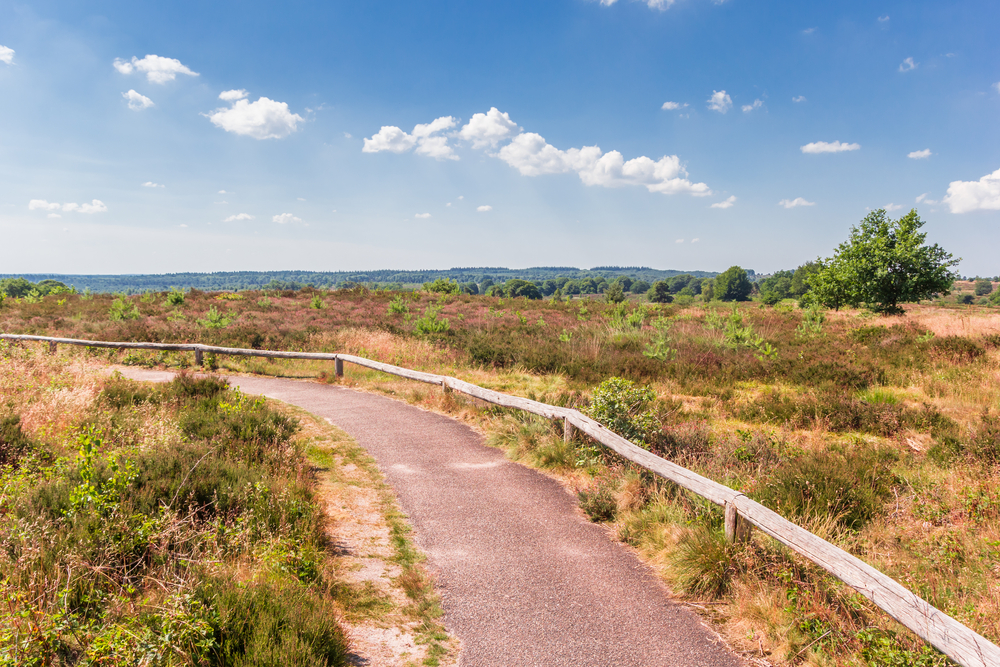
This gorgeous national park is located in the eastern Dutch province of Overijssel and takes about two hours to get there from Amsterdam by car. Perfect for a mini road trip! 🚙
Doesn’t this look perfect for a hike? Image: Depositphotos
The park’s landscape dates all the way back to the ice age! ❄️
More than 150,000 years ago, heavy ice caps pushed thousands of rocks in their path and compressed them to form today’s smooth surface.
The national park’s website shows all the activities on offer here: hiking, scenic cycling, mountain biking, and horse riding!
The park also organises tours and excursions with different outdoor activities such as water safaris (or just kayaking), and petting farms for your kids (or for you, no judgment here 😉).
There’s also has so many things to see! Ranging from flora and fauna-rich forests and marshes to the permanent flock of Twilhaar’s sheep and the rare black grouse bird which roams the heathland.
So there we have it—11 wonderful national parks in the Netherlands that you must visit! So put on your hiking boots and rally your friends—it’s time to return to nature!
What are your favourite national parks in the Netherlands? Tell us in the comments below!
When you think of the Netherlands, what do you picture? Maybe some windmills, coffee shops, and even the red light district. And we’re sure the timeless tulips quickly spring to mind as well.
Every tulip season in the Netherlands, tourists flock to the Keukenhof Flower Gardens and other Dutch fields to gaze in awe at the array of flowers, bulbs and tulips on display.
The tulip is a quintessential Dutch symbol, but how exactly did tulips become a thing in the Netherlands? Before we look into the history of this relationship, let us find out more about the flower.
What are tulips?
The tulip is a bulbous spring-flowering plant of the lily family. Did you know this means they are also related to onions, garlic and asparagus? 🧅
Tulip flowers are usually boldly coloured, cup-shaped and incredibly symmetrical. The name “tulip” is thought to be derived from a Persian word for turban, which their shape resembles.
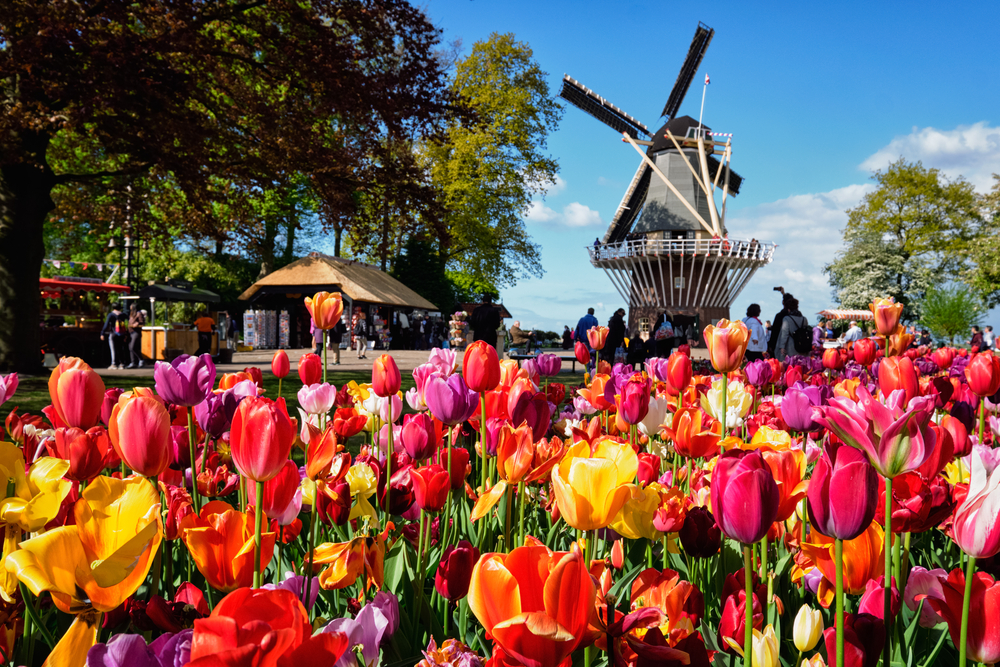
Windmills and tulips — does it get any more Dutch? Image: Depositphotos
How did the tulips travel to the Netherlands?
No, that’s not the opener for a “chicken crossing the road”-type joke.
While tulips may be very popular in the Netherlands, it’s not their original home. They are believed to stem from the Tien Shan mountain ranges in Central Asia, where they were already being cultivated by gardeners in the Ottoman Empire for decades. 🤯
Tulips are rare and exotic plants, which means Western Europe soon became fascinated by them. They were officially introduced in the Netherlands at the end of the 16th century.
So who was responsible for the tulip transportation? Well, it’s not known for sure.
The most widely accepted story is that Oghier Ghislain de Busbecq, Emperor Ferdinand I’s ambassador to Suleyman the Magnificent, was responsible.
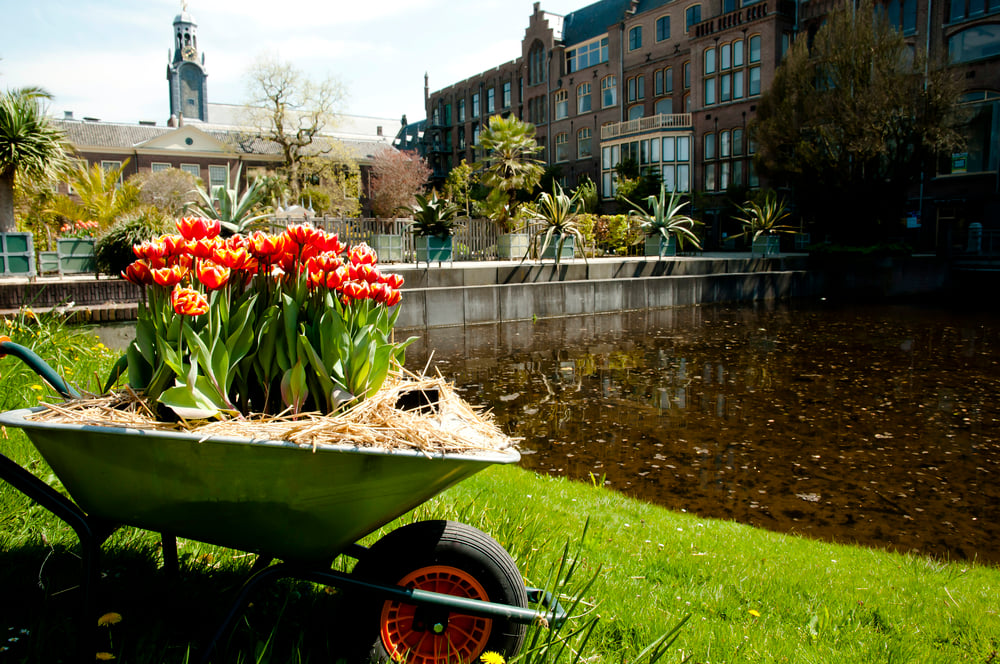
Leiden’s Hortus Botanicus: the home of the original Dutch tulip! Image: Depositphotos
At this time, a Flemish botanist by the name of Carolus Clusius was made the director of the Hortus Botanicus in Leiden, conducting research into medicinal plants.
This is where De Busbecq comes back into the story by sending his friend Clusius a few tulips for his garden in Leiden. Ta-da! The first bulb field in the Netherlands was born.
At the beginning of the 17th century, everyone had become so besotted with tulips that people started using them as garden decoration. They soon became a major trading product in Holland and other parts of Europe.
The interest was HUGE, and bulbs were sold for unbelievably high prices.
But it wasn’t all fair trading: between 1596 and 1598, over a hundred bulbs were STOLEN from Clusius’ rare collection. Thieves! 😲
“Tulip Mania” (yes, we’re serious)
Tulpenmanie(Tulip Mania) refers to the craze that befell the Dutch in the 17th century. They went wild for the flowers, and the brighter the better.
Clusius studied the tulips and their unique colourings for a long time, with no way of knowing that the colourings were actually caused by a virus. 🔍
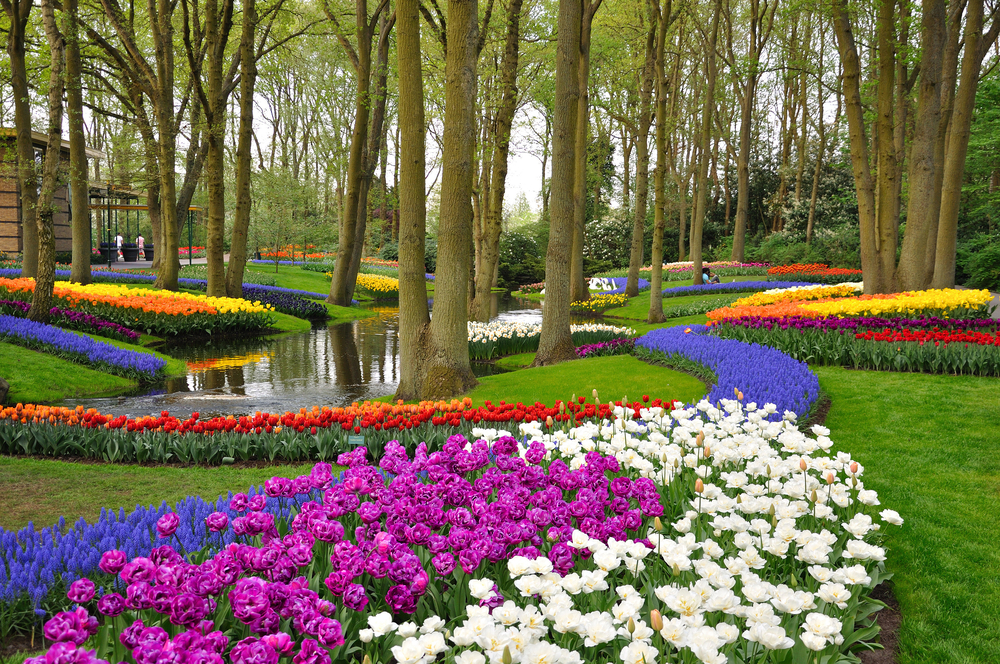
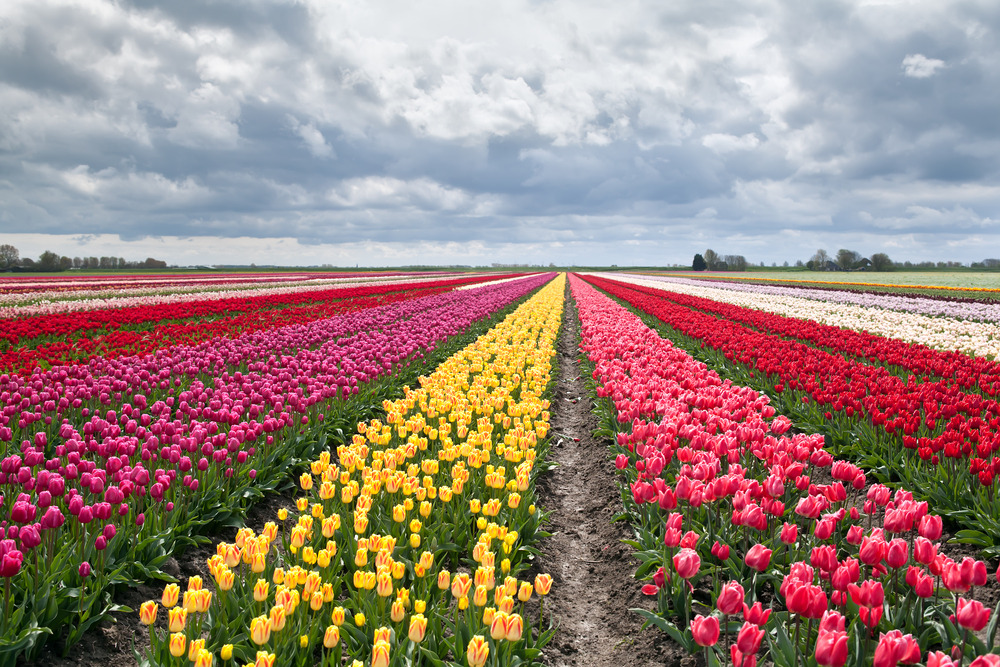
Tulips are now to be seen everywhere in the Netherlands, especially during the spring season! Image: Pexels
Not discovered until 1931, the virus responsible was actually transferred by aphids. Nowadays, multicoloured tulips are artificially bred to look that way.
At first, people were content with exchanging seeds and bulbs, but when it became obvious that the ultra-colourful tulip bulbs were more popular, the price was hiked, and demand soared.
Believe it or not, tulips were even used as currency. In 1633, actual properties were sold for handfuls of bulbs. How does that make any “cents”?!
What about tulips today?
Even though we might not reach the hysterical heights of Tulip Mania, the Dutch affection for all things floral flourishes — for free, in some places! 👇
Tulips are still extremely popular in the Netherlands and are even celebrated at festivals, and many companies offer tours of the tulip fields.
Millions of springtime tourists flock to Keukenhof every year to marvel at the famous gardens. Elsewhere in the city, the annual Amsterdam Tulip Festival ensures the famous flower blooms all over.
Throughout the first half of April, more than 850,000 colourful (and rare) tulips can be seen in the gardens of museums, private homes, and other parts of Amsterdam.
5 fun facts about tulips in the Netherlands
1. Canada gets 10,000 tulip bulbs yearly, as a sign of gratitude.
In 1943, Dutch Princess Margriet was born in Canada’s Ottawa Civic Hospital, as the royal family fled the Netherlands to escape the war in Europe.
The maternity ward where she was born had to be declared an international territory so she could inherit her Dutch citizenship from her mother, Princess Juliana. Each year, as a sign of gratitude, the Dutch royal family sends 10,000 bulbs to Ottawa for the tulip festival!
The Keukenhof is one of the best places to admire tulips blossoming! Image: Depositphotos
2. The Netherlands decorates the Vatican for Easter each year.
Since 1986, the Netherlands has sent flowers to St Peter’s Basilica every Easter.
This tradition started following Pope John Paul II’s visit to the country in 1985, and since then, the Vatican has decided to let the Netherlands be in charge of the Easter floral display.
3. Tulips were once more valuable than a house.
During the tulpenmanie in the 1600s, tulips were said to have cost 10 times more than a working man’s average salary in the Netherlands, making them more valuable than many homes.
4. The Dutch tulip industry is worth billions.
The Netherlands is the world’s largest commercial producer of tulips, with around three billion exported each year. Are we surprised?
5. And they make a pretty decent snack, too!
Tasty tulips? Their petals are edible! During the Dutch famine of 1944 in WWII, people often had to resort to eating sugar beets and tulips.
So, there you have it. Now your tulip knowledge is in full bloom! Next time you see a brightly-lined field of the famous flowers, maybe you’ll imagine the kind of house a handful of tulips could buy these days…
Did you know the origin of these iconic Dutch flowers? Let us know your thoughts in the comments!
Well, you can put those worries to (flower)bed — and let your floral knowledge blossom with this useful Flower Map from Bollenstreek. 👇
See all the green flower icons? That’s where you’ll find the beautiful tulip fields. 📍
Clicking on them will reveal the location but also show you pictures with the date that they were updated. This way, you can be sure to know what to expect if you’re planning ahead!
You can also submit your own photos to help others! It’s like growing one big Dutch flower community. 🌿
So, when does the bloom really boom in the Netherlands?
Following the opening of the popular Keukenhof tulip fields to visitors, the best time to see tulips in 2024 will be from March 21st until May 12th. This is the best indication of full bloom in the Dutch capital at least, so plan your visit accordingly! 💐
Pssssst… Want to enjoy the pretty petals in peace? Keukenhof recommends the quieter times of between 10:30 AM and 4 PM Monday-Wednesday. Perfect for capturing the flowers in the bright morning light without getting others in your shot! 📸
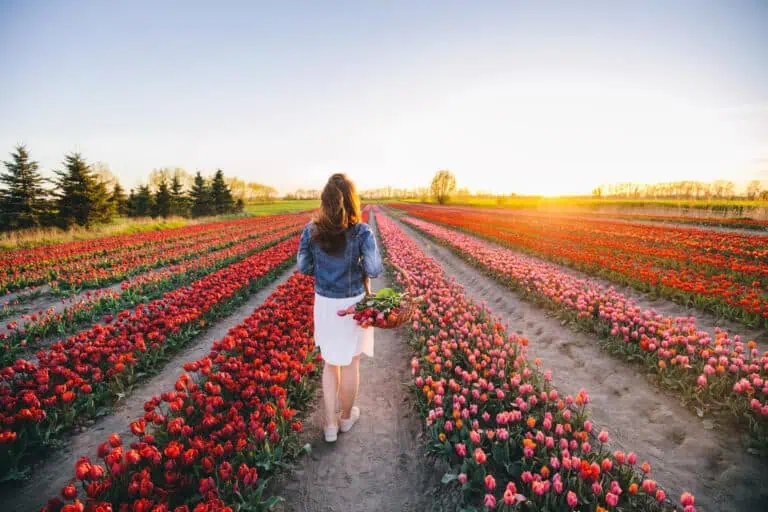
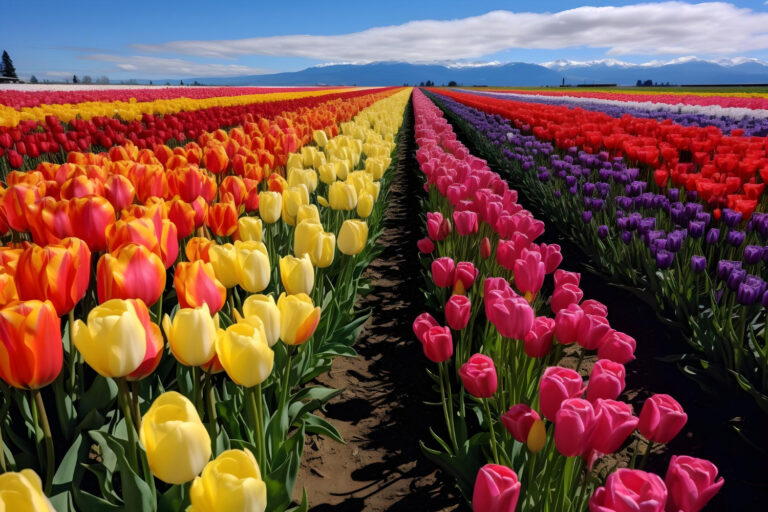
Have flowering fields ever been so photogenic? Image: Depositphotos
Hopefully, you have all the information you need to make the most of the season! It really is the best time to take in the wonders of the Dutch spring landscape, and tulips are a stunning staple.
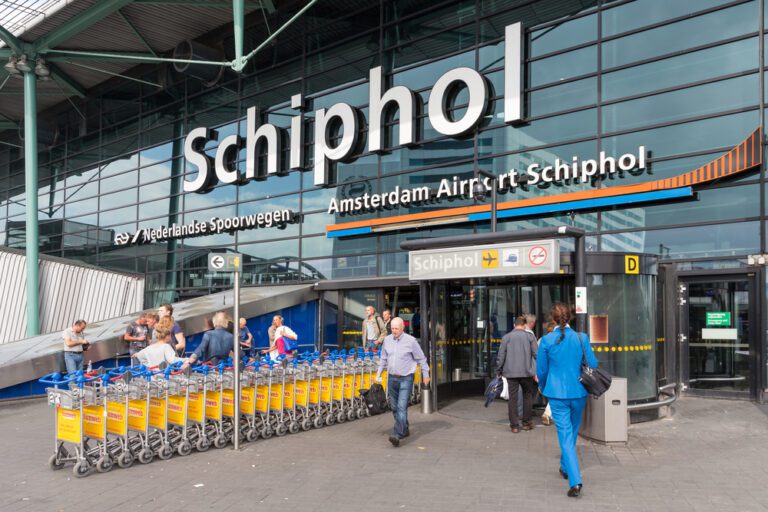
No one was travelling much during the pandemic — especially not by plane. Now Schiphol Airport is making up for its COVID-19 losses by charging airlines higher fees.
Airlines using Schiphol’s runways have been complaining about sky-high prices for years. Since 2021, take-off and landing costs have increased by almost 40%.
But, as NU.nl reports, that’s not the end of it, and prices will continue to increase until 2025.
Why should you care? Because Schiphol and its airlines will also pass some of their costs onto us travellers. You might notice this in rising ticket prices, or on the receipt for your pre-flight snack. 👇😬
#Schiphol Airport is a commercial area and a gated community. They can charge what they want, people are stuck and can only complain afterwards. Food & Beverage, concessions and rent are expensive at this airport. #FencedMonopolyhttps://t.co/IBTcWV3rm4
Holiday travel favourites KLM and easyJet insisted to the Trade Appeals Board (CBb) that Schiphol’s price increases are excessive — but the CBb disagrees: when compared to other airports, Schiphol’s rates are not unreasonable.
Do we have different definitions of “unreasonable”? Well, technically, yes.
According to aviation law, Schiphol must not take advantage of its dominant position as the only national airport in the country when increasing rates. The administrative judge believes that this is not the case.
The ruling is impossible to appeal, so Schiphol’s rates are already on a one-way ticket up. ✈️
How do you feel about flight prices increasing? Let us know your thoughts in the comments below.
It’s your first day at work as an international, and you are about to enjoy lunch with your Dutch colleagues. You reach the cafeteria, only to be shocked that what is on the menu is, well, just a sandwich.
Oh, it’s also completely overpriced and doesn’t even contain that many ingredients. Enjoy!
As an expat in the Netherlands, Dutch lunch customs might seem strange. Why is the munch so minimalist? Does it just take some getting used to, like the wonderfully bleak Dutch weather?
We’ve done some meal prepping for all you need to know about having lunch in the Netherlands.
Sandwiches served with a slice of history
The Dutch love for sandwiches — be it as broodjes or boterhams — comes from a much older, ancestral love for bread. Even in the 17th century, bread was a hot topic (or should we say toasty topic 😉) in the Netherlands.
A staple food even back then, bread was enjoyed with cheese or butter during breakfast, then with meat or hutspot(a dish combining meat and vegetables) for lunch, and finally with porridge in the evening. 😋
Bread was such an integral part of society that different types could symbolise different social statuses. The working class consumed bread made out of coarse wheat or rye, while the rich ate white bread.
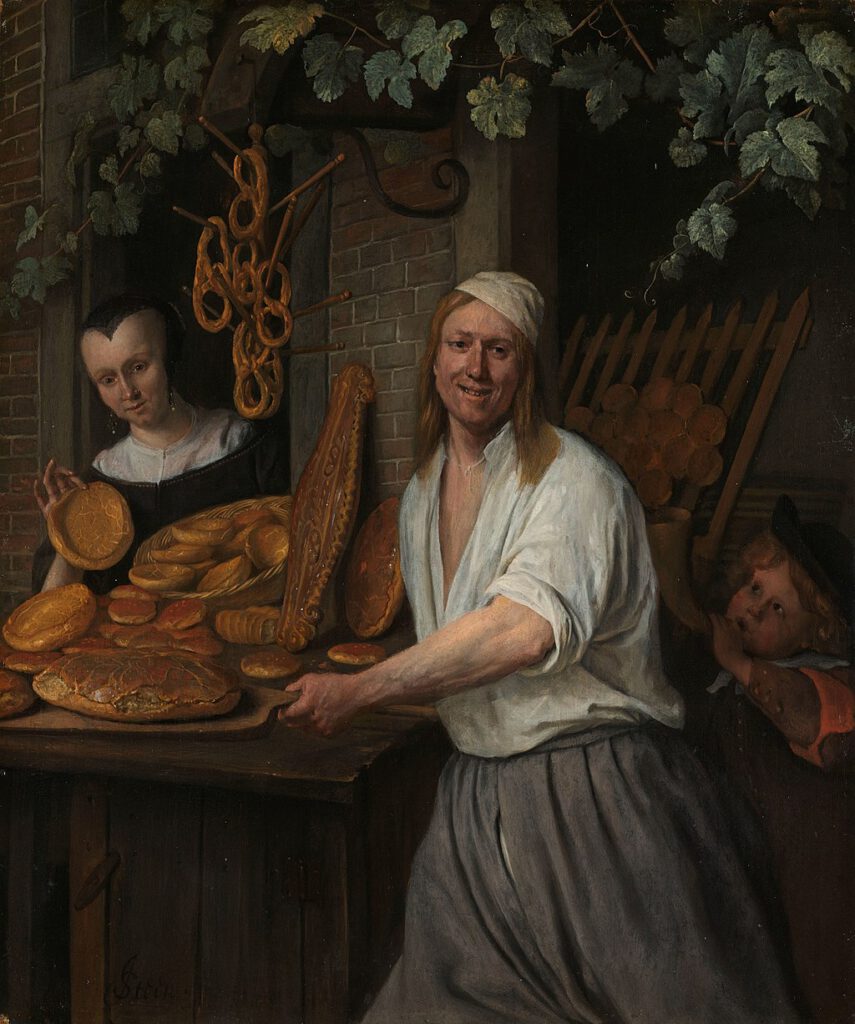
Painting of a Dutch Golden Age baker flexing his bread fresh from the oven. Image: Rijksmuseum/Wikimedia Commons/Public Domain
This is serious stuff: the government even appointed brood-wegers (bread weighers) who inspected bakers’ bread to ensure the perfect size, weight, ingredients, and bake.
They ought to leave no crumbs — bakers not following the right procedures would get a hefty fine. 💸
If bread has been bred as a building block of Dutch society, then sandwiches are the fully-baked masterpiece. You can check out some of DailyDutchLunch‘s posts for the fun reality of sandwich art in the Netherlands.
Or feast your eyes on our video about the ultimate Dutch sandwich:
Get (b)ready for lunch culture in the Netherlands
Get a “loaf” of this — the days of the Dutch Golden Age may be over, but the bread culture keeps growing, and nowadays, a wide assortment of sandwiches is available.
Usually, the Dutch tuck into lunch around midday, which lasts between 30 minutes and an hour, though this varies per workplace. Feeling extra productive? Sandwiches are handy for a 15-minute desk lunch, too. ⏰
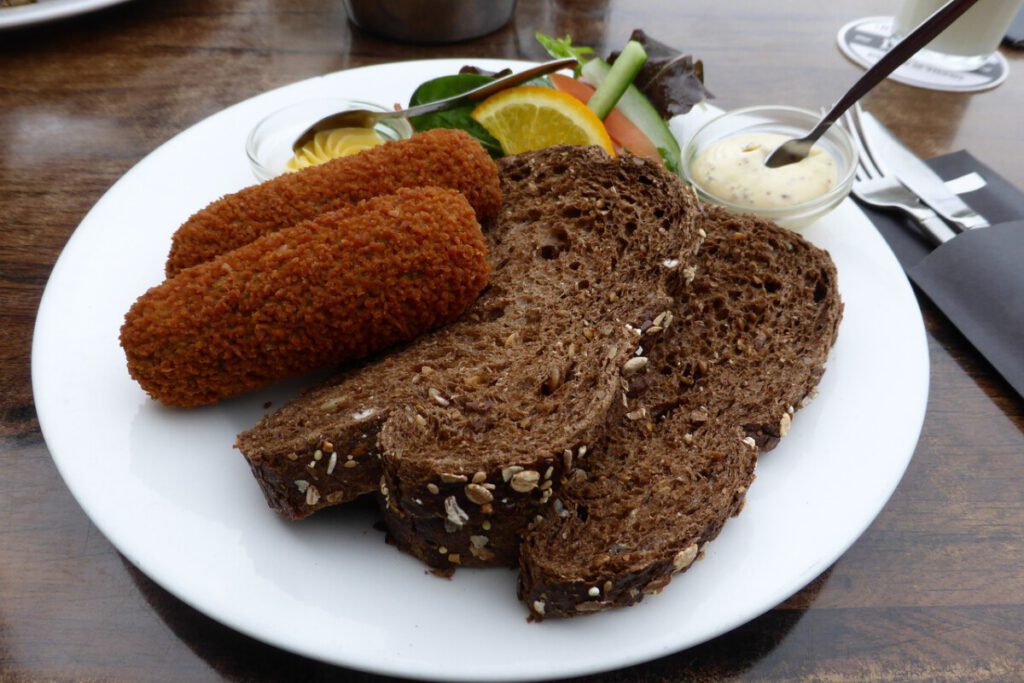
Sometimes kroketten are added to lunch for an extra Dutch touch! Image: Pixabay
Lunch is a moment of social gathering, as co-workers flock together to eat and socialise. In canteens at workplaces, one of the few warm meals you can usually get besides the cold Protestant sandwiches (a.k.a. bread with butter and ham or cheese) is soup. ♨
Some people might also bring lunch packed from home, which — as you might have already guessed — is probably a sandwich.
Well, one reason their lunch is on the lighter side is to maintain productivity and return to work feeling energised. After all, we know what it feels like when you eat big, only to enter a food coma for the rest of the afternoon. 😴
We’re looking at you, Southern Europeans. 👀⌚
How does Dutch lunching compare to other European countries?
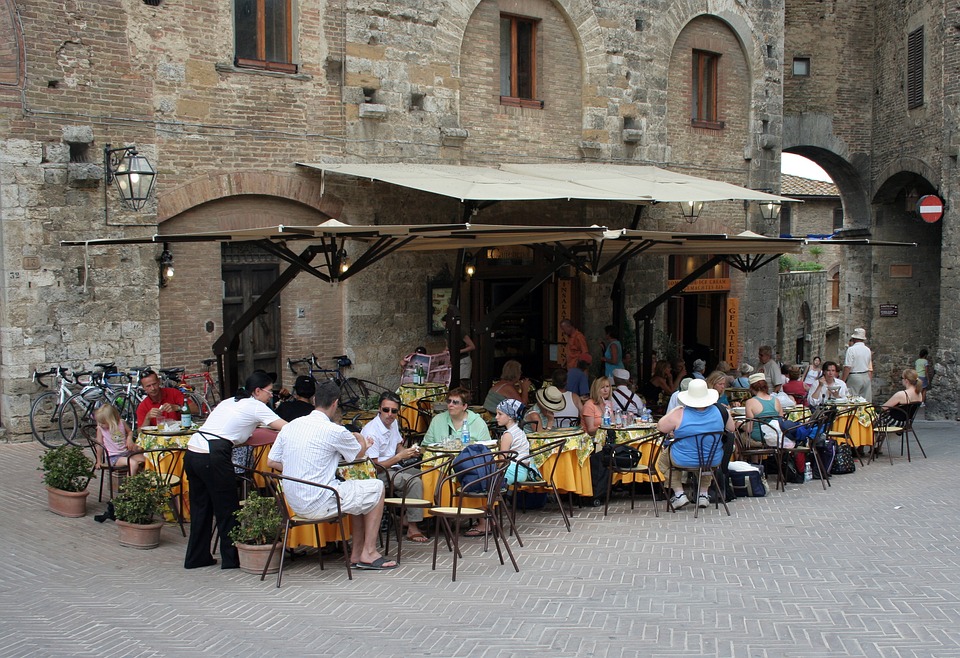
Consider the Italians. Their lunch break is two hours long, usually from 1 PM until 3 PM. Most shops close at this time, and the lunch is an all-in, two-course, communal experience complete with something sweet before coffee.
Italians enjoy their lunch very differently than the Dutchies. Image: Pixabay
The French have a similarly extravagant lunch culture. It’s not uncommon to have a four-course meal, and lunch is considered a celebratory moment of food and socialising with friends. 🍽
In the end, perhaps it is all just a trade-off — who is getting more work done? The French and Italians might eat rich, have nicer weather and a joie de vivre attitude, but are they efficient? Do their trains arrive on time? Wait, never mind…
It’s just up to how each country rolls. If the Dutch didn’t have bad weather and weren’t constantly fighting the seas, they wouldn’t be the country they are now. Maybe they would have better lunch options, but hey, who are we to turn down bread with margarine?
We’re not “baking” it up, here’s what you said
In order to get to the bottom of lunch culture in the Netherlands, we asked some of our readers from our awesome Facebook group about their experiences. Here are some of our favourite answers:
Our own Bobby Salomon, from Amsterdam, toasted the efficiency argument:
“Because there’s no time, it costs too much, it’s difficult to bring and/or keep warm if you make it yourself and — personally — I’m really uncomfortable with a warm stomach if I still have to do stuff after.”
Kostas from Greece, home of one of the best global cuisines, shares the understanding that a heavy lunch and productivity don’t mix:
“Dutch food has influences from nice cuisines, and contrary to what you may think, Dutch people really enjoy food. Lunch is usually something more light and fresh because they take lunch really early as well as dinner and therefore do not prefer heavy things when taking a break then going back to work four hours or so.”
Finally, Kenneth wanted to know:
“The next question should have been ‘Why did the Dutch people raid the whole world for spices hundreds of years ago only for their descendants not to use them?'”
Great question.
That ties up our article on Dutch lunch, and we wholeheartedly suggest that you should go and get yourself a boterham in celebration. Remember, you are not eating just bread with ham, you are getting a taste of true culture!
Do you have a favourite Dutch sandwich? Tell us in the comments below!