His license has now been revoked, and his Mercedes has been seized, with a report to be filed with the Central Bureau for Driving Licenses.
We get it, life can be busy. But is losing your license — and your Mercedes — really worth it? Turns out you can’t outrun a speed camera, even at 240 km/h.
Do you think losing their car and license was a fair consequence? Let us know in the comments.
Most internationals in the Netherlands have gone through this experience. You’ve been practising your Dutch and gathering the courage to use it in a public setting.
You walk up to a stranger and finally use the sentences you’ve been practising over and over again in your head.
But all it takes is one ‘Hoi,’ and the person you’ve approached immediately switches to English. 🙃
What is it?
Dutch people are notorious for switching to English if they detect that you’re not a native Dutch speaker, even when you’re actually speaking the language with them at that moment.
If you’ve ever visited, lived (or still live) in the Netherlands, then you know that the weather can be a bit hit-and-miss. Whether it’s rainy, windy, stormy, freezing, snowing, too hot, or rainy again, there always seems to be something to complain about.
Some people say it rains so much here because it gives Dutch people something to talk about!
But seriously, why does it rain so much in the Netherlands? And does it actually rain that much more than in other places? What is up with the weather in the Netherlands?! Let’s find out!
The Dutch climate
As you probably know, the Netherlands is located next to the North Sea, and the wind direction usually blows southwest, which means it has what’s known as a ‘moderate maritime climate.’
Fun fact: in Dutch, this is known as het zeeklimaat (sea climate).
This means that the Netherlands experiences warm (but not hot) summers and fairly mild winters, without any really big temperature changes during the seasons (which is certainly not how it feels to us during winter, or summer for that matter).
Snow is quite rare in the Netherlands, so when it comes out, it’s time to play! Image: Magnific
But compared to places such as, say, Canada, the Netherlands doesn’t actually get that cold.
Rain in the Netherlands
While it seems like it rains a lot in the Netherlands, in actuality, the average rainfall isn’t that high.
The main reason that it seems to rain so much is that the weather can be very unpredictable, and the lack of mountains in the Netherlands means there is nothing to block any incoming depressions from the sea.
The Netherlands actually only receives about 700 millimetres of rainfall a year, which is fairly similar to places such as San Antonio, Texas, just without any of the really extreme temperature changes, floods, and tornadoes!
But while we can tell you that it doesn’t actually rain that much here, it doesn’t change the fact that the unpredictability of the weather can still be annoying.
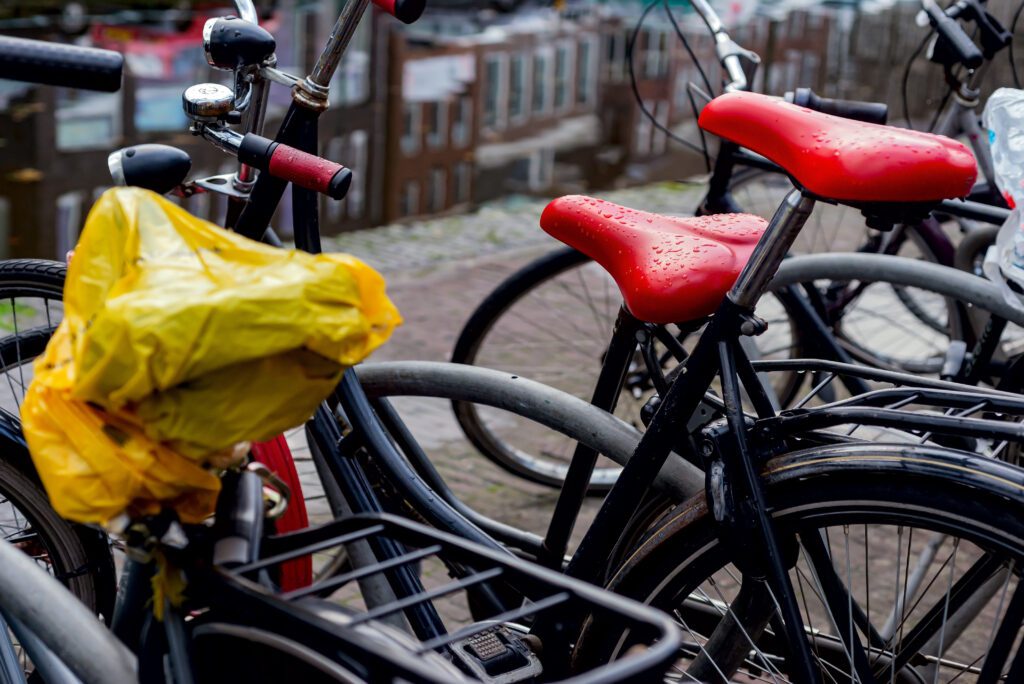
A bike seat cover is a Dutch essential (or a plastic bag — that’ll do the job too)! Image: Depositphotos
Even if the weather seems nice and sunny in the morning, by the afternoon it might be raining; so you should always take an umbrella or jacket with you, just in case.
And when you go out during the middle of summer, expecting a lovely warm sunny day, but instead you get RAIN (again!), it sure does feel like it’s always raining!
How to survive the weather in the Netherlands
While it might not rain a huge amount, the rainfall does come fairly often in small amounts.
And even those small parts can be annoying when you are trying to get to work or school, sight-see or travel around the country.
Here are our top tips for surviving the Dutch rain:
Always carry a decent umbrella with you — preferably one small enough to fit in a bag but sturdy enough not to turn inside out as soon as it’s windy, which it usually is here in the Netherlands!
If you’re getting into the Dutch habit of biking everywhere, make sure you cover your bike seat with a plastic bag (secured with a rubber band) when you’re leaving it outside — this will save you having a wet behind when you have to get back on it after a rain shower!
Check the weather apps, but don’t always trust them. Sometimes mine has told me it’s snowing when it’s sunny, so at least look outside as well.
If it is raining (or pouring), take advantage of some of the country’s great indoor attractions, such as museums, art galleries, and breweries. Every major city in the Netherlands, like Amsterdam, Leiden, and Tilburg, has great museums you can go to!
How do you survive the weather here? Let us know in the comments below!
If you’ve just moved to the Netherlands or are visiting for a while, you’re probably curious where to find the best coffeeshops in Almere.
This guide was written and regularly updated by the DutchReview editorial team, based in Amsterdam, drawing on first-hand visits to each.
Almere is one of the few places in the Netherlands where cannabis is fully legal, not just tolerated. While this city might not have the same international reputation as Amsterdam’s coffeeshops, it’s fast becoming a destination for legal weed in Almere — thanks largely to its involvement in the Dutch wietexperiment.
Unlike the rest of the Netherlands — where coffeeshops operate under gedoogbeleid (a tolerance policy that permits cannabis sales but keeps production technically illegal) and weed is only decriminalised — Almere is part of the Dutch government’s wietexperiment (weed experiment), making it one of the only places in the country where the entire supply chain, from grower to customer, is fully legal.
Whether you’re a seasoned smoker or just want to dip your toes into the world of Dutch weed, here are the three best coffeeshops in Almere, from an Almere local.
🌿 Quick facts: weed in Almere
Getting there: Direct train from Amsterdam Centraal to Almere Centrum, running frequently throughout the day — journey time approximately 20 minutes
City: Almere, Flevoland — 20 minutes from Amsterdam by direct train
Legal status: Fully legal under the Dutch wietexperiment (controlled cannabis supply chain experiment) — not just tolerated, but government-regulated
Coffeeshops: Three participating coffeeshops — Boerejongens, Chillie Kiki, and Koffie & Dromen
Price range: €10–15 per gram, depending on strain and coffeeshop
Daily purchase limit: Maximum 5 grams per person, per day
Minimum age: 18+ — valid photo ID required
1. Boerejongens Almere: a premium coffeeshop experience
Let’s kick things off with one of the most well-known names among the best Dutch coffeeshops: Boerejongens. Located right in the heart of Almere, at the Grote Markt, this place feels like a sleek, stylish, high-end dispensary rather than your typical dark coffeeshop.
What really makes this place stand out is that it stocks weed from Hollandse Hoogtes (a licensed cannabis grower under the wietexperiment), which offers some of the highest-quality regulated weed in the Netherlands. The strains on offer are carefully selected and of premium quality and include some of my personal favourites.
Strain tip: If you’re ready for a relaxing night in, Gorilla Glue is my top recommendation. This indica dominant strain will let you sink into your couch like it’s a cloud, while its 40% sativa composition means you can still make it to the fridge. With a sweet and sour tang and an earthy smell, this is hands down the best pick for unwinding after a long day without completely zoning out.
The staff here are dressed in white lab coats, offer incredibly friendly service, and make it easy to ask about the different strains so you can find one that suits your needs.
The staff here are trained in advising the best (and legal) products. Image: DutchReview
There’s also always someone dressed in a blue shirt: these are experts in Almere’s legal weed experiment and are the best people to advise you over the legal strains.
Boerejongens is one of the best coffeeshops in Almere for a sophisticated yet chill experience.
Boerejongens Almere
Address: Grote Markt 23, Almere Centrum
Vibe: Sleek, upmarket dispensary feel — think boutique, not basement
Price range: €13–15 per gram
Best for: First-timers who want expert guidance, or seasoned smokers after premium quality
2. Coffeeshop Chillie Kiki: affordable and authentic
Now, if you’re after something a little more laid-back and local, Coffeeshop Chillie Kiki is a great pick. An Almere institution since 2005, this coffeeshop has a solid reputation among locals for a down-to-earth vibe and affordable prices.
I’ve been here a few times, and it’s always the same: the staff are friendly but not too chatty, and the weed selection is fantastic for the price. They also have FYTA weed on the menu — another licensed grower operating under the wietexperiment — which means it’s government-regulated and consistently high quality. At Chillie Kiki, I particularly like Fyta’s Race Fuel OG, a 50/50 strain with a high THC content (around 20%!) giving you an energising and uplifting effect.
Grab a joint, kick back, and enjoy the simple pleasures of a great weed session without spending a fortune, because this Almere coffeeshop is one of my favourites.
Chillie Kiki
Address: Schoolstraat 260, Almere Haven
Vibe: No-frills, local and laid-back — the kind of place regulars keep to themselves
Price range: €10–12 per gram
Best for: Budget-conscious smokers who’d rather spend on weed than atmosphere
Standout strain: Race Fuel OG by FYTA — 50/50, high THC, energising
Coffeeshop Koffie & Dromen is perfect for those who enjoy a more relaxed, cosy vibe. The atmosphere is warm and relaxed, and the staff are as friendly as they come.
Best of all? This coffeeshop is on an authentic, vintage BOAT. Imagine smoking your joint while floating on the water. It’s one of those “only in the Netherlands” experiences, and trust me, it’s worth it.
My favourite strain here is the Rainbow Sherbert 11 (RS11), a brilliant cross between Pink Guava with a Sunset Sherbert. This strain is known for its calming effects, without making you a couch potato. With a fruity tang and hints of sour citrus, this is more than an ideal strain for on the go — it tastes good too.
The chilled-out vibe, the impressive and legal weed selection, and the boat make this place a truly memorable stop. Whether you’re looking to have a quiet afternoon by yourself or want to enjoy a smoke with friends, Koffie & Dromen is easily a top coffeeshop in Almere.
Koffie & Dromen
Address: Festivalplein 19, Almere Centrum
Vibe: Cosy and unique — you’re smoking on a vintage boat, need we say more
Price range: €10–13 per gram
Best for: Anyone after a one-of-a-kind, only-in-the-Netherlands experience
Yes! In Almere, buying and smoking weed in coffeeshops is not only allowed, but it’s completely legal.
Thanks to Almere’s involvement in the wietexperiment, you can be sure that the weed you’re buying is regulated and of high quality. It’s comes direct from the grower in a sealed package and has specific details on THC and CBD levels — now that’s fancy.
As of April 7, 2025, only fully regulated weed is sold, so you don’t have to worry about anything shady.
Just keep a couple of rules in mind:
You can only smoke in designated places: So no puffing in public areas or near schools, and no smoking tobacco indoors.
You need to be 18 or older: Bring a valid ID with you — yep, even if you think you look 25, make sure you’ve got the proof.
You can buy a maximum of five grams a day: Luckily, that’s enough for even the best of us to party.
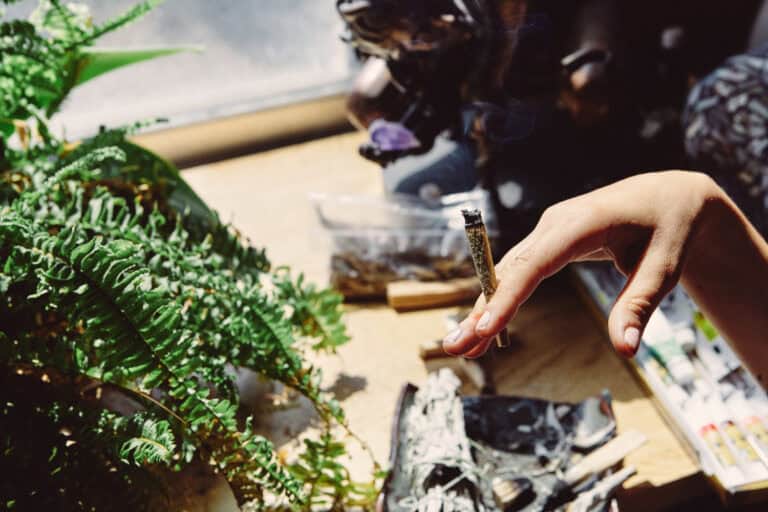
The weed experiment means that weed in Almere is legal and regulated. Image: Freepik
Tips for smoking weed in Almere safely
While weed in Almere coffeeshops is legal, make sure to stay safe while smoking by:
Avoiding street dealers: Only buy from coffeeshops. Street dealers are illegal, and you don’t want to get caught up in anything dodgy or buy weed that’s laced with something else.
Going easy: Dutch weed tends to be a bit stronger than what you might be used to, so take it slow and see how you feel.
Remaining in safe environments: After you’ve smoked, take it easy. Don’t bike, drive, or explore too much — just chill out and let the buzz pass.
Other things to do in Almere (besides lighting up)
If you’ve got a bit of time to kill in Almere, don’t spend it all at coffeeshops. There’s plenty to see and do, and it’s a great way to take in the city after a relaxing sesh.
Visit the Oostvaardersplassen nature reserve: A beautiful nature reserve with wildlife like deer and wild horses. It’s perfect for a scenic walk after your smoke — take it from me. 😉
Explore Almere Centrum: A design lover’s dream. The city is known for its modern, innovative architecture. If you appreciate good design, you’ll love it here.
Walk around Almere Haven: A charming neighbourhood full of canals, cosy cafes, and quaint shops.
Chill on Almeerder beach: In summer, this beach is the place to be. If you’re feeling adventurous, rent a paddleboard and enjoy the water. Got some extra time? Check out the rest of the Duin area, with cafes, restaurants, open-water pools, sailing schools, and more.
Check out the PIT Safety Museum: For something a bit different, head to this quirky museum dedicated to safety and emergency services.
Shop or catch a film: The shopping district is buzzing with shops, restaurants, and cinemas — perfect for a fun day out.
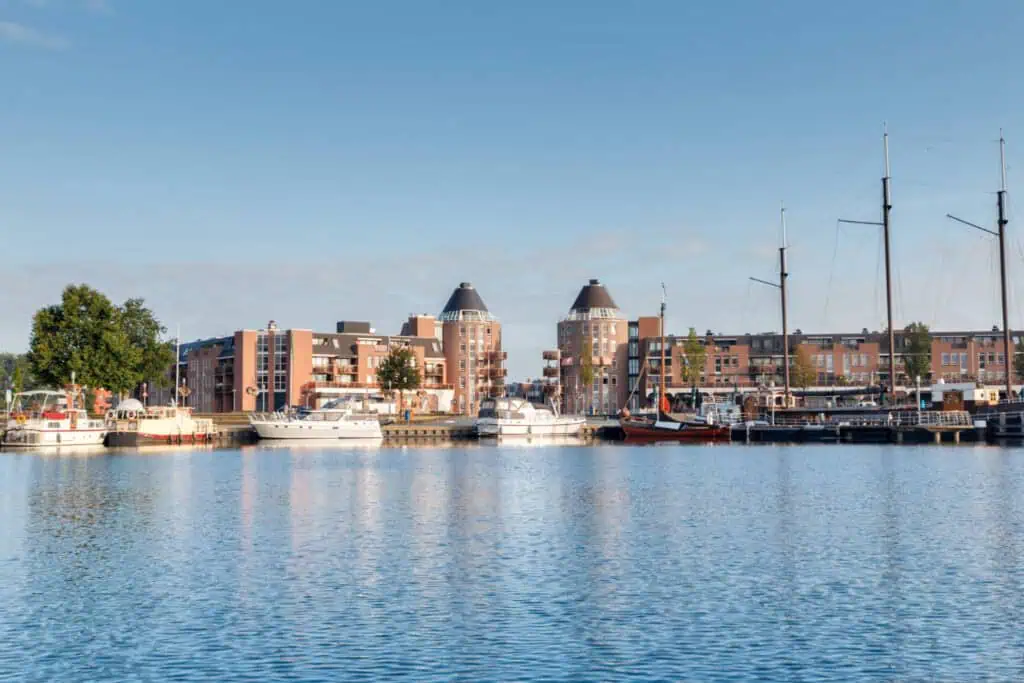
The Almere Haven is a top spot for visitors, and is close by to some of the best Almere coffeeshops. Image: Freepik
So, is Almere worth visiting for cannabis in 2026?
Almere might not have the same tourist draw as Amsterdam, but it’s got a unique, laid-back charm that makes it well worth the visit.
If you’re after high-quality weed without the crowds, this city delivers.
With coffeeshops like Boerejongens, Chillie Kiki, and Koffie & Dromen, you can enjoy a relaxing experience with top-notch weed in a calm, friendly atmosphere.
So, whether you’re a local or just passing through, Almere is a great place to light up and kick back. You won’t be disappointed!
What is your favourite coffeeshop in Almere? Tell us in the comments below!
FAQ: smoking weed in Almere
Can you smoke weed in Almere?
Yes, you can smoke weed in Almere — and unlike the rest of the Netherlands, it’s completely legal thanks to the city’s involvement in the Dutch wietexperiment. Just stick to designated smoking areas, don’t light up near schools or in public spaces, and you’re good.
Is Almere weed legal for tourists?
Weed in Almere is legal for tourists, as long as you’re 18 or older and can show a valid ID. You can buy up to five grams per day from any of Almere’s three participating coffeeshops — no Dutch residency required.
How much does weed cost in Almere?
Weed in Almere typically costs between €10–15 per gram, depending on the strain and the coffeeshop. Chillie Kiki is the most budget-friendly option, while Boerejongens sits at the premium end of the price range.
How do I get to Almere from Amsterdam?
Getting to Almere from Amsterdam is easy — direct trains from Amsterdam Centraal run frequently and take around 20 minutes. From Almere Centrum station, all three coffeeshops are reachable on foot or by a short bus ride.
If you’re heading to the Netherlands, chances are you want to smoke weed in Amsterdam — right?
This guide was written and regularly updated by the DutchReview editorial team, based in Amsterdam, drawing on first-hand visits to each.
Of course, before you light up your green and enjoy all those good vibes, it’s important that you know smoking weed in Amsterdam might not be quite what you expect.
For example, did you know that weed in Amsterdam isn’t technically legal — despite what you may have heard?
Yep. So listen up, weed-desiring folks: here’s everything you need to know when it comes to getting high in Amsterdam.
Quick facts: smoking weed in Amsterdam
🏙️ Is Amsterdam in the wiet experiment? No — Amsterdam was explicitly excluded from the Netherlands’ regulated cannabis supply experiment, which runs in ten other cities until 2029
⚖️ Legal status: Cannabis is not fully legal in the Netherlands — it is tolerated under gedoogbeleid, a policy of allowing coffeeshop sales without fully legalising the drug
🔞 Age requirement: You must be 18 or over to enter a coffeeshop and purchase cannabis; valid photo ID (passport or EU identity card) is required
🛒 Purchase limit: You can buy up to 5 grams of cannabis per transaction at each coffeeshop; you may not carry more than 5 grams in public
💶 Average price: Standard strains cost between €10 and €20 per gram; premium imported “Cali” strains can reach €25–€35 per gram
🚭 Public smoking ban: Since May 2023, smoking weed is banned in De Wallen (the Red Light District), Dam Square, Damrak, and Nieuwmarkt — fines of €100 apply
Surprised? I was, too! In most of the Netherlands, weed is only decriminalised, not legal.
There are only ten cities, not including Amsterdam, in the whole country where weed is fully legal as part of an ongoing regulation experiment.
This means that consuming weed in Amsterdam and the rest of the country is only tolerated, unlike other countries like Canada, Germany, and Uruguay, where it is legal.
Essentially, you’re able to walk into a coffeeshop, purchase less than five grams of weed, and smoke it. All is good as long as you’re not being a pain in the butt.
Basically, weed is neither legal nor illegal in the Netherlands: it’s a smoky grey area.
🙋♂️ But how do Amsterdam coffeeshop owners get their stock?
Great question! This is where it gets fun. Stocking a coffeeshop is technically illegal because it requires a person to transport more than the allowed five grams of weed at once, and leads to people growing more than the allowed maximum of five plants.
As a result, each day, many coffeeshop owners swap tens of thousands of euros in cash for a few kilos of cannabis. A coffeeshop is only allowed 500 grams on-site at any time, leading to multiple deliveries during daily business.
So can you legally smoke weed in Amsterdam?
Technically? No. In practice? Yes, you can smoke weed in Amsterdam in public or in private.
However, make sure you’re abiding by the rules, namely:
You’re over 18,
You don’t have more than five grams of weed in your possession,
You’re not causing a public disturbance, and
You’re smoking in an area of Amsterdam where it is not banned.
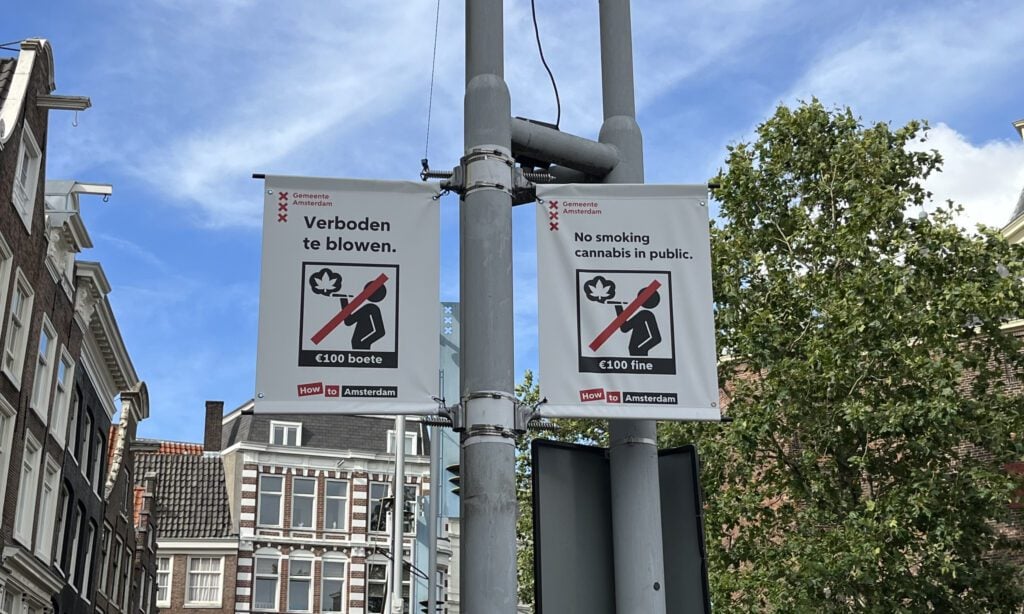
See this sign? That means you’re in a part of Amsterdam where smoking weed is not allowed. Image: DutchReview
Where in Amsterdam am I allowed to smoke weed?
In February 2023, the municipality of Amsterdam announced a partial smoking ban in the city, the so-called blowverbod. They did this as part of an attempt to scare off rowdy tourists who would cause trouble after consuming drugs and alcohol.
The weed ban counts only for some of the most central areas of Amsterdam, namely: de Wallen (the Red Light District), the Dam, the Damrak, and the Nieuwmarkt. 🚭
Blazing it up in one of these areas could land you a juicy €100 fine. Ouch! That being said, according to various Dutch sources, the Dutch police often let you get away with a warning at first.
👉 How to order weed at an Amsterdam coffeeshop
Ordering weed at an Amsterdam coffeeshop is just as easy as ordering a coffee at Starbucks: once you know how to do it, it’s simple!
1. Walk inside and look at the menu
Most coffeeshops have a menu near the register with the types of weed available and the prices. You can either take a look at this and make a decision for yourself or ask the person at the register for a recommendation.
You’ll need to decide:
what variety and strain of weed you would like, and
how you would like to consume it
The main categories of weed are pure weed (just the leaves), weed mixed with tobacco (the most common option in the Netherlands), and hashish (a more concentrated form of weed, typically with higher amounts of THC).
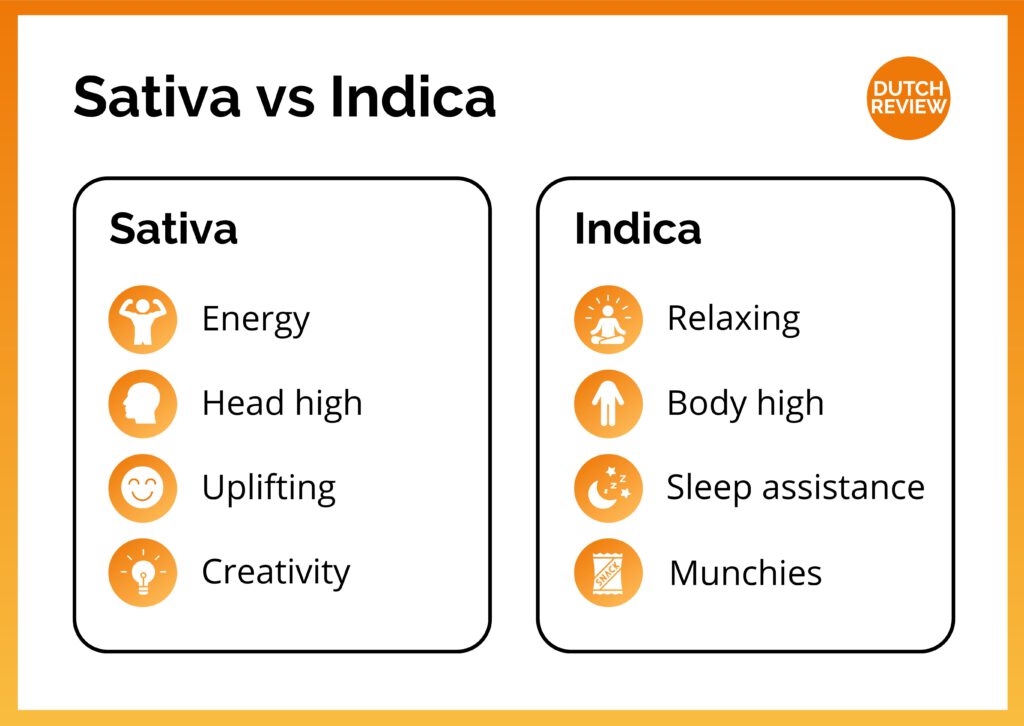
You will also be asked to decide between Indica weed (for a more relaxing body high) or Sativa weed (for an uplifting head high).
Which one will you go for? Image: DutchReview
Finally, you’ll be asked to choose your delivery method. Would you prefer to:
roll your own joints by buying loose buds?
buy a pre-rolled joint?
eat it via an edible?
If it’s your first time smoking weed in Amsterdam, my advice is to go for a pre-roll of pure Sativa or Indica.
If you’re entirely new to smoking and feel a bit nervous, an edible might be for you. Be aware that edibles should be consumed in small quantities (share a muffin with a couple of friends) because their effects take a while to activate and sneak up on you.
2. Order at the counter with your ID ready
You can place your order (almost always in English!) at the counter. Ask them for what you decided, or ask for a recommendation. E.g. you could ask for:
“A pre-rolled joint that will make me relaxed.”
“An edible for a first-timer.”
“One gram of bud that I can use in a bong at a party.”
You might be asked for your ID before you’re allowed to purchase anything. You need to be at least 18 years old to buy and smoke weed in the Netherlands, so make sure you have an identification card or your passport at easy access.
The budtender will weigh your choice of weed on scales if you took a loose option, or hand you your pre-rolled joints or edibles.
3. Request anything else you need and pay
Do you need a lighter? Rolling papers? A grinder? (If you’re rolling your own joint). These items are almost always available at the counter or in a nearby vending machine.
If your coffeeshop only has rather pricey grinders (e.g. the metal ones), you can head over to a nearby kiosk or tourist shop for a cheaper option. I managed to snag a plastic one for just €5 there!
Some coffeeshops have complimentary rolling papers and filters available at the counter when you’re buying weed, so take advantage of this where possible.
Finally, you need to cough up your cash. The attendant will tell you your total and you can make the payment.
⚠️ Warning! Some coffeeshops in Amsterdam only accept cash and others only accept card payments. It’s best to have both on hand before you make your order. Be careful, because some bank cards don’t work in the Netherlands.
4. Choose where you will smoke and light up!
Many coffeeshops in Amsterdam have an indoor area. If you’ve bought weed from the coffeeshop you can head through and smoke inside or on their terrace.
Plenty of coffeeshops nowadays have drinks or even some light bar snacks available. There may also be a TV or music going so you can fully chill out.
If you’d prefer not to get high with other people around you, you’re just as welcome to pocket your weed and head to a private location: a private household, a park, whatever your choice.
However, make sure you’re allowed to smoke wherever you end up; many hotels and Airbnbs won’t allow it, and there are some places in Amsterdam where it is forbidden.
The cost of weed in Amsterdam is dependent on a number of things, including:
strain and variet
strength
location of the coffeeshop
As a general guide, you can expect to pay:
Item
Cost
One gram of weed
Between €10 and €20
A pre-rolled joint
Between €8 and €15
An edible brownie, cookie, or similar
Between €8 and €20
Prices vary by coffeeshop, strain, and location — shops near the city centre and tourist areas tend to charge more.
👍 Best coffeeshops to smoke weed in Amsterdam
When you smoke weed in Amsterdam, you want an option with high-quality weed — but also a great atmosphere.
There are some major tourist hotspots that tourists flock to, but if you want the best coffeeshop experience, I’ve had good luck with Boerejongens. Their workers have stacks of knowledge about types of weed and are happy to offer suggestions, and the coffeeshops’ interiors are pure class.
If you’re all about that authentic feel, head to the old-world charm of Tweede Kamer. The coffeeshop is a slice of Dutch history after being opened in 1985, and the range of strains is top-notch.
7 best coffeeshops to visit to smoke weed in Amsterdam
Coffeeshop
The best parts
Location
Website
Boerejongens
Great vibe, high-quality staff, two locations, best spacecakes
🧳 YSK: Smoking weed in Amsterdam is mainly a tourist activity
Walk into any coffeeshop in Amsterdam — no, not a café where you get good coffee and cold drinks, a coffeeshop where you get weed and bad coffee — and you will instantly notice something: the people behind the counter are all Dutch, and most customers are foreigners.
This is because, despite what you may have heard about the Netherlands being a weed paradise, the Dutch don’t actually smoke that much weed. In fact, less than 25% of Dutchies admit that they’ve tried a weed product in their lifetime.
⚠️ Knowing your limits when smoking weed in Amsterdam
This is the part where we warn you that you should be careful when smoking weed in Amsterdam, especially if you’re doing it for the first time.
Smoking weed allows you to control how high you get by smoking just a little or a lot. Hopefully, you’re getting high with a friend, in which case you two can share a one-gram pre-roll to start with.
We don’t want to sound like your Mum, but make sure to:
Stay hydrated,
Be careful with bikes when roaming the city, and
Never buy weed from any place that isn’t a coffeeshop.
If it’s your first time smoking weed in Amsterdam, it’s also a good idea to take a close friend with you. Image: Depositphotos
If you don’t know how your body (or mind) will react to marijuana, take it slow and stay in a safe place with friends until the high has worn off. Smoking weed in Amsterdam is very safe — but smoke responsibly, kids. 😉
🍄 Truffles and edibles: other ways to get high in Amsterdam
If you’re looking for something a bit more trippy or want to make Van Gogh’s Starry Night come to life, then perhaps consider trying truffles.
In Amsterdam, truffles are sold in smart shops and are actually legal — so if you’ve ever wanted to give them a go, this could be your sign.
Alternatively, perhaps you want to spend your entire holiday exploring the epic club scene in the Netherlands?
If you’re interested in harder drugs, then make sure you read up on ecstasy use in the Netherlands. The pills have a higher concentration here than in other countries, so be wary.
There is much more to smoking weed in Amsterdam than just hopping into the nearest coffeeshop near your hotel and asking for a joint.
It’s important to know what you’re getting, understand your own limits, and be in a safe environment when you are trying something for the first time. But it is a fun stack and a quintessential aspect of visiting Amsterdam and the Netherlands.
What tips do you have when it comes to smoking weed in Amsterdam? Tell us in the comments below!
Frequently Asked Questions about smoking weed in Amsterdam
Is weed legal in Amsterdam?
Weed is not fully legal in Amsterdam, but it is tolerated under a Dutch policy known as gedoogbeleid. This means that adults aged 18 and over can purchase up to five grams of weed per transaction at a licensed coffeeshop and consume it without being prosecuted. However, growing, transporting, and selling weed outside of licensed coffeeshops remains technically illegal — it’s a grey area the Netherlands has lived with since the 1970s.
Can tourists buy weed in Amsterdam coffeeshops?
Yes, tourists can buy weed in Amsterdam coffeeshops — the city never implemented the resident-only wietpas (weed pass) that some other Dutch cities adopted. You’ll need to be 18 or over and show a valid passport or EU identity card; a driving licence is often not accepted, especially for non-EU visitors. You can purchase up to five grams per transaction.
How much does weed cost in Amsterdam coffeeshops?
The cost of weed in Amsterdam coffeeshops depends on the strain, quality, and location of the shop. As a general guide, standard strains cost between €10 and €20 per gram, while premium imported “Cali” strains can reach €25–€35 per gram. Pre-rolled joints typically cost between €8 and €15, and edibles such as space cakes or brownies range from €8 to €20.
What is the difference between weed and hash in Amsterdam coffeeshops?
The difference between weed and hash in Amsterdam coffeeshops comes down to the form of cannabis. Weed refers to the dried flower of the cannabis plant, while hash (or hasj) is a more concentrated extract made from compressed cannabis resin, typically with a higher THC content and a different flavour profile. Both are available at most Amsterdam coffeeshops — if you’re unsure which to try, ask the budtender for a recommendation based on your experience level.
Where can I smoke weed in Amsterdam?
You can smoke weed in Amsterdam inside licensed coffeeshops, in most outdoor public spaces outside the city centre, and in private accommodation where the owner permits it. Since May 2023, Amsterdam’s blowverbod bans smoking weed in several central areas — specifically De Wallen (the Red Light District), Dam Square, Damrak, and Nieuwmarkt — with fines of €100 for violations. Always check for signage before lighting up outdoors.
The Dutch are famously relaxed about many things — smoking weed, sipping a drink, and generally living the good life. But mixing weed and alcohol in the same venue? Absolutely not, hoor!
This guide was written and regularly updated by the DutchReview editorial team, based in Amsterdam, drawing on first-hand visits to each coffeeshop featured.
That’s because in Amsterdam, it’s actually illegal for coffeeshops, bars, or cafés to sell both cannabis and alcohol over the same counter. Wild, right?
So, does that mean there are no smoker-friendly bars in Amsterdam, and you’ll have to choose between a cold beer and a joint on your next trip to the city? Not at all.
Enter the smoker-friendly bar in Amsterdam: a brilliant loophole where you can bring your own weed, smoke it (pure, of course), and enjoy a nice drink — all under one roof. Wat leuk! (That’s Dutch for “how nice!”)
And lucky you — as a seasoned expat in the Netherlands, I know exactly where to go. Let’s dive into the best spots where you can light up and cheers at the same time. 😎
⚖️ Legal framework: Smoker-friendly bars operate under the Dutch gedoogbeleid — a policy of tolerating cannabis use without fully legalising it
🌿 What is a smoker-friendly bar? A licensed bar where you can bring your own cannabis from a nearby coffeeshop and smoke it on-site while purchasing alcohol
🛒 Can you buy weed there? No — Dutch law prohibits venues from selling both cannabis and alcohol, so you must bring your own
🔞 Age requirement: You must be 18 or over to enter, and valid photo ID is required
🚭 Tobacco rule: Smoking tobacco indoors has been banned in the Netherlands since 2008 — only pure cannabis joints are permitted
But all good highs must come to an end. In 2008, the Dutch government introduced new regulations that forced over 750 coffeeshops across the country to make a choice: sell cannabis or alcohol — but not both.
To make matters stricter, that same year the Netherlands also implemented a nationwide indoor smoking ban, meaning you can no longer smoke tobacco or tobacco-mixed joints in public indoor spaces — including coffeeshops. 🚭
And more recently, in May 2023, Amsterdam brought in a blowverbod — a ban on smoking weed in parts of the city centre. So if you’re strolling through de Wallen (the Red Light District), Dam Square, Damrak, or Nieuwmarkt, keep that joint in your pocket.
Still, if you dream of kicking back with a cold drink and some top-shelf green, there’s good news: smoker-friendly bars in Amsterdam still exist — and they’re very much worth discovering.
Best smoker-friendly bars in Amsterdam
So, where exactly can you light up a joint and sip a beer — at the same time? Here’s your guide to the best smoker-friendly bars in Amsterdam. Buckle up, folks — we’re heading straight into the smoky, boozy heart of Amsterdam nightlife. 💃
Here are six top spots in the city where you can pair a pint with a puff — no sneaky alleyway sessions required.
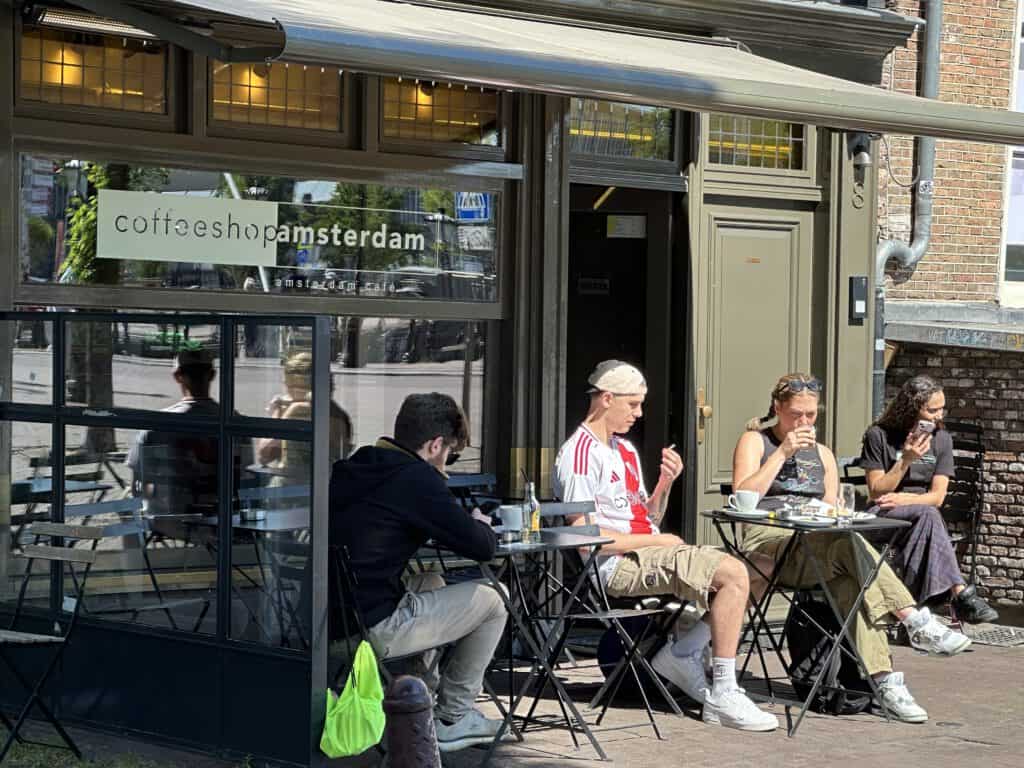
1. CoffeeshopAmsterdam Café, Singel: cocktails and gezelligheid
CoffeeshopAmsterdam Café even has a terrace to smoke and drink on. Image: DutchReview
CoffeeshopAmsterdam Café really delivers the full package: it’s just a short stroll from Amsterdam Centraal, it oozes gezellige vibes, and the drinks menu? Absolutely on point (seriously — try the cocktails 🍹).
Unlike many smoker-friendly bars that are tucked away in dark corners, this one is bright, open, and accessible, with a boutique-style interior that feels more like a stylish café than a hazy den.
Here’s the deal: you can’t buy weed on-site, but you’re more than welcome to bring your own (tobacco-free!) joints from a nearby coffeeshop (like Coffeeshop Amsterdam just two minutes walk away) and spark up while sipping a cocktail or one of their signature milkshakes.
The ventilation in the downstairs lounge is excellent, too — perfect if you want to light up without smelling like a walking joint for the rest of the night. 💨
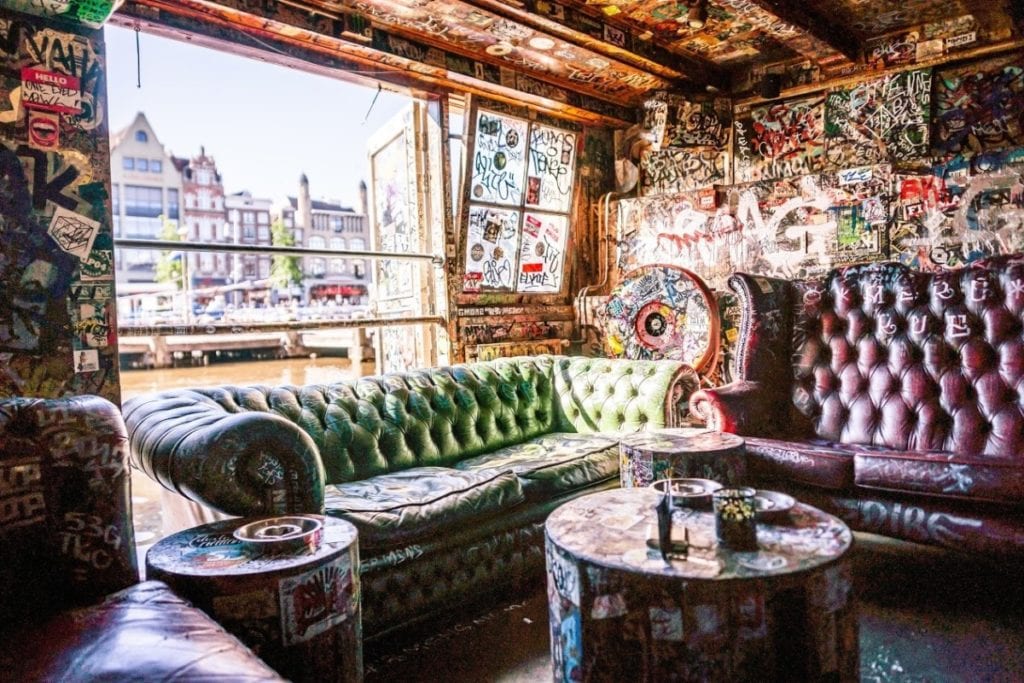
2. Café Hill Street Blues, Warmoesstraat: for grungy canalside views
Can you imagine a cooler location to smoke up and enjoy Amsterdam’s best canal views? Image: Supplied
Love your venues a bit gritty, alternative, and proudly rough around the edges? Then Café Hill Street Blues is your kind of place. It’s one of the coolest smoker-friendly bars in Amsterdam to kick back with a joint and a beer.
This Red Light District favourite wears its graffiti-covered, sticker-plastered vibe like a badge of honour. The mismatched furniture, street-art walls, and beat-up couches make it feel like an underground hideout — and yes, you’re welcome to add your own doodle or scribble to the decor.
It’s fun, it’s raw, and it’s got character. You might even catch one of their casual live music nights, adding an extra buzz to your buzz.
3. Lost in Amsterdam, Nieuwendijk: the OG smokers’ bar
Looking for the original smoker-friendly bar in Amsterdam? You’ve found it. Lost in Amsterdam has been around for over 15 years and still holds its crown as one of the best spots to combine a joint with a drink.
Here, you’re welcome to smoke pure cannabis, lounge on a Moroccan-style couch, and browse a massive menu of cocktails, milkshakes, and water pipes. (Pro tip: the milkshakes are legendary 🥤.)
The vibe is cosy and laid-back, with soft lighting and plush decor that gives off total holiday mode. It’s the kind of place you settle into and suddenly realise you’ve been there for hours — in the best way possible.
Lost in Amsterdam is a true classic — and a must-visit if you want the full smoker’s lounge experience.
📌 Where:Nieuwendijk 19a, 1012 LZ, Amsterdam, Amsterdam Centrum ⏰ Opening times: Sunday through Thursday: 10 AM until 1 AM; Friday and Saturday: 10 AM until 3 AM
4. Barney’s Uptown, Haarlemmerstraat: smoke it up in class
Isn’t this the perfect setting to enjoy a tequila (shaken, not stirred) and a joint? Image: Supplied
Fresh off the train from Schiphol? Take a five-minute stroll from Amsterdam Centraal and you’ll land at Barney’s Uptown — a smoker-friendly bar with serious rock-‘n-roll energy, live DJs, and an atmosphere that’s always buzzing.
This spot goes beyond snacks — they serve full meals, and their cocktail menu is worth coming back for (even if you’re not high).
Need a refill? No problem. Barney’s Coffeeshop is right across the street, making it super easy to stock up and return to your seat for round two. 😮💨
Barney’s Uptown is ideal if you’re looking to pair a quality meal with your green — all without straying far from the station.
5. Hunter’s Bar, Utrechtsestraat: for a laid-back vibe
Short on time but still want the full smoke-and-sip experience? Head to Hunter’s Bar, conveniently located right across from the legendary Boerejongens Coffeeshop. With neighbours like that, it pretty much has to be smoker-friendly — and it is.
Hunter’s is actually a small empire, with seven coffeeshops and two smokers’ bars spread across Amsterdam, Haarlem, and Zandvoort. But this central location is a favourite thanks to its fresh beer on tap, laid-back vibe, and walking distance to Rembrandtplein.
It’s a perfect pitstop if you’re sightseeing in the city centre — or just need somewhere chill to roll, relax, and refresh.
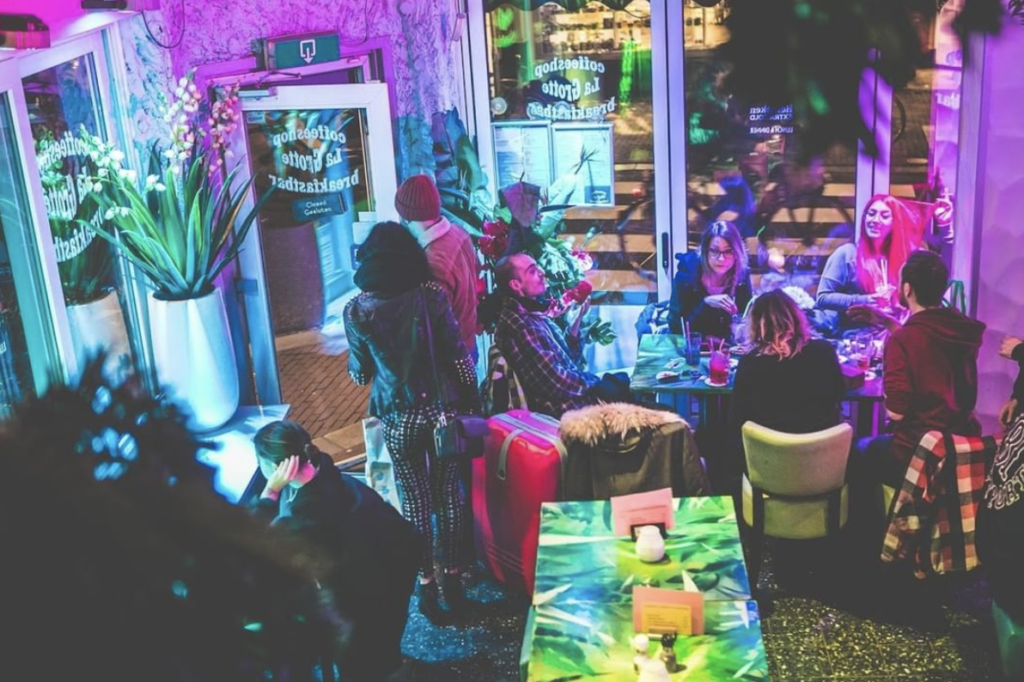
6. Miss B by La Grotte, Haarlemmerstraat: funky interior for a great trip
This light play is going to take you straight into outer space. Image: Supplied
When the Dutch government made venues choose between weed or alcohol, Miss B by La Grotte picked the bar life — and never looked back. Now, it’s one of the funkier smoker-friendly bars in Amsterdam where you can bring your own cannabis and light up in style. 🔥
Even if you’re not planning on getting high, the trippy purple-green lighting and surreal interior will give you a psychedelic experience all on its own.
Pair that vibe with their mouthwatering drinks menu, and you’ve got yourself a night to remember — or half remember, depending on how strong your joint was.
Now you really know how to have fun in Amsterdam — smoking weed, drinking beers and enjoying the best of both worlds. Looking for what comes after? Check out the best clubs in Amsterdam to keep the night going. 😉
Which smokers’ bar in Amsterdam will you check out first? Tell us in the comments!
What Amsterdam bars can I smoke weed in: frequently asked questions
Can I smoke weed in bars in Amsterdam?
Yes, you can smoke weed in a specific type of bar in Amsterdam called a smoker-friendly bar. These are licensed alcohol-serving venues — distinct from coffeeshops — where customers are permitted to bring their own cannabis and smoke it on-site. Only pure joints are allowed; tobacco mixed with cannabis is prohibited under the Netherlands’ 2008 indoor smoking ban. Examples include Lost in Amsterdam (Nieuwendijk 19A, Amsterdam Centrum) and Barney’s Uptown (Haarlemmerstraat 105, Haarlemmerbuurt).
What are the best bars in Amsterdam where I can smoke weed?
The best smoker-friendly bars in Amsterdam are CoffeeshopAmsterdam Café (Singel 8, Amsterdam Centrum), Café Hill Street Blues (Warmoesstraat 52A, De Wallen), Lost in Amsterdam (Nieuwendijk 19A, Amsterdam Centrum), Barney’s Uptown (Haarlemmerstraat 105, Haarlemmerbuurt), Hunter’s Bar (Utrechtsestraat 16, Grachtengordel-Zuid), and MissB by La Grotte (Haarlemmerstraat 34, Haarlemmerbuurt). None of these venues sell cannabis — you must bring your own from a nearby coffeeshop.
Do they sell weed at smoker-friendly bars in Amsterdam?
No, smoker-friendly bars in Amsterdam do not sell cannabis. Dutch law prohibits any venue from selling both alcohol and cannabis over the same counter, so these bars serve drinks only.
Instead, you can buy it at one of Amsterdam’s many coffeeshops and bring it to the bar. Lucky for all of us, many bars, such as Barney’s Uptown (Haarlemmerstraat 105), which sits across the street from Barney’s Coffeeshop (Haarlemmerstraat 102), have a coffeeshop nearby, so we don’t have to travel far to get our supplies. 😉
Which is the oldest smoker-friendly bars in Amsterdam?
The oldest smoker-friendly bar in Amsterdam is Lost in Amsterdam, located at Nieuwendijk 19A in Amsterdam Centrum, a short walk from Amsterdam Centraal station. It has been operating for over 15 years and is known for its Moroccan-inspired décor, extensive cocktail menu, and legendary milkshakes. It is open Sunday to Thursday 10 AM–1 AM and Friday to Saturday 10 AM–3 AM.
Can tourists smoke weed in Amsterdam bars?
Yes, tourists can smoke weed in Amsterdam’s smoker-friendly bars — as long as they follow the rules. You can’t buy cannabis at the bar itself, so you’ll need to pick up your supply from a nearby coffeeshop first and bring it with you. Bear in mind that you must be 18 or over, and only pure joints (no tobacco mixed in) are permitted indoors.
Do you need ID to enter a smokers’ bar in Amsterdam?
Yes, you will need ID to enter a smokers’ bar in Amsterdam, as all venues serving alcohol are required to verify that you’re 18 or over. A passport or government-issued ID card is the safest option to bring — a photo on your phone won’t always cut it. Don’t leave your accommodation without it, or you may find yourself turned away at the door.
What is the difference between a coffeeshop and a smokers’ bar in Amsterdam?
The difference between a coffeeshop and a smokers’ bar in Amsterdam comes down to what they sell. A coffeeshop is a licensed venue where you can buy and consume cannabis on-site, but cannot serve alcohol. A smokers’ bar is the opposite — it sells alcohol and soft drinks, but does not sell cannabis; you bring your own from a coffeeshop nearby. Thanks to a 2008 Dutch regulation, venues have been required to choose one or the other, which is exactly how smoker-friendly bars came to exist.
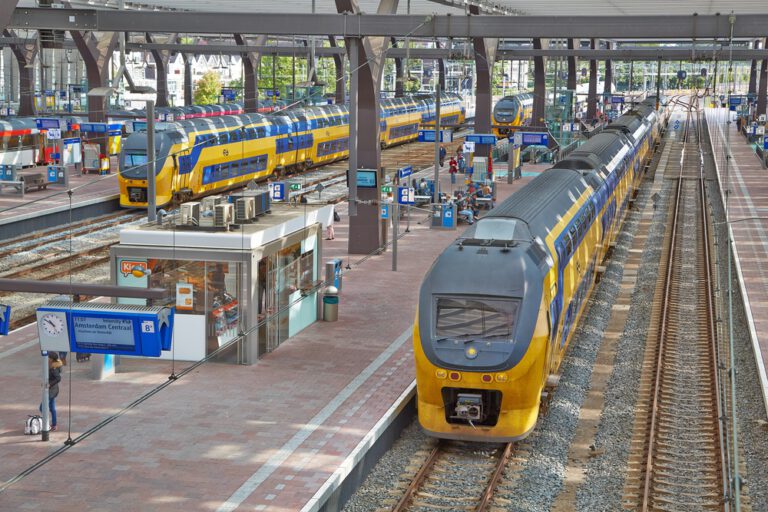
No trains will run to or from Rotterdam Centraal on Saturday, June 14 and Sunday, June 15, as ProRail carries out essential maintenance on the city’s train safety system.
The work affects a large chunk of the Dutch rail network, and with replacement options involving a patchwork of metros and buses, commuting to and from Rotterdam will take more planning than usual.
Here’s what you need to know.
Which routes are affected?
No trains will run between the following lines during the weekend of June 14 to 15:
Rotterdam Centraal — Delft Campus
Rotterdam Centraal — Gouda
Rotterdam Centraal — Zwijndrecht
High-speed line: Rotterdam Centraal — Breda and Schiphol Airport
If your regular route passes through Rotterdam, expect a longer journey and some delays.
How to get around the works
NS has mapped out several alternative routes, depending on where you’re headed.
To Den Haag Centraal: Take metro E from Rotterdam Centraal to Beurs, then continue by metro to Schiedam Centrum. From there, catch a bus to Delft Campus, where trains run onward to Den Haag Centraal.
To Gouda: Head to Schiedam Centrum by metro via Beurs and pick up an NS bus to Delft Campus. From there, Intercity trains run to Gouda via Den Haag HS.
(Alternatively, you can take metro D or E to Beurs, switch to metro A, B, or C towards Capelsebrug, and board an NS express bus directly to Gouda.)
To Dordrecht: Take the metro via Beurs to Capelsebrug, where NS express buses run directly to Dordrecht.
NS also advises travellers to plan their journey in advance, using either the NS App or their Reisplanner, as alternative routes may involve multiple transfers.
Why is this happening?
ProRail contractors will be replacing the train safety system in Rotterdam. because the current one is outdated.
The system controls how signals and switches operate; it’s essentially the nervous system keeping trains running safely. As such, it’s the kind of work that can only be done when trains aren’t running, hence the full weekend shutdown.
Want to make sure DutchReview pops up on your news feed more often? Just add us as a preferred news provider, and we’ll handle the rest.
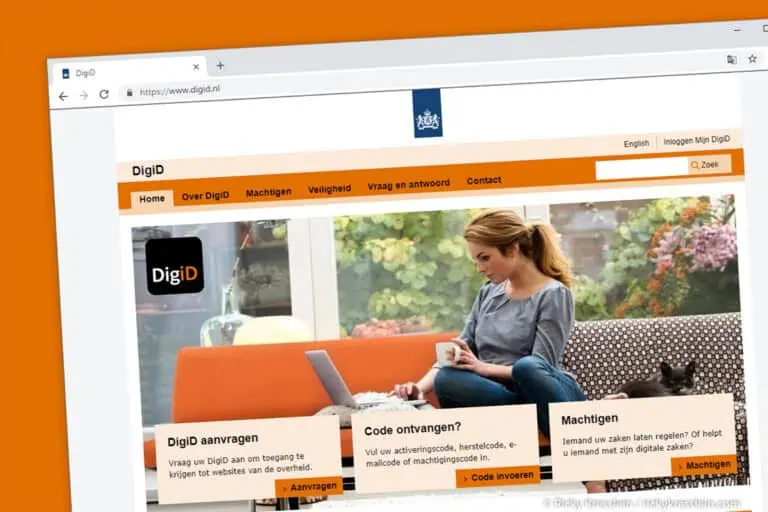
This couldn’t have come at a more pertinent time, given that the Netherlands recently blocked the takeover of Solvinity, the company running DigiD’s infrastructure, by US tech giant Kyndryl.
Before the block, the Dutch government endured months of parliamentary panic about who (or which foreign government) might end up with access to the system that millions of residents use daily to log in to everything from the Belastingdienst to their health insurer.
Here’s why only European companies can bid
Logius, the government agency that manages DigiD, will run the next tender under the Aanbestedingswet Defensie en Veiligheid (ADV), a procurement process designed for defence and security-sensitive contracts.
Unlike a standard European tender, the ADV allows the government to restrict bidders by country.
This means that countries whose laws allow their governments to compel tech companies to hand over data, like the US, are out.
And that’s not a hypothetical concern, either. When American firm Kyndryl tried to acquire Solvinity, the company couldn’t guarantee that US legislation (including the Cloud Act) wouldn’t give Washington control over Dutch digital government.
Security upgrades are coming too
Needless to say, blocking one dodgy acquisition doesn’t fix underlying vulnerabilities.
A confidential audit Logius completed at the end of 2025 flagged four areas of concern:
encryption,
monitoring,
network security,
and access management.
According to Logius, they are considering a range of tailored fixes across these areas, from covering additional encryption, adjustments to task responsibilities, and expanded logging and monitoring. However, the exact measures will vary by platform.
Monitoring across Solvinity’s platform is also being expanded, with oversight centralised under the Logius Security Operations Centre.
And the Netherlands isn’t alone in bolstering security, either.
The EU announced this week that it intends to push member states toward European providers for large government digital contracts, weighing the origin of technology alongside price and quality.
Want to make sure DutchReview pops up on your news feed more often? Just add us as a preferred news provider, and we’ll handle the rest.
A major Dutch police investigation has exposed a network of men who allegedly drugged women and circulated footage of their sexual abuse online.
The investigation, run by the Sexual Crimes Team and the Regional Detective Service of the Rotterdam police unit, was tipped off by intelligence passed on from authorities in Germany and the UK.
Searches of homes were conducted on May 27 and 28, 2026, during which four men were taken into custody and questioned.
Police have eight suspects so far
According to a police news bulletin, officers identified eight male suspects aged between 21 and 51.
They come from Rotterdam, Sassenheim, Hilversum, Veldhoven, Sint Willebrord, Amstelveen, the municipality of Hulst, and the municipality of Horst aan de Maas.
The four men arrested so far are from Horst aan de Maas, Hulst, Sint Willebrord, and Sassenheim. Additional arrests have not been ruled out.
Here’s what they’re accused of
Although the suspicions against the men vary in severity, all are suspected of participating in a private online group which shared illegally obtained footage of drugged victims.
Some are suspected of creating or distributing sexual imagery, while others face more serious allegations, ranging from drugging victims to (attempted) rape.
During home searches, police seized computers, USB sticks, SD cards, and mobile phones. Sedatives and other drug agents were also found at various locations, as were weapons.
Victims may not know what happened to them
As yet, investigators have not established how many victims there are.
That will depend in part on the analysis of the seized devices, according to Milou van der Kolk of Rotterdam’s Sexual Crimes Team.
“What is clear is that this case has an enormous impact,” she said. “As a victim, you may not know what happened to you, because you may have been drugged and were unconscious. The news that your partner or an acquaintance may have drugged you and perhaps even raped you or attempted to do so can turn your life completely upside down.”
The drugging method involved in this type of crime is known as drug-facilitated sexual assault (DFSA). Common substances used include GHB, Rohypnol, and sleeping medications such as zolpidem.
These act by suppressing the nervous system and can cause memory loss, with symptoms that may resemble heavy intoxication.
A pattern is emerging beyond the Netherlands
Unfortunately, the pattern of abuse doesn’t stop at the Dutch border.
CNN’s investigation earlier this year found Telegram groups in which men shared techniques for drugging partners and family members without their knowledge, alongside footage of the abuse.
More than 20,000 videos of so-called “sleep content” were found on the pornographic website Motherless, which was taken offline by the Dutch Public Prosecution Service in early May… only to reappear online last week.
The case also draws comparisons to the Pelicot case in France, in which Gisèle Pelicot was drugged by her husband and raped by him and dozens of other men over the course of nearly a decade, with victims in contact via private chat groups.
There are now 12 UNESCO World Heritage Sites in the Netherlands. That’s right — this tiny country is filled to the brim with exciting and unique cultural sights!
Here is the full list of Dutch sites, ranked in the order they joined the world-renowned UNESCO list.
This post might have affiliate links that help us write the articles you love, at no extra cost to you. Read our statement.
1. The prehistoric gem, Schokland
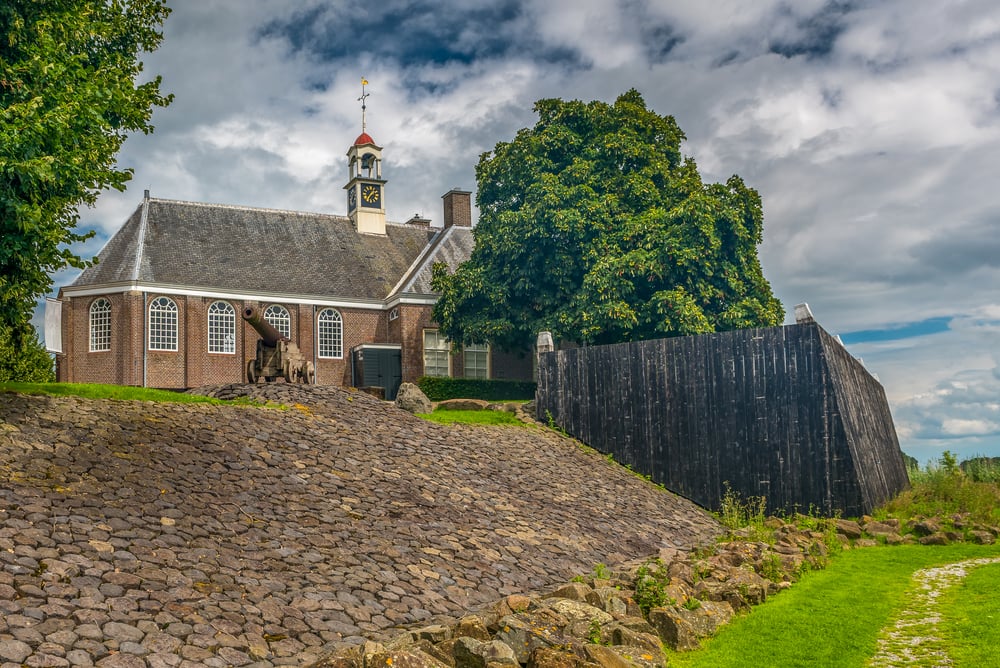
The island of Schokland and its surroundings possess a mysterious past as an archaeological monument and former island.
This World Heritage Site lies in the centre of Noordoostpolder and is steeped in cultural history.
It’s home to a sweet old church, a lighthouse keeper’s house, and the Schokland Museum. According to Statistics Netherlands, just five people live there!? 🤔
The Schokland museum in all its glory. Image: Depositphotos
Due to the rising sea levels, residents of Schokland retreated to the three most elevated parts of the land by the 19th century, until a major flood in 1825.
Archaeologists later found a wealth of largely undamaged treasures buried in the ground.
There is evidence of human habitation going back more than 10,000 years (that’s prehistoric!), and they’ve dug up all sorts of things, from earthenware, tools, and man-made mounds, to the remains of houses and churches — and even entire graves. Eeek!
2. The Water Defence Lines of Amsterdam
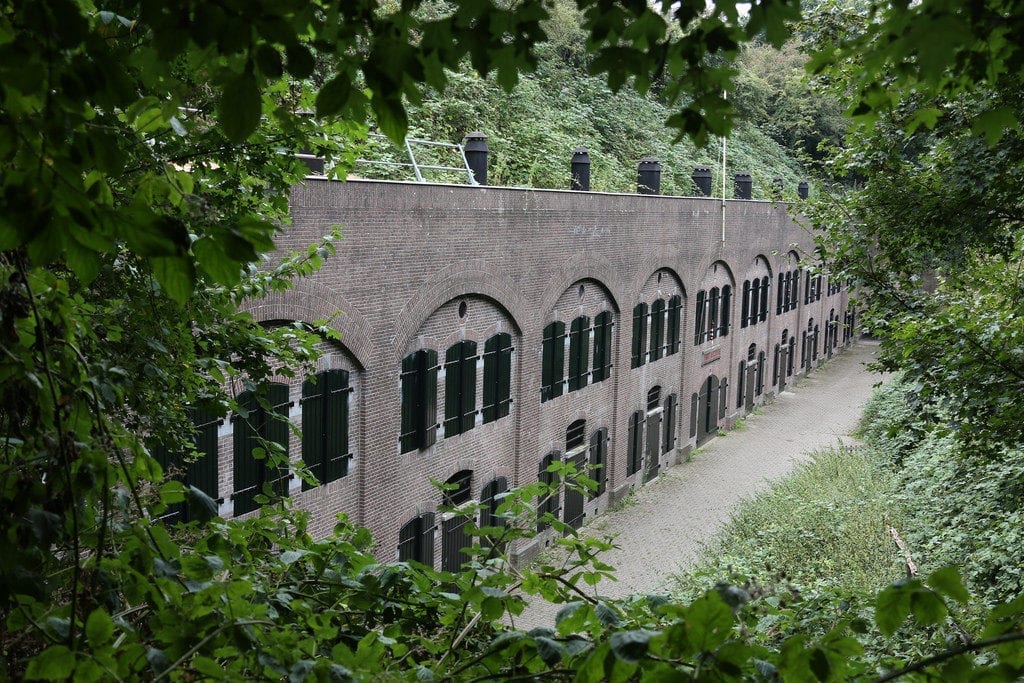
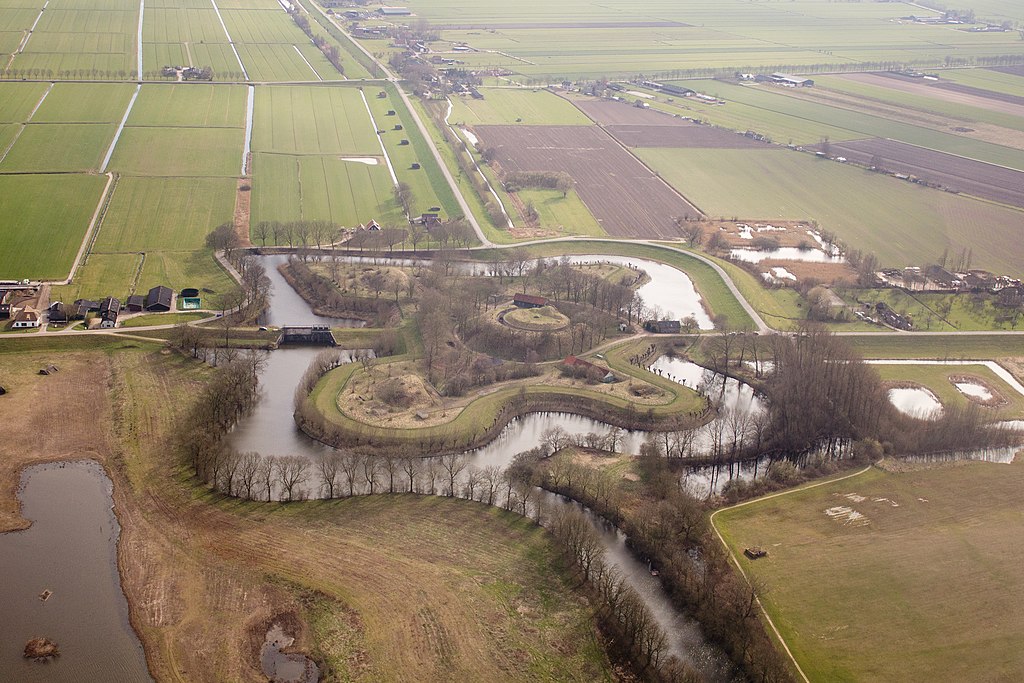
Also known as the Stelling van Amsterdam. This monument is a ring of 46 forts stretching more than 135 kilometres around the city.
The line of defence was erected to protect the national stronghold built between 1883 and 1920.
It may not be the most exciting words you’ve ever seen, but this is a vital part of the Netherlands’ history.
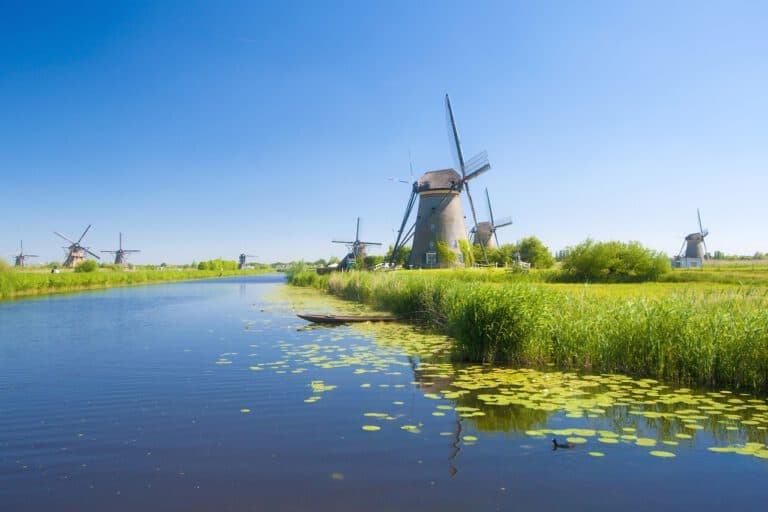
The Dutch made a huge contribution to this water-handling technology, and these historic windmills can be seen as a way of paying homage to that (in addition to them being a pretty sight and wildly popular among tourists).
It has 19 drainage mills, three pumping stations, two discharge sluices, and two Water Board Assembly Houses, which work for the drainage of the land.
The windmills essentially keep water out of the polder.
4. The impressive D.F. Wouda steam pumping station
Another celebration of technology! They weren’t kidding when they said the Netherlands was the land of water.
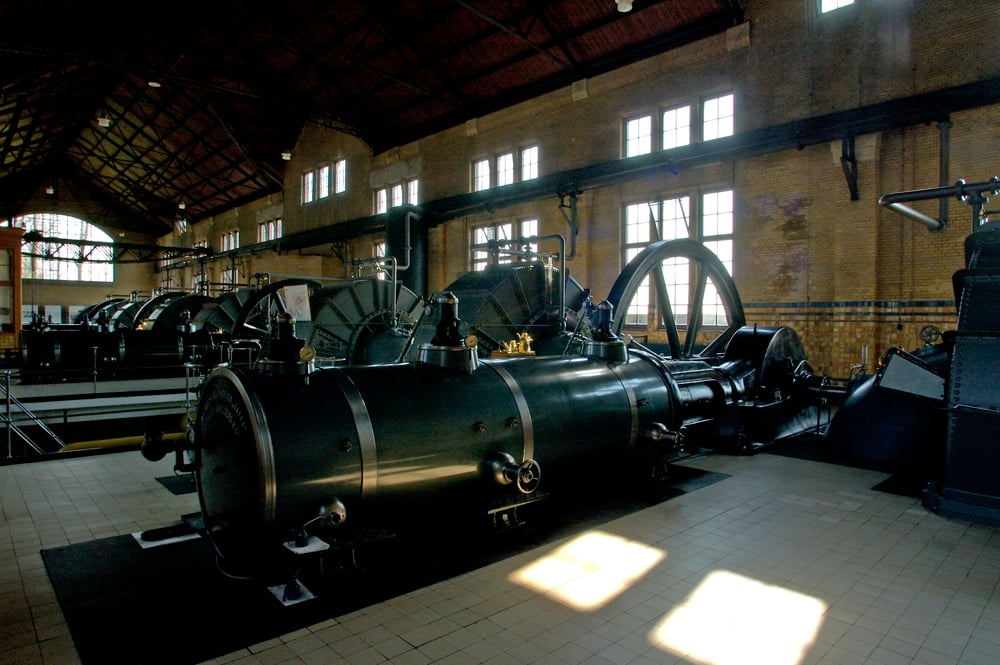
Also known as the Woudagemaal Steam Pumping Station, this World Heritage Site is a steam-powered pumping station that pumps excess water out of Friesland.
The D.F. Wouda Steam Pumping Station is a must-visit for any eager traveller. Image: Depositphotos
It is the largest station of its kind that is still in use, which is impressive considering it opened in 1920.
It now runs on heavy fuel oil and can pump up to 4,000 cubic metres of water per minute!
Are you an engineering nerd? Then head to the busy seaside town called Lemmer to marvel at this beauty.
The visitor entrance provides information about the site’s history, an interactive museum experience that kids will love, and regular tours.
5. The charming Beemster polder
The Beemster Polder, a beautiful green expanse in North Holland, has been incredibly well-preserved since the 17th century.
The whole place used to be mostly water. Now, thanks to ingenious and intricate planning, it’s an agricultural landscape made up of fields, roads, canals, dikes, and settlements.
Isn’t the charming Beemster Polder just a sight for sore eyes? Image: Depositphotos
Middenbeemster, a little town in the countryside with horses, moats, a drawbridge, and a central market square, is sure to be a lovely summer outing.
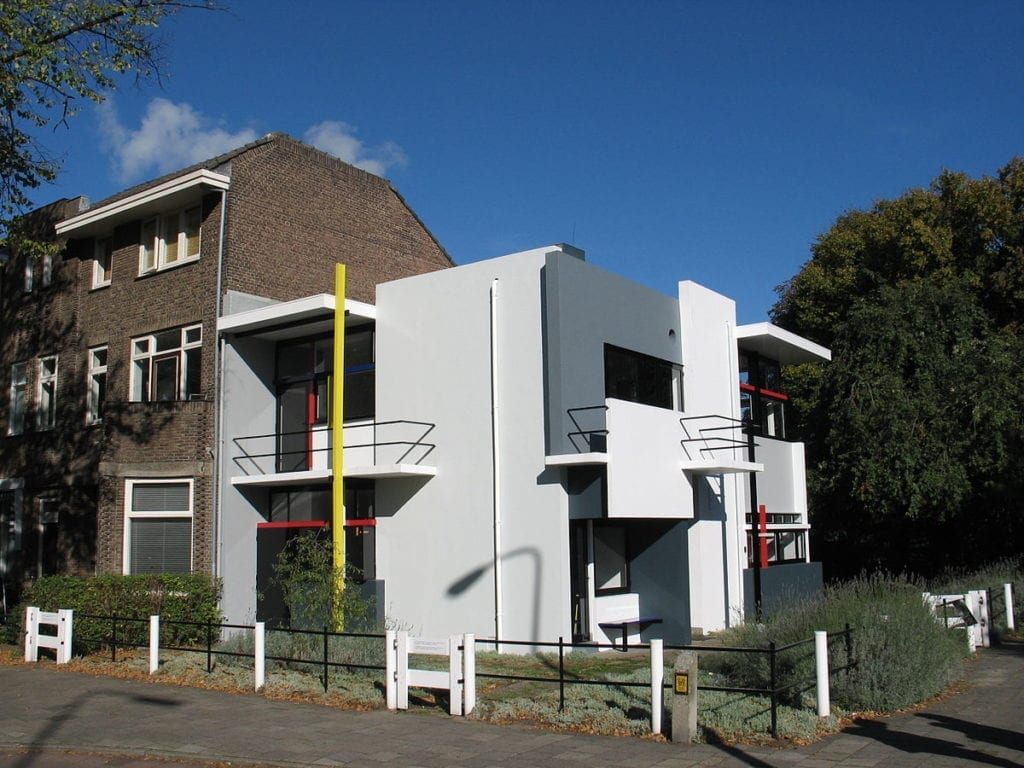
Mrs Schröder lived in the house until her death in 1985.
Bertus Mulder restored it and turned it into a museum where visitors can learn more about her life and the Dutch artistic movement De Stijl, of which the Rietveld Schröder House is an embodiment.
7. The natural Wadden Sea
The Wadden Sea is an intertidal zone of the North Sea, meaning that the area is above water at low tide and underwater at high tide.
Why is a ‘seashore’ on this list? It is one of the largest unbroken intertidal sand and mudflats systems in the world, and is ridiculously biologically diverse. 🔬
As well as all the plants and fishies, it’s home to the harbour seal, grey seal, and harbour porpoise.
The Waddenzee is home to a number of animals and fish. Image: Depositphotos
The Dutch part of the Waddenzee belongs to North Holland, Friesland, and Groningen.
It has tidal channels, sandy shoals, sea-grass meadows, mussel beds, sandbars, mudflats, salt marshes, estuaries, beaches, and dunes.
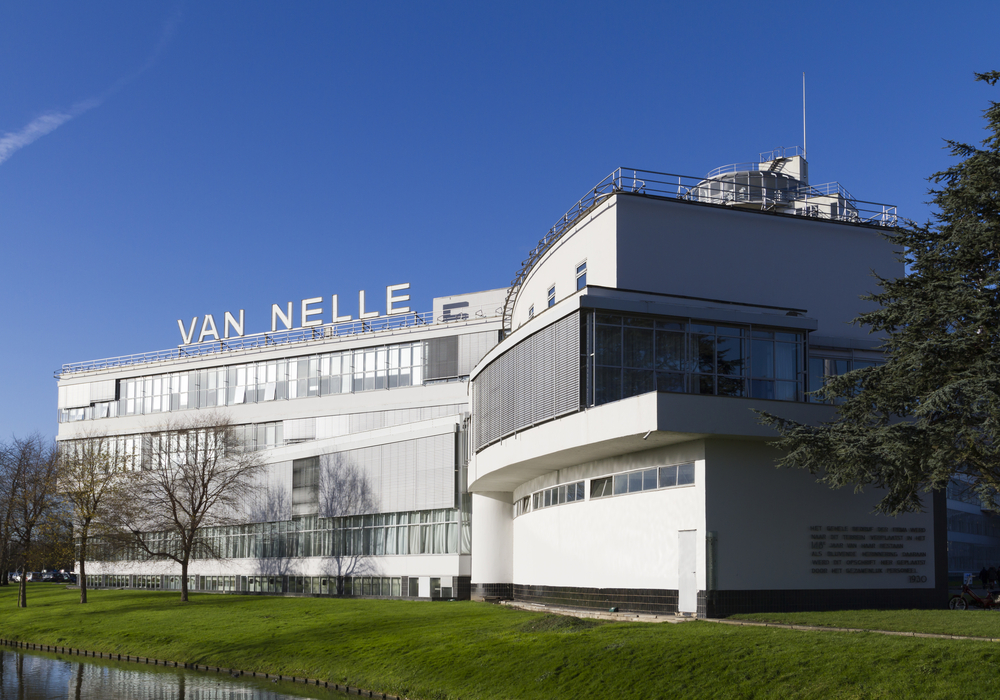
Located on the Schie in Rotterdam is the former Van Nelle Factory (Van Nellefabriek).
The architecture of these buildings, interestingly, depicts a Russian Constructivist influence, and is now a popular place for guided tours.
A factory, beautiful? Yes — wait until you see the Van Nelle Factory’s unique architecture. Image: Depositphotos
In 2015, the Van Nelle Factory topped the list of the 25 most beautiful factories in the world.
Le Corbusier, one of the pioneers of modern architecture, said the building was “the most beautiful spectacle of the modern age” in 1932.
Before that, Howard Robertson declared it “a poem in steel and glass” in 1930.
10. The historical Colonies of Benevolence
Within the last few years, the Netherlands has gained some new World Heritage Sites.
Coming in at number 11 are the transnational Colonies of Benevolence.
There are three settlements in the Netherlands: Frederiksoord, Wilhelminaoord, and Veenhuizen in Drenthe, and Wortel in Belgium, just south of the Dutch border.
The government set up the colonies in 1818 to combat poverty among the population.
The system was designed to flood large land areas if enemy troops quickly approached.
The line is 220 kilometres long and runs like a green ribbon through four provinces.
12. The Eise-Eisinga Planetarium
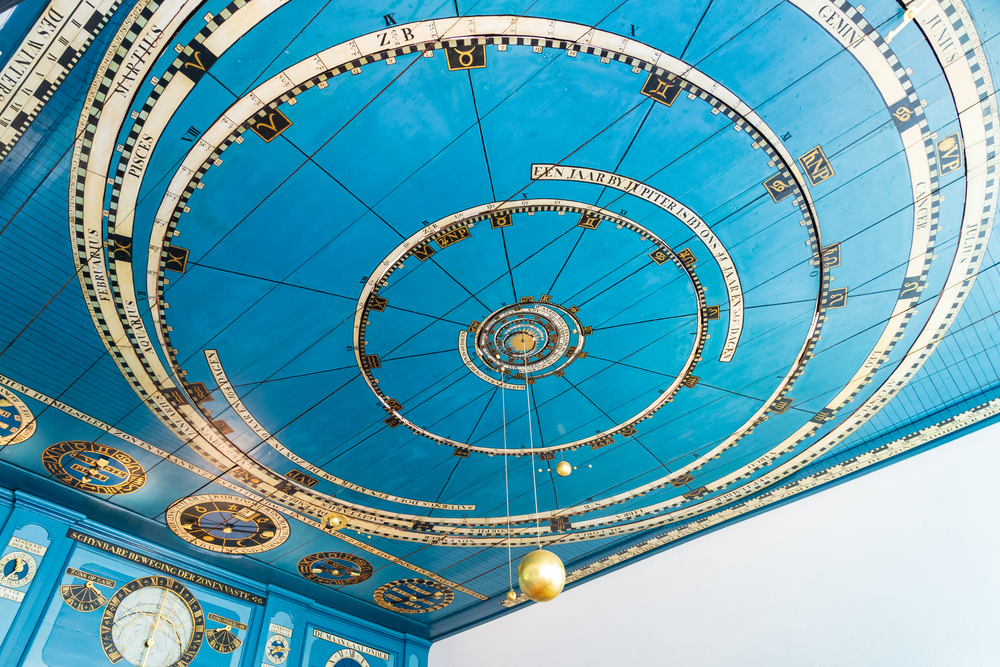
Last but certainly not least, we have our latest addition to the family of Dutch World Heritage Sites: the Eise-Eisinga Planetarium in Franeker, located in the province of Friesland.
Dating back to the 18th century, this is the oldest planetarium in the world, and today it’s a museum that’s open to the public. Image: Depositphotos
Thanks to the new inclusion of the Royal Eise-Eisinga Planetarium, the oldest functioning planetarium in the world, Friesland now contains four different cultural heritage sites (the Wouda steam pumping station, the Wadden Sea, and the Colonies of Benevolence).
The planetarium was invented by the talented amateur astronomer Eise Eisinga to prove that a prophecy about planets being on a collision course was wrong — and we’re definitely glad he was right.
Bonus: the picture-perfect town and harbour of Willemstad, Curaçao
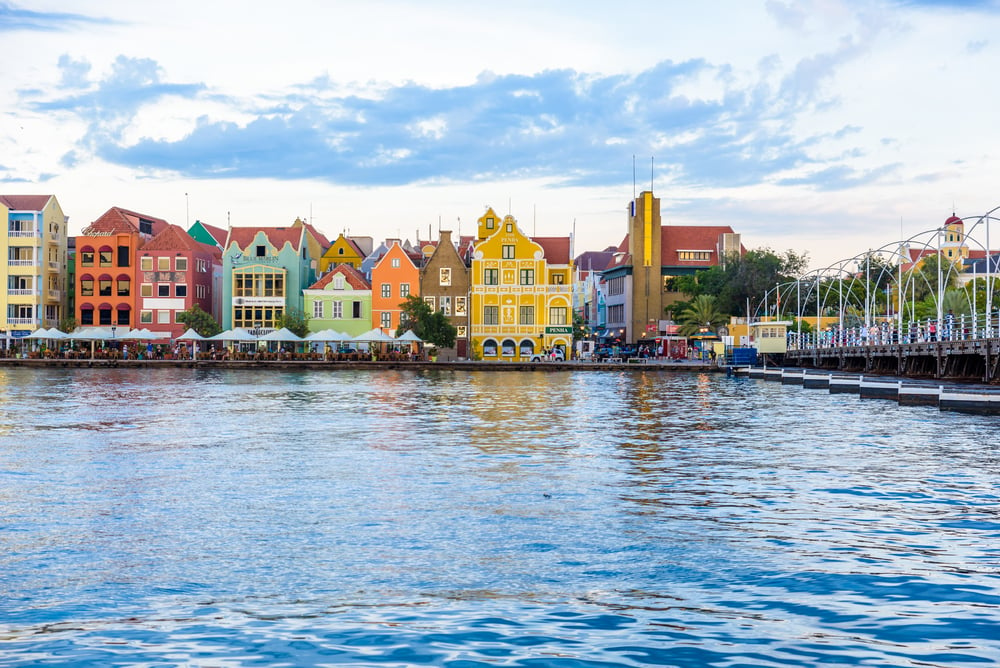
Ok, in order to reach this World Heritage Site, you might need to take a few extra buses (and planes). Willemstad is a town on the Caribbean Island of Curaçao.
Yes, you read that right — if you didn’t already know, Curaçao is part of the Kingdom of the Netherlands! 😎
You won’t be able to stop taking photos with these playful, colourful buildings in the historic city centre of Willemstad. Image: Depositphotos
Willemstad, a uniquely cute and colourful port town, is where the Dutch established a trading settlement. The site has become a symbol of the growing multicultural community in the Netherlands.
The island was one of the epicentres of the slave trade, so you should also stop by the Kura Hulanda Museum, which talks about the history of the slave trade on Willemstad.
You can also walk around the sandy beaches and colourful streets full of street art and book tours to learn about the community’s culture and history.
The Netherlands has a rich history and beautiful sites to visit — take advantage of your time here and visit these historical places!
Which one of the World Heritage Sites in the Netherlands is your favourite? Tell us in the comments below!







![Smoking weed in Amsterdam: ultimate guide [Updated 2026]](https://dutchreview.com/wp-content/uploads/smoking-weed-in-amsterdam-768x512.jpeg "Smoking weed in Amsterdam: ultimate guide [Updated 2026]")