Joost Klein can heave a grote sigh of relief: the investigation about the incident leading to his disqualification from Eurovision 2024 was closed. However, not everyone is impressed with the decision.
An investigation by the Swedish Prosecution Authority ensued, and yesterday, it finally reached a verdict.
Turns out nothing can be proven
“[Klein] made a movement that hit the woman’s film camera,” reads the Authority’s press release.
However, the investigation “cannot prove that the act was capable of causing serious fear or that the man had any such intention,” says senior prosecutor Fredrik Jönsson.
Klein is obviously very relieved. “The last couple of months were terrible,” he reveals on Instagram, commenting on the decision. But he “knew the truth. There is no case against me, because there never was a case.”
Now, he is glad to be cleared of accusations and able to focus on his new album.
Not everyone is happy
As the Swedish Prosecutor Authority puts it, “the course of events was fast and was perceived differently by the witnesses of the incident.”
Indeed, the other people involved do not share Klein’s enthusiasm about the case’s outcome.
The camerawoman who came forward with the allegations is “saddened”, reports RTL — and is considering challenging the court’s decision.
Meanwhile, the EBU has doubled down on its decision to disqualify Joost from the contest.
“This was an investigation into whether a criminal act was committed and not whether Mr Klein behaved inappropriately and breached ESC rules and procedures,” says EBU Deputy Director General Jean Philip De Tender.
“This new development therefore does not have any impact on our decision.”
But will it have an impact on Joost’s reputation and career prospects? Only time will tell.
What do you think of Joost’s case being dropped? Tell us in the comments below.
A fire broke out at a student rugby clubhouse in Rotterdam on Saturday afternoon. It could have been a disaster if not for a secret weapon: the team’s 130-litre beer stash.
When the kitchen of the clubhouse on Prinselaan caught fire, the building was empty.
The flames reached all the way to the ceiling, dangerously close to gas pipes and electricity cables.
At that point, “the clubhouse could have gone up in flames,” Rotterdam Student Rugby Club president Guus Hoofdman tells AD.
Crisis averted
Luckily, the camera system detected the fire, and emergency services rushed to the house.
When they arrived, however, they found that their job had been stolen by an unlikely ally: the built-in beer pipe.
The pipe exploded in the heat, turning it into a hose and showering the kitchen with enough beer to put out the fire. Amen! 🙏
No major loss (except for beer)
The heroic pipe gave this story a happy ending.
Apart from some minor damage to the kitchen, the clubhouse and its players were unscathed, and the team will be able to kickstart the upcoming season as planned.
If you keep your eyes on the skies over the next few nights, you’ll be treated to a shooting star show.
Earth will pass by an annual meteor shower named the Perseids, which NASA calls “the best meteor shower of the year.” Pretty cool, right?
Your best chance of seeing the shooting stars is between Monday evening and Tuesday morning around 3:45 AM.
If you’re not a morning person, fear not: you just need to stay awake until it gets fully dark at around 11 PM to catch the phenomenon.
If that doesn’t suit your schedule, you can still enjoy the show the following evening.
To get the best view, you should look towards the northeast.
What will the conditions be like?
The Earth passes the Perseid shower around this time every year, but conditions this year are much better for the stargazers than last year.
“There will be virtually no cloud cover in the coming days… which makes conditions perfect for sitting in the garden and looking at the sky,” NOS weatherman Willemijn Hoebert told the NOS.
So grab your morning coffee — or a warm Chocomel — early tomorrow and catch the show in the sky.
Where will you watch the meteor shower? Let us know in the comments below. 👇
We’ve spent the last two weeks glued to our screens, watching incredible athletes accomplish unthinkable things.
While the ultimate goal for most athletes is, of course, a gold medal, there’s a special cherry on top. 🥇🍒
In addition to wowing the spectators, the Dutch winners also wow their bank accounts with a chunk of cash from their home country.
Go for gold
The cash comes from the NOC*NSF (The Dutch Olympic Committee*Dutch Sports Federation) which allocated a sparkling €1.3 million in 2024 for prizes.
Those standing highest on the podium with a gold medal hanging from their neck benefit the most. Individuals get a whopping €30,000 to save (or spend on beers at the pub afterwards).
For those earning a silver medal, they receive €15,000, and a bronze medal is a decent €7,500.
It works a little differently for teams of six people or more (otherwise, the football team might bankrupt the NOC*NSF).
A team member will receive a minimum of €11,000 for earning a gold medal, €5,500 for silver, and €3,500 for bronze.
Medal
Individual prize
Team prize (per player)
Gold 🥇
€30,000
€11,000
Silver 🥈
€15,000
€5,500
Bronze 🥉
€7,500
€3,500
No double dipping
Of course, there are athletes out there winning multiple medals (like our star, Sifan Hassan).
Unfortunately, the NOC*NSF only pays the bonus once. Luckily, they do it based on the highest medal earned, so Hassan’s win at the marathon yesterday also won her a nice €30,000.
If that’s not enough, players can also look to their specific sports organisation to see if they’ll contribute some extra money to the pot.
Do you think the players earn enough — or too much? Share your opinion in the comments below!
Leaving the rumours of a homegrown degree in the dust, it’s been announced that the Princess will study at University College London.
The second daughter of the Dutch King and Queen will start her course in Science & Engineering for Social Change in late September. 👩🎓
#News Princess Alexia will start her study Science & Engineering for Social Change at the Faculty of Engineering at University College London in England at the end of September 2024!📚
The announcement comes after months of speculation about where Alexia would choose to study following her gap year.
It looked like the Princess was heading for the Dutch north, after a leak revealed her email address registration with Groningen University. However, she admitted in June that she was still undecided.
Last month, wine from Twente received an official EU quality mark, confirming the trend of the Netherlands increasingly making a name for itself in the wine-making industry.
Twente is the ninth Dutch area to be recognised as a protected wine region by the European Union.
This is certified by a quality label called Protected Designation of Origin (PDO), or Beschermde Oorsprongsbenaming (BOB) in Dutch.
Twente’s PDO has filled local wine-makers with pride, placing the Netherlands in the same league as countries with a much more established wine-making tradition.
This inspired some bold claims. “On average, we make better wine in the Netherlands than in France,” sommelier Koen Van der Plas tells RTL.
Dutch wine’s improbable friend: climate change
The Dutch winemakers’ mastery is not the only factor making the Netherlands rise as a wine industry star. Oddly enough, climate change also seems to be playing a role.
With global warming withering Southern Europe’s vineyards and making winters milder everywhere, the Dutch climate is increasingly favourable for growing quality grapes.
Wine production is moving further north, giving countries like the Netherlands an edge over traditional wine-making champions like France or Italy.
However, climate change is not all good news (sarcasm, don’t worry!)
Winters are milder but also increasingly unpredictable. This causes grapes to start growing early, with a higher risk of sudden temperature drops resulting in irreparable frost damage.
However, more and more quality grape varieties are growing on Dutch soil, and new wineries are springing up every year.
This makes the Netherlands well-positioned to become a major wine exporter in the future — also thanks to the shiny new PDO secured by Twente. Hoera! 🥂
Will the Netherlands become a star in the wine-making industry? Place your bets in the comments below.
The city’s popular international reputation means that proficiency in Dutch is now not required for more than one in five vacancies.
The same goes for the number of international students, whose part-time jobs stacking shelves and serving coffee also rarely require Nederlands.
…But some cities are resisting
While Delft, The Hague, Eindhoven and Leiden follow Amsterdam in terms of the frequency of English spoken, Anglicisation is much slower in Zwolle, Leeuwarden, and Heerlen.
When you hear the anglicised attempts at pronouncing Groningen, you can understand their resistance.
How comfortable employees feel speaking English at work and limits to courses taught in English continue to influence how quickly English is taking over other parts of the Netherlands.
One thing is for certain, though: Amsterdam is very accommodating to those of us who can’t master a hard “g”.
How do you feel about speaking English in the Netherlands? Let us know in the comments below.
Out of money but looking for some amazing things to do in Groningen? Well, you’re in luck, because there are plenty of fun things to do in this vibrant city without spending a single euro.
Fun fact: a quarter of Groningen’s population consists of students, making it the city with the youngest population in the Netherlands. If you live here, chances are you’re a youngster yourself.
With that comes the second big chance… of being broke — what with paying for crazy and unnecessary things such as a roof over your head and food.
1. Visit the Forum
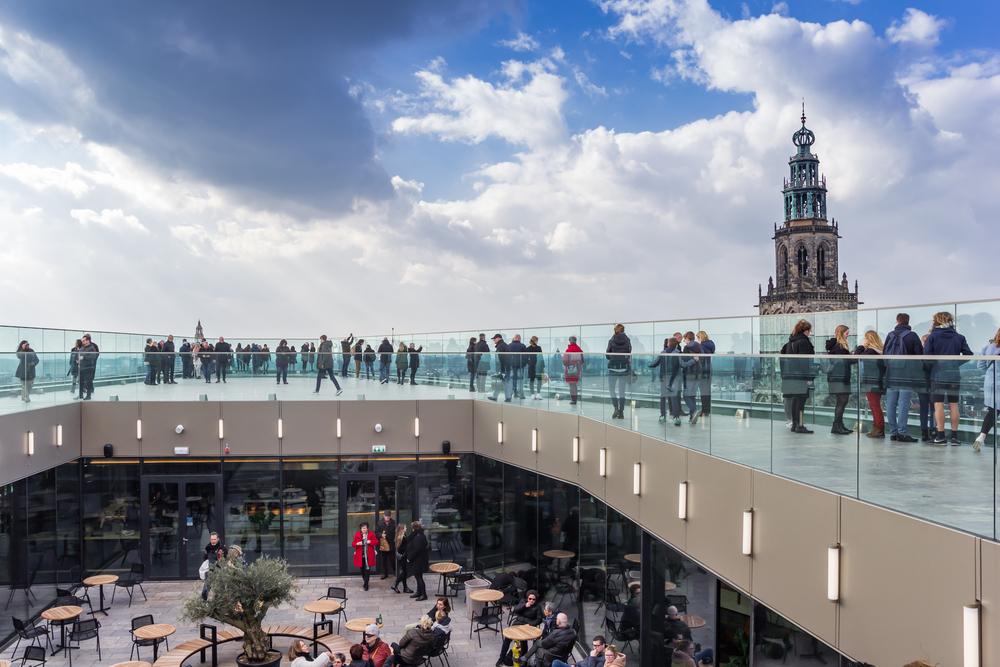
Towering above the city, the Forum, which opened in 2019, is a new cultural centre housing a library — one of the last public spaces where you aren’t expected to spend any money, a cinema, and parts of the Groninger Museum.
The Forum offers 360-degree views of the city. Image: Depositphotos
The Forum is well worth a visit. Be sure to take the escalators to the viewing platform at the top (it’s 45 metres up).
Also, take in the gorgeous 360-degree views of the city that this sky-scraping landmark offers!
2. Relax in the Prinsentuin
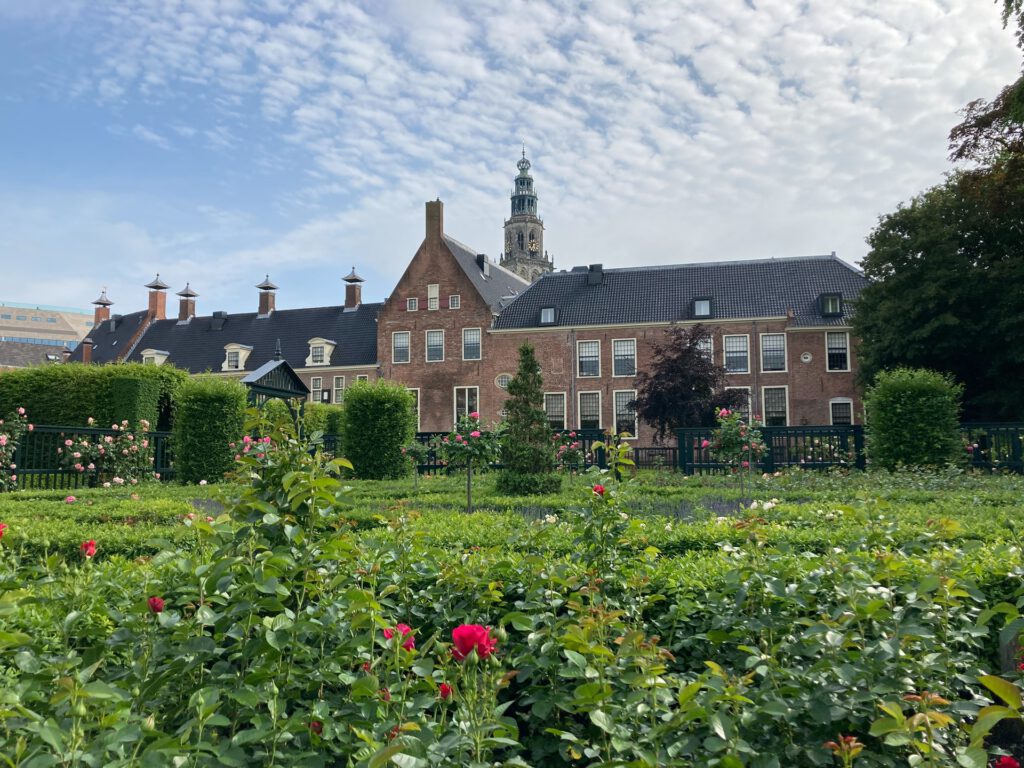
An incredibly quiet spot smacked right in the city centre, this Renaissance garden has wonderful flowers and beautiful landscaping all year round.
Enjoy some inner city peace. Image: Unsplash
Bring a book and come here and feel like you’re a prince(ss) and this is your own private garden.
3. Explore the city’s architecture
If it’s a nice sunny day, just wander around the city and admire the surprising mix of modern and gothic architecture.
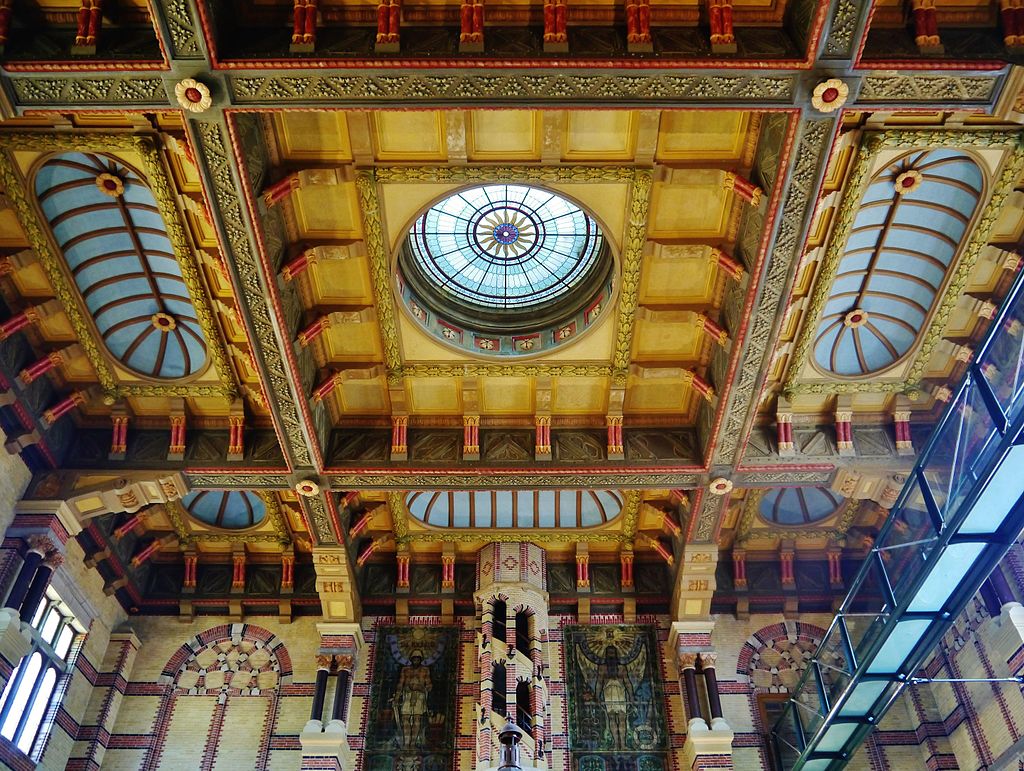
The are several landmarks worth taking in, such as the Martini Tower, an adjacent church, the Aa-Kerk, the synagogue, the eclectic Groninger Museum, and even the central station is a work of art.
The prettiest station in the Netherlands? Image: Zairon/Wikimedia Commons/CC 4.0
Speaking of the station, the square in front of it holds Groningen’s most famous statue: het Peerd van Ome Loeks.
The white statue, depicting a (quite fat) horse and its owner, was created in 1959 and refers to the popular Groningen folk song “Het peerd van ome Loeks is dood” (uncle Loeks’ horse died).
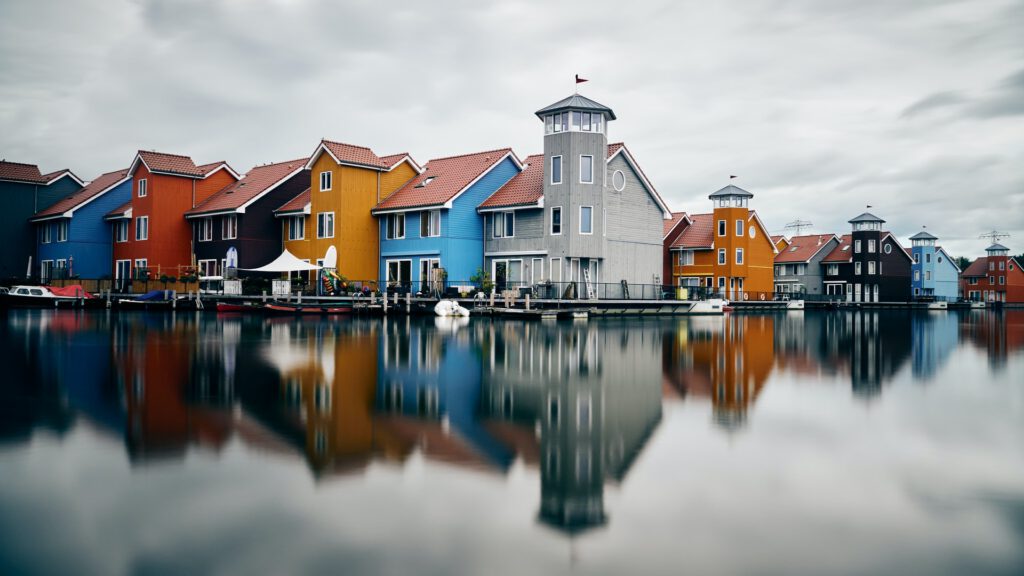
4. Visit the colourful houses at Reitdiephaven
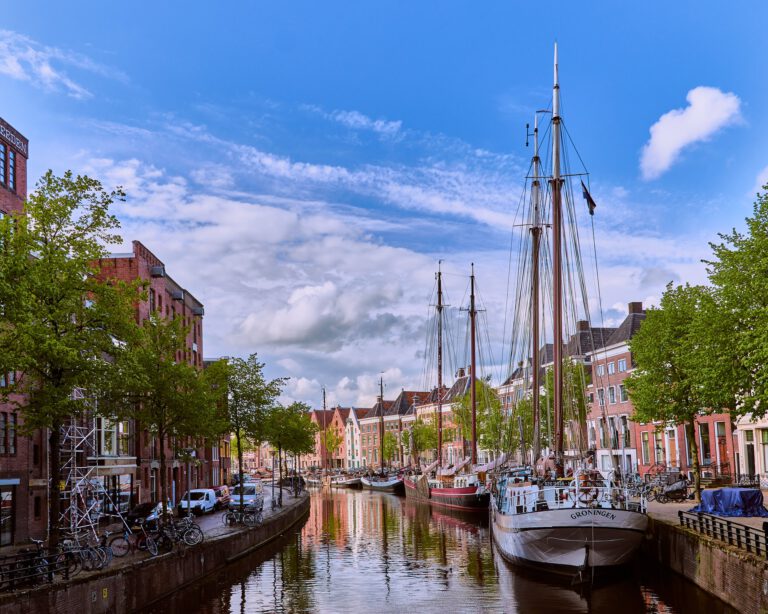
By far the most Instagrammable place in Groningen, this cute little harbour and the lined-up colourful houses are just a 15-minute bike ride from the city centre.
The prettiest spot in the city. Image: Unsplash
However, apart from strolling around and taking pretty pictures, there’s not much to do here.
5. Relax at the city beach
On warm summer days — even though they’re few and far between, there’s no better place to be than the city beach.
The Stads Strand Groningen is a great spot to hang out on a sunny day! Image: Dreamstime
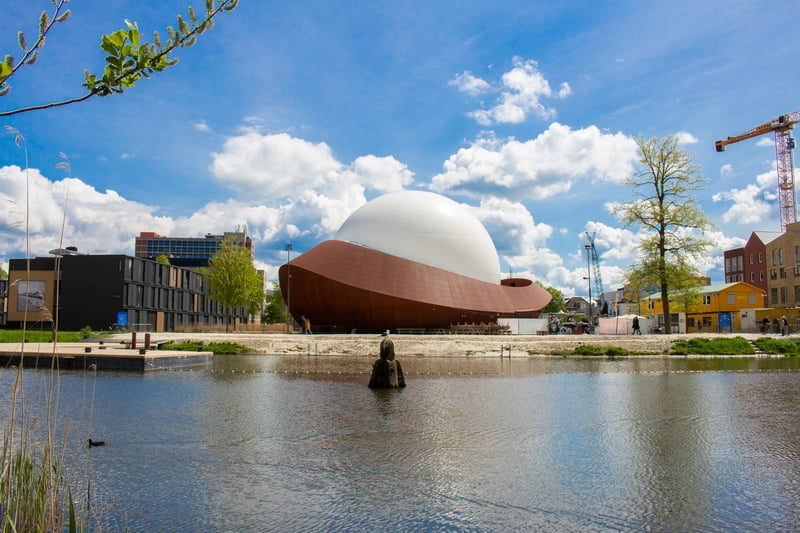
Relax on the warm sand in the shadow of The Dot (a multifunctional meeting place), take a dip in the refreshing water, and enjoy the buzz while catching a tan. ☀️
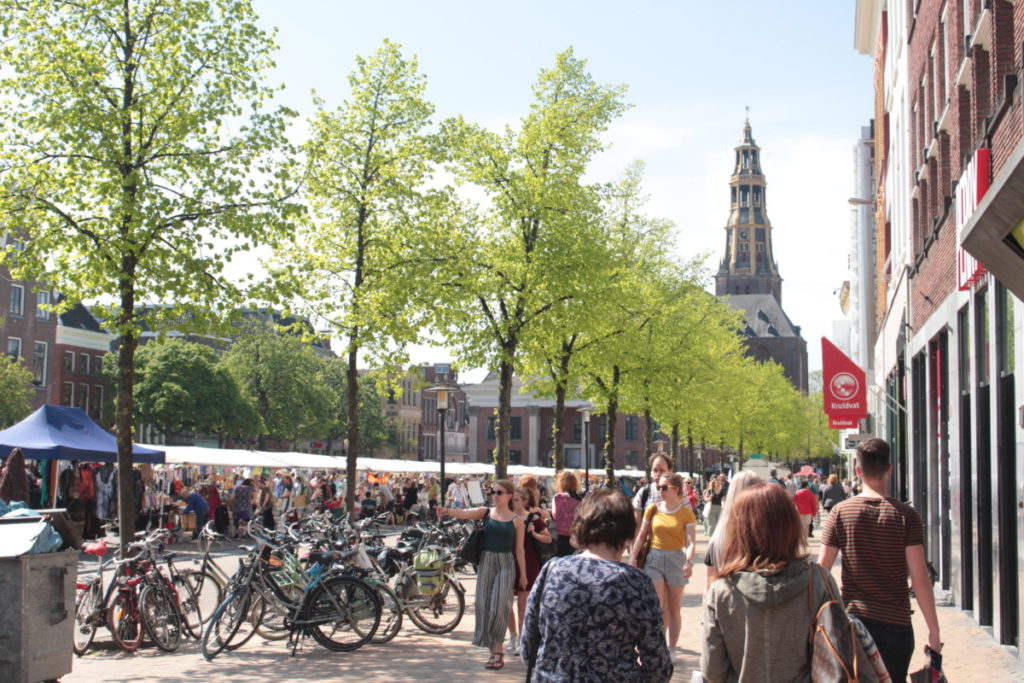
6. Explore the weekly farmer’s market
Vismarkt, Groningen — a local favourite! Image: Laura Corrigan/Supplied
There’s nothing more wholesome and satisfying than wandering through the stalls of fresh fish and brightly coloured fruits and vegetables with the smell of fresh stroopwaffel entering your nose.
The farmer’s market at the Vismarkt is a favourite amongst residents of Groningen, and it’s the place to see and be seen.
Watch out, though! This activity is only free if you resist the urge to load up your tote bag with a week’s worth of random supplies.
⏰ When? The market days are Tuesday, Friday and Saturday from 9:00 to 17:00
7. Enjoy a cycling route
If you dare to go beyond the city, the province of Groningen offers some of the greenest and most varied scenery in the whole country and is a joy to explore on two wheels. 🚲
As one of the most renowned universities for business and management studies in Europe, it’s no surprise that studying at Nyenrode Business University comes with plenty of pluses.
2. You’ll get the perfect balance between theory and practice
Students follow a rigorous study programme at Nyenrode Business University, learning about core topics of business and management, like strategy, marketing, entrepreneurship, and finance.
But that’s not all. Students will also have a chance to test this academic knowledge — and we don’t mean in exams.
There are plenty of opportunities to work on case studies and real projects that allow students to gain practical skills and knowledge that they can use in the future.
Put those skills to good use! Image: Nyenrode Business University
By the time you graduate, you’ll have extensive hands-on experience and the knowledge to back it up.
3. You’ll have plenty of opportunities for career development
Students also get a lot of guidance when it comes to career development and counselling at Nyenrode Business University.
Whether you have a million-euro business idea waiting to be developed or need a bit of help deciding where you want to intern, you can get some advice on how to best proceed.
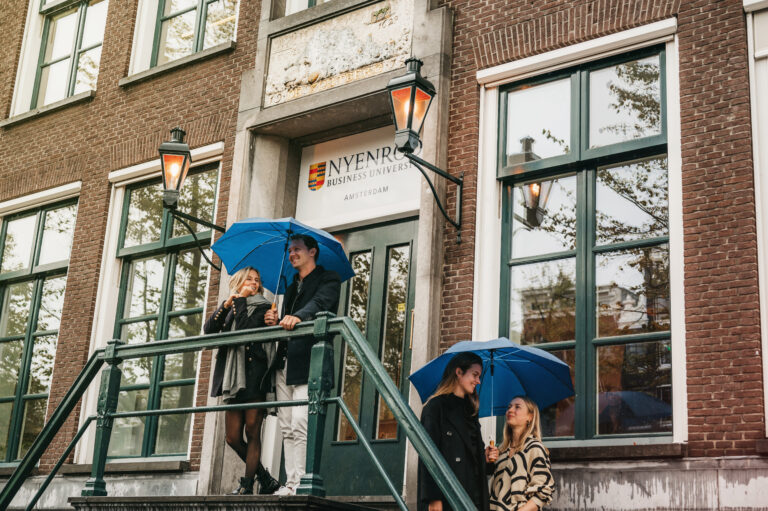
We love to see a career-oriented student. Image: Nyenrode Business University
As part of the study programmes, students also have to work on important soft skills that can make a career in business all the more easy.
This includes skills like negotiation, leadership, stakeholder management, and professional business writing — skills you can’t always learn sitting in a classroom with your head buried in a book.
4. You’ll be part of the tight-knit Nyenrode community (and have guaranteed housing!)
Student life and experience are some of the most important parts of becoming a university student — and let’s just say that studying at Nyenrode presents another benefit.
Nyenrode Business University is one of the few university institutions in the Netherlands that actually guarantees housing for all of its students.
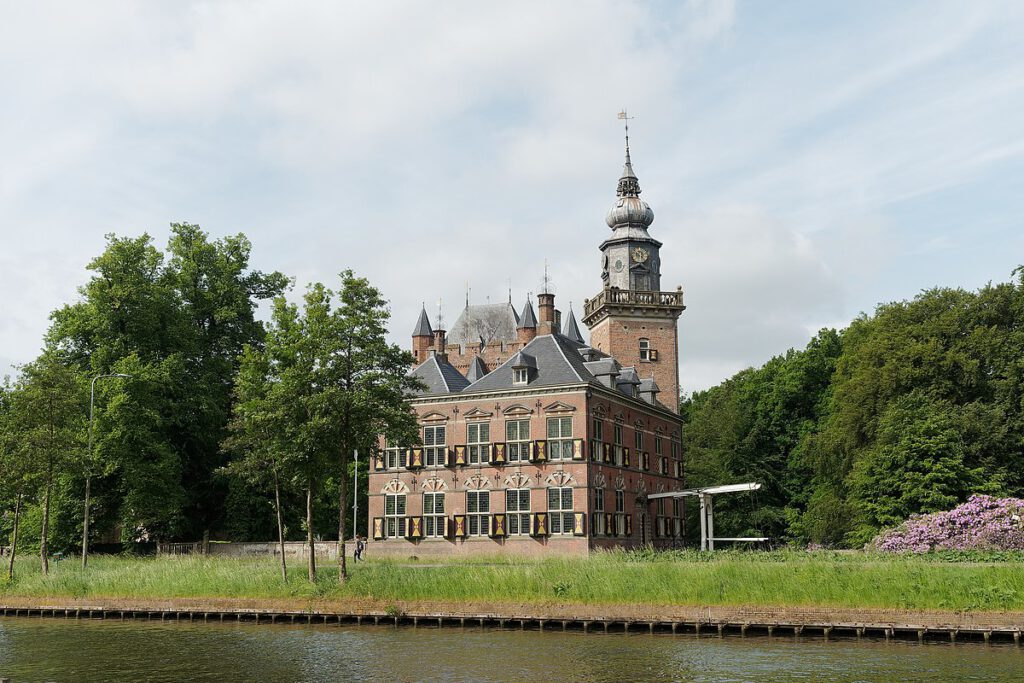
Who wouldn’t want to live in a castle? Image: Arnoldius/Wikimedia Commons/CC4.0
Whether students choose to live in Amsterdam or Breukelen (which they get to choose, both for bachelor’s and master’s degrees!), they can move to the city knowing they have housing ready for them.
Both campuses also have top-notch facilities, such as study areas, student lounges, laundromats, and sports facilities, to make the campus feel more like a home.
Plus, there are plenty of opportunities to socialise and make friends while studying at Nyenrode.
In addition to classes, studying, and lounges, students will play sports while they’re studying, as Nyenrode believes it stimulates teamwork and learning from other peers in a non-academic setting.
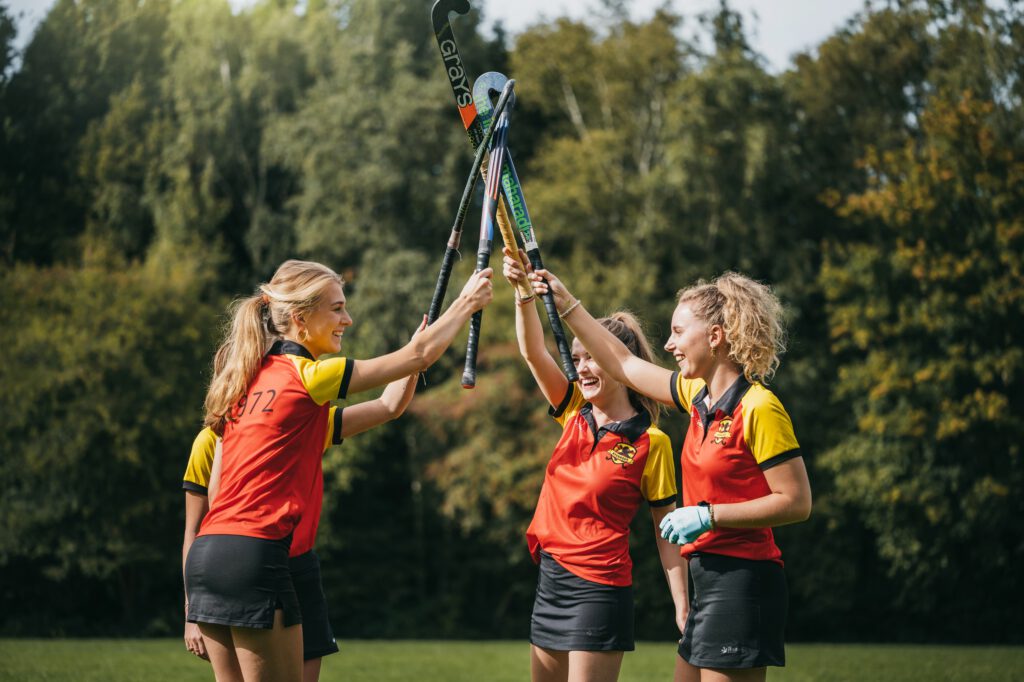
There’s no “I” in “team”! Image: Nyenrode Business University
5. You’ll spend a lot of time in a multicultural environment
If you aren’t packing your suitcases already, we have another benefit that’s sure to appeal to a keen international student.
All the study programmes, accommodations, and extracurricular activities are multicultural and international-friendly.
Students can always contact the international office for questions relating to studying, working, and living in the Netherlands (including any immigration questions they may have).
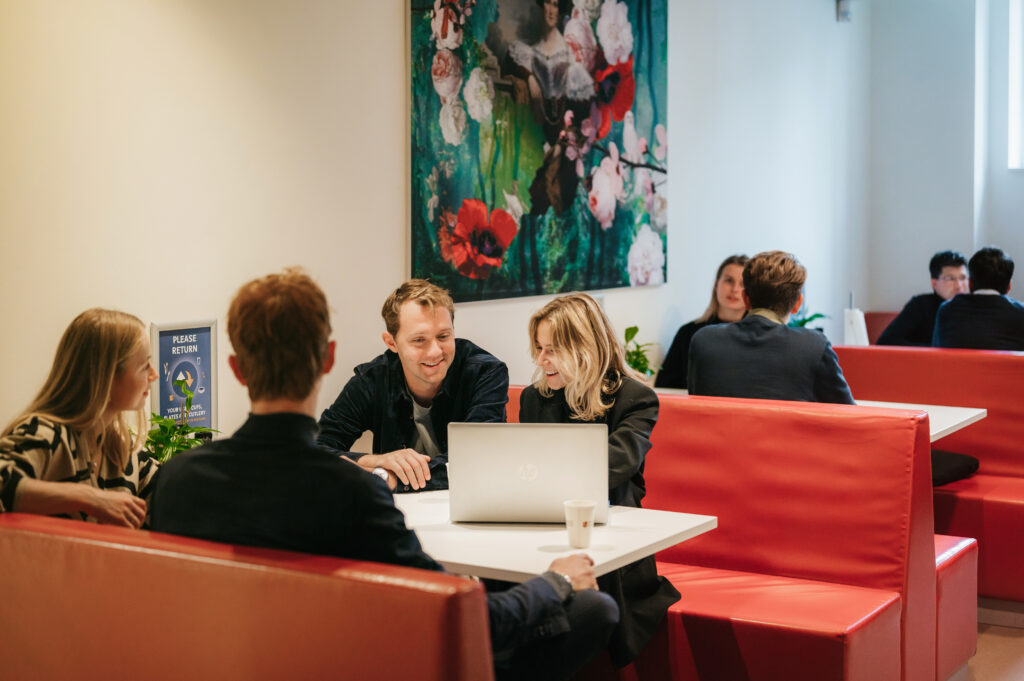
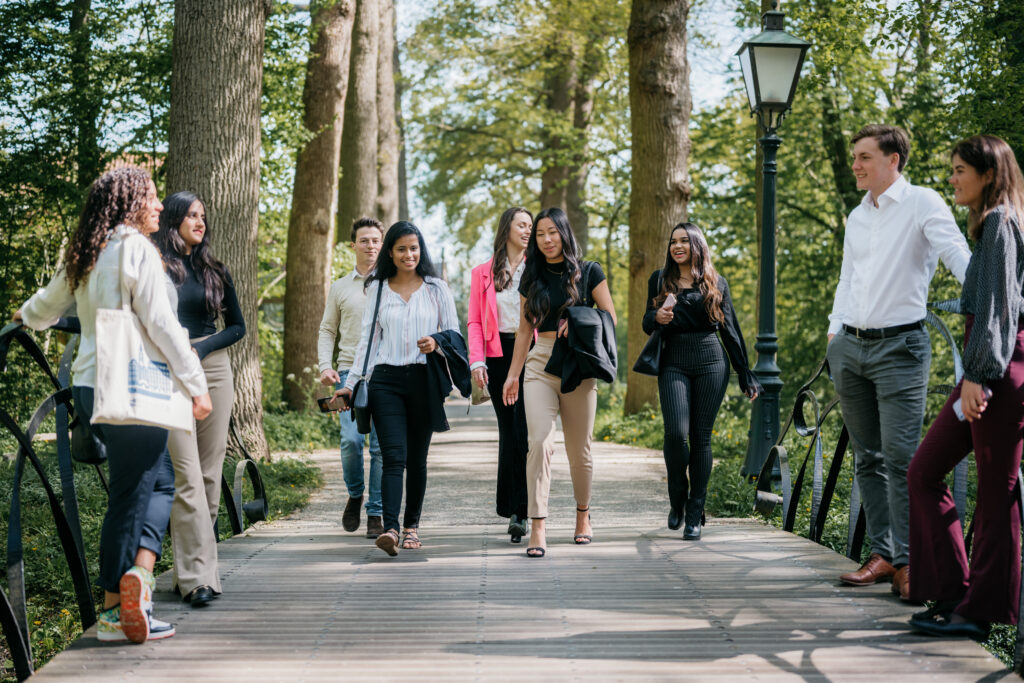
You’ll get a chance to meet people from all over the world. Image: Nyenrode Business University
Nyenrode Business University’s two main study programmes are in English, and the campuses and non-academic activities help integrate Dutch and non-Dutch students outside of studying.
People from all over the world come to Nyenrode to study, making it a melting pot of cultures and perspectives.
On top of that, bachelor’s students in their third year have the opportunity to do an exchange programme at one of Nyenrode’s partner universities, while master’s students can take part in an international immersion programme for a week. When else would you get a chance like this?
All in all, Nyenrode Business University offers a brilliant education in business and management and gives its students a unique student experience.
Plus, extra perks like guaranteed housing and career development opportunities are certain to set Nyenrode apart from other institutions.
What are your experiences studying in the Netherlands? Would you like to study at Nyenrode? Tell us in the comments!
Last week, a Dutch artist was shocked to find her “Argentinian” art agent listed as a spy among the 24 Russians released in a prisoner swap.
Dutch painter Mariken Heijwegen thought of “Maria Rosa Mayer Muños” as a sweet, shy Argentinian with great taste, selling art in her gallery in Slovenia.
Mariken spotted the art gallery on Instagram and messaged Maria Rosa to start a collaboration. After selling two paintings through the gallery, the two met in person.
They instantly clicked, and Mariken asked Maria Rosa to be her art agent. Soon, however, she got a call from a lawyer. He told her the collaboration had to stop but was vague about why.
Art agent by day, secret agent by night
Turns out, “Maria Rosa” was actually called Anna Doeltseva, and she had been arrested for espionage.
As Mariken explained to NOS, “She wasn’t just my agent, she was also a secret agent.”
Doeltseva and her husband, Artem Doeltsev, were Russian spies deployed in Slovenia.
They lived there with their two children, posing as an Argentinian couple owning an IT company and an art gallery.
A story of family secrets
For years, the couple remained unsuspected, their identity buried so deep that even their children didn’t know. In 2022, however, a tip from foreign intelligence led to their arrest.