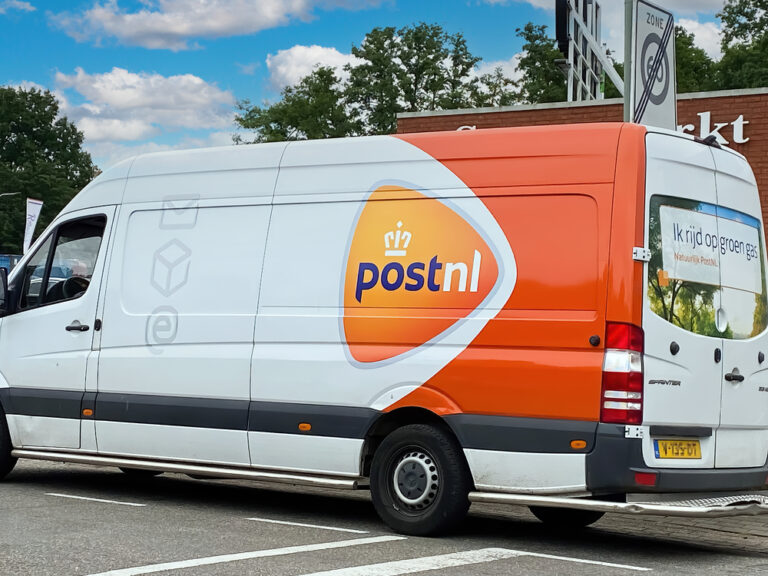
Women in Eindhoven have come forward after being harassed and receiving videos of genitals from a PostNL delivery driver.
One woman spoke with AD, telling the paper of her experience with the delivery man, who has worked in her Eindhoven neighbourhood for years.
Started with a follow request
The woman tells the paper that the harassment began with a follow requests on Instagram.
The woman could tell from the profile picture that the profile belonged to her delivery man, but denied the request. However, the requests didn’t stop.
The delivery man then managed to find the woman on Facebook and sent her a video of him playing with his genitals.
The woman responded telling the man she did not appreciate the video and asking him to stop contacting her.
But did he? No. “I saw my phone blowing up. Almost every half hour I got a message from him,” she tells AD. She blocked the man and notified the police of her situation.
Many more victims
As it turns out, this woman was not alone in experiencing harassment by the PostNL delivery man.
Another woman posted in a local Facebook group about her experience with the man, and several other women commented underneath the post saying they had experienced something similar.
By sharing details about the driver, the women were able to determine that they had all likely been harassed by the same man.
PostNL investigating the situation
When speaking with AD, the woman explained that she had filed a complaint against the delivery driver with PostNL. However, she had heard nothing back.
AD then reached out to PostNL, who then responded with the following:
“We are aware of the situation and are currently investigating it. This is, of course, completely unacceptable and in no way aligns with our standards and values. Based on the results of the investigation, we will take appropriate action.”
How do you think the company should respond? Tell us your thoughts in the comments below.
In the quiet countryside of Oosterwolde, Friesland, an anonymous tip led authorities to a breeder’s farm that was hiding a heartbreaking secret.
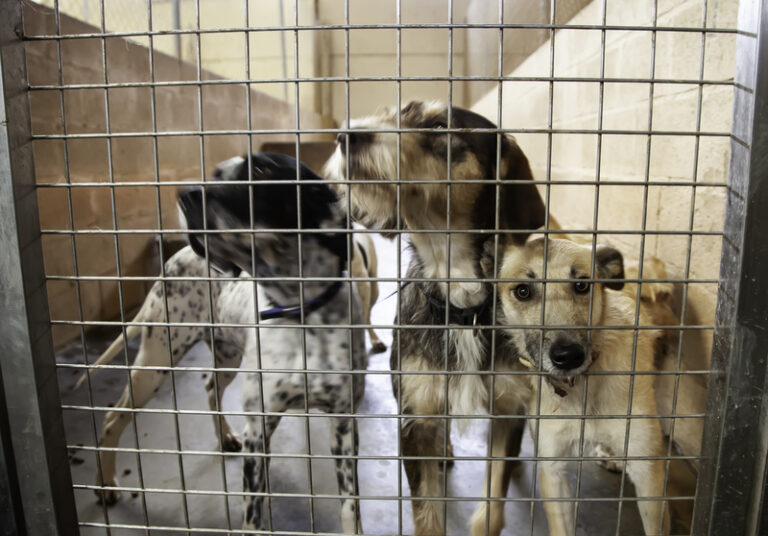
A joint inspection by the Dutch Food and Consumer Product Safety Authority (NVWA), local police, fire brigade, and Municipal Health Service (GGD), revealed a horrific sight: 72 neglected dogs and one dead puppy.
Living conditions were awful
In a post on Instagram, the NVWA shared details about the shocking find:
The conditions were nothing short of appalling, with dogs crammed into overcrowded kennels, surrounded by filth, with some living in enclosures covered in urine and faeces.
The air was so foul that inspectors had to wear breathing masks just to go inside, and one little puppy had tragically already passed away.
However, there’s hope on the horizon
The NOS reports that each of the surviving dogs has now been transferred to shelters where they’re receiving the love, warmth, and medical care they desperately need. ❤️
To make sure this doesn’t happen again, the mayor has sealed off the breeder’s home, and the Public Prosecution Service is taking over the legal side of things.
The costs of care will be covered by the owner, who now faces serious consequences.
While their journey is far from over, these dogs are finally in good hands and hopefully on their way to loving forever homes.
A Delta flight en route to Amsterdam took a wild turn… and it’s not the kind you want at 38,000 feet. 😬
According to Flightradar24, the turbulence hit late on July 30, shortly after the aircraft departed from Salt Lake City and forced the pilots to make a diversion to Minneapolis.
A sudden drop mid-air
Delta Flight 56, operated by a two-year-old Airbus A330-900neo, departed Salt Lake City in the late afternoon and initially climbed without issue.
But at 11:23 PM UTC (just after midnight in the Netherlands), the flight suddenly encountered severe turbulence, causing it to drop 410 metres in just 30 seconds.
Radar images show other flights in the area avoiding storm activity. However, this particular flight continued through it, leading passenger Stef Rohaan to tell NU.nl he suspects the crew did not anticipate turbulence this strong.
He says the meal service had been postponed earlier, but resumed just before the incident. “That’s when it really hit. Everything started flying through the air,” he says.
Emergency landing after two hours
After encountering turbulence, the aircraft diverted to Minneapolis–Saint Paul International Airport and landed safely at 7:51 PM local time. The flight had only been in the air for about two hours.
Delta confirmed that 25 of the 275 passengers on board were taken to local hospitals for evaluation. Flightradar24 reports that the airline describes the turbulence as “significant.”
Het Parool states that no further details about the condition of those injured have been released, while NU.nl adds that it is still unclear whether any Dutch nationals were among them.
What causes turbulence this severe?
Turbulence is a common part of flying and is usually caused by strong winds, rising air, or jet streams.
Meteorologist Matthijs van der Linden explains to NU.nl that an aircraft stays in the air because of the lift created by airflow over the wings.
“If one of the two suddenly changes, for example, due to a jet stream, there will be a sharp decrease or increase in the lift of the wings,” he says.
Sudden pressure changes can lead to violent shaking or a rapid drop in altitude, as experienced by Delta Flight 56.
Have you ever experienced turbulence this severe? Share your experiences in the comments below. 👇
This is probably the biggest reason why the Dutch later have the guts to challenge or even criticise their boss.
Who is the boss in the picture? Image: Pixabay
Some managers want you to not just nod and write down whatever they are telling you. They want you to question what they are saying to have a better end result or product.
It may seem strange to you that a Dutch employee can disagree with their boss in a meeting, but it’s easy to get used to.
Some people may think it’s fake, saying their manager is only pretending not to have power over their employees, but in real life, they do.
It’s a valid point, but at the end of the day, Dutch bosses are held accountable for their positions and employees are treated with as much respect as their employer counterparts.
Should you join in?
Yes! If you can find a Dutch workplace like this, you will love it!
It is more direct, but at the same time, you’re treated as an equal rather than as an underling to your boss. Sounds good, right?
What do you think of this Dutch quirk? Have you experienced it? Tell us in the comments below!
Whether you’re eating delicious pannekoeken, uitsmijter, or stamppot, another hidden essential to a Dutch meal is a tall glass of milk!?
Yeah, that’s right. Dutchies will have their usual glasses of water (obviously) and beer (because, you know, they’re Dutch), but they’ll also be sure to get a huge helping of milk.
What is it?
Regardless of the meal (breakfast, brunch, lunch, or dinner), Dutch people will drink a huge glass of milk with their food, whether or not it goes well with what they’re eating.
Drinking milk as kids is probably why the Dutch grow so tall! Image: Depositphotos
Aardappels, vlees, groente (potatoes, meat, vegetables), pea soup, or bread with cheese? They’ll have it with milk on the side.
Sure, we understand a glass of milk in the morning when waking up or at night before going to bed. But during every single meal of the day?
It seems just a little excessive.
Why do they do it?
Well, you’ve probably heard about how milk is rich in nutrients — milk proteins and fats, vitamins, minerals, and calcium.
It makes sense that Dutchies would probably rather drink something like milk over juices or tea (although you can pry their coffee mugs from their cold, dead hands).
Milk is known to help make your bones grow strong and supposedly make you grow taller.
Why is it quirky?
It seems like obsessive milk drinking does have its perks. Just look at the size and build of the Dutch!
Dutch parents do their best to get their kids to drink lots of milk to grow their bones. Is that the magic ingredient that makes Dutch kids the tallest in the world?
We’re not sure. But they might be onto something. 🤔
Should you join in?
Not every stomach is built for drinking milk (curse you, lactose intolerance!), so maybe every single meal is too excessive.
However, drinking milk in moderation isn’t bad for you, so why not enjoy a glass every now and then? Maybe just don’t pair it with pea soup.
What do you think of this Dutch quirk? Have you experienced it? Tell us in the comments below!
Dordrecht is perfect for a day trip from Rotterdam. It’s just a quick 14-minute train ride, and it’s accessible even by ferry. It’s not too far for Amsterdam either, with the journey taking 90 minutes one way.
With that background, I can unequivocally say that Dordrecht is a very under-appreciated gem. Often ignored, but very much worth a day trip or even a weekend getaway.
The charm of going on a day trip to Dordrecht
Dordrecht has all of the quaint, gezellig qualities we associate and love about the Netherlands, plus some unique features too.
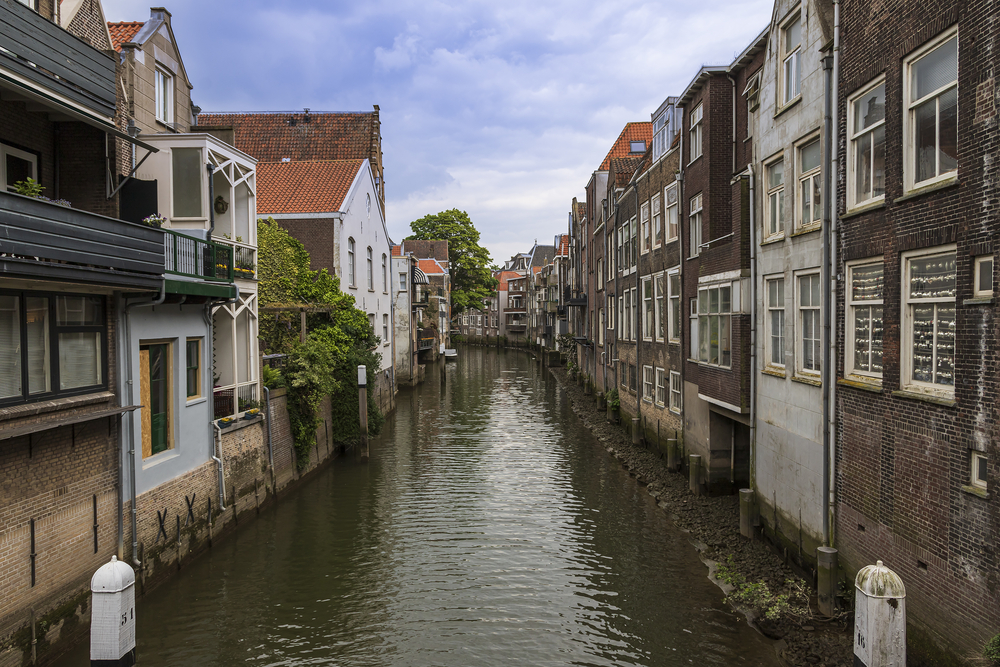
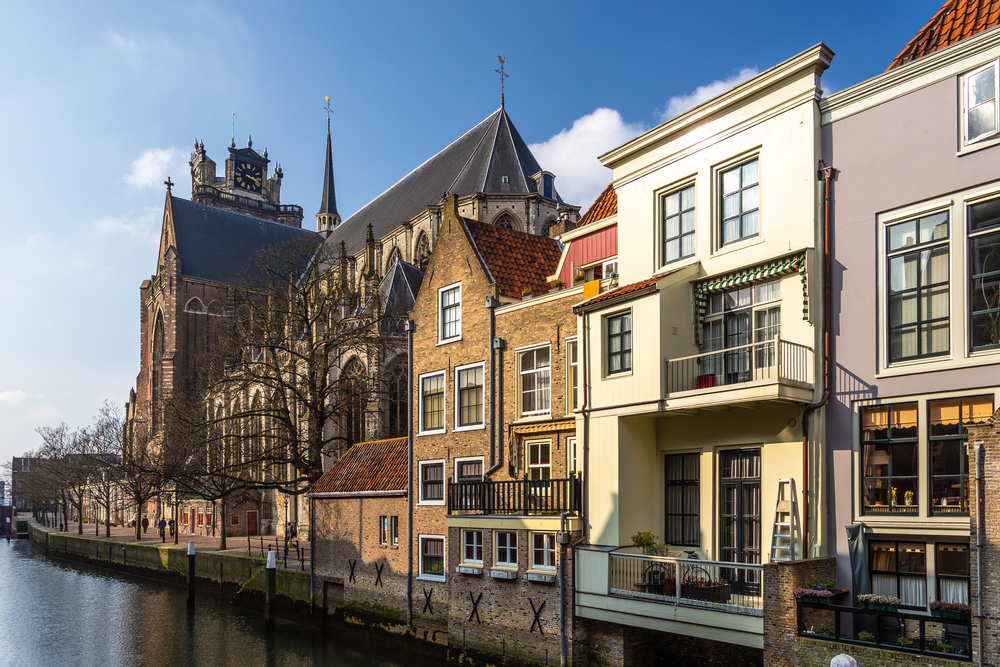
There are gorgeous canals and step-gabled architecture, beautiful people buzzing by on bicycles, outdoor squares (Schefferslein and Grote Markt, among other convivial spots) where fluitjes of beer and plates of bitterballen await, as well as the usual touristy streets.
Make sure to catch a boat tour on one of Dordrecht’s wonderful canals! Image: Depositphotos
But the mystical Dordrecht is also drenched in history! Plus, its quaint harbour-like layout and its position on the banks of the huge Oude Maas river make it truly outstanding.
Dordrecht, in my Dutch travels, is one of the cutest and friendliest of all the towns I’ve visited in the Netherlands.
The history of Dordrecht
Dordrecht is ancient. In fact, it’s one of the oldest river towns in the Netherlands.
Claiming a critically strategic geographic position where several smaller rivers converge into one giant one, the town emerged centuries ago as a major trading centre and commercial hot spot.
It’s claimed that Dordrecht is the oldest official town in the country. Having been granted a city charter in 1220, it’s older than Amsterdam, Leiden, Haarlem, or Utrecht.
And for those early centuries, Dordrecht was one of the most powerful political and trading centres in the land, or — more appropriately — on the water.
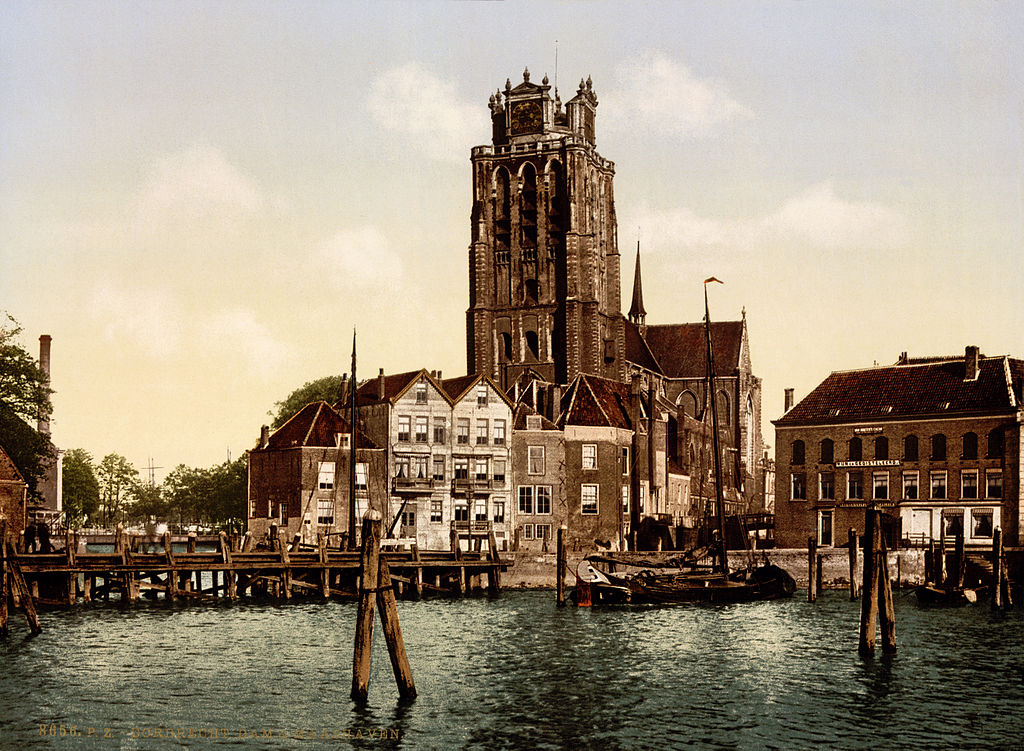
Dam and harbour of the Maas river in Dordrecht, 1890 – 1900. Image: Photoglob Zürich/Wikimedia Commons/Public Domain
In 1572, at the beginning of the Eighty Years’ War (the Dutch war of independence from occupying Spain), it was in Dordrecht where political, military, and ruling class leaders from all over the Netherlands met to declare independence.
War and future independence were sparked here. For Americans, it would be like the signing of the Declaration of Independence in 1776 in Philadelphia, when the newly formed United States declared itself free from England. Here, in Dordrecht, a similar political event unfolded, more than 200 years earlier.
To get a sense of Dordrecht’s past, check out the anonymously painted “St. Elizabeth’s Day Flood” in the Rijksmuseum. It’s an amazing painting depicting the tragic events of 1421 when the dykes in the surrounding countryside were breached and 22 villages were swept away in the flooding.
You’ll realise that most of Dordrecht looks pretty much the same today as it is depicted in the painting! The Grote Kerk in Dordrecht’s old town looks the same, and the view from the top makes you feel as if you’ve climbed right inside the “St. Elizabeth’s Day Flood” painting itself.
Where to start (and continue) your day trip to Dordrecht
For a modern visitor to Dordrecht, the town is easy to walk around. Unlike Rotterdam or Amsterdam, it’s so small you can hardly get lost. Keep wandering around, and when you get to the river, turn around.
You’ll likely start your visit from the tiny train station. Look out the window as you approach the town for excellent views.
The walk into the town centre is very short and fast. Make sure you stop by the VVV (tourist information centre) on your way to grab a free map of the town or buy tickets to the museum here. The ladies behind the desk might be the most friendly Dutch people anywhere!
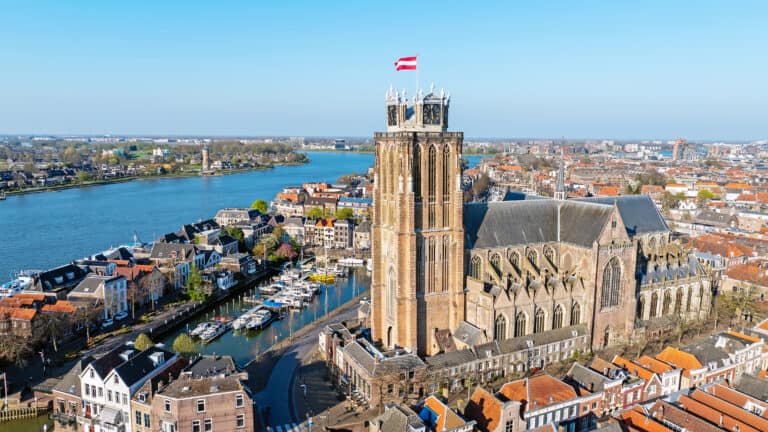
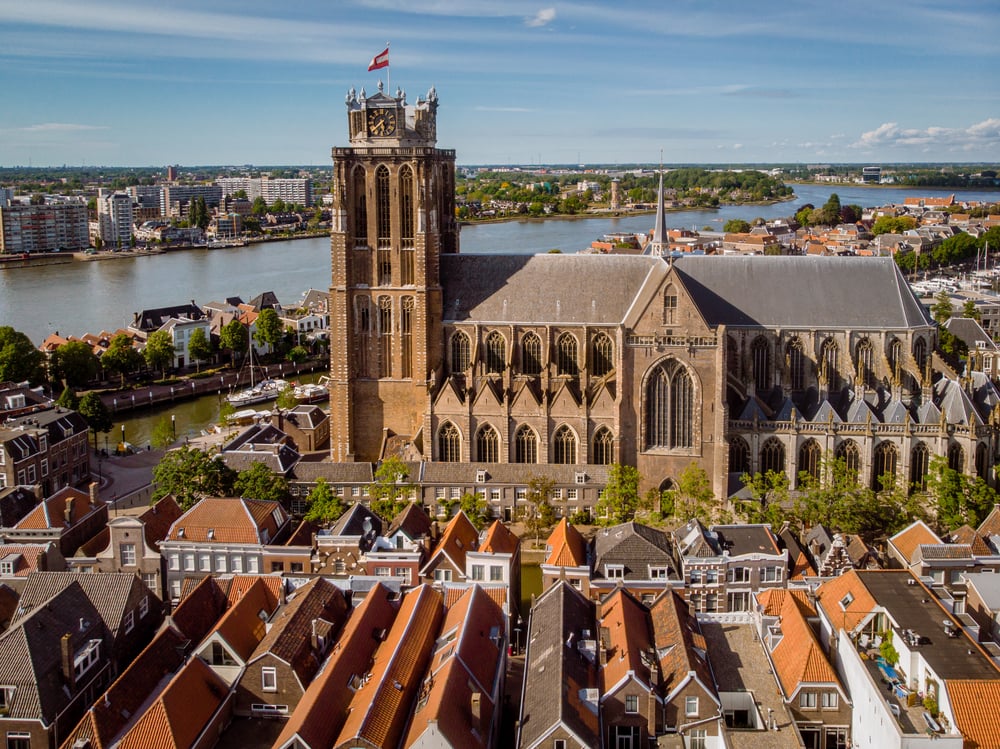
Grote Kerk in all its gothic glory. Image: Depositphotos
Then, after getting oriented, head for the Visbrug — the landmark bridge over the Wijnhaven canal at the foot of the Stadhuis. Note the two lion sculptures in repose, guarding the magnificence of the environment.
Wander the streets in this central neighbourhood and you’ll see some of the oldest houses in town, many dating from the 1660s. Stroll down Voorstraat, one of the nicest shopping streets, until you see the noble Augustinerkerk.
It is an elegant old church with a small, almost hidden doorway leading to Het Hof, a gorgeous hideaway spot of tranquillity where you can almost sense the ghosts of important town citizens strolling around conducting business deals and gossiping about ships and commerce.
Then walk down to where the land comes to a point sticking into the river, the Groothoofdspoort. This is the ideal spot to look out over the water and let the mind wander and soak in the ambience. The riverfront views are incredible.
Take a seat on one of the promenade benches and enjoy the views. You’ll see pleasure boats bobbing out on the water. Perhaps even a huge commercial tanker drifting by like a whale!
And you’ll find outdoor cafés on each corner, dotting the streets. Stop for a coffee or a beer and relax — this is about as Dutch as you can get!
Museums to visit on your day trip to Dordrecht
The one museum you shouldn’t miss is the Dordrechts Museum. It’s sort of like a mini-Rijksmuseum but way less intimidating and manageable to explore in one visit.
However, you’ll still want to devote at least a solid two hours to exploring the important classic art and rotating modern art exhibits, with a stop at the nice gift shop and typical café inside.
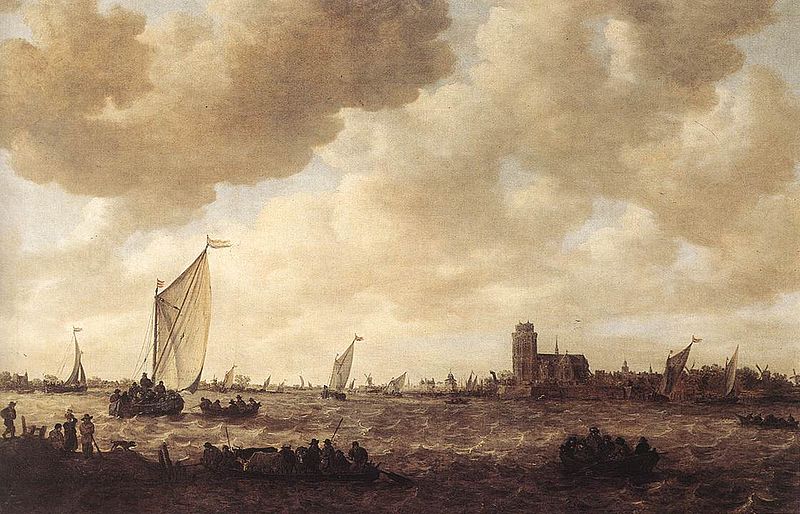
Van Goyen’s ‘View of Dordrecht’ is a masterpiece. As you’re looking at the painting, suddenly, it will hit you. Image: Jan van Goyen/Wikimedia Commons/Public Domain
In the museum itself, you’ll get to enjoy treasures by Dutch Masters Jan van Goyen (1596-1656) and Albert Cuyp (1620-1691), among many others.
I also made time for a quick visit to the Museum 1940-1945. It depicts the Nazi occupation of Dordrecht, the subsequent Dutch resistance movement, and the story of World War II in the southern region of the Netherlands during a very dark period of history.
It’s a tiny museum — like the ground floor of a townhouse, tiny — but the men who guide you through it are extremely kind.
I asked about a film, and the next thing I knew, they had set up a TV monitor and placed old VCR tapes on for me to watch. Dordrecht is truly a great small town for an authentic Dutch experience.
Must-see on your day trip to Dordrecht: Grote Kerk
After checking out the stunning Dordrechts Museum, wander toward the Grote Kerk on the other side of town. You can’t miss it — look up!
Like those Parisian hotels that boast an “Eiffel Tower view” (which, in my opinion, is a scam since you can see the Eiffel Tower from ANYWHERE in Paris), the Grote Kerk looms majestically over Dordrecht as if to guard its ancient secrets and spirit.
Built over 150 years, the Grote Kerk allows visitors to climb the spiral stairs to the top — all 275 steps!
Have you ever been on a day trip to Dordrecht? Tell us in the comments below what your favourite thing was! 👇
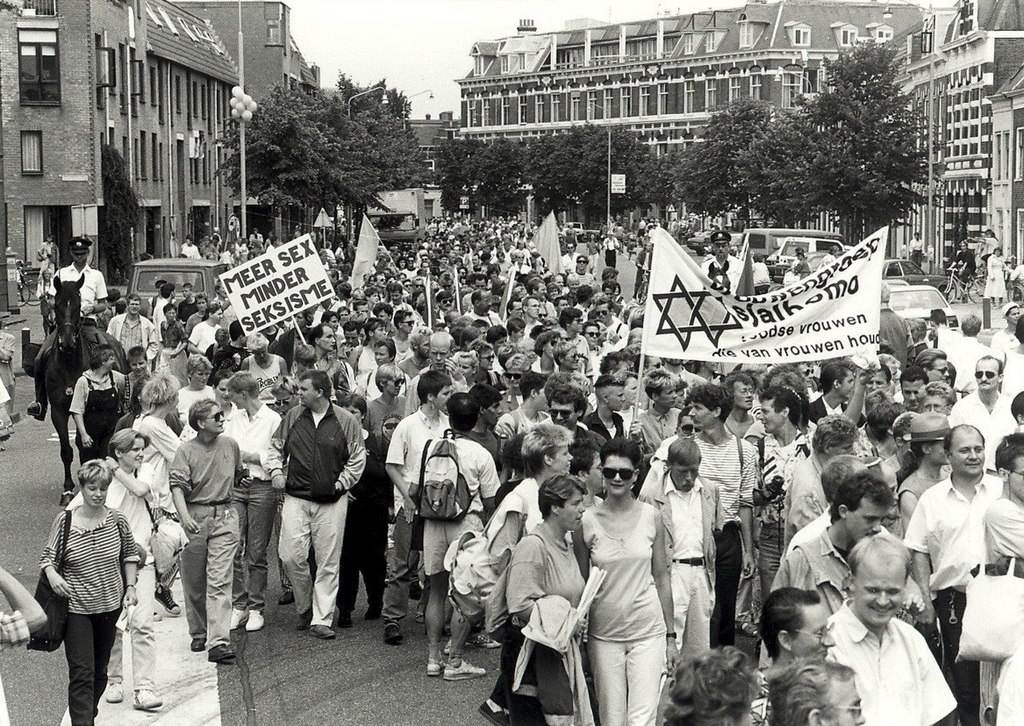
If there was ever a time when a group of people said “enough is enough,” it was definitely during the Stonewall riots in the US. In the Netherlands, a similar sentiment followed in 1979 during Roze Zaterdag (Pink Saturday.)
Let’s run through a short history of gay rights in the US and Netherlands, and how they interconnect in celebration of Pride in Amsterdam.
To begin, let’s start with the Stonewall riots.
The riots were much more than a fight, they ignited a spirit that gave purpose to many in the LGBTQIA+ community to not only fight for the right to love and unapologetically be themselves but also inspire others to do the same.
So what were they?
The Stonewall riots
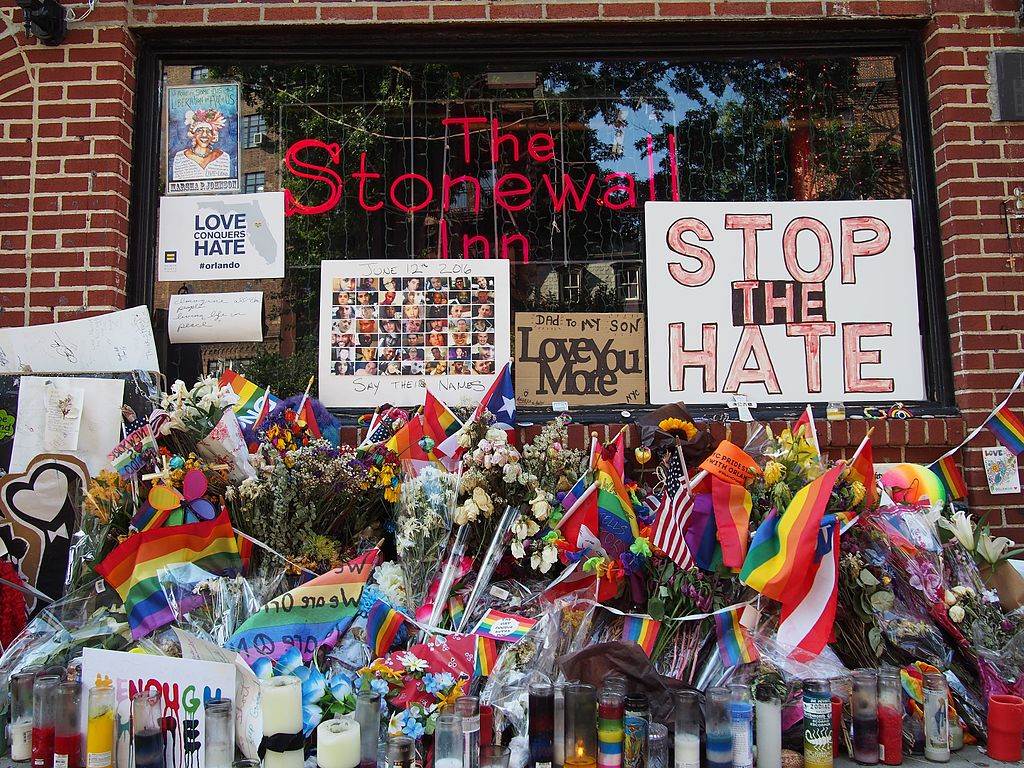
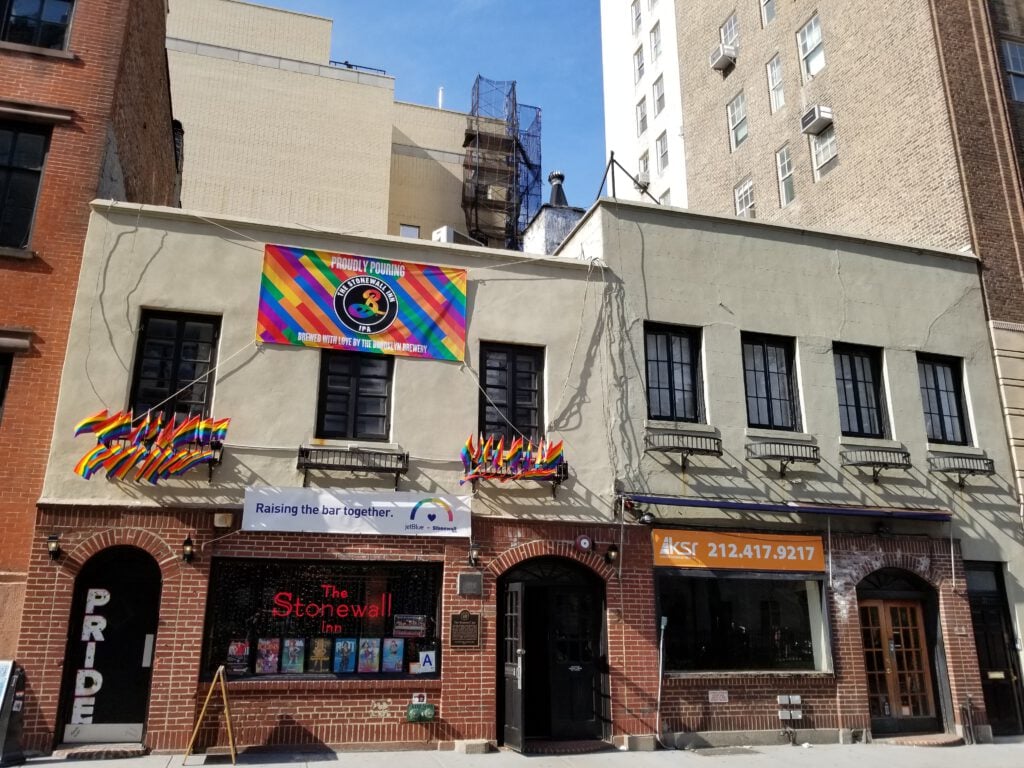
It was early in the morning of June 28, 1969, when the police raided the Stonewall Inn to make their usual arrests of its gay patrons.
They often enjoyed intimidating and arresting the bar’s patrons — but on this particular day, the crowd became fed up and refused to be intimidated.
The Netherlands and the US have a shared history when it comes to Amsterdam Pride. Image: Depositphotos
On the 52nd anniversary of the Stonewall riots, we take a trip down memory lane to remember this important part of history, and how it came to inspire something beautiful all over the world, especially in the Netherlands.
The years before Stonewall
The 1950s were a low point for the US when it came to protecting the rights of its citizens, be they Black or Queer.
For example, it was at this time that the American Psychiatric Association’s diagnostic manual listed homosexuality as a sociopathic personality disturbance, President Dwight D.
Eisenhower signed an executive order that would ban homosexuals from working for the federal government, saying they were a security risk, and the police arrested and molested them with impunity.
Gays and lesbians were effectively outlaws, living in secrecy and fear.
The Stonewall Inn
At the time before the riots, many Queer people never had the illusion that living according to societal norms and standards would improve their situation, nor did they have the option to try.
The only places where they could openly be themselves were gay and lesbian bars and the Stonewall Inn provided a safe haven for so many in the community.
The Stonewall was one of the few gay bars in Greenwich Village where patrons could dance, drink and be themselves, even if for a while.
It attracted a diverse, young clientele, although only a small number of lesbians. Some patrons dressed in various forms of drag, including “scare drag”, as well as other types of attires.
Those who ran the inn often had to bribe police officers to look the other way, thereby, protecting not only their business but also to some extent the visitors.
Cops who were bribed had to notify the inn in advance when they came for their raids. That way, patrons could usually get away just before the police arrived.
The riots
Police raids on gay bars were nothing new at the time.
These were mostly used as intimidation tactics where patrons often had to identify themselves, were beaten up, and if they wore clothes that were not “appropriate” for their gender, they were arrested.
Normally, the cops responsible for the Stonewall Inn area often turned a blind eye in exchange for bribes, but on the evenings of June 27 and 28, the police came from another district.
The Stonewall Inn remains an important space for the LGBTQ+ community. Image: Rhododendrites/Wikimedia Commons/CC4.0
The inn had not been tipped off in advance and was fully packed as a result.
About six officers — including those who led the NYPD’s public morals division — went into the bar, where undercover colleagues were already inside.
There is no film or video footage of the Stonewall uprising.
There is one photo from the first night taken by Joseph Ambrosini, a Daily News photographer, and four photos of Stonewall uprising participants from the second night taken by Fred W. McDarrah, a Village Voice photographer.
Eyewitness accounts report that when the police walked in, the music stopped and the lights were turned on as they instructed patrons to show their IDs on their way out.
Some of the lesbian customers were harassed and bullied by male police officers inside the bar.
The last straw was when a lesbian patron who came out of the bar was manhandled by police as they tried to force her into a car.
There was a scuffle with the police, stones and later Molotov cocktails were thrown at their cars, and the more the police tried to intimidate them, the more things escalated.
The approximately 2,000 protesters who gathered could not even be stopped by the Mobile Unit.
The next day activists stood in the street handing out pamphlets. They called on people to gather in front of the Stonewall Inn later that night.
The call was answered en masse and the crowd that night was even bigger than the night before and later in the same week, more people mobilised and started the riots again.
The aftermath
In the aftermath of the riots, a large group of those involved formed the Gay Liberation Front, an organisation dedicated to decriminalising homosexuality in the US.
According to Come Out! Magazine, the first periodical published by the gay and lesbian community after the Stonewall riots in June 1969, “The Gay Liberation Front is a coalition of radical and revolutionary homosexual men and women committed to fight the oppression of the homosexual as a minority group, and to demand the right to the self-determination of our own bodies.”
Dozens of similar organisations sprang up as more and more spontaneous marches started taking place all over the country. For example, in July a Gay Power rally took place in Washington Square Park in New York.
Ultimately, this activism led to the first Gay Prides being held on June 28, 1970, in New York, Los Angeles, and Chicago. The march in NYC took place on Christopher Street, across the street from the Stonewall Inn.
Although the struggle for LGBTQIA+ rights did not actually begin at Stonewall, the uprising was a key turning point and a catalyst for explosive growth in a movement that would eventually spread all over the US and other parts of the world (including the Netherlands).
From Stonewall riots to Gay Prides
The Stonewall riots gave rise to the birth of hundreds of gay organisations all over America in a short period of time.
The Gay Liberation Front (GLF) which was founded after the uprising decided in November 1969 to commemorate the Stonewall riots under the name Christopher Street Liberation Day.
Christopher Street is the name of the street where the Stonewall Inn is located.
On the first Christopher Street Liberation Day in New York (exactly one year after the Stonewall uprising), an estimated 3,000 to 15,000 people began marching at Greenwich Village and went 51 blocks up Sixth Avenue to Central Park.
The energy would soon spread to other American cities, and eventually to London, Paris, West Berlin, and Stockholm.
Today, Gay Pride Parades that were inspired by the first Christopher Street Liberation Day take place worldwide.
Pride in the Netherlands
Despite its name, Amsterdam Pride has a different origin than many Gay Prides in other parts of the world.
These often commemorate the Stonewall riots, but in the Netherlands, Pride doesn’t just commemorate the Stonewall riots but also an event called Roze Zaterdag (Pink Saturday).
Pink Saturday (Roze Zaterdag)
Pink Saturday is the Dutch version of the Gay Pride Parade, which was held for the first time on June 25 and nowadays annually in every city.
The event was given the name “Pink Saturday” by ROZA an activist group from Limburg.
The name traces its origins to a demonstration organised by ROZA on April 14, 1979, in Roermond following some bigoted statements by bishop Gijsen about homosexuality in an interview with Elsevier magazine in January 1979.
The bishop had said some nasty and hateful things about homosexuality and none of that was going to be tolerated by activist groups and/or the LBGTQIA+ community. So they demonstrated.
Pink Saturday in Amersfoort in 1982 is remembered to be one of the darkest episodes in Dutch history.
What was supposed to be a festive day turned into riots as the three parades with gays, lesbians, and friends marching towards the city centre were threatened, spat on, and pelted with onions and eggs.
Several attendees were seriously injured, with some young people from the neighbourhood attacking the parades while also searching for a fight.
Amateur videographer and gay rights activist Rob de Vries recorded the parades and the mayhem and this video can be found on NPO.
It gives a glimpse of the hatred that the LGBTQIA+ community had to endure in the Netherlands at the time.
Celebrated together in June
Pink Saturday is traditionally organised at the end of June every year because of the connection with the Stonewall riots.
The event creates an avenue for celebration, demonstration, and emancipation, while also offering space for information, discussions, parties, meetings, and visibility for sexual and gender diversity.
It is also a reminder that there was once a time when the Netherlands was not so accepting of the LGBTQIA+ community.
While things may be somewhat better now, there is still a lot of work to be done concerning acceptance and rights for the gay, lesbian, transgender, queer and intersex communities in the Netherlands.
Pride Amsterdam
Pride Amsterdam was first held in 1996.
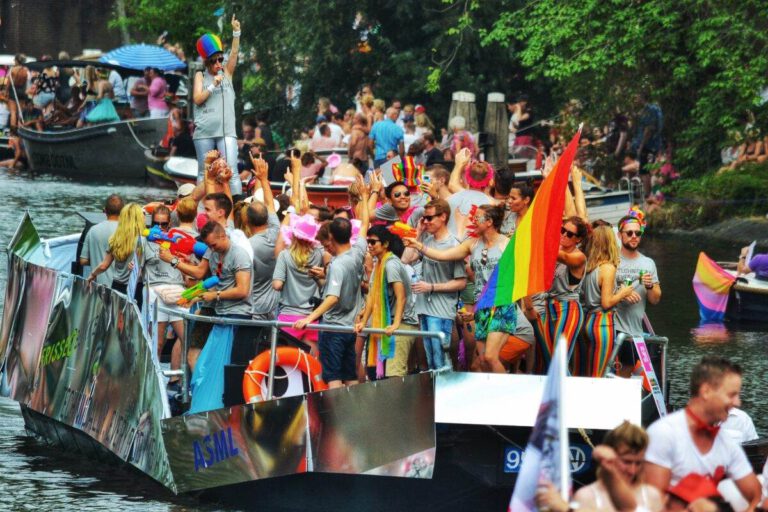
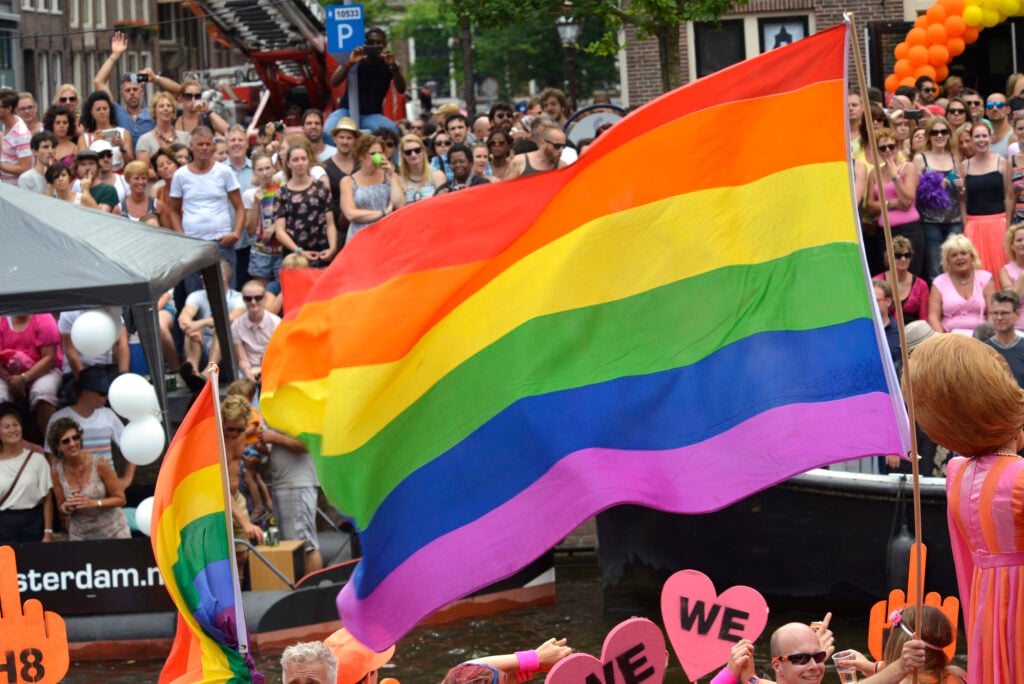
The highlight of this festive day is the Canal Parade, which is held every year on the first Saturday of August (except in 2020 due to the coronavirus pandemic and lockdown).
This is an eccentric boat procession through the canals of Amsterdam.
Pride Amsterdam is known across the world. Image: Depositphotos
Pride Amsterdam started purely as a party. It was and still is, a celebration of marginalised sexual orientations and identities.
The first boat parade in 1996 attracted about 25,000 visitors. Today, the event attracts hundreds of thousands of people every year, with a record 560,000 attendees in 2016.
Pride Amsterdam is one of the most beautiful things about the Netherlands.
It is not just a celebration of love, expression, marginalised sexual orientations, and identities, it also remembers those who dared to stand up for their rights and the rights of others during the Roze Zaterdag and the Stonewall riots.
Finally …
In 1960s America, gays and lesbians were seen as nothing but outlaws and had no choice but to live in secrecy and fear.
They were labelled insane by doctors, immoral by religious leaders, unemployable by business owners, and liability by the government.
It was a period when society saw homosexuals as predators and child molesters, the police saw them as criminals while constantly preying on them because they were easy targets that society didn’t care for.
Stonewall electrified the push for gay equality and every year as Pride is celebrated in the Netherlands, we all remember the activists who gave blood, sweat, and tears for the LGBTQIA+ community of today to dream big.
Did you know the history behind Pride in Amsterdam? Tell us your thoughts in the comments below!
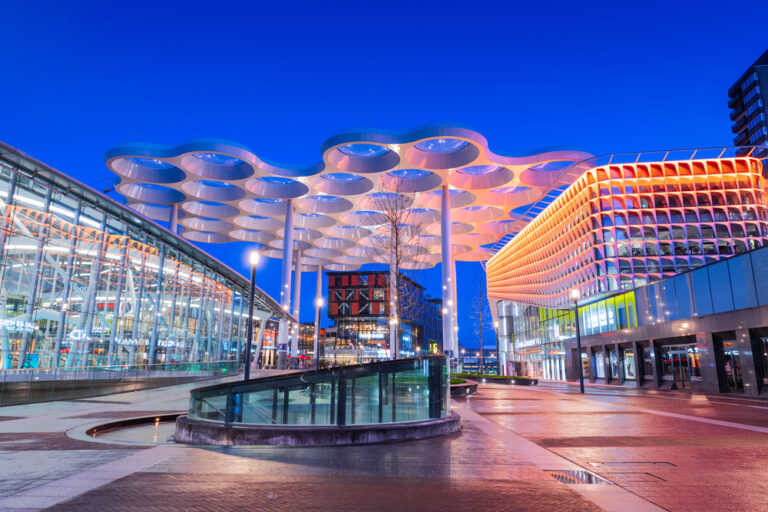
From August 1 to 14, don’t be surprised if you spot tents popping up at Utrecht Centraal.
No, you’re not seeing things: it’s Glamping Utrecht Centraal, a pop-up sleepover spot pitched by NS for students kicking off their studies in Utrecht.
Glamping? In Utrecht Centraal??
The makeshift campsite will be made specially for first-years coming from far away for Utrechtse Introductie Tijd, the introduction week for all students who will be studying in the city.
To help those who have yet to find accommodation, NS will set up ten cosy, fully equipped tents on the station’s upper floor.
Lucky tenants can expect comfy beds, breakfast, drinks, earplugs, chill tunes, and even a bike to cruise into town. All you need to bring? A toothbrush and your phone charger.
Each morning starts with a relaxed breakfast where students can meet fellow campers before heading off (on time!) to the day’s activities. And if you’re still late? Not even NS can help you now.
The best part? It’s 100% free
But there’s a catch: NS is looking for fun, adventurous guests with a good story and a charged phone.
To get a spot, students have to send in a creative video via Instagram before August 1. NS started reviewing entries on July 28, and only the best will make the cut.
Do you like this NS initiative? Tell us your thoughts in the comments below.
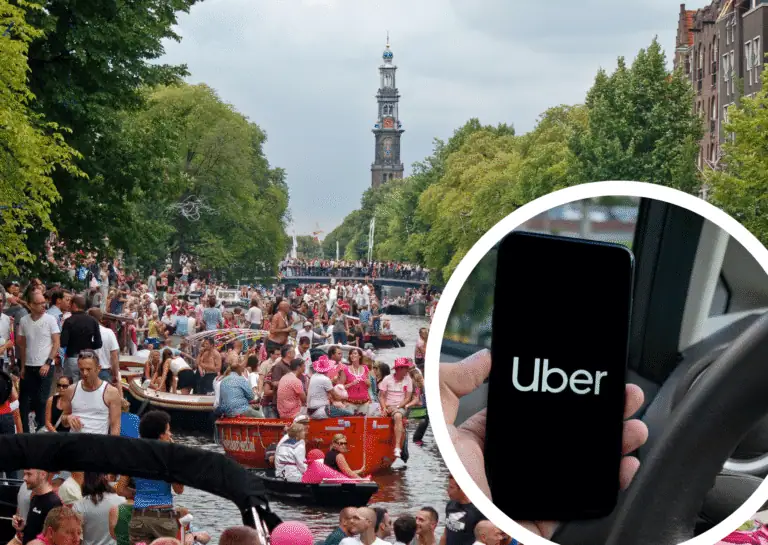
Brace yourself, Amsterdam: Uber and Bolt drivers are going offline after this year’s Canal Parade, and no, it’s not because they’re joining the party. 🎉
According to Het Parool, platform drivers are stepping away from the wheel this Saturday, August 2, from 8:00 PM to 6:00 AM, calling for better pay and working conditions.
Drivers want more than just five-star ratings
The strike is being organised by Taxi Protest Amsterdam (TPA), which is urging platform drivers across the city to log off for the night — though it’s still unclear how many will take part. 🤔
Their demands? A base fare of €2 per kilometre (excluding boarding and driving time), a pause on onboarding new drivers, and a professional competence requirement for anyone working as a taxi driver.
According to the group, working conditions are only going downhill, and previous talks with Uber Netherlands, the City of Amsterdam, and members of the House of Representatives have led nowhere.
Canal Parade rides could get messy
Of all nights to strike, they’ve chosen THE busiest — and sparkliest — one.
With hundreds of thousands expected at the Canal Parade, don’t be surprised if your trip home takes longer than your glitter makeup routine.
But before you panic-text your group chat: not all cabs are disappearing. TPA says only Uber and Bolt drivers are involved, while traditional taxis will still be circling the city ”so that Amsterdam isn’t completely taxi-free,” the group tells Het Parool.
So yes, you’ll still get home — just don’t count on a quick escape from the crowds. 😏
What’s your take? Would you pay more if it meant fairer treatment for platform drivers? Share your thoughts below. 💬
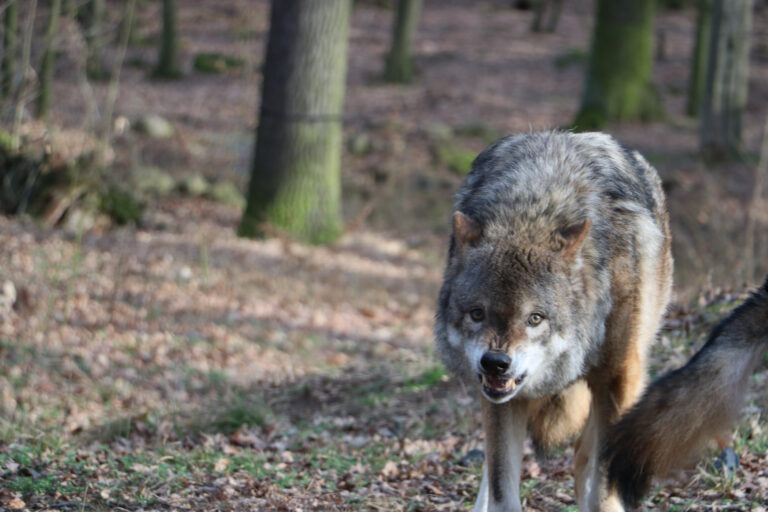
A six-year-old boy was injured yesterday morning in what authorities believe was an attack by a wolf near the Pyramide van Austerlitz in the province of Utrecht.
The young boy was playing near the historic Pyramide van Austerlitz when the suspected wolf encounter occurred.
The animal attempted to drag the child away into the forest.
Bitten and dragged by the armpit
Speaking with the NOS, his father, Mike, explains that his son sustained claw marks, bite wounds, and scratches on his back and under his armpit during the incident.
The child was immediately transported by ambulance to the University Medical Center (UMC) in Utrecht, where he received stitches before being discharged the same day.
“We’re shaken by what happened, and we both have a kind of realisation that we were lucky,” Mike tells reporters.
He wasn’t present during the morning incident but rushed to the forest after hearing what had happened. Concerningly, he noted that other families with children were still walking in the area.
Hit with sticks
According to the AD, witnesses to the attack started hitting the wolf with sticks as he tried to drag the child away. He eventually released the child and ran into the woods.
The AD also reports that the forest has been dealing with one particularly problematic wolf called Bram.
A province spokesperson tells the paper that DNA tests are being done to determine whether a wolf indeed carried out the attack and whether Bram could be the perpetrator.
This isn’t the first time wolves have caused concern in Dutch nature areas, with children often being the target of the attacks.
Do not visit alone or with your children and dogs
Following the incident, Landgoed Den Treek has strongly advised visitors to avoid the area with children and dogs until further notice. “Safety comes first!” their website warns.
In a statement, Woudenberg Mayor Magda Jansen, whose municipality includes the Pyramide van Austerlitz, expressed deep sympathy for the family while highlighting ongoing concerns.
“In recent months, I’ve repeatedly voiced my great concern about the wolf situation in our area. The impact on many people is particularly significant, people’s safety is at stake, and the uncertainty among entrepreneurs and farmers is also enormous,” she said.
The mayor has sharpened safety advice for the area: “Please follow this advice. Don’t go into the forest with children. As an adult, you’ll also need to be very alert if you enter the forest. Stay on the paths and especially don’t go into the forest alone.”