Hebe Zwart is 140 cm tall, and has blond hair, blue eyes, and light skin. She was last seen wearing a pink jacket, a black skirt, and carrying a purple backpack.
According to the police, the girl also has a disability and scoliosis, making her walk slightly unstable.
Her assistant is 178 cm tall, with medium-long hair and blue eyes. The two were likely in a Kia Picanto car, with license plate number PR-425-K, on their way from Raamsdonksveer to Vught in the Netherlands.
The Dutch police are taking the case very seriously, and are currently collecting all relevant tips through the AMBER alert.
If you think you might have seen Hebe and her assistant, or if you have any information you think will benefit the police search, please fill in the Police’s online tip form.
A collision with a train this morning caused a bus to rip in half, spreading wreckage all over the scene.
The accident happened in Bergen op Zoom in the south of the Netherlands. Surprisingly, there were no injuries reported, says NU.nl.
Thankfully there were no passengers on board the bus at the time of the collision, and the bus driver appeared to be uninjured when checked by ambulance staff.
The train driver and conductor were reported to be very shaken, but uninjured.
Translation: Train crashes into bus. No injuries. #bergenopzoom #ns
The 85 passengers on the train were also assessed by medical staff, before being removed from the damaged train. They were transported away from the location of the crash by (another) bus.
Rail travel is temporarily disrupted
Trains between Roosendaal and Kruiningen-Yereseke will be temporarily halted, but buses will still be up and running.
At present, there is no information on how long the blockage is expected to last.
As the train involved in the accident was derailed, an inspection of the tracks will be conducted to make sure there are no defects or damage.
What do you think of the accident? Tell us all about it in the comments below!
The weather is being classically Dutch again: we will have a combination of all four seasons this week! 🌦
The weather will change a lot in the following days — living in the Netherlands, that’s something you hear a lot! The good news is that we will at least be able to enjoy some mild temperatures and sunshine. ☀️
You might notice that the past few days were already a bit warmer than the weeks before, and this will continue for the following week! — NU.nl reports.
As we covered on Friday, you might be able to leave a layer of clothes in the closet because we are borrowing some warmer air from Spain.
While Monday offers clouds and moderate rain, the rest of the work week is looking up!
After everyone survives the gloomy Monday, the sun will also be making its comeback in the Netherlands on Tuesday, especially in the afternoon. ☀️
Wednesday will have perfect dry autumn weather with a maximum temperature of 18 degrees, while the coldest will be 6.
On Thursday, in the southeast part of the Netherlands, the day will start with a lot of clouds and rain.
But not for too long
Thursday marks the end of those cosy Pumpkin Spice Latte walks, with the rain pouring itself back into the country back! ☔️
For the rest of the week, the Netherlands will experience more wind and changeable weather. But, according to Weerplaza, the temperature might rise again during the weekend.
One thing is for sure: the Dutchies will definitely have something to talk about! 😉
What’s your ultimate method to adjust for the Dutch weather? Tell us in the comments!
Amsterdam’s bustling Central Station is partly cordoned off, following a shooting last night that wounded at least two people.
We may need to be wary of more than faulty brakes when taking the train, as the NOS just reported on a shootout at Amsterdam Centraal.
Many witnesses and few facts
There are conflicting reports on how many gunmen were involved in the attack, although the station was rather busy during the time of the shooting. Witnesses are to be questioned by police.
According to a spokesperson for the police, at least two people were injured during the shooting. The injured were taken to hospital, but their condition remains unknown.
Amsterdam-centrum. Twee gewonden bij #schietpartij in hal van #centraal station #Amsterdam op de Ruijterkade. Een slachtoffer zou gestoken zijn. Het schietincident vond om 00.36 uur plaats. Beiden slachtoffers per amb naar zkh. Twee verdachten te voet ervandoor. #politieonderzoekpic.twitter.com/qnWu6EvoY7
Translation: Amsterdam centre. Two were injured in a shooting in the central hall of Amsterdam Centraal on the Ruijterkade. One victim was reportedly stabbed. The shooting incident took place at 00:36 AM. Both victims were taken to the hospital by ambulance. Two suspects took off on foot. Police are investigating.
Unfortunately, the gunmen still remain at large, having run away after the shooting.
A new staircase in Brabant was painted in the colours of the rainbow last Tuesday, in celebration of National Coming Out day. Unfortunately, it has also been spray-painted in hate speech.
The staircase in Cuijk, Brabant, was the target of a homophobic attack, in which perpetrators left phrases such as ‘cancer gays’ and even painted a swastika over the rainbow, reports NU.nl.
And while you may be thinking: “isn’t the Netherlands very progressive when it comes to gay people?”
Well, yes, in some ways, but incidents like this prove that homophobia is alive and well and more needs to be done to combat such hostile mindsets.
Coming Out Day 🌈
As Coming Out Day fell on Tuesday 11, October, there were hundreds of events around the Netherlands to celebrate this milestone in many queer people’s lives.
But, it seems the day of pride has been overshadowed in Brabant by this incident.
Op Coming-Outdag besteedden we aandacht aan het ‘uit de kast komen’. Met hulp van leerlingen van het Merletcollege is een trap bij de Maaskade in Cuijk in regenboogkleuren geverfd. Verschillende generaties deelden de ervaring van hun coming out. Kijk op: https://t.co/hv3QTwvJ3apic.twitter.com/7MAuJ3F6A4
Translation: On Coming-Out Day we paid attention to ‘coming out’. With the help of students from the Merlet College, a staircase at the Maaskade in Cuijk has been painted in rainbow colours. Different generations shared the experience of their coming out. Look at: https://bit.ly/3Mx4J9h.
Volunteers are now forced to paint over the hate speech, instead of being able to enjoy what should have been a happy, colourful installation in the city. 😥
What do you think of this incident? Tell us your thoughts in a comment below!
Dinner is an important aspect of any country’s culture. The Dutch, like in other aspects of their lives, like to keep dinner as efficient as possible.
Dutchies often consider lunch to be a quick affair, chowing down bread as quickly as possible before returning to work. But what can you expect from something more intimate, like dinner?
Norms and etiquette for dinner
There’s so much to think about when you experience a new culture, especially when it comes to food! What time should you get there? What are the norms and etiquette? What kind of food should you anticipate? Here’s all you need to know about table manners in the Netherlands — as well as pre-table manners.
Arrival time for dinner in the Netherlands
Cultures around the world have varying times when it comes to dinner. Dutchies like to start early, usually between 5 PM and 6 PM.
There is a historical explanation for this early time for dinner, and it was influenced by the socio-economic circumstances of the 19th century.
Lower social classes would eat a warm meal around midday, while the higher classes would eat at 3 PM. With the introduction of factory work, however, working-class people no longer had the time to go home for a meal.
On the other hand, middle-class families, starting in the 20th century, moved their warm meals from 3 PM to 6 PM so that middle-class women could benefit more from the possibilities of shopping, as shopping centres started to appear around towns.
By the 1960s, most families ate a meal in the evenings, between 5 and 6 PM.
We know what you’re thinking. What are you supposed to do around 9 or 10 PM, when you inevitably feel hungry again?
The answer is very straightforward. Be a responsible adult and go to bed at that time, instead of staying up until 2 AM watching YouTube!
What to expect from the actual dinner
So you’ve been invited to your first Dutch dinner, and don’t really know what to expect. Well, first things first: be on time.
Dutch people take their time very seriously, and not being on time can be perceived as very rude and disrespectful.
Worse than not being on time is cancelling last minute, it’s all about being mindful of other people.
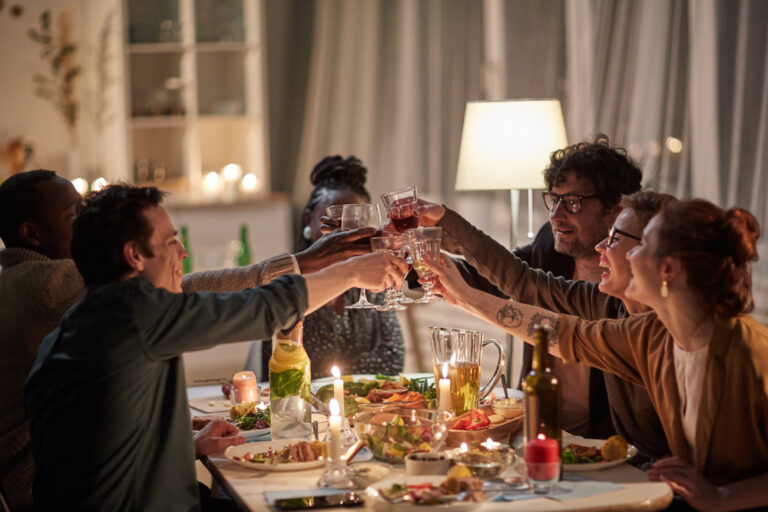
This could be us, but you cancelled last minute. Image: Pexels
Assuming your time management skills are on point, what else should you consider?
If you’ve been called to someone’s place, it’s safe to assume that they will provide the food. Nevertheless, it’s good practice to bring something like a bottle of wine if you are going to a person’s home.
With time, as you get to know someone, you can just straight up ask them if they want you to bring something, but until then, bringing drinks is a sign of respect.
If you are meeting someone for dinner at a restaurant in town, it’s safe to assume that you will have the “Go Dutch” approach. This means that everyone pays their fair share of the bill, in an egalitarian, Calvinist way.
When it comes to tipping when you’re at a restaurant, you should definitely consider tipping for good service, but tipping is not a widespread practice in the Netherlands.
What about table manners? Common sense usually applies here. Don’t chew your food loudly, don’t speak with a mouth full of food, that kind of stuff.
It’s the norm to excuse yourself when going to the bathroom. Talking on the phone while eating dinner is also rude. If you need to pick up your phone, excuse yourself from the table and go somewhere else while answering.
Traditional Dutch meals
Usually, dinner is, for many Dutchies, the only warm meal of the day. When it comes to traditional dishes, Dutch cuisine is, well, not particularly flavourful. As one of our favourite running jokes here at DutchReview goes:
Image: DutchReview/Supplied
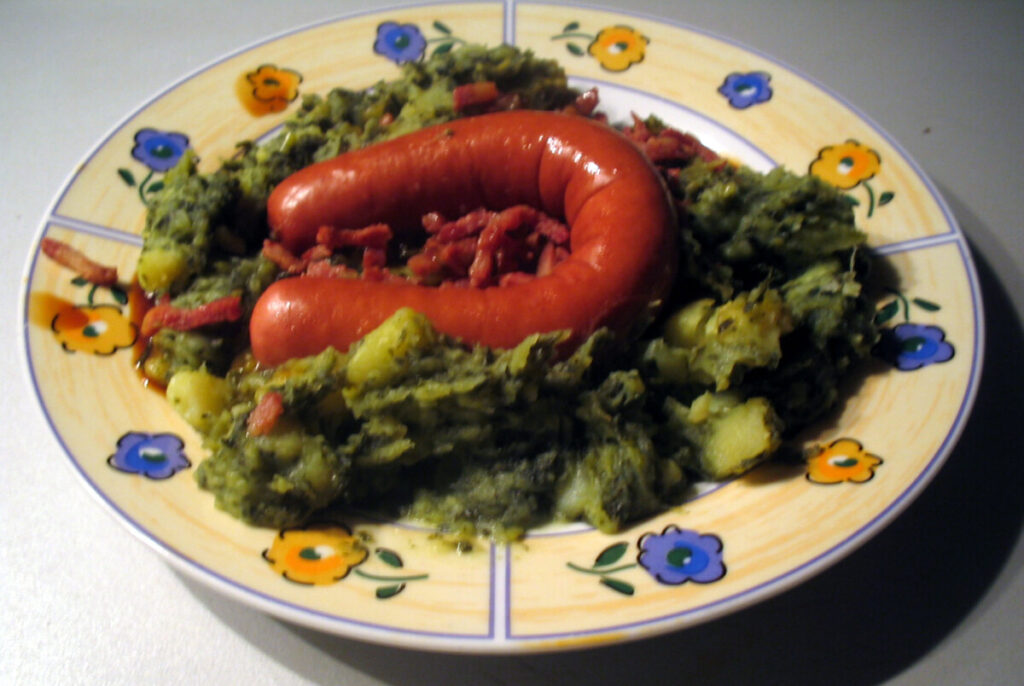
Jokes aside, one of the most traditional Dutch meals you can expect for dinner is stamppot. This dish is made of mashed potatoes, combined with several vegetables, which may include carrot, onion, sauerkraut, spinach, and kale.
Stamppot is also calledhutspot in the Netherlands, and is often served with smoked sausage (rookworst).
Dutch food is not particularly famous, but it can be alright! Image: M. Minderhoud/Wikimedia Commons/CC3.0.
Beyond stamppot, Dutchies also eat a variety of soups for dinner, including pea soup (snert) which also contains vegetables and sausage, as well as brown bean soup.
Dutchies also love their pancakes, so expect to have a serving of them for dinner too, from time to time.
They can be eaten with powdered sugar or syrup, and alternatively, for a more classic “dinner” experience, you can put cheese or bacon on them. The limit is your creativity (or that of the host), so don’t hesitate to go a bit crazy!
Another favourite of Dutchies to eat for dinner is gourmetten. What is it, you may ask? On a mini BBQ-like device, pieces of random meat are served hot, alongside side dishes and different sauces.
Sounds weird? Well, that’s because it is. Not exactly haute couture, but it will definitely help you bond with your Dutch in-laws.
Foreign influences on Dutch food
As a former colonial power, Dutch cuisine has been heavily influenced (for the better, honestly) by the cuisines of its former colonies.
Not only that, but immigrants coming from countries that were not under Dutch colonial control also brought new flavours to the lowlands.
Surinamese food is certainly a must-try if you are looking for some meals that don’t involve potatoes with salt and pepper.
Indonesian food should also be on your list and usually provides a healthier alternative to the deep-fried-to-oblivion variety of Dutch foods.
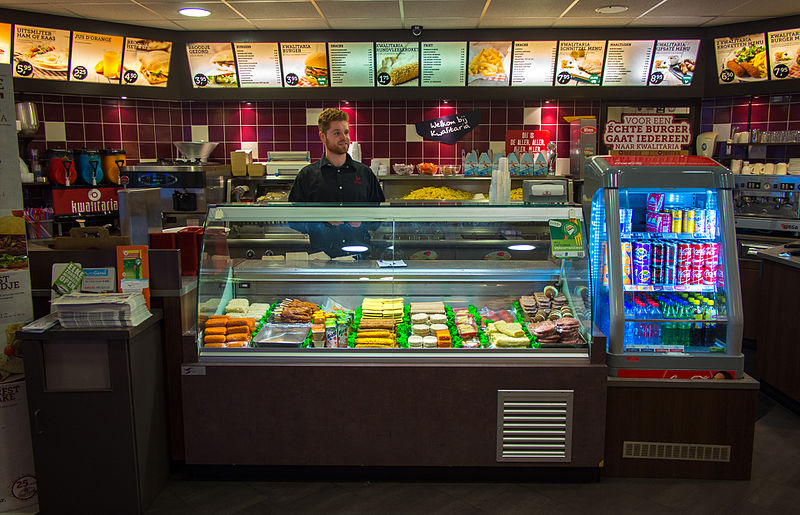
If you’re a youngster, and you’re not looking to eat anything exquisite for dinner with your friends, there are always the nighttime snackbars.
They have everything you want, as long as what you want includes deep-frying everything to oblivion. Bitterballen, croquettes, and other Dutch classics will be readily available for your taste buds.
Of course, there are the infamous frites or patats, (depending on who you are asking). French fries are eaten all the time in the Netherlands (ok, maybe not regularly for breakfast, but you get the point).
They come in a variety of different shapes, with different sauces, and they’re certainly a Dutch culinary experience you should go through.
Another great option, although more on the fast-food side, is to try something like the kapsalon, a straightforward dish in its ingredients, yet reflective of the multiculturalism of the Netherlands.
The easiest dinner ever. Image: Takeaway/Wikimedia Commons/CC4.0
Restaurants to consider for dinner in the Netherlands
There’s a great variety of restaurants catering for all food preferences in the Netherlands. It all boils down to what city in the country you’re in.
In Amsterdam and looking for great places for dining? The most famous city in the Netherlands has plenty of places to eat. Looking to get away from the tourists? Here are some trendy places to go for dinner in Leiden.
Are there any essential aspects of dinner that we missed? Let us know what you think in the comments! Editor’s Note: This article was originally published in July 2020 and was fully updated in October 2022 for your reading pleasure.
Imagine being fired for not turning your webcam while working so your superiors can spy on you. It sounds horrifically made-up, doesn’t it?
One man’s wrongful dismissal for not turning his webcam on fired up people all over the internet, and lit a legal fire under his employer — to the tune of €75,000! 🔥
Except, for one Dutchman, it was all too horrifically real, reports Metro.
Big Brother wishes he were watching you
The unnamed ex-employee worked as a telemarketer for the tech company Chetu Inc., based in Miramar, Florida.
He was employed there for over a year and a half with no issues, before being asked to participate in a “Corrective Action Programme”.
During this period, he had to have his screen sharing on, be logged in, and have his webcam on…*record scratches* throughout the entire day. 🤨
Because he isn’t a character in George Orwell’s novel ‘1984,’ the man protested at the invasion of privacy. He suggested the company could follow all his activities via screen sharing instead.
The company’s response, however, was to give him the boot for “refusal to work” and “insubordination”.
The law’s got your back, Jack!
Unfortunately for Chetu Inc., a complaint was soon made to the Zeeland-West Brabant court against them.
The court found that no concrete reason had been given for the sudden firing, which meant that it wasn’t legally valid.
Although Chetu Inc. tried to argue that spying on their workers in their homes was no different to having them watched in an office environment (ummm…hello? 🙄), the court wasn’t having any of it.
Oh look. It’s another company that failed in Europe because it wasn’t allowed to abuse workers over there like they abuse American workers pic.twitter.com/Wzgt2O9cdU
They promptly slapped Chetu Inc. with Article 8 of the European Treaty on Human Rights, which states that “video surveillance” of an employee must be considered a “considerable intrusion into the employee’s private life”.
Human rights violations are expensive (who knew?)
Finding the bizarre webcam rules an invasion of privacy, the court ordered Chetu Inc. to pay their ex-employee a grand sum of €75,000.
The amount also includes €585 for the ex-employee’s legal fees and other legal costs, an 8% holiday allowance, €2,700 in unpaid salary, €8,375 for the unlawful dismissal, €9,500 in counselling — and a whopping €50,000 in damages. 💰
Do you think it’s a reasonable request to have your webcam on the entire time you’re working from home? Tell us all about it in the comments below!
If you’ve been searching the skies for air travel this holiday season, then you’ve probably been struck by some sky-high ticket prices. ✈️
According to an analysis by comparator Weflycheap, flying within Europe has become significantly more expensive than in 2019. Tickets rose between 25% and a baffling 80%.
Intercontinental flights have also been met with some of the highest prices in travel history, with airfares jumping between 15% and 50%.
Needless to say, many internationals hoping to travel back home for Christmas might have no alternative but to spend this festive season in the lowlands.
It’s happening in the Netherlands also, KLM cancelling flights, amsterdam airport being over run, petrol sky high prices. Last time I check the Netherlands was a very progressive, successful country. This is happening everywhere
Finding cheap flight deals to travel this autumn seems to be a never-ending quest these days — and the costly airfares are slowly proving to be unaffordable for the majority of us. 😞
Those living in the Netherlands will have to think twice before booking their usual holiday trip to the warmth this year. Why? Because a ticket to Ibiza now clocks in at 122% more than in 2019, costing an average of €205.
For Barcelona, this is even greater — with tickets increasing by 216% and costing about €237. 💰
Travel isn’t immune to inflation
Folks casting around for a holiday abroad through package deals (flight and hotel) will also have to splurge a pretty penny. While these prices haven’t gone up quite as high as airfare alone, it’s still much greater than a few years ago.
We can even expect to see big changes in ticket prices for faraway destinations like Cuba, Dominican Republic, and Bali.
“We see a price increase of between 10% and 20% for all destinations, with peaks of even 40%,” Eelko van Drongelen of Weflycheap tells AD.
In addition, costs to stay at a holiday park have also increased by as much as 15% to 25% — largely due to the high energy costs we’ve all had to deal with. 🙄
“Houses are often less well insulated, and the tropical swimming pools in this period cost a fortune”, van Drongelen tells AD.
Want to save a penny? Fly today!
Oddly enough, those who travel last minute can consider themselves lucky in knowing that prices for last-minute flights are hardly higher than in 2019.
If you book a flight today to Bonaire for nine days, you’re looking at a slick price of €574. Flights to Portugal are about €187 with a hotel included, and Spain stands at €185.
That being said, who wants to ditch work today and vaya a España? 😁
Were you planning on travelling this autumn season? Tell us in the comments below! 👇
The Dutch princess hasn’t been able to leave the house or live in Amsterdam to start university due to threats to her well-being, reports the NOS.
Despite beginning her degree in Politics, Psychology, Law and Economics at the University of Amsterdam this September, Amalia has been removed from the student house she was living in and hasn’t been allowed to return to Amsterdam.
Dutch princess can’t live a normal life
Despite making efforts to integrate herself into non-royal life better, such as choosing to live in a student house over a private residence and even rejecting her royal allowance, the Dutch princess still can’t live a normal life.
And her parents seem upset about it too. In an interview, Queen Maxima said, “I’m very proud of her for how she keeps up with all this, to be honest.”
Princess Catharina-Amalia of the Netherlands (18) was forced to move out of student housing and back in with her parents after a number of threats against her.
Her parents have said increase threats have had a major impact on her life, & that C-A only leaves home for school.
Both the King and Queen feel for her that she cannot leave the house and empathise with her. “Yes, I can not describe that, that is really very heavy,” King Willem-Alexander said.
Threat to Amalia remains unknown
Although the threats to poor Princess Amalia’s life are surely severe, there are not many details on what, exactly, is going on.
In fact, that the King and Queen have commented on it at all is very strange. Terrorism expert, Jelle van Buuren, told Nieuwsuur that threats to the royal family are usually not discussed.
We suppose it just goes to show just how much this is affecting the Royal Family. 🥺
However, Princess Amalia met Prime Minister Rutte last month to discuss organised crime communications. A meeting like that would indicate there is a reasonable fear that the princess is under threat of an attack or even kidnapping.
Prime of her life
As Amsterdam alderman Marjolein Moorman told the NOS, “A young woman of 18 is thus deprived of her freedom and social life in the prime of her life. What an unscrupulous b*st*rd you are.”
Well, that about sums it up. 🤷♀️
We can only hope the princess will be okay, and that she can return to normal life as a university student soon.
It’s been a typical Dutch October, with all four seasons in a day — but now comes the good part.
You might notice that the weather has been warmer in the past few days despite the rain. That’s because we are being graced with warmer air from Spain and the sea. 🇪🇸
Like Garfield, we all hate Mondays, but this time the Dutch weather may just give our mood a boost!
It looks like the warmest part of the Netherlands will be the area of Limburg, where they are expecting no less than 22 degrees. In the north part of the country, it will be just slightly cooler with 19 degrees.
The following days of the week will stay warmer as well — hoera!
What’s up, weather?
The sea is 17 degrees, which might still be a bit cold to have a beach day, but it’s helping to balance the current temperature.
“That also means that the air is more humid, and we have to deal with mist in the morning,” says Weerplaza weathercaster, Diana Woei, to AD.nl.
It looks like the October weather is continuing so it’s still wise to take your umbrella with you next week. But, you might be able to leave a layer of clothes on the closet!
Are you ready for some warmer days, or do you feel prepared to have your pumpkin spice latte? Tell us in the comments below!