A 39-year-old woman from Amstelveen has been infected with the West Nile virus, bringing the total number of infected to four, across three provinces — with the GGD warning that the virus may be “present in other locations in the Netherlands”.
The local broadcaster AT5 first reported on the case, with the municipal health service (GGD) later confirming the infection.
It’s the first time the virus has turned up this close to the capital, with the other cases popping up in Utrecht and Drenthe. The RIVM confirms that the virus has also been detected in the provinces of North Brabant and South Holland.
A local infection, with serious complications
Unlike the woman from Drenthe, who reportedly caught the virus in Southeast Europe, the patient from Amstelveen was infected in the Netherlands.
Rather worryingly, her infection has now developed into meningitis, which is a swelling of the tissue surrounding the brain and spinal cord.
Outcomes this severe aren’t common, with the RIVM noting that around 80% of West Nile infections cause no symptoms. Only about 19% of the infected “develop mild flu-like symptoms”.
The fourth case this year (and two deaths)
With this case in Amstelveen, the total number of West Nile infections in 2026 has now hit four — with two deaths among them.
The RIVM’s first sign that the virus was circulating within the Netherlands came earlier in the month, when the virus was detected in a Utrecht blood donor. His infection, thankfully, was mild.
No cause for concern just yet
Despite the latest case, the RIVM rates the chance of catching West Nile virus and becoming seriously ill from it as “very small”.
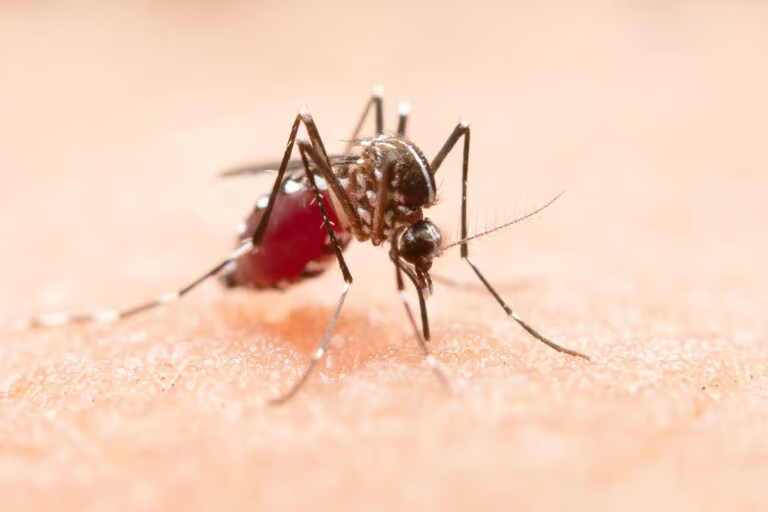
The common house mosquito picks it up after feeding on an infected person, then passes it on when it bites someone else. In other words, it won’t spread through human-to-human contact, even if one person is infected.
If you’re worried about your odds, then use screens on your windows and cover up with long sleeves or jackets during dusk, when mosquitoes are most active. Or just spray on a liberal amount of DEET, and you’re good to go.
Have you noticed more mosquitoes than usual in your area? Share your tips for getting rid of these pesky little predators in the comments below.
Building passive income in the Netherlands is more accessible than most people think, and this guide covers the practical side, from savings accounts, investing, and pensions to property and the tax rules that apply to it all.
If you’ve been Googling “passive income Netherlands” and wondering whether any of the options are actually worth the effort, the short answer is: yes, and you don’t need much to get started.
What does “passive income” actually mean in the Netherlands?
Passive income is money that flows into your account without you actively working for it every day. In other words, it’s a great way of earning more money without grinding away at a side hustle or a second job.
In the Netherlands, passive income can involve one or more of the following:
Savings interest: This is money your bank pays you for holding your cash.
Investment returns: This covers growth in ETFs, index funds, stocks, or bonds.
Dividends: These are regular payouts from companies whose shares you hold.
Rental income: This can be returns from property you own but don’t live in.
Pension growth: This involves long-term, tax-advantaged investments through a pension provider.
Investments and savings are two major roads to building passive income. Image: Magnific
And the good news is that you needn’t be an investment guru to get set up. Between regulated investment platforms, savings and fixed-term savings options, and a solid pension culture, the Netherlands offers you a plethora of tools to work with.
Good to know: Passive income in the Netherlands includes interest on savings, investment returns, dividends, and rental income. The Dutch tax system (specifically Box 3) taxes wealth above €59,357 per person (or €118,714 for fiscal partners), but most people fall well below that threshold.
Savings accounts and interest rates in the Netherlands
Variable savings accounts (spaarrekeningen or flexibel sparen) give you the most flexibility, as you can generally withdraw your money at any time. However, rates can change, so your interest is never guaranteed for the long term.
Fixed-term deposits (deposito’s or termijndeposito’s), on the other hand, lock your money in for a set period in exchange for a higher, guaranteed rate.
If you don’t need immediate access to a chunk of your savings, opening a fixed-term deposit account is worth considering.
And it’s safe, too! All banks registered in the EU have deposits covered by €100,000 under the EU Deposit Guarantee Scheme (including foreign banks operating in the Netherlands), so your funds are protected, regardless of which provider you choose.
Where can I find the best rates?
According to De Nederlandsche Bank, Dutch households held roughly €600 billion in savings at the end of 2024 alone. However, much of that wealth was sitting in low-interest bank accounts and earning very little.
Why? Well, big Dutch banks are convenient, but their rates are rarely the most competitive. As of 2026, typical interest rates hover around 1.50% to 1.70% on flexible savings accounts.
Neobanks and investment platforms tend to offer much higher interest rates than traditional Dutch banks. Image: Magnific
Instead, experts advise that you explore saving options in:
Neobanks, which typically provide you with much higher interest rates than traditional Dutch banks.
Investment platforms, which may offer attractive savings deals on uninvested cash.
For people who prioritise cash flow, Yieldfund’s fixed-interest bond plans distribute yields every Monday and create a consistent payment schedule. Depending on the selected term, the plans offer interest rates ranging from 2% to 4% per month. As with all corporate bond investments, capital is subject to risk.
The best ways to invest for passive income in the Netherlands
While accumulating interest on your savings is a start, investing is what can actually build you passive income over time.
ETFs and index funds
Exchange-traded funds (ETFs) are one of the most accessible entry points for passive investors in the Netherlands. They spread your money across hundreds or thousands of companies at once, reducing risk and saving you the hassle of selecting individual stocks yourself.
The monetary barrier to entry is also quite low, as you can start with a recurring monthly contribution as low as €50.
In addition to this, the Dutch Authority for the Financial Markets (Autoriteit Financiële Markten, or AFM) regulates providers that operate in the Netherlands, so the potential for a scam is also low.
Stocks
While individual stocks tend to carry more risk than ETFs, they can also generate dividends for you.
These are direct payouts from companies to shareholders (you) and are typically paid quarterly or annually.
Got your eye on a certain company? Holding dividend-paying stocks alongside ETFs is a great way to build a mixed passive income stream, without putting all your eggs in one basket.
There are a plethora of different investment types to help grow your passive income. Image: Magnific
Bonds
Bonds are essentially loans you make to a government or company in exchange for regular interest payments.
If you’re risk-averse or you want to avoid as much volatility as possible, bonds are lower risk than stocks and are a handy addition to any balanced portfolio.
Most AFM-regulated investment platforms will give you direct access to bond markets, and you can also filter your options depending on your preferred region.
Other ways to build passive income in the Netherlands
Saving and investing might be popular choices in the Netherlands, but they aren’t the only ways to build a passive income.
Other solid options include:
Property investing
Rental income is one of the most traditional forms of passive income, but you’ll need to be realistic about the state of the Dutch housing market.
Property prices are high, especially in big cities like Amsterdam, Utrecht, and Rotterdam. In addition to this, Dutch rental regulations have tightened in recent years, and you’ll have to familiarise yourself with concepts like the rent points system and rent ceilings.
Plus, if you own a second home that you’re planning to rent out, it may fall under the Netherlands’ Box 3 tax.
Digital income and side projects
Royalties, digital products, and affiliate revenue all count as passive income once they’re up and running without significant daily input from you.
Whether you’re a podcaster or YouTuber, side hustles count! Image: Magnific
However, if you’re running a freelance project on the side, it’s worth noting that different tax rules may apply.
Alternative investments
Should you want to go beyond savings, stocks, and property investments, crypto and peer-to-peer lending are both worth knowing about.
However, the Belastingdienst (Dutch tax authority) counts crypto as a Box 3 asset, so if you’re holding coins on an investment platform, that still needs to go on your Dutch tax return.
Pension investing
The Dutch pension system runs on three pillars: the state AOW pension, your employer’s scheme, and private top-ups.
You can think of the AOW as your foundation; it’s solid, but rarely enough on its own. You only build up 2% of a full entitlement for each year you live or work here, so if you arrived mid-career, you’re already behind.
If you’re employed by a Dutch company, check whether you’re enrolled in a workplace pension scheme. Both you and your employer contribute a slice of your salary, and you’d be surprised how many people simply never look into it.
Still have gaps? A private pension plan lets you pick a provider, set a monthly contribution, and let the market do the heavy lifting until you retire.
Building passive income takes time and depends on contributions and market performance. Yieldfund does it differently, with fixed-interest corporate bonds that pay 2–4% per month and distribute interest every week.
Interest payments are credited to the Yieldfund wallet app, where they can be stored or transferred to a personal bank account. As with all corporate bond investing, capital is at risk. Learn more.
Setting funds aside for your pension is a great way of building a passive income source. Image: Magnific
The Dutch (Box 3) wealth tax: what it means for your passive income
If you have savings or investments in the Netherlands, Box 3 is the part of your tax return that covers them.
If your total assets sit below €59,357 (or €118,714 if you have a fiscal partner), you owe nothing in Box 3. Are your total assets above that figure? Then read on.
Rather than taxing what you actually earned, the Belastingdienst assumes you made a certain return on your assets and taxes that figure at 36%. In 2026, those assumed rates are:
Savings and bank balances: 1.28% (not yet finalised)
Investments, property, and other assets: 6.00%
So if you hold €100,000 in investments, the tax office assumes you earned €6,000 on it — and taxes 36% of that, regardless of your actual return.
If your actual return turns out to be lower than what the Belastingdienst assumed, you can report your real return instead and be taxed on that value instead.
Let op: Box 3 is in the middle of a major overhaul. A new system taxing actual returns rather than assumed ones is due to begin on January 1, 2028, so the rules may look quite different by this time next year.
How to get started: a checklist for growing your passive income
Geen stress, because you don’t need much to get started, just a few accounts and a rough plan you can revisit every few months.
Move your savings to an account offering a competitive interest rate. Many neobanks and investment platforms have higher rates than traditional Dutch banks, so explore your options.
Open an investment account and set up a small monthly contribution. Even €50 counts, and some will let you invest a much lower figure than that.
Buy a diversified ETF to get broad market exposure that minimises your risk and avoids the hassle of picking stocks yourself.
Check your employer’s pensionsituation. Dutch employers typically contribute 8–16% of pensionable salary, so not following up may leave serious money on the table.
Look into supplementary pension investing if you’re planning to stay long-term. Even if you’re an international, tax-advantaged accounts do exist.
Remember to check back in six months to see how things are going, and adjust your contributions if you need to.
Common mistakes to avoid while building passive income
Between the wealth of “hack” advice on the internet and the desire to grow your income ASAP, it’s easy to fall into some financial pitfalls.
Here’s what to avoid:
Waiting until you have “enough” to start: Compound growth rewards time in the market above everything else, so starting with €50 a month now beats starting with €500 a month in three years.
Expecting fast results: Growing passive income is a slow process, and returns often feel small at first.
Putting everything in one place: Spreading your funds across a savings account, a diversified ETF, and a pension contribution is a solid strategy. Concentrating everything in one asset (especially something volatile like crypto) tends to be a risk that rarely pays off the way people hope.
Ignoring Box 3 until your tax return reminds you: If your assets are growing, it’s worth keeping an eye on where you stand relative to the €59,357 threshold.
Have you already started building passive income in the Netherlands, or are you still figuring out where to begin? Share your tips or experience in the comments below.
Disclaimer: DutchReview isn’t a financial advisor, and this article shouldn’t be taken as financial advice. Investing puts your capital at risk, and you may get back less than you put in. Always do your own research and, when in doubt, speak to a qualified financial advisor or belastingadviseur (tax advisor) before making any decisions with your money.
One person has died, and two police officers were injured, after a shooting in the Dutch village of Overasselt, sparking a major police operation and multiple arrests.
According to Omroep Gelderland, a local resident heard loud bangs at around 4 AM today (September 1), which promptly woke him up.
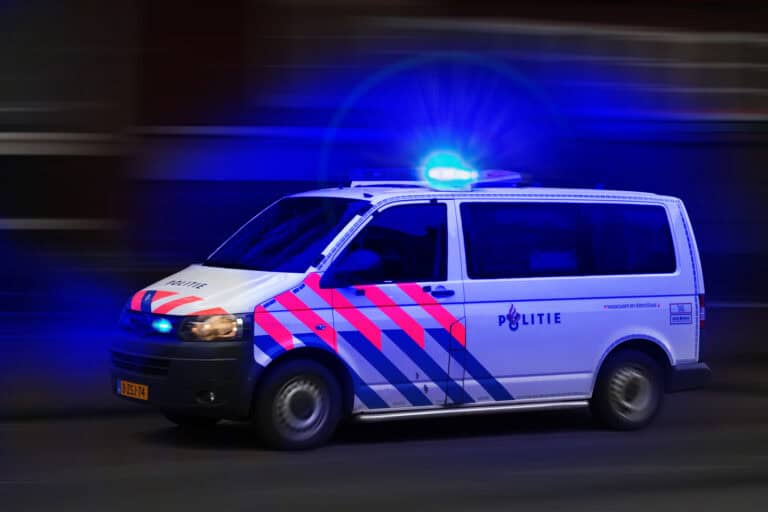
Officers were on the scene by 5:15 AM, with numerous emergency services, including ambulances and a trauma helicopter. Of the injured, one of the victims succumbed to their wounds, and two of the officers had to be taken to hospital.
A section of the Ewijkseweg in Overasselt, and the area surrounding a cornfield behind it, has been cordoned off.
What exactly happened?
Though the motive and sequence of events are still unclear, police note that an “extensive investigation is currently underway in and around Overasselt”.
As reported in their live blog, the situation escalated suddenly, with multiple arrests at 7:10 AM and then several further arrests at 9:45. It’s still uncertain how many people, exactly, were arrested — officers note that it’s “too early for exact numbers”.
An arrest team also fired several warning shots in the area, around the same time frame as the second wave of arrests.
Surveillance footage obtained by De Telegraaf shows a large group of people walking around in the area shortly after 4 AM, with some carrying what look like weapons.
The same clips have also been reposted on social media site X, showing the group running away:
Reporting by De Telegraaf suggests that the shooting may have been a result of a drug conflict, linked to criminal Bolle Jos. Meanwhile, Overasselt residents tell NOS that the group in the surveillance footage may have been headed towards a known figure in the Dutch crime world.
Do you have any information about the shooting? You can contact the police on 0900-8844.
Want to make sure DutchReview pops up on your news feed more often? Just add us as a preferred news provider, and we’ll handle the rest.
Here’s a little secret: the KNM exam is one of the most underestimated among the Dutch inburgering (integration) exams.
It sounds so simple: knowledge of Dutch society (Kennis van de Nederlandse Maatschappij). All you have to do is answer questions about life in the Netherlands, right?
Well, yes and no. As someone who sat the exam in 2021 (and is literally paid to write about Dutch society), I was surprised at how in-depth some of the questions are. For example*:
Julia attends high school at the HAVO level. When she graduates, what kind of higher education can she pursue?
How has the role of women in Dutch society changed throughout history?
What is actief kiesrecht?
To make matters more difficult, you’ll answer 40 questions on your KNM exam — but you have no idea which questions. There are potentially endless combinations of questions that you could be asked.
That means the only way to be fully prepared for the exam is, well, to study. 🤯
Note: In 2025, the KNM exam underwent a number of changes. Now, instead of posing questions that will ask what you should do in certain scenarios, the exam will focus on your factual knowledge of life in the Netherlands. The exam will also focus more on women’s rights and Jewish history in the Netherlands.
Why people fail the KNM exam
Yes, people do fail the KNM exam. Scroll through any inburgeren group on Facebook, and you’ll see it happen. How?
Well, firstly, the multiple-choice exam requires surprisingly deep knowledge of Dutch society and systems (education, taxes, banking, police, and more), a la the questions above.
Secondly, the whole exam is in Dutch, and some words are surprisingly complicated for an A2 level.
Finally, most people study for the exam by leafing through textbooks filled with boring content and Dutch language that’s also way above an A2 level — the level often required for most of the other exams.
It’s time to say doei to textbooks when studying for the KNM exam. Image: Magnific
In one word: ugh. 😮💨
So, how can you ace the KNM integration exam while maintaining your sanity? A swift, entertaining, and comprehensive online course (of course).
The best way to prepare for the KNM exam: InburgeringOnline.nl
The future is here! Skip the late-night sessions with an outdated textbook and open your eyes to entertaining videos, online quizzes, and easy-to-understand Dutch from InburgeringOnline.nl.
Now, let’s be clear: this course won’t repair your relationship with your Aunt Maggie or help you drop five kilos.
All it can do is help you prepare for the KNM exam — and we think that’s pretty damn good. 😉
Here’s how it works:
Log in to the online course in your own time.
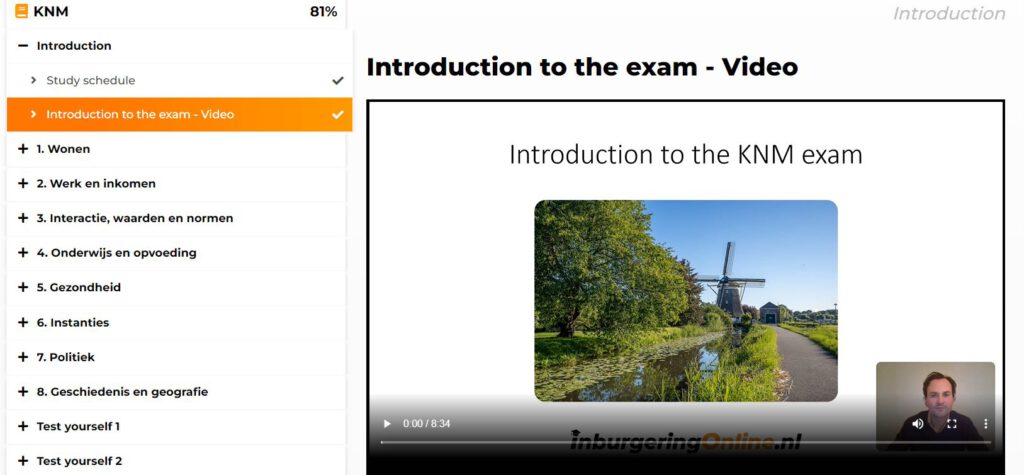
Watch a quick overview of how the course works from your new KNM study buddy, Bart, a bona fide Dutchie and experienced Dutch language teacher.
Work through each topic about Dutch society by watching lighthearted videos presented in simple Dutch and completing the related exercises.
Test yourself at the end and amaze yourself with your progress.
Profit! (Or pass the exam, whichever works).
Best of all, the content is entertaining and easy to follow. Leuk!
Bart’s KNM course is super easy to navigate. Image: InburgeringOnline.nl/Supplied
TIP: You don’t have to watch the videos to get the most benefit. Listen to them while cleaning, catching the train, or riding your bike, too! Passive learning at its finest. 💪
Okay, but what makes it different?
You can buy a textbook if you like — we’re not your mum. But allow us to tell you why an online course may just make your day.
First up, the videos are fluff-free. They’re entertaining, but they only tell you what you need to learn, for both the exam and also for life in the Netherlands! ✅
Textbooks? Nah. An online course? Ja! Image: Depositphotos
Because the exam is in Dutch, so are the videos. However, the Dutch is ultra-clear and easy to understand, and any difficult words are translatedin real-time — so you’ll never find yourself lost.
If you’re still working on your language skills, you can slow down the videos, or if you’re an old pro, you can also speed them up.
Best of all, an online course lets you prepare entirely on your schedule.
You can smash it all out in a day, or you can focus on one section each night. Need to repeat or review a lesson? Geen probleem!
The proof is in the pudding
Yes, we know it’s all about reviews, right? Fortunately, past participants say ⭐⭐⭐⭐⭐. Here’s one example:
“[The course] helped immensely to reduce the preparation time from many months to a few days,” says Kumar Malladi (44). “When I went to the exam, everyone around thought it was too tough, where I felt weird because I could answer most questions without any issue.”
He highly recommends the course “not just for passing exams but [also for] being able to actually start the journey in integrating.”
Preparing for the KNM exam with InburgeringOnline.nl
Alright, before you click away madly to InburgeringOnline.nl, you should read this because it will save you money.
You can get access to the KNM exam preparation course for a low monthly fee. But, if you need to take your other Dutch integration exams, the full package of Dutch integration courses is heavily discounted — and what’s more Dutch than loving a korting?
Here’s how:
If you order a six-monthsubscription to the KNM course, you’ll save 20%.
If you order a full package on a six-month or a 12-month subscription, you’ll save 40% and get the KNM course absolutely free.
Does that save you valuable money to put in your piggy bank to buy a windmill one day? Yes, it does.
Have you taken the KNM exam? Tell us your experience in the comments below!
*Note: The example questions listed above are not real exam questions. Students who take the exams have to wear a hood, drink from a golden goblet, and vow never to disclose the actual questions on the exam, so we’ve created some similar questions instead.
A fixed one-year energy contract now costs the average Dutch household around €277 per month, a leap of €53 since the start of February.
That’s according to the latest report from the energy comparison website Keuze.nl, which has tracked the average annual energy prices across 17 suppliers.
If your contract is coming up for renewal, here’s what to know before you make a decision.
How much have prices risen by?
As compiled by Keuze.nl, the average consumer gas price is:
2.4% higher than a month ago,
and 24.8% higher than in August 2025.
While electricity prices haven’t risen as steeply, they’re still:
1.5% higher than a month ago,
and 17.8% higher than in August 2025.
Though these figures may not seem all that alarming on their own, back in June, RaboResearch predicted a new average contract could hit €270 a month by autumn. At €277 per month, we’ve blown past that estimate already.
What does this mean for your wallet?
The effects depend entirely on the type of energy contract you’ve got.
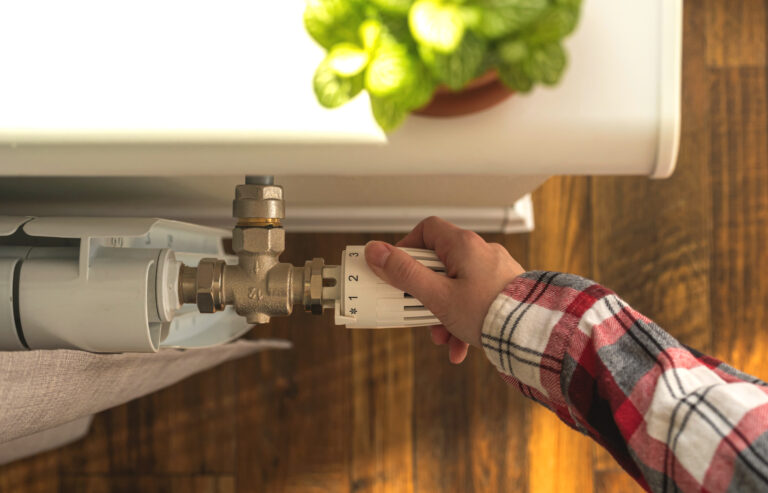
With a vast (fixed) contract, your rate stays locked in until the contract expires, so the current spike won’t affect you — unless you’re taking out a new fixed contract or renewing your old one right now.
With a variabel (variable) contract, your provider adjusts the rate a few times per year, typically monthly or quarterly. And with a dynamisch (dynamic) contract, your energy prices change every fifteen minutes to an hour.
Keuze.nl floats one example of a cost breakdown, with a variable energy contract:
Household
Gas and power
Power only
2 people in an apartment
€153.25
€55.57
3 people in a terraced house
€198.68
€68.02
4 people in a corner house
€233.15
€80.93
“During a severe winter, gas prices can rise much further,” Keuze.nl energy expert Geert Wirken warns. “You won’t feel this if you have a fixed contract at that time. You will, however, if you have a variable or dynamic contract.”
Should you lock in, you could “pay as much as €200 less per year in variable delivery costs”. Factor in the welcome bonuses that many providers offer to new customers, and that figure jumps to over €600.
Why are energy prices still rising?
Two main factors contribute to the sustained price hike, according to Keuze.nl. Gas reserves are uncomfortably low, especially with heating season around the corner, and geopolitical tensions near supply routes continue to affect the market.
Specifically, the blockade of the Strait of Hormuz, a key shipping route in the Persian Gulf, has made it much harder to keep gas flowing to Europe.
Given the ongoing tension in the region, analysts don’t expect price drops anytime soon.
Keuze.nl expects an average of €66 per MWh for the heating season from October, 2026 to March, 2027. At the consumer price, that translates to around €1.61 per m³.
Have you locked in a fixed energy contract, or are you determined to ride out the more flexible dynamic or variable contracts this winter? Share your thoughts in the comments.
A new report shows international students give the Dutch government far more than they cost, primarily because so many stay, work, and pay taxes after graduating.
After all the political noise about rising international students being a net negative, the country’s own economists have swiftly reached the opposite conclusion.
“International students make a positive contribution to Dutch government finances over their entire lives,” writes the Dutch Central Planning Bureau (CPB) in a new study. Why? Well, an increasing number of them choose to “continue to work and pay taxes in the Netherlands after graduation”.
Compiled at the request of the Dutch education ministry, the study calculates a proper tally of what foreign students cost the Dutch economy, versus what they give back.
Some students pay back nearly €250k
While foreign students study at Dutch universities, the government does pitch in — primarily for those from the European Economic Area (EEA), through higher-education funding and student finance.
However, CPB stresses, “these costs are recouped later through tax revenues”. In addition to this, international students at research universities tend to earn higher-than-average salaries later on, resulting in more income tax for the Dutch state.
On average, research university graduates from non-EEA countries contribute nearly €250,000 to public finances over their lifetime.
Meanwhile, EEA university graduates and non-EEA applied-sciences graduates contribute €100,000 each on average, while EEA applied-sciences students land at roughly break-even.
In other words, costs incurred by the Dutch state for these foreign students tend to pale in comparison to what they pay back.
More students are calling the Netherlands home
Five years after finishing their higher education journey, roughly one in five EEA students (and two in five non-EEA students) are still living in the Netherlands. A decade ago, those figures were a quarter lower.
But why do so many graduates choose to call the Netherlands home? One reason, the study highlights, is how easy it is to find work.
POV: your Dutch employer casually hands you free money 🤑🇳🇱 Working in the Netherlands comes with some seriously underrated perks. Let’s spill 👇 💰 Vakantiegeld (holiday allowance) — at least 8% of your salary, dropped into your account every May. Consider it your annual “treat yourself” fund. 🎁 13e maand (13th month) — a whole extra month’s pay at year’s end. Because twelve months of salary is apparently for amateurs. 🚆 Travel cost compensation — whether you’re squeezing onto a very cosy NS train or cycling through that famous Dutch drizzle (rain? what rain? 🌧️🚲), plenty of employers help cover your commute. Not every contract includes all three, so give yours a good read before you sign 👀 Ready to make the move – or level up your Dutch career? Our partners at @Undutchables Recruitment know the international job market like the backs of their (very Dutch) hands. Which perk are you claiming first? Let us know 👇 #DutchReview#Undutchables#WorkingInTheNetherlands
International students who’ve recently graduated find paid work “faster than students who graduated earlier, allowing them to contribute to the Dutch economy and government finances sooner”.
Helaas, there’s also a downside
According to the study, international student numbers jumped from around 76,000 in 2017 to roughly 131,000 in 2024. Bachelor’s programmes saw the strongest increase, with the number of international students doubling during that time frame.
While this surge can ease labour shortages in the short term, they also “exacerbate shortages in the housing market”.
But before you start sharpening those pitchforks, CBP does point out that the overall intake of international students at Dutch universities has been declining since 2021.
Looking further ahead, the bureau does not “expect major effects on the labour and housing markets”, pointing out that foreign students can still “contribute to innovation and international relations”.
Want to make sure DutchReview pops up on your news feed more often? Just add us as a preferred news provider, and we’ll handle the rest.
Ah, the difficulties of finding housing in the Netherlands. I was relieved to finally land a room as an international student, but was I ready to meet all 28 of my flatmates?
It’s not as crowded as it sounds. The numerous neighbours are because my accommodation is shared student housing for first-year internationals.
A true student experience is best embraced when sharing it with strangers from all over the world. No regrets, right?
How did I get here?
This time last year, I was ready to leave London behind and pursue a Literature Master’s in the lovely city of Utrecht. Immediately, obstacles appeared…
Firstly, I was in a toxic relationship: sleepless nights, unanswered phone calls, and serious commitment issues.
My sparring partner? The non-EU student visa application process.
Amid the piles of paperwork, I was desperately searching for accommodation. Sometimes, it was like talking to a brick wall — just not the walls of a house I could move into.
Through the rejections and silences, a welcome interruption came in the form of an online ballot for short-stay international student housing.
On a bleak London morning in May, I was hunched over my laptop, frantically logging in to every accommodation provider I had registered for.
In the next few moments, they would make all the student rooms they could offer available for booking. And I knew that in the same few moments, they would ALL be gone. Ruthless.
Poised to click the nanosecond that the rooms became available (16 tabs open, as close to the WiFi box as I could possibly get), the blessed CONFIRMATION flashed up green on a fourth-floor room — I was in.
I couldn’t be happier with where I ended up. Image: Lottie Gale
In hindsight, perhaps I should have paid more attention to the Google reviews warning of rats and overflowing bins. 👀
But, finally, I had something. And 28 other lucky students did too. That’s more than enough people to take on a few rats.
One (very) big, (sometimes) happy (sort of) family
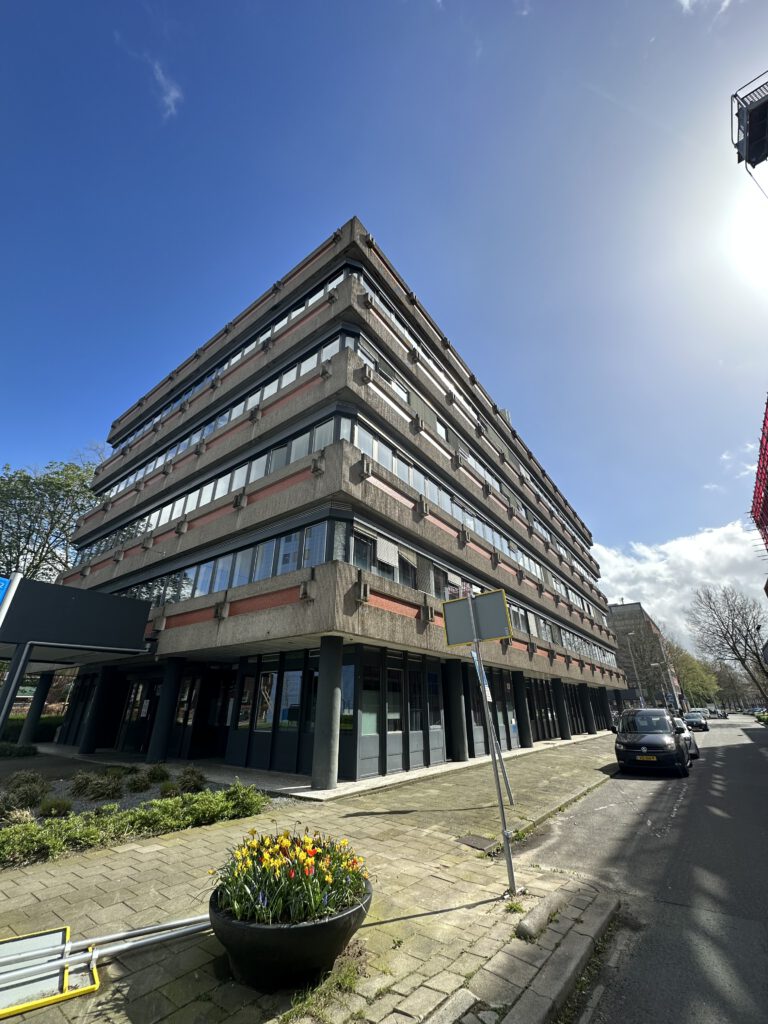
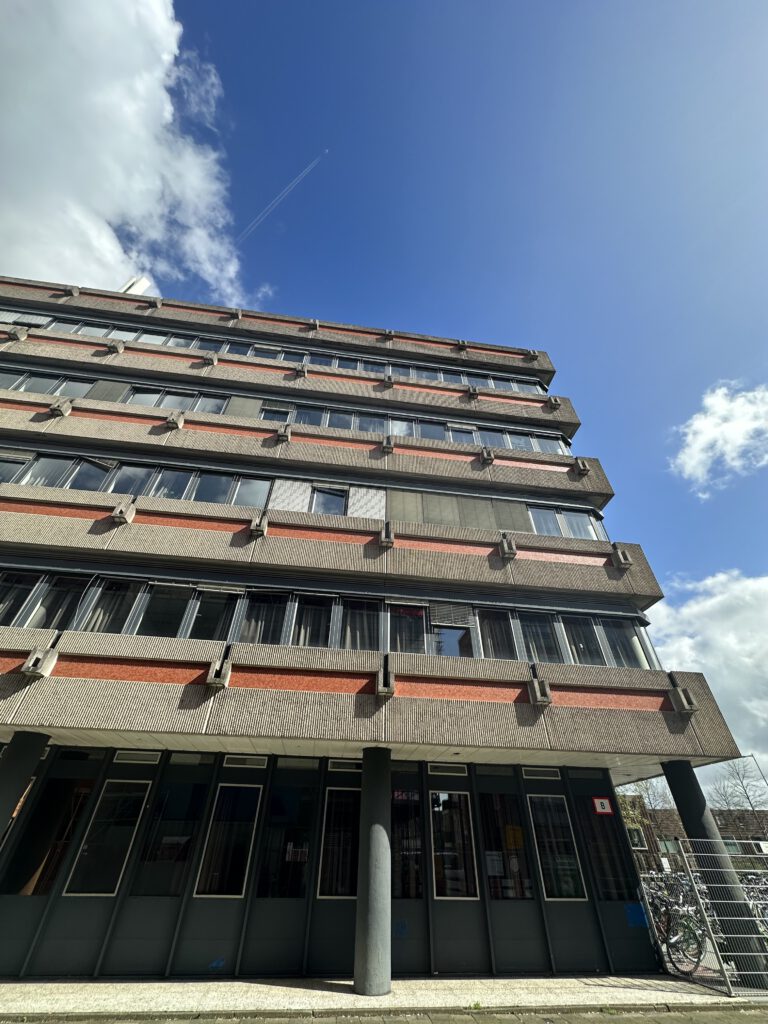
Central to the wonderful city of Utrecht, there stands an ageing ex-office building that now houses over 120 international students per year across four identical floors.
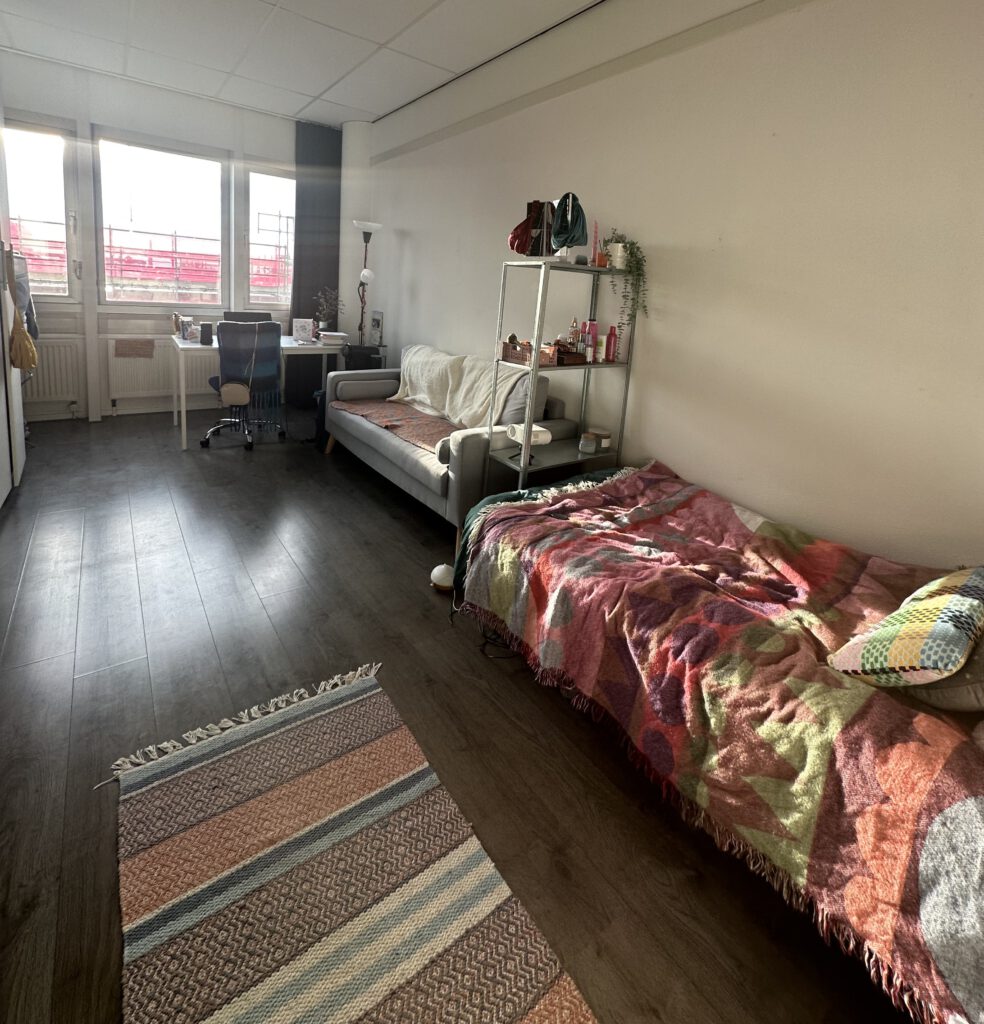
Home sweet home in the sunshine! Image: Lottie Gale
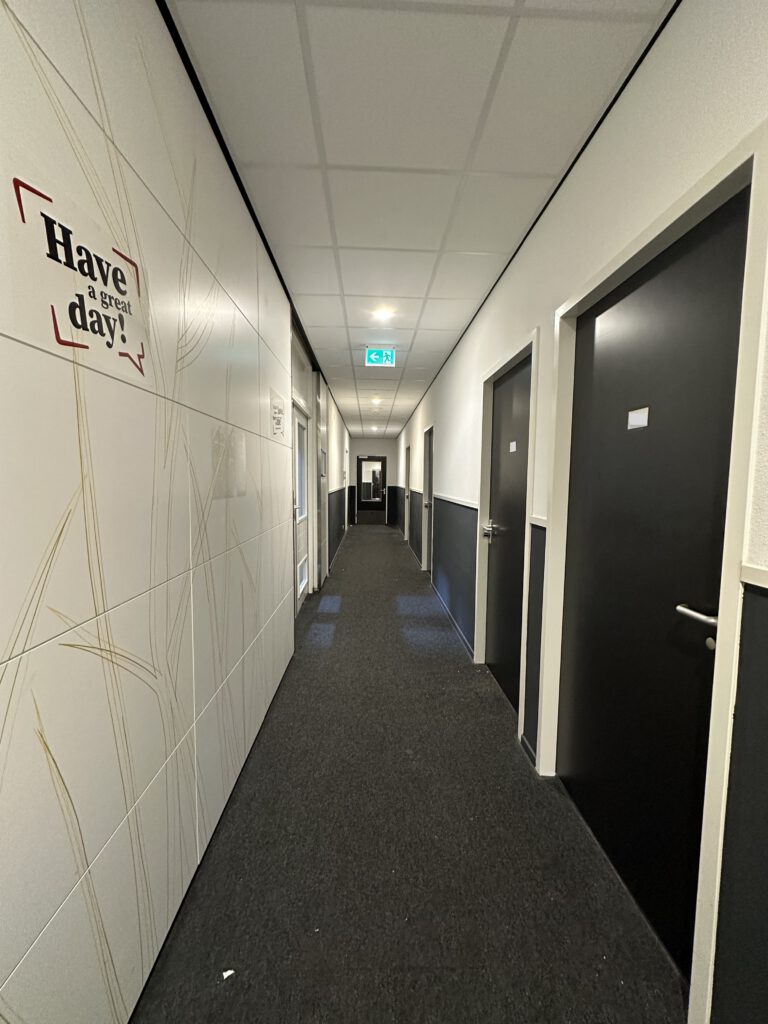
14 rooms line this wing of our floor, mirrored on the other side. Image: Lottie Gale
Explaining the setup can surprise some people…
Everyone, ever: “So, you share everything?”
Me: “Yes.”
Everyone, again: “Everything?! Between 28 people?!”
That’s right. Think campsite-style.
On each floor, there are two bathroom blocks with six showers and toilet cubicles, then two kitchens with the usual fridges, hobs and microwaves.
Like most student housing, it’s a daily gamble on how many of those appliances will work.
Luckily, it’s not all communal — I do get my own room! However, the walls are so thin at times that it sounds like my neighbours have let themselves in for a sleepover.
I’m always surprised when the deafening slam of a door was not, in fact, inside my own head but three, even four rooms down. Gezellig, right?
Of course, there are better environments for busy students who, in some cases, have paid a lot of money to be there. But it brings you closer in unexpected ways.
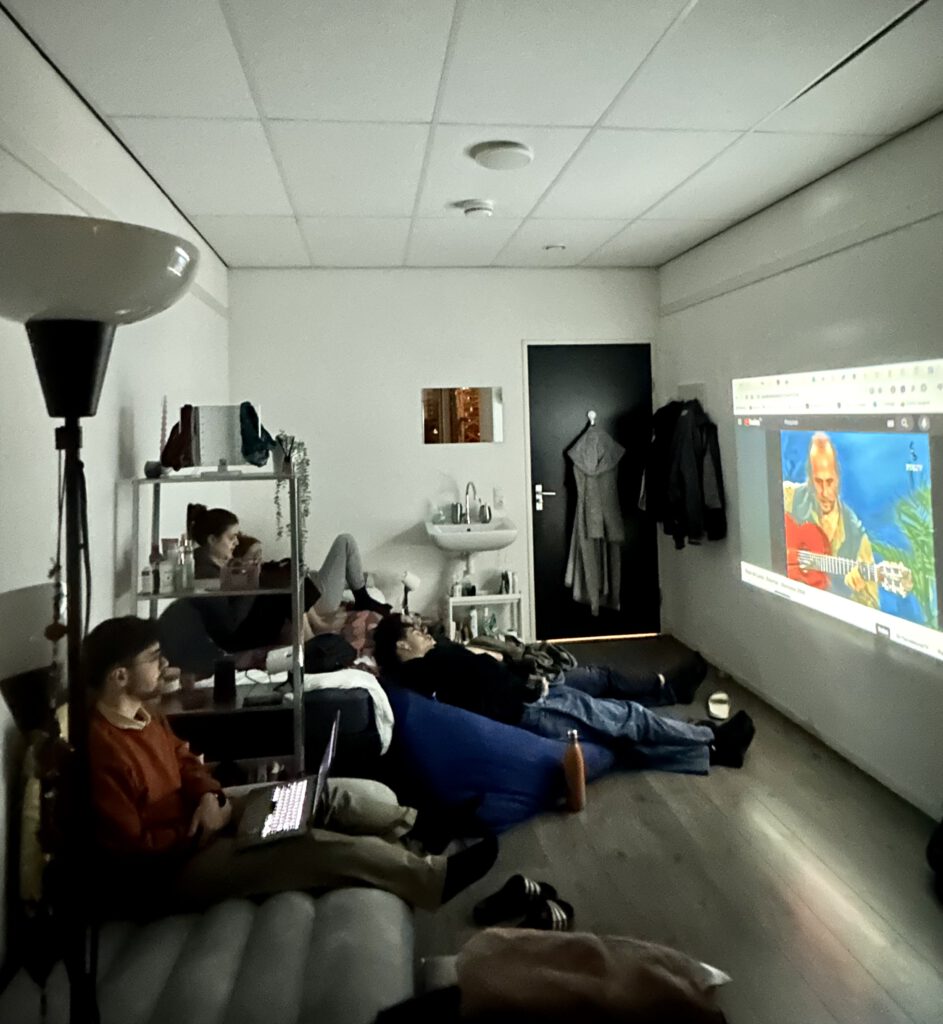
A projector was the best investment for this kind of living. Image: Lottie Gale
When you share a home with 28 people, life becomes like a sitcom. I imagine us in a bonus version of Friends if the episodes went something like:
The One Where There’s No Hot Water,
The One Where Everyone Avoids the First Toilet Cubicle, or
The One Where They Try To Do Laundry on a Sunday (spoiler: no chance).
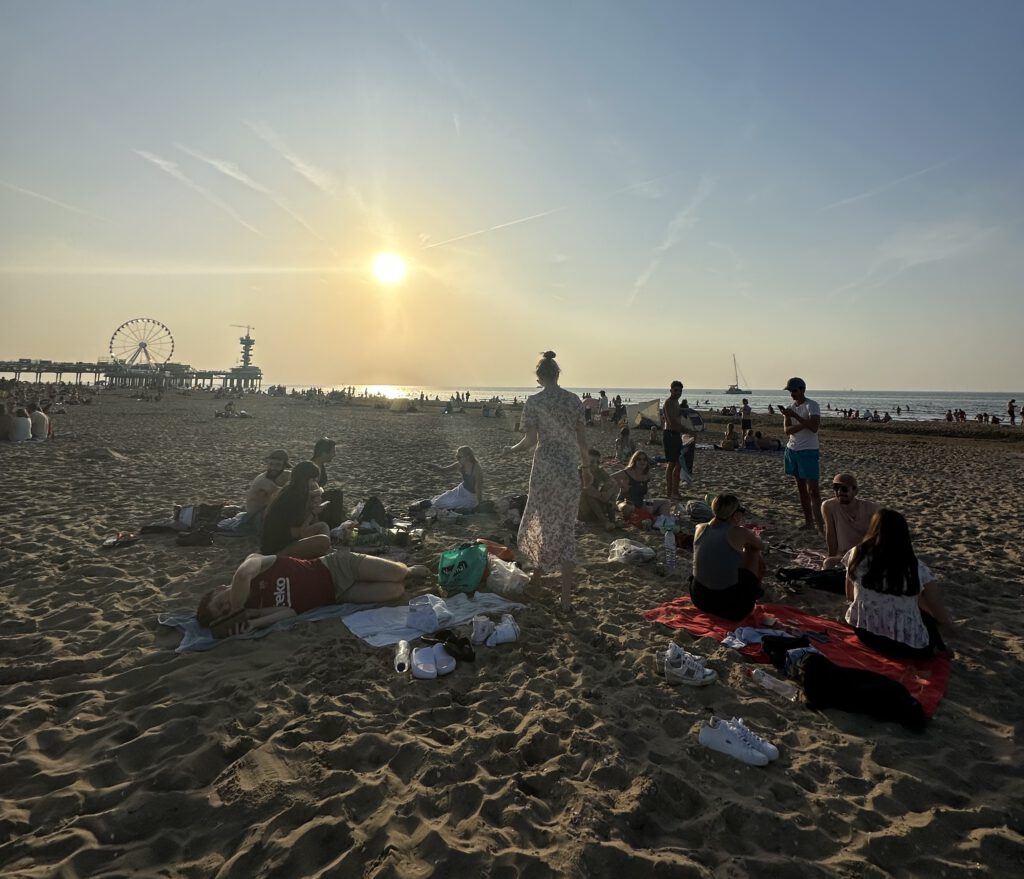
It’s not all doom and gloom, of course; that would be doing a disservice to the extra special episodes: The One With Raclette Night(guest starring Homemade Tiramisu) and The One Where They All Go to Scheveningen Beach.🥺
I can’t believe that when I met everyone, the sun was actually shining in the Netherlands. Image: Lottie Gale
From across the pond to down the hall and back again
Among 28 flatmates, almost 20 nationalities are represented (and more than 20 languages). Our little flat is home to people from Spain, China, Italy, England, Bulgaria, Iran, Russia, Ireland, Greece, Germany, Poland, Japan, Brazil, Portugal, Romania, and Suriname.
It’s crazy to think that in such an unlikely living situation, these cross-cultural connections could be some of the most important in our lives.
And, even if it’s only short-term, I’ve now got some great holiday destinations to visit this summer.
As one of the only monolingual speakers, I attempted to learn at least some useful daily phrases from my housemates.
Saying good night, buonanotte, gutenacht, boanoite, Καληνύχτα, buenasnoches and — of course — goedenacht, can take a while! 🇬🇧🇮🇹🇩🇪🇧🇷🇬🇷🇪🇸🇳🇱
Cultural crossovers (and occasional clashes)
Even though I can’t quite call the Netherlands home after only six months here, the people have become a sort of home. And I have to thank our cosy chaos of cultures for that!
Wherever you travel, spending time in one place means you seek a temporary family in the people around you. And just like family living together for a while, you can clash.
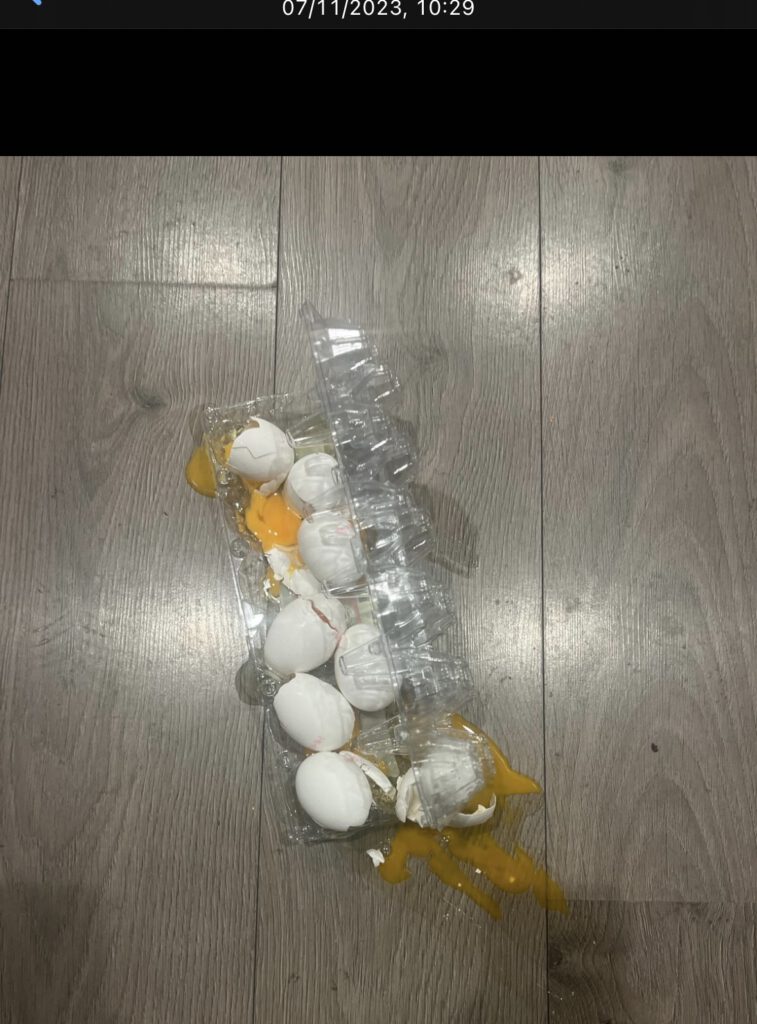
Introducing a series capturing the “I broke something in the kitchen, and I have to shamefully message the group chat to own up” panic:
Oops… Image: Lottie Gale
Living in such close quarters with people from all over the world, all of different ages, and all studying various courses, means you learn quickly.
The most important lesson? Shift your schedule. Forget eating at 6 or 7 PM, unless you want to dine alone.
Start cooking dinner at 9 or 10 PM, however, and you’ll have some Spanish, Italian, and maybe Brazilian company. The Greeks will be cooking lunch.
Sometimes we’re organised enough to eat together. Image: Lottie Gale
But, seriously, it’s special to experience such condensed diversity. It’s often as simple as discussing how ridiculous English culture (“What is netball, Lottie?!”) or the Dutch weather can be.
There’s a hilarious contrast on a clear, 10-degree day: Southern Europeans/Hemisphere-rs wrapped up in layers next to the British and Irish in their T-shirts and shorts.
Mostly, we have bonded over being in this new place by talking about the old: political controversies back home, the lack of employment opportunities, and whatever prompted us to leave in the first place.
It might be a squeeze in the flat, but there’s certainly a lot of space for stories. ❤️
What do you think of this living arrangement? Could you survive with 30 neighbours? Have your say in the comments below.
Dutch food? Meh. The housing market? A disaster. But Dutch banks? They know what they’re doing — especially ING!
When it comes to banking in the Netherlands, ING stands out as the ideal partner for expats.
But ING is not just a reliable bank for your general financial needs; they also offer a bunch of features that make daily banking more efficient and saving money a breeze.
Whether you’re grabbing a coffee, saving money for a trip, or just keeping tabs on your spending, opening an ING account will have you covered with tools designed to make your life easier.
Here are seven of my favourite features that I use every day.
1. Round up and save
Do I like to spend money on the occasional overpriced iced coffee and sweet treat? Heck yeah. Do I feel bad about it? Not anymore.
Since I started using ING’s “Round Up and Save” feature, I feel less guilty spending money because I know each euro that goes out also means I’m putting money aside for my savings. Confused by that girl math? Let me explain.
ING’s “Round Up and Save” tool rounds up every purchase you make to the nearest euro and transfers the difference into your savings account. So, if I’m buying that iced latte for €5.70, ING will round it up to €6 and put that extra €0.30 straight into my savings.
Even better, I can accelerate my savings by rounding up to the nearest €2, €5, or even €10, making it a perfect way to build up savings without even thinking about it.
2. ING Loyalty Shop
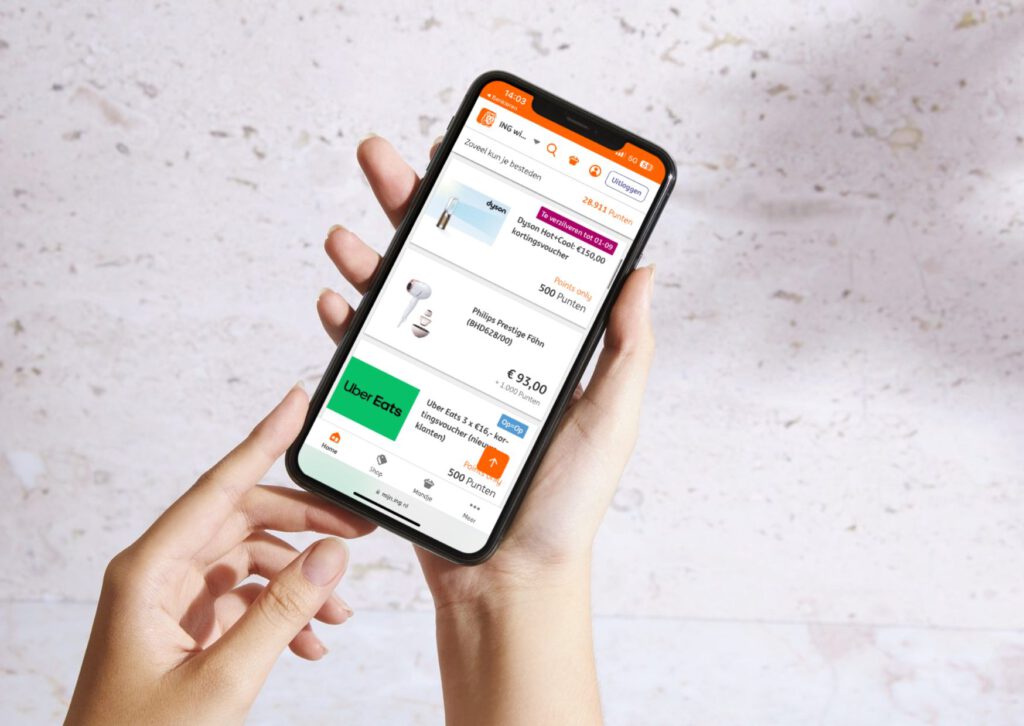
Love shopping? ING’s got something for you: its Loyalty Shop!
This shop is filled with deals and discounts, which you can access in exchange for points (punten). How do you get the points, you ask? By just going about your day-to-day life!
We won’t say no to €150 off a Dyson appliance! Image: DutchReview
With normal banking activities like using your ING credit card, sending a payment request or opening a savings account, you accumulate points that can be redeemed for discounts on everyday expenses like dining out, shopping, and cinema visits.
Saving up points takes no effort, and using them is a fantastic way to save money on the things you love doing. It’s a win-win!
3. Savings goals
Saving for a car? Putting money aside for a vacation? Or just building that rainy-day fund? Put your money in separate piggy banks! 🐷
Just as you would’ve done with your money as a child, ING’s “Savings Goal” feature lets you create individual savings accounts — “piggy banks” — for each of your financial targets.
You can have up to ten goals per savings account, each with its own name and icon in the ING app. When you start your savings goal, the app will ask you how much you want to save and by when.
The tool keeps you on track by clearly showing your progress and how close you are to reaching your target. If your priorities change, you can withdraw the money at any time.
Oh, and do you just want to save for the fun of it? The goal and timeline are optional, so you can use it as a stock-standard savings account, too!
4. Financial insights
In today’s economy, keeping track of your spending is crucial. That’s why ING has a Financial Insights feature that makes this simple.
This tool analyses your transactions and gives you a detailed breakdown of where your money is going each month. You’ll get a clear picture of your spending habits, from groceries to entertainment and healthcare.
With ING, you’ll always have your finances right in your pocket. Image: ING
It’s like having a personal accountant who doesn’t miss a single transaction. Can it be scary to find out how much you spend on Uber Eats? Sometimes. But you know what they say: The first step toward change is awareness.
5. ING iOS widgets
Speaking of having a clear overview of your finances, did you know you can put an ING widget on your iPhone’s home screen to check your balance quickly whenever you feel like it?
The ING widget is a game-changer if you’re anxious like me and always want instant access to your current balance without even opening the app.
I know what you’re thinking: won’t everyone be able to see how much (or little) money I have? But the answer is no! Your balance is hidden until Face ID verifies your identity.
6. Look Ahead
As the name suggests, ING’s Look Ahead feature is a super smart tool for planning ahead in your financial life. No psychic abilities or crystal balls needed, just your ING app.
Staying on top of your finances has never been so effortless. Image: Depositphotos
How does it work? Look Ahead analyses your past transactions and uses the information to forecast your future expenses.
It takes into account your regular bills, upcoming events, and even your spending patterns to help you avoid any nasty surprises.
This proactive approach to managing your finances lets you be prepared for the month ahead and avoid unexpected expenses.
7. Budgeting
Last but not least, the ING app’s budget feature is perfect for controlling your spending. You can set budgets for different categories, such as groceries, dining out, and entertainment.
You can indicate how much you want to spend per month on each category, and ING will track your spending.
Once you’re nearing your limit, the app will let you know, and you can adjust your behaviour accordingly (because, let’s be real, you don’t need any more trinkets from HEMA).
The budgeting tool is an excellent way to hold yourself accountable and stick to your financial goals and plans. You got this!
ING offers a range of features that make everyday banking not only easier but also more enjoyable. Whether you’re an expat or a local, these tools are guaranteed to help you manage your money better and achieve your financial goals.
So, while the housing market might be a headache and Dutch food an acquired taste, at least your banking is in good hands! 🙌
The Trimbos Institute has issued a national “Red Alert” for ecstasy pills stamped with Donald Trump’s face, warning that they may cause fatal overheating.
Of all the ways Donald Trump could possibly ruin your life, an ecstasy pill with his face on it definitely wasn’t on our 2026 bingo card.
According to Trimbos, several of these tablets turned up at testing centres run by the Drugs Information and Monitoring System (DIMS) last week. And if we said researchers were shocked by what they found, that’d probably be an understatement.
What makes these Trump XTC pills so deadly?
As reported by Trimbos, the core issue is the “very high amount of the substance PMMA”. PMMA, or para-methoxymethamphetamine, is a synthetic substance that mimics MDMA, the active ingredient in ecstasy.
However, unlike MDMA, PMMA’s effects kick in much later, causing users to mistakenly assume that they need to take more of the drug to feel its effects.
Hours later, these effects can show up all at once, hitting you with a barrage of nausea, tachycardia (racing heartbeat), convulsions, and an extremely high body temperature.
Here’s how to spot them
All the pills come in two colours, Trimbos reports, with several different colour combinations discovered so far.
One side of the pill shows Trump’s face, with his familiar quiff and pout. The other has “NL” and “Trump” stamped on it, with a score line between them.
Here are examples of two different colourways:
There’s no mistaking that face! Image: Trimbos
Not a trip you’ll want to take
Trimbos is blunt about what to do if you ever come across Donald Trump’s face staring up at you from a colourful XTC pill: “Do not use this pill under any circumstances”.
If you, or someone you know, has taken one of these, then immediately call emergency services. In the meantime, Trimbos stresses you should “try to calm the person in question as much as possible”.
Meanwhile, if you’ve got a batch of XTC pills and are unsure whether they contain PMMA, your safest bet is having them tested at DIMS.
Is this weirder than the Dutch garden gnome made entirely of MDMA? Share your thoughts in the comments.
The small, unassuming town of Geldrop in Eindhoven has every street named after J.R.R. Tolkien’s Lord of the Rings. It’s the moment all fans of the epic trilogy have been waiting for!
Why make this a Lord of the Rings village? Simple: consistency.
The streets needed some sort of theme, and the best idea they could come up with was Lord of the Rings! And we’re here for it!
Every Lord of the Rings character has their moment in the spotlight! Image: DutchReview
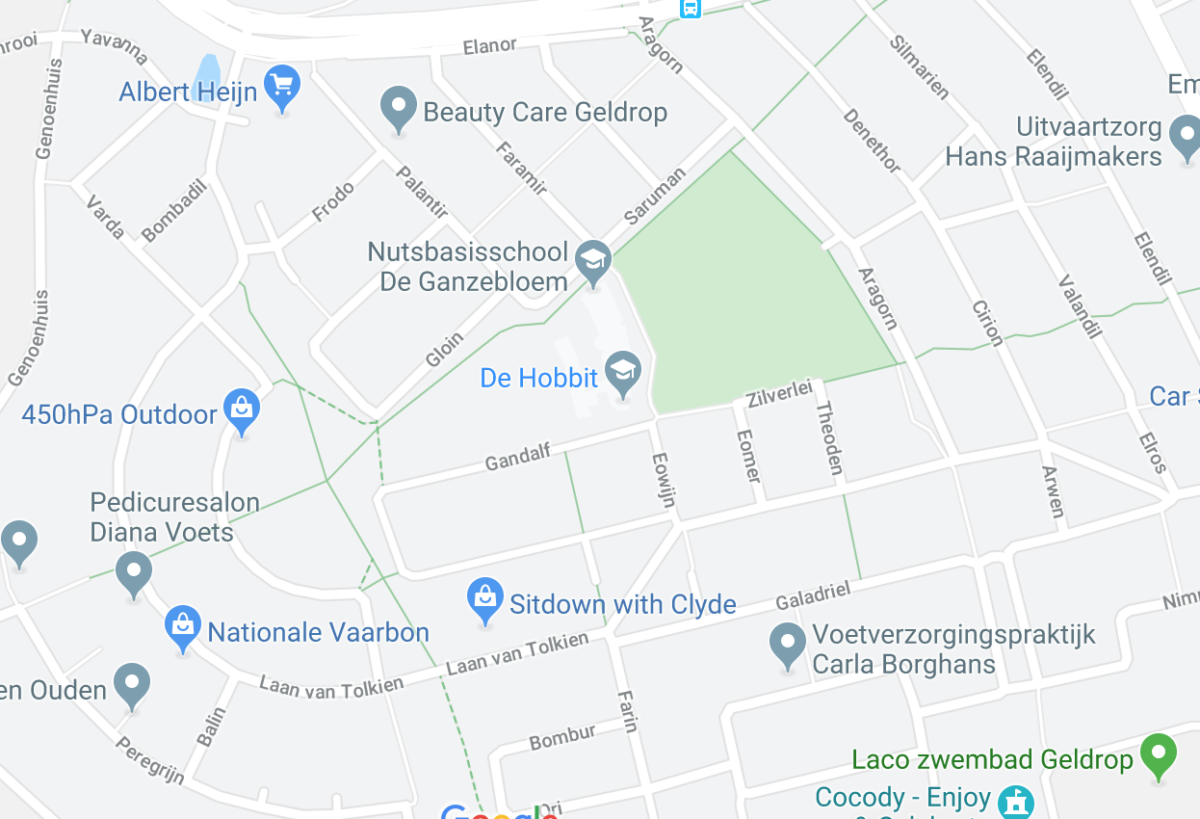
In the heart of the city is Laan von Tolkien (Tolkien Avenue). From this centre, the streets branch out into names of hobbits, elves, dwarves and even a few ents (the talking trees). 🌳
A Lord of the Rings town
The street-naming system is pretty well executed: all the streets are organised in clusters of characters that are related to each other. For example, in the north of the neighbourhood are the Gondorian streets with names like Aragon, Denethor, and Palantir.
To the west is the dwarf section, which includes Bifur, Bofur, Bombur, Balin, Dwalin, Dori, Ori, Fili and Kili.
A touch down south are Pippin, Peregrin and Gimli. Gandalf and Samwise are together in the centre. 🧝
This is Hobbiton in New Zealand, not Geldrop. Image: Unsplash
But as much as we hate to be the bearers of bad news, Geldrop doesn’t exactly look like a village in Lord of the Rings. Really, it looks more like most Dutch towns but with a bit more pizzazz, to say the least.
Bilbo is nowhere to be found
Bilbo Baggins, despite being a protagonist in the series, doesn’t have a single street named after him. Neither does Gollum or any other ‘evil’ character — except for Saruman.
Maybe they put on the ring and became invisible.
Have you visited this Lord of the Rings village? Tell us in the comments!