Even if you’re not from the Big Apple, chances are you’ve heard of the New York ‘Knicks.’ What you might not know is that the name traces straight back to the Dutch.
From references in shows like Friends and Sex and the City to the star-studded ‘celebrity row’ courtside, the Knicks are as iconic as New York City itself.
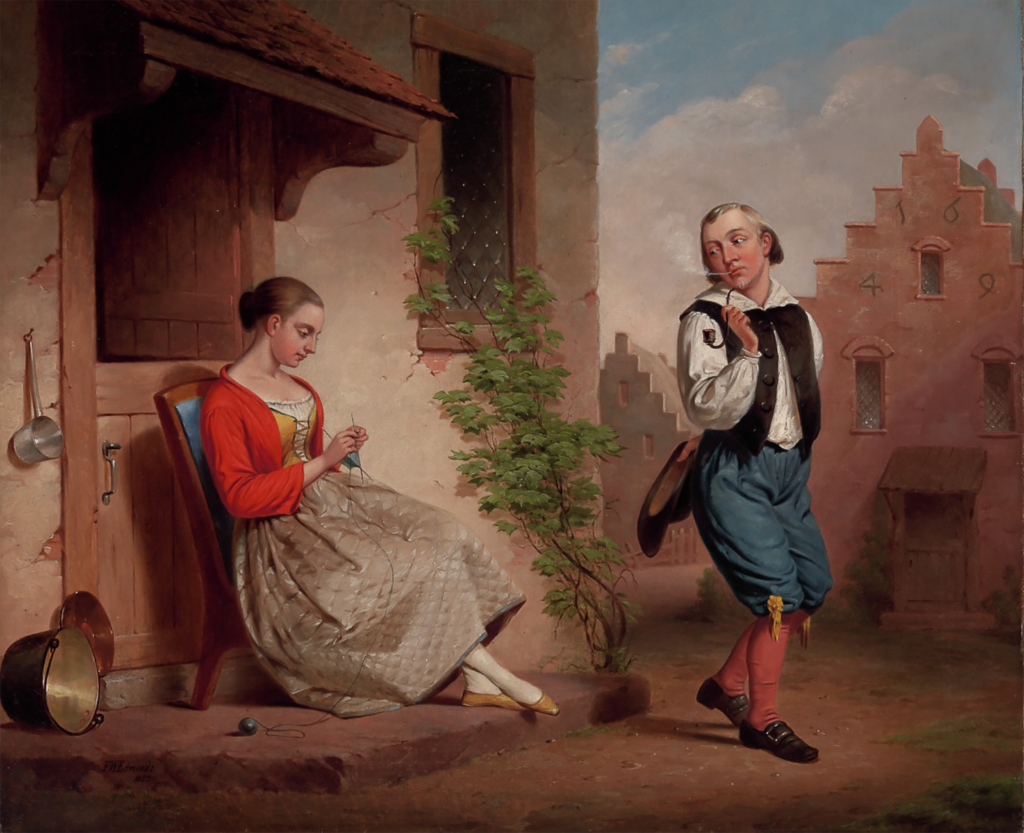
The name ‘Knicks’ is clipped from the word ‘knickerbockers,’ also referred to as ‘knickers’ — a style of loose trousers cinched just below the knee worn by Dutch settlers in the New World in the 17th century.
An 1850 painting of a courtship in New Amsterdam. The young man is dressed in the distinctive outfit of a Dutch settler, wearing “knickerbockers.” Image: Francis W. Edmonds/Wikimedia Commons/Public domain
Why Dutch men have now moved to skinny jeans, we don’t know.
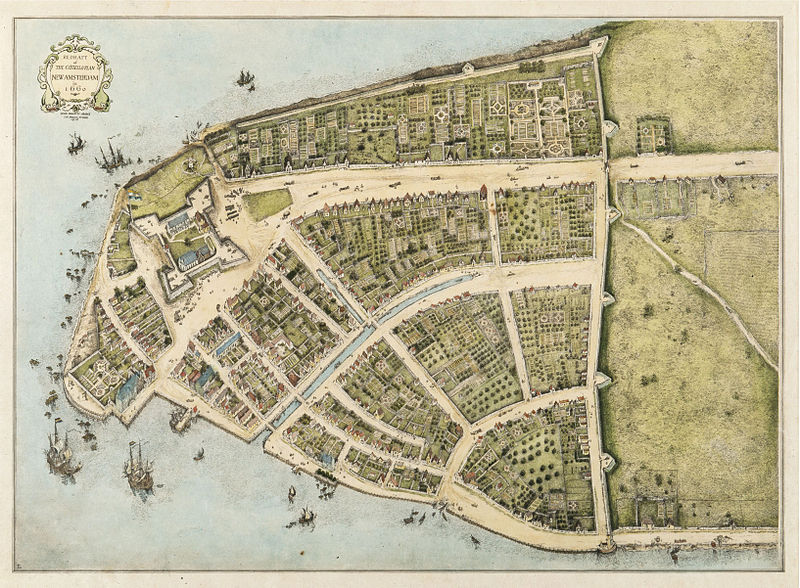
The Dutch arrived in the 1600s, founding ‘New Amsterdam’ at the southern tip of Manhattan Island in 1625.
Outside of wearing knickerbockers (and likely acting as if they had them in a twist), the Dutch weren’t called “knickerbockers” themselves until the early 1800s.
A redraft of the 1660 Castello Plan. The area where New Amsterdam used to be coincides with where the Financial District is in Manhattan nowadays. Image: John Wolcott Adams/Wikimedia Commons/Public domain
In 1809, Irving published the satirical ‘A History of New York from the Beginning of the World to the End of the Dutch Dynasty’ under the pseudonym Diedrich Knickerbocker (has a nice ring to it!).
Irving was the first to use the term “knickerbocker” to denote a New Yorker with original Dutch settler ancestry.
How he landed on it is debated. One theory is that Irving borrowed it from a friend in Congress, “Herman Knickerbocker,” simply because it sounded Dutch enough.
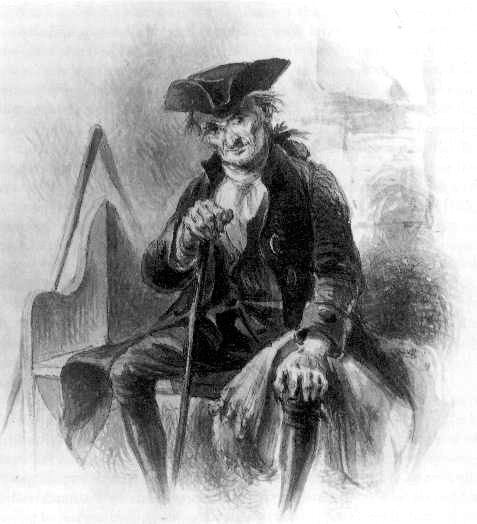
A 1849 drawing of Irving Washington under his pen name Diedrich Knickerbocker by illustrator Felix Octavius Carr Darley. Image: Felix Octavius Carr Darley/Wikimedia Commons/Public domain
As Peter-Christian Aigner of the Gotham Center for New York History tells NPR, after American independence in 1776, Irving felt it was important for the young city to have “this mythical past.”
Enter Father Knickerbocker
By the late 19th century, “knickerbocker” had become a shorthand for native New Yorkers generally, personified by the cartoon figure of ‘Father Knickerbocker.’
Sporting a cotton wig, three-cornered hat, knickers and all, he became a mascot for the city’s colonial-era identity.
So when college basketball promoter Ned Irish founded a new team in 1946, the name practically made itself. Nothing said New York quite like the good old Dutch Knickerbocker. The name got clipped to “Knicks,” and the rest is basketball history.
Are you surprised by this origin story? Let us know in the comments.
Supermarket meat has always been a bit of a gamble in the Netherlands: limited cuts, inconsistent quality, and very little information about where any of it actually comes from.
No wonder more people are turning to online butchers instead.
Specialised platforms, such as The Butchery, have emerged to fill the gap left by the supermarkets, focusing on meat quality rather than just ticking a box.
Let’s talk about what quality meat actually looks like when you’re ordering online, and what to watch out for when choosing a platform.
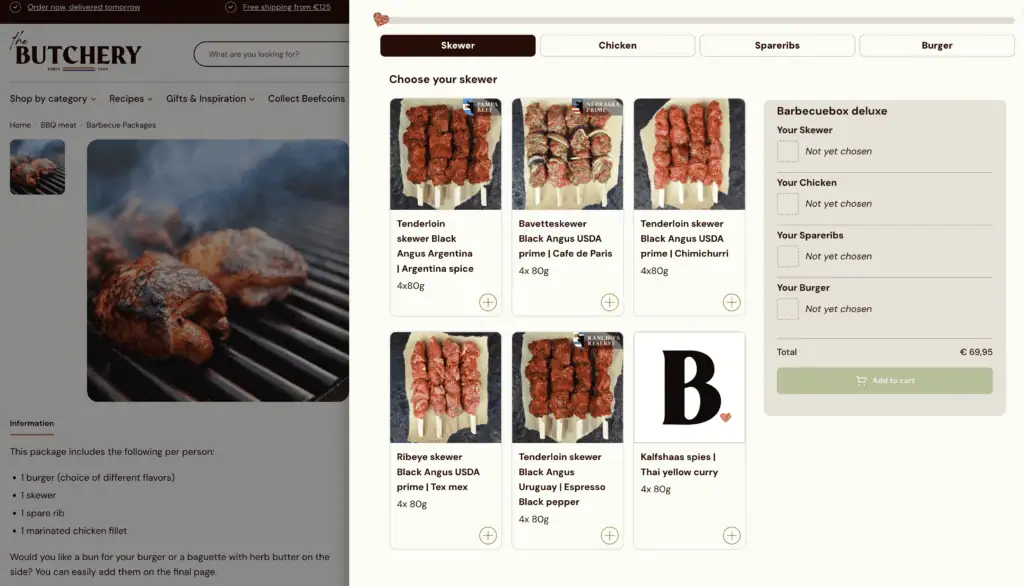
With the sun coming out, so are the BBQs. The Butchery offers premium BBQ packages, allowing you to pick and choose what you’d like to see sizzle on the grill.
Curate your BBQ selection with The Butchery. Image: Abuzer van Leeuwen
What “quality meat” actually means when ordering online
It’s easy for any website to use the word “quality.” What actually matters is whether they can back it up.
When ordering meat online, quality comes down to a few practical things: clear sourcing and origin information, well-defined cuts with accurate weights, proper handling during delivery, and consistency from one order to the next.
That last one is easy to overlook. Plenty of services get the first order right. The question is whether the fifth is just as good.
What to look for when choosing an online butcher in the Netherlands
Before you commit to any platform, there are a few things worth checking.
You want to ensure you’re getting what you paid for — each time. Image: The Butchery/Supplied
Transparency about the product: Can you actually find out where the meat comes from, how it’s cut, and what you’re getting? If the website is vague about this, treat it as a red flag.
Flexibility: Some services lock you into subscriptions or preset boxes. If you want to choose your own cuts and quantities, make sure that’s actually possible before signing up.
Delivery and packaging standards: Meat needs to be kept at the right temperature during transport. Flash-freezing and vacuum packaging are both good signs.
Accessibility for internationals: A surprising number of Dutch food platforms are entirely in Dutch, which makes things unnecessarily difficult if you’re still working on your Nederlands. An English-language site is a nice extra.
How ordering meat online in the Netherlands usually works
If you’ve never ordered meat online before, here’s roughly what the process looks like.
You browse the available cuts, select what you want, and choose your quantities.
Most quality platforms list everything by weight, which gives you much more control than picking up a random package at the supermarket.
You place your order, and the meat is delivered (typically flash-frozen and vacuum-packed) to your door.
Meet The Butchery
The Butchery ticks all the boxes laid out above (and then some).
One great online butcher? The Butchery! Image: The Butchery/Supplied
The platform is fully available in English, which immediately sets it apart for internationals.
It also works less like a food delivery app and more like an actual butcher: you choose your cuts, you get what you asked for, and there’s no subscription or mystery box standing between you and your dinner.
Tip! Wracking your brain trying to come up with the perfect Father’s Day gift? Nothing makes a papa happier than some good meat. Check out The Butchery’s giftcards.
Our experience using The Butchery
And yes, we’re speaking from experience. Let’s get into it. 👇
The meat itself is excellent
The first thing we noticed was that the burger range was impressive, and the BBQ selection gives you options you simply won’t find at the supermarket.
If you’re into wagyu, they have that too. And we mean proper wagyu, not the loosely labelled variety that seems to end up everywhere.
For expats especially, The Butchery is a find. Brisket, Sunday roast cuts, proper beef ribs — these are the things that tend to disappear from Dutch supermarket shelves (if they were ever there to begin with).
At The Butchery, they’re just part of the regular range.
Consistent quality without the guesswork
One of The Butchery’s standout practices is that every single item is individually weighed. You’re paying for a specific weight, and that’s exactly what you get: not an approximation, not “roughly” that amount.
For anyone who meal preps or cooks to a recipe, this kind of precision actually matters.
Every cut is also triple-trimmed and prepared entirely in-house, so what arrives is 100% grill-ready and ready to cook. No unexpected fat caps, no awkward prep work at your end.
Control over what you order
There are no forced subscriptions, no preset boxes, and no minimum orders designed to move stock. You choose what you want, in the quantity you want. That’s it.
Packaging that goes the extra mile
A standard in the meat packing industry is two or three layers of vacuum film. However, The Butchery uses a custom four-layer vacuum film.
The extra nylon layer makes the packaging puncture-resistant, so sharp bones won’t tear through it during delivery.
The film also blocks oxygen completely, preventing drying out and keeping flavour intact. It’s heat-resistant too, which means it’s safe for thawing and even sous vide cooking. A UV filter prevents any discolouration from light exposure.
Flash-frozen for a reason
All The Butchery’s meat is delivered flash-frozen. This means it is frozen ultra-fast at -40 degrees Celsius, which prevents large ice crystals from forming inside the meat.
This matters because ice crystals damage cell walls, which is what causes quality loss when meat is frozen poorly. Flash-freezing keeps those cell walls intact, preserving the texture and tenderness right up to the moment you cook it.
When your order arrives, you can go straight to the freezer, or defrost and cook immediately — whichever works for you.
Who this works for
The Butchery makes most sense for people who cook regularly, plan their meals, or like to keep quality cuts in the freezer.
It’s also a strong option for expats and internationals who want specific cuts that Dutch supermarkets simply don’t stock, or who’d prefer a platform they can actually navigate in English without reaching for Google Translate.
FAQ: ordering meat online in the Netherlands
How is meat delivered when you order online?
Most online butchers deliver meat flash-frozen and vacuum-packed. Packaging quality and temperature control matter far more than how quickly it arrives.
Can you freeze meat that’s delivered online?
Yes, and with flash-frozen meat, you can put it straight in the freezer without any loss of quality. The flash-freezing process is specifically designed to preserve the meat at its best.
How do portion sizes work when ordering online?
Cuts are listed by weight, which gives you much more control than supermarket packaging.
Have you ordered meat online in the Netherlands before, or are you still navigating the supermarket lottery? Tell us in the comments below!
Registering with a doctor in the Netherlands can be quite a confusing process compared to how it works in your home country. Is the practice accepting patients? Do you have all the required documents? Where’s your pharmacy?
Don’t worry, we’ll guide you through the whole process, step by step.
Before we begin, however, let’s quickly run through why registering for a doctor in the Netherlands is so important.
Why should I register for a doctor in the Netherlands?
In the Netherlands, you can’t just show up at any doctor’s office with a fever or stomach pain. You first need to register with a specific general practitioner (GP), or huisarts,as they’re called in the Netherlands.
Why? Because if you’re not registered, they may refuse to help you if you aren’t considered an ‘urgent case.’
If you want to get medical care for a sore throat that comes along, you need to be registered with a doctor in the Netherlands. Image: Depositphotos
Registering with a GP is essential and a gateway to medical care in the Netherlands. For example, if you want to see a specialist, you first need to consult with your GP and have them refer you.
Plus, you’ll have someone to turn to who knows your medical history and can give you the best help.
For this reason, it’s best to register with a GP as soon as you move to the Netherlands. It can be a lengthy and tiresome process — and no one wants to sit at home with a fever, scouring the internet for a doctor to take them in. So, get going! 👇
Step one: scout for a general practitioner (GP) near you
First things first, do some research and identify the doctors in your area.
In the Netherlands, GPs often only accept patients within a 15-minute perimeter of the practice. Why? In the case of a medical emergency, your doctor can provide you with medical care quickly.
There are a few ways to go about finding a GP in your area.
Check comparison websites
You can use comparison websites, such as Zorgkaart Nederland, to find a practice near you.
Use a quick Google search to find a Dutch doctor near you. Image: Depositphotos
With these websites, you simply enter your home postcode, and the site lists all the practices closest to you.
Note: These websites are in Dutch, but you can use your browser’s translation tool to translate them!
Use the right Google search
Another way to find a doctor’s practice near you is to do a Google search. In the Netherlands, the best way to get results is by searching your postcode or city and the word ‘huisarts’.
Just make sure to check the practice’s website or give them a call to ask if they take patients from your exact postcode!
The catch with this system is that there’s a limited number of doctors that you can register with, often making the search a bit of a lengthy task.
In some cases, you may be forced to register with a doctor’s practice that’s quite far from your home.
That’s where some other options come into play, and they can be lifesavers for internationals.
Consider alternative options
A few big cities in the Netherlands have ‘international health centres’ that accept new patients based on city-wide postcodes. So, for example, no matter where you live in The Hague, you’re eligible to register at the International Health Centre The Hague.
Another alternative option is to skip all these steps and use telemedicine services, which can find you an English-speaking doctor and set up an online consultation within minutes.
With online appointments, you avoid long commutes, full waiting rooms when feeling sick, and you have someone to turn to if you haven’t managed to register with a Dutch doctor yet.
Step two: check whether the doctor accepts new patients
Now that you’ve found a GP that matches your home address, the next step is to make sure that the practice is actually taking on new patients.
As we’ve pointed out above, there is a limited number of doctors to treat patients in the Netherlands.
Many Dutch GPs reach full capacity quickly, especially in late summer. This is why it’s very important to register for a doctor as soon as you arrive in the country.
There are a limited number of doctors in the Netherlands, so it’s best to register quickly. Image: Freepik
If a practice is no longer taking patients, it will usually say so on the practice’s website. If there’s no message, call or e-mail the practice to find out if they can take you.
While you’re on the phone with the doctor’s office, it’s also important to take the opportunity to tell them if you’re a non-Dutch speaker.
Most GPs in the Netherlands speak English, but it’s always good to check this in order to ensure a fully comfortable medical care experience.
Step three: sign up for health insurance (if you haven’t already)
Have you found a huisarts that you want to register with? That’s great! Now it’s time to sign up for health insurance if you don’t have some already.
Health insurance is essential to complete your registration with a Dutch doctor, and it is also mandatory in the Netherlands.
Although health insurance can sound complicated, you can generally rely on these rules to figure out what type of health insurance you need:
If you’re working in the Netherlands: it’s compulsory for you to take out Dutch health insurance
If you’re an EU student (and not working): you may use your home country’s insurance with the European Health Insurance Card (EHIC) or take out private travel insurance. You can also get standard Dutch health insurance.
If you’re a non-EU student (and not working): you will have to get private health insurance, as you arenot eligible to apply for basic Dutch health insurance and you don’t have access to an EHIC card.
Signing up for health insurance will allow you to find and visit a doctor in the Netherlands. Image: Depositphotos
If you are required to take out Dutch health insurance, these are some of the most popular providers for internationals in the Netherlands:
However, basic Dutch insurance packages cover costs for visits and treatments by a GP, most prescribed medications, and hospital stays.
Step four: gather the required documents
Now, the next step in registering for a Dutch doctor is to rummage around all those stacks of papers and find a few documents that you must provide.
What do you need to register with a GP? Here’s a checklist of three things to have at hand:
Proof of identity (a passport, residence permit or EU identity card)
Your BSN number
Your health insurance details
You’ll need your health insurance details to register with a Dutch GP. Image: Depositphotos
Your BSN is an eight or nine-digit-long number given to you by the Dutch municipality when you registered your address after moving to the Netherlands.
When it comes to your health insurance details, you will usually need your insurance policy number (polisnummer) and the name of your health insurance provider.
Step five: fill out an intake form or attend an intake appointment
You’re almost there! One of the last steps to registering with a doctor in the Netherlands is filling out the intake form using all the documents you have gathered.
All you’ll need to give them is your personal information, such as your name and address, and important bureaucratic details, such as your BSN and health insurance number.
Your doctor will ask about your medical history in an intake appointment. Image: Depositphotos
You can usually find an online intake form on the practice’s website. However, in some cases, you might have to hand in a hard copy at the doctor’s office.
The doctor may also ask you to attend an intake appointment to get to know you better, ask about your medical history, and any medical concerns you have. This is a great opportunity to ask any questions and get familiar with the Dutch healthcare system.
Step six: register with a Dutch pharmacy
Ta-daa, you’ve officially got a Dutch GP. One important last step is to register with a Dutch pharmacy in order to collect your meds and get healthy!
In the Netherlands, everyone registers with one particular pharmacy — usually the one closest to their home or doctor’s office. This means that they’ll have all your medical information and can provide more advice for your personal situation.
Your doctor will send your prescription to a pharmacy for you to collect your medication. Image: Freepik
All you’ll need to register with a Dutch pharmacy is proof of identity and your insurance information. The rest of the process should be automatic.
By registering with a particular pharmacy, the process of receiving your medication is simplified. After an appointment with your GP, your prescription should arrive straight in your pharmacy’s mailbox, where you can then pick it up.
While registering for a doctor in the Netherlands may seem like quite a big task, it’s perhaps one of the most important things you can do when you first arrive in the country.
After following these steps, you can relax and be at ease. You’re completely prepared for those not-so-nice moments to go smoothly.
How have you found registering with a general practitioner in the Netherlands? Tell us about your experience in the comments below!
How to register for a doctor in the Netherlands: Frequently Asked Questions
Is it compulsory to register with a Dutch doctor?
It isn’t required to register with a Dutch doctor by law, but it’s highly recommended as a doctor may refuse you treatment if you aren’t registered with them.
Do I have to pay every time I visit a doctor’s appointment in the Netherlands?
Basic Dutch health insurance covers the cost of GP consultations in the Netherlands, so you shouldn’t have to pay anything when attending a doctor’s appointment.
What do I need to register with a Dutch doctor?
You will need your proof of identity (passport or EU identity card), your BSN number, and health insurance details to register with a Dutch doctor.
Do internationals have to register with a Dutch doctor?
Internationals don’t have to register with a doctor in the Netherlands. There are many other options, such as international health centres and online GP services. However, it is recommended that you register with a Dutch doctor to make the process more smooth.
The Dutch-American Friendship Treaty (DAFT) visa is one of the most accessible routes to legal residency in the Netherlands for American citizens — and in 2025, almost 700 Americansused it to make the move.
The DAFT visa allows US entrepreneurs and freelancers to live and work in the Netherlands by simply registering a Dutch business and depositing a minimum of €4,500 in starting capital.
There’s no points-based assessment, no employer sponsor required, and no Dutch language requirement. For self-employed Americans, it’s one of the simplest legal pathways to EU residency available anywhere in the world.
It sounds almost too good to be true. As a politically fatigued US-citizen myself, I’ve watched more and more Americans start asking: “Wait, can I actually just… leave?”
Well, if you’re a freelancer, consultant, or entrepreneur, the answer is yes. Here’s everything you need to know.
While the DAFT visa is one of the most accessible routes to the Netherlands, it’s still complex — and having proper legal guidance can save you a lot of stress. The expert immigration lawyers at AZ Legal specialise in the DAFT visa process and have helped countless US citizens make the move.
What is the Dutch-American Friendship Treaty (DAFT)?
The Dutch-American Friendship Treaty is a bilateral agreement between the Netherlands and the United States, signed in The Hague on March 27, 1956. The treaty was originally signed as part of the Marshall Plan to encourage trade and investment between the two countries.
It’s technically a residence permit — not a visa —, but everyone calls it the DAFT visa, so we will too. In plain terms, it lets American entrepreneurs start a business in the Netherlands and live there legally.
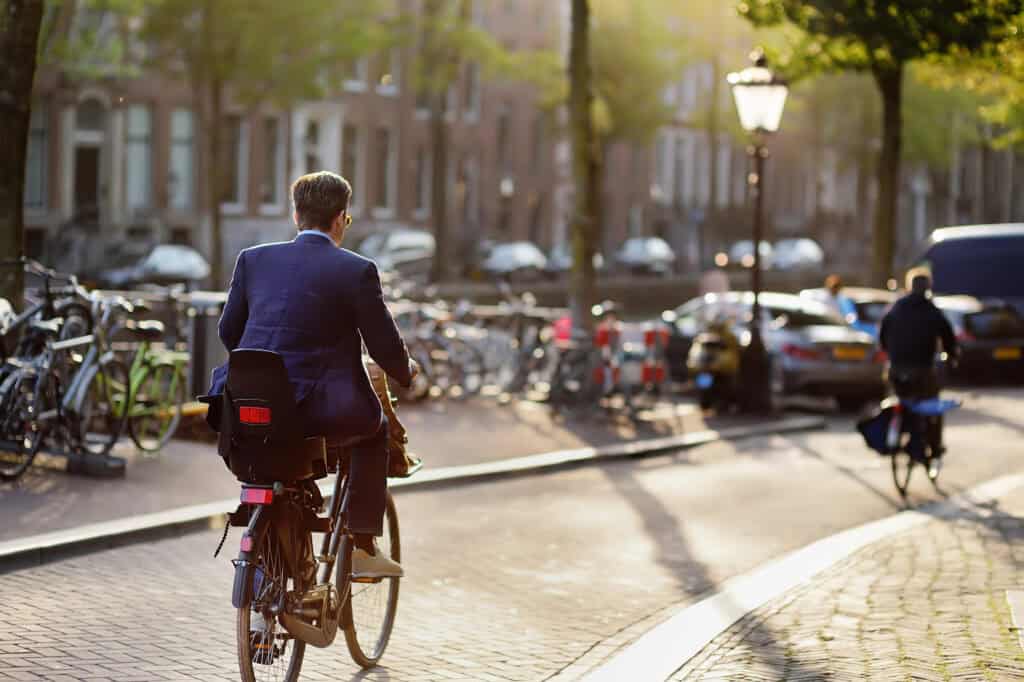
You could be biking to work just like any Dutch businessman! Image: Dreamstime
You don’t need a Dutch employer, a job offer, or an especially impressive business plan. You just need to be American, be self-employed, and meet a few financial requirements. Easy peasy.
How does the DAFT visa work in the Netherlands?
Normally, non-EU nationals who want to work independently in the Netherlands have to pass a points-based evaluation system. The Dutch government assesses your business against strict criteria to determine whether it provides “added value” to the Dutch economy. You need at least 90 points to qualify.
DAFT allows Americans to skip all of that: it exempts them from the points test entirely.
What you’re left with is a much faster and more accessible process: register a business, apply for your permit with the IND (the Dutch Immigration and Naturalisation Service), and renew it every two years.
The headline requirement: you must be a US citizen. That’s a non-negotiable.
Beyond that, you need to start or operate a business in the Netherlands and keep it genuinely active. Passive income, retirement funds, and dormant shell companies don’t count.
This could be you! Ready to make some amazing Dutch friends? Image: Dreamstime
There’s no age restriction, no diploma requirement, no minimum number of Dutch clients, and no business plan requirement. That means you can even serve American clients from Amsterdam!
Can family members join a DAFT visa holder?
Yes, your partner and children under 18 can join you, provided they apply for their own residence permits as dependents. One nuance worth flagging: family members can start working in a self-owned business from the moment they receive their residence sticker, but they can’t enter regular employment until you’ve received the final verdict on your DAFT application. It’s an important distinction, especially if your partner has a job lined up.
If your partner isn’t a US citizen, the process may be slightly more involved — some nationalities require an MVV (machtiging tot voorlopig verblijf).
This is a temporary entry clearance visa that non-exempt nationalities must obtain from a Dutch embassy in their home country before travelling to the Netherlands for a long stay.
DAFT visa requirements for Americans
Here’s what you’ll need to get your DAFT permit.
Minimum investment requirement
You must deposit a minimum of €4,500 into your Dutch business bank account. Keep in mind that this isn’t a fee or a one-time payment — it’s a capital requirement that must stay in the account for the full duration of your permit.
Business requirements
You need to register your business with the Dutch Chamber of Commerce, known as the Kamer van Koophandel (KVK). You must operate as a self-employed entrepreneur (ZZP) or company owner (BV), and the business must be active and generating real revenue at the time of application.
Documents required
Valid US passport (copies of all stamped pages)
Apostilled birth certificate (and marriage certificate or certificate of unmarried status, if applicable)
Business registration documents
Proof of the €4,500 deposit and an opening balance sheet from a BECON-registered Dutch accountant
Rental agreement or consent declaration for your Dutch address
Proof of health insurance
How to apply for the DAFT visa step by step
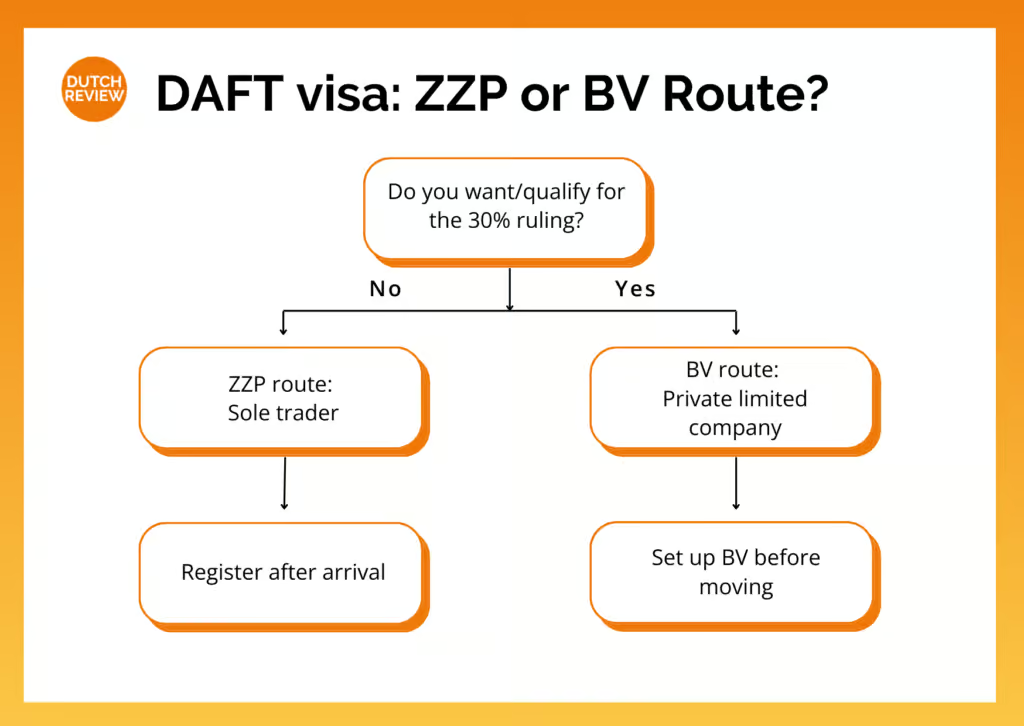
Before you get into the steps, there’s one decision you need to make first: which type of business are you setting up? This matters more than it sounds, because it changes the entire sequence of events.
Your two main options are
a ZZP (zelfstandige zonder personeel): a sole trader, roughly equivalent to being a 1099 freelancer in the US, or
a BV (besloten vennootschap): a private limited company, roughly equivalent to an LLC.
The ZZP can only be registered after you arrive in the Netherlands and have acquired your BSN number.
The BV, on the other hand, should ideally be set up before you move. This is especially important if you want to claim the Dutch 30% ruling, a tax benefit that lets some expats receive 30% of their income tax-free.
Both the BV and the ZZP route have legal and tax implications, and handling these properly can save you a lot of hassle down the line. The expert team at AZ Legal specialise in the DAFT visa, and can help you secure residency in the Netherlands quickly and with confidence.
It cannot be backdated, so if you want it, you need to act before you board the plane.
Choosing the right pathway is important! Figure out what applies to you. Image: DutchReview
Path 1: ZZP (zelfstandige zonder personeel — sole trader)
This is the simpler setup and most likely the right call if you expect to earn under €69,000 per year.
Step 1: Enter the Netherlands
Arrive on your 90-day visa-free Schengen entry.
Post your DAFT application to the IND. This can also be done from abroad before you arrive. You can skip the BSN and KVK fields for now, as you don’t have those numbers yet.
Step 2: Book your IND appointments and get your residence sticker
Once the IND receives your application, you’ll get a V-number and an invoice for the €423 application fee.
Use your V-number to book two IND appointments: one for biometrics and one for your verblijfssticker (residence endorsement sticker). They’re separate appointments but can usually be booked back-to-back.
Your verblijfssticker goes straight into your passport and immediately grants you the right to live and work in the Netherlands while your full permit processes.
Step 3: Register at the gemeente (municipality) and get your BSN
This must happen after your IND sticker appointment because you need to show the sticker to register.
Bring your passport, apostilled birth certificate, rental agreement, and IND confirmation letter.
Your burgerservicenummer (BSN) — your Dutch citizen service number, needed for taxes and banking — arrives by post within a few days.
Step 4: Register your business with the KVK
Now that you have your BSN, you can register your eenmanszaak (sole proprietorship) with the Chamber of Commerce. The KVK registration fee is €80.10.
Open a business bank account in your company’s name.
Step 5: Deposit €4,500 and get your opening balance sheet
Deposit the minimum investment into your business bank account.
Obtain an opening balance sheet from a BECON-registered Dutch accountant (a Dutch accounting register that verifies professional qualifications).
All of this must be in place within 6 months of IND approval.
Important: the IND is currently running an expedited pilot that allows you to submit your application without these documents upfront. This may revert during 2026. If it does, KVK registration, balance sheet, and bank statements will need to be submitted before IND approval. Double-check the current situation when you apply.
Step 6: Receive your full residence permit
Expect the final verdict within one to two months of submitting your application.
Your permit is valid for two years.
Joining family members can live in the Netherlands from the moment they receive their own sticker and can work in a self-owned company from that point, but can only enter regular employment after the final DAFT verdict.
Here’s a sneak peek of the views your kids could be enjoying! Image: Freepik
This is the route to take if you expect to earn over €69,000 per year in wages from your company and want to access the 30% ruling. The front-loading is more work, but the tax savings can be substantial.
Step 1: Set up your BV before you move
Incorporate your BV and sign an employment contract with it before migrating. This is a hard requirement for 30% ruling eligibility — it cannot be backdated.
Be aware that setting up a BV costs considerably more than a ZZP. In addition to the KVK registration fee (€82.25), you’ll need a civil-law notary to draft the deed of incorporation. Notary fees typically run €500–€1,500, bringing the total setup cost to roughly €1,200–€2,000 for a standard single-founder BV.
Open a business bank account.
Deposit at least €4,500 into your BV’s business bank account and obtain an opening balance sheet from a BECON-registered Dutch accountant. Since your BV is already set up, this can and should be done before you arrive.
Important caveat: the BV and pre-arrival employment contract are only required if you want the 30% ruling. The ruling has a salary minimum of €69,000 in 2026. If you won’t meet that threshold, you don’t need to set up the BV pre-arrival.
Step 2: Enter the Netherlands and submit your DAFT application
Arrive on your 90-day visa-free Schengen entry.
Submit your application to the IND. Since your BV is already set up, you can also do this from abroad before you even arrive.
Step 3: Book your IND appointments and get your residence sticker
Use your V-number to book biometrics and sticker appointments — two separate appointments, bookable back-to-back.
Receive your verblijfssticker, which lets you live and work immediately.
Pay the €423 IND fee.
Step 4: Register at the gemeente and get your BSN
Must happen after your IND sticker appointment.
Bring a passport, an apostilled birth certificate, a rental agreement, IND confirmation letter.
BSN arrives by post within a few days.
Step 5: Receive your full residence permit
Expect the final verdict within one to two months.
The permit is valid for two years.
Joining family members can live in the Netherlands from the moment they receive their own sticker and can work in a self-owned company from that point, but can only enter regular employment after the final DAFT verdict.
How long does the DAFT visa last?
Your initial permit lasts for two years. After that, you can renew provided your business has been active, and your minimum of €4,500 has stayed in the account. The renewal then lasts for five years.
Keep in mind that when it’s time to renew your permit, the IND will check your financials. While there’s no strict benchmark, some recommend showing you’ve earned at least €1,700 per month between the seventh and 24th months.
So while nobody’s checking your revenue on day one, don’t treat the first two years as a free ride. It could be catastrophic later on.
Can DAFT lead to permanent residency?
Yes. After five years of legal residence in the Netherlands, you may be eligible to apply for permanent residency — or even Dutch citizenship, if you meet the additional requirements (including passing a Dutch language and integration exam, known as inburgering).
Imagine raising your kids in this beautiful country! Image: Dreamstime
Worth knowing: permanent residency lets you keep your US passport while living in the Netherlands indefinitely.
Dutch citizenship is a bigger step; the Netherlands generally requires you to renounce your US citizenship as part of the naturalisation process, unless you qualify for one of a limited number of exceptions.
Examples of businesses Americans start under DAFT
The beauty of DAFT is that there are no restrictions on the type of business you run or where your clients are based. You can invoice American clients from an Amsterdam apartment — plenty of people do. Here’s who typically takes this route:
Freelancers and consultants: writers, designers, strategists, coaches
Remote workers: anyone with a US employer willing to hire them as a contractor
In short, if you can work independently and remotely, DAFT would probably work for you. Who knew moving to the Netherlands from the US was so achievable?
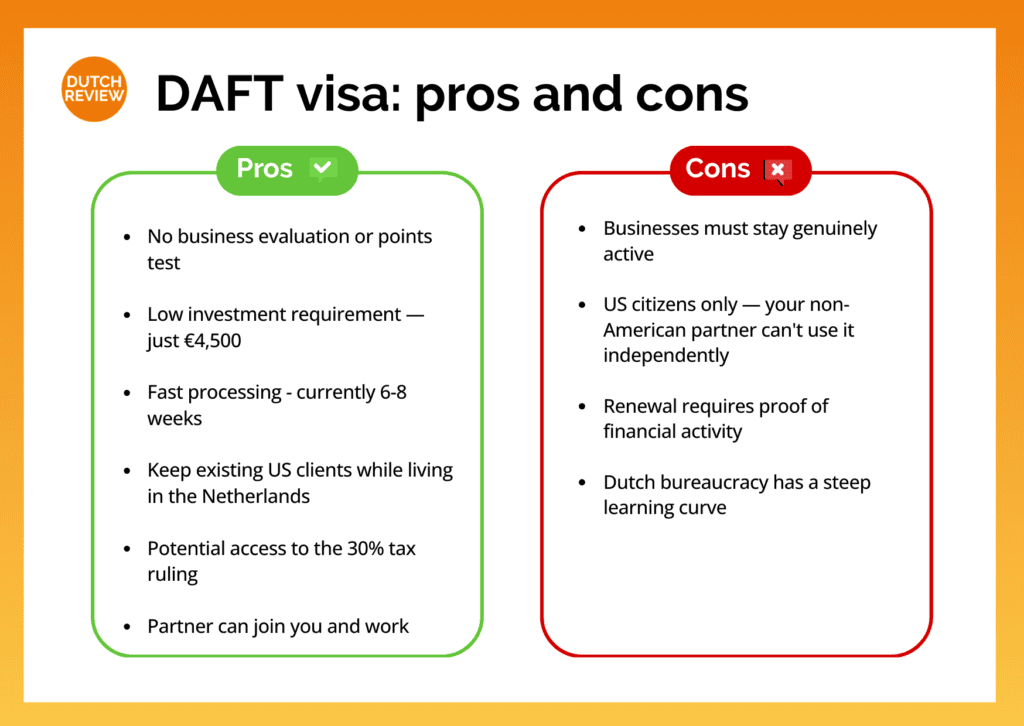
Pros and cons of the DAFT visa
The advantages
No points-based evaluation; you don’t have to prove your business “adds value” to the Dutch economy
Low investment requirement (€4,500) compared to most entrepreneur visas worldwide
Fast processing; currently 6–8 weeks under the expedited pilot
Flexibility on business type and client location
Potential access to the Dutch 30% ruling — one of the most generous expat tax benefits in Europe
Family can join, and your partner can work
The challenges
You must keep the business genuinely active; passive income or shell structures won’t cut it
Dutch bureaucracy takes some getting used to. Apostilles, BECON accountants, BSN numbers — there are a lot of acronyms to learn
Exclusive to US citizens: your non-American partner can’t use DAFT as their own immigration route, though they can apply to join you as a dependent once your permit is approved.
At renewal, you’ll need to show the business has been financially productive
DAFT vs other ways to move to the Netherlands
If you’re not sure whether DAFT is right for you, here’s how it stacks up against the other main options.
Make sure you weigh your options before choosing DAFT! Image: DutchReview
DAFT vs Dutch self-employed visa
The standard Dutch self-employed visa requires you to pass a 90-point evaluation of your business concept. It’s time-consuming, difficult, and routinely rejected. DAFT removes that requirement entirely for Americans.
Personally, I’ve seen multiple friends and family members get rejected on this basis. There’s no contest: DAFT is an easier route.
DAFT vs highly-skilled migrant visa
The highly skilled migrant (HSM) visa is for Americans who have a job offer from a Dutch employer. It’s a strong option if you’re going the employment route, but it requires a sponsor and a salary above a set threshold.
If you’re self-employed or want to run your own business, DAFT is the better fit. If you’ve got a cushy job offer and sponsorship, don’t overcomplicate things, though!
DAFT vs Startup visa
The startup visa is aimed at innovative, scalable businesses. It requires a Dutch “facilitator” (an approved mentor organisation) and only runs for one year.
DAFT is less restrictive, more flexible, and available to a much broader range of business types.
Thinking about making the move? Share your questions or experiences in the comments below.
Frequently asked questions about the DAFT treaty
How much money do you need for the DAFT visa?
You need a minimum of €4,500 deposited in your business bank account to qualify for the DAFT visa. This amount must stay there for the duration of your permit.
Do you need to speak Dutch for DAFT?
You don’t need to speak Dutch to apply for or hold a DAFT permit. The Netherlands is one of the most English-friendly countries in the world, so day-to-day life and running a business in English is very manageable. You will need to pass a Dutch language exam (inburgering) if you later apply for permanent residency or citizenship — but that’s years down the line, and there are plenty of resources to help you pass!
How long does the DAFT application process take?
Under the current IND expedited pilot, you can expect a verdict within six to eight weeks of submitting your application. You’ll receive your residence sticker within a couple of weeks of arriving in the Netherlands, which allows you to live and work immediately while you wait for the final decision.
Can you work as a freelancer under DAFT?
Yes, freelancing is one of the most common uses of the DAFT visa. You can serve clients anywhere in the world, including your existing US clients, as long as you invoice them through your Dutch business.
Can you bring your partner or family?
Your partner and children under 18 can apply for dependent residence permits alongside your DAFT application. Your partner will be able to work in the Netherlands without a separate work permit once the final DAFT verdict comes through. If your partner is not a US citizen, additional steps may apply depending on their nationality.
Homeowners in the Netherlands spend significantly less of their income on housing than renters do, and the gap is widest for people just entering the market, according to the latest report from Statistics Netherlands(CBS).
In 2024, homeowners spent a median of 16.3% of their disposable income on housing, compared with 24.6% for tenants in social housing and 30% for private renters.
All percentages have dipped slightly from 2023, but the gap between homeowners and renters remains wide.
CBS measures this using a ‘housing cost ratio’ (woonquote): total housing costs, such as rent or mortgage payments plus utilities, as a percentage of disposable income (net income plus benefits/allowances).
First-time renters have it worst
The greatest divide is between first-time movers and everyone else.
Households made up entirely of first-time renters in the private market have the highest housing-cost burden of any group measured: 35.1% of disposable income.
That compares with 26.3% for first-time buyers and 27% for first-time renters in social housing.
Marginal differences in occupancy length
Differences tied to how long someone has lived in their home are smaller by comparison.
The highest reading is 31.0% for private renters who’ve lived in their home less than five years; the lowest is 15.2% for homeowners who’ve stayed in their home 20 years or more.
CBS explains that owners typically see mortgage costs remain the same or decline over time, while their income rises, whereas renters are subject to fluctuating rents.
As a renter or homeowner, how have you found navigating the Dutch housing market? Let us know in the comments.
The Dutch tax office guesses the income of people who don’t file a return, and a new report says those guesses run far too high, leaving tens of thousands overcharged.
If you don’t respond to their requests to file a return, the Belastingdienst (Dutch Tax and Customs Administration) estimates your income and sends you a bill based on that estimate. The problem? These bills are often excessively high.
These findings come from the Inspectie belastingen, toeslagen en douane, the watchdog that oversees Dutch taxes, benefits, and customs. They’ve now written to the Minister and State Secretary of Finance, urging the tax office to start collecting the correct amounts.
Some estimated bills were around €9,000 too high
Back in 2022, roughly 79,000 people were handed one of these estimated bills after they didn’t respond in time.
According to the report, roughly 14,000 people went on to file a proper return, and once they did, the Belastingdienst was forced to recalculate their bills. About 90% of them had been overcharged…and their tax bills went down considerably.
In fact, for about 60% of those 14,000, the corrected figure meant they owed nothing at all, or were even due a refund.
For those who were required to pay tax, the report states that the “average tax amount decreased by around €9,000.”
Who tends to get caught out?
The inspectorate stresses that the issue isn’t about dodging tax.
Instead, the core problem lies in situations where people can’t easily manage the process, including those with:
limited capacity or health problems,
little knowledge of how the Dutch tax system works,
difficulty using computers,
limited Dutch language skills,
and trouble gathering the right paperwork.
If any of this sounds like it applies to your situation, the key takeaway is that the tax office won’t fix an estimate for you. It’s on you to prove your real income was lower, and the fight can be more than worth it.
If you let your excessive bill go unchallenged, your government benefits could suffer. Image: Magnific
For example, if your income is estimated too high, you risk losing part of your toeslagen (the Dutch income-related allowances, such as healthcare or rent support).
Reimbursements for legal aid or a supplementary student grant can also shrink.
Here’s what to do if you get an estimated bill
Don’t ignore it, even if the number looks utterly absurd on paper. An unchallenged assessment stands, and that amount can easily become real debt.
Instead, you should:
File your actual tax return: The fastest way to correct an estimate is to submit your real income figures through Mijn Belastingdienst using your DigiD (the Dutch digital ID login).
Object within six weeks: You can formally object to an assessment within six weeks of its date. After that window, you can still ask the tax office to reduce it, but your options may be narrower.
Ask for a payment pause or plan if you can’t pay: If the bill is too high to pay while you fix it, you can apply for a payment arrangement. Just know that interest applies, so it’s a way to buy time, not a free pass.
Get help if the paperwork is the problem. The tax office offers support for people who find filing difficult, and a pilot starting this autumn will reach out to people with tax problems directly to offer help before things go wrong.
Have you ever been hit with a Dutch tax bill that looked way off? Tell us how you sorted it in the comments.
The first thing you probably ask yourself when you decide to take out a Dutch mortgage is this: “Okay, so what can I afford to buy?” In other words, you want to know about your borrowing power.
In this article, we’ll cover important factors to consider when buying and financing a home in the Netherlands.
In the end, what’s most important is that you understand the options and choose what best suits your plans and wishes. Ensuring that your finances don’t keep you up at night and you can sleep with a clear mind in your new home.
In the Netherlands, there are several factors that will determine how much money a mortgage provider will lend you. Many of these factors are dependent on timing.
So, what’s your borrowing power in the Netherlands going to look like in 2026?
We teamed up with the mortgage experts at OHAO to bring you the latest insights into your borrowing power for 2026. With access to 40+ mortgage lenders, they deliver top-quality advice and help you compare mortgage interest rates. And the best part? No hidden fees. OHAO’s advisory fee is among the lowest in the market — transparent, fair, and the same for everyone.
What is borrowing power?
Put simply, your borrowing power is the mortgage amount a mortgage provider will approve.
This is determined based on a number of factors:
Your gross annual income. Yep, that’s right, gross income — so before taxes. While only a certain amount of your income may be landing in your bank account, when calculating your borrowing power, your income before taxes will be considered. Why? Because you can be eligible for a tax benefit on part of the interest paid on the mortgage loan for your residential property.
The duration of the mortgage. This will also affect your borrowing power. In the Netherlands, the standard mortgage duration is 30 years. You can choose a shorter term. However, the shorter the term may lower your borrowing power. This is because your monthly mortgage repayments are higher if you repay faster.
The interest rate. A higher mortgage interest rate, means lower borrowing power. If the interest is higher, less of your calculated budget (income that can be spent on housing) goes towards capital repayment, so you can borrow less.
Good to know: If you have a partner, their income will also be considered. Since 2023, this second income will account for 100% of the calculation (as opposed to 90% in previous years).
Changes for your Dutch borrowing power in 2026
As mentioned before, your borrowing power also depends on timing. Every year the government adjusts the calculation rules, mortgage providers adjust their conditions, interest rates can change, and the housing market evolves. So, what’s different in 2026?
Dutch mortgage interest rates in 2026 are expected to remain stable — but what does this mean for your mortgage? Image: Freepik
Dutch mortgage interest rates are stabilising
Mortgage interest rates in the Netherlands have stabilised after declining throughout 2025, with rates now hovering around their lowest point in recent years.
According to major Dutch banks, rates are expected to remain broadly stable through 2026, with the European Central Bank (ECB) keeping its deposit rate around 2.25%.
What does this mean for your borrowing power in 2026? With interest rates staying low and stable, combined with an expected 4.1% wage increase, most households will be able to borrow more.
If interest rates remain stable and wages increase as expected, many households could see a modest improvement in their borrowing capacity — however, the exact impact will still depend on personal income, expenses, and lender criteria.
A mortgage expert can discuss your Dutch borrowing power with you — so what’s changing in 2026? Image: Freepik
How does this work?
In the Netherlands, your borrowing capacity is influenced by:
The loan-to-value ratio (LTVR) or risk category
The interest fixation period, i.e. the period of time the client chooses to fix the interest rate (we’ll explain these below).
The interest rates of the mortgage provider
The loan-to-value ratio (LTVR) sounds tricky, but it’s actually quite simple.
For example: If a house is worth €350,000 and you want to take out a loan for €350,000, then your LTVR is 100%. This means that your LTVR also falls into the high-risk category. If your mortgage is €315,000, the LTV is 90%, which means the mortgage provider might offer you a lower interest rate.
This means that if you use more of your savings to finance your home, the LTV can decrease. A lower LTV can mean a lower interest rate and lower monthly payments. Lower interest rates can result in a higher borrowing power!
In the end, what’s most important is to balance the following aspects. Let’s order them by priority:
Monthly payments: What monthly payments are you comfortable with?
Input of savings: What amount of your savings can you use for this purchase?
Borrowing power: Within your parameters and the banks’ conditions, what is the best balance?
Sustainable measures remain very important
As we all know, energy in the Netherlands is expensive. How does this interact with the housing market?
Many people are looking for sustainable measures to reduce energy costs and be less dependent on, for example, gas.
The future of Dutch housing is a sustainable one, and that will help improve your borrowing power. Image: Freepik
Not only are sustainable housing options a good move to consider when you already own a home, but also when you’re looking to buy one.
If you wish to make sustainable changes to the home you’re considering buying, this can increase your borrowing power.
As of January 2024, home buyers in the Netherlands could borrow more money to purchase a home and improve its energy label. In 2026, this continues to play an important role in how much you can borrow towards a mortgage.
Just how much extra money you can borrow is determined by where the house’s energy label falls:
The lower the energy rating, the more money you can borrow to implement energy-saving measures in the home.
The higher the energy rating, the more you can borrow to purchase the home.
Energy label
Extra money to implement energy-saving measures
Extra money to purchase the home
E, F and G energy label
€20,000
€0
C or D energy label
€15,000
€5,000
A or B energy label
€10,000
€10,000
A+ or A++
€10,000
€20,000
A+++
€0
€25,000
A++++
€0
€40,000
A++++ with at least a 10-year energy performance guarantee
€0
€50,000
The NHG limit has gone up
As of January 2026, you can take out a mortgage with the National Mortgage Guarantee (NHG) for homes with a purchase price or value of up to €470,000, including renovation costs, or €498,200 if you plan on taking energy-saving measures.
In order to take out a mortgage with the National Mortgage Guarantee, you must pay a one-off contribution. In 2026, this contribution amount remains at 0.4%
For example, if you wanted to take out a mortgage of €450,000 with the NHG in 2026, the one-time costs are €1,800.
Another important change in 2026? From January, this NHG limit applies to all home types.
Singles can still borrow €17,000 more than couples
If you are single and not looking to mingle, you don’t have to give up on your dream of owning a home.
In January 2024, single people in the Netherlands with an income of at least €28,000 became eligible to borrow an extra €16,000 towards buying a home. In 2025, this amount increased to €17,000 and will remain the same in 2026.
By allowing for this extra borrowing power, the Dutch government hopes to give singles a fighting chance in the Dutch housing market.
Whether or not your wages increase is very important in 2026
Good news! According to the National Institute for Budget Information (NIBUD), your wages will increase in 2026 by an expected 4.1%. And an increased wage means increased borrowing power.
What sort of increase can we expect? Well, in 2026, households with an average gross income of €70,000 are able to borrow around €6,000 more compared to 2025.
As NIBUD researcher Marcel Warnaar puts it, “On average, people will be able to get a larger mortgage in the new year.”
However, please note: without a wage increase, your borrowing capacity may actually decrease slightly due to inflation. According to NIBUD, it’s the wage growth that’s driving increased borrowing power, not just the interest rates.
How do interest rates impact your borrowing power?
A mortgage expert will make the whole process a lot less stressful for you, and they can tell you what your borrowing power is for a house in the Netherlands. Image: Freepik
Interest rates are certainly going to impact your borrowing power. And how much do you know about them? For example, do you know the difference between fixed and floating mortgage interest rates?
A floating/variable mortgage interest rate means that the interest rate can change every month throughout the loan period. This change is determined by your mortgage provider and largely based on fluctuations within the market.
A fixed interest rate does what you imagine, the interest rate is fixed throughout the fixed period you choose. Depending on the mortgage provider, that can be any period from one year, to the full duration of 30 years.
Let’s compare the two a bit further.
The pros and cons of floating mortgage interest rates
First up, the pros of a floating mortgage interest rate:
One of the key pros of taking out a mortgage with a floating interest rate is that you have the flexibility to adjust your mortgage.
Your interest contract is renewed every month. As a result, you can adjust your mortgage every month without having to pay a penalty to break a fixed contract.
The mortgage provider can adjust the interest rate every month, and if the provider decides to decrease rates, you benefit from this directly.
However, there are also some cons.
For one, you will experience uncertainty in your monthly payments. The bank can change your floating rate every month, which in turn means your monthly payment can change every month.
Is the interest rate decreasing? Good! You’ll have lower costs. Is the interest rate increasing? Well, your monthly payments will too.
Floating rates are often (slightly) higher than short fixed rates (one to three years).
So, who should choose this option? Floating interest rates are mostly interesting for people who want to regularly check interest rates and are ok with changing monthly payments.
Pros and cons of fixed mortgage interest rates
Now, let’s talk about fixed mortgage interest rate loans. First up, the pros.
One big pro is that you can enjoy certainty in your monthly payments.
During your fixed interest period, you know exactly what your monthly payments will be, no surprises. If the mortgage provider decides to increase their rates, you will not be affected during your fixed period.
After the fixed interest period, your mortgage provider will offer new interest rates. At that time, you can also choose to refinance your mortgage with another mortgage provider with better rates and conditions.
As for the cons, there is less flexibility than with floating rates. You can only change the interest rates after the fixed period. Want to break the contract during the fixed period? This could get you a penalty.
So, who should choose this option? Fixed interest rates are mostly interesting for people who like more security in their monthly payments. You can choose to fix the interest for a period that suits you best.
Feeling overwhelmed? That’s completely understandable. The experts at OHAO have helped thousands of expats navigate the Dutch mortgage process, earning an average rating of 9.9 on Advieskeuze. You can check their reviews and schedule a free, no-obligation call.
What fixed interest should international homebuyers in the Netherlands consider?
First of all, you should determine how long you expect to stay in the Netherlands — especially if you’re considering opting for a fixed interest period.
On average, people stay in their first home for four to seven years. When benefitting from the 30% ruling you might consider living here for the five year duration of the ruling.
Internationals may stand to benefit from lower interest rates. Image: Freepik
Or maybe you’re planning on starting a family in a couple of years and you may want to move to another place or country. Whatever your future plans are, you can tailor your mortgage to these.
For example, the standard fixed interest period is 10 years. However, if you are planning to leave the Netherlands in six years, you might not need the security of a 10 years fixed rate.
In that case, you would pay a higher interest for an extra four years security that you do not end up using.
Moral of the story? You should make sure to gather all the information and advice before you make the final decision.
Are you an international who has bought a home in the Netherlands recently? Tell us about your experience in the comments below!
Whether you’re a freelancer or setting up your Dutch company, the answer depends on your business structure, and getting it wrong could freeze your finances.
Your legal structure, where your existing bank account is held, and your bank’s own terms and conditions all factor in. Here’s what the Dutch government’s official guidelines say.
Personal accounts are sometimes permitted (but not always!)
Whether you’re allowed to use your personal bank account for business transactions depends mainly on the legal structure of your company.
For a sole proprietorship (eenmanszaak) or a general partnership (VOF), Dutch law permits you to use your personal bank account to manage business finances.
However, if you own a BV (private limited company) or NV (public limited company), the rules are much stricter.
According to Dutch law, having a business bank account is mandatory for BVs and NVs. This is primarily because your bank account will be used to deposit share capital, receive payments, and pay taxes and salaries, so your finances need to be clear as crystal.
Mixing your personal and business finances is a headache waiting to happen. Revolut Business gives you a dedicated business account you can open entirely online, with no branch visit required.
Already KVK-registered? Sign up before June 30, 2026, to earn an exclusive €80 bonus and unlock a local Dutch IBAN, multi-currency accounts, and daily interest on your savings. (Terms & conditions apply.)
If you’re a freelancer, there are no legal constraints against using your personal Dutch bank account for business. Image: Magnific
Always check if your existing IBAN qualifies
While you may legally be in the clear, some banks prohibit using a private account for business purposes. If in doubt, always check your bank’s terms and conditions.
In addition to this, where your current account is held matters as much as what type of account it is.
If you live in a Single Euro Payment Area (SEPA) country and have a bank account there, you may be able to use it for your Dutch business. As the Dutch government states, your account “must be suitable for business use and be in the name of the business or entrepreneur.”
However, if your account is held with a bank outside the SEPA zone, you will need to apply for a Dutch IBAN.
Good to know: The Dutch Tax Administration (Belastingdienst) accepts any SEPA IBAN; however, Dutch payroll providers and suppliers may require a local IBAN due to their own systems or policies.
Foreign entrepreneurs can use the Quick Scan ‘Dutch Business Bank Account’
Are you a foreign entrepreneur who isn’t sure if you’re eligible for a Dutch business bank account? There’s an official tool for that.
You can check your validity even before you have a KVK number. Image: Magnific
The Quick Scan Dutch Business Bank Account, run by the Dutch Banking Association (NVB), is designed for foreign entrepreneurs who are still in the process of registering with the KVK and applying for a residence permit.
While the scan won’t open an account for you, it does tell you upfront whether you’re likely to be approved, before you’ve committed time and paperwork to the full application.
The scan is available if you’re setting up with support from the Netherlands Foreign Investment Agency (NFIA), or through a startup facilitator recognised by the Netherlands Enterprise Agency.
Are you managing your company’s finances through a personal account, or did you open a dedicated business bank account from the start? Tell us in the comments.
The air is brisk as I strut down the gravelled pathway in front of the famous Binnenhof. Three vodka sodas in, and my arms are interlinked with my girlfriends’.
There’s a party at one of the (three) clubs in The Hague tonight. The TikTok reel promises the “littest night in Den Haag” — a Dutch guy sporting gelled hair as a helmet, mansplaining at the camera while the videographer pulses back and forth in what I can only describe as convulsion.
As we approach, chugging the last of the Stelz we shoved in our jean pockets, my stomach drops.
Pounding in the damp air are the dembow beats of Daddy Yankee’s ‘Gasolina’ — one of the Dutch frat boy anthems. It’s then and there I know I’m done for.
As the bouncer lets us in, I catch a peek of the DJ in the corner of the room. Curtains of blonde hair, 190cm lanky build, Meller sunglasses on, Heineken in hand: a Dutch DJ.
Despite the Netherlands being the motherland to world-famous artists like Martin Garrix and Tiësto, here’s a public service announcement: just because you’re a Dutch man doesn’t mean you should be a DJ.
And yes, I know — “omg you just don’t like techno.” No schat, I just don’t like my eardrums ringing with tinnitus for a week because Dutch men believe there’s a direct correlation between decibels and the quality of their set.
Hey Siri, press shuffle on Spotify
Which brings me to the music itself. Where does one set end and the other begin?
The Dutch DIY DJ scene is suffering from a bad case of sonic monoculture.
If you asked me to predict what gets played at a Dutch college “rave,” I’d go with the top 100, sprinkle in some early 2000s nostalgia, then slap on a filter of house or reggaeton — DJed, inexplicably, by white Dutch men.
That would be fine if it weren’t the case every single time. You cannot convince me these sets aren’t Spotify playlists, albeit with worse transitions.
Music and DJing are about meticulous curation and care — the latter something Dutch men lack in general, so I guess I can’t really act that surprised.
Introducing Pepijn: your 20-something-year-old Dutch DJ living in De Pijp
But let’s get to the real issue here, because it’s not actually all about the music.
POV: You’re leaning against a sticky bar in a gentrified pub in Amsterdam, waiting for your biertje. As you reach for it, so does a mess of floppy blonde hair.
In comes the Dutchman: Pepijn.
Pepijn thinks you’re cute. He asks where you’re from, gets briefly disappointed when he realises you’re not a Latina, but continues chatting you up because his friends aren’t here yet.
While you twiddle your Hertog Jan — which you bought yourself, might I add — Pepijn whips out his phone.
“Ja, so I’m a DJ,” he boasts, “house x EDM x techno x acid type of thing — did you maybe come to my King’s Day set?”
Pepijn is wearing sunglasses indoors. He shows you his SoundCloud and TikTok. There’s this implicit expectation that you’ll be impressed.
You muster a “leuk!”
The TikTok DJ
Here’s the thing: being a DJ has become shorthand for a certain kind of cool. The headphones half-on, half-off. The performative nonchalance. The girls with phones in the air.
Social media has packaged this aura so effectively that the goal has slyly shifted from wanting to make people dance to simply looking like someone who makes people dance.
And look, I get the appeal. But this is where Dutch directness curdles into something less sexy.
That famous self-assurance — the cultural allergy to hierarchy, the refusal to be intimidated by anyone or anything — means that a Dutch man who has spent four hours in GarageBand will back himself with the same confidence as Martin Garrix.
There’s no performance anxiety or “I’m just starting out.” It’s just Pepijn, sunglasses on, TikTok open, waiting for your reaction.
The unfortunate export paradox
But ultimately, I do feel for the Dutch men.
Because some of the world’s most impressive DJs come from the Netherlands, the bar is set extraordinarily high. Which means Pepijn’s TikTok set doesn’t exist in a vacuum, but in a direct, icky contrast to Martin Garrix.
See, if I encountered these sets coming out of North Korea, I might be impressed.
But double standards make the world go round, and the Netherlands has spent decades building its reputation as an electronic music giant — a reputation it’s now everyone’s problem to live up to.
So to Pepijn, and to all the Dutch men currently filming their next TikTok: the bar is not on the floor. It is, in fact, quite high.
Misschien, just because you’re a Dutch man doesn’t mean you should be a DJ.
Do you agree? Tell us your thoughts in the comments.
Fasten your seatbelts: the EU has finally updated its air passenger rights rules. The deal means airlines must show the true cost of a ticket upfront, can’t add additional charges for carry-on luggage, and owe you more if your flight is delayed.
It took 13 years of negotiations — longer than most Ryanair delays, to be fair — but the EU has finally updated rules that hadn’t changed since 2004.
On Monday, the European Parliament announced that they promise increased transparency, consumer protection, and emphasis on the duty of care.
The new deal secures the right to carry a personal item on board without an additional fee, while also increasing transparency by requiring that carry-on luggage be included in the advertised flight price to improve comparability.
This means that once you buy that plane ticket, you shouldn’t have to pay extra just to bring your belongings with you.
So, what luggage will be included in the ticket price?
A personal item: Measuring up to 40 by 30 by 15 cm — your typical “Ryanair bag.”
Carry-on luggage: a small wheeled suitcase with a maximum weight of 7 kg.
However, passengers may choose to opt out of travelling with hand luggage. This would then reduce the cost of their ticket.
Up to €600 for delayed or cancelled flights
But that’s not the only good news for travellers.
Under the new agreement, compensation for delays of over three hours or cancelled flights depends on the flight distance, starting at €250 for journeys up to 1,500 km and rising to €600 for journeys longer than 3,500 km.
Most low-cost carriers in the EU, such as Ryanair and Easyjet — notorious for delays and hidden fees — have an average route length of 1,233km.
There’s a catch, though: airlines can still dodge compensation if they blame the delay on something outside of their control. Think weather, air traffic issues, or that one passenger who always makes things weird.
The list isn’t exhaustive either, so expect creative excuses.
Free name corrections and printed boarding passes
Does that ‘ or accent in your name constantly lead to misspellings? Passengers also gain the right to request corrections to name spelling errors and to obtain a printed boarding pass after check-in, both free of charge.
Currently, budget carrier Ryanair charges for name changes starting at €115 online.
The deal still needs formal approval from both Parliament and Council, with ratification scheduled for Tuesday, reports NOS.
What do you think of these changes? Let us know in the comments.